Ratherius – The Combative Bishop

Series: On This Day in Church History

April 25, 975 – By R.J. Morgan

 No generation is without its Christian heroes, but they were scarce in the tenth century. Ratherius might have been one but for his headstrong style. He was brilliant and religious, but opinionated and envious.

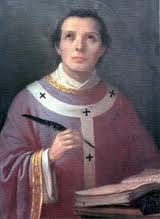
Ratherius was born near Verona, Italy. He excelled in school and eventually became a monk. In 931 he was consecrated Bishop of Verona. His tenure was turbulent, for he railed against the sins of the clergy. “The cohabitation of clergy with women,” he wrote, “is so customary, so public, that they think it lawful.” It wasn’t just immoral relationships that Ratherius had in mind, but wedded ones. He was merciless on priests who married, calling their unions “adulteries.”

The concept of a celibate clergy reaches early into church history. In the Eastern Church, the early councils approved marriage for clergymen. But the Western Church wasn’t so sure. At the Council of Nicaea, an idea arose for ministers to leave their wives and devote themselves to the single life. The scheme was rejected, but a few years later Pope Siricius ordered celibacy for priests. Later, Pope Leo decreed that if a married man entered the ministry, he was not to “put away” his wife, but to live with her “as brother and sister.”

The issue was being vigorously debated during the days of Ratherius, and the Bishop of Verona knew what he believed—that the single life allows full devotion to Christ. But his aggressive stance on that and other issues provoked backlash. He was deposed and imprisoned for two years, during which time, being without books, he wrote one entitled The Combat. He escaped to Southern France and supported himself by tutoring rich children. Being restored to his bishopric, he was soon deposed again. This time he became abbot of Alna, but he argued with his monks about the Eucharist. They sighed with relief when he returned a third time to Verona. Once again he was exiled, returning to the abbotship of Alna. He stayed there awhile then moved to other positions here and there before dying on April 25, 974.

Love each other as brothers and sisters and honor others more than you do yourself. Never give up. Eagerly follow the Holy Spirit and serve the Lord. Let your hope make you glad. Be patient in time of trouble and never stop praying. And do your best to live at peace with everyone. Romans 12:10-12,18

Adapted from the April 25 entry Robert J. Morgan. On This Day. Nashville: Thomas Nelson, 1997.

A Tribute To Charles Hodge – One of The Greatest Theologians America Has Ever Produced

Series: On This Day in Christian History – April 24

 “A Gifted Mind and Still Greater Heart”

By Mike and Sharon Rusten

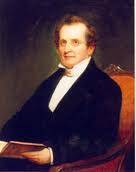
(Princeton University Library – Pictured on left)

Charles Hodge was born in Philadelphia on December 27, 1797, and raised by his mother because his father died six months after Charles’s birth. A gifted student, Charles entered the College of New Jersey, later Princeton University, in 1812 at the age of fourteen. As a senior he publicly confessed his faith in Christ during a campus revival, where over half of the student body gave their allegiance to Jesus. After entering Princeton Seminary in 1816, he excelled in his studies and graduated at age twenty-two. A year later he became professor of biblical languages at the school and the seminary’s third professor.

Hodge taught at Princeton Seminary for over fifty years and became America’s leading Reformed theologian of the nineteenth century. His three-volume Systematic Theology remains in print today.

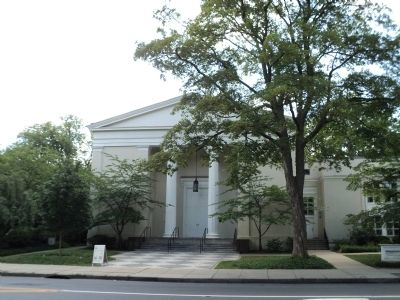
On April 24, 1872, a unique celebration took place in Princeton to honor Charles Hodge for his fifty years of teaching. On that day all the shops in town closed, and people from near and far gathered in the First Presbyterian Church to honor the town’s most distinguished citizen. Present were Charles’ wife, Mary, their eight children, and a large number of grandchildren. Also in attendance were four hundred graduates of the seminary, almost 15 percent of the total alumni of the school. There were presidents and faculty representatives from many other colleges and seminaries as well as officials from virtually every denomination. (1st Presbyterian of Princeton pictured at left – it was built in 1836 and still stands today)

That day Henry Boardman spoke on behalf of the seminary trustees. He pointed out that celebrations for national heroes were not uncommon, but here was “the spontaneous homage paid to a simple teacher of God’s Word and defender of its truth.” Then addressing Dr. Hodge he said:

What honor, beloved Brother, has God put upon you! For fifty years you have been training men to preach the glorious gospel of grace of God to their fellow-sinners. The teacher of teachers, your pupils have become professors in numerous Colleges and Seminaries at home and abroad. Not to speak of one or two thousand pastors, who are exerting an ameliorating influence upon this nation more potent than that of an equal number of men belonging to any other calling, you are helping, through your students, to educate a great body of Christian ministers, not a few of whom are to be employed in laying the foundations of Christianity on pagan lands.

At that time Charles Hodge had personally taught twenty-seven hundred students—no other seminary in the country had even enrolled that many. In his address Boardman pointed out that there were men scattered around the world who honored Hodge for the gifted mind God had given him and who “love him for his still greater heart.”

During the program the seventy-five-year-old Hodge sat on a sofa off to the side of the platform, out of sight of the audience. Almost overcome by emotion after fifteen men had spoken their words of tribute, he came to the lectern to respond: “When I say thank you for all your respect, confidence and love, I am nothing, I am powerless. I can only bow down before you with tearful gratitude, and call on God to bless you, and to reward you a hundred-fold for all your goodness.”

(pictured at left is the altar at the Princeton University Chapel)

That night before retiring, the tired but grateful Hodge summed up the day by writing in his journal: “April 24th. The apex of my life…altogether affording an imposing and most affecting testimony of the unity of faith, and of common love to the same gospel, and to our common God and Savior Jesus Christ.”

Reflection:

Most of us are not gifted teachers like Charles Hodge, but God intends for us to impact the lives of those around us. God placed thousands of students in Hodge’s life. He may place one or two people in your life to disciple. It isn’t the number that matters; it is the faithfulness with which you invest yourself.

“We are telling you about what we ourselves have actually seen and heard, so that you may have fellowship with us. And our fellowship is with the Father and with his Son, Jesus Christ.” – 1 John 1:3

More on Charles Hodge

Charles Hodge [1797-1898], was an American Presbyterian theologian, was ordained in 1821, and taught at Princeton for almost his whole life. In 1825 he founded the Biblical Repository and Princeton Review, and during forty years was its editor, and the principal contributor to its pages. He received the degree of D.D. from Rutgers College in 1834, and that of LL.D. from Washington College, Pennsylvania, in 1864. In 1840 Dr. Hodge was transferred to the chair of didactic theology, retaining still, however, the department of New Testament exegesis, the duties of which he continued to discharge until his death.

“His most important works are his commentaries on Romans (1835), Ephesians (1856), 1 Corinthians (1857), 2 Corinthians (1859), as well as Constitutional History of the Presbyterian Church in the United States (2 vols., 1839-40), Systematic Theology (3 vols., 1871-3), and What is Darwinism? (1874). He was an outstanding defender of Calvinism, and has a claim to be considered one of the best theologians and Bible commentators America has produced.” Charles Hodge was the father of the influential theologian A.A. Hodge.

The Author’s: Mike and Sharon Rusten are not only marriage and business partners; they also share a love for history. Mike studied at Princeton (B.A.), the University of Minnesota (M.A.), Westminster Theological Seminary (M.Div.), Trinity Evangelical Divinity School (Th.M.), and New York University (Ph.D.). Sharon studied at Beaver College, Lake Forest College, and the University of Minnesota (B.A.), and together with Mike has attended the American Institute of Holy Land Studies (now Jerusalem University College). The Rustens have two grown children and live in Minnetonka, Minnesota. This article was adapted from the April 24th entry in their fantastic book The One Year Book of Christian History, Carol Stream, IL: Tyndale, 2003.

The 10 Commandments of Human Relations By Robert G. Lee

(1) Speak to people. There is nothing as nice as a cheerful word of greeting.

(2) Smile at people. It takes seventy-two muscles to frown, only fourteen to smile.

(3) Call people by name. The sweetest music to anyone’s ears is the sound of his or her name.

(4) Be friendly and helpful. If you would have friends, be friendly.

(5) Be cordial. Speak and act as if everything you do is a genuine pleasure.

(6) Be genuinely interested in people. You can like almost anybody if you try.

(7) Be generous with praise—cautious with criticism.

(8) Be considerate with the feelings of others. There are usually three sides to a controversy; yours, the other fellow’s and the right one.

(9) Be alert to give service. What counts most in life is what we do for others.

(10) Add to this a good sense of humor, a big dose of patience and a dash of humility, and you will be rewarded many-fold.


About the Author: Robert G. Lee, (1886-1978), Southern Baptist minister and leader, was born in Post Mill, South Carolina, the son of a devout Baptist sharecropper and his wife.  Despite the family’s poverty Lee was able to attend Furman Prep School and after spending time working on the Panama Canal to earn enough money, attended Furman College, where he graduated with a B.A. degree in 1913.  Believing he was called to preach, he refused an offer to take a position teaching Latin at Furman and accepted a position at a small church in Saluda, SC.  Lee quickly gained a reputation for his pulpiteering and moved on in a progression of successively larger churches until accepting the pastorate of Bellevue Baptist Church in Memphis, TN in 1927.  He spent the next 33 years at Bellevue, during which Sunday morning attendance grew from a more-than-respectable 2,000 to nearly 10,000 per week.  During his time at the church Lee earned a national reputation as a master preacher, publishing over fifty volumes of his sermons and delivering his most famous sermon, “Payday, Someday”, nearly 1,300 times to audiences around the world.  Lee served five years as the president of the Tennessee Baptist Convention and three years (1948-1950) as president of the Southern Baptist Convention.  Although a Southern Baptist loyalist, Lee was well-respected both within post-war evangelical networks and the separatist ranks of the fundamentalist movement.

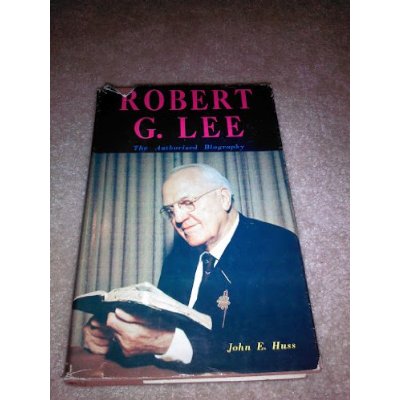
For further reading, see John E. Huss, Robert G. Lee: The Authorized Biography (Zondervan, 1967).

The Connection Between Words and Character in the Book of Proverbs By Gordon Cheng

The Connection Between Words and Character in the Book of Proverbs

Chart Adapted From *Gordon Cheng

WORDS USED FOR HARM, SPOKEN BY

PEOPLE WITH FOOLISH CHARACTER

WORDS USED FOR GOOD, SPOKEN BY

PEOPLE OF GOOD CHARACTER

Adulterers use words as traps for fools

(Proverbs 7:10-21)

“The teaching of the wise is a fountain of life” (Proverbs 13:14)

“When words are many, transgression is not lacking” (Proverbs10:19)

“The heart of the righteous ponders how to answer” (Proverbs 15:28)

“The words of the wicked lie in wait for blood” (Proverbs 12:6)

“…the mouth of the upright delivers them” (Proverbs 12:6)

“There is one whose rash words are like sword thrusts” (Proverbs 12:18)

“…the tongue of the wise brings healing” (Proverbs 12:18)

“The words of a whisperer are like delicious morsels; they go down into the inner parts of the body” (Proverbs 18:8)

“Gracious words are like a honeycomb, sweetness to the soul and health to the body” (Proverbs 16:24)

“Do you see a man who is hasty in his words? There is more hope for a fool than for him” (Proverbs 29:20)

“Whoever restrains his words has knowledge.” (Proverbs 17:10-27)

 Chart Adapted from the fantastic book by Gordon Cheng. Encouragement: How Words Change Lives. Kingsford, Australia: Matthias Media, 2006, 19-20.

About *Gordon Cheng: He is the author of the popular course, Six Steps to Encouragement. He is married to Fiona and has three daughters. He has studied in psychology and theology, and worked with university students and as a minister to several parishes in Melbourne and Sydney, Australia. He is interested in choral and pian music, writing letters to newspapers, and reading church history.

Did Jesus Rise From the Grave on April 23rd in A.D. 33?

Series: On This Day in Christian History – April 23rd

 “The Most Important Day to Christianity” By A. Kenneth Curtis & Daniel Graves

Many scholars believe that Christ died and rose from the dead again in A.D. 30. Others prefer a date in AD 33, although champions of several other dates can be found. If the events recorded in the Gospels took place in AD 33, then this day in the year 33 is the probable date for Christ’s resurrection.

The witness of the Christian Church and of convinced believers across the centuries has affirmed that without the Resurrection, there could be no Christianity. The cross of Christ makes no sense without His triumphant restoration to life, for it is the Resurrection that explains His death as a sacrifice for sins. It is the Resurrection that proves Christ was no liar. It is the Resurrection that gives us hope of a new, eternal life, showing to us that as Christ rose, so will we.

The Resurrection is the one fact that the apostles and early Church constantly held forth as the vindication of their message. It is the oldest traceable doctrine of the early Christian liturgy. Even notable anti-Christian scholars admit that the early church held the Resurrection as fact, however much those same scholars hope to show that the Church was mistaken in its belief.

The records we have tell us that Christ was buried, His tomb sealed and soldiers posted around it. At about dawn of the first day of the new week (Sunday), there was an earthquake because an angel came down from heaven and rolled back the stone. The guards were so frightened that they fell senseless to the ground. At that time, some of Christ’s female followers were on their way to the tomb to anoint His body. They were no doubt wondering how they would roll way the stone. Imagine their surprise when they found it rolled back and Christ’s body gone! Thinking that His body had been removed, they began weeping. One of them asked a gardener if he knew where the body had been taken. Then she recognized the “gardener” as Jesus himself.

The women rushed back to tell the disciples what they had witnessed. Peter and John raced to the tomb and found that all was as the women had said. An angel assured the men that Christ was indeed risen (see Matthew 28:1-20; Mark 16:1-20; Luke 24:1-49; John 20:1-30). Afterward, Jesus appeared several times to His disciples and to His brother James.

All arguments against the Resurrection must deal with the eyewitness testimony of the early disciples, the great Church that sprang from it, the witness of changed lives around the world and the empty tomb. Modern dimensional mathematics suggests the plausibility of Christ’s appearances, and modern physics demonstrates the necessity of additional dimensions, bringing the account into the sphere of scientific plausibility.

The Church has historically insisted that our Christian life would be impossible without the Resurrection, for through it Christ has removed the sting of death from all those who believe in Him.

“When the perishable puts on the imperishable, and the mortal puts on immortality, then shall come to pass the saying that is written: ‘Death is swallowed up in victory.’ ‘O death, where is your sting?’ The sting of death is sin, and the power of sin is the law. But thanks be to God, who gives us the victory through our Lord Jesus Christ. Therefore, my beloved brothers, be steadfast, immovable, always abounding in the work of the Lord, knowing that in the Lord your labor is not in vain” (1 Corinthians 15:54-58).

 *Other Significant Events on April 23rd in Church History:

1616: William Shakespeare died. The great poet-playwright quoted from or alluded to the Bible hundreds of times in his plays and other works.

1849: The young Fyodor Dostoevsky was arrested and accused of plotting to overthrow the Russian government. After a terrifying appearance at a fake execution, he was exiled to Siberia, where he took comfort in the Bible. Later he wove Christian themes into his novels.

1950: Lutheran Bishop Otto Dibelius of Germany issued a protest against teaching materialism as a substitute for religion in state-sponsored youth movements.

1959: The communists of Poland confiscated Church properties. The congregations were required to lease the properties back for their use.

1960: Japanese Christian Socialist Toyohiko Kagawa died on this day. Kagawa sought to literally apply God’s words by embracing the lowest orders and slum populace.

1982: Cameron Townsend, founder of Wycliffe Bible Translators, died. Wycliffe Bible Translators is one of the world’s largest missions organizations.

*Adapted from Did Jesus Rise From the Grave on April 23rd in A.D. 33?, in the book This Day In Christian History edited by A Kenneth Curtis and Daniel Graves, Camp Hill, PA: Christian Publications.

Daniel The Prophet of God – World History in Advance – April 23, 536 B.C.

Series: On This Day in Christian History – April 23 – By Mike and Sharon Rusten*

 “God sometimes tells us ahead of time what is going to happen”

In 536 B.C. Daniel was a very old man living in Persia. He had been deported from Jerusalem sixty-nine years earlier with the first group of captives and taken to Babylon. In Babylon Daniel rose to the top in government service, serving under Nebuchadnezzar, Darius the Mede, and perhaps also Cyrus the king of Persia. Under Nebuchadnezzar Daniel became the governor of the province of Babylon. Belshazzar, son of Nebuchadnezzar, appointed him to be third ruler in his kingdom, and Darius made him one of three presidents to whom his 120 satraps reported.

Three years earlier, after a time of prayer and mourning over the sins of his people, Daniel had received a vision from the angel Gabriel who gave him a message that included the timing of the future events in the history of God’s people (Daniel 9:20-27).

Now once again Daniel was in prayer and mourning. In particular he prayed for greater understanding of the visions he had already received. For three weeks as he prayed, he ate no rich food or meat and drank no wine. Then suddenly on April 23, 536 B.C., as the old man was standing beside the Tigris River, he looked up and saw a vision of “a man dressed in linen clothing, with a belt of pure gold around his waist. His body looked like a dazzling gem. From his face came flashes like lightning, and his eyes were like flaming torches. His arms and feet shone like polished bronze, and his voice was like the roaring of a vast multitude of people” (10:4-6).

Daniel was the only person who saw this vision. The men who were with him saw nothing but became so terrified that they ran away to hide. So Daniel was left all alone to watch the awesome vision. He began feeling very weak, and when the man began to speak, Daniel fainted, falling facedown on the ground. Then the man’s hand touched Daniel and lifted him, still trembling, to his hands and knees. The man said, “O Daniel, greatly loved of God, listen carefully to what I have to say. Stand up, for I have been sent to you” (10:11). When he said this, Daniel stood up, still trembling in fear.

Then the man said, “Do not be afraid, Daniel. Since the first day you began to pray for understanding and to humble yourself before your God, your request has been heard in heaven. I have come to answer to your prayer. But for twenty-one days the spirit prince of the kingdom of Persia blocked my way. Then Michael, one of the archangels, came to help me, and I left him there with the spirit prince of the kingdom of Persia. Now I am here to explain what will happen to your people in the future, for the vision concerns a time yet to come” (10:12-14).

Daniel was then given a summary of the future kings of the Persian Empire (11:2) and told of the appearance of Alexander the Great (11:3) and the division of Alexander’s kingdom into four lesser kingdoms (11:4). Daniel is next told of the continuing struggle between Syria (the king of the north) and Egypt (the king of the south) from 323 B.C. to 167 B.C. when Antiochus IV Epiphanes, the Syrian ruler, erected an altar to Zeus on top of the brazen altar in the temple in Jerusalem and there offered a pig as a sacrifice (11:5-32). This is followed by a description of the Maccabean revolt in which the Jews were able to win independence from Syria (11:35).

The vision then fast forwards to the future Antichrist, a person similar to Antiochus Epiphanes in many ways, and describes the battles of the end times (11:36-12:13).

The message to Daniel and the book itself ended with the words “You will rest, and then at the end of the days, you will rise again to receive the inheritance set aside for you” (12:13).

 For Reflection:

When God describes the future, what does that tell you about Him? God is not only the author of the Bible but also the author of history—past, present, and future.

“God rules the kingdoms of the world and appoints anyone he desires to rule over them.” – Daniel 5:21

Author’s of the Article Above: Mike and Sharon Rusten are not only marriage and business partners; they also share a love for history. Mike studied at Princeton (B.A.), the University of Minnesota (M.A.), Westminster Theological Seminary (M.Div.), Trinity Evangelical Divinity School (Th.M.), and New York University (Ph.D.). Sharon studied at Beaver College, Lake Forest College, and the University of Minnesota (B.A.), and together with Mike has attended the American Institute of Holy Land Studies (now Jerusalem University College). The Rustens have two grown children and live in Minnetonka, Minnesota. This article was adapted from the April 23rd entry in their wonderful book The One Year Book of Christian History, Carol Stream, IL: Tyndale, 2003.

14 Things To Pray For – By Dr. David P. Craig

(1) Pray for the glory of the LORD and that His glory may fill our land:

“Ascribe to the LORD, O clans of the peoples, ascribe to the LORD glory and strength! Ascribe to the LORD the glory due His name; bring an offering and come before Him! Ascribe to the LORD the glory due his name and worship the LORD in the splendor of holiness…Surely His salvation is near those who fear Him, that glory may dwell in our land”  (1 Chronicles 16:28-29; Psalm 29:2; 85:9).

(2) Pray that God’s name would be made Holy:

“Our Father in heaven, hallowed be your name” (Matthew 6:9).

(3) Pray that God’s kingdom will come:

“Your kingdom come” (Matthew 6:10a).

(4) Pray that God’s people would do God’s will on earth:

“Your will be done, on earth as it is in heaven” (Matthew 6:10b).

(5) Pray for God to meet your daily provision:

“Give us this day our daily bread” (Matthew 6:11).

(6) Pray that God will forgive you of your sins:

“And forgive us our debts, as we also have forgiven our debtors…if we confess our sins He is faithful and just to forgive us of our sins and to cleanse us from all unrighteousness” (Matthew 6:12 & 1 John 1:9).

(7) Pray that God will deliver you from doing evil:

“And lead us not into temptation but deliver us from evil” (Matthew 6:13).

(8) Pray that God would open doors and empower believers to declare the gospel:

“At the same time, pray also for us, that God may open to us a door for the word, to declare the mystery of Christ…that I may make it clear, which is how I ought to speak…and also for me, that words may be given to me in opening my mouth boldly to proclaim the mystery of the gospel…that I may declare it boldly, as I ought” (Colossians 4:3-4 & Ephesians 6:19, 20b).

(9) Pray that all kinds of people (from rulers to servants) will be saved:

“First of all, then, I urge that supplications, prayers, intercessions, and thanksgivings be made for all people, for kings and all who are in high positions, that we may lead a peaceful and quiet life, godly and dignified in every way. This is good, and it is pleasing in the sight of God our Savior, who desires all people to be saved and to come to the knowledge of the truth” (1 Timothy 2:1-4).

(10) Pray for your enemies:

“But I [Jesus] say to you, Love your enemies and pray for those who persecute you” (Matthew 5:44; see Stephen’s example in Acts 7:59-60; and Jesus’ example in Luke 23:34).

(11) Pray for sick believers to be healed:

“He heals the brokenhearted and binds up their wounds…Is anyone among you sick? Let him call for the elders of the church, and let him pray over him, anointing him with oil in the name of the Lord. And the prayer of faith will save the one who is sick, and the Lord will raise him up. And if he has committed sins, he will be forgiven” (Psalm 147:3; James 5:14-15).

(12) Pray for one another’s sins:

“Therefore, confess your sins to one another and pray for one another, that you may be healed. The prayer of a righteous person has great power as it is working” (James 5:16).

(13) Pray for Israel:

“Pray for the peace of Jerusalem! May they be secure who love you!” (Psalm 122:6)

(14) Pray for justice and deliverance for Christian martyrs:

“They cried out with a loud voice, “O Sovereign Lord, holy and true, how long before you will judge and avenge our blood on those who dwell on the land?” (Revelation 6:10)

John Calvin: He Went Where He Didn’t Want To Go – April 22, 1538

Series: On This Day in Christian History – April 22 – By Mike and Sharon Rusten*

In 1536 John Calvin no longer felt safe in his native France, so he left for Strasbourg, a free city situated between France and Germany that had declared itself Protestant. On his way there he stopped for the night in Geneva, Switzerland. Just two months earlier Geneva had given its allegiance to Protestantism as a result of the labors of William Farel, who had been ministering there for three years. That evening Farel met with Calvin and immediately asked him to join in leading the church in Geneva. Calvin declined, saying he wanted to go to Strasbourg to study and write. Farel thundered at him that unless Calvin joined him in Geneva, God would bring down curses upon him. Somewhat intimidated by Farel’s pronouncement, twenty-eight-year-old Calvin agreed to stay, even though his preference was to go to Strasbourg.

Calvin’s initial stay in Geneva, however, was short. In January 1537 Geneva’s Council of Two Hundred zealously enacted a series of ordinances prohibiting immoral behavior, gambling, foolish songs, and desecration of Sunday with no thought as to how they would be enforced. In July the council ordered all citizens to assent to a confession of faith. In November the council ordered banishment for anyone who refused to swear to the confession. This was more than the man on the street could stomach, and in the city council election three days later, a majority of anticlerical councilmen were elected.

The Council of Two Hundred met the following day, April 22, 1538, to decide their fate. The meeting stretched into a second day, at which time the order was given to Calvin and Farel to leave Geneva within three days. Farel went to Neuchatel, and Calvin returned to his original plan and went to Strasbourg.

In Strasbourg Calvin became pastor of the Church of the Strangers, a French refugee church. There he met and married Idelette deBure, the widow of an Anabaptist. Calvin was content in Strasbourg and probably would have spent the rest of his life there had it not been for the Roman Catholic cardinal’s efforts to bring Geneva back into the fold of the Catholic Church. In 1539 the cardinal write to the Genevans, inviting them to return to the pope. No one in Geneva felt qualified to answer the letter, so it was sent to Calvin to respond, which he did very effectively.

Meanwhile Geneva was not doing well in his absence. A new election had placed the city government back in the hands of friends who feared that the only way to save the city from anarchy was to bring Calvin back. As a result, in October 1540 the Council of Two Hundred voted to invite him back to Geneva.

Once again Calvin’s personal desire was not to go to Geneva. He wrote to a friend, “There is no place in the world which I fear more; not because I hat it; but because I feel unequal to the difficulties which await me there.” And once again it was through the counsel and persuasion of Farel, who himself was not invited back, that Calvin was convinced to return.

He returned to Geneva in September 1541 and ministered there the rest of his life, making Geneva the center for the Reformed faith.”

  For Reflection:

John Calvin spent most of his life in a place where he would rather not have been. Yet he was convinced that God wanted him in Geneva, so that is where he ministered. Do you put geographical limitations on where you will serve God? We will always be happiest where we are in the center of God’s will, regardless of where that may be.

“With my authority, take this message of repentance to all the nations, beginning in Jerusalem.” – Luke 24:47

Author’s of the Article Above: Mike and Sharon Rusten are not only marriage and business partners; they also share a love for history. Mike studied at Princeton (B.A.), the University of Minnesota (M.A.), Westminster Theological Seminary (M.Div.), Trinity Evangelical Divinity School (Th.M.), and New York University (Ph.D.). Sharon studied at Beaver College, Lake Forest College, and the University of Minnesota (B.A.), and together with Mike has attended the American Institute of Holy Land Studies (now Jerusalem University College). The Rustens have two grown children and live in Minnetonka, Minnesota. This article was adapted from the April 22nd entry in their wonderful book The One Year Book of Christian History, Carol Stream, IL: Tyndale, 2003.

 *Other Significant Events on April 22nd in Church History:

 536: Pope St. Agapetus died in the eastern empire, where he had gone in a vain attempt to prevent General Belisarius from coming to Italy. He failed at that but succeeded in moving Justinian away from the Monphysite heresy. After his death, his body was brought back to Rome.

1538: John Calvin and William Farel (see above) were fired by the town council of Geneva and ordered to leave the city within three days. The day before they had refused to administer the Lord’s Supper unless the townsfolk repented.

1723: J.S. Bach was elected cantor of St. Thomas in Leipzig. This was the last post that he held before his death. Bach had a rule never to convert Christian works to secular use, although he often converted secular works to Christian use.

1987: Dr. J. Edwin Orr died on this day. He was a historian of revivals and showed that no revival ever began without prayer.

*Adapted from This Day In Christian History, edited by A Kenneth Curtis and Daniel Graves, Camp Hill, PA: Christian Publications.

St. Anselm on Proving That Which Is Said Cannot Be Proven

Series: On This Day in Christian History – April 21st, 1109

 By A. Kenneth Curtis, Daniel Graves, and Robert J. Morgan

“God’s eternal power and character cannot be seen. But from the beginning of creation, God has shown what these are like by all he has made” (Rom. 1:20). Many miss the majesty of God’s creation, but one boy on the Swiss-Italian border got the message.

Anselm grew up on the breathtaking St. Bernard. His mother frequently reminded him of the Creator, and Anselm imagined God living among the Alps. In his mid-teens Anselm, quarreling with his father, entered a French monastery where he expanded his knowledge of God through study of Scripture. His keen mind and mature faith led to repeated calls from England, and eventually Anselm crossed the channel to become the archbishop of Canterbury.

Anselm won a name as a reformer because he attempted to end abuses such as the slave trade. He urged the holding of regular synods and, while h was archbishop, enforced clerical celibacy within his see. Through his learning and methodology, he became one of the creators of scholasticism. But his most notable gift to history has become known as the ontological proof for the existence of God.

Can the existence of God be proven? Anselm thought so. Modern philosophers and theologians disagree. However, it is Anselm’s argument, the ontological proof, which remains the slipperiest for modern logic to deal with and is though to be impossible to refute.

Anselm’s argument went something like this: When we discuss the existence of God, we define Him as a perfect being, greater than anything else that can be conceived. If God does not exist, then the name “God” refers to an imaginary being. This makes the definition of “God” contradictory, for to be real, to be living, to have power is greater than to be imaginary. It is clear that the word God cannot be discussed as defined if He does not exist, because He must be conceived as really existing in order for Him to be greater than anything else, for a God who does not exist is not greater than anything else.

In short, no philosopher can legitimately argue that God does not exist if he defines “God” as a perfect being that is greater than any that can be imagined; for to be perfect, God must have real existence. Those who acknowledge that He exists do not have a problem with self-contradiction when they affirm His existence, whereas those who deny His existence do. Since we can indeed raise the question of God’s existence and argue the point, then God must exist.

His life and teaching breathed of Christ. Belief in God, Anselm felt, was rational and logical, not a blind leap of mindless faith. The beauty of creation evidenced God’s existence; and furthermore, the very fact that our minds could imagine and infinite, loving God gave evidence that he existed. Anselm’s famous argument for God’s existence said that if God could exist in our minds, he could exist in reality.

But Anselm’s deepest writings were on the atonement, which he defined as Christ’s blood being a “satisfaction” made to God by the Lord Jesus. Love of Christ’s atonement brought Anselm comfort when he found himself in the crossfire between the pope and English king. The redheaded King William (Rufus the red) was profane and violent. He reputedly arose a worse man every morning, and went to bed a worse man every night. He enjoyed seeing animals and men tortured, while Anselm would go out of his way to save a hare.

As archbishop of Canterbury, the zealous Anselm continually struggled with King William for church rights. As a result of the struggle he was exiled. As a theologian, Anselm was most remembered for his book Why did God Become Man? In it he argued that each of us has run up such a debt of sin that there is no way we can repay God. Christ, as infinite God, has merit enough and plenty to spare for our debts. Anselm argued that we must first believe in order to understand. In modern terms we might say that truth only begins to come clear when one is committed to it: You cannot see around a bend in a trail unless you walk toward it.

I look to the hills! Where will I find my help?

It will come from the LORD,

Who created the heavens and the earth.

The LORD is your protector,

And he won’t go to sleep or let you stumble.

The protector of Israel doesn’t doze or ever get drowsy. – Psalm 121:1-4

On this day April 21, 1109 Anselm died surrounded by friends who placed his body in ashes on the floor. He was probably canonized in 1494, although there is debate as o whether this occurred at all. Anselm will be long remembered for his ontological proof for the existence of God, and his defense of the atonement and deity of Christ.

*Other Significant Events on April 21st in Church History:

1073: Pope Alexander II died. He became the first pope elected under the new electoral system by the college of cardinals.

1142: Peter Abelard died on this day His conceptualism (a way of describing how the mind knows ideas) tried to resolve difference between two schools of philosophy called Nominalism and Realism. But Abelard may better be remembered as the man who seduced his student Heloise than as a thinker who tried to ground theology in reason. He was often accused of heresy, but he remained one f the most popular teachers of his day and was cofounder of schools that were later incorporated into the University of Paris.

1621: William Bradford was chosen governor of Massachusetts when John Carver died.

1855: Dwight L. Moody was converted to Christianity. His Sunday school teacher Edward Kimball, said, “My plea was a very weak one, but I was sincere.” Moody became a powerful evangelist.

*Adapted from the April 21st entries in This Day In Christian History, edited by A Kenneth Curtis and Daniel Graves, Camp Hill, PA: Christian Publications & Robert J. Morgan. On This Day. Nashville: Thomas Nelson, 1997.

3 Principles To Remember Concerning Trials By George Sweeting

“Count it all joy, my brothers, when you meet trials of various kinds, for you know that the testing of your faith produces steadfastness. And let steadfastness have its full effect, that you may be perfect and complete, lacking in nothing.” – James 1:2-4

“When you pass through the waters, I will be with you; and through the rivers, they shall not overwhelm you; when you walk through fire you shall not be burned, and the flame shall not consume you. For I am the LORD your God, the Holy One of Israel, your Savior.” – Isaiah 43:2-3a

“In this you rejoice, though now for a little while, if necessary, you have been grieved by various trials, so that the tested genuineness of your faith–more precious than gold that perishes though it is tested by fire–may be found to result in praise and glory and honor at the revelation of Jesus Christ.” – 1 Peter 1:6-7

(1) Trials are a common experience of all of us. No one is immune. Trials are a part of living.

(2) Trials are transitory. Greek scholar C.B. Williams translates 1 Peter 1:6 this way: “In such a hope keep on rejoicing, although for a little while you must be sorrow-stricken with various trials.” Trials, though difficult, are “for a little while.”

(3) Trials are lessons that shouldn’t be wasted. Though not enjoyable or necessarily good in themselves, trials constitute a divine work for our ultimate good. Jesus never promised an easy journey, but He did promise a safe landing.

“God incarnate is the end of fear; and the heart that realizes that He is in the midst…will be quiet in the middle of alarm.” – F.B. Meyer

“Adversities do not make a man frail. They show what sort of man he is.” – Thomas A Kempis

“Sometimes your medicine bottle has on it, “Shake well before using.” That is what God has to do with some of His people. He has to shake them well before they are ever usable.” – Vance Havner

“We are always on the anvil; by trials God is shaping us for higher things.” H. W. Beecher

“Pressure produces! As we face the pressures of life, let it not just be a passive acceptance, but rather a positive cooperation with God’s purpose for our lives.” – George Sweeting


About the author: DR. GEORGE SWEETING is a former president and chancellor of the Moody Bible Institute He received a diploma from Moody Bible Institute, his B.A. from Gordon College, and his Doctor of Divinity from Gordon-Conwell Theological Seminary. Dr. Sweeting has served as a pastor in several churches, including Grace Church, Madison Avenue Baptist Church, and The Moody Church and also spent nine years traveling the world as an evangelist. Dr. Sweeting has written numerous books, including The Joys of Successful Aging, Too Soon to Quit, Lessons from the Life of Moody, and Don’t Doubt in the Dark. He is the host of the radio program Climbing Higher and a former columnist for Moody Magazine. The above three points were adapted from one of his sermons on the purpose of trials in a Christian’s life.