What Satan Doesn’t Want You To Know!

Hell’s Best Kept Secret by Ray Comfort

In the late seventies, God very graciously opened an itinerant ministry to me. As I began to travel, I found that I had access to church growth records, and found to my horror that something like 80 to 90% of those making a decision for Christ were falling away from the faith. That is, modern evangelism with its methods is creating something like 80 to 90 of what we commonly call backsliders for every hundred decisions for Christ.

Let me make it more real for you. In 1991, in the first year of the decade of harvest, a major denomination in the U.S. was able to obtain 294,000 decisions for Christ. That is, in one year, this major denomination of 11,500 churches was able to obtain 294,000 decisions for Christ. Unfortunately, they could only find 14,000 in fellowship, which means they couldn’t account for 280,000 of their decisions, and this is normal, modern evangelical results, and something I discovered way back in the late seventies; it greatly concerned me. I began to study the book of Romans intently and, specifically, the gospel proclamation of men like Spurgeon, Wesley, Moody, Whitfield, Luther, and others that God used down through the ages, and I found they used a principle which is almost entirely neglected by modern evangelical methods. I began teaching that principle; I was eventually invited to base our ministry in southern California, the city of Bellflower, specifically to bring this teaching to the church of the U.S.

Things were quiet for the first three years, until I received a call from Bill Gothard, who had seen the teaching on video. He flew me to San Jose in northern California; I shared it with a thousand pastors. Then in 1992 he screened that video to 30,000 pastors. The same year David Wilkerson called from New York. He called from his car. (He had been listening to the teaching in his car and called me on his car phone.) Immediately, he flew me 3,000 miles from L.A. to New York to share the one-hour teaching with his church; he considered it to be that important. And recently I heard of a pastor who had listened to the audio tape 250 times. I’d be happy if you’d listen just once to this teaching which is called “Hell’s Best Kept Secret.”

The Bible says in Psalm 19, verse 7, The law of the Lord is perfect converting the soul.” What is it that the Bible says is perfect and actually converts the soul? Why scripture makes it very clear: “The law of the Lord is perfect converting the soul.” Now to illustrate the function of God’s law, let’s just look for a moment at civil law. Imagine if I said to you, “I’ve got some good news for you: someone has just paid a $25,000 speeding fine on your behalf.”

You’d probably react by saying, “What are you talking about? That’s not good news: it doesn’t make sense. I don’t have a $25,000 speeding fine.” My good news wouldn’t be good news to you: it would seem foolishness. But more than that, it would be offensive to you, because I’m insinuating you’ve broken the law when you don’t think you have. However, if I put it this way, it may make more sense: “On the way to this meeting, the law clocked you at going 55 miles an hour through an area set aside for a blind children’s convention. There were ten clear warning signs stating that fifteen miles an hour was the maximum speed, but you went straight through at 55 miles an hour. What you did was extremely dangerous; there’s a $25,000 fine. The law was about to take its course, when someone you don’t even know stepped in and paid the fine for you. You are very fortunate.”

Can you see that telling you precisely what you’ve done wrong first actually makes the good news make sense. If I don’t clearly bring instruction and understanding that you’ve violated the law, then the good news will seem foolishness; it will seem offensive. But once you understand that you’ve broken the law, then that good news will become good news indeed.

Now in the same way, if I approach an impenitent sinner and say, “Jesus Christ died on the cross for your sins,” it will be foolishness and offensive to him. Foolishness because it won’t make sense. The Bible says that: “The preaching of the cross is to them that perish foolishness” (1Cor. 1:18). And offensive because I’m insinuating he’s a sinner when he doesn’t think he is. As far as he’s concerned, there are a lot of people far worse than him.

But if I take the time to follow in the footsteps of Jesus, it may make more sense. If I take the time to open up the divine law, the ten commandments, and show the sinner precisely what he’s done wrong, that he has offended God by violating His law, then when he becomes, as James says, “convinced of the law as a transgressor (Jam. 2:9), the good news of the fine being paid for will not be foolishness, it will not be offensive, it will be the power of God unto salvation (Rom. 1:16).

Now, with those few thoughts in mind by way of introduction, let’s now look at Romans 3, verse 19. We’ll look at some of the functions of God’s law for humanity. Romans 3, verse 19: “Now we know that whatsoever things the law says, it says to them who are under the law that every mouth may be stopped and all the world may become guilty before God.” So one function of God’s law is to stop the mouth. To stop sinners justifying themselves and saying, “There’s plenty of people worse than me. I’m not a bad person. Really.” No, the law stops the mouth of justification and leaves the whole world, not just the Jews, but the whole world guilty before God. Romans 3, verse 20: “Therefore by the deeds of the law there shall no flesh be justified in his sight: for by the law is the knowledge of sin.” So God’s law tells us what sin is. 1 John 3:4 says, “Sin is transgression of the law.”

Romans 7, verse 7: “What shall we say then?” says Paul. Is the law sin? God forbid! No, I had not known sin but by the law.” Paul says, “I didn’t know what sin was until the law told me.” In Galatians 3:24, “Wherefore, the law was our schoolmaster to bring us to Christ that we might be justified by faith.” God’s law acts as a schoolmaster to bring us to Jesus Christ that we might be justified through faith in His blood. The law doesn’t help us; it just leaves us helpless. It doesn’t justify us; it just leaves us guilty before the judgment bar of a holy God.

And the tragedy of modern evangelism is because around the turn of the century when it forsook the law in its capacity to convert the soul, to drive sinners to Christ, modern evangelism had to, therefore, find another reason for sinners to respond to the gospel. And the issue that modern evangelism chose to attract sinners was the issue of “life enhancement”. The gospel degenerated into “Jesus Christ will give you peace, joy, love, fulfillment, and lasting happiness.” Now to illustrate the unscriptural nature of this very popular teaching, I’d like you to listen very carefully to this following anecdote, because the essence of what I’m saying pivots on this particular illustration; so please listen carefully.

Two men are seated in a plane. The first is given a parachute and told to put it on as it would improve his flight. He’s a little skeptical at first because he can’t see how wearing a parachute in a plane could possibly improve the flight. After a time he decides to experiment and see if the claim is true. As he puts it on he notices the weight of it upon his shoulders and he finds that he has difficulty in sitting upright. However, he consoles himself with the fact that he was told the parachute would improve the flight.

So, he decides to give the thing a little time. As he waits he notices that some of the other passengers are laughing at him, because he’s wearing a parachute in a plane. He begins to feel somewhat humiliated. As they begin to point and laugh at him and he can stand it no longer, he slinks in his seat, unstraps the parachute, and throws it to the floor. Disillusionment and bitterness fill his heart, because, as far as he was concerned, he was told an outright lie.

The second man is given a parachute, but listen to what he’s told. He’s told to put it on because at any moment he’d be jumping 25,000 feet out of the plane. He gratefully puts the parachute on; he doesn’t notice the weight of it upon his shoulders, nor that he can’t sit upright. His mind is consumed with the thought of what would happen to him if he jumped without that parachute.

Let’s analyze the motive and the result of each passenger’s experience. The first man’s motive for putting the parachute on was solely to improve his flight. The result of his experience was that he was humiliated by the passengers; he was disillusioned and somewhat embittered against those who gave him the parachute. As far as he’s concerned it’ll be a long time before anyone gets one of those things on his back again.

The second man put the parachute on solely to escape the jump to come, and because of his knowledge of what would happen to him without it, he has a deep-rooted joy and peace in his heart knowing that he’s saved from sure death. This knowledge gives him the ability to withstand the mockery of the other passengers. His attitude towards those who gave him the parachute is one of heart-felt gratitude.

Now listen to what the modern gospel says. It says, “Put on the Lord Jesus Christ. He’ll give you love, joy, peace, fulfillment, and lasting happiness.” In other words, “Jesus will improve your flight.” So the sinner responds, and in an experimental fashion, puts on the Savior to see if the claims are true. And what does he get? The promised temptation, tribulation, and persecution. The other passengers mock him. So what does he do? He takes off the Lord Jesus Christ, he’s offended for the word’s sake (Mark 4:17), he’s disillusioned and somewhat embittered, and quite rightly so. He was promised peace, joy, love, fulfillment, and lasting happiness, and all he got were trials and humiliation. His bitterness is directed toward those who gave him the so-called “good news”. His latter end becomes worse than the first: another inoculated and bitter backslider.

Saints, instead of preaching that Jesus improves the flight, we should be warning the passengers they’re going to have to jump out of the plane. That it’s “appointed unto man once to die, but after this the judgment” (Heb. 9:27). And when a sinner understands the horrific consequences of breaking God’s law, then he will flee to the Savior solely to escape the wrath that’s to come. And if we’re true and faithful witnesses, that’s what we’ll be preaching. That there is wrath to come; that God “commands all men everywhere to repent” (Acts 17:30). Why? “Because He has appointed a day, in which He will judge the world in righteousness” (vs. 31). You see, the issue isn’t one of happiness, but one of righteousness. It doesn’t matter how happy a sinner is, how much he’s enjoying “the pleasures of sin for a season” (Heb. 11:25). Without the righteousness of Christ, he’ll perish on the day of wrath. “Riches profit not on the day of wrath, but righteousness delivers from death” (Prov. 11:4).

Peace and joy are legitimate fruits of salvation, but it’s not legitimate to use these fruits as a draw card for salvation. If we continue to do so, sinners will respond with an impure motive lacking repentance. Now, can you remember why the second passenger had joy and peace in his heart? It was because he knew that parachute was going to save him from sure death. And as a believer, I have, as Paul says, “joy and peace in believing” (Rom. 15:13), because I know that the righteousness of Christ is going to deliver me from the wrath that’s to come.

Now with that thought in mind, let’s take a close look at an incident on board the plane. We have a brand new stewardess. She’s carrying a tray of boiling hot coffee. It’s her first day; she wants to leave an impression on the passengers, and she certainly does. Because as she’s walking down the aisle, she trips over someone’s foot and slops that boiling hot coffee all over the lap of our second passenger. Now what’s his reaction as that boiling liquid hits his tender flesh? Does he go, “Ssssfffff! Man that hurt”? Mmm-hhh. He feels the pain. But then does he rip the parachute from his shoulders, throw it to the floor and say, “The stupid parachute!”? No. Why should he? He didn’t put the parachute on for a better flight. He put it on to save him from the jump to come. If anything, the hot coffee incident causes him to cling tighter to the parachute and even look forward to the jump.

Now if you and I have put on the Lord Jesus Christ for the right motive, to flee from the wrath that’s to come, when tribulation strikes, when the flight gets bumpy, we won’t get angry at God; we won’t lose our joy and peace. Why should we? We didn’t come to Jesus for a happy lifestyle: we came to flee from the wrath that’s to come. And if anything, tribulation drives the true believer closer to the Savior. And sadly we have literally multitudes of professing Christians who lose their joy and peace when the flight gets bumpy. Why? They’re the product of a man-centered gospel. They came lacking repentance, without which you can’t be saved.

I was in Australia recently ministering; Australia is a small island off the coast of New Zealand. And I preached sin, law, righteousness, holiness, judgment, repentance, and hell, and I wasn’t exactly crushed by the amount of people wanting to “give their hearts to Jesus.” In fact, the air went very tense. After the meeting, they said, “There’s a young guy down in the back who wants to give his life to Christ.” I went down the back and found a teenage lad who could not pray the sinner’s prayer because he was weeping so profusely.

Now, for me it was so refreshing, because for many years I suffered from the disease of “evangelical frustration”. I so wanted sinners to respond to the gospel I unwittingly preached a man-centered message. The essence of which was this: “You’ll never find true peace without Jesus Christ; you’ve a God-shaped vacuum in your heart that only God can fill.” I’d preach Christ crucified; I’d preach repentance. A sinner would respond to the alter; I’d open an eye and say, “Oh no. This guy wants to give his heart to Jesus and there’s an 80% chance he’s going to backslide. And I am tired of creating backsliders. So I’d better make sure this guy really means it. He’d better be sincere!” So I’d approach the poor guy in a Gestapo spirit. I’d walk up and say, “Vhat do you vant?” He’d say, “I’m here to become a Christian.” I’d say, “Do you mean it?” He’d say, “Yeah.” I’d say, “Do you REALLY MEAN IT!?” He’d say, “Yeah, I reckon.” “Okay, I’ll pray with you, but you’d better mean it from your heart.” He said, “Okay, okay.” “Now you repeat this prayer sincerely after me and mean it from your heart sincerely and really mean it from your heart sincerely and make sure you mean it. ‘Oh, God, I’m a sinner.’ ” He’d say, “Uh…oh, God, I’m a sinner.” And I’d think, “Man, why isn’t there a visible sign of contrition. There’s no outward evidence the guy is inwardly sorry for his sins.” Now, if I could have seen his motive, I would have seen he was 100% sincere. He really did mean his decision with all his heart. He sincerely wanted to give this Jesus thing a go to see if he could get a buzz out of it. He had tried sex, drugs, materialism, alcohol. “Why not give this Christian bit a go and see if it’s as good as all these Christians say it is: peace, joy, love, fulfillment, lasting happiness.”

He wasn’t fleeing from the wrath that was to come, because I hadn’t told him there was wrath to come. There was this glaring omission from my message. He wasn’t broken in contrition, because the poor guy didn’t know what sin was. Remember Romans 7, verse 7? Paul said, “I had not known sin but by the law.” How can a man repent if he doesn’t know what sin is? Any so-called “repentance” would be merely what I call “horizontal repentance”. He’s coming because he’s lied to men, he’s stolen from men.

But when David sinned with Bathsheba and broke all ten of the ten commandments (when he coveted his neighbor’s wife, lived a lie, stole his neighbor’s wife, committed adultery, committed murder, dishonored his parents, and thus dishonored God), he didn’t say “I’ve sinned against man.” He said, Against you, and you only, have I sinned, and done this evil in your sight” (Ps. 51:4). When Joseph was tempted sexually, he said, “How can I do this thing and sin against God?” (Gen. 39:9). The prodigal son said, “I’ve sinned against heaven” (Luke 15:21). Paul preached “repentance toward God” (Acts 20:21). And the Bible says, “Godly sorrow works repentance” (2 Cor. 7:10). And when a man doesn’t understand that his sin is primarily vertical, he’ll merely come and exercise superficial, experimental, and horizontal repentance, and fall away when tribulation, temptation, and persecution come.

A.B. Earl said, “I have found by long experience that the severest threatenings of the law of God have a prominent place in leading men to Christ. They must see themselves lost before they will cry for mercy; they’ll not escape danger until they see it.” Now I’d like you to do something a little unusual. I’ll not embarrass you; I give you my word. But I would like to ask, how many of you were thinking of something else when I was reading that quote from A.B. Earl? Now, I want to admit something to you. I was thinking of something else when I was reading that quote from A.B. Earl: I was thinking, “Nobody’s listening to me; they’re thinking of something else.” So, to make a very important point, I’d like you to be really honest. If you were thinking of something else and you haven’t got a clue what A.B. Earl said, could you raise your hand up nice and high…up nice and high.

It’s usually half to two- thirds and we’ve got that here tonight. Let’s try again….God bless you, Pastor, for your honesty. A.B. Earl was a famous evangelist of the last century who had 150,000 converts to substantiate his claims. Satan doesn’t want you to get a grip of this, so listen very closely. A.B. Earl said, “I have found by long experience [that’s the true test] that the severest threatenings of the law of God have a prominent place in leading men to Christ. They must see themselves lost before they will cry for mercy; they’ll not escape danger until they see it.”

You see, you try and save a man from drowning when the man doesn’t believe he’s drowning, he’ll not be too happy with you. You see him swimming out in the lake; you think, “I think he’s drowning. Yes, I believe he is.” You dive in, pull him to the shore, without telling him anything. He’s not going to be very happy with you. He won’t want to get saved until he sees that he’s in danger. They’ll not escape danger until they see it. You see, if you came to me and said, “Hey, Ray,” and I said, “Yeah.” You said, “This is a cure to Groaninzin’s disease; I sold my house to raise the money to get this cure. I’m giving it to you as a free gift.” I’d probably react something like this: “What? Cure to what? Groaninzin’s disease? You sold your house to raise the money to get this cure? You’re giving it to me as a free gift? Why, thanks a lot. Bye….That guy’s a nut.” I mean, that’s probably how I’d react if you sold your house to raise the money to get a cure for a disease I’d never heard of and your giving it to me as free gift, I’d think you’re rather strange.

But instead, if you came to me and said, “Ray, you’ve got Groaninzin’s disease. I can see ten clear symptoms on your flesh. You’re going to be dead in two weeks.” And I became convinced I had the disease (the symptoms were so evident), and said, “Oh! What shall I do?” And then you said, “Don’t worry. This is a cure to Groaninzin’s disease. I sold my house to raise the money to get this cure. I’m giving it to you as a free gift.” I’m not going to despise your sacrifice; I’m going to appreciate it and I’m going to appropriate it. Why? Because I’ve seen the disease that I might appreciate the cure.

And sadly, what’s happened in the U.S. and the Western world is that we have preached the cure without first convincing of the disease. We have preached a gospel of grace without first convincing men of the law, that they’re transgressors; and, consequently, almost everyone I try and witness to in southern California or around the Bible belt has been born-again six or seven times. You say, “You need to give your life to Jesus Christ.” “Uh, I did that when I was seven, eleven, seventeen, twenty-three, twenty-five, twenty-eight, thirty-two…”

You know the guy’s not a Christian. He’s a fornicator. He’s a blasphemer, but he thinks he’s saved because he’s been “born-again”. What’s happening? He’s using the grace of our God for an occasion of the flesh. He doesn’t esteem the sacrifice. For him it’s not a bad thing to trample the blood of Christ underfoot (Heb. 10:29). Why? Because he’s never been convinced of the disease that he might appreciate the cure.

Biblical evangelism is always, without exception, law to the proud and grace to the humble. Never will you see Jesus giving the gospel, the good news, the cross, the grace of our God, to a proud, arrogant, self-righteous person. No, no. With the law he breaks the hard heart and with the gospel he heals the broken heart. Why? Because He always did those things that please the Father. God “resists the proud and gives grace to the humble” (Jam. 4:6; 1Pet. 5:5). “Everyone who is proud of heart,” Scripture says, “is an abomination to the Lord” (Prov. 16:5).

Jesus told us whom the gospel is for. He said, “The spirit of the Lord is upon me because he has anointed me to preach the gospel to the poor, the broken-hearted, the captives and the blind” (Luke 4:18). Now, they are spiritual statements. The poor in spirit (Mat. 5:3). The broken hearted are the contrite ones (Is. 57:15). The captives are those of whom Satan has taken captive to do his will (2Tim. 2:26); and the blind are those of whom the god of this world has blinded lest the light of the gospel should shine on them (2Cor. 4:4). Only the sick need a physician (Mark 2:17), and only those who are convinced of the disease will appreciate and appropriate a cure.

So we’re going to now very briefly look at examples of law to the proud and grace to the humble in Luke 10:24…Luke 10:24. And when I give you a reference from the pulpit I’ll give it twice, because I know that men are present, and men need to be told things twice….Men need to be told things twice. This can be backed up biblically.

When God speaks to men in the Bible he uses their name twice. “Abraham, Abraham…Saul, Saul…Moses, Moses…Samuel, Samuel…” Because men need to be told things twice. Women once. I don’t know how many times I’ve sat in a pew, preacher said, “Ah, Luke 10:25.” I turn to my wife and say, “What’d he say?” She says, “Luke 10:25.” I say, “Thank you, dear.” HELP-MATE. That’s why God created women, because men could not handle it on their own. The whole thing is: men lose things, women find things. “Where’s the keys love?” “Hangin’ on your nose, Dear.” I mean, I don’t know how many times I’ve opened the cupboard, “There’s no honey here, Honey!” She says, “Here is here, Dear.” Where would man be without women? Mm? Still in the Garden of Eden. Eve found the tree. Adam didn’t really know what was going on. In fact, if you look at the creation of woman, to create woman the Bible says God put man into a deep sleep. And Scripture doesn’t say he ever came out of it.

In Luke 10:25 we see a certain lawyer stood up and tempted Jesus. This is not an attorney, but a professing expert on God’s law. He stood up and he said to Jesus, “How can I get everlasting life?” Now, what did Jesus do? He gave him law. Why? Because he was proud, arrogant, self-righteous. Here we have a professing expert on God’s law tempting the Son of God. And the spirit of his question was, “And what do you think we’ve got to do to get everlasting life?” So Jesus gave him law. He said, “What is written in the law? What is your reading of it?” He says, “Ah, you should love the Lord your God with all your heart, mind, soul, and strength; love your neighbor as yourself.” And Jesus said, “This do and you shall live.”

And then the Scripture says, “But He, willing to justify Himself, said to Jesus, ‘Who’s my neighbor?’ ” The Living Bible brings out more clearly the effect of the law on the man. It said, “The man wanted to justify his lack of love for some kinds of people; so he asked, ‘Which neighbors?’ ” See, he didn’t mind Jews, but he didn’t like Samaritans. So Jesus then told him the story of what we call the “good Samaritan” who was not “good” at all. In loving his neighbor as much as he loved himself, he merely obeyed the basic requirements of God’s law. And the effect of the essence of the law, the spirituality of the law (of what the law demands in truth), was that that man’s mouth was stopped. See, he didn’t love his neighbor to that degree. The law was given to stop every mouth and leave the whole world guilty before God.

Similarly, in Luke 18, verse 18, the rich, young ruler came to Jesus. He said, “How can I get everlasting life?” I mean, how would most of us react if someone came up and said, “How can I get everlasting life?” We’d say, “Oh…quickly say this prayer before you change your mind.” But what did Jesus do with His potential convert? He pointed Him to the law. He gave him five horizontal commandments, commandments to do with his fellow men. And when he said, “Ah, I’ve kept those from my youth,” Jesus said, “One thing you lack.” And he used the essence of the first of the ten commandments: “I am the Lord your God…You shall have no other Gods before me” (Ex. 20:2– 3). He showed this man that His god was His money, and you cannot serve God and mammon” (Mt. 6:24). Law to the proud.

Then we see grace being given to the humble in the case of Nicodemus (John 3). Nicodemus was a leader of the Jews. He was a teacher in Israel. Therefore, he was thoroughly versed in God’s law. He was humble of heart, because he came to Jesus and acknowledged the Deity of the Son of God. A leader in Israel? “We know that you’ve come from God for no man can do these miracles that you do unless God is with Him.”

So Jesus gave the sincere seeker of truth, who had a humble heart and a knowledge of sin by the law, the good news of the fine being paid for and “For God so loved the world that He gave his only begotten Son.” And it was not foolishness to Nicodemus but the “power of God to salvation.” Similarly, in the case of Nathaniel (John 1:43–51). Nathaniel was an Israelite brought up under the law in deed, not just in word, in whom there was no guile; there was no deceit in his heart. Obviously the law was a schoolmaster to bring this godly Jew to Christ.

Similarly with the Jews on the day of Pentecost (Acts 2). They were devout Jews, godly Jews, who, therefore, ate, drank, and slept God’s law. Matthew Henry, the Bible commentator, said the reason they were gathered together on the day of Pentecost was to celebrate the giving of God’s law on Mt. Sinai. So when Peter stood up to preach to these godly Jews, he didn’t preach wrath. No, the law works wrath; they knew that. He didn’t preach righteousness or judgment. No, no. He just told them the good news of the fine being paid for, and they were pricked in their hearts and cried, “Men and brethren, what shall we do?” (vs. 37).

The law was a schoolmaster to bring them to Christ that they might be justified through faith in His blood. And the hymn-writer said, “By God’s word at last my sin I learned; then I trembled at the law I’d spurned, till my guilty soul imploring turned to Calvary.”

1 Timothy, chapter 1, verse 8, says, “But we know that the law is good if it used lawfully for the purpose for which it was designed.” God’s law is good if it’s used lawfully for the purpose for which it was designed. Well, what was the law “designed” for? The following verse tells us: “The law was not made for a righteous man but for sinners.” It even lists the sinners: homosexuals, fornicators. If you want to bring a homosexual to Christ, don’t get into an argument with him over his perversion; he’s ready for you with his boxing gloves on. No, no. Give him the ten commandments.

The law was made for homosexuals. Show him that he is damned despite his perversion. If you want to bring a Jew to Christ, lay the weight of the law upon him; let it prepare his heart for grace as happened on the day of Pentecost. If you want to bring a Moslem to Christ, give him the law of Moses; they accept Moses as a prophet. Well, give them the law of Moses and strip them of their self-righteousness and bring them to the foot of a blood-stained cross. I heard of a Moslem reading our book Hell’s Best Kept Secret, and God soundly saved him purely through reading the book. Why? Because the law of the Lord is perfect converting the soul.

Think of the woman caught in the act of adultery (John 8:1–11). Violation of the seventh commandment. The law called for her blood (Lev. 20:10). She found herself in between a rock and a hard place. She had no avenue but to fling herself at the feet of the Son of God for mercy; and that is the function of God’s law. Paul spoke of being shut up under the law (Gal. 3:23). It condemns. You say, “You can’t condemn sinners.” Saints, they’re already condemned. John 3, verse 18: “He that believes not is condemned already.” All the law does is show him himself in his true state.

Ladies, you might recognize this. Your table needs dusting in your living room. So you dust it clean; all the dust is gone. Then you draw back the curtains and let in the early morning sunlight. What do you see on the table? Dust. What do you see in the air? Dust. Did the light create the dust? No, the light merely exposed the dust. And when you and I take the time to draw back the curtains of the holy of holies and let the light of God’s law shine upon the sinner’s heart, all that happens, is that he sees himself in truth. “The commandment is a lamp and the law is light” (Prov. 6:23). That’s why Paul said, “By the law is the knowledge of sin” (Rom. 3:20). That’s why he said, “By the commandment sin became exceedingly sinful” (Rom. 7:13). In other words, the law showed him sin in its true light.

Now, normally at this stage of this teaching I go through the ten commandments one by one, but what I’ll do is share with you how I witness personally because I think it would be more beneficial. Now, I’m a strong believer in following in the footsteps of Jesus. Never, ever, would I approach someone and say, “Jesus loves you.” Totally unbiblical; there’s no precedent for that in Scripture. Neither would I go up to someone and say, “I’d like to talk to you about Jesus Christ.” Why? Because if I wanted to awaken you from a deep sleep, I wouldn’t use a flashlight in your eyes. That will offend you. I’d turn on the light dimmer very gently.

First, the natural, then the spiritual. Why? Because “the natural man receives not the things of the spirit of God; neither can he know them. They are foolishness to him because they are spiritually understood” (1 Cor. 2:14). The precedent in Scripture is given in John 4 for personal witness. You can see Jesus’ example with the woman at the well. He started in the natural realm, swung to the spiritual, brought conviction using the seventh commandment, and then revealed Himself as the Messiah. So, when I meet someone, I’ll talk about the weather, I’ll talk about sport: let them feel a little bit of sanity. Get to know them; maybe joke here and there and then deliberately swing from the natural to the spiritual. Now, the way I do this is that I use gospel tracts. We have something like 24, 25 different tracts; we’re a ministry to the body of Christ. We’ve printed millions and millions of tracts and our tracts are unusual. If you get a hold of them, what you’ll have to do is have a stack on you because people chase you and ask for more. Let me give you an example.

This is our optical illusion tract. Which looks bigger, if you can see? Does the pink look bigger? Can you see that? For those listening by tape…They’re the same size; it’s an optical illusion. I say, “It’s actually a gospel tract; instructions are on the back…how to get saved, actually.” I say, “You can keep that.” He says, “Hey…thanks a lot! This is neat…Whoa!” “Got another gift for you.” And out of my pocket I get a pressed penny with the ten commandments on it.

We have a machine that does this. We buy the pennies new from the bank; nice golden-looking pennies and we feed them into this machine and it presses them, or it will do your thumbnail if you want to hold still. But it presses them with the ten commandments. It’s legal to do this: this is considered art. It’s not defacing a penny. So I say, “Here’s a gift.” He says, “Oh…what is it?” I say, “It’s a penny with the ten commandments on it; I did it with my teeth….I do the i’s with my eye teeth but the e’s are really difficult.”

Now, what I’m doing is putting out a feeler to see if he’s open to spiritual things. If he negatively says, “Ten commandments? Thanks a lot,” he’s not open. But the usual reaction is, “Ten commandments…Hey, thanks! I appreciate this.” I say, “Ah, do you think you’ve kept the ten commandments?” He says, “Ah, yeah…pretty much.” I say, “Let’s go through them. Ever told a lie?” He says, “Ah, yeah…yeah, one or two.” I say, “What does that make you?” He says, “A sinner.” I say, “No, no. Specifically, what does it make you?” He says, “Well, man, I’m not a liar.” I say, “How many lies, then, do you have to tell to be a liar? Ten and a bell rings and ‘ppppbbbbtttt’ across your forehead? Isn’t it true if you tell one lie, it makes you a liar?” He says, “Yeah…I guess you’re right.”

I say, “Have you ever stolen something?” He says, “No.” I say, “Come on; you’ve just admitted to me you’re a liar.” I say, “Ever stolen something, even if its small?” and he says, “Yeah.” I say, “What does that make you?” He says, “A thief.” I say, “Jesus said, ‘If you look at a woman and lust after her, you commit adultery with her in your heart’ (Mat. 5:28). Ever done that?” He says, “Yeah, plenty of times.” “Then from your own admission, you’re a lying, thieving, adulterer at heart, and you have to face God on judgment day; and we’ve only looked at three of the ten commandments. There’s another seven with their cannons pointed at you. Have you used God’s name in vain?”

“Yeah…I’ve been trying to stop.” “You know what you’re doing? Instead of using a four-letter filth word beginning with ‘s’ to express disgust, you’re using God’s name in its place. That’s called blasphemy; and the Bible says, ‘Every idle word a man speaks he’ll give account thereof on the day of judgment’ (Mat. 12:36). ‘The Lord will not hold him guiltless who takes his name in vain’ (Ex. 20:7).

The Bible says “if you hate someone, you are a murderer” (1 John 3:15). Now the wonderful thing about God’s law is that God has taken the time to write it upon our heart. Romans 2, verse 15: “…which show the work of the law written in their hearts, their conscience bearing witness…” Now, conscience means “with knowledge.” Con is “with,” science is “knowledge.” Conscience. So when he lies, lusts, fornicates, blasphemes, commits adultery, he does it with knowledge that it’s wrong.

God has given light to every man. The Holy Spirit convicts them of sin, righteousness, and judgment (John 16:8). Sin which is transgression of the law (1 John 3:4); righteousness which is of the law (Rom. 10:5; Philip. 3:9); judgment which is by the law. His conscience accuses him—the work of the law written on his heart (Rom. 2:15)—and the law condemns him. So I say, “So if God judges you by this standard on the day of judgment, are you going to be innocent or guilty?” He says, “Guilty.” I say, “Well, do you think you’ll go to heaven or hell?” And the usual answer is, “Heaven.”

A product of the modern gospel. I say, “Why do you feel like that? Is it because you think God is good and he’ll overlook your sins?” He says, “Yeah, that’s it. He’ll overlook my sins.” “Yeah, well, try that in a court of law. You’ve committed rape, murder, drug pushing—very serious crimes. The judge says, ‘You’re guilty. All the evidence is here. Have you anything to say before I pass sentence?’ And you say, ‘Yes, Judge. I’d like to say I believe you’re a good man and you’ll overlook my crimes.’ The judge would probably say, ‘You’re right about one thing. I am a good man, and because of my goodness, I’m going to see that justice is done. Because of my goodness, I’m going to see that you’re punished.’ ”

And the very thing sinners are hoping will save them on the day of judgment, the goodness of God, will be the very thing that will condemn them. Because if God is good, He must by nature punish murderers, rapists, thieves, liars, fornicators, and blasphemers. God is going to punish sin wherever it’s found. So with this knowledge, he’s now able to understand. He now has light that his sin is primarily vertical: that he has “sinned against heaven” (Luke 15:21). That he has violated God’s law and that He has angered God and the wrath of God abides upon Him (John 3:36). He can now see that He is “weighed in the balance” of eternal justice and “found wanting” (Dan. 5:27).

He now understands the need for a sacrifice. “Christ redeemed from the curse of the law being made a curse for us” (Gal. 3:13). “God commended His love toward us in that while we were yet sinners Christ died for us” (Rom. 5:8). We broke the law; he paid the fine. It’s as simple as that. And if a man will repent, if a woman will repent and put their faith in Jesus, God will remit their sins so that on the day of judgment, when their court case comes up, God can say, “Your case is dismissed through lack of evidence.” “Christ redeemed from the curse of the law being made a curse for us.” And, therefore, exercise repentance towards God, faith toward our Lord Jesus Christ (Acts 20:21), put his hand to the plough and not look back because he’s fit for the kingdom (Luke 9:62). That word fit means “ready for use”. The soil of his heart has been turned that he might receive the engrafted word which is able to save his soul (Jam. 1:21).

Now, I haven’t got time to share these quotes with you, but they’re in our literature. I’m sure you’ll recognize these names. John Wycliffe, the Bible translator. He said, “The highest service to which a man may obtain on earth is to preach the law of God.” Why? Because it will drive sinners to faith in the Savior, to everlasting life.

Martin Luther said, “The first duty of the gospel preacher is to declare God’s law and to show the nature of sin.” In fact, as we read these quotes, these men have so much conviction you can feel their teeth grit. They say things like, “If you do not use the law in gospel proclamation, you will fill the church with false converts.” Stony ground hearers who will receive the word with joy and gladness.

Listen to what Martin Luther said. He said, “Satan, the god of all dissension stirs up daily new sects. And last of all which of all others I should never have foreseen or once suspected, he has raised up a sect such as teach that men should not be terrified by the law, but gently exhorted by the preaching of the grace of Christ.” So what’s Luther saying? He saying, “Listen, guys. There’s a demonic, Satanic sect that’s just risen up. Man, I never, ever would have believed this could happen. He’s raised up a sect such as teach that men should not be terrified by the law, but gently exhorted by the preaching of the grace of Christ,” which perfectly sums up most of our evangelism.

John Wesley said to a friend, in writing to a young evangelist, “Preach 90 percent law and 10 percent grace.” And you say, “90 percent law and 10 percent grace? Pretty heavy. Couldn’t it be 50-50.” Think of it like this. I’m a doctor; you’re a patient. You have a terminal disease. I have a cure, but it’s absolutely essential that you are totally committed to this cure; if you’re not 100 percent committed, it will not work. How am I going to handle it? Probably like this. “Come in here. Sit down. I’ve some very serious news for you: you have a terminal disease.” I see you begin to shake. I think to myself, “Good. He’s beginning to see the seriousness of this situation.”

I bring out charts; I bring out x-rays. I show you the poison seeping through your system. I speak to you for ten whole minutes about this terrible disease. How long, then, do you think I’m going to have to talk about the cure? Not long at all. When you’re sitting there trembling after ten minutes, I say, “By the way, here’s the cure.” You grab it and gulp it down.

Your knowledge of the disease and its horrific consequence has made you desire the cure. You see, before I was a Christian, I had as much desire for righteousness as a four-year-old boy has for the word “bath.” What’s the point? See, Jesus said, “Blessed are those who hunger and thirst for righteousness.” How many non-Christians do you know who are hungering and thirsting after righteousness? The Bible says, “There is none who seek after God” (Rom. 3:11). It says they love the darkness, they hate the light; neither will they come to the light least there deeds be exposed (John 3:19–20). The only thing they drink in is iniquity like water (Job 15:16). But the night I was confronted with the spiritual nature of God’s law and understood that God requires truth in the inward parts (Ps. 51:6), that He saw my thought-life and considered lust to be the same as adultery, hatred the same as murder, I began to say, “I can see I’m condemned. What must I do to be made right?” I began to thirst for righteousness.

The law put salt on my tongue. It was a schoolmaster to bring me to Christ. Charles Spurgeon said, “They will never accept grace until they tremble before a just and holy law.” D.L. Moody, John Bunyan, John Newton, who wrote “Amazing Grace” (and if anyone had a grip on grace it was Newton), he said that “the correct understanding of the harmony between law and grace is to preserve oneself from being entangled by errors on the right hand and on the left.” And Charles Finney said, “Evermore the law must prepare the way for the gospel.” He said, “To overlook this in instructing souls is almost certain to result in false hope, the introduction of a false standard of Christian experience, and to fill the church with false converts.”

Saints, the first thing David Wilkerson said to me when he called me on his car phone was, “I thought I was the only one who didn’t believe in follow-up.” Now, I believe in feeding a new convert; I believe in nurturing him. I believe in discipling him—biblical and most necessary. But I don’t believe in following him. I can’t find it in Scripture.

The Ethiopian eunuch was left without follow-up. How could he survive? All he had was God and the Scriptures. You see, follow-up…now let me explain follow-up for those of you who don’t know. Follow-up is when we get decisions, either through crusades or local church, and we take laborers from the harvest field, who are few as it is, and give them this disheartening task of running after these decisions to make sure they’re going on with God.

What it is, is a sad admission of the amount of confidence we have in the power of our message and in the keeping power of God. If God has saved them, God will keep them. If they’re born of God, they’ll never die. If He’s begun a good work in them, He’ll complete it to that day (Philip. 1:6); if He’s the author of their faith, He’ll be the finisher of their faith (Heb. 12:2). He’s able to save to the uttermost them that come to God by Him (Heb. 7:25). He’s able to keep them from falling and present them faultless before the presence and glory with exceeding joy (Jude 24). Jesus said, No one will pluck you from my father’s hand” (John 10:29).

You see, saints, the problem is that Lazarus is four days dead (John 11). We can run in the tomb, we can pull him out, we can prop him up, we can open his eyes, but “he stinketh” (vs. 39). He needs to hear the voice of the Son of God. And the sinner is four days dead in his sins. We can run up and say, “Say this prayer.” Still, he needs to hear the voice of the Son of God, or there is no life in him; and the thing that primes the sinner’s ear to hear the voice of the Son of God is the law. It’s a schoolmaster to bring him to Christ that he might be justified through faith (Gal. 3:24). Saints, the law works; it converts the soul (Ps. 19:7). It makes the person a new creature in Christ. That old things pass away; behold, all things are become new (2 Cor. 5:17). So find yourself a sinner, and experiment on him. But as you do so, remember this one anecdote.

You’re sitting on a plane, sipping you’re coffee, biting a cookie, and watching a movie. It’s a good flight, very pleasurable, when suddenly you hear, “This is your captain speaking. I have an announcement to make. As the tail section has just fallen off of this plane, we’re about to crash. There’s a 25,000 foot drop. There’s a parachute under your seat; we’d appreciate it if you’d put it on. Thank you for your attention, and thank you for flying with this airline.”

You say, “What!? 25,000 feet!? Man, am I glad to be wearing this parachute!” You look next to you; the guy next to you is biting his cookie, sipping his coffee, and watching the movie. You say, “Excuse me, did you hear the captain? Put the parachute on.” He turns to you and says, “Oh, I really don’t think the captain means it. Besides, I’m quite happy as I am, thanks.” Don’t turn to him in sincere zeal and say, “Oh, please, put the parachute on. It will be better than the movie.” Now, that doesn’t make sense. If you tell him that somehow the parachute will improve his flight, he’s going to put it on for a wrong motive. If you want him to put it on and keep it on, tell him about the jump. You say, “Excuse me, ignore the captain if you wish. Jump without a parachute…SPLAT!” He says, “I’m sorry; I beg your pardon.” “I said, if you jump without a parachute, law of gravity. ‘Ppppbbbbtttt’ on the ground.” “Ah! Goodness me! I see what you’re saying! Thank you very much!”

And as long as that man has knowledge he has to pass through the door and face the consequences of breaking the law of gravity, there’s no way you’re going to get that parachute off his back, because his very life depends on it. Now, if you look around you, you’ll find there are plenty of passengers enjoying the flight. They’re enjoying the pleasures of sin for a season. Go up and say, “Excuse me. Did you hear the command from our Captain about salvation, ‘Put on the Lord Jesus Christ.’” He turns to you and says, “Oh, I really don’t think God means it. God is love. Besides, I’m quite happy as I am, thanks.” Don’t turn to him in sincere zeal without knowledge and say, “Please, put on the Lord Jesus Christ. He’ll give you love, joy, peace, fulfillment, and lasting happiness. You’ve got a God-shaped vacuum in your heart only God can fill. If you have a marriage problem, drug problem, alcohol problem, just give your heart to Jesus.” No. You’ll give him the wrong motive for his commitment.

Instead say, “Oh, God, give me courage!” and tell him about the jump. Just say, “Hey, it’s appointed to man once to die. If you die in your sins, God will be forced to give you justice, and His judgment is going to be so thorough. Every idle word a man speaks he’ll give account thereof on the day of judgment; if you’ve lusted, you’ve committed adultery. If you’ve hated someone, you’ve committed murder. And Jesus warned that justice will be so thorough, the fist of eternal wrath will come upon you and [SMACK] grind you to powder. God bless.”

Now saints, I’m not talking about hell-fire preaching. Hell-fire preaching will produce fear-filled converts. Using God’s law will produce tear-filled converts. This one comes because why? He wants to escape the fires of hell. But in his heart, he thinks God is harsh and unjust, because the law hasn’t been used to show him the exceeding sinful nature of sin. He doesn’t see hell as being his just desert, that he deserves hell.

Therefore, he doesn’t understand mercy or grace; and, therefore, he lacks gratitude to God for His mercy. And gratitude is the prime motivation for evangelism. There’ll be no zeal in the heart of a false convert to evangelize. But this one comes knowing he has sinned against heaven. That God’s eye is in every place beholding the evil and the good and God has seen darkness, as though it were pure light. He’s seen his thought life. If God in His holiness on the day of wrath made manifest all the secret sins of his heart, all the deeds done in darkness, if he made manifest all the evidence of his guilt, God could pick him up as an unclean thing and cast him into hell and do that which is just. But instead of giving him justice, he’s given him mercy. He’s commended his love toward him in that while he’s yet a sinner Christ died for him. He falls on his knees before that blood-stained cross, and he says, “Oh, God, if You do that for me, I’ll do anything for You. I delight to do Your will, oh, my God. Your law is written upon my heart.” And like the man who knew he had to pass through the door and face the consequences of breaking the law of gravity and would never take his parachute off because his very life depended on it, so he who comes to the Savior, knowing he has to face a holy God on the day of wrath, would never forsake the righteousness of God in Christ because His very life depends on it.

Let me see if I can coagulate this teaching as we draw it to a close. I was in a store some time ago, and the owner of the store was serving a customer and using God’s name in blasphemy. Now, if somebody used my wife’s name in blasphemy, I would be extremely offended if they used her name as a curse word in that sense. But this guy was using God’s name as a curse word, when God had given him life, his eyes, the ability to think, his children, his food; every pleasure he’s ever had was given to him by the goodness of God, and he’s using God’s name as a curse word. Indignantly, between him and his customer, I leaned and said, “Excuse me. Is this a religious meeting?” The guy says, “What? H-E-L-L no!” “Yes it is, because now you’re talking about hell. Let me get you one of my books.”

So I went out to my car and got a book that I’ve written called God Doesn’t Believe in Atheists: Proof the Atheist Doesn’t Exist. And it’s a book which uses logic, humor, reason, and rationalism to prove the existence of God, which you can do in two minutes without the use of faith. It’s a very simple thing to conclusively, absolutely prove God’s existence; and it proves also that the atheist doesn’t exist. In fact, let me show you our bumper sticker. “National Atheist’s Day: April 1.” So I gave him this book, and two months later I went in and gave him another book I’ve written called My Friends Are Dying! A book which is a true and gripping story about the ministering of the gospel in the most murderous portion of Los Angeles; a book which also uses humor in its presentation. I gave him those books and he called me and told me what had happened. He told me his wife kept giving him filthy looks, because there he was reading a book called My Friends Are Dying! and laughing every two minutes. But he was cleaning out his room and he picked up God Doesn’t Believe in Atheists. He said, “Ah,” and he opened it up and read the first page and then he read the whole book, 260 pages. He said, “It was weird because I hate reading.”

Then he read My Friends Are Dying!, gave his life to Christ, bought himself a Bible, came around to say, “Hi,” and told me after two days of being a Christian, in his Bible he was already up to what he called the book of “Lev-ih-tie- kus.” And I guess he was going to read “Palms” and then John. But up until his commitment, the man was a practicing witch. “The law of the Lord is perfect, converting the soul.”

And it’s as though God looked down upon me, as for many years I open-air preached, and as I fought off the enemy with the feather duster of modern evangelism, it’s as though God said, “What are you doing? My weapons are not carnal but mighty through God to the pulling down of strongholds (2 Cor. 10:4). Here are ten great cannons.” And as I lined up the ten cannons of God’s law, no longer did sinners scoff and mock. No, their faces went pale; they lifted their hands and said, “I surrender all! All to Jesus I freely give!” They came across to the winning side never to become deserters.

Such converts become soul winners, not pew warmers, laborers, not layabouts, assets, not liabilities for the local church. And now saints, with every head raised and every eye open, and no music playing, let me challenge you as to the validity of your salvation. Modern evangelism says, “Never question your salvation.” The Bible says the exact opposite. It says, “Examine yourself and see if you’re in the faith” (2 Cor. 13:5). Better now than on the day of judgment. The Bible says “make your calling and election sure” (2 Pet. 1:10), and some of you know that something is radically wrong in your Christian walk.

You lose your peace and joy when the flight gets bumpy. There is a lack of zeal to evangelize. You never fell on your face before Almighty God and said, “I’ve sinned against You, oh God! Have mercy upon me!” You’ve never fled to Jesus Christ and His blood for cleansing, in desperation crying out, “God be merciful to me a sinner!” And there’s a lack of gratitude; there’s not a burning zeal for the lost. You can’t say you’re on fire for God; in fact, you’re in danger of being one of the ones that are called “lukewarm” and will be spewed out of the mouth of Christ on the day of judgment (Rev. 3:16) when multitudes will cry out to Jesus, “Lord, Lord.” And he’ll say, “Depart form me you worker of iniquity—lawlessness: I never knew you” (Mat. 7:22–23). No regard to the divine law.

The Bible says, “Let everyone who names the name of Christ depart from iniquity”—lawlessness (2Tim. 2:19). So today you need to readjust the motive for your commitment. Friend, don’t let your pride stop you. I would like to pray for you: I’ll remain up here, you remain in your seat. And if you’d like to be included in this prayer, I’d like for you to slip up your hand, but remember this. If you say, “Well, I should put my hand up but what will people think?” that’s pride. You prefer the praises of men to the praises of God (John 12:43). Everyone who is proud of heart is an abomination to the Lord (Prov. 16:5). God resists the proud but gives grace to the humble. So humble yourself before the mighty hand of God; He’ll exalt you in due time (1Pet. 5:5–6). Call it are committal; call it a committal. But whatever you call it, make your calling and election sure.

*This message was first preached in August 1982.  “Hell’s Best Kept Secret” is non-copyrighted, duplication is encouraged.  http://www.LivingWaters.com – Living Waters Publications, P.O. Box 1172, Bellflower, CA  90706 – Order line: 1-800-437-1893

About the Author/Speaker: Ray Comfort is the best-selling author of more than 70 books, including The Evidence Bible (2002 Gold Medallion Book Awards finalist). He is the co-host of an award-winning television program (with actor Kirk Cameron), blogs daily to hundreds of atheists at “Atheist Central” (http://raycomfortfood.blogspot.com), has debated atheistic evolution on ABC’s Nightline and on the BBC. His “Atheist Test” booklet has sold more than one million copies. He lives with his wife, Sue, in Southern California where they have three grown children.

Is Christianity a Crutch for the Weak? by Dan Story

“Only Jesus Christ Meets Human Needs At Their Deepest Level”

What Crutch and Weak Mean to a Christian

Christianity is a crutch for weak people! Obviously, my definitions of crutch and weak are different from the critic’s. Nowhere in Scripture is a Christian’s faith seen as a crutch in the sense of an escape from the reality of a fallen, suffering world (John 17:15). Likewise, nowhere are Christians portrayed as weaklings. On the other hand, throughout Scripture our faith is seen as a supporting pillar, an anchor, a means to healing broken and damaged lives. Likewise, throughout Scripture, believers are seen as depending on and drawing strength from the person who created and sustains them (2 Cor. 12:9–10) and who offers them life more abundantly (John 10:10). It’s in these senses that Christianity is a crutch and Christians are weak. We gladly accept the power of God to us through His Son Jesus Christ (John 14:16).

Why We Need a Crutch

There are three basic needs all people seek to fulfill in order to have peace of mind.

First, physical needs: food, shelter, rest, warmth, and so on.

Second, emotional or psychological needs: love, acceptance, self-esteem, and many others. These two needs are tangible and easy to identify, and they are fulfilled by either our physical environment or other people. We need food and shelter to live; we get this from our environment. We need love, acceptance, and a feeling of worth to function happily in human society; we get this from human relationships.

Being human also means that we seek to satisfy a third basic need: spiritual fulfillment—peace of mind with regard to a belief in a supernatural Being who can answer life’s most perplexing questions in a relevant and believable way that is consistent with reality. The quest for spiritual peace of mind is a worldwide phenomena and a characteristic of mankind as far back as history and archaeology allow us to investigate. As mentioned earlier, all peoples in every culture exhibit a belief in supernatural beings and seek to live in harmony with them. Cultures that have attempted to suppress this instinctive drive have invariably met with failure. The religious fervor in atheistic communist countries, now that religious freedom is returning, is an open acknowledgment that no society can totally suppress humankind’s spiritual need.

C. S. Lewis and others have argued effectively that every natural desire the family of man exhibits is a manifestation of a real and necessary human need. In the physical realm, we crave food because we are hungry; we crave warmth when we become cold; we crave sexual fulfillment because we are created to enjoy intimate physical relationships. Likewise, in the psychological realm, we desire love because we were created to be loved, self-esteem because we were created of value. In the same manner, we crave spiritual fulfillment because God has placed this desire in us. As fourth-century theologian Augustine said, “Thou [God] hast made us for Thyself, and our heart is restless until it rests in Thee.”

It is logical to assume that if man possesses a natural desire for something in which the world offers no fulfillment, there is something outside the world that will fulfill it. In short, we will have no longings that are unfulfillable, including spiritual longings.

It is crucial at this point to see something very clearly. Of the three innate drives we seek to fulfill, the spiritual drive is the most vital for peace of mind. Let me explain. Physical health does not necessarily lead to peace of mind. The suicide rate among handicapped people is far below the national average. Many handicapped people experience a genuine peace of mind as a result of spiritual fulfillment. Likewise, neither money nor material possessions guarantee peace of mind. Many spirit-filled poor people are vastly more content and happier than many rich people. Nor does emotional fulfillment necessarily lead to peace of mind. The suicide rate among mental-health workers (psychologists, therapists, etc.) is as high as it is in any other profession (some say higher). One would expect that those most knowledgeable in the means of attaining emotional good health would be the ones most likely to achieve it, but that’s not necessarily true. As another example, many thousands of prisoners, isolated from normal social interactions, and after years of living angry, violent, and bitter lives, have come to possess a profound peace of mind and deep spiritual fulfillment by experiencing God’s love and forgiveness.

What’s my point? This: Whereas fulfilling spiritual needs can result in peace of mind in spite of unfulfilled physical or psychological needs, the opposite is not true. Fulfilling physical or psychological needs does not lead to peace of mind without spiritual fulfillment. Regardless of how satisfying one’s life is with regard to good health, material prosperity, and emotional contentment, there exists a longing for something that this earth or human relationships cannot provide: spiritual peace of mind. And only God through Jesus Christ can satisfy that longing.

Two Objections

Before moving on, I want to address two objections that may have surfaced in your mind.

1. “I’m not a religious person, and I don’t go to church. I have peace of mind without religion, so obviously religion is unnecessary in order to have peace of mind.”

I’m not saying no peace of mind can result from good health or emotional stability. Obviously, fulfilling either of these two needs will result in a certain amount of satisfaction or else they would not be real human drives. But this is a much different kind of peace of mind than what one attains through spiritual fulfillment. Peace of mind that relies on good health, financial security, or emotional stability is tenuous and will vanish if these things are threatened. On the other hand, peace of mind founded on spiritual fulfillment will never die because its stability rests on the eternal power of God, not on human strength, success, or earthly objects.

2. “I agree that spiritual peace of mind supersedes all other human drives. But Christianity is not the only religion that offers spiritual fulfillment. Millions of people around the world worship other gods and follow other religions, and they too experience what you call ‘peace of mind.’ ”

This objection contains a degree of truth. Spiritual fulfillment can be achieved in non-Christian religions. But the error here is that other religions are fakes. In other words, as pointed out numerous times throughout this book, they are perversions of religious truth. They are not genuine revelations from God. If Christianity is the only true religion, then Christianity alone will offer eternal peace of mind. False religions can only offer a false sense of security because they do not have the correct answers to life’s bewildering questions, especially to What happens to me when I die?

To see this played out in real life, one needs only to examine religious conversions. Many millions of practitioners of false religions have converted to Christianity. They all acknowledge that Christianity is the only true religion and that what they thought previously was spiritual peace of mind turned out to be spiritual deception. On the other hand, it is very uncommon to see Christians convert to non-Christian religions. It is much more natural to walk from darkness to light than it is to walk from light to darkness (John 8:12). The few non-Christian religions that do boast a constituent of former Christians (such as Mormonism and Jehovah’s Witnesses) all use the Bible as a “holy book” and parallel many of their teachings with Christian doctrine, thereby employing a subtle and deceptive way of enticing Christians into accepting their heretical beliefs.

How Spiritual Fulfillment Works

Christianity offers spiritual fulfillment in two ways.

The Philosophical Approach

I earlier defined spiritual fulfillment as “peace of mind with regard to a belief in a supernatural Being who can answer life’s most perplexing questions in a relevant and believable way that is consistent with reality.” Thus, in the Christian world view, spiritual fulfillment is gaining answers to precisely the same questions that the non-Christian world cannot answer:

•            Who am I? What is my status in relation to the rest of life and the cosmos?

•            Where did I come from? What is the origin of my existence?

•            Why am I here? What purpose do I have for my existence?

•            What happens to me when I die? Is there life after death, and how do I obtain it?

All of these questions are unanswerable by science or philosophy because they involve issues beyond the scientist’s or philosopher’s ability to respond. They are unanswerable by non-Christian religions because they do not have divine revelation. These questions can only be answered by an all-powerful, all-knowing Intelligence who stands above and apart from humanity and yet who loves His creatures so much that He invites them to share in a loving personal relationship with Him. This describes only the God of Scripture. Since God created man, He knows exactly what man needs to achieve eternal and complete happiness.

Christianity is true precisely because it offers answers to life’s great mysteries that are in total harmony and consistency with the world as it exists. Unlike other religions, the Christian world view is coherent and believable; it is not mystical, esoteric, or far-fetched.

The Practical Approach

Christianity is also true because it meets human needs at their deepest level in a pragmatic way. Being a Christian is not always easy, but it promises something no other religion in the world can offer: it replaces the old, beaten self with a new spirit-filled self. Christianity has been the world’s most successful religion not only because it is the true revelation of God but because it makes changes in the inner man. While other religions have rules and regulations to follow, Christianity has a risen Savior that promises a born-again life (John 3:3) if we trust in Him. Jesus assures us that He “came that [we] might have life, and might have it abundantly” (John 10:10, nasv; see Phil. 4:5–7, 19).

Jesus is our crutch because we cannot attain eternal peace and life without Him. Only God has the answers to the questions of life, and only through Jesus Christ can we experience spiritual peace of mind. Prominent theologian J. I. Packer put it like this: “Once you become aware that the main business that you are here for is to know God, most of life’s problems fall into place of their own accord.”

Is Christianity a crutch for weak people? Yes, in the same sense that gasoline is a crutch for an automobile. As Lewis said, Christians “run” on Jesus Christ—not because they are weaklings, but because God’s power becomes our power through acknowledging our dependence on Him. The apostle Paul says it best:

And He has said to me, “My grace is sufficient for you, for power is perfected in weakness.” Most gladly, therefore, I will rather boast about my weaknesses, that the power of Christ may dwell in me. Therefore I am well content with weaknesses, with insults, with distresses, with persecutions, with difficulties, for Christ’s sake; for when I am weak, then I am strong” (2 Cor. 12:9–10, nasv).

Article adapted from Dan Story. Defending Your Faith. Grand Rapids: Kregel, 2004, 223-228.

About the Author in his own words: I was born in Phoenix, Arizona, the youngest of three siblings. From birth to the eighth grade, I lived in two states, six cities, and twelve houses (that I can remember). My wife and I were both nineteen when we married, and we have two children and four grandchildren. We presently live in Ramona, California. My hobbies include hiking, wildlife photography, traveling (especially to national and state parks), and mountain biking. 

I have had two great passions in my life. The first is rooted in one of my earliest childhood memories. At the time, my family lived in Seal Beach, California, and my father owned a mining claim in a remote section of the Tonto National Forest in central Arizona.

When I was four or five years old, I visited the mine with Mom and Dad. I credit that trip into the arid wilderness as the beginning of a lifelong love for nature and all things wild, lonely, and beautiful—an enchantment that has never weakened nor ever departed during all the ensuing years. 

When I became an adult, my love for nature became the focus of my life (other than my family and closest friends) and dominated my recreational and writing activities throughout the 1970s and early 1980s. With my wife, kids, and friends, I camped, backpacked, hiked, and explored numerous wilderness areas throughout the Western United States. My wife and I joined the Sierra Club, volunteered at a wildlife rescue center, and were active in various local environmental undertakings, including promoting California’s “Bottle Bill” and establishing a large open space preserve in San Diego County.

My first published magazine article in 1974 was titled “Helping Children Learn an Ecology Value,” followed by “The Wild Chaparral,” “Clocking the Cuckoo” (about the Roadrunner), and a two and a half year series of “Animal of the Month” articles published in a Sierra Club newspaper. In short, nature was my life and protecting and enjoying it was my passion. 

This changed dramatically after I became a Christian in 1981. My passion soon changed from delight in nature (creation) to worshipping the Creator. Although my enthusiasm and love for nature did not diminish, it was no longer the center of my life. In fact, my thesis for a master’s degree in Christian Apologetics was a 330-page book titled, Environmental Stewardship: A Biblical Approach to Environmental Ethics. After graduating in 1988, however, my focus in writing changed. Instead of defending the wilderness, I took up the case for Jesus Christ and began to write books and booklets, and to teach classes and workshops, on how to defend the Christian faith. 

Today, my ministry focuses primarily on Christian environmentalism (“creation care”). My writing and teaching includes topics on biblical environmental ethics and stewardship, ecological issues, wildlife, and other nature related topics (all from a Christian perspective and often with an apologetic emphasis). 

For a list of the books and articles I have published in the area of Christian apologetics, Christian environmentalism, wildlife and nature, click on “Published Works.” For information on my creation care and apologetic workshops, click on “Workshops.” 
For my credentials and ministry experiences, click on “Credentials.

The Calvinistic Heritage of Dispensationalism By Dr. Thomas Ice

If systematic Dispensationalism is rightly understood it logically makes sense only within a theocentric and soteriologically Calvinists theology. Dispensationalism teaches that it is GOD who is ruling His household, as administered through the various dispensations of history. Though Dispensationalism, or elements of Dispensationalism have been disseminated throughout a wide diversity of Protestant traditions, this system of theology is best seen as a system of theology that views God as the Sovereign ruler of heaven and earth; man as a rebellious vice-regent (along with some angels); Jesus Christ is the hero of history as He is saves some by His Grace; history as a lesson in the outworking of God’s glory being displayed to both heaven and earth. In essence, Dispensationalism is a theology properly derived from biblical study and lets God be God.

Modern, systematic Dispensationalism is approaching two hundred years of expression and development. We live at a time in which Dispensationalism and some of its ideas have been disseminated and adopted by various theological traditions. This is not surprising since our day is characterized by anti-systemization and eclecticism in the area of thought. It may be surprising, to some, to learn that Dispensationalism was developed and spread during its first 100 years by those within a Reformed, Calvinistic tradition. It had only been in the last 75 to 50 years that Dispensationalism and some of its beliefs were disseminated in any significant way outside of the sphere of Calvinism.

Definitions

Before proceeding further I need to provide working definitions of what I mean by Calvinism and Dispensationalism.

First, by Calvinism, I am speaking mainly of the theological system that relates to the doctrine of grace or soteriological Calvinism. This would include strict and modified Calvinism (i.e. four and five point Calvinism [some hold to limited atonement and some hold to universal atonement]). I am referring to that aspect of Calvinism that speaks of the fallen nature of man and the elective grace of God (John Calvin image at left).

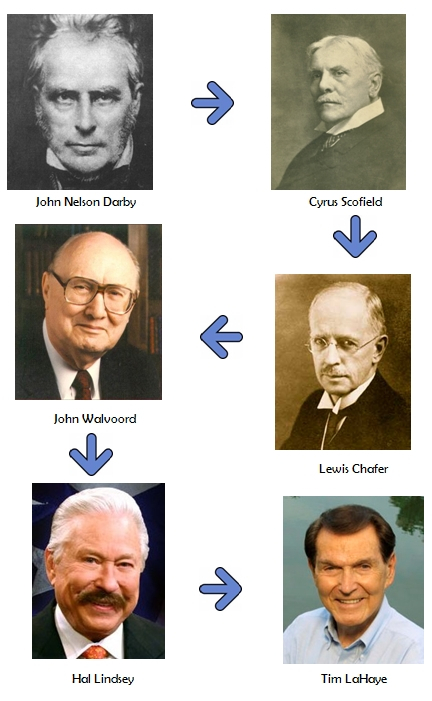
Second, by Dispensationalism, I have in mind that system of theology that was developed by J. N. Darby (pictured on right) that gave rise to its modern emphasis of consistent literal interpretation, a distinction between God’s plan for Israel and the church, usually a pretribulational rapture of the church before the seventieth week of Daniel, premillennialism, and a multifaceted emphasis upon God’s glory as the goal of history. This includes some who have held to such a system but may have stop short of embracing pretribulationism. The focus of this article will be upon Dispensational premillennialism.

Theological Logic

In concert with the Calvinist impulse to view history theocentricly, I believe that dispensational premillennialism provides the most logical eschatological ending to God’s sovereign decrees for salvation and history. Since Dispensational premillennialists view both the promises of God’s election of Israel and the church as unconditional and something that God will surely bring to pass, such a belief is consistent with the Bible and logic. A covenant theologian would say that Israel’s election was conditional and temporary. Many Calvinists are covenant theologians who think that individual election within the church is unconditional and permanent. They see God’s plan with Israel conditioned upon human choice, while God’s plan for salvation within the church is ultimately a sovereign act of God. There is no symmetry in such logic. Meanwhile, Dispensational premillennialists see both acts as a sovereign expression of God’s plan in history that is a logical, consistent application of the sovereign will of God in human affairs.

Samuel H. Kellogg, a Presbyterian minister, missionary, and educator wrote of the logic between Calvinism and “modern, futurist premillennialism,” which was in that day (1888) essentially dispensational. “But in general,” notes Kellogg, “we think, it may be rightly said that the logical relations of premillennialism connect it more closely with the Augustinianthan with any other theological system” (Samuel H. Kellogg, “Premillennialism: Its relations to Doctrine and Practice,” Bibliotheca Sacra, XLV [1888], p. 253).

His use of “Augustinian” is the older term for Calvinism. Kellogg points out the different areas in which Calvinism and premillennialism are theologically one. “Premillennialism logically presupposes an anthropology essentially Augustinian. The ordinary Calvinism affirms the absolute helplessness of the individual for self-regeneration and self- redemption” (Kellogg, “Premillennialism,” p. 254). He continues, “it is evident that the anthropological presuppositions on which premillennialism seems to rest, must carry with them a corresponding soteriology” (Kellogg, “Premillennialism,” p. 257). Kellogg reasons that “the Augustinian affinity of the premillennialist eschatology becomes still more manifest. Nothing is more marked than the emphasis with which premillennialists constantly insist that, the present dispensation is strictly elective” (Kellogg, “Premillennialism,” p. 258-59). “In a word,” concludes Kellogg, “we may say that premillennialists simply affirm of the macrocosm what the common Augustinianism affirms only of the microcosm” (Kellogg, “Premillennialism,” p. 256).

This is not to say that Dispensationalism and Calvinism are synonymous. I merely contend that it is consistent with certain elements of Calvinism that provide a partial answer as to why Dispensationalism sprang from the Reformed tradition. C. Norman Kraus contends,

There are, to be sure, important elements of seventeenth-century Calvinism in contemporary dispensationalism, but these elements have been blended with doctrinal emphasis from other sources to form a distinct system which in many respects is quite foreign to classical Calvinism (C. Norman Kraus, Dispensationalism in America: Its Rise and Development. Richmond: John Knox Press, 1958, p. 59).

Nevertheless, Dispensationalism did develop within the Reformed community and most of its adherents during the first 100 years were from within the Calvinist milieu. Kraus concludes: “Taking all this into account, it must still be pointed out that the basic theological affinities of dispensationalism are Calvinistic. The large majority of men involved in the Bible and prophetic conference movements subscribed to Calvinistic creeds” (Ibid). I will now turn to an examination of some of the founders and proponents of Dispensationalism?

Darby and the Brethren

Modern systematic dispensationalism was developed in the 1830s by J. N. Darby and those within the Brethren movement. Virtually all of these men came from churches with a Calvinistic soteriology. “At the level of theology,” says Brethren historian H. H. Rowdon, “the earliest Brethren were Calvinists to a man” (Harold H. Rowdon, Who Are The Brethren and Does it Matter? Exeter, England: The Paternoster Press, 1986, p. 35). This is echoed by one of the earliest Brethren, J. G. Bellett, who was beginning his association with the Brethren when his brother George wrote, “for his views had become more decidedly Calvinistic, and the friends with whom he associated in Dublin were all, I believe without exception, of this school” (George Bellett, Memoir of the Rev. George Bellett . London: J. Masters, 1889, pp. 41–2, cited in Max S. Weremchuk, John Nelson Darby. Neptune, N.J.: Loizeaux Brothers, 1992, p. 237, f.n. 25).

What were Darby’s views on this matter? John Howard Goddard observes that Darby “held to the predestination of individuals and that he rejected the Arminian scheme that God predestinated those whom he foreknew would be conformed to the image of Christ.”  In his “Letter on Free-Will,” it is clear that Darby rejects this notion. “If Christ has come to save that which is lost, free-will has no longer any place.”  “I believe we ought to hold to the word;” continues Darby, “but, philosophically and morally speaking, free-will is a false and absurd theory. Free-will is a state of sin” (Ibid, p. 186).  Because Darby held to the bondage of the will, he logically follows through with belief in sovereign grace as necessary for salvation.

Such is the unfolding of this principle of sovereign grace, without which not one should would be saved, for none understand, none seek after God, not one of himself will come that he might have life. Judgment is according to works; salvation and glory are the fruit of grace (J. N. Darby, “Notes on Romans,” in The Collected Writings of J. N. Darby [Winschoten, Netherlands: H. L. Heijkoop, 1971], 26: 107–8).

Further evidence of Darby’s Calvinism is that on at least two occasions he was invited by non-dispensational Calvinists to defend Calvinism for Calvinists. One of Darby’s biographers, W. G. Turner spoke of his defense at Oxford University:

It was at a much earlier date (1831, I think) that F. W. Newman invited Mr. Darby to Oxford: a season memorable in a public way for his refutation of Dr. E. Burton’s denial of the doctrines of grace, beyond doubt held by the Reformers, and asserted not only by Bucer, P. Martyr, and Bishop Jewell, but in Articles IX—XVIII of the Church of England (W. G. Turner, John Nelson Darby: A Biography [London: C. A. Hammond, 1926], p. 45).

On another occasion Darby was invited to the city of Calvin—Geneva, Switzerland—to defend Calvinism. Turner declares, “He refuted the ‘perfectionism’ of John Wesley, to thedelight of the Swiss Free Church.”  Darby was awarded a medal of honor by the leadership of Geneva (Rowdon, Who Are The Brethren, pp. 205–07).

Still yet, when certain Reformed doctrines came under attack from within the Church in which he once served, “Darby indicates his approval of the doctrine of the Anglican Church as expressed in Article XVII of the Thirty-Nine Articles” (Goddard, “The Contribution of Darby,” p. 86).  On the subject of election and predestination, Darby said,

For my own part, I soberly think Article XVII to be as wise, perhaps I might say the wisest and best condensed human statement of the view it contains that I am acquainted with. I am fully content to take it in its literal and grammatical sense. I believe that predestination to life is the eternal purpose of God, by which, before the foundations of the world were laid, He firmly decreed, by His counsel secret to us, to deliver from curse and destruction those whom He had chosen in Christ out of the human race, and to bring them, through Christ, as vessels made to honour, to eternal salvation (J. N. Darby, “The Doctrine of the Church of England at the Time of the Reformation,” in The Collected Writings of J. N. Darby [Winschoten, Netherlands: H. L. Heijkoop, 1971], 3:3).

Dispensationalism in America

 Darby and other Brethren brought dispensationalism to America through their many trips and writings that came across the Atlantic. “In fact the millenarian (or dispensational premillennial) movement,” declares George Marsden, “had strong Calvinistic ties in its American origins” (George M. Marsden, Fundamentalism and American Culture: The Shaping of Twentieth-Century Evangelicalism: 1870–1925 [New York: Oxford University Press, 1980], p. 46). Reformed historianMarsden continues his explanation of how dispensationalism came to America:

This enthusiasm came largely from clergymen with strong Calvinistic views, principally Presbyterians and Baptists in the northern United States. The evident basis for this affinity was that in most respects Darby was himself an unrelenting Calvinist. His interpretation of the Bible and of history rested firmly on the massive pillar of divine sovereignty, placing as little value as possible on human ability (Ibid).

The post-Civil War spread of dispensationalism in North America occurred through the influence of key pastors and the Summer Bible Conferences like Niagara, Northfield, and Winona. Marsden notes:

The organizers of the prophetic movement in America were predominantly Calvinists. In 1876 a group led by Nathaniel West, James H. Brookes, William J. Eerdman, and Henry M. Parsons, all Presbyterians, together with Baptist A. J. Gordon, …These early gatherings, which became the focal points for the prophetic side of their leaders’ activities, were clearly Calvinistic. Presbyterians and Calvinist Baptists predominated, while the number of Methodists was extremely small… Such facts can hardly be accidental (Ibid).

Proof of Marsden’s point above is supplied by Samuel H. Kellogg—himself a Presbyterian and Princeton graduate—with his breakdown of the predominately dispensational Prophecy Conference in New York City in 1878. Kellogg classified the list of those that signed the call for the Conference as follows (Kellogg, “Premillennialism,” p. 25):

Reformed Episcopalians 10
Congregationalists 10
Methodists 6
Adventists 5
Lutheran 1
Presbyterians 31
United Presbyterians 10
Reformed (Dutch) 3
Episcopalians 10
Baptist 22

Kellogg concluded that “the proportion of Augustinians in the whole to be eighty-eight per cent” (Ibid, p. 254). “The significance of this is emphasized,” continues Kellogg, “by the contrasted fact that the Methodists, although one of the largest denominations of Christians in the country, were represented by only six names” (Ibid). Kellogg estimates that “analyses of similar gatherings since held on both sides of the Atlantic, would yield a similar result” (Ibid).

George Marsden divides Reformed Calvinism in America into three types: “doctrinalist, culturalist, and pietist” (George M. Marsden, “Introduction: Reformed and American,” in David F. Wells, ed., Reformed Theology in America: A History of Its Modern Development [Grand Rapids: Baker, 1997], p. 3). He then explains that “Dispensationalism was essentially Reformed in its nineteenth-century origins and had in later nineteenth-century America spread most among revival-oriented Calvinists” (Ibid, p. 8). This is not to say that only revival-oriented Calvinists were becoming dispensational in their view of the Bible and eschatology. Ernest Sandeen lists at least one Old School Presbyterian—L. C. Baker of Camden, New Jersey—as an active dispensationalist during the later half of the nineteenth century (Ernest R. Sandeen, The Roots of Fundamentalism: British and American Millenarianism, 1800–1930 [Grand Rapids: Baker, 1970]).

Timothy Weber traces the rise of Dispensationalism as follows:

The first converts to dispensational premillennialism after the Civil War were pietistic evangelicals who were attracted to its Biblicism, its concern for evangelism and missions, and its view of history, which seemed more realistic than that of the prevailing postmillennialism. Most of the new premillennialists came from Baptist, New School Presbyterian, and Congregationalist ranks, which gave the movement a definite Reformed flavor. Wesleyan evangelicals who opposed premillennialism used this apparent connection to Calvinism to discredit it among Methodists and holiness people (Timothy P. Weber, “Premillennialism and the Branches of Evangelicalism,” in Donald W. Dayton and Robert K Johnston, editors, The Variety of American Evangelicalism [Downers Grove, IL: InterVarsity Press]).

It is safe to say that without the aid of Reformed Calvinists in America dispensational premillennialism would have had an entirely different history. Men like the St. Louis Presbyterian James H. Brookes (1830–1897), who was trained at Princeton Seminary, opened his pulpit to Darby and other speakers. Brookes, considered the American father of the pretribulational rapture in America, also discipled a new convert to Christ in the legendary C. I. Scofield (For more on the life of Brookes see Larry Dean Pettegrew, “The Historical and Theological Contributions of the Niagara Bible Conference to American Fundamentalism,” [Th.D. Dissertation from Dallas Theological Seminary, 1976]; David Riddle Williams, James H. Brookes: A Memoir, [St. Louis: Presbyterian Board of Publication, 1897]). Others such as Presbyterians Samuel H. Kellogg (Princeton trained), E. R. Craven, who was a PrincetonCollege and Seminary graduate and Old School Presbyterian (Samuel Macauley Jackson, ed., The New Schaff-Herzog Encyclopedia of Religious Knowledge [Grand Rapids: Baker, 1952], 3: 296), and Nathaniel West provided great leadership in spreading dispensationalism in the late 1800s.

Scofield, Chafer, and Dallas Seminary

C. I. Scofield (1843–1921), Lewis Sperry Chafer (1871–1952), and Dallas Theological Seminary (est. 1924) were great vehicles for the spread of dispensationalism in America and throughout the world. Both Scofield and Chafer were ordained Presbyterian ministers. The “Scofield Reference Bible, is called by many the most effective tool for the dissemination of dispensationalism in America” (Larry V. Crutchfield, The Origins of Dispensationalism: The Darby Factor, [Lanham, MD: University Press of America, 1992], preface).  Scofield was converted in mid-life and first discipled by James H. Brookes in St. Louis. He was ordained to the ministry at the First Congregational Church of Dallas in 1882 and transferred his ministerial credentials to the Presbyterian Church in the U. S. in 1908 (Daniel Reid, ed., Dictionary of Christianity in America [Downers Grove, IL: InterVarsity Press, 1990], pp. 1057–58). Thus, his ministry took place within a Calvinistic context (Chart of some of the biggest popularizers of Dispensationalism pictured left – Darby, Scofield, Chafer were Calvinists – not certain about the others).

Scofield was the major influence upon the development of Chafer’s theology. John Hannah notes that “it is impossible to understand Chafer without perceiving the deep influence of Scofield” (John David Hannah, “The Social and Intellectual History of the Origins of the Evangelical Theological College,” [Ph. D. Dissertation from The University of Texas at Dallas, 1988], pp. 118–19). In fact, “Chafer often likened this relationship to that of father and a son” (Jeffrey J. Richards, The Promise of Dawn: The Eschatology of Lewis Sperry Chafer, [Lanham, MD: University Press of America, 1991], p. 23). This relationship grew out of Chafer’s study under Scofield at the Northfield Conference and from a life-changing experience in Scofield’s study of the First Congregational Church of Dallas in the early 1900s. Scofield toldChafer that his gifts were more in the field of teaching and not in the area of evangelism in which he had labored. “The two prayed together, and Chafer dedicated his life to a lifetime of biblical study” (Ibid).

Scofield and Chafer were two of the greatest American dispensationalists and both developed their theology from out of a Reformed background. Scofield is known for his study bible and Chafer for his Seminary and systematic theology. Jeffrey Richards describes Chafer’s theological characteristics as having “much in common with the entire Reformed tradition. Excluding eschatology, Chafer is similar theologically to such Princeton divines as Warfield, Hodge, and Machen. He claims such doctrines as the sovereignty of God, …total depravity of humanity, election, irresistible grace, and the perseverance of the saints” (Ibid, p.3). C. Fred Lincoln describes Chafer’s 8-volume Systematic Theology as “unabridged, Calvinistic, premillennial, and dispensational” (C. F. Lincoln, “Biographical Sketch of the Author,” in Lewis Sperry Chafer, Systematic Theology [Dallas: Dallas Seminary Press, 1948], 8:6).

Since its founding in 1924 as The Evangelical Theological College (changed to Dallas Theological Seminary in 1936), it has exerted a global impact on behalf of dispensationalism. Dallas Seminary’s primary founder was Chafer, but William Pettingill and W. H. Griffith-Thomas also played a leading role. Pettingill, like Chafer, was Presbyterian. Griffith Thomas, an Anglican, wrote one of the best commentaries on the Thirty-nine Articles of the Anglican Church (W. H. Griffith Thomas, The Principles of Theology: An Introduction to the Thirty-nine Articles [Grand Rapids: Baker Book House, 1979/1930]), which is still widely used by conservative Anglicans and Episcopalians today. The Thirty-nine Articles are staunchly Calvinistic. Both men were clearly Calvinists. The seminary, especially before World War II, considered itself Calvinistic. Chafer once characterized the school in a publicity brochure as “in full agreement with the Reformed Faith and itstheology is strictly Calvinistic.”  In a letter to Allan MacRae of Westminster Theological Seminary, Chafer said, “You probably know that we are definitely Calvinistic in our theology” (Cited in Ibid, p. 200). “Speaking of the faculty, Chafer noted in 1925 that they were ‘almost wholly drawn from the Southern and Northern Presbyterian Churches’“ (Cited in Ibid., p. 346). Further, Chafer wrote to a Presbyterian minister the following: “I am pleased to state that there is no institution to my knowledge which is more thoroughly Calvinistic nor more completely adjusted to this system of doctrine, held by the Presbyterian Church” (Ibid., p. 346, footnote 323).

Since so many early Dallas graduates entered the Presbyterian ministry, there began to be a reaction to their dispensational premillennialism in the 1930s. This was not an issue as to whether they were Calvinistic in their soteriology, but an issue over their eschatology. In the late 1930s, “Dallas Theological Seminary, though strongly professing to be a Presbyterian institution, was being severed from the conservative Presbyterian splinter movement” (Ibid, pp. 357-358).  In 1944, Southern Presbyterians issued a report from a committee investigating the compatibility of dispensationalism with the Westminster Confession of Faith. The committee ruled dispensationalism was not in harmony with the Church’s Confession. This “report of 1944 was a crippling blow to any future that dispensational premillennialism might have within Southern Presbyterianism” (Ibid, 364). This ruling effectively moved Dallas graduates away from ministry within Reformed denominations toward the independent Bible Church movement.

A Broadening of Dispensational Acceptance

Even though dispensationalism had made a modest penetration of Baptists as early as the 1880s through advocates such as J. R. Graves (See J. R. Graves, The Work of Christ Consummated in 7 Dispensations [Memphis: Baptist Book House, 1883]), a strong Calvinist, they were rebuffed by non-Calvinists until the mid-1920s when elements of dispensational theology began to be adopted by some Pentecostals in an attempt to answer the increasing threat of liberalism. Kraus explains:

Some teachers said explicitly that premillennialism was a bulwark against rationalist theology. Thus it is not surprising to find that the theological elements which became normative in dispensationalism ran directly counter to the developing emphasis of the “New Theology” (Kraus, Dispensationalism, p. 61).

Up to this point in history, those from the Arminian and Wesleyan traditions were more interested in present, personal sanctification issues, rather than the Calvinist attention in explaining God’s sovereign work in the progress of history. However, the rise of the fundamentalist/liberal controversy in the 1920s stirred an interest, outside of the realm of Calvinism, in defending the Bible against the anti-supernatural attacks of the liberal critics. Dispensationalism was seen as a conservative and Bible-centered answer to liberalism, not only within fundamentalism, but increasingly by Pentecostals and others as well. Timothy Weber notes:

But in time, dispensationalism had its devotees within the Wesleyan tradition as well. More radical holiness groups resonated with its prediction of declining orthodoxy and piety in the churches; and Pentecostals found in it a place for the outpouring of the Spirit in a “latter-day rain” before the Second Coming (Weber, “Premillennialism,” p. 15).

Latter Rain Pentecostalism

One of the first non-Calvinist groups to adopt a dispensational orientation can be found among some Pentecostals in the mid-1920s. This development must be understood against a backdrop of the Wesleyan and holiness heritage out of which Pentecostalism arose at the turn of last century. The American holiness movement of the 1800s was primarily postmillennial and if premillennial, then historical premillennial. They were not in any way dispensational.

Pentecostalism is at heart a supposed restoration of apostolic Christianity that is meant to bring in the latter rain harvest in preparation for Christ’s return. The phrase “latter rain” is taken from Joel 2:23 & 28 and sometimes James 5:7 as a label describing an end-time revival and evangelistic harvest expected by many charismatics and Pentecostals. Some time in the future, they believe the Holy Spirit will be poured out like never before. The latter rain teaching is developed from the agricultural model that a farmer needs rain at two crucial points in the growing cycle in order to produce a bountiful harvest. First, right after the seed is planted the “early rain” is needed to cause the seed to germinate in order to produce a healthy crop. Second, the crop needs rain right before the harvest, called the “latter rain,” so the grain will produce a high yield at harvest time, which shortly follows. Latter rain advocates teach that the Acts 2 outpouring of the Holy Spirit was the “early rain” but the “latter rain” outpouring of the Holy Spirit will occur at the end-times. This scenario is in conflict with dispensationalism that sees the current age ending, not in revival, but apostasy. It will be during the tribulation, after the rapture of the church, that God will use the miraculous in conjunction with the preaching of the gospel. Thus, latter rain theology fits within a postmillennial or historical premillennial eschatology, but it is not consistent with dispensationalism.

Many Christians are aware that the Pentecostal movement began on January 1, 1901 in Topeka, Kansas when Agnes Ozman (1870–1937) spoke in tongues under the tutelage of Charles Fox Parham (1873–1929). Yet, how many realize that in the “early years Movement’” (Donald Dayton, Theological Roots of Pentecostalism (Grand Rapids: Zondervan, 1987), p. 27)? This is because Parham titled his report of the new movement as “The Latter Rain: The Story of the Origin of the Original Apostolic or Pentecostal Movements” (Dayton, Roots, pp. 22–23). Many are also aware that William J. Seymour (1870–1922) came under the influence of Parham in Houston, Texas in 1905 and then took the Pentecostal message to Azusa Street in Los Angeles in 1906, from where it was disseminated to the four-corners of the world. But, how many are also aware that he too spoke of these things in terms of a latter rain framework?

There is no doubt that the latter rain teaching was one of the major components—if not the major distinctive—in the theological formation of Pentecostalism. “Modern Pentecostalism is the ‘latter rain,’ the special outpouring of the Spirit that restores the gifts in the last days as part of the preparation for the ‘harvest,’ the return of Christ in glory,” says Donald Dayton (Ibid, 27).  David Wesley Myland (1858–1943) was one of the early Pentecostal leaders. He wrote the first distinctly Pentecostal hymn entitled, “The Latter Rain” in 1906. The “first definitive Pentecostal theology that was widely distributed, the Latter Rain Covenant” appeared in 1910 (Stanley M. Burgess and Gary B. McGee, editors, Dictionary of Pentecostal and Charismatic Movements [Grand Rapids: Zondervan, 1988], p. 632).  Myland argued in his book that “now we are in the Gentile Pentecost, the first Pentecost started the church, the body of Christ, and this, the second Pentecost, unites and perfects the church into the coming of the Lord” (Cited by Dayton, Roots, p. 27).

Dayton concludes that the “broader Latter Rain doctrine provided a key…premise in the logic of Pentecostalism” (Ibid).  In spite of having such a key place in the thinking of early Pentecostalism, “the latter rain doctrine did tend to drop out of Pentecostalism” in the 1920s “only to reappear, however, in the radical Latter Rain revitalization movement of the 1940s” (Ibid, 43). One of reasons that latter rain teachings began to wane in the mid-1920s was that as Pentecostalism became more institutionalized it needed an answer to the inroads of liberalism. As noted above, dispensationalism was seen helpful in these areas.

The Latter Rain teaching developed out of the Wesleyan-Holiness desire for both individual (sanctification) and corporate (eschatological) perfection. Thus, early perfectionist teachers like John Wesley, Charles Finney, and Asa Mahan were all postmillennial and social activists. Revivalism was gagged by carrying the burden of both personal and public change or perfection. It follows that one who believes in personal perfection should also believe that public perfection is equally possible. Those who believe the latter are postmillennialists. After all, if God has given the Holy Spirit in this age to do either, then why not the other? If God can perfect individuals, then why not society?

However, as the 1800s turned into the 1900s, social change was increasingly linked with Darwin’s theory of evolution. The evolutionary rationale was then used to attack the Bible itself. To most English-speaking Christians it certainly appeared that society was not being perfected, instead it was in decline. Critics of the Bible said that one needed a Ph.D. from Europe before the Bible could be organized and understood. It was into this climate that dispensationalism was introduced into America and probably accounts for its speedy and widespread acceptance by many conservative Christians. To many Bible believing Christians, Dispensationalism made a great deal more sense of the world than did the anti-supernaturalism conclusions of liberalism.

Dispensationalism, in contrast to Holiness teaching, taught that the world and the visible church were not being perfected, instead Christendom was in apostasy and heading toward judgment. God is currently in the process of calling out His elect through the preaching of the gospel. Christian social change would not be permanent, nor would it lead to the establishment of Christ’s kingdom before His return. Instead a cataclysmic intervention was needed (Christ’s second coming), if society was to be transformed.

Early Pentecostalism was born out of a motivation and vision for restoring to the church apostolic power lost over the years. Now she was to experience her latter-day glory and victory by going out in a blaze of glory and success. On the other hand, dispensationalism was born in England in the early 1800s bemoaning the latter-day apostasy and ruin of the church. Nevertheless, within Pentecostalism, these two divergent views were merged. Thus, denominations like the Assemblies of God and Foursquare Pentecostals moved away from doctrines like the latter rain teaching and generated official positions against those teachings. It was in the mid-1920s that dispensationalism began to be adopted by non-Calvinists and spread throughout the broader world of Conservative Protestantism.

Dispensationalism appealed to the average person with its emphasis that any average, interested person could understand the Bible without the enlightened help of a liberal education. Once a student understood God’s overall plan for mankind, as administered through the dispensations, he would be able to see God’s hand in history. Thus, dispensational theology made a lot of sense to both Pentecostal and evangelical believers at this point in history.

Post War Development

Fundamentalism/Evangelicalism and Pentecostalism- Charismatic movements spread rapidly in America after the second World War and since dispensationalism was attached to them, it also grew rapidly. Many baby-boomers within Pentecostal and Charismatic churches grew up with dispensationalism and the pre-trib rapture as part of their doctrinal framework. Thus, it would not occur to them that dispensationalism was not organic to their particular brands of restoration theology. Further, as non-Calvinist Fundamentalism grew after the War, especially within independent Baptist circles, there was an even greater disconnect of dispensational distinctives from their Calvinist roots.

We have seen that the Pentecostal/Charismatic movement has a tradition of both Latter Rain/restoration teachings as well as the later rise of a dispensational stream. However, these are contradictory teachings that appear to be on a collision course.

Either the church age is going to end with perfection and revival or it will decline into apostasy, preparing the way for the church to become the harlot of Revelation during the tribulation. It is not surprising to see within the broader Pentecostal/Charismatic movement, since the mid 1980s, a clear trend toward reviving Latter Rain theology and a growing realization that it is in logical conflict with their core doctrine. Many, who grew up on Dispensational ideas and the pre-trib rapture, are dumping these views as the leaven of Latter Rain theology returns to prominence within Pentecostal/Charismatic circles.

Pentecostal/Charismatic leaders like Earl Paulk  and Tommy Reid, to name just a couple among many, are attempting to articulate the tension over the struggles of two competing systems. They are opting for the dismissal of dispensational elements from a consistent Pentecostal/Charismatic and Latter Rain theology. Tommy Reid observes:

This great Last Day revival was often likened in the preaching of Pentecostal pioneer to the restoration promised to Israel in the Old Testament. Whereas Dispensationalists had relegated all of these prophetic passages of restoration only to physical Israel, Pentecostal oratory constantly referred to these prophecies as having a dual meaning, restoration for physical Israel, AND restoration for the present day church. WE WERE THE PEOPLE OF THAT RESTORATION, ACCORDING TO OUR THEOLOGY (Tommy Reid, Kingdom Now But Not Yet. Buffalo: IJN Publishing, 1988, pp. xv-xvi. [emphasis in original]).

At the same time, the purge of Dispensationalism from Reformed Christianity, begun in the late 1930s, has been pretty much completed. Typical of this polarization is found in books like John Gerstner’s Wrongly Dividing The Word Of Truth: A Critique of Dispensationalism (John H. Gerstner, Wrongly Dividing The Word Of Truth: A Critique of Dispensationalism. Brentwood, TN: Wolgemuth & Hyatt Publishers, 1991). While admitting on the one hand that a “strange thing about Dispensationalism is that it seems to have had its strongest advocates in Calvinistic churches” (Ibid, 106). Gerstner so strongly opposes dispensationalism, that it has blinded him to the true Calvinist nature of such a God-centered theology. Gerstner claims that he and other Reformed theologians have raised “strong questions about the accuracy of dispensational claims to be Calvinistic” (Ibid, pp. 105-47). It appears that since Dispensationalism arose within the Reformed tradition, as a rival to Covenant Theology, some want to say that they cannot logically be Calvinistic. This is what Gerstner contends. However, in spite of Gerstner’s sophistry on this issue,he cannot wipe out the historical fact that dispensationalism was birthed within the biblical mindset of a clear theocentric theology and by those who held strongly to soteriological Calvinism. The fact that Dispensationalism arose within a Reformed context is probably the reason why the Reformed community has led the way in the criticism of Dispensational theology.

Conclusion

The purpose of this article is to remind modern Dispensationalists and Calvinists of the historical roots of Dispensationalism. It is precisely because Dispensationalism has penetrated almost every form of Protestantism that many today may be surprised to learn of its heritage. In our day of Postmodern irrationalism, where it is considered a virtue to NOT connect the dots of one’s theology, we need to be reminded that the theology of the Bible is a seamless garment. It all hangs together. If one starts pulling at a single thread, the whole cloth is in danger of unraveling.

I personally think that if systematic Dispensationalism is rightly understood then it still logically makes sense only within a theocentric and soteriologically Calvinistic theology. After all, Dispensationalism teaches that it is GOD who is ruling His household, as administered through the various dispensations of history. However, the reality is that Dispensationalism, or elements of Dispensationalism (i.e., pretribulationism, futurism, etc.), have been disseminated throughout a wide diversity of Protestant traditions. Dispensationalism is best seen as a system of theology that sees views God as the Sovereign ruler of heaven and earth; man as a rebellious vice-regent (along with some angels); Jesus Christ is the hero of history as He is saves some by His Grace; history as a lesson in the outworking of God’s glory being displayed to both heaven and earth. Dispensationalism is a theology that I believe is properly derived from biblical study and lets God be God (Article Adapted from Vol. 4: Conservative Theological Journal Volume 4. 2000 (12) (127). Fort Worth, TX: Tyndale Theological Seminary).

About the Author: Dr. Thomas Ice is the Executive Director of The Pre-Tribulational Research Center. He founded The Center in 1994 with Dr. Tim LaHaye to research, teach, and defend the pretribulational rapture and related Bible prophecy doctrines. The Center is currently located on the campus of Liberty University in Virginia.

Dr. Ice has authored or co-authored about 30 books, written hundreds of articles, and is a frequent conference speaker. He has served as a pastor for 15 years. Dr. Ice has a B.A. from Howard Payne University, a Th.M. from Dallas Theological Seminary, a Ph.D. from Tyndale Theological Seminary, and is a Doctoral Candidate at The University of Wales in Church History. Dr. Ice lives in Omaha, Nebraska with his wife Janice. Two of their three boys are college graduates and the third is currently in college.

Missional Discipleship by Jonathan Dodson

“Missional Discipleship: Reinterpreting the Great Commission”

In evangelical subculture the ubiquity of the Great Commission is matched by the poverty of its interpretation. Matthew 28:18-20 — the command to make disciples of all nations — is frequently summoned to validate countless and sundry discipleship and evangelism programs, ideas and practices, often ignoring the interpretive wealth of the text. It’s as if we expect that planting the Great Commission flag at end of a sentence will immediately summit our discipleship agendas.

One way to remedy this poverty of our interpretation is by reading the Great Commission in light of other biblical commissions. Depending on how we count them we there are at least five commissions, one in the Old Testament and four in the New (It is certainly possible that there are more commissions. In fact, the Abrahamic covenant in Gen 12:1-3 contains a programmatic mandate for all of Scripture: Go and God will make you a blessing to the nations, which is progressively manifested in making a new people of God, comprised of Jews and Gentiles).

The four commissions in the NT are actually variations of the same mandate (Matt. 28:18-20; Mark 16:15; Luke 24:48-49/Acts 1:8; John 20:21), each issued by Jesus, emphasizing a slightly different aspect of what it means to be a disciple. The operative verbs in these NT commissions are: make disciples, preach, witness, and send. They are gospel-driven commands. The OT commission, frequently referred to as the creation or cultural mandate, was issued by God before the Fall of humanity, emphasizing creative activity with the following verbs: be fruitful, multiply, rule, and subdue (Gen 1.27-28 – it is variously repeated in the Old Testament e.g. Gen. 9:1,7; 17:2-6; 26:3; 28:3; Ex. 1:7; Ezek. 36:11; Jer. 23:3).By producing more creators who rule and subdue the elements of the earth, the creation mandate is a command to produce peoples and cultures.

A surface reading of these Old and New Testament texts places them at odds with one another. In Genesis it would seem that the purpose of humanity is to produce people and culture, whereas the Gospels appear to advocate pulling away from people and culture. As a result, many have chosen one reading over the other, soul-winning or culture-making, disciple-making or social action. These impoverished readings call for reinterpretation, one that that allows both Genesis and the Gospels to speak. In fact, reading the gospel commissions in light of the cultural mandate will reveal a multi-layered, missional mandate.

Moving beyond poverty-ridden proof texts and into the wealth of the biblical commissions, we will reflect on the differences between the texts. This will require confrontation with the Bible’s demands to make culture and disciples, to care for creation and be agents of new creation. As a result, we will be challenged to understand and embrace discipleship as more than “spiritual disciplines” or an evangelistic program. We will see that Scripture calls us to missional discipleship, a following after Jesus that requires redemptive engagement not just with souls but with creation and culture.

Gospel of Matthew: Distinctive Discipleship

Part of what makes the Great Commission great is its scope. When Jesus said: “Go therefore and make disciples of all nations” he was orienting a primarily Jewish audience to a distinctly multi-ethnic mission. As Ralph Winter has advanced, the commission is not calling Christians to Christianize nation-states, but to evangelize ethnic groups. We get the word, “ethnic” from the Greek word for nations, which refers not to modernist geo-political states, but instead to non-Jewish ethnic groups. Christ does not advocate Christendom, a top-down political Christianity. Instead, in affirmation of the cultural mandate, he calls his followers to transmit a bottom-up, indigenous Christianity, to all peoples in all cultures.

As Andrew Walls has pointed out, the command is to make disciples of all nations not from all nations. The Great Commission is not about soul-extraction, to remove the disciple from his culture, but instead, to make disciples within their cultural context. Walls comments:

Conversion to Christ does not produce a bland universal citizenship: it produces distinctive discipleship, as diverse and variegated as human life itself. Christ in redeeming humanity brings, by the process of discipleship, all the richness of humanity’s infinitude of cultures and subcultures into the variegated splendor of the Full Grown Humanity to which the apostolic literature points (Eph 4.8-13 [Andrew Walls, The Missionary Movement in Christian History, Maryknoll: Orbis, 1996, 51. The original Greek reading of Matt. 28:18 is literally “disciple all ethne” or “make disciples all nations” and does not contain a preposition. However, the grammatical construction of the phrase leads to an “of” reading, not a “from” or “in” reading]).

What we should strive for is distinctive discipleship, discipleship that uniquely expresses personal faith in our cultural context. Disciples in urban Manhattan will look different than disciples in rural Maehongson. These differences allow for a flourishing of the gospel that contributes to the many-splendored new humanity of Christ.

According to the Gospel of Matthew, distinctive disciples are those who who, in following Jesus, refuse a one-sided, soul-centered gospel, and instead live out faith in context. The distinctive disciple retains the image of Adam — a culture maker — while growing in the image of Christ and becoming a disciple-maker.

Gospel of Mark: A Worldly Gospel

Mark’s commission reads: “Go into all the world and proclaim the gospel to the whole creation” (Mk. 16:15, It is widely recognized that this verse and the latter portion of Mark’s gospel (16:9-20) is absent from many Marcan manuscripts. However, we cannot be certain that the ending is missing from the original text. If it was absent, our point concerning the “worldly gospel” of Mark still stands in that Mark repeatedly depicts Jesus as the Restorer of creation: driving out demons, healing the sick, resurrecting the dead, calming the sea). Where Matthew emphasizes the action of making distinctive disciples, Mark stresses the importance of preaching to all creation.

When Jesus used the word “preach” he did not mean converse. The Greek word for preach always carries a sense of urgency and gravity, as though what is to be proclaimed is of great importance. In this case, it is the gospel that is of utmost importance. This gospel is a worldly gospel — a message that is culturally relevant and creation renewing.

The Greek word for “creation” can be used both broadly and narrowly, referring to the cosmos or to people. Here it should be taken broadly, referring to the world, its peoples and its cultures. Preaching the gospel of Christ has cosmic implications. So it is with Paul: “this gospel has been proclaimed in all creation under heaven, and of which I, Paul, became a minister” (Col. 1:23). Thus, Paul perceives himself as an announcer of a worldly Christ-centered gospel, that through Jesus all things are reconciled to himself, whether on earth or in heaven (Col. 1:20). Paul preaches with Mark’s great commission emphasis — preaching for the redemption of all creation.

While this worldly gospel saves, it also condemns. In Mark, Jesus explains that not all will believe this grand Story or receive its great Savior: “Whoever believes and is baptized will be saved, but whoever does not believe will be condemned” (Mk. 16:16). Mark’s commission reveals the divisive nature of the gospel. For some it brings life; for others it brings death, but all are to be given the opportunity to be written into the story of God’s redemption of all creation.

As with Matthew, the scope of God’s redemptive activity is important. From the beginning, God’s design for creation was for it to flourish and become inhabitable. Outside of Eden, the earth was uninhabitable. Humanity was charged with the task of caring for the earth and creating culture, making the uninhabitable habitable.

Adam failed to trust God with this task and sought to rule not only over creation, but also over God. As a result, the creation project was subjected to sin and calamity (Rom. 8:20). Israel would follow in Adam’s footsteps. Then came Jesus. Jesus preached a worldly gospel, a restorative message that put the creation project back on track. His glorified, resurrection body is clearly proof of the new creation to come.

Just prior to ascending to heaven, Jesus told those who believe that they will be given power to heal the sick, restore the demon-possessed, and to speak new languages (Mk. 16:17-18). This worldly gospel is for the redemption and renewal of the earth, the body, the heart, the mind, and the cultures of the world. It is a saving message that rescues people from their unbelief, not their world, and reconciles their alienation from one another, their world, and their Creator.

According to the Gospel of Mark, Jesus died to bring life to all creation, to restore the environment, renew cultures and remake peoples, spiritually and physically. We are called to preach a worldly gospel.

Gospel of Luke: Resurrection Stories

Luke’s commission also emphasizes preaching the gospel: “repentance and forgiveness of sins should be proclaimed in his name to all nations, beginning from Jerusalem. You are witnesses of these things” (Luke 24:47-48). In particular, we are called to preach “repentance and forgiveness of sins.” A social gospel will not suffice. Christ calls us to repent — to turn our heart allegiances away from all things other, and to receive forgiveness for betraying our Creator. But a forgiven and repentant person is not idle; they are compelled to witness — to tell the story of their transformation.

Where Matthew and Mark respectively emphasize distinctive discipleship and preaching a worldly gospel, Luke calls us to witness — to tell our distinct gospel stories. No two stories are alike, but all share the same Savior. What does it mean to be “witnesses of all these things”? Well, at the very least it means sharing Jesus’ self-sacrificing offer of forgiveness, but that is just one thing. What of the other things?

We are to tell of Jesus’ death, but we are also to tell of His resurrection.

Consider the context of Luke’s commission. The eleven disciples were discussing the reliability of Jesus sightings, when suddenly Christ appeared in the room. Thinking he was a ghost, they were filled with fright. Jesus responded: “See my hands and my feet, that it is I myself. Touch me, and see. For a spirit does not have flesh and bones as you see that I have” (24:39). To make his point, Jesus proved he had a body by eating some fish and chips. In flesh and bone, Jesus charges his follower to be witnesses of his resurrection.

The problem with many of our stories is that they contain all spirit and very little flesh. We communicate our mystical encounters with God, our mountain top experiences with Jesus, and our superhuman victories over sin. Many people see right through our spiritual stories, precisely because our witness is too good to be true. We fail to mention our bad, unless it is in the past, failing further to witness of resurrection, in the present. People want to touch redemption, which means they need to see resurrection power in our personal struggles.

Jesus’ body was resurrected as an expression of God’s commitment to creation (1 Cor. 15). God does not jettison the body for the soul. His gospel of redemption is for the whole world, beginning with enfleshed people. His resurrection is a bright reminder of new creation in the midst of bleak darkness, of tangible transformation in gross dilapidation. The stories we tell should boast of Jesus’ death and resurrection, of his forgiveness of sin and of his restoration of sinners — reconciled families and marriages, restored and housed homeless, renewed life among AIDS orphans, and so on.

According to the Gospel of Luke, we are to be witnesses of death and resurrection, to live and recount the stories of a resurrected, fleshly Jesus who lives in the midst of broken humanity offering healing and hope.

Gospel of John: Humble and Cultural Accommodation

John’s commission is short and sweet: “As the Father sent me, I am also sending you” (John 20:21). Whereas the previous gospel writers emphasized Jesus’ command to make distinctive disciples, preach a worldly gospel, and witness a fleshly Jesus, John stresses Jesus sending his disciples. As the text continues, Jesus makes plain that the disciples are sent as a forgiving community, offering the grace they have received from him to others.

According to John Piper, we are either goers, senders, or disobedient, but according to Jesus we are all the sent. Missionary activity is not the exclusive task of people who sell all their possessions and move overseas. All followers of Jesus are called to live as missionaries in their culture. If we are all sent into our cultures as distinctive disciples to share a worldly gospel about a fleshly Christ, how then are we to live as the sent? Jesus said, “As the Father sent me, I am also sending you.” Our paradigm for living a sent life, a missionary life, is the sending of the Son by the Father.

When the Father sent the Son, Jesus left the glory of his trinitarian abode and became a helpless infant in the care of humans he created. This required an accommodating humility. Jesus grew up and became a first century, toga-wearing, sandal-sporting, temple-frequenting Jew. He accommodated first century Jewish culture (also known as contextualization). So, within reason we should take on the trappings of our culture in order to contextually relate the gospel. This can entail wearing broken-in jeans, togas, hand-made sandals or a suit and tie.

However, our accommodation is not purely cultural; it is missional. It leads us to immerse ourselves into the humanity of our neighborhoods and cities in order relate the gospel to people and their needs. Being a local missionary requires more than relevant attire; it demands humility of heart to listen to the stories of others, to empathize with their frustration, suffering, and brokenness and to redemptively retell their stories through the gospel. To be sent by God is to follow the example of the incarnation, to redemptively engage others with a humble heart and cultural accommodation.

In John’s commission, the paradigm of accommodating humility is accompanied by the power of the Holy Spirit. The Spirit is not too holy for distinctive discipleship. After sending his disciples, Jesus breathed on them and they received the Holy Spirit (John 20:22). The power of missional living does not spring from cultural savvy or social sensitivity; it requires the otherworldly, utterly personal power of the Holy Spirit. Only the Spirit of God can make men new.

According to the Gospel of John, we have been sent as missionaries to humbly demonstrate and culturally accommodate the gospel of Christ through the power of the Spirit. In being sent, we do not abandon the cultural commission, but instead, unite it with our redemptive mission.

The Gospel of Genesis: Creation Mandate

The “good news” of Genesis 1-2 is that God created all things to be enjoyed, managed, cultivated, and recreated by humanity. The gospel of Genesis 3 is that, though Adam rejected God, God did not reject Adam. Still possessing the creation mandate, Adam was expelled from Eden, but clothed with the hope of a new creation (Gen 3:15, 21).

The creation mandate charges us to be fruitful and multiply, to rule and subdue the earth. This fruitful multiplication continues both physically and spiritually through the reproducing ministry of missional disciples, who increase in number and good works (Acts 6:7; Col. 1:6, 10). These good works include ruling and subduing creation through the careful, creative arrangement of the elements of the earth into art, technology, infrastructure etc. for the flourishing of humanity. The basis for our cultural activity is found in Genesis.

Retaining the cultural impulse of Genesis, the Gospels call us to a missional discipleship that entails creation care, cultural engagement, social action, and gospel proclamation. Missional disciples will not content themselves by preaching a culturally irrelevant, creation indifferent, resurrection neglecting message. Instead, they redemptively engage peoples and cultures through Christ for the renewal of his creation.

By digging deeper into the great commissions, we have unearthed a wealth of cultural and theological insight. This rereading of familiar evangelistic texts has demonstrated that God in Christ has called us not to mere soul-winning, but to distinctive discipleship, to heralding a worldly gospel of a fleshly Christ who humbly accommodates human culture and understands the human condition. These commissions call us to missional discipleship — to redemptive engagement with all peoples and cultures.

About the Author: Jonathan Dodson (M. Div; Th.M, Gordon-Conwell Theological Seminary) serves as a pastor of Austin City Life in Austin, Texas. He has written articles in numerous blogs and journals such as The Resurgence, The Journal of Biblical Counseling, and Boundless. Dodson has discipled men and women abroad and at home for almost two decades, taking great delight in communicating the gospel and seeing Christ formed in others. His first book – and its fantastic – was published by Crossway Books and is called Gospel-Centered Discipleship. This article originally appeared on http://www.boundless.org on February 12, 2008.

How to Share the Gospel With Muslims by J.T. Smith

Editors’ Note: Christians didn’t discover the need for missions in the Muslim world on September 11, 2001. The Middle East is the homeland of our faith, too, the site of many great acts of God’s miraculous redemption. Long before the Twin Towers fell in Manhattan that clear fall day, Christians debated why the church has struggled to gain a hearing for the gospel where the call once sounded freely. Yet in the last decade, debate has intensified as we agonized over the depth of many Muslims’ hostility toward Christianity. Missionaries and academics have wondered aloud whether the problem extends beyond Western politics, military intervention, and spiritual bondage to the very way we present the gospel. Could our methods be to blame? Could more sophisticated contextualization unlock many more hearts for Christ?

These are the questions we asked experienced pastors and missionaries to answer this week. Whether you’re planning to take the gospel overseas yourself or supporting those who do, we hope these articles will help you make wise, informed decisions about this great missionary challenge of our generation.

“How do you pray?”

Ahmed and I had been sitting at a little teashop talking about various things when he asked this question. Like many other Muslims, he was curious about how Christians pray. I began to explain how our hearts need to be purified in order for us to approach God in prayer. He agreed and wanted to know more. “What do you say when you pray?” he asked. I told him that we can speak to God as a loving father. I then went on to show him the Lord’s Prayer from Matthew 6.

“Is that from the Bible?” he asked. “Yes it is,” I answered. He responded, “That’s beautiful! Can I get one?” From the beginning, it was obvious that God was working in Ahmed’s life to draw him to Jesus. It was a blessing to introduce him to Jesus the savior—whom he had only known as Jesus the prophet.

As we talk about Insider Movements and how we should or shouldn’t be sharing Christ with Muslims, two dangers can emerge. First, people can become a leery of Muslim evangelism out of fear of doing so incorrectly. We should have no fear in sharing the gospel with Muslims. It is the gospel that we are sharing, after all. It is powerful to save!

Second, we must remember that Muslim evangelism should not be merely talked about and debated on blogs or in academic circles. It is something that should be done wherever we find Muslims. In that endeavor let me offer some words of counsel to all who seek to make Christ supreme among Muslims.

Ground yourself in the fact that God is sovereign in salvation.

Muslims come to faith by a supernatural work of God, by which the Holy Spirit opens their hearts (Acts 16:14) and grants them the gift of repentance (2 Tim. 2:25). We believe that a Muslim coming to faith is not intrinsically connected to our form of contextualization, but rests solely on God’s divine intervention (Dan. 4:35; Ps. 115:3; John 6:64-65) and our humble obedience to proclaim the gospel (Acts 1:8; Matt. 9:38, 28:19-20). God is not concerned with glorifying a method; he is concerned with glorifying his Son. Strategies are useful and necessary, but none of them offers the “key” to Muslim evangelism.

Be diligent in working to understand the local culture and determine the best way to present the gospel.

God’s sovereignty is not meant to make us lazy, careless, or vague in our evangelism. It gives us hope, because our finite attempts to share the gospel are backed by an infinitely powerful Savior who has “ransomed people for God from every tribe and language and people and nation” (Rev. 5:9). Wanting to present the gospel clearly and knowing that God’s grace is irresistible are not mutually exclusive.

When it comes to understanding the local culture, we should seek to do two things:

(1) Know Islam. We need to ask ourselves, What are Muslims longing for? What keeps Muslims from attaining this? Don’t be afraid to read the Qur’an or other religious sources. These things will give you great insight into Muslims hearts and minds.

(2) Use their language. When I say “language” I’m referring to two things. First, speak their actual language. If you want to see a church planted among Arabic-speaking Muslims, learn Arabic. If you’re working among Pakistanis, learn Urdu. If among Bengalis, learn Bengali. Second, speak the language (figuratively) that communicates to them. My wife and I lived and worked among Arabic speakers. We learned early on that we could not get people to listen by presenting a beautiful apologetic syllogism proving Jesus is God. We had to use stories, parables, and passages from their religious books.

Center your gospel presentation on Jesus and the Bible.

The degree to which Muslim-background believers seek to retain their previous religion correlates with how we present the gospel to them. In other words, if we use the Qur’an extensively in our evangelism, we risk encouraging a sentimental attachment to it. Muslim-background believers may see the Qur’an as the means by which they understood the gospel and therefore have a harder time letting it go. If we present the gospel as fulfilling their previous religion, we open ourselves up to future problems.

I am not against the proper use of the Qur’an in evangelism. I am concerned with how much we use it. We should not give it center place in our gospel presentation. Jesus is the only way to the Father. Muslims must believe Jesus is their savior, and this belief can only come from the Scriptures. The story of redemption cannot be told from the Qur’an.

Don’t force your ideas on them.

Muslim evangelism can be messy; discipleship can be even worse. Each convert I worked with was different. I made it a point to preach the gospel and let it linger, giving them the time and freedom to think through the implications and determine how they should be applied in that particular culture. We should not attempt to impose our ideas or forms on Muslim-background believers. This means we shouldn’t impose either Western or Islamic expressions of Christianity on them. This is where much of the tension comes from.

We all have an idea of what we hope to see, and how we do Muslim ministry will be determined by our desired outcome. Insider Movement advocates envision implanting the gospel in a Muslim culture with the hopes that it will grow like yeast and lead to transformation from the inside out. In order to do this, they believe, the message must take on Islamic form. Anything less will be viewed as foreign and suspect. Others argue that Muslims need to be called out of Islam and gathered into a separate body with a clear Christ-centered identity. Anything less, they claim, would be viewed as syncretistic.

I would argue that both are correct. The gospel will take on a form of the culture that it is speaking to; if it doesn’t, it will not be understood. But the gospel will also speak with a prophetic voice within the culture that calls for transformation. It goes in and calls out. Our goal is to preach the gospel of Christ from the Scriptures and let the Spirit transform lives and communities.

In the end, expressions of the church or faith communities among Muslims may challenge all our views at some point. However, if these expressions are orthodox in their beliefs, Christ-centered in their view of the gospel, and not deceptive in their practices, we have cause for rejoicing. May God give us wisdom, grace, patience, and boldness as we seek to share the gospel with Muslims.

J.T. Smith and his wife have been ministering to Muslims for the past ten years. They have spent the last four and a half years in the Arabian Peninsula seeking to plant churches among Arabs. This article originally appeared on http://thegospelcoalition.org/blogs/tgc/2012/05/15/how-to-share-the-gospel-with-muslims/

Homosexuality and Its Quest to be the New Normal by Eric Raymond

President Obama’s recent statement concerning his views of same sex marriage has generated no small amount of discussion and controversy. In what was doubtlessly a political calculation the President made that statement couched in political and attitudinal terms. That is, this new take is his personal view. He has personally has come to a place where he can now accept and stand behind same sex marriage.

This change is not restricted solely to the President. Advocates for Gay rights have tirelessly worked to change the public perception of same sex couples. Over the last 15-25 years America has done a near 180 on the issue. The attempt has been to sanitize and normalize homosexuality.

There have been countless actors, musicians, athletes, and politicians who have publicly spoken out in favor of Gay rights. Many from these same spheres have themselves disclosed that they themselves are gay. It has become commonplace to have television shows and movies with gay characters. Characters like Oscar on The Office have helped to gradually move the meter on public opinion.

Now NBC is set to debut a new show this fall entitled The New Normal. What is the premise? Two guys are married and of course can’t have a child of their own. They hire a surrogate to begin their family.

This is not simply an attempt at normalization from Hollywood it is a realization of it on Main Street. In a short period of time recently my wife and I saw a gay couple walking on our block, my son saw two guys kissing at their lockers at school, we visited a potential home purchase owned by two men, and have seen many (many) gay couples at the grocery store. And listen, we are in Omaha! This is, after all, “somewhere in Middle America.” While it may not yet be “The New Normal” homosexuality is surely becoming more or prevalent and more accepted.

Now, what does this mean for Christians? What does this mean for missions?

Among other things,

It means that we better get justification and sanctification clear. This is such an epidemic in evangelicalism; we aim to justify the church and sanctify the world. The world is not going to keep the Ten Commandments, walk in the Spirit, or glorify Christ…they can’t! They are unbelievers and they will act like it. This should not surprise us. We can recall our own unbelieving lives and we have read passages like Romans 3. The transformation into Christ likeness comes out of being declared not guilty and righteous in God’s eyes (Rom. 5.1). This comes by the merit of Christ in his doing and dying for sinners like us. We cannot expect unbelievers to look and act like believers. Having our these theological categories straight will greatly aid our interaction with the new normal.

It means that we better be clear about the character of God. The repeated theme is that “God made me this way and he would not want me to be unhappy.” The issue is not as much about the morality of the unbeliever but the character of God. Who is God? How did he create? Why did he create? How does he communicate what morality is? How do we know what he values? All of these questions drive us back to the Word of God for objectivity rather than subjectivity. God’s love is characterized by holiness and truth. You cannot know or experience the love of God apart from truth. In order to feel his love we must know him. Before we go about arguing about the cultural usages and understanding of particular Greek words there is priority to understand and communicate who God is.

It means that we better be clear about the problem. Far too many times I have heard evangelicals talk about homosexuality like our job was to get them to become heterosexual. If we can just get them to be straight then our work is done. The Christian objective in missions is to see people become Christians! This means that we want to see all sexual sinners become worshipers of Jesus. This includes fornicators, adulterers, porn-addicts, homosexuals, or whatever other category you can think up. The goal is to become a believer who turns from the worship of self to the worship of God. It is to turn from rebellion that is characterized by the suppression of truth to the submission that is characterized by obedience to the truth (Rom. 1.18-25; 3.19-27). The central issue is worship, or idolatry. The central answer is always the gospel.

It means that we better be clear about our tone. Can you lovingly engage a homosexual with the gospel in a winsome, tactful and still faithful way? Can you love them? This is really a question that I think evangelicals need to wrestle with and decidedly answer “yes, we must!” Pivoting out of the points above, that is out of the gospel, we have to see our own weakness and neediness. Who among us is not needy of the grace of Christ? Then we must lovingly and faithfully talk to others about it. If you can’t get control of yourself and speak the words of grace and truth to someone who is straight or gay then you need to ask God to give you a bigger heart. Ask him to shake you of pride and work gospel compassion down into you. I know that God is saving a lot of people from a gay lifestyle and I pray that he will continue to do so. As missionaries we need to speak and act like we actually want him to.

CONCLUSION–Be Prophetic from the Center!

The “new normal” is upon us. How will we respond? D.A. Carson has rightly said, “It is easy to sound prophetic from the margins, what we need is to be prophetic from the center.” That is, preaching against issues that flow out of a rejection of the gospel (sexual sin, abortion, etc) are peripheral and must be addressed by means of the core gospel, that which is of first importance.” (1 Cor. 15.3-5) In light of these ever-changing times, may this timeless charge become the “new normal” for us as evangelicals.

About the Author: Erik Raymond has been writing at Ordinary Pastor since 2006. He lives in Omaha with his wife and kids while pastoring at Emmaus Bible Church. Follow regular updates on Twitter at www.twitter.com/erikraymond. This excellent article was adapted from his website http://www.ordinarypastor.com on May 15, 2012.

Tim Keller on “The Call To Discipleship”

There is a growing recognition in churches today about the need for discipleship. In what follows I would like to describe, from the Gospel of Luke, what it means to be a disciple of Jesus Christ. Luke has some helpful insights about discipleship. The first eight chapters are focused on “who is Jesus?” But there’s a shift in chapter 9, where Peter with the help of the Holy Spirit realizes that Jesus is not one more in a succession of prophets and teachers. Peter says, “You are the Christ of God” – you are the Messiah, the one who is bringing the ruling power of God back into the world to heal and repair all the brokenness—whether it’s spiritual, psychological, social, or physical.

From the time Jesus’ identity is revealed, he begins to say, “Follow me.” If he is who he says he is, what does it mean to follow him? Being a disciple of Jesus Christ means setting a new priority, finding a new identity, and living a new mercy. All three are critical; they all fit together. Let’s look at them.

Setting a New Priority

(1) Being a disciple means setting a new priority. In Luke 9:57–62 Jesus meets three eager men, all willing to follow him. Jesus’ responses to them are surprisingly blunt. The first man says, “I will follow you wherever you go.” Jesus says, “Foxes have holes and birds of the air have nests, but the Son of Man has no place to lay his head.” It’s as if Jesus is saying, “There’s nothing wrong with what you just said, but I discern a wrong attitude underneath your statement. Do you know what kind of Savior I am? I’m not the kind that rallies constituents, pulls together armies, and then triumphs. I am a Savior who saves through being condemned, through dying, through giving my heart to be broken. Let’s apply this to one area of your life: I see that you have a home, a nice standard of living. Are you willing to put me before that? Are you willing to lose those things for me?”

Then Jesus addresses two other men, similarly concerned with their families. One says, “I’d love to come with you, but first I have to bury my father.” The other says, “First let me go back and say goodbye to my family.” There is nothing wrong with having a funeral for your father or going back to see your family, but behind these requests Jesus sees a wrong attitude of heart. He’s saying, “I know you. For you specifically to go to your father’s funeral—or back home—would be a bad idea. I must come first.” Notice their language. In both cases they say, “Lord, first, let me do this.” Jesus says there can’t be any but first. “I must be your first priority.” That’s what he means when he says: “No one who puts his hand to the plow and looks back is fit for service in the kingdom of God.”

Anyone who plows a field must be completely focused on plowing. And following Jesus is no different, “My disciple has to be utterly focused on me.” By the way, “fit for the kingdom” is an unfortunate translation; the word there means “useful.” You might think he’s saying, “Unless you’re totally committed, you don’t qualify for my kingdom.” Of course no one qualifies for Jesus’ kingdom. It’s all by grace. He’s saying: Unless delighting Jesus, resembling him, serving him, and knowing him is your highest priority, the healing power of the kingdom of God will not be flowing through you. You will not be a useful vehicle for it.

The second and more cryptic line is, “Let the dead bury their own dead.” Obviously physically dead people can’t dig graves, so the first noun must refer to the spiritually dead. To be spiritually dead means to be as blind and insensitive to spiritual reality as a physical body is to physical reality. You may be saying, “Well, I believe in Jesus, but I can’t put him first right now. I’ve got my career; I’ve got to wait till my parents die, because they would be unhappy if I became a Christian . . . I see who he is and what he’s done, but I’m not going to put him first just yet. Someday I will.” When someone says, “I understand Christianity. I’m just not ready to put it at the central place in my life,” then that person really doesn’t understand it yet! Jesus says: Putting anything before me reveals spiritual deadness. Let the dead bury their dead. If you put your father before me, there’s a spiritual deadness in your life.

Talking this harshly is not my style, but I’m afraid to mute the smelling–salts-ness of Jesus’ message: Let the dead bury the dead! No one who looks back is fit for the kingdom of God! Foxes have holes, birds have nests . . . But “I have to be the first priority in your life, or you’re not a disciple; if you don’t put me first in your life, it’s not that you’re just uncommitted or lazy, disorganized or undisciplined. No, you just don’t get it! You don’t really see who I am and what I’ve done; you don’t understand the meaning of my life and work. You need to wake up!”

Let me illustrate. In 1971 I heard a talk—two illustrations—that changed my life. The woman who gave the talk, named Barbara Boyd, said, “If somebody says to me, ‘Come on in, Barbara, but stay out, Boyd,’ it’s a bit of a problem, because I can’t separate them. It’s not like the top half of me is Barbara, and the bottom half of me is Boyd. So if you won’t have Boyd, you can’t get Barbara. If you’re going to keep the Boyd out, I can’t come in at all!” She continued: “To say, ‘Jesus, come into my life, forgive my sins, answer my prayers; do this for me, do that for me—but don’t be the absolute master of my life; Jesus, Savior, come in; but Lord, stay out,’ how can he come in at all? Because he’s all Savior, and he’s all Lord. He’s Lord because he’s Savior. He’s Savior because he’s Lord.”

I remember her second illustration: “If the distance between the Earth and the sun, which is 92 million miles, was the thickness of a piece of paper, the diameter of our galaxy would be a stack of papers 310 miles high. And our galaxy is less than a speck of dust in the part of the universe that we can see. And that part of the universe might just be a speck of dust compared to all the universe. And if Jesus is the Son of God who holds all this together with the power of his word, is this the kind of person you ask into your life to be your personal assistant?” Then she asked us all to go outside and for one hour say nothing. “Just think about what this means to you.”

She was expanding on Jesus’ message:  If you intellectually assent, “Yes, I think Jesus is probably the Son of God; I think he probably died for our sins,” but he is not the center of your life, then you may think you understand, but you really don’t. It’s not just a matter of commitment or lack of discipline, there’s spiritual deadness; you don’t really see it, understand it, get it. Wake yourself up!

Finding a New Identity

(2) Discipleship is not just a matter of bending your will to Jesus’ will; it’s melting your heart into a whole new shape. A disciple is not someone who simply sets a new priority; a disciple finds a new identity. We see this in Luke 9:23–25. At first sight verse 23 looks like it’s just another way of saying set a new priority: “If anyone would come after me, he must deny himself and take up his cross daily and follow me.” But there’s more to it than that. In Semitic literature, the second and third sentences often restate the first. And here the second and third sentences say, “For whoever wants to save his life will lose it, and whoever loses his life for me will save it.” The word life is not the word for physical life. There’s a good Greek word for that: bios, from which we get our word biology. The Greek word that’s translated “life” here is psyche, meaning “self.” He’s talking—pretty radically—about the psychological, inner life. “Your old way of having an identity, of gaining a sense of self, has got to end. In a sense you have to die to it. And I can give you a whole new identity. You’ll get a whole new true self.”

Let’s look at this more closely. Verses 24 and 25 show what he’s not saying. He’s not taking the typical Eastern or Western approach to identity. In Buddhism the deepest consciousness of enlightenment is losing all sense that you are an individual self. The boundaries between you and the rest of reality disappear. The Eastern way to humility, to peace, is to actually lose the sense of an individual self.

But Jesus doesn’t stop at, “I want you to lose yourself.” He says, “Lose yourself to find yourself,” which means, “I want you to die to your old approach to identity, and get a new sense of individual self.” He’s not going the Eastern way. But he’s sure not going the Western way either.

W. H. Auden wrote a work called The Age of Anxiety in which he satirizes the modern Western obsession with “finding yourself.” In it there’s a great line that reads: “Miserable wicked me, / How interesting I am.” Others have also noted our obsession with finding and fulfilling your deepest desires as the main thing you’re supposed to do in life. It almost seems that Jesus has us in mind when he says, “You’re never going to find out who you really are by trying to find out who you really are. You’re going to have to lose yourself in serving me.” Some things happen only as a byproduct, and identity is one of them.

“What good is it for a man to gain the whole world?” (9:25). Gaining things from the world is the normal way we try to get a self. In fact, the three men at the end of Luke 9 are examples of this. Some people say you’re nobody unless you have a lucrative career. People in more traditional cultures say you’re nobody unless you have a family. But Jesus is saying, “If you get the whole world, it cannot give you a stable self.” He says, “If you lose yourself for me . . .” In other words, “Instead of trying to gain a self by gaining things, build everything in your life on me, on who I am, on what I have done, then finally you’ll have a true self that is stable, because you were built to know me.”

A disciple is not only someone who has set a new priority, but someone whose entire identity has been reshaped and forged. But how is that possible?

Living a New Mercy

(3) The key to setting a new priority and finding a new identity is in living a new mercy. And this is also evident in Luke 9. Jesus is on his way to Jerusalem, and, it says in verse 52, “He sent messengers on ahead, who went into a Samaritan village to get things ready for him; but the people there did not welcome him.” They rejected him. “When the disciples James and John saw this, they asked, ‘Lord, do you want us to call fire down from heaven to destroy them?’”

Let’s try to understand them. Remember that there was a prophet, named Elijah, who called down fire upon some soldiers who were seeking to arrest him. And on the Mount of Transfiguration, Jesus had appeared—to James and John—with Elijah and Moses. The message of the Transfiguration (Luke 9:28–36) was that Jesus was even greater than Moses and Elijah.

So think of the logic of the disciples: You’re greater than Elijah. These people have rejected you, and that’s even worse than rejecting Elijah. That adds even more effrontery to the godhead. Shall we not bring down fire and destroy them?

This would be the kind of prophet the world can relate to. But Jesus Christ doesn’t rebuke the unbelieving Samaritans; he rebukes the disciples! He is the absolute un-Elijah. Can you imagine their continued perplexity if they still believe he’s greater than Elijah? The soldiers come after Jesus to kill him—in the Garden—and what does he do? He heals an ear that was cut during a skirmish. Later on, the soldiers are pounding nails into his hands, and what does he say? Father, forgive them; they really don’t understand what they’re doing.

Why doesn’t fire come down on the Samaritans? On the soldiers? The answer comes in Luke 12, where Jesus says, “I have come to bring fire on the earth, and how I wish it were already kindled.” That’s very interesting for two reasons. One is that fire, in biblical imagery, always means the judgment of God. Second, he says he comes to bring fire on the earth! This is perplexing because, after all, he has just rejected Elijah’s fiery approach. Ah! Semitic literature: the second sentence is a restatement of the first; this is what he actually says, in Luke 12:49–50: “I have come to bring fire on the earth, and how I wish it were already kindled! But I have a baptism to undergo, and how distressed I am until it is completed!” He’s already been baptized with water, so he’s clearly talking about something else. “I’ve come to bring fire. How constrained I am until it’s completed. I have come to undergo a baptism, how crushed I am until it’s over.” Why didn’t the fire come down on the Samaritans or later on the soldiers? Because the fire came down on him. He was baptized. He was the one immersed in the judgment of God. He got what we deserved. This is the answer to all the riddles.

Look back over the years, and you will see that when people want to atone for their sins and be forgiven, they put a sacrifice on the altar and burn it with fire. There’s something inside us that intuitively says, “That can’t be enough to put away sins.” That’s right. All those fires were pointing to this fire. It didn’t come down on the Samaritans or the soldiers, because it came down on Jesus Christ. He came to take it. He came to bear it. Luke 9:22 says, “The Son of Man must suffer many things and be rejected . . . and on the third day be raised to life.” They rejected him; shouldn’t they be rejected? He’s rejected for them. The Son of Man came to be rejected and to be killed. This is the secret to the change of identity. You have to be melted and amazed and astounded that he took the fire, the punishment, for you. And that’s the key to everything else.

Here’s the reason: You cannot change your identity without a radical experience of mercy; without a radical experience of grace; without a radical experience of love.

I’ve heard people say, “You’re right. I probably should change my identity, build my identity on God.” But you can’t change your identity by just deciding. It’s not an act of the will. A person can’t just say, “You know, I’m having a problem in my life because I built my identity on my parents’ expectations. I think I’ll build my identity on my career and accomplishments.” You can’t do that! That’s not transformation; that’s acting. Your heart is not a computer in which you can just install a program. There’s only one way that the root of your personality can be changed, and that is by an experience of love. Only when your heart experiences love from a new source beyond anything it’s ever known before will your heart start to move toward that source, and begin to be deeply changed.

Thomas Chalmers, the well-known Scottish preacher, in his famous sermon, “The Expulsive Power of a New Affection,” says it all: Seldom do any of our habits or flaws disappear by a process of extinction through reasoning or “by the mere force of mental determination.” Reason and willpower are not enough. “But what cannot be destroyed may be dispossessed… The only way to dispossess [the heart] of an old affection is by the expulsive power of a new one.” A young man, for example, may “cease to idolize pleasure, but it is only because the idol of wealth has become the stronger and gotten the ascendancy,” and is enabling him to discipline himself for prosperous business. “Even the love of money ceases to have the mastery over the heart” if it’s drawn into another world of ideology and politics, “and he is now lorded over by the love of power.” But “there is not one of these [identity] transformations in which the heart is left without an object. Its desire for one particular object may be conquered, but . . . its desire for having some one object” of absolute love “is unconquerable.” It is only when admitted “into the number of God’s children through the faith that is in Jesus Christ [that] the spirit of adoption is poured out upon us. It is then that the heart, brought under the mastery of one great and predominate affection, is delivered from the tyranny of its former desires, in the only way that deliverance is possible.” So it isn’t enough to hold out a “mirror of its imperfections” to your soul. It’s not enough to lecture your conscience. Rather, you must “try every legitimate method of finding access to your hearts for the love of him who is greater than the world.”

Until you’re melted by the amazing sight, knowledge, and sense of Jesus taking the fire for you, you can’t have that transformation of identity. You can’t just decide, “I think I’m going to change my identity.” It can’t be done. It has to be an experience of love.

Jesus is saying that your career can’t buy it for you. Even the best parents can’t give it to you. “Don’t give the title deed of your heart to anyone but me. Don’t have any other master but me, because I’m the only one that will never leave you, and if you fail me, will forgive you.”

So you have to have all three. There must be an experience of this new, radical mercy, which leads you to find a new identity, which in turn helps you set a new priority.

Being a Disciple

Notice three practical things about being a disciple.

First, discipleship is not an option.

Jesus says that if anyone would come after me, he must follow me. If you want to come after me—it’s a general term—if you want to have any experience of me, any relationship with me, you have to be a disciple. There are not two kinds of Christians: regular Christians and people who are really disciples. There’s only one: to be a Christian is to be a disciple. To have anything to do with me is to follow me in the way I define it: setting a new priority, finding a new identity, experiencing living out of a new mercy.

Second, having said that it’s not an option—on the other hand, it is a journey.

It’s rhetorically brilliant of Luke to note this. In verse 51 Jesus sets out on a journey toward Jerusalem. It’s Jesus’ journey of discipleship, “He sets his face to go to Jerusalem.” And it’s from the moment he begins his journey toward the cross that he begins all his teaching about discipleship. All the next nine chapters, all the teaching on discipleship, comes as he’s going on a journey. This is Luke’s way of saying that discipleship is a journey. In other words, on the one hand, there is a decisive point. You have to leave. Have you left? To go on the journey means saying, “I take my hands off my life.” To go on the journey means saying, “I give up my right to self-determination.” To go on the journey means saying, “I will obey you, Lord, and I’ll get rid of all the if’s. Not “I’ll obey you if,” but obey. Period. “I drop my conditions. I drop the if’s; they’re gone!” Not until you say that have you begun the journey. However, after your decisive beginning, the fact remains that it’s a journey. It’s a process that takes time. You’re not going to have it all together. It’s very important to keep that in mind, because if you think that discipleship is the way you’re saved—that by being committed and focused and giving Jesus the priority you’re going to please God and that will get you saved—you’re missing the point. Look at the order. He doesn’t say, “If you follow me, I’ll go to the cross for you.” He says, “I’m going to the cross for you, so follow me.” You’re not saved because you’re a disciple; you’re a disciple if and only if you understand what he has done to save you.

There is one last thing. The sign of true, growing, gospel disciples is their gentleness.

What really amazes me about the heart of this passage is that the disciples say, “We’re going to show you how intensely committed we are to you. Look at those people rejecting you. Don’t you want us to bring fire down on them?!” And what does Jesus say? “You don’t get it.” And here’s why.

My experience is that committed disciples of any religion, philosophy, or political cause are hard on themselves and on other people too. They’re committed to the cause, so why aren’t you committed to the cause? You should all be committed to the cause; what’s the matter with you? But the gospel is utterly different. The harder you are on yourself and the gospel, the easier you are on other people. Jesus Christ is saying: My disciples are not terrorists. My disciples know they’re saved by grace, so when they look at people who aren’t doing it right, they don’t say, “Why aren’t you as good as we are? Why aren’t you as committed as we are?” They don’t call fire down from heaven. Jesus says to his disciples: You don’t understand yet. You haven’t had the transformation of identity, because you don’t yet understand my mercy. You don’t know what I’ve done for you, because as yet you can’t, but someday you will. These disciples are probably racist; notice this: they’re calling down fire on the half-breed Samaritans. A lot of Israelites have done a lot of things to reject Jesus, but this is the first time any of his followers wanted fire to come down. Perhaps there’s racism; there’s definitely self-righteousness. Superiority, bigotry, stridency, harshness—they go away, the more you become a disciple. They go away as you become aware that Jesus took the fire for you, as it becomes more central in your heart. And that’s a sign that you’re not just trying to save yourself, not just being religious.

Are you becoming more gentle? More tolerant? More gracious with people around you? More kind? Follow Jesus. He’ll give you what you need. He’s a wonderful counselor. One guy comes and says, “I’m ready to follow you wherever you go.” Jesus says, “Go home and think about it.” Another guy says, “I want to go home and think about it.” Jesus says, “Follow me.” Why? Because he’s the perfect counselor. All other counseling theories look flat next to his, because he never gives you a template. He gives you exactly what you need. Follow him, and he will love you singularly. He will love the real you, and love you into a whole new identity. He will give you exactly what you need.

Sermon by Dr. Tim Keller given February 9, 2003, at Redeemer Presbyterian Church, New York. Edited and transcribed by the C.S. Lewis Institute.

About the Preacher: DR. TIMOTHY KELLER was born and raised in Pennsylvania, and educated at Bucknell University, Gordon-Conwell Theological Seminary, and Westminster Theological Seminary. He was first a pastor in Hopewell, Virginia. In 1989 he started Redeemer Presbyterian Church in Manhattan with his wife, Kathy, and their three sons. Today, Redeemer has more than five thousand regular attendees at five services, a host of daughter churches, and is planting churches in large cities throughout the world. He is the author of King’s Cross (on the Gospel of Mark), Counterfeit God’s, The Prodigal God (on Luke 15), the New York Times bestseller The Reason for God & the forthcoming Center Church (August 2012).

John Piper on What Is the Christian Gospel?

“Exploring What Makes the “Good News” Good News”

The gospel is not just a sequence of steps (say, the “Four Laws” of Campus Crusade or the “Six Biblical Truths” of Quest for Joy). Those are essential. But what makes the gospel “good news” is that it connects a person with the “unsearchable riches of Christ.”

There is nothing in itself that makes “forgiveness of sins” good news. Whether being forgiven is good news depends on what it leads to. You could walk out of a courtroom innocent of a crime and get killed on the street. Forgiveness may or may not lead to joy. Even escaping hell is not in itself the good news we long for—not if we find heaven to be massively boring.

Nor is justification in itself good news. Where does it lead? That is the question. Whether justification will be good news depends on the award we receive because of our imputed righteousness. What do we receive because we are counted righteous in Christ? The answer is fellowship with Jesus.

Forgiveness of sins and justification are good news because they remove obstacles to the only lasting, all-satisfying source of joy: Jesus Christ. Jesus Christ is not merely the means of our rescue from damnation; he is the goal of our salvation. If he is not satisfying to be with, there is no salvation. He is not merely the rope that pulls us from the threatening waves; he is the solid beach under our feet, and the air in our lungs, and the beat of our heart, and the warm sun on our skin, and the song in our ears, and the arms of our beloved.

This is why the New Testament often defines the gospel as, simply, Christ. The gospel is the “gospel of Christ” (Romans 15:19; 1 Corinthians 9:12; 2 Corinthians 2:12; 9:13; 10:14; Galatians 1:7; Philippians 1:27; etc.). Or, more specifically, the gospel is “the gospel of the glory of Christ” (2 Corinthians 4:4). And even more wonderfully, perhaps, Paul says that the preaching of the gospel is the preaching of “the unsearchable riches of Christ” (Ephesians 3:8).

Therefore to believe the gospel is not only to accept the awesome truths that

1) God is holy,

2) we are hopeless sinners,

3) Christ died and rose again for sinners, and

4) this great salvation is enjoyed by faith in Christ—but believing the gospel is also to treasure Jesus Christ as your unsearchable riches.

What makes the gospel Gospel [good news] is that it brings a person into the everlasting and ever-increasing joy of Jesus Christ.

The words Jesus will speak when we come to heaven are: “Enter into the joy of your Master” (Matthew 25:21). The prayer he prayed for us ended on this note: “Father, I desire that they also, whom you have given me, may be with me where I am, to see my glory” (John 17:24). The glory he wants us to see is the “unsearchable riches of Christ.” It is “the immeasurable riches of [God’s] grace in kindness toward us in Christ Jesus” (Ephesians 2:7).

The superlatives “unsearchable” and “immeasurable” mean that there will be no end to our discovery and enjoyment. There will be no boredom. Every day will bring forth new and stunning things about Christ which will cause yesterday’s wonder to be seen in new light, so that not only will there be new sights of glory every day, but the accumulated glory will become more glorious with every new revelation.

The gospel is the good news that the everlasting and ever-increasing joy of the never-boring, ever-satisfying Christ is ours freely and eternally by faith in the sin-forgiving death and hope-giving resurrection of Jesus Christ.

May God give you “strength to comprehend with all the saints what is the breadth and length and height and depth, and to know the love of Christ that surpasses knowledge” (Ephesians 3:18–19).

About the Author: John Piper was the Pastor for Preaching at Bethlehem Baptist Church in Minneapolis, Minnesota for over 30 years. He grew up in Greenville, South Carolina, and studied at Wheaton College, where he first sensed God’s call to enter the ministry. He went on to earn degrees from Fuller Theological Seminary (B.D.) and the University of Munich (D.theol.). For six years he taught Biblical Studies at Bethel College in St. Paul, Minnesota, and in 1980 accepted the call to serve as pastor at Bethlehem. John is the author of more than 40 books, including Desiring God, The Pleasures of God, Recovering Biblical Manhood and Womanhood, What Jesus Demands from the World, and Don’t Waste Your Life. He is the founder of Desiring God Ministries, and is currently transitioning from the pastorate into speaking and writing full time with DGM. DesiringGod.org provides a huge selection of God-centered resources from the prolific ministry of John Piper with free sermons, books, conference teachings, and articles like this one. The excerpt above is from his book Taste and See: Savoring the Supremacy of God in All of Life. Sisters, Or.: Multnomah Publishers, 2005, 406-407.

From Mecca to Calvary: The Testimony of Thabiti Anyabwile

Interview with Thabiti Anyabwile – on his book “The Gospel for Muslims”

 By Matt Svoboda

From the Bible belt, to Islam, to following Jesus, to going into the ministry, and now he has a nationwide stage. Thabiti Anyabwile is a gospel-centered pastor who has preached at the last several Together for the Gospel conferences.  He served under Mark Dever at Capitol Hill Baptist Church in Washington DC before becoming the Senior Pastor at First Baptist Church in Grand Cayman in the Cayman Islands.  I can’t forget to mention that he doesn’t even like the beach!  He has written a few other books, all of which I have read, and I have been greatly blessed by his preaching and writing ministry.

Thabiti Anyabwile has written a book that I have not read, but have ordered it and am very much looking forward to reading. The Gospel for Muslims appears to be a great book for helping Christians to share Christ with confidence to Muslims. I am grateful that Thabiti agreed to do this interview.  Admittedly, I have not really studied Islam or how to share the gospel with Muslims.  This interview and book will be as beneficial for me as anyone. Enjoy the interview below and you can buy the book at the link above:

1) Could you summarize your testimony of how you converted from Islam to Christianity? What were a couple of “milestones” in your process of conversion?

I grew up in small town North Carolina, smack in the middle of the Bible belt.  My family was nominally Christian, attending church at Easter, Christmas, and few times during the year.  The first turning point came for me when I was arrested after my sophomore year in high school.  I’d never been in trouble before; so I did what my big brothers sometimes did when they got in trouble—I went to church.  But sadly, I didn’t have ears to hear the gospel, and I don’t think the gospel was always preached clearly.

So, I went off to college an angry young man.  There, I began friendships with a number of Muslim men.  By my sophomore year in college, I became a practicing Muslim, zealous for Islam.  I practiced Islam through the rest of undergraduate school and a short time after.  The next turning point came near the end of undergraduate school.  During Ramadan, the Muslim month of prayer and fasting, while reading the Qur’an, I was suddenly aware that the Qur’an admitted too much about Jesus on the one hand (virgin birth, miracles, prophet, gospels are signs from God, etc.) but denied too much on the other hand (not the Son of God, not crucified, etc.).  After a year of trying to find satisfactory answers, I finally concluded that the inconsistencies couldn’t be explained.  Islam was false.

About the same time, a casual conversation with co-workers exposed a nagging problem I’d had all along.  We were discussing various people from world history who we respected.  And a co-worker look at the group and said she couldn’t think of anyone more righteous than me.  After my protests, she continued to insist and to list off the reasons why she thought that.  In that conversation I could see that the righteousness she described was all external behaviors.  But inside, I knew my heart was corrupt and sinful, full of unrighteousness.  I knew I didn’t have the kind of righteousness that would satisfy a holy God.

Rather than turn to Christ, I went further in despair.  Around that time, my wife and I found out we were pregnant with what would have been our first child.  We lost the child three months into the pregnancy.  The Lord dealt us a kind blow.  He humbled us.  And in that period of humbling, we heard the preaching of the gospel with faith for the first time.  The preacher, expounding Exodus 32, explained the sinfulness of sin, and I was deeply convicted.  And the preacher held out Jesus Christ, the only Savior, who not only took God’s wrath against sin but also supplied the perfect righteousness we need to satisfy a holy God.  In God’s amazing kindness, my wife and I both came to faith in the Lord that morning.

2) What is the main reason that you wanted to write this book “The Gospel for Muslims?”

I’m often asked by people who know my testimony, “How can we share the gospel with Muslims?”  When they ask this, they’re really asking, “Is there any special knowledge I need or technique that will be effective in evangelizing Muslims?”  But when you think about it, that’s the wrong question.  The question suggests that we lack confidence in the gospel itself to change the hardest hearts or to save our Muslim neighbors.  So, I wrote the book to remind Christians that “the gospel is the power of God unto salvation for everyone who believes, to the Jew first but also to the Gentile,” including the Muslim.  What we need is fresh confidence in Christ and the news of His salvation through His death, burial, resurrection, and coming.  If we know the gospel, we know everything we need to know to see our Muslim friends, coworkers, and neighbors saved from the coming wrath of God, and saved to love and enjoy the Savior forever.

3) What are some common misconceptions that Christians have about Muslims?

There are many.  We sometimes think that every Muslim is a terrorist.  Television images and our own fear have a lot to do with that.  But the chances are overwhelming that our Muslim friend or neighbor is not a terrorist.  They’re people with the same concerns, ambitions, and needs as our non-Muslim neighbors.

Also, many people tend to think that every Muslim has memorized the Qur’an by three years old and is able to give extended and sophisticated explanations of their faith.  But in reality, most Muslims don’t know the Qur’an very well at all.  And Islam itself is not one thing all over the world.  Arab Islam differs significantly from Islam in Indonesia (the largest Muslim country in the world) and North Africa and North America.  You’re more likely to meet a nominal Muslim, much like my nominal Christian family back in NC, than you are to meet a Muslim with the entire Qur’an committed to memory.

But perhaps the biggest myth is that Muslims do not convert.  That simply is not true.  Many, many Muslims are saved by God’s sovereign grace through faith in Christ all the time!  They pay significant costs—losing family, friends and sometimes jobs.  But this is exactly what Jesus tells His followers to expect, and it’s worth it.  As those who already believe, we should expect that the same gospel that saved us will save our Muslim friends.  And we should be ready to help them pay the costs of following our Lord.

4) What are the key passages in Scripture that you use when sharing the gospel with Muslims?  Is there a certain “method” that you use?

I don’t use a certain method in evangelism.  Rather, I concentrate on explaining the gospel clearly, making distinctions in terms so that things like “repentance” and “faith” are seen to be distinct from those things in Islam.  Also, I want to make sure that distinctively Christian realities—like the Trinity, the crucifixion and resurrection, the necessity of turning from sin, abandoning our righteousness, and trusting Jesus alone to save us—are driven home.  I want to make sure my Muslim friend knows that these are personal issues, not just abstract theological issues.  His sin is real.  He has personally offended the holy God of all creation.  His rejection of Jesus means He is abiding in His sin and in God’s wrath.  And unless he repents and trusts Christ, he will suffer eternal judgment.

In my experience, most Muslims are eager to either hear what we think about Jesus, or to try and disprove the gospel.  To do that, they often turn to the gospels themselves.  That puts us on home turf, familiar ground.  Normally, I start where they start and I make sure to read the five verses before and after the verse they usually misquote.  It’s amazing how often the gospel is right there in the context!  So, simply modeling good Bible reading and explaining what’s there tends to “work” as an evangelistic approach.  The Spirit blesses the word.

5) Along with reading your book, how can Christians get trained in order to better share the gospel with Muslims?

There are many good books out there on evangelism.  Continue to read books that encourage in a biblical approach to evangelism.  I’d recommend Mark Dever’s The Gospel and Personal Evangelism and Mack Stiles’ Marks of the Messenger and Speaking of Jesus (which has a video training resource as well).  Those would be wonderful works to study.  Also, reading good books on the gospel itself, including: Greg Gilbert’s What is the Gospel?, and John Murray’s Redemption Accomplished and Applied.

But there’s really no training like actually sharing your faith.  Don’t worry about “having all the answers.”  In the process of sharing and being questioned, God gives us grace and teaches us things we won’t likely learn any other way.  Consider Philemon 6: “I pray that you may be active in sharing your faith, so that you will have a full understanding of every good thing we have in Christ.”  Isn’t it awesome of God to tie our evangelism together with granting us “a full understanding of every good thing we have in Christ”?  The Lord simultaneously reaches the sinner and rewards the evangelist!

6) Are there any “pitfalls” that Christians often fall into when sharing the gospel with Muslims?

There are several, most of them connected with the misconceptions we have of Muslims.  We sometimes give in to the fear of man.  We sometimes find ourselves playing Bible “ping pong,” lobbing verses back and forth in an effort to win an argument.  Sometimes we try to make unpleasant aspects of the gospel more appealing by leaving them out or softening them.  Or, we’re lured into accepting the claims and premises of Islam as though they were true.  All of these can be pitfalls.

7) What are some “things to avoid” when sharing the gospel with Muslims?

I don’t think it’s helpful to get into discussions of politics, to attack the Qur’an or Prophet Muhammad, or to be disrespectful.  When we’re fearful, feeling under-prepared, and lose sight of the fact that we’re trying to win people to the truth that is in Christ, our flesh exerts enormous control and we tend to do things we’d probably be better off avoiding.

Also, it’s important to avoid serving pork products (or having them in your home) if you’re inviting a Muslim friend or neighbor over.  Avoid immodest clothing and cross-gender conversations.  Many Muslims associate Christianity with the decadence and moral decay of the West.  We want to avoid those associations.

Try your best to avoid assumptions, like: they’d never be interested in attending my church.  Actually, your Muslim neighbor or friend may find themselves with freedoms and interests that they couldn’t pursue in other countries.  Don’t assume they’re not interested in the faith and the church.

8) What are some good ways Christians can lovingly engage Muslims in their community?

Love Muslims the way you’d love anyone.  They’re people made in God’s image, and they experience the same burdens, needs, ambitions, and cares as everyone else.  So, in general, simply move toward them in intentional love.  As we pay attention to them, opportunities for specific acts of kindness and love will emerge.

But some general things also come to mind.  Volunteer in an English-as-Second-Language class or group.  Invite them to your home for a meal or to watch a game.  Most internationals will live in the United States without ever entering an American home.  Practice hospitality.  Also, if you both have children, ask them how they and the kids are adjusting to the culture and ways of the U.S.  Invite your Muslim neighbor and their children to participate in a ball game or some other activity you share with your children.  Be something of a cultural broker, empathizing with their struggles and helping them negotiate life in your community.

9) Any final thoughts or advice that you would like to share with Christians who would like to better engage Muslims with the gospel?

Let the gospel do the work!  Be confident in the power of God encased in the gospel.  Get out there are share the good news and trust the Spirit to use you for the glory of Christ!

More About Thabiti Anyabwile: He is the Senior Pastor of First Baptist Church of Grand Cayman in the Grand Cayman Islands and a Council member with The Gospel Coalition. In his own words, “I love the Lord because He first loved me. I love His people because He has given me a new heart. I have received God’s favor in the form of my wife, Kristie. And together we know His blessing through three children. I was once a Muslim, and by God’s grace I have been saved through faith in Jesus Christ. By God’s unfathomable grace I am a preacher of the Gospel of Jesus Christ, in which I hope to serve Him until He returns or calls me home!”

He earned his B. A. and M. S. degrees in psychology from North Carolina State University in Raleigh, NC. Before moving to minister in the Caribbean, he served with Dr. Mark Dever at Capitol Hill Baptist Church in Washington, D.C. He is married to Kristie and they have three children: Afiya, Eden, and Titus. As a native of Lexington, North Carolina, he has an affinity for Western-NC-BBQ. Thabiti writes regularly at Pure Church as part of The Gospel Coalition blog crew. He has also authored several books, The Gospel for Muslims: An Encouragement to Share Christ with Confidence (Thabiti converted to Christianity from Islam); Finding Faithful Elders and Deacons; Ephesians: God’s Big Plan for Christ’s New People; May We Meet in the Heavenly World: The Piety of Lemuel Haynes; What Is A Healthy Church Member?; The Decline of African American Theology: From Biblical Faith to Cultural Captivity; The Faithful Preacher: Recapturing the Vision of Three Pioneering African American Pastors. He has also contributing chapters to the following books: For the Fame of God’s Name: Essays in Honor of John Piper; Holy, Holy, Holy: Proclaiming the Perfections of God; Proclaiming a Cross-Centered Theology; Glory Road: The Journeys of 10 African-Americans into Reformed Christianity; and John Calvin: A Heart for Devotion, Doctrine & Doxology.

The Interview above took place on About the Author: Thabiti Anyabwile is the Senior Pastor of First Baptist Church of Grand Cayman in the Grand Cayman Islands and a Council member with The Gospel Coalition. In his own words, “I love the Lord because He first loved me. I love His people because He has given me a new heart. I have received God’s favor in the form of my wife, Kristie. And together we know His blessing through three children. I was once a Muslim, and by God’s grace I have been saved through faith in Jesus Christ. By God’s unfathomable grace I am a preacher of the Gospel of Jesus Christ, in which I hope to serve Him until He returns or calls me home!”

He earned his B. A. and M. S. degrees in psychology from North Carolina State University in Raleigh, NC. Before moving to minister in the Caribbean, he served with Dr. Mark Dever at Capitol Hill Baptist Church in Washington, D.C. He is married to Kristie and they have three children: Afiya, Eden, and Titus. As a native of Lexington, North Carolina, he has an affinity for Western-NC-BBQ. Thabiti writes regularly at Pure Church as part of The Gospel Coalition blog crew. He has also authored several books, The Gospel for Muslims: An Encouragement to Share Christ with Confidence (Thabiti converted to Christianity from Islam); Finding Faithful Elders and Deacons; Ephesians: God’s Big Plan for Christ’s New People; May We Meet in the Heavenly World: The Piety of Lemuel Haynes; What Is A Healthy Church Member?; The Decline of African American Theology: From Biblical Faith to Cultural Captivity; The Faithful Preacher: Recapturing the Vision of Three Pioneering African American Pastors. He has also contributing chapters to the following books: For the Fame of God’s Name: Essays in Honor of John Piper; Holy, Holy, Holy: Proclaiming the Perfections of God; Proclaiming a Cross-Centered Theology; Glory Road: The Journeys of 10 African-Americans into Reformed Christianity; and John Calvin: A Heart for Devotion, Doctrine & Doxology.

The interview above took place on May 7, 2010 and can be found on SBC Voices: http://sbcvoices.com/interview-thabiti-anyabwile-the-gospel-for-muslims/

Tim Keller on 7 Ministry Applications of the Gospel

These wonderful excerpts from a sermon on 1 Peter 1:1-12 and 1:22-2:12 were given in “The Spurgeon Fellowship Journal – Spring 2008.” I appreciate the wonderful abilities that Tim Keller has to explain, elucidate, and illuminate on the gospel of our Lord and Savior Jesus Christ. There is great food for thought here, and wonderful implications for living out the gospel in ministry – enjoy! – Dr. David P. Craig

 Tim Keller on Gospel-Centered Ministry

I am here to talk to you about what ministry shaped by the gospel, profoundly shaped by the gospel, really looks like . . .

In this letter, Peter was not writing to the same type of situation Paul addressed in his letter to the Corinthians. Paul was writing into a situation where there were doctrinal fractions, divisions, and party divisiveness . . . Peter was speaking to a persecuted church – a church which was both passively and actively persecuted . . . they were being beset by a culture around them with very different values that they do not know how to relate to. So, of course, you can never divide the doctrinal from the practical issues. However, I would say that Peter here was less concerned about expounding on the content of the gospel as Paul was in 1 Corinthians 15. I’ll show how the gospel should shape the way in which we live, our ministry, and how the church operates as a community.

When I was looking through 1 Peter 1 and 2, I found seven features that Peter uses to describe the gospel . . . Since everything in these seven points has already been explicated in the previous sermon, I am simply going to draw out the implications for ministry. I am going to read a nice long section: 1 Peter 1:1-12, 1:22-2:12. Chapters one and two are remarkable at giving you all the features of the gospel and helping us to understand the ministry implications:

“Peter, an apostle of Jesus Christ, to those who are elect exiles of the dispersion in Pontus, Galatia, Cappadocia, Asia, and Bithynia, according to the foreknowledge of God the Father, in the sanctification of the Spirit, for obedience to Jesus Christ and for sprinkling with his blood: may grace and peace be multiplied to you. Blessed be the God and Father of our Lord Jesus Christ!

According to his great mercy, he has caused us to be born again to a living hope through the resurrection of Jesus Christ from the dead, to an inheritance that is imperishable, undefiled, and unfading, kept in heaven for you, who by God’s power are being guarded through faith for a salvation ready to be revealed in the last time. In this you rejoice, though now for a little while, if necessary, you have been grieved by various trials, so that the tested genuineness of your faith— more precious than gold that perishes though it is tested by fire—may be found to result in praise and glory and honor at the revelation of Jesus Christ.

Though you have not seen him, you love him. Though you do not now see him, you believe in him and rejoice with joy that is inexpressible and filled with glory, obtaining the outcome of your faith, the salvation of your souls. Concerning this salvation, the prophets who prophesied about the grace that was to be yours searched and inquired carefully, inquiring what person or time the Spirit of Christ in them was indicating when he predicted the sufferings of Christ and the subsequent glories. It was revealed to them that they were serving not themselves but you, in the things that have now been announced to you through those who preached the good news to you by the Holy Spirit sent from heaven, things into which angels long to look.

Having purified your souls by your obedience to the truth for a sincere brotherly love, love one another earnestly from a pure heart, since you have been born again, not of perishable seed but of imperishable, through the living and abiding word of God; for “All flesh is like grass and all its glory like the flower of grass. The grass withers, and the flower falls, but the word of the Lord remains forever.” And this word is the good news that was preached to you. So put away all malice and all deceit and hypocrisy and envy and all slander. Like newborn infants, long for the pure spiritual milk, that by it you may grow up into salvation— if indeed you have tasted that the Lord is good. As you come to him, a living stone rejected by men but in the sight of God chosen and precious, you yourselves like living stones are being built up as a spiritual house, to be a holy priesthood, to offer spiritual sacrifices acceptable to God through Jesus Christ. For it stands in Scripture:

“Behold, I am laying in Zion a stone, a cornerstone chosen and precious, and whoever believes in him will not be put to shame.” So the honor is for you who believe, but for those who do not believe, “The stone that the builders rejected has become the cornerstone,” and “A stone of stumbling, and a rock of offense.” They stumble because they disobey the word, as they were destined to do. But you are a chosen race, a royal priesthood, a holy nation, a people for his own possession, that you may proclaim the excellencies of him who called you out of darkness into his marvelous light. Once you were not a people, but now you are God’s people; once you had not received mercy, but now you have received mercy. Beloved, I urge you as sojourners and exiles to abstain from the passions of the flesh, which wage war against your soul. Keep your conduct among the Gentiles honorable, so that when they speak against you as evildoers, they may see your good deeds and glorify God on the day of visitation.”

I hate to do what I am about to do, which is a “fly-over.” I hate to go by some of these verses. These verses are deep wells, as we know. I know at least three or four men of God who would probably base their entire lives on one or two of these verses. I thought of Ed Clowney as I went by verses 2 and 9. Nevertheless, we are here for an overview. And therefore, I would suggest to you that Peter shows us in these two chapters that there are seven features of the gospel that we have to tease out of the ministry. I will say them here so you can write them down.

The gospel is: (1) historical, (2) doxological, (3) Christocentrical, (4) personal, (5) cultural, to quote Don Carson, (6) “massively transformational,” and (7) wonderful. Each one has a ministry implication.

(1) The gospel is historical . . . The word “gospel” shows up twice. Gospel actually means “good news.” You see it spelled out a little bit when it says “he has caused us to be born again to a living hope through the resurrection of Jesus Christ”. Why do we say that the gospel is good news? Some years ago, I heard a tape series I am sure was never put into print by Dr. Martin Lloyd-Jones. It was an evening sermon series on 1 Corinthians 15. He clarified how the Gospel is based on historical events in how the religion got its start. He said there was a big difference between advice and news. The Gospel, he would say, is good news, but not good advice. Here’s what he said about that: “Advice is counsel about something that hasn’t happened yet, but you can do something about it. News is a report about something that has happened which you can’t do anything about because it has been done for you and all you can do is to respond to it.”

So he says think this out: here’s a king, and he goes into a battle against an invading army to defend his land. If the king defeats the invading army, he sends back to the capital city messengers, envoys, and very happy envoys. He sends back good newsers. And what they come back with is a report. They come back and they say: It’s been defeated and it’s been all done. Therefore respond with joy and now go about your lives in this peace which has been achieved for you. But if he doesn’t defeat the invading army, and the invading army breaks through, the king sends back military advisers and says . . . “Marksmen over here and the horseman over there, and we will have to fight for our lives.”

Dr. Martin Lloyd-Jones says that every other religion sends military advisers to people. Every other religion says that if you want to achieve salvation, you will have to fight for your life. Every other religion is sending advice saying, “here are the rites, here are the rituals, here’s the transformation of the consciousness and here are the laws and the regulations. Marksmen over here and horsemen over there and we are going to fight for our lives.” We send heralds; we send messengers and not military advisers. Isn’t that clarifying? It’s just incredibly clarifying. And it’s not like there’s nothing to do about it, my goodness. Both the messenger and the military adviser get an enormous response. One is a response of joy and the other one is a response of fear. All other religions give advice and they drive everything you do with fear . . . as you know, when you hear the gospel, when you hear the message that it’s all been done for you, it’s a historical event that has happened, your salvation is accomplished for you, what do you want to do? You want to obey the Ten Commandments, you want to pray, and you want to please the one that did this for you.

If, on the other hand, military advisers say you have to live a really good life if you want to get into heaven, what do you do? You want to pray and you want to obey the Ten Commandments. It looks the same, doesn’t it? But for two radically different reasons: One is joy and the other one is fear. In the short run, they look alike. But in the long run, over here we have burn out and self-righteousness and guilt and all sorts of problems. And that’s fascinating.

But having said that, what’s the ministry implication? The ministry implication is this: the significance of preaching, of proclamation, of declarative preaching, is irreplaceably central in Gospel ministry. Declarative preaching is irreplaceably central.

Why? If basically we are sending people “how to”, if we are saying here’s the “how to” to live the right way, if that’s the primary message, I am not sure words are necessarily the best thing to send. You want to send a model. If I were to teach an advanced seminar on preaching (and I never have) I would make everybody read CS Lewis’ Studies in Words. It’s amazing because we are wordsmiths and he shows you how important it is to craft your words properly. The last chapter is called “At the Fringe of Language” and he says language can’t do everything. He says that one of the things language cannot do is describe complex operations. On the other hand, when it comes to describing how, to explain to somebody that Joshua Chamberlain, without any ammunition, charged down Little Round Top in an incredible, risky adventure at the height of the Battle of Gettysburg, and as a result changed the course of history. You don’t show people that, you tell them that. It’s something that happened, you describe it. You tell them that. If you are going to give them how-tos, very often what you want is modeling and dialogue, action and reflection and so forth.

Therefore, if you believe the gospel is good news, declarative preaching (verbal proclaiming) will always be irreplaceably central to what we do. However, if you subscribe to the assertion that the gospel is simply good advice on how to live a life that changes people and connects to God . . . dialogue would be alright. Stories and modeling and reflection would be more important. In other words, you would believe what some people would quip: “proclaim the gospel, use words if necessary”. You’ve probably heard that. That shows, I think, that they don’t quite understand what the gospel is all about.

(2) The gospel is Doxological. The purpose of the gospel is not merely forgiveness of individuals, but to bring people to full flourishing through glorious worship. Now where do you see that?

Karen Jobs, in her commentary of 1 Peter, points out what all commentators point out, but I like the way she titled it. Chapter 1 verse 3 to verse 12 is all one sentence in Greek. Therefore, there is a main clause. All that follows are subordinate clauses to the main clause. Here is the main clause: “Praise be to the God and Father and our Lord Jesus Christ”. She entitled the whole section, (and that’s what I like about it), “Doxology and Basis for the Christian Life,” because everything in there, even the new birth, is to the praise of the glory of God. Now why is this so important?

One of the most life-changing and especially ministry-changing things in my life was reading Martin Luther’s “Larger Catechism” a few years ago. In “Larger Catechism,” he lays out his understanding of the Ten Commandments. Luther says that the first commandment is first because (he thinks) all the other commandments are based on it. In other words, when you break any of the commandments two through ten, you have already broken or are in the process of breaking commandment one. So, Martin Luther says you don’t lie unless you have already made something else more than God your functional savior; something else is your greatest joy. Why do you lie? You lie either because the approval of other people is more important than God’s or because money is more than the security you have in God. So you wouldn’t lie unless you already have first made something else more important than God in your life . . . something more fundamental to your meaningless in life or happiness or joy. And then Luther went one step further and said underneath every sin is idolatry in general. And underneath every idolatry in general is always some form of work-righteousness in general, in particular some kind of self-salvation project . . . whenever you make something more important than God, that thing is essentially a savior of your making.

Martin Luther says of the first commandment, you have to believe the Gospel. You can’t look to anything else for your justification . . . you have to believe in the Gospel and you can’t look to anything else for your justification . . . If he were here today, he would say that underneath everything from eating disorders to racism is a self-salvation project, a failure to believe in the Gospel, and is some form of idolatry. You have either made an idol of thinness . . . or of your race and your blood . . . your heart’s imagination is captured. Your heart is essentially adoring and dotting on something other than God . . .

Some years ago . . . I was talking to a young woman, a fifteen year-old girl in my church in Virginia . . . she was really struggling and said this: “I really understand this, I am a Christian. I have clothed myself in the righteousness of Christ, I have a guaranteed place in heaven, and I am the delight of the Father. But what good is that when the boys in high school won’t even look at me?” She was absolutely honest. You might say: is she even a Christian? Of course she was a Christian, as far as I can tell. If I look back on it and she looks back on it, there have been changes. Here’s the point: boys were on video, and God was on audio . . . if you have an audio and video happening at the same time, you know which one wins. Right?

Jonathan Edwards would say that the ultimate purpose of preaching is not just to make the truth clear, but also to make it real. Of course for it to be real, it’s got to be clear. If it’s confused . . . sorry, no worship happens. But you can’t stop there. We are, I think, afraid of the spirit of the age, of subjectivism, because we believe in objective truth. As a result, our expository messages are too cognitive. Jonathan Edwards did not tell stories, he was incredibly rational. But he was also unbelievably vivid. He was incredibly logical, and precise, and clear because he knew that unless the truth is clear, it will never be real. It’s got to be crystal clear, amazingly clear. But it also has to be vivid.

I don’t think this is going to be very easy. I see the narrative preaching approach which works superficially on people’s emotions. And you have a kind of an expository preaching that tends to be like a Bible commentary that works more on the head. But the heart is not exclusively the emotions, and certainly not just the intellect . . . Therefore, the preaching has to be gripping . . .

What I love about Edwards is how incredibly rational he is, how logical and persuasive he is and yet at the same time, so vivid. You go into his messages and there’s the sun, the moon, and the stars. There are mountains and dandelions . . . it’s just astounding . . . he understood that telling stories to tweak the emotions, is like putting dynamite on the face of the rock, blowing it up and shearing off the face but not really changing the life.

One the other hand, if you bore down into it with the truth, and put dynamite in there, if you are able to preach Christ vividly, and you are able to preach the truth practically and you are able to preach it out of a changed life and heart in yourself (which obviously isn’t the easiest thing by any means) then when there is an explosion, it really changes people’s lives. I don’t think we have the right end of the stick in general, either in the movement of the people who are working towards telling stories because they want to get people emotionally or working towards giving people the truth because they want to be sure that people are doctrinally sound.

The Doctor, Martyn Lloyd-Jones, was not a touchy-feely type . . . based on his understanding of Edwards, he asserts that the first and primary object of preaching is not to give information. It is, as Jonathan Edwards said, to produce an impression. This is the Doctor, now. It is the impression at the time that matters, even more than what you can remember subsequently. Edwards, in my opinion, understood the true notion of preaching. It is not primarily to impart information . . . while you write your notes, you may be missing something that will impact your spirit.

As preachers, we must not forget this. We should tell our people to read books at home and to take notes at home; the business of preaching is to make such knowledge live. Now, by the way, I don’t mind if people are taking notes in my sermons, in the first part of the sermon. But if you are still taking notes at the end of the sermon, I don’t think that I have made it home . . .

Thomas Chalmers puts it like this:

“It is seldom that any of our bad habits or flaws disappear by a mere nature process of natural extinction. At least it is very seldom it is done by the instrumentality of reasoning or by the force of mental determination. What cannot be destroyed however may be dispossessed. One case may be made to give away to another and to lose its power entirely has the reigning affect of the mind. Here’s an example: A youth may cease to idolize sensual pleasure but it is because of the idol of wealth. The desire to make money has gotten ascendancy, so he becomes disciplined. But the love of money might have ceased to be in his heart if he was draw to ideology and politics. Now he is lorded over by the love of power and moral superiority instead of wealth. But there is not one of these transformations in which the heart is left without an object. The human heart’s desire for one particular object is conquered. But its desire to have some object of adoration is unconquerable. The only way to dispossess the heart of all its affection is by the explosive power of a new one. Thus is it not enough to hold out to the world the mirror of its own imperfections, it is not enough to come forth with the demonstration . . . of the character of their enjoyment, it is not enough to just simply speak the conscience, to speak its follies. Rather, you must seek, as a preacher, every legitimate method of finding access to the heart for the love of Him who is greater than the world.”

(3) The gospel is Christocentrical. The gospel, as Don [D.A. Carson] pointed out, in a certain sense, the gospel is just Jesus. What is the gospel? It is who Jesus is and what He did for us. The Gospel is Jesus. Of course, you see this in 1 Peter 1:10 where it says, “About which salvation the prophets sought out and searched out, prophesying concerning the grace for you; searching for what, or what manner of time, the Spirit of Christ made clear within them, testifying beforehand of the sufferings of Christ, and the glories that should follow.”

What’s intriguing to me is this: reading in Luke and Acts how Jesus got His disciples together during the forty days before He ascended after He was resurrected. What was He doing? I am sure He was doing more than what we are told. But if you look in Luke 24, it looks like He was giving them a New Testament hermeneutical seminar. This should give professors a lot of hope . . . even Jesus thought running a seminar on hermeneutics was a good idea! If he was running them in those forty days, maybe it is a good idea to run them now. Basically, He was saying that everything in the Old Testament points to Him . . .

He told Cleopas and the other disciples on the road to Emmaus and in the upper room that everything in the Prophets and the Psalms and the Law points to Him. It’s intriguing, we see that in Luke and now here in 1 Peter we have an echo of it. Peter was in on that seminar . . . now he is explaining that concerning this salvation, the salvation of the gospel of Christ, the Prophets had the Holy Spirit in them pointing them towards Jesus . . . Peter is saying what Jesus was saying . . . that everything pointed towards Jesus. Every text in the Old Testament was pointing toward Jesus.

Now my ministry implication is this: The basic subject of every sermon ought to be Jesus, regardless of what passage is at hand. It doesn’t matter whether it is Old or New Testament; it’s got to be about Jesus. By the way, you might say this is only about Old Testament hermeneutics; no, you need to know that my friend Sinclair Ferguson says most evangelical ministers don’t preach Christ. Not only do they not preach Christ in the Old Testament . . . they don’t preach Christ in the New Testament. I will get back to this in a second.

I know this is somewhat of an internal debate here and I’ve got to be careful. I don’t want to be a party guy and say, “I follow Chapell, or I follow Goldsworthy.” And you know there are people who say that you preach everything in the Bible pointing to Jesus and there are other good men that just don’t think that’s right. You shouldn’t preach Christ from Jacob wrestling with God . . . you should preach about wrestling with God in prayer or suffering or something like that. Honestly, I believe those good and sincere men are wrong on the basis of reading the Bible and the understanding of hermeneutics and so on.

But part of this goes back, I remember, some years ago, to when I sat down with my wife. You know what that’s like – on the way home – after the sermon. First you are hoping she will say: “Great sermon, honey.” But if she doesn’t say anything, you fear the worst. I remember one day we really got into it. I said, “Let me ask you, how often do you think it was a great sermon? How many weeks out of the month?” And she said “no more than one in every four or five weeks.” So, we sat down and here’s what she said: “For a good part of your sermon, your sermons are great. They are rational and biblical, and they are exegetical. They show me how I should live, and what I should believe. But every so often – suddenly at the end – Jesus shows up. And when Jesus shows up, it suddenly becomes not a lecture but a sermon for me, because when you say this is what you ought to do, I think to myself, ‘I know, I know, okay. Now I am a little clearer about it and I am a little more guilty about it. Fine.’ But sometimes you get to the place where you say, ‘This is what you ought to do, though you really probably can’t do it; but there is one who did. And because He did it on our behalf, and because He did it in our place, we believe in Him. We will begin to be able to do it.’” This is true only to the degree that we understand what He did for us. And she says: “That’s different. One time out of four or five, your lecture becomes a sermon when Jesus shows up and I want to do that. I have hope. And I begin to see how I can do it.”

I really didn’t understand . . . but basically, now I do. Here’s the thing. Your preaching will never be doxological and it won’t be central unless it is Christocentric. Here’s why: if you tell people they need to be generous, and ask why they aren’t being more generous . . . I happen to know about people being generous. Sometimes you don’t know about the lust in someone’s heart week to week, but you know if people are being generous week to week.

Why aren’t people being more generous? Are they just being sinners? Let’s go back to Martin Luther. Let’s go back to the catechism. If you are not being generous, then there is something going on there, is there not? You are saying your status or your security, which is based on money, is very important to you. You need to be able to buy certain cloths and live in certain circles and go to certain places. Human approval, security, there’s idols underneath the lack of generosity. The money is more than just money. It’s security, it’s significance, it’s status. You’ve got to make more money, and then you will give it away.

How do you do that? You have to show that Jesus Christ is their true wealth. You have to show them what their idols are. You have to get to Jesus. As a result, if you don’t get there, you are going to find that you are wailing on people’s wills. You are beating on wills. Sinclair Ferguson wrote a book . . . called Preaching Christ in the Old Testament. And this is what he says: Not only do most ministers not preach Christ in the Old Testament; they don’t preach Christ from the New Testament. The preacher has looked into the text, even in the New Testament, to find himself and the congregation . . . not to find Christ. You can do this even in the New Testament, in the Gospels. The sermon, therefore, is consequently about the people in the Gospels and not the Christ in that Gospel. The more fundamental issue is this question: What is the Bible really about? Is the Bible basically about me and what I must do or is it about Jesus and what He has done? Is the Bible about the objective and indicative?

Here’s an example. Hermeneutics is important. You can’t just find Jesus in every little twig. And there needs to be a way where you are following the trajectory of the text no matter what that text is to Jesus. You have to show how Jesus is the ultimate fulfillment of that particular trajectory of the text. You’ve got to be responsible. And yet, like Sinclair said, it’s more like an instinct. It’s not so much just the right hermeneutical principles; it’s an instinct. Do you believe the Bible is basically about you or basically about Him? Is David and Goliath basically about you and how you can be like David and Goliath or about Him, the One that took on the only giants in life who can kill us? You see. And His victory is imputed on us. Who is this all about? That’s the fundamental question.

And when that happens, you start to read the bible anew. Jesus is the true and better Adam who passed the test in the garden. His garden is a much tougher garden and his obedience is imputed on us. Jesus is the true and better Abel, who though innocently slain has blood that cries out: not for our condemnation but for our acquittal. Jesus is the true and better Abraham, who answers the call of God, who leaves all the familiar comforts of the world into the void, not knowing where He went. Jesus is the true and better Isaac who is not only offered by his father on the mount but who was truly sacrificed for us all. While God said to Abraham: “Now I know you truly love me, because you did not withhold your son, your only son, from me.” Now we, at the foot of the cross, can say to God: “Now we know you love us because you did not withhold your Son, your only Son, whom you love, from us.”

Jesus is the true and better Jacob, who wrestled and took the blows of justice that we deserved so we like Jacob only receive the wounds of grace that wake us up and disciple us. Jesus is the true and better Joseph, who is at the right hand of the king, and forgives those who betrayed and sold him and uses his power to save them. Jesus is the true and better Moses, who stands in the gap between the people and the LORD and mediates the new covenant. Jesus is the true and better rock of Moses who struck with the rod of God’s justice now gives us water in the desert. Jesus is the true and better Job, He is the truly innocent sufferer who then intercedes for and saves His stupid friends. Is that a type? That’s not typology. That’s an instinct.

Jesus is the true and better David, whose victory becomes the people’s victory even though they didn’t lift a stone to accomplish it themselves. Jesus is the true and better Esther, who didn’t just risk losing an earthly palace but lost ultimately the heavenly one, who didn’t just risk His life but gave His life, who didn’t say if I perish I perish but when I perish, I perish for them . . . to save my people. Jesus is the true and better Jonah who was cast out into the storm so we can be brought in. He’s the real Passover Lamb; He’s the true temple, the true prophet, the true priest, the true king, the true sacrifice, the true lamb, the true life, the true bread. The Bible is not about you. And that’s an instinct.

Until that shows up in your sermons, it will be lectures and not sermons. It won’t be doxological, it won’t be central.

(4) The gospel is personal and individual. Don [D.A. Carson] already said this. In 1 Peter 1 and 2, we see a lot of references to the new birth. What does the new birth mean – think about the metaphor of the birth – you can’t make yourself a Christian? You can make yourself a Buddhist. You can make yourself a Muslim. You can make yourself an Atheist. But you can’t make yourself a Christian. To become a Christian, you have to be converted . . . notice that’s a passive. You don’t convert yourself, something happens to you. Through faith you’re born again. You are confronted with you sin in front of a holy and jealous God. And you see the provision. Now, that’s individual conversion. This is very important, at this moment, in all our lives as Christians, especially in North America, but I am sure in other places as well. There is an erosion in the confidence of the thing that I just said. It is the idea that we have sinned against a holy and jealous God, the wrath of God has to be satisfied, Jesus Christ stood in our place, substitutionary atonement is provided, and when we believe in this, both in His suffering and obedience is imputed to us . . .

J.I. Packer, in his little chapter on grace in Knowing God, said there are two things you have to know in order to understand the concept of grace. Grace isn’t the opposite of Law. First of all, you have to understand how lost you are, how bad you are, how dire your condition is, and how big the debt is. You have to understand that . . .

Now if somebody says, “I believe Jesus died for me, He shed His blood for me and I have given my life to Christ. I accepted Him; I walked forward and invited Him into my life,” but you don’t see any change in that person’s life, you don’t see identify shifting, behavior transformation and joy, what’s the problem? It’s clear that this person doesn’t understand the size of the debt, and therefore the size of the payment . . . Jim Packer used to say to understand grace, and for grace to be transforming, first you have to understand the debt.

The second thing you have to understand, besides the size of the debt, is the magnitude of the provision. There are people who do understand that they are pretty bad. They do understand how flawed they are. They do understand how far short they fall. But they aren’t convinced of the magnitude, sufficiency, freeness, and fullness of the provision. They may only believe that Jesus died the death that we should have died. And maybe they also don’t believe Jesus lived the life that we should have lived . . . And you also see Pharisees – people who are really under the burden of guilt. As a result, they are withdrawn and hostile and moralistic and legalistic. And we look at these two groups of people and the evangelical world is filled with them. Easy-Believeism is really deadly. The Cost of Discipleship book by Bonhoeffer explains why Easy-Believeism was the reason Nazism could come into power. That’s pretty dangerous. Why Easy-Believesim? Why the Moralism? Because they don’t understand the gospel; the old gospel, the historic gospel. The gospel of salvation by grace through faith and the work of Jesus Christ alone, and substitutionary atonement . . . they don’t get it.

So what’s the solution to all the Easy-Believeism? Why is it that we don’t have people living the life they ought to live? Why do we see people culturally withdraw, being really negative and narrow? Because people think the solution is “let’s change the gospel” . . . I can’t imagine that anybody is going to write a hymn that goes like this: “my chains fell off and my heart was free, I rose forth and followed thee.” It’s just not going to happen . . .

(5) The gospel is cultural. What do I mean by cultural? The gospel creates a culture called The Church. It’s not just an aggregation of saved individuals. It’s a culture. The gospel is so different in what it says about God, you, and your standing with God. It’s so identity transforming; every other religion or system motivates you through fear and pride to do the right thing. Only the gospel motivates you through joy . . . the fear and trembling joy . . . the fear of God joy. That doesn’t mean that now we are a bunch of saved individuals with wonderful internal fulfillment. It means that when we get together we want to do things differently. We will do everything differently. The gospel is massively transformational and it creates a counter culture but it also makes us as people relate to the culture around us. And this comes out especially in 1 Peter 2. I will be brief on this but it’s crucial.

Those of us who believe in that individual gospel often miss the communal aspects of the gospel. And in 1 Peter 2:12, he says “Keep your conduct among the Gentiles honorable, so that when they speak against you as evildoers, they may see your good deeds and glorify God on the day of visitation.” Right before this, he says, “Beloved, I urge you as aliens and strangers.” In 1 Peter 1:1, “Peter, an apostle of Jesus Christ, To God’s elect, strangers in the world.” There’s been a lot of discussion about this. There’s pretty much a consensus. The word “strangers” there means not a tourist who’s just passing through the world briefly, but not a citizen of the world either. Somebody who’s going to be there a long time whose true citizenship and value belongs somewhere else.

Peter makes an amazingly balanced statement and we have to understand this. The gospel, I believe, is radical. The nature of the gospel, on the one hand, does say “you need to engage” to the legalists who are afraid to be polluted by the culture and have the tendency to bolster their fragile sense of righteousness by feeling superior to the sinners around them. On the other hand, the gospel also confronts the secular, irreligious, liberal Christian, who asserts that we really can’t believe in sin or the holiness of God and hell because it offends people.

The gospel says that there are dangers on both sides: cultural accommodation, culture withdrawal. Most of us as Christians today think that most of the dangers today are on one side. We tend to get together with a group of people and say: the main danger, the main danger today is cultural accommodation. On the other side, there are Christians who think the main danger is cultural isolation and irrelevance. No one will see the good deeds of those who withdraw from the world and just hate the world. They don’t glorify God. They are not involved with caring for the poor; they are not engaged. On the other hand, people who accommodate the culture are never persecuted. How do we know that the radical gospel is turning us into a counter-culture for the common good? This counter-culture should be distinct, very different from the side we have inside of us, but a side that shows that we love the world and care about the world. We love our enemies because we are saved by a man who died loving His enemies.

Therefore, this balance is awfully hard to maintain. In Jeremiah 29, the exiles, wanted to stay outside of Babylon and remain pure. The Babylonians wanted to come in to Babylon, and lose their cultural identity. God told them through Jeremiah to do the hardest thing possible. In a sense, He said, “I don’t want you to stay out and be different. I don’t want you to go in and become like them. I want you to go deeply in and stay very different.” And that’s exactly what 1 Peter is talking about. Peter calls them exiles. He knows that the relationship with the culture around them has to be the same relationship as the Jewish exiles had with the Babylonians. We need to seek the welfares of the city. We need to care about that. We need to follow in the footsteps of the one who serves His enemies and forgave His enemies and died for His enemies.

At the same time, we have to be telling people that they are going to hell. Now, generally speaking, by and large, the people who want to be prophetic don’t want to be priestly. The people that want to talk about going to hell do not just sacrificially pour out themselves and say we are going to love you and we are going to serve you, whether you really like what we do or not. And the people who are serving like that are afraid of talking about things like hell or wrath. I don’t know whether we can become a movement of people who understand what 1 Peter is saying: that the gospel creates a counter culture, but a culture that engages the community around us at the expense of persecution . . .

New Yorkers love what the Bible says about forgiveness and reconciliation and caring about the poor. They hate what it says about sex and gender and family. Go on to the Middle East and find people who love what the Bible says about sex and gender and family, but abhor the idea of forgiving people, 70 times 7. I think what 1 Peter 2:12 is trying to say is in every single culture, if you actually live distinctively in an engaged way, you will get persecution AND you will get approval. It will always be different depending on the culture. You will attract people, you will influence people. You will be salt and light and at the same time you will get punched in the mouth.

If you are only getting punched in the mouth, or if you are only getting praise, you are not living the gospel life. Either you are falling into legalism and withdrawal or you are falling into accommodation.

(6) The gospel is massively transformational. When I say the gospel is massively transformational, I am just saying the gospel creates a worldview, a basis of worldview that actually touches every area of life; the way you do business, the way you do art, the way you conduct your family life. What do I mean when I say the gospel is wonderful? 1 Peter 1:12, “It was revealed to them that they were not serving themselves but you, when they spoke of the things that have now been told you by those who have preached the gospel to you by the Holy Spirit sent from heaven. Even angels long to look into these things.”

Angels love to look into the gospel. They never get tired of it. So what does that mean? It means gospel ministry is endlessly creative. It means you can preach the gospel and never have to be afraid of boring people . . .

(7) The gospel is wonderful. Isn’t that amazing? The gospel is not the ABC’s of Christianity, it’s A to Z. It’s not just the elementary and introductory truths. The gospel is what drives everything that we do. The gospel is pretty much the solution to every problem. The gospel is what every theological category should be expounding when we do our systematic theology. It should be very much a part of everything.

Even angels long to look into it. And you should. Let’s pray.

About Dr. Tim Keller: He was born and raised in Pennsylvania, and educated at Bucknell University, Gordon-Conwell Theological Seminary, and Westminster Theological Seminary. He was first a pastor in Hopewell, Virginia. In 1989 he started Redeemer Presbyterian Church in Manhattan with his wife, Kathy, and their three sons. Today, Redeemer has more than five thousand regular attendees at five services, a host of daughter churches, and is planting churches in large cities throughout the world. He is the author of a study of Mark entitled King’s Cross; The Prodigal God based on Luke 15; The Freedom of Self-Forgetfulness; Generous Justice; Counterfeit Gods; Ministries of Mercy: The Call of the Jericho RoadThe Meaning of Marriage; a wonderful small group study entitled Gospel In Life; and the New York Times bestseller The Reason for God; & the forthcoming Center Church (August 2012). Tim has a passion for Jesus Christ, making the Gospel clear, church planting, and reaching cities for Christ. If you really want to understand the gospel, and how grace applies to all of life I urge you to devour his books and sermons!