“Every Day With Jesus is Like A Thanksgiving Holiday” By Dr. David P. Craig

“Thank God It’s Thanksgiving Everyday – Especially on Thursday’s!”

I have always loved the Thanksgiving Holiday. It’s one of the few times of the year where our very large family can come together from all over the United States and enjoy giving thanks for our many blessings. This year more than likely I’ll be having liquid formula through a feeding tube in my stomach. I already had the G-Tube surgically implanted in my stomach this past week. During chemotherapy and radiation around Thanksgiving time will be a time of great testing for me, when according to my Doctors I will be unable to swallow and chew due to the severity of my treatment for throat and neck cancer. Watching every one I love dearest passing around the turkey with all the trimmings will be something my eyes will enjoy, but not my taste buds. However, I’m good with that. I’m good with whatever comes my way because I can choose whether I’m a “reactor” or a “responder.” Let me explain.

Over the past decade I’ve had eye problems off and on – a cataract surgery and lattice degeneration in both eyes, which required laser surgery to repair numerous tiny little “tears” in the back of my eyes. A few days ago the Eye Doctor discovered I have a Vitreous Detachment and a Vitreous Hemorrhage in my right eye. After seeing a cataract specialist I was referred to another specialist who confirmed these diagnoses. All I know is that it is difficult for me to read, and that I see flashes of light at night, and what looks like a “blob” during the day out of my right eye. The Ophthalmologist thinks it should go away – but for now, I’m hoping and praying the “blob” will clear up.

I have also had an off-and-on battle with “Gout” (Charles Haddon Spurgeon had Gout as well – which makes me feel a little bit better about it – at least I’m in good company). They say Gout is a “rich man’s disease” (well one out of two ain’t bad – and “rich” isn’t the one). The first time I experienced Gout was after coaching one of my daughter’s soccer practices. I remember lying on the bed at night after soccer practice and feeling like someone took my right big toe and pounded it with a hammer as if they were really mad at the nail – and it just so happened my big “toe” represented the nail. It was excruciating. I’ve finally (after years of hopping, limping, and crawling through various “Gout” attacks) resorted to taking medication a few months ago – so far so good. The reality is I get “Gout” not because I’m rich, but because my body is missing an enzyme and therefore I manufacture too much uric acid which builds up “crystals” (more like little torturous demons) in weak areas of the body – joints in the extremities – and inflames them, so that even a bed sheet touching the inflamed joint hurts like you just got stepped on by a really upset “Chuck Norris.”

Today I am on my way to the hospital to get my face fitted for a mask that I will wear for radiation treatment. I will also have a CT-Scan to see if I’m ready to start chemotherapy and radiation for the Stage 3, throat and neck cancer I’ve recently been diagnosed with. God-willing I will begin treatment early next week (the sooner the treatment begins – the better). So what’s with all the grim news? Well, honestly, I truly believe that some tough days are ahead – but they will go a lot better if I have a thankful heart.

I also have learned something about life – We are either coming out of tough times, going through tough times, or about to go through tough times! The good news – is that as Christians we know that God “God is faithful, and he will not let you be tempted beyond your ability, but with the temptation he will also provide a way of escape that you may be able to endure it” (1 Corinthians 10:13b). Warren W. Wiersbe calls the Christian life a “land of hills and valleys.” We journey from low points to high points and everything in between.

 Why Lord? What’s with All the Tough Stuff?

James puts it this way, “Count it all joy, my brothers, when you meet trials of various kinds, for you know that the testing of your faith produces steadfastness. And let steadfastness have its full effect, that you may be perfect and complete, lacking nothing” (James 1:2-4). In other words, if you want to lack nothing, be spiritually mature, and satisfied – the only way to do it, is by meeting all kinds of trials with “joy.” Why? Because God designed it that way! If you’ve got a problem with it…He’s got a bigger problem! He took our sin problem head-on and voluntarily. He sent His perfect Son to die in your and my place and exchanged His perfect record of righteousness for your (and my) heinous record of unrighteousness.

I didn’t choose to have a cataract or lattice degeneration in my eyes; Gout, or Squamous Cell Carcinoma Cancer. But, I do know for a fact that God has allowed me to have these ailments, and I can either react to, (negative thinking) or respond to (positive thinking) God’s sovereign will and plans. I know that God works everything out for my good, and more importantly, for His glory. I know that God can heal me if He chooses to do so. I know that He can use medicine and the skill of excellent Physicians, medications, diet, and the prayers of His people to rid me of my cancer if He so desires. I also know, that we live in a fallen world, and one out of one people die. As a pastor I’ve easily performed over 100 funerals, and I’ve also witnessed miraculous healings. However, I do not presume to know what God’s sovereign hidden will happens to be in my cancer. I only know that I must decide whether God is good or evil – and the track record is that I’m very evil, and He is very good – as a matter of fact Perfect and immutably so. Only God is infinitely Wise in His plans. I simply want to trust and obey Him in the midst of this trial.

 God is Good and Sovereign:

Lamentations 3:21-26 – But this I call to mind, and therefore I have hope: The steadfast love of the Lord never ceases; his mercies never come to an end; they are new every morning; great is your faithfulness. “The Lord is my portion,” says my soul, “therefore I will hope in him.” The Lord is good to those who wait for him, to the soul who seeks him. It is good that one should wait quietly for the salvation of the LORD.”

Psalm 90:12 – Moses prays, “so teach us to number our days that we may get a heart of wisdom.”

Proverbs 16:9 – Solomon says, “Man plans His ways, but the LORD determines His steps.”

Psalm 139:16 “Your eyes saw my unformed substance; in your book were written, every one of them, the days that were formed for me, when as yet there was none of them”– in paraphrase: “All of our days are numbered before one of them came to be.”

Romans 8:18, 28-29, 32 – “For I consider that the sufferings of this present time are not worth comparing with the glory that is to be revealed to us…And we know that for those who love God all things work together for good, for those who are called according to his purpose. For those whom he foreknew he also predestined to be conformed to the image of his Son, in order that he might be the firstborn among many brothers…He who did not spare his own Son but gave him up for us all, how will he not also with him graciously give us all things?”

In summary: God has given me a certain number of days to suffer and grow in wisdom. He has always been faithful to provide for all my needs. If He didn’t spare His own Son – how could He possibly abandon me now? In the days He entrusts to me I can either react or respond to everything that He allows in my life. He promises that everything that comes my way is ultimately for my good and His glory. Ultimately all of my suffering is not worth comparing with the glories to come. God has predestined and purposed for me in His infinite wisdom and love that through suffering my character would conform to the image of Jesus – so that I would look like His brother – an heir with Christ, adopted into the family of God! God will give me an allotted time known only to Him to make much of Jesus and to bring Him glory – nothing else really matters.

Are You a “Reactor” or a “Responder”?

Here is an example of the difference and importance of “reacting” to circumstances, and “responding” to them: If I begin radiation and chemotherapy on Monday and within a few weeks my tumor shrinks from 7 to 5 cm, and the cancer cells are disappearing – then that’s a positive “response” to the treatment – it’s working! My body is responding to the treatment. If the tumor and cancer cells metastasize to another part of my body and the tumor grows to 8-9 cm then that’s called a “reaction” to the treatment – it’s not working. My body would be “reacting” to the treatment. The treatment will either cause my body to “react,” (negatively) or “respond” (positively) to the treatment. Responding is good. Reacting is bad.

The good news of the gospel is that even when you or I “react” negatively in our thinking, Christ has us covered! Even when you or I “respond” it’s only by His grace that we’re able to respond the way we should. I thank God that my salvation is NOT based on the way I react or respond to everything in life. I thank God that it is solely by repentance and faith – God’s gift to me – sola gratia, sola fide, solus Christus, Soli Deo Gloria – that I’m accepted, adopted, and saved by my beloved Triune God.

I truly believe that we can respond to circumstances by responding by having a greater understanding of the incredible mercy and grace of God in saving us. Read carefully just a sampling of God’s amazing Triune grace and mercy in saving us:

“But to all who did receive him, who believed in his name, he gave the right to become children of God, who were born, not of blood nor of the will of the flesh nor of the will of man, but of God” (John 1:12-13).

“No one can come to me unless the Father who sent me draws him. And I will raise him up on the last day” (John 6:44).

“And you were dead in the trespasses and sins in which you once walked, following the course of this world, following the prince of the power of the air, the spirit that is now at work in the sons of disobedience—among whom we all once lived in the passions of our flesh, carrying out the desires of the body and the mind, and were by nature children of wrath, like the rest of mankind. But God, being rich in mercy, because of the great love with which he loved us, even when we were dead in our trespasses, made us alive together with Christ—by grace you have been saved” (Ephesians 2:1-5).

“For by grace you have been saved through faith. And this is not your own doing; it is the gift of God, not a result of works, so that no one may boast. For we are his workmanship, created in Christ Jesus for good works, which God prepared beforehand, that we should walk in them.” (Ephesians 2:8-10).

“Therefore you have no excuse, O man, every one of you who judges. For in passing judgment on another you condemn yourself, because you, the judge, practice the very same things. We know that the judgment of God rightly falls on those who practice such things. Do you suppose, O man—you who judge those who practice such things and yet do them yourself—that you will escape the judgment of God? Or do you presume on the riches of his kindness and forbearance and patience, not knowing that God’s kindness is meant to lead you to repentance?” (Romans 2:1-4).

For he says to Moses, “I will have mercy on whom I have mercy, and I will have compassion on whom I have compassion.” So then it depends not on human will or exertion, but on God, who has mercy.” (Romans 9:15-16).

“But when the goodness and loving kindness of God our Savior appeared, he saved us, not because of works done by us in righteousness, but according to his own mercy, by the washing of regeneration and renewal of the Holy Spirit, whom he poured out on us richly through Jesus Christ our Savior, so that being justified by his grace we might become heirs according to the hope of eternal life” (Titus 3:4-7).

I like the way Pastor David Platt puts it, “Salvation has absolutely nothing to do with human merit and absolutely everything to do with divine mercy.” John MacArthur says it like this, ““There are basically only two kinds of religion in the world: those based on human achievement and those based on divine accomplishment. One says you can earn your way to heaven; the other says you must trust in Jesus Christ alone.” Tullian Tchividijian makes the same point this way, ““The Bible doesn’t tell the story of good people who do great things; it tells the story of great sin that is met with a greater Savior.”

Paul David Tripp writes, ““Because we sin specifically, the gospel intends us to grow in grace specifically…We must emphasize again and again the nowism of the gospel…Jesus didn’t just die for your past and future, He died for you’re here and now! To die for you, Jesus had to first live for you. He lived a perfect life in your place so he would be an acceptable sacrifice for your sin.”

When trials come into our lives in the form of a long traffic light that makes us late for work, an unexpected tax increase, or in the form of a pink slip from our boss, small or large trial – we all have them – where we differ and show what we are made of is in the arena of our character. Character is made in the shade of trials – the inner being. Our character is manifest in the light of the fight. It is in the heat of the hottest fire where the gold is most refined. Gold is never made without heat. Our purity came at a huge cost – the life of the perfect One – crucified (the greatest suffering), buried (the greatest abandonment), risen (the greatest triumph), and coming again (our greatest hope)!

Therefore, I am going to do something I’ve never done before starting this Thursday – Today. I’m going to make it a “Day of Thanks” – no matter what comes my way. I am going to choose to “respond” and not “react” – be positive and not negative – praise God and not whine to Him. I’m going to spend my entire day choosing joy over sorrow, and to focus on the Grandeur of the God of the Gospel.

Thursday’s for me – from this Thursday on – by God’s grace will be a day of responding to God in gratitude and thanks all day long. October 18, 2012 is going to be a day dedicated to Thanksgiving. I will not ask for anything of God. I will spend my day delighting in what He has already done and will continue to do for me. I will choose to delight in His nature and attributes. I will respond to Him by rejoicing in His plans that are ultimately always for His glory and for my good. As a Christian I know that even my suffering has a purpose – I know that behind every pain there is a plan by a loving God who suffered and was in more pain than I’ll ever know, in order to spare me from His wrath that I so rightly deserved. Now all I know is that because of the Triune work and plan of God I will never be punished for my wretched sin – Jesus took care of it, and stated “It is finished” two thousand years ago.

The new normal for me may consist of a lot of pain – but that’s ok because Jesus has been through the greatest pain on my behalf – out of love for the Father and love for me as His adopted heir in the family of God. His goal for me whether He gives me many more years or just a few more days is spelled out clearly by the Apostle Paul in Romans 5:1-8,

“Therefore, since we have been justified by faith, we have peace with God through our Lord Jesus Christ. Through him we have also obtained access by faith into this grace in which we stand, and we rejoice in hope of the glory of God. Not only that, but we rejoice in our sufferings, knowing that suffering produces endurance, and endurance produces character, and character produces hope, and hope does not put us to shame, because God’s love has been poured into our hearts through the Holy Spirit who has been given to us. For while we were still weak, at the right time Christ died for the ungodly. For one will scarcely die for a righteous person—though perhaps for a good person one would dare even to die—but God shows his love for us in that while we were still sinners, Christ died for us.”

 Today is a Day of Thanksgiving because I’ve been:

(1)  Justified by faith (not my works – but the perfect works of Jesus on my behalf);

(2)  I have peace with Jesus – He’s not mad at me even though He died for “my” sins;

(3)  I stand in grace – undeserved, free, and infinite – accessed solely by faith in Jesus Person and Work on my behalf in his life, death, burial, and resurrection;

(4)  I can rejoice in the hope of the glory of God – I will see Him in His perfect glory forever – no blinders and no barriers because I am his child forever;

(5)  I can rejoice in my sufferings – because they have purpose – they aren’t by “chance” or “luck” – they are carefully designed by an infinitely wise and loving God to conform me to the image of Jesus;

(6)  My character will be produced by endurance, strength, and hope by choosing to respond and not react in the midst of the hardships – because the more I become like Jesus – the more prepared I will be to bring gratitude and glory to Him;

(7)  I have God’s love in my heart because He poured it there via the Holy Spirit – no more guilt or shame, because I’m covered by the blood of Christ, and the Spirit has taken up residence in my life forever – never to leave me nor forsake me;

(8)  No matter how weak I am – Jesus the risen one who conquered death – who died for my sin – who rose from the dead and will return and reign as King – the righteous for the unrighteous – how can I doubt His love or plans for me;

(9)  He can never love me more than he already has demonstrated – for while I was a sinner He died for me. I can never do anything to make Him love me more. So whether I “react” or “respond” because of my repenting of my sins past, present, and future – He’s got me covered by His blood shed for me.

Thursdays from this day forth will be “Days of Thanksgiving.” Not the all-you-can eat Turkey and gravy fests The focus on my prayers will be to be express my gratitude and “respond” to God’s amazing graces in my life. And if He never did another thing for me – only He would be worthy of all of my praise for Who He is, what He has done, and what He has promised to do for His glory and His Eternal Kingdom.

Today I Start with this Simple Prayer of Thanks – “Response”:

“Father thank you for orchestrating my election in eternity past. If you never did anything else than to pick me on your team – adopt me into your family and not make me pay forever for my sin – that would be enough for me to thank you each millisecond for the next billion years. Jesus, thank you for coming after me courageously and unflinchingly receiving the Father’s wrath for my sin – if it were only my sin it would have been brutal enough. But you also took on the sins of the world. You are the Man – there is no one who can be named in the same breath with the name of Jesus. At your name every knee will bow and every tongue will confess that You are Lord. I do so now willingly, with gratitude, humbly, and filled with joy – that you would exchange your righteousness for my righteousness which to you are only as “filthy rags.” Holy Spirit, I am grateful that you regenerated me. You took a dead man with no ability whatsoever to trust in Jesus, and made me alive spiritually. You gave me the gift of faith in the One you pointed me to – the Holy Lamb of God who takes away the sins of the world – and who took away all my sins – past, present, and future. Thank you Triune God for your plan to save me; your perfect execution to save me in totally fulfilling the righteous requirements of the law; and the reconciliatory requirements in order to forgive me on the basis of the name that above all other names, and You will reign as King forever and ever! – Amen!

I hope that you will join me in committing to making one day a week – it doesn’t have to be a Thursday; the date isn’t as important as your becoming focused on the Gospel – seeking to conform to being more like Jesus. I encourage you to join me in becoming a “responder” to the Gospel and not a “reactor” that doubts the goodness of our loving God. Please join me in giving God the Father, Son, and Spirit the gratitude and glory due Him for the great things He has done – let’s strive to be “responders” to His grace, and not “reactors” because of our foolish idolatries. Soli Deo Gloria!

 About Dr. David P. Craig

I am first and foremost a great sinner, saved by an even Greater Savior – Jesus Christ. I have been a pastor for over 23 years and working as a Pastoral Life Coach for the past year. There is nothing I enjoy more than teaching from God’s Word and pointing others to the focal point of the Scriptures and the Universe – it’s all about Jesus. I have no greater passion than to make disciples who make disciples of my Lord and Savior Jesus Christ! Whether I make disciples by teaching large groups, coaching one-on-one, or in discipleship – the formate doesn’t matter to me. I love seeing and experiencing the Spirit of God come upon and transform lives through the power of the Gospel. I love to help people get more balance in their lives by identifying and delivering them from their idolatries and discovering that Jesus is always better than anything else. I have been blessed with a wonderful wife, five outstanding children, two amazing grand sons, and my only claim to fame is that I know where to find lasting satisfaction and joy – and it’s to be found only in knowing Jesus personally and intimately.

Tim Keller’s 5 Steps to a Wise and Godly Life from Proverbs

Proverbs: A Mini Guide to LIfe

There are five things that comprise a wise, godly life. They function both as means to becoming wise and godly as well as signs that you are growing into such a life:

1. Put your heart’s deepest trust in God and his grace. Every day remind yourself of his unconditioned, covenantal love for you. Do not instead put your hopes in idols or in your own performance.

“Let love and faithfulness never leave you; bind them around your neck, write them on the tablet of your heart. Then you will win favor and a good name in the sight of God and man. Trust in the LORD with all your heart.” (Proverbs 3:3-5a)

2. Submit your whole mind to the Scripture. Don’t think you know better than God’s word. Bring it to bear on every area of life. Become a person under authority.

“Lean not on your own understanding; in all your ways acknowledge him, and he will make your paths straight.” (Proverbs 3:5b-6)

3. Be humble and teachable toward others. Be forgiving and understanding when you want to be critical of them; be ready to learn from others when they come to be critical of you.

“Do not be wise in your own eyes; fear the LORD and shun evil. This will bring health to your body and nourishment to your bones.” (Proverbs 3:7-8)

4. Be generous with all your possessions, and passionate about justice. Share your time, talent, and treasure with those who have less.

“Honor the LORD with your wealth, with the first fruits of all your crops; then your barns will be filled to overflowing, and your vats will brim over with new wine.” (Proverbs 3:9-10)

5. Accept and learn from difficulties and suffering. Through the gospel, recognize them as not punishment, but a way of refining you.

“My son, do not despise the LORD’s discipline and do not resent his rebuke, because the LORD disciplines those he loves, as a father the son he delights in.” (Proverbs 3:10-11)

As I meditated on these five elements–rooted in his grace, obeying and delighting in his Word, humble before other people, sacrificially generous toward our neighbor, and steadfast in trials–I thought of Jesus.

The New Testament tells us that the personified ‘divine wisdom’ of the Old Testament is actually Jesus.

The Son of Man came eating and drinking, and they say, ‘Look at him! A glutton and a drunkard, a friend of tax collectors and sinners!’ Yet wisdom is justified by her deeds.” (Matthew 11:19)

And I realized that:

a) Jesus showed the ultimate trust and faithfulness to God and to us by going to the cross,

b) Jesus was saturated with and shaped by Scripture,

c) Jesus was meek and lowly in heart

“Come to me, all who labor and are heavy laden, and I will give you rest. Take my yoke upon you, and learn from me, for I am gentle and lowly in heart, and you will find rest for your souls. For my yoke is easy, and my burden is light.” (Matthew 11:28-30),

d) Jesus, though rich, became poor for us,

e) and he bore his suffering, for us, without complaint. We can only grow in these five areas if you know you are saved by costly grace. That keeps you from idols, from self-sufficiency and pride, from selfishness with your things, and from crumbling under troubles. Jesus is wisdom personified, and believing his gospel brings these character qualities into your life.

For a number of weeks I have been spending time praying for these five things for my family and my church leaders. There’s no better way to instill these great things in your own heart, than to pray intensely for them in the lives of those you love.

– Tim Keller, Excerpted from the March 16, 2010 post on RCTC – http://redeemercitytocity.com/blog/view.jsp?Blog_param=146; Click on this link: Proverbs: A Mini-Guide to Life

 About Dr. Tim Keller

In 1989 Dr. Timothy J. Keller, his wife and three young sons moved to New York City to begin Redeemer Presbyterian Church. In 20 years it has grown to meeting for five services at three sites with a weekly attendance of over 5,000. 
Redeemer is notable not only for winning skeptical New Yorkers to faith, but also for partnering with other churches to do both mercy ministry and church planting. Redeemer City to City is working to help establish hundreds of new multi-ethnic congregations throughout the city and other global cities in the next decades.

 Books Authored By Dr. Tim Keller:

Every Good Endeavor: Connecting Your Work to God’s Plan for the World. New York, Penguin Publishing, November, 2012.

Center Church: Doing Balanced, Gospel-Centered Ministry in Your City. Grand Rapids: Zondervan, September, 2012.

The Freedom of Self Forgetfulness. New York: 10 Publishing, April 2012.

Generous Justice: How God’s Grace Makes Us Just. New York: Riverhead Trade, August, 2012.

The Gospel As Center: Renewing Our Faith and Reforming Our Ministry Practices (editor and contributor). Wheaton: Crossway, 2012.

The Meaning of Marriage: Facing the Complexities of Commitment with the Wisdom of God. New York, Dutton, 2011.

The Prodigal God. New York, Dutton, 2011.

King’s Cross: The Story of the World in the Life of Jesus. New York, Dutton, 2011.

Counterfeit Gods: The Empty Priorities of Money, Sex, and Power, and the Only Hope That Matters. New York, Riverhead Trade, 2011.

The Reason For God: Belief in an Age of Skepticism. New York, Dutton, 2009.

Worship By The Book (contributor). Grand Rapids: Zondervan, 2002.

Ministries of Mercy: The Call of the Jericho Road. Phillipsburg: P&R Publishing, 1997.

Zig Ziglar on The Power of Having a Positive Attitude

“The Power of Attitude”

My friend and associate John Maxwell says, “Never underestimate the power of your attitude. It is the advance man of our true selves. Its roots are inward, but its fruit is outward. It is our best friend, or our worst enemy. It is more honest and more consistent than our words. It has an outward look based on past experiences. It is the thing which draws people to us or repels them. It is never content until it is expressed. It is the librarian of our past; it’s the speaker of our present, and it’s the prophet of our future.”

Many people have stated that attitudes are more important than facts, and research establishes that something like 85 percent of the reason we get jobs and get ahead in those jobs has to do with our attitudes. Unfortunately, among too many of our youth today, when someone speaks of attitude, it’s invariably a reference to a bad one.

Attitude is the key to education. It’s the key to getting along with others and moving ahead in life. The student with a right attitude is more than willing to study to accomplish the objective of passing. A worker with the right attitude will learn to do the job better and proceed cheerfully in doing that job. The husband or wife with the right attitude will handle difficult situations in a much more effective way and enhance the relationship substantially The physician with the right attitude will have a leg up in administering care to patients.

When everything else is equal or if there is any doubt, the coach will always choose the athlete with the best attitude. So will the employer or the man or woman seeking a mate.

Message: Develop a winning attitude.

Article adapted from the always encouraging and optimistic: Zig Ziglar. Something to Smile About: Encouragement and Inspiration for Life’s Ups and Downs.

 About Zig Ziglar:

Zig Ziglar was born in Coffee County, Alabama on November 26, 1926 and was the tenth of 12 children. In 1931, when Ziglar was five years old, his father took a management position at a Mississippi farm, and family moved to Yazoo City, Mississippi, where he spent his early childhood. In 1932, his father died of a stroke, and his younger sister died two days later.

Zigler served in the Navy during World War II (circa 1943-1945). He was in the Navy V-12 College Training Program, attending the University of South Carolina. In 1944 he met his wife Jean, in Jackson, Mississippi; he was 17 and she was 16. They married in late 1946.

Ziglar later worked as a salesman in a succession of companies. In 1968 he became the vice president and training director for the Automotive Performance company, moving to Dallas, Texas.

In 1970, Ziglar went into the business of motivational speaking full-time, with an emphasis on Christian values. Until then, he called himself by his given name, Hilary, but now satarted using his nickname, Zig, instead.

Until 2010 (aged 86) Ziglar traveled around the world taking part in motivational seminars, but has been somewhat limited recently due to a fall down a flight of stairs in 2007 that has impaired his short-term memory and physical abilities.

Through the ups and downs of life Ziglar has maintained his optimism and encouraged thousands of people to be their best in the particular endeavors to which God has called them. Zig Ziglar is one of the most inspirational people on the planet today and is a terrific example of someone who has embraced the struggle of life giving God the glory each step of the way.

 Zig Ziglar’s Encouraging and Attitude Helping Books:

Ziglar, Zig; Ziglar, Tom. Born to Win: Find Your Success Code. Dallas: SUCCESS Media (2012).

Something Else To Smile About: More Encouragement and Inspiration for Life’s Ups and Downs. Nashville: Thomas Nelson (2010).

Ziglar, Zig; Norman, Julie Ziglar. Embrace the Struggle: Living Life on Life’s Terms. New York: Howard Books (2009).

The One-Year Daily Insights with Zig Ziglar. Tyndale House Publishers (2009)

Inspiration 365 Days a Year with Zig Ziglar. SIM (2008)

God’s Way is Still the Best Way. Nashville: Thomas Nelson  (2007).

Better Than Good: Creating a Life You Can’t Wait to Live. Nashville: Thomas Nelson Publishers (2006).

Conversations with My Dog. B&H Books (2005).

The Autobiography of Zig Ziglar. New York: Random House (2004).

Confessions of a Grieving Christian. Nashville: B&H Publishing Group 2004).

Courtship After Marriage: Romance Can Last a Lifetime. Nashville: Thomas Nelson  (2004).

Staying Up, Up, Up in a Down, Down World. Nashville: Thomas Nelson  (2004).

Zig Ziglar’s Life Lifters: Moments of Inspiration for Living Life Better. B&H (2003).

Selling 101: What Every Successful Sales Professional Needs to Know. Nashville: Thomas Nelson Publishers (2003).

Ziglar, Zig and Hayes, John P. Network Marketing For Dummies. Foster City, Calif: IDG Books (2001).

Success for Dummies. Foster City, Calif: IDG Books (1998).

Something to Smile About: Encouragement and Inspiration for Life’s UPS and DOWNS. Nashville: Thomas Nelson (1997).

Great Quotes from Zig Ziglar. Career Press (1997)

Over the Top. Nashville: Thomas Nelson Publishers (1994).

Five Steps to Successful Selling. Nigtingale-Conant Corp. (1987).

Top Performance: How to Develop Excellence in Yourself and Others. New York: Berkley Books (1986).

Raising Positive Kids in a Negative World. Nashville: Oliver Nelson (1985).

Zig Ziglar’s Secrets of Closing the Sale. New York: Berkley Books (1982).

See You at the Top. Gretna: Pelican (1975).

“Where Is Your Faith?” Dr. David Martyn Lloyd-Jones Exposition on Luke 8:22-25

(*Disclaimer: There is much that Lloyd-Jones writes here and elsewhere that is to be commended. However, in this case I wholeheartedly disagree with his view that a Christian should “never be depressed.” Many godly men and women have battled with depression their entire lives – Martin Luther and Charles H. Spurgeon to name two (not to mention – David and Moses in the Bible). I think that certain personalities are prone to depression and some people are clinically depressed and can be helped tremendously with the aid of medication and biblically based counseling. If you are severely depressed and have battled chronic depression I think you would be wise to seek medical attention. I agree with Lloyd-Jones that the Holy Spirit is powerful to help anyone overcome anything, and that all Christians can and should grow in their faith in the Omnipotence, Omniscience, and Omnipresence of God. The reality is that yes, Christians should never sin, but we do; and thanks to the work of the Trinity we are saved by grace and sanctified by grace. Sanctification is a journey of ups and downs and God-willing this sermon will help you to increase your faith – no matter what your doubts and struggles may be! – DPC) 

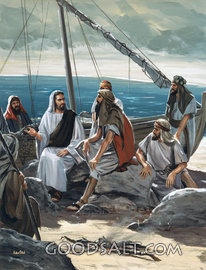
One day he got into a boat with his disciples, and he said to them, “Let us go across to the other side of the lake.” So they set out, and as they sailed he fell asleep. And a windstorm came down on the lake, and they were filling with water and were in danger. And they went and woke him, saying, “Master, Master, we are perishing!” And he awoke and rebuked the wind and the raging waves, and they ceased, and there was a calm. He said to them, “Where is your faith?” And they were afraid, and they marveled, saying to one another, “Who then is this, that he commands even winds and water, and they obey him?” – Luke 8:22-25

I WANT to call attention particularly to this question which was addressed by our Lord and Savior Jesus Christ to the disciples. He said to them: `Where is your faith?’ Indeed I would call your attention to this entire incident as a part of our consideration of the subject of spiritual depression. We have already considered a number of causes of the condition and this particular incident in the life and ministry of our Lord brings us face to face with yet another cause.

The one that is dealt with here is the whole problem and question of the nature of faith. In other words, there are many Christians who get into difficulty and are unhappy from time to time because they clearly have not understood the nature of faith. `Well’, you may say, `if they have not understood the nature of faith, how can they be Christians?’ The answer is that what makes one a Christian is that one is given the gift of faith. We are given the gift of faith by God through the Holy Spirit and we believe on the Lord Jesus Christ and that saves us; but that does not mean that we have fully understood the nature of faith. So it comes to pass that, while we may be truly Christian and genuinely saved through receiving this gift of faith, we may subsequently get into trouble with our spiritual experience because we have not understood what faith really is. It is given as a gift, but from there on we have to do certain things about it.

Now this very striking incident brings out the vital importance of distinguishing between the original gift of faith and the walk of faith, or the life of faith which comes subsequently. God starts us off in this Christian life and then we have to walk in it. `We walk by faith, not by sight’, is the theme that we are now considering.

Before I come actually to that particular theme, I must say a few words about this great incident in and of itself. Looked at from any standpoint it is a very interesting and important incident. It has a great deal to tell us, for instance, about the Person of our Lord Himself. It brings us face to face with what is described as a paradox, the seeming contradiction in the Person of our Lord Jesus Christ. There He was, weary and tired, so tired, in fact, that He fell asleep. Now this incident is recorded by the three so-called synoptic Gospels, Matthew, Mark and Luke, and it is really important from the standpoint of understanding the Person of the Lord Jesus Christ. Look at Him. There is no doubt about His humanity, He is fatigued, He is tired and weary, so much so that He just falls asleep, and, though the storm has arisen, He still goes on sleeping. He is subject to infirmity, He is a man in the body and flesh like all the rest of us. Ah, yes, but wait a minute. They came to Him and awoke Him saying:

`Master, carest Thou not that we perish?’ Then He arose and rebuked the wind and the raging of the sea, and they ceased and there was a calm-one of the others describes it as `a great calm’. Now it is not surprising that the disciples, seeing all this, wondered and said one to another: `What manner of Man is this! For He commandeth even the winds and water and they obey Him’.

Man, and yet obviously God. He could command the elements, He could silence the wind and stop the raging of the sea. He is the Lord of nature and of creation, He is the Lord of the universe. This is the mystery and the marvel of Jesus Christ-God and Man, two natures in One Person, two natures unmixed yet resident in the same Person.

We must start here, because if we are not clear about that there is no purpose in our going on. If you do not believe in the unique deity of the Lord Jesus Christ, you are not a Christian, whatever else you may be. We are not looking at a good Man only, we are not interested merely in the greatest Teacher the world has ever seen; we are face to face with the fact that God, the Eternal Son, has been in this world and that He took upon Him human nature and dwelt amongst us, a Man amongst men-God-Man. We are face to face with the mystery and the marvel of the Incarnation and of the Virgin Birth. It is all here, and it shines out in all the fullness of its amazing glory. `What manner of Man is this?’ He is more than Man. That is the answer-He is also God.

However, that is not, it seems to me, the special purpose of this particular incident. You get that revelation in other places also, it shines out right through all the Gospels; but the separate particular incidents in which it is seen, generally also have some special and peculiar message of their own to teach us. In this case there can be no doubt that that message is the lesson with regard to the disciples and their condition at this point-it is the great lesson concerning faith and the nature or the character of faith. I do not know what you feel, but I never cease to be grateful to these disciples. I am grateful for the record of every mistake they ever made, and for every blunder they ever committed, because I see myself in them. How grateful we should be to God that we have these Scriptures, how grateful to Him that He has not merely given us the gospel and left it at that. How wonderful it is that we can read accounts like this and see ourselves depicted in them, and how grateful we should be to God that it is a divinely inspired Word which speaks the truth, and shows and pictures every human frailty.

So we find our Lord rebuking these men. He rebukes them because of their alarm, because of their terror, because of their lack of faith. Here they were in the boat with Him, and the storm arose, and soon they were in difficulties. They baled out the water, but the boat was filling up and they could see that in a few moments it was going to sink. They had done everything they could but it did not seem to be of any avail, and what amazed them was that the Master was still sleeping soundly in the stern of the vessel. So they awoke Him and said: `Master, Master, carest Thou not that we perish?’ -are You unconcerned about it all? And He arose, and having rebuked the wind and the sea, He rebuked them.

Now we must be careful to observe this rebuke and to understand what He was saying. In the first place, He was rebuking them for being in such a state at all. `Where is your faith?’ He says. Matthew puts it: `O ye of little faith!’ Here as elsewhere `He marvelled at their unbelief’. He rebuked them for being in that state of agitation and terror and alarm while He was with them in the boat.

That is the first great lesson we have to apply to ourselves and to one another. It is very wrong for a Christian ever to be in such a condition. I do not care what the circumstances may be, the Christian should never be agitated, the Christian should never be beside himself like this, the Christian should never be at his wit’s end, the Christian should never be in a condition in which he has lost control of himself. That is the first lesson, a lesson we have emphasized before because it is an essential part of the New Testament teaching. A Christian should never, like the worldly person, be depressed, agitated, alarmed, frantic, not knowing what to do. It is the typical reaction to trouble of those who are not Christian, that is why it is so wrong to be like that.

The Christian is different from other people, the Christian has something which the non-Christian does not possess, and the ideal for the Christian is that which is stated so perfectly by the Apostle Paul in the fourth chapter of the Epistle to the Philippians : `I have learned, in whatsoever state I am, therewith to be content . . . I can do all things through Christ which strengtheneth me’. That is the Christian position, that is what the Christian is meant to be like. The Christian is never meant to be carried away by his feelings, whatever they are-never. That is always wrong in a Christian. He is always to be controlled, as I hope to show you. The trouble with these men was that they were lacking in self-control. That is why they were miserable, that is why they were unhappy, that is why they were alarmed and agitated, though the Son of God was with them in the boat. I cannot emphasize this point too strongly. I lay it down as a simple proposition that a Christian should never lose self-control, should never be in a state of agitation or terror or alarm, whatever the circumstances. That is obviously our first lesson.

The position of these people was alarming. They were in jeopardy and it looked as if they were going to be drowned the next moment, but our Lord says in effect: `You should not be in that condition. As My followers you have no right to be in such a state even though you are in jeopardy’. That is the first great lesson, and the second is, that what is so wrong about being in this condition is that it implies a lack of trust and of confidence in Him. That is the trouble and that is why it is so reprehensible. That is why He reprimanded these men at that point. He said in effect: `Do you feel like this in spite of the fact that I am with you? Do you not trust Me?’ Mark reports them as saying: `Master, carest Thou not that we perish?’ Now I do not think that they were referring only to themselves or to their own safety. I do not think that they were so self-centred.

I do not think that they simply meant: Don’t You care that we are going to drown? without considering Him at all. I believe they were including Him as well, that they thought they were all going to be drowned. `Master, carest Thou not that we perish?’ But still, this agitation and alarm always carries with it a lack of implicit trust and confidence in Him. It is a lack of faith in His concern for us and in His care for us. It means that we take charge and are going to look after the situation ourselves, feeling either that He does not care, or perhaps that He cannot do.

It means that we take charge and are going to look after the situation ourselves, feeling either that He does not care, or perhaps that He cannot do anything. That is what makes this so terrible, but I wonder whether we always realize it. It seems obvious as we look at it objectively in the case of these disciples; but when you and I are agitated or disturbed and do not know what to do, and are giving the impression of great nervous tension, anybody looking at us is entitled to say : `That person has not much faith in his or her Lord. There does not seem to be much point in being a Christian after all, there is not much value in Christianity as I see it in that person’.

Now during the war we were all subject to these trials in an exceptional way, but even now in days of peace anything that comes across our path and puts us in difficulty, at once shows whether we believe in Him and trust in Him, by our response and reaction to it. There seems to me, therefore, on the very surface to be these two great lessons.

We must never allow ourselves to be agitated and disturbed whatever the circumstances because to do so implies a lack of faith, a lack of trust, a lack of confidence in our blessed Lord and God. However, let us look at the passage in detail, let us now draw some general principles out of the incident and its great teaching.

First of all, in looking at this whole question of faith, let me say a word about what I might call `the trial of faith’. Scripture is full of this idea of the trial of one’s faith. Take the eleventh chapter of the Epistle to the Hebrews. That is, in a sense, nothing but a great exposition of this theme of the trial of faith. Every one of those men was tried. They had been given great promises and they had accepted them, and then everything seemed to go wrong. It is true of all of them. Think of the trial of a man like Noah, the trial of a man like Abraham, the trials that men like Jacob and especially Moses had to endure. God gives the gift of faith and then the faith is tried.

Peter, in his First Epistle in the first chapter, says exactly the same thing. He says : `Though ye are in heaviness for a season’ because of certain circumstances, the object of that is `that the trial of your faith which is more precious than of gold that perisheth, though it be tried with fire, might be found unto praise and honor and glory at the appearing of Jesus Christ’. That is the theme of all the Scriptures. You find it in the history of the Patriarchs and of all the Old Testament saints, you find it running through the New Testament. Indeed, it is peculiarly the theme of the last book of the Bible, the Book of Revelation.

Let us then be clear about this. We must start by understanding that we may well find ourselves in a position in which our faith is going to be tried. Storms and trials are allowed by God. If we are living the Christian life, or trying to live the Christian life, at the moment, on the assumption that it means just come to Christ and you will never have any more worry in the whole of your life, we are harboring a terrible fallacy. In fact it is a delusion and it is not true. Our faith will be tried, and James goes so far as to say: `Count it all joy when ye fall into divers temptations (trials)’ (James 1:2). God permits storms, He permits difficulties, He permits the wind to blow and the billows to roll, and everything may seem to be going wrong and we ourselves to be in jeopardy. We must learn and realize that God does not take His people and lead them into some kind of Elysium in which they are protected from all `the slings and arrows of outrageous fortune’. Not at all, we are living in the same world as everybody else. Indeed, the Apostle Paul seems to go further than that.

He tells the Philippians: `Unto you it is given in the behalf of Christ, not only to believe on Him, but also to suffer for His sake’ (Philippians 1. 29). `In the world’, says our Lord, `ye shall have tribulation but be of good cheer; I have overcome the world’ (John 16:33) `Be of good cheer’-yes, but remember that you will have the tribulation. Paul and Barnabas going on their missionary journey visited the churches and warned them, `that we must through much tribulation enter into the Kingdom of God’ (Acts 14:22).

We must start by realizing that `to be forewarned is to be forearmed’ in this matter. If we have a magical conception of the Christian life, we are certain to find ourselves in trouble, because, when difficulties come, we shall be tempted to ask: `Why is this allowed?’ And we should never ask such a question. If we but realized this fundamental truth, we never would ask it. Our Lord goes to sleep and allows the storm to come. The position may indeed become quite desperate and we may appear to be in danger of our lives. Everything may seem to be against us, yet-well here it is, a Christian poet has said it for us:

`When all things seem against us To drive us to despair’ .. .

But it does not drive him to despair because he goes on to say:

`We know one gate is open One ear will hear our prayer’.

But things may be desperate: `All things seem against us, to drive us to despair’. Let us then be prepared for that. Yes, but we must go further. While all this is happening to us, our Lord appears to be utterly unconcerned about us. That is where the real trial of faith comes in. The wind and the billows were bad enough and the water coming into the ship. That was terrible, but the thing that to them was most terrible of all was His apparent unconcern. Still sleeping and not apparently caring. `Master, carest Thou not that we perish?’ He appears to be unconcerned, unconcerned about us, unconcerned about Himself, unconcerned about His cause, unconcerned about His Kingdom.

Just imagine the feelings of these men. They had followed Him and listened to His teaching about the coming of the Kingdom, they had seen His miracles and were expecting marvelous things to happen; and now it looked as if everything was going to come to an end in shipwreck and drowning. What an anti-climax and all because of His unconcern! We must be very young indeed in the Christian life if we do not know something about this. Do we not all know something of this position of trial and difficulty, yes, and of a feeling that God somehow does not seem to care? He does not do anything about it. `Why does He allow me, a Christian, to suffer at the hands of a non-Christian?’ says many a person. `Why does He allow things to go wrong with me and not with the other person?’ `Why is that man successful while I am unsuccessful? Why does not God do something about it?’ How often do Christian people ask such questions. They have asked it about the whole state of the Church today. `Why does He not send revival? Why does He allow these rationalists and atheists to take the ascendancy? Why does He not break in and do something, and revive His work?’ How often we are tempted to say such things, exactly as these disciples in the boat were!

The fact that God permits these things and that He often appears to be quite unconcerned about it all really constitutes what I am describing as the trial of faith. Those are the conditions in which our faith is tried and tested, and God allows it all, God permits it all. James even tells us to `count it all joy’ when these things happen to us. This is a great subject-the trial of faith. We do not talk much about it these days, do we? But if we went back to the seventeenth or eighteenth century we would find that it was then a very familiar theme. I suppose that in many ways it was the central theme of the Puritans. It was certainly prominent later on in the evangelical awakening of the eighteenth century. The trial of man’s faith and how to overcome these things, the walk of faith, and the life of faith, was their constant theme.

Let us now go on to the second question–What is the nature of faith, the character of faith? This is above everything the particular message of this incident and I feel that it is brought out especially clearly in this record of it in the Gospel according to St. Luke. That is why I am taking the incident from that particular Gospel and emphasizing the way in which our Lord puts the question: `Where is your faith?’ There is the key to the whole problem. You observe our Lord’s question. It seems to imply that He knows perfectly well that they have faith. The question He asks them is: `Where is it? You have got faith, but where is it at this moment? It ought to be here, where is it?’ Now that gives us the key to the understanding of the nature of faith.

Let me first of all put it negatively. Faith, obviously, is not a mere matter of feeling. It cannot be, because one’s feelings in this kind of condition can be very changeable. A Christian is not meant to be dejected when everything goes wrong. He is told to `rejoice’. Feelings belong to happiness alone, rejoicing takes in something much bigger than feelings; and if faith were a matter of feelings only, then when things go wrong and feelings change, faith will go. But faith is not a matter of feelings only, faith takes up the whole man including his mind, his intellect and his understanding. It is a response to truth, as we shall see.

The second thing is still more important. Faith is not something that acts automatically, faith is not something that acts magically. This, I think, is the blunder of which we have all, at some time or another, been guilty. We seem to think that faith is something that acts automatically. Many people, it seems to me, conceive of faith as if it were something similar to those thermostats which you have in connection with a heating apparatus, you set your thermostat at a given level, you want to maintain the temperature at a certain point and it acts automatically. If the temperature is tending to rise above that, the thermostat comes into operation and brings it down; if you use your hot water and the temperature is lowered, the thermostat comes into operation and sends it up, etc. You do not have to do anything about it, the thermostat acts automatically and it brings the temperature back to the desired level automatically. Now there are many people who seem to think that faith acts like that. They assume that it does not matter what happens to them, that faith will operate and all will be well. Faith, however, is not something that acts magically or automatically. If it did, these men would never have been in trouble, faith would have come into operation and they would have been calm and quiet and all would have been well. But faith is not like that and those are utter fallacies with respect to it.

What is faith? Let us look at it positively. The principle taught here is that faith is an activity, it is something that has to be exercised. It does not come into operation itself, you and I have to put it into operation. It is a form of activity.

Now let me divide that up a little. Faith is something you and I have to bring into operation. That is exactly what our Lord said to these men. He said: `Where is your faith?’ which means, `Why are you not taking your faith and applying it to this position?’ You see, it was because they did not do so, because they did not put their faith into operation, that the disciples had become unhappy and were in this state of consternation. How then does one put faith into operation? What do I mean by saying that faith is something we have to apply? I can divide my answer in this way. The first thing I must do when I find myself in a difficult position is to refuse to allow myself to be controlled by the situation. A negative, you see. These men were in the boat, the Master was asleep and the billows were rolling, the water was coming in, and they could not bale it out fast enough. It looked as if they were going to sink, and their trouble was that they were controlled by that situation. They should have applied their faith and taken charge of it, and said: `No, we are not going to panic’. They should have started in that way, but they did not do so. They allowed the position to control them.

Faith is a refusal to panic. Do you like that sort of definition of faith? Does that seem to be too earthly and not sufficiently spiritual? It is of the very essence of faith. Faith is a refusal to panic, come what may. Browning, I think had that idea when he defined faith like this: `With me, faith means perpetual unbelief kept quiet, like the snake ‘neath Michael’s foot’. Here is Michael and there is the snake beneath his foot, and he just keeps it quiet under the pressure of his foot. Faith is unbelief kept quiet, kept down. That is what these men did not do, they allowed this situation to grip them, they became panicky. Faith, however, is a refusal to allow that. It says: `I am not going to be controlled by these circumstances-I am in control’. So you take charge of yourself, and pull yourself up, you control yourself. You do not let yourself go, you assert yourself.

That is the first thing, but it does not stop at that. That is not enough, because that may be nothing but resignation. That is not the whole of faith. Having taken that first step, having pulled yourself up, you then remind yourself of what you believe and what you know. That again is something these foolish disciples did not do. If only they had stopped a moment and said:

`Now then what about it? Is it possible that we are going to drown with Him in the boat? Is there anything He cannot do? We have seen His miracles, He turned the water into wine, He can heal the blind and the lame, He can even raise the dead, is it likely that He is going to allow us and Himself to be drowned in this way? Impossible! In any case He loves us, He cares for us, He has told us that the very hairs of our head are all numbered!’ That is the way in which faith reasons. It says: `All right, I see the waves and the billows but’-it always puts up this `but’. That is faith, it holds on to truth and reasons from what it knows to be fact. That is the way to apply faith.

These men did not do that and that is why they became agitated and panic stricken. And you and I will become panic stricken and agitated if we fail to do the same. Whatever the circumstances, therefore, stand, wait for a moment. Say: `I admit it all, but–‘ But what? But God! but the Lord Jesus Christ! But what? The whole of my salvation! That is what faith does. All things may seem to be against me `to drive me to despair’, I do not understand what is happening; but I know this, I know that God has so loved me that He sent His only begotten Son into this world for me, I know that while I was an enemy, God sent His only Son to die on the Cross on Calvary’s Hill for me. He has done that for me while I was an enemy, a rebellious alien. I know that the Son of God `loved me and gave Himself for me’. I know that at the cost of His life’s blood I have salvation and that I am a child of God and an heir to everlasting bliss. I know that. Very well, then, I know this, that `if when we were enemies, we were reconciled to God by the death of His Son, much more, being reconciled, we shall be saved by His life’ (Romans 5:10). It is inevitable logic, and faith argues like that. Faith reminds itself of what the Scripture calls ‘the exceeding great and precious promises’.

Faith says: ‘I cannot believe that He who has brought me so far is going to let me down at this point. It is impossible, it would be inconsistent with the character of God’. So faith, having refused to be controlled by circumstances, reminds itself of what it believes and what it knows.

And then the next step is that faith applies all that to the particular situation. Again, that was something these men did not do, and that is why our Lord puts it to them in this way: `Where is your faith?’ –`You have got it, why don’t you apply it, why don’t you bring all you know to bear on this situation, why don’t you focus it on this particular problem?’ That is the next step in the application of faith. Whatever your circumstances at this moment, bring all you know to be true of your relationship to God to bear upon it. Then you will know full well that He will never allow anything to happen to you that is harmful. `All things work together for good to them that love God.‘ Not a hair of your head shall be harmed, He loves you with an everlasting love.

I do not suggest that you will be able to understand everything that is happening. You may not have a full explanation of it; but you will know for certain that God is not unconcerned. That is impossible. The One who has done the greatest thing of all for you, must be concerned about you in everything, and though the clouds are thick and you cannot see His face, you know He is there. `Behind a frowning providence He hides a smiling face.’ Now hold on to that. You say that you do not see His smile. I agree that these earthborn clouds prevent my seeing Him, but He is there and He will never allow anything finally harmful to take place. Nothing can happen to you but what He allows, I do not care what it may be, some great disappointment, perhaps, or it may be an illness, it may be a tragedy of some sort, I do not know what it is, but you can be certain of this, that God permits that thing to happen to you because it is ultimately for your good. `Now no chastening for the present seemeth to be joyous, but grievous; nevertheless afterward it yieldeth the peaceable fruit of righteousness’ (Hebrews 12:11).

That is the way faith works. But you and I have to exercise it. It does not come into operation automatically. You have to focus your faith on to events and say: `All right, but I know this about God, and because that is true I am going to apply it to this situation. This, therefore, cannot be what I think it is, it must have some other explanation’. And you end by seeing that it is God’s gracious purpose for you, and having applied your faith, you then hold on. You just refuse to be moved. The enemy will come and attack you, the water will seem to be pouring into the boat, but you say: `It is all right, let the worst come to the worst’. You stand on your faith. You say to yourself: `I believe this, I am resting on this, I am certain of this and though I do not understand what is happening to me I am holding on to this!’

That brings me to my final word, which is my third principle –the value of even the weakest or smallest faith. We have looked at the trial of faith, we have looked at the nature of faith, let me say a closing word on the value of even the weakest and smallest faith. However poor and small and however incomplete the faith of these disciples was on this occasion, they at any rate had a sufficient amount of faith to make them do the right thing in the end. They went to Him. Having been agitated and distressed and alarmed and exhausted, they went to Him. They still had some kind of feeling that He could do something about it, and so they woke Him and said: `Master, are you not going to do something about it?’ That is very poor faith you may say, very weak faith, but it is faith, thank God. And even faith `like a grain of mustard seed’ is valuable because it takes us to Him. And when you do go to Him this is what you will find. He will be disappointed with you and He will not conceal that. He will rebuke you, He will say: `Why did you not reason it out, why did you not apply your faith, why do you appear agitated before that worldly person, why do you behave as if you were not a Christian at all, why didn’t you apply your faith as you should have done? I would have been so pleased if I could have watched you standing like a man in the midst of the hurricane or stormy why didn’t you?’ He will let us know that He is disappointed in us and He will rebuke us; but, blessed be His Name, He will nevertheless still receive us. He does not drive us away. He did not drive these disciples away, He received them and He will receive us. Yes, and He will not only receive us, He will bless us and He will give us peace. `He rebuked the wind and the sea and there was a great calm.’ He produced the condition they were so anxious to enjoy, in spite of their lack of faith. Such is the gracious Lord that you and I believe in and follow. Though He is disappointed in us often and though He rebukes us, He will never neglect us; He will receive us, He will bless us, He will give us peace, indeed He will do for us what He did for these men.

With this peace He gave them a still greater conception of Himself than they had had before. They marveled, and were full of amazement at His wonderful power. He, as it were, threw that into the bargain on top of all the blessings. If you find yourself in this position of trial and trouble and testing, take it as a wonderful opportunity of proving your faith, of showing your faith, of manifesting your faith and bringing glory to His great and Holy Name. But if you should fail to do that, if you should apparently be too weak to apply your faith, if you are being so besieged and attacked by the devil and by hell and by the world, well, then, I say, just fly to Him at once and He will receive you and will bless you, He will give you deliverance, He will give you peace. But remember always that faith is an activity, it is something that has to be applied. `Where is your faith?’ Let us make certain that it is always at the place and at the point of need and of testing.

The Article/Sermon above was adapted from Chapter 10 in the Classic book of Sermons by Dr. David Martyn Lloyd-Jones. Spiritual Depression: It’s Causes and Cure. Grand Rapids: Eerdmans, 1965.

 About the Preacher:

Dr. David Martyn Lloyd-Jones (1899-1981) [hereafter – DMLJ] was a British evangelical born and brought up within Welsh Calvinistic Methodism, he is most noted for his pastorate and expository preaching career at Westminster Chapel in London.

In addition to his work at Westminster Chapel, he published books and spoke at conferences and, at one point, presided over the Inter-Varsity Fellowship of Students (now known as UCCF). Lloyd-Jones was strongly opposed to the liberal theology that had become a part of many Christian denominations in Wales and England.

DMLJ’s most popular writings are collections of his sermons edited for publication, as typified by his multi-volume series’ on Acts, Romans, Ephesians, 1 John, and Philippians. My favorite writings are his expositions on the Sermon on the Mount; Revival; Joy Unspeakable; Spiritual Depression; and his recently revised 40th Anniversary edition of Preaching and Preachers.

Born in Wales, Lloyd-Jones was schooled in London. He then entered medical training at Saint Bartholomew’s Hospital, better known simply as Bart’s. Bart’s carried the same prestige in the medical community that Oxford did in the intellectual community. Martyn’s career was medicine. He succeeded in his exams so young that he had to wait to take his MD, by which time he was already chief clinical assistant to Sir Thomas Horder, one of the best and most famous doctors of the day. By the age of 26 he also had his MRCP (Member of the Royal College of Physicians).

Although he had considered himself a Christian, the young doctor was soundly converted in 1926. He gave up his medical career in 1927 and returned to Wales to preach and pastor his first church in Sandfields, Aberavon.

In 1935, Lloyd-Jones preached to an assembly at Albert Hall. One of the listeners was 72-year-old Dr. Campbell Morgan, pastor of Westminster Chapel in London. When he heard Martyn Lloyd-Jones, he wanted to have him as his colleague and successor in 1938. But it was not so easy, for there was also a proposal that he be appointed Principal of the Theological College at Bala; and the call of Wales and of training a new generation of ministers for Wales was strong. In the end, however, the call from Westminster Chapel prevailed and the Lloyd-Jones family finally committed to London in April 1939.

After the war, under Lloyd-Jones preaching, the congregation at Westminster Chapel grew quickly. In 1947 the balconies were opened and from 1948 until 1968 when he retired, the congregation averaged perhaps 1500 on Sunday mornings and 2000 on Sunday nights.

In his 68th year, he underwent a major medical operation. Although he fully recovered, he decided to retire from Westminster Chapel. Even in retirement, however, Lloyd-Jones worked as a pastor of pastors an itinerant speaker and evangelist. “The Doctor”, as he became known, was one of the major figureheads of British evangelicalism and his books and published sermons continue to be appreciated by many within the United Kingdom and beyond. DMLJ believed that the greatest need of the church was revival.

Are You a Worrier? Zig Ziglar on The Problem of Worrying

Therefore do not be anxious, saying, ‘What shall we eat?’ or ‘What shall we drink?’ or ‘What shall we wear?’ For the Gentiles seek after all these things, and your heavenly Father knows that you need them all. But seek first the kingdom of God and his righteousness, and all these things will be added to you.“Therefore do not be anxious about tomorrow, for tomorrow will be anxious for itself. Sufficient for the day is its own trouble” (Matthew 6:31-34, ESV). 

 Why Worry?

 Worry has been described as “interest paid on trouble before it comes due.”

One of America’s worst enemies is worry. Worry is like a rocking chair; it requires a lot of energy, and it gets you nowhere. Leo Buscaglia said, “Worry never robs tomorrow of its sorrow, it only saps today of its joy.”

 Question: Are you a Worrier?

Americans take more pills to forget more worries about more things than ever before and more than people in any other nation in history. That’s bad. According to Dr. Charles Mayo, “Worry affects the circulation and the whole nervous system. I’ve never know a man who died from overwork, but I’ve known many who have died from doubt.”

Mathematically speaking, it really doesn’t make sense to worry. Psychologists and other researchers tell us that roughly 40 percent of what we worry about will never happen and 30 percent has already happened. Additionally, 12 percent of our worries are over unfounded health concerns. Another 10 percent of our worries involve the daily miscellaneous fretting that accomplishes nothing. That leaves only 8 percent. Plainly speaking. Americans are worrying 92 percent of the time for no good reason, and if Dr. Mayo is right, it’s killing us.

One solution that will reduce your worry is this: Don’t worry about what you can’t change. Example: For a number of years I’ve flown in excess of two hundred thousand miles a year. On occasion, flights are canceled or delayed. As I write this, I’m sitting on the runway waiting for my gate to clear. If I worry or get angry, nothing will change. If I take constructive action and finish this chapter, I’m ahead of the game. That’s a positive way to use energy that I would have wasted on anger, frustration, or worrying.

The message is clear: If you don’t like your situation in life, don’t fret or worry—do something about it. Worry less, and act more.

 About Zig Ziglar:

Zig Ziglar was born in Coffee County, Alabama on November 26, 1926 and was the tenth of 12 children. In 1931, when Ziglar was five years old, his father took a management position at a Mississippi farm, and family moved to Yazoo City, Mississippi, where he spent his early childhood. In 1932, his father died of a stroke, and his younger sister died two days later.

Zigler served in the Navy during World War II (circa 1943-1945). He was in the Navy V-12 College Training Program, attending the University of South Carolina. In 1944 he met his wife Jean, in Jackson, Mississippi; he was 17 and she was 16. They married in late 1946.

Ziglar later worked as a salesman in a succession of companies. In 1968 he became the vice president and training director for the Automotive Performance company, moving to Dallas, Texas.

In 1970, Ziglar went into the business of motivational speaking full-time, with an emphasis on Christian values. Until then, he called himself by his given name, Hilary, but now satarted using his nickname, Zig, instead.

Until 2010 (aged 86) Ziglar traveled around the world taking part in motivational seminars, but has been somewhat limited recently due to a fall down a flight of stairs in 2007 that has impaired his short-term memory and physical abilities.

Through the ups and downs of life Ziglar has maintained his optimism and encouraged thousands of people to be their best in the particular endeavors to which God has called them. Zig Ziglar is one of the most inspirational people on the planet today and is a terrific example of someone who has embraced the struggle of life giving God the glory each step of the way.

The article above was adapted from one of Zig’s many encouraging books: Something to Smile About: Encouragement and Inspiration for Life’s UPS and DOWNS. Nashville: Thomas Nelson, 1997.

 Zig Ziglar’s Books:

  • Ziglar, Zig; Ziglar, Tom. Born to Win: Find Your Success Code. Dallas: SUCCESS Media (2012).
  • Something Else To Smile About: More Encouragement and Inspiration for Life’s Ups and Downs. Nashville: Thomas Nelson (2010).
  • Ziglar, Zig; Norman, Julie Ziglar. Embrace the Struggle: Living Life on Life’s Terms. New York: Howard Books (2009).
  • The One-Year Daily Insights with Zig Ziglar. Tyndale House Publishers (2009)
  • Inspiration 365 Days a Year with Zig Ziglar. SIM (2008)
  • God’s Way is Still the Best Way. Nashville: Thomas Nelson  (2007).
  • Better Than Good: Creating a Life You Can’t Wait to Live. Nashville: Thomas Nelson Publishers (2006).
  • Conversations with My Dog. B&H Books (2005).
  • The Autobiography of Zig Ziglar. New York: Random House (2004).
  • Confessions of a Grieving Christian. Nashville: B&H Publishing Group 2004).
  • Courtship After Marriage: Romance Can Last a Lifetime. Nashville: Thomas Nelson  (2004).
  • Staying Up, Up, Up in a Down, Down World. Nashville: Thomas Nelson  (2004).
  • Zig Ziglar’s Life Lifters: Moments of Inspiration for Living Life Better. B&H (2003).
  • Selling 101: What Every Successful Sales Professional Needs to Know. Nashville: Thomas Nelson Publishers (2003).
  • Ziglar, Zig and Hayes, John P. Network Marketing For Dummies. Foster City, Calif: IDG Books (2001).
  • Success for Dummies. Foster City, Calif: IDG Books (1998).
  • Something to Smile About: Encouragement and Inspiration for Life’s UPS and DOWNS. Nashville: Thomas Nelson (1997).
  • Great Quotes from Zig Ziglar. Career Press (1997)
  • Over the Top. Nashville: Thomas Nelson Publishers (1994).
  • Five Steps to Successful Selling. Nigtingale-Conant Corp. (1987).
  • Top Performance: How to Develop Excellence in Yourself and Others. New York: Berkley Books (1986).
  • Raising Positive Kids in a Negative World. Nashville: Oliver Nelson (1985).
  • Zig Ziglar’s Secrets of Closing the Sale. New York: Berkley Books (1982).
  • See You at the Top. Gretna: Pelican (1975).

Dr. David P. Craig on Cancer and God’s Glory

“Peace in Cancer, Because Christ is Bigger!”

I’m in good company – John Piper and Tim Keller have both battled cancer – and there are many other less known Christians who have faced the battle. As of today, Piper and Keller have been freed from any trace of cancer. Perhaps my greatest pastoral hero was Dr. James Montgomery Boice. When he was diagnosed with cancer he continued to minister in his church in Philadelphia as he always had – being faithful to the gospel, emphasizing God’s glory and sovereignty – and the Lord took him home within six months of his being diagnosed with cancer. He was steadfast and brave because all he had known and preached for forty years was the sovereignty and goodness of his Savior – the Lord Jesus Christ.

Tomorrow, I go to the hospital for a PET scan. When I first found out recently that the lump in my neck was cancer (and not an infection – as I had hoped) – I didn’t take the news too well. After receiving the news I came home and went for a long walk – cried, prayed, got angry with God, confessed every known sin, and got extremely tired, depressed, and discouraged. A few days after the news I settled down and realized that this is where the gospel meets the road of life – when faced with our mortality.

In the excellent book Suffering and the Goodness of God edited by Christopher W. Morgan and Robert A. Peterson, Robert W. Yarborough writes an excellent illustration in the first chapter that articulates the realities of life and death and the integration of the gospel that gives us hope in the face of our mortality:

Suffering is a bracing slap in the face that drives God’s people again and again to clarify and purify the fundamental terms of acknowledgment and worship of their God. It drives us to turn our hearts to God in truer prayer. The rediscovery and application of a brutally realist God-centeredness is an urgent need in an era of much crass human-centeredness—typified recently in the ego-centered absurdity of Episcopal priest Ann Holmes Redding’s simultaneous profession of both Christian and Muslim faith (Cf. Eric Young, “Episcopal Priest Suspended over Muslim-Christian Identity,” Christian Post Reporter, July 7, 2007, http://www.christianpost.com/article/20070707/28350_Episcopal_Priest_Suspended_Over_Muslim-Christian_Identity.htm – July 9, 2007).

Nor have we explored implications of the fact that whatever suffering Christians and everybody else must endure in this world, it pales next to scriptural predictions of what awaits the divinely accursed both in this age and in the age to come (Cf. Stephen Keillor, God’s Judgments: Interpreting History and the Christian Faith. Downers Grove: IVP Academic, 2007. 40. See Christopher W. Morgan and Robert A. Peterson, eds., Hell Under Fire. Grand Rapids, MI: Zondervan, 2004).

This has contemporary significance in that contemplation of both current and eschatological woe is an important incentive to cultivate a seemly sense of urgency in personal pursuit of God, in ecclesial labors including evangelism, and in mission generally. But the last word of this introductory chapter belongs not to one more thesis or argument but to a story. We began speaking of a boy’s death by crocodile in Costa Rica. No one could save him [he was killed by the crocodile].

A second story, very similar, has a different ending. In the Nseleni River near subtropical Empangeni, South Africa, two third-graders released from school with pinkeye decided to slip away for a secret swim. As they were leaving the water, a hidden crocodile’s jaws closed on Msomi’s leg. He shouted frantically for help. Companions wisely and understandably fled. Except for Themba. He grabbed his friend Msomi in a tug-of-war with the determined reptile. Matters hung in the balance for a long turbulent moment. Suddenly Msomi broke free. He scampered out of the water, bleeding from his left leg and arm and from a cut across his chest. But he was saved. And Themba the noble rescuer, a third-grade kid with the heart of a grizzled warrior? Msomi, visibly shaken, lamented from his hospital bed: “I ran out of the water, but as Themba tried to get out, the crocodile caught him and he disappeared under the water. That was the last time I saw my friend alive. I’ll never forget what happened that day—he died while trying to save me” (Sibusiso Ngalwa, “Boy Dies Saving Friend from Crocodile,” April 4, 2004, http://www.io l. co.za/?click_id= 14&art_id=vn20040404110517366C649996&set_id=1 – July 10, 2007).

The crocodiles of crises and calamities beset us all. Eventually we wander into the kill zone where the unwanted lurks, biding its time.

Suffering is ubiquitous and finally terminal in this age. But there is a God, and he is good, and those who seek him are saved. We are all Msomi, but there is a Themba (Christopher W. Morgan and Robert A. Peterson, eds., Suffering and the Goodness of God. Wheaton, IL.: Crossway Books, 2008).

I praise God that Jesus is my Savior – my Themba. Although Themba’s death for his friend was an incredible act of love it was not salvific in a spiritual sense. Only Jesus’ perfect life and purposeful atoning death propitiated the wrath of God that my sin deserves. Therefore, whether this cancer takes my life or not – I’m covered by the blood of Christ’s death as payment for my sins. His perfect love casts out my fear!

I’m sure I’ll have ups and downs along the way. However, I hope that whether I live or die soon, or in several years that I can live like Keller, Piper, and Boice who have paved the way for me – at peace with God because of Jesus – my Themba!

My heart’s desire is that whether God chooses to take me home or spare my life mercifully and graciously that I will be able (with Christ’s help) to bring Him the glory that He deserves for already sparing my life and rescuing me from eternal separation from Him.

May I be able to say with the apostle Paul, “For me to live is Christ, and to die is gain”…and “So whether we [I] eat or drink, or whatever we [I] do, may all be to the glory of God” (Philippians 1:21; 1 Corinthians 10:31).

Why? because of passages like 2 Corinthians 5:21 and Romans 8:1,11, 18, 28-39:

“For our sake [my sake] he made him [Jesus] to be sin who knew no sin, so that in him we might become the righteousness of God…There is therefore now no condemnation for those who are in Christ Jesus…If the Spirit of him who raised Jesus from the dead dwells in you, he who raised Christ Jesus from the dead will also give life to your mortal bodies through his Spirit who dwells in you…For I consider that the sufferings of this present time are not worth comparing with the glory that is to be revealed to us… And we know that for those who love God all things work together for good, for those who are called according to his purpose. For those whom he foreknew he also predestined to be conformed to the image of his Son, in order that he might be the firstborn among many brothers. And those whom he predestined he also called, and those whom he called he also justified, and those whom he justified he also glorified.

What then shall we say to these things? If God is for us, who can be against us? He who did not spare his own Son but gave him up for us all, how will he not also with him graciously give us all things? Who shall bring any charge against God’s elect? It is God who justifies. Who is to condemn? Christ Jesus is the one who died—more than that, who was raised—who is at the right hand of God, who indeed is interceding for us. Who shall separate us from the love of Christ? Shall tribulation, or distress, or persecution, or famine, or nakedness, or danger, or sword? As it is written, “For your sake we are being killed all the day long; we are regarded as sheep to be slaughtered.”

No, in all these things we are more than conquerors through him who loved us. For I am sure that neither death nor life, nor angels nor rulers, nor things present nor things to come, nor powers, nor height nor depth, nor anything else in all creation, will be able to separate us from the love of God in Christ Jesus our Lord.”

Dr. Gary R. Collins on Six Ways To Find Your Passion

“How To Find Your Passion”

(1)  Ask someone who knows you well to identify your passions.

(2)  Look at your environment. Does this reveal what really interests and excites you?

(3)  If you had no limitations in terms of money or time, what would you do?

(4)  Think of times in your life when you felt exuberant and excited to be alive. What might this say about your passion?

(5)  When you were young and your parents couldn’t find you, what did they assume you were doing? What does this say about your passion?

(6)  Pray that God will reveal His passion and open doors for you to be able to use your passion for His glory in your life.

The six steps above are condensed and adapted from the excellent book on by Gary Collins called Christian Coaching. Colorado Springs: NavPress, 2009 (Revised Edition).

 About the Author:

Gary R. Collins is a licensed clinical psychologist with a Ph.D. in clinical psychology from Purdue University. He is author of numerous articles and over 50 books, including Christian Counseling: A Comprehensive Guide, The Biblical Basis of Christian Counseling, and Christian Coaching: Helping Others Turn Potential into Reality. Gary was general editor of the thirty-volume Resources for Christian Counseling series of professional counseling books mostly published in the 1980s, the Word Christian Counseling Library of cassette tapes, and the twelve-volume Contemporary Christian Counseling series of books that appeared in the early 1990’s.

In December 2001 NavPress published Gary’s book Christian Coaching, a book that has been revised, expanded, updated, and published in 2009. The third edition of Christian Counseling (revised, expanded and completely updated) was published by Thomas Nelson publishers in 2007, followed by an accompanying Casebook of Christian Counseling, also published by Nelson.

Gary Collins grew up in Canada and graduated from McMaster University in Hamilton, Ontario and the University of Toronto before taking a year of study at the University of London. His first teaching occurred during that year as he taught courses for the University of Maryland in Germany and England. Gary spent several years in the Royal Canadian Navy Reserve before moving to the United States to study clinical psychology at Purdue University. He took his clinical psychology internship at the University of Oregon Medical School Hospitals (now University of Oregon Health Sciences University) in Portland and subsequently enrolled at Western Seminary for a year of theological study.

At Western he met his wife Julie. They were married in 1964 and moved to Minnesota where Gary taught psychology at Bethel College in St. Paul. Their two daughters, Lynn and Jan were born in Minnesota. After a year on the faculty of Conwell School of Theology in Philadelphia, the Collins family moved to Illinois where Gary taught psychology and counseling at Trinity Evangelical Divinity School. For much of that time he was department chairman.

In 1991, Gary assumed responsibility for co-leading the fledgling American Association of Christian Counselors. In the seven years that followed, Gary was AACC Executive Director and later the organization’s first President. During that time AACC grew from about 700 paid members to more than 15,000. In addition to these duties, Gary founded Christian Counseling Today, the official AACC magazine which he edited for several years. In October, 1998 Gary Collins resigned from his responsibilities with AACC so he could devote more time to developing Christian counseling and Christian coaching worldwide. In addition to his other responsibilities, he currently holds a position as Distinguished Professor of Coaching and Leadership at Richmont Graduate University (formerly Psychological Studies Institute) in Atlanta and Chattanooga. In addition he is Distinguished Visiting Professor in the School of Psychology and Counseling at Regent University in Virginia where he consults with the faculty and annually teaches an accredited on-line doctoral course in coaching.

Gary has accepted invitations to speak in more than fifty countries and he continues to travel overseas and within North America to give lectures and lead workshops on Christian counseling, leadership, and Christian coaching. Gary also has a small coaching practice, writes the weekly Gary R. Collins Newsletter, and mentors a number of young, emergent leaders. He is active in a local fitness center, is blessed with boundless energy and good health, and has no plans to retire. Gary and Julie Collins live in northern Illinois, not far from their two daughters, their son-in-law, and their grandson Colin Angus McAlister.

Great Questions to Ask Your Mentoree/Disciple

[Bobb Biehl is a personal and organizational leadership expert – below are some great questions to go over = personally; with your staff, team, mentoree, small group, disicple/s, etc.]

(Adapted from Bobb Biehl, Mentoring, pp. 201-202)

 DREAMING…about the Future in a Practical Way

  1. God: What three changes in me would most please our Eternal God in His Holy Heaven?
  1. Dream/Purpose: What can I do to make the most significant difference for God in my lifetime? Why am I on the earth? What is the very best organizational context for my dream?
  1. Primary Result: What is the single best measurable indicator that I am making progress with my dream?
  1. Life Priorities: If I could accomplish only three measurable priorities before I die, what would I accomplish?
  1. Ten-Year Focus: If I could accomplish only three measurable priorities in the next ten years what would make a 50% difference in my life-long contribution, what would I accomplish?
  1. Annual Focus:
    • Focus – What single word best captures the focus of my next year?
    • Opportunity – Where was my greatest unexpected success last year? Why? What three steps could I take now to take full advantage of this “Window of Opportunity” this coming year?
    • Land Mines – What three land mines or roadblocks need my immediate attention? What have I been praying most about in the past 30 days? What three changes could reduce my “risk” by 50%?
    • 30/10/50% – If I could only accomplish three measurable priorities in the next twelve months that would make a 50% difference in my contribution in the next ten years, which 3 things would I most want to accomplish?
  1. Quarterly Focus: What three measurable priorities could I accomplish in the next ninety days to make a 50% difference in the results I see by the end of the year?
  1. Organization: What three categories could I make to see a 50% difference in our morale as a family or team?
  1. Cash: If I had to cut my budget 21%, what would be the first three things to go? If I got a surprise gift of 21% of my budget, what three things would I do immediately?
  1. Quality: What three changes could improve the quality of my work by 50% in the next twelve months?

Bobb Biehl is an executive mentor. He graduated from Michigan State University (psychology major) in 1964 and received a Master’s degree (counseling) from Michigan State in 1966.

In 1976, Bobb founded Masterplanning Group International. As its president, he has consulted personally with over 400 clients. In that time, he has met one-on-one with over 3,500 executives (board members, senior executives, and staff members) and invested an estimated 40,000 hours in private sessions with some of the finest leaders of our generation. His clients are primarily large or fast-growing churches, nonprofit organizations, for profit corporations, and government agencies.

Based on these thousands of hours of practical “rubber-meets-the-runway” experience, Bobb has originated 35 resources (books, tapes, notebooks) in the area of personal and organizational development. These resources include published books entitled Boardroom Confidence, Dreaming, Leading with Confidence, Masterplanning, Mentoring, Stop Setting Goals, and Why You Do What You Do. His latest book, Dreaming Big, is co-authored with Dr. Paul Swets.

Bobb is a founding member of the board of directors of Focus on the Family. He is also a member of the board of directors of Liquid Metal (publicly traded). Prior to starting Masterplanning Group, Bobb was on the executive staff of World Vision International. While at World Vision he designed and developed the Love Loaf program, which has raised millions of dollars worldwide.

Bobb and his wife, Cheryl, have been married since 1964.

John Frame on The Importance of Seminary Training

“Learning At Jesus’ Feet: A Case For Seminary Training” 

At some point in their walk with Jesus, many Christians ask whether they should attend seminary — either to earn a degree or just to take a few courses. I’ve been teaching in seminaries for thirty-five years, and I’ve done some thinking about this question. In this article, I’ll encourage you to go to seminary if you can, and I’ll try to help those who are seeking guidance for this important decision.

First of all, what is a seminary? A seminary is, of course, an academic institution that teaches knowledge and skills needed for Christian ministry. By “ministry” here, I mean both the official ministries of the church and ministries independent of churches: “parachurch” campus ministries, missions, mercy ministries, etc. But seminary also offers opportunities for anyone who wants to explore God’s Word in depth. Most seminaries offer master’s programs that are open to people who are not called to full-time ministry, and they offer “special student” status to people who just want to take a course or two, to deepen their knowledge of Scripture.

So a seminary is not just for professionals, not just for those who are seeking a credential for ordination. Its purpose is broader than that: it is a place for people to study God’s Word together. And, since Jesus is the Word made flesh (John 1:14), to study in seminary is to study at Jesus’ feet.

What a time it must have been, when Jesus shared His words and heart with His disciples (students) for the three years of His earthly ministry! They saw His compassionate healings, marveled at His miraculous power, listened to His word, saw His glory (Matt. 17:1- 13), and were humbled by His servant-leadership (Matt. 20:25-28, John 13:1-20). But these great events left them perplexed on the fundamental questions: who was Jesus? Why did He come?

Jesus had often told them that He was to die, as a sacrifice for sins (Matt. 20:28, John 12:33, 18:32), but they did not understand (Mark 9:31-32, Luke 8:33-34). After He was raised, however, there was a mysterious meeting between Jesus and two disciples on the road to Emmaus. The disciples had treated reports of His Resurrection as wild rumors. But “beginning with Moses and all the Prophets, [Jesus] interpreted to them in all the Scriptures the things concerning Himself ” (Luke 24:27). What a time that must have been! Now they saw that Jesus’ resurrection was not a wild rumor, but a divine necessity (verse 26). It not only did happen; it had to happen, so that God could save us from our sins. Afterward, the two disciples said to each other, “Did not our hearts burn within us while He talked to us on the road, while He opened to us the Scriptures?” (verse 32; my quotations are from the ESV).

Luke, who tells us about this mysterious meeting, tells us also that Jesus appeared to His disciples “during forty days… speaking about the kingdom of God” (Acts 1:3). During this time, Jesus evidently taught the whole body of apostles, as He had taught the two on the road to Emmaus, how the Old Testament Scriptures pointed to Him. Afterwards, when the Holy Spirit came upon the church in Acts 2, Peter, and later other disciples, began preaching and teaching the Old Testament in a very different way from the Jewish teachers: everything pointed to Christ! Certainly the apostles had learned from Jesus, during the forty days, how to read and teach the Bible.

Seminary is something like those three years and those forty days. In many ways, of course, it is different. Jesus didn’t need to teach His disciples how to read Hebrew and Greek. He didn’t need to teach them post-canonical church history, because at the time there wasn’t any. Nor, most likely, did He give reading and writing assignments. He knew their hearts, so He knew how much they had learned. And although He didn’t give letter grades, He regularly evaluated their progress, often negatively. To the two on the road to Emmaus, He said, “O foolish ones, and slow of heart to believe all that the prophets have spoken!” (Luke 24:25).

Nor, of course, did Jesus charge tuition in any formal way. But the disciples and Jesus shared expenses and the generosity of supporters in a common fund — managed, unfortunately, by Judas Iscariot, (John 12:6, 13:29). Seminaries also must have money to survive, and they too live from the contributions of students and the generosity of supporters, mostly the latter.

Of course the main difference between Jesus’ teaching and a modern seminary is that most seminaries require college degrees for admission. Seminary, therefore, is not for everybody. It is for those who are intellectually prepared to learn from Jesus at a scholarly level. Does Jesus, then, restrict his teaching to academic types? Certainly not. Jesus today teaches people of all ages, nationalities, educational backgrounds, and socio-economic levels. He teaches through sermons, Sunday schools, missionaries, evangelists, TV and radio ministries, the internet, personal Bible study, and through godly families teaching their children. But He also teaches His church through the discipline of academic courses, and seminary is one place to get teaching at that level.

This is not to say that everything in seminary is abstract and theoretical. Seminaries also teach preaching, counseling, evangelism and church planting, subjects we call “practical theology.” And seminaries usually require students to do “field work,” getting experience in actual ministry, with evaluation. Further, seminaries try their best to maintain a Christian community, where people love and support one another through prayer, communal worship, counseling, and modeling Christ. Seminary, of course, is not the church. Students, like all Christians, should turn to the church as their main place of worship and nurture. But a good seminary will understand that Christians should nurture one another wherever they are, so that even an academic institution, if it is Christian, should be a community of love. So even with tuition and exams and papers, the essence of seminary will be sitting at the feet of Jesus. We learn from Him as He teaches us through His brothers and sisters.

So I ask you to consider the privilege of sitting at Jesus’ feet. Once when He lived on earth, Jesus visited His friends, sisters Mary and Martha, in the town of Bethany. Martha was preoccupied with serving her guests, but Mary “sat at the Lord’s feet and listened to His teaching” (Luke 10:39). Martha was upset that Mary was not helping. That seemed to be a legitimate complaint. But Jesus surprises us by commending Mary. She had “chosen the good portion, which will not be taken away from her” (verse 42). Now normally sisters should help one another out in household tasks. But this was a special occasion. If the Lord were to come to your house, would you want to miss anything? Martha was doing a good thing by working to serve Jesus and her other guests. But she didn’t quite understand what she was missing: the eternal Son of God, teaching in her own living room!

Don’t miss the opportunity to sit at the feet of Jesus. Many other things are important, such as housework, employment, and ministry itself. But we all need to take time away from it all to meditate on the Word.

Facing the temptations of Satan, Jesus said, quoting Deuteronomy 8:3, “Man shall not live by bread alone, but by every word that comes from the mouth of God” (Matt. 4:4). We need to understand that the Word of God is every bit as important to us as food and drink. It is God Himself speaking to us, the words that He has breathed out (2 Tim. 3:16). Without it, we die. But blessed are those who delight in the law of the Lord and meditate on it day and night (Psalm 1:2). They are like trees planted by the streams, who bear fruit and prosper in all they do (verse 3).

So the only question remaining is, how will you sit at the feet of Jesus? Personal Bible study is one way, and God honors that. Listening closely to your pastor’s sermons is also a good thing. Attending Sunday school classes and going to Bible conferences will take you still further. But if you have the academic background for more advanced study, and you have opportunity, shouldn’t you take advantage of that also? Just think what it would mean to be able to read God’s Word in its original languages. Imagine spending several years, getting a systematic survey of all the teachings of the Bible and learning how to communicate them persuasively to this dying world. And imagine getting resources for continuing education —tools that will enable you to continue studying God’s Word in depth for the rest of your life.

Think about the relationships that can develop at seminary: with learned and godly professors who will become friends and mentors or life; with other students, with whom you’ll compare notes. Friends you make at seminary tend to stick closer to you than high school and college buddies. You often meet your seminary classmates in church meetings, common ministries, or just traveling around. (Evangelical circles, for better or worse, are a small world.)

In the process, you’ll also learn a lot about yourself. You’ll probably be surprised to find out how much you don’t know about God’s Word, and that will teach you humility. You’ll learn more about your spiritual strengths and weaknesses, where you are gifted and where you are not. Thus you’ll be better able to pinpoint the place in the kingdom where God wants you to be.

Let me now deal with seven problems people often raise about going to seminary:

(1) Can I afford it?

As I said earlier, seminary is not free. Jesus and His disciples also needed funds to support themselves. But God supplied their needs, and in my experience God has supplied the needs of most people who want in a serious way to attend seminary. Sometimes He does not, for His own various reasons. And for some it is certainly a financial stretch. But that shouldn’t discourage those who really want to study God’s Word at seminary level. The tuition can look expensive, but a careful look at financial aid, loan programs, and work-study opportunities can considerably reduce the sticker shock.

(2) Could seminary be a spiritual danger to me?

This objection is not as strange as it may sound at first hearing. For some, seminary can be a trial of faith. One can become so immersed in academic assignments, papers, technical terminology, Hebrew paradigms and such that he comes to feel far from God. I’ve addressed some of these concerns in another pamphlet, Studying Theology as a Servant of Jesus. Seminary does require a devotional discipline to match our academic discipline, but that challenge, on the whole, is a good thing. And what most students find is that once we face that challenge, the academic and the devotional merge in a wonderful way. The dry periods tend to be at the beginning, when you are struggling to master the basics. But when the theology of the Bible starts to come together in your mind, when you start to see the overall shape of it, your academic study will feed your soul. In the end, sitting at the feet of Jesus cannot be anything other than uplifting.

Further, as I mentioned earlier, a good seminary will seek to help students who are going through dry periods, by being a Christian community.

(3) Will seminary reduce my effectiveness?

Sometimes, it is true, people go to seminary and they come back speaking jargon, making fine distinctions that nobody can under- stand, looking down their noses at folks who have less education than they (but who may be more mature in the Lord) generally making nuisances of themselves. Such people are ineffective, even detrimental to the work of the Lord. It is a shame that people like this are found at seminary and at graduation get unleashed to afflict the church. For what it’s worth, let me say that at our seminary we continually warn our students against this sort of thing, but it does happen. I would say, however, that these theological nuisances would probably be nuisances even if they hadn’t attended seminary. If seminary does not sufficiently deter their pride, at least it probably has the effect of knocking them down a notch or two, showing them a few things that they don’t know. And it may also plant some seeds of biblical self-image that may provoke later reflection. But seminary doesn’t do away with original sin. Only the grace of God in Christ can do that. So your planning for seminary should include a lot of prayer — not only for finances and academic success, but also for your relation to God, that the power of the Word that you study will get deep into your heart.

(4) Is it right to leave my present ministry in order to go to seminary?

Every Christian has his own ministry, right where he is — perhaps as a Sunday school teacher, an elder or deacon, a church staff member, a parachurch worker, or simply one who seeks to witness for Christ on the job. Sometimes you can continue such ministries even while you are at seminary. There may be a seminary in your local area where you can schedule classes that don’t interfere with your current labors. There are also some seminaries that have distance education programs in which you can stay home and take classes by tape or webcast. But often students have to pick up stakes and move to a new place in order to attend seminary.

(5) Is it worth it?

I can’t address every situation of this kind. But I think that in many cases the answer is yes. What you learn at seminary can make you a far more effective Sunday school teacher, campus evangelist, or on-the-job witness than you were before. It can make you a better support to your local pastor. And it can qualify you for an even larger sphere of ministry, and that will be good for the kingdom of God.

Your present ministry may be vital in the lives of many people, as you lead them through the spiritual battle. But a spiritual warrior, like a literal soldier, must be well trained and equipped. You should ask whether you are now able to use the sword of the Spirit, the Word of God, well enough to deal with the enemy. Some time at seminary may make you far better able to continue your ministry at a later point in time. And as for now, remember that if God is calling you to seminary, He is sovereignly able to care for those you have been ministering to.

(6) But I have opportunities for training with my church or ministry organization. Isn’t that sufficient?

For some people it may be. And I would hope that someday, somehow, seminary-level training might be available through every local church and ministry organization. But, as of now, most of them just aren’t at that point. In most cases, seminary training takes you to a whole new level of understanding, beyond local ministry training.

You might think that you can get this level of understanding just by reading books by seminary professors. But if you go to seminary, you’ll be studying with the people who write the books. You can ask them questions, which will help you not only to get answers, but also (and more important) to learn how they think. You’ll get frameworks, paradigms and ways of bringing Bible truth together that just aren’t available elsewhere. Consider these examples:

a. Do you understand the covenant? Jesus came to put the “new covenant” into effect. But what is the new covenant, and how is it different from the old? When we present the Gospel, we teach people to believe in Christ as their personal “Lord and Savior.” But both Lord and Savior are covenantal terms. Lord is the name of God that designates Him as the head of the covenant, and Savior tells us what He does in that office. I’ve written an 850- page book, The Doctrine of God, to show that covenant Lordship is the key to what the Bible says about God and about Jesus. Do you know what covenant Lordship means? If not, are you sure you can present the Gospel as the apostles did? You can learn about this in seminary — at least in the seminary where I teach! I don’t know where else you can study this doctrine in depth.

b. When the apostles were filled with the Spirit to evangelize the world, they presented Jesus as the fulfillment of the Old Testament Scriptures. As Jesus taught the two disciples in Luke 24, the apostles proclaimed from the Old Testament that the death and Resurrection of Christ had to happen. It was not just an accident. So they preached that anyone who really believes the Old Testament must believe in Jesus. Can you do that? That’s a basic part of preaching the Gospel, according to Scripture, but almost nobody knows how to do that today. After His Resurrection, Jesus taught His disciples how to do it (Luke 24:27). You can learn how to do that at seminary, and maybe nowhere else.

c. Do you understand how Jesus fulfills the Old Testament offices of prophet, priest, and king, and what difference this makes to church government and to your personal Christian life? Do you understand why the church is so important to God, as His people, the body of Christ, the bride of Christ, and not just a collection of individuals? Learning about this can revolutionize your mission strategy and the priorities of your own life. But where can you study this in depth other than in seminary?

d. What about just reading and teaching the Bible? Can you imagine how much richer your teaching could be if you could read Scripture in the original languages and learn how to interpret the Greek and Hebrew texts? You could learn the basic grammar from going through a book. But you need also to learn idioms and literary styles. You need to learn about the literary genres in the Bible. You need to learn the difference between synonymous and antithetical parallelism, and where the emphasis falls in a chiastic structure (note: it doesn’t fall at the beginning or the end). Well, I don’t know where you can learn this sort of thing except in seminary.

e. How much do you know about the history of the church? It’s true that Scripture, not church history, is our final authority. But it’s also true that “those who don’t know history are doomed to repeat it,” and “we should not try to re-invent the wheel.” Many of the heresies appearing today are just repetitions of heresies that have appeared before in church history. Many of our questions about worship, nurture, and evangelism have appeared before as well. It’s good to know how the church dealt with these issues in the past. Sometimes they’ve been wrong, sometimes right. But we need to be able to avoid their mistakes and to build on their achievements. Where can you get that kind of knowledge other than in seminary?

(7) But isn’t it better to prepare for ministry while doing ministry?

Yes it is. That is why every seminarian should be involved in ministry while he is at seminary. That is why field work is a requirement in most seminary curricula. There should be a regular dialogue between what you learn in class and what you do in ministry. Your studies should help you to minister, as God drives the Word into your heart and increases your effectiveness. And your ministry should help you to ask good questions in your classes and to tailor your program to be relevant to your ministry. You should not think of seminary as a time-out from ministry.

But of course if you go to seminary you will probably spend less time than you do now in actual ministry. You will have to make time for your classes and assignments. I think that for most of us this temporary change in priorities is a good thing.

Remember the biblical metaphor of warfare. A soldier should always be ready to fight for his country. But good soldiers need periods of training, even classroom instruction, to be at their best, ready for the more difficult challenges. The disciples experienced that training at Jesus’ feet. They ministered with Him and served Him. But like Mary of Bethany, they sometimes just listened, as when Jesus took them away from the crowds for time alone with Him (Matt. 8:18, 13:36, 14:22-23). And for forty days they listened to Jesus’ teaching, waiting for the fullness of the Holy Spirit, before they went on to the great ministry to which God had called them. Remember also that the Apostle Paul spent three years in Arabia and But is God calling me to seminary?

God’s calling can sometimes be spectacular, as when Moses met God in the burning bush and when Paul met the Lord Jesus on the road to Damascus. Isaiah’s calling in Chapter 6 of his prophecy is another case in point. But often God’s calling is spectacularly unspectacular. In 1 Cor. 7, Paul tells the church, “Only let each person lead the life that the Lord has assigned to him, and to which God has called him” (verse 17). Some, when God called them to believe in Christ, were single, others married, some Jews, some Gentiles, some slave, some free. Those were their callings. I doubt that many of them had dramatic encounters with God, telling them what to do with their lives. Their calling was simply to serve God in the place where they were.

So at one level, your calling is to serve Christ wherever you find yourself. That doesn’t mean you can never do anything different from what you’re doing now, though Paul tells the Corinthians generally to avoid major changes in their lives (such as marriage), due to “the present distress” in Corinth (verse 26), (perhaps persecution or famine). Your calling may well change, for any number of reasons. But don’t wait for a dream, a vision, or a sign from heaven. Look prayerfully at your gifts and opportunities, and see how you can best serve the Lord. That will be His calling for you. And that calling may well include seminary.

I hope you will consider what I’ve said prayerfully and that you will search the Scriptures yourself to determine whether what I’ve said is true (see Acts 17:11). Not all of you should conclude that seminary is the right place for you, but I believe many of you should. I think it would be a great benefit to the church, and to the lost, if many more Christians attended good seminaries. That would do much to reduce the appalling ignorance and immaturity in many Christian circles, which brings such discredit on the name of Christ.

Most of all, I want you to have the burning heart that the two disciples had when the risen Christ explained the Scriptures to them (Luke 24:32). I want you to have, at the deepest possible level, the sense that Jesus Himself is speaking to you in His Word, revealing His secrets, renewing your mind, showing you how to love as He loved. Seminary is not the only place where you can experience that burning heart. But at seminary you can sit at Jesus’ feet for several years, immersing yourself in His Word, and thereby getting to know Him personally. If God opens this door to you, you will have a tremendous privilege, one open to few other Christians. I have never known anyone who was not profoundly changed by his seminary experience, most of them very much for the better. I pray that God will help you in making this decision and that He will open the door to bring you to seminary, to sit at Jesus’ feet.

About John Frame: (A.B., Princeton University; B.D., Westminster Theological Seminary; A.M. and M.Phil., Yale University; D.D., Belhaven College) is Professor of Systematic Theology and Apologetics at Reformed Theological Seminary in Orlando, Florida. He is author of The Doctrine of God; Doctrine of the Knowledge of God; The Christian Life; Salvation Belongs to the Lord; Contemporary Worship Music; Worship in Spirit & Truth; Cornelius VanTil: Analysis of His Thought; The Doctrine of the Knowledge of God; Apologetics to the Glory of God and Medical Ethics: Principles, Persons and Problems.

R.C. Sproul on How The Scriptures Use The Phrase “Will of God”

“Discerning God’s Will” by R.C. Sproul

“It is the will of God.”

How easily these words fall from the lips or flow from the pen. How difficult it is to penetrate exactly what they mean. Few concepts in theology generate more confusion than the will of God.

One problem we face is rooted in the multifaceted way in which the term “will” functions in biblical expressions. The Bible uses the expression “will of God” in various ways. We encounter two different Greek words in the New Testament (boulē and thēlema), both of which are capable of several nuances. They encompass such ideas as the counsel of God, the plan of God, the decrees of God, the disposition or attitude of God, as well as other nuances. Further distinctions in historical theology add to the labyrinth of meanings attached to the simple formula “the will of God.”

Augustine once remarked, “In some sense, God wills everything that happens.” The immediate question raised by this comment is, In what sense? How does God “will” the presence of evil and suffering? Is He the immediate cause of evil? Does He do evil? God forbid. Yet evil is a part of His creation. If He is sovereign over the whole of His creation, we must face the conundrum, How is evil related to the divine will?

Questions like this one make distinctions necessary—sometimes fine distinctions, even technical distinctions—with respect to will of God. Some of those distinctions made by theologians include the following:

(1) The Decretive Will of God

This is sometimes described as the sovereign efficacious will, by which God brings to pass whatever He pleases by His divine decree. An example of this may be seen in God’s work of creation. When God said, “Let there be light,” He issued a divine imperative. He exercised His sovereign efficacious will. It was impossible for the light not to appear. It appeared by the sheer necessity of consequence. That is, the decretive will can have no other effect, no other consequence than what God sovereignly commands. He did not request the light to shine. Nor did He coax, cajole, or woo it into existence. It was a matter of the authority and power vainly sought by the king of Siam when he said to Anna (to no avail), “So let it be said; so let it be done.” No creature enjoys this power of will. No man’s will is that efficacious. Men issue decrees and then hope they will bring about their desired effects. God alone can decree with the necessity of consequence.

(2) The Preceptive Will of God

The preceptive will of God relates to the revealed commandments of God’s published law. When God commands us not to steal, this “decree” does not carry with it the immediate necessity of consequence. Where it was not possible for the light to refuse to shine in creation, it is possible for us to refuse to obey this command. In a word, we steal.

We must be careful not to make too much of this distinction. We must not be lulled into thinking that the preceptive will of God is divorced from His decretive will. It is not as though the preceptive will has no effect or no necessity of consequence. We may have the power to disobey the precept. We do not have the power to disobey it with impunity. Nor can we annul it by our disregard. His law remains intact whether we obey it or disobey it. Even this law cannot ultimately be frustrated. There will come a time when no one will steal. The sinner in hell will be forcibly restrained from stealing. The saint in heaven, in the glorified state of perfected sanctification, will be totally disinclined to theft.

In one sense the preceptive will is part of the decretive will. God sovereignly and efficaciously decrees that His law be established. It is established and nothing can disestablish it. His law exists as surely as the light by which we read it.

Yet we still observe the acute difference between the light’s obedience to God’s creative decree and our disobedience to God’s moral, preceptive decree. How do we account for this?

A common way to resolve this conundrum is by appeal to a distinction between the sovereign will of God and His permissive will.

(3) The Permissive Will of God

The distinction between the sovereign will of God and the permissive will of God is fraught with peril, and it tends to generate untold confusion.

In ordinary language the term permission suggests some sort of positive sanction. To say that God “allows” or “permits” evil does not mean that He sanctions it in the sense that He grants approval to it. It is easy to discern that God never permits sin in the sense that He sanctions it in His creatures.

What is usually meant by divine permission is that God simply lets it happen. That is, He does not directly intervene to prevent its happening. Here is where grave danger lurks. Some theologies view this drama as if God were impotent to do anything about human sin. This view makes man sovereign, not God. God is reduced to the roll of spectator or cheerleader, by which God’s exercise in providence is that of a helpless Father who having done all He can do, must now sit back and simply hope for the best. He permits what He cannot help but permit because He has no sovereign power over it. This ghastly view is not merely a defective view of theism; it is unvarnished atheism.

Obviously the motive behind this specious theology is virtuous. It is fueled by a desire to exonerate God from any culpability for the presence of evil in the world. I am sure God is pleased by the sentiment but repulsed by a theory that would strip Him of His very deity. Calvin said of this:

“Hence the distinction was devised between doing and permitting because to many this difficulty seemed inexplicable, that Satan and all the impious are so under God’s hand and power that He directs their malice to whatever end seems good to Him, and uses their wicked deeds to carry out His judgments. And perhaps the moderation of those whom the appearance of absurdity alarms would be excusable, except that they wrongly try to clear God’s justice of every sinister mark by upholding a falsehood” (Institutes I.xviii.1).

Calvin locates the scurrilous untruth in the faulty distinction between willing and permitting:

“It seems absurd to them for man, who will soon be punished for his blindness, to be blinded by God’s will and command. Therefore they escape by the shift that this is done only with God’s permission, not also by His will; but He, openly declaring that He is the doer, repudiates that evasion. However, that men can accomplish nothing … except what He has already decreed with Himself and determines by His secret direction, is proved by innumerable and clear testimonies” (Ibid.).

Calvin goes on to enumerate several passages that support his thesis, looking to Job, Satan and the Sabeans, the role of Pilate and Judas in the execution of Christ, the role of Absalom in Jewish history, etc.

The key phrase is this: “Therefore they escape by the shift that this is done only with God’s permission, not also by His will.”

Here the operative word is only. If we are in any just way to speak of God’s permissive will, we must be careful to notice not only the word permissive but also the word will. Whatever God “permits” He sovereignly and efficaciously wills to permit. If I have a choice to sin or not sin, God also has a choice in the matter. He always has the ability and the authority to stop me from exercising my will. He has absolute power to restrain me. He can vaporize me instantly if it is His pleasure. Or He can keep me on a long leash and let me do my worst. He will only permit me to do my worst if my worst coincides with His perfect providential plan.

In the treachery perpetrated by Joseph’s brothers, it was said, “You meant it for evil; God meant it for good.” God’s good will was served through the bad will of Joseph’s brothers. This does not mean that since they were only doing the will of God the acts of the brothers were virtues in disguise. Their acts are judged together with their intentions, and they were rightly judged by God to be evil. That God brings good out of evil only underscores the power and the excellence of His sovereign decretive will.

We sometimes get at this same problem by distinguishing between God’s active will and His passive will. Again we face difficulties. When God is “passive,” He is, in a sense, actively passive. I do not mean to speak nonsense but merely to show that God is never totally passive. When He seems to be passive, He is actively choosing not to intercede directly.

Augustine addressed the problem this way: “Man sometimes with a good will wishes something which God does not will, as when a good son wishes his father to live, while God wishes him to die. Again it may happen that man with a bad will wishes what God wills righteously, as when a bad son wishes his father to die, and God also wills it.… For the things which God rightly wills, He accomplishes by the evil wills of bad men.”

About the Author: Dr. R.C. Sproul is the founder and chairman of Ligonier Ministries, an international Christian education ministry located near Orlando, Florida. His teaching can be heard on the program Renewing Your Mind, which is broadcast on hundreds of radio outlets in the United States and in 40 countries worldwide. He is the executive editor of Tabletalk magazine and general editor of The Reformation Study Bible, and the author of more than seventy books (including some of my all time favorites: The Work of Christ; The Holiness of God; Chosen By God; Reason to Believe; Knowing Scripture; Willing to Believe; The Intimate Marriage; Pleasing God; If There’s A God, Why Are There Atheists?, and Defending The Faith) and scores of articles for national evangelical publications. Dr. Sproul also serves as president of Ligonier Academy of Biblical and Theological Studies and Reformation Bible College. He currently serves as Senior Minister of preaching and teaching at Saint Andrew’s in Sanford, FL. The article above was adapted from Ligonier Ministries Tabletalk magazine – August, 1993.