John Wooden: 9 Promises To Help Change Your Life

9 Promises To Make a Big Difference in Your Own and Others Lives:

  • Promise to think of the best, to work only for the best, and to expect only the best in yourself and others.
  • Promise to be just as enthusiastic about the success of others as you are about your own.
  • Promise yourself to make all your friends know there is something in them that is special and that you value.
  • Promise yourself that you will talk health, happiness, and prosperity as often as possible.
  • Promise yourself to be so strong that nothing can disturb your peace of mind.
  • Promise to forget the mistakes of the past and press on to greater achievements in the future.
  • Promise to wear a cheerful appearance at all times and give every person a smile.
  • Promise to give so much time to improving yourself that you have no time to criticize others.
  • Promise to be too large for worry, too noble for anger, too strong for fear, and to happy to permit trouble to press on you.

 About Coach John Wooden:

John Wooden was born on his parents’ farm near Centerville, Indiana. Life was difficult for the Woodens. Their farm had neither running water nor electricity and money was often in short supply. In later years, Coach Wooden credited his success to the habits of discipline and hard work he learned on the farm.

Rural America did not share in the prosperity enjoyed by large cities in the 1920s. In 1924, the Woodens, like many farm families, went bankrupt and lost their farm. The family moved to Martinsville, a small town which, like so many in Indiana, took great pride in the performance of its high school basketball teams. Wooden, who had shown a gift for the game from grade school days, soon became a star player on his high school team. The team went to the state championship three years running, and won it twice. While still in high school, John met Nellie Riley. By his own account, it was love at first sight, and the two teenagers decided to marry as soon as John finished college.

John Wooden entered Purdue University in Indiana to study civil engineering, but became an English major instead. In college basketball, he earned a reputation as a fearless player of dazzling speed. He made All-American three years running and won a place in the Basketball Hall of Fame.

After graduation in 1932, he was offered a spot on the Celtics professional basketball team, but passed it up to begin a teaching career and marry his beloved Nellie. His first post was in Dayton, Kentucky, where he not only taught high school English, but coached all of the school’s athletic teams. The basketball team had a losing season, the only one in Wooden’s entire career.

The following year, John and Nellie settled in South Bend, Indiana, where he taught English and coached the basketball team of South Bend Central High School. In eleven years of coaching high school basketball Wooden’s teams won 218 games, losing only 42. The young coach served as a physical education instructor in the United States Navy during World War II. Appendicitis kept him from shipping off for the South Pacific. A Japanese kamikaze plane struck the ship Wooden was to travel on, killing the officer who had taken his place.

After military service, Wooden, like many other teachers he knew, was not re-hired at his old job. He quickly found work however, at Indiana State Teachers’ College, later known as Indiana State University. He coached basketball at the school, resuming his string of winning seasons.

In 1948, Wooden accepted an offer to coach the UCLA Bruins. At the time, the team was considered the weakest in the Pacific conference. The University had not provided the team with the facilities usually considered essential; the Bruins lacked a home court to play in, and had to share practice facilities with the school’s other teams.

Wooden’s Bruins astonished the skeptics by winning 22 out of 29 games in his first season as coach. The following year, they took 24 out of 31 and won their conference championship. Under Wooden’s tutelage, the Bruins maintained their high win-loss ratio, and won the Pacific conference titles again in 1952, 1956, 1962 and 1963.

In 1964, Wooden achieved a long sought-after goal. His team had a perfect season, and won the NCAA championship. The following year, they won the title again, losing only two games in a 30-game season. What they lacked in size, the 1964 and ’65 Bruins made up for in speed, discipline and an extra-keen will to win that has been the hallmark of all of Wooden’s teams. The break-up of this championship lineup may have cost the Bruins the championship in 1966, but they came back with a vengeance in 1967, and held the championship for the next seven years.

The seven-foot center Lew Alcindor (later Kareem Abdul-Jabbar) dominated the Bruins’ game for the first three seasons of their seven-year streak. Bill Walton was the dominant star of the 1973 and ’74 seasons, when UCLA set the all-time record for an unbroken winning streak: 88 consecutive games. In 1974, UCLA again won the Pacific conference title, but lost to North Carolina State in the NCAA semi-finals.

The Bruins bounced back in 1975, Coach Wooden’s last year, winning 27 out of 30 games, turning around a losing semi-final against Louisville in the closing minute of the game. In the final game of the tournament, UCLA defeated the University of Kentucky, 92-85.

In all his years as coach, John Wooden prohibited his players from any use of profanity, and consistently avoided it himself. Still, in his first 12 years at UCLA, the coach developed a fearsome reputation among opposing teams for the fanciful harangues he directed at officials and opposing players from the bench. This habit was virtually the only aspect of his career for which the coach expressed any regret. In the championship years, fans and players alike noticed a distinct mellowing of Wooden’s behavior on the bench.

One of Coach Wooden’s proudest moments, he later recalled, came when he overheard one of his players, an African-American, reply to a reporter’s question about racial tensions on the team: “You don’t know our coach. He doesn’t see color. He just sees ballplayers.” Wooden remained close to many of his former players in his long years of retirement. He died peacefully in Los Angeles at the age of 99. His record of accomplishment remains unmatched.

The 9 Promises above adapted from Wooden: A Lifetime of Observations and Reflections On and Off The Court. Coach John Wooden with Steve Jamison. Contemporary Books: Chicago, 1997, pp. 79-78.

This is Not An Abandoned World! By Steve Brown

While I was driving the other day, I saw the ugliest car I’ve ever seen. This car wasn’t just ugly–it was ugly on top of ugly. It had a large gash on its side; one of the doors was held together with baling wire; and several other parts were almost completely rusted out. The car’s muffler was so loose that with every bump, it hit the street, sending sparks in every direction. I couldn’t tell the original color of the car. The rust had eaten away much of the paint, and so much of the car had been painted over with so many colors that any one of them (or none of them) could have been the first coat. The most interesting thing about the care was the bumper sticker: “THIS IS NOT AN ABANDONED CAR.”

We live in a fallen world, and sometimes it looks as ugly as that car. Almost everywhere you turn, you can see tragedy and heartache. Only a fool misses the point from the morning headlines that we are sitting on the edge of disaster.

A long time ago, in a manger, a baby was born. He was a sign to us. His presence read, ‘THIS IS NOT AN ABANDONED WORLD.”

During every Christmas season, there’s a break in the bleakness; a bit of beauty in the middle of the ugliness shines through. People will laugh and make merry. Most won’t understand why they laugh. Many of them will make merry because that is what one is supposed to do during the holiday season. But there are some who will pause and remember, “For unto us a child is born.”

We have not been abandoned. Someday the Owner will return, then all the ugliness will be remedied. There won’t be anymore pain, and all tears will be dried.

May you live merrily because He came. Make your life merry because He keeps coming. Keep it merry because He is coming again to set things right.

Two Biblical Reminders of Our King and Kingdom to Come:

There shall come forth a shoot from the stump of Jesse,

and a branch from his roots shall bear fruit.

And the Spirit of the Lord shall rest upon him,

the Spirit of wisdom and understanding,

the Spirit of counsel and might,

the Spirit of knowledge and the fear of the Lord.

And his delight shall be in the fear of the Lord.

He shall not judge by what his eyes see,

or decide disputes by what his ears hear,

but with righteousness he shall judge the poor,

and decide with equity for the meek of the earth;

and he shall strike the earth with the rod of his mouth,

and with the breath of his lips he shall kill the wicked.

Righteousness shall be the belt of his waist,

and faithfulness the belt of his loins.

The wolf shall dwell with the lamb,

and the leopard shall lie down with the young goat,

and the calf and the lion and the fattened calf together;

and a little child shall lead them.

The cow and the bear shall graze;

their young shall lie down together;

and the lion shall eat straw like the ox.

The nursing child shall play over the hole of the cobra,

and the weaned child shall put his hand on the adder’s den.

They shall not hurt or destroy

in all my holy mountain;

for the earth shall be full of the knowledge of the Lord

as the waters cover the sea.

In that day the root of Jesse, who shall stand as a signal for the peoples—of him shall the nations inquire, and his resting place shall be glorious (Isaiah 11:1-10).

“Then I saw a new heaven and a new earth, for the first heaven and the first earth had passed away, and the sea was no more. And I saw the holy city, new Jerusalem, coming down out of heaven from God, prepared as a bride adorned for her husband. And I heard a loud voice from the throne saying, “Behold, the dwelling place of God is with man. He will dwell with them, and they will be his people, and God himself will be with them as their God. He will wipe away every tear from their eyes, and death shall be no more, neither shall there be mourning, nor crying, nor pain anymore, for the former things have passed away.”

And he who was seated on the throne said, “Behold, I am making all things new.” Also he said, “Write this down, for these words are trustworthy and true.” And he said to me, “It is done! I am the Alpha and the Omega, the beginning and the end. To the thirsty I will give from the spring of the water of life without payment. The one who conquers will have this heritage, and I will be his God and he will be my son. But as for the cowardly, the faithless, the detestable, as for murderers, the sexually immoral, sorcerers, idolaters, and all liars, their portion will be in the lake that burns with fire and sulfur, which is the second death.”

Then came one of the seven angels who had the seven bowls full of the seven last plagues and spoke to me, saying, “Come, I will show you the Bride, the wife of the Lamb.” And he carried me away in the Spirit to a great, high mountain, and showed me the holy city Jerusalem coming down out of heaven from God, having the glory of God, its radiance like a most rare jewel, like a jasper, clear as crystal. It had a great, high wall, with twelve gates, and at the gates twelve angels, and on the gates the names of the twelve tribes of the sons of Israel were inscribed—on the east three gates, on the north three gates, on the south three gates, and on the west three gates.

And the wall of the city had twelve foundations, and on them were the twelve names of the twelve apostles of the Lamb. And the one who spoke with me had a measuring rod of gold to measure the city and its gates and walls. The city lies foursquare, its length the same as its width. And he measured the city with his rod, 12,000 stadia. Its length and width and height are equal. He also measured its wall, 144 cubits by human measurement, which is also an angel’s measurement. The wall was built of jasper, while the city was pure gold, like clear glass.

The foundations of the wall of the city were adorned with every kind of jewel. The first was jasper, the second sapphire, the third agate, the fourth emerald, the fifth onyx, the sixth carnelian, the seventh chrysolite, the eighth beryl, the ninth topaz, the tenth chrysoprase, the eleventh jacinth, the twelfth amethyst. And the twelve gates were twelve pearls, each of the gates made of a single pearl, and the street of the city was pure gold, like transparent glass.

And I saw no temple in the city, for its temple is the Lord God the Almighty and the Lamb. And the city has no need of sun or moon to shine on it, for the glory of God gives it light, and its lamp is the Lamb. By its light will the nations walk, and the kings of the earth will bring their glory into it, and its gates will never be shut by day—and there will be no night there. They will bring into it the glory and the honor of the nations. But nothing unclean will ever enter it, nor anyone who does what is detestable or false, but only those who are written in the Lamb’s book of life.

Then the angel showed me the river of the water of life, bright as crystal, flowing from the throne of God and of the Lamb through the middle of the street of the city; also, on either side of the river, the tree of life with its twelve kinds of fruit, yielding its fruit each month. The leaves of the tree were for the healing of the nations. No longer will there be anything accursed, but the throne of God and of the Lamb will be in it, and his servants will worship him. They will see his face, and his name will be on their foreheads. And night will be no more. They will need no light of lamp or sun, for the Lord God will be their light, and they will reign forever and ever.

And he said to me, “These words are trustworthy and true. And the Lord, the God of the spirits of the prophets, has sent his angel to show his servants what must soon take place.” “And behold, I am coming soon. Blessed is the one who keeps the words of the prophecy of this book” (Revelation 21:1-22:7).

For Thought:

Reflect on the passages just cited. Try to etch into your mind what the future holds for the children of the King. Then, as you face various hardships, recall your future with Him. And remember, just as He has prepared a great inheritance for His children, so has He chosen to prepare them to receive it. He is with you now, working in your life to make you ready for glory. You can find peace and joy in that.

About Steve Brown:

Dr. Steve Brown is one of the most sought after preachers and conference speakers in the country. Having had extensive radio experience before entering the ministry, he is now heard weekdays on the national radio program, Key Life, and one minute feature, “Think Spots”. Steve also hosts a weekly radio talk show, “Steve Brown, Etc.”. He served as the senior pastor of Key Biscayne Presbyterian Church for 17 years before joining the Reformed Theological Seminary (RTS) faculty as Professor of Preaching. After teaching full time for almost two decades at RTS, Dr. Brown retired and is Emeritus Professor of Preaching but remains an Adjunct Professor of Preaching teaching occasional classes each year.

Dr. Brown is the author of many (16 and counting) books and also serves on the Board of the National Religious Broadcasters and Harvest USA (He earned his B.A. from High Point College; an S.T.B. from Boston University School of Theology; and an Litt.D. from King College). Steve is one of my favorite writers and speakers because he is authentic, a great story-teller, is a theologian in disguise, and really knows how to address the realities of how sinful humans can experience the amazing grace of God. The article above was adapted from pages 62-63 in his excellent book on surviving and thriving in a tough world: Jumping Hurdles, Hitting Glitches, and Overcoming Setbacks. Colorado Springs: NavPress, 1992.

Steve Brown Has Authored These Outstanding Grace-Filled Books:

Three Free Sins: God’s Not Mad at You. New York: Simon and Schuster/ Howard Books, 2012.

A Scandalous Freedom. New York: Simon and Schuster/ Howard Books, 2009.

What Was I Thinking? Things I’ve learned Since I Knew It All. New York: Simon and Schuster/ Howard Books, 2006.

Follow the Wind: Our Lord, the Holy Spirit. Grand Rapids: Baker, 1999.

Approaching God: How to Pray. New York: Howard, 1996.

Living Free: How to Live a Life of Radical Freedom and Infectious Joy. Grand Rapids: Baker, 1994.

Born Free: How to Find Radical Freedom and Infectious Joy in an Authentic Faith. Grand Rapids: Baker, 1993.

How To Talk So People Will Listen. Grand Rapids: Baker, 1993.

If Jesus Has Come: Thoughts on the Incarnation for Skeptics, Christians and Skeptical Christians by a Former Skeptic. Grand Rapids: Baker, 1992.

Jumping Hurdles, Hitting Glitches, Overcoming Setbacks. Colorado Springs: NavPress, 1992.

No More Mr. Nice Guy! Saying Goodbye to “Doormat” Christianity. Nashville: Thomas Nelson, 1991.

When Being Good Isn’t Good Enough. Nashville: Thomas Nelson, 1990.

Welcome to the Family: A Handbook for Living the Christian Life. Old Tappan, New Jersey: Fleming H. Revell, 1990.

When Your Rope Breaks: Christ-centered advice on how to go on living—when making it through another day is the hardest thing in the world. Nashville: Thomas Nelson, 1988.

Heirs with the Prince. Nashville: Thomas Nelson, 1985.

If God is in Charge: Thoughts On The Nature of God For Skeptics, Christians, and Skeptical Christians.Grand Rapids: Baker 1983.


John C. Maxwell On Changing Your Life By Changing Your Thinking

“Finally, brothers, whatever is true, whatever is honorable, whatever is just, whatever is pure, whatever is lovely, whatever is commendable, if there is any excellence, if there is anything worthy of praise, think about these things” (Philippians 4:8)

 “Think About These Things”

I consider the above verses to be one of the most important verses in the Bible. What occupies your mind and what you think means more than anything else in your life. Your thought life will determine how much you earn, where you live, and what you become in life.

Your life today is a result of your thinking yesterday. Your life tomorrow will be determined by what you think today. During a question and answer period at a recent ministerial conference, a pastor spoke up and said, “I think I can build a church to an average of 200. What do you think?” I said, “I agree, you can build one to that size.” Another pastor without raising his hand blurted out, “I think I can build a church up to 500. What do you think?”

The first pastor stood up and said, “That doesn’t seem fair. Why do you think he can build a larger church than I can when you do not even know our abilities and talents?” My reply to the protesting pastor was, “It doesn’t matter which one of you has the greatest ability. That which determines the success of your church’s growth more than any other ingredient is what you think you can do. If you think you can, you can. If you think you are, you are.”

Words have never been more true than in the Proverbs, “As a man thinks in his heart, so is he.” We have all heard the comment about an individual who lacks tact in his conversation: “He says what he thinks.” That comment could be made about each one of us. Although we may not instantly blurt out our initial reactions, they will come out sooner or later if we continue to think about them. What enters our mind and occupies our thought process will somewhere, sometime, come out of our mouth.

My father is an example of the preceding statement. In the past 32 years he has been successful in church leadership. He has been successful as a pastor, district superintendent, and for the last 16 years as president of Circleville Bible College. One of the reasons for his success has been his ability to study and concentrate on church-related subjects. Since this specific area has occupied his thinking process for the past 32 years, he opens his mouth and out come church growth principles. He has become what he thinks about. It has been said before, “Be careful what you set your heart on, for you will surely get it.” Be careful what occupies your mind, because it will greatly determine what you will become tomorrow.

Much of my counseling with people centers around their desire to change their lives. I share with them a simple two-step formula which will help make them a different person. First, I let them read 2 Corinthians 5:17, “Therefore if anyone is in Christ, he is a new creation, old things are passed away, all things are become new.” The new birth that Jesus said we all must experience to be assured of going to Heaven not only determines our eternal destiny, it also changes our life right now. Forgiveness of sins removes much heartache and all guilt from the past. The love, joy, and peace that Jesus gives when we become His children will without question make a change in any individual’s life.

But I know many Christians who still need radical transitions in their home and in their daily lives. The second step to becoming the person you want to be is changing your thought life. You can literally change your life by beginning to think different thoughts. If you desire a mental “spring cleaning” I suggest you check the following areas.

 (1) In What Environment Do You Live?

Each one of us are products of the environment that surrounds our lives. It is no accident that people who tend to be negative are too often found in the same household. Two people can live in the same county, under the same law, with the same privileges, and yet turn out to be drastically different in their values, priorities, and life-styles. Why? Because their environment, especially at home, was drastically different. Their thoughts reflected what they were given by their environment.

 (2) What Are You Doing With Your Free Time?

How you spend the time that is your own will greatly determine what you think about. No doubt. Satan brings his greatest temptations to people when they have time on their hands. It takes discipline of character and proper goals to handle correctly the extra hours given to an individual in our society.

My parents were very concerned about what we children did in our spare time growing up. They were careful to make sure my brother, sister, and I had plenty of games at home so that our friends could come to our house to play. This enabled them to watch over our activities and relationships. I will forever be indebted to them for encouraging me to read the Bible and/or good Christian material for a half-hour daily. They understood the importance of filling my free time with tools that would help me to think right.

(3) Who Are Your Closest Friends?

The people you associate with will greatly determine how you think. One of the positive values of attending church is that the Christian receives encouragement from other believers. It is possible to know the characteristics of a person by knowing his friends. Peer pressure is often the greatest influence upon the life of an individual.

To Sum up, you can change your life by changing your thinking. You can change your thinking by changing your environment, the use of your free time, and your associations. Use Philippians 4:8 as the guideline to be applied in your thought life. Do your best to make it your standard for selecting friends, filling your free time, and changing your surroundings.

About John C. Maxwell:

John C. Maxwell is an internationally renowned pastor, leadership expert, coach, and author who has sold over 21 million books. Dr. Maxwell founded EQUIP and the John Maxwell Company, organizations that have trained more than 5 million leaders in 174 countries. Every year he speaks to Fortune 100 companies, international government leaders, and organizations such as the United States Military Academy at West Point, the National Football League, and the United Nations. A New York Times, Wall Street Journal, and Business Week best-selling author, Maxwell’s The 21 Irrefutable Laws of Leadership has sold more than 2 million copies. Developing the Leader Within You and The 21 Indispensable Qualities of a Leader have each sold more than 1 million copies. The article above was adapted from the encouraging and practical book by John C. Maxwell. Think On These Things. Kansas City: Beacon Hill Press, 1979, Chapter 1. This was the book that launched Maxwell’s writing career!

You can read his blog at JohnMaxwellOnLeadership.com, follow him at Twitter.com/JohnCMaxwell, and learn more about him at JohnMaxwell.com.


God’s 3 Powers At Work Within Us from Ephesians 3:20-21 by Crawford W. Loritts JR.

“God’s Got You Covered”


“Now to him who is able to do far more abundantly than all that we ask or think, according to the power at work within us, to him be glory in the church and in Christ Jesus throughout all generations, forever and ever. Amen” (Ephesians 3:20-21).

I recently took my ten-year-old nephew J.J. on a speaking engagement. He was overwhelmed when we got there. It was a huge auditorium, thousands of people were there, and television cameras were everywhere.

It made me smile to see J.J.’s reaction to everything, but after a while he asked me a question that made me chuckle. He looked at me and, with a look of concern, on his face, he said, “Uncle C.W., do I need some money for food?”

“No, buddy,” I said with a smile. “You don’t need anything. The folks here have taken care of everything. As long as you’re with Me, you don’t have need of anything.”

It’s a truth we take from the written Word of God: He has us covered! The apostle Paul addressed this issue when he wrote: “Now to him who is able to do far more abundantly than all that we ask or think, according to the power at work within us, to him be glory in the church and in Christ Jesus throughout all generations, forever and ever. Amen” (Ephesians 3:20-21).

What an amazing promise! This means that the same power that raised Jesus from the dead rests within us, ready to enable us to rise to any challenge we may face. No matter what task is ahead, no matter what problem lies before you, God has promised that the power that lives within us through the Spirit of God is more than enough for us to emerge victorious.

In this verse, the verb “work” is in the present tense, meaning that God did not just do the work in us at the time we first received salvation, but continues to work within us. That’s right! God’s power is at work in you at this very moment.

 I want to highlight three ways that God’s power works within us:

  • The first is His conforming us to the image of His Son, meaning He is working in us to make us more like Jesus. God uses the problems we face in this life, combined with the power of His Spirit, to change us and make us into reflections of Christ.
  • The second way that His power works within us is by enabling us to do that which, in our own efforts, is impossible. For example, that power enables us to overcome even the most stubborn habitual sin, and it enables us to speak with authority to others about the Lord Jesus Christ.
  • Third, that power is at work to sustain us. We all go through times of trouble and trial, times when we don’t know what we are going to do next. The power of God works within us during those times to keep us and give us balance.

My friend Joseph Garlington likes to say, “God’s power is getting you ready for what He already has ready for you.” Another way to say that is, no matter what your needs are, no matter how desperate a situation God is taking you through, you will always have the power to be victorious.

Always remember, God’s got you covered!

 ABOUT THE AUTHOR:

CRAWFORD W. LORITTS JR. (B.S., D.Th., Philadelphia Biblical University; D.Div., Biola University) is the senior pastor of Fellowship Bible Church in Roswell, Georgia. He has served as a national evangelist with the American Missionary Fellowship and the Urban Evangelistic Mission, and as Associate Director of Campus Crusade for Christ. He co-founded Oak Cliff Bible Fellowship in Dallas, Texas. He is a frequent speaker for professional sports teams, including three Super Bowls and the NCAA Final Four Chapel, and has spoken at conferences, churches, conventions and evangelistic outreaches throughout Europe, Africa, Asia, the Caribbean and the United States. He is also the host of Living A Legacy, a daily radio program.

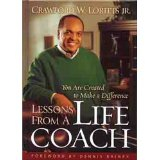
Dr. Loritts has written numerous articles and is the author of six books, including Leadership as an Identity, Lessons from a Life Coach, and For a Time We Cannot See. He co-authored Developing Character in Your Child with his wife, Karen. Dr. Loritts and his wife have four grown children and live in the Atlanta, Georgia area.

Article above adapted from Crawford W. Loritts JR. Lessons From A Life Coach: You Are Created to Make a Difference. Chicago: Moody Press, 2001, pp. 136-137.

Dr. Warren Wiersbe on the question: What is the Purpose of Life’s Trials?

“The Bumps Are What You Climb On”

A little boy was leading his sister up a mountain path and the way was not too easy. “Why, this isn’t a path at all,” the little girl complained. “It’s all rocky and bumpy.” And her brother replied, “Sure, the bumps are what you climb on.” That’s a remarkable piece of philosophy. What do you do with the bumps on the path of life?

I have been a reader of biographies for many years, and I have yet to find a successful person whose life was free from problems and difficulties. Looking at these people from a distance, you might think they had it made and that life was easy for them. But when you get closer, you discover that their climb to the top of the mountain was not an easy one. The road was rocky and bumpy, but the bumps were what they climbed on to get to the top.

We don’t have to read too far in the Bible before we discover the truth. Abraham certainly didn’t become a great man of faith overnight. He had to go through some difficult tests on the road of life before he reached the top of the mountain. No sooner did Abraham arrive in Canaan than a famine came to the land. Imagine facing a famine in the land God has promised you! Then Abraham had problems with his nephew, Lot; and then war came to the land, and Abraham had to go out and fight. His wife led him astray with bad counsel and the result was the birth of Ishmael, a boy who brought sorrow to Abraham’s heart. Finally, Isaac, the promised son, was born, bringing great joy to Abraham and Sarah. Then God asked Abraham to put Isaac on the altar, a sacrifice that would be difficult for any father or mother. Yes, there were many bumps on that road, but Abraham used the bumps to climb higher.

If anybody walked a rocky road, Joseph did. His father pampered him, hated by his brothers, sold for a slave, falsely accused, put into prison, forgotten, and apparently forsaken. But the bumps on the road helped him to climb higher, and one day Joseph became the second in command of all Egypt. Moses had a similar experience, and so did David, Daniel, and Paul. Here were people who did not complain about the road; they accepted the difficulties of life and used them as stepping-stones to the top of the mountain.

I don’t know what difficulties you are going through just now, but I know some of the feelings you have, because I have been on this bumpy road myself. You feel like quitting, like giving up. You can’t understand why the road doesn’t get easier, why God doesn’t remove the stones and straighten the path. If God did that, you might never get to the top, because the bumps are what you can climb on.

Psalm 91 says, “He that dwelleth in the secret place of the most High shall abide under the shadow of the Almighty.” It is a psalm that magnifies the care that God exercises over His children. Eleven different kinds of dangers are named in this psalm-war, snares, sickness, terrors by night, arrows by day, and others-yet God says that He can protect us from them all. This doesn’t mean that we will never experience accidents or injuries; but it does mean that no matter what happens in the will of God, all things will work together for good.

One of the greatest promises found in Psalm 91 has to do with the stones on the path. “For he shall give his angels charge over thee, to keep thee in all thy ways. They shall bear thee up in their hands, lest thou dash thy foot against a stone.” God doesn’t promise to remove the stones from the path, but He does promise to make them stepping-stones and not stumbling blocks. He promises to help us climb higher because of the difficulties of life.

Most of us respond in a predictable wayto the rocks in the path. We complain about them; we kick against them and only hurt ourselves. We try to pick them up and get rid of them, only to discover they are too heavy for us. We can’t always get around them, and we wonder if we can get over them. Some people just stop and go no further. Others give up and turn back. But the child of God does not have to stop or go back; he can use the rocky places in life as stepping-stones to climb higher.

The trouble with most of us is that we are accustomed to paved roads and level sidewalks. But life is not made that way. Sometimes the road is level and easy, and the birds are singing and the way is wonderful. But sometimes the road is rocky and bumpy, and we hear no music and feel no helping hand. Then what? Complain? Give up? No, that’s the time to remember God’s promise: “For he shall give his angels charge over thee, to keep thee in all thy ways.” God’s invisible army is at your service, and God can see you through.

Charlie Brown in the “Peanuts” comic strip is one of my favorite characters. In one particular strip, he is complaining because his team always loses their games. Lucy tries to console him by saying, “Remember, Charlie Brown, you learn more from your defeats than you do from your victories.” And Charlie Brown replies, “That makes me the smartest man in the world!”

If life were nothing but a series of defeats, all of us would get discouraged. God knows how to balance our lives so that we have sunshine and rain, calm and storm, laughter and tears. On the road of life there are level places that delight us, and there are difficult places that challenge us. If we get off the path of God’s will and go on a detour, the way will be rough from start to finish. The detour is always rougher than the main road. But there are rocks and bumps even on the paths of God’s choosing, and we have to learn to accept them and benefit from them. The bumps are what you climb on.

But this takes faith. It is much easier to kick the rock and turn around and go back. The secret to climbing higher is to look away from yourself and your difficulties, and look by faith to Jesus Christ. He knows where you are, how you feel, and what you can do. Turn it all over to Him and start walking by faith. The very rocks that seem like barriers to human eyes will, to the eyes of faith, become blessings. Listen to the promises of Psalm 91:15: “He shall call upon me, and I will answer him: I will be with him in trouble; I will deliver him, and honor him.”

If anybody faced obstacles on the road of life, it was our Lord Jesus Christ. He was born into a poor family, a member of a rejected minority race. He grew up in obscurity in a little town that mentioned only in scorn—“Can any good thing come out of Nazareth?” He gathered about Him a small group of nondescript men, and one of them became a traitor and sold Him for the price of a slave. He was called a liar, a glutton, a drunkard, and a man in league with the devil. Men twisted His words and questioned His motives, yet Jesus Christ continued to do the will of God. Finally, He came to that greatest stone of all—being crucified like a common thief. But He continued to climb that mountain, and God gave Him the victory.

This is why the writer of the Book of Hebrews urges us to look to Jesus Christ and keep on trusting. “Looking unto Jesus the author and finisher of our faith; who for the joy that was set before him endured the cross, despising the shame, and is set down at the right hand of the throne of God” (12:2). We are to look not at ourselves, our circumstances, our troubles, or the bumps in the road, but unto Jesus.

Yes, the bumps are what you climb on!

About Warren W. Wiersbe:

Warren W. Wiersbe is the Distinguished Professor of Preaching at Grand Rapids Baptist Seminary, and is the author of more than 100 books. Billy Graham calls him “one of the greatest Bible expositors of our generation.” Interestingly, Warren’s earliest works had nothing to do with scriptural interpretation. His interest was in magic, and his first published title was Action with Cards (1944).

“It was sort of imbecilic for a fifteen-year-old amateur magician to have the audacity to write a book and send it to one of the nation’s leading magic houses,” Warren says. But having a total of three books published by the L.L. Ireland Magic Company—before the age of 20—gave him a surge of confidence. In later years, he applied his confidence and writing talent to the Youth for Christ (YFC) ministry.

Warren wrote many articles and guidebooks for YFC over a three-year period, but not all his manuscripts were seen by the public eye. One effort in particular, The Life I Now Live, based on Galatians 2:20, was never published. The reason, Warren explains with his characteristic humor, is simple: it was “a terrible book…Whenever I want to aggravate my wife, all I have to say is, ‘I think I’ll get out that Galatians 2:20 manuscript and work on it.’” Fortunately, Warren’s good manuscripts far outnumbered the “terrible” ones, and he was eventually hired by Moody Press to write three books.

The much-sought-after author then moved on to writing books for Calvary Baptist Church. It was during his ten years at Calvary that Expository Outlines on the New Testament and Expository Outlines on the Old Testament took shape. These two works later became the foundation of Warren’s widely popular Bible studies known as the Be series, featuring such titles as Be Loyal (a study on Matthew) and Be Delivered (a study on Exodus). Several of these books have been translated into Spanish.

His next avenue of ministry was Chicago’s Moody Memorial Church, where he served for seven years. He wrote nearly 20 books at Moody before moving to Lincoln, Nebraska, where he and his wife, Betty, now live. Prior to relocating, he had been the senior pastor of Moody Church, a teacher at Trinity Evangelical Divinity School, and a producer of the Back to the Bible radio program.

During all these years of ministry, Warren held many more posts and took part in other projects too numerous to mention. His accomplishments are extensive, and his catalog of biblical works is indeed impressive and far-reaching (many of his books have been translated into other languages). But Warren has no intention of slowing down any time soon, as he readily explains: “I don’t like it when people ask me how I’m enjoying my ‘retirement,’ because I’m still a very busy person who is not yet living on Social Security or a pension. Since my leaving Back to the Bible, at least a dozen books have been published, and the Lord willing, more are on the way.”

Some of Wiersbe’s recent books include Your Next MiracleThe 20 Essential Qualities of a Child of GodThe Bumps are What You Climb OnClassic Sermons on the Fruit of the SpiritClassic Sermons on Jesus the ShepherdKey Words of the Christian LifeLonely PeopleA Gallery of GraceReal Peace: Freedom and Conscience in the Christian Life, and On Being a Leader for God.

The article above was adapted from the very encouraging and practical book by Warren W. Wiersbe. The Bumps Are What You Climb On: Encouragement for Difficult Days. Baker: Grand Rapids, 2003 (Chapter One).

A Supernatural Life by Steve Brown

Series: Friday Humor #3

A friend of mine told me a great story the other day, which he confirmed was true.

A woman shipped a very valuable dog on airplane. But when the clerks checked the cage after the flight was complete, they found the dog dead. So they went out and bought one just like it and replaced the live dog for the dead one. When the woman came to pick up her dog, she looked in the cage and stepped back in surprise.

“What’s the matter?” an attendant asked.

“Why,” she said in a trembling voice, “That dog was dead when I put him in the cage.”

Jesus said that Christians have passed from death to life. Since that’s true, pagans, especially those who knew us before we trusted in Christ, ought to be just as surprised when they come in contact with us as that woman was when she saw her dog. Our new life ought to be different than the old one—so different, in fact, that people notice the difference.

What in your life can only be explained in terms of the supernatural? Ask a pagan. He should know.

Meditation:

What habits of your old life still linger in your new? I know. Old habits die hard, but God is bigger than any habit, and He sure won’t tolerate bad ones. So get through with them. With God at your side, start rooting them out of your life. As long as you can rely on Him you can do it—He promises you (Philippians 4:13)

 For Further Study:

Acts 9:1-31, “But Saul, still breathing threats and murder against the disciples of the Lord, went to the high priest and asked him for letters to the synagogues at Damascus, so that if he found any belonging to the Way, men or women, he might bring them bound to Jerusalem. Now as he went on his way, he approached Damascus, and suddenly a light from heaven shone around him. And falling to the ground he heard a voice saying to him, “Saul, Saul, why are you persecuting me?” And he said, “Who are you, Lord?” And he said, “I am Jesus, whom you are persecuting. But rise and enter the city, and you will be told what you are to do.” The men who were traveling with him stood speechless, hearing the voice but seeing no one. Saul rose from the ground, and although his eyes were opened, he saw nothing. So they led him by the hand and brought him into Damascus. And for three days he was without sight, and neither ate nor drank.

Now there was a disciple at Damascus named Ananias. The Lord said to him in a vision, “Ananias.” And he said, “Here I am, Lord.” And the Lord said to him, “Rise and go to the street called Straight, and at the house of Judas look for a man of Tarsus named Saul, for behold, he is praying, and he has seen in a vision a man named Ananias come in and lay his hands on him so that he might regain his sight.” But Ananias answered, “Lord, I have heard from many about this man, how much evil he has done to your saints at Jerusalem. And here he has authority from the chief priests to bind all who call on your name.” But the Lord said to him, “Go, for he is a chosen instrument of mine to carry my name before the Gentiles and kings and the children of Israel. For I will show him how much he must suffer for the sake of my name.” So Ananias departed and entered the house. And laying his hands on him he said, “Brother Saul, the Lord Jesus who appeared to you on the road by which you came has sent me so that you may regain your sight and be filled with the Holy Spirit.” And immediately something like scales fell from his eyes, and he regained his sight. Then he rose and was baptized; and taking food, he was strengthened.

For some days he was with the disciples at Damascus. And immediately he proclaimed Jesus in the synagogues, saying, “He is the Son of God.” And all who heard him were amazed and said, “Is not this the man who made havoc in Jerusalem of those who called upon this name? And has he not come here for this purpose, to bring them bound before the chief priests?” But Saul increased all the more in strength, and confounded the Jews who lived in Damascus by proving that Jesus was the Christ.

When many days had passed, the Jews plotted to kill him, but their plot became known to Saul. They were watching the gates day and night in order to kill him, but his disciples took him by night and let him down through an opening in the wall, lowering him in a basket.

And when he had come to Jerusalem, he attempted to join the disciples. And they were all afraid of him, for they did not believe that he was a disciple. But Barnabas took him and brought him to the apostles and declared to them how on the road he had seen the Lord, who spoke to him, and how at Damascus he had preached boldly in the name of Jesus. So he went in and out among them at Jerusalem, preaching boldly in the name of the Lord. And he spoke and disputed against the Hellenists. But they were seeking to kill him. And when the brothers learned this, they brought him down to Caesarea and sent him off to Tarsus.

So the church throughout all Judea and Galilee and Samaria had peace and was being built up. And walking in the fear of the Lord and in the comfort of the Holy Spirit, it multiplied.”

Ephesians 4:17-5:12, Now this I say and testify in the Lord, that you must no longer walk as the Gentiles do, in the futility of their minds. They are darkened in their understanding, alienated from the life of God because of the ignorance that is in them, due to their hardness of heart. They have become callous and have given themselves up to sensuality, greedy to practice every kind of impurity. But that is not the way you learned Christ!— assuming that you have heard about him and were taught in him, as the truth is in Jesus, to put off your old self, which belongs to your former manner of life and is corrupt through deceitful desires, and to be renewed in the spirit of your minds,  and to put on the new self, created after the likeness of God in true righteousness and holiness.

Therefore, having put away falsehood, let each one of you speak the truth with his neighbor, for we are members one of another. Be angry and do not sin; do not let the sun go down on your anger, and give no opportunity to the devil. Let the thief no longer steal, but rather let him labor, doing honest work with his own hands, so that he may have something to share with anyone in need. Let no corrupting talk come out of your mouths, but only such as is good for building up, as fits the occasion, that it may give grace to those who hear. And do not grieve the Holy Spirit of God, by whom you were sealed for the day of redemption. Let all bitterness and wrath and anger and clamor and slander be put away from you, along with all malice. Be kind to one another, tenderhearted, forgiving one another, as God in Christ forgave you.

Therefore be imitators of God, as beloved children. And walk in love, as Christ loved us and gave himself up for us, a fragrant offering and sacrifice to God. But sexual immorality and all impurity or covetousness must not even be named among you, as is proper among saints. Let there be no filthiness nor foolish talk nor crude joking, which are out of place, but instead let there be thanksgiving. For you may be sure of this, that everyone who is sexually immoral or impure, or who is covetous (that is, an idolater), has no inheritance in the kingdom of Christ and God. Let no one deceive you with empty words, for because of these things the wrath of God comes upon the sons of disobedience. Therefore do not become partners with them; for at one time you were darkness, but now you are light in the Lord. Walk as children of light (for the fruit of light is found in all that is good and right and true), and try to discern what is pleasing to the Lord. Take no part in the unfruitful works of darkness, but instead expose them. For it is shameful even to speak of the things that they do in secret.”

 About the Writer:

Dr. Steve Brown is one of the most sought after preachers and conference speakers in the country. Having had extensive radio experience before entering the ministry, he is now heard weekdays on the national radio program, Key Life, and one minute feature, “Think Spots”. Steve also hosts a weekly radio talk show, “Steve Brown, Etc.”. He served as the senior pastor of Key Biscayne Presbyterian Church for 17 years before joining the Reformed Theological Seminary (RTS) faculty as Professor of Preaching. After teaching full time for almost two decades at RTS, Dr. Brown retired and is Emeritus Professor of Preaching but remains an Adjunct Professor of Preaching teaching occasional classes each year.

Dr. Brown is the author of many (16 and counting) books and also serves on the Board of the National Religious Broadcasters and Harvest USA (He earned his B.A. from High Point College; an S.T.B. from Boston University School of Theology; and an Litt.D. from King College). Steve is one of my favorite writers and speakers because he is authentic, a great story-teller, is a theologian in disguise, and really knows how to address the realities of how sinful humans can experience the amazing grace of God. The article above was adapted from page 112 in his excellent book on surviving and thriving in a tough world: Jumping Hurdles, Hitting Glitches, and Overcoming Setbacks. Colorado Springs: NavPress, 1992.

Steve Brown Has Authored These Outstanding Grace-Filled Books:

Three Free Sins: God’s Not Mad at You. New York: Simon and Schuster/ Howard Books, 2012.

A Scandalous Freedom. New York: Simon and Schuster/ Howard Books, 2009.

What Was I Thinking? Things I’ve learned Since I Knew It All. New York: Simon and Schuster/ Howard Books, 2006.

Follow the Wind: Our Lord, the Holy Spirit. Grand Rapids: Baker, 1999.

Approaching God: How to Pray. New York: Howard, 1996.

Living Free: How to Live a Life of Radical Freedom and Infectious Joy. Grand Rapids: Baker, 1994.

Born Free: How to Find Radical Freedom and Infectious Joy in an Authentic Faith. Grand Rapids: Baker, 1993.

How To Talk So People Will Listen. Grand Rapids: Baker, 1993.

If Jesus Has Come: Thoughts on the Incarnation for Skeptics, Christians and Skeptical Christians by a Former Skeptic. Grand Rapids: Baker, 1992.

Jumping Hurdles, Hitting Glitches, Overcoming Setbacks. Colorado Springs: NavPress, 1992.

No More Mr. Nice Guy! Saying Goodbye to “Doormat” Christianity. Nashville: Thomas Nelson, 1991.

When Being Good Isn’t Good Enough. Nashville: Thomas Nelson, 1990.

Welcome to the Family: A Handbook for Living the Christian Life. Old Tappan, New Jersey: Fleming H. Revell, 1990.

When Your Rope Breaks: Christ-centered advice on how to go on living—when making it through another day is the hardest thing in the world. Nashville: Thomas Nelson, 1988.

Heirs with the Prince. Nashville: Thomas Nelson, 1985.

If God is in Charge: Thoughts On The Nature of God For Skeptics, Christians, and Skeptical Christians. Grand Rapids: Baker 1983.

Terry Muck on How To Be Thankful in a Thankless World

If we gauge gratitude by the way God has worked in our lives, then nothing the world withholds can dispel our thanksgiving, and we can even rejoice in the pettiness of those around us.—Terry Muck

An old man wistfully reads the Hebrew Scripture’s promise of a Messiah to come. Night after night he reads until the light or his energy wanes. Each night he prays, O, that I could see the Messiah before I die!

Silence is his only answer. Still he prays.

Then one night he prays and, instead of silence, God answers: I have heard your prayer.

You shall see the Promised One.

Not sure he has heard correctly, the old man continues his yearning prayer on the nights that follow—yet the answer grows stronger, more firm. You shall see him. You shall hold him and touch the Messiah.

Simeon’s joy was great. He was probably already an old man when God told him he would not die until he had seen the Messiah. The promised coming of the Savior was ancient, and few really believed it anymore. For a man of Simeon’s age, it was too much to hope for. Yet God said it would happen—and the promised day did come.

In the temple Simeon took the baby Jesus in his arms and said, “Sovereign Lord, as you have promised, you now dismiss your servant in peace. For my eyes have seen your salvation, which you have prepared in the sight of all people” (Luke 2:29–30 niv).

Simeon’s experience is the paradigm of true thanksgiving. What better reason for giving thanks to God than the fact that we have all been given the chance to see the Savior? We have not held the baby Jesus in our arms, but we have been given the joy of holding him in our minds and hearts. If every other facet of our lives were negative—if we were poor, homeless, and friendless—we would still have this reason to be thankful: the fact of Jesus Christ.

Our human nature being what it is, however, very often we find the fact of Jesus Christ is not enough to help us maintain an attitude of thanksgiving. Gratitude is one of the most difficult emotions to express and maintain.

Perhaps our culture is partly to blame. Gratitude is particularly hard when everything comes easily, when our relative wealth makes us think we can, by birthright or the sweat of our brow, get whatever we need. Why should we be thankful when we’ve earned it on our own?

For Christian leaders, the problem is even more complex. Leaders are victims to all the gratitude-limiting pressures of a wealthy society, but as helping professionals they also suffer the ingratitude of those they serve, both lay workers and fellow leaders. Christian leaders are assailed from two directions: a sated society and a sometimes thankless Christian community.

Victims of prosperity

Wealth is not a worldwide phenomenon. Other cultures still have to struggle to earn their daily bread, to keep their families warm and safe. Westerners who live in those cultures for even a short time discover new meaning to the word gratitude.

Missionaries are typical.

Franklin and Phileda Nelson went to Burma as missionaries in the 1940s. They served there eight and a half years before the government closed the country to further missionary work. They returned to the United States where Franklin served several churches in various pastoral roles.

While in Burma they worked among remote tribes, and Franklin found his sense of gratitude for God’s providence rekindled:

In the Burmese hill country, the only way to get to remote villages was by “shank mare.” (That’s walking, in case you’ve never heard the phrase.) It was not at all uncommon for me to walk twenty miles a day in the dry season. When I got back to the States and worked as a pastor and church leader, I rarely walked a mile a day; the telephone and car made walking unnecessary.

In Burma, if one of us got sick, the nearest hospital was ten days away. In the States, medical care is minutes away. In Burma, we’d go months without bread. Once we asked our daughter Karen to say grace before a meal, and she said, “Why do I have to pray for my daily bread when I don’t ever get any?” I have often coveted that experience for our youngest daughter who never had to wonder where her food came from. It’s hard to have that sense of helplessness and humility so vital to prayer when you sit down to your daily bread and don’t even think about how you got it.

I don’t in any way blame people here for not knowing what God can do. We’re victims of our prosperity. But I sometimes wish we had a few more hard times so people could experience firsthand how wonderful it is to be totally dependent on God.

Thankless followers

One denominational official lamented that for him one of the hardest things about leadership has been developing lay and professional leaders in churches, only to have them quickly forget “from whence cometh their help” and turn their backs on their benefactors as soon as they begin to make it on their own.

I asked my father, who recently retired after thirty-five years of teaching at a Christian college, if he had any regrets about his fruitful professorial career.

“I guess it would have to be the lack of gratitude by students,” he said. “I never had very high expectations about students thanking me. They are in school at a difficult age—late teens and early twenties. Their identity crisis makes it a hard time psychologically for expressing thankfulness. But I did notice a steady decline over the years in what gratitude there was. It was almost as if students were never taught to be thankful. And even though I didn’t expect much gratitude, I missed it all the same.”

Gratitude is one of those curious emotions that grows or shrivels in direct proportion to the amount we receive from others. Pastors, especially, seem to get caught in the middle of a two-flank attack: our wealthy society discourages it, and the nature of the pastoral task often seems hopeless, helpless, and thankless. Over the past generation or two, a subtle devaluation of the pastoral role has occurred that rivals the devaluation of the dollar. In the same span that has seen the dollar shrink in buying power by almost half, the role of the pastor in the local community has probably shrunk even further. The natural respect once shown is a thing of the past. The gratitude that goes with respect is even less.

Interestingly, you don’t find many pastors publicly bemoaning their reduced status. But in terms of their functioning in the community, in terms of their spiritual lives, the danger is that cynicism about the task can subtly creep in and rot the roots of thankfulness.

God-based gratitude

What’s the solution? Perhaps to focus on the natural opportunities of Christian leadership, not its shortcomings. The call to ministry is not strictly parallel to other professional career paths. God guides his chosen leaders in profound ways. We sometimes feel frustrated with our inability to discern God’s will for our lives. The factor most often overlooked in such cases is that gratitude for guidance is actually one of the things that increases its intensity. Recognition that God has directed in the past is what increases the volume of his voice in the future.

Some helpful insights for gratitude can be found in Deuteronomy 26, which outlines three elements to thanksgiving.

The first is a concrete expression of thanks. “Take some of the firstfruits of all that you produce from the soil of the land … and [the priest shall] set it down in front of the altar of the Lord your God” (vv. 2–4 niv). God says that when the Israelites arrive in the land and have conquered it and are living there, they must present to the Lord the firstfruits from each annual harvest. They are to take it in a basket and hand it to the priest at the temple.

It is almost paradoxical but still true today: giving increases gratitude. Psychologists tell us that the human mind grasps the concrete far more easily than the abstract. By giving a concrete expression of thanks, the abstract reality (our feeling of gratitude), the crucial part, becomes more real to us.

Sometimes the concrete gift is prayer itself. Gib Martin, pastor of Trinity Church in Burien, Washington, said, “Bonhoeffer wrote that the Psalms were God’s gift to the church, and when we have nothing else to give God, we can give those back to him in the form of prayers. I have tried that and reaped the benefits.”

The second element is to remember difficulties God has seen you through. Verses five to nine say that after the priest has accepted the gifts in the name of God, the people should recite a brief history of their being freed from Egypt and given a new fertile land. In this illustration, the children of Israel remember what it was like to live in Egypt. For us it is the remembrance or recognition of what we are like without God. After all, that is the crucial factor. What is it like not to hold the Messiah in our hearts and minds? Bleak, desolate, hopeless.

One Christian leader said she uses the harder times of her life to combat current crises: “I’m a person who is always ready with plan B or C if plan A doesn’t work out. I think my experiences have forced me to develop that attitude. I once had three major surgeries in three months. I had no control over what would happen with my life then. Remembering those brick walls helps me understand God’s sovereignty and the potter-clay relationship.”

Perhaps for today’s Christian leaders, fellowship needs are greater than any other. Most local churches, for example, are one-person pastorates, and most are operated in entrepreneurial fashion. Fellowship languishes under such conditions. No camaraderie with staff, no employer to unload on, no evaluation sessions to tell you how it’s going. Ministerial associations usually turn into bragging rather than brainstorming sessions. The minister feels cut off from the warmth of peer support.

Again, Franklin Nelson’s experience on the mission field is instructive:

Like the pastorate in the States, the mission field can be lonely. I remember when our first daughter was born. Several days after her birth I had to visit some villages. It would take two weeks. After a couple of days out I began to feel sorry for myself. I was alone, climbing steep hills, no one to talk to and tell about my new daughter.

I asked the Lord for some sign that he was with me. I didn’t know what I wanted him to do because I didn’t know what would help me. As far as I knew, it was impossible to cheer me up. But I asked God to do it anyway.

The middle of that afternoon I came to a village. It was a new Christian village that was just beginning to get grounded spiritually, so I didn’t expect the warm welcome of old friends. But to my surprise, they came out en masse singing a welcome song. I hadn’t planned on spending the night there, but they asked me to. They took me to a hut they had cleaned up very nicely. I decided to stay. This overwhelming hospitality and love, totally unexpected, answered my prayer. It was simple, something we expect almost as a matter of course back home. But it was just what I needed at that time.

Remembrances of God’s love in good times and bad can stimulate our gratitude.

The third element is to be grateful for what the Lord has made out of us. After reciting the litany of our once-lost-now-found status, the Lord says to “rejoice in all the good things the Lord your God has given to you and your household” (v. 11). Like Simeon who held the baby Jesus and rejoiced, we should be ever aware that God has worked, is working, and will continue to work in our lives.

For Christian leaders, then, the key to developing a deep thankfulness is not to base our gratitude on the uncertain status of wealth and prosperity or the fickle gratitude of those we serve. The Christian leader’s gratitude must be based on a deep satisfaction in ministries faithful to God’s will.

Gordon Johnson pastored College Avenue Baptist Church in San Diego. Before coming to California, Gordon had been dean of a Christian college and had held several pastorates. He said:

Gratitude for me comes only when I focus strictly on what God has done in my life. For example, I pray for guidance more often than anything—and God has always answered. When I was serving a church in Chicago, I had two job offers at once. One was to become dean of students at a Christian college. They asked first, and after interviewing there, I was pretty convinced I would go if the college trustee board approved the call. I went back to Chicago and preached in my church on Sunday morning. After the service representatives from another church in the area came up and asked if they could take me and my family out to dinner. We had no other commitments, so I agreed. At dinner they asked me if I would come to pastor their church. I was thrown into a terrible confusion. Why is God doing this? What is he trying to tell me?

That week an official letter of invitation came from both the church and the college. I prayed about both at length and finally wrote a letter of acceptance to the college and a letter of rejection to the other church. My wife typed the letters, and I remember sitting on the edge of my bed that evening looking at them both. I felt sick, plagued by inner doubt. You’re just getting emotional about this, I thought. Get them in the mail and that will give you some peace.

I walked to the corner mailbox and dropped the letters in. But when I got back home, I felt sicker and sicker about the whole thing. About eleven o’clock that night I called the post office to see if I could get the letters back. “Too late,” they said. They had already gone.

The next morning I called the college president and asked if he would please ignore the letter he was about to receive from me. I did the same with the pastoral search committee. Then I got on a train and went back to the college for one more look. By the end of that visit, I decided being dean of students wasn’t for me, and I turned down their invitation. I also declined the invitation from the other church.

Looking back, I think God used the invitation from the church to get me to rethink the way he was working in my life.

Had Gordon not asked the fundamental question of What is God trying to tell me in this? His prayer for guidance might have been the much more self-centered—Please, God, which of these offers will be the best for me?

If we gauge our gratitude on worldly wealth and opportunity, we may someday find ourselves in Franklin Nelson’s shoes in Burma with no worldly wealth to celebrate. If we gauge gratitude on the thankfulness of those around us, human nature will disappoint us. Nine of ten healed lepers ran away without even thanking Jesus.

If, however, we gauge gratitude by the way God has worked in our lives, then nothing the world withholds can dispel our thanksgiving, and we can even rejoice in the pettiness of those around us because we can say, “Lord Jesus, thank you for the opportunity of working with these your children so obviously in need of your love.”

To those who seek, God provides the grace to be gracious.

About Terry Muck:

Terry C. Muck is professor of World Religions at Asbury Theological Seminary. The article above was adapted from chapter six in a collection of articles from the Library of Christian Leadership book entitled Deepening Your Ministry Through Prayer and Personal Growth: 30 Strategies to Transform Your Ministry; edited by Marshall Shelley. Nashville: Moorings, 1996.

Dr. David P. Craig: Christ, Chemotherapy, Radiation and Reformation Day

October 31, 1517 & October 31, 2012 (495 years Later)

Anyone who follows this blog regularly already knows that I have been diagnosed with cancer. I begin my treatment today – 4-5 hours of chemotherapy and 24 minutes of Radiation. I will have 33 straight treatments with the hopes that my cancer will be killed.

I don’t believe it’s by coincidence or an accident that my chemotherapy and radiation treatment begin on October 31st – the day that Martin Luther nailed his 95 Thesis to the Church Door at Wittenberg, Germany. Luther’s 95 Theses sparked perhaps one of the five most significant days in Church history since the closing of the Canon of Scripture on any church historian’s list of significant days.

I want to make a few observations before I leave for the hospital for treatment today:

(1)  I am grateful for truth and those who fight for it – no matter what the cost. When you get cancer you start hearing stories of courageous people of all ages who have battled and overcome cancer; and on the other hand, there are many who were courageous and have lost the battle. Honestly, I’ve never been so inspired by others in a battle for anything. When death is on the line – anything cancer survivors have to say, is like E.F. Hutton speaking to me – when they talk I listen (1980’s television commercial “When E.F. Hutton talks, people listen”). I am grateful that Martin Luther did not recant of his teaching of justification by faith in Christ Jesus. There is no greater comfort I have than my security and peace with God the Father through His Son – Jesus Christ. I know that whether I live or die – that I’m justified before God the Father because of the Person and Work of Jesus Christ my Savior and Lord. I am so grateful for the promise of Jesus related to Him being the pinnacle of truth when He declares to Thomas and the disciples in John 14:6, “I am the way, the truth, and the life, no one comes to the Father except through me.”

(2)  I thank God for what theologians call “common grace.” Two of the people that have helped me the most since I’ve been diagnosed with cancer are not followers of Christ. And yet, I am so grateful for their advice, wisdom, and compassion in my battle with cancer and all the medical procedures I’ve had to go endure so far. I am grateful for doctors, nurses, pharmacists, and others who have come alongside me with an expertise in their particular areas in treating cancer. It is a common grace that all truth is God’s truth. The rain falls on the wicked farmer’s and righteous farmer’s crops alike. I am reminded that all people are made in God’s image and though they may not share my passion for Christ and God’s Word – they are special and many share an affinity for objective truth’s and helping their fellow man. Luther was helped by many who were not followers of Christ in helping bring about the Reformation of the church and the Gospel. In the Bible God uses men as wicked as Judas to bring about His purposes.

(3)  I am grateful for God’s sovereignty. I know that nothing can happen to me that He does not allow. R.C. Sproul likes to say there is not one single maverick molecule that is not under God’s control. I believe that God can kill my cancer without chemotherapy or radiation treatment. Many family members, and friends, and even Christians I don’t even know, in different parts of the world are praying for me. I feel totally humbled by this outpouring of love. Elders, my mom, and several close friends have anointed me with oil. However, the cancer is still there. As of today I still have cancer that needs to be killed through the means of God’s people praying, medications, radiation and chemotherapy treatment, and the various nutritional cancerous killing foods I’ve been eating and drinking. However, no matter what happens I know that God is sovereign – in control of everything (including my cancer), and that He is good – He will be glorified no matter what becomes of my cancer. Luther was not perfect – as a matter of fact that’s why he was so passionate about the Bible. In God’s sovereignty He raised up a brilliant and yet very bombastic theologian to shake things up in the Church. I don’t claim to be brilliant, nor too bombastic, but I do know that God will bring about good and the glorification of His Son on a much smaller scale in sovereignly using my cancer for His ultimate purposes and plans – and that is extremely comforting. The fact that no one, no thing, no ruler, no nation, no disease – can thwart the sovereign plan of God to bring glory to Himself.

(4)  Luther said that suffering helped him understand the Bible, and that without experiencing pain and suffering you can’t be a good theologian. I strive hard to be a good interpreter and teacher, but I totally concur with Luther – suffering makes you a much better theologian. I don’t like suffering or pain any more than anyone else. But I think that the emotional pain that led to physical pain for the advancement of the gospel in Luther’s life was worth it. It was worth it for me, and worth it for you. I’m so glad that I know salvation by grace through faith in Christ alone because Luther’s heritage has been passed down for almost 500 years. Before him it was taught by all of the apostles in the New Testament. It is extremely clear. But nothing good, comes easy, or without a cost. We have the phrase in America – “No pain, no gain.” Without Christ’s suffering and pain on the cross there would be no spiritual gain in any way, shape, or form in our standing with God. I stand amazed at Jesus’ voluntarily leaving His rightful place with the Father and Spirit to come to planet earth to pay the ultimate price and be the one and only sacrifice for our sin. He is able to empathize with our sufferings and weaknesses, and is yet without sin.

Today I stand as Luther did on the truth of justification by faith alone in Jesus; in God’s common grace through the expertise of the doctors and nurses and the medications they will use to kill my cancer; in the sovereign will of God working all things together for my good and His glory; and I’m prepared to suffer because in Christ I know that His sufferings were greater still and for a greater good; no matter what happens – as Luther was able to say “Here I Stand” – I can also stand firmly today 495 years later because of Jesus the Nazarene.

The song below will be going through my mind during radiation and chemotherapy treatment today. It summarizes everything that Luther stood for on October 31, 1517. It is a song that talks about going from darkness to light; sinner to saint; from totally condemned because of my sin to fully redeemed by His righteousness. Why? Because of the amazing plan of the Father to send His Son – the Perfect for the imperfect; the Clean for the unclean; the obedient sacrificial Lamb for the rebellious goat. I hope and pray that the chemotherapy and radiation will do for me in a physical sense what Christ has done for me in a spiritual sense. I pray the cancer will be wiped away as Jesus has washed away all of my sin. Here is the song written by Charles H. Gabriel that summarizes these truths of the Reformation:

 “I Stand Amazed in the Presence”

 (Verse 1):

I stand amazed in the presence

Of Jesus the Nazarene,

And wonder how he could love me,

A sinner, condemned, unclean.

Refrain:

How marvelous! How wonderful!

And my song shall ever be:

How marvelous! How wonderful

Is my Savior’s love for me!

(Verse 2):

For me it was in the garden

he prayed: “Not my will, but thine.”

He had no tears for own griefs,

But sweat-drops of blood for mine.

(Verse 3):

In pity angels beheld him,

and came from the world of light

to comfort him in the sorrows

he bore for my soul that night.

(Verse 4):

He took my sins and my sorrows,

he made them his very own;

he bore the burden to Calvary,

and suffered and died alone.

(Verse 5):

When with the ransomed in glory

his face I at last shall see,

‘twill be my joy through the ages to sing of his love for me.

(Refrain)


Dr. Tim Keller on The Pervasive Influence of Idolatry in the Human Heart

(Nobody has impacted and influenced my understanding of Jesus Christ and God’s amazing grace in the Biblical Gospel than Pastor Tim Keller – you will find more posts by Tim Keller on VLM’s website than any other writer – because nothing is more important than understanding, receiving, and applying the Gospel for closure on our past, present, and future justification and sanctification with the God of the Gospel – And nobody explains the Gospel in a more deep and applicational manner, in my opinion, than Tim Keller – DPC)

“Counterfeit Gods – The Personal Story”

I often get asked how I personally became acquainted with the pervasive influence of idolatry in the human heart.

Like many younger ministers I worked far too many hours, never saying “no” to anyone’s request for my pastoral services. When salary increases were offered to me, I turned them down. When administrative help was offered to me, I declined. I was quite proud of being the kind of person who worked very hard, never complained, and never asked for any help. This regularly brought me into conflict with my wife, who rightly contended that I was neglecting my relationships to her and to my young sons. It also led to health problems, although I was only in my early thirties.

Nevertheless, I continued to feel that the way I was living was noble and good. I believed I was sacrificially committed to the ministry of the Word. I was especially delighted to make sacrifices that nobody saw — not my people or even my family. That made me feel most noble of all. If all this created some problems for me personally, wasn’t that just evidence of how truly devoted I was? It was a very dangerous situation. My future was bleak, though I didn’t know it. In the short run, this kind of ministry workaholism is often rewarded by admiring people all around.

Some well-meaning friends, however, saw the problem and literally “laid the law” on me, showing me that I was violating the commandments of taking Sabbath and of honoring my family. I usually responded with incremental changes that never endured. Others used the modern technique of self-esteem — “You need to think of yourself; you need to do things that make you happy.” I despised that advice as terribly selfish.  I valued self-sacrifice.

It wasn’t until I began to search my heart with the Biblical category of idolatry that I made the horrendous discovery that all my supposed sacrifices were just a series of selfish actions. I was using people in order to forge my own self-appreciation. I was looking to my sacrificial ministry to give me the sense of “righteousness before God” that should only come from Jesus Christ. People make idols out of money, power, accomplishment, or moral excellence. They look to these things to “save them” — to give them the sense of purity, value, and acceptability that only Jesus can give. In my case, I was using ministry (and my own people) in this way.

Without the category of idolatry — a good thing turned into a pseudo-salvation — I would never have been able to see myself. Nothing but the concept of counterfeit gods could have blasted me out of my illusion of virtue and superiority. I thank God for this life-saving insight — though I still struggle mightily with the implementation of what I’ve learned.

*Article Originally posted by Dr. Tim Keller on October 20, 2009 at the excellent resource site: http://redeemercitytocity.com/blog/view.jsp?Blog_param=60

 About Tim Keller and His Absolutely Brilliant Gospel Centered Books:

 In 1989 Dr. Timothy J. Keller, his wife and three young sons moved to New York City to begin Redeemer Presbyterian Church. In 20 years it has grown to meeting for five services at three sites with a weekly attendance of over 5,000. Redeemer is notable not only for winning skeptical New Yorkers to faith, but also for partnering with other churches to do both mercy ministry and church planting.  Redeemer City to City is working to help establish hundreds of new multi-ethnic congregations throughout the city and other global cities in the next decades.

Dr. Tim Keller is the author of several phenomenal Christo-centric books including:

Every Good Endeavor: Connecting Your Work to God’s Plan for the World. New York, Penguin Publishing, November, 2012.

Center Church: Doing Balanced, Gospel-Centered Ministry in Your City. Grand Rapids: Zondervan, September, 2012.

The Freedom of Self Forgetfulness. New York: 10 Publishing, April 2012.

Generous Justice: How God’s Grace Makes Us Just. New York: Riverhead Trade, August, 2012.

The Gospel As Center: Renewing Our Faith and Reforming Our Ministry Practices (editor and contributor). Wheaton: Crossway, 2012.

The Meaning of Marriage: Facing the Complexities of Commitment with the Wisdom of God. New York, Dutton, 2011.

The Prodigal God. New York, Dutton, 2011.

King’s Cross: The Story of the World in the Life of Jesus. New York, Dutton, 2011.

Counterfeit Gods: The Empty Priorities of Money, Sex, and Power, and the Only Hope That Matters. New York, Riverhead Trade, 2011.

The Reason For God: Belief in an Age of Skepticism. New York, Dutton, 2009.

Worship By The Book (contributor). Grand Rapids: Zondervan, 2002.

Ministries of Mercy: The Call of the Jericho Road. Phillipsburg: P&R Publishing, 1997.


David R. Helm: A Biblical Exposition on Sharing in Christ’s Sufferings From 1 Peter 4:1-6

“Embrace Your Calling to Suffer in the World”
“Since therefore Christ suffered in the flesh, arm yourselves with the same way of thinking, for whoever has suffered in the flesh has ceased from sin, so as to live for the rest of the time in the flesh no longer for human passions but for the will of God. For the time that is past suffices for doing what the Gentiles want to do, living in sensuality, passions, drunkenness, orgies, drinking parties, and lawless idolatry. With respect to this they are surprised when you do not join them in the same flood of debauchery, and they malign you; but they will give account to him who is ready to judge the living and the dead. For this is why the gospel was preached even to those who are dead, that though judged in the flesh the way people are, they might live in the spirit the way God does” (1 Peter 4:1-6).

Some would say that those who suffer most often suffer first from blind naiveté. Albert Schweitzer thought as much about Jesus, claiming that his cruel death on the cross was nothing more than the unfortunate result of naiveté. According to Schweitzer, Jesus, the misguided visionary, never saw the sufferings of the cross coming until it was too late:

There is silence all around. The Baptist appears, and cries: “Repent, for the Kingdom of Heaven is at hand.” Soon after that comes Jesus, and in the knowledge that He is the coming Son of Man lays hold of the wheel of the world to set it moving on that last revolution which is to bring all ordinary history to a close. It refuses to turn, and He throws Himself upon it. Then it does turn, and crushes Him. Instead of bringing in the eschatological conditions, He has destroyed them. The wheel rolls onward, and the mangled body of the one immeasurably great Man, who was strong enough to think of Himself as the spiritual ruler of mankind and to bend history to His purpose, is hanging upon it still. That is His victory and His reign (Albert Schweitzer, The Quest of the Historical Jesus. New York: Macmillan, 1968, pp. 370, 371).

Peter, however, has been telling a different story. Jesus was vindicated in death. He rose victorious in the spirit and now reigns eternally as the Ascended Son at God’s right hand. According to Peter, naiveté is set aside. Jesus’ suffering was not the unfortunate result of an impoverished itinerant’s idealistic fervor. Instead, his suffering was by divine initiative. Persecution was the predetermined pathway for God’s Son.

All the Gospel writers concur. The Jesus they present to the world is well aware that his unique work required suffering and service. Jesus believed it on the strength of the Hebrew Scriptures. And Jesus embraced it every step along the way of his earthly ministry. Repeatedly he told his disciples, “The Son of Man must suffer many things and be rejected by the elders and the chief priests and the scribes and be killed” (Mark 8:31; 9:31; 10:33). When Jesus stood before the Sanhedrin on the night of his betrayal, never once did he defend himself in hopes of avoiding the cross. In fact, when he did speak, he intentionally said what he knew would seal his fate (Mark 14:62).

Clearly, Jesus fully embraced his calling to suffer out of his desire to save us. As Peter argued in 3:18: Christ suffered once for sins, the righteous for the unrighteous, that he might bring us to God.

Now, with the opening phrase of our text, Peter again returns to Christ’s sufferings, but this time with different intentions — he feels no need to further encourage us with Christ’s triumphant vindication. He accomplished that in 3:18-22. Rather, he writes about Christ’s suffering in this particular text to call us to embrace it as well. In 4:1 he says: “Since therefore Christ suffered in the flesh, arm yourselves with the same way of thinking.”

“Arm yourselves.” Emulate Jesus. It is as if Peter has finally come to the place in the letter where he rises up to unashamedly proclaim, “Followers of Jesus, be prepared to embrace not only submission but suffering as an aspect of your calling! Get yourselves ready for suffering!” (It is interesting that until this time suffering appears in the letter to be “if necessary.” But now he speaks with definitive force, preparing the church for the inevitable).

The question of course is, how? How do we go about getting ready? What does a person need to know and do to prepare to embrace his or her calling in the world?

Fortunately for us, the structure of our text unfolds the answers to these questions with clarity and simplicity. If we intend to embrace this aspect of our calling, there are three gospel commitments we must be willing to make (4:1-3), two personal costs we should be ready to endure (4:4), and one encouraging reminder that a final accounting awaits all humanity (4:5, 6).

THREE GOSPEL COMMITMENTS (vv. 1-3)

Become a Person of Resolve

How do we go about embracing our calling? First, by becoming persons of resolve. Take another look at verse 1. Peter writes, “arm yourselves with the same way of thinking.” Notice, to embrace our calling in Christ initially requires the attention of our mind. We begin by thinking clearly. And for that we need to develop the mental disposition of Jesus.

Today, in the West at least, it is the church that suffers from a naiveté of the mind. It is difficult for Christians here to understand and embrace God’s intentions in suffering. We prefer a gospel in which God gives us healthy bodies and bulging wallets. And we too readily think that material blessing is the entitled reward of the gospel. To put it bluntly, the democratized West expects in Jesus, comfort, ease, and acceptance from the world.

Yet, in actual fact the life of Christ challenges all of this. Jesus resolved to live as a stranger in the world. He expected hardship. And when he read his own Hebrew Scriptures, they taught him that union with God culminates in mixed reviews here on earth.

In one sense, when Peter calls us to arm ourselves with “the same way of thinking,” he is saying, “Beloved, grow up! Get the mind of Christ. Become a person of resolve. Be prepared. If you have been united with him by faith, you will need to identify with him in suffering.”

The first gospel commitment Peter calls us to embrace closes with a phrase that needs some explanation. Look at the latter part of 4:1:

“Arm yourselves with the same way of thinking, for whoever has suffered in the flesh has ceased from sin.”

The natural question this phrase raises is, what does it mean to “cease from sin”? Is the suffering person a sinless person? We ask this even though we know that such a wooden interpretation of the verse goes against all of Scripture and life experience. So what is Peter saying?

He is simply affirming that those who suffer for the gospel do, by their very willingness, demonstrate that they are done with sin. To put it as clearly as I can, everyone who suffers for Jesus first resolved, somewhere along the line, to cease from sinning. After all, the suffering they experience is a result of leaving off with sin. Thus, Peter says, “For whoever has suffered in the flesh has ceased from sin.”

Live for the Will of God

In the next verse Peter puts forward the second and third gospel commitments that followers of Christ make as they embrace their calling in the world: “…so as to live for the rest of the time in the flesh no longer for human passions but for the will of God” (v. 2).

The two commitments we are to make are spelled out by way of contrast: “…no longer for human passions” with “but for the will of God.” Since the following verse is going to highlight the kinds of behavior the Christian leaves behind, let’s look first at what we are to be about. Peter says we are to live “for the will of God.” What does Peter mean by the phrase “the will of God”? And how are we to start living for his will? Fortunately we have already seen in 1 Peter the kinds of godly pursuits he wants us to pursue. And in fact, in each of those places he contrasted the
things that God wills for us with the same phase he uses here — “human passions.”

So by looking back in the letter for “passions” we will run headlong into what Peter means when he wants us to make a commitment to “the will of God.” Look at 1 Peter 1:14,15: “As obedient children, do not be conformed to the passions of your former ignorance, but as he who called you is holy, you also be holy in all your conduct.”

If the will of God is found by way of contrast to human passions, then we can know for sure that we prepare our minds for suffering by giving ourselves wholly over to the pursuit of holiness. God wants us to make a commitment to holiness, to sanctification, to putting on the new man. This is how we prepare to embrace our calling.

Another text in 1 Peter that teaches us what the will of God is can be found in 2:11,12: “Beloved, I urge you as sojourners and exiles to abstain from the passions of the flesh, which wage war against your soul. Keep your conduct among the Gentiles honorable, so that when they speak against you as evildoers, they may see your good deeds and glorify God on the day of visitation.

We do the will of God when we “keep [our] conduct . . . honorable” by doing “good deeds.” This, of course, will require us to be countercultural. We will always be swimming against the current of today’s moral tide. We are to be known for doing good. And as we have seen in this letter, the supreme mark of goodness is our submission to difficult and ungodly people in authority.

Leave Human Passions Behind

I love the opening phrase in verse 3: “The time that is past suffices.” It is as if Peter barks out, “Enough already. Put sin in your rearview mirror.” And then he goes on to list the kinds of things that Christians are to put away. Look at how the verse finishes: “living in sensuality, passions, drunkenness, orgies, drinking parties, and lawless idolatry.”

Be done. Enough. The past is sufficient. Life as an ongoing fraternity party is a major problem in the church today. If we are not there in person, we are all too often present through what we watch on television, see in the theaters, or watch on the Internet. For men, sensuality is an especially prevalent issue. Sex is the elephant in the room. Peter says that in this matter it is time to clean house. Until we wake up and tackle this area head-on and out in the open, we will only continue debilitating a generation and will keep them from being grounded in their faith, unable to fly unencumbered toward Heaven’s delights.

The Danish philosopher Søren Kierkegaard tells a parable of the disastrous effects of not putting to death the desires of the flesh, of failing to leave a way of life behind. One springtime a duck was flying with his friends northward across Europe. During the flight he came down in a barnyard where there were tame ducks. He enjoyed some of their corn. He stayed for an hour, and then for a day. One week passed, and before he knew it a month had gone by. He loved the good food, so he stayed all summer long.

One autumn day, when the same wild ducks were winging their way southward again, they passed overhead, and the duck on the ground heard their cries. He was filled with a strange thrill and joy, and he desired to fly with them once again. With a great flapping of wings he rose in the air to rejoin his old comrades in flight.

But he found that his good fare had made him so soft and heavy that he could rise no higher than the eaves of the barn. He dropped back again into the barnyard and said to himself, “Oh well, my life is safe here, and the food is good.” Every spring and autumn when he heard the wild ducks honking, his eyes would gleam for a moment, and he would begin flapping his wings. But finally the day came when the wild ducks flew overhead uttering their cries, but he paid no attention. In fact, he failed to hear them at all.

What an apt parable for the church in our time. As Christians, too many of us have feasted for too long on the pleasant fare this world has to offer. We too easily forget that the time past was enough. We forget that we are still far from home — we haven’t arrived at our destination yet. Sadly, many go on day by day unfazed by the gospel thought that as we feed on the husks of this world we demonstrate that we think too little of the delights that await us in Heaven. Peter says to us, “Enough. Rise up, O men of God. Have done with lesser things” (From the hymn “Rise Up, O Men of God,” lyrics by William P. Merrill; http://www.cyberhymnal.org/htm/r/i/riseupom.htm; accessed July 31, 2007).

C. S. Lewis struggled with his own inability to grasp the gravity of his sin in light of God’s clear teaching on the subject. He wrote:

Indeed the only way in which I can make real to myself what theology teaches about the heinousness of sin is to remember that every sin is the distortion of an energy breathed into us — an energy which, if not thus distorted, would have blossomed into one of those holy acts whereof “God did it” and “I did it” are both true descriptions. We poison the wine as He decants it into us; murder a melody He would play with us as the instrument. We caricature the self-portrait He would paint. Hence all sin, whatever else it is, is sacrilege (C.S. Lewis, Letters to Malcolm: Chiefly on Prayer, chapter 13, as quoted in Wayne Martindale and Jerry Root, The Quotable Lewis. Wheaton, IL: Tyndale House, 1989, p. 547).

God has plans for your body, and they are plans for purity and for good. Don’t cheapen life. Don’t settle for distortion. Don’t poison the wine God decants into you. Be done with “sensuality, passions, drunkenness, orgies, drinking parties, and lawless idolatry.”

Make three gospel commitments that tell the world you are prepared to embrace this aspect of your calling in Christ.

  • Become a person of resolve.
  • Live for the will of God.
  • Leave human passions behind.

TWO PERSONAL COSTS (v. 4)

But as you do, know this: your newfound commitments come with a twofold cost. Consider verse 4: With respect to this they are surprised when you do not join them in the same flood of debauchery, and they malign you.

They Are Surprised at You

First, your friends and family will be surprised. You will be misunderstood. Remember, there are no categories for them to understand why you no longer grab all that you can in this life without regard for the next. “Come on,” they will say. “What happened? Loosen up. Look out for your own happiness. Pursue some pleasure. Live a little!” Malcolm Muggeridge articulates well how your new life in Christ will affect your relationship with former friends who are still pursuing only happiness and pleasure:

Anyone who suggests that the pursuit of happiness — that disastrous phrase written almost by chance into the American Declaration of Independence, and usually signifying in practice the pursuit of pleasure as expressed in the contemporary cult of eroticism — runs directly contrary to the Christian way of life as conveyed in the New Testament is sure to be condemned as a life-hater (Malcolm Muggeridge, Jesus Rediscovered. London: Collins, 1969, pp. 101,102).

Over time their surprise will turn to ridicule.

They Malign You

Surprise evokes misunderstanding, and misunderstanding evokes a sense of being judged. And when the world feels that it has been judged by your way of life, those who are of it will condemn you as “a life-hater.” They will malign you. Take a look again at the progression of behavior embedded in verse 4. “Surprised” gives way to the word “malign”:

With respect to this they are surprised when you do not join them in the same flood of debauchery, and they malign you.

R. C. Sproul, in his book The Holiness of God, tells of a time when Billy Graham was invited to play golf with President Ford and two PGA tour professionals. He writes:

After the round of golf was finished, one of the other pros came up to the golfer and asked, “Hey, what was it like playing with the President and with Billy Graham?” The pro unleashed a torrent of cursing, and in a disgusted manner said, “I don’t need Billy Graham stuffing religion down my throat.” With that he turned on his heel and stormed off, heading for the practice tee. His friend followed. . . . His friend said nothing. He sat on the bench and watched. After a few minutes the anger of the pro was spent. He settled down. His friend said quietly, “Was Billy a little rough on you out there?” The pro heaved an embarrassed sigh and said, “No, he didn’t even mention religion. I just had a bad round.”

About the incident Sproul concludes:

Astonishing. . . . Billy Graham is so identified with religion, so associated with the things of God, that his very presence is enough to smother the wicked man who flees when no man pursues. Luther was right, the pagan does tremble at the rustling of a leaf. He feels the hound of heaven breathing down his neck. He feels crowded by holiness even if it is only made present by an imperfect, partially sanctified human vessel (R.C. Sproul, The Holiness of God. Wheaton, IL: Tyndale House, 1985, pp. 91-93).

ONE FINAL ACCOUNTING (vv. 5, 6)

Peter closes our text with a reminder on the final judgment. It is meant as an encouragement to his readers. In verse 5 it appears that he is especially thinking of the judgment that awaits those unbelievers who choose to malign us. But they will give account to him who is ready to judge the living and the dead. In one sense you and I do not need to judge the world. It already stands condemned. Entrust yourself to God, and wait for Jesus to set all things straight. The closing verse in our text is tricky to get hold of at first glance. It is especially hard to see how it functions as an encouraging word to

Christians who await the final judgment. “For this is why the gospel was preached even to those who are dead, that though judged in the flesh the way people are, they might live in the spirit the way God does” (v. 6).

What we need to remember is that the early church had many questions about their family members and friends who had died after coming to faith in Christ. They wondered what happened to believers after death. There was a concern for those who had already undergone the penalty of death. Peter wants to reassure his readers here with news that although believers are “judged in the flesh the way all people are,” they need not worry about their future with God. He says they will still “live in the spirit the way God does.”

We have nothing to fear in Christ! We have nothing to fear in embracing suffering in this life. Peter wants us to grasp this as part of our calling. To do so, we need to make three gospel commitments: become a person of resolve, live for the will of God, and leave human passions behind. We must be ready to incur two costs: the surprise of those with whom we once lived in sin and the inevitable maligning and slander that is sure to follow. In all this, though, Peter reassures us with one encouraging reminder: there will be a final accounting for everyone. As those who are in Christ, we shall live on in the Spirit forever.

Dear Lord, help us to truly embrace our calling to suffer in Christ. May we receive it with open arms. We know that everything we bear for you in this life will be nothing to compare with the glory we will share in with you in Heaven. Make us people of resolve. In your precious name we pray, Amen.

The end of all things is at hand; therefore be self-controlled and sober-minded for the sake of your prayers. Above all, keep loving one another earnestly, since love covers a multitude of sins. Show hospitality to one another without grumbling. As each has received a gift, use it to serve one another, as good stewards of God’s varied grace: whoever speaks, as one who speaks oracles of God; whoever serves, as one who serves by the strength that God supplies — in order that in everything God may be glorified through Jesus Christ. To him belong glory and dominion forever and ever. Amen. (4:7-11)

The Sermon/Article above was adapted from the sermon based on 1 Peter 4:1-6 in David R. Helm’s terrific book of sermons on 1 & 2 Peter, and Jude: Sharing Christ’s Sufferings in the Christo-centric Series of expositions published by Crossway books in Wheaton, IL. – The Preaching the Word Series edited by the faithful expositional preacher R. Kent Hughes.

About the Preacher:

David Helm, along with Arthur Jackson, serves as Lead Pastor of our Hyde Park Congregation, and is the Director of Ministry Training at HTC. After ten and a half years as founding Sr. Pastor of Holy Trinity Church, David handed off the Senior Pastor role to Jon Dennis on November 23, 2008. In addition to serving our South Side congregation, David is Chairman of The Charles Simeon Trust, a ministry devoted to equipping men in expository preaching.

A graduate of Wheaton College and Gordon-Conwell Theological Seminary, David is ordained in the PCA and serves on the council of The Gospel Coalition. He authored I, II Peter and Jude in Crossway’s Preaching the Word series, and contributed to Preach the Word:Essays in Expository Preaching in Honor of Kent Hughes. In addition, David has written The Big Picture Story Bible and The Genesis Factor (the latter with Jon Dennis).

David and his wife, Lisa, have five children (Noah, Joanna, Baxter, Silas and Mariah) and reside in the Hyde Park neighborhood. In his spare time, he generally roots for the Chicago White Sox and enjoys Johnny Cash.