Book Review: Being George Washington by Glenn Beck

A Call To Lead in the Ilk of Our First President

 I was encouraged to read this book because of the gaping hole in leadership internationally, nationally, and locally – whether in politics, education, business, or in the church. Simultaneous with my reading of this book I was interested in something that John Gardner (in an essay on leadership) pointed out, “When the United States was formed, the population stood at around 3 million. That 3 million produced at least six leaders of world class—Washington, Adams, Jefferson, Franklin, Madison, and Hamilton.” Today we have a population 90 times larger than that and I can’t name a single leader that comes close to the aforementioned six men. Along with Gardner I ask the question “Where are they?”

Therefore, my curiosity was peaked in reading this book to discover what we can learn from Washington’s life – and whether we can truly produce great leaders today. One of the main points that Beck makes in the book early on is that “for America to achieve the greatness that George Washington achieved, we have to remember that it is achievable.” In story after story Beck brings out some of the keys to great leadership – character (based on a strong faith in God and His good providence); putting others before self – especially what’s best for the whole; having a vision for liberty and fighting for it; focusing on that which will last beyond us. In a nutshell Beck highlights Washington’s character, trust, and honor in story after story and demonstrates how he united America around freedom so that we could be the best we could be.

The primary lesson of this book and of great leadership is stated by Beck in this manner, “Everything we do in life—every battle that we fight and every mountain that we climb, no matter how many times we fall—may be for no other purpose than to prepare us for that moment when we are called upon to make a difference in this world…What Washington did do was accept the responsibility he had been given, beg the grace of God upon himself and his army, and then work relentlessly to accomplish his goals. What he did do was to keep on working, regardless of the personal sacrifices required or the setbacks that he encountered. He kept the faith, no matter who stood against him; regardless of the gossip, the naysayers and sometimes, regardless even of the betrayal of his friends.”

In conclusion Beck states that if you and I are to be like George Washington in today’s world means:

“a daily struggle between your heart and your brain; between instant gratification and enduring greatness.”

“looking out for our families, our neighbors, and our countrymen—standing for them when they can’t stand for themselves.”

“putting country before party.”

“becoming a leader – not of a country or army, but of yourself, your community, and your own family. It means taking personal responsibility for your actions and holding those around you to the same standard.”

“accepting that this country was chosen for Divine protection because the struggle for freedom is worthy of protection.”

In other words, great leadership involves humility before God; responsibility with what He has stewarded unto us, and faithfulness to the task at hand. This book was a pleasure to read, and pointed out both the strengths and weaknesses of Washington. However, the constant reminder was to be what we can be with God’s help, and do what we can do (not focus on what we can’t do), one step or opportunity at a time. Being a great leader like Washington involves great sacrifice, risk, unselfishness, and tremendous dedication. In the final analysis we need to be willing to personally answer the key question that Beck asks, “Are you willing to lose everything to do what is right?” I am grateful that Washington did, hope I will too, and that his tribe will increase abundantly.


Book Review: Salvation Accomplished By The Son by Robert A. Peterson

Brilliant and Balanced Account of Christ’s Work on Our Behalf

 Dr. Peterson gives four reasons for reading this book in his introduction: 1) The current debate over the meaning of Christ’s death; 2) The abysmal failure of evangelicals’ to teach that not only the death of Christ saves sinners, but also the significance of the resurrection in relationship to salvation (Scripture teaches that a literal bodily resurrection is absolutely ESSENTIAL to Christ’s saving work); 3) Jesus’ death and resurrection do not stand alone – but are part and parcel of the GREATEST STORY ever told – “His becoming a genuine human being and living victoriously are essential prerequisites for his death and resurrection. If he had not become one of us, he could not have died in our place. If he had sinned, his death could not have rescued others; he would have needed rescue himself.” And 4) Events (Christ’s death and resurrection) do not interpret themselves; they need words to explain them.

I would like to add a fifth reason to read this book: Christians need to go deeper in our understanding of the gospel and integrate this into our worldview of everything. Dr. Peterson’s book is not an easy read, it is lengthy, but well worth the effort because you will come out of reading this book with a greater appreciation of the central message of the Bible, of the depth of God’s love and work on our behalf, and you will have a greater appreciation of the person and work of Christ – especially how aspects of His present work (post-resurrection) impact our lives in the here and now. I can’t recommend this book highly enough – it is simply outstanding. He brilliantly integrates Systematic and Biblical Theology and balances this out with its practical ramifications for all of life with Christ at the center. My prediction is that it will be the new standard textbook replacing John Stott’s – The Cross of Christ – for 21st century students of the Person and Work of Christ.

Book Review: After You’ve Blown It by Erwin W. Lutzer

Helping You Reconcile With God and Others

In the opening chapter of this concise book (less than 100 pages) *Lutzer writes, “Strictly speaking, of course, not one of us deserves redemption. God owes us nothing, but He nevertheless offers His undeserved grace. Though we deserve damnation, He invites each of us to be redeemed. Worthy or not, we come to Him to receive forgiveness and the assurance that God still has a plan for our lives.”

Using Biblical stories and modern applications to those stories this is a book about how there is hope for anyone, no matter how bad they have blown it, by grace through faith in Jesus Christ. I highly recommend this book especially for the following types of people:

1)    Those who think they are too “bad” to be saved.

2)    Those who think they are “good” and don’t need to be saved.

3)    Those who are enmity with God and know it – and aren’t sure how to remedy it.

4)    Those who are at enmity with others – and aren’t sure how to remedy it.

5)    Those who need to be reminded that God has a plan for them, and that no matter how bad you’ve blown it – there is hope for you because of the Person and Work of the Lord Jesus Christ.

6)    Those of you who help others in counseling ministries.

It’s a fantastic little book – concise, full of Biblical wisdom, a clear gospel presentation, and leads and will encourage and give you hope. I also recommend it highly as a gift to give to those who are confused, discouraged, and broken over their sin.

*Since 1980, Erwin W. Lutzer has served as senior pastor of the world-famous Moody Church in Chicago, where he provide leadership to Chicago pastors. Dr. Lutzer earned his B.Th. from Winnipeg Bible College, a Th.M. from Dallas Theological Seminary, an M.A. in philosophy from Loyola University, an LL.D. from Simon Greenleaf School of Law, and a D.D. from Western Conservative Baptist Seminary.

Dr. Lutzer is a featured radio speaker on the Moody Broadcasting Network and the author of numerous books, including The Vanishing Power of DeathCries from the Cross, the best-selling One Minute Before You Die and Hitler’s Cross, which received the Evangelical Christian Publishers Association (EPCA) Gold Medallion Book Award. He speaks both nationally and internationally at Bible conferences and tours and has led tours of the cities of the Protestant Reformation in Europe.

Dr. Lutzer and his wife, Rebecca, live in the Chicago area and are the parents of three grown children. (Courtesy of Multnomah Publishers)

Book Review: The Gospel Centered-Life by Bob Thune and Will Walker

A Phenomenally Christ Centered Workbook

 I think that the most important concept that Christians can formulate in their minds is how the gospel applies in our lives every day. The authors describe this workbook as “a nine-lesson small group study intended to help participants understand how the gospel shapes every aspect of life. Each lesson is self-contained, featuring clear teaching from the Scriptures and requires no extra work outside of the group setting.”

The Gospel-Centered life is designed to do the following:

1)    Deepen your grasp of the gospel as you see your need for continued renewal.

2)    Grow as you experience transformation from the inside out.

3)    Be challenged to develop authentic relationships as the gospel moves you to love and serve others.

Each lesson contains the following sections: 1) a Bible Conversation; 2) An article from a primary source that teaches some good in depth content on the topic; 3) Discussion questions related to the content and their practical ramifications in our lives; 4) An exercise to take the discussion from theory to application; 5) The wrap-up gives the leader the chance to answer any last minute questions, reinforce ideas, and spend some time in prayer.

Thune and Walker give a helpful summary of how each lesson is organized and what it is designed to accomplish (the “Big Idea” for study, discussion, and application):

Section One – three lessons answering the question: What is the gospel?

Lesson 1: The Gospel Grid – “If the gospel is constantly ‘bearing fruit and growing’ (Col. 1:6), then everything has to do with the gospel—God, humanity, salvation, worship, relationships, shopping, recreation, work, personality…everything! The objective in this lesson is to establish a framework for talking about the gospel.”

Lesson 2: Pretending & Performing – “Each of us tends to ‘shrink the cross,’ which is to say that something is lacking in our understanding, appreciation, or application of Jesus’ sacrifice for our sin. This manifests itself in two main ways: pretending and performing. Pretending minimizes sin by making ourselves out to be something we are not. Performing minimizes God’s holiness by reducing his standard to something we can meet, thereby meriting his favor. Both are rooted in an inadequate view of God’s holiness and out identity.”

Lesson 3: Believing The Gospel – “This lesson turns our attention to the positive aspects of the gospel: what remedies has God given in the gospel to keep us from shrinking the cross and depending on our own effort?”

Section Two – three lessons answering the question: What does the gospel do in us?

Lesson 4: Law & Gospel – “Continue to think about how the gospel interacts with our lives, but now we turn to consider the gospel’s relationship to law. What is the law? Does God expect me to obey it? What is the purpose of the law? How does the law help me to believe the gospel? How does the gospel help me to obey the law?”

Lesson 5: Repentance – “This lesson deals with repentance. In our culture, this usually sounds like a bad thing, but repentance is the norm for gospel-centered living. Becoming more aware of God’s holiness and our sinfulness leads us to repent and believe the gospel of Jesus. Biblical repentance frees us from our own devices and makes a way for the power of the gospel to bear fruit in our lives.”

Lesson 6: Heart Idolatry – “The Christian walk consists of two repeated steps: repentance and faith. Turning our attention to the topic of faith, we focus on how we grow through believing the gospel. The goal in this lesson is to take ‘believing the gospel’ out of the abstract and make it concrete.”

Section Three – three lessons answering the question: How does the gospel work through us?

Lesson 7: Mission – “The gospel is simultaneously at work in us and through us. Inwardly, our desires and motives are being changed as we repent and believe the gospel. As we experience Christ’s love in this way, we are compelled to engage those around us with the same kind of redemptive love. God’s grace brings renewal everywhere, in and through us.”

Lesson 8: Forgiveness – “The gospel that works in us always works through us. It shows its power in our relationships and actions. One key way this happens is when we forgive others biblically.”

Lesson 9: Conflict – “Conflict is something we all experience (regularly), but often handle in very fleshly ways. The gospel gives us a pattern and a means to healthy conflict resolution.”

The Gospel Centered Life is designed for:

1)    “Pastors and leaders who want to spur gospel renewal in their churches and ministries.

2)    Church planters who want to form gospel DNA in the churches they start.

3)    Students and campus ministers who are looking to live out the gospel on campus.

4)    Christians who want to be more deeply formed around the gospel.

5)    Small group leaders who are looking for content that ‘works’ with diverse groups of people.

6)    Missionaries who are looking for simple material to disciple new Christians.”

I can’t recommend this workbook highly enough. Another way I have used this material is in coaching and counseling non-believers and believers. If not the best, its one the best workbooks I know of to help others become more Christ-centered and apply the gospel in all aspects of life.

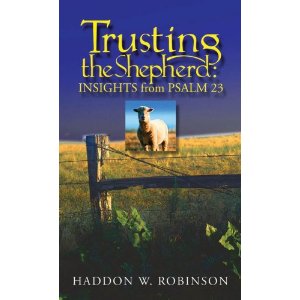
Book Review: Trusting the Shepherd: Insights from Psalm 23 by Haddon W. Robinson

Comfort and Guidance from a Wise Bible Teacher

Dr. Haddon W. Robinson is a veteran preacher, teacher of preachers, Seminary President, and one of the most sought after Bible teachers in the USA. In this short little book Robinson breaks down the most famous chapter in the Bible verse by verse giving cultural background and bridging the gap between the original meaning and the Psalms meaning for us today.

I find that for myself and most Christians I know – the battles with stress, worry, anxiety, and fear are huge. Even though we know we are supposed to trust in the Lord and walk by faith and not by sight, we struggle with trusting in a Sovereign and good God.

Robinson writes, “Someone has observed that every major portion of Scripture was written by someone having a hard time to men and women having a hard time or about to have a hard time.” Keeping this in mind throughout the chapters of this book Dr. Robinson applies the Twenty-third Psalm to many of the common human struggles we all face and shows how the Good Shepherd is worthy of our complete trust.

One of the most beneficial words of wisdom that helped me in the reading of this book was this: “God’s guidance has to do with what we are, not where we are. If we are what God wants us to be, He will have no trouble placing us where He wants us to be. We do not have to be plagued by decisions if we stay close to the Shepherd. He leads us in the right paths and they are paths of righteousness.”

I think this book is well worth reading because it will give you new insights, encourage you to trust in the Lord, and it will help you continue to become more like the Chief Shepherd – Our Lord Jesus Christ. It would be a perfect gift for people going through BIG trials like sickness, being out of work, facing death, etc. – it is a reminder of how we are like sheep who need the guidance, provision, and protection of an all-loving, all-knowing, all-wise, all-powerful, and perfect Shepherd.

Book Review: Lost in the Middle by Paul David Tripp

Great Help For Applying God’s Grace To Your Life

 I want to write out the outset that this book (along with “The Holiness of God” by R. C. Sproul; “Heaven” by Peter Kreeft; “Emotionally Healthy Spirituality” by Pete Scazzero and “Prodigal God” by Tim Keller) has been one of the top paradigm shifting books I have read to help me change my thinking – radically. I also, have to write that I do not have the skill or ability to describe or recommend this book with the superlatives it deserves. I can only write that if you are struggling with “mid-life crisis” this book is absolute MUST reading and I’m confident that you will be much better off by reading it.

All that written – on with the review. I have personally battled depression my whole life. I am a perfectionist and have had to learn to “chill out” over the years, because I have found that things break, plans don’t work out the way you thought they would, and God is sovereign and I’m overwhelmingly NOT!

In this book Paul Tripp brilliantly exegetes reality and brokenness in this fallen world in which we live. He gives dozens of illustrations from the Bible, and men and women in the 21st century to point out the various manifestations of why so many people struggle with the mid-life years. I have read the book twice (and I’m certain – I will read it again) because so many of the stories are about my own struggles. He brings out in the open so many thoughts, and questions that many of us wrestle with and answers them with penetrating insight, theological depth, and practical life giving grace.

This book is not an easy read. I think the more you struggle with life (especially in your middle years) – the harder it will be to read. I found myself crying, and physically aching as I read some of the stories and analysis from Tripp’s pen. However, in the final analysis the book leads you to a fresh new start and brilliantly applies the gospel to your life. Brimming with hope – Tripp shows very practically how God’s purposes and plans for your life will be fulfilled, no matter what you have done, or how you feel at this stage of life.

I have been immensely helped in so many ways from reading this book. Let me list just five:

1)    It was just flat out helpful to have so many of the things I’ve thought and felt be identified and addressed so insightfully by the author – in other words – “I’m not crazy” – there are actually millions of people that have gone and are going through what I am during this stage of life – and they are still trucking!

2)    I learned to appreciate the realities of God’s design for humanity and how His plans will culminate – my story is a part of the fulfillment of the Great Story of the Bible. Tripp helps you to see that nothing in your life is wasted, and that Christ’s victory on the cross is also your ultimate victory as well. Your failure has been nullified by Christ’s Person and Work on your behalf. We have fallen, but He has picked us up. We have failed, but He has succeeded, and ultimately everything will be made new and perfect again – forever!

3)    I was so encouraged over and over again. Sometimes I feel like a major failure in every area of life: as a Christian, pastor, provider, husband, father, taking care of myself physically, and the list can go on and on. However, Tripp is able to bring out the positive realities that result from recognizing our weaknesses and how that makes God’s grace such a wonderful reality for us.

4)    I felt like I got to sit down with Jesus as I read this book. Perhaps one of the most helpful things he did in the book is show how much we are like the people in the Bible (even though we think we are not). The author has such a good grasp of theology, the Bible, and what God and people are like – that almost everything he writes is penetrating the deepest recesses of your soul. I think Paul Tripp is very wise, because he has a very intimate relationship with Jesus and brings that relationship to the reader in the book. It made me want to know God more intimately, the Bible more than I do, and to walk more closely with Jesus.

5)    It made me even more excited about Heaven and to live for that which will last forever. It made me want to live more simply, for others, and for those things that will please my Master – Jesus. Like many of the Psalms – I started reading the book in a discouraged and depressed state, and by the end of the book I was able to praise my Lord with a smile on my face, and with joy in my soul.

I feel like this review is rubbish compared to how GOOD this book actually is. I can only say that this book will help you to understand your sin, need of a Savior, and need for His grace more than you ever have before. Also, that His grace is MUCH greater than all your sin. One more thing – anyone at any life stage can benefit tremendously from this book – you don’t have to be struggling through mid-life to benefit from this book. Get this book, get copies to give away, and grow in His amazing grace. Thanks, Paul Tripp – and I hope that many more people will read and benefit from this book – I sure have!

Book Review: Gospel Centered Family by Ed Moll and Tim Chester

Helping Parents Become What God Wants Them To Be

 Parenting is difficult at times, and also very rewarding. Moll and Chester state, “Good parenting is not about adopting certain techniques. It’s about living as part of God’s story and letting God’s good news shape your values, attitudes, and behavior.” I couldn’t agree more. This outstanding workbook for parents offers 12 chapters in four sections on helping families become: 1) Gospel-centered; 2) Grace-centered; 3) Word-centered; and 4) Mission-centered.

Each chapter stands alone and contains the following five sections:

Consider this – A scenario—often based on a real-life situation—which raises some kind of dilemma or frustration in gospel ministry.

Biblical background – A relevant Bible passage together with some questions to help you think it through.

Read all about it – A discussion of the principle, both in terms of its theological underpinning and its contemporary application.

Questions for reflection – Questions that can be used for group discussion or personal reflection.

Ideas for action – Some ideas or an exercise to help people think through the application of the principle to their own situation.

The chapters are short, chalked full of great advice and ideas for implementation, and very encouraging. I believe that God will use this workbook to help parents be more focused and intentional in equipping their families for impacting culture with the gospel. I highly recommend this book as well as the Gospel Centered Church, Gospel Centered Marriage, and The Gospel Centered life – all outstanding workbooks for individuals and especially for small group/community discipleship.

Book Review: The Gospel Centered Church by Steve Timmis and Tim Chester

A Fantastic Resource For Making Multiplying Disciples

 Veteran British church planters Steve Timmis and Tim Chester have put together a very helpful workbook for churches that desire to be more intentionally & strategically gospel driven. In three loaded sections this guide (suited ideally for discipleship, leadership teams, or small group’s of various kinds) covers six sessions on the Priority of Mission; six sessions on the Priority of People; and another six sessions on the Priority of Community and the last chapter which is on why “It’s all about the gospel.” This book is ideal as a workbook for church planting core groups, or churches that want to be more missional and multiplicational in their process of making and maturing disciples of Christ.

Each chapter stands alone and contains the following five sections:

Consider this – A scenario—often based on a real-life situation—which raises some kind of dilemma or frustration in gospel ministry.

Biblical background – A relevant Bible passage together with some questions to help you think it through.

Read all about it – A discussion of the principle, both in terms of its theological underpinning and its contemporary application.

Questions for reflection – Questions that can be used for group discussion or personal reflection.

Ideas for action – Some ideas or an exercise to help people think through the application of the principle to their own situation.

I think this is a phenomenal resource that helps a church think through how to contextualize the gospel message in its own unique setting. It is concise, deep, Christ exalting, biblical, gospel oriented, God-glorifying and extremely practical. I can’t recommend this resource highly enough.

Book Review: Every Body Matters by Gary Thomas

A Swift Kick in the Pants to Get in Shape for God’s Glory

 On the positive side – Thomas has written a compelling book for Christians to take care of their bodies for the right reasons. He elaborates on the wrong reasons and the right reasons in the book. If we take care of our bodies by eating better, and exercising we have more energy to work, serve, minister, and maximize our relationships by using all of our gifts and talents for God’s glory. Thomas puts it this way, “By God’s design, we are a people with souls who desperately yearn for intimacy with God – people whose souls reside in bodies that can hinder or help this pursuit. Which will it be?”

Thomas does a good job throughout the book in balancing the convicting aspects that lead to poor health (e.g., laziness & gluttony) and highlighting the positive aspects that result from good health – there are many. He makes an excellent case for how freeing taking care of God’s temple (your body) can be, and gives numerous real life examples and Scriptures to back this up. Gluttony and laziness have proven in many churches to be “acceptable” sins. I am glad that Thomas calls a spade a spade!

I have two BIG theological pet peeves that really bothered me in this book:

In chapter two Thomas writes in a confusing manner, when he writes of “mind and spirit” and “soul and body.” In this chapter he exchanges the word “spirit” for “heart.” I wish he would have defined his terms and defended his trichotomist position better (he really doesn’t define any of these terms). I think this is very unfortunate, because it’s very easy to derive bad theology when you do not make clear distinctions in addressing the soul/spirit and body. I happen to be a dichotomist (of which the vast majority of theologians throughout history and today are and have been), which is neither here nor there in this review, but if you are writing a book for the masses, it would have been nice if Thomas had done more work in this area to make his position more clear, and less vague.

Thomas makes this statement in chapter 3, “the enemy can disrupt and disable our lives through sickness, which thwarts God’s purposes for us in the world.” If he means by this that we reap what we sow – that’s one thing – case in point well taken. However, nothing can thwart the purposes of God – when Satan attacked Job physically he still had to ask permission from God, and God’s purposes aren’t necessarily clear, but nobody and nothing can ever thwart the purposes of a sovereign, omnipotent, and all wise God.

Overall, I appreciate the message of this book. It’s really a kick in the pants for Christians to be good stewards of what God has entrusted to us, and to control and be responsible over the choices we can make. It’s not about what we can’t do, but what we can do with the bodies God has entrusted to us in order to serve Him well for as long as we can – and we can serve Him much better if we take care of our temples for His glory.

I would hesitate to give this book to new or weak brothers and sisters in Christ because of the overemphasis on man’s responsibility and what I would consider a weak view of God’s sovereignty. It is subtle, and I don’t know if Thomas intended this or not (I hope not). The book comes with questions for discussion and I think can be beneficial for small groups. I would definitely make certain that my small group leaders have a good God-centered theology before letting them loose with this book.  I give this book a 3.5 out of 5 stars for good ideas, but for weak theological underpinnings.

Book Review: The Mystery of the Holy Spirit by R. C. Sproul

 How To Know The Holy Spirit Personally and Intimately

 Many times as a pastor I have heard Christians refer to the Holy Spirit as an “it,” or a “power/force,” or the like. I have also heard many times that the most abstract member of the trinity to many Christians is the Holy Spirit. It has been my own experience that I have had to work harder to understand and know the Holy Spirit more than any other Person in the Trinity. In this book Dr. Sproul writes with profound insight, biblical acumen, and exegetical precision and gradually peels away the mysteries surrounding the third Person in the Trinity.

There are ten good reasons to read this book and its because each chapter handles a distinct important aspect of the character or attributes of the Holy Spirit and Sproul then cogently and articulately explains the ramifications for us theologically and then practically.

In chapter one Dr. Sproul asks and answers the question “Who is the Holy Spirit?” by using various Scriptures demonstrating that the Holy Spirit is a “person;” that we are called to a have a “personal relationship with him;” and that he performs “personal tasks.”

In chapter two the author gives a plethora of Scriptures and some very good logical arguments like this one: “Were the Holy Spirit not God, it is extremely unlikely that blasphemy against Him would be regarded as unpardonable,” to show very clearly that the Bible teaches the deity of the Holy Spirit in both the Old and New Testaments.

In chapter three Dr. Sproul tackles and dismantles the most common objections raised against the Trinity and deals with them historically, biblically, and philosophically. He answers the following objections with great erudition, concise simplicity, and with immense sagacity:

Objection #1: The Word “Trinity” is not a biblical word and represents the invasion of foreign philosophy into biblical revelation.

Objection #2: The doctrine of the Trinity is contradictory and therefore irrational.

He demonstrates clearly in this chapter that the Trinitarian formula is neither contradictory nor irrational—rather it is biblical and logical.

Chapter four is vintage Sproul. Dr. Sproul is known for his outstanding vocabulary and for making things clear by explaining the meaning of words with reference to his subject of discussion. Dr. Sproul takes the time in this chapter to define the meanings and distinctions of the Holy Spirit as “essence” and “person.” He explains this by elaborating on three concepts: contradiction, paradox, and mystery with reference to our understanding of the Holy Spirit’s character and attributes.

Chapter five is a wonderful explanation of God the Holy Spirit’s work in physical and spiritual creation. He summarizes the chapter in this manner: “It is the Holy Spirit who supplies the dynamic for the created world. By His power the universe has life and motion…there is a parallel between the Spirit’s work in creation and redemption. As He is the generating power of biological life, so is He the source and generating power of spiritual life. His work in redemption mirrors and supplements His work in creation. He works both in creation and re-creation of a fallen world.”

In Chapter six Dr. Sproul gives a masterful presentation on what it means to be “born-again” or “regenerated” by the Holy Spirit. He demonstrates from John 3 and Ephesians 2 how we are “dead” spiritually and must be “made alive” by the Holy Spirit in order to be saved. He gives an outstanding presentation of why regeneration must precede faith and obliterates the much believed idea that faith + rebirth = justification.

Chapter seven is a wonderful articulation of the eternal security of those who are indeed regenerate. Sproul gives a very good presentation on the biblical distinctions of justification (monergistically – God alone working to save us); and sanctification (synergistically – the cooperation between the Holy Spirit and us).

I think chapter 8 on the Baptism of the Holy Spirit is perhaps the best in the book. The baptism of the Spirit may be one of the least understood issues in theology today. Dr. Sproul brings great clarity and synthesis to a better understanding of this doctrine and its immense importance. The thesis he defends is summed up at the end of the chapter in this manner:

“I am not saying that everyone who is a member of a Christian church has the Holy Spirit. Membership in the visible church no more guarantees the baptism of the Holy Spirit than it guarantees salvation. We know that there are unbelievers who are church members. No unbeliever has the baptism of the Holy Spirit, but every believer, every regenerate person, does have the baptism of the Holy Spirit. Every Christian from Pentecost to the present is both regenerate of the Spirit and baptized in the Spirit. That is the essence of the meaning of Pentecost. Anything less casts a shadow over the sacred importance of Pentecost in the history of redemption. Any person who is regenerate is also sealed by the Spirit, baptized in the Spirit, and has the earnest of the Spirit.”

In chapter nine we have a great exposition of Galatians 5 contrasting the works of the flesh and the work of the Spirit, and lastly in chapter ten Dr. Sproul shows how the Holy Spirit is Christ’s Vicar on earth to empower, comfort, and use us for the glory of Christ.

Honestly, I’m surprised this book has not been a BIG seller. As far as I’m concerned it is the best book bridging great scholarship in laymen’s terms on the Person and Work of the Holy Spirit in the English language. I have read over twenty books on the Holy Spirit – and this is my third time through Sproul’s work, and it is still the one I would recommend most if you are going to read one book on the Holy Spirit.

*Dr. R.C. Sproul is the founder, chairman and president of Ligonier Ministries, an international Christian education ministry located near Orlando, Florida. His teaching can be heard on the program Renewing Your Mind, which is broadcast on hundreds of radio outlets in the United States and in 40 countries worldwide. He is the executive editor of Tabletalk magazine and general editor of The Reformation Study Bible, and the author of more than seventy books and scores of articles for national evangelical publications. Dr. Sproul also serves as president of Ligonier Academy of Biblical and Theological Studies and Reformation Bible College. He currently serves as senior minister of preaching and teaching at Saint Andrew’s in Sanford, FL.