How Should Christians Respond to Hate?

HOW SHOULD CHRISTIANS REACT TO HATE?

Chris Broussard

By Dan Darling

It’s no secret that the biblical sexual ethic, a beautiful monogamous relationship reserved for marriage between a man and a woman, has swiftly fallen out of favor in our culture. The recent declaration that Jason Collins, a veteran NBA center, has exposed the deep rifts in our society on the issue of homosexuality. While most of the world celebrated Collin’s courage, ESPN NBA reporter, Chris Broussard, a committed evangelical Christian, had his own courage to say, into a stiff wind of opposition, that Collin’s lifestyle choices conflict with the Christian faith

Nothing in this story should surprise us. Society has been moving this direction for some time now. But what caught me off guard, I guess, was the public shaming of the Christian position on marriage. I heard many, well-respected sports commentators, guys I’ve listened to and followed for many years, seemingly equate Christians like Broussard with bigots and with the ignorant and unlearned. The sweeping intolerance of Christianity, the crude names leveled at Broussard and others seems to mark a new moment in our country. The reality is that holding the biblical sexual ethic will now invite open scorn. I only expect it to get worse. I only expect those who stand firm on the Scriptures to experience further persecution and hostility. And we shouldn’t be surprised. Jesus himself promised that his followers would endure some level of persecution. “They hated me, they will hate you,” he predicted (John 15:18).

So the question is this: how now shall we live? What should our reaction be? In my view there are two wrong responses and one right one.

1) We can cave in and seek the approval of men rather than the approval of God. There is a growing movement in the evangelical world that is seeking to make complicated what the Scriptures make plain, namely that perhaps the Bible is not so explicitly condemning of homosexuality as we think. As a person wired to avoid conflict I’m sympathetic to the desire to find this in the Bible, but it is just not there. Jesus himself affirmed the law of Moses when he repeated the words from Genesis, “For this cause a man will leave his father and mother and cleave to His wife” (Matthew 19:5). And while Jesus offered grace to the women who violated the biblical marriage ethic and condemned the Pharisees who wanted to stone her, he also told her, “Go and sin no more.” He didn’t act as if her sexual activity out of marriage was okay. He said it was sin. Sin that brought him to this earth and nailed him to a cross. Sin he graciously has forgiven. Sin which invites the grace and holiness of God. As much as we want to cave in on marriage, because to do so would make our lives as Christians much, much easier, to do so is to abandon the way of Christ. I’m reminded of Peter’s words to the persecuted believers of the 1st Century, “Stand firm in the faith” (1 Peter 5:19).

2) We can ratchet up the angry, hateful, personal rhetoric. As shameful it is to cave in on Scriptural truth, it’s equally sinful to sort of use our position as an increasingly marginalized minority to lash out at those who don’t agree with us. But if we’re to take serious the truth we claim to uphold, we have to listen to all the words of Jesus, including his words, “Love your enemies” (Matthew 5:43-48). And we have to listen to the words of that same Apostle Peter. The same guy who told us to “stand firm” also told us to do it with civility and respect (1 Peter 3:15). I find it interesting that Peter, speaking to an increasingly marginalized, persecuted group of Christians, found it important to say, essentially, “Make sure you suffer, not for your own evil, but for doing good” (1 Peter 2:20; 1 Peter 3:17). In other words, we are to speak firmly, but with kindness, winsomeness, charity, and grace. If we are honest, we would admit that the Christian community does not always do this well. We should disagree with Jason Collin’s choices, but we should not mock him, we should not post crude or hurtful slurs online. We should not slander those who disagree with us. We should lead with grace, remembering that Jesus didn’t come to condemn, but to offer salvation and life. Jesus came for sinners and so we should seek to love sinners as much as He did. We should, like Paul, remember that we are counted in that group: we are as much sinners in need of grace as the unrepentant homosexual. I find it interesting that Paul, at the end of his life, nearing the time of his martyrdom at the hands of a cruel despot, surveyed the entire landscape and said, “I am the chief of sinners” (1 Timothy 1:15). Imagine that. Paul looked around the entire world, saw wicked men like Nero and the soft Christians who betrayed him and yet said, “They may be sinners, but I’m worse.” What a spirit of humility! This is the spirit that should inform our engagement on these issues where most of the culture resists. We should as the Spirit to help us fight the urge to return rhetorical evil with rhetorical evil (1 Peter 3:9). We should reject the sort of knee-jerk, crude, mean-spirited kind of speaking that seems to characterize much of our public discourse. Civility is not unimportant and it’s not overrated and it’s not the enemy of courage.

3) We can respond with love and grace. 

2 Timothy 3:12 reminds us that “all who live godly in Christ will suffer persecution.” The level of persecution we face today in America is low-level at best. Much of what we think is persecution is simply consequences of our own inability to treat people with grace. But we’re moving into an era where our positions on the issues may invite charges of bigotry. This is where we must not react with surprise or fear–remembering that trials are an opportunity for joy (James 1:2) and occasions for growth and Christlikeness (John 15; James 1:2-4). Fear stems from a lack of faith and fear causes us to react in unloving ways. But if we believe that God is completely sovereign and that we have been tasked by Him to the ministry of reconciliation (2 Corinthians 5:18), it is incumbent on us to model Jesus’ behavior and react to hatred and intolerance with grace and love. We should be wise about responding to every charge with a countercharge. We should hold our fire sometimes, as Jesus did in the face of false accusations (John 18:33-38). We should forgive others, looking to Christ’s own forgiveness of us (Ephesians 4:32) and His forgiveness of those who crucified him, “Forgive them, for they know not what they do” (Luke 23:42). We should not be defensive, whiny, petulant. We should work hard to  see every human as someone worthy of respect (1 Peter 2:17), created in the image of God (James 3:9). We should not make our fight personal or political (Ephesians 6:12). The real enemy doesn’t have a human face, but is our adversary (1 Peter 5:8). And our real hope is not in a short-term victory, but in the future hope of a coming kingdom, another world, a city whose builder and maker is God (Matthew 6:10; Hebrews 11:10).

As followers of Jesus, we’re not simply called to be counter-cultural with our sexual ethics, but also in the way we talk, speak, and articulate these things. If we are called to suffer for our faith, let’s pray God gives us the courage and grace to endure and that our lives are but a small glimpse of Christ within.

SOURCE: http://www.crosswalk.com/blogs/daniel-darling/how-should-christians-react-to-hate.html

ABOUT THE AUTHOR

Daniel Darling is the Vice President for Communications for the Ethics and Religious Liberty Commission of the Southern Baptist Convention (ERLC). For five years, Dan served as Senior Pastor of Gages Lake Bible Church in the northwest suburbs of Chicago and is the author of several books, including Teen People of the Bible, Crash Course, iFaith, Real, and his latest, Activist Faith. He is a weekly contributor to Out of Ur, the blog of Leadership Journal. His work has been featured in evangelical publications such as Relevant Magazine, Homelife, Focus on the Family, Marriage Partnership, In Touch with Dr. Charles Stanley. He has guest-posted on leading blogs such as Michael Hyatt, The Gospel Coalition, OnFaith (Washington Post), and others. He is a contributing writer for many publications including Stand Firm, Enrichment Journal and others. Dan’s op-eds have appeared in Washington Posts’ On Faith, CNN.com’s Belief Blog, and other newspapers and opinion sites. He is a featured blogger for Crosswalk.com, Churchleaders.com and Believe.com, Covenant Eyes, G92, and others. Publisher’s Weekly called his writing style “substantive and punchy.” Dan is a sought-after speaker and has been interviewed on TV and radio outlets across the country, including CNN, 100 Huntley Street, Moody Broadcasting Network, Harvest Television, The Sandy Rios Show, American Family Radio, the Salem Radio Network, and a host of other local and national Christian media. He holds a bachelor’s degree in pastoral ministry from Dayspring Bible College and is pursuing a Masters of Divinity degree from Trinity Evangelical Divinity School. He and his wife Angela have four children and reside in the Nashville area. Daniel is represented by Tamela Hancock Murray of The Steve Laube Literary Agency

Creating A Positive Environment With Our Words

ENCOURAGE ONE ANOTHER

Encourage each other

By Dane Ortlund

Our words to one another about one another not only describe reality. They also create reality.

“You idiot!” does not simply assess what is objectively true to the speaker. It also produces, in the one spoken to, death and darkness. Not only do our words reveal what is true of us, they also generate reality for another. Specifically, our words are either death-bringing or life-giving. Either depleting or nourishing, draining or filling.

The gospel is a message of life, of nourishing, of filling. Because of Christ’s work in our behalf, we are set free from sin, adopted into God’s family, welcomed in. The “word of truth, the gospel of your salvation” (Eph. 1:13) is a word that gives life. And the great privilege we have when we gather with other believers—other obnoxious believers, other theologically imprecise believers, other spiritually sleepy believers, other frustrating believers, other sinning believers—is of passing on horizontally a taste of what we’ve been given vertically. Amid all my sin and messiness, in Jesus, God has given me a word of welcome, a word of love—“the word of life” (Phil. 2:161 John 1:1). Loved with this word of grace, I love others with words of grace.

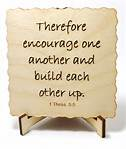
After all, when Paul says, “Therefore encourage one another and build one another up,” what is the “therefore” referring to? What is fueling such encouragement? One of the greatest exultations in all the New Testament about the hope of the gospel: “God has not destined us for wrath, but to obtain salvation through our Lord Jesus Christ, who died for us so that whether we are awake or asleep we might live with him” (1 Thess. 5:9–10).

Having been shown life through the word of the gospel, we give life through the words we use.

That’s easier said than done. All day long, words are flowing out of us. Passing another and saying hello in the hallway at work, chatting over lunch, greeting our spouse at the end of the day, tucking a child in with a good night story, speaking with a salesperson at Best Buy, talking on the phone while driving. We also use words without employing the larynx: emails, tweets, Facebook comments, handwritten notes stuck on the fridge. Even in this article I am using words: Are they bringing life?

In the hurricane of words that make up any given day, how do we walk in wisdom such that our words inject sanity, calm, and life rather than destruction? In two ways.

First, by saying nothing.

One major way we give life to others with our words is by not using any. It feels awkward to sit with someone depressed or overwhelmed with life and to say nothing. But what comes out of our mouth as medicine can, in fact, sicken rather than strengthen another’s heart (Prov. 23:8). A sufferer, when the pain is raw, needs warm presence, not fixing words. Paul said, “Weep with those who weep” (Rom. 12:15), not “provide theological answers to those who weep.” That Romans 8:28 comes before Romans 12:15 in the canon does not mean it should in our counseling and friendships.

Second, by saying something.

All our words tumble out impelled by one of two motives. I am using words either for myself or for you. All my speech is either fueled by self (no matter how smiling it is) or by love (no matter how painful it is).

The question, then, is why do you speak the words you do? Why do you speak the way you do? What is the aroma of your words? Are you spraying bullets, forgetting God has set down the gun rightly aimed at you? Do you speak to others the way you wish to be spoken to? What kind of speech has given you life as you consider meaningful relationships in your past? Do you ever—ever—look another human being in the face and say to them the following words: “May I tell you something I admire about you?” (It is one of the great secrets to Christian community that speaking a word of grace to another builds up you as much as the other.)

In your short life, you have a million tiny opportunities, including a hundred today, to inject a small but potent dose of life and light into another. As you consider doing this, you will immediately find a good reason presenting itself that seems to clearly mitigate your impulse to build another up. Some weakness, some corresponding fault, will arise in your mind, cancelling out your reason to encourage that person. Indeed, with some people in our lives, we honestly have difficulty finding anything encouraging to say.

Once more we remember the gospel. God did not allow our own faults to mitigate His word of gospel life to us. We have given Him every reason to withhold that precious word from us. Instead He lavishes us with assurances of undeserved love. We come alive. We breathe again.

John Owen wrote that God “loves life into us.” Will you love life into another?

*SOURCE: July 1st, 2013 @ http://www.ligonier.org/learn/articles/encourage-another/

ABOUT THE AUTHOR

Dr. Dane Ortlund serves as Bible publishing director at Crossway Books in Wheaton, Illinois. He is the author of Defiant Grace: The Surprising Message and Mission of Jesus.

James Boice on God’s Glory Alone – Soli Deo Gloria

To him be the glory forever! Amen. – Romans 11:36

Romans 9-11 Boice 

The title of this study is not an exact translation of the second half of Romans 11:36, but I have selected it because it is the way the Protestant Reformers expressed what this verse is about and because the words, though in Latin, are well known. Soli Deo Gloria means “To God alone be the glory.” Soli Deo—“to God alone.” Gloria—“the glory.” These words stand virtually as a motto of the Reformation.

The Reformers loved the word solus (“alone”).

They wrote about sola Scriptura, which means “Scripture alone.” Their concern in using this phrase was with authority, and what they meant to say by it was that the Bible alone is our ultimate authority—not the pope, not the church, not the traditions of the church or church councils, still less personal intimations or subjective feelings, but Scripture only. These other sources of authority are sometimes useful and may at times have a place, but Scripture is ultimate. Therefore, if any of these other authorities differ from Scripture, they are to be judged by the Bible and rejected, rather than the other way around.

The Reformers also talked about sola fide, meaning “faith alone.” At this point they were concerned with the purity of the gospel, wanting to say that the believer is justified by God through faith entirely apart from any works he or she may have done or might do. Justification by faith alone became the chief doctrine of the Reformation.

The Reformers also spoke of sola gratia, which means “grace alone.” Here they wanted to insist on the truth that sinners have no claim upon God, that God owes them nothing but punishment for their sins, and that, if he saves them in spite of their sins, which he does in the case of the elect, it is only because it pleases him to do so. They taught that salvation is by grace only.

There is a sense in which each of these phrases is contained in the great Latin motto Soli Deo Gloria. In Romans 11:36, it follows the words “for from him and through him and to him are all things,” and it is because this is so, because all things really are “from him and through him and to him,” that we say, “To God alone be the glory.” Do we think about the Scripture? If it is from God, it has come to us through God’s agency and it will endure forever to God’s glory. Justification by faith? It is from God, through God, and to God’s glory. Grace? Grace, too, has its source in God, comes to us through the work of the Son of God, and is to God’s glory.

Many Christian organizations have taken these words as their motto or even as their name. I know of at least one publishing company today that is called Soli Deo Gloria. It is also an appropriate theme with which to end these studies of the third main (and last doctrinal) section of Paul’s letter to the Romans. Indeed, what greater theme could there be? For what is true of all things—that they are “from” God, “through” God, and “to” God—is true also of glory. Glory was God’s in the beginning, is God’s now, and shall be God’s forever. So we sing in what is called the Gloria Patri.

Glory be to the Father, and to the Son

and to the Holy Ghost;

As it was in the beginning, is now

and ever shall be:

World without end. Amen.

Haldane’s Revival

At the beginning of this series—in volume 1, chapter 2—177 studies ago, I mentioned a revival that took place in Geneva, Switzerland, under the leadership of a remarkable Scotsman named Robert Haldane (1764–1842). He was one of two brothers who were members of the Scottish aristocracy in the late eighteenth and early-nineteenth centuries. His brother, James Haldane (1768–1851), was a captain with the British East India Company. Robert was the owner of Gleneerie and other estates in Perthshire. When he was converted in the decade before 1800, Robert sold a major part of his lands and applied the proceeds to advancing the cause of Jesus Christ in Europe. James became an evangelist and later an influential pastor in Edinburgh, where he served for fifty-two years.

In the year 1815, Robert Haldane visited Geneva. One day when he was in a park reading his Bible, he got into a discussion with some young men who turned out to be theology students. They had not the faintest understanding of the gospel, so Haldane invited them to come to his rooms twice a week for Bible study. They studied Romans, and the result of those studies was the great Exposition of Romans by Haldane from which I so often quote.

All those students were converted and in time became leaders in church circles throughout Europe. One was Merle d’Aubigné, who became famous for his classic History of the Reformation in the Sixteenth Century. We know the first part of it as The Life and Times of Martin Luther. Another of these men was Louis Gaussen, author of Theopneustia, a book on the inspiration of the Scriptures. Others were Frédéric Monod, the chief architect and founder of the Free Churches in France; Bonifas, who became an important theologian; and César Malan, another distinguished leader. These men were so influential that the work of which they became a part was known as Haldane’s Revival.

What was it that got through to these young men, lifting them out of the deadly liberalism of their day and transforming them into the powerful force they became? The answer is: the theme and wording of the very verses we have been studying, Romans 11:33–36. In other words, a proper understanding of God’s sovereignty.

We know this because of a letter from Haldane to Monsieur Cheneviere, a pastor of the Swiss Reformed Church and Professor of Divinity at the University of Geneva. Cheneviere was an Arminian, as were all the Geneva faculty, but Haldane wrote to him to explain how appreciation of the greatness of God alone produced the changes in these men. Here is his explanation:

There was nothing brought under the consideration of the students of divinity who attended me at Geneva which appeared to contribute so effectually to overthrow their false system of religion, founded on philosophy and vain deceit, as the sublime view of the majesty of God presented in the four concluding verses of this part of the epistle: Of him, and through him, and to him, are all things. Here God is described as his own last end in everything that he does.

Judging of God as such an one as themselves, they were at first startled at the idea that he must love himself supremely, infinitely more than the whole universe, and consequently must prefer his own glory to everything besides. But when they were reminded that God in reality is infinitely more amiable and more valuable than the whole creation and that consequently, if he views things as they really are, he must regard himself as infinitely worthy of being more valued and loved, they saw that this truth was incontrovertible.

Their attention was at the same time directed to numerous passages of Scripture, which assert that the manifestation of the glory of God is the great end of creation, that he has himself chiefly in view in all his works and dispensations, and that it is a purpose in which he requires that all his intelligent creatures should acquiesce, and seek and promote it as their first and paramount duty.

A testimony like that leads me to suggest that the reason we do not see great periods of revival today is that the glory of God in all things has been largely forgotten by the contemporary church. It follows that we are not likely to see revival again until the truths that exalt and glorify God in salvation are recovered. Surely we cannot expect God to move among us greatly again until we can again truthfully say, “To him [alone] be the glory forever! Amen.”

To Him Be the Glory

Romans 11:36 is the first doxology in the letter. But it is followed by another at the end, which is like it, though more complete: “To the only wise God be glory forever through Jesus Christ! Amen” (Rom. 16:27). It is significant that both doxologies speak of the glory of God, and that forever. Here are two questions to help us understand them.

1. Who is to be glorified?

The answer is: the sovereign God. For the most part, we start with man and man’s needs. But Paul always started with God, and he ended with him, too. In fact, the letter to the Romans is so clearly focused on God that it can be outlined accurately in these terms. Donald Grey Barnhouse published ten volumes on Romans, and he reflected Paul’s focus in the titles for these ten volumes, all but the first of which has God in the title. Volume one was Man’s Ruin. But then came God’s Wrath, God’s Remedy, God’s River, God’s Grace, God’s Freedom, God’s Heirs, God’s Covenants, God’s Discipline, and God’s Glory. We say with Paul, “To God be the glory forever! Amen.”

2. Why should God be glorified?

The answer is that “from him and through him and to him are all things,” particularly the work of salvation. Why is man saved? It is not because of anything in men and women themselves but because of God’s grace. It is because God has elected us to it. God has predestinated his elect people to salvation from before the foundation of the world. How is man saved? The answer is by the redeeming work of the Lord Jesus, the very Son of God. We could not save ourselves, but God saved us through the vicarious, atoning death of Jesus Christ. By what power are we brought to faith in Jesus? The answer is by the power of the Holy Spirit through what theologians call effectual calling. God’s call quickens us to new life. How can we become holy? Holiness is not something that originates in us, is achieved by us, or is sustained by us. It is due to God’s joining us to Jesus so that we have become different persons than we were before he did it. We have died to sin and been made alive to righteousness. Now there is no direction for us to go in the Christian life but forward. Where are we headed? Answer: to heaven, because Jesus is preparing a place in heaven for us. How can we be sure of arriving there? It is because God, who began the work of our salvation, will continue it until we do. God never begins a work that he does not eventually bring to a happy and complete conclusion.

“To him be the glory forever! Amen.”

The great Charles Hodge says of the verse we are studying;

Such is the appropriate conclusion of the doctrinal portion of this wonderful epistle, in which more fully and clearly than in any other portion of the Word of God, the plan of salvation is presented and defended. Here are the doctrines of grace, doctrines on which the pious in all ages and nations have rested their hopes of heaven, though they may have had comparatively obscure intimations of their nature. The leading principle of all is that God is the source of all good, that in fallen man there is neither merit nor ability, that salvation, consequently, is all of grace, as well satisfaction as pardon, as well election as eternal glory. For of him, and through him, and to him, are all things; to whom be glory forever. Amen.

So let us give God the glory, remembering that God himself says:

I am the Lord; that is my name!

I will not give my glory to another

or my praise to idols.

Isaiah 42:8

and

For my own sake, for my own sake, I do this.

How can I let myself be defamed?

I will not yield my glory to another.

Isaiah 48:11

People Who Give God Glory

What of the objections? What of those who object to the many imagined bad results of such God-directed teaching? Won’t people become immoral, since salvation, by this theory, is by grace rather than by works? Won’t they lose the power of making choices and abandon all sense of responsibility before God and other people? Won’t people cease to work for worthwhile goals and quit all useful activity? Isn’t a philosophy that tries to glorify God in all things a catastrophe?

A number of years ago, Roger R. Nicole, professor of systematic theology at Gordon-Conwell Divinity School in South Hamilton, Massachusetts, and now at Reformed Theological Seminary in Orlando, Florida, answered such objections in a classic address for the Philadelphia Conference on Reformed Theology (1976), basing his words on an earlier remarkable address by Emile Doumergue, a pastor who for many years was dean of an evangelical seminary in southern France. Nicole’s address was likewise titled “Soli Deo Gloria.” The quotations below are from his answers to three important questions.

1. Doesn’t belief in the sovereignty of God encourage evil by setting people free from restraints? Doesn’t it make morality impossible?

“I suppose one could proceed to discuss this in a theological manner—to examine arguments, consider objections, and line up points in an orderly disposition. I would like, however, instead of going into a theological discussion, to challenge you in terms of an historical consideration. In the Reformation, there was a group of men who made precisely these assertions. Over against the prevailing current, they said that man is radically corrupt and is therefore totally unable by himself to please God. He is incapable of gathering any merits, let alone merit for others. But did these assertions damage morality? Were these people a group of scoundrels who satisfied their own sinful cravings under the pretense of giving glory to God? One does not need to be very versed in church history to know that this was not so. There were at that time thefts, murders, unjust wars. Even within the church there was a heinous and shameful trafficking of sacred positions.

“But what happened?

“These people, who believed that man is corrupt and that only God can help him, came forward like a breath of fresh air. They brought in a new recognition of the rights of God and of his claim upon the lives of men. They brought in new chastity, new honesty, new unselfishness, new humbleness, and a new concern for others. “Honest like the Huguenots,” they used to say. … Immorality was not promoted; it was checked by the recognition of the sovereignty of God.

“ ‘That is impossible,’ some say. Yet it happened.”

2. Doesn’t belief in the sovereignty of God eliminate man’s sense of responsibility and destroy human freedom? Doesn’t it destroy potential?

“Again, rather than going into the arguments of the matter, let us merely examine what happened in the sixteenth century when the sovereignty of God was asserted. Did the people involved allow themselves to be robbed of all initiative? Were they reduced to slavery under the power of God? Not at all! On the contrary, they were keenly aware of their responsibility. They had the sense that for everything they were doing, saying and thinking they were accountable to God. They lived their lives in the presence of God, and in the process they were pioneers in establishing and safe-guarding precious liberties—liberty of speech, religion and expression—all of which are at the foundation of the liberties we cherish in the democratic world.

“Far from eclipsing their sense of freedom, the true proclamation of the sovereignty of God moved them toward the recognition and expression of all kinds of human freedoms which God has himself provided for those whom he has created and redeemed.

“ ‘It is impossible that this should happen,’ we are told. Perhaps! But it happened.”

3. Doesn’t commitment to God’s sovereignty undercut strenuous human activity? Doesn’t it make people passive?

“We may make an appeal to history. What did these people—Calvin, Farel, Knox, Luther—what did they do? Were they people who reclined on a soft couch, saying, ‘If God is pleased to do something in Geneva, let him do it. I will not get in his way’? Or, ‘If God wants to have some theses nailed to the door of the chapel of Wittenberg Castle, let him take the hammer. I will not interfere’? You know very well that this is not so. These were not people lax in activity. They were not lazy. Calvin may be accused of many things, but one thing he has seldom been accused of is laziness. No, when the sovereignty of God is recognized, meaningfulness comes to human activity. Then, instead of seeing our efforts as the puny movements of insignificant people unable to resist the enormous momentum of a universe so much larger than ourselves, we see our activity in the perspective of a sovereign plan in which even small and insignificant details may be very important. Far from undermining activity, the doctrine of the sovereignty of God has been a strong incentive for labor, devotion, evangelism and missions.

“ ‘Impossible!’ Yet it happened.”

God’s Blessings for Our World

Nicole continues: “In the first century the world was in a frightful condition. One does not need to be a great authority on Roman history to know that. There were signs of the breakdown of the Roman Empire—rampant hedonism and a dissolution of morals. But at that point God was pleased to send into the world that great preacher of the sovereignty of God, the apostle Paul, and this introduced a brand new principle into the total structure. The preaching of Paul did not avert the collapse of the Roman Empire, but it postponed it. Moreover, it permitted the creation of a body of believers that persisted through the terrible invasions of the barbarian hordes, and even through the Dark Ages. …

“In the sixteenth century … the church had succumbed to deep corruption. It was corrupt ‘in its head and members.’ In many ways it was a cesspool of iniquity. People did not know how to remedy the situation. They tried councils, internal purges, monastic orders. None of these things seemed to work. But God again raised up to his glory men who proclaimed the truth of his sovereignty, the truth of God’s grace. In proclaiming this truth they brought a multitude of the children of God into a new sense of their dependence upon and relationship to Christ. In proclaiming this truth they benefited even the very people who opposed them in the tradition of the church. They are small, these men of the Reformation. They had little money, little power and little influence. One was a portly little monk in Germany. Another was a frail little professor in Geneva. A third was a ruddy but lowly little man in Scotland. What could they do? In themselves, nothing. But by the power of God they shook the world.

Radically corrupted, but sovereignly purified!

Radically enslaved, but sovereignly emancipated!

Radically unable, but sovereignly empowered!

“These men were the blessing of God for our world.”

“To God alone be glory!” To those who do not know God that is perhaps the most foolish of all statements. But to those who do know God, to those who are being saved, it is not only a right statement, it is a happy, wise, true, inescapable, and highly desirable confession. It is our glory to make it. “To him be the glory forever! Amen.”

 SOURCE: James Montgomery Boice. Expositions on Romans. Volume 3. God and History (Romans 9-11). Chapter 179, “Soli Deo Gloria” based on Romans 11:36.

COACHING QUESTIONS WITH YOUR DISCIPLE

GOSPEL COACHING WITH A DISCIPLE

Gospel Coach

PERSONAL LIFE

(1) What are some evidences of grace in your life recently?

(2) What can you tell me about your spouse and family?

(3) How do you relax or what do you do for fun?

(4) How is your spouse doing?

(5) How are you doing as a couple?

(6) Are there any new strains on your relationship that surprised you?

(7) Has your spouse complained about your time together recently?

SPIRITUAL LIFE

(1) How is the condition of your soul?

(2) How would you describe your call to follow Jesus Christ?

(3) What are some of the Christian communities you participate in and how do they encourage your walk with Jesus?

(4) What is God doing in your heart right now?

(5) How have you seen the Holy Spirit produce new fruit in your life?

MISSIONAL LIFE

(1) What opportunities for ministry do you see before you?

(2) What is God calling you to be or do?

(3) What skills or abilities has God-given you that help clarify your calling?

QUESTIONS FOR FEEDING YOUR DISCIPLE

PERSONAL LIFE

(1) What is God teaching you about your role as a husband and father/wife and mother?

(2) What obstacles are you experiencing in your personal life?

(3) How is your health? Are you taking any medications?

(4) What would enhance your relationship with your spouse?

SPIRITUAL LIFE

(1) What information or resources would be helpful to your spiritual growth?

(2) Where have you experienced the most growth lately?

(3) What is the biggest threat to your oneness with Christ?

(4) Where are you most vulnerable to sin?

(5) What sins are you battling?

(6) What compels you to worship God?

MISSIONAL LIFE

(1) When have you had a significant impact on another person?

(2) In what ways are you making disciples?

(3) What are some challenges you are facing in your primary ministry responsibility?

(4) What resources do you need to accomplish your ministry goals?

QUESTIONS FOR LEADING YOUR DISCIPLE

PERSONAL LIFE

(1) How are you leading your family?

(2) What is the greatest need in your personal life (Look for idols, agendas, identity struggles, and selfishness)?

SPIRITUAL LIFE

(1) How is the Lord leading you to respond to Him?

(2) What is the greatest need in your spiritual life (Look for idols, agendas, identity struggles, and selfishness)?

MISSIONAL LIFE

(1) What is the Lord leading you to {pick one} know (head), feel (heart), or do (hands) with regard to ministry?

(2) What is the mission of your ministry?

(3) What is the greatest need of your ministry life?

QUESTIONS FOR PROTECTING YOUR DISCIPLE

PERSONAL LIFE

(1) What challenges do you face personally?

(2) What temptations occur in your personal life?

(3) How are you prone to wander personally (health, finances, time, marriage, etc.)?

SPIRITUAL LIFE

(1) What challenges do you face spiritually?

(2) What temptations occur in your spiritual life?

(3) What kind of priority do you give to Bible reading and prayer in your life?

(4) Where are you prone to wander spiritually?

MISSIONAL LIFE

(1) What challenges do you face missionally?

(2) What temptations occur in your ministry life?

(3) Where are you prone to wander in ministry?

*SOURCE: Adapted from Appendix 4 in Gospel Coach: Shepherding Leaders to Glorify God by Scott Thomas and Tom Wood. Wheaton: Crossway Books, 2013.

James Boice Sermon: “The Sixth Day” – Genesis 1:24-27

SERIES: GENESIS – PART 11

Genesis 1-11 vol 1 Boice

And God said, “Let the land produce living creatures according to their kinds: livestock, creatures that move along the ground, and wild animals, each according to its kind.” And it was so. God made the wild animals according to their kinds, the livestock according to their kinds, and all the creatures that move along the ground according to their kinds. And God saw that it was good.

Then God said, “Let us make man in our image, in our likeness, and let them rule over the fish of the sea and the birds of the air, over the livestock, over all the earth, and over all the creatures that move along the ground.”

So God created man in his own image,

in the image of God he created him;

male and female he created them. – Genesis 1:24-27

In our study of the days of creation I have set the sixth day off from the other five, because man is created on the sixth day and there is something special about his creation. He is the peak of creation. Moreover, from this point on the story of Genesis is the story of man—in rebellion against God but also as the object of his special love and redemption.

To say that man is the most important part of creation might be thought a chauvinistic statement, as though we might as easily say, if we were fish, that fish are most important. But this is not true. Men and women actually are higher than the forms of creation around them. They rule over creation, for one thing—not by mere force of strength, for many animals are stronger, but by the power of their minds and personalities. Men and women also have “God-consciousness,” which the animals do not have. No animal is guilty of moral or spiritual sin. Nor do animals consciously “glorify God, and enjoy him forever.” The Bible stresses man’s high position when it says toward the end of the creation account: “Then God said, ‘Let us make man in our image, in our likeness, and let them rule over the fish of the sea and the birds of the air, over the livestock, over all the earth, and over all the creatures that move along the ground.’ So God created man in his own image, in the image of God he created him; male and female he created them” (vv. 26–27).

In these verses the uniqueness of man and his superiority to the rest of creation are expressed in three ways. First, he is said to have been made “in God’s image.” This is not said of either objects or animals. Second, he is given dominion over the fish, birds, animals, and even the earth itself. Third, there is a repetition of the word “created.” This word is used at only three points in the creation narrative: first, when God created matter from nothing (v. 1); second, when God created conscious life (v. 21); and third, when God created man (v. 27). This is a progression, from the body (matter) to soul (personality) to spirit (life with God-consciousness). Lest we should miss this, the word “create” is repeated three times over in reference to the man and woman. As Francis Schaeffer writes, “It is as though God put exclamation points here to indicate that there is something special about the creation of man” (Schaeffer, Genesis in Space and Time, 33).

How Old is Man?

How old is man? This is a troublesome question, because there seems to be a conflict between the account in Genesis and the apparent evidence of science on this point. The various biblical genealogies (Genesis 5 is the earliest example) suggest that man is on the order of thousands—perhaps ten or twenty thousands—of years old. But anthropologists speak of man or manlike creatures being on the order of 3.5 to 4 million years old. The work of the Leakey family in Kenya and Tanzania provides the best-known examples.

What are we to say of this conflict? It may be impossible to resolve it finally at this stage of our knowledge, but the issues can be put in proportion. First, we must say that this seems to be a real conflict and not merely a case in which we are dealing with two different ways of looking at the same evidence. It has been pointed out by biblical scholars, among them no less a scholar than Princeton’s B. B. Warfield, that the biblical genealogies are not necessarily all-inclusive when they list a series of descendants. That is to say, they may (and in fact do) leave gaps, so that a person identified as a “son” of the person coming before him in the list need not necessarily be a literal son but may be a grandson or great-grandson. Moreover, the gaps may sometimes be quite large, as for example, the summation of the genealogy of Jesus Christ occurring in Matthew 1:1 (“the genealogy of Jesus Christ the son of David, the son of Abraham”). Because of this, it is possible, even probable, that the genealogies of Genesis, which suggest a creation of Adam in a time scale of approximately four thousand years before Christ (Bishop Ussher’s date was 4004 b.c.), are actually summations of much longer periods. Still, even if we multiply the figure of four thousand years three, four, or even five times, we are far from what most anthropologists are claiming. An origin of the race on the order of twelve thousand to twenty thousand years ago is very different from an origin of 3.5 to 4 million years ago.

It helps to put the fossil evidence in perspective, however, for not all fossils claimed to be human are necessarily so. Skeletal materials found at sites from historical times are essentially the same as those of modern man, called Homo sapiens (“thinking” or “discerning man”). But as one goes back beyond historical times there are increasing differences. Cro-Magnon man, who is prehistoric and whose remains have been found scattered widely throughout western Europe, was similar to people who exist today. He used bone and stone tools and made cave paintings of animals and other features of his world. Slightly farther back (on the order of one hundred thousand years) is the so-called Neanderthal man. He also used tools and buried his dead. But he was less human in appearance, having a receding forehead and a pronounced jaw. He seems to have been more apelike. Remains of this “man” were found in Europe, Israel, Zambia, and Rhodesia. Still farther back are a number of other essentially “modern” types found in France, Germany, and England, dating from perhaps 250,000 years ago, according to the most accepted calculations.

The so-called Peking man and Java man date from between five hundred thousand to 1 million years ago. Sometimes crude tools have been found with these skeletons, but the chief reason for their being regarded as humans is that they apparently walked upright, hence are designated Homo erectus. Most anthropologists would call Homo erectus the first truly modern man. The discoveries of Richard and Mary Leakey in Africa, while frequently referred to as evidences of ancient men in the secular press, are at best prehuman creatures, even by the Leakeys’ own judgments. They apparently walked upright, but they were quite small—about four feet in height—and had a brain capacity of about one-third that of modern man. The general impression one has of the skulls is that they represent extinct apelike rather than manlike forms.

One other perspective needs to be thrown on this problem: the uncertainty in dating these apparently ancient human ancestors. One case is particularly worth noting. In the Paluxy River basin in central Texas, near the town of Glen Rose, fossilized tracks of men and dinosaurs apparently appear together. This does not mean that either men or dinosaurs are of relatively recent history. Both may be quite ancient. But it does mean that something is wrong with the currently accepted time framework proposed by evolutionists, for according to that framework there should be a 60-million-year gap between the last of the dinosaurs and man. Clearly, there may yet be great revisions in what anthropologists and other scientists are proposing.

In the interim what may Christians, who hold to the truthfulness of Genesis and who still want to be honest where scientific data is concerned, conclude? One scientist, Robert A. Erb of Valley Forge, Pennsylvania, concludes that fossil “man” is not necessarily man and that Christians do themselves a disservice when they regard all such as Adam’s descendants. He writes, “I believe in a historical Adam and would tend to date him near the beginning of the Neolithic (new stone) age in the Near East (about 8,000 b.c.). Indeed, this step in the creative work of God may be the cause of what is known as the Neolithic Revolution, with the domestication of plants and animals, the building of cities, the invention of pottery, the beginnings of writing and such things. That Adam does not belong to the Upper Paleolithic age of 30,000 years ago is suggested by: the domestication of plants and animals in the account of Cain and Abel (Gen. 4:2) and Cain building a city (Gen. 4:17). In about six generations (neglecting the probable gaps in genealogy), Tubal-cain was working with metals (Gen. 4:22) and Jubal was making music (Gen. 4:21).”

The conclusion is that, while the earth and universe may indeed be quite old (on the order of billions of years), there is no need to insist that man is millions of years old. His creation by God may be as recent as the genealogies of Genesis seem to indicate.

In God’s Image

When Genesis 1 speaks of the creation of man, as it does several times over, it is not concerned with the time at which he was created. What concerns the author of Genesis is man’s being created “in God’s image.” This is repeated several times: “Then God said, ‘Let us make man in our image, in our likeness. …’ So God created man in his own image, in the image of God he created him.” What does this mean? What does it mean to be made in God’s image?

One thing it means is that men and women possess the attributes of personality, as God himself does, but as the animals, plants, and matter do not. To have personality one must possess knowledge, feelings (including religious feelings), and a will. This God has, and so do we. We can say that animals possess a certain kind of personality. But an animal does not reason as men do; it only reacts to certain problems or stimuli. It does not create; it only conforms to certain behavior patterns, even in as elaborate a pattern as constructing a nest, hive, or dam. It does not love; it only reproduces. It does not worship. Personality, in the sense we are speaking of it here, is something that links man to God but does not link either man or God to the rest of creation.

A second element that is involved in man’s being created in the image of God is morality. This includes the two further elements of freedom and responsibility. To be sure, the freedom men and women possess is not absolute. Even in the beginning the first man, Adam, and the first woman, Eve, were not autonomous. They were creatures and were responsible for acknowledging this by their obedience in the matter of the tree of the knowledge of good and evil. Since the fall that freedom has been further restricted so that, as Augustine said, the original posse non peccare (“able not to sin”) has become a non posse non peccare (“not able not to sin”). Still there is a limited freedom for men and women even in their fallen state, and with that there is also moral responsibility. In brief, we do not need to sin as we do or as often as we do. And even when we sin under compulsion (as may sometimes be the case), we still know it is wrong and, thus, inadvertently confess our likeness to God in this as in other areas.

It is relevant to the matter of morality that, when the sanctification of the believer is spoken of as being “renewed in knowledge in the image of [his] Creator” (Col. 3:10) or “conformed to the likeness of his Son” (Rom. 8:29), it is the moral righteousness of the individual that is most in view, though of course this may also refer to the perfection of personality in ways we do not as yet understand fully.

The third element involved in man’s being made in God’s image is spirituality, meaning that man is made for communion with God, who is Spirit (John 4:24), and that this communion is intended to be eternal as God is eternal. Although man shares a body with such forms of life as plants or flowers and a soul with animals, only he possesses a spirit. It is on the level of the spirit that he is aware of God and communes with him.

Here lies our true worth. We are made in God’s image and are therefore valuable to God and others. God loves men and women, as he does not and cannot love the animals, plants, or inanimate matter. Moreover, he feels for them, identifies with them in Christ, grieves for them, and even intervenes in history to make individual men and women into all that he has determined they should be. We get some idea of the special nature of this relationship when we remember that in a similar way the woman, Eve, was made in the image of man. Therefore, though different, Adam saw himself in her and loved her as his companion and corresponding member in the universe. It is not wrong to say that men and women are to God somewhat as the woman is to the man. They are God’s unique and valued companions. In support of this we need only think of the Bible’s teaching concerning Christ as the bridegroom and the church as his bride.

A Shattered Image

In this chapter we have been looking at man as God made him and intends him to be, that is, before the fall or as he will eventually become again in Christ. Although man was made in the image of God, this image has been greatly marred by sin. There are vestiges of the image remaining, but man today is not what God intended. He is a fallen being, and the effects of the fall are seen on each level of his being: in his body, soul, and spirit.

When God gave man the test of the forbidden tree, which was to be a measure of his obedience and responsibility toward the One who had created him, God said, “You are free to eat from any tree in the garden; but you must not eat from the tree of the knowledge of good and evil, for when you eat of it you will surely die” (Gen. 2:16–17). The woman was beguiled by the serpent and ate. She came to Adam; and Adam, who was not beguiled, nevertheless ate of it too, thereby saying to God, “I do not care for all the trees that you have given me; so long as this tree stands here in the midst of the garden it reminds me of my dependence on you, and therefore I hate it; I will eat of it, regardless of the consequences, and die.”

Man’s spirit, that part of him that had communion with God, died instantly. This is clear from the fact that he ran from God when God came to him in the garden. Men and women have been running and hiding ever since. His soul, the seat of his intellect, feelings, and identity, began to die. So people began to lose a sense of who they are, gave vent to bad feelings, and suffered the decay of their intellect. This is the type of decay described by Paul in Romans 1 where we are told that, having rejected God, men inevitably “became futile [in their thinking] and their foolish hearts were darkened. Although they claimed to be wise, they became fools and exchanged the glory of the immortal God for images made to look like mortal man and birds and animals and reptiles” (vv. 21–23). Eventually even the body died. So it is said of us, “Dust you are and to dust you will return” (Gen. 3:19).

Donald Grey Barnhouse has pictured what happened as a three-story house that was bombed in wartime. The bomb had destroyed the top floor entirely, the debris of which had fallen down into the second floor, severely damaging it. The weight of the two ruined floors produced cracks in the walls of the first floor so that it was doomed to collapse eventually. Thus it was with Adam. His body was the dwelling of the soul, and his spirit was above that. When he fell the spirit was entirely destroyed, the soul ruined, and the body destined to a final collapse.

However, the glory of the gospel is seen at precisely this point, for when God saves a person he saves the whole person, beginning with the spirit, continuing with the soul, and finishing with the body. The salvation of the spirit comes first; for God first establishes contact with the one who has rebelled against him. This is regeneration, the new birth. Second, God works with the soul, renewing it after the image of the perfect man, the Lord Jesus Christ. This work is sanctification. Finally, there is the resurrection in which even the body is redeemed from destruction.

Moreover, God makes a new creation, for he does not merely patch up the old spirit, soul, and body, as if the collapsing house were just being buttressed and given a new coat of paint. God creates a new spirit that is his own Spirit within the individual. He creates a new soul, known as the new man. At last, he creates a new body. This body is like the resurrection body of the Lord Jesus Christ through whom alone we have this salvation.

About the Preacher

Boice JM in pulpit

James Montgomery Boice, Th.D., (July 7, 1938 – June 15, 2000) was a Reformed theologian, Bible teacher, and pastor of Tenth Presbyterian Church in Philadelphia from 1968 until his death. He is heard on The Bible Study Hour radio broadcast and was a well-known author and speaker in evangelical and Reformed circles. He also served as Chairman of the International Council on Biblical Inerrancy for over ten years and was a founding member of the Alliance of Confessing Evangelicals. James Boice was one of my favorite Bible teachers. Thankfully – many of his books and expositions of Scripture are still in print and more are becoming available. The sermon above was adapted from Chapter 11 in Genesis 1-11: An Expositional Commentaryvol. 1: Creation and Fall. Grand Rapids: Baker, 2006.

Under Dr. Boice’s leadership, Tenth Presbyterian Church became a model for ministry in America’s northeastern inner cities. When he assumed the pastorate of Tenth Church there were 350 people in regular attendance. At his death the church had grown to a regular Sunday attendance in three services of more than 1,200 persons, a total membership of 1,150 persons. Under his leadership, the church established a pre-school for children ages 3-5 (now defunct), a high school known as City Center Academy, a full range of adult fellowship groups and classes, and specialized outreach ministries to international students, women with crisis pregnancies, homosexual and HIV-positive clients, and the homeless. Many of these ministries are now free-standing from the church.

Dr. Boice gave leadership to groups beyond his own organization. For ten years he served as Chairman of the International Council on Biblical Inerrancy, from its founding in 1977 until the completion of its work in 1988. ICBI produced three classic, creedal documents: “The Chicago Statement on Biblical Inerrancy,” “The Chicago Statement on Biblical Hermeneutics” and “The Chicago Statement on the Application of the Bible to Contemporary Issues.” The organization published many books, held regional “Authority of Scripture” seminars across the country, and sponsored the large lay “Congress on the Bible I,” which met in Washington, D.C., in September 1987. He also served on the Board of Bible Study Fellowship.

He founded the Alliance of Confessing Evangelicals (Alliance) in 1994, initially a group of pastors and theologians who were focused on bringing the 20th and now 21st century church to a new reformation. In 1996 this group met and wrote the Cambridge Declaration. Following the Cambridge meetings, the Alliance assumed leadership of the programs and publications formerly under Evangelical Ministries, Inc. (Dr. Boice) and Christians United for Reformation (Horton) in late 1996.

Dr. Boice was a prodigious world traveler. He journeyed to more than thirty countries in most of the world’s continents, and he taught the Bible in such countries as England, France, Canada, Japan, Australia, Guatemala, Korea and Saudi Arabia. He lived in Switzerland for three years while pursuing his doctoral studies.

Dr. Boice held degrees from Harvard University (A.B.), Princeton Theological Seminary (B.D.), the University of Basel, Switzerland (D. Theol.) and the Theological Seminary of the Reformed Episcopal Church (D.D., honorary).

A prolific author, Dr. Boice had contributed nearly forty books on a wide variety of Bible related themes. Most are in the form of expositional commentaries, growing out of his preaching: Psalms (1 volume), Romans (4 volumes), Genesis (3 volumes), Daniel, The Minor Prophets (2 volumes), The Sermon on the Mount, John (5 volumes, reissued in one), Ephesians, Phillippians and The Epistles of John. Many more popular volumes: Hearing God When You Hurt, Mind Renewal in a Mindless Christian Life, Standing on the Rock, The Parables of Jesus, The Christ of Christmas, The Christ of the Open Tomb and Christ’s Call to Discipleship. He also authored Foundations of the Christian Faith a 740-page book of theology for laypersons. Many of these books have been translated into other languages, such as: French, Spanish, German, Japanese, Chinese and Korean.

He was married to Linda Ann Boice (born McNamara), who continues to teach at the high school they co-founded.

Source: Taken directly from the Aliance of Confessing Evangelicals’ Website

James Montgomery Boice’s Books:

1970 Witness and Revelation in the Gospel of John (Zondervan)
1971 Philippians: An Expositional Commentary (Zondervan)
1972 The Sermon on the Mount (Zondervan)
1973 How to Live the Christian Life (Moody; originally, How to Live It Up,
Zondervan)
1974 Ordinary Men Called by God (Victor; originally, How God Can Use
Nobodies)
1974 The Last and Future World (Zondervan)
1975-79 The Gospel of John: An Expositional Commentary (5 volumes,
Zondervan; issued in one volume, 1985; 5 volumes, Baker 1999)
1976 “Galatians” in the Expositor’s Bible Commentary (Zondervan)
1977 Can You Run Away from God? (Victor)
1977 Does Inerrancy Matter? (Tyndale)
1977 Our Sovereign God, editor (Baker)
1978 The Foundation of Biblical Authority, editor (Zondervan)
1979 The Epistles of John: An Expositional Commentary (Zondervan)
1979 Making God’s Word Plain, editor (Tenth Presbyterian Church)
1980 Our Savior God: Studies on Man, Christ and the Atonement, editor (Baker)
1982-87 Genesis: An Expositional Commentary (3 volumes, Zondervan)
1983 The Parables of Jesus (Moody)
1983 The Christ of Christmas (Moody)
1983-86 The Minor Prophets: An Expositional Commentary (2 volumes,
Zondervan)
1984 Standing on the Rock (Tyndale). Reissued 1994 (Baker)
1985 The Christ of the Open Tomb (Moody)
1986 Foundations of the Christian Faith (4 volumes in one, InterVarsity
Press; original volumes issued, 1978-81)
1986 Christ’s Call to Discipleship (Moody)
1988 Transforming Our World: A Call to Action, editor (Multnomah)
1988, 98 Ephesians: An Expositional Commentary (Baker)
1989 Daniel: An Expositional Commentary (Zondervan)
1989 Joshua: We Will Serve the Lord (Revell)
1990 Nehemiah: Learning to Lead (Revell)
1992-94 Romans (4 volumes, Baker)
1992 The King Has Come (Christian Focus Publications)
1993 Amazing Grace (Tyndale)
1993 Mind Renewal in a Mindless Age (Baker)
1994-98 Psalms (3 volumes, Baker)
1994 Sure I Believe, So What! (Christian Focus Publications)
1995 Hearing God When You Hurt (Baker)
1996 Two Cities, Two Loves (InterVarsity)
1996 Here We Stand: A Call from Confessing Evangelicals, editor with
Benjamin E. Sasse (Baker)
1997 Living By the Book (Baker)
1997 Acts: An Expositional Commentary (Baker)
1999 The Heart of the Cross, with Philip Graham Ryken (Crossway)
1999 What Makes a Church Evangelical?
2000 Hymns for a Modern Reformation, with Paul S. Jones
2001 Matthew: An Expositional Commentary (2 volumes, Baker)
2001 Whatever Happened to the Gospel of Grace? (Crossway)
2002 The Doctrines of Grace, with Philip Graham Ryken (Crossway)
2002 Jesus on Trial, with Philip Graham Ryken (Crossway)

Chapters

1985 “The Future of Reformed Theology” in David F. Wells, editor,
Reformed Theology in America: A History of Its Modern Development
(Eerdmans)
1986 “The Preacher and Scholarship” in Samuel T. Logan, editor, The
Preacher and Preaching: Reviving the Art in the Twentieth Century
(Presbyterian and Reformed)
1992 “A Better Way: The Power of Word and Spirit” in Michael Scott
Horton, editor, Power Religion: The Selling Out of the Evangelical Church?
(Moody)
1994 “The Sovereignty of God” in John D. Carson and David W. Hall,
editors, To Glorify and Enjoy God: A Commemoration of the 350th
Anniversary of the Westminster Assembly (Banner of Truth Trust)

SOURCE: from the Tenth Presbyterian Church, Philadelphia, website

Tim Keller Sermon: Paradise in Crisis – Genesis 3:1-9

Series The Bible: The Whole Story Part 2 – Creation and Fall

Tim Keller teaching at RPC image

Preached in Manahattan, New York, January 11, 2009

 Now the serpent was more crafty than any of the wild animals the Lord God had made. He said to the woman, “Did God really say, ‘You must not eat from any tree in the garden’?” The woman said to the serpent, “We may eat fruit from the trees in the garden, but God did say, ‘You must not eat fruit from the tree that is in the middle of the garden, and you must not touch it, or you will die.’ ”

“You will not surely die,” the serpent said to the woman. “For God knows that when you eat of it your eyes will be opened, and you will be like God, knowing good and evil.” When the woman saw that the fruit of the tree was good for food and pleasing to the eye, and also desirable for gaining wisdom, she took some and ate it. She also gave some to her husband, who was with her, and he ate it.

Then the eyes of both of them were opened, and they realized they were naked; so they sewed fig leaves together and made coverings for themselves. Then the man and his wife heard the sound of the Lord God as he was walking in the garden in the cool of the day, and they hid from the Lord God among the trees of the garden. But the Lord God called to the man, “Where are you?” – Genesis 3:1-9

In this series of sermons we’re trying to get across that the Bible is not a series of disconnected stories, each one with a little moral for how to live, but it’s actually primarily a single story about what went wrong with the human race and what will put it right. Figuring out what went wrong with the human race is actually really important.

Beatrice Webb, who was one of the architects of the modern British welfare system … She and her husband and some others founded the London School of Economics. She was a socialist, an activist, a British leader. She kept a diary, and in 1925 she went back and looked at her older diary, and she wrote, “In my diary, 1890, I wrote, ‘I have staked everything on the essential goodness of human nature.’

Now, 35 years later, I realize how permanent are the evil impulses and instincts in us and how little they seem to change, like greed for wealth and power, and how mere social machinery will never change that. We must ask better things from human nature, but will we get a response? No amount of science or knowledge has been of any avail, and unless we curb the bad impulse, how will we get better social institutions?”

That’s a remarkable statement from somebody who ought to know. She is saying there is something so wrong with us that leads to selfishness and violence, that leads to corruption in business and corruption in government, that leads to war and atrocities, and that’s consistent across history.

She says science hasn’t dealt with it. Education hasn’t dealt with it. Social machinery hasn’t dealt with it. Who will explain it? Chapter 3 and chapter 4 of Genesis do, and we’re looking at them for four weeks. Let’s start with this very famous text, and let’s learn what we can by noticing four features of the narrative: the sneer, the lie, the tree, and the call.

The story starts with a sneer. It says, “Now the serpent was more crafty than any of the wild animals the LORD God had made. He said to the woman, ‘Did God really say, “You must not eat from any tree in the garden”?’ ” Satan is speaking through the serpent. Right away readers say, “Who is Satan, and where did he come from, and what’s wrong with him, and how did he get that way?” but this text is about us. It doesn’t tell us anything about that. It’s here to explain how we got to be the way we are, and how we are now.

If we read it that way, it’s incredibly instructive, but if we ask, “Where did he come from, and what’s all this?” it doesn’t. It’s all right. That’s not what we need to know right now. It’s not the most important thing we ever need to know. What we see is the fall of the human race starts not with an action, but with an attitude, not with an act, but with a sneer. This word translated really, which could also be translated indeed … “Indeed, did he really say …?” It shows the sense of this is not that the Serpent is denying what God said; he’s mocking what God said.

He’s not saying God didn’t say it; he’s saying it’s ridiculous. It’s laughable. The sense of it is if you ever hear somebody say something like this: “Did he really say that?” That doesn’t mean he’s asking, “Did it really happen?” No, he’s saying, “Was he such an idiot, such a jerk, to say that? Did he really say that?” He is not denying God said it; he’s mocking it. He’s trying to get Adam and Eve to laugh at it. He’s trying to change their attitudes toward it. Therefore, the fall of the human race starts not with an action, or even with a thought, but with an attitude of heart.

We’re going to learn two things from this. The first thing (though this doesn’t always happen, I think this happens a lot) is, more often than not, we lose God not through argument, but through atmosphere. For example, here’s a little speech in a novel. It’s about two people who went to college and lost their Christian faith, and then one person gets it back later.

The person speaking got the faith back and is talking to the other person about how they “lost” their faith in college. He says, “Let’s be frank. We found ourselves in contact with a certain current of ideas and plunged into it because it seemed modern and successful. At college we started automatically writing the kinds of essays that got good marks and saying the kinds of things that won applause.

We were afraid of the label ‘fundamentalism,’ afraid of a breach with the spirit of the age, afraid of ridicule. Having allowed ourselves to drift, accepting every half-conscious solicitation from our desires, we reached a point where we no longer believed the faith, in the same way a drunken man reaches a point in which he believes another glass will do him no harm.”

I don’t want anybody to think I’m saying that’s how people lose the faith in college. Very often people lose their faith through argument, but not usually. They usually lose it through sneers. Everybody is sneering. Everybody is snarky. Everybody is saying, “You really believe that?” or “He really believes that?” “Does she really believe that?” You just want to go into your shell. You want to go along. You very often lose God not through argument, but through atmosphere.

Over the years, I have to say, for every one argument I’ve gotten against Christian belief I get 99 sneers. When somebody says, “Do you really believe that?” a proper measured response would be, “Well, that’s an assertion trying to create an atmosphere; it’s not really an argument. So could you please tell me why you think what I believe is untenable?” Just file that. So first of all, I think we learn here we tend to lose God as much, if not more, from atmosphere than argument.

Secondly, humor. The fall of the human race happened through an attitude of the heart that was expressed through a particular kind of humor. Here’s what I’d like us to think about, at least briefly. There’s a kind of humor that is actually an expression of humility. It persuades, it’s humble, and it says we’re all alike. And there’s a kind of humor that is an exercise of the will for power. It’s serpentine. It’s a way of putting somebody else down so it puts you up.

There’s a kind of humor that brings us all down and deflates and gets us to talk, and there’s a kind of humor that puts one group or one person up and smashes everybody to the ground. It’s serpentine. Do you know the difference? One brought about the fall of the human race and will bring about your fall, and one actually can be healing.

W.H. Auden wrote some wonderful essays and did some wonderful lectures on Shakespeare, doing literary criticism of Shakespeare. In a couple of his essays, he says he believed Shakespeare, whether he was personally a Christian or not, had a Christian view of human nature and the world, and therefore, Shakespearean comedy was different than Greek classical comedy.

Auden says in Greek classical comedy, the comedy ends with the audience laughing and the characters on stage in tears, but in Shakespeare comedies, like Much Ado About Nothing, it always ends with everybody laughing. The people out there are laughing and the people up here are laughing. Why? He says the Greek classical idea was what is funny is “Look at those fools up there. They’re not sophisticated like us.” Therefore, the audience is led by the comedy to laugh at the people up there because they lack the sophistication of the audience.

But, he says in one of his essays, there’s a different kind of humor Shakespeare had. He says comedies like Much Ado About Nothing are based on the belief that all men are sinners, and therefore, no one, whatever his rank or talents, should claim immunity from the comic exposure. Then Auden goes on and talks about the fact the Christian gospel turns the Greek idea of excellence and sophistication on its head.

In Christianity the ultimate excellence is to know you need the comic exposure to see your own pretensions and pride exposed and to seek forgiveness. He says, “Therefore, in Shakespeare the characters are exposed and forgiven, and when the curtain falls, the audience and the characters are all laughing together.”

David Denby, a movie critic for the New Yorker, wrote a book that’s coming out this week called Snark. In it he’s talking about how there’s a kind of humor that puts everybody down and says everybody is full of it and everybody is out for themselves. New York magazine this week wrote a snarky review of the book. It says, “When you have a society filled with BS, you just have to get up and say it’s filled with BS, and I’m going to get up and say it’s filled with BS.”

Auden would say that’s classical. That’s Greek comedy. What you’re really saying is, “Everybody but me is filled with BS. Everybody but me is out for themselves.” There is a kind of humility that says we human beings need to be laughed at. Look at our pretensions. And there is a kind of cynicism that is corrosive, that laughs at any truth claims, any claims that this is right and this is wrong, and is, therefore, basically serpentine, putting yourself in the judgment seat.

What will happen is that kind of cynical, corrosive, serpentine humor that says “Everybody is filled with BS but me, everybody is on the take, everybody is out for themselves but me,” leaves you in the end with no meaning in life. That can’t give you meaning in life. It leaves you in the end without friends. It’s serpentine. The Serpent laughs at you. If you laugh like the Serpent, the Serpent in the end will laugh like you.

Secondly, the fall of the human race proceeds with a lie. The next thing you see is after the attitude of the heart comes a lie for the mind. We see it here in verse 4. God has said, “Don’t eat of this tree,” and the Serpent comes back in verse 4 and says, “You will not surely die, for God knows that when you eat of it your eyes will be opened.”

Here’s what he’s saying. “God, if you obey him, will keep you down. God knows if you do this and this you’ll broaden your horizons, but he doesn’t want you to.” What Satan is trying to get into the heart of the human race is “If you obey God, you’ll miss out. If you obey God, you won’t be happy. If you obey the will of God, it’ll cut you off from other options. It will keep you from being all you want to be. You will not thrive and flourish.”

What’s so extremely interesting to see here is that Satan knows what is really crucial to destroy. Notice Satan does not go after the existence of God. He doesn’t say, “The only way I’m going to destroy the human race is to get everybody to disbelieve in God.” Heck no. He knows the whole human race can believe in God. Practically the whole human race does believe in God, and it’s a mess. That’s not the issue.

He also doesn’t actually go after the law or the will or the holiness of God. He doesn’t say, “Oh, God doesn’t care what you do.” He doesn’t say, “God doesn’t say you can’t eat of that tree.” He doesn’t deny the existence of God. He doesn’t deny the law of God, the will of God, the holiness of God. He denies the goodness of God. He denies the goodness and the love and the grace and the good will of God behind all of those decrees.

He says, “If you obey God, you can’t trust his good will. You can’t trust him. You’re going to have to take your life into your own hands.” That lie went in, and that lie is in my heart and that lie is in your heart. Do you know what it’s doing? It’s doing a lot. Why is it we say, “I know the Bible says I shouldn’t sleep with this person I’m not married to, but it would be great”? “I know the Bible says I shouldn’t spend all this money on myself; I should give it away, but it would be great to spend it all on myself.” “I know I’m not supposed to hold a grudge against this person and try to seek revenge, but boy, it feels good to seek revenge.” You’re tempted.

Do you know why you’re tempted? There would be no temptation unless, underneath, you already believed you can’t trust God. Your heart is saying, “If you obey, you won’t be happy.” The fact that Satan has destroyed our trust in the love of God is beneath everything else. Remember, in the fall we did our series on the Prodigal Son in Luke 15.

There were two different guys, weren’t there? There was the elder brother. He was very religious. He was very moral. He lived a very good life. He followed all of the rules. Why? So that forced God and everybody else to respect and reward him. Then there was the younger brother. He went off, and he had sex with prostitutes, and he lived it up with all of his material possessions. They look very, very different, but look at the bottom of each one.

Why is the moralist, the moralist? Why does he say, “I’m going to earn my salvation”? Because he doesn’t trust in the grace of God. Why does the younger brother go off and say, “I’m going to live any way I want; I’m going to do what I want to do”? Because he doesn’t trust the grace of God. He doesn’t believe if he obeys God he’ll be happy. They don’t believe in the love of God. They don’t believe in the good will of God. It’s at the root of everything. We’ll talk about this more next week.

Philip Roth has a novel called The Human Stain. It’s a metaphor for evil. At one point, one of the characters in the book talks about it. The human stain is the evil of the heart that makes everybody want to put everyone else down. It’s there before. It’s underneath all our wrongdoing. “I want to put other people down, and I have to prove myself.” Do you know where that comes from?

Erick Erickson in his book Childhood and Society says if a child, in the very earliest years, learns not to trust the dominant personality of the parents because they’ve been abused or because they’ve been neglected or abandoned … If a child in the very beginning of their life cannot trust the dominant personality in their life, then they have a fundamental inability to attach or trust ever again, and it’s a taproot for all other kinds of pathologies.

Now listen. I’m not a psychologist. I have no idea whether Erick Erickson is right about childhood pathologies or not. I do know it’s really weird that Genesis says that is exactly what happened in the beginning of the human race. When we were in our infancy, we believed the Serpent that we can’t trust God, that we can’t trust his love.

There are people right now working themselves to death in their jobs because they’re trying to prove to themselves and everybody else that they’re valuable because they don’t trust the love of God, and there are people putting everybody else down and exploiting and lying to everyone. The human stain. Why? They don’t trust God. If you don’t trust God, you don’t trust anybody. We’ve been ruined by the lie.

So first there was a sneer for the heart. Then secondly there was a lie for the mind. Finally, that leads to an act of the will. But it’s a tree sin. Take a look down here at verse 6: “When the woman saw that the fruit of the tree was good for food and pleasing to the eye, and also desirable for gaining wisdom, she took some and ate it. She also gave some to her husband, who was with her, and he ate it.”

What was the great sin? What was this great horrible action? What is it that ruined the human race? They ate of the tree. What is this thing? What was wrong with that? What in the world could be wrong with a tree? By the way, a lot of people say, “I don’t get it. We have Ten Commandments. Sometimes to not kill somebody is actually rather hard to obey. Sometimes not to steal is hard to obey. But not to eat of a tree?

You can see why stealing could be bad, and you can see why killing can be bad, you can see why adultery can be bad, but not eating from a tree. What was the big deal about the tree? What was so bad about that? What was the logic behind the prohibition? God says, ‘You can do anything. It’s paradise. But you can’t eat from that tree.’ What was so bad about that?” Here’s what’s so bad about that.

What if God had actually given Adam and Eve an explanation? You can see Adam and Eve walking up to the tree and saying, “What’s so bad about eating from this tree?” and God saying, “Well, if you eat from the tree, there will be infinite suffering and misery and death for the rest of human history.” They would have gone, “Never mind. There’s a whole other … I mean, the rest of the world. There are all of these other trees.”

You know what? The reason God didn’t give them the explanation is crucial to why the decree was so important and what it was all about. If he had given them the explanation and they had said, “Oh, I’m not going to eat from the tree …” Why? Because cost-benefit analysis. “It’s not worth it.” That’s not really obedience, is it? That’s cost-benefit analysis. That’s self-interest. You’re still in the driver’s seat.

No, no. Here’s what’s going on. God was saying to Adam and Eve, “My children, I am God, and your life is a gift to you, and this world is a gift to you. I want you to live as if I’m God and you are living by my power. I want you to live as if this world is a gift and, therefore, not your possession to do with any way you want. I want you to see your lives are a gift from me and, therefore, not yours and something you can do with any way you want.

Therefore, don’t eat from that tree. This is your chance. You can either choose to treat me as God and to treat your life and the world as if it belongs to me and, therefore, you have to use it as I direct, or you can put yourself in the place of God. You can act as if your life is yours and that you generated it. You can act as if this entire world is yours and you can use it any way you want. You can treat me as God, or you can put yourself in the place of God.”

The Serpent knows that, because the Serpent says, “Take of the tree, and you will be like God.” That’s what Adam and Eve do. What’s so important for us to see is you need to look beyond all of the rules. You have to look through the rules. “Don’t lie. Don’t cheat. Don’t commit adultery. Don’t do fornication. Don’t spend all your money on yourself. Don’t be selfish.” All of the things the Bible says. There are the rules.

Behind the rules is, “Don’t put yourself in the place of God. Obey the rules because you’re not God.” God says, “Obey my rules not because of cost-benefit analysis, not because you see why, but because I’m God.” Do you realize that virtually everything that’s wrong with us in this world is you and I putting ourselves in the place of God? This is the problem.

On the one end, it’s not that hard to see that killing, murder, that kind of thing (which is awful, of course, and happens all the time all over the place in the world every day), is certainly putting yourself in the place of God, but have you ever thought about your anxiety? Some of us are eaten up with anxiety. Some of us are going to the doctor because of the way in which it’s corroding our bodies. We’re so anxious. Why? I’ll speak for myself. You’ve heard me say this before.

I get anxious because I have an idea of how my life has to go, how the church has to go, how things have to go in history, and I’m afraid God, who’s in charge of history, isn’t going to get it right. He’s not going to do it the way it needs to be. I know better. What am I doing? Why am I eaten up with anxiety? I’m in the place of God. See this is the sin behind these other sins. This is the thing that’s staining us.

Because of the mistrust, we put ourselves in the place of God. “I can’t trust God, so I have to do it myself.” How do I deal with worry? I deal with worry by saying, “I don’t know; God knows.” I pull myself a little bit out of the place of God, and I start to feel better, and by tomorrow I’ll be back. See, from anxiety on the one hand to murder on the other hand to grudges …

If you won’t forgive somebody, it’s because you’re putting yourself in the place of God. You think you know what they deserve. How do you know? You think you have the right to see them until they get what they deserve. You don’t have the right. You’re putting yourself in the place of God. All of our problems are coming because we’ve done what the Serpent asked us to do.

Do you know what this means? Let’s get down to nitty-gritty. One thing New Yorkers hate doing … They don’t mind obeying the will of God. They see what the Bible says. They don’t mind obeying the will of God as long as it makes sense to them, but if they feel like, “This is not very progressive,” or “This doesn’t meet my needs …” Do you know who William Borden is? You probably don’t.

William Borden grew up in Chicago in the late nineteenth century and went off to Yale in the 1890s, I believe. Yes, he was one of those Bordens. He was extremely wealthy. The Borden’s dairy. He was part of that family, and he was the heir of a great wealth. When he was at Yale, he sensed God’s call to the mission field, and he decided he was going to go to North China and work amongst Mongols and Chinese people.

It was very, very dangerous at the time, and when he announced to his family he was going to go into missionary work, this was appalling to everybody. A man of his stature, of his wealth, of his station in society didn’t do that. He got opposition from his family. He got opposition from his class of people. But he was absolutely resolute. When he graduated from Yale, he gave his entire inheritance (which at that time was $1 million, which was a heck of a lot of money) to mission agencies. He gave it away.

Now in relative poverty, he moved to Cairo to learn Arabic. Just out of college, with his whole life ahead of him, bright … Within a few weeks he had contracted spinal meningitis, and within a few weeks after that he was dead. Scratched on an ordinary piece of paper, which he wrote in his diary as he lay dying, found in his bedroom after he died, were these three phrases: “No reserve, no retreat, no regrets.”

Why wouldn’t he have written in his diary, “God, what are you doing? All my obedience, all my commitment, all my promise, all of my money, all of this preparation. Why would I die now? What possible good …? What are you doing?” Oh no. “No reserve, no retreat, no regrets.” Why? Because he didn’t obey the will of God for reputation. He didn’t obey the will of God for results. He didn’t obey the will of God for impact. He obeyed the will of God just for God’s sake. Not because it made sense, not because he understood it, just because it was God, because God is God and he wasn’t.

Don’t you see that is the ultimate deconstruction of the human will to power that’s ruining the world? If you say, “I’m going to be religious,” or “I’m going to believe in God and I’m going to obey,” but it’s calculated, it’s part of a career move, it’s part of a way of helping you get the inner strength so you can get out and do all of the things … There has to be at some point, “I’m doing this because God says so, because he’s God and I’m not. Period.”

That’s the ultimate deconstruction of the human will for power, which the Serpent got into our systems and poisoned us with. Even though I’m not saying William Borden overcame sin in his human nature, in that one act, where he was faithful to the end, he completely overturned the will of the Serpent. He disbelieved the lie that you can’t trust God. He refused the action of putting himself in the place of God.

By the way, we happen to know he ended up inspiring thousands and thousands of other missionaries over the next generation to go into missions. But he didn’t know that, and you don’t have to know that. See this is the stain. This is the thing that has come into our lives. In the next couple of weeks we’re going to see how this plays out, but we want to end with this. What does God do? Here’s the end.

At the very end, in verses 8–9, you see the rest of the history of the human race in a nutshell. Do you know that? The rest of the entire history of the world in a nutshell. “Then the man and his wife heard the sound of the LORD God as he was walking in the garden in the cool of the day, and they hid from the LORD God among the trees of the garden. But the LORD God called to the man, ‘Where are you?’ ”

Please notice two things. The first thing is we are now hiders. If you take that idea and go back over your entire life and think about it, if you rethink your life in terms of that, you’ll see a lot. It’ll be an illuminating exercise. Because we don’t trust God, we now hide from ourselves. We cannot bear to know who we really are. We can’t have a realistic honest appraisal of ourselves. That’s what therapy is all about. If it wasn’t for verse 8, you wouldn’t have a job, therapists.

We hide from ourselves, we hide from each other (spin, dishonesty), but most of all, we hide from God, because in the presence of God we see what we don’t want. We’re hiding. We’re running from the truth, from God, from each other, from our very selves. We’ll look at more of that in the next couple of weeks.

The other thing that is so remarkable is that while we hide, according to these texts, God seeks. It’s our nature to hide; it’s God’s nature to seek. God comes back saying, “Where are you?” Now does he really need information? Does he really not know what happened? Of course not. If he knows what happened, what is he doing?

He’s engaging. In love he’s coming after them. In love he’s counseling them. He’s trying to get them to answer. We learn two things. The first thing we learn is we hide; God seeks. If we ever find God it’s because God found us. There’s that little hymn that goes like this:

‘Tis not that I did choose thee,

For Lord, that could not be;

This heart would still refuse thee,

Hadst thou not chosen me.

My heart owns none before thee,

For thy rich grace I thirst;

This knowing, if I love thee,

Thou must have loved me first.

Anybody who ever finds faith with God feels like that. “You must have come after me; I never would have come after you.” That’s just a fact. The Bible from the very beginning to the end teaches that. More importantly, God going out in love finds its ultimate expression in Jesus Christ. It’s in Jesus Christ all of the things the Serpent gave us are dealt with. Jesus comes back and smashes the Serpent’s head, because he deals with the tree, he deals with the lie, and he even deals with the joke.

First of all, how does Jesus Christ deal with the tree? In the garden of Gethsemane, he’s struggling. There’s a garden. See centuries after Adam and Eve are struggling in the garden over a command about a tree, Jesus is in a garden, and he’s struggling over a command about a tree. It’s called the cross. He knows he has to go to the cross and die for our sins and pay the penalty we owe, and he’s struggling.

Think about this. Adam and Eve were in a bright sunny garden, and God said, “Obey me about the tree, and you will live,” and they didn’t. Jesus Christ was in a dark garden, and God said, “Obey me about the tree, and you’ll be crushed,” and he did, for us. Here’s what he did. He climbed the tree of death and turned that tree of death, the cross, into a tree of life for you and me. There’s the reversal of the tree sin.

What’s the tree sin? Us putting ourselves where only God deserves to be, putting ourselves in the place of God. The tree salvation is God putting himself where we deserve to be, on the cross. See the original tree sin was us putting ourselves where only God deserved to be, taking prerogatives only God deserves to have, putting ourselves in the place of God, but the tree salvation, which is a salvation of Jesus Christ, his death on the cross, is God coming down and putting himself where we deserve to be and taking it for us.

That not only deals with the tree, but that deals with the lie. The lie is, “You can’t trust God,” and all the poison in your life is because you don’t believe God loves you. You don’t believe in the grace of God. What’s going to overcome that? “Well I just believe in a god of love.” That will never overcome it. That’s too weak. It’s weak tea. It won’t work. This is the only thing that will overcome it.

You have to see Jesus Christ climbing a tree of death and turning that tree of death for him into a tree of life for you and me. That will finally begin to take the toxins out of your soul, and you’ll finally start to actually believe God loves you. This is the only thing that will take that out. It’s the only crowbar strong enough to wedge out of your heart the belief that “Basically I’m on my own.”

Lastly, Jesus even deals with the joke. He turns the sneer into something else. Dr. David Martyn Lloyd-Jones used to say the way in which he could tell the difference between a person who was a Pharisee, who believed they were saved by their good works, because they lived a good life, and a Christian who understood the gospel of grace, was to ask them, “Are you a Christian?”

If you ask a pharisaical, moralistic person, “Are you a Christian?” the person gets very … “What do you mean? Of course. Why would you even ask? How dare you ask?” But if you ask anybody who understands the gospel of grace, “Are you a Christian?” they laugh. They say, “Yes, what a joke. Me, a Christian. But it’s true.”

If you’re not a joke to yourself that you’re a Christian, that God is in the middle of your life, that God is using you … If that doesn’t make you laugh, you don’t understand the gospel. It’s a whole different kind of laughter than the laughter of the Serpent. Jesus Christ has dealt with the tree, he has dealt with the lie, and he has even dealt with the sneer and turned it to laughter. Let’s pray.

Our Father, we have a lot to plow through this next month as we try to understand how we got to be the way we are and as we begin to try to understand the various aspects of that and to know how to try to overcome it using the grace and the gospel of Jesus Christ. So we pray you’d be with us, and we pray you will remind us of what a great joke it is that we belong to you because of your grace. Help us to smile. Help us to laugh at that. Help us to rejoice for the rest of our lives that your Son did what he did. We pray this in Jesus’ name, amen.

ABOUT THE PREACHER

In 1989 Dr. Timothy J. Keller, his wife and three young sons moved to New York City to begin Redeemer Presbyterian Church. In 20 years it has grown to meeting for five services at three sites with a weekly attendance of over 5,000. Redeemer is notable not only for winning skeptical New Yorkers to faith, but also for partnering with other churches to do both mercy ministry and church planting.  Redeemer City to City is working to help establish hundreds of new multi-ethnic congregations throughout the city and other global cities in the next decades.

Dr. Tim Keller is the author of several phenomenal Christo-centric books including:

Joy for the World: How Christianity Lost Its Cultural Influence and Can Begin Rebuilding It (co-authored with Greg Forster and Collin Hanson (February or March, 2014).

Romans 1-7 For You (God’s Word For You Series). The Good Book Company (2014).

Encounters with Jesus:Unexpected Answers to Life’s Biggest Questions. New York, Dutton (November 2013).

Walking with God through Pain and Suffering. New York, Dutton (October 2013).

Judges For You (God’s Word For You Series). The Good Book Company (August 6, 2013).

Galatians For You (God’s Word For You Series). The Good Book Company (February 11, 2013).

Every Good Endeavor: Connecting Your Work to God’s Plan for the World. New York, Penguin Publishing, November, 2012.

Center ChurchDoing Balanced, Gospel-Centered Ministry in Your City. Grand Rapids: Zondervan, September, 2012.

The Freedom of Self Forgetfulness. New York: 10 Publishing, April 2012.

Generous Justice: How God’s Grace Makes Us Just. New York: Riverhead Trade, August, 2012.

The Gospel As Center: Renewing Our Faith and Reforming Our Ministry Practices (editor and contributor). Wheaton: Crossway, 2012.

The Meaning of Marriage: Facing the Complexities of Commitment with the Wisdom of God. New York, Dutton, 2011.

King’s Cross: The Story of the World in the Life of Jesus (Retitled: Jesus the KIng: Understanding the Life and Death of the Son of God). New York, Dutton, 2011.

Gospel in Life Study Guide: Grace Changes Everything. Grand Rapids, Zondervan, 2010.

The Reason For God: Belief in an Age of Skepticism. New York, Dutton, 2009.

Counterfeit Gods: The Empty Priorities of Money, Sex, and Power, and the Only Hope That Matters. New York, Riverhead Trade, 2009.

Heralds of the King: Christ Centered Sermons in the Tradition of Edmund P. Clowney (contributor). Wheaton: Crossway Books, 2009.

The Prodigal God. New York, Dutton, 2008.

Worship By The Book (contributor). Grand Rapids: Zondervan, 2002.

Ministries of Mercy: The Call of the Jericho Road. Phillipsburg: P&R Publishing, 1997.


FRIDAY HUMOR: A Tale of Two Christmas Sweaters

SERIES: FRIDAY HUMOR #43

Christmas sweater matt damon

My mother once gave me two sweaters for Christmas. The next time we visited, I made sure to wear one.

As we entered her home, instead of the expected smile, she said,

“What’s the matter? You didn’t like the other one?”

*SOURCE: Carlos Sales

Establishing a Gospel Coach and Disciple Relationship

INTAKE FORM FOR GOSPEL COACHING WITH A DISCIPLE

Gospel Coach

This form is helpful in establishing a gospel coach and disciple relationship. It facilitates the coach’s getting to know the disciple and establishes a starting point for the journey toward Jesus and his calling in the disciple’s life. Feel free to revise this form to include only questions that will be beneficial for your particular gospel coaching relationship. This list is quite comprehensive and is meant to be selectively utilized.

PERSONAL LIFE

KNOW

(1) Tell me about your family [spouse, children’s names and ages, etc.].

(2) When is your birthday? Anniversary?

(3) What makes you excited or feel really alive?

(4) What are some skills and talents that God has blessed you with?

(5) What have been lifelong desires and dreams for you? What is going on with these dreams and desires now?

(6) What are you hoping for in the next six months?

(7) How has God saved you personally? How is he saving you daily?

(8) How would you describe a “perfect day”?

(9) How would you describe a “terrible day”?

(10) How is ministry impacting your family?

(11) How is your family impacting your ministry?

(12) How is your ministry impacting your faith?

(13) How is your faith impacting your ministry?

 (14) How is your personality affecting others?

(15) How are others affecting your personality?

(16) How is your integrity impacting others? What people are you influencing both positively and negatively?

(17) How is your character influencing your culture?

(18) How is your character influencing your church community?

(19) How are you developing character in your leaders?

(20) How is your physical health? What does your exercise look like weekly? What do you do for recreation? What does your eating look like daily? What does your sleep and rest look like? Do you have any health issues that affect your life and ministry? How are you dealing with these?

(21) How is your emotional health? How is ministry affecting your emotions? How are your emotions affecting your ministry? What tone are you setting in your home through your emotions? What tone are you setting in your ministry through your emotions?

FEED

(1) What area of your character in your personal life are you most convicted about by the Holy Spirit? What do you envision this developed area to look like? How would you describe this area now? What things could you do to develop or grow in this area? What commitment do you have to grow in this area? What has made it difficult for you to see growth or change in this area?

(2) What is currently confusing you about the gospel on a heart level?

(3) What books are you currently reading? What are you learning?

(4) How can I encourage, help, and support you?

(5) How are you making space to be refreshed in God’s salvation in a personal, practical way?

LEAD

(1) What is holding you back from personal growth in Jesus?

(2) What are you holding on to that is keeping you from being more like Christ?

(3) What current personal failures are most frustrating to you?

(4) What has God accomplished in your character in the last year?

(5) How has God shown faithfulness to you in the last year?

(6) How are you and God doing?

(7) Where do you think God wants you to go in your personal growth in the next six months? Why?

PROTECT

(1) Who do you need to help you?

(2) To whom will you be accountable?

(3) How can I help you?

(4) Where do we really need God to show up?

(5) Where is your heart hard?

(6) What lies do you believe?

(7) What doubts have crept in?

(8) In what ways have you invited unbelief and deception in your personal life? How can I help close those doors?

(9) How will we pray?

MINISTRY CALL

KNOW

(1) How would you describe your personal call?

(2) What people and circumstances are associated with your call to ministry

(3) How and when has your call to ministry been affirmed in your life?

(4) How have others affirmed your call to ministry?

(5) What opportunities do you have to fulfill this calling?

FEED

(1) What leadership gifts or abilities do you need to develop to fulfill your calling or current assignment?

(2) How would you describe your current abilities in this area?

(3) What options do you have to develop your leadership?

(4) What will you do to develop your leadership?

LEAD

(1) When has your call to leadership been challenged?

(2) Under what circumstances have you doubted your call?

(3) Is there anything in this current experience that is causing you to question your call?

(4) What activities or events do you use to anchor, form up, or strengthen your call?

(5) How should your call be focused or clarified?

(6) What does your call’s success look like?

PROTECT

(1) Who have been mentors in your life?

(2) What mentors and coaches do you need now to fulfill your call?

(3) Who else do you need to help you?

(4) What do you need most from God right now?

SPIRITUAL LIFE

KNOW

(1) What are some of the major milestones in your theological development?

(2) What are you reading in Scripture right now? What are you learning about God?

(3) How do you practice abiding in Jesus?

(4) What increases your affections toward God and others?

(5) What deadens your affections toward God and others?

(6) What is causing your anxiety or fear right now?

FEED

(1) What are some areas with which you wrestle theologically?

(2) What information are you missing?

(3) How hungry are you to know God?

(4) How dependent do you feel on Jesus in your life?

LEAD

(1) What discrepancies may be emerging between what your mind knows and what your heart believes in Scripture?

(2) How is the Holy Spirit leading you to grow in your understanding of Jesus?

(3) What does your prayer life look like?

(4) Who are the people in your life you are praying for?

(5) What are you praying for?

(6) What are your prayers revealing about your faith?

(7) Who is effectively bringing you clarity about who Jesus is and about the truth of Scripture? How are you prioritizing these people in your life?

PROTECT

(1) What are you feeding yourself with to feel satisfied outside of Christ?

(2) What current obstacles hinder your spiritual growth?

(3) Who is pulling you away from your relationship with God? How?

(4) Who is planting doubt and discouragement in your heart about Jesus?

(5) What anti-Christian spiritual teaching are you tempted to believe? Why?

(6) What are you allowing to take priority over your relationship with Jesus? Why?

(7) What obedience has Jesus called you to that you have been ignoring or trying to escape?

MISSIONAL LIFE

KNOW

(1) What opportunities for mission are present in your life?

(2) Who are the lost people God has brought into your life? What does your relationship with these people look like?

(3) What percentage of your time is spent with people who do not know Jesus?

(4) What are your spiritual gitfs?

(5) Describe your current ministry and missional responsibilities? Do these match your calling? Are any of these activities being performed under compulsion?

(6) To what degree do you and your church understand the prevailing culture in your city?

(7) How do you and your church engage the culture?

(8) How do you and your church serve the culture?

(9) How and where do you and your church attract the culture?

(10) How and where do you and your church initiate relationships in the culture?

(11) How is your church perceived by the culture?

(12) How do you and your church receive the culture?

(13) How do your leaders impact the culture?

FEED

(1) Where is ignorance in your mission or ministry killing you?

(2) Are you experiencing any physical or emotional burnout? How easily discouraged are you in your mission? How is your patience quotient? Are you easily angered in your ministry? Are yu disconnecting completely from your mission for Sabbath? How?

(3) Which Christian missiologists have influenced and shaped your mission through their writing or preaching?

(4) How would you like to see your church connect with culture?

(5) What can you personally do to connect with culture?

(6) What is working now in connecting with culture?

(7) What other possibilities do you see for you or your fellowship to connect with culture?

LEAD

(1) What does success in your mission look like?

(2) How will you know when you are accomplishing what God has called you to?

(3) How close are you to that success now?

(4) What roadblocks are you experiencing in accomplishing your mission?

(5) Is the direction you are headed the direction to which you have been called?

(6) Where and how have you and your church been effective in reaching into your culture?

(7) Which of your leaders most impact the culture?

(8) Who are the persons of peace with whom you are connecting?

(9) Where has there been a significant network of evangelistic relationships?

(10) What is stopping you or your church from engaging or impacting culture?

(11) What are one or two things could you and your church do to understand, engage, or receive your culture?

PROTECT

(1) What is draining your energy and sapping life from you in your mission?

(2) Who is attacking your mission — intentionally or unintentionally?

(3) What voices of discouragement are you listening to?

(4) What personal sins are hindering your mission and calling?

(5) Where are you allowing cowardice to hinder your mission and leadership?

(6) Where are you charging ahead of the Holy Spirit in your own strength?

(7) Who has sinned against you, and how is it affecting the mission?

(8) Who have you sinned against, and how have you dealt with it?

(9) What keeps rising up to distract you and your people from the mission?

(10) What risks are you willing to take to demonstrate dependence on God?

(11) What can help you understand your culture?

(12) Where do you most need God’s help?

(13) How are you praying for needs in the culture?

*SOURCE: Adapted from Appendix 2 in Gospel Coach: Shepherding Leaders to Glorify God by Scott Thomas and Tom Wood. Wheaton: Crossway Books, 2013.

Brad Johnston on The “Learning” in Contentment

content

My favorite weekly meeting is Wednesday at 6 a.m. at Perkins Restaurant.

There I recently had one of those jump-off-the-page-of-your-Bible experiences. Call me dumb, but I had never processed the fact that three times in Paul’s famous “contentment passage” in Philippians 4 – which I have quoted anecdotally dozens of times – the Apostle specifically uses the word “learned” (in Philippians 4:9 and 11, 12 ).

The men’s prayer breakfast is not a big one, as prayer breakfasts go. But it is a faithful one, an intimate one. Men from our church gather like clockwork each week for the sole purpose of lifting our hearts together before the Throne of Grace. We make 3-4 specific prayer requests for the week, and then lift one another’s burdens to the Lord in prayer before a hearty breakfast. Our prayers are far ranging, kingdom focused prayers for the advance of God’s reign in this world. It is not a place where we sit on our hands, but where we take the Kingdom by storm.

But recently  God has landed the prayer breakfast guys in the school of contentment. He has simply overwhelmed us with his presence and blessings and pressed us to “come back” to a place of joy and satisfaction — of thanksgiving! In my analysis, the Lord has been teaching us a contentment that can be described as intense pleasure in who Jesus is, and what he has done/is doing/will do for his people. We have been discovering something of the end that Paul has in mind when he calls to learn contentment. Three observations about how God leads us into biblical contentment.

First, he has called each one of us to action. Contentment is not passivity. Each of the men at prayer breakfast wear various hats: in the church, as the head their families, and in their professional labors. Men must sometimes leave early because of pressing matters on their plate. We aspire to be like the Apostle Paul, who was engaged in the work to which he was called. What he believed was visible in his lifestyle and he called those to whom he ministered to “learn by practice” what they had seen Paul practice.

Second, God has called each of us to flexibility. In a variety of ways each of us has had unexpected developments in our lives recently. It has really pushed us to understand better what Paul meant in Phil. 4:11 that “whatever situation” is a place where God will minister his grace by prompting me to trust in his wisdom and rest in his provision. The guys have discussed in recent weeks the places of apparent chaos and of disappointment. The wonder of Paul’s Calvinistic convictions is that he could never step outside of God’s personal and transformative gaze. Whether in Tarsus, Jerusalem, or the far flung wilderness of Asia Minor Paul knew that because God was God, therefore Paul could never step off his grid. His heavenly Father was intent on teaching him the positive aspects of the Tenth Commandment every day and in every — at a very personal level!

Finally, God has called us to be fixated on Christ. Paul no doubt had specific episodes from his ministry in mind when he said “I have learned the secret of facing plenty and hunger, abundance and need” (Phil. 4:12). As he pushed forward in his itinerant ministry year after year things didn’t always go as planned. Colleagues abandoned him. Logistics did not work out. Travel plans were stymied. And yet through it all the Apostle’s faith shone through: “all things through Christ who strengthens me.”

It has been such an intense pleasure to explore this theme of contentment with the guys over our waffles and eggs recently. Through different circumstances and at different times he has brought each of us to that place of peaceful contentment. We are simply overwhelmed at the blessings the Lord has poured out into our lives. It doesn’t usually mean we stay there. But we are learning, learning, learning that instead of grasping and fighting for what we desire, we can rest contentedly in God’s absolute sovereignty. Instead of fixating on something material, or urgent, or created, we can reorient our fixation upon Jesus Christ. Then we can quietly do what we can in God’s kingdom, and leave the results up to him.

Soli Deo gloria.

SOURCE” http://gentlereformation.com/?p=336235

Kyle Strobel on Enjoying God’s Beatific Beutific Beauty

An Interview with Kyle Strobel and Tony Reinke (Interviewer)

Formed for the Glory of God Strobel

Length: 37:20 Authors on the Line podcast track: #13 Record date: September 21, 2012 Book focus: Jonathan Edwards’s Theology: A Reinterpretation (T&T Clark; Dec. 27, 2012). SOURCE: http://www.desiringgod.org/

— The following rough transcript is unedited —

“How good is God, that he has created man for this very end, to make him happy in the enjoyment of himself, the Almighty, who was happy from the days of eternity in himself, in the beholding of his own infinite beauty: the Father in the beholding and love of his Son, his perfect and most excellent image, the brightness of his own glory; and the Son in the love and enjoyment of the Father.”a

Those are the beautiful words of Jonathan Edwards. God’s beauty is central to the writings of the 18th century theologian, and for good reason. Without understanding the beauty of God, the Trinitarian nature of God himself will never make sense to us, and the Christian life and eternity in heaven will not make much sense to us either. So seems to be the case made by Jonathan Edwards in his writings, and one young Edward’s scholar making this connection is Kyle Strobel.

Strobel appeared on the very first episode of the Authors on the Line podcast, to talk about Edwards and the religious affections. He returns to the podcast to talk about his new book, Jonathan Edwards’s Theology: A Reinterpretation, published by T&T Clark. His new book was an easy choice for inclusion into my list of top 12 books of 2012, and for good reason—it’s a fascinating book. And yet it’s also an academic book which means it’s not easy to read and it’s not cheap either. But many of Strobel’s most important points will be spread around in a more popular book published by IVP later this year. And these points are the centerpiece of this podcast about beauty and beatific in the theology of Jonathan Edwards.

The Father’s delight in the beauty of the Son, and the Son’s enjoyment of the Father is the ultimate Beatific Vision—the capital-b Beatific, capital-v, Vision. We look forward to the day when we see Christ with our own eyes (1 John 3:2), a blessed experience of the beatific vision, but that is only an experience that is nothing less than participation in the very experience of God right now and from all eternity. God enjoys himself, and the Christian, by grace, gets pulled up into that divine joy.

I think Strobel is right when he writes, “[Jonathan] Edwards depicts God’s life as the mutual behold- ing of infinite beauty. God created humanity that another being might partake in God’s goodness and delight. This beatific-delight … provides the theological setting for talking about Edwards’s under- standing of spiritual knowledge” (151). And this is what I also find in Scripture. The point here is that at the center of Jonathan Edwards theology, Strobel writes, is the beatific beauty of God.

I began the conversation with Strobel by asking him for a general definition of an old word, a richly loaded word, but a word we don’t use much anymore—the word beatific.

This happens every now and again, but probably not nearly as much with any other doctrine that I can think of other than beatific vision. It is, I think, Protestants have somehow… but without every actually studying it, have just assumed this is Catholic, quote, unquote. And have never really explored the fact that everyone from Hodge to Owen to Edwards made it a central part of their work. And so basically the term beatific vision… it is… Edwards actually probably comes up with the easiest way to talk about it. At one point he calls it the happifying sight. And basically what that means is it is the sight that we are told about in Scripture when we are… you know, John, 1 John 3:2 when he says, “When he appears we shall be like him because we shall see him as he is.” And then when Paul in 1 Corinthians 13 says, “We will see him face to face,” that, you know, later in 2 Corinthians, you know, we all with unveiled face, beholding the glory of the Lord are being transformed into the same image from one degree of glory to another. You see these… it isn’t just Paul particularly makes about… that are saturated with visual imagery of light and specifically shining from the face of Christ, that somehow the image of face to face is trying to push this vision into a relational mode so it is not simply looking at an object, but it is coming to a relationship of not… a relational knowledge that is intimate, that is deep, that is face to face being not simply an image that depicts relationship at a certain kind of relational knowledge. And so the idea is that as we see God, as we are pulled into that relationship, it is happifying, it creates a situation where we are fully alive in the fullest sense of the term. And we are made… we are kind of finally stepping into how we were created to be, which is just glorying in the presence of God.

Those reformed thinkers you mentioned talk about beatific vision as our vision of Christ in heaven. But there’s a more fundamental beatific vision that goes back into God’s very nature. Explain this for us.

Well, typically for the reformed, particular the reformed high orthodox, if you were going to write a full blown systematic theology you would talk about the beatific vision in three separate places. You would talk about in your prolegomena, right up front, because the way the reformed understood knowledge was that God is the archetypal knowledge. He knows himself fully and perfectly. And that somehow forms what was called ectypal knowledge. And the way ectypal knowledge was understood it is that there were three main kinds. There was pilgrim knowledge which is the knowledge by faith. We might say that is knowledge through a glass darkly to use Paul’s imagery. That knowledge of faith is, as Scripture talks about faith is the … it is kind of necessarily of the unseen. And so typically faith was unseen to dissolve into sight in glory and that sight was the beatific vision.

And so if you take someone like John Owen, he is going to make comments like, for those people who do not contemplate the faith of God in Jesus Christ by faith here in this life, will never see him face to face in heaven. And everything that… whenever you talk about faith, then, it is kind of pressed into a visual mold, because the journey we are on is journey towards this sight. You can think of Pilgrim’s Progress very much in these same kind of themes.

And so… and then there was a third kind of ectypal union which is the knowledge of God that Jesus had which was knowledge by union.

So when you talk about what it means to know God, immediately the reformed would talk about the very beginning of theology the beatific vision as the kind of knowledge we are all oriented towards. And so our knowledge of faith, the knowledge we have here as we are theologizing, as we are seeking to be faithful to God, is always oriented by the sight we will have.

Well, then, what happened in the higher orthodox period is the reformed also started talking about God’s be- atific vision. I think the Latin there is beatitsio Dei and so basically what you have here is that God’s own knowledge of God’s self knowledge is beatific. And that … I would say Edwards ran with this more than any other thinker and it has huge implications for his theology.

And then when you finally got to heaven, in your systematic theology, that whole discussion would be ori- ented by the beatific vision. Obviously that is going to be the biggest place where you really try to develop it. So what Edwards does and what a lot of reformed figures did is that when you are talking about ectypal the- ology, you are talking about what God’s knowledge is, that pure theology is God’s theology in a sense,

God’s self knowledge. And the question then becomes: Well, how does that theology orient our fallen ver- sion of theology, our theology through a glass darkly?

And what Edwards said was, well, basically the way we come to know God’s life—and he looked at Scrip- ture of this and he makes… in his discourse on the Trinity he makes an argument for how we should under- stand the trinity that is broadly Augustinian in the sense that he uses the psychological analogies, the Son as the understanding of God, that the Spirit is the will and love of God. But the way he ties these together is with the beatific vision of God, that the Father generates the Son and the Son and Father gazing upon one another generates the Spirit as love. And so God’s life is perfect and infinite knowledge and perfect and infi- nite love. And we shouldn’t see those as two separate things. So really God’s live is religious affection and pure act. And religious affection is seeing God and that is thereby knowing God and having your heart, your affections inclined towards him.

And so God’s life is the beatific vision or, another way of putting that is God’s life is religious affection, a pure act. And this is one of the things I discovered in my study of Edwards for my dissertation is that no one had asked the question: Why does Edwards care about religious affection?

And so when I lay out my approach and then come to religious affection, what became clear is Edwards cares so much about this because there is the only way to know God is through God’s own self knowledge, that God’s archetypal knowledge, the knowledge of himself he has in his own life governs how we know him as well. And therefore you can’t have knowledge of God without having your heart inclined towards him, because all knowledge of God is affectionate knowledge. And that is true in God’s life and therefore it has to be true in our life that faith is the same kind of knowledge of God that the beatific is. It is just through a glass darkly and so it is limited and therefore our heart is, in a sense, constrained because of our sinfulness, but not only our sinfulness, our fleshliness in the sense of not only merely evilness, not merely baseness, but the dis- tance, so to speak between us and God.

In the incarnation Jesus reveals God to us. Explain for us how Christ reveals the beauty of God, and how Edwards explains this.

Well, I mean, for Edwards, then, Christ is the image of the invisible God as Paul says in Colossians, right? I mean, if what we see in Christ is God’s example, God’s picture of what he is and who he is. It is God’s per- fect revelation that all revelation itself has to be understood through Christ and the work of redemption that is taking place through Christ working in the world. And what we see, therefore, in the person of Christ—and we will talk later about beauty—but what we are going to see is the excellency of Christ, that Christ, because of the incarnation takes on a certain kind of beauty. And therefore in a real sense what salvation entails is it is coming to see, it is, as Jesus critiqued, it is… religious people have eyes to see that they can’t see. And in regeneration we are given eyes to see and we behold Christ and we behold the cross and we finally realize that this is beautiful in the sense that this is for me. This is not an extrinsic event. This is not an event even for humanity, but it is an event for me. And that moment of Edwards is what is happening in regeneration. There is illumination by the Spirit. The Spirit illumines Christ as he truly is and, you know, as … we learn in John 15 through 17 if you have seen me you have seen the Father, Jesus tells us. So what we are having there is this… this kind of first glimpse of what we will see for eternity.

And for Edwards unlike for Owen, where Owen would say eternity will look at Christ, because if we see him we see the Father, Edwards takes the step further and I think is actually closer to Calvin on this actually is that we will then, because we are united to Christ in glory we will gaze upon the Father through the eyes of the Son. And we will then share in that in an inner trinitarian gazing. It is mediated through Christ. It is not direct.

Another way of putting this would be that the sight of the Father that Christ has by nature we are gifted by grace through his life and person, his person and work. And that would be probably what Edwards is going to say when he turns to us something like 2 Peter 1:4, that we are partakers of the divine nature. It is that un- ion with Christ that allows us to partake in the life of God.

I’m thinking of 2 Corinthians 3:18, as we behold the glory of Christ by faith now, we are being trans- formed. How much of this beatific vision of faith, play a role in our present sanctification, in Christian growth now?

It plays everything. This is what makes Edwards a bit different. Edwards, unlike Owen and unlike almost anyone I have ever … I haven’t seen anyone in the reformed tradition do what Edwards does with this. Whereas typically, say, someone like Owen would say faith will dissolve into sight and so if you have this spectrum of knowledge there is a distinct category of faith and that ends and you step into a distinct new cat- egory of sight. And faith is oriented by sight and so when we talk about faith we use a lot of visual terminol- ogy, but we are not saying usually is that it is just kind of a darkened version of a beatific vision or some- thing like that. But that is exactly what Edwards said. And so for Edwards what is interesting is that if you think of these two categories, the pilgrim knowledge by faith and beatific vision by sight in glory, they both end up seeing attributes of the other one. And so heaven, for Edwards, is an impressive state. He is very simi- lar to Gregory of Nyssa on this point, is that we will eternally grow into the knowledge of God.

And the way he talks about this is we will always fully be satisfied, like, we will be full in the sense like a bucket will be full of water, but the bucket itself, our capacities are always growing in heaven, because we are learning about God, we are knowing God. Therefore, you know, we are… our capacity is becoming great- er to receive from him and enjoy him. Well, as our capacities grow, so do our… so does our enjoyment, but because we are finite and God is infinite, that will never cease.

So now heaven becomes a pilgrim state. It becomes a journey with God. It is just now an internal journey. And the opposite happens as well. Whereas the beatific vision, having seen God face to face, there is a glory we know there that that is a very clear vision. Well now the pilgrim life, the life by faith is the beatific vision just now through a glass darkly. And it is darkened by our faith as well as our sin and also it is always a darkened sight. But the life of holiness will be, for Edwards, will include at least as a key component in it this sense of clarity of vision. And this is why beauty is so important for him. It is being transfixed by the beauty and glory of God. And so Edwards, when he talks about the Christian life, always is turning to medi- tative and contemplative imagery and practices, because what we are doing when we are being confronted by Christ in Scripture is we are gazing upon God in a real sense. And this orients everything for him, even preaching. You know, when Edwards preaches, a lot of people will talk up a literary value of his preaching, Edwards kind of the poet. And there is certainly something true about that. But what I see when I see Ed- wards, I think, is actually more accurate to Edwards himself is that Edwards is kind of still visual. He is a painter in a sense. And so when he is preaching he is casting, he is using language to paint a picture of Jesus to present for his people. And so he is. He is trying to get them to gaze upon this one, this Christ that has been revealed by God. And as we do so, that is where we know holiness. That is where we know growth. That is where we know transformation is the gaze upon this God, that we will be transformed from one de- gree of glory to another as we see him.

Lets transition from beatific to beauty, it’s not a hard transition, it’s not really a transition at all. What is the connection in Jonathan Edwards’s mind between beatific and his definition of beauty?

Well, they are going to be, in one sense, identical, because what God is… God is not only good and God is not only true, but God is the beautiful God. And so Edwards will make a distinction between primary beauty and secondary beauty. Primary beauty is God’s own life. And when Edwards talks about the beauty of terms like proportion, terms like harmony—and those are all relational terms. So it makes sense that in God’s life which is invisible, to talk about beauty you are clearly not talking about something visual or physical, but you are talking about how God exists as the triune God. And so it is God’s all knowledge of God is pushed into this visual mold and, therefore, it is pushed into the mold of beauty.

And ultimately… and what I like about… There is a lot I like about this, but one of the things I really like about it is that we all recognize this. When we… when we… when we see something, physical beauty, so this, Edwards would call secondary beauty, that is something that is, you know…. like the image we… or the lan- guage we use when we talk about that is it took my breath away. And sometimes our… you know our heart races or we kind of incline towards it. We want to kind of be united with the beautiful. And what… that is exactly what religious affections are. That is exactly what Edwards says happens when we actually come to see God in Christ. It is we come to recognize that in some sense he is beautiful.

You once I tell my students is that when we come into contact with the cross, that is the distinctive moment where if you are just naturally looking at, this is horrific. And… but there is a reason why the Church came to call that day Good Friday, because when you look at it from with hindsight, post resurrection and ascen- sion, what you realize is this was for me and that this act itself was beautiful in some real way, even as it is full of depravity. It is because of sin and it is brokenness. It is torturous and it is all these things. You are rec- ognizing it as beautiful in a real sense.

And so much of the Christian life—and this is, you know, this has been true in the reformed faith. It is even true of someone like John Owen who would talk less about beauty, but because the knowledge by faith is oriented by the beatific vision, it … the knowledge we have by faith is oriented visually. And you turn to the- se passages. You know, as Paul, you know, we have looked at several passages by Paul who says this and Paul obviously is a lot more like … later on in Colossians he will make the comment that set your mind on things that are above where Christ sits at the right hand of God, you know. There is this idea of turn and ori- ent yourself to who God is as you turn and gaze upon Christ. But even, you know, in the Psalms, Psalm 17:15 says, “As for me, I shall behold your face in righteousness. When I awake I shall be satisfied with your likeness.”

In Revelation it is that they will see his face and his name will be on their forehead. So throughout Scripture we see this visual image that God presents himself to us. And our call to repentance is a call to not only to turn, but to turn and look and be reoriented to reality as we gaze upon who God really is.

It seems like Edwards likes to use the category of holiness as God’s beauty. Holiness is to be set apart. And yet his separateness is what makes Him attractive. Explain this for us from Edwards.

Well, if… the… holiness for Edwards runs along the same trajectory as his understanding of glory. And so it is actually easier to talk about glory because it will be the exact same. They trace along the same [?] they have the exact same contours for Edwards. And so what God’s glory is for Edwards ultimately is, first it is the reality or we could even say the nature of God’s inner life. And Edwards talks about three different levels of glory. So the first level of glory would be the kind of nature of God’s inner life. The second level would be God communicating that the reality, the nature, Edwards, say, of that inner life, economically, externally to himself and the way he does this is by Son and by Spirit.

The Son and the Spirit bring God’s kind of nature, God’s life with them as they relate to us. They bring the understanding and love of God or the image of God and in the Spirit… it is the image of God in the Son and then in the Spirit the illumination of that image. And the third level of glory is as we are confronted by Son and Spirit, as we are indwelt by the Spirit and pulled into union with the Son, that also is called God’s glory and in that moment what is taking place is we are now kind of receiving who God is, which means we are participating in his self knowledge. That is one of the things people mistake with Edwards is for holiness it means not only that … it certainly doesn’t mean that you are just trying to act well. It means you are now partaking in God’s own holiness, because he has given you holiness itself, the Spirit. There is a reason why… Edwards thinks there is a reason why the Spirit is called the Holy Spirit, because in the economy, the Holy Spirit brings holiness itself. That is the Spirit’s nature. And so we receive God’s own holiness and God’s own love, God’s own understanding as he confronts us. And we are called into that. We are pulled in to par- take of that. So, again, looking at 2 Peter 1:4, partaking in the divine nature is partaking in the divine love, partaking in the divine knowledge, partaking in the divine holiness.

And the big term for Edwards in that is glory. And as we do so, we … as we kind of receive God’s self knowledge, God’s self revelation, we communicate that back to God in our lives in praise, in prayer and so on and so forth. And so the holiness is oriented by sight, again, because God’s own life is oriented by sight, because, again, going back to Edwards understanding of the trinity as God the Father gazing upon God the Son and God the Son gazing back upon God the Father and then existing infinitely in the love of the Spirit. So everything is this affectionate kind of knowledge.

And once you push affection like Edwards did center stage, and the Puritans generally did this as the re- formed have, many of the reformed have, is once affection becomes center stage and the only way to relate to God is to relate to God in an essential way that is affectionate, then you automatically begin to tap into and to recognize these aspects of Scripture that are more visual that … like you tend to start talking about beauty more and that… in the reformed tradition and many traditions that has been a very unutilized category. We like to talk about truth. We like to talk about goodness, but beauty, we just stop talking about. The reason why Edwards grabbed on to that is that the recognition of when we talk about knowledge of God and when we talk about what it means to see this image of the invisible God, that God presents himself to us in a cer- tain kind of way, beauty is really the most helpful category. It is talking about it because beauty entails truth. When you are seeing something is beautiful you are seeing it truly. And it is also always tied together with goodness. When something is truly beautiful it is good. And so for Edwards this category is more of a meta category. It incorporates all that we want to talk about as Christians into one kind of big category. And be- cause human beings are as Calvin liked to say, you know, that our hearts are idol factories, that we aren’t primarily thinking things, but we are worshipping and loving things. And what we are worshipping and what we are loving is what we think and our brokenness is beautiful. And unfortunately that turns out to be ugliness. But when we are given eyes to see and we gaze upon Christ that … I don’t…. it recalibrates our heart to who he is, the reality of who he is.

One thing you point out in Formed for the Glory of God, a book you will be publishing in June, is that beauty is fundamentally attractive and relational. You write that Edwards slips into poetry when he is writing about God. And also, Edwards wrote a poem about his to-be-wife Sarah. Beauty is a relational expression. How does this work itself out in Edwards’s theology?

Yeah, one of the interesting things about the Christian claim and I think it is. I mean, I think it is one of those things we can generally call, this is what Christians have always kind of said even if we have ignored it is that if we are going not talk about beauty, it is fundamentally to say that God is beautiful, first and foremost. Well again, that means because God is invisible, that means beauty is only {?} by God’s life which is rela- tional. It is … you known, the Father as the Son and the Holy Spirit. It is … the eternal reality is that divine life of relationship. And so it means all beauty is, again, cast into this mold. And a lot of people throughout history have recognized. I think it was Lewis. I could be wrong about that. I think Lewis made the comment somewhere about when we see something as beautiful, we want it almost in us. And we want to kind of pull ourselves within it. And it is … there is something innate about that, that seems in the human person. And with beauty both going into God as well as only to others, that is true. Beauty always seeks union. And so again what we end up with is love the Lord your God with all your heart and love your neighbor as yourself. Putting that in beauty, have eyes to see God the Father as beautiful. And as you view, you will recognize the beauty around you and you won’t climb towards it. You will love your neighbor as yourself, because you will finally see them for what they really are. You will no longer be captivated by what the world calls beautiful, for instance. You will no longer think that success is what beauty is. You will recognize this. The per- son is created as fundamentally beautiful. And so it is at the heart of it relational because God is relational.

Lets talk about secondary beauty. When Edwards looks at the ocean, sunset, or spiders, and creation he was seeing God reflected in these things and he enjoyed the beauty. What was going on in Edwards mind as he took in the beauty of nature?

Yeah, well, you know, I mean, one of the fascinating things, the things I find fascinating, not just about Ed- wards, but about the Bible is, you know, if you go to, I believe, that Psalm 19, 19:15, I believe, I just totally out of the top of my head and stuff. I could be wrong with that, but I think it is about that. We are told that creation declares the glory of God and that creation pours forth speech. And this is something we see in Ed- wards is that just as words are signs of something beyond the midpoint, beyond themselves, so all of created reality, all beauty we see in creation points beyond itself. It is a sign of something signified by that sign which is God and his action. And to understand Edwards, one of the key caveats and I think this is one of the most neglected areas of Edwards, actually, is you have to understand how much personhood drives his un- derstanding of things. And God…. the personal reality of God is key to that. And one of the things I argue in the Jonathan Edwards theology book is that… it is that very point, that God is personal and therefore to un- derstand who God is, God has to reveal himself. It is God’s self revelation. And this is true of any person. To know someone is to have them reveal themselves to you.

And this is important, again, for Edwards because it would be wrong to say we can’t know things about peo- ple. We can deduce things. We can, I mean, we know their physical… their temporal… you know, but we and totally realize that that is not knowing them truly. A lot of theologians throughout history have maybe made that mistake, though, thinking if I can say true things about God, that must mean I know God. And there was… no, that is case at all. To know him is to have him reveal himself to you. Primarily for Edwards that is going to be reveal himself to you in Christ Jesus and then through the holy Scriptures. But it is also going to mean through nature, because the other way we learn about people is through what they do. And so nature, because God created it is … are these words.

And in Edwards, there is a famous Edwards quote about Edwards was saying, you know, people might think I am crazy. This is a paraphrase. But, basically, you know, I realize people might think this sounds nuts, but when I look at the universe it needs a whole language full of words and if you only could learn this language, you would basically see what I do. And I think what he is saying there is what we have in Christ, when we have kind of seen who he is, it gives us eyes to see positively in a way that we couldn’t see before.

We see that as Paul tells us in Ephesians as well as Colossians that in him all things hold together and he is… the plan for the fullness of time is to unite all things in him. And what is going on there is that creation itself will recognize who this God is and proclaims it. And so in the beauty of nature, we see… we only get that secondary beauty because it rests on the primary beauty. So, in other words, secondary beauty it is only beautiful because it is relying upon primary beauty, which means it is relational. Now it doesn’t mean it is personal. You might look at something in the nature and when you say it is relational you might say the col- ors are relating in certain ways or the shapes are relating. There is proportion. There is harmony between colors and nature and images and forms and things like that. But that, what that is pointing back to is a per- sonal relational reality in the heart of God’s life.

Edwards spent 13 hours a day in his office thinking and writing and slipping into poetry about God. Few of us have that luxury. How do we translate Edwards’s vision of beauty into our busy lives that are taken up with 9-5 jobs and busy families?

Sure. Yeah, no that is a great point. I mean and Edwards’ day is… I mean it is so different from our own. And a lot of that isn’t even … I mean, it isn’t even the fact that we couldn’t tap this, that we don’t have the space for it, I don’t think. But you look at how our space differs from Edwards and our space tends to be filled with noise and with chaos. How many homes have multiple TVs going on at the same time? How many moments of your day is actually silence? And we live in a culture of just perpetual noise, perpetual business, perpetual chaos and Edwards didn’t.

And one of the things I remember hearing a story. When I studied at the Edwards Center at Yale one of … kind of a senior Edwards scholar who lived nearby would come in every Friday for lunch and just tell stories. And so we would just sit and listen to him. You know, he was fantastic. And he told a story about something he had come across in a… it was a pastor’s diary who met Edwards once, at least once. And he was telling about the occasion and he said, “You know, I was going to pastor Edwards house wherever and Edwards.” He expected to sit I his office and just chat with him a bit. And when he got there they were going to have lunch as well. And when he got there Edwards said, “I packed us a picnic lunch. Let’s go for a ride and then hike to the top of a hill.”

And that is what they did. And I think when I heard that—and this is early on in my Edwards studies—it kind of broke this conception I had of Edwards. You know, Edwards describes himself as, you know, I a not great with people. I {?}. He has a very kind of honest self description, but it … and it makes me think of someone who has become such an academic that they almost are unrelatable. That, I don’t think that is quite right with Edwards and, I mean, I think there is something true about it. I think he did recognize some true things about himself, but Edwards loved being outside. He loved taking horse rides. He would get on a horse and by horseback ride. He just enjoyed it. He loved being a part of God’s creation and I just love the image of him taking this young pastor and saying, “Let’s go for a ride. Let’s hike to the top of the hill and have a picnic lunch and just sort of be in creation.”

I mean, I think a lot of us walk through God’s creation every day and don’t notice it. Edwards might have spent more time in his office than we do, but the little… the less amount of time he spent in nature he was actually there thinking about how God is present. We are often just moving form one place to another. So I think the key isn’t… the issue isn’t even one of time as much of utilizing the time we have well. And even within that, recognizing that any kind of work we do can be sanctified, because God is present with us, that beauty is all around, at even the darkest moments. The is something inherently beautiful about God’s crea- tion and the question is not if you hear, the question is: Do you have eyes to see?

Lets close on a summary note: How central for Edwards is beauty?

It is… it would… the same… It would be the same as asking how essential is glory or how central is love, be- cause what you are saying are really different ways of talking about the same thing. You are talking about God’s own life. And I think one of the surprising aspects… and I shared this in class and one of the things I kind of… it is just curious, I notice, with my students is that even the Christian students I have, because I have got actually a very broad mix. The Christian students are still surprised when the Bible explains to them that when there is something wrong with the world, the way God solves it is by being present. That if actual- ly God is himself in his own life that is the solution.

That is why God sent Immanuel, God with us. That is one of the many reasons why it has to be God. It can- not be a messenger of God, because it is God’s very presence that is the solution to the brokenness of reality. It is why at the end of Revelation we see the new Jerusalem descending in the shape of a cube, because that cube is a symbolic representation of the holy of holies where God’s perfect presence was. And we are told in that same passage that God is now dwelling with mankind. And it is that very presence that is the solution to reality, the brokenness of reality, to the painfulness of reality, to sin itself.

And when we recognize that God is beautiful, that changes the nature of so many of our questions. And for Edwards one… I actually think the reason why Edwards is so attractive to so many is really the same reason Augustine is and the same reason that most of the great theologians understood this truth that God is beauti- ful and Christians shouldn’t have to apologize for that. And, unfortunately, for whatever reason is the Church seems to forget it and I don’t know if it is because we feel the need to apologize for it, because by claiming God is beautiful we immediately make… have to make proclamations about all the other things that we give ourselves to or {?}.

But for Edwards, because God is beautiful, then all of life needs to be oriented by that and we can enjoy the beautiful realities of the world, but only enjoy them fully once we realize that they point beyond themselves to the beauty of God.

Thank you Kyle.

To repeat the words of Jonathan Edwards, “How good is God, that he has created man for this very end, to make him happy in the enjoyment of himself, the Almighty.” Incredible thoughts.

That was Jonathan Edwards scholar Kyle Strobel from his Phoenix office at Grand Canyon University where he teaches. In this podcast we discussed his academic book, Jonathan Edwards’s Theology: A Reinterpretation, released by T&T in January of 2013. Be looking for his next book where many of the- se same ideas will be shared at a more popular level in the book, Formed for the Glory of God: Learn- ing from the Spiritual Practices of Jonathan Edwards, due out in June from IVP.

Thank you for listening to the Authors on the Line podcast. This free podcast is supported, produced, and distributed by Desiring God in Minneapolis. You can subscribe and find a full archive of episodes by searching for Authors on the Line in iTunes, or watch for new episodes online at desiring God dot org forward-slash blog.

I’m your host, Tony Reinke. Thanks for listening.

ORIGINAL SOURCE: http://www.desiringgod.org/interviews/enjoying-god-s-beatific-beauty-an-interview-with-kyle-strobel