Friday Humor: Stephen W. Brown on Christians and Laughter

SERIES: FRIDAY HUMOR # 27 – A MEDITATION ON LAUGHTER

Brown Steve image

I’m often criticized for allowing (or causing) too much laughter in my ministry. I can understand that. In fact, I pray about it a lot. After all, God is holy and sometimes I wonder if laughter is appropriate before holiness. I believe, and have often said, that if you have never stood before God and been afraid, you probably never stood before God.

Have you read in Isaiah 6 where the prophet encountered God in the temple? That chapter opens with these words: “In the year that King Uzziah died, I saw the Lord seated on a throne, high and exalted” (verse 1). Then the angels shout “Holy, holy, holy is the LORD Almighty; the whole earth is full of his glory” (verse 3).

Isaiah was doing just fine up to that point. In fact, at the time, he was involved in church work, doing what people do in church (probably picking up the bulletins from the first service), when the real God of the universe came into the temple. It shattered every preconceived idea Isaiah ever had about God. His response was what yours or mine would have been. He cried out, “Woe to me!…I am ruined! For I am a man of unclean lips, and I live among a people of unclean lips, and my eyes have seen the King, the LORD Almighty” (verse 5).

If Isaiah had laughed it would have been highly inappropriate. When people complain about laughter, I understand their complaint. God, after all, is God, and His awesomeness and power ought to solicit something other than the superficial laughter of His people. And then I start laughing. I don’t mean to. It just comes out. I start thinking about Him and that He has done, and sometimes I can’t stifle the chuckles. I’ve apologized a hundred times. I’ve tried–God knows I’ve tried–to be more serious and clergy-like, but I just can’t do it. Maybe it’s just the natural, nervous laughter that happens when one is frightened. Maybe things are funnier in a serious setting like church or a religious radio broadcast. It could be that the pressure is finally getting to me and my laughter is preceding the words, “They’re coming to take me away.”

But I don’t think so. In fact, I think there’s much more laughter in this thing called Christianity than I ever thought. Whether or not you hear the laughter would not have been appropriate, the message Isaiah was given was not for joking either. He received a message of judgment. He was charged to call the people to repentance.

But after the sorrow and the repentance, a veritable flood of laughter rushes out: “and the ransomed of the LORD will return. They will enter Zion with singing; everlasting joy will crown their heads. Gladness and joy will overtake them, and sorrow and sighing will flee away” (35:10). And then, almost as if we didn’t get the message the first time, he says it again several chapters later: “The ransomed of the LORD will return. They will enter Zion with singing; everlasting joy will crown their heads. Gladness and joy will overtake them, and sorrow and sighing will flee away” (51:11). When the people of God have been redeemed, God commands them, “Burst into songs of joy together, you ruins of Jerusalem, for the LORD has comforted his people, he has redeemed Jerusalem” (52:9).

In that wonderful passage where Isaiah proclaims the work of Messiah (as well as his own) and from which Jesus quoted in reference to Himself, there is a great statement about the proclamation that comes from the throne of grace: “The Spirit of the Sovereign LORD is on me, because the LORD has anointed me to preach good news to the poor. He has sent me to bind up the brokenhearted, to proclaim freedom for the captives and release from darkness for the prisoners, to proclaim the year of the LORD’s favor…to comfort all who mourn, and provide for those who grieve in Zion–to bestow on them a crown of beauty instead of ashes, the oil of gladness instead of mourning, and a garment of praise instead of a spirit of despair.” (Isaiah 61:1-3)

We get a lot of people who write to us at Key Life [Steve’s radio ministry], telling us that we make them laugh. Sometimes people write to tell me a funny story. Some have said that in their world, our broadcast is the one place where they smile. One listener said, “Steve, don’t ever get too serious. We need to laugh. I love what you teach, but I also love the fun you have doing it. It makes the teaching and living better.” Then I started feeling guilty again. I prayed, “Father, you didn’t call me to be a comedian. You called me to be a Bible teacher. Forgive me I’m not taking You seriously. Forgive me if I have made something light out of…” That was when my prayer was interrupted. I thought I heard laughter. I checked. Do you know what? I did. It was the laughter of God.

So, I have discovered that one of my ministries is laughter. Not the laughter of derision or cynicism, or the laughter that follows a dirty story, but the free, uninhibited laughter of the redeemed. That kind of laughter starts at the throne.

That may not sound like much to you. I didn’t think so either until a woman wrote to tell me how she had lost her husband. She described her loneliness and how she felt there was no reason to live on. Then she said, “But when I heard you laugh, I laughed too. I just wanted you to know that it helped a lot.”

Heaven knows we have enough sour Christians. There isn’t much about the world to inspire laughter. The hurt and pain we experience don’t leave much room for humor; there’s probably more reason for tears than laughter in most lives. So maybe there’s a place for a ministry that doesn’t take itself too seriously, that lightens up the landscape a bit. Perhaps that doesn’t sound so very important, but I think it really is. God has given His people laughter and that laughter has great healing power.

I recently heard about a man the went to the doctor for his annual physical. The doctor came to him with all the reports and test results and told him, “Mr. Jones, your health is very good. There is no reason why you can’t live a completely normal life as long as you don’t try to enjoy it.”

Don’t we sometimes communicate the same message to people? We say in effect, “Now that you have been forgiven of all your sins and you’re sure of Heaven, and now that you have meaning in your life and have found great power in prayer, you ought to be able to live a normal Christian life–as long as you don’t try to enjoy it.” Of course, biblical truth is important. Reaching out to those with significant needs is important too. We also need to have an uncompromising, clear, and forceful presentation of truth. But all that doesn’t exclude laughter–it includes it, transforms it, sanctifies it, even glorifies it.

So let’s throw back our heads and laugh. God’s infinite riches are ours in Christ. What other reason could we ever need to laugh?

TIME TO DRAW AWAY

Read Exodus 15:1-21 and 2 Samuel 6.

For meditation: Take out some paper and put at the top of it “Reasons to Laugh.” Then begin writing under that heading what you have from God’s hand that’s cause for joy. Keep in mind that all good things come from God, so if you count your spouse, a friend, your home, or whatever or whoever else as a source of joy, understand that God is its ultimate source. It won’t take long before you discover how much you have to laugh about.


JHHGOS S Brown image

About Steve Brown:

Dr. Steve Brown is one of the most sought after preachers and conference speakers in the country. Having had extensive radio experience before entering the ministry, he is now heard weekdays on the national radio program, Key Life, and one minute feature, “Think Spots”. Steve also hosts a weekly radio talk show, “Steve Brown, Etc.”. He served as the senior pastor of Key Biscayne Presbyterian Church for 17 years before joining the Reformed Theological Seminary (RTS) faculty as Professor of Preaching. After teaching full time for almost two decades at RTS, Dr. Brown retired and is Emeritus Professor of Preaching but remains an Adjunct Professor of Preaching teaching occasional classes each year.

Dr. Brown is the author of many (16 and counting) books and also serves on the Board of the National Religious Broadcasters and Harvest USA (He earned his B.A. from High Point College; an S.T.B. from Boston University School of Theology; and an Litt.D. from King College). Steve is one of my favorite writers and speakers because he is authentic, a great story-teller, is a theologian in disguise, and really knows how to address the realities of how sinful humans can experience the amazing grace of God. The article above was adapted from pages 202-205 in his excellent book on surviving and thriving in a tough world: Jumping Hurdles, Hitting Glitches, and Overcoming Setbacks. Colorado Springs: NavPress, 1992.

Steve Brown Has Authored These Outstanding Grace-Filled Books:

Three Free Sins: God’s Not Mad at You. New York: Simon and Schuster/ Howard Books, 2012.

A Scandalous Freedom. New York: Simon and Schuster/ Howard Books, 2009.

What Was I Thinking? Things I’ve learned Since I Knew It All. New York: Simon and Schuster/ Howard Books, 2006.

Follow the Wind: Our Lord, the Holy Spirit. Grand Rapids: Baker, 1999.

Approaching God: How to Pray. New York: Howard, 1996.

Living Free: How to Live a Life of Radical Freedom and Infectious Joy. Grand Rapids: Baker, 1994.

Born Free: How to Find Radical Freedom and Infectious Joy in an Authentic Faith. Grand Rapids: Baker, 1993.

How To Talk So People Will Listen. Grand Rapids: Baker, 1993.

If Jesus Has Come: Thoughts on the Incarnation for Skeptics, Christians and Skeptical Christians by a Former Skeptic. Grand Rapids: Baker, 1992.

Jumping Hurdles, Hitting Glitches, Overcoming Setbacks. Colorado Springs: NavPress, 1992.

No More Mr. Nice Guy! Saying Goodbye to “Doormat” Christianity. Nashville: Thomas Nelson, 1991.

When Being Good Isn’t Good Enough. Nashville: Thomas Nelson, 1990.

Welcome to the Family: A Handbook for Living the Christian Life. Old Tappan, New Jersey: Fleming H. Revell, 1990.

When Your Rope Breaks: Christ-centered advice on how to go on living—when making it through another day is the hardest thing in the world. Nashville: Thomas Nelson, 1988.

Heirs with the Prince. Nashville: Thomas Nelson, 1985.

If God is in Charge: Thoughts On The Nature of God For Skeptics, Christians, and Skeptical Christians.Grand Rapids: Baker 1983.

Dr. John Piper on Having a “Gratitude Ethic”

How Does Gratitude Motivate?John Piper image

On May 29 [1983] in my message on Galatians 5:1-5, I opposed the “Gratitude Ethic” which says: “God has worked for me, now I will return the favor and work for him;” or: “God has given me more than I could ever pay back, but I will devote my life to trying.” But the question was raised by Steve Roy after the service whether there may be another way gratitude could motivate obedience that does not involve a debtor mentality. So I spent about six hours on Memorial Day trying to think that question through. Here is where I am.

Definition: gratitude is a species of joy which arises in our heart in response to the good will of someone who does (or tries to do) us a favor. We do not respond with gratitude to a person if they accidentally do us a favor. Nor do we respond with gratitude if they do us a favor with mercenary ulterior motives. On the other hand, we do respond with gratitude to a person who tries to do us a favor but is hindered by circumstances beyond his control—say, he sacrifices his life to bring us medicine in the jungle but it turns out not to heal. We still feel gratitude toward him. Therefore gratitude is not merely the response of joy to a benefit received. It has special reference to the good will of another person. A person whose joy centers only on a gift received with no sense of joy in the good will of the giver, we call an ingrate. So gratitude is a species of joy which arises in response to the good will of someone who does (or tries to do) us a favor.

This joy, like all joys, has in it an impulse to express or display the value of its cause. This is a crucial insight for understanding how gratitude motivates behavior. It is the nature of joy to demonstrate or express the value of its cause. When something gives us joy we feel an impulse to show the value of it by our words or actions.

The intensity of this joy and its expressive impulse is determined by three varying factors:

1) the importance to us of the gift offered (We are more thankful for a winter coat than for an ice-cream cone);

2) the sacrifice it cost someone to give the gift (We are more thankful if a person risks his life than if his gift is of no inconvenience);

3) our own sense of unworthiness to receive the gift (We are more thankful for free gifts than earned wages).

The question how gratitude can properly motivate good behavior is the question: how should we express or demonstrate the value of God’s good will toward us? Gratitude is the joy that arises in response to God’s good will toward us in all his gifts. This joy has an impulse to express the value of that good will. How should it do so?

Answer: It should express the value of God’s good will in a way that honors the nature andaim of that will and does not contradict it. (For example: I should not try to show my gratitude to someone who just paid my way through an alcohol treatment center by throwing him a beer party.)

Let’s take God’s good will expressed in sending his Son to die, for example. The nature of that act of love is that it was unconditional, undeserved, a gift of sheer grace. The aim of that act was to unleash a power of forgiveness and renewal that would transform people into reflectors of God’s glory. So the way gratitude for this act of God’s good will toward us should express itself is by saying and doing what honors the nature of it as free and theaim of it as God’s glory.

Certain attitudes are thus ruled out: any attempt to pay God back would contradict the nature of the act as free and gracious. Any attempt to turn and become God’s benefactors is ruled out as dishonoring to the nature and aim of the divine act. That was my point last Sunday. But there are some proper ways for the impulse of the joy of gratitude to find expression:

1) the admission that we don’t deserve Christ honors the gracious freeness of the gift.

2) Words of love, praise and thanks will pop out like fruit on the branch of gratitude.

3) Trust in the forgiveness and renewing power unleashed in the cross honors its aim.

4) Acts of self-denying love also show how free we are made by the all-sufficiency of the gift of love in the cross.

This is how I see gratitude motivating obedience to Christ. It does not prompt us to pay him back or to meet his needs. As a species of joy it has in it an impulse to show the value of God’s good will. What shows the value of God’s good will in its true nature and aim are words of praise, a heart of trust, and a life of love.

Thankful for you,

Pastor John

©2013 Desiring God Foundation. May 31, 1983. Used by Permission.

Permissions: You are permitted and encouraged to reproduce and distribute this material in its entirety or in unaltered excerpts, as long as you do not charge a fee. For Internet posting, please use only unaltered excerpts (not the content in its entirety) and provide a hyperlink to this page. Any exceptions to the above must be approved by Desiring God.

Please include the following statement on any distributed copy: By John Piper. ©2013 Desiring God Foundation. Website: desiringGod.org

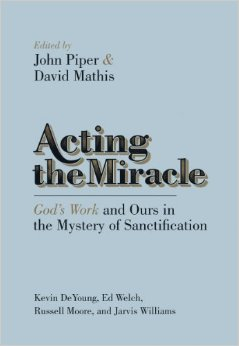
BOOK REVIEW: “Acting the Miracle” Edited by Dr. John Piper and David Mathis

GOD’S WORK AND OURS IN THE MYSTERY OF SANCTIFICATION

ATM Piper

Book Review by David P. Craig

There are various aspects to the biblical doctrine of sanctification – essentially becoming more like Jesus “conformed to the image of Christ” (Romans 8:29). Theologians often talk about two aspects of our becoming like Christ: Definitive sanctification and Progressive sanctification. Definitive sanctification is our legal status with God whereby we become righteous in God’s sight upon our conversion and justification in Christ Jesus. This book focuses on the Progressive sanctification aspect. It addresses the issue of how we actually progress in actual holiness as we live by faith in Jesus.

There are seven helpful chapters in this book by some excellent scholar/pastors:

(1) David Mathis gives the introduction which focuses on the complexities of sanctification and how it relates to our justification and union with Christ.

(2) John Piper defines sanctification by grounding its reality in the holiness of God and the sinfulness of humanity. He provides a wonderful  exegetical study of Romans 8:28-30 and answers the question: “What is the Place of Sanctification in the Process of Salvation?”

(3) Kevin DeYoung examines what should motivate our sanctification. He gives a very practical explanation from Colossians 3 that seeks to balance the element of justification, duty, and gratitude in the context of grace as we seek to be more like Jesus. He points out that our greatest incentives in the pursuit of holiness are theologically based on our identity in Christ. Sanctification is diverse and there is a multiplicity of reasons for this diversity, but it all stems from our union with Christ as we grow in our understanding of and application of His grace.

(3) Ed Welch (a well-known biblical counselor) tackles three specific issues: (a) Attention-Deficit/Hyperactivity Disorder; (b) Depression; (c) and Panic Attacks. He gives examples of how to care for individuals who manifest these symptoms, there causes, and how people who struggle with these battles can grow in Christ-likeness. Welch shows how Scripture can be used to help men and women with existing sin by addressing their souls and minds with the gospel.

(4) Jarvis Williams gives an articulate biblical theology of how we can pursue a practical maturity in the gospel by (a) Understanding God’s action for us in and through Christ is the foundation underneath our sanctification; (b) By four distinct means of grace – the Word of God; preaching to yourself and meditation; fervent prayer; and suffering; (c) Understanding how God’s action for us and in us through Christ leads to the miracle of our sanctification.

(5) Russell Moore gives a wonderful explanation of the many ways that the Church – participation in the Local Body of Christ – providing the communal context necessary for our maturity in Christ. He gives a solid case for the corporate aspect of our sanctification from First Corinthians 4-6.

(6) John Piper answers many question with relationship to our present and future glorification. Among the questions he addresses are these: How do we go about ‘pursuing the holiness without which no one will see the Lord’? How do we strive to enter through the narrow door? How do we dethrone and kill canceled sin? His goal in this chapter is to demonstrate “how this grand process of sanctification is leading to the predestined glory where the beauty of holiness fills the earth.”

(7) The appendix consists of transcript of a conversation with all the contributors addressing how they each go about pursuing personal devotional and prayer time from the September 29, 2012 Desiring God National Conference in Minneapolis, Minnesota.

I highly recommend this book for all Christians who are concerned about the goal of the Christian life – conforming to the image of Christ – and the practical ramifications of this conformation as we transform into His likeness and bring Him glory for the salvation and joyous sanctification of a multitude of people throughout the Earth.

How To Earn Money For God’s Glory

Biblical Personal Finance: Earning for God’s Glory

By William Boekestein

To paraphrase a question often asked by a popular financial advisor, imagine what the people of God could do if their financial houses were in order.

If the question doesn’t sound very “spiritual” we might have an unbiblical notion of spirituality. More than 2,000 Scripture verses deal with money and possessions. The way we manage money is fundamentally a spiritual matter (Luke 16:10-11). On top of this, consider the problems related to poor money management. In a recent survey 46% of Americans reported suffering from debt-related stress. Financial problems can lead to marital breakdowns and contribute to unethical behavior (Prov. 30:8-9).

It never ceases to amaze me that algebra is required in school but personal finance is not. We desperately need to hear what the Bible says about personal finance.

In Ephesians 4:28 Paul boils personal finance down to two points: Earning and spending. He does so not as a financial guru but as a pastor teaching believers how to “walk worthy of the calling with which [they] were called” (v. 1).

Fiscal fidelity looks different from family to family. Some believers cannot work due to severe handicap. Sometimes wives contribute to the family’s budget by working in the home. Still, ordinarily, earning and saving helps us to look not only to our own interests but also to the interests of others (Phil. 2:4).

A number of principles help us navigate the waters of earning:

1. Heads of Household Must Provide

Paul says something startling in 1 Timothy 5:8. “But if anyone does not provide for his own, and especially for those of his own household, he has denied the faith and is worse than an unbeliever.” It’s hard to understand Paul’s phrase “worse than an unbeliever.” What could be worse than denying the gospel and rejecting God’s free grace? God’s answer: Failing to provide for your family. While it is permissible for a man to delegate breadwinning to his wife for weighty and justifiable reasons, the responsibility ultimately rests on him (Ruth 3:1-4Eph. 5:28-29).

2. Needlessly Burdening Others Is Sin

It has become acceptable today for people who could be helping provide for themselves, to burden others. I’ll never forget the answer I heard when I once asked a man what he did for work. “I leech off the government,” he said. Even though such an answer approaches the pinnacle of shame, I have stopped being surprised having now heard the answer a number of times. The Bible says, “If anyone will not work, neither shall he eat.” Paul goes on to write, “For we hear that there are some who walk among you in a disorderly manner, not working at all, but are busybodies. Now those who are such we command and exhort through our Lord Jesus Christ that they work in quietness and eat their own bread” (2 Thess. 3:10-12).

3. Work Is for God’s Glory

Roughly 25% of our adult lives are dedicated to work. If we don’t work well, much of our life displeases our Maker. Even those who do not need to work to provide for their families still must work to glorify God. “Whatever you do, do your work heartily, as for the Lord rather than for men…It is the Lord Christ whom you serve” (Col. 3:23,24).

This rule of God-honoring productivity also applies to young people. Children should begin laboring on behalf of the family from an early age. By their early teen years they should be pulling much of their own weight. This is important because children are developing lifelong habits. For a few generations many parents have not required their children to work. As a result, laziness and self-serving indulgence abounds. In some families a young person’s schooling is viewed as their work. When this is the case parents must see that their students are academically disciplined. Students not working hard at school should be otherwise gainfully employed so they can “eat their own bread.” The status of “student” doesn’t entitle anyone to be slothful and unproductive.

4. Workaholism Does Not Honor God

Very few people in our day and place are forced to overwork in order to survive. Instead, often workaholism is a sign of imbalance. It may indicate a retreat from family stressors. It may indicate that the family is spending more than they should and may need to downsize in order for the breadwinner to be home more. Workaholism can also be one of the many counterfeit gods we worship. The love of money, the seduction of success, and the power and glory of achievement may drive us to work too much. Even during busy times God demands rest (Ex. 34:21).

*Article origin: http://www.ligonier.org/blog/biblical-personal-finance-earning-gods-glory/ (September 25, 2013)

ABOUT THE AUTHOR

William Boekestein is the pastor of Covenant Reformed Church in Carbondale, PA.

He received his B.A. at Kuyper College and his M.Div. at Puritan Reformed Theological Seminary. He has worked in residential construction and taught at a Christian school for several years. He and his wife have three children.

He has authored “Life Lessons from a Calloused Christian: A Study of Jonah with Questions,” as well as three fully-illustrated children’s books on the history of the Reformed Confessions (“Faithfulness under Fire: The Story of Guido de Bres ,” “The Quest for Comfort: The Story of the Heidelberg Catechism,” and “The Glory of Grace: The Story of the Canons of Dort”).

His latest, co-authored with Joel Beeke, is “Why Christ Came: 31 Meditations on the Incarnation.”

Dr. Bryan Chapell on “Biblical Principles for Christian Bloggers”

What biblical principles should guide Christian bloggers? I am increasingly thinking about this question because maintaining the mission and reputation of the institution I lead increasingly requires me to respond quickly and frequently to questions, assertions, and criticisms from the unjuried world of the blogosphere.

I do not think I have always responded well. Defending truth may well require correction and rebuke (2 Tim. 4:2). Still, I confess discomfort with the ready sarcasm and flip accusations that seem so prevalent in the world of blogs and but so foreign to the biblical ethic of esteeming others more highly than ourselves (Phil. 2:3-4).

Listening to the “ouch” from others about things I have written, and feeling the “ouch” from what others have written, have convicted me of the need to think more seriously about the biblical benefits and boundaries of such words—a task also urged by leaders with similar concerns at a recent meeting of The Gospel Coalition’s Council.

I am particularly concerned about two issues: What general principles should guide Christians in distributed communication, and what special principles should guide Christians when they address issues about and to the church in such communication?

Some may shrug off the question of what is proper Christian communication on the internet, saying it is hardly likely that all internet dialogue will honor the rule of Christ. Even Christians may argue that internet sites and social media create something of a digital lunchroom where participants not only expect the conversation to be free flowing but also less accountable to the standards of traditional media.

Of course, the context and genre of communication properly influence our judgment of what Christians can or should say. We do not expect a stage play to sound like a Sunday sermon, or a website to be as careful as a catechism. But if Christians are to be salt and light in every sphere of life, then they must also consider what should characterize internet communication that honors Christ.

The present era is not the first in which Christians have considered whether the Bible’s standards apply to new forms of communication. Gutenberg, Marconi, Coughlin, Hearst, Limbaugh, Drudge, Huffington, and Zuckerberg represent waves of new communication approaches that have changed the shoreline of expectations regarding what utterances can or should be distributed. Still, we limit our God if we presume that he cannot establish transcendent standards of truth and love that supersede changing communication expectations.

As a Christian who believes in the lordship of Christ over the whole of life, I know that I have a responsibility to discern what the Bible requires of me in all aspects of life—even those of the web. [1] I also know that I cannot here address all possible issues (such as those faced by bloggers in lands of persecution). Still, I hope the following discussion of biblical principles will make all of us who engage in internet communication more conscious of applicable biblical principles—and also a bit more reflective before hitting the “post” button.

I. Christian Communication Must Be True

Christian communication that purports to be true, should be. That’s obvious, but some additional specificity may be helpful—and challenging. The third commandment (which requires care for God’s name, particularly in taking oaths and vows in support of the truth) and the ninth commandment (which is more narrowly concerned with malicious slander) plainly forbid spreading falsehoods in either personal or public communication. [2]

The Bible repeats the requirement of guarding the truth many times and in many ways in both the Old and New Testaments (e.g.,Ex 23:1Lv 19:11-1635-36Ps 82:2-3Prv 23:1031:8-9Rom 12:9-102 Cor 12:20Eph 4:252 Tm 3:3; Jas 3:171 Jn 4:20). The judgment of charity binds us not only to tell the truth but also to seek to interpret other’s statements and actions in the best light (Mt 7:121 Cor 13:6-7). We are also obligated to protect the reputations of others against slander, innuendo, false implication, and even the damage to truth caused by inappropriate silence (Zech 8:16Prv 17:151 Tm 6:4; 2 Tm 4:16).

These standards of truth are high, but they merely form the ground floor of the biblical architecture for communication that honors God. Simply telling the truth is not enough.

II. Christian Communication Must Be Provable

The Bible does not allow us to publish what we think is true if we cannot prove it. Before we disseminate favorable or unfavorable information we are required to ensure and evidence its accuracy.

Dependable Sources

This means first that we must have dependable sources. Where facts are not plain, we may not receive or act upon accusations without the confirmation of multiple witnesses (e.g., Nm 35:302 Cor 13:11 Tm 5:19). Unproven suspicions, idle speculation, quarrelsome suppositions, and malicious rumors have no place in Christian communication (Prv 16:2826:201 Tm 6:20; 2 Tm 2:16, 23, 24; Ti 3:9). The Bible admonishes us not to accept reports from foolish, undependable, or malicious sources (e.g. Prv 10:1426:24-528:26Eccl 10:3)—an important standard for the readers, as well as the writers, of blogs.

Righteous judgment also requires getting the perspective of the accused (Dt 1:16-1717:2-1325:1Matt 18:15-17). The Bible will not allow us to act as though we have the whole story, when we have heard only from one side of a dispute (Prv 18:17).

Biblical mandates to assess the reliability of sources and perspectives ordinarily make it wrong to receive or distribute anonymous accusations. Allowing “unidentified sources” to make controversial claims not only denies readers the ability to judge the reliability of the source, but may also jeopardize the biblical right of those being accused not to have their reputations stolen or unfairly damaged (1 Pet 2:1).

Verifiable Claims

The biblical requirements of dependable sources and provable information mean that some matters will always be unpublishable for Christians. For example, if we cannot prove the motive for an action, then we cannot publish speculations or assertions about motive without being guilty of spreading unsubstantiated gossip.

In faith-related publications and blogs the attribution of motive where it cannot be confirmed is, sadly, one of the most common breaches of biblical principle. With regularity I read reports that individuals or institution are doing something that a blog or publication disapproves because:

  1. “They desire to lead the church to the right” (or “to the left”).

  2. “They just want the approval of their friends.”

  3. “They fear the reaction of their supporters.”

The Bible says only God “knows the secrets of the heart” (Ps 44:21; cf. 1 Sm 16:71 Cor 4:5Jas 4:11). Impugning motives without proof violates the ethics of biblical communication.

Years ago a report claimed that in the face of declining attendance, mainline Protestant church leaders “seem reluctant to talk boldly about justice issues for fear of making members uncomfortable.” While non-mainline church leaders may find such statements credible and may even take delight in them, without further substantiation this statement fails to meet the standards of biblical communication. This report claims that thousands of ministers in numerous denominations are cowards who willingly compromise their ethics in order to gain approval. Even if the writer believes this story is true, such sweeping and disparaging claims about motives should never be published without corroborating evidence or credible testimony.

Any medium that exhibits a pattern of unproven accusation becomes a threat to all groups who would be jeopardized by falling into public disapproval—including religious groups. While Christians may be sorely tempted to assign motives they suspect are true, what cannot be proven should not be published.

Responsible Allegations

Christian bloggers (and other publishers) sometimes adopt secular practices to justify attributions of motive or to make accusations without proof. For example, a blog may not name a person being disparaged, but may provide not-so-subtle hints of the accused’s identity.

Another way of sidestepping responsibility for attributing motives involves using some form of the word “allege”—as in, “He did this awful thing because he wants to promote a gay, feminist, liberal, fundamentalist, postmodern, secular, humanist, evolutionist agenda—allegedly.”

In secular journalism, the word allegedly may be used to shield those legally accused from conclusions about their guilt. However, the word can also protect publications from libel suits where accusations are being made without adequate proof. The publication can always protest, “We did not actually accuse the person of wrongdoing, we only alleged it.” Such a defense, however, while being within legal fences, transgresses the biblical commands against spreading gossip and against stealing another’s reputation. Christian bloggers may not escape scriptural injunctions against impugning motives by padding accusations with “allegedly” language.

It may, of course, be newsworthy to report that a significant individual or group has impugned the motives of another person. When well-known Pastor Jacobs says that well-known Pastor Wells began this ministry in order to “line his own pocket,” then the fact that one of such stature has made such an accusation becomes a story in itself. But a journalist or blogger who relates such information must also hold Pastor Jacobs accountable to prove that what he has said is true. Further, if the one making the accusation does not have stature, nor significant proof that the claim is credible, then biblical mandates against the spread of gossip forbid repeating the allegation (Ex 23:1Prv 10:181 Cor 6:102 Cor 12:202 Tm 3:3; Eph 4:31).

So if we honor the biblical requirements to distribute only what is true and only what is provable, then have we fulfilled all of the obligations of Christian communication? The answer is still no. We cannot distribute information or commentary simply because we believe it is true. And even if we can prove what we are reporting is true, that is still not enough. What else could possibly be required of Christians before they distribute news about others?

III. Christian Communication Must Be Edifying

The further biblical obligations of Christian communicators may initially be grasped by considering a secular journalism distinction. In the minds of most non-journalists “libel” and “slander” are synonymous, relating to the spread of false information that damages someone’s reputation. But there is a legal distinction between the two terms. Slander spreads falsehood; libel occurs when a person is “held up to public ridicule or contempt,” even if what is said is true.

In a classic example of libel, a story may reveal that a homemaker with four children in a sleepy suburb was a drug addict 15 years ago. Without a compelling public interest (and special rules of law apply to public figures and issues of public interest) the law will not allow journalists to publish such facts—even if they are true.

Edifying Motives

Secular law will not allow the distributing information (even if it can be proven true) that damages without purpose—and neither will Scripture. Christians are biblically obligated only to say what will edify (i.e., build up; see Eph. 4:1216). This means that, in addition to being careful about judging the motives of others, Christians must also consider their own motives when assessing the appropriateness of news they distribute or characterizations they make.

Journalists are trained to consider whether there is “a compelling public interest” for their story. Christians (whether writers, bloggers, broadcasters, or good neighbors) are under the further obligation to consider how their words fulfill their calling to “give grace to those who hear” and to redeem all things for the glory of the Savior (Eph. 4:291 Cor. 10:31).

I recognize that, for some people, saying blogs should be edifying is a little like advocating a polite hockey game. When our society’s web tastes are accustomed to bruising rhetoric, we do not relish commentary unless it bashes somebody. Christian bloggers face the dilemma of knowing the Bible requires edifying speech, but also realizing that a blog that does not rip or ridicule may not attract the traffic that justifies its existence.

Edifying Purposes

By identifying this dilemma, I do not want to suggest that there is never biblical cause to criticize or challenge. We edify not only by saying encouraging things, but by identifying injustice, dishonesty, irresponsibility, and evil that threaten a church, community, or orthodoxy. We do not further Christ’s purposes by ignoring wrongs that perpetuate heresy, corruption, or oppression. To edify we may need to “reprove, rebuke, and exhort, with complete patience and teaching” (2 Tm 4:2).

Biblical edification may also include declining to report what damages others for no purpose honoring to God or furthering his priorities (Prv 11:1317:9Jas 1:261 Pt 4:8). Thus, when I met with an organizational committee designing the mission statement for a web magazine, we recognized that it was not enough to say the publication would engage in “accurate reporting.” A commitment only to accuracy may simply allow a publication to gather facts that, while true, result in cynical, destructive, and self-absorbed journalism.

Truthful and accurate reporting remains essential, but without a higher, spiritual purpose the facts alone will not keep our reports edifying and biblical. As a consequence, our web magazine added to its mission statement a clause committing us to engage in accurate reporting “for the welfare of the church.”

If criticism must be leveled, Christians must understand that their reporting and commentary cannot simply be driven by pageviews, the satisfaction of embarrassing opponents, or leverage in the latest church power struggle.

If Christians do not recognize the need for a higher standard than bare truth, then we may not see anything wrong with reporting the true and provable positions of U.S. troops in a time of war (as a well-known television reporter did years ago), or vilifying a brother or sister in Christ simply because we have the facts and find it fun to do so.

Without the higher goal of edification, truth can be employed for evil as effectively as can lies. Thus, in addition to being true and provable, edifying communication must also be respectful, fair, and responsible.

Respectful

Communication guided by Scripture advocates priorities that promote the kingdom of God on earth. At times, this mission will require us to expose and counter unbiblical influences and worldviews to which peers may be blind (e.g., materialism, consumerism, escapism, authoritarianism, secularism, humanism, racism, and cynicism). Advancing Christ’s purposes also requires holding the church, its members, and its leaders accountable to kingdom priorities of compassion, integrity, purity, humility, and sacrifice. But in order for such communication to contribute faithfully to Christ’s purposes, it must also be respectful.

Respectful communication is driven by the awareness that our comments and critiques are always directed toward those made in the image of God (Gn 1:26-27Jas 3:9). We are stewards of his glory even amid the “glorious ruins” of humanity, to borrow from Francis Schaeffer. The golden rule applies not because others always deserve such regard, but because the divine image in them—marred as it may be—requires our regard. Those guilty of gross misconduct are, yet, to be treated as a believer would wish to be treated (Lk 6:31).

The Christian responsibility to address wrongdoing accurately and vigorously does not annul the law of love toward neighbors or enemies (Lv 19:17-18Mt 5:44Lk 10:36-37Rom 12:9-10Jas 2:81 Jn 4:20-21). We do not approve of evil, but we speak of evildoers with prayer that the exposure of their sin will lead to their correction and repentance. We never cease to be responsible to communicate in a manner best for others’ eternal good. Thus, we must regard all, always, with “proper respect” (1 Pt 2:17).

If such respect is demanded for persons in general, then it is even more necessary for the leaders of God’s appointment in both the secular and church realms (2 Sm 1:14-16Rom 13:1Heb 13:17). Sadly these two classes of individuals often receive the most disrespectful commentary in “Christian” publications and web posts. Christians who write critically of leaders are never excluded from the apostles’ commands to pray for those in authority and to treat them with respect (Rom 13:71 Tm 2:1-4; and 1 Pt 2:13-14,17). Yet, despite these clear scriptural imperatives, the demeaning of leaders is blood sport made frequent on religious blogs, especially in their feedback comments. There the most provocative seem convinced that the righteousness of their perspective permits them to ignore Scripture about honoring leaders.

Proper respect for secular authorities established by God may actually be less difficult for us than respect for fellow believers. We often save our worst slurs for those we consider enemies within the camp. Critique of, and disagreement with, church leaders can create ethical challenges for believers that secular commentators do not face. For example, how do we deal with leaders among the covenant people whom an apostle would label as dried up springs or muddy pigs (2 Pt 2:1722)?

Before we would attach such labels, we must be very sure that we can also speak with an apostle’s certainty about the character of those we are describing. Additionally, if we are not sure that we are describing unbelievers, then we also have an obligation to remember that we are speaking of those united to Christ and indwelt by his Spirit (Gal 2:20).

Such persons are as precious to God as Jesus himself and are to be honored by us (Rom. 12:10). They are his covenant people, his treasured possession, and citizens of heaven with all of its rights, privileges, and protections (Eph 2:19). With such persons we are required to keep the unity of the Spirit and the bond of peace as much as we are able (Eph 4:2-3Rom 12:18).

Finally, we are biblically required to treat fellow believers—especially leaders—as members of our eternal family (Gal 6:101 Tim. 5:17-20Heb. 13:17).

Some time ago, a blog posted an article implying that a professor at our seminary had taken a position contrary to principles he has defended all of his life. I phoned the author to say that, while he had written nothing factually untrue, his insinuation breached biblical obligations. “The Bible says that you are to ‘treat older men as fathers’ (1 Tm 5:1),” I said, “and, until you have proof of his error, you are bound to defend the reputation of this man as though he were your own father.” The writer simply replied that he did not feel that these principles applied in this situation. But he had no basis for excusing himself from his family obligations to a father in the faith.

The compartmentalization of life that excuses living by differing ethics in differing spheres is a betrayal of Scripture. Christ is Lord over the whole of life (Phil 2:9-11). As the psalmist writes, “The earth is the Lord’s and everything in it” (Ps 24:1).

The principles that govern how we treat fellow believers in the church and in our homes do not disappear simply because we are alone, posting a blog comment late at night. We are always obligated to speak the truth in love (Eph 4:15), honor others as we would wish to be honored (Phil 2:3-41 Pet 2:17), and defend the reputations of fellow believers from false, unproven, or uncharitable characterizations (cf. Prv 31:8-92 Tim 4:16).

Fair

So how do we deal with a fellow believer whom we believe is wrong and whose misdeeds need to be brought to light? We must deal with such a person fairly.

Fair Representation

We do not show partiality simply because one is weak or powerful, unlovely or attractive, wealthy or destitute (Lv 19:15Rom 12:7;1 Tm 5:21; Jas 2:1-9). We represent others’ thoughts, ideas, and explanations as accurately and credibly as possible.

As a rule of thumb, our arguments should represent our opponents in a way they would approve or make their case even better than they could. Straw man caricatures of others’ positions are not fair, because incomplete representations of others’ ideas do not reveal the full truth of another believer’s convictions. In other words, straw man arguments are a form of lying about a person, because they misrepresent what that person actually believes.

In order to represent other persons fully and fairly, Christian are obligated to obtain their views directly from them (not relying on hearsay or gossip). Especially if the report contains an accusation, it is important to allow them to interact with what will be reported. In essence, the principles of Matthew 18, giving a person direct opportunity to respond to personal accusation, do not disappear from our Christian obligations simply because we are engaged in internet chatter.

If someone has intentionally said or published a matter available for public scrutiny, then the initial obligations of Matthew 18 are already met for critics. Scripture intends for accusations to be proven by witnesses so that false claims or misunderstanding do not become the basis of judgment. But if someone has made views or actions available to others (in publications, internet, or other media outlets), then he or she self-attests to the concerns that others may wish to critique. In other words, we are not obligated personally to contact an author or speaker about published views before critiquing those views.

Fair Critique

When critiquing published views, the obligations of truthfulness, charity, and respect remain. If the potential for misunderstanding is significant, critics must make a reasonable effort to clarify the original author or speaker’s intentions before distributing judgments that could needlessly distort, create conflict, or damage reputations. Often this can be done by giving the original author or speaker a preview of the article, entry, or comment that a critic has prepared to publish. The instant postings that internet readers may expect from a blogger do not remove the Christian’s obligation fairly to represent others’ views or actions.

When clarification from the original source is not feasible, and the intentions of that source are unclear, we may not assume the worst possible reading to be the only possible meaning. In such a situation, a critic is obligated to provide an alternative interpretation to readers in addition to the critique—even if the alternative interpretation could blunt the critique. The rule of charity requires us not to make a malicious reading of another’s words the only interpretation we consider.

Fair Judgment

A Christian blogger is also biblically bound to judge whether those making critique or comment have the expertise and character to make fair comment. To give platform to what is uninformed or ungodly, unfairly exposes the body of Christ and its members to wrong impressions and consequent damage.

I recognize that the ethics of the internet favor the democratization and equalization of all commentary. A wiki-mindset assumes that the larger the universe of opinion, the greater the likelihood that truth will bubble up. But the Bible does not judge truth by consensus or establish morality by popularity.

We are called to make our evaluations with righteous judgment, requiring adequate knowledge and applying biblical principles (Deut 16:18Ps 87:2-3Prv 3:30Jn 7:24). In order to enable readers to maintain these priorities, we should at least require commenters claiming special knowledge or expertise to identify their relevant credentials, qualifications, or associations.

In addition, we are commanded to keep our tongues from expressions of malice, slander, and obscene talk (Col 3:8) and to ensure our “speech always be gracious” (Col 4:6). Giving platform to those who will not follow these standards makes us complicit in their sin.

Responsibilities for Bloggers

A blogger may contend that he or she is not responsible for what others say in such open forums. But this defense can be compromised by the blogger’s self-interests. At sites known for their edginess, shutting down or refereeing incendiary comments may damage the popularity of the blog.

The “cock-fight fascination” that draws visitors to religious controversy creates ethical pressures for Christian bloggers who believe they best fulfill their mission by garnering more attention for their point of view. The Bible calls them to seek peace, but they have to multiply controversy (or allow commenters to do so) in order to keep their blog visitable and viable (Rom 12:18Heb 12:14-15).

We will not have means to navigate these issues unless we again agree that the Bible applies in the blogosphere (Ps 24:1). With that agreement, we can examine biblical responsibilities that we personally assume when we post on the internet.

The biblical ethic that primarily should bind us is not maximizing pageviews but faithfulness. If faithfulness should require our failure to succeed in worldly terms, then loyalty to heaven’s priorities demands that we fail rather than disregard Scripture.

As a consequence, principles of Christian speech stated previously in this article regulate believers’ internet communication:

  • Christians are not permitted to voice idle speculation or echo damaging rumors.

  • Our speech (spoken, printed or digitized) must be gracious, respectful, free of malice, and without obscenity.

  • Our judgments must be fair, impartial, and based on adequate information.

  • We may not demean for personal gratification or gain.

  • We may not slander.

Still, the question remains regarding what bloggers should allow others to say in comment forums. Here is the key principle: A publisher (site, blog, or other media outlet) that has the ability to referee others’ comments has the responsibility for the righteousness, if not the rightness, of what others say in that forum.

In other words, a blogger may well provide for expression of a variety of views without expecting that they all be correct or agreeable. But the variety of views should all be expressed righteously; i.e., without transgression of biblical standards of godly and ethical speech.

When making determinations about what blog comments to allow, we should remember that the Bible says it is as wrong to pass unsubstantiated reports, unfair statements, and gossip as it is to originate them (Ex. 23:1Prov. 10:1817:420:19Rom 1:29-32;2 Cor. 12:20Eph. 4:315:11). As stated previously, the Bible also prohibits receiving unproven accusations or publishing reports from foolish, undependable, or malicious sources.

Responsibilities for Readers

Note this principle about ungodly reports not only means that bloggers should reject unbiblical comments; it also means that believers should avoid reading them. By keeping the pageviews high, readers imbibe evil and contribute to the viability of sites promoting ungodliness.

Much ungodliness in the Christian blogosphere would disappear if responsible Christians steered clear of the scandal sites and watchblogs. All believers are obligated to promote only what builds up the body of Christ (Eph. 4:1216). Thus, we cannot excuse ourselves from responsibility for what others say, if we have provided, or supported, their platform.

Responsibility for Comments

But what if the blogger cannot monitor the comments of others for practical reasons (e.g., posts are too numerous or time is too short), or principled convictions (e.g., the purpose of the forum is to provide uncensored expression of opinion)? Is it ever right to provide platform to unrestricted commentary, knowing that ungodly or unethical speech will result?

The answer to these questions must be a qualified yes. The need for free expression may on occasion and for a time outweigh the need to guard Christian expression. In times of crisis, repression, or breaking news, it may be more important to allow comments to fountain than to impose monitoring that may restrict information or create distrust of open access to the site. If it is apparent that everyone can say anything, then readers will hopefully adopt a caveat emptor (“buyer beware!”) mindset regarding all comments—and hopefully more principled standards will guide the site when the crisis has passed.

Still, open channel commentary of an unbiblical nature should not be the practice of Christian bloggers on sites representing themselves as dependable sources of information and Christian dialogue. Giving platform to comments that demean or defame disregards too much Scripture. Captivating, funny, or titillating as it may be to read a clever put-down or an impassioned rant, ungodly communication should not be promoted by God’s people.

Though seminary students are busy, every now and then a student newspaper or webzine gets started on our campus. I always encourage it—on two conditions.

The first condition is that all characterizations of persons or positions must be respectful. The second condition is that, before anything critical is published, the writer of the article must make sure the person or group being criticized has been allowed to comment whether the piece is accurate and fair—particularly if it involves citing private matters or could have been misunderstood.

Not surprisingly the requirements to be respectful, fair, and responsible often kill the incentive of those interested in the publication. The internet has made students today so accustomed to a person or idea being flamed for fun that they see no reason for a publication unless it allows them similar pleasure.

A student said to me, “But we want controversy.” I had to ask, “At whose expense and to what end?” The answer was only that controversy would boost readership. That is certainly true. Controversy and insult will get attention just as surely as a fight behind the gym will gather a crowd. But the apostle Paul wrote, “So I tell you this, and insist on it in the Lord, that you must no longer live as the pagans do. . . . Let no corrupting talk come out of your mouths, but only such as is good for building up, as fits the occasion, that it may give grace to those who hear” (Eph 4:1729). Those whose faith differs from that of the world must have communication principles that differ from the world.

IV.  Christian Communication Must Be Redemptive

No set of words—such as respectful, fair, and responsible—will ultimately provide all the criteria active bloggers need for the complex and quick decisions needed for their frequent posts. I do not anticipate that any blogger (or I) will remember all of the Bible verses that apply to each day’s writing or comment editing.

Redemptive Instincts

Like so many other aspects of the Christian life, we develop habits and instincts that guide us through most of life’s ethical issues. As a consequence of how biblical instincts develop and control those in whom the Spirit dwells, I write now with great hope for Christians active in the blogosphere. For though Bible memory and text application may fail us, there remains an overriding ethic that will guide committed Christians: we are stewards of Christ’s name on earth.

Fundamental to our Christian calling is the joy that we each participate in the redemption of creation for the glory of our Savior. The splendid gift of Christian communication, in whatever media or form it takes, is that Christ can use our thoughts, words, and images to further his purposes on earth and for eternity.

Redemptive Purposes

Our communication is not simply about staying within the bounds of biblical propriety—it is about being champions of truth, beauty, justice, and mercy. The heart and mind set upon such things are not consumed by petty arguments, not enthralled with personal banter, and not distracted by personal acclaim.

Those led by the Spirit know deep down at the soul level what speech and attitudes are redemptive, and these become the guiding passions of each day’s campaign for the glory of Christ. These passions are not simply about vanilla smiles and sweet sentiment. They are the wellspring of instincts that can identify the most subtle evil; they are the lifeblood of the will to endure lifelong battles; and they are the backbone of the character to stand alone if need be to speak for Christ.

We are advocates for the advance of the kingdom of God. Such advocacy under the banner of our Savior is truly noble and will be full of enough controversy for anyone willing to fight on his terms. You will find, however, that even fellow believers will often resist fighting on Christ’s terms because of the discipline and charity such redemptive battles require. They always obligate us to consider the heart and soul of those we are fighting, as well as those we are defending. Our most rigorous critiques still require us to desire the good of those we are correcting and, if they are believers, to engage them in such a way that the Spirit will lead them to repentance and reconciliation in the church (Rom 12:2115:2Eph 4:29321 Thes 5:152 Tm 2:25; 1 Pt 2:1).

Our published words should seek to safeguard the opportunity for unity that is the church’s unique testimony and power. Name calling, the desire to shame, and the demand to take scalps for the camp we represent will not redeem. Our communication must honor Christ in manner as well as in message until the whole body is united under its Head for his worldwide purposes (Eph. 1:21-114:15-16).

The Bible forbids any action motivated by malice (Lv 19:17Eph 4:31Col 3:8Jas 1:20). Yet, because the lust for victory and retaliation is so strong—even in the church—respectful, fair, and responsible communication will cause its champions to suffer attack and abuse. But such suffering for the sake of the kingdom is the redemptive pattern that the Master left us to follow and will produce the fruit he desires (Jn 15:51 Pt 2:21).

Redemptive Responsibilities

Even those who are not called to write blogs or publish other forms of Christian communication have responsibilities. First, we should use Christian principles to evaluate the communication that pervades our internet browsing. Consistently imbibing contemporary media without biblical discretion tempts us to consider what is pervasive as being acceptable and imitable.

The reason some of today’s advocacy journalism and web commentary are so dangerous to Christians is not because we are blind to their biases. Rather, the danger lies in our tendency to think that, since we agree with the viewpoints of certain commentators, therefore their digs at, and disrespect of, opponents are acceptable among us.

Blocs of Christians grow to appreciate certain commentators because they seem willing to say what we would like to say but our biblical instincts have made us hesitant to express. At first, we chortle at the sarcasm and scorn with guilty pleasure that our enemies have been made to squirm. But, over time, we no longer feel guilty, and then the real damage is done. Christ’s testimony erodes when his people grow so accustomed to verbal disdain that we begin to believe such speech is permissible for us. When the church fills with people holding so little regard for her spoken witness, then her redemptive purposes are far removed from her daily priorities.

We must determine whether our web tastes have been cultivated by the world or by its Creator. Returning evil for evil is not a Christian option. When the speech habits of the world become the unexamined practices of the redeemed, then it is time for correction and repentance. We correct by letting those in our own camps know when their commentary has moved beyond the bounds of biblical ethics and Christian love. We repent by, first, confessing that we are as wrong to receive gossip and slander as to spread it, and, second, by refusing to consume or visit the publications and sites that claim to be Christian and do not honor Christ’s commands.

Redemptive Calling

Words have power to defend the helpless, repulse evil, inspire beauty, promote mercy, and further justice. Words also have the power to counter each of these kingdom goals. The believer’s calling, whether on the internet or in neighborhood conversation, is to communicate in ways that extend Christ’s rule over all. When we provide and support communication that is true, substantiated, edifying, and redemptive, then Christians will simultaneously counter and transform our culture. This generation’s communication trajectories have clearly been claimed by the internet; this generation’s calling is now to claim the internet for Christ.


[1] A few years ago, I gathered many of these thoughts for a journalism essay [published as “A Christian Journalism,” in Speaking the Truth, ed. Kimberly Collins (New York: World Journalism Institute, 2008)], but new challenges have led to some fresh edits and adds that will hopefully advance this conversation.

[2] See expositions of these commandments in Westminster Larger Catechism 111-113, 145; Westminster Shorter Catechism 76-78, 53-55). The answer to Question 145 of the Westminster Larger Catechism is particularly instructive: The sins forbidden in the ninth commandment are, all prejudicing the truth, and the good name of our neighbours, as well as our own, especially in public judicature; giving false evidence, suborning false witnesses, wittingly appearing and pleading for an evil cause, outfacing and overbearing the truth; passing unjust sentence, calling evil good, and good evil; rewarding the wicked according to the work of the righteous, and the righteous according to the work of the wicked; forgery, concealing the truth, undue silence in a just cause, and holding our peace when iniquity calleth for either a reproof from ourselves, or complaint to others; speaking the truth unseasonably, or maliciously to a wrong end, or perverting it to a wrong meaning, or in doubtful and equivocal expressions, to the prejudice of truth or justice; speaking untruth, lying, slandering, backbiting, detracting, tale bearing, whispering, scoffing, reviling, rash, harsh, and partial censuring; misconstructing intentions, words, and actions; flattering, vain-glorious boasting; thinking or speaking too highly or too meanly of ourselves or others; denying the gifts and graces of God; aggravating smaller faults; hiding, excusing, or extenuating of sins, when called to a free confession; unnecessary discovering of infirmities; raising false rumors, receiving and countenancing evil reports, and stopping our ears against just defense; evil suspicion; envying or grieving at the deserved credit of any, endeavoring or desiring to impair it, rejoicing in their disgrace and infamy; scornful contempt, fond [i.e., infatuated or doting] admiration; breach of lawful promises; neglecting such things as are of good report, and practicing, or not avoiding ourselves, or not hindering what we can in others, such things as procure an ill name.

*Article origin: http://thegospelcoalition.org/resources/entry/the_bible_for_bloggers August 27, 2012

ABOUT THE AUTHOR:

Dr. Chapell has served as President of Covenant Seminary since 1994. He began teaching at Covenant Seminary in 1984 after ten years in pastoral ministry. Before becoming President, he served for six years as Vice President for Academics and Dean of Faculty. He is much sought after as a speaker in churches and conferences around the country. Christ-Centered Preaching has established him as one of the nation’s most recognized teachers of homiletics. Dr. Chapell teaches the introductory homiletics courses and several practicums, giving every MDiv student the opportunity to study under him.

An Acronym for Showing L.O.V.E

SHOWING LOVE IS:

Couple walking on the beach

Listening when you are speaking

Offering my help when you need it

Valuing all the wonderful things you do

Encouraging you when times are tough

– Tami Stephens

Preaching with Authority: Three Characteristics of Expository Preaching

“Preaching With Authority” by Dr. Albert Mohler

139971264

Authentic expository preaching is marked by three distinct characteristics: authority, reverence, and centrality. Expository preaching is authoritative because it stands upon the very authority of the Bible as the word of God. Such preaching requires and reinforces a sense of reverent expectation on the part of God’s people. Finally, expository preaching demands the central place in Christian worship and is respected as the event through which the living God speaks to his people.

A keen analysis of our contemporary age comes from sociologist Richard Sennett of New York University. Sennett notes that in times past a major anxiety of most persons was loss of governing authority. Now, the tables have been turned, and modern persons are anxious about any authority over them: “We have come to fear the influence of authority as a threat to our liberties, in the family and in society at large.” If previous generations feared the absence of authority, today we see “a fear of authority when it exists.”

Some homileticians suggest that preachers should simply embrace this new worldview and surrender any claim to an authoritative message. Those who have lost confidence in the authority of the Bible as the word of God are left with little to say and no authority for their message. Fred Craddock, among the most influential figures in recent homiletic thought, famously describes today’s preacher “as one without authority.” His portrait of the preacher’s predicament is haunting: “The old thunderbolts rust in the attic while the minister tries to lead his people through the morass of relativities and proximate possibilities.” “No longer can the preacher presuppose the general recognition of his authority as a clergyman, or the authority of his institution, or the authority of Scripture,” Craddock argues. Summarizing the predicament of the postmodern preacher, he relates that the preacher “seriously asks himself whether he should continue to serve up monologue in a dialogical world.”

The obvious question to pose to Craddock’s analysis is this: If we have no authoritative message, why preach? Without authority, the preacher and the congregation are involved in a massive waste of precious time. The very idea that preaching can be transformed into a dialogue between the pulpit and the pew indicates the confusion of our era.

Contrasted to this is the note of authority found in all true expository preaching. As Martyn Lloyd-Jones notes:

Any study of church history, and particularly any study of the great periods of revival or reawakening, demonstrates above everything else just this one fact: that the Christian Church during all such periods has spoken with authority. The great characteristic of all revivals has been the authority of the preacher. There seemed to be something new, extra, and irresistible in what he declared on behalf of God.

The preacher dares to speak on behalf of God. He stands in the pulpit as a steward “of the mysteries of God” (1 Cor 4:1) and declares the truth of God’s word, proclaims the power of that word, and applies the word to life. This is an admittedly audacious act. No one should even contemplate such an endeavor without absolute confidence in a divine call to preach and in the unblemished authority of the Scriptures.

In the final analysis, the ultimate authority for preaching is the authority of the Bible as the word of God. Without this authority, the preacher stands naked and silent before the congregation and the watching world. If the Bible is not the word of God, the preacher is involved in an act of self-delusion or professional pretension.

Standing on the authority of Scripture, the preacher declares a truth received, not a message invented. The teaching office is not an advisory role based on religious expertise, but a prophetic function whereby God speaks to his people.

Authentic expository preaching is also marked by reverence. The congregation that gathered before Ezra and the other preachers demonstrated a love and reverence for the word of God (Neh 8). When the book was read, the people stood up. This act of standing reveals the heart of the people and their sense of expectation as the word was read and preached.

Expository preaching requires an attitude of reverence on the part of the congregation. Preaching is not a dialogue, but it does involve at least two parties—the preacher and the congregation. The congregation’s role in the preaching event is to hear, receive, and obey the word of God. In so doing, the church demonstrates reverence for the preaching and teaching of the Bible and understands that the sermon brings the word of Christ near to the congregation. This is true worship.

Lacking reverence for the word of God, many congregations are caught in a frantic quest for significance in worship. Christians leave worship services asking each other, “Did you get anything out of that?” Churches produce surveys to measure expectations for worship: Would you like more music? What kind? How about drama? Is our preacher sufficiently creative?

Expository preaching demands a very different set of questions. Will I obey the word of God? How must my thinking be realigned by Scripture? How must I change my behavior to be fully obedient to the word? These questions reveal submission to the authority of God and reverence for the Bible as his word.

Likewise, the preacher must demonstrate his own reverence for God’s word by dealing truthfully and responsibly with the text. He must not be flippant or casual, much less dismissive or disrespectful. Of this we can be certain, no congregation will revere the Bible more than the preacher does.

If expository preaching is authoritative, and if it demands reverence, it must also be at the center of Christian worship. Worship properly directed to the honor and glory of God will find its center in the reading and preaching of the word of God. Expository preaching cannot be assigned a supporting role in the act of worship—it must be central.

In the course of the Reformation, Luther’s driving purpose was to restore preaching to its proper place in Christian worship. Referring to the incident between Mary and Martha in Luke 10, Luther reminded his congregation and students that Jesus Christ declared that only one thing is necessary,” the preaching of the word (Luke 10:42). Therefore, Luther’s central concern was to reform worship in the churches by re-establishing there the centrality of the reading and preaching of the word.

That same reformation is needed in American evangelicalism today. Expository preaching must once again be central to the life of the church and central to Christian worship. In the end, the church will not be judged by its Lord for the quality of its music but for the faithfulness of its preaching.

When today’s evangelicals speak casually of the distinction between worship and preaching (meaning that the church will enjoy an offering of music before adding on a bit of preaching), they betray their misunderstanding of both worship and the act of preaching. Worship is not something we do before we settle down for the word of God; it is the act through which the people of God direct all their attentiveness to the one true and living God who speaks to them and receives their praises. God is most beautifully praised when his people hear his word, love his word, and obey his word.

As in the Reformation, the most important corrective to our corruption of worship (and defense against the consumerist demands of the day) is to rightly return expository preaching and the public reading of God’s word to primacy and centrality in worship. Only then will the “missing jewel” be truly rediscovered.

*Article originally appeared @ http://www.albertmohler.com/2013/09/06/preaching-with-authority-three-characteristics-of-expository-preaching/

About Dr. R. Albert Mohler Jr.

mohler-about-image

Dr. R. Albert Mohler Jr. serves as president of The Southern Baptist Theological Seminary – the flagship school of the Southern Baptist Convention and one of the largest seminaries in the world.

Dr. Mohler has been recognized by such influential publications asTime and Christianity Today as a leader among American evangelicals. In fact, Time.com called him the “reigning intellectual of the evangelical movement in the U.S.”

In addition to his presidential duties, Dr. Mohler hosts two programs: “The Briefing,” a daily analysis of news and events from a Christian worldview; and “Thinking in Public,” a series of conversations with the day’s leading thinkers. He also writes a popular blog and a regular commentary on moral, cultural and theological issues. All of these can be accessed through Dr. Mohler’s website, http://www.AlbertMohler.com. Called “an articulate voice for conservative Christianity at large” by The Chicago Tribune, Dr. Mohler’s mission is to address contemporary issues from a consistent and explicit Christian worldview.

Widely sought as a columnist and commentator, Dr. Mohler has been quoted in the nation’s leading newspapers, including The New York Times,The Wall Street JournalUSA TodayThe Washington PostThe Atlanta Journal/Constitution and The Dallas Morning News. He has also appeared on such national news programs as CNN’s “Larry King Live,” NBC’s “Today Show” and “Dateline NBC,” ABC’s “Good Morning America,” “The NewsHour with Jim Lehrer” on PBS, MSNBC’s “Scarborough Country” and Fox’s “The O’Reilly Factor.”

Dr. Mohler is a theologian and an ordained minister, having served as pastor and staff minister of several Southern Baptist churches. He came to the presidency of Southern Seminary from service as editor of The Christian Index, the oldest of the state papers serving the Southern Baptist Convention.

A native of Lakeland, Fla., Dr. Mohler was a Faculty Scholar at Florida Atlantic University before receiving his Bachelor of Arts degree from Samford University in Birmingham, Ala. He holds a master of divinity degree and the doctor of philosophy (in systematic and historical theology) from Southern Seminary. He has pursued additional study at the St. Meinrad School of Theology and has done research at University of Oxford (England).

Dr. Mohler also serves as the Joseph Emerson Brown Professor of Christian Theology at Southern Seminary. His writings have been published throughout the United States and Europe. In addition to contributing to a number of collected volumes, he is the author of several books, includingCulture Shift: Engaging Current Issues with Timeless Truth (Multnomah); Desire & Deceit: The Real Cost of the New Sexual Tolerance (Multnomah); Atheism Remix: A Christian Confronts the New Atheists (Crossway); He Is Not Silent: Preaching in a Postmodern World (Moody); The Disappearance of God: Dangerous Beliefs in the New Spiritual Openness (Multnomah); and Words From the Fire: Hearing the Voice of God in the Ten Commandments (Moody). From 1985 to 1993, he served as associate editor of Preaching, a journal for evangelical preachers, and is currently editor-in-chief of The Southern Baptist Journal of Theology.

A leader within the Southern Baptist Convention, Dr. Mohler has served in several offices including a term as Chairman of the SBC Committee on Resolutions, which is responsible for the denomination’s official statements on moral and doctrinal issues. He also served on the seven-person Program and Structure Study Committee, which recommended the 1995 restructuring of the nation’s largest Protestant denomination. In 2000, Dr. Mohler served on a blue-ribbon panel that made recommendations to the Southern Baptist Convention for revisions to the Baptist Faith and Message, the statement of faith most widely held among Southern Baptists. Most recently, he served on the Great Commission Task Force, a denominational committee that studied the effectiveness of SBC efforts to fulfill the Great Commission. He currently serves as chairman of the Southern Baptist Convention’s Council of Seminary Presidents.

Dr. Mohler has presented lectures or addresses at institutions including Columbia University, the University of Virginia, Wheaton College, Samford University, Trinity Evangelical Divinity School, the University of Richmond, Mercer University, Cedarville University, Beeson Divinity School, Reformed Theological Seminary, The Master’s Seminary, Geneva College, Biola University, Covenant Theological Seminary, The Cumberland School of Law, The Regent University School of Law, Grove City College, Vanderbilt University and the historic Chautauqua Institution, among many others.

Dr. Mohler is listed in Who’s Who in America and other biographical reference works and serves on the boards of several organizations including Focus on the Family. He is a member of the Council for Biblical Manhood and Womanhood and serves as a council member for The Gospel Coalition.

He is married to Mary, and they have two children, Katie and Christopher.

Book Review: Are Miraculous Gifts For Today? 4 Views

How Does God the Holy Spirit Work Through His Church Today?

Book Review By David P. Craig

AMGFT? 4 Views

This will be one of the longest book reviews I’ve ever written. I’m writing it as much for me (to sort through what I read) as anyone else. I want to give an overview of the positions in the book, their presenters, and the pros and cons of each position as represented by the presenters. Then I would like to close this review with the strengths and weaknesses of the arguments that were presented  and whether or not there was any resolution.

The essential issues addressed in this book by four presenters and one facilitator is related to these important questions: “How is the Holy Spirit working in churches today? Is he really giving miraculous healings and prophecies in tongues? Is he giving Christians new power for ministry when they experience a ‘baptism in the Holy Spirit’ after conversion? Is he driving out demons when Christians command them? Or are these events confined to a distant past, to the time when the New Testament was being written and living apostles taught and governed–and worked miracles–in the churches? There are many Pentecostals who say that Christians should seek to be baptized in the Holy Spirit after conversion, and that this experience will result in a new spiritual power for ministry. But other evangelicals respond that they already have been baptized in the Holy Spirit, because it happened the moment they became Christians, Who is right? What are the arguments on each side?”

In addition to these questions there are many differences over what spiritual gifts are currently in operation today. “Can people have a gift of prophecy today, so that God actually reveals things to them and they can tell these revelations to others? Or was that gift confined to the time when the New Testament was still unfinished, in the first century A.D.? And what about healing? Should Christians expect that God will often heal in miracles when we pray today? Can some people still have the gift of healing? Or should our prayer emphasis be that God will work to heal through ordinary means, such as doctors and medicine? Or again, should we mostly encourage people to see the sanctifying value of sickness and pray that they will have grace to endure it?

Lastly, questions related to what is speaking in tongues? How should they be practiced in the church (if at all)? And should evangelism and ministry be accompanied by demonstrations of God’s miraculous power? These and many more questions and issues are addressed by the presenters.

The presenters consist of two Theologians that would lean toward the cessasionist category. Some well-known schools that have traditionally represented cessationism include: Westminster Theological Seminary, Dallas Theological Seminary, and The Master’s Seminary. Cessationists argue “that there are no miraculous gifts of the Holy Spirit today. Gifts such as prophecy, tongues, and healing were confined to the first century, and were used at the time the apostles were establishing the churches and the New Testament was not yet complete.”

Representing the Cessationist position is Dr. Richard B. Gaffin. He has been a long time Professor of Systematic Theology at Westminster Theological Seminary in Philadelphia. Dr. Gaffin has written a book defending this position entitled Perspectives on Pentecost: Studies in New Testament Teaching on the Gifts of the Holy Spirit (Phillipsburg, N.J.: P&R, 1979). Gaffin has degrees from Calvin College (A.B.), and Westminster Seminary (B.D., Th.M., Th.D.), and is also a minister in the Orthodox Presbyterian Church.

The next position discussed in the book is called the “open but cautious” position. The open but cautious position is described this way by the editor: “These people have not been convinced by the cessationist arguments that relegate certain gifts to the first century, but they are not really convinced by the doctrine or practice of those who emphasize such gifts today either. They are open to the possibility of miraculous gifts today, but they are concerned about the possibility of abuses that they have seen in groups that practice these gifts. They do not think speaking in tongues is ruled out by Scripture, but they see many modern examples as not conforming to scriptural guidelines; some also are concerned that it often leads to divisiveness and negative results in churches today. They think churches should emphasize evangelism, Bible study, and faithful obedience as keys to personal and church growth, rather than miraculous gifts. Yet they appreciate some of the benefits that Pentecostal, Charismatic, and Third Wave churches have brought to the evangelical world, especially a refreshing contemporary tone in worship and a challenge to renewal in faith.”

Representing the “Open but cautious” view is the Distinguished Professor of Systematic Theology from Talbot School of Theology, Dr. Robert L. Saucy. Dr. Saucy has taught for more than 40 years at Talbot and is the author of numerous books related to eschatology and the church including: Unleashing God’s Power in You (with Neil T. Anderson; Bridgetree, 2012); The Case for Progressive Dispensationalism: The Interface Between Dispensational and Non-Dispensational Theology (Grand Rapids: Zondervan, 2010); Scripture: Its Power, Authority and Relevance (Nashville: Word, 2001); and The Church in God’s Program (Chicago: Moody Press, 1974). Dr. Saucy earned his degrees at Westmont College (A.B.), and Dallas Theological Seminary (Th.M., and Th.D.). He is a member of a Conservative Baptist Church.

The third view presented is called the “Third Wave” view. It is a  continuationist view of the miraculous gifts. Wayne Grudem explains this position as follows: “Third Wave people encourage the equipping of all believers to use the New Testament spiritual gifts today and say that the proclamation of the gospel should ordinarily be accompanied by ‘signs, wonders, and miracles,’ according the the New Testament pattern. They teach however, that baptism in the Holy Spirit happens to all Christians at conversion and that subsequent experiences are better called ‘fillings’ or ’empowerings’ with the Holy Spirit. Though they believe the gift of tongues exist today, they do not emphasize it to the extent that Pentecostals and Charismatics do.”

The presenter of the “Third Wave” view is Dr. C. Samuel Storms. He is currently the pastor of Bridgeway Church in Oklahoma City, Oklahoma. In the past he has been an associate of Dr. S. Lewis Johnson’s at Believer’s Chapel in Dallas, Texas; a pastor at Christ Community Church in Ardmore, Oklahoma; and an associate pastor with Mike Bickle in Kansas City, Missouri at the Metro Christian Fellowship. He is the founder of Enjoying God Ministries and has also been a professor of theology at Wheaton College. Dr. Storms has earned his degrees from The University of Oklahoma (B.A.); Dallas Theological Seminary (Th.M.); and The University of Texas (Ph.D.). Dr. Storms has authored numerous books including: The Beginner’s Guide to Spiritual Gifts. Ventura: Regal, 2013; Chosen for Life: The Case for Divine Election. Wheaton: Crossway, 2007; and Convergence: Spiritual Journeys of a Charismatic Calvinist. Enjoying God Ministries, 2005.

The term “Third Wave”  was coined in the 1980’s by the Fuller Seminary professor of missions – Dr. C. Peter Wagner. Dr. Wagner has designated the first wave of the renewal of the Holy Spirit – The Pentecostal renewal  (Which began in 1901). The charismatic renewal followed on the heels of the Pentecostal renewal in the 1960-70’s. Perhaps the best-known proponent of the “Third Wave” position was John Wimber the leader of the Association of Vineyard Churches and the pastor of the Vineyard Christian Fellowship in Anaheim, California.

The Pentecostal and Charismatic views are very similar but have some differences. Wayne Grudem explains, “Pentecostal refers to any denomination or group that traces its historical origin back to the Pentecostal revival that began in the United States in 1901, and that holds the following doctrines: (1) All the gifts of the Holy Spirit mentioned in the New Testament are intended for today; (2) baptism in the Holy Spirit is an empowering experience subsequent to conversion and should be sought by Christians today; and (3) when baptism in the Holy Spirit occurs, people will speak in tongues as a ‘sign’ that they have received this experience. Pentecostal groups usually have their own distinct denominational structures, among which are the Assemblies of God, the Church of God in Christ, and many others.”

Charasmatic, on the other hand, refers to any groups (or people) that trace their historical origin to the charismatic renewal movement of the 1960’s and 1970’s and seek to practice all the spiritual gifts mentioned in the New Testament (including prophecy, healing, miracles, tongues, interpretation, and distinguishing between spirits). Among charismatics there are differing viewpoints on whether baptism in the Holy Spirit is subsequent to conversion and whether speaking in tongues is a sign of baptism in the Spirit. Charismatics by and large have refrained from forming their own denominations, but view themselves as a force of renewal within existing Protestant and Roman Catholic churches. There is no representative charismatic denomination in the United States today, but the most prominent charismatic spokesman is probably Pat Robertson with his Christian Broadcasting Network, the television program “The 700 Club,” and Regent University.

Representing the Pentecostal position is Dr. Douglas A. Oss. He also demonstrates where the Pentecostal and Charismatic positions differ. Dr. Oss is currently Professor of Biblical Theology and New Testament Interpretation at the Assemblies of God Theological Seminary in Springfield, Missouri. Dr. Oss has earned degrees from Western Washington University (B.A), Assemblies of God Theological Seminary (M.Div.) and Westminster Theological Seminary (Ph.D.). He has published articles in the Journal of the Evangelical Theological Society; Bulletin for Biblical Research; Grace Theological Journal; Westminster Theological Journal; and Enrichment Journal. He also translated 1 and 2 Corinthians for the New Living Translation and served on the Translation Advisory Committee for the English Standard Version.

The general editor and author of the introduction and conclusion of the book is Dr. Wayne Grudem. Dr. Grudem is Research Professor of Theology and Biblical Studies at Phoenix Seminary in Phoenix, Arizona. He received a B.A. from Harvard University, an M.Div. and a D.D. from Westminster Seminary, Philadelphia, and a Ph.D (in New Testament) from the University of Cambridge, England. He has published over twenty books, including his newest book, The Poverty of Nations: A Sustainable Solution, which was published in August 2013 and his magnum opus: Systematic Theology: An Introduction to Biblical Doctrine (Zondervan, 2009). He has also written a layman’s version of his doctoral thesis entitled The Gift of Prophecy in the New Testament and Today (Crossway, 1988). He was also the General Editor for the 2.1 million-word ESV Study Bible (Evangelical Christian Publishers Association Book of the Year and World Magazine book of the year, 2009).

In each essay the four authors address from their own view the following five topics: (1) baptism in the Holy Spirit and the question of postconversion experiences; (2) the question of whether some gifts have ceased; (3) a discussion of specific gifts, especially prophecy, healing, and tongues; (4) practical implications for church life; (5) dangers of one’s own position and that of the others. After each essay the three other presenters respond with an eight-page response. At the end of the book Dr. Grudem evaluates each position citing the pro’s and con’s of each, and then brings out the areas of agreement and disagreement. He also offers some guidelines for continued dialogue and solutions leading toward consensus.

In an interesting point Grudem says, “People have asked me why these four men who all believe the same Bible and all have deep love for our Lord could not reach agreement on these things. I tell them that it took the early church until A.D. 381 (at Constantinople) to finally settle the doctrine of the Trinity, and until A.D. 451 (at Chalcedon) to settle disputes over the deity and humanity of Christ in one person. We should not be surprised if these complex questions about the work of the Holy Spirit could not be resolved in two days!” Point well taken.

In reading the book one gets an immediate sense of the complexities related to miraculous gifts. Ultimately it all comes down to interpreting the biblical data. The author’s all leave no stones unturned in their theological and exegetical presentations. They all present well written essay’s with good arguments. Obviously, they all can’t be right. However, the spirit with which they write is right. They articulate their arguments cogently and compellingly and yet all recognize that their own view has deficiencies and weaknesses. However, each scholar makes an excellent case for his view.

As for the areas of disagreement there were many. The big idea conveyed by Gaffin and Saucy is that Jesus and the Apostles miracles were unique in relationship to God’s Redemptive Historical Plan (Gaffin) and God’s working in the new covenant program of God (Saucy). Gaffin came at his view through the lens of the Redemptive Historical method of interpretation (He is a Covenant Theologian). Whereas Saucy as a Progressive Dispensationalist had a little different take on the uniqueness of the miraculous events that took place during this period of history. Both Gaffin and Saucy believe that we no longer have Apostles and that the fact that we no longer have Apostles and a ‘closed canon” matters significantly in why the miraculous gifts operated differently in the New Testament, then they do today (if at all). Thus for Gaffin and Saucy there is definitely a distinction drawn between then and now with reference to the expectation of miracles. They argue extensively both theologically and exegetically to demonstrate the significance of the new covenant, the openness and closing of the canon, and how the Apostles’ and Christ’s ministry were needed and specific to that time of Redemptive History (New Covenant) – and therefore, no longer necessary today.

On the other hand both Storms and Oss make solid exegetical and theological cases for why the miraculous gifts should continue today. They argue from Joel and Acts specifically – that these are indeed the last days, and that there is no particularly good reason (biblically or theologically) why we don’t need the miraculous gifts any less now, than they did in the New Testament. They make the case that the cessation of gifts is simply not taught at all in the New Testament. I think the biggest problem they have is in regards to “Apostles” and where do they fit in today?

The primary weaknesses of Saucy and Gaffin’s arguments are with reference to “Why” miraculous gifts have ceased. They also do an inadequate job of explaining the myriad of these miraculous realities today – with virtually no comments about the plethora of miracles taking place in the 10/40 window for instance.

As for Storms and Oss they do an inadequate job of dealing with Saucy and Gaffin’s arguments with reference to consistency in their interpretation with reference to the gift/office of “apostleship”. If there are no longer apostles than how are the other miraculous gifts substantiated?

All the author’s were particularly weak in bringing out specific examples of the miraculous gifts today – both examples, and their practice or function in their own churches. Of course this wasn’t so much an issue for Gaffin as a cessationist, and for Saucy as a ‘non-expectant-continuationist’. However, I would have liked to seen more interaction with the miraculous experiences and claims of those representing the continuationist perspective. Sam Storms provided some examples, but Oss provided precious little in this regard.

Each author gave a huge amount of weight and space in their writing to the theological/exegetical basis for their views and very little to the experiential/practical basis for their positions. I would have liked to have seen more balance here. Especially because the title of the book was “Are Miraculous Gifts For Today?” I think the book would have been longer, but more balanced and really dealt more with the ‘today’ aspect of miraculous gifts rather than just the “then” aspect.

The areas of disagreement highlighted by Grudem fall under various categories:

“(1) Expectation. Because of differences in understanding the way in which the Holy Spirit ordinarily works during the church age, the authors differed significantly in their expectations of how we should expect the Holy Spirit to work in a miraculous way to heal, to guide, to work miracles, to give unusual empowering for ministry, and to bring things to mind (or reveal things to us).

(2) Encouragement. Because of differences in understanding what we should expect the Holy Spirit to do today, the authors also differed in how much they think we should encourage Christians to seek and pray for miraculous works of the Holy Spirit today.”

(3) There was disagreement on what to call ‘prophecy’ today and whether or not it should be considered ‘inspired’ of God. According to Dr. Saucy, God can bring things to mind today, but this should usually be called personal guidance not prophecy. Dr. Gaffin beleives that the gift of prophecy was restricted to the giving of Scripture and ended when the New Testament canon was completed.

(4) “Although all the authors agreed that God can still work miracles (including healing), Storms and Oss maintain that people today can have that gift, Gaffin limits it to the apostolic age, and Saucy, while open to the gift today, would examine claims to miracles with great care and caution (he felt that, historically speaking, miracles seem to be especially prominent in church-planting situations).”

(5) “Regarding the gift of speaking in tongues plus interpretation, according to Gaffin and Saucy these two gifts, when put together, constitute Scripture-quality revelation from the Holy Spirit. Gaffin believes that these gifts only functioned during the ‘open canon’ situation when the New Testament was incomplete. When asked what is happening in the lives of Christians who claim to speak in tongues today, Gaffin is not sure but believes this activity is probably just an ability to speak in nonsense syllables. He is also open to being shown from Scripture that this activity is helpful to certain people in their prayer lives, though he would still not call it the gift of speaking in tongues. To Saucy, while Scripture does not rule out tongues today, many modern expressions do not conform to the scriptural practice or purpose of tongues…

Storms and Oss, on the other hand, hold that speaking in tongues is not a revelation from God but a form of human prayer and praise–it is the Christian’s own human spirit praying to God through syllables that the speaker does not understand. Storms and Oss believe this gift continues today. Oss adds that tongues is prompted by the Holy Spirit, can also be used by God to convey a message to the church, though not a Scripture-quality word. Both Storms and Oss also hold that the gift of interpretation is simply the ability to understand what the tongue-speaker is saying in those words of prayer and praise.”

(6) “Regarding any empowering work of the Holy Spirit after conversion, Oss calls this ‘baptism in the Holy Spirit’ the first time it happens; the other authors use different terms such as empowering or filling or anointing by the Holy Spirit.”

(7) “Though all the authors agreed that there may be several purposes for miracles, both Gaffin and Saucy see the initial authentication of the gospel message in the first century as the primary purpose of miracles, while Storms and Oss believe that other purposes, such as bearing witness to the gospel message in all ages, ministering to the needs of God’s people, and brining glory to God even in the present day, should receive equal emphasis.

(8) The empowering work of the Holy Spirit after conversion. “While Oss sees a pattern in the book of Acts whereby Christians experienced a single empowering work of the Holy Spirit (or baptism in the Holy Spirit) distinct from conversion, and sees speaking in tongues as the sign that signifies this, the other authors do not see such a pattern or encourage Christians to seek such a single experience distinct from their conversion and distinct from experiences of empowering that may occur multiple times throughout the Christian life.”

(9) The greatest area of disagreement was to what degree we should see the New Testament as a pattern for church life today by way of imitation. “Storms and Oss, throughout our converstaions, continued to emphasize that in all areas of life (such as evangelism, moral conduct, doctrine, church government and ministry, etc.), we should seem to take patterns of the New Testament as patterns we should imitate in our lives today. They challenged Gaffin and Saucy to explain why it was only in the area of miraculous works of the Holy Spirit that they were unwilling to take the New Testament as God’s pattern for us today.”

(10) Church life. “Churches holding to the views advocated by Storms and Oss include much more teaching and encouragement of people to pray for, seek, and exercise miraculous gifts (healing, prophecy, tongues and interpretation, miracles, distinguishing between spirits, and perhaps some others). But churches holding to views expressed by Gaffin, and to some extent by Saucy, do not encourage people to seek or pray for these gifts and do not ordinarily provide ‘space’ for them to occur either in large assemblies or in smaller home fellowship groups in the life of the church.”

In my opinion there were pro’s and con’s in each position presented. The value of this book is that each position is presented within a theological framework (whether Redemptive-Historical or Dispensational), exegetically based, historically nuanced, and given its modern significance. I think the presenters gave the most attention to the theological and exegetical elements. They gave lesser attention to the historical and current or practical ramifications of the issues. I was a little disappointed that they didn’t spend more time showing how their views actually function in their own ministries.

However, anyone can learn a lot from the presentations and the presenters. I appreciated the irenic spirit that was displayed throughout the writing. The positions were attacked non-ad hominem. The ideas and interpretations were attacked – not the men themselves. There was a spirit of gentleness and respect maintained throughout. All five authors spent two days in Philadelphia together in discussion and prayer after they had written and responded to one another’s essays.

I began my journey reading this book holding to an “open but cautious” position. I don’t think my position changed that much. However, I actually learned to appreciate each position more than I did before reading the book. I think I developed a greater understanding of each position, as well as a greater respect for each view. Grudem even comments at the end of the book that he believes that all five of them felt like they could all be elders in the same church – that would be very interesting indeed!

Though the authors clearly disagreed strongly on the continuation vs. non-continuation of the miraculous gifts for today, there was a consensus of affirmation on many things: (1) Agreement that God does heal and work miracles today; (2) An affirmation that God the Holy Spirit empowers Christians for various kinds of ministry, “and this empowering is an activity that can be distinguished from the inner-transforming work of the Holy Spirit by which he enables us to grow in sanctification and in obedience to God”; (3) Agreement that God the Holy Spirit guides us (but more study is needed in how the Holy Spirit uses our impressions and feelings); (4) Unity on the fact that God in his sovereignty can bring to our mind specific things, “not only (i) by occasionally bringing to mind specific words of Scripture that meet the need of the moment, but also (ii) by giving us sudden insight into the application of Scripture to a specific situation, (iii) by influencing our feelings and emotions, and (iv) by giving us specific information about real life situations that we did not acquire through ordinary means (though Dr. Gaffin holds this last category is so highly exceptional that it is neither to be expected nor sought; he prefers a term other than ‘revelation’ to describe these four elements). On this specific point there was the least agreement among the four authors.”

I highly recommend that Christians read this book for the following five reasons: (1) You will learn much about Christian history – in particular about the Redemptive Historical Method of biblical Interpretation from both a continuationist (Oss) and non-continuationist perspective (Gaffin). (2) You will learn how to argue for a position without using ad hominem arguments. Oftentimes when Christians debate on these issues it all comes down to attacking experiences or one’s sanctification status. All the author’s do a wonderful job treating one another as brother’s in Christ and speak the truth in love with gentleness and respect. (3) You will appreciate the strengths and weaknesses of each argument. You will see that these issues are more complex than you think. They involve weighty matters of hermeneutics, historical theology, biblical theology, systematic theology, exegesis, and real life application. (4) You will appreciate both the intellectual and emotional realities of your relationship with and understanding of the Holy Spirit. (5) You will appreciate the diversity and unity that we can have as Christians even when we agree to disagree. I think the presenter’s were all wise, thoughtful, thorough, clear, articulate, and humble. No one came across as having arrived. As they discussed the Holy Spirit I believe they were also manifesting the fruit of the Spirit. This book is a great example of the way Christians should approach differences – with dialogue, in humility, and pursuing the truth in community.

TIM KELLER: TWO WAYS THE GOSPEL CHANGES YOUR VIEW OF SIN

THE GOSPEL CHANGES YOUR VIEW OF SIN

In Luke 11, Jesus is instructing his followers on the subject of prayer, and in the midst of it he says, “If you then, though you are evil, know how to give good gifts to your children…” (Luke 11:13).

This off-handed reference to his own disciples as “evil” reveals an astounding (to modern readers) assumption by Jesus; namely, that even the best human beings are so radically corrupt that they can be referred to as evil persons. Nevertheless, in spite of calling them evil, Jesus obviously loves his disciples with the utmost tenderness and even delight, and he is willing to pay the ultimate price for them (John 13; 17:20–26).

This view differs totally from the view of sin and evil prevalent in the world today. No one, apart from those who hold Jesus’ view of sin, can look at friends and family, take genuine delight in them, and say, “I love them—but they have lots of evil in them! And so do I!”

What then is the biblical view of sin? Sin is a distortion and dislocation of the heart from its true center in God (Romans 1:21–25). This distortion is expressed as a basic motive for all human life—the heart desire of every person to be his or her own savior and lord (the serpent’s original temptation in Genesis 3:5 was “you will be like God”).

Søren Kierkegaard used very modern terms when he defined sin as building your identity on anything besides God (See Soren Kierkegaard, The Sickness Unto Death, 1849). That definition is just another way to convey the old biblical themes of idolatry, self-justification, and self-glorification.

Sin, therefore, is something that everyone is doing all the time (see Romans 1:18–3:20, with the summary in 3:20). People who flout God’s moral law are doing this overtly, of course, but even moral, religious people are trying to be their own saviors by earning salvation and being good. It is just as possible to avoid Jesus as Savior (to be your own savior) by keeping God’s law as by breaking it. Everyone is separated from God equally—regardless of the external form of behavior.

The fundamental motives of self-justification and self-glorification are what distort our lives and alienate us from God. Unless a person is converted, these mo- tives operate as the main driver for everything we do. This situation is true of every culture and class of people. In the ultimate sense, then, everyone is equally a sinner in need of Jesus’ salvation by grace alone.

Once this radical view of sin is grasped, it revolutionizes the believer’s attitude toward others who do not share his or her beliefs. Here are two ways it changes you in this regard.

First, it means you sense more than ever a common humanity with others. The biblical view significantly changes in Christians the natural and traditional human attitudes toward those who behave in ways that they do not approve. It is normal for human beings (whose hearts are always seeking to justify themselves and who are always trying to make the case that they are one of the “good guys”) to divide the world into the good and the bad. If, however, everyone is naturally alienated from God and therefore “evil,” then that goes for everyone from murderers to ministers.

The biblical teaching on sin shows us the complete pervasiveness of sin and the ultimate impossibility of dividing the world neatly into sinful people and good people. It eliminates our attitudes of superiority toward others and our practices of shunning or excluding those with whom we differ.

Second, it means you expect to be constantly misunderstood—especially about sin! The gospel message is that we are saved by Christ’s work, not by our work. But everyone else (even most people in church) believes that Christianity is just another form of religion, which operates on the principle that you are saved if you live a good life and avoid sin. Therefore, when others hear a Christian call something “sin,” they believe you are saying, “These are bad people (and I am good). These are people who should be shunned, excluded (and I should be welcomed). These are people whom God condemns because of this behavior (but I am accepted by God because I don’t do that).”

You may not mean that by the term “sin” at all, but you must realize and expect that others will hear what you are saying that way. They have to. Until they grasp the profound difference between religion and the Christian faith, they will probably understand your invoking of the word “sin” as self-righteous condemnation—no matter what your disclaimers.

For example, if most people hear you saying, “People who have sex outside of marriage are sinning,” they will immediately believe you look down on them, that you think they are lost because of that behavior, that you are one of the “good people” who don’t do things like that, and so on. If people hear a Christian say, “Well, these people are sinning, but I don’t think of myself as any better than they are—we are all sinners needing grace,” they will think you have spoken nonsense. They have a completely different grid or paradigm in their minds about how anyone can approach and relate to God, and they are hearing the word “sin” through that grid.

This reality is why wise Christians will in general try to avoid public pronouncements on particular behaviors as sinful. Rather, they will try to help people hear the radical message of the Bible about the true inward nature of sin, its universality, and salvation by grace. They will try to explain that people are ultimately lost only if they are too proud to see they are lost and in need of a Savior who saves by sheer grace, just as a drowning person offered a life preserver will only die if he won’t admit he needs it.

Christians must talk to their friends about sin to explain our need for Jesus and for God’s grace, but we must do so in a way that quickly puts the term in context—the context of the full message of Jesus’ salvation.

Copyright © 2011 by Timothy Keller, Redeemer City to City. This article first appeared in the Redeemer Report in January 2003.

We encourage you to use and share this material freely—but please don’t charge money for it, change the wording, or remove the copyright information.

ABOUT THE AUTHOR

In 1989 Dr. Timothy J. Keller, his wife and three young sons moved to New York City to begin Redeemer Presbyterian Church. In 20 years it has grown to meeting for five services at three sites with a weekly attendance of over 5,000. Redeemer is notable not only for winning skeptical New Yorkers to faith, but also for partnering with other churches to do both mercy ministry and church planting.  Redeemer City to City is working to help establish hundreds of new multi-ethnic congregations throughout the city and other global cities in the next decades.

Dr. Tim Keller is the author of several phenomenal Christo-centric books including:

Joy for the World: How Christianity Lost Its Cultural Influence and Can Begin Rebuilding It (co-authored with Greg Forster and Collin Hanson (February or March, 2014).

Encounters with Jesus:Unexpected Answers to Life’s Biggest Questions. New York, Dutton (November 2013).

Walking with God through Pain and Suffering. New York, Dutton (October 2013).

Judges For You (God’s Word For You Series). The Good Book Company (August 6, 2013).

Galatians For You (God’s Word For You Series). The Good Book Company (February 11, 2013).

Every Good Endeavor: Connecting Your Work to God’s Plan for the World. New York, Penguin Publishing, November, 2012.

Center ChurchDoing Balanced, Gospel-Centered Ministry in Your City. Grand Rapids: Zondervan, September, 2012.

The Freedom of Self Forgetfulness. New York: 10 Publishing, April 2012.

Generous Justice: How God’s Grace Makes Us Just. New York: Riverhead Trade, August, 2012.

The Gospel As Center: Renewing Our Faith and Reforming Our Ministry Practices (editor and contributor). Wheaton: Crossway, 2012.

The Meaning of Marriage: Facing the Complexities of Commitment with the Wisdom of God. New York, Dutton, 2011.

King’s Cross: The Story of the World in the Life of Jesus (Retitled: Jesus the KIng: Understanding the Life and Death of the Son of God). New York, Dutton, 2011.

Gospel in Life Study Guide: Grace Changes Everything. Grand Rapids, Zondervan, 2010.

The Reason For God: Belief in an Age of Skepticism. New York, Dutton, 2009.

Counterfeit Gods: The Empty Priorities of Money, Sex, and Power, and the Only Hope That Matters. New York, Riverhead Trade, 2009.

Heralds of the King: Christ Centered Sermons in the Tradition of Edmund P. Clowney (contributor). Wheaton: Crossway Books, 2009.

The Prodigal God. New York, Dutton, 2008.

Worship By The Book (contributor). Grand Rapids: Zondervan, 2002.

Ministries of Mercy: The Call of the Jericho Road. Phillipsburg: P&R Publishing, 1997.

Friday Humor: THE BIBLE QUIZ

Whispering image

Series: Friday Humor #26

Q. What kind of man was Boaz before he married?

A. Ruthless

Q. What do they call pastors in Germany?

A. German Shepherds

Q. Who was the greatest financier in the Bible?

A. Noah. He was floating his stock while everyone else was in liquidation.

Q. Who was the greatest female financier in the Bible?

A. Pharoah’s daughter. She went down to the bank of the Nile and drew out a little prophet.

Q. What kind of motor vehicles are in the Bible?

A-1. Jehovah drove Adam and Eve out of the Garden in a Fury

A-2. David’s Triumph was heard throughout the land.

A-3. Also, probably a Honda, because all the apostles were in one Accord.

Q. Who was the greatest comedian in the Bible?

A. Samson. He brought the whole house down.

Q. What excuse did Adam give to his children as to why he no longer lived in Eden?

A. Your mother ate us out of house and home.

Q. Which servant of God was the most flagrant lawbreaker in the Bible?

A. Moses. He broke all 10 commandments at once.

Q. Which area of Palestine was extremely wealthy?

A. The area around Jordan. The banks were always overflowing.

Q. Who is the greatest baby sitter mentioned in the Bible?

A. David. He rocked Goliath to a very deep sleep.

Q. Which Bible character had no parents?

A. Joshua, son of Nun.

Q. Why didn’t they play cards on the Ark?

A. Because Noah was standing on the deck.