Book Review: The Wisdom of God by Nancy Guthrie

Jesus Only Wise – Jesus in the Wisdom Literature

One of the most exciting things about living in the times in which we are living is the anticipation of the return of Christ and the ushering in of His kingdom. Along with this prophetic reality is the intensification of our study of God’s Word to look for Christ from Genesis to Revelation. According to the author this study is “uniquely designed to help you look into the wonder of the wisdom literature of the Old Testament (covering 10 weeks of studies in Job, Psalms, Proverbs, Ecclesiastes, and Song of Solomon) and see how it prepares us for and points us toward Christ.

This book will help you:

(1) Learn how to study the Bible inductively (each chapter contains questions for personal Bible study);

(2) Understand the Bible and how the different books of the Bible fit together as a whole (each lesson contains a teaching chapter on the core truths of the Biblical Book being studied);

(3) Interact with the central truths of each Wisdom Literature Book and how they relate to the whole Bible (each chapter has a discussion starter and a dozen or so questions of exposition based on the passage of study;

(4) Apply the relevant applications from each passage in your life (each chapter has one or more questions to put the passage into action in one’s life);

(5) Love and worship Jesus Christ (each lesson is loaded with cross references, charts, discussion, and a “Looking Forward” section highlighting Jesus as the central figure, hero, and theme of each passage of study and of the entire Scriptures).

I don’t know of a small group study out there today that has more depth, more of Jesus, is more fun to study and discuss than this new series by Nancy Guthrie. It is simply outstanding in its depth of Biblical exposition, helpful in its applications, and highlights the fact that Jesus is what the Bible and life is all about. It’s about time that someone has put together a series of books designed for serious lay people about, by, and for Christ at the center of all of the Scriptures. If you are looking for a phenomenal Bible study that is theologically deep, practically relevant, and will help you to worship and love Jesus more than ever then this is the Bible study for you!

Note: I was provided with a free copy of this book from the publisher for review and was not required to write a positive review.

About the Author: Life can knock the wind out of you, taking with it your confidence in God. Or at least who you thought he was. Perhaps this explains why those who survive heart-breaking tragedy with their hope intact, and their faith expanded, have the power to inspire us. We want to hear from those people, we want to learn what they’ve learned. This may be why so many people love hearing from Nancy Guthrie. In burying two of her three children, Nancy has endured the kind of loss most of us hope we never have to face. Yet her hope has not dimmed, and her easy laugh has not disappeared.

Those who have watched Nancy and David Guthrie walk through the loss of two infant children, and the millions who have read their story worldwide inTIME Magazine and USA Today, have wondered at their ability to emerge from such sorrow with joy for life and passion for God. In reality, this deep place of pain caused Nancy to dig into the scriptures like she never had before, looking for answers to her questions and a deeper relationship to God. She offered many of the lessons she learned from this sorrowful experience in her 2002 book, Holding On to Hope: A Pathway of Suffering to the Heart of God (Tyndale House Publishers) which has helped thousands of people pursue God in the midst of their suffering. She regularly hears from readers book from all around the world who have been touched by the as the book as it has been translated into numerous languages including German, Danish, Norwegian, Korean and Chinese.

Her second book, The One Year Book of Hope (also Tyndale), a daily devotional for people who are hurting or grieving, released in 2005. The Guthries have seen God continue to use their loss to minister to other people going through loss in a variety of ways, including serving as co-hosts for a new production of the GriefShare video series. GriefShare is a 13-week video curriculum series that is used to facilitate weekly grief groups in more than 4,000 churches nationwide.

Today, Nancy’s energies and passions are focused on her growing Bible teaching ministry, Her newest book comes out of the study of Hebrews she taught for the women at her church in the fall of 2005. Hoping for Something Better: Refusing to Settle for Life as Usual (July 2007, Tyndale House Publishers), provides readers and small groups with a 10-week journey through the book of Hebrews and includes study questions for a weekly discussion.

Nancy’s previous books have received significant media coverage includingUSA Today, Christianity Today, Beliefnet, and stories syndicated nationally by Religion News Service and Associated Press. Nancy has been a guest on radio and television programs such as “FamilyLife Today,” “The Bible Answerman,” “Back to the Bible,” Moody Radio, “Life Today with James Robison,” “The 700 Club,” and many more. Her books have been promoted by international ministries including Focus on the Family, New Life Ministries, Insight for Living, the Christian Research Institute, and Rick Warren’s Ministry Toolbox.

In addition to teaching a weekly Bible class at her church, Nancy speaks regularly at women’s retreats and evangelistic events nationally and internationally including recent events at The Brooklyn Tabernacle, Second Baptist Church of Houston, a Ravi Zacharias International Ministries Conference, and a women’s conference in Scotland. Nancy has worked in the Christian publishing industry for over twenty years as a publicist and special project editor. She currently handles media relations for CBA: The Association for Christian Retail, and the ministry of Anne Graham Lotz.

Nancy and her husband, David, and son, Matt, make their home in Nashville, Tennessee, where they attend Christ Presbyterian Church (Presbyterian Church in America).

How Can We Agree to Disagree on Theological Issues?

Dealing with Differences by Dr. Roger Nicole

We are called upon by the Lord to contend earnestly for the faith (Jude 3). But that does not necessarily involve being contentious; it involves avoiding compromise, standing forth for what we believe, standing forth for the truth of God — without welching at any particular moment. Thus, we are bound to meet, at various points and various levels, people with whom we disagree. We disagree in some areas of Christian doctrine. We disagree as to some details of church administration. We disagree as to the way in which certain tasks of the church should be pursued. And, in fact, if we are careful to observe a few principles that I would like to expound for you, then I would suggest that they might be valuable also in disagreements that are not in the religious field. They also would apply to disagreements in politics or difficulties with people in your job or friction within the family or contentions between husband and wife or between parents and children. Who does not encounter from time to time people who are not in complete agreement? Therefore, it is good to seek to discover certain basic principles whereby we may relate to those who differ from us.

In order to approach this subject, there are three major questions that we must ask; and I would like to emphasize very strongly that, in my judgment, we need to ask them precisely in the right order:

(1) What do I owe the person who differs from me?

(2) What can I learn from the person who differs from me?

(3) How can I cope with the person who differs from me?

First, I suggest that we need to face squarely the matter of our duties. We have obligations to people who differ from us. This does not involve agreeing with them. We have an obligation to the truth that has a priority over agreement with any particular person; if someone is not in the truth, we have no right to agree. We have no right even to minimize the importance of the difference; and therefore, we do not owe consent or indifference. But what we owe that person who differs from us, whoever that may be, is what we owe every human being — we owe them to love them. And we owe them to deal with them as we ourselves would like to be dealt with or treated (Matt. 7:12).

And how, then, do we desire to be treated? Well, the first thing that we notice here is that we want people to know what we are saying or meaning and that we have taken into consideration and understand what those with whom we disagree have said. In short, I would say we owe our opponents to deal with them in such a way that they may sense that we have a real interest in them as persons, that we are not simply trying to win an argument or show how smart we are, but that we are deeply interested in them — and are eager to learn from them as well as to help them.

Second, we need to ask the question: “What can I learn from those who differ from me?” It is not censurable selfishness to seek to gain maximum benefits from any situation that we encounter. It is truly a pity if we fail to take advantage of opportunities to learn and develop what almost any controversy affords us.

The first thing that I should be prepared to learn is that I am wrong and the other person is right. Obviously, this does not apply to certain basic truths of the faith like the deity of Christ or salvation by grace. Yet, apart from issues where God has spoken so that doubt and hesitancy are not permissible, there are numerous areas where we are temperamentally inclined to be very assertive and yet can quite possibly be in error. When we are unwilling to acknowledge our fallibility, we reveal that we are more interested in winning a discussion and safeguarding our reputation than in the discovery and triumph of truth.

Moreover, we may learn from one who differs from us that our presentations, while correct as far as they go, fail to embody the truth in its entirety on the subject in view. Although what we assert is true, there are elements of truth that, in our own clumsy way, we have overlooked. The person who differs from me may render me great service by compelling me to present the truth in its completeness and thus avoid pitfalls created by under-emphasis, over-emphasis, and omissions. Thus my account will be “full-orbed” rather than “half-baked!”

Finally, it is also proper to raise the query: “How can I cope with those who differ from me?” That is to say, how are we to argue with others?

In evangelical circles, biblical arguments carry a maximum of weight if properly handled, for they invoke the authority of God Himself in support of a position. Yet we must ever strive to take account of the fullness of biblical revelation to have the boldness to advance as far as it leads, and the restraint to stop in our speculations where the Bible ceases to provide guidance.

Beyond this, we must also employ general arguments, namely logic, history, and tradition. While the authority involved is not on the same level as the Bible, it has a bearing on the discussions and must be considered by those who wish to make a strong case.

Perhaps the most important consideration for the Christian is to remain aware at all times of the goal to be achieved. Are we attempting to win an argument in order to manifest our own superior knowledge and debating ability? Or are we seeking to win another person whom we perceive as enmeshed in error or inadequacy by exposing him to the truth and light that God has given to us?

The article above appeared originally May 15, 2009 @ http://www.ligonier.org/blog/teacher/roger-nicole/

About the Author: Dr. Roger R. Nicole (1915-2010) served as a professor of theology at the Gordon-Conwell Theological Seminary in South Hamilton, Massachusetts and Reformed Theological Seminary in Orlando, Florida. Dr. Nicole received his A.B. from the Gymnase Classique, Lausanne; his M.A. from the Sorbonne, Paris; his B.D., S.T.M., and Th.D. from Gordon Divinity School; and his Ph.D. from Harvard University. Dr. Nicole was a Baptist minister and the author of numerous books and articles. He was long regarded as one of the pre-eminent theologians by his peers in America. He devoted his lifetime to defending orthodox Christian doctrines under attack – in particular the inerrancy of the Scriptures; the Classical View of God’s Omniscience and Sovereingty; and the Penal Substitutionary atonement of Christ.

Book Review: The Mormon Faith – A Theological Assessment by Dr. William W. Wells

A Concise and Cogent Comparison of Mormon and Christian Theology 

In this short book Dr. William W. Wells has done a superb job of honing in on the essential theological differences of Mormonism and the Historic Christian faith. John Maxwell has made the statement, “Everything rises or falls on leadership.” Dr. Wells wastes precious little time in demonstrating in his book that in religion everything rises or falls on its theological underpinnings.

After a brief introduction, and history of the Mormon faith – Wells defines Christianity by focusing on its essence or ontology. He brilliantly illustrates historically and theologically what indeed suffices for the reality of Christianity. He clearly and concisely illustrates the theological foundations of Christianity centering on three core affirmations: (1) The character and nature of God as Triune; (2) The person and work of Jesus Christ; and (3) The creation and nature of humanity.

Wells compares and contrasts the theology of the Mormon faith with that of the Christian faith by using their own statements of doctrine from their founders using their own words from the primary sources of theological belief consisting of the King James translation of The Bible, The Book of Mormon, The Pearl of Great Price, and the Doctrine and Covenants – what Mormon theologians refer to as “The Standard Works of the Church.”

In comparing and contrasting the foundations of Historical Orthodox Christianity from the Bible and Church history with the Mormon teachings on their understanding of the nature of God, man, Christ, creation, and salvation the only similarities are the terms or language used by each. The definitions, doctrines, and practices of Mormonism and Christianity could not be further apart. Wells does very little by way of interpretation or application – he allows the authoritative documents of Mormonism and Orthodox Christianity to speak for themselves.

I highly recommend this book for anyone who wants to understand what makes Mormonism tick, and how it is absolutely unrecognizable from anything that resembles what C.S. Lewis called “Mere Christianity.” Mormonism as articulated by its own authoritative documents is actually a total departure from the core foundational doctrines of the Christian faith. It is not mere Christianity – it is mere heresy. The Mormon faith is not Christian based on its theology in any way shape or form.

This isn’t to say that Mormons and Christians share many of the same values and even beliefs. However, when it comes to all of the key elements that make one a “Christian” – the facts in this book speak for themselves – Christian theology and Mormon theology are about as close as Hawaiian weather and Antarctic weather are alike.

Wells with the uttermost graciousness has simply provided the cardinal theological beliefs of Mormonism and Christianity side by side and in a very compelling way has shown that they are distinct, different, and not remotely close. I highly recommend this book as a resource to find out the truth about what Mormons really believe (from their own authoritative documents) and what Christians really believe (from the Bible and Church History) and why this is of eternal significance.

Dr. Wells has shown that theology – what people believe about God, creation, mankind, salvation, and eternity is of massive importance. I hope that this book receives a wide reading by Christians, Mormons, and anyone concerned about their own soul, and the souls of others.

About the Author of The Mormon Faith: Dr. William Wells completed an undergraduate degree in Anthropology at Wheaton College and graduated from Trinity Evangelical Divinity School in Deerfield, IL. He also earned a Ph.D. in Philosophy and Religion from Syracuse University in NY. Upon completing his doctorate in 1970, he taught at the University of Hawaii, Hilo College and later at Regent College in Vancouver, B.C. & the Graduate School of Theology at Wheaton College. In his forties, Dr. Wells left academia and a few years later joined Wycliffe Bible Translators. Now retired after twenty years of service with Wycliffe, he lives in Southern California where he continues to teach and write. He has also written A Brief Introduction to the Bible; and Faith of Our Fathers: An Introduction to the Evangelicals.


Dr. John PIper on God’s Design for Marriage: 4 Biblical Realities

4 Reasons Why Marriage Is God’s Doing – by Jonathan Parnell

(Summarizing John Piper)

The most foundational thing we can say about marriage is that it is God’s doing. John Piper explains, “A glimpse into the magnificence of marriage comes from seeing in God’s word that God himself is the great doer. Marriage is his doing. It is from him and through him” (24).

In his book This Momentary Marriage, Pastor John Piper gives four reasons why marriage is God’s doing:

First, marriage was God’s design.

While Genesis 1:27–28 makes clear that marriage is meant for male and female, the logic of Genesis 2 also confirms it.

In [Genesis 2:18], it is God himself who decrees that man’s solitude is not good, and it is God himself who sets out to complete one of the central designs of creation, namely, man and woman in marriage. “It is not good that the man should be alone; I will make him a helper fit for him. Don’t miss that central and all-important statement: God himself will make a being perfectly suited for him — a wife. (p. 21)

Second, God gave away the first bride.

God took the role as the first Father to give away the bride. “Genesis 2:22: ‘And the rib that the Lord God had taken from the man he made into a woman and brought her to the man.’ He didn’t hide her and make Adam seek. He made her; then he brought her.” (p. 22)

Third, God spoke the design of marriage into existence.

We can see this if we look carefully at Matthew 19:4–5: “[Jesus] answered, ‘Have you not read that he [God] who created them from the beginning made them male and female, and said [Note: God said!], “Therefore a man shall leave his father and his mother and hold fast to his wife, and the two shall become one flesh”‘?” Jesus said that the words of Genesis 2:24 are God’s words, even though they were written by Moses. (p. 22)

Fourth, God performs the one-flesh union.

The one-flesh union between a man and woman is the heart of what marriage is.

Genesis 2:24 is God’s word of institution for marriage. But just as it was God who took the woman from the flesh of man (Genesis 2:21), it is God who in each marriage ordains and performs a uniting called one flesh. Man does not create this. God does. And it is not in man’s power to destroy. This is implicit here in Genesis 2:24, but Jesus makes it explicit in Mark 10:8–9. He quotes Genesis 2:24, then adds a comment that explodes like thunder with the glory of marriage. “‘The two shall become one flesh.’ So they are no longer two but one flesh. What therefore God has joined together, let not man separate.”

When a couple speaks their vows, it is not a man or a woman or a pastor or parent who is the main actor — the main doer. God is. God joins a husband and a wife into a one-flesh union. God does that. The world does not know this. Which is one of the reasons why marriage is treated so casually. And Christians often act like they don’t know it, which is one of the reasons marriage in the church is not seen as the wonder it is. Marriage is God’s doing because it is a one-flesh union that God himself performs. (p. 23)

Article adapted from: http://www.desiringgod.org/blog/posts/four-reasons-why-marriage-is-gods-doing posted on May 21, 2012.

Discipleship in Facebook World

Face-to-Face Discipleship in a Facebook World by John J. Bombaro

Three decades of data have revealed near systemic evangelical ignorance of the Scriptures, ignorance of theology, church history, Christian art, architecture, and iconography and, correspondingly, ignorance of Christian deportment, both social and practical (The abiding mass media and academic depiction of the average evangelical as an emotive, anti-intellectual fundamentalist given to cult of personality groupthink, in fact does have a basis in credible research. While we may sense misrepresentations on South Park and The Simpsons, data evidences that popular opinions about evangelicals may be more stereotype than unfair caricature. See, e.g., David F. Wells, No Place for Truth: Or Whatever Happened to Evangelical Theology? Grand Rapids: Eerdmans, 1993; Mark A. Noll, The Scandal of the Evangelical Mind. Grand Rapids: Eerdmans, 1994; and Michael S. Horton, Made in America: The Shaping of Modern American Evangelicalism. Grand Rapids: Baker, 1991).  Ignorance abounds with the information superhighway literally at our fingertips and Kindles glutted with books.

This ignorance, however, has little to do with intelligence or ability, and everything to do with literacy—the kind of literacy that results from catechesis, interpersonal catechesis. Our evangelical churches are illiterate because catechesis rarely takes place, and when it does it is usually unremarkable and undemanding, thanks to our seeker-sensitivity complex. And it is only interpersonal, challenging catechesis—face-to-face discipleship between the catechist and catechumen—that can dispel such illiteracy, so that the baptized may not only recognize the story in its various manifestations (the contents of the Bible, confessional articles, liturgical appointments and rites, and so forth), but also own it as their integrated worldview and lifestyle. It was this kind of discipling that Jesus expected from his ministerium (Matt. 28:19; John 21:15-18). Interpersonal discipleship fortifies the church against flaccid nominalism. Modern technologies, for all their usefulness and genius, have not and cannot fill the gap between Christian initiation and catechetical confirmation; only face-to-face discipleship can.

After decades of unbridled optimism, catechists were beginning to make a U-turn on the necessity of employing modern technologies as the principal means of discipling. To be sure, cautionary statements have been issued since the 1980s by the likes of Neil Postman, C. John Sommerville, D. G. Hart, and Neal Gabler, that modern technology was not all it was cracked up to be, particularly in connection with religious learning (See Postman’s Amusing Ourselves to Death: Public Discourse in an Age of Show Business. New York: Penguin Books, 1984; and Technopoly: The Surrender of Culture to Technology. New York: Vintage, 1993; Sommerville’s How the News Makes Us Dumb: The Death of Wisdom in an Information Society. Downers Grove: IVP, 1999; Bruce Kuklick and D. G. Hart, eds., Religious Advocacy and American History. Grand Rapids: Eerdmans, 1997; and Gabler’s Life the Movie: How Entertainment Conquered Reality-Starring Everyone. New York: Vintage, 2000).

Biblical literacy rates are down, learning is increasingly a passive activity, the line of demarcation between educating and entertaining has been blurred, and—for all the time spent in front of electronic media devices (averaging nine hours a day for high school students)—American pupils are scoring lower than their Eastern and Sub-Continent counterparts in the fields of mathematics, science, language acquisition and proficiency, to say nothing of catechetical retention (See Gary M. Burge, “The Greatest Story Never Read: Recovering Biblical Literacy in the Church,” Christianity Today 43, no.9 (1999): 45-49; E. Christian Kopff, The Devil Knows Latin: Why America Needs the Classical Tradition (Wilmington, DE: Intercollegiate Studies Institute, 1999); and Mark Bauerlein, The Dumbest Generation: How the Digital Age Stupefies Young Americans and Jeopardizes Our Future (New York: Tarcher/Penguin, 2008). As one Sudanese pastor said, “I’ll take any one of my catechumens over a dozen of yours in America.” This Anglican priest was making the point that discipleship is about quality, not quantity. It is baptism that gives us quantity. Face-to-face discipleship gives us quality. But then came Facebook as the latest Christian-consumer expectation within the church. Face-to-face discipleship now competes with Facebook discipleship.

Old School Discipling through Personal Presence

Biblical models of discipleship entail corporate settings (cf. Acts 2:42; Heb. 10:25) and more intimate contexts for mentoring (cf. Acts 8:26ff; 10:27-48; the Pastoral Epistles). Jesus’ ministry to the assembled masses and pedagogical retreats with his disciples provide paradigmatic case studies for intentional catechetical ministry that has been replicated by the apostles and succeeding generations within the church. Indeed, when Jesus commissioned his disciples as apostles (hoi apostoloi) in John 20:21-23, he intended a personal, intimate, and present ministry. The Father “sent” (apestalken) the Son in human flesh to “be with us” (John 1:14), to minister grace and truth. In the same way (kathos) the Son sends his personal representatives—the apostoloi—to minister the grace and truth of God. Anything otherwise would yield Docetism, impinging upon God’s incarnational purposes and presence (Docetism [from the Greek dokeo, “to seem”] refers to a heretical Gnostic doctrine in the early church that held that Jesus only appeared [seemed] to have a human body, and so his incarnate representation, suffering, and death on the cross were merely apparent [virtual], not real). Personal, present representation is therefore the essence of Christian ministry—the ministry of disciple-making through holy baptism and the formation of the disciple through catechetical instruction (Matt. 28:19-20).

Given this biblical precedence and two millennia of ecclesial emulation of the discipling process, is it possible to take a digital approach to, say, the Lenten form of Christian discipleship? I don’t think so. Cyber-social networks such as Facebook facilitate neither the corporate setting nor the context for mentoring as intended by the Father and the Son.

The tradition of Lent is the liturgical calendar season of forty weekdays before Easter, observed by many Reformation traditions and consisting of penitence and fasting. It stretches from Ash Wednesday to Holy Saturday. Despite attempts to spin the significance of the biblical number “40” into something wonderfully transformative (à la Rick Warren’s The Purpose-Driven Life), forty-day periods in the Bible always are associated with trials of temptation, affliction, fasting, repentance, and suffering while entreating God for grace. One thinks of Moses, Elijah, and Jesus himself fasting in the wilderness. One also thinks of global judgment for forty days in Noah’s lifetime, as well as the first generation of Hebrews that experienced the Exodus, who also spent forty years wandering and never entering the Promised Land. Lenten seasons, be it with Moses and the Hebrews, Elijah and the Israelites, or Jesus and his “last Adam” representation of humanity, were never exclusively about individual self-discovery. They have always been far more corporate in the disciplines of repentance and entreaty. These experiences necessitated challenging encounters with familial (head of household) and communal spiritual shepherds (prophets and priests).

Maintaining continuity with the Old Testament and holding Jesus’ wilderness trial as the paragon, the church enters the season of Lent. Since the third century, entire congregations have embraced and participated in the drama of Lent that reaches its apogee on Good Friday when the Messiah was crucified “for us and for our salvation,” only to give way to corporate relief on Easter morning. Lent was a church affair, and it was bound up with the formation of disciples by way of catechetical preaching, instructing baptismal candidates and confirmands, and shaping Christian character through the rigors of spiritual disciplines—praying, fasting, meditating, self-denying, serving, and studying. It was all very corporate, all quite interpersonal. We repented together, we mourned together, we celebrated together. Moreover, it was decidedly low tech: personal presence, Word, sacraments, brotherly consolation, encouragement. Christians touched and ate together in 3-D.

Today, Lent seems to have suffered from the encroachment of our Facebook society. I say this because, like so much else in American evangelicalism, even Lent seems to have been reduced to an exercise in isolation, militating against biblical categories of discipleship. What was once a parish exercise is now more frequently referred to as an individual experience enjoyed from the comforts of home or wherever one can WiFi a 4G network. Evidencing this trend are not only sparsely attended Lenten services (in the ever-shrinking sphere in which it remains), but the way we as evangelicals think about the world. A Facebook instant message (IM) exchange shared by a friend may be typical:

A: Doing lent?

B: You mean giving up something?

A: No u know the whole lent thing—church and all.

B: Not really. How about you?

A: Me neither tho I was thinking I’d renew my new years resolutions.

B: Cool. I’ll pray for you.

This exchange came from a West Coast evangelical church’s Facebook forum titled, “The Fellowship Wall.” For this and other churches, posting, texting, and blogging sometimes constitutes Christian fellowship and the substance of discipleship. Where once catechisms were employed and midweek Lenten services pocked calendars, now it is good enough simply to have connected electronically. Clip, paste, send. And we all say “Amen.”

New School Discipleship through Facebook

There can be no doubt that Facebook and social networks such as Myspace and Twitter are displacing interpersonal mediums of discipling. In a broader sense, they are filling a socialization vacuum about which Robert D. Putnam so ably wrote in his groundbreaking book, Bowling Alone (Robert D. Putnam, Bowling Alone: The Collapse and Revival of American Community (New York: Simon & Schuster, 2000). I thank Brian Thomas, vicar at Grace Lutheran Church, San Diego, for this insight and his conversation on much that follows. Putnam’s data showed how Americans have become increasingly disconnected from family, friends, neighbors, our democratic structures, and church. He concluded that radical individualism, narcissism, consumerism, moral relativism, and a profound sense of entitlement fragment communities and organizations that, by their very nature and existence, operate on a fundamentally different principle than autonomy. With the loss of this social capital through civil engagement new, more convenient, and personally defined civic forms have arisen, but have done so by accommodating an America that is radically individualistic, narcissistic, consumerist, morally relative, and entitled. Facebook is the most successful new civil forum, and it is finding a welcome home in the church—the very entity designed by God to provide a totally different solution to communal disengagement from docetic enterprises like Facebook.

The gravitation toward employing cyber-social networks for activities once understood to require personal presence is seen in every corner of evangelicalism. Church Facebook pages abound. A decade ago a common query was, “Does this church have a website?” Now the question is, “Is this church on Facebook?” That is because Facebook provides unique features, carries a certain status, and facilitates particular expectations for its nearly 650 million patrons. Facebook is an innovative cultural force shaping societal expectations about identity and a sense of belonging, which is why churches are enlisting its novel methodology. Per usual, evangelicalism is eager to give people what they want (convenience and low commitment) instead of what disciples need (challenging and engaging discipleship).

The contents on church Facebook pages range from posting intimations to sermon podcasting to forums for discipleship. Subscribers say that the need to employ Facebook-type interfaces is natural and fitting: It’s just another tool for marketing, conveniently connecting believers, evangelistic endeavors, and Christian education. After all, the church has a history of technological employments—the printing press, Christian radio, television, theater. Evangelicals expect that the utilization of technology will terminate in enriching humanity with the Word of God or, synonymously, increasing catechetical literacy. At the same time, we would do well to remember the observations of Marshall McLuhan: “We become what we behold. We shape our tools and thereafter our tools shape us” (Marshall McLuhan, Understanding Media: The Extensions of Man. New York: McGraw-Hill, 1964, xi.). If the ideas of McLuhan have any traction, and the medium of social networking is really a message about virtuosity or unreality (corresponding to McLuhan’s aphorism: “The medium is the message”), then church-via-Facebook will have the opposite effect upon discipleship and enriching Christian communities because it is not, by design, a conducive forum for the biblical discipleship of believers. It promotes tweets not tomes. It is not demanding but user friendly. It does not foster spiritual disciplines as there’s no accountability. How, then, can we expect a tool that truncates our sensory engagement with reality (limiting it to an LCD panel) to play a role in reversing catechetical illiteracy?

A related conversation emerged in my University of San Diego class, “Protestantism in the USA.” My students confirmed a suspicion I held. They believe that old “brick and mortar” churches are becoming increasingly redundant because evangelicalism is leading the way toward a fully personalized spirituality—done at home online. They reasoned, “You choose your friends online. Why not choose your church?” By this they did not mean utilizing a search engine to ascertain which church you would like to attend, but rather choosing whom you would like to have in your self-determined cyber-congregation, something quite different from the Body of Christ where those you might otherwise decline an invitation to view your page sit down next to you, hold your hand during the Lord’s Prayer, and may even share the chalice with you during Holy Communion. They were saying that there will be no need to attend church because there is even now the possibility of forming your own virtu-church in the same way one customizes an iTunes collection. And in good keeping with the evangelical accommodation of individualism through self-application Bibles and a flattened ecclesiological topography, virtu-church provides the ideal setting for self-feeding where, when, how, and with whom you like. It’s the next logical step in consumerist Christianity. They reported that this was not only a possibility, but a present reality: “I hardly ever go to church,” confessed one student, “I stay connected through Facebook and I can do it from anywhere.” The class nodded in universal agreement—assembling with believers is superfluous when Facebook is omnipresent. There was no perceived need to improve their catechetical literacy: they knew how to navigate the site.

Facebooked

After class, however, a student told me how her Emergent church went belly-up through Facebook, confirming another suspicion I held. This particular fellowship did all of its intimations, connecting, and correspondence through the online social network. Before long, the homilies and prayers were simply posted, and assembling took place online, with the discipling of new believers being facilitated by way of the IM tool. “It was so exciting,” she said. The Facebook app on your phone allowed you to carry the church in your pocket and contribute through PayPal.

Then, of course, the social networking within the church became more exclusive. Facebook is, after all, a gateway or filter. Consequently, undesirables were precluded or excluded. (So much for evangelism.) The IM walls became forums for gossip. (So much for fellowship.) Mentors and neophytes never actually met for discipleship because the gateway fixed a buffer between catechist and catechumen. The church emerged and disbanded within four years. Facebook’s exclusivity principle cut them off from the wider Christian world and, in fact, one another. The medium mangled the message. In the end, they were still “bowling alone.” Facebook changed their church dynamics because there was no need to leave the house for the lanes of corporate or catechetical discipleship. They were taught that it was enough that they were bowling on Wii.

The cyber-solution to civic engagement resulted, in this case, in greater exclusion and isolation, proving once again that disciples cannot be made or discipled online: there’s no water, no bread and wine, no living thing transmitted through 1s and 0s. It was never intended to be so in a church that requires its catechumens to “take, eat” (Matt. 26:26). Facebook’s methodology cannot establish a mentoring context where interpersonal engagement entails the entire person in the discipling process, addressing issues of character, disposition, emotions, and body language. This only happens when someone is there, really there. To give one’s time writing an e-mail is one thing, but to give of the self through personal presence sets discipleship on an entirely different and elevated plane. Personal presence is the essence of gift giving (John 3:16).

For all the “friendships” being made online, there are still no hugs, handshakes, or looking in the eye. And that’s the irony of online social networks. The medium of Facebook is the message of the unreal; Myspace is no place; “friends” are files; chat is voiceless; templates establish individuation. What is more, when the whole world is denying that God is real, for churches or catechists to resort to the domain of virtuosity sends the wrong theological message. If the sheep are suspended in the Ethernet, then what of the Shepherd?

The domain of virtuosity cannot convert ecclesial settings where catechist/catechumen relationships envelop the totality of our humanity—mind, will, emotions, and physicality. Discipleship therefore must take place face to face since the church curates the substance of Christian faith and practice through embodied transmission. Stated differently, authentic discipleship requires personal presence because the living medium remanates the living message to living recipients.

As an ordained minister, it is one thing for me to text, e-mail, or phone a parishioner, and another thing for me to be present. Pastoral visitations hold significantly different weight from electronic communications, and the effect they have is likewise dissimilar. That’s because disciples who have cut their teeth on old school catechesis expect their pastor to be there instead of stockpiling e-messages. The Son of God showed up to take away the sins of the world. In like manner, the pastor needs to show up to baptize, absolve, commune, commiserate, counsel, and catechize if Christ’s apostolic commissioning is to be accomplished. Being a disciple of Jesus (whether catechist or catechumen) means that loving others comes at the price of sacrifice. There is something real, urgent, and authenticating for our humanity about having to be there in person. The physics of voice and sound, the force of human emotion and passions, and indeed, touching are effective tools in the ministry of the Holy Spirit through earthen vessels. This is the high expectation of Christ and discipleship in the real world. Conversely, the expectations of Christians who live in a Facebook world are low. The pastor is a flat screen image, like a celebrity pastor whose multicampus sermon broadcasts are streamed to smartphones. You may never meet your pastor in person let alone receive catechesis or a hospital visit from him: hence, discipleship happens on your time, when you want to log in. The convenience of cyber-socializing in a risk-free domain devoid of self-giving love perpetuates evangelical ignorance precisely because one is not being a disciple, a learner of Christ, which takes place in the context of where two or more are gathered—really gathered.

Principles of Facebook

As far as discipleship is concerned, Facebook must be placed in the same category of brilliant technologies that, when misappropriated, “bite back.” Edward Tenner has convincingly argued in his well-documented Why Things Bite Back: New Technology and the Revenge Effect that technologies in fact do have their appropriate sphere of utility that, when transgressed, results in unforeseen and unintended consequences (Edward Tenner, Why Things Bite Back: New Technology and the Revenge Effect (London: Fourth Estate, 1996). Christian discipleship and fellowship are at least two planes that, when transected with Facebook, have the opposite effect; that’s because, as far as compatibility with Christian community building and discipleship is concerned, the fundamental premises upon which Facebook rests (viz., exclusivity, self-identification, and convenience) are antithetical to the kingdom Christ created. Just ask the Galatians to whom Paul wrote.

The fundamental premises behind Facebook are the concepts of adolescent clique, exclusivity, and reliving (in a virtual way) high school and college popularity and posturing. Individually and collectively, these principles are ill-suited for Christian discipleship.

“Clique” is antithetical to the building of Christian communities, expanding conversation, and communion in both its vertical and horizontal dimensions. Jesus, Paul explains, broke down walls of separation (Eph. 2:16), and so the revolutionary social network of the church was sexless, ageless, raceless, and without socioeconomic status (Gal. 3:28; Col. 3:11). The Facebook principle of clique erects walls of separation by way of “friendship” segregation. It dissolves fellowshipping into Facebooking among those we discriminate as worthy brethren. While biblical discipleship advances maturation, America’s prevailing social network promotes a return to adolescence—the period of life where our self-identity is most confused and unfounded, indeed, self-referential. No wonder we’re attracted to Facebook and Myspace: they facilitate opportunities to go back and remake ourselves in an ideally self-determined fashion. You can upload your independent spiritual profile by tweeting the new you. This attraction will persist so long as no event-oriented, identity-making fixtures such as holy baptism, Holy Communion, holy confirmation, and holy matrimony (the things of face-to-face discipleship) persevere with us. And since God-given means of disciple making and discipling cannot be experienced in the two-dimensional realm, then identity makers default to pop culture rites of passage such as driving age, drinking age, launching your Facebook profile, and sexual encounters. Don’t believe me? Ask a teen or collegian or, better yet, any “real housewife.”

British author A. S. Byatt, an avowed atheist who openly describes herself as “anti-Christian,” has seen this quite clearly (See http://www.guardian.co.uk/books/2009/apr/25/ as-byatt-interview). In a recent interview, Byatt laments the loss of the Christian metanarrative that once provided her Western culture with its existential orientation manifested through conversation, communities, and communion (See http://www.guardian.co.uk/books/video/2010/aug/25/as-byatt-facebook). Now, she says, with the grand biblical story effectively purged from public discourse, all we have are autobiographies, anonymity, and autonomy.

It was this Christian metanarrative—passed on through the catechetical process—she explains, that told us who we are, where we are going, and what it all means (Hence the definition of catecheo: “to sound again,” i.e., the catechumen repeats or reproduces the catechism. Cf. Bombaro, “A Catechetical Imitation of Christ,” Modern Reformation 18, no. 2 (March/April 2009): 31-35). Without that picture of reality, observes Byatt, we Facebook. Facebook is synonymous with “Selfbook” (my term) where living takes place before the cyber-mirror through which the virtual self legitimates the spatiotemporal self (if the spatiotemporal matters anymore). “It is a mirror,” she explains, “because there’s no picture.” By “picture” Byatt means an objective world about which we live and move and have our being, the external referent to the real. To sustain that picture requires work: storytelling, rituals, contextualizing, the discipline of self-sacrifice, and deference to the governing story. To sustain existence in a Facebook world, however, one must blog, upload, or tweet. I tweet, therefore I am. One’s identity is forged and altered and altered again to sustain self-actualization.

It doesn’t matter that no one is listening, because you are engaging a mirror—the projection of your ideal self, however conceived (regardless, none of it happens in real time in a real community anyway). This, I believe, is why Byatt says that Facebook and Twitter are gods. Life lived not only through but literally in front of the digital portal to the unreal world is life lived coram Deo, before the face of God or, which is to say the same thing, yourself. In this sense, Byatt intimates that we confirm McLuhan’s prophecy: “We become what we behold.”

Without a comprehensive picture of reality to either embrace or discuss in dispute, all we are left with is ourselves or, more accurately, the ideal of ourselves. It naturally follows that we are self-obsessed, but now it is an obsession not with our incarnational existence but a dehumanized virtual one. Plato would be proud. But that’s a scary prospect: detachment from reality to retreat into the pseudo-self, where one projects a hologram to those deemed worthy of “friendship.” No wonder Byatt worries about the loss of conversation, communities, and communion. Discipleship is impossible when the catechist and catechumen are the same person.

In the 1980s and 90s one was remade or, better, renamed by way of consumption of phenomenological goods, be it clothing, cars, or house. Matter mattered, even if it was too much. Personal presentation and personality were inseparable from you. Today, however, one need only tweet the new you—personal presentation and personality edited and “photoshopped” before posting. Before, Madonna was the paragon of change, but that took time, even if it was only two years between album releases. Facebook has retired her “material girl” paradigm for an immediate ethereal one. We don’t need her example of postmodern transformation that, one could argue, was tethered to her vocation, because one can be instantly born again by way of texting. Texting or blogging about yourself is the new revelation—a fresh word from you about you. Unlike God’s real-world elocution, in a Facebook world the word is ours. We are the sovereign speakers, and therein lies our evangelical ignorance: news about me is never the good news. It has to come from outside of me to save me from me. We need God’s Word to save us from the tools we’ve misappropriated that have us sinking deeper into ourselves. It is for the sake of the gospel that we need face-to-face discipleship in a Facebook world.

Self-Giving in Discipleship

Virtual living reflects negatively upon the incarnation and our own “enfleshment.” It must—just like the Roman Catholic Church’s “Confession App” (where there is no real person, no real voice, behind that “Confession App”; no one is present in persona Christi), (See http://www.csmonitor.com/Innovation/Latest-News-Wires/2011/0208/Confession-app-for-iPhone-approved-by-Catholic-Church). so too with the imago Dei: there need not be a real person behind my Facebook page. There is no image of God in us when what we are is a digitized self-projection, a two-dimensional facade. We’re right back to the First Commandment. It’s just about the image of me, the idea of you. It is fantasy living, a kind of voyeurism, because through this nonreality we project ideas of idyllic perfection. Perhaps it is a way to deal with sin, a form of self-justification. But I suspect that we know better because our expectations for friendship are low on Facebook, and that tells me our expectations of God and ourselves are equally low. With no living encounters there can be no accountability or responsibility for oneself, let alone another. It should come as no surprise that Facebook is now the preferred forum for posting suicide notes.

We have to get in touch with reality again. When banking can be done online, filling the tank happens at the pump, self-checkout eliminates human interaction, and social networking is two dimensional (like the image of ourselves), then perhaps now more than ever the church must reestablish face-to-face discipleship to recover our humanity.

Perhaps an unimpressed utilitarian approach toward this Internet tool might be the church’s best approach to the social networking phenomenon since, at least in this case, the adage, “We make the tools and then the tools make us,” seems to obtain.

Don’t get me wrong; I’m no Luddite. There’s some usefulness to Facebook. It’s just that I am still working on what that may be, since a good deal of my time is spent counseling couples whose marriages have been obliterated by affairs started on social networks. Still, when the premise of what is now a global institution divides, distorts, and dilutes, then at least within the church we have to recognize that this medium (in which the spatiotemporal self is suspended for the hologram life) is perfectly ill-suited for virtually everything that pertains to Christian life and faith, except for maybe the intimations.

The Facebook blog is no substitute for the fellowship hall, to say nothing of the Communion rail. For all of their admirable qualities, social network technologies simply cannot facilitate corporate repentance or the interpersonal bond between catechumen and catechist. Mind you, they were never intended to do so. Their genius has other applications; thank God for that. I never want to go back to the days without modern plumbing, dentistry, or computers. But given the way Christ built the church, we have to acknowledge that there is no “spiritual discipline” app.

The art of discipleship requires work with difficulty, which is why the church meets together. The catechist “sounds down” to where the catechumen is at so that in turn the catechumen may “sound again” the catechism. All of it presupposes being present with one another, having personal relationships in spatiotemporality. There is therefore no hiding or anonymity in biblical discipleship. It comes with risk—someone may see your secondhand couch, the dishes in the sink, or the pimple on your nose. But that is what God’s household is like: all are called out of the blogosphere to their Father’s table to break bread. We’re not supposed to stay in our rooms texting or tweeting or Facebooking. The church is a social network with real beings, real warmth, real self-giving, real challenges—challenges to love the “other,” the “different,” the not-your-demographic, and to do so as an expression of our baptismal identity. The ethos of baptism leads the disciple to Communion—the “with union” meal. Jesus made us “friends” in the church; and as members of the Body of Christ, our lives are intertwined. We need the mutual support and encouragement we offer to one another as we reflect on our sin and seek God’s mercy in Jesus the Son for relief, sounding again the catechism that dispels ignorance and liberates us from the bondage of contemporary Zeitgeists like dehumanizing social networks.

This article originally appeared in the “Word and Sacrament: Making Disciples of All Nations” July/August 2011 Vol. 20 No. 4 Page number(s): 17-23 edition of Modern Reformation.

About the Author: Rev. John J. Bombaro (Ph.D., King’s College, University of London) is the parish minister at Grace Lutheran Church in San Diego, California and a lecturer in theology and religious studies at the University of San Diego.

The Calvinistic Heritage of Dispensationalism By Dr. Thomas Ice

If systematic Dispensationalism is rightly understood it logically makes sense only within a theocentric and soteriologically Calvinists theology. Dispensationalism teaches that it is GOD who is ruling His household, as administered through the various dispensations of history. Though Dispensationalism, or elements of Dispensationalism have been disseminated throughout a wide diversity of Protestant traditions, this system of theology is best seen as a system of theology that views God as the Sovereign ruler of heaven and earth; man as a rebellious vice-regent (along with some angels); Jesus Christ is the hero of history as He is saves some by His Grace; history as a lesson in the outworking of God’s glory being displayed to both heaven and earth. In essence, Dispensationalism is a theology properly derived from biblical study and lets God be God.

Modern, systematic Dispensationalism is approaching two hundred years of expression and development. We live at a time in which Dispensationalism and some of its ideas have been disseminated and adopted by various theological traditions. This is not surprising since our day is characterized by anti-systemization and eclecticism in the area of thought. It may be surprising, to some, to learn that Dispensationalism was developed and spread during its first 100 years by those within a Reformed, Calvinistic tradition. It had only been in the last 75 to 50 years that Dispensationalism and some of its beliefs were disseminated in any significant way outside of the sphere of Calvinism.

Definitions

Before proceeding further I need to provide working definitions of what I mean by Calvinism and Dispensationalism.

First, by Calvinism, I am speaking mainly of the theological system that relates to the doctrine of grace or soteriological Calvinism. This would include strict and modified Calvinism (i.e. four and five point Calvinism [some hold to limited atonement and some hold to universal atonement]). I am referring to that aspect of Calvinism that speaks of the fallen nature of man and the elective grace of God (John Calvin image at left).

Second, by Dispensationalism, I have in mind that system of theology that was developed by J. N. Darby (pictured on right) that gave rise to its modern emphasis of consistent literal interpretation, a distinction between God’s plan for Israel and the church, usually a pretribulational rapture of the church before the seventieth week of Daniel, premillennialism, and a multifaceted emphasis upon God’s glory as the goal of history. This includes some who have held to such a system but may have stop short of embracing pretribulationism. The focus of this article will be upon Dispensational premillennialism.

Theological Logic

In concert with the Calvinist impulse to view history theocentricly, I believe that dispensational premillennialism provides the most logical eschatological ending to God’s sovereign decrees for salvation and history. Since Dispensational premillennialists view both the promises of God’s election of Israel and the church as unconditional and something that God will surely bring to pass, such a belief is consistent with the Bible and logic. A covenant theologian would say that Israel’s election was conditional and temporary. Many Calvinists are covenant theologians who think that individual election within the church is unconditional and permanent. They see God’s plan with Israel conditioned upon human choice, while God’s plan for salvation within the church is ultimately a sovereign act of God. There is no symmetry in such logic. Meanwhile, Dispensational premillennialists see both acts as a sovereign expression of God’s plan in history that is a logical, consistent application of the sovereign will of God in human affairs.

Samuel H. Kellogg, a Presbyterian minister, missionary, and educator wrote of the logic between Calvinism and “modern, futurist premillennialism,” which was in that day (1888) essentially dispensational. “But in general,” notes Kellogg, “we think, it may be rightly said that the logical relations of premillennialism connect it more closely with the Augustinianthan with any other theological system” (Samuel H. Kellogg, “Premillennialism: Its relations to Doctrine and Practice,” Bibliotheca Sacra, XLV [1888], p. 253).

His use of “Augustinian” is the older term for Calvinism. Kellogg points out the different areas in which Calvinism and premillennialism are theologically one. “Premillennialism logically presupposes an anthropology essentially Augustinian. The ordinary Calvinism affirms the absolute helplessness of the individual for self-regeneration and self- redemption” (Kellogg, “Premillennialism,” p. 254). He continues, “it is evident that the anthropological presuppositions on which premillennialism seems to rest, must carry with them a corresponding soteriology” (Kellogg, “Premillennialism,” p. 257). Kellogg reasons that “the Augustinian affinity of the premillennialist eschatology becomes still more manifest. Nothing is more marked than the emphasis with which premillennialists constantly insist that, the present dispensation is strictly elective” (Kellogg, “Premillennialism,” p. 258-59). “In a word,” concludes Kellogg, “we may say that premillennialists simply affirm of the macrocosm what the common Augustinianism affirms only of the microcosm” (Kellogg, “Premillennialism,” p. 256).

This is not to say that Dispensationalism and Calvinism are synonymous. I merely contend that it is consistent with certain elements of Calvinism that provide a partial answer as to why Dispensationalism sprang from the Reformed tradition. C. Norman Kraus contends,

There are, to be sure, important elements of seventeenth-century Calvinism in contemporary dispensationalism, but these elements have been blended with doctrinal emphasis from other sources to form a distinct system which in many respects is quite foreign to classical Calvinism (C. Norman Kraus, Dispensationalism in America: Its Rise and Development. Richmond: John Knox Press, 1958, p. 59).

Nevertheless, Dispensationalism did develop within the Reformed community and most of its adherents during the first 100 years were from within the Calvinist milieu. Kraus concludes: “Taking all this into account, it must still be pointed out that the basic theological affinities of dispensationalism are Calvinistic. The large majority of men involved in the Bible and prophetic conference movements subscribed to Calvinistic creeds” (Ibid). I will now turn to an examination of some of the founders and proponents of Dispensationalism?

Darby and the Brethren

Modern systematic dispensationalism was developed in the 1830s by J. N. Darby and those within the Brethren movement. Virtually all of these men came from churches with a Calvinistic soteriology. “At the level of theology,” says Brethren historian H. H. Rowdon, “the earliest Brethren were Calvinists to a man” (Harold H. Rowdon, Who Are The Brethren and Does it Matter? Exeter, England: The Paternoster Press, 1986, p. 35). This is echoed by one of the earliest Brethren, J. G. Bellett, who was beginning his association with the Brethren when his brother George wrote, “for his views had become more decidedly Calvinistic, and the friends with whom he associated in Dublin were all, I believe without exception, of this school” (George Bellett, Memoir of the Rev. George Bellett . London: J. Masters, 1889, pp. 41–2, cited in Max S. Weremchuk, John Nelson Darby. Neptune, N.J.: Loizeaux Brothers, 1992, p. 237, f.n. 25).

What were Darby’s views on this matter? John Howard Goddard observes that Darby “held to the predestination of individuals and that he rejected the Arminian scheme that God predestinated those whom he foreknew would be conformed to the image of Christ.”  In his “Letter on Free-Will,” it is clear that Darby rejects this notion. “If Christ has come to save that which is lost, free-will has no longer any place.”  “I believe we ought to hold to the word;” continues Darby, “but, philosophically and morally speaking, free-will is a false and absurd theory. Free-will is a state of sin” (Ibid, p. 186).  Because Darby held to the bondage of the will, he logically follows through with belief in sovereign grace as necessary for salvation.

Such is the unfolding of this principle of sovereign grace, without which not one should would be saved, for none understand, none seek after God, not one of himself will come that he might have life. Judgment is according to works; salvation and glory are the fruit of grace (J. N. Darby, “Notes on Romans,” in The Collected Writings of J. N. Darby [Winschoten, Netherlands: H. L. Heijkoop, 1971], 26: 107–8).

Further evidence of Darby’s Calvinism is that on at least two occasions he was invited by non-dispensational Calvinists to defend Calvinism for Calvinists. One of Darby’s biographers, W. G. Turner spoke of his defense at Oxford University:

It was at a much earlier date (1831, I think) that F. W. Newman invited Mr. Darby to Oxford: a season memorable in a public way for his refutation of Dr. E. Burton’s denial of the doctrines of grace, beyond doubt held by the Reformers, and asserted not only by Bucer, P. Martyr, and Bishop Jewell, but in Articles IX—XVIII of the Church of England (W. G. Turner, John Nelson Darby: A Biography [London: C. A. Hammond, 1926], p. 45).

On another occasion Darby was invited to the city of Calvin—Geneva, Switzerland—to defend Calvinism. Turner declares, “He refuted the ‘perfectionism’ of John Wesley, to thedelight of the Swiss Free Church.”  Darby was awarded a medal of honor by the leadership of Geneva (Rowdon, Who Are The Brethren, pp. 205–07).

Still yet, when certain Reformed doctrines came under attack from within the Church in which he once served, “Darby indicates his approval of the doctrine of the Anglican Church as expressed in Article XVII of the Thirty-Nine Articles” (Goddard, “The Contribution of Darby,” p. 86).  On the subject of election and predestination, Darby said,

For my own part, I soberly think Article XVII to be as wise, perhaps I might say the wisest and best condensed human statement of the view it contains that I am acquainted with. I am fully content to take it in its literal and grammatical sense. I believe that predestination to life is the eternal purpose of God, by which, before the foundations of the world were laid, He firmly decreed, by His counsel secret to us, to deliver from curse and destruction those whom He had chosen in Christ out of the human race, and to bring them, through Christ, as vessels made to honour, to eternal salvation (J. N. Darby, “The Doctrine of the Church of England at the Time of the Reformation,” in The Collected Writings of J. N. Darby [Winschoten, Netherlands: H. L. Heijkoop, 1971], 3:3).

Dispensationalism in America

 Darby and other Brethren brought dispensationalism to America through their many trips and writings that came across the Atlantic. “In fact the millenarian (or dispensational premillennial) movement,” declares George Marsden, “had strong Calvinistic ties in its American origins” (George M. Marsden, Fundamentalism and American Culture: The Shaping of Twentieth-Century Evangelicalism: 1870–1925 [New York: Oxford University Press, 1980], p. 46). Reformed historianMarsden continues his explanation of how dispensationalism came to America:

This enthusiasm came largely from clergymen with strong Calvinistic views, principally Presbyterians and Baptists in the northern United States. The evident basis for this affinity was that in most respects Darby was himself an unrelenting Calvinist. His interpretation of the Bible and of history rested firmly on the massive pillar of divine sovereignty, placing as little value as possible on human ability (Ibid).

The post-Civil War spread of dispensationalism in North America occurred through the influence of key pastors and the Summer Bible Conferences like Niagara, Northfield, and Winona. Marsden notes:

The organizers of the prophetic movement in America were predominantly Calvinists. In 1876 a group led by Nathaniel West, James H. Brookes, William J. Eerdman, and Henry M. Parsons, all Presbyterians, together with Baptist A. J. Gordon, …These early gatherings, which became the focal points for the prophetic side of their leaders’ activities, were clearly Calvinistic. Presbyterians and Calvinist Baptists predominated, while the number of Methodists was extremely small… Such facts can hardly be accidental (Ibid).

Proof of Marsden’s point above is supplied by Samuel H. Kellogg—himself a Presbyterian and Princeton graduate—with his breakdown of the predominately dispensational Prophecy Conference in New York City in 1878. Kellogg classified the list of those that signed the call for the Conference as follows (Kellogg, “Premillennialism,” p. 25):

Reformed Episcopalians 10
Congregationalists 10
Methodists 6
Adventists 5
Lutheran 1
Presbyterians 31
United Presbyterians 10
Reformed (Dutch) 3
Episcopalians 10
Baptist 22

Kellogg concluded that “the proportion of Augustinians in the whole to be eighty-eight per cent” (Ibid, p. 254). “The significance of this is emphasized,” continues Kellogg, “by the contrasted fact that the Methodists, although one of the largest denominations of Christians in the country, were represented by only six names” (Ibid). Kellogg estimates that “analyses of similar gatherings since held on both sides of the Atlantic, would yield a similar result” (Ibid).

George Marsden divides Reformed Calvinism in America into three types: “doctrinalist, culturalist, and pietist” (George M. Marsden, “Introduction: Reformed and American,” in David F. Wells, ed., Reformed Theology in America: A History of Its Modern Development [Grand Rapids: Baker, 1997], p. 3). He then explains that “Dispensationalism was essentially Reformed in its nineteenth-century origins and had in later nineteenth-century America spread most among revival-oriented Calvinists” (Ibid, p. 8). This is not to say that only revival-oriented Calvinists were becoming dispensational in their view of the Bible and eschatology. Ernest Sandeen lists at least one Old School Presbyterian—L. C. Baker of Camden, New Jersey—as an active dispensationalist during the later half of the nineteenth century (Ernest R. Sandeen, The Roots of Fundamentalism: British and American Millenarianism, 1800–1930 [Grand Rapids: Baker, 1970]).

Timothy Weber traces the rise of Dispensationalism as follows:

The first converts to dispensational premillennialism after the Civil War were pietistic evangelicals who were attracted to its Biblicism, its concern for evangelism and missions, and its view of history, which seemed more realistic than that of the prevailing postmillennialism. Most of the new premillennialists came from Baptist, New School Presbyterian, and Congregationalist ranks, which gave the movement a definite Reformed flavor. Wesleyan evangelicals who opposed premillennialism used this apparent connection to Calvinism to discredit it among Methodists and holiness people (Timothy P. Weber, “Premillennialism and the Branches of Evangelicalism,” in Donald W. Dayton and Robert K Johnston, editors, The Variety of American Evangelicalism [Downers Grove, IL: InterVarsity Press]).

It is safe to say that without the aid of Reformed Calvinists in America dispensational premillennialism would have had an entirely different history. Men like the St. Louis Presbyterian James H. Brookes (1830–1897), who was trained at Princeton Seminary, opened his pulpit to Darby and other speakers. Brookes, considered the American father of the pretribulational rapture in America, also discipled a new convert to Christ in the legendary C. I. Scofield (For more on the life of Brookes see Larry Dean Pettegrew, “The Historical and Theological Contributions of the Niagara Bible Conference to American Fundamentalism,” [Th.D. Dissertation from Dallas Theological Seminary, 1976]; David Riddle Williams, James H. Brookes: A Memoir, [St. Louis: Presbyterian Board of Publication, 1897]). Others such as Presbyterians Samuel H. Kellogg (Princeton trained), E. R. Craven, who was a PrincetonCollege and Seminary graduate and Old School Presbyterian (Samuel Macauley Jackson, ed., The New Schaff-Herzog Encyclopedia of Religious Knowledge [Grand Rapids: Baker, 1952], 3: 296), and Nathaniel West provided great leadership in spreading dispensationalism in the late 1800s.

Scofield, Chafer, and Dallas Seminary

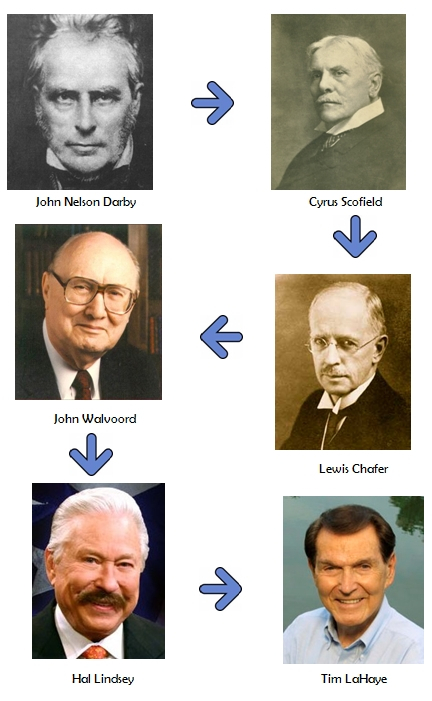
C. I. Scofield (1843–1921), Lewis Sperry Chafer (1871–1952), and Dallas Theological Seminary (est. 1924) were great vehicles for the spread of dispensationalism in America and throughout the world. Both Scofield and Chafer were ordained Presbyterian ministers. The “Scofield Reference Bible, is called by many the most effective tool for the dissemination of dispensationalism in America” (Larry V. Crutchfield, The Origins of Dispensationalism: The Darby Factor, [Lanham, MD: University Press of America, 1992], preface).  Scofield was converted in mid-life and first discipled by James H. Brookes in St. Louis. He was ordained to the ministry at the First Congregational Church of Dallas in 1882 and transferred his ministerial credentials to the Presbyterian Church in the U. S. in 1908 (Daniel Reid, ed., Dictionary of Christianity in America [Downers Grove, IL: InterVarsity Press, 1990], pp. 1057–58). Thus, his ministry took place within a Calvinistic context (Chart of some of the biggest popularizers of Dispensationalism pictured left – Darby, Scofield, Chafer were Calvinists – not certain about the others).

Scofield was the major influence upon the development of Chafer’s theology. John Hannah notes that “it is impossible to understand Chafer without perceiving the deep influence of Scofield” (John David Hannah, “The Social and Intellectual History of the Origins of the Evangelical Theological College,” [Ph. D. Dissertation from The University of Texas at Dallas, 1988], pp. 118–19). In fact, “Chafer often likened this relationship to that of father and a son” (Jeffrey J. Richards, The Promise of Dawn: The Eschatology of Lewis Sperry Chafer, [Lanham, MD: University Press of America, 1991], p. 23). This relationship grew out of Chafer’s study under Scofield at the Northfield Conference and from a life-changing experience in Scofield’s study of the First Congregational Church of Dallas in the early 1900s. Scofield toldChafer that his gifts were more in the field of teaching and not in the area of evangelism in which he had labored. “The two prayed together, and Chafer dedicated his life to a lifetime of biblical study” (Ibid).

Scofield and Chafer were two of the greatest American dispensationalists and both developed their theology from out of a Reformed background. Scofield is known for his study bible and Chafer for his Seminary and systematic theology. Jeffrey Richards describes Chafer’s theological characteristics as having “much in common with the entire Reformed tradition. Excluding eschatology, Chafer is similar theologically to such Princeton divines as Warfield, Hodge, and Machen. He claims such doctrines as the sovereignty of God, …total depravity of humanity, election, irresistible grace, and the perseverance of the saints” (Ibid, p.3). C. Fred Lincoln describes Chafer’s 8-volume Systematic Theology as “unabridged, Calvinistic, premillennial, and dispensational” (C. F. Lincoln, “Biographical Sketch of the Author,” in Lewis Sperry Chafer, Systematic Theology [Dallas: Dallas Seminary Press, 1948], 8:6).

Since its founding in 1924 as The Evangelical Theological College (changed to Dallas Theological Seminary in 1936), it has exerted a global impact on behalf of dispensationalism. Dallas Seminary’s primary founder was Chafer, but William Pettingill and W. H. Griffith-Thomas also played a leading role. Pettingill, like Chafer, was Presbyterian. Griffith Thomas, an Anglican, wrote one of the best commentaries on the Thirty-nine Articles of the Anglican Church (W. H. Griffith Thomas, The Principles of Theology: An Introduction to the Thirty-nine Articles [Grand Rapids: Baker Book House, 1979/1930]), which is still widely used by conservative Anglicans and Episcopalians today. The Thirty-nine Articles are staunchly Calvinistic. Both men were clearly Calvinists. The seminary, especially before World War II, considered itself Calvinistic. Chafer once characterized the school in a publicity brochure as “in full agreement with the Reformed Faith and itstheology is strictly Calvinistic.”  In a letter to Allan MacRae of Westminster Theological Seminary, Chafer said, “You probably know that we are definitely Calvinistic in our theology” (Cited in Ibid, p. 200). “Speaking of the faculty, Chafer noted in 1925 that they were ‘almost wholly drawn from the Southern and Northern Presbyterian Churches’“ (Cited in Ibid., p. 346). Further, Chafer wrote to a Presbyterian minister the following: “I am pleased to state that there is no institution to my knowledge which is more thoroughly Calvinistic nor more completely adjusted to this system of doctrine, held by the Presbyterian Church” (Ibid., p. 346, footnote 323).

Since so many early Dallas graduates entered the Presbyterian ministry, there began to be a reaction to their dispensational premillennialism in the 1930s. This was not an issue as to whether they were Calvinistic in their soteriology, but an issue over their eschatology. In the late 1930s, “Dallas Theological Seminary, though strongly professing to be a Presbyterian institution, was being severed from the conservative Presbyterian splinter movement” (Ibid, pp. 357-358).  In 1944, Southern Presbyterians issued a report from a committee investigating the compatibility of dispensationalism with the Westminster Confession of Faith. The committee ruled dispensationalism was not in harmony with the Church’s Confession. This “report of 1944 was a crippling blow to any future that dispensational premillennialism might have within Southern Presbyterianism” (Ibid, 364). This ruling effectively moved Dallas graduates away from ministry within Reformed denominations toward the independent Bible Church movement.

A Broadening of Dispensational Acceptance

Even though dispensationalism had made a modest penetration of Baptists as early as the 1880s through advocates such as J. R. Graves (See J. R. Graves, The Work of Christ Consummated in 7 Dispensations [Memphis: Baptist Book House, 1883]), a strong Calvinist, they were rebuffed by non-Calvinists until the mid-1920s when elements of dispensational theology began to be adopted by some Pentecostals in an attempt to answer the increasing threat of liberalism. Kraus explains:

Some teachers said explicitly that premillennialism was a bulwark against rationalist theology. Thus it is not surprising to find that the theological elements which became normative in dispensationalism ran directly counter to the developing emphasis of the “New Theology” (Kraus, Dispensationalism, p. 61).

Up to this point in history, those from the Arminian and Wesleyan traditions were more interested in present, personal sanctification issues, rather than the Calvinist attention in explaining God’s sovereign work in the progress of history. However, the rise of the fundamentalist/liberal controversy in the 1920s stirred an interest, outside of the realm of Calvinism, in defending the Bible against the anti-supernatural attacks of the liberal critics. Dispensationalism was seen as a conservative and Bible-centered answer to liberalism, not only within fundamentalism, but increasingly by Pentecostals and others as well. Timothy Weber notes:

But in time, dispensationalism had its devotees within the Wesleyan tradition as well. More radical holiness groups resonated with its prediction of declining orthodoxy and piety in the churches; and Pentecostals found in it a place for the outpouring of the Spirit in a “latter-day rain” before the Second Coming (Weber, “Premillennialism,” p. 15).

Latter Rain Pentecostalism

One of the first non-Calvinist groups to adopt a dispensational orientation can be found among some Pentecostals in the mid-1920s. This development must be understood against a backdrop of the Wesleyan and holiness heritage out of which Pentecostalism arose at the turn of last century. The American holiness movement of the 1800s was primarily postmillennial and if premillennial, then historical premillennial. They were not in any way dispensational.

Pentecostalism is at heart a supposed restoration of apostolic Christianity that is meant to bring in the latter rain harvest in preparation for Christ’s return. The phrase “latter rain” is taken from Joel 2:23 & 28 and sometimes James 5:7 as a label describing an end-time revival and evangelistic harvest expected by many charismatics and Pentecostals. Some time in the future, they believe the Holy Spirit will be poured out like never before. The latter rain teaching is developed from the agricultural model that a farmer needs rain at two crucial points in the growing cycle in order to produce a bountiful harvest. First, right after the seed is planted the “early rain” is needed to cause the seed to germinate in order to produce a healthy crop. Second, the crop needs rain right before the harvest, called the “latter rain,” so the grain will produce a high yield at harvest time, which shortly follows. Latter rain advocates teach that the Acts 2 outpouring of the Holy Spirit was the “early rain” but the “latter rain” outpouring of the Holy Spirit will occur at the end-times. This scenario is in conflict with dispensationalism that sees the current age ending, not in revival, but apostasy. It will be during the tribulation, after the rapture of the church, that God will use the miraculous in conjunction with the preaching of the gospel. Thus, latter rain theology fits within a postmillennial or historical premillennial eschatology, but it is not consistent with dispensationalism.

Many Christians are aware that the Pentecostal movement began on January 1, 1901 in Topeka, Kansas when Agnes Ozman (1870–1937) spoke in tongues under the tutelage of Charles Fox Parham (1873–1929). Yet, how many realize that in the “early years Movement’” (Donald Dayton, Theological Roots of Pentecostalism (Grand Rapids: Zondervan, 1987), p. 27)? This is because Parham titled his report of the new movement as “The Latter Rain: The Story of the Origin of the Original Apostolic or Pentecostal Movements” (Dayton, Roots, pp. 22–23). Many are also aware that William J. Seymour (1870–1922) came under the influence of Parham in Houston, Texas in 1905 and then took the Pentecostal message to Azusa Street in Los Angeles in 1906, from where it was disseminated to the four-corners of the world. But, how many are also aware that he too spoke of these things in terms of a latter rain framework?

There is no doubt that the latter rain teaching was one of the major components—if not the major distinctive—in the theological formation of Pentecostalism. “Modern Pentecostalism is the ‘latter rain,’ the special outpouring of the Spirit that restores the gifts in the last days as part of the preparation for the ‘harvest,’ the return of Christ in glory,” says Donald Dayton (Ibid, 27).  David Wesley Myland (1858–1943) was one of the early Pentecostal leaders. He wrote the first distinctly Pentecostal hymn entitled, “The Latter Rain” in 1906. The “first definitive Pentecostal theology that was widely distributed, the Latter Rain Covenant” appeared in 1910 (Stanley M. Burgess and Gary B. McGee, editors, Dictionary of Pentecostal and Charismatic Movements [Grand Rapids: Zondervan, 1988], p. 632).  Myland argued in his book that “now we are in the Gentile Pentecost, the first Pentecost started the church, the body of Christ, and this, the second Pentecost, unites and perfects the church into the coming of the Lord” (Cited by Dayton, Roots, p. 27).

Dayton concludes that the “broader Latter Rain doctrine provided a key…premise in the logic of Pentecostalism” (Ibid).  In spite of having such a key place in the thinking of early Pentecostalism, “the latter rain doctrine did tend to drop out of Pentecostalism” in the 1920s “only to reappear, however, in the radical Latter Rain revitalization movement of the 1940s” (Ibid, 43). One of reasons that latter rain teachings began to wane in the mid-1920s was that as Pentecostalism became more institutionalized it needed an answer to the inroads of liberalism. As noted above, dispensationalism was seen helpful in these areas.

The Latter Rain teaching developed out of the Wesleyan-Holiness desire for both individual (sanctification) and corporate (eschatological) perfection. Thus, early perfectionist teachers like John Wesley, Charles Finney, and Asa Mahan were all postmillennial and social activists. Revivalism was gagged by carrying the burden of both personal and public change or perfection. It follows that one who believes in personal perfection should also believe that public perfection is equally possible. Those who believe the latter are postmillennialists. After all, if God has given the Holy Spirit in this age to do either, then why not the other? If God can perfect individuals, then why not society?

However, as the 1800s turned into the 1900s, social change was increasingly linked with Darwin’s theory of evolution. The evolutionary rationale was then used to attack the Bible itself. To most English-speaking Christians it certainly appeared that society was not being perfected, instead it was in decline. Critics of the Bible said that one needed a Ph.D. from Europe before the Bible could be organized and understood. It was into this climate that dispensationalism was introduced into America and probably accounts for its speedy and widespread acceptance by many conservative Christians. To many Bible believing Christians, Dispensationalism made a great deal more sense of the world than did the anti-supernaturalism conclusions of liberalism.

Dispensationalism, in contrast to Holiness teaching, taught that the world and the visible church were not being perfected, instead Christendom was in apostasy and heading toward judgment. God is currently in the process of calling out His elect through the preaching of the gospel. Christian social change would not be permanent, nor would it lead to the establishment of Christ’s kingdom before His return. Instead a cataclysmic intervention was needed (Christ’s second coming), if society was to be transformed.

Early Pentecostalism was born out of a motivation and vision for restoring to the church apostolic power lost over the years. Now she was to experience her latter-day glory and victory by going out in a blaze of glory and success. On the other hand, dispensationalism was born in England in the early 1800s bemoaning the latter-day apostasy and ruin of the church. Nevertheless, within Pentecostalism, these two divergent views were merged. Thus, denominations like the Assemblies of God and Foursquare Pentecostals moved away from doctrines like the latter rain teaching and generated official positions against those teachings. It was in the mid-1920s that dispensationalism began to be adopted by non-Calvinists and spread throughout the broader world of Conservative Protestantism.

Dispensationalism appealed to the average person with its emphasis that any average, interested person could understand the Bible without the enlightened help of a liberal education. Once a student understood God’s overall plan for mankind, as administered through the dispensations, he would be able to see God’s hand in history. Thus, dispensational theology made a lot of sense to both Pentecostal and evangelical believers at this point in history.

Post War Development

Fundamentalism/Evangelicalism and Pentecostalism- Charismatic movements spread rapidly in America after the second World War and since dispensationalism was attached to them, it also grew rapidly. Many baby-boomers within Pentecostal and Charismatic churches grew up with dispensationalism and the pre-trib rapture as part of their doctrinal framework. Thus, it would not occur to them that dispensationalism was not organic to their particular brands of restoration theology. Further, as non-Calvinist Fundamentalism grew after the War, especially within independent Baptist circles, there was an even greater disconnect of dispensational distinctives from their Calvinist roots.

We have seen that the Pentecostal/Charismatic movement has a tradition of both Latter Rain/restoration teachings as well as the later rise of a dispensational stream. However, these are contradictory teachings that appear to be on a collision course.

Either the church age is going to end with perfection and revival or it will decline into apostasy, preparing the way for the church to become the harlot of Revelation during the tribulation. It is not surprising to see within the broader Pentecostal/Charismatic movement, since the mid 1980s, a clear trend toward reviving Latter Rain theology and a growing realization that it is in logical conflict with their core doctrine. Many, who grew up on Dispensational ideas and the pre-trib rapture, are dumping these views as the leaven of Latter Rain theology returns to prominence within Pentecostal/Charismatic circles.

Pentecostal/Charismatic leaders like Earl Paulk  and Tommy Reid, to name just a couple among many, are attempting to articulate the tension over the struggles of two competing systems. They are opting for the dismissal of dispensational elements from a consistent Pentecostal/Charismatic and Latter Rain theology. Tommy Reid observes:

This great Last Day revival was often likened in the preaching of Pentecostal pioneer to the restoration promised to Israel in the Old Testament. Whereas Dispensationalists had relegated all of these prophetic passages of restoration only to physical Israel, Pentecostal oratory constantly referred to these prophecies as having a dual meaning, restoration for physical Israel, AND restoration for the present day church. WE WERE THE PEOPLE OF THAT RESTORATION, ACCORDING TO OUR THEOLOGY (Tommy Reid, Kingdom Now But Not Yet. Buffalo: IJN Publishing, 1988, pp. xv-xvi. [emphasis in original]).

At the same time, the purge of Dispensationalism from Reformed Christianity, begun in the late 1930s, has been pretty much completed. Typical of this polarization is found in books like John Gerstner’s Wrongly Dividing The Word Of Truth: A Critique of Dispensationalism (John H. Gerstner, Wrongly Dividing The Word Of Truth: A Critique of Dispensationalism. Brentwood, TN: Wolgemuth & Hyatt Publishers, 1991). While admitting on the one hand that a “strange thing about Dispensationalism is that it seems to have had its strongest advocates in Calvinistic churches” (Ibid, 106). Gerstner so strongly opposes dispensationalism, that it has blinded him to the true Calvinist nature of such a God-centered theology. Gerstner claims that he and other Reformed theologians have raised “strong questions about the accuracy of dispensational claims to be Calvinistic” (Ibid, pp. 105-47). It appears that since Dispensationalism arose within the Reformed tradition, as a rival to Covenant Theology, some want to say that they cannot logically be Calvinistic. This is what Gerstner contends. However, in spite of Gerstner’s sophistry on this issue,he cannot wipe out the historical fact that dispensationalism was birthed within the biblical mindset of a clear theocentric theology and by those who held strongly to soteriological Calvinism. The fact that Dispensationalism arose within a Reformed context is probably the reason why the Reformed community has led the way in the criticism of Dispensational theology.

Conclusion

The purpose of this article is to remind modern Dispensationalists and Calvinists of the historical roots of Dispensationalism. It is precisely because Dispensationalism has penetrated almost every form of Protestantism that many today may be surprised to learn of its heritage. In our day of Postmodern irrationalism, where it is considered a virtue to NOT connect the dots of one’s theology, we need to be reminded that the theology of the Bible is a seamless garment. It all hangs together. If one starts pulling at a single thread, the whole cloth is in danger of unraveling.

I personally think that if systematic Dispensationalism is rightly understood then it still logically makes sense only within a theocentric and soteriologically Calvinistic theology. After all, Dispensationalism teaches that it is GOD who is ruling His household, as administered through the various dispensations of history. However, the reality is that Dispensationalism, or elements of Dispensationalism (i.e., pretribulationism, futurism, etc.), have been disseminated throughout a wide diversity of Protestant traditions. Dispensationalism is best seen as a system of theology that sees views God as the Sovereign ruler of heaven and earth; man as a rebellious vice-regent (along with some angels); Jesus Christ is the hero of history as He is saves some by His Grace; history as a lesson in the outworking of God’s glory being displayed to both heaven and earth. Dispensationalism is a theology that I believe is properly derived from biblical study and lets God be God (Article Adapted from Vol. 4: Conservative Theological Journal Volume 4. 2000 (12) (127). Fort Worth, TX: Tyndale Theological Seminary).

About the Author: Dr. Thomas Ice is the Executive Director of The Pre-Tribulational Research Center. He founded The Center in 1994 with Dr. Tim LaHaye to research, teach, and defend the pretribulational rapture and related Bible prophecy doctrines. The Center is currently located on the campus of Liberty University in Virginia.

Dr. Ice has authored or co-authored about 30 books, written hundreds of articles, and is a frequent conference speaker. He has served as a pastor for 15 years. Dr. Ice has a B.A. from Howard Payne University, a Th.M. from Dallas Theological Seminary, a Ph.D. from Tyndale Theological Seminary, and is a Doctoral Candidate at The University of Wales in Church History. Dr. Ice lives in Omaha, Nebraska with his wife Janice. Two of their three boys are college graduates and the third is currently in college.

Dr. John Piper’s 10 Resolutions For Mental Health

 Psalm 19:1, “The heavens declare the gory of God, and the sky proclaims His handiwork.”

On October 22, 1976, Clyde Kilby, who is now with Christ in Heaven, gave an unforgettable lecture. I went to hear him that night because I loved him. He had been one of my professors in English Literature at Wheaton College. He opened my eyes to more of life than I knew could be seen. O, what eyes he had! He was like his hero, C. S. Lewis, in this regard. When he spoke of the tree he saw on the way to class this morning, you wondered why you had been so blind all your life. Since those days in classes with Clyde Kilby, Psalm 19:1 has been central to my life: “The sky is telling the glory of God.”

That night Dr. Kilby had a pastoral heart and a poet’s eye. He pled with us to stop seeking mental health in the mirror of self-analysis, but instead to drink in the remedies of God in nature. He was not naïve. He knew of sin. He knew of the necessity of redemption in Christ. But he would have said that Christ purchased new eyes for us as well as new hearts. His plea was that we stop being unamazed by the strange glory of ordinary things. He ended that lecture in 1976 with a list of resolutions. As a tribute to my teacher and a blessing to your soul, I offer them for your joy.

1. At least once every day I shall look steadily up at the sky and remember that I, a consciousness with a conscience, am on a planet traveling in space with wonderfully mysterious things above and about me.

2. Instead of the accustomed idea of a mindless and endless evolutionary change to which we can neither add nor subtract, I shall suppose the universe guided by an Intelligence which, as Aristotle said of Greek drama, requires a beginning, a middle, and an end. I think this will save me from the cynicism expressed by Bertrand Russell before his death when he said: “There is darkness without, and when I die there will be darkness within. There is no splendor, no vastness anywhere, only triviality for a moment, and then nothing.”

3. I shall not fall into the falsehood that this day, or any day, is merely another ambiguous and plodding twenty-four hours, but rather a unique event, filled, if I so wish, with worthy potentialities. I shall not be fool enough to suppose that trouble and pain are wholly evil parentheses in my existence, but just as likely ladders to be climbed toward moral and spiritual manhood.

4. I shall not turn my life into a thin, straight line which prefers abstractions to reality. I shall know what I am doing when I abstract, which of course I shall often have to do.

5. I shall not demean my own uniqueness by envy of others. I shall stop boring into myself to discover what psychological or social categories I might belong to. Mostly I shall simply forget about myself and do my work.

6. I shall open my eyes and ears. Once every day I shall simply stare at a tree, a flower, a cloud, or a person. I shall not then be concerned at all to ask what they are but simply be glad that they are. I shall joyfully allow them the mystery of what Lewis calls their “divine, magical, terrifying and ecstatic” existence.

7. I shall sometimes look back at the freshness of vision I had in childhood and try, at least for a little while, to be, in the words of Lewis Carroll, the “child of the pure unclouded brow, and dreaming eyes of wonder.”

8. I shall follow Darwin’s advice and turn frequently to imaginative things such as good literature and good music, preferably, as Lewis suggests, an old book and timeless music.

9. I shall not allow the devilish onrush of this century to usurp all my energies but will instead, as Charles Williams suggested, “fulfill the moment as the moment.” I shall try to live well just now because the only time that exists is now.

10. Even if I turn out to be wrong, I shall bet my life on the assumption that this world is not idiotic, neither run by an absentee landlord, but that today, this very day, some stroke is being added to the cosmic canvas that in due course I shall understand with joy as a stroke made by the architect who calls himself Alpha and Omega.

John Piper was pastor for preaching and vision at Bethlehem Baptist Church in the Twin Cities of Minnesota. He grew up in Greenville, South Carolina, and studied at Wheaton College, Fuller Theological Seminary (B.D.), and the University of Munich (D.theol.). For six years he taught Biblical Studies at Bethel College in St. Paul, Minnesota, and in 1980 accepted the call to serve as pastor at Bethlehem. John is the author of more than 40 books and more than 30 years of his preaching and teaching is available free at desiringGod.org. John and his wife, Noel, have four sons, one daughter, and twelve grandchildren.

The Self-Existence of God by A.W. Tozer

Lord of all being! Thou alone canst affirm I AM THAT I AM; yet we who are made in Thine image may each one repeat ”I am,” so confessing that we derive from Thee and that our words are but an echo of Thine own. We acknowledge Thee to be the great Original of which we through Thy goodness are grateful if imperfect copies. We worship Thee, O Father Everlasting. Amen.

”God has no origin,” said Novatian and it is precisely this concept of no-origin which distinguishes That-which-is-God from whatever is not God.

Origin is a word that can apply only to things created. When we think of anything that has origin we are not thinking of God. God is self-existent, while all created things necessarily originated somewhere at some time. Aside from God, nothing is self-caused.

By our effort to discover the origin of things we confess our belief that everything was made by Someone who was made of none. By familiar experience we are taught that everything ”came from” something else. Whatever exists must have had a cause that antedates it and was at least equal to it, since the lesser cannot produce the greater. Any person or thing may be at once both caused and the cause of someone or something else; and so, back to the One who is the cause of all but is Himself caused by none.

The child by his question, ”Where did God come from?” is unwittingly acknowledging his creaturehood. Already the concept of cause and source and origin is firmly fixed in his mind. He knows that everything around him came from something other than itself, and he simply extends that concept upward to God. The little philosopher is thinking in true creature-idiom and, allowing for his lack of basic information, he is reasoning correctly. He must be told that God has no origin, and he will find this hard to grasp since it introduces a category with which he is wholly unfamiliar and contradicts the bent toward origin-seeking so deeply ingrained in all intelligent beings, a bent that impels them to probe ever back and back toward undiscovered beginnings.

To think steadily of that to which the idea of origin cannot apply is not easy, if indeed it is possible at all. Just as under certain conditions a tiny point of light can be seen, not by looking directly, at it but by focusing the eyes slightly to one side, so it is with the idea of the Uncreated. When we try to focus our thought upon One who is pure uncreated being we may, see nothing at all, for He dwelleth in light that no man can approach unto. Only by faith and love are we able to glimpse Him as he passes by our shelter in the cleft of the rock. ”And although this knowledge is very cloudy, vague and general,” says Michael de Molinos, being supernatural, it produces a far more clear and perfect cognition of God than any sensible or particular apprehension that can be formed in this life; since all corporeal and sensible images are immeasurably remote from God.”

The human mind, being created, has an understandable uneasiness about the Uncreated. We do not find it comfortable to allow for the presence of One who is wholly outside of the circle of our familiar knowledge. We tend to be disquieted by the thought of One who does not account to us for His being, who is responsible to no one, who is self-existent, self-dependent and self-sufficient.

Philosophy and science have not always been friendly toward the idea of God, the reason being that they are dedicated to the task of accounting for things and are impatient with anything that refuses to give an account of itself. The philosopher and the scientist will admit that there is much that they do not know; but that is quite another thing from admitting that there is something which they can never know, which indeed they have no technique for discovering.

To admit that there is One who lies beyond us, who exists outside of all our categories, who will not be dismissed with a name, who will not appear before the bar of our reason, nor submit to our curious inquiries: this requires a great deal of humility, more than most of us possess, so we save face by thinking God down to our level, or at least down to where we can manage Him. Yet how He eludes us! For He is everywhere while He is nowhere, for ”where” has to do with matter and space, and God is independent of both. He is unaffected by time or motion, is wholly self-dependent and owes nothing to the worlds His hands have made.

Timeless, spaceless, single, lonely,

Yet sublimely Three,

Thou art grandly, always, only

God is Unity!

Lone in grandeur,

lone in glory,

Who shall tell Thy wondrous story?

Awful Trinity!

– Frederick W. Faber

It is not a cheerful thought that millions of us who live in a land of Bibles, who belong to churches and labor to promote the Christian religion, may yet pass our whole life on this earth without once having thought or tried to think seriously about the being of God. Few of us have let our hearts gaze in wonder at the I AM, the self-existent Self back of which no creature can think. Such thoughts are too painful for us. We prefer to think where it will do more good – about how to build a better mousetrap, for instance, or how to make two blades of grass grow where one grew before. And for this we are now paying a too heavy price in the secularlzation of our religion and the decay of our inner lives.

Perhaps some sincere but puzzled Christian may at this juncture wish to inquire about the practicality of such concepts as I am trying to set forth here. ”What bearing does this have on my life?” he may ask. ”What possible meaning can the self-existence of God have for me and others like me in a world such as this and in times such as these?”

To this I reply that, because we are the handiwork of God, it follows that all our problems and their solutions are theological. Some knowledge of what kind of God it is that operates the universe is indispensable to a sound philosophy of life and a sane outlook on the world scene.

The much-quoted advice of Alexander Pope,

Know then thyself, presume not God to scan:

The proper study of mankind is man,

if followed literally would destroy any possibility of man’s ever knowing himself in any but the most superficial way. We can never know who or what we are till we know at least something of what God is. For this reason the self-existence of God is not a wisp of dry doctrine, academic and remote; it is in fact as near as our breath and as practical as the latest surgical technique.

For reasons known only to Himself, God honored man above all other beings by creating him in His own image. And let it be understood that the divine image in man is not a poetic fancy, not an idea born of religious longing. It is a solid theological fact, taught plainly throughout the Sacred Scriptures and recognized by the Church as a truth necessary to a right understanding of the Christian faith.

Man is a created being, a derived and contingent self, who of himself possesses nothing but is dependent each moment for his existence upon the One who created him after His own likeness. The fact of God is necessary to the fact of man. Think God away and man has no ground of existence.

That God is everything and man nothing is a basic tenet of Christian faith and devotion; and here the teachings of Christianity coincide with those of the more advanced and philosophical religions of the East. Man for all his genius is but an echo of the original Voice, a reflection of the uncreated Light. As a sunbeam perishes when cut off from the sun, so man apart from God would pass back into the void of nothingness from which he first leaped at the creative call.

Not man only, but everything that exists came out of and is dependent upon the continuing creative impulse. ”In the beginning was the Word, and the Word was with God, and the Word was God…. All things were made by him and without him was not any thing made that was made.” That is how John explains it, and with him agrees the apostle Paul: ”For by him were all things created, that are in heaven and that are in earth, visible and invisible, whether they be thrones, or dominions, or principalities, or powers: all things were created by him, and for him; and he is before all things, and by him all things consist.” To this witness the writer to the Hebrews adds his voice, testifying of Christ that He is the brightness of God’s glory and the express image of His Person, and that He upholds all things by the word of His power.

In this utter dependence of all things upon the creative will of God lies the possibility for both holiness and sin. One of the marks of God’s image in man is his ability to exercise moral choice. The teaching of Christianity is that man chose to be independent of God and confirmed his choice by deliberately disobeying a divine command. This act violated the relationship that normally existed between God and His creature; it rejected God as the ground of existence and threw man back upon himself. Thereafter he became not a planet revolving around the central Sun, but a sun in his own right, around which everything else must revolve.

A more positive assertion of selfhood could not be imagined than those words of God to Moses: I AM THAT I AM. Everything God is, everything that is God, is set forth in that unqualified declaration of independent being. Yet in God, self is not sin but the quintessence of all possible goodness, holiness and truth.

The natural man is a sinner because and only because he challenges God’s selfhood in relation to his own. In all else he may willingly accept the sovereignty of God; in his own life he rejects it. For him, God’s dominion ends where his begins. For him, self becomes Self, and in this he unconsciously imitates Lucifer, that fallen son of the morning who said in his heart, ”I will ascend into heaven, I will exalt my throne above the stars of God. . . . I will be like the Most High.”

Yet so subtle is self that scarcely anyone is conscious of its presence. Because man is born a rebel, he is unaware that he is one. His constant assertion of self, as far as he thinks of it at all, appears to him a perfectly normal thing. He is willing to share himself, sometimes even to sacrifice himself for a desired end, but never to dethrone himself. No matter how far down the scale of social acceptance he may slide, he is still in his own eyes a king on a throne, and no one, not even God, can take that throne from him.

Sin has many manifestations but its essence is one. A moral being, created to worship before the throne of God, sits on the throne of his own selfhood and from that elevated position declares, ”I AM.” That is sin in its concentrated essence; yet because it is natural it appears to be good. It is only when in the gospel the soul is brought before the face of the Most Holy One without the protective shield of ignorance that the frightful moral incongruity is brought home to the conscience. In the language of evangelism the man who is thus confronted by the fiery presence of Almighty God is said to be under conviction. Christ referred to this when He said of the Spirit whom He would send to the world, ”And when he is come, he will reprove the world of sin, and of righteousness, and of judgment.”

The earliest fulfilment of these words of Christ was at Pentecost after Peter had preached the first great Christian sermon. ”Now when they heard this, they were pricked in their heart, and said unto Peter and to the rest of the apostles, Men and brethren, what shall we do?” This ”What shall we do?” is the deep heart cry of every man who suddenly realizes that he is a usurper and sits on a stolen throne. However painful, it is precisely this acute moral consternation that produces true repentance and makes a robust Christian after the penitent has been dethroned and has found forgiveness and peace through the gospel.

”Purity of heart is to will one thing,” said Kierkegaard, and we may with equal truth turn this about and declare, ”The essence of sin is to will one thing,” for to set our will against the will of God is to dethrone God and make ourselves supreme in the little kingdom of Mansoul. This is sin at its evil root. Sins may multiply like the sands by the seashore, but they are yet one. Sins are because sin is. This is the rationale behind the much maligned doctrine of natural depravity which holds that the independent man can do nothing but sin and that his good deeds are really not good at all. His best religious works God rejects as He rejected the offering of Cain. Only when he has restored his stolen throne to God are his works acceptable.

The struggle of the Christian man to be good while the bent toward self-assertion still lives within him as a kind of unconscious moral reflex is vividly described by the apostle Paul in the seventh chapter of his Roman Epistle; and his testimony is in full accord with the teaching of the prophets. Eight hundred years before the advent of Christ the prophet Isaiah identified sin as rebellion against the will of God and the assertion of the right of each man to choose for himself the way he shall go. ”All we like sheep have gone astray,” he said, ”we have turned every one to his own way,” and I believe that no more accurate description of sin has ever been given.

The witness of the saints has been in full harmony with prophet and apostle, that an inward principle of self lies at the source of human conduct, turning everything men do into evil. To save us completely Christ must reverse the bent of our nature; He must plant a new principle within us so that our subsequent conduct will spring out of a desire to promote the honor of God and the good of our fellow men. The old self-sins must die, and the only instrument by which they can be slain is the Cross. ”If any man come after me, let him deny himself, and take up his cross, and follow me,” said our Lord, and years later the victorious Paul could say, ”I am crucified with Christ: nevertheless I live; yet not I, but Christ liveth in me.”

My God, shall sin its power maintain

And in my soul defiant live!

‘Tis not enough that Thou forgive,

The cross must rise and self be slain.

O God of love, Thy power disclose:

‘Tis not enough that Christ should rise,

I, too, must seek the brightening skies,

And rise from death, as Christ arose.

– Greek hymn

Article adapted from Chapter 5 of A.W. Tozer’s classic book on the Attributes of God entitled: The Knowledge of the Holy. Harper, many reprints – most recently 2008.

About the Author. Aiden Wilson Tozer was born April 21, 1897, on a small farm among the spiny ridges of Western Pennsylvania. Within a few short years, Tozer, as he preferred to be called, would earn the reputation and title of a “20th-century prophet.”

Able to express his thoughts in a simple but forceful manner, Tozer combined the power of God and the power of words to nourish hungry souls, pierce human hearts, and draw earthbound minds toward God.

When he was 15 years old, Tozer’s family moved to Akron, Ohio. One afternoon as he walked home from his job at Goodyear, he overheard a street preacher say, “If you don’t know how to be saved . . . just call on God.” When he got home, he climbed the narrow stairs to the attic where, heeding the preacher’s advice, Tozer was launched into a lifelong pursuit of God.

In 1919, without formal education, Tozer was called to pastor a small storefront church in Nutter Fort, West Virginia. That humble beginning thrust him and his new wife Ada Cecelia Pfautz, into a 44-year ministry with The Christian and Missionary Alliance.

Thirty-one of those years were spent at Chicago’s Southside Alliance Church. The congregation, captivated by Tozer’s preaching, grew from 80 to 800.

In 1950 Tozer was elected editor of the Alliance Weekly now called Alliance Life. The circulation doubled almost immediately. In the first editorial dated June 3, 1950, he set the tone: “It will cost something to walk slow in the parade of the ages while excited men of time rush about confusing motion with progress. But it will pay in the long run and the true Christian is not much interested in anything short of that.”

Tozer’s forte was his prayer life which often found him walking the aisles of a sanctuary or lying face down on the floor. He noted, “As a man prays, so is he.” To him the worship of God was paramount in his life and ministry. “His preaching as well as his writings were but extensions of his prayer life,” comments Tozer biographer James L. Snyder. An earlier biographer noted, “He spent more time on his knees than at his desk.”

Tozer’s love for words also pervaded his family life. He quizzed his children on what they read and made up bedtime stories for them. “The thing I remember most about my father,” reflects his daughter Rebecca, “was those marvelous stories he would tell.”

Son Wendell, one of six boys born before the arrival of Rebecca, remembers that, “We all would rather be treated to the lilac switch by our mother than to have a talking-to by our dad.”

Tozer’s final years of ministry were spent at Avenue Road Church in Toronto, Canada. On May 12, 1963, his earthly pursuit of God ended when he died of a heart attack at age 66. In a small cemetery in Akron, Ohio, his tombstone bears this simple epitaph: “A Man of God.”

Some wonder why Tozer’s writings are as fresh today as when he was alive. It is because, as one friend commented, “He left the superficial, the obvious and the trivial for others to toss around. . . . [His] books reach deep into the heart.”

His humor, written and spoken, has been compared to that of Will Rogers–honest and homespun. Congregations could one moment be swept by gales of laughter and the next sit in a holy hush.

For almost 50 years, Tozer walked with God. Even though he is gone, he continues to speak, ministering to those who are eager to experience God. As someone put it, “This man makes you want to know and feel God.”

An Excellent Defense of The Rapture by Dr. John MacArthur

But we do not want you to be uninformed, brethren, about those who are asleep, so that you will not grieve as do the rest who have no hope. For if we believe that Jesus died and rose again, even so God will bring with Him those who have fallen asleep in Jesus. For this we say to you by the word of the Lord, that we who are alive and remain until the coming of the Lord, will not precede those who have fallen asleep. For the Lord Himself will descend from heaven with a shout, with the voice of the archangel and with the trumpet of God, and the dead in Christ will rise first. Then we who are alive and remain will be caught up together with them in the clouds to meet the Lord in the air, and so we shall always be with the Lord. Therefore comfort one another with these words.(1 Thessalonians 4:13–18, NASB)

The study of the end times is the consuming passion of many in the church today. Sensational best-selling authors argue that current events fulfill their often dubious interpretations of biblical prophecy. Some claim to have figured out the secret that even Jesus in His Incarnation did not know—the time of the Second Coming (cf. Matt. 24:36). Tragically, some people get so caught up in the study of eschatology that they neglect the basic principles of spiritual growth and evangelism that the Second Coming is designed to motivate.

Of all the end-time events, the Rapture of the church seems to generate the most interest and discussion. The young church at Thessalonica also had questions about that event, so Paul addressed their concerns in this passage. But unlike most modern-day treatises on the subject, Paul’s concern was not just doctrinal, but pastoral. His intent was not to give a detailed description of the Rapture, but to comfort the Thessalonians. The intent of the other two passages in the New Testament that discuss the Rapture (John 14:1–3; 1 Cor. 15:51–58) is also to provide comfort and encouragement for believers, not to fuel their prophetic speculations.

When Paul penned this epistle, the Thessalonians had been in Christ only for a few months. The apostle had taught them about end-time events, such as Christ’s return to gather believers to Himself (e.g., 1:9–10; 2:19; 3:13). They also knew about the Day of the Lord (5:1–3), a time of coming judgment on the ungodly. But some issues about the details of their gathering to Christ troubled them. First, they seem to have been afraid that they had missed the Rapture, since the persecution they were suffering (3:3–4) caused some to fear they were in the Day of the Lord, which they obviously had not expected to experience (2 Thess. 2:1–2). Furthering that misconception were some false teachers, about whom Paul warned in 2 Thessalonians 2:2, “[Do] not be quickly shaken from your composure or be disturbed either by a spirit or a message or a letter as if from us, to the effect that the day of the Lord has come.” But the persecution they were experiencing was not that associated with the Tribulation or the Day of the Lord. It was merely the persecution that all believers can expect (2 Tim. 3:12) and that Paul had warned the Thessalonians about (3:3–4).

The Thessalonians’ fears that they were in the Day of the Lord and thus had missed the Rapture imply that the Rapture precedes the Tribulation. If the Thessalonians knew that the Rapture came at the end of the Tribulation, persecution would not have caused them to fear they had missed it. Instead, that persecution would have been a cause for joy, not concern. If the Day of the Lord had arrived, and the Rapture was after the Tribulation, then that blessed event would have been drawing near.

But of gravest concern to the Thessalonians were those of their number who had died. Would they receive their resurrection bodies at the Rapture, or would they have to wait until after the Tribulation? Would they miss the Rapture altogether? Would they therefore be second-class citizens in heaven? Were their deaths chastisement for their sins (cf. 1 Cor. 11:30)? They loved each other so deeply (cf. 4:9–10) that those thoughts greatly disturbed them. Their concern for those who had died shows that the Thessalonians believed the return of Christ was imminent and could happen in their lifetime. Otherwise, there would have been no reason for their concern. The Thessalonians’ fear that their fellow believers who had died might miss the Rapture also implies that they believed in a pretribulational Rapture. If the Rapture precedes the Tribulation, they might have wondered when believers who died would receive their resurrection bodies. But there would have been no such confusion if the Rapture follows the Tribulation; all believers would then receive their resurrection bodies at the same time. Further, if they had been taught that they would go through the Tribulation, they would not have grieved for those who died, but rather would have been glad to see them spared from that horrible time.

Paul wrote this section of his epistle to alleviate the Thessalonians’ grief and confusion. He was concerned that they not … be uninformed … about those who are asleep and thus grieve as do the rest who have no hope. Since their grief was based on ignorance, Paul comforted them by giving them knowledge.

The phrase we do not want you to be uninformed or its equivalent frequently introduces a new topic in Paul’s epistles (cf. Rom. 1:13; 1 Cor. 10:1; 11:3; 12:1; 2 Cor. 1:8; Phil. 1:12; Col. 2:1). The conjunction but and the affectionate term brethren (cf. (vv. 1, 10; 1:4; 2:1, 9, 14, 17; 3:7; 5:1, 4, 12, 14, 25) emphasize the change in subject and call attention to the new topic’s importance. In this case, Paul introduced not only a new subject but also new revelation he had received “by the word of the Lord” (v. 15).

Since it was their primary concern, Paul first addressed the question of those who are asleep. While koimaō (asleep) can be used of normal sleep (Matt. 28:13; Luke 22:45; Acts 12:6), it more often refers to believers who have died (vv. 13–15; Matt. 27:52; John 11:11; Acts 7:60; 13:36; 1 Cor. 11:30; 15:6, 18, 20, 51; 2 Peter 3:4). In verse 14 those who are asleep are identified as “the dead in Christ.” The present tense participle koimōmenōn (v. 13) refers to those who are continually falling asleep as a regular course of life in the church. They had grown increasingly concerned as their fellow believers continued to die.

It is important to remember that in the New Testament “sleep” applies only to the body, never to the soul. “Soul sleep,” the false teaching that the souls of the dead are in a state of unconscious existence in the afterlife, is foreign to Scripture. In 2 Corinthians 5:8 Paul wrote that he “prefer[red] rather to be absent from the body and to be at home with the Lord,” while in Philippians 1:23 he expressed his “desire to depart and be with Christ, for that is very much better.” Those statements teach that believers go consciously into the Lord’s presence at death, for how could unconsciousness be “very much better” than conscious communion with Jesus Christ in this life? Jesus promised the repentant thief on the cross, “Truly I say to you, today you shall be with Me in Paradise [heaven; cf. 2 Cor. 12:4; Rev. 2:7]” (Luke 23:43). Moses’ and Elijah’s souls were not asleep, since they appeared with Jesus at the Transfiguration (Matt. 17:3), nor are those of the Tribulation martyrs in Revelation 6:9–11, who will be awake and able to speak to God. After death the redeemed go consciously into the presence of the Lord, while the unsaved go into conscious punishment (Luke 16:19–31).

Paul related this information to the Thessalonians so that they would not grieve. There is a normal sorrow that accompanies the death of a loved one, caused by the pain of separation and loneliness. Jesus grieved over the death of Lazarus (John 11:33, 35), and Paul exhorted the Romans to “weep with those who weep” (Rom. 12:15). However, the apostle did not have that kind of grief in mind here, but grief like the rest who have no hope. In Ephesians 2:12 Paul described unbelievers as “having no hope and without God in the world.” There is an awful, terrifying, hopeless finality for unbelievers when a loved one dies, a sorrow unmitigated by any hope of reunion. Commenting on the hopeless despair of unbelievers in the ancient world, William Barclay writes,

In the face of death the pagan world stood in despair. They met it with grim resignation and bleak hopelessness. Aeschylus wrote, “Once a man dies there is no resurrection.” Theocritus wrote, “There is hope for those who are alive, but those who have died are without hope.” Catullus wrote, “When once our brief light sets, there is one perpetual night through which we must sleep.” On their tombstones grim epitaphs were carved. “I was not; I became; I am not; I care not.” (The Letters to the Philippians, Colossians, and Thessalonians, rev. ed. [Louisville: Westminster, 1975], 203)

Even those pagans who believed in life after death did not have that hope confirmed by the Holy Spirit; they merely clung to it without affirmation from God. But Christians do not experience the hopeless grief of nonbelievers, for whom death marks the permanent severing of relationships. Unlike them, Christians never say a final farewell to each other; there will be a “gathering together [of all believers] to Him” (2 Thess. 2:1). Partings in this life are only temporary.

The Thessalonians’ ignorance about the Rapture caused them to grieve. It was to give them hope and to comfort them that Paul discussed that momentous event, giving a fourfold description of it: its pillars, participants, plan, and profit.

The Pillars of the Rapture

For if we believe that Jesus died and rose again, even so God will bring with Him those who have fallen asleep in Jesus. For this we say to you by the word of the Lord,(4:14–15a)

The blessed hope of the Rapture is not based on the shifting sands of philosophical speculation. Nor is it religious mythology, a fable concocted by well-meaning people to comfort those who grieve. The marvelous truth that the Lord Jesus Christ will return to gather believers to Himself is based on three unshakeable pillars: the death of Christ, the resurrection of Christ, and the revelation of Christ.

The Death of Christ

For if we believe that Jesus died(4:14a)

Ifdoes not suggest uncertainty or doubt, but rather logical sequence. Paul says “since,” or “based on the fact that” we believe that Jesus died certain things logically follow. The apostle’s simple statement summarizes all the richness of Christ’s atoning work, which provides the necessary foundation for the gathering of the church. His death satisfied the demands of God’s righteousness, holiness, and justice by paying in full the penalty for believers’ sins. By virtue of Christ’s substitutionary death, when God “made Him who knew no sin to be sin on our behalf, so that we might become the righteousness of God in Him” (2 Cor. 5:21), Christians have been made acceptable to God and thus fit to be gathered into His presence.

Significantly, Paul did not use the metaphor of sleep to refer to Jesus, but says that He died. Jesus experienced the full fury of death in all its dimensions as He “bore our sins in His body on the cross, so that we might die to sin and live to righteousness” (1 Peter 2:24). His death transformed death into sleep for believers. T. E. Wilson notes, “Death has been changed to sleep by the work of Christ. It is an apt metaphor in which the whole concept of death is transformed. ‘Christ made it the name for death in the dialect of the church (Acts 7:60) (Findlay)’ ” (What the Bible Teaches: 1 and 2 Thessalonians [Kilmarnock, Scotland: John Ritchie Ltd., 1983], 45). When believers die, their spirit goes immediately into conscious fellowship with the Lord, while their bodies temporarily sleep in the grave, awaiting the Rapture.

The Resurrection of Christ

and rose again, even so God will bring with Him those who have fallen asleep in Jesus.(4:14b)

The resurrection of Christ indicates that the Father accepted His sacrifice, enabling Him to “be just and the justifier of the one who has faith in Jesus” (Rom. 3:26). Paul taught that truth to the Romans when he wrote that “[Christ] was raised because of our justification” (Rom. 4:25). Christ’s resurrection proves that He conquered sin and death, and became the source of resurrection life for every Christian. I. Howard Marshall writes, “The death of believers does not take place apart from Jesus, and hence Paul can conclude that God will raise them up and bring them into the presence of Jesus at the parousia. God will treat those who died trusting in Jesus in the same way He treated Jesus Himself, namely by resurrecting them” (1 and 2 Thessalonians, The New Century Bible Commentary [Grand Rapids: Eerdmans, 1983], 124).

The phrase even solinks believers’ resurrections inextricably to the resurrection of Christ. In John 14:19 Jesus said, “Because I live, you will live also.” In the most detailed passage on the resurrection in Scripture, Paul wrote that “Christ [is] the first fruits, after that those who are Christ’s at His coming” (1 Cor. 15:23). Earlier in that same epistle, he stated plainly, “Now God has not only raised the Lord, but will also raise us up through His power” (1 Cor. 6:14). In his second inspired letter to the Corinthians, Paul wrote, “He who raised the Lord Jesus will raise us also with Jesus” (2 Cor. 4:14).

To further assuage their fears, Paul reassured believers that God will bring with Him [Jesus] those who have fallen asleep in Jesus. Their fellow believers who died will not miss out on the Rapture but will return with Christ in glory. Some interpret the phrase God will bring to mean that the spirits of dead believers will come from heaven with Christ to meet their resurrected bodies. Others see in it the truth that at the Rapture, God will bring all believers, living and dead, back to heaven with Christ. While the first view is certainly true, the second one seems to be the emphasis of this passage.

What the passage does not teach is that the spirits of dead believers immediately return to earth with Christ for the establishing of the millennial kingdom. That view places the Rapture at the end of the Tribulation and essentially equates it with the Second Coming. It trivializes the Rapture into a meaningless sideshow that serves no purpose. Commenting on the pointlessness of a posttribulational Rapture, Thomas R. Edgar asks,

What can be the purpose for keeping a remnant alive through the tribulation so that some of the church survive and then take them out of their situation and make them the same as those who did not survive? Why keep them for this? [The] explanation that they provide an escort for Jesus does not hold up. Raptured living saints will be exactly the same as resurrected dead saints. Why cannot the dead believers fulfill this purpose? Why keep a remnant alive [through the Tribulation], then Rapture them and accomplish no more than by letting them die? There is no purpose or accomplishment in [such] a Rapture ….

With all the saints of all the ages past and the armies [of angels] in heaven available as escorts and the fact that [raptured] saints provide no different escort than if they had been killed, why permit the church to suffer immensely, most believers [to] be killed, and spare a few for a Rapture which has no apparent purpose, immediately before the [Tribulation] period ends?… Is this the promise? You will suffer, be killed, but I will keep a few alive, and take them out just before the good times come. Such reasoning, of course, calls for some explanation of the apparent lack of purpose for a posttribulational Rapture of any sort.

We can Note the Following:

(1) An unusual, portentous, one-time event such as the Rapture must have a specific purpose. God has purposes for his actions. This purpose must be one that can be accomplished only by such an unusual event as a Rapture of living saints.

(2) This purpose must agree with God’s general principles of operation.

(3) There is little or no apparent reason to Rapture believers when the Lord returns and just prior to setting up the long-awaited kingdom with all of its joyful prospects.

(4) There is good reason to deliver all who are already believers from the tribulation, where they would be special targets of persecution.

(5) To deliver from a period of universal trial and physical destruction such as the tribulation requires a removal from the earth by death or Rapture. Death is not appropriate as a promise in Rev. 3:10.

(6) Deliverance from the tribulation before it starts agrees with God’s previous dealings with Noah and Lot and is directly stated as a principle of God’s action toward believers in 2 Pet. 2:9. (“Robert H. Gundry and Revelation 3:10, ” Grace Theological Journal 3 [Spring 1982], 43–44)

The view that the raptured saints return to earth with Christ also contradicts John 14:1–3:

Do not let your heart be troubled; believe in God, believe also in Me. In My Father’s house are many dwelling places; if it were not so, I would have told you; for I go to prepare a place for you. If I go and prepare a place for you, I will come again and receive you to Myself, that where I am, there you may be also.

The phrases “My Father’s house” and “where I am” clearly refer to heaven (cf. John 7:34). Jesus promised to take believers back to heaven with Him when He returns to gather His people. There has to be a time interval, then, between Christ’s return to gather His people (the Rapture) and His return to earth to establish the millennial kingdom (the Second Coming). During that interval between the Rapture and the Second Coming, the believers’ judgment takes place (1 Cor. 3:11–15; 2 Cor. 5:10); a posttribulational Rapture would leave no time for that event.

The phrase in Jesus is best understood as describing the circumstances in which the departed saints fell asleep. They died in the condition of being related to Jesus Christ. Paul used essentially the same phrase in 1 Corinthians 15:18 when he wrote of those “who have fallen asleep in Christ.”

By demonstrating God’s acceptance of His atoning sacrifice, the resurrection of Christ buttresses the first pillar on which the Rapture is based, the death of Christ.

The Revelation of Christ

For this we say to you by the word of the Lord, (4:15a)

Paul’s teaching on the Rapture was not his own speculation but direct revelation from God. The phrase this we say to you by the word of the Lord has the authoritative tone of an inspired writer revealing what God has disclosed to him. Some argue that the word of the Lord was something Jesus said while He was here on earth. But there are no close parallels to the present passage in any of the Gospels. Nor is there any specific teaching in the Gospels to which Paul could be alluding. Although the Lord talked in the Gospels about a trumpet and the gathering of the elect, the differences between those passages and the present one outweigh the similarities, as Robert L. Thomas notes:

Similarities between this passage in 1 Thessalonians and the gospel accounts include a trumpet (Matt. 24:31), a resurrection (John 11:25, 26), and a gathering of the elect (Matt. 24:31) …. Yet dissimilarities between it and the canonical sayings of Christ far outweigh the resemblances …. Some of the differences between Matthew 24:30, 31 and 1 Thessalonians 4:15–17 are as follows: (1) In Matthew the Son of Man is coming on the clouds, … in 1 Thessalonians ascending believers are in them. (2) In the former the angels gather, in the latter the Son does so personally. (3) In the former nothing is said about resurrection, while in the latter this is the main theme. (4) Matthew records nothing about the order of ascent, which is the principal lesson in Thessalonians. (“1 & 2 Thessalonians,” in Frank E. Gaebelein, ed. The Expositor’s Bible Commentary,vol. 11 [Grand Rapids: Zondervan, 1979], 276–77)

Nor is it likely that Paul is referring to a saying of Jesus not recorded in the Gospels (cf. Acts 20:35); he does not state or imply that he is directly quoting Christ’s words. Further, in 1 Corinthians 15:51 Paul referred to the Rapture as a mystery; that is, a truth formerly hidden but now revealed. That indicates that Jesus did not disclose the details of the Rapture during His earthly ministry. (He referred to the Rapture in John 14:1–3 in a general, nonspecific sense.) Paul’s teaching on the Rapture was new revelation, possibly given by God through a prophet (such as Agabus; Acts 21:11) but more likely directly to Paul himself. The Thessalonians had apparently been informed about the Day of the Lord judgment (5:1–2), but not about the preceding event—the Rapture of the church—until the Holy Spirit through Paul revealed it to them. This was new revelation, unveiled mystery.

The Rapture, then, does not rest on the shaky foundation of whimsical theological speculation, but on the sure foundation of the death, resurrection, and revelation of the Lord Jesus Christ.

The Participants of the Rapture

we who are alive and remain until the coming of the Lord, will not precede those who have fallen asleep.(4:15b)

Two groups of people will participate in the Rapture: those who are alive at the coming of the Lord and those who have fallen asleep. That Paul used the plural pronoun we indicates that he believed the Rapture could happen in his lifetime. He had a proper anticipation of and expectation for the Lord’s return, though unlike many throughout church history, the apostle did not predict a specific time for it. He accepted Christ’s words in Matthew 24:36, “But of that day and hour no one knows, not even the angels of heaven, nor the Son, but the Father alone,” and Acts 1:7, “It is not for you to know times or epochs which the Father has fixed by His own authority.” At the same time, Paul understood the parable of the wise and foolish virgins, which illustrates the foolishness of not being constantly prepared for the Lord’s return (Matt. 25:1–13). The Lord expressed the point of that parable when He declared, “Be on the alert then, for you do not know the day nor the hour” (Matt. 25:13; cf. 24:45–51). Paul thus avoided both common errors regarding Christ’s return; he neither got involved in date setting, nor did he push the return of Christ into the distant, nebulous future.

Several other passages express Paul’s fervent hope and expectation that he himself might be among those who are alive and remain until the coming of the Lord. In Romans 13:11 he wrote, “Do this, knowing the time, that it is already the hour for you to awaken from sleep; for now salvation is nearer to us than when we believed.” The salvation of which he wrote was the redemption of the body (Rom. 8:23) that takes place when Christ returns. In verse 12 Paul added, “The night [of man’s sin and Satan’s rule] is almost gone, and the day [of Christ’s return] is near.” He wrote to the Corinthians, “Now these things happened to them as an example, and they were written for our instruction, upon whom the ends of the ages have come” (1 Cor. 10:11). Paul knew he was in the messianic age, the period between Christ’s first and second comings, the last days of human history. He likely had no idea that they would last as long as they have. Later in that epistle, Paul, as he does here in 1 Thessalonians, includes himself among those who might still be alive at the Rapture: “Behold, I tell you a mystery; we will not all sleep, but we will all be changed, in a moment, in the twinkling of an eye, at the last trumpet; for the trumpet will sound, and the dead will be raised imperishable, and we will be changed” (1 Cor. 15:51–52). As he concluded that letter Paul wrote, “If anyone does not love the Lord, he is to be accursed. Maranatha” (1 Cor. 16:22). Maranatha comes from two Aramaic words that mean “Oh Lord, come!” and expresses Paul’s strong hope that the Lord would return soon. Earlier in this epistle, he commended the Thessalonians for waiting “for His Son from heaven” (1:10). He expressed his desire for them that God “may establish [their] hearts without blame in holiness before our God and Father at the coming of our Lord Jesus with all His saints” (3:13). Pronouncing a final benediction as he concluded this letter, Paul wrote, “Now may the God of peace Himself sanctify you entirely; and may your spirit and soul and body be preserved complete, without blame at the coming of our Lord Jesus Christ” (5:23). The apostle wrote to Titus that he was “looking for the blessed hope and the appearing of the glory of our great God and Savior, Christ Jesus” (Titus 2:13).

On the other hand, Paul fully realized that he might die before the Rapture. In 1 Corinthians 6:14 he acknowledged that he might be among those resurrected at the Rapture: “Now God has not only raised the Lord, but will also raise us up through His power.” He affirmed to the Philippians his desire that “Christ will even now, as always, be exalted in my body, whether by life or by death” (Phil. 1:20). At the end of his life, sensing his imminent death, he wrote to Timothy, “For I am already being poured out as a drink offering, and the time of my departure has come. I have fought the good fight, I have finished the course, I have kept the faith” (2 Tim. 4:6–7). While acknowledging both possibilities, Paul used we because when he wrote, it was still possible for the Lord to return in his lifetime. By so doing, he conveyed to the Thessalonians his own longing for Christ’s imminent return.

Paul lived in constant expectation of Christ’s return. But the apostle nevertheless reassured the Thessalonians that those of their number who had died would not miss the Rapture, which will also include those who have fallen asleep. Moreover, the living will not precede the dead. They will not take precedence over them or gain an advantage over them. Those who die before the Rapture will in no sense be inferior to those who are alive. All Christians will participate in the Rapture.

The Plan of the Rapture

For the Lord Himself will descend from heaven with a shout, with the voice of the archangel and with the trumpet of God, and the dead in Christ will rise first. Then we who are alive and remain will be caught up together with them in the clouds to meet the Lord in the air, and so we shall always be with the Lord.(4:16–17)

Having reassured the Thessalonians that their departed loved ones will not miss out on the Rapture, Paul gave a step-by-step description of that event.

First, the Lord Himself will return for His church. He will not send angels for it, in contrast to the gathering of the elect that takes place at the Second Coming (Mark 13:26–27).

Second, Jesus will descend from heaven, where He has been since His ascension (Acts 1:9–11). Earlier in this epistle, Paul commended the Thessalonians because they were waiting “for His Son from heaven, whom He raised from the dead, that is Jesus” (1:10). At his trial before the Sanhedrin, Stephen cried out, “Behold, I see the heavens opened up and the Son of Man standing at the right hand of God” (Acts 7:56). The writer of Hebrews said of Christ, “When He had made purification of sins, He sat down at the right hand of the Majesty on high” (Heb. 1:3).

Third, when Jesus comes down from heaven, He will do so with a shout. Keleusma(command) has a military ring to it, as if the Commander is calling His troops to fall in. The dead saints in their resurrected bodies will join the raptured living believers in the ranks. The Lord’s shout of command will be similar to His raising of Lazarus, when “He cried out with a loud voice, ‘Lazarus, come forth’” (John 11:43). This is the hour “when the dead will hear the voice of the Son of God, and those who hear will live” (John 5:25). The righteous dead of the church age will be the first to rise—a truth that must have greatly comforted the anxious Thessalonians.

Fourth, the voice of the archangel will sound. There is no definite article in the Greek text, which literally reads, “an archangel.” In Jude 9, the only other passage in Scripture that mentions an archangel, the archangel is Michael. Scripture does not say whether or not he is the only archangel (there were seven archangels according to Jewish tradition). Thus, it is impossible to say who the archangel whose voice will be heard at that Rapture is. Whoever he is, he adds his voice to the Lord’s shout of command.

Fifth, to the Lord’s command and the archangel’s voice will be added the sounding of the trumpet of God (cf. 1 Cor. 15:52). Trumpets were used in Scripture for many reasons. They sounded at Israel’s feasts (Num. 10:10), celebrations (2 Sam. 6:15), and convocations (Lev. 23:24), to sound an alarm in time of war (Num. 10:9) or for any other reason it was necessary to gather a crowd (Num. 10:2; Judg. 6:34) or make an announcement (1 Sam. 13:3; 2 Sam. 15:10; 20:1; 1 Kings 1:34, 39, 41). The trumpet at the Rapture has no connection to the trumpets of judgment in Revelation 8–11. It seems to have a twofold purpose: to assemble God’s people (cf. Ex. 19:16–19) and to signal His deliverance of them (cf. Zech. 1:16; 9:14–16).

Sixth, the dead in Christ will rise first. As noted above, the dead saints will in no way be inferior to those alive at the Rapture. In fact, they will rise first, their glorified bodies joining with their glorified spirits to make them into the image of Christ, as the apostle John wrote: “We know that when He appears, we will be like Him, because we will see Him just as He is” (1 John 3:2). Those who were in Christ in life will be so in death; death cannot separate believers from God (Rom. 8:38): “therefore whether we live or die, we are the Lord’s” (Rom. 14:8).

Finally, those believers who are alive and remain will be caught up together with the dead saints in the clouds to meet the Lord in the air, and so we shall always be with the Lord. Harpazō (caught up) refers to a strong, irresistible, even violent act. In Matthew 11:12 it describes the taking of the kingdom of heaven by force. In John 10:12 it describes a wolf snatching sheep; in John 10:28–29 it speaks of the impossibility of anyone’s snatching believers out of the hands of Jesus Christ and God the Father; in Acts 8:39 it speaks of Philip’s being snatched away from the Ethiopian eunuch; and in 2 Corinthians 12:2, 4 it describes Paul’s being caught up into the third heaven. It is when living believers are caught up that they are transformed and receive their glorified bodies (Phil. 3:21). “In a moment, in the twinkling of an eye” believers “will be changed” (1 Cor. 15:52), rescued from the grasp of Satan, the fallen flesh, the evil world system, and the coming wrath of God.

The time of the Rapture cannot be discerned from this passage alone. But when it is read with other Rapture texts (John 14:3; Rev. 3:10; cf. 1 Cor. 15:51–52; Phil. 3:2–21), and compared to judgment texts (Matt. 13:34–50; 24:29–44; Rev. 19:11–21), it is clear that there is no mention of judgment at all in the Rapture passages, whereas the others major on judgment. It is therefore necessary to conclude that the Rapture occurs at a time other than the judgment.

It is best, then, to separate the two events. That initiates the case for the Rapture to occur imminently, before the elements of judgment described in Scripture as leading up to the Second Coming in judgment.

Again, no solitary text of Scripture makes the entire case for the pretribulation Rapture. However, when one considers all the New Testament evidence, a very compelling case for the pretribulational position emerges, which answers more questions and solves more problems than any other Rapture position. The following arguments present a strong case in favor of the pretribulation Rapture.

First, the earthly kingdom of Christ promised in Revelation 6–18 does not mention the church as being on earth. Because Revelation 1–3 uses the Greek word for church nineteen times, one would reasonably assume that if the church were on earth rather than in heaven in chapters 6–18, they would use “church” with similar frequency, but such is not the case. Therefore, one can assume that the church is not present on the earth during the period of tribulation described in Revelation 6–18 and that therefore the Lord has removed it from the earth and relocated it to heaven by means of the Rapture.

Second, Revelation 19 does not mention a Rapture even though that is where a posttribulational Rapture (if true) would logically occur. Thus, one can conclude that the Rapture will have already occurred.

Third, a posttribulational Rapture renders the Rapture concept itself inconsequential. If God preserves the church during the Tribulation, as posttribulationists assert, then why have a Rapture at all? It makes no sense to Rapture believers from earth to heaven for no apparent purpose other than to return them immediately with Christ to earth. Further, a posttribulational Rapture makes the unique separation of the sheep (believers) from the goats (unbelievers) at the return of Christ in judgment redundant because a posttribulational Rapture would have already accomplished that.

Fourth, if God raptures and glorifies all believers just prior to the inauguration of the millennial kingdom (as a posttribulational Rapture demands), no one would be left to populate and propagate the earthly kingdom of Christ promised to Israel. It is not within the Lord’s plan and purpose to use glorified individuals to propagate the earth during the Millennium. Therefore, the Rapture needs to occur earlier so that after God has raptured all believers, He can save more souls—including Israel’s remnant—during the seven-year Tribulation. Those people can then enter the millennial kingdom in earthly form. The most reasonable possibility for this scenario is the pretribulational Rapture.

Fifth, the New Testament does not warn of an impending tribulation, such as is experienced during Daniel’s seventieth week, for church-age believers. It does warn of error and false prophets (Acts 20:29–30; 2 Peter 2:1; 1 John 4:1–3), against ungodly living (Eph. 4:25–5:7; 1 Thess. 4:3–8; Heb. 12:1), and of present tribulation (1 Thess. 2:14–16; 2 Thess. 1:4; all of 2 Peter). Thus it is incongruous that the New Testament would be silent concerning such a traumatic change as Daniel’s seventieth week if posttribulationism were true.

Sixth, Paul’s instructions here to the Thessalonians demand a pretribulational Rapture because, if Paul were teaching them posttribulationism, one would expect them to rejoice that loved ones were home with the Lord and spared the horrors of the Tribulation. But, in actuality, the Thessalonians grieved. In addition, with a posttribulational teaching one would expect them to sorrow over their own impending trial and inquire about their future doom; however, they expressed no such dread or questioning. Further, one might expect Paul to instruct and exhort them concerning such a supreme test as the Tribulation, but Paul wrote only about the hope of the Rapture.

Seventh, the sequence of events at Christ’s coming following the Tribulation demands a pretribulational Rapture. A comparing and contrasting of Rapture passages with Second Coming passages yields strong indicators that the Rapture could not be posttribulational.

For example:

(a) at the Rapture, Christ gathers His own (vv. 16–17 of the present passage), but at the Second Coming, angels gather the elect (Matt. 24:31);

(b) at the Rapture, resurrection is prominent (vv. 15–16 of the present passage), but regarding the Second Coming, Scripture does not mention the resurrection;

(c) at the Rapture, Christ comes to reward believers (v. 17 of the present passage), but at the Second Coming, Christ comes to judge the earth (Matt. 25:31–46);

(d) at the Rapture, the Lord snatches away true believers from the earth (vv. 15–17 of the present passage), but at the Second Coming, He takes away unbelievers (Matt. 24:37–41);

(e) at the Rapture, unbelievers remain on the earth, whereas at the Second Coming, believers remain on the earth;

(f) concerning the Rapture, Scripture does not mention the establishment of Christ’s kingdom, but at His second coming, Christ sets up His kingdom; and

(g) at the Rapture, believers will receive glorified bodies, whereas at the Second Coming, no one will receive glorified bodies.

Eighth, certain of Jesus’ teachings demand a pretribulational Rapture. For instance, the parable of the wheat and the tares (Matt. 13:24–30) portrays the reapers (angels) removing the tares (unbelievers) from among the wheat (believers) in order to judge the tares, which demonstrates that at the Second Coming, the Lord has unbelievers removed from among believers. However, at the Rapture, He takes believers from among unbelievers. This is also true in the parable of the dragnet (Matt. 13:47–50) and in the discussion of the days of Noah and the description of the nations’ judgment, both in the Olivet Discourse (Matt. 24–25).

Ninth, Revelation 3:10 teaches that the Lord will remove the church prior to the Tribulation. In the Greek, the phrase “I also will keep you from” can mean nothing other than “I will prevent you from entering into.” Jesus Christ will honor the church by preventing it from entering the hour of testing, namely Daniel’s seventieth week, which is about to come upon the entire world. Only a pretribulational Rapture can explain how this will happen.

Thus, the Rapture (being caught up) must be pretribulational, before the wrath of God described in the Tribulation (Rev. 6–19). At the Rapture, living believers will be caught up together with the believers raised from the dead as the church triumphant joins the church militant to become the church glorified. Clouds are often associated in Scripture with divine appearances. When God appeared at Mount Sinai, “The glory of the Lord rested on Mount Sinai, and the cloud covered it for six days” (Ex. 24:16). Clouds marked God’s presence in the tabernacle (Ex. 40:34), the temple (1 Kings 8:10), and at Christ’s transfiguration (Matt. 17:5). At His ascension Christ “was lifted up while they were looking on, and a cloud received Him out of their sight” (Acts 1:9).

Some argue that the word meet suggests meeting a dignitary, king, or famous person and escorting him back to his city. They then argue that after the meeting described in this passage, believers will return to earth with Christ. But such an analogy is arbitrary and assumes a technical meaning for meetnot required by either the word or the context. As noted earlier in this chapter, that explanation also renders the Rapture pointless; why have believers meet Christ in the air and immediately return to earth? Why should they not just meet Him when He gets here? Gleason L. Archer comments, “The most that can be said of such a ‘Rapture’ is that it is a rather secondary sideshow of minimal importance” (Gleason L. Archer, Jr., Paul D. Feinberg, Douglas J. Moo, and Richard Reiter, The Rapture: Pre-, Mid-, or Post-Tribulational? [Grand Rapids: Zondervan, 1984], 215). As was also noted earlier in this chapter, a posttribulational Rapture contradicts the teaching of Christ in John 14:1–3 that He will return to take believers to heaven, not immediately back to earth.

The final step in the plan of the Rapture is the blessed, comforting truth that after Christ returns to gather us (believers) to Himself, we shall always be with the Lord.

The Profit of the Rapture

Therefore comfort one another with these words.(4:18)

The benefit of understanding the Rapture is not to fill the gaps in one’s eschatological scheme. As noted at the beginning of this chapter, Paul’s goal in teaching the Thessalonians about the Rapture was to comfort them. The “God of all comfort” (2 Cor. 1:3) grants to all believers the encouraging comfort of knowing that Christ will one day return for them. At that monumental event, the dead in Christ will be raised, join with the living saints in experiencing a complete transformation of body and soul, and be with God forever. Therefore, there was no need for the Thessalonians to grieve or sorrow over their fellow believers who had died. No wonder Paul calls the return of Christ “the blessed hope” (Titus 2:13).

Article above adapted from the commentary by John MacArthur. 1 & 2 Thessalonians. Chicago: Moody Press, 2002, 123-138.

About the Author: Dr.John MacArthur is the pastor-teacher of Grace Community Church in Sun Valley, California. Grace Church has grown from 450 members in 1969, when MacArthur accepted the pastorate, to over 12,000 today. He is also the president of The Master’s College and Seminary in Newhall, California, a prolific author of more than two dozen books, and the speaker on the worldwide radio broadcast, Grace to You, heard over 700 times daily–every half hour, day and night, somewhere around the world. 

The primary emphasis of MacArthur’s ministry has always been the expository preaching and teaching of God’s Word through a verse-by-verse exposition of the Scripture. His studies pay particular attention to the historical and grammatical aspects of each biblical passage. MacArthur’s recently published book, How to Get the Most from God’s Word, released in conjunction with The MacArthur Study Bible, is designed to fill what he sees as “an increased hunger for the meat of the Word.” He assures the reader that the Bible is trustworthy and that an understanding of Scripture is available to everyone. He then provides guidance on how to study the Bible and how to discern the meaning of Scripture for oneself. Dr. MacArthur explains that the book and the Study Bible have been “in the works for 30 years…the product of 32 hours a week, 52 weeks a year…dedicated to the study of God’s Word.” He asserts that “God’s Word is the only thing that satisfies my appetite, but it also arouses an even deeper hunger for more.”
Among MacArthur’s other books are The MacArthur New Testament Commentary series, The Gospel According to Jesus, The Master’s Plan for the Church, Saved Without a Doubt, The Glory of Heaven, Lord Teach Me to Pray, Unleashing God’s Word in Your Life, Safe in the Arms of God, The Second Coming, Why One Way?, and Truth for Today, and Slave: The Hidden Truth About Your Identity in Christ. His books have been translated into Chinese, Czechoslovakian, French, Finnish, Hungarian, Korean, Polish, Romanian, Spanish, and several Indian languages. Though occasionally viewed by some groups as a controversial figure for strong critiques of freudian psychology, trends in the modern charismatic movement as well as the self-esteem movement, John MacArthur is seen by many as a champion of correcting many of the ills of evangelical Christianity. He is also a champion of helping believers grow stronger in their relationship with God through the committed study of the Word and personal commitment to the local church.
MacArthur spent his first two years of college at Bob Jones University, completed his undergraduate work at Los Angeles Pacific College, and studied for the ministry at Talbot Theological Seminary. John and his wife, Patricia, live in Southern California. They have four grown children — Matt, Marcy, Mark, and Melinda–and eight grandchildren.

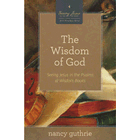
Prayer: The Prelude To Revival by Dr. Roger R. Nicole

It is in keeping with Reformed thought that revival should be grounded in prayer, because in prayer we acknowledge God’s sovereignty. God alone is the One who can dispense revival. So, revival is not something that is within the reach of human beings; it is something God alone can provide.

Sometimes people have expressed the attitude they think we ought to have in a motto which goes like this: “You ought to pray like a Calvinist and preach like an Arminian.” That is, pray as if everything depended upon God and preach as if everything depended on you. I would like to suggest a change in this formula which will improve it by fifty percent: “You ought to pray like a Calvinist and preach like a Calvinist.” Do not pray as if everything depends on God. (There is no good reason to have an “as if” in that motto, because things do depend on God. He is the One who sovereignly ordains and blesses.) Then preach like a Calvinist, because there, too, the results depend on God. Do not imagine that either prayer or preaching are activities in which we suddenly take leave of the doctrine of God’s sovereignty.

What Does Prayer Change?

When we consider prayer, there are questions which often are disturbing to the minds of some people. The first question is: “Do you think that you can really change the mind of God? That is, can prayer make God modify His sovereign plan?” There are people who feel that unless you are prepared to say this, there is no great value in prayer. I do not know what the reader’s particular idea on this subject may be, but I would like to say that if you believe you can change the mind of God through prayer, I hope you are using some discretion. If that is the power you have, it is certainly a most dangerous thing. Surely God does not need our counsel in order to set up what is desirable. Surely God, whose knowledge penetrates all minds and hearts, does not need to have us intervene to tell Him what He ought to do. The thought that we are changing the mind of God by our prayers is a terrifying concept.

I will be frank to confess that if I really thought I could change the mind of God by praying, I would abstain. I would have to say, “How can I presume, with the limitations of my own mind and the corruptions of my own heart—how can I presume to interfere in the counsels of the Almighty?” It is almost as if you were to introduce somebody who is utterly ignorant of electronics to a weapons plant in which, by pushing certain buttons, one might precipitate an explosion. You say, “Go ahead and push buttons. Never mind what happens.” Oh, no! There is comfort for the child of God in being assured that our prayers will not change God’s mind. This is not what is involved in prayer, and we are not in danger of precipitating explosions by some rash desire on our part. But then people say, “If you cannot change God’s mind, what is the point of praying? If prayer does not change things, prayer is worthless.”

Here you have perhaps noticed that I have changed the formula. I did not say,” change the mind of God,” but “change things.” I never said that prayer does not change things. Prayer does change things, but it does not change the mind of God. The reason prayer changes things but does not change God is that He has appointed prayer as an effectual means for accomplishing His own purpose. This effectual means is essential for this accomplishment. When we have a right understanding of the sovereignty of God, we recognize that God has established a plan in which not only the effects but also the causes are ordained. We cannot disconnect the causes from the effects or the effects from the causes.

For example, I lift a book in your sight. Because the book has risen into the air, I am in a position to say, “God has ordained that it should get to this particular place.” He must have ordained it because that is where the book is. But notice, God did not ordain for the book to rise all by itself. He ordained that it should rise at the end of my hand. He ordained that I should have strength in my arm to lift it. He ordained that I should choose this particular book in order to illustrate this particular point. There is a connection between the book’s rising and the subject I wish to develop. All these things are tied up together. If there were no lecture, there would be no point of illustrating the power of second causes. If there were no desire to illustrate the power of second causes, my hand would have remained at my side. If my hand had remained at my side, the book would not have risen. I think we can argue in this way.

God, however, ordained that there should be this lecture, that there should be a desire to show the correlation of causes and effects in His sovereign plan, that this particular illustration should come to my mind, and that I should implement it by the strength that He has given me. One cannot say, “If you hadn’t touched it, it would have risen anyway,” because God did not ordain that it should rise anyway. He ordained that it should rise through my hand.

That is exactly the case with prayer. Prayer is an effectual secondary cause that God has related to the effects involved. Just as the activity of human beings on earth is related to the effects that are produced, just as the book rising is related to the hand lifting, so are the effects of prayer related to the prayer that is offered. So although prayer does not change the mind of God, it does change things. God has appointed change through prayer, even though the way in which the cause is related to the effect is not perfectly clear to us.

The fact that the way this happens is not clear does not give us grounds for denying the relationship. We pray for healing. If God provides healing, we cannot say, “There would have been healing whether I prayed or not; I would have gotten well anyway.” God provided healing in relation to prayer.

We pray for an increase in the knowledge of God and earnestness in His service. If God is pleased to bless our lives in this way, we cannot say, “This would have happened whether I prayed or not.” God provides His blessing in relation to the prayer.

We pray for the salvation of someone we love, someone God placed on our hearts to intercede and plead for. That person is born again by the work of the Holy Spirit. We cannot say, “This would have happened whether I prayed or not.” It is related to our prayers. God, who has appointed the salvation, has also appointed prayer as the means to that salvation. We cannot omit any link in that chain and say that the chain will exist whether the link is there or not.

A final question is: “How can I pray if I do not see how prayer works?” That is not a wise way of handling the matter, since it is God who tells us that prayer is part of His plan for us. It is not necessary that we have an understanding of the ways in which God’s purposes are implemented. God has put this means at our disposal. He encourages us to pray. In 2 Chronicles 7:14 He says, “If My people, who are called by My name, will humble themselves and pray and seek My face and turn from their wicked ways, then will I hear from heaven and will forgive their sin and will heal their land.” To insist that we must have an understanding of how this works is a very unreasonable attitude.

Even in affairs of daily life we do not have this attitude. I am sure you have used a touch-system telephone. Do you understand how it works? Do you have that consummate knowledge of communications to know exactly what goes on when you press those little buttons? Do you know how those numbers are changed into binary code and used to track down the particular telephone you wish to call? Experts may understand this. But I must say, as far as I am concerned, when I am calling, I do not think of any of those things. I just pick up the phone and touch the buttons. I do not worry about how this happens. I am interested only in whom I am going to reach and what I will say.

It is the same with prayer. We do not have to know how it works. It is enough to know that it does work. Prayer is part of God’s sovereign plan and is an effectual means by which we can share with God in the fulfillment of that plan. When we pray, we are cooperating; we are working together with God in the work to which, in His own mercy, He has been pleased to call us.

Since prayer is part of God’s plan, we are not forcing God’s hand at any time by praying. We are not intruding our own will in a way that is disagreeable or uncomfortable to God. We do not need to fear that we are finagling with buttons about which we know nothing, which might bring disaster on ourselves and others. We are praying in line with the great purposes of God. Without prayer there are many things that would be different. It is by virtue of prayer that they are what God has planned them to be. 

Prayer and Revival

In Scripture, prayer is presented as a prerequisite for revival. It is a prelude. If you study the history of revivals, you will find that they are best documented not only in their effects but also in their preparatory prayer periods. This was true of the revival in New England under the ministry of Jonathan Edwards. It was true in the revival in Wales under Evan Roberts. It was true of the revivals attending the ministry of Charles Grandison Finney in the United States. Revival that is worthwhile is bathed in prayer. When He wants a revival, God is pleased to lead His people to pray that revival might be forthcoming.

The prayer that leads to revival must be believing prayer. This is the point the apostle James makes in his Epistle (James 1:5–7). When we come to the Lord we must come with the expectation that He is able and will do great things. If we come vacillating, wondering whether God is able to accomplish anything, whether the situation is really so desperate that even God cannot touch it, then obviously our prayer is lacking in fervency. We are just going through the motions, as it were. We are not really praying.

God wants us to come to Him in faith. Indeed, prayer is an exercise of faith in which we are steeped in the supreme greatness and ability of God, and have our eyes fixed on the majesty of His purpose and the superlative quality of His resources. Nothing is impossible for our God. Our God is able to move mountains. He is able to transform hearts, break resistances, reach out even underneath the conscious lives of people to transform them. So we should never say, “Here is somebody beyond God’s reach. The hardness of heart is so great, the wickedness of life is so manifest, that this cannot possibly be a candidate for acceptance into the kingdom of God. We might as well give up on this person.”

In spite of the fact that the early church had seen God do many great things, it undoubtedly thought this way about Paul. The early Christians thought, “This one is lost. There is no way God will bring Paul into the kingdom. He is a persecutor, an enemy, an opponent. There is no hope for him.” When Paul tried to join the church, they gave him the cold shoulder (Acts 9:26). They said, “We can’t trust this man. He will be spying on us and then use his knowledge to annihilate the church.” It took Barnabas to reason, “God saved me; may be He can save Paul, too.” He went close to Paul and befriended him at great danger to himself. He made sure that Paul truly was a child of God. Then he brought him to the apostles (Acts 9:27). We, too, might think, “What less likely a candidate for election than Paul?” Yet God was pleased to reach him and change him. God made him the great apostle of the Gentiles, the benefit of whose ministry is still with us to this day.

We need believing prayer, prayer that does not concentrate on the obstacles. We must not say, “He is hopeless,” or “Our country has gone to the dogs,” or “Our church has gone liberal.” Prayer must recognize that God is all-powerful and can do wonders. If anyone prays and does not believe, that one is unstable (James 1:6–7). He cannot expect anything. But if we come with faith, accepting the reality of the power of God, we will experience that effective prayer which changes things in keeping with God’s purpose.

If It Be God’s Will

The second characteristic of the prayer that brings revival is submission. It must be submissive prayer. That is, we must be prepared to submit our own ideas, aims, and ambitions to the sovereign God. We must not intrude with our outlook, pressing it on God, as it were. Rather, we must come with a desire to understand God’s outlook and subordinate our desires to what He has ordained.

Some people say, “That kind of prayer is not really effective. If you start by saying, ‘If it be Your will …’ you are attempting to give God an out in case He is not going to do it. You are not believing.” That is not the point at all. We do not need to give God an out. God does not need an out. What we are doing when we say, “If it is Your will…” is articulating the principle that we are not telling God what should be done but are actually identifying with His purpose and asking to work together with Him in fulfillment of that purpose.

We have a moving example of this kind of prayer on the lips of our Lord Himself. In Gethsemane He said, “If it is possible… Yet not as I will, but as You will” (Matt. 26:39). This is mysterious to us, for it indicates that at that point of His human consciousness, our Lord was left in suspense as to what the will of God was. “Not as I will, but as You will.” That is the condition of effective prayer—that we should be willing to accept what God has ordained in order that His purpose might be accomplished.

Sometimes it is hard for us to pray that way, because our will is so strong, and our understanding of what God should want is so clear that we do not even feel like saying, “Your will be done.” When we pray for revival, especially, we say, “We do not need to introduce conditional clauses. The very fact that God leads us to pray is an indication that He wills that some form of revival should come.” Still, the very essence of a consecrated prayer is that it should be in keeping with the will of God.

This is what is meant by praying in the name of Jesus. To pray in the name of Christ is not simply to have a little addition to your prayer, in which you use those words almost as a magical formula to insure success. To pray in the name of Christ is to identify yourself with Christ, with His aims, His purposes, His ministry. It is to say, “I am with Jesus, I am for Him and His purposes.” The one who prays in the name of Jesus does not need to fear disappointments, because unity with the purpose of God protects him from that. There is a submission to God which acknowledges with gratitude the way in which God is pleased to answer.

This prayer must be God-centered. It must relate itself to God’s glory rather than to our private desires. Of course, God permits us to present our private desires as well. There is nothing wrong in asking God to give us good weather for mountain climbing if good weather is important for it. But here again, it would be wise to say, “If it be Your will,” because there are also people, such as farmers, who need rain. Since the desire of the mountaineer may conflict with the desire of the farmer, it would be good for both of them to be submitted to whatever God is pleased to send. God permits us to present our desires, but we must have a supreme desire, especially in the prayer for revival, to see the glory of God manifested.

Some of the most effective prayers in Scripture do this. They are even argumentative at this point. Think of the prayer of Abraham when he prayed for Sodom and Gomorrah. He even argued with God, saying, “Is it right for You to destroy those cities if fifty … forty-five … forty … thirty … twenty … ten righteous people live there?” (Gen. 18:24–33). God blessed that prayer. So we can say that if Lot and his family were saved, it was because of the faithful intercession of Abraham, who did not relent, even though, in the end, the number he cited was not sufficiently small to warrant salvation of the wicked cities.

Think of the prayer of Moses who argued, “If You destroy Your people, what will happen to Your name? Your glory is at stake. Don’t do it” (Ex. 32:11–13). God blessed that glorious intercessory prayer of Moses, who disregarded his personal ambitions in order to identify with the purposes of God.

A prayer for revival should be centered, not in the desire that we should have more money for our church (because there will be more people coming), not that there should be a new vitality in our denomination (as compared with other denominations), nor that any other of our human desires and ambitions should be satisfied, but rather that the glory of God might be manifested. We should pray that His name might be exalted, that His kingdom might be made evident, that His glorious reign might be established even more widely in the hearts of men and women.

Do Not Give Up

Our prayer must be persistent. The Scripture emphasizes that we ought not easily be discouraged in prayer (Luke 18:1). If we do not receive at once the answer we are looking for, we ought not to reason, “Well, God just doesn’t want me to have that; I guess I’ll give up.” There are people who have been wonderfully persistent in prayer—for husbands or wives, children or parents—and God has blessed their persistence. Do not give up too soon. Do not conclude too rapidly that God is uninterested. So long as you have a burden on your heart, keep praying.

In the church in which I am a member there is a man who has moved me profoundly in this respect. It is a wonderful church now. We have a preacher who is a wonderful expositor of the Word of God. I never attend a service there at which my soul is not blessed. But some 40 years ago this church was exceedingly small—there were about 10 or 12 people on a Sunday morning—and it was passing through a veritable desert from the point of view of biblical ministry. I understand that at one time one of the pastors was actually a practicing Christian Scientist. Throughout this bleak period this man, Deacon George Day, was praying. He did not say, “This church gives me nothing. There is nothing to be expected here, nothing to be hoped. I am going to find another fellowship that will be more fruitful for me.” No! This man said, “This is my church. I am not going to give up. Since I do not get any spiritual nurture from the sermons, I will get it from the Bible directly. I will attend some other meetings in other places, but I am still going to be in my own church on Sunday morning, and I am going to pray for this ministry.” Deacon Day kept praying for that church for years. Now he is an old man, more than 80. There is hardly any strength left in his body. When he can come to church he uses an earphone, because he is very deaf. But there is joy in his heart which moves one to tears. Whenever I see Deacon Day, I see the power of God to answer persistent prayer. I see a warrior who did not allow himself to be defeated, but who stayed at his post, pleading for his church and asking God’s blessing upon it.

Pray and Work Also

Finally, the prayer that leads to revival must be consistent prayer, in which we are prepared also to do what we can to achieve what we are asking. If we pray for the conversion of our loved ones, somehow we must give out witness, too. We must witness by life and words, when they can be effectually presented. If we pray for revival, we must be prepared to open our hearts so that God may revive them. We ought never to take prayer as a means of avoiding the actions God challenges us to.

My father had an experience which I would like to relate to illustrate this point. As a young minister he had been an assistant in a large church which had only two pastors in 50 years, one ministry of 25 years, followed by another of 25 years. After having been in that church, my father became pastor of a very small church in a little village in southern France. Prayer meeting was on Wednesday evening, and there was usually a very limited attendance. One Wednesday there was a frightful storm. The wind was blowing. Rain was falling in buckets. My father thought, “There is not going to be anybody at the prayer meeting tonight. If I go, I will only drench myself. I might as well stay home.” My father was very interested in Hebrew and was studying the song of Deborah in the book of Judges. The temptation was great to stay in his cozy home and deal with that.

As my father was wrestling with this, there came to his memory a sermon given at the time of his ordination. It was on the passage which says, “Go out and make them come in” (Luke 14:23). Most of the time we think about the expression “make them come in.” But on this occasion, the preacher had focused on the phrase, “Go out.” He had said, “‘Go out’ means to reach out for people; it means, do not stay in the coziness of your study. You must go out and reach out.” While the gales were blowing and the wind was hitting the windows, my father remembered that and concluded, “Well, I guess God wants me to go out. I do not expect many people. I do not expect very much of anything go out and speak at the prayer meeting.” But if God has told me to go out, I will go out. I do not expect many people. I do not expect very much of anything at this prayer meeting. But if God has told me to go out, I will go out. This was the meeting in which revival started in his church!

Prayer is the prelude to revival. Do you want revival? Then be prepared to pray. “If My people, who are called by My name, will humble themselves and pray … then will I hear from heaven and will forgive their sins and will heal their land.”

About the Author: Dr. Roger R. Nicole (1915-2010) served as a professor of theology at the Gordon-Conwell Theological Seminary in South Hamilton, Massachusetts and Reformed Theological Seminary in Orlando, Florida. Dr. Nicole received his A.B. from the Gymnase Classique, Lausanne; his M.A. from the Sorbonne, Paris; his B.D., S.T.M., and Th.D. from Gordon Divinity School; and his Ph.D. from Harvard University. Dr. Nicole was a Baptist minister and the author of numerous books and articles. He was long regarded as one of the pre-eminent theologians by his peers in America. He devoted his lifetime to defending orthodox Christian doctrines under attack – in particular the inerrancy of the Scriptures; the Classical View of God’s Omniscience and Sovereingty; and the Penal Substitutionary atonement of Christ. This article was originally an address given at the 1982 Philadelphia Conference on Reformed Theology, Philadelphia, PA. It is also Chapter 13 in the Book Our Sovereign Saviour: The Essence of the Reformed Faith. Genies House, Fearn, Ross-shire, Great Britain: Christian Focus Pupblications, 2002. More about Roger Nicole below.