Why Sola Scriptura is Crucial to Evangelicalism by Dr. R.C. Sproul

“The only source and norm of all Christian knowledge is the Holy Scripture.” This thematic statement introduces De Scriptura Sacra of Heinrich Heppe’s classic work in Reformed dogmatics and provides a succinct expression of the Reformation slogan: Sola Scriptura (Scripture Alone). The two key words that are used to crystallize the sola character of Scripture are source and norm.

The Reformation principle of Sola Scriptura was given the status of the formal cause of the Reformation by Melanchthon and his Lutheran followers. The formal cause was distinguished from the material cause of Sola Fide (by faith alone). Though the chief theological issue of the Reformation was the question of the matter of justification, the controversy touched heavily on the underlying question of authority. As is usually the case in theological controversy, the issue of ultimate authority lurked in the background (though it was by no means hidden or obscure) of Luther’s struggle with Rome over justification. The question of the source of Luther’s doctrine and the normative authority by which it was to be judged was vital to his cause.

Sola Scriptura and Inerrancy

A brief historical recapitulation of the steps that led to Luther’s Sola Scriptura dictum may be helpful. After Luther posted his Ninety-Five Theses in 1517, a series of debates, correspondence, charges, and countercharges ensued, culminating in Luther’s dramatic stand at Worms in April 1521. The two most significant transitional points between the theses of 1517 and the Diet of Worms of 1521 were the debates at Augsburg and Leipzig.

In October 1518 Luther met with Cardinal Cajetan of the Dominicans. Cajetan was acknowledged to be the most learned theologian of the Roman Curia. In the course of their discussions Cajetan was able to elicit from Luther his views on the infallibility of the pope. Luther asserted that the pope could err and claimed that Pope Clement VI’s bull Unigenitus (1343) was contrary to Scripture.

In the summer of 1519 the dramatic encounter between Luther and Johannes von Eck took place at Leipzig. In this exchange Eck elicited from Luther the admission of his belief that not only could the pope err but church councils could and did err as well. It was at Leipzig that Luther made clear his assertion: Scripture alone is the ultimate, divine authority in all matters pertaining to religion.

Gordon Rupp gives the following account:

Luther affirmed that “among the articles of John Huss and the Hussites which were condemned, are many which are truly Christian and evangelical, and which the church universal cannot condemn!” This was sensational! There was a moment of shocked silence, and then an uproar above which could be heard Duke George’s disgusted, “Gad, Sir, that’s the Plague!… ” Eck pressed his advantage home, and Luther, trapped, admitted that since their decrees are also of human law, Councils may err.

So by the time Luther stood before the Diet of Worms, the principle of Sola Scriptura was already well established in his mind and work. Only the Scripture carries absolute normative authority. Why? For Luther the sola of Sola Scriptura was inseparably related to the Scriptures’ unique inerrancy. It was because popes could and did err and because councils could and did err that Luther came to realize the supremacy of Scripture. Luther did not despise church authority nor did he repudiate church councils as having no value. His praise of the Council of Nicea is noteworthy. Luther and the Reformers did not mean by Sola Scriptura that the Bible is the only authority in the church. Rather, they meant that the Bible is the only infallible authority in the church.

Paul Althaus summarizes the train of Luther’s thought by saying:

We may trust unconditionally only in the Word of God and not in the teaching of the fathers; for the teachers of the Church can err and have erred. Scripture never errs. Therefore it alone has unconditional authority. The authority of the theologians of the Church is relative and conditional. Without the authority of the words of Scripture, no one can establish hard and fast statements in the Church.

Thus Althaus sees Luther’s principle of Sola Scriptura arising as a corollary of the inerrancy of Scripture. To be sure, the fact that Scripture is elevated to be the sole authority of the church does not carry with it the necessary inference that it is inerrant. It could be asserted that councils, popes, and the Bible all err and still postulate a theory of Sola Scriptura. Scripture could be considered on a primus inter pares (“first among equals”) basis with ecclesiastical authority, giving it a kind of primacy among errant sources. Or Scripture could be regarded as carrying unique authority solely on the basis of its being the primary historical source of the gospel. But the Reformers’ view of Sola Scriptura was higher than this. The Reformation principle of Sola Scriptura involved inerrancy.

Sola Scriptura, ascribing to the Scriptures a unique authority, must be understood in a normative sense. Not descriptive, but rather normative authority is meant by the formula. The normative character of the Sola Scriptura principle may be seen by a brief survey of sixteenth-century Reformed confessions.

The Theses of Berne (1528): The Church of Christ makes no laws or commandments without God’s Word. Hence all human traditions, which are called ecclesiastical commandments, are binding upon us only in so far as they are based on and commanded by God’s Word (Sec. II).

The Geneva Confession (1536): First we affirm that we desire to follow Scripture alone as a rule of faith and religion, without mixing with it any other things which might be devised by the opinion of men apart from the Word of God, and without wishing to accept for our spiritual government any other doctrine than what is conveyed to us by the same Word without addition or diminution, according to the command of our Lord (Sec. I).

The French Confession of Faith (1559): We believe that the Word contained in these books has proceeded from God, and receives its authority from him alone, and not from men. And inasmuch as it is the rule of all truth, containing all that is necessary for the service of God and for our salvation, it is not lawful for men, nor even for angels, to add to it, to take away from it, or to change it. Whence it follows that no authority, whether of antiquity, or custom, or numbers, or human wisdom, or judgments, or proclamations, or edicts, or decrees, or councils, or visions, or miracles, should be opposed to these Holy Scriptures, but on the contrary, all things should be examined, regulated, and reformed according to them (Art. V).

The Belgic Confession (1561): We receive all these books, and these only, as holy and confirmation of our faith; believing, without any doubt, all things contained in them, not so much because the church receives and approves them as such, but more especially because the Holy Ghost witnessed in our hearts that they are from God, whereof they carry the evidence in themselves (Art. V). Therefore we reject with all our hearts whatsoever doth not agree with this infallible rule (Art. VII).

Second Helvetic Confession (1566): Therefore, we do not admit any other judge than Christ himself, who proclaims by the Holy Scriptures what is true, what is false, what is to be followed, or what is to be avoided (Chap. II).

Uniformly the sixteenth-century confessions elevate the authority of Scripture over any other conceivable authority. Thus, even the testimony of angels is to be judged by the Scriptures. Why? Because, as Luther believed, the Scriptures alone are inerrant. Sola Scriptura as the supreme norm of ecclesiastical authority rests ultimately on the premise of the infallibility of the Word of God.

Extent of the Norm
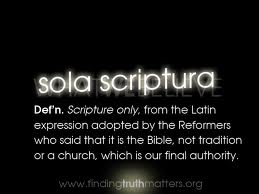
To what extent does the Sola Scriptura principle of authority apply? We hear statements that declare Scripture to be the “only infallible rule of faith and practice.” Does this limit the scope of biblical infallibility? Among advocates of limited inerrancy we hear the popular notion that the Bible is inerrant or infallible only when it speaks of matters of faith and practice. Matters of history or cosmology may contain error but not matters of faith and practice. Here we see a subtle shift from the Reformation principle. Note the difference in the following propositions:

A. The Bible is the only infallible rule of faith and practice.

B. The Bible is infallible only when it speaks of faith and practice.

In premise A, “faith and practice” are generic terms that describe the Bible. In premise B, “faith and practice” presumably describe only a particular part of the Bible. Premise A affirms that there is but one infallible authority for the church. The proposition sets no content limit on the infallibility of the Scriptures. Premise B gives a reduced canon of that which is infallible; that is, the Bible is infallible only when it speaks of faith and practice. This second premise represents a clear and decisive departure from the Reformation view.

Premise A does not say that the Bible provides information about every area of life, such as mathematics or physics. But it affirms that what he Bible teaches, it teaches infallibly.

The Source of Authority

Heppe’s sola indicates that the Bible is not only the unique and final authority of the church but is also the “only source of all Christian knowledge.” At first glance this statement may seem to suggest that the only source of revelation open to man is that found in Scripture. But that is not the intent of Heppe’s statement, nor is it the intent of the Reformation principle of Sola Scriptura.

Uniformly the Reformers acknowledged general revelation as a source of knowledge of God. The question of whether or not that general revelation yields a bona fide natural theology was and is widely disputed, but there is no serious doubt that the Reformers affirmed a revelation present in nature. Thus the sola does not exclude general revelation but points beyond it to the sufficiency of Scripture as the unique source of written special revelation.

The context of the Sola Scriptura schema with respect to source was the issue (raised over against Rome) regarding the relationship of Scripture and Tradition. Central to the debate was the Council of Trent’s declaration regarding Scripture and Tradition. (Trent was part of the Roman counteroffensive to the Reformation, and Sola Scriptura was not passed over lightly in this counter-offensive.)

In the Fourth Session of the Council of Trent the following decree was formulated: This (Gospel), of old promised through the Prophets in the Holy Scriptures, our Lord Jesus Christ, the Son of God, promulgated first with His own mouth, and then commanded it to be preached by His Apostles to every creature as the source at once of all saving truth and rules of conduct. It also clearly perceives that these truths and rules are contained in the written books and in the unwritten traditions, which, received by the Apostles from the mouth of Christ Himself, or from the Apostles themselves, the Holy Ghost dictating, have come down to us, transmitted as it were from hand to hand. Following then, the examples of the Orthodox fathers, it receives and venerates with a feeling of piety and reverence all the books both of the Old and New Testaments, since one God is the author of both; also the traditions, whether they relate to faith or to morals, as having been dictated either orally by Christ or by the Holy Ghost, and preserved in the Catholic church in unbroken succession.

In this decree the Roman Catholic church apparently affirmed two sources of special revelation—Scripture and the Tradition of the church—although in recent years this “dual source” theory has come into question within the Roman church.

G. C. Berkouwer’s work on Vatican Council II provides a lengthy discussion of current interpretations of the Tridentine formula on Scripture and Tradition. Some scholars argue that Tradition adds no new content to Scripture but merely serves either as a depository in the life of the church or as a formal interpretive tool of the church. A technical point of historical research concerning Trent sheds some interesting light on the matter. In the original draft of the fourth session of Trent the decree read that “the truths … are contained partly [partim] in Scripture and partly [partim] in the unwritten traditions.” But at a decisive point in the Council’s deliberations two priests, Nacchianti and Bonnucio rose in protest against the partim … partim formula. These men protested on the grounds that this view would destroy the uniqueness and sufficiency of Scripture. All we know from that point on is that the words partly … partly were removed from the text and replaced by the word and (et). Did this mean that the Council responded to the protest and perhaps left the relationship between Scripture and Tradition purposely ambiguous? Was the change stylistic, meaning that the Council still maintained two distinct sources of revelation? These questions are the focus of the current debate among Roman theologians.

One thing is certain. The Roman church has interpreted Trent as affirming two sources of special revelation since the sixteenth century. Vatican I spoke of two sources. The papal encyclical Humani Generis spoke of “sources of revelation.” Even Pope John XXIII spoke of Scripture and Tradition in Ad Petri Cathedram.

Not only has the dual-source theory been confirmed both by ecumenical councils and papal encyclicals, but tradition has been appealed to on countless occasions to validate doctrinal formulations that divide Rome and Protestantism. This is particularly true regarding decisions in the area of Mariology.

Over against this dual-source theory stands the sola of Sola Scriptura. Again, the Reformers did not despise the treasury of church tradition. The great councils of Nicea, Ephesus, Chalcedon, and Constantinople receive much honor in Protestant tradition. The Reformers themselves gave tribute to the insights of the church fathers. Calvin’s love for Augustine is apparent throughout the Institutes. Luther’s expertise in the area of Patristics was evident in his debates with Cajetan and Eck. He frequently quotes the fathers as highly respected ecclesiastical authorities. But the difference is this: For the Reformers no church council, synod, classical theologian, or early church father is regarded as infallible. All are open to correction and critique. We have no Doctor Irrefragabilis of Protestantism.

Protestant churches have tended to be confessional in character. Subscription to confessions and creeds has been mandatory for the clergy and parish of many denominations. Confessions have been used as a test of orthodoxy and conformity to the faith and practice of the church. But the confessions are all regarded as reformable. They are considered reformable because they are considered fallible. But the Sola Scriptura principles in its classic application regards the Scripture as irreformable because of its infallibility. Thus the two primary thrusts of Sola Scriptura point to:

1) Scripture’s uniqueness as normative authority and

2) its uniqueness as the source of special revelation. Norm and source are the twin implicates of the Sola Scriptura principle.

Is Sola Scriptura the Essence of Christianity?
In a recent publication on questions of Scripture, Bernard Ramm wrote an essay entitled, “Is ‘Scripture Alone’ the Essence of Christianity?” Using the nineteenth-century German penchant for the quest of the “Wesen” of Christianity as a jumping-off point, Ramm gives a brief history of the liberal-conservative controversy concerning the role of Scripture in the Christian faith. Defining Wesen as “the essence of something, the real spirit or burden of a treatise, the heart of the matter,” he concludes that Scripture is not the Wesen of Christianity. He provides a historical survey to indicate that neither the Reformers nor the strong advocates of inerrancy, A. A. Hodge and B. B. Warfield, believed that Sola Scriptura was the essence of Christianity. Ramm cites numerous quotations from Hodge and Warfield that speak of the Scriptures as being “absolutely infallible,” and “without error of facts or doctrines.” Yet these men affirmed that “Christianity was true independently of any theory of inspiration, and its great doctrines were believable within themselves.”

Ramm goes on to express grave concern about the present debate among evangelicals concerning inerrancy. Here his concern focuses not on the teaching of Hodge and Warfield but on the attitudes of their contemporary disciples who, in Ramm’s opinion, go beyond their forefathers in asserting a particular view of Scripture as being Christianity’s essence. Ramm writes:

From the other writings of Warfield in particular, it would be impossible to say that he identified the Wesen of Christianity with his view of Holy Scripture. He was enough of a historian of theology to avoid saying that. The “inspiration” article was an essay in strategy. However, among current followers of the so-called Warfield position there have been certain shifts away from the original strategic stance of the essay. One’s doctrine of Scripture has become now the first and most important doctrine, one’s theory of the wesen of Christianity, so that all other doctrines have validity now only as they are part of the inerrant Scripture. Thus evangelical teachers, or evangelical schools or evangelical movements, can be judged as to whether or not they are true to the wesen of Christianity by their theory of inspiration. It can be stated even more directly: an evangelical has made a theory of inspiration the wesen of Christianity if he assumes that the most important doctrine in a man’s theology, and most revelatory of the entire range of his theological thought, is his theology of inspiration.

It appears from this statement that the “essence” of Ramm’s concern for the present state of evangelicalism is that one’s doctrine of Scripture is viewed as the essence or wesen of Christianity. This writer can only join hands with Ramm in total agreement with his concern. To make one’s view of Scripture in general or of inspiration in particular the essence of Christianity would be to commit an error of the most severe magnitude. To subordinate the importance of the gospel itself to the importance of our historical source book of it would be to obscure the centrality of Christ. To subordinate Sola Fide to Sola Scriptura would be to misunderstand radically the wesen of the Reformation. Clearly Ramm is correct in taking his stand on this point with Hodge, Warfield, and the Reformers. Who can object to that?

One may be troubled, however, by a portion of Ramm’s stated concern. Who are these “current followers” of Warfield who in fact do maintain that Sola Scriptura is the heart or essence of Christianity? What disciple of Warfield’s has ever maintained that Sola Scriptura is essential to salvation? Ramm provides us with no names or documentary evidence to demonstrate that his deep concern is warranted.

To be sure, strong statements have been made by followers of the Warfield school of the crucial importance of Sola Scriptura and the centrality of biblical authority to all theological disputes. Perhaps these statements have contained some “overkill” in the passion of debate, which is always regrettable. We must be very cautious in our zeal to defend a high view of Scripture not to give the impression that we are talking about an article on which our salvation depends.

We can cite the following statements by advocates of the Warfield school that could be construed as a possible basis for Ramm’s concern. In God’s Inerrant Word, J. I. Packer makes the following assertion:

What Luther thus voiced at Worms shows the essential motivation and concern, theological and religious, of the entire Reformation movement: namely that the Word of God alone must rule, and no Christian man dare do other than allow it to enthrone itself in his conscience and heart.

Here Packer calls the notion of Sola Scriptura “the essential motivation and concern” of the Reformation. In itself this quote certainly suggests that Packer views Sola Scriptura as the essence of the Reformation.

However, in defense of Packer it must be noted that to say Sola Scriptura was the essential motivation of the Reformation movement is not to say that Sola Scriptura is the essence of Christianity. He is speaking here of a historical controversy. That Sola Scriptura was at the heart of the controversy and central to the debate cannot be doubted. To say that Sola Scriptura was an essential motif or concern of the Reformation cannot be doubted. That is was the essential concern may be brought into question; this may be regraded as an overstatement. But again, in fairness to Packer, it must be noted that earlier in his essay he had already indicated that Justification by Faith Alone was the material principle. So he had already maintained that Sola Scriptura was subordinate to Sola Fide in the controversy. In any case, though the word essential is used, there is no hint here that Packer maintains that Sola Scriptura is the essence of Christianity.

In a recent unpublished essay, Richard Lovelace of Gordon-Conwell Theological Seminary cites both Harold Lindsell and Francis Schaeffer as men who have sounded urgent warnings concerning the relationship between inerrancy and evangelicalism. Lovelace cites the following statements of Schaeffer:

There is not use of evangelicalism seeming to get larger and larger, if at the same time appreciable parts … are getting soft at that which is the central core, namely the Scriptures.… We must say most lovingly but clearly: evangelicalism is not consistently evangelical unless there is a line drawn between those who take a full view of Scripture and those who do not.

Again Schaeffer is cited: “Holding to a strong view of Scripture or not holding to it is the watershed of the evangelical world.” In these statements Francis Schaeffer maintains that the Scriptures are:

1) the “central core” of evangelicalism,

2) a mark of “consistent evangelicalism,” and

3) the “watershed of the evangelical world.”

These are strong assertions about the role of Sola Scriptura, but they are made with reference to evangelicalism, not Christianity (though I am sure Schaeffer believes evangelicalism is the purest expression of Christianity to be found). Evangelicalism refers to a historical position or movement. When he speaks of “watersheds,” he is speaking of crucial historical turning points. When he speaks of “consistent” evangelicalism, he implies there may be such a thing as inconsistent evangelicalism.

The troublesome quote of Schaeffer is that one in which he says the Scriptures are “the central core” of evangelicalism. Here “core” is in the singular with the definite article giving it a sola character. Does Schaeffer mean that the Bible is the core of evangelicalism and the gospel is the husk? Is Sola Scriptura the center and Sola Fide at the periphery of evangelicalism? It is hard to think that Schaeffer would make such an assertion. Indeed, one may question if Schaeffer means what he in fact does say here. Had he said, “Scripture is at the core of evangelicalism,” there would be no dispute. But to say it is the core appears an overstatement. Perhaps we have here a slip of the pen, which any of us can and frequently do make.

In similar fashion Harold Lindsell may be quoted: “Is the term ‘evangelical’ broad enough in its meaning to include within it believers in inerrancy and believers in an inerrancy limited to matters of faith and practice?” Lindsell raises the question of whether or not inerrancy of the entire Bible is essential to the term evangelical. The question raised is: If Sola Scriptura in its fullest sense is of the Wesen of evangelicalism, can one who espouses limited inerrancy be genuinely called evangelical? The issue is the meaning of the term evangelical. Does it carry with it the automatic assumption of full inerrancy? Again we must point out the difference between the historical label “evangelical” and what is essential to Christianity.

None of the scholars mentioned have said that adherence to inerrancy or Sola Scriptura is essential to salvation. None have Sola Scriptura as the Wesen of Christianity.

It could be said that the argument of the writer of this chapter is constructed on straw men who “come close” to asserting that Sola Scriptura is the essence of Christianity but who, in the final analysis, shrink for such an assertion. But it is not my purpose to create straw men. It is simply to find some basis for Ramm’s assertion about modern followers of Warfield. Since I have not been able to find any followers of Warfield who assert Sola Scriptura as the Wesen of Christianity, the best I can do is to cite examples of statements that could possibly be misconstrued to assert that. It is probably charity that restrained Ramm from naming those he had in mind. But unfortunately, the absence of names casts a shadow of suspicion over all modern followers of Warfield who hold to full inerrancy.

Though advocates of inerrancy in the full sense of Sola Scriptura do not regard it as being essential to salvation, they do maintain that the principle is crucial to Christianity and to consistent evangelicalism. That in Scripture we have divine revelation is no small matter. That the gospel rests not on human conjecture or relational speculation is of vital importance. But there is no quarrel with Ramm on these points. He summarizes his own position by saying:

1. There is no questioning of the Sola Scriptura in theology. Scripture is the supreme and final authority in theological decision-making.

2. One’s views of revelation, inspiration, and interpretation are important. They do implicate each other. Our discussion rather has been whether a certain view of inspiration could stand as the wesen of Christianity. We have in no manner suggested that matters of revelation, inspiration, and interpretation are unimportant in theology.

Here we delight in agreement with this strong affirmation of the crucial importance of Sola Scriptura.

Strangely, however, Ramm continues his summary by saying, “If the integrity of other evangelicals, evangelical schools, or evangelical movements are assessed by their view of inspiration, then, for them, inspiration has become the wesen of Christianity.” The inference Ramm draws at this point is at once puzzling and astonishing, and perhaps we meet here merely another case of overstatement or a slip of the pen. How would it follow from an assessment of others’ evangelicalism as being consistent or inconsistent according to their view of Scripture that inspiration has become the wesen of Christianity? This inference involves a quantum leap of logic.

If the first two points of Ramm’s summary are correct—that Sola Scriptura is important and that it implicates views of interpretation and theological decision making—why should not a school’s or movement’s integrity (a fully integrated stance) be assessed by this principle? Though Sola Scriptura is not the wesen of Christianity, it is still of crucial importance. If a school or movement softens its view of Scripture, that does not mean it has repudiated the essence of Christianity. But it does mean that a crucial point of doctrine and classical evangelical unity has been compromised. If, as Ramm suggests, one’s view of Scripture is so important, then a weakening of that view should concern us.

The issue of full or limited inerrancy is a serious one among those within the framework of historic evangelicalism. In the past a healthy and energetic spirit of cooperation has existed among evangelicals from various and diverse theological persuasions and ecclesiastical affiliations. Lutherans and Baptists, Calvinists and Arminians, and believers of all sorts have united in evangelical activity. What has been the cohesive force of that unity? In the first instance, there has been a consensus of catholic articles of faith, such as the deity of Christ. In the second instance, a strong point of unity has been the cardinal doctrine of the Protestant Reformation: justification by faith alone. In the last instance, there has been the unifying factor of Sola Scriptura in the sense of full inerrancy. The only “creed” that has bound the Evangelical Theological Society together, for example, has been the affirmation of inerrancy. Now that point of unity is in jeopardy. The essence of Christianity is not the issue. But a vital point of consistent evangelicalism is.

Sola Scriptura and Limited Inerrancy

Is Sola Scriptura compatible with a view of Scripture that limits inerrancy to matters of faith and practice? Theoretically it would seem to be possible if “faith and practice” could be separated from any part of Scripture. So long as biblical teaching regarding faith and practice were held to be normative for the Christian community, there would appear to be no threat to the essence of Christianity. However, certain problems exist with such a view of Scripture that do seriously threaten the essence of Christianity.

The first major problem we encounter with limited inerrancy is the problem of canon reduction. The canon or “norm” of Scripture is reduced de facto to that content relating to faith and practice. This immediately raises the hermeneutical question concerning what parts of Scripture deal with faith. As evangelicals wrestle among themselves in intramural debates, they must keep one eye focused on the liberal world of biblical scholarship, for the principle of the reduction of canon to matters of “faith” is precisely the chief operative in Bultmann’s hermeneutic. Bultmann thinks we must clear away the prescientific and faulty historical “husk” of Scripture to get to the viable kernel of “faith.” Thus, although Bultmann has no inerrant kernel or kerygma to fall back on, his problem of canon reduction remains substantially the same as that of those who limit inerrancy to faith and practice.

Before someone cries foul or cites the informal fallacy of argumentum ad hominem (abusive) or the “guilt by association” fallacy, let this concern be clarified. I am not saying that advocates of limited inerrancy are cryptic or even incipient Bultmannians, but that there is one very significant point of similarity between the two schools: canon reductionism. Evangelical advocates of limited inerrancy are not expected to embrace Bultmann’s mythical view of New Testament supernaturalism. But their method has no inherent safeguard from an arbitrary delimitation of the scope of the biblical canon.

The second serious problem, closely related to the first, is the problem of the relationship of faith and history, perhaps the most serious question of contemporary New Testament scholarship. If we limit the notion of inerrancy to matters of faith and practice, what becomes of biblical history? Is the historical substratum of the gospel negotiable? Are only those portions of the biblical narrative that have a clear bearing on faith inerrant? How do we escape dehistoricizing the gospel and relegating it to a level of supratemporal existential “decision”? We know that the Bible is not an ordinary history book but a book of redemptive history. But is it not also a book of redemptive history? If we exclude the realm of history from the category of inspiration or inerrancy either in whole or in part, do we not inevitably lose the gospel?

The third problem we face with limiting inerrancy to matters of faith and practice is an apologetic one. To those critics outside the fellowship of evangelicals, the notion of “limited inerrancy” appears artificial and contrived. Limited inerrancy gets us off the apologetical hook by making us immune to religious-historical criticism. We can eat our cake and have it too. The gospel is preserved; and our faith and practice remains intact while we admit errors in matters of history and cosmology. We cannot believe the Bible concerning earthly things, but we stake our lives on what it says concerning heavenly things. That approach was totally abrogated by our Lord (John 3:12).

How do we explain and defend the idea that the Bible is divinely superintended in part of its content but not all of it? Which part is inspired? Why only the faith and practice parts? Again, which are the faith and practice parts? Can we not justly be accused of “weaseling” if we adopt such a view? We remove our faith from the arena of historical verification nor falsification. This is a fatal blow for apologetics as the reasoned defense of Christianity.

Finally, we face the problem of the domino theory. Frequently this concern is dismissed out of hand as being so much alarmism. But our doctrine of Scripture is not a child’s game of dominoes. We know instances in which men have abandoned belief in full inerrancy but have remained substantially orthodox in the rest of their theology. We are also aware of the sad instances in which full inerrancy is affirmed yet the substance of theology is corrupt. Inerrancy is no guarantee of biblical orthodoxy. Yet even a cursory view of church history has shown some pattern of correlation between a weakening of biblical authority and serious defection regarding the Wesen of Christianity. The wesen of nineteenth-century liberalism is hardly the gospel evangelicals embrace.

We have already seen, within evangelical circles, a move from limited inerrancy to challenges of matters of faith and practice. When the apostle Paul is depicted as espousing two mutually contradictory views of the role of women in the church, we see a critique of apostolic teaching that does touch directly on the practice of the church. In the hotly disputed issue of homosexuality we see denominational commissions not only supplementing biblical authority with corroborative evidence drawn from modern sources of medical psychological study but also “correcting” the biblical view by such secular authority.The direction of these movements of thought is a matter of grave concern for advocates of full inerrancy.

We face a crisis of authority in the church. It is precisely our faith and our practice that is in question. It is for faith and practice that we defend a fully infallible rule—a total view of Sola Scriptura.

We know some confusion has existed (much unnecessarily) about the meaning of full inerrancy. But with all the problems of definition that plague the concept, we do not think it has died the death of a thousand qualifications.

We are concerned about Sola Scriptura for many reasons. But we affirm it in the final analysis not because it was the view of the Reformers, not because we slavishly revere Hodge and Warfield, not even because we are afraid of dominoes or a difficult apologetic. We defend it and express our deep concern about it because we believe it is the truth. It is a truth we do not want to negotiate. We earnestly desire dialogue with our evangelical brothers and colaborers who differ from us. We want to heal the wounds that controversy so frequently brings. We know our own views are by no means inerrant. But we believe inerrancy is true and is of vital importance to our common cause of the gospel.

Further dialogue within the evangelical world should at least help us clarify what real differences there are among us. Such clarification is important if there is to be any hope of resolving those differences. We do not intend to communicate that a person’s Christian faith stands or falls with his view of Scripture. We do not question the Christian commitment of advocates of limited inerrancy. What we do question is the correctness of their doctrine of Scripture, as the question ours. But we consider this debate, as serious as it is, a debate between members of the household of God. May our Father bring us to unity here as he has in many glorious affirmations of his gospel.

Article above written by Dr. R.C. Sproul. “Sola Scriptura: Crucial to Evangelicalism.” The Foundations of Biblical Authority. James M. Boice, ed. Grand Rapids: Zondervan, 1980.

About the Author: Dr. R.C. Sproul is the founder and chairman of Ligonier Ministries, an international Christian education ministry located near Orlando, Florida. His teaching can be heard on the program Renewing Your Mind, which is broadcast on hundreds of radio outlets in the United States and in 40 countries worldwide. He is the executive editor of Tabletalk Magazine and general editor of The Reformation Study Bible, and the author of more than seventy books (including some of my all time favorites: THE HOLINESS OF GOD; CHOSEN BY GOD; KNOWING SCRIPTURE; WILLING TO BELIEVE; REASON TO BELIEVE; and PLEASING GOD) and scores of articles for national evangelical publications. Dr. Sproul also serves as president of Ligonier Academy of Biblical and Theological Studies and Reformation Bible College. He currently serves as Senior Minister of preaching and teaching at Saint Andrew’s in Sanford, FL

10 Reasons For Going To Church by Theodore Roosevelt

Teddy Roosevelt (the 26th President of the United States of America) offered these ten reasons for going to church in the Ladies’ Home Journal in 1917:

(1) In this actual world a churchless community, a community where men have abandoned and scoffed or ignored their religious needs, is a community on the rapid downgrade.

(2) Church work and church attendance mean the cultivation of the habit of feeling some responsibility for others and the sense of braced moral strength which prevents a relaxation of one’s own moral fiber.

(3) There are enough holidays for most of us which can quite properly be devoted to pure holiday making…Sunday’s differ from other holidays—among other ways—in the fact that there are fifty-two of them every year…On Sunday, go to church.

(4) Yes, I know all the excuses. I know that one can worship the Creator and dedicate oneself to good living in a grove of trees, or by a running brook, or in one’s own house, just as well as in church. But I also know as a matter of cold fact the average man does not thus worship or thus dedicate himself. If he stays away from church he does not spend his time in good works or in lofty meditation. He looks over the colored supplement of the newspaper.

(5) He may not hear a good sermon at church. But unless he is very unfortunate he will hear a sermon by a good man who, with his good wife, is engaged all the week in a long series of wearing and humdrum and important tasks for making hard lives a little easier.

(6) He will listen to and take part in reading some beautiful passages from the Bible. And if he is not familiar with the Bible, he has suffered a loss…

(7) He will probably take part in singing some good hymns.

(8) He will meet and nod to, or speak to, good, quiet neighbors…He will come away feeling a little more charitably toward all the world, even toward those excessively foolish young men who regard church going as rather a soft performance.

(9) I advocate a man’s joining in church works for the sake of showing his faith by his works.

(10) The man who does not in some way, active or not, connect himself with some active, working church misses many opportunities for helping his neighbors, and therefore, incidentally, for helping himself.

10 Ideas for Making a Memorable Mother’s Day

(1) Have a florist deliver a corsage and on the card tell her you’re taking her to dinner.

(2) Create a May-to-May calendar using family pictures. Place a star on a day each month for a special date you will have with her.

(3) Gather scrapbook supplies and spend the day working on it together.

(4) Plant some colorful summer flowers in her yard and/or patio pots.

(5) Have each family member write a special memory they have of her. Tuck each note in a separate Mother’s Day card selected or created by each individual.

(6) Prepare a picnic lunch and let her pick the place it will be enjoyed.

(7) Have the family gather around her and ask her to share favorite memories of her childhood. Be sure to have a video or tape/cd recorder going.

(8) Give her a basket full of thing that help her relax. Include a long, narrow tablet and ask her to list things she’s been wishing help with, Recruit family members to get jobs done in the next few weeks.

(9) Give the gift of your time by helping her sort through pictures and bring her photo album up-to-date.

(10) Remember to tell her how much you love her and what you love about her.

*List compiled by Marilyn Mcauley – mother of three, grandmother of six.

A History of Mother’s Day by Robert J. Morgan

Mother’s Day, in one form or another, has been around a long time. In ancient Greece, a celebration honoring mothers occurred every Spring.

In the Middle Ages, a custom called Mothering Sunday began when children, who often left home early to learn a trade or become apprentices, would be released from work every year on the forth Sunday of Lent to attend church with their families. As they returned home, they often took cakes or little gifts to their mothers. This was termed “going a-mothering.” To this day, Mother’s Day in the United Kingdom is celebrated on the fourth Sunday of Lent.

It was in 1872 that Julia Ward Howe (author of The Battle Hymn of the Republic) suggested the idea of Mother’s Day in the United States.

The cause was taken up by Anna Jarvis, daughter of a Methodist pastor. Jarvis felt the scars of the Civil War could be healed by mothers—and by honoring mothers. She died in 1905 before her dream of establishing a holiday could be fulfilled. But her daughter, also named Anna Jarvis, took up the crusade.

Anna had been deeply influenced by her mother, and she often recalled hearing her mother say that she hoped someone would one day establish a memorial for all mothers, living and dead.

Anna had been particularly touched at age twelve while listening to her mother teach a Sunday school class on the subject “Mothers in the Bible.” Mrs. Jarvis closed the lesson with a prayer to this effect: I hope and pray that someone, sometime, will found a memorial mother’s day. There are many days for men, but none for mothers.

Anna never forgot that moment, and at their mother’s graveside service, Anna’s brother Claude heard her say “… by the grace of God, you shall have that Mother’s Day.”

Anna thus began a campaign to establish a national Mother’s Day. She and her supporters began to write a constant stream of letters to ministers, businessmen, politicians and newspaper editors. She spent a fortune trying to attract attention to her idea, and took every opportunity to give speeches, send telegrams, or write articles promoting her cause.

On the second anniversary of her mother’s death, May 12, 1907, Anna led a small tribute to her mother at Andrews Methodist Episcopal Church in Gafton, West Virginia. She donated five hundred white carnations, her mother’s favorite flower, to be worn by everyone in attendance. On this first Mother’s Day service, the pastor used the text, “Woman, behold thy son; Son, behold thy mother.” (John 19:26) That same day a special service was held at the Wannamaker Auditorium in Philadelphia, which could seat no more than a third of the fifteen thousand people who showed up.

After that, things begin to take off. Various states jumped on the bandwagon, officially proclaiming a Mother’s Day each year, and, in 1914, President Woodrow Wilson officially established Mother’s Day a national holiday to be held on the second Sunday of May.

But having succeeded at last, Anna Jarvis soon became embittered by the commercialization of the holiday and turned against it, actually filing a lawsuit to stop a 1923 Mother’s Day festival. She was even arrested for disturbing the peace at a mother’s convention where women sold white carnations.

“This is not what I intended,” Jarvis growled. “I wanted it to be a day of sentiment, not profit!”

“A printed card means nothing except that you are too lazy to write to the woman who has done more for you than anyone in the world,” she said on another occasion. “And candy! You take a box to Mother—and then eat most of it yourself. A pretty sentiment.”

Shortly before her death in 1948, Anna Jarvis, living in a nursing home, received Mother’s Day cards from all around the world. But she told a reporter she was sorry she had ever started the whole thing.

We aren’t.

Article Adapted from R.J. Morgan. Nelson’s Complete Book of Stories, Illustrations & Quotes. Nashville: Thomas Nelson, 2000, 578-579.

Tim Keller on “The Call To Discipleship”

There is a growing recognition in churches today about the need for discipleship. In what follows I would like to describe, from the Gospel of Luke, what it means to be a disciple of Jesus Christ. Luke has some helpful insights about discipleship. The first eight chapters are focused on “who is Jesus?” But there’s a shift in chapter 9, where Peter with the help of the Holy Spirit realizes that Jesus is not one more in a succession of prophets and teachers. Peter says, “You are the Christ of God” – you are the Messiah, the one who is bringing the ruling power of God back into the world to heal and repair all the brokenness—whether it’s spiritual, psychological, social, or physical.

From the time Jesus’ identity is revealed, he begins to say, “Follow me.” If he is who he says he is, what does it mean to follow him? Being a disciple of Jesus Christ means setting a new priority, finding a new identity, and living a new mercy. All three are critical; they all fit together. Let’s look at them.

Setting a New Priority

(1) Being a disciple means setting a new priority. In Luke 9:57–62 Jesus meets three eager men, all willing to follow him. Jesus’ responses to them are surprisingly blunt. The first man says, “I will follow you wherever you go.” Jesus says, “Foxes have holes and birds of the air have nests, but the Son of Man has no place to lay his head.” It’s as if Jesus is saying, “There’s nothing wrong with what you just said, but I discern a wrong attitude underneath your statement. Do you know what kind of Savior I am? I’m not the kind that rallies constituents, pulls together armies, and then triumphs. I am a Savior who saves through being condemned, through dying, through giving my heart to be broken. Let’s apply this to one area of your life: I see that you have a home, a nice standard of living. Are you willing to put me before that? Are you willing to lose those things for me?”

Then Jesus addresses two other men, similarly concerned with their families. One says, “I’d love to come with you, but first I have to bury my father.” The other says, “First let me go back and say goodbye to my family.” There is nothing wrong with having a funeral for your father or going back to see your family, but behind these requests Jesus sees a wrong attitude of heart. He’s saying, “I know you. For you specifically to go to your father’s funeral—or back home—would be a bad idea. I must come first.” Notice their language. In both cases they say, “Lord, first, let me do this.” Jesus says there can’t be any but first. “I must be your first priority.” That’s what he means when he says: “No one who puts his hand to the plow and looks back is fit for service in the kingdom of God.”

Anyone who plows a field must be completely focused on plowing. And following Jesus is no different, “My disciple has to be utterly focused on me.” By the way, “fit for the kingdom” is an unfortunate translation; the word there means “useful.” You might think he’s saying, “Unless you’re totally committed, you don’t qualify for my kingdom.” Of course no one qualifies for Jesus’ kingdom. It’s all by grace. He’s saying: Unless delighting Jesus, resembling him, serving him, and knowing him is your highest priority, the healing power of the kingdom of God will not be flowing through you. You will not be a useful vehicle for it.

The second and more cryptic line is, “Let the dead bury their own dead.” Obviously physically dead people can’t dig graves, so the first noun must refer to the spiritually dead. To be spiritually dead means to be as blind and insensitive to spiritual reality as a physical body is to physical reality. You may be saying, “Well, I believe in Jesus, but I can’t put him first right now. I’ve got my career; I’ve got to wait till my parents die, because they would be unhappy if I became a Christian . . . I see who he is and what he’s done, but I’m not going to put him first just yet. Someday I will.” When someone says, “I understand Christianity. I’m just not ready to put it at the central place in my life,” then that person really doesn’t understand it yet! Jesus says: Putting anything before me reveals spiritual deadness. Let the dead bury their dead. If you put your father before me, there’s a spiritual deadness in your life.

Talking this harshly is not my style, but I’m afraid to mute the smelling–salts-ness of Jesus’ message: Let the dead bury the dead! No one who looks back is fit for the kingdom of God! Foxes have holes, birds have nests . . . But “I have to be the first priority in your life, or you’re not a disciple; if you don’t put me first in your life, it’s not that you’re just uncommitted or lazy, disorganized or undisciplined. No, you just don’t get it! You don’t really see who I am and what I’ve done; you don’t understand the meaning of my life and work. You need to wake up!”

Let me illustrate. In 1971 I heard a talk—two illustrations—that changed my life. The woman who gave the talk, named Barbara Boyd, said, “If somebody says to me, ‘Come on in, Barbara, but stay out, Boyd,’ it’s a bit of a problem, because I can’t separate them. It’s not like the top half of me is Barbara, and the bottom half of me is Boyd. So if you won’t have Boyd, you can’t get Barbara. If you’re going to keep the Boyd out, I can’t come in at all!” She continued: “To say, ‘Jesus, come into my life, forgive my sins, answer my prayers; do this for me, do that for me—but don’t be the absolute master of my life; Jesus, Savior, come in; but Lord, stay out,’ how can he come in at all? Because he’s all Savior, and he’s all Lord. He’s Lord because he’s Savior. He’s Savior because he’s Lord.”

I remember her second illustration: “If the distance between the Earth and the sun, which is 92 million miles, was the thickness of a piece of paper, the diameter of our galaxy would be a stack of papers 310 miles high. And our galaxy is less than a speck of dust in the part of the universe that we can see. And that part of the universe might just be a speck of dust compared to all the universe. And if Jesus is the Son of God who holds all this together with the power of his word, is this the kind of person you ask into your life to be your personal assistant?” Then she asked us all to go outside and for one hour say nothing. “Just think about what this means to you.”

She was expanding on Jesus’ message:  If you intellectually assent, “Yes, I think Jesus is probably the Son of God; I think he probably died for our sins,” but he is not the center of your life, then you may think you understand, but you really don’t. It’s not just a matter of commitment or lack of discipline, there’s spiritual deadness; you don’t really see it, understand it, get it. Wake yourself up!

Finding a New Identity

(2) Discipleship is not just a matter of bending your will to Jesus’ will; it’s melting your heart into a whole new shape. A disciple is not someone who simply sets a new priority; a disciple finds a new identity. We see this in Luke 9:23–25. At first sight verse 23 looks like it’s just another way of saying set a new priority: “If anyone would come after me, he must deny himself and take up his cross daily and follow me.” But there’s more to it than that. In Semitic literature, the second and third sentences often restate the first. And here the second and third sentences say, “For whoever wants to save his life will lose it, and whoever loses his life for me will save it.” The word life is not the word for physical life. There’s a good Greek word for that: bios, from which we get our word biology. The Greek word that’s translated “life” here is psyche, meaning “self.” He’s talking—pretty radically—about the psychological, inner life. “Your old way of having an identity, of gaining a sense of self, has got to end. In a sense you have to die to it. And I can give you a whole new identity. You’ll get a whole new true self.”

Let’s look at this more closely. Verses 24 and 25 show what he’s not saying. He’s not taking the typical Eastern or Western approach to identity. In Buddhism the deepest consciousness of enlightenment is losing all sense that you are an individual self. The boundaries between you and the rest of reality disappear. The Eastern way to humility, to peace, is to actually lose the sense of an individual self.

But Jesus doesn’t stop at, “I want you to lose yourself.” He says, “Lose yourself to find yourself,” which means, “I want you to die to your old approach to identity, and get a new sense of individual self.” He’s not going the Eastern way. But he’s sure not going the Western way either.

W. H. Auden wrote a work called The Age of Anxiety in which he satirizes the modern Western obsession with “finding yourself.” In it there’s a great line that reads: “Miserable wicked me, / How interesting I am.” Others have also noted our obsession with finding and fulfilling your deepest desires as the main thing you’re supposed to do in life. It almost seems that Jesus has us in mind when he says, “You’re never going to find out who you really are by trying to find out who you really are. You’re going to have to lose yourself in serving me.” Some things happen only as a byproduct, and identity is one of them.

“What good is it for a man to gain the whole world?” (9:25). Gaining things from the world is the normal way we try to get a self. In fact, the three men at the end of Luke 9 are examples of this. Some people say you’re nobody unless you have a lucrative career. People in more traditional cultures say you’re nobody unless you have a family. But Jesus is saying, “If you get the whole world, it cannot give you a stable self.” He says, “If you lose yourself for me . . .” In other words, “Instead of trying to gain a self by gaining things, build everything in your life on me, on who I am, on what I have done, then finally you’ll have a true self that is stable, because you were built to know me.”

A disciple is not only someone who has set a new priority, but someone whose entire identity has been reshaped and forged. But how is that possible?

Living a New Mercy

(3) The key to setting a new priority and finding a new identity is in living a new mercy. And this is also evident in Luke 9. Jesus is on his way to Jerusalem, and, it says in verse 52, “He sent messengers on ahead, who went into a Samaritan village to get things ready for him; but the people there did not welcome him.” They rejected him. “When the disciples James and John saw this, they asked, ‘Lord, do you want us to call fire down from heaven to destroy them?’”

Let’s try to understand them. Remember that there was a prophet, named Elijah, who called down fire upon some soldiers who were seeking to arrest him. And on the Mount of Transfiguration, Jesus had appeared—to James and John—with Elijah and Moses. The message of the Transfiguration (Luke 9:28–36) was that Jesus was even greater than Moses and Elijah.

So think of the logic of the disciples: You’re greater than Elijah. These people have rejected you, and that’s even worse than rejecting Elijah. That adds even more effrontery to the godhead. Shall we not bring down fire and destroy them?

This would be the kind of prophet the world can relate to. But Jesus Christ doesn’t rebuke the unbelieving Samaritans; he rebukes the disciples! He is the absolute un-Elijah. Can you imagine their continued perplexity if they still believe he’s greater than Elijah? The soldiers come after Jesus to kill him—in the Garden—and what does he do? He heals an ear that was cut during a skirmish. Later on, the soldiers are pounding nails into his hands, and what does he say? Father, forgive them; they really don’t understand what they’re doing.

Why doesn’t fire come down on the Samaritans? On the soldiers? The answer comes in Luke 12, where Jesus says, “I have come to bring fire on the earth, and how I wish it were already kindled.” That’s very interesting for two reasons. One is that fire, in biblical imagery, always means the judgment of God. Second, he says he comes to bring fire on the earth! This is perplexing because, after all, he has just rejected Elijah’s fiery approach. Ah! Semitic literature: the second sentence is a restatement of the first; this is what he actually says, in Luke 12:49–50: “I have come to bring fire on the earth, and how I wish it were already kindled! But I have a baptism to undergo, and how distressed I am until it is completed!” He’s already been baptized with water, so he’s clearly talking about something else. “I’ve come to bring fire. How constrained I am until it’s completed. I have come to undergo a baptism, how crushed I am until it’s over.” Why didn’t the fire come down on the Samaritans or later on the soldiers? Because the fire came down on him. He was baptized. He was the one immersed in the judgment of God. He got what we deserved. This is the answer to all the riddles.

Look back over the years, and you will see that when people want to atone for their sins and be forgiven, they put a sacrifice on the altar and burn it with fire. There’s something inside us that intuitively says, “That can’t be enough to put away sins.” That’s right. All those fires were pointing to this fire. It didn’t come down on the Samaritans or the soldiers, because it came down on Jesus Christ. He came to take it. He came to bear it. Luke 9:22 says, “The Son of Man must suffer many things and be rejected . . . and on the third day be raised to life.” They rejected him; shouldn’t they be rejected? He’s rejected for them. The Son of Man came to be rejected and to be killed. This is the secret to the change of identity. You have to be melted and amazed and astounded that he took the fire, the punishment, for you. And that’s the key to everything else.

Here’s the reason: You cannot change your identity without a radical experience of mercy; without a radical experience of grace; without a radical experience of love.

I’ve heard people say, “You’re right. I probably should change my identity, build my identity on God.” But you can’t change your identity by just deciding. It’s not an act of the will. A person can’t just say, “You know, I’m having a problem in my life because I built my identity on my parents’ expectations. I think I’ll build my identity on my career and accomplishments.” You can’t do that! That’s not transformation; that’s acting. Your heart is not a computer in which you can just install a program. There’s only one way that the root of your personality can be changed, and that is by an experience of love. Only when your heart experiences love from a new source beyond anything it’s ever known before will your heart start to move toward that source, and begin to be deeply changed.

Thomas Chalmers, the well-known Scottish preacher, in his famous sermon, “The Expulsive Power of a New Affection,” says it all: Seldom do any of our habits or flaws disappear by a process of extinction through reasoning or “by the mere force of mental determination.” Reason and willpower are not enough. “But what cannot be destroyed may be dispossessed… The only way to dispossess [the heart] of an old affection is by the expulsive power of a new one.” A young man, for example, may “cease to idolize pleasure, but it is only because the idol of wealth has become the stronger and gotten the ascendancy,” and is enabling him to discipline himself for prosperous business. “Even the love of money ceases to have the mastery over the heart” if it’s drawn into another world of ideology and politics, “and he is now lorded over by the love of power.” But “there is not one of these [identity] transformations in which the heart is left without an object. Its desire for one particular object may be conquered, but . . . its desire for having some one object” of absolute love “is unconquerable.” It is only when admitted “into the number of God’s children through the faith that is in Jesus Christ [that] the spirit of adoption is poured out upon us. It is then that the heart, brought under the mastery of one great and predominate affection, is delivered from the tyranny of its former desires, in the only way that deliverance is possible.” So it isn’t enough to hold out a “mirror of its imperfections” to your soul. It’s not enough to lecture your conscience. Rather, you must “try every legitimate method of finding access to your hearts for the love of him who is greater than the world.”

Until you’re melted by the amazing sight, knowledge, and sense of Jesus taking the fire for you, you can’t have that transformation of identity. You can’t just decide, “I think I’m going to change my identity.” It can’t be done. It has to be an experience of love.

Jesus is saying that your career can’t buy it for you. Even the best parents can’t give it to you. “Don’t give the title deed of your heart to anyone but me. Don’t have any other master but me, because I’m the only one that will never leave you, and if you fail me, will forgive you.”

So you have to have all three. There must be an experience of this new, radical mercy, which leads you to find a new identity, which in turn helps you set a new priority.

Being a Disciple

Notice three practical things about being a disciple.

First, discipleship is not an option.

Jesus says that if anyone would come after me, he must follow me. If you want to come after me—it’s a general term—if you want to have any experience of me, any relationship with me, you have to be a disciple. There are not two kinds of Christians: regular Christians and people who are really disciples. There’s only one: to be a Christian is to be a disciple. To have anything to do with me is to follow me in the way I define it: setting a new priority, finding a new identity, experiencing living out of a new mercy.

Second, having said that it’s not an option—on the other hand, it is a journey.

It’s rhetorically brilliant of Luke to note this. In verse 51 Jesus sets out on a journey toward Jerusalem. It’s Jesus’ journey of discipleship, “He sets his face to go to Jerusalem.” And it’s from the moment he begins his journey toward the cross that he begins all his teaching about discipleship. All the next nine chapters, all the teaching on discipleship, comes as he’s going on a journey. This is Luke’s way of saying that discipleship is a journey. In other words, on the one hand, there is a decisive point. You have to leave. Have you left? To go on the journey means saying, “I take my hands off my life.” To go on the journey means saying, “I give up my right to self-determination.” To go on the journey means saying, “I will obey you, Lord, and I’ll get rid of all the if’s. Not “I’ll obey you if,” but obey. Period. “I drop my conditions. I drop the if’s; they’re gone!” Not until you say that have you begun the journey. However, after your decisive beginning, the fact remains that it’s a journey. It’s a process that takes time. You’re not going to have it all together. It’s very important to keep that in mind, because if you think that discipleship is the way you’re saved—that by being committed and focused and giving Jesus the priority you’re going to please God and that will get you saved—you’re missing the point. Look at the order. He doesn’t say, “If you follow me, I’ll go to the cross for you.” He says, “I’m going to the cross for you, so follow me.” You’re not saved because you’re a disciple; you’re a disciple if and only if you understand what he has done to save you.

There is one last thing. The sign of true, growing, gospel disciples is their gentleness.

What really amazes me about the heart of this passage is that the disciples say, “We’re going to show you how intensely committed we are to you. Look at those people rejecting you. Don’t you want us to bring fire down on them?!” And what does Jesus say? “You don’t get it.” And here’s why.

My experience is that committed disciples of any religion, philosophy, or political cause are hard on themselves and on other people too. They’re committed to the cause, so why aren’t you committed to the cause? You should all be committed to the cause; what’s the matter with you? But the gospel is utterly different. The harder you are on yourself and the gospel, the easier you are on other people. Jesus Christ is saying: My disciples are not terrorists. My disciples know they’re saved by grace, so when they look at people who aren’t doing it right, they don’t say, “Why aren’t you as good as we are? Why aren’t you as committed as we are?” They don’t call fire down from heaven. Jesus says to his disciples: You don’t understand yet. You haven’t had the transformation of identity, because you don’t yet understand my mercy. You don’t know what I’ve done for you, because as yet you can’t, but someday you will. These disciples are probably racist; notice this: they’re calling down fire on the half-breed Samaritans. A lot of Israelites have done a lot of things to reject Jesus, but this is the first time any of his followers wanted fire to come down. Perhaps there’s racism; there’s definitely self-righteousness. Superiority, bigotry, stridency, harshness—they go away, the more you become a disciple. They go away as you become aware that Jesus took the fire for you, as it becomes more central in your heart. And that’s a sign that you’re not just trying to save yourself, not just being religious.

Are you becoming more gentle? More tolerant? More gracious with people around you? More kind? Follow Jesus. He’ll give you what you need. He’s a wonderful counselor. One guy comes and says, “I’m ready to follow you wherever you go.” Jesus says, “Go home and think about it.” Another guy says, “I want to go home and think about it.” Jesus says, “Follow me.” Why? Because he’s the perfect counselor. All other counseling theories look flat next to his, because he never gives you a template. He gives you exactly what you need. Follow him, and he will love you singularly. He will love the real you, and love you into a whole new identity. He will give you exactly what you need.

Sermon by Dr. Tim Keller given February 9, 2003, at Redeemer Presbyterian Church, New York. Edited and transcribed by the C.S. Lewis Institute.

About the Preacher: DR. TIMOTHY KELLER was born and raised in Pennsylvania, and educated at Bucknell University, Gordon-Conwell Theological Seminary, and Westminster Theological Seminary. He was first a pastor in Hopewell, Virginia. In 1989 he started Redeemer Presbyterian Church in Manhattan with his wife, Kathy, and their three sons. Today, Redeemer has more than five thousand regular attendees at five services, a host of daughter churches, and is planting churches in large cities throughout the world. He is the author of King’s Cross (on the Gospel of Mark), Counterfeit God’s, The Prodigal God (on Luke 15), the New York Times bestseller The Reason for God & the forthcoming Center Church (August 2012).

Thomas Jefferson’s 10 Commandments of Responsibility

Responsibility:

 (1) Never put off till tomorrow what you can do today.

 (2) Never trouble another for what you can do yourself.

 (3) Never spend your money before you have it.

 (4) Never buy what you do not want because it is cheap.

 (5) Pride costs us more than hunger, thirst, and cold.

 (6) We never repent of having eaten too little.

 (7) Nothing is troublesome that we do willingly.

 (8) How much pain have cost us the evils which have never happened.

 (9) Take things always by their smooth handle.

 (10) When angry, count to ten before you speak; if very angry, a hundred.

 – Thomas Jefferson was the Third President of the United States

The Problem of Evil by Gregory E. Ganssle

“How Can God Have All Power and Be Loving and Yet There Be Evil?”

What philosophers call “the problem of evil” is a family of arguments from the existence or nature of evil to the conclusion that God does not or probably does not exist. The oldest form of the argument is that the mere existence of evil is logically incompatible with God’s existence. If God exists, evil could not, and if evil exists, God could not. I call this argument the “charge of contradiction.” The claim is that there is a logical contradiction in asserting that God is all-powerful, God is all-loving, and that evil exists. Wouldn’t this kind of God eliminate all evil? The existence of God, in this view, is on a par with a square circle. Given the existence of evil, it is impossible for God to exist. The challenge is to show that theism is logically consistent.

Few today, including atheists, think this argument succeeds. If God might have a good reason to allow evil, then it is possible that both God and evil exist. We need not know what God’s actual reasons are, but if it is possible He has one, then the argument is defeated. Most think it is possible that God has good reasons to allow evil and that, therefore, there is no contradiction between God’s existence and the existence of evil.

Today, the most important form of the argument against the existence of God from evil is called the “evidential argument from evil.” The one who presses this argument admits that the existence of God and the reality of evil are not logically incompatible. The argument is that the amount and the kinds of evil we find in the world is strong evidence against the existence of God.

Even though it is possible that God has a reason to allow the evils we find in the world, it does not seem likely that there are good reasons for some of the evils we see. We cannot prove that there is no good reason, but if we have lots of cases in which it seems as though there is none, we will conclude that there probably is no good reason to allow these evils. If it is true that probably there is no good reason to allow these cases of evil, then it is probable that God does not exist. This argument is called the “evidential argument” because we cannot prove that there is no good reason to allow the particular evils we are thinking about. These evils do, then, look like good evidence that God does not exist.

In order to begin to answer this argument, we must think about the claim that it is probable that no good reason exists to allow the evil in question. Why should we believe this is true? The one who puts this argument forward will appeal to cases of evil in which it is difficult to find a reason that might fit. Does this mean we ought to conclude that it is probable that there is no reason? No.

The reasoning here goes as follows: It seems like there is no reason to allow this evil therefore, probably there is no reason to allow it. Sometimes this kind of reasoning is strong and other times it is weak. Let me illustrate. The argument is of the form: It seems like there is no x, therefore, probably there is no x. The Bible has numerous cases where one could mount this argument. Let’s take the case of Lazarus’s death in John 11. Lazarus was likely in the prime of his life. He’s a good man and a close friend of Jesus. Lazarus becomes ill and dies. The citizens of his village, Bethany, could see such an evil and after three days of mourning come to the conclusion that there is no reason for this. Therefore, God doesn’t exist. Then Jesus comes to Bethany. Lazarus’s sisters, Mary and Martha, chastise Jesus for not getting there sooner. As we read John’s account, we see that unbeknownst to Mary and Martha, Jesus had reasons for delaying. Moreover, there were reasons Lazarus was permitted to die in the prime of his life. When Jesus arrived at Lazarus’s tomb, He prayed and then called Lazarus to come out of the tomb four days after his death. The reason for Lazarus’s sickness, death, Jesus’ delay, and Lazarus’s resuscitation was that God’s glory might be seen.

Some of the citizens might have thought they had a strong case against the existence of God the three days after Lazarus died. But subsequent events place the evil of Lazarus’s death in a much different context. In light of this context, Lazarus’s death is seen to be part of a much greater good than anyone in Bethany could imagine.

The pattern that we see in this and numerous other biblical cases shows that there are times when we can’t say, “If God had a reason to allow this particular case of evil, we would probably know what it is.”

There are two reasons we can’t always make this claim.

First, we can figure out reasons that God might have for many (perhaps most) of the evils in the world. For example, both human freedom and a stable, cause-effect universe are necessary for any meaningful action. Meaningful action, then, may be a reason that God allows various kinds of evil.

Second, it is reasonable to think that God will have reasons that we cannot grasp for allowing evils in our lives. In fact, to think that we should be able to figure out God’s reasons for allowing every case of evil implies that we think God is not much smarter than we are. If God is the almighty creator of the universe, there will be evil the reason for which we cannot discern. This is exactly what we should expect if there is a God. It cannot be counted as evidence against God.

So even though it might seem, at first glance, that there are no good reasons to allow certain evils we see, this does not provide strong evidence that these evils are really unjustified. The argument that the kinds of evil we see make it unlikely that God exists has been seen to be pretty weak.

The philosophical problem of evil has to do with what is reasonable to believe. To what degree is it reasonable to believe in God in light of what we seem to know about evil? We have seen that evil does not contradict God’s existence. Nor is it strong evidence against the existence of God. The evil in the world, then, does not make it unreasonable to believe in an all-powerful and all-loving God.

Cabal, T., Brand, C. O., Clendenen, E. R., Copan, P., Moreland, J., & Powell, D. (2007). The Apologetics Study Bible: Real Questions, Straight Answers, Stronger Faith. Nashville, TN: Holman Bible Publishers. The Article above is by Gregory E. Ganssle, 736-737.

About the Author: Greg graduated from the University of Maryland in 1978. He earned a Masters of Arts in Philosophy from the University of Rhode Island (1990) and a PhD. in Philosophy (1995) from Syracuse University where his dissertation on God’s relation to time won a Syracuse University Dissertation Award.

He has taught philosophy at Syracuse and is currently a part time lecturer in the philosophy department at Yale University. Greg is also a senior fellow at the Rivendell Institute. The Rivendell Institute combines ministry to Graduate Students and Faculty with Academic Research.

Greg has spoken on over fifty campuses throughout the USA. Greg’s main interests are in philosophy of religion. He also thinks about the integration of faith and the academic enterprise.

Greg has been married to Jeanie since 1985. They have three children: David, Nick, and Elizabeth.

10 Danger Signs of Stress

YOU MAY BE UNDER TOO MUCH STRESS IF YOU…

Find yourself irritable or impatient with things you normally tolerate.

Have difficulty getting to sleep and feel exhausted when you are awake.

Sense you are one step away from falling apart.

Suffer from frequent headaches or stomach pains.

Get distracted easily and have trouble concentrating.

Talk more negatively than usual.

Become forgetful and absentminded.

Don’t laugh as much as you used to.

Use alcohol, prescription drugs, or food to help you relax.

Postpone what is truly important, to accomplish what isn’t that important.

– Carol Clifford, PH.D. (Psychology)


Book Review: The 7% Solution by John H. Graves

How To Develop A Strategic Plan for Income in Your Later Years

I’d never heard of John H. Graves before reading this book, but I will be highly recommending this book to my clients from now on as a Life Coach. One of the seven key areas of life that all people need advice in is how to handle personal finances. As a matter of fact, I was doing a conference overseas and had to counsel an accountant for a major corporation who knew how to keep the books for a multi-million dollar company but her own personal debt was mounting out of control. I truly wish I could have handed her this book two years ago – it has everything you need to develop more confidence and have less stress in the financial arena of your life.

The proper handling and investing of money is a huge issue that makes or breaks many marriages, the quality of life, and high stress factors, which can lead to dangerous addictions, and various diseases of all shapes and forms. Enter in this book.

At the outset Graves’ assures the reader that no matter what the economy looks life, and no matter how bleak the future looks among various prognosticators, it is up to us to take control of our finances. The reality is that no one will care for your financial needs, and know what you will need in your latter years more than you do.

The big idea of this book to show you a myriad of ways – with a plethora of helpful examples, illustrations, and various strategies – to develop an investment portfolio in your retirement years that will net you a 7% distribution of income. In reading this book you will learn:

(1) How to determine the amount of income needed during retirement.

(2) How to identify different sources of income in retirement (the pros and cons of each)

(3) How to evaluate, select, monitor, and manage a variety of investments, from the most simple, to the more complex.

In layman’s terms Graves shows you how to get a clear picture of what you will need in your retirement years by explaining clearly, concisely, cogently, and coherently the following:

Helping you to develop a worksheet that will lay out the reality of your current financial situation and where that will take you. This will help you practical realize whether or not you are heading in the right direction towards the “7% solution” in your retirement years. You will be able to discern and determine where the strengths and weaknesses in your portfolio lie and what adjustments can be made to get the desired results.

(1) How to gather your expense and income data for retirement.

(2) Responsibilities of a financial advisor (what they actually do); versus your own responsibilities.

(3) How to pick stocks for the long term – with a focus on the importance of getting value.

(4) How bonds work – how to determine bonds with good value.

(5) An overview of low maintenance investments.

(6) An examination of annuities and how they fit into an income-producing retirement portfolio.

(7) Looking beyond cookie-cutter portfolios – how limited partnertships and business development companies can fit into your portfolio.

(8) How REIT’s, real estate, proceeds from sale of a business, and structured settlements can add sources of income to your portfolio.

(9) Proven strategies for designing your 7% portfolio.

(10) How to manage your portfolio during the accumulation and distribution stages.

(11) How to reduce your tax burden.

(12) Getting the most from your retirement years. How to develop a trust, and various ways you can give back to your church, synagogue, or community.

This is truly a great book for understanding strategic portfolio depth, sources of income, decreasing debt, and alleviating the stress of retirement, by being responsible, strategic, and intentionally proactive in developing a plan that works for you and providing for your family in your latter years. No matter what age you are, income level you have achieved, or your goals for the future are – the 7% solution will work for you.

About the Author: John Graves, ChFC, CLU has spent 26 years advising people how to become
better stewards of their resources. As an indepedent financial advisor, he focuses on designing and maintaing clients’ portfolios consistent with their needs, rather than some market paradigm. John is a Chartered Life Underwriter and Chartered Financial Consultant through The American College in Bryn, Mawr Pennsylvania.
He has traveled extensively, with more than 80 countries’ stamps in his passport. His avocation is adventure. He has sailed to Hawaii several times as well as across the Atlantic and throughout the Mediterranean and Caribbean. He has trekked the Andes, the Sahara, the Taklamakan, the Serengeti, and the Namib.
In his previous career, John was a chef. He does enjoy a fine meal with a nice Bordeaux or Montalcino.
John agrees with Benjamin Graham that the search for value is far more interesting than a brief joy ride in the markets. His passion is sharing knowledge with others so that they, too, might embrace all that life has to offer.

John Piper on What Is the Christian Gospel?

“Exploring What Makes the “Good News” Good News”

The gospel is not just a sequence of steps (say, the “Four Laws” of Campus Crusade or the “Six Biblical Truths” of Quest for Joy). Those are essential. But what makes the gospel “good news” is that it connects a person with the “unsearchable riches of Christ.”

There is nothing in itself that makes “forgiveness of sins” good news. Whether being forgiven is good news depends on what it leads to. You could walk out of a courtroom innocent of a crime and get killed on the street. Forgiveness may or may not lead to joy. Even escaping hell is not in itself the good news we long for—not if we find heaven to be massively boring.

Nor is justification in itself good news. Where does it lead? That is the question. Whether justification will be good news depends on the award we receive because of our imputed righteousness. What do we receive because we are counted righteous in Christ? The answer is fellowship with Jesus.

Forgiveness of sins and justification are good news because they remove obstacles to the only lasting, all-satisfying source of joy: Jesus Christ. Jesus Christ is not merely the means of our rescue from damnation; he is the goal of our salvation. If he is not satisfying to be with, there is no salvation. He is not merely the rope that pulls us from the threatening waves; he is the solid beach under our feet, and the air in our lungs, and the beat of our heart, and the warm sun on our skin, and the song in our ears, and the arms of our beloved.

This is why the New Testament often defines the gospel as, simply, Christ. The gospel is the “gospel of Christ” (Romans 15:19; 1 Corinthians 9:12; 2 Corinthians 2:12; 9:13; 10:14; Galatians 1:7; Philippians 1:27; etc.). Or, more specifically, the gospel is “the gospel of the glory of Christ” (2 Corinthians 4:4). And even more wonderfully, perhaps, Paul says that the preaching of the gospel is the preaching of “the unsearchable riches of Christ” (Ephesians 3:8).

Therefore to believe the gospel is not only to accept the awesome truths that

1) God is holy,

2) we are hopeless sinners,

3) Christ died and rose again for sinners, and

4) this great salvation is enjoyed by faith in Christ—but believing the gospel is also to treasure Jesus Christ as your unsearchable riches.

What makes the gospel Gospel [good news] is that it brings a person into the everlasting and ever-increasing joy of Jesus Christ.

The words Jesus will speak when we come to heaven are: “Enter into the joy of your Master” (Matthew 25:21). The prayer he prayed for us ended on this note: “Father, I desire that they also, whom you have given me, may be with me where I am, to see my glory” (John 17:24). The glory he wants us to see is the “unsearchable riches of Christ.” It is “the immeasurable riches of [God’s] grace in kindness toward us in Christ Jesus” (Ephesians 2:7).

The superlatives “unsearchable” and “immeasurable” mean that there will be no end to our discovery and enjoyment. There will be no boredom. Every day will bring forth new and stunning things about Christ which will cause yesterday’s wonder to be seen in new light, so that not only will there be new sights of glory every day, but the accumulated glory will become more glorious with every new revelation.

The gospel is the good news that the everlasting and ever-increasing joy of the never-boring, ever-satisfying Christ is ours freely and eternally by faith in the sin-forgiving death and hope-giving resurrection of Jesus Christ.

May God give you “strength to comprehend with all the saints what is the breadth and length and height and depth, and to know the love of Christ that surpasses knowledge” (Ephesians 3:18–19).

About the Author: John Piper was the Pastor for Preaching at Bethlehem Baptist Church in Minneapolis, Minnesota for over 30 years. He grew up in Greenville, South Carolina, and studied at Wheaton College, where he first sensed God’s call to enter the ministry. He went on to earn degrees from Fuller Theological Seminary (B.D.) and the University of Munich (D.theol.). For six years he taught Biblical Studies at Bethel College in St. Paul, Minnesota, and in 1980 accepted the call to serve as pastor at Bethlehem. John is the author of more than 40 books, including Desiring God, The Pleasures of God, Recovering Biblical Manhood and Womanhood, What Jesus Demands from the World, and Don’t Waste Your Life. He is the founder of Desiring God Ministries, and is currently transitioning from the pastorate into speaking and writing full time with DGM. DesiringGod.org provides a huge selection of God-centered resources from the prolific ministry of John Piper with free sermons, books, conference teachings, and articles like this one. The excerpt above is from his book Taste and See: Savoring the Supremacy of God in All of Life. Sisters, Or.: Multnomah Publishers, 2005, 406-407.