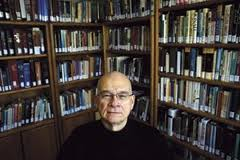
A Christian Harvard Law Professor Speaks Wisely About His Stage 4 Cancer

Dr. Bill Stuntz Godly Response to His Cancer Diagnosis

William Stuntz 1958 to 2011

My cancer has been promoted: I’m officially in stage 4. My doctors have found two can- cerous nodules—a euphemism for “small tumors”—one on each of my lungs. I started chemo this week. Next week, I’ll see a thoracic surgeon who will, sometime this summer, cut those tumors out. Needless to say, this isn’t good news—though, thanks to medical advances (especially, thanks to those evil drug companies that politicians regularly attack), it isn’t disastrous news either. We’ll see what the future brings.

I don’t have any previous experience with this sort of thing, but judging from what I hear and read, I’m supposed to be asking why all this is happening, and why it’s happening to me. Honestly, those questions are about the farthest thing from my mind.

Partly, that’s because they aren’t hard questions. Why does our world have gravity? Why does the sun rise in the East? There are technical answers, but the meta- physical answer is simple: that’s how reality works. So too here. Only in the richest parts of the rich world of the twenty-first century could anyone entertain the thought that we should expect long, pain-free lives. Suffering and premature death (an odd phrase: what does it mean to call death “premature”?) are constant presences in the lives of most of the peoples of the Earth, and were routine parts of life for generations of our predecessors in this country—as they still are today, for those with their eyes open. Stage 4 cancers happen to middle-aged men and women, seemingly out of the blue, because that’s how reality works.

As for why this is happening to me in particular, the implicit point of the question is an argument: I deserve better than this. There are two responses. First, I don’t—I have no greater moral claim to be free from unwanted pain and loss than anyone else. Plenty of people more virtuous than I am suffer worse than I have, and some who don’t seem virtuous at all skate through life with surprising ease. Welcome to the world.

Once again, it seems to me that this claim arises from the incredibly unusual experience of a small class of wealthy professionals in the wealthiest parts of the world today. We think we live in a world governed by merit and moral desert. It isn’t so. Luck, fortune, fate, providence—call it what you will, but whatever your preferred label, it has far more to do with the successes of the successful than what any of us deserves. Aristocracies of the past awarded wealth and position based on the accident of birth. Today’s meritoc- racies award wealth and position based on the accident of being in the right place at the right time. The difference is smaller than we tend to think. Once you under- stand that, it’s hard to maintain a sense of grievance in the face of even the ugliest medical news. I’ve won more than my share of life’s lotteries. It would seem churlish to rail at the unfairness of losing this one—if indeed I do lose it: which I may not.

The second response is sim- pler; it comes from the movie “Unforgiven.” Gene Hackman is dying, and says to Clint Eastwood: “I don’t deserve this. To die like this. I was building a house.” Eastwood responds: “Deserve’s got nothing to do with it.”

That gets it right, I think. It’s a messed-up world, upside-down as often as it’s rightside up. Bad things happen; future plans (that house Hackman was building) come to naught. Deserve’s got nothing to do with it.

Why, then, are we so prone to think otherwise? This is one of the biggest reasons I believe my faith is true: something deep within us expects, even demands moral order—in a world that shouts from the rooftops that no such order exists. Any good metaphysical theory must explain both of those phenomena: both the expectation and the lack of supporting evidence for the thing expected. The only persuasive way to get there, I think, is to begin with a world made good that was twisted, corrupted, bent. Buried deep in our hearts are hints of the way things ought to be; the ugliest reality can’t snuff them out. Still, that reality exists; it can’t be denied. Christianity sees that reality, recognizes it for what it is—but also sees the expectation, and recognizes where it comes from.

Bottom line: I don’t need anyone to tell me why I’m in the situation I’m in, and I certainly don’t think I merit an exemption from the rottenness to which the rest of the world is subject.

But I do need to know some things. Three, to be precise: first, that I’m not alone; second, that my disease has not made me ugly to those I love and to the God who made me; and third, that somehow, something good can come from this. My faith tells me that the God of the universe suf- fered everything I suffer and infinitely worse. Death and suffering don’t separate human beings from our Creator—on the contrary: those things unite us with our Creator. The barrier became the bridge: that is the great miracle of the Incarnation, the Cross, and the Resurrection. So I need never suffer alone. Job’s story confirms that, far from rejecting the ugli- ness of disease and pain, God embraces those who suffer and takes on their suffering. Beauty and ugliness are turned inside-out. Joseph’s story and the gospels alike show a God who delights to use the worst things to produce the best things. That doesn’t make life’s hells less than hellish. But it does make them bearable.

This isn’t just whistling in the dark—at least, I hope it isn’t. It all makes sense to me: it fits the world I see and feel, with all its shades of glory and misery. And it answers the questions my soul cries out. “Why” isn’t one of those questions.

Article adapted from: http://www.law.upenn.edu/blogs/dskeel/archives/2008/04/ more_cancerstuntz.html#more

[In Dr. Fritzt own words: “I’m a law professor—I teach criminal law and criminal procedure at Harvard—and also an evangelical Christian.That puts [me] in a pretty small, and maybe pretty weird, demo- graphic. I’m also a political junkie and a registered Republican, though I’ve cast as many Democratic votes as Republican ones. I’m interested in all those things—law and legal theory, crime and criminal justice, everything about American politics and political culture, the culture of evangelical Protestantism, and the intersections of various items on that list.] From: http://www.law.upenn.edu/ blogs/dskeel/archives/2008/02/ welcome.html]

 Harvard Law School: Obituary for Dr. Stuntz

William Stuntz, a renowned scholar of criminal justice at Harvard Law School,  an evangelical Christian and a teacher much beloved by students and colleagues, died March 15 after a long battle with cancer.

Stuntz, 52, joined the HLS faculty in 2000 and was named the Henry J. Friendly Professor of Law in 2006. His influential scholarship over the past three decades addressed the full spectrum of issues related to criminal justice and procedure, from the overcrowding of prisons and racial disparities in incarceration to the appropriate role of faith, emotion and mercy in the penal system. He authored three dozen law review articles and essays on criminal law, and published articles and op-eds in the New York Times, Christianity Today, First Things, The New Republic and The Weekly Standard.  This fall,  Harvard University Press will publish a book he authored on the collapse of the criminal justice system.

In a statement to the Harvard Law School community today, Dean Martha Minow observed: “Bill was extraordinary; his wisdom and compassion touched our lives in so many ways, large and small.  His gifts to society through his scholarship and teaching on criminal law and justice changed and improved academic inquiry and policies on the ground.  His scholarship and teaching of Christian legal theory and of confronting life’s burdens inspire people in our community and well beyond it.  He imbued his work and his life with a vision of mercy and compassion.  The Harvard Law School, the larger community of scholars, and the communities connected through Bill’s writings are better, wiser, kinder because of Bill.”

That kindness—and a personal style marked also by good humor and generosity—profoundly affected those who knew Stuntz or knew of him through his writing. As Minow wrote: “Among his many gifts to us was the grace with which he lived his life.  In knowing Bill, we couldn’t help but be reminded to live life as our better selves.  Bill once wrote, ‘We understand that the world is not what it should be, and that our own capacities to understand it are severely limited.’  He described and lived his life in recognition of the need for humility and also for judgment and work to repair what we find around us.  His devotion to family and friends remains legendary. Those of us lucky enough to have been able to consult with him for personal or professional advice will never forget his insights and generosity.”

Carol Steiker, the Howard J. and Katherine W. Aibel Professor of Law at HLS, and a criminal justice scholar who was a close colleague of Stuntz, said: “He was an extraordinary and unforgettable teacher, scholar, colleague and friend. He was someone we’ll all miss, more than we can really say.”

Celebrated for his unusual ability to appeal to a wide variety of legal scholars and others of all political and methodological perspectives, Stuntz was generous with his time and guidance. Colleagues and students were especially struck by his open-mindedness, as reflected in his willingness to listen to a variety of opinions and to change his own when he felt it appropriate. Many observed that his style served as a model for civil discourse.

Extremely popular among his students for his compassion and accessibility, Stuntz was the 2004 recipient of the HLS Sacks-Freund Teaching Award, given by the graduating class to honor a professor for his or her contributions to teaching. In the upcoming week, the the Harvard Law & Policy Review will be publishing a series of student reflections on Professor Stuntz (Read the introduction to the collection at http://hlpronline.com/2011/03/professor-bill-stuntz-in-memoriam/).

From his perspective as a legal scholar and also an evangelical Protestant, Stuntz co-authored a blog that addressed law, politics, and other topics, “Less Than the Least,” with fellow evangelical David Skeel, a law professor at the University of Pennsylvania Law School. As they noted in their blog, “We are both law professors and evangelical Protestants – a weird combination in our time. We hope it’s also an interesting combination.” Stuntz wrote honestly and lyrically, with humor and wisdom, about his struggles with chronic pain and his long battle with cancer, as well as the role of his religious faith in helping him deal with his illnesses.

Said Skeel: “Although Bill was an enormously influential scholar, and was widely viewed as the leading criminal procedure scholar of the past generation, he may have had an even broader impact writing and speaking about his struggles with cancer the past three years, and with debilitating back pain before that. His blog posts and other writings have been reprinted in numerous church bulletins and widely circulated elsewhere. I’ve never known anyone who lived out the Christian call to love one’s neighbor as oneself the way Bill did. He was an inspiration to everyone who came into contact with him.”

Many readers of the blog, including fellow cancer patients, wrote of being deeply touched by the honesty and compassion that imbued his writing.

A year ago, in March 2010, a large group of his many admirers, including legal scholars, colleagues, friends, and students—“a simply dazzling array of conference participants,” as Dean Martha Minow said in opening remarks—gathered at HLS for a two-day conference, “A Celebration of the Career of Bill Stuntz.” In tribute after tribute, they noted that Stuntz had exerted a tremendous influence on the fields of American criminal justice and criminal procedure while at the same time having a profound effect, professionally and personally, on so many who worked with or were taught by him.

Present at the conference, Stuntz described factors that had led to what he called the “disaster of criminal justice in our time,” in particular, the massive and “racially unfair” prison population in the U.S., but held out hope that the system might become fairer.

HLS Professor Jeannie Suk ’02, a former student of Stuntz, and a moderator of one of the panels at the conference, said after learning of Stuntz’s death: “He was a wonderful mentor to me since my time as a student at Harvard Law School. He was the one, when I was a student, who looked me right in the eye and told me not to worry about seeing things that might be unconventional or that might surprise or anger people, that it was a good thing if I had those instincts. He encouraged me to develop that and to be unafraid.”

She added, “The whole time I was an assistant professor, he was very ill, yet … he would stop by my office, he would read all my drafts [of articles] and have something to say about them, with great insight. I really think he was one of the main reasons, the primary reason, I became a professor, that I became a criminal law scholar.”

Born on July 3, 1958, Stuntz grew up in Annapolis, then attended the College of William and Mary and the University of Virginia School of Law.  After two judicial clerkships, he was a professor at the University of Virginia for 14 years until he joined the Harvard Law faculty in 2000.

Stuntz was the loving husband of Ruth Stuntz of Belmont, and devoted father of Sarah Stuntz, Andrew Stuntz, and Samuel Cook-Stuntz, all of Cambridge. He also leaves his parents, John and Sandy Stuntz of Annapolis, Md., and siblings, Linda Adamson of Annapolis, Michael Stuntz of Silver Spring, Md., Richard Stuntz of Annapolis, and David Stuntz of Durham, NC, as well as many nieces and nephews, and a daughter-in-law, Elizabeth Cook-Stuntz.

A memorial service will be held at Park Street Church in Boston on Saturday, March 19 at 5:00 p.m. In lieu of flowers, guests should feel free to make donations to International Justice Mission (www.ijm.org) or the Cancer Center Priorities Fund at Massachusetts General Hospital (165 Cambridge Street, Suite 600, Boston, MA 02114-2792).

“Every Day With Jesus is Like A Thanksgiving Holiday” By Dr. David P. Craig

I have so much to be thankful for – now 15 treatments into Chemo and Radiation – almost half way done with my 33 treatments here are my reflections on Thanksgiving Day. DPC

lifecoach4God's avatarLifeCoach4God

“Thank God It’s Thanksgiving Everyday – Especially on Thursday’s!”

I have always loved the Thanksgiving Holiday. It’s one of the few times of the year where our very large family can come together from all over the United States and enjoy giving thanks for our many blessings. This year more than likely I’ll be having liquid formula through a feeding tube in my stomach. I already had the G-Tube surgically implanted in my stomach this past week. During chemotherapy and radiation around Thanksgiving time will be a time of great testing for me, when according to my Doctors I will be unable to swallow and chew due to the severity of my treatment for throat and neck cancer. Watching every one I love dearest passing around the turkey with all the trimmings will be something my eyes will enjoy, but not my taste buds. However, I’m good with that. I’m…

View original post 3,962 more words

Dr. Tim Keller on The Pervasive Influence of Idolatry in the Human Heart

(Nobody has impacted and influenced my understanding of Jesus Christ and God’s amazing grace in the Biblical Gospel than Pastor Tim Keller – you will find more posts by Tim Keller on VLM’s website than any other writer – because nothing is more important than understanding, receiving, and applying the Gospel for closure on our past, present, and future justification and sanctification with the God of the Gospel – And nobody explains the Gospel in a more deep and applicational manner, in my opinion, than Tim Keller – DPC)

“Counterfeit Gods – The Personal Story”

I often get asked how I personally became acquainted with the pervasive influence of idolatry in the human heart.

Like many younger ministers I worked far too many hours, never saying “no” to anyone’s request for my pastoral services. When salary increases were offered to me, I turned them down. When administrative help was offered to me, I declined. I was quite proud of being the kind of person who worked very hard, never complained, and never asked for any help. This regularly brought me into conflict with my wife, who rightly contended that I was neglecting my relationships to her and to my young sons. It also led to health problems, although I was only in my early thirties.

Nevertheless, I continued to feel that the way I was living was noble and good. I believed I was sacrificially committed to the ministry of the Word. I was especially delighted to make sacrifices that nobody saw — not my people or even my family. That made me feel most noble of all. If all this created some problems for me personally, wasn’t that just evidence of how truly devoted I was? It was a very dangerous situation. My future was bleak, though I didn’t know it. In the short run, this kind of ministry workaholism is often rewarded by admiring people all around.

Some well-meaning friends, however, saw the problem and literally “laid the law” on me, showing me that I was violating the commandments of taking Sabbath and of honoring my family. I usually responded with incremental changes that never endured. Others used the modern technique of self-esteem — “You need to think of yourself; you need to do things that make you happy.” I despised that advice as terribly selfish.  I valued self-sacrifice.

It wasn’t until I began to search my heart with the Biblical category of idolatry that I made the horrendous discovery that all my supposed sacrifices were just a series of selfish actions. I was using people in order to forge my own self-appreciation. I was looking to my sacrificial ministry to give me the sense of “righteousness before God” that should only come from Jesus Christ. People make idols out of money, power, accomplishment, or moral excellence. They look to these things to “save them” — to give them the sense of purity, value, and acceptability that only Jesus can give. In my case, I was using ministry (and my own people) in this way.

Without the category of idolatry — a good thing turned into a pseudo-salvation — I would never have been able to see myself. Nothing but the concept of counterfeit gods could have blasted me out of my illusion of virtue and superiority. I thank God for this life-saving insight — though I still struggle mightily with the implementation of what I’ve learned.

*Article Originally posted by Dr. Tim Keller on October 20, 2009 at the excellent resource site: http://redeemercitytocity.com/blog/view.jsp?Blog_param=60

 About Tim Keller and His Absolutely Brilliant Gospel Centered Books:

 In 1989 Dr. Timothy J. Keller, his wife and three young sons moved to New York City to begin Redeemer Presbyterian Church. In 20 years it has grown to meeting for five services at three sites with a weekly attendance of over 5,000. Redeemer is notable not only for winning skeptical New Yorkers to faith, but also for partnering with other churches to do both mercy ministry and church planting.  Redeemer City to City is working to help establish hundreds of new multi-ethnic congregations throughout the city and other global cities in the next decades.

Dr. Tim Keller is the author of several phenomenal Christo-centric books including:

Every Good Endeavor: Connecting Your Work to God’s Plan for the World. New York, Penguin Publishing, November, 2012.

Center Church: Doing Balanced, Gospel-Centered Ministry in Your City. Grand Rapids: Zondervan, September, 2012.

The Freedom of Self Forgetfulness. New York: 10 Publishing, April 2012.

Generous Justice: How God’s Grace Makes Us Just. New York: Riverhead Trade, August, 2012.

The Gospel As Center: Renewing Our Faith and Reforming Our Ministry Practices (editor and contributor). Wheaton: Crossway, 2012.

The Meaning of Marriage: Facing the Complexities of Commitment with the Wisdom of God. New York, Dutton, 2011.

The Prodigal God. New York, Dutton, 2011.

King’s Cross: The Story of the World in the Life of Jesus. New York, Dutton, 2011.

Counterfeit Gods: The Empty Priorities of Money, Sex, and Power, and the Only Hope That Matters. New York, Riverhead Trade, 2011.

The Reason For God: Belief in an Age of Skepticism. New York, Dutton, 2009.

Worship By The Book (contributor). Grand Rapids: Zondervan, 2002.

Ministries of Mercy: The Call of the Jericho Road. Phillipsburg: P&R Publishing, 1997.


Don’t Waste Your Cancer: An Interview With Matt Chandler

Tabletalk (The Monthly Magazine of R.C. Sproul’s – Ligonier Ministries) And Matt Chandler on His Battle with Brain Cancer

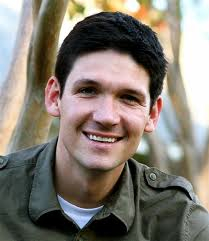
Tabletalk: By way of offering a brief introduction of yourself and your family, when was God’s call to serve His people confirmed for you (Matt, cancer free, recently pictured above with his wife Lauren and their three children)?

Matt Chandler: I think my story is a bit strange in that my awareness of God’s call on my life to serve His people was a bit lost in me serving His people. I’ll try and explain that. I was very frustrated with my church experiences heading into college. I loved sharing the gospel and loved the God of the Bible, but it appeared to me (probably my immaturity) that my church and I were seeing different things in the Scriptures. I saw atonement and the fear of the Lord, and at church they were teaching us not to drink beer and not to have sex. To be truthful, I wasn’t drinking beer or having sex, and could see that drunkenness was sinful and that God had a plan for sex in marriage. Yet it appeared to me that those were secondary issues that should be addressed after the atoning work of Christ was communicated and understood. I started teaching at an ecumenical gathering while I was in college and assumed I would finish school, become a good lawyer, and teach Sunday school at the local Baptist church wherever I settled (I was hoping for the West Coast). The Bible study blew up numerically, and we were running around one thousand to fifteen hundred students every week. A young woman from that study asked me when I received the “call of ministry.” I was honestly confused by her question. I thought she was asking if the Baptists had literally called me on the phone and let me teach the Bible study. She clarified her question, and it sent all my dreams and plans into another direction altogether. It was at this time that I came to understand that I wouldn’t be spending my life doing law and teaching Sunday school but rather teaching and leading God’s people into maturity by the Spirit’s power and by the proclamation of the Word.

TT: What counsel would you give to a believer on the day he or she is diagnosed with cancer? How about six months after the diagnosis?

MC: One of God’s big mercies in all of this has been allowing me to pastor a young church. I have done multiple funerals every year I have been here, and only one has been for a person over the age of fifty. I learned very early that people need to have a good grasp of God’s goodness and God’s sovereignty. On the day that a person is diagnosed, I try to encourage them in God’s knowledge — that this hasn’t surprised Him or caught Him off guard. I want to remind them that this isn’t punitive, but rather that God is on the move and He can be trusted. Six months after the diagnosis is harder to answer because cancer can go one of two ways. If the man or woman is still in a real fight, I want to draw his or her attention to Hebrews 11 or the story of Abraham being promised a son or even David being anointed king and then running from Saul for all those years before sitting on the throne. I think it’s important to remind people after the initial shock of diagnosis wears off and the wear and tear of treatment settles in that victory for those who are children of God is guaranteed, although difficulty, pain, and waiting might all be very present.

TT: In what ways has your cancer sanctified you?

MC: It’s made me look long and hard at my motives and has drawn me deeply into God in prayer. I am an excellent studier and researcher, and before all this began, I would say a decent man of prayer; but I learned after they told me I only had two to three years left that I knew much more about God than I actually knew Him. The bulk of my sanctification through this ordeal has been the birth of a deep desire for intimacy with our great God and King.

TT: How do you counsel Christians to face death and disease (both those who are personally facing such crises and those who are currently enjoying robust health)?

MC: I simply have tried to point out that we shouldn’t be surprised by death and disease because the Bible is filled with it. As I stated above, an understanding of God’s goodness and His sovereign power are necessary to cope with life in a fallen world. I want to teach people that life is extremely fragile and that there isn’t a person in our sanctuary or listening to a podcast who can’t have his or her whole world change with a phone call or, as in my case, getting up one morning and getting a cup of coffee. Those are heavy truths, and I know they don’t make for feel-good sermons, but it’s better to know these truths than to pretend it’s not reality.

TT: You’ve written that if you had not heard John Piper’s answer to the question “For whom did Christ die?” at the 1997 Passion conference, you would not have had ground to stand on years later when you heard the words “brain cancer.” How did your understanding of the atonement help you deal with such a devastating diagnosis?

MC: Actually, I think my wife, Lauren, said that in a blog she wrote after my prognosis was given to us. That sermon was significant for both of us because up until that point, I’m not sure we grasped the size and holiness of God. That sermon changed the trajectory of both our lives in that it shifted how we saw God and understood Him.

TT: You’ve also written that there were moments last year when you felt you were “punched in the soul” but that you were reminded nevertheless that the disease with which you’re dealing “isn’t punitive but somehow redemptive.” Could you unpack that a little?

MC: I have been very blessed by God in my life. My cancer has honestly been one of the more difficult things to deal with. Lauren and I have tried to trust the Lord in everything, and when we’ve stepped out in faith He has been beyond gracious to us. People come to hear; they give generously to the church, and almost every “idea” we’ve had God has blessed and grown. I can honestly say that ministry and life were pretty easy for us up until Thanksgiving 2009. After I had the seizure and they found the tumor, I thought it would be like everything else had been — easy and would end well. When I first met my neurosurgeon on the Tuesday after Thanksgiving, I was ignorantly and maybe even arrogantly thinking that nothing would come of it and that we would just need to watch this thing and see.

I was caught completely off guard when Dr. Barnett told me that it didn’t look good and that we needed to do surgery immediately. That was one of the first times in my life, if not the first time, that things went “worst-case scenario” on me. The Holy Spirit was quick to remind me of great passages on God’s sovereignty and goodness in difficulty. I thought of Romans 8, Hebrews 11, and several others. I wasn’t being punished with brain cancer because I didn’t tell that guy at the gym about Jesus or because I hadn’t read Piper’s latest book, but rather God was at work. He was doing something, and I could be sure that He loved me and in the end I would have increased joy and He would be glorified. Here we are over a year later and that’s exactly what’s happened.

TT: How has dealing with your disease affected your view of God’s sovereignty (or, how has your view of God’s sovereignty affected how you view your disease)?

MC: (Pictured above Matt on a video update to his church after chemo treatment – having lost his hair – which has since grown back) I believe the Scriptures teach that God is aware of every act at every level of the universe. From a star exploding to the rate at which our planet spins to a cell dividing, He knows. I don’t believe in the end that God gave me cancer, but He certainly could have stopped it and didn’t. So I have to believe like Joseph, John the Baptist, and Paul had to believe when they were in prison — that God is working, and what the enemy means for evil, He will turn to good. There have been multiple occasions when God has used this tremendously. The Associated Press let me preach the gospel in an article that ran worldwide. The story has caught the imagination of the media here in Dallas, and we’ve been able to talk about the atoning work of Christ on TV as well as in newspaper articles. That has led to a ton of men and women surrendering their lives to Christ after wanting to talk with me through their own sufferings. If my life gets “cut short” but we get to see new births in the kingdom, then I don’t feel slighted or robbed in the least.

TT: In the late summer/early fall of 2010, you went to Sudan. How did that trip impact your life?

MC: I was deeply moved by my trip to Sudan. I’ve traveled quite a bit internationally but have never seen anything like it. It isn’t even a Third World country. That’s what they want to be. We are connected with some extremely godly men there, and the opportunities for the advancement of a Christ-centered, biblically-strong faith growing in southern Sudan are very real. On a side note, if I had not been diagnosed with cancer, I would not have been able to make the trip. The original diagnosis had us clear my external speaking schedule and opened that time frame for us to go.

Article Information:

From: Tabletalk Magazine – From Ligonier Ministries and R.C. Sproul. © Tabletalk magazine. Website: http://www.ligonier.org/tabletalk. Email: tabletalk@ligonier.org. Toll free: 1-800-435-4343. Interview published on July 1st, 2011.

 About Matt Chandler:

Matt Chandler serves as lead pastor of the Village Church in Flower Mound, Texas. He has become a leader in the evangelical world through his ministry at the Village Church, the Acts 29 Church Planting Network, and his teaching at multiple conferences. Matt is known to a wider audience most recently through his faithful witness to Jesus Christ while battling a malignant brain tumor. Chandler is also the author of the teaching series Philippians: To Live Is Christ & to Die Is Gain; and his excellent first book published by Crossway, entitled: The Explicit Gospel.

Dr David P. Craig on the Question: “Am I Pastor or a Life Coach?”

Answer: “I’m a Pastoral Life Coach”

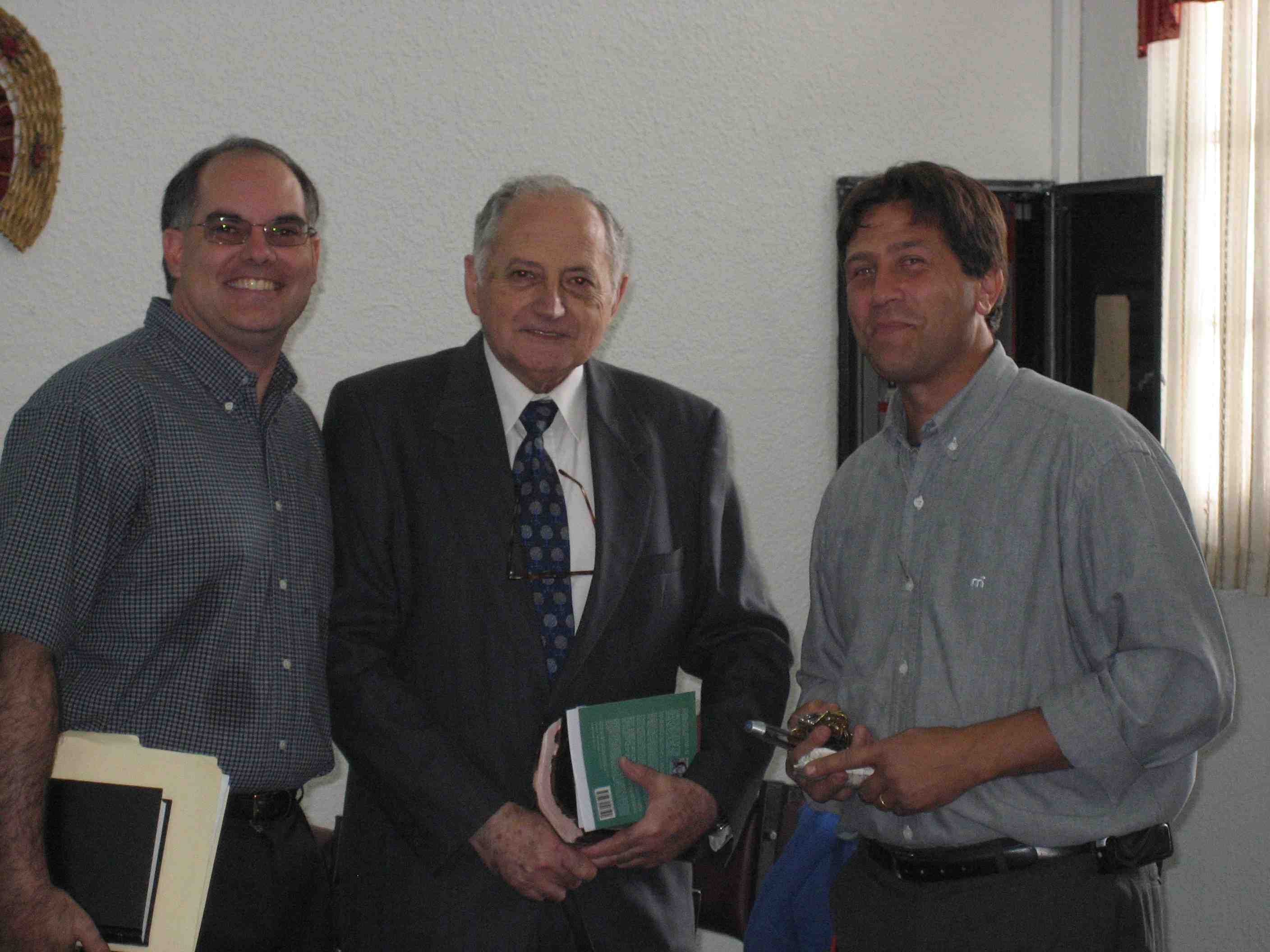
About the picture above: From the left [me] David P. Craig; in the middle – my uncle Enrique – the brother of my mother – and a faithful disciple and evangelist of Jesus, and on the right, a church member named Jorge. I had just preached on what family relationships from Ephesians 5 :22 -6:4 look like when Christ is at the center of them. It was a tremendous honor to preach in Spanish with several family members present on my mother’s side. My family has a long history of church involvement – planting; preaching; and service in Quilmes – a large city in a suburb of Buenos Aires. I had just returned from a week of training pastors in the Northern part of Argentina – Jujuy; and was about to do some training with some young church leaders at A Christian Camp Facility in Buenos Aires.

In January of 2006 I had returned from a trip to South America to train pastors and missionaries (almost all of them were bi-vocational; in the Province of Jujuy on the Northern Argentinean and Southern Bolivian border. I have been on such trips in Europe, Asia, the Caribbean, and many times in Argentina (the land of my roots – My parents were born there and I have adopted many of their customs – especially drinking an Argentine tea called “mate;” becoming a soccer fanatic – especially of River Plate and Quilmes, and of course their national team (Messi is the Best!); and loving all foods Argentine – especially “asados” with “entrana” and chorizos; empanadas, bocadillos, tortilla, and gnocchi. I also grew up learning “Castellano” – the Italian sounding Spanish of the Argentines – full of slang – they have a unique word, phrase, or idiom for everything!

Both of my grandfathers were preachers. My dad’s father – John Craig (my youngest son, Johnny aged 16, is named after him) – was a Plymouth Brethren missionary who was born in Belfast, Ireland and spent over 50 years in Argentina and Uruguay planting churches, being an itinerant preacher, and making disciples (I’ve spoken in parts of Argentina where people have told me that my grandfather led them to the Lord and discipled them – it always brings me to tears of joy). John Craig died at the age of 86 and he was still pastoring a church in the Province of Tucuman in Argentina shortly before his promotion to Heaven.

My mom’s dad – Saul Moreira (of Portuguese heritage) was a beloved Bible teacher and expositor of the Bible. Everyone loved to hear “Don Saul” teach – children, co-workers, and the various “Hermanos Libres” churches in and around Quilmes – a large suburb of Buenos Aires  La Boca is most famous for the “Boca Juniors Football Club” and the dance known worldwide as the “Tango.”

About the picture above: My Grandfather – Saul Moreira – was one of the project supervisors of the building of the bridge pictured above “Puente Transborador” – built in 1914 is one of the most recognized bridges in all of South America. The Bridge is located in what many consider the heart of Buenos Aires – “La Boca.” The La Boca neighborhood was so named for its position at “the mouth” of the Riachuelo, and its role as the port of call for thousands of immigrants from Italy, Spain, and other European countries in the 1800’s and early 1900’s. It’s within walking distance from of the birth of the “Tango” in El Caminito, and the home of the famous Boca Juniors Football Club).

When I was 17 years old (almost the age of my youngest son) I was a soccer, football, basketball, and baseball FANATIC! On any given day you would see me with a ball in competition depending on the season – I was fiercely seeking a victory in one of these sports. Growing up in the 1970’s and 1980’s in Huntington Beach, CA., I was a diehard Laker fan (during the Magic Johnson vs. Larry Bird era); a HUGE Dodger fan -during the Dodgers vs. Cincinnati Red Machine; when the St. Louis Rams were the L.A. Rams and played in Anaheim; and the L.A. Galaxy didn’t exist and we had season tickets for the L.A Aztecs. I still vividly recall going to the L.A. Coliseum and witnessing the amazing offensive and defensive skills of some of the best players in world soccer history – Johann Cruyff, Pele, and Franz Beckenbauer.

About the picture above: My room in Huntington Beach in 1975.  I was ten years old and already a sports fanatic. Notice the Rams (in L.A. back then) souvenirs on the left and the Los Angeles Dodgers souvenirs on the right. There is a 10th Anniversary Houston “Astrodome” pennant on my desk, and I’m reading a baseball world series magazine from 1975. I still love the Dodgers; wear Hawaiian shirts; but prefer the San Diego Chargers to those “traders” – the St. Louis Rams.

In my junior year of High School I was involved in a serious car accident. My best friend at the time was driving his Jeep and we were cut off by a drunk driver after the first day of baseball season my junior year. My dad and mom were on a business trip in Europe at the time. My older sister and the great staff at the hospital in Fountain Valley took terrific care of me. I suffered numerous broken ribs, bones, and had a lot of stitches in my head. I can remember shaking in bed at the hospital for a week straight and had a migraine headache for the next three months that subsided gradually so I could take catnaps here and there.

It was during that time that I received my calling to the ministry. Up until that year I was dreaming of either being a pro soccer or baseball player. Before the car accident I made my decision to focus on baseball and have a terrific junior season at Liberty Christian High School in Huntington Beach. I had dreamed about being a Los Angeles Dodger with the goal of taking over Bill Russell’s job at shortstop  The reality is I was a good baseball player, but not “great.”  I think if I had focused on being great at one sport instead of being “good” at four sports – I would have had a chance to make the pros (I ended up playing soccer in college for 3 years in Portland).

About the picture above. From about 1975 to 1980 my family would get about 20-30 games of season tickets during some of the Dodgers best years. The first Dodger game I went to was in 1974 and Ron Cey “The Penguin” hit a home run against the New York Mets to win the game in the 9th inning. I was imediately hooked on the Dodgers.Here is a picture of the “Fabulous Four: Ron Cey – 3B; Davey Lopes – 2B; Bill Russell – SS; and Steve Garvey – 1B.

I missed all of baseball season my junior year. During that summer – I started thinking more seriously about my life.  I had been a disciple of Jesus Christ since I was six years old.  I always loved the Lord, went to church weekly, loved going to “big church” (my pastor was the well-known Bible expositor – David L. Hocking. I’d rather hear “Pastor Dave” preach the meat of the Word than “watered down” Sunday school lessons designed for children who’d rather play with lincoln logs, than listen to a teacher. From an early age I’ve always loved apologetics and anything to do with the Bible, Theology, the Gospel, and the Church for whom Jesus gave His life.

However, the summer of 1983 was different from any previous summer in my short life. My passion for sports waned, and God gave me a renewed passion to know Him intimately and magnify Jesus in the proclamation of the Gospel. My senior year of high school I didn’t play any sports for the first time since I was six years old. I realized that I was a follower of Christ second, and a sports idolater first. I needed to repent of my sin of “sports idolatry” and was struck by what the Apostle Paul said in 1 Corinthians 10:31, “So whether you eat, or drink, or whatever you do, do it all to the glory of God.”

Up until my junior year of high school I had been a selfish “sports-aholic,” primarily living for the thrill of victory and to avoid the agony of defeat. I had been living for my glory first, and Christ’s second. I was convicted by the Holy Spirit of this rebellious state and moved by the Holy Spirit “to be transformed by the renewing of my mind” (See Romans 12:1-2).

Over the summer I started asking and wrestling with these questions:

“What if I had died in that accident?”

“What have I accomplished in life that will actually last for eternity?”

“What will I do that will last for eternity for the rest of my life?”

“What things will last on into eternity when I die?”

“Why did God create humans for in the first place?”

“How many people do I know that have I never told about Jesus?

There were many more questions like those above. However, my senior year was different. I started going to a Christian Book store called “Pilgrim’s Progress” and started devouring theology books by J.I. Packer, R.C. Sproul, David Martyn Lloyd-Jones, and many others. While all my friends were going on dates and spending money on movies – I was saving money to buy more books. I studied Greek that fall in a discipleship relationship with my Bible professor in High School – he was a Talbot Seminary student at the time (I would eventually earn my Master of Divinity at Talbot in 1991); I started teaching a junior high Sunday school class in my church; I was witnessing to everything that breathed – I even practiced on my cocker spaniel – “Carlitos” and my cat “Jinx.”

Two defining moments happened to me in the summer of 1983. The first was through an evangelist that you’ve probably heard of – Luis Palau. Billy Graham, Bill Bright, and Luis Palau have planted more seeds of the Gospel than perhaps all the other evangelists of history combined. Luis Palau was passing through on his way to Los Angeles and came over for dinner one evening. Anyone who has ever eaten my mom’s cooking, would NEVER pass up an opportunity to eat her food! If she were younger (she’s 80 today – and still cooks up a storm), I’m convinced she would have her own show on the Food Network and be more popular than Paula Dean or Giada DeLaurentiis!

About the picture above: Luis Palau has literally preached to more people than anyone in the history of Christianity next to Billy Graham – and he’s done it in perfect Spanish and English.  I haven’t heard or seen much of Luis since our days at Multnomah – but I will be forever indebted to Luis for recommending I attend Multnomah University. I received some great training there. However, the best gifts I received were some of my life-long godly friends – who are all comrades in the ministry of the Gospel around the world. Luis Palau’s nephew George Palau, who with his wonderful wife – Stacey – runs an orphanage in Mexico is one of those very close friends. George is one of the greatest servants of Christ I’ve ever known. I have learned much more from him, than I ever will from Luis. Nothing against Luis. But one of the great things about being a Christian is that we all impact one another up close in the context of community – especially when we minister to those who are suffering and in great need. George drove all the way from Mexico yesterday to spend the day with me. I love George, Dave Steele, Eddie Remley, and Mark Wilks, as if they were my very own brothers – and in Christ we are a “band of brothers.” 

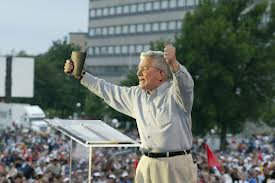
Luis Palau is one of the few “big name” Christian heroes that I really respect and admire. He is one of the few pastors I know that is the same in his home, as when he is in front of a crowd of 100,000 people. What you see or hear from Luis is what you get. He practices what he preaches, and is quick to repent when he blows it. My parents grew up in the same Plymouth Brethren (“Los Hermanos Liberes”) church as Luis in Quilmes, Argentina and have known him since he was very young.

Getting back to the dinner. My mom made her famous Caesar salad, homemade spinach ravioli with her amazing Osso-Bucco and meat-sauce, and we had her amazing homemade “dulce de batata” for dessert (I remember – because these are three foods I never eat anywhere else – because no one comes close to preparing these items as well as my mom). After this very filling and satisfying meal Luis and I went for a long walk. I picked his brain and remember asking him, “Luis, how do you know if you are being called to the ministry?”

I honestly can’t remember his exact reply. I just remember that he affirmed my calling and recommended that I attend the same college he attended when Ray Stedman (author of the very influential book “Body Life” and, at that time Pastor of the influential Peninsula Bible Church in Northern California) helped bring a young Luis to the United States to be pastorally trained – because he heard Luis preach on a trip to Argentina and saw how gifted he was. Ray Stedman made it possible for Luis Palau to go to Multnomah School of the Bible in Portland, Oregon. The school’s motto was, “If it’s Bible you want, then you want Multnomah”.  Luis encouraged me to visit the school and noted and affirmed my passion to know the Word and to make Jesus known.

The second “defining moment” for me came in letting my parents know that I believed and felt overwhelmingly that God was calling me to full-time ministry. God was blessing my teaching, evangelism, and discipleship with youth. I couldn’t imagine doing anything more worthwhile for the rest of my life. I wanted to make my time and life count for what would matter for eternity.

A few days after my walk and talk with Luis Palau, I sat down at approximately 11:30 a.m. at the kitchen table with my mom. My parents are godly people. My dad has worked hard since he was seven years old and he has had several successful businesses in Argentina, England, and the United States. My dad has always been incredibly giving and very involved in ministry. I don’t ever remember getting up in the morning not seeing my dad with an open Bible and drinking mate (Argentine tea). My dad has been an elder and on the Board of several missions around the world. He devours theology, and manifests all the fruit of the Spirit. There is not a single man on the planet that I admire, respect, and desire to be more like than my father. He has been such a good model and such an influence in my life – that I could probably write a whole book on his influence for good in my life.

Meanwhile, getting back to the table with my mom. My dad was working in his office – he added an office to the garage over our Huntington Harbor home, so he didn’t have to drive to Los Angeles anymore. I sat down with my mom and was hesitant to bring up my “calling” for fear that my parents would think I was “loco.” I thought I would share it with my mom first before bringing it up to my dad. My plan up until that summer had been to get a baseball scholarship to a Pac Ten (now Pac 12 or whatever they call it) school, preferably UCLA (Go Bruins! – largely through John Wooden’s influence in my life – his book “They Call Me Coach” was the first book I read from cover-to-cover; John Wooden pictured below)), and to major in Business Administration. I never thought of being anything but a professional athlete – my only difficult decision was I wanted to play all four major USA sports – baseball, football, basketball, and soccer! I’m sure hockey would have been in there too, but nobody except for Canadians knew what that was in the 1980’s – until we won the Olympics in the “Miracle on Ice”!

About the picture above: John Wooden won 10 National Championships as a coach of the UCLA Bruins Basketball team. Wooden had some great players; but he was also able to make great players make other players even better. I think John Wooden (a committed Christ follower) would have been a great pastor as well. He is a perfect model of a life coach – committed to Christ; committed to bringing out the best in individuals; and their teams, churches, and organizations. Everybody wins when they have a good coach. John Wooden was simply the best!

I would literally dream almost every night, and daydream in my classes in school of throwing the over time touchdown pass in the last seconds of the Super Bowl to lead the Rams to victory over the Steelers; hitting a grand slam in the bottom of the ninth in the seventh game of the World Series before the home crowd in Los Angeles over (who else?) the New York Yankees; shooting a three-point shot in over time to win the NBA championship for the Lakers against the Celtics.  I dreamed of taking the Americans all the way to the final in the World Cup and beating Germany, Argentina, or Brazil by scoring a hat trick in bringing the World Cup to the USA for the first time. I even remember in my dreams calling my cousins Ariel and Martin in Argentina to apologize to them for beating their homeland in their favorite sport!

Oh yeah – sorry, sidetracked – back to the table with my mom. When I told my mom about the stirring in my heart, my desire to know the Scriptures, my passion to proclaim Christ, and my desire to attend Multnomah in Portland – she began to sob. I was thinking to myself, “Oh no, now I’m in trouble – there goes the family business.”

My mom came around the table and gave me a big hug and went and got her Bible and read from 1 Samuel 1 – the story of Samuel’s being dedicated to the Lord (I encourage you to read it). She read the entire chapter to me out loud and then after reading the last three verses of chapter 1 and the first 2 verses of chapter where Hannah says and prays the following:

And she said, “Oh, my lord! As you live, my lord, I am the woman who was standing here in your presence, praying to the Lord. For this child I prayed, and the Lord has granted me my petition that I made to him. Therefore I have lent him to the Lord. As long as he lives, he is lent to the Lord.” And he worshiped the Lord there. And Hannah prayed and said, “My heart exults in the Lord; my horn is exalted in the Lord. My mouth derides my enemies, because I rejoice in your salvation. “There is none holy like the Lord: for there is none besides you; there is no rock like our God.” (1 Samuel 1:26-2:2)…

She came and hugged me, and said that Hannah’s was her story and Samuel’s story was my story. Rachel (my mom) told me that the doctors told her she would never have a child again. She lost two children due to complications between my sister – Miriam – and myself.

I never knew the story of my mom and dad’s loss until this day, at this moment, at the table in our kitchen. In short, my mother had always wanted six children (two of them I will meet for the first time in Heaven one day). I have two brothers – Daniel, 15 years my senior and George, 10 years older than me; and a sister that’s 8 years older than me – Miriam. One child my mom lost was never named (but will have a name that Jesus has given according to Revelation), the other was named Michelle.

My mom went and got my dad from the office and she shared the story of how she prayed that if God gave her another child – she and my dad would dedicate him to the Lord – just as Hannah had dedicated Samuel. Talk about a confirmation! We all wept and prayed, and thanked the Lord for His answers to prayer to my faithful parents prayer to bring glory to the Lord Jesus Christ.

About the Picture above: My parents have been the biggest influences on my life spiritually. My dad, Daniel, will be 90 in January; and my mom, Rachel, will be 81. They prayed for me before I was born. They read the Bible to me from the time I was a baby (and still quote it to me on the phone or every time we are together). They are my biggest heroes in life. They are going to be married 64 years on December 4, 2012. My parents have always been my biggest fans, but better than that – they have been huge fans of Jesus, His Church, and the spread of the Gospel around the world. They have had a lot of difficult times financially, physically, and have lost almost all their life-long friends. And yet they always have a smile on their faces and exhibit the peace of God that surpasses all understanding. I love them with such admiration, appreciation, and respect that I will never be able to convey in words. I am a Christian today because of the sovereign election of God in eternity past; and love and follow Jesus because they modeled His love and grace when I was growing up, and continue to do so, to this very day. I can’t think of two people who better model what the Apostle Paul said, “Follow my example, as I follow the example of Jesus Christ.”

Since that day I have gone on to earn a B.S. (at Multnomah); a M.Div. at Talbot School of Theology; a doctorate and doctoral work in Theology and Pastoral Leadership at Westminster Seminary in Escondido, and Northwest Graduate School in Seattle. I have been a youth and senior pastor in California and Washington State. I have traveled to more than 30 countries on missions trips and training pastors and missionaries. I have discipled dozens of men. My best education was one I never purposely applied for, but have most definitely been “accepted” to. It’s proverbially called “The School of Hard Knocks.” I would concur with the great Reformer Martin Luther who summarized his learning in this way, ““Suffering has made me a better theologian than any book I’ve ever read.” However, I don’t think I’ve seen the tip of the iceberg of what God has entrusted unto me as a steward of the glorious Gospel of Jesus Christ.

The questions I asked earlier are questions I’m still asking. Having been diagnosed with cancer recently and beginning radiation and chemotherapy in the next week, I pray that God will continue to change me and conform me to His Son. I pray that whether I live another forty-six years, or only have days to live for him – that people will know, see, and hear about my Lord and Savior Jesus Christ. I desire more than anything that all my family members would know and follow Jesus. I firmly believe with the sentiment, “This life will soon be past, only what’s done for Christ will last.”

I have lived a wonderful life. I have been bruised and broken, but not crushed. I am becoming stronger through life’s trials and tribulations. Since the age of seventeen all I’ve ever wanted to do, is know Jesus intimately and make Him known.

This past year I’ve been doing some “life coaching” through a non-profit ministry I established called Vertical Living Ministries. I started this Pastoral ministry with the help of some wonderful people who have sacrificially contributed generously, so that I can make multiplying disciples of the Lord Jesus Christ around the world. I have trained people one-on-one and in small and large groups, discipled men and women, and trained people in Christ-centered living through this ministry.

I originally established Vertical Living MInistries to provide training for leaders in poor countries. We who live in America have access to so many good resources by way of books, conferences, Bible Colleges, and Seminaries. I have been to countries where pastors share one Bible amongst themselves and have absolutely no training or access to any resources whatsoever. However, now with my cancer, I really don’t know where God is calling me. However, I know that I will always be a pastor. I am a shepherd. I have had Jesus shepherd me, and I simply want to find other sheep who will follow hard after the Good Shepherd.

I call myself a Pastoral Coach because I want to encourage Christians to make Christ number one in their lives. I love “life” coaching because I can help disciples of Christ focus on the following nine areas of Christo-centricity.  Just as we talk about  a Planetary system that’s Helio, and not Geo-centered, I like to think of life functioning best when our lives revolve around, and in our Lord and Savior, Jesus Christ.

(1) Spiritually – Your Relationship to God through the Lordship of Jesus Christ. My main focus here is to help people understand the life transforming ramifications of the Gospel in your life: past, present, and future ramifications for today. Most Christians only remember or hold on to their past, or future in Christ and forget how the Gospel needs to be lived out on a daily basis – we are continually learning to repent and grow in our faith with Christ at the center of it all.

(2) Marriage – Your triune covenantal relationship with Christ at the center. Marriages can work for two unbelievers, and even sometimes when an unbeliever is married to an unbeliever. However, it was designed by God to not be a marriage of two, but of three. I help couples to practically make Christ the center of their “solar system” in their marriage.

(3) Family/Parenting – How to be a Christ-centered family and raise Children that love Jesus above all else. For many parents, their children become “idols.”, especially for women.  Their identity, security, and significance is oftentimes wrapped up in the performance, success, and behavior of their children. If their children are doing well – they are doing well. However, if a child rebels or is unsuccessful in life – they take it personally, and lose their way. Many “empty nesters” – especially women, become depressed and feel like life is meaningless when their kids move out of the home. I help parents to see that our security and significance needs to be properly placed in submission to the Lordship of Christ. Only God never changes. If we place our security in our kids or anything else – we are in big trouble. In raising our children we are merely short-term stewards of what is rightfully God’s. The greatest thing we can do as parents is to model Christo-centricity for our children. I’m grateful that my parents modeled and taught me daily that the most important thing in life is my relationship with and service unto Jesus.

(4) Vocationally – Your Work in the World and with the Church. Most women have the idolatry of “motherhood.” Most men see their significance and security in their work. Their identity is wrapped up in their position, possessions, and provisions for their families. Well, what happens to the man who loses his job, gets physically incapacitated, or runs into midlife.  You’ve been working at a job for 30 years and come to realize that you were climbing the wrong ladder that was leaning up against the wrong wall in your “prime” years? Men and women both have pseudo securities – or what the Bible calls “idolatry.” I try to teach people how to view their talents, passions, skills, abilities, and hobbies as unto the Lord. Ultimately, God is our boss and we will spend the bulk of our lives working – but do we find the pleasure of God in our work? Few things excite me more than seeing businessmen or women shine brightly for the sake of Christ in the context of making a profit that will last for eternity in the lives of others.

(5) Health – Taking care of your body that God will use on this earth until the day of your final glorification. This is one of the most neglected areas for Christians. It’s very easy to get out of balance in what we eat, how we exercise, and being responsible with the stewardship of our bodies. I love what C.S. Lewis says, “You don’t have a soul, you are a soul. You have a body.” In other words, we are dualists. We have an immaterial part of us, and we are housed in a physical body that must be maintained. Sometimes, we can’t control what happens to our bodies (Doctors don’t know how I got cancer). However, even if we have ailments and age, we still need to be responsible in taking care of our bodies as best as we can, so we can serve Jesus as long as we can, and as effectively as we can, while we “house” the soul.

(6) Friendship – Your connections and building bridges with others as you reflect Christ in your community. Too many people are wrapped up in work, family, and get isolated outside of community. I thank God for the emphasis on community by many churches. However, if you want to have friends, you must be a friend. Nobody models this better than Jesus, “a friend of sinners.” Friends are so important – especially in tough times. Having friends and family means the world to me especially when the “going gets tough.” I firmly believe that especially among pastors (health and friendships are two of the most neglected areas in this list of nine – and that it’s what will “do them in” during mid-life or their retirement years).

(7) Financially – Your stewardship of God’s resources. I can honestly say that having to give away or sell more than 6,000 theology books in the past five years, going from a 3,400 square foot house we owned to a 1,600 square foot condo we rent, and having to give away all our pets (four cats and a dog) have been some of the hardest things to go through, but also some of the best. Money and possessions (having control) is a huge idolatry in our culture. Simple is better. Jesus left earth for Heaven literally naked – and so will we. However, are you content with only Him and nothing else? Look at the difference Jesus made two thousand years ago, and is still making today. He owned nothing and left no possessions behind. Nothing “owned” Him. What owns you? I believe that generosity exhibits the nature and character of God perhaps more fully than any other trait. For example, I don’t think it’s coincidence that the most famous verse in the Bible is about the greatest sacrifice and the greatest gift: “For God so loved the world, that He gave His one and only Son, that whoever believes in Him will not perish, but have eternal life” (John 3:16). Aren’t you glad God is a giver? How about you? I believe that Tim Keller is dead-on here when he says, “Idolatry is just a failure to obey God, It’s setting the whole heart on something besides God… Where your money goes most effortlessly, that’s where your heart really rests.” In my life I’ve found peace and rest not in the economy, but in Jesus alone – and He never changes – satisfaction is truly found when you realize that when God is all you have, He’s all you really need.

(8) Mentoring – Investing in Others Using your unique Skills, Gifting, Talents, Personality, and Passion. I’m forty-six years old and have never really been formally discipled or mentored by anyone. That’s a tragedy of the first order. I firmly believe that every single man and every woman has strengths and skills to teach future generations, but these don’t typically happen without intentionality. I train people to use their unique gifts, passions, abilities, skills, and so forth and pass those on to future generations – with intentionality. It really upsets me to no end to see how self-absorbed we’ve become. We have our I-pads, I-pods, and I-phones, and have become “I-focused”! Don’t get me wrong – I love technology, but for many it’s become an obsession and an idol. We need to become more focused on Jesus and others if we want to make a difference that will last into eternity. I love what Paul says about Jesus in Philippians 2:4-5, “Let each of you look not only to his own interests, but also the interests of others. Have this mind among yourselves, which is yours in Christ Jesus.”

(9) Discipleship – You’re investing in the Spiritual Growth of other followers and would-be followers of Christ. Nothing gets me more riled up than the lack of lifestyle and intentional discipleship taking place among Christians. Again, without intentionality this just doesn’t happen. I have asked men in their twenties up until their eighties if they have ever been discipled by another man – In thirty years of doing ministry I hear “Never” or “What are you talking about” at least 90% of the time. This is unconscionable! And yet, the great commission is all about “making disciples” of all nations. Are you intentionally making disciples in your circle of influence with your children, friends, neighbors, spouses, family, co-workers, teammates, and fellow students?

It is my prayer and hope to take the baton that has been passed on to me from my godly heritage in these nine areas. I hope that God will use my cancer to further the Gospel. I desire to teach, preach, and live for the glory of Christ while I have breath.

My life verses are 1 Timothy 4:16 where the Apostle Paul says to Timothy: “Keep a close watch on yourself and on the teaching. Persist in this, for by so doing you will save both yourself and your hearers.”

Acts 20:24, where the Apostle Paul proclaims, “But I do not account my life of any value nor as precious to myself, if only I may finish my course and the ministry that I received from the Lord Jesus Christ, to testify to the gospel of the grace of God.”

And Romans 8:16-18 & 28-30, where the Apostle Paul declares, The Spirit himself bears witness with our spirit that we are children of God, and if children, then heirs—heirs of God and fellow heirs with Christ, provided we suffer with him in order that we may also be glorified with him. For I consider that the sufferings of this present time are not worth comparing with the glory that is to be revealed to us… And we know that for those who love God all things work together for good, for those who are called according to his purpose. For those whom he foreknew he also predestined to be conformed to the image of his Son, in order that he might be the firstborn among many brothers. And those whom he predestined he also called, and those whom he called he also justified, and those whom he justified he also glorified.”

It’s been about 13 months since I last preached – I haven’t had any invitations. And yet the passion of my soul is to preach the Gospel. Sometimes I feel like a Pastor who is a dinosaur in the 21st century, fast-paced Church. I have tried to get a job in a modern church for the past 13 months – in churches that appear to want CEO’s, not Shepherds; Programs, not Preachers; is more concerned about being politically correct and pragmatic than Theologically correct and Christ-centered. Whether I end up pastoring again in a local church or life coaching, I can’t help but be what I am – dependent on God’s mercy and grace as I battle cancer. Since the age of seventeen all I’ve ever wanted to do, is to know Jesus and to make Him known.

I love Him because He first loved me. I love the gospel and to declare it with my whole heart, mind, and soul. I love to shepherd people – not because I’m a great shepherd, but because I have a Great Shepherd! His name is Jesus! As long as I have breath I will declare Him among the nations. I will serve Him because He came to seek, serve, and save me first. He is my peace, and He is the hope of all nations. He will reign on the Earth again, and I will reign with Him. Until that day, I believe wholeheartedly with these words of Paul David Tripp:

“No matter how great your weakness is, God’s power is greater. No matter how out of control your life is, God’s sovereignty is greater. No matter how alone you may feel, God’s presence is greater. No matter how out of control your life is, God’s provisions are greater. No matter how deep your sin is, God’s grace is deeper. No matter how foolish your foolishness is, God’s wisdom is greater. The same sovereign God who planned the details of your life sent his Son so you would have what you need to face what He willed for you.”

According to the New American Oxford Dictionary a “Pastor” is “one who gives guidance to someone.” A coach is “a tutor who gives private or specialized teaching.” It is my desire to guide people with the experiences and education I’ve received and to teach them of Jesus at the center of all of life. Whether in a local church as a pastor, or in the Church universal as a “pastoral life coach.” I only want to invest in that which matters for eternity. All these years I have preached the Gospel – how one can have peace with God through the Lord Jesus Christ. Now as I battle cancer, it is my desire to preach with my life and suffering how to have peace with my Lord and Savior Jesus Christ.

Once again I quote from the Apostle Paul,

For if I preach the gospel, that gives me no ground for boasting. For necessity is laid upon me. Woe to me if I do not preach the gospel!” (1 Corinthians 6:19)

“For the love of Christ controls us, because we have concluded this: that one has died for all, therefore all have died; and he died for all, that those who live might no longer live for themselves but for him who for their sake died and was raised” (12 Corinthians 5:14-15).

“Indeed, I count everything as loss because of the surpassing worth of knowing Christ Jesus my Lord. For his sake I have suffered the loss of all things and count them as rubbish, in order that I may gain Christ and be found in him, not having a righteousness of my own that comes from the law, but that which comes through faith in Christ, the righteousness from God that depends on faith—that I may know him and the power of his resurrection, and may share his sufferings, becoming like him in his death, that by any means possible I may attain the resurrection from the dead.

Not that I have already obtained this or am already perfect, but I press on to make it my own, because Christ Jesus has made me his own. Brothers, I do not consider that I have made it my own. But one thing I do: forgetting what lies behind and straining forward to what lies ahead, I press on toward the goal for the prize of the upward call of God in Christ Jesus” (Philippians 3:8-14).

 Sola Scriptura! Sola Fide! Sola Gratia! Solus Christus! Soli Deo Gloria!

 (Scripture Alone! Faith Alone! Grace Alone! Christ Alone – To God be the Glory Alone!)

“Every Day With Jesus is Like A Thanksgiving Holiday” By Dr. David P. Craig

“Thank God It’s Thanksgiving Everyday – Especially on Thursday’s!”

I have always loved the Thanksgiving Holiday. It’s one of the few times of the year where our very large family can come together from all over the United States and enjoy giving thanks for our many blessings. This year more than likely I’ll be having liquid formula through a feeding tube in my stomach. I already had the G-Tube surgically implanted in my stomach this past week. During chemotherapy and radiation around Thanksgiving time will be a time of great testing for me, when according to my Doctors I will be unable to swallow and chew due to the severity of my treatment for throat and neck cancer. Watching every one I love dearest passing around the turkey with all the trimmings will be something my eyes will enjoy, but not my taste buds. However, I’m good with that. I’m good with whatever comes my way because I can choose whether I’m a “reactor” or a “responder.” Let me explain.

Over the past decade I’ve had eye problems off and on – a cataract surgery and lattice degeneration in both eyes, which required laser surgery to repair numerous tiny little “tears” in the back of my eyes. A few days ago the Eye Doctor discovered I have a Vitreous Detachment and a Vitreous Hemorrhage in my right eye. After seeing a cataract specialist I was referred to another specialist who confirmed these diagnoses. All I know is that it is difficult for me to read, and that I see flashes of light at night, and what looks like a “blob” during the day out of my right eye. The Ophthalmologist thinks it should go away – but for now, I’m hoping and praying the “blob” will clear up.

I have also had an off-and-on battle with “Gout” (Charles Haddon Spurgeon had Gout as well – which makes me feel a little bit better about it – at least I’m in good company). They say Gout is a “rich man’s disease” (well one out of two ain’t bad – and “rich” isn’t the one). The first time I experienced Gout was after coaching one of my daughter’s soccer practices. I remember lying on the bed at night after soccer practice and feeling like someone took my right big toe and pounded it with a hammer as if they were really mad at the nail – and it just so happened my big “toe” represented the nail. It was excruciating. I’ve finally (after years of hopping, limping, and crawling through various “Gout” attacks) resorted to taking medication a few months ago – so far so good. The reality is I get “Gout” not because I’m rich, but because my body is missing an enzyme and therefore I manufacture too much uric acid which builds up “crystals” (more like little torturous demons) in weak areas of the body – joints in the extremities – and inflames them, so that even a bed sheet touching the inflamed joint hurts like you just got stepped on by a really upset “Chuck Norris.”

Today I am on my way to the hospital to get my face fitted for a mask that I will wear for radiation treatment. I will also have a CT-Scan to see if I’m ready to start chemotherapy and radiation for the Stage 3, throat and neck cancer I’ve recently been diagnosed with. God-willing I will begin treatment early next week (the sooner the treatment begins – the better). So what’s with all the grim news? Well, honestly, I truly believe that some tough days are ahead – but they will go a lot better if I have a thankful heart.

I also have learned something about life – We are either coming out of tough times, going through tough times, or about to go through tough times! The good news – is that as Christians we know that God “God is faithful, and he will not let you be tempted beyond your ability, but with the temptation he will also provide a way of escape that you may be able to endure it” (1 Corinthians 10:13b). Warren W. Wiersbe calls the Christian life a “land of hills and valleys.” We journey from low points to high points and everything in between.

 Why Lord? What’s with All the Tough Stuff?

James puts it this way, “Count it all joy, my brothers, when you meet trials of various kinds, for you know that the testing of your faith produces steadfastness. And let steadfastness have its full effect, that you may be perfect and complete, lacking nothing” (James 1:2-4). In other words, if you want to lack nothing, be spiritually mature, and satisfied – the only way to do it, is by meeting all kinds of trials with “joy.” Why? Because God designed it that way! If you’ve got a problem with it…He’s got a bigger problem! He took our sin problem head-on and voluntarily. He sent His perfect Son to die in your and my place and exchanged His perfect record of righteousness for your (and my) heinous record of unrighteousness.

I didn’t choose to have a cataract or lattice degeneration in my eyes; Gout, or Squamous Cell Carcinoma Cancer. But, I do know for a fact that God has allowed me to have these ailments, and I can either react to, (negative thinking) or respond to (positive thinking) God’s sovereign will and plans. I know that God works everything out for my good, and more importantly, for His glory. I know that God can heal me if He chooses to do so. I know that He can use medicine and the skill of excellent Physicians, medications, diet, and the prayers of His people to rid me of my cancer if He so desires. I also know, that we live in a fallen world, and one out of one people die. As a pastor I’ve easily performed over 100 funerals, and I’ve also witnessed miraculous healings. However, I do not presume to know what God’s sovereign hidden will happens to be in my cancer. I only know that I must decide whether God is good or evil – and the track record is that I’m very evil, and He is very good – as a matter of fact Perfect and immutably so. Only God is infinitely Wise in His plans. I simply want to trust and obey Him in the midst of this trial.

 God is Good and Sovereign:

Lamentations 3:21-26 – But this I call to mind, and therefore I have hope: The steadfast love of the Lord never ceases; his mercies never come to an end; they are new every morning; great is your faithfulness. “The Lord is my portion,” says my soul, “therefore I will hope in him.” The Lord is good to those who wait for him, to the soul who seeks him. It is good that one should wait quietly for the salvation of the LORD.”

Psalm 90:12 – Moses prays, “so teach us to number our days that we may get a heart of wisdom.”

Proverbs 16:9 – Solomon says, “Man plans His ways, but the LORD determines His steps.”

Psalm 139:16 “Your eyes saw my unformed substance; in your book were written, every one of them, the days that were formed for me, when as yet there was none of them”– in paraphrase: “All of our days are numbered before one of them came to be.”

Romans 8:18, 28-29, 32 – “For I consider that the sufferings of this present time are not worth comparing with the glory that is to be revealed to us…And we know that for those who love God all things work together for good, for those who are called according to his purpose. For those whom he foreknew he also predestined to be conformed to the image of his Son, in order that he might be the firstborn among many brothers…He who did not spare his own Son but gave him up for us all, how will he not also with him graciously give us all things?”

In summary: God has given me a certain number of days to suffer and grow in wisdom. He has always been faithful to provide for all my needs. If He didn’t spare His own Son – how could He possibly abandon me now? In the days He entrusts to me I can either react or respond to everything that He allows in my life. He promises that everything that comes my way is ultimately for my good and His glory. Ultimately all of my suffering is not worth comparing with the glories to come. God has predestined and purposed for me in His infinite wisdom and love that through suffering my character would conform to the image of Jesus – so that I would look like His brother – an heir with Christ, adopted into the family of God! God will give me an allotted time known only to Him to make much of Jesus and to bring Him glory – nothing else really matters.

Are You a “Reactor” or a “Responder”?

Here is an example of the difference and importance of “reacting” to circumstances, and “responding” to them: If I begin radiation and chemotherapy on Monday and within a few weeks my tumor shrinks from 7 to 5 cm, and the cancer cells are disappearing – then that’s a positive “response” to the treatment – it’s working! My body is responding to the treatment. If the tumor and cancer cells metastasize to another part of my body and the tumor grows to 8-9 cm then that’s called a “reaction” to the treatment – it’s not working. My body would be “reacting” to the treatment. The treatment will either cause my body to “react,” (negatively) or “respond” (positively) to the treatment. Responding is good. Reacting is bad.

The good news of the gospel is that even when you or I “react” negatively in our thinking, Christ has us covered! Even when you or I “respond” it’s only by His grace that we’re able to respond the way we should. I thank God that my salvation is NOT based on the way I react or respond to everything in life. I thank God that it is solely by repentance and faith – God’s gift to me – sola gratia, sola fide, solus Christus, Soli Deo Gloria – that I’m accepted, adopted, and saved by my beloved Triune God.

I truly believe that we can respond to circumstances by responding by having a greater understanding of the incredible mercy and grace of God in saving us. Read carefully just a sampling of God’s amazing Triune grace and mercy in saving us:

“But to all who did receive him, who believed in his name, he gave the right to become children of God, who were born, not of blood nor of the will of the flesh nor of the will of man, but of God” (John 1:12-13).

“No one can come to me unless the Father who sent me draws him. And I will raise him up on the last day” (John 6:44).

“And you were dead in the trespasses and sins in which you once walked, following the course of this world, following the prince of the power of the air, the spirit that is now at work in the sons of disobedience—among whom we all once lived in the passions of our flesh, carrying out the desires of the body and the mind, and were by nature children of wrath, like the rest of mankind. But God, being rich in mercy, because of the great love with which he loved us, even when we were dead in our trespasses, made us alive together with Christ—by grace you have been saved” (Ephesians 2:1-5).

“For by grace you have been saved through faith. And this is not your own doing; it is the gift of God, not a result of works, so that no one may boast. For we are his workmanship, created in Christ Jesus for good works, which God prepared beforehand, that we should walk in them.” (Ephesians 2:8-10).

“Therefore you have no excuse, O man, every one of you who judges. For in passing judgment on another you condemn yourself, because you, the judge, practice the very same things. We know that the judgment of God rightly falls on those who practice such things. Do you suppose, O man—you who judge those who practice such things and yet do them yourself—that you will escape the judgment of God? Or do you presume on the riches of his kindness and forbearance and patience, not knowing that God’s kindness is meant to lead you to repentance?” (Romans 2:1-4).

For he says to Moses, “I will have mercy on whom I have mercy, and I will have compassion on whom I have compassion.” So then it depends not on human will or exertion, but on God, who has mercy.” (Romans 9:15-16).

“But when the goodness and loving kindness of God our Savior appeared, he saved us, not because of works done by us in righteousness, but according to his own mercy, by the washing of regeneration and renewal of the Holy Spirit, whom he poured out on us richly through Jesus Christ our Savior, so that being justified by his grace we might become heirs according to the hope of eternal life” (Titus 3:4-7).

I like the way Pastor David Platt puts it, “Salvation has absolutely nothing to do with human merit and absolutely everything to do with divine mercy.” John MacArthur says it like this, ““There are basically only two kinds of religion in the world: those based on human achievement and those based on divine accomplishment. One says you can earn your way to heaven; the other says you must trust in Jesus Christ alone.” Tullian Tchividijian makes the same point this way, ““The Bible doesn’t tell the story of good people who do great things; it tells the story of great sin that is met with a greater Savior.”

Paul David Tripp writes, ““Because we sin specifically, the gospel intends us to grow in grace specifically…We must emphasize again and again the nowism of the gospel…Jesus didn’t just die for your past and future, He died for you’re here and now! To die for you, Jesus had to first live for you. He lived a perfect life in your place so he would be an acceptable sacrifice for your sin.”

When trials come into our lives in the form of a long traffic light that makes us late for work, an unexpected tax increase, or in the form of a pink slip from our boss, small or large trial – we all have them – where we differ and show what we are made of is in the arena of our character. Character is made in the shade of trials – the inner being. Our character is manifest in the light of the fight. It is in the heat of the hottest fire where the gold is most refined. Gold is never made without heat. Our purity came at a huge cost – the life of the perfect One – crucified (the greatest suffering), buried (the greatest abandonment), risen (the greatest triumph), and coming again (our greatest hope)!

Therefore, I am going to do something I’ve never done before starting this Thursday – Today. I’m going to make it a “Day of Thanks” – no matter what comes my way. I am going to choose to “respond” and not “react” – be positive and not negative – praise God and not whine to Him. I’m going to spend my entire day choosing joy over sorrow, and to focus on the Grandeur of the God of the Gospel.

Thursday’s for me – from this Thursday on – by God’s grace will be a day of responding to God in gratitude and thanks all day long. October 18, 2012 is going to be a day dedicated to Thanksgiving. I will not ask for anything of God. I will spend my day delighting in what He has already done and will continue to do for me. I will choose to delight in His nature and attributes. I will respond to Him by rejoicing in His plans that are ultimately always for His glory and for my good. As a Christian I know that even my suffering has a purpose – I know that behind every pain there is a plan by a loving God who suffered and was in more pain than I’ll ever know, in order to spare me from His wrath that I so rightly deserved. Now all I know is that because of the Triune work and plan of God I will never be punished for my wretched sin – Jesus took care of it, and stated “It is finished” two thousand years ago.

The new normal for me may consist of a lot of pain – but that’s ok because Jesus has been through the greatest pain on my behalf – out of love for the Father and love for me as His adopted heir in the family of God. His goal for me whether He gives me many more years or just a few more days is spelled out clearly by the Apostle Paul in Romans 5:1-8,

“Therefore, since we have been justified by faith, we have peace with God through our Lord Jesus Christ. Through him we have also obtained access by faith into this grace in which we stand, and we rejoice in hope of the glory of God. Not only that, but we rejoice in our sufferings, knowing that suffering produces endurance, and endurance produces character, and character produces hope, and hope does not put us to shame, because God’s love has been poured into our hearts through the Holy Spirit who has been given to us. For while we were still weak, at the right time Christ died for the ungodly. For one will scarcely die for a righteous person—though perhaps for a good person one would dare even to die—but God shows his love for us in that while we were still sinners, Christ died for us.”

 Today is a Day of Thanksgiving because I’ve been:

(1)  Justified by faith (not my works – but the perfect works of Jesus on my behalf);

(2)  I have peace with Jesus – He’s not mad at me even though He died for “my” sins;

(3)  I stand in grace – undeserved, free, and infinite – accessed solely by faith in Jesus Person and Work on my behalf in his life, death, burial, and resurrection;

(4)  I can rejoice in the hope of the glory of God – I will see Him in His perfect glory forever – no blinders and no barriers because I am his child forever;

(5)  I can rejoice in my sufferings – because they have purpose – they aren’t by “chance” or “luck” – they are carefully designed by an infinitely wise and loving God to conform me to the image of Jesus;

(6)  My character will be produced by endurance, strength, and hope by choosing to respond and not react in the midst of the hardships – because the more I become like Jesus – the more prepared I will be to bring gratitude and glory to Him;

(7)  I have God’s love in my heart because He poured it there via the Holy Spirit – no more guilt or shame, because I’m covered by the blood of Christ, and the Spirit has taken up residence in my life forever – never to leave me nor forsake me;

(8)  No matter how weak I am – Jesus the risen one who conquered death – who died for my sin – who rose from the dead and will return and reign as King – the righteous for the unrighteous – how can I doubt His love or plans for me;

(9)  He can never love me more than he already has demonstrated – for while I was a sinner He died for me. I can never do anything to make Him love me more. So whether I “react” or “respond” because of my repenting of my sins past, present, and future – He’s got me covered by His blood shed for me.

Thursdays from this day forth will be “Days of Thanksgiving.” Not the all-you-can eat Turkey and gravy fests The focus on my prayers will be to be express my gratitude and “respond” to God’s amazing graces in my life. And if He never did another thing for me – only He would be worthy of all of my praise for Who He is, what He has done, and what He has promised to do for His glory and His Eternal Kingdom.

Today I Start with this Simple Prayer of Thanks – “Response”:

“Father thank you for orchestrating my election in eternity past. If you never did anything else than to pick me on your team – adopt me into your family and not make me pay forever for my sin – that would be enough for me to thank you each millisecond for the next billion years. Jesus, thank you for coming after me courageously and unflinchingly receiving the Father’s wrath for my sin – if it were only my sin it would have been brutal enough. But you also took on the sins of the world. You are the Man – there is no one who can be named in the same breath with the name of Jesus. At your name every knee will bow and every tongue will confess that You are Lord. I do so now willingly, with gratitude, humbly, and filled with joy – that you would exchange your righteousness for my righteousness which to you are only as “filthy rags.” Holy Spirit, I am grateful that you regenerated me. You took a dead man with no ability whatsoever to trust in Jesus, and made me alive spiritually. You gave me the gift of faith in the One you pointed me to – the Holy Lamb of God who takes away the sins of the world – and who took away all my sins – past, present, and future. Thank you Triune God for your plan to save me; your perfect execution to save me in totally fulfilling the righteous requirements of the law; and the reconciliatory requirements in order to forgive me on the basis of the name that above all other names, and You will reign as King forever and ever! – Amen!

I hope that you will join me in committing to making one day a week – it doesn’t have to be a Thursday; the date isn’t as important as your becoming focused on the Gospel – seeking to conform to being more like Jesus. I encourage you to join me in becoming a “responder” to the Gospel and not a “reactor” that doubts the goodness of our loving God. Please join me in giving God the Father, Son, and Spirit the gratitude and glory due Him for the great things He has done – let’s strive to be “responders” to His grace, and not “reactors” because of our foolish idolatries. Soli Deo Gloria!

 About Dr. David P. Craig

I am first and foremost a great sinner, saved by an even Greater Savior – Jesus Christ. I have been a pastor for over 23 years and working as a Pastoral Life Coach for the past year. There is nothing I enjoy more than teaching from God’s Word and pointing others to the focal point of the Scriptures and the Universe – it’s all about Jesus. I have no greater passion than to make disciples who make disciples of my Lord and Savior Jesus Christ! Whether I make disciples by teaching large groups, coaching one-on-one, or in discipleship – the formate doesn’t matter to me. I love seeing and experiencing the Spirit of God come upon and transform lives through the power of the Gospel. I love to help people get more balance in their lives by identifying and delivering them from their idolatries and discovering that Jesus is always better than anything else. I have been blessed with a wonderful wife, five outstanding children, two amazing grand sons, and my only claim to fame is that I know where to find lasting satisfaction and joy – and it’s to be found only in knowing Jesus personally and intimately.

John Piper on the Question: How Can We Be Thankful In The Midst of Suffering?

Thanksgiving in Suffering

“Since we have a great high priest, Jesus, the Son of God, who has passed through the heavens [or: gone into heaven], let us hold fast our confession. For we do not have a high priest who is unable to sympathize with our weaknesses, but one who in every respect has been tested as we are, yet without sin. Let us then with confidence draw near to the throne of grace, that we may receive mercy and find grace to help in time of need” (Hebrews 4:14-16).

I want to present Jesus to you as a sympathetic Go-between for you and God. I want you to understand how Jesus, the Son of God, is alive today, and stands ready to serve you as your advocate with God the Father. I want you to see why you can draw near to the throne of God with Jesus as your Go-between and Advocate, and expect to find mercy and grace to help in times of need. If it’s true that we can always go to God’s throne and find mercy and help in times of need, then there can always be thanksgiving, even in suffering—and that’s my theme, “Thanksgiving in Suffering.”

A Wrong Way to View Jesus as a Go-Between

Now when I call Jesus a “Go-between” for you and God, I realize that I might be creating a false picture in your mind. You might take me to mean that God is the bad guy and we are the victims and Jesus is the good guy, and Jesus comes between us and God the way a level-headed son comes in between a furious father and a helpless child and rescues the child by grabbing the father’s arms and saying, “Cool it! Cool it, dad.”

We Are Not Victims but Sinners

There are three things wrong with that picture. You and I are not victims of God, we are sinners against God. The Bible says, “All have sinned and fallen short of God’s glory” (Romans 3:23). Our consciences tell us plainly that we have not even lived up to our own standards, let alone God’s.

Sending Jesus Was God’s Idea

The second thing wrong with that picture is that Jesus did not intrude himself between us and God. He didn’t jump in to wrestle God away from us against God’s will. God put Jesus between us and himself. “For God so love the world that he GAVE his only begotten Son, that whoever believes on him might have everlasting life” (John 3:16). The Go-between was God’s idea. He took the initiative to make a way for sinners to come to him through Jesus.

God Is Never Impulsive or Rash or Reckless

The third thing wrong with that picture is that God does not lose his cool. He is not impulsive or rash or reckless. He is perfectly righteous and unswervingly just and infinitely holy and pure. He never plays fast and loose with truth or with virtue. He upholds his law with unimpeachable equity and integrity. No shady deals. No bribery. No skeletons in the closet. “God is light and in him is no darkness at all” (1 John 1:5).

The Right Understanding of Jesus as a Go-Between

That’s why we need a Go-between. The Bible says, “Your iniquities have made a separation between you and your God, and your sins have hid his face from you” (Isaiah 59:2). God is like a blazing fire of light and truth and righteousness, and I am like a broken, dark, dead, dry piece of wood. If I get near him, I will be consumed.

And so God sends a Go-between—his Son. He takes on human nature, he lives a perfect life, he dies to bear the sins of many, and he rises to vindicate the saving power of his death. Now Jesus says, “I am the way the truth and the life, no one comes to the Father but by me” (John 14:6). Jesus is the only true Go-between with God. The apostle Peter said, “Christ died for sins once for all, the righteous for the unrighteous, that he might bring us to God” (1 Peter 3:18). Only Jesus can bring us to God. The apostle Paul said, “We were reconciled to God by the death of his Son” (Romans 5:10). Only Jesus can save us from the separation and alienation that cuts us off from the Father. “There is salvation in no one else, for there is no other name under heaven given among men by which we must be saved” (Acts 4:12). It’s Jesus or alienation.

He came into the world and took on himself our human nature, our weaknesses, our pain, and our death. He was tested in every way like we are, and yet he didn’t sin. Since he didn’t sin, he can be a perfect High Priest—a Go-between—for us. And since he suffered and was tested and tempted, he can be a sympathetic Go-between.

The Amazing Invitation of Hebrews 4:16

I say all of this just to lay the foundation for the amazing invitation that God gives to us in Hebrews 4:16. He says, “Therefore, let us with confidence [not hesitation, not reluctance, but with confidence let us] draw near to the throne of grace, that we may receive mercy and find grace to help in time of need.” When Jesus is your Go-between, the throne of God is a throne of grace, not judgment, and what you find there is mercy and grace to help in time of need.

What this means is that when Jesus, the perfect Go-between, has met your need for forgiveness and acceptance with God, he doesn’t take off and say, “You’re on your own now; see you in heaven.” Instead, he stands ready to serve you all the rest of your life.

The Christian life begins with forgiveness and reconciliation with God. It’s like a great homecoming, with tears of repentance and hope and joy and acceptance. For some it’s almost too good to be true. But then the Christian life continues, and it’s a life of ongoing dependence on the grace of God. We don’t escape the pain and stress and disappointments and suffering and calamities and tragedies and frustrations and pressures of life in this world.

In fact, sometimes becoming a Christian and obeying the Word of the Lord increases our troubles rather than lessening them. But the difference now is, first, that the outcome of life is settled—it will be eternal life with infinite happiness (Romans 8:17–18)—and, second, all along the way in this world God helps us in times of need through our Go-between, Jesus. God’s invitation to everyone is, first, come to Jesus for forgiveness and reconciliation with me, and then, second, “Draw near to the throne of grace, that you may receive mercy and find grace to help in time of need.”

The Story of Sandra Tarlen

I want to illustrate this power and willingness of God to help you in time of need by introducing you to one more person who is living evidence that God gives mercy and grace to help in time of need.

This person is Sandra Tarlen. She has been part of our fellowship since early this year. Her story goes like this.

My major crisis started when I was four years old! I was burned in a gasoline fire. A little boy threw a can of gasoline into a fire and I was standing on the other side. The gas went through the fire and into my face and the flames followed. My face suffered 1st, 2nd, and 3rd degree burns. These burns left ugly, disfiguring scars. When I started school it was very difficult. I felt different from the rest of the children and a lot of them were very cruel to me. I didn’t like school much, but I didn’t like summers either, because that always meant I would have to have another surgery on my face.

My father became an alcoholic and the word love or any action of love was not heard or seen in my family that I can ever remember. An old man who lived next door to us was always very nice and would buy or make me things—but there was a price to pay for gifts. He fondled and molested me repeatedly. One night when I was 13 years old, I was walking home from the show, and a gang of young men picked me up and raped me.

Although these things caused me to feel dirty and empty inside, they also gave me the feeling that at least somebody wanted me for something. I began to fill a lot of loneliness with sexual relationships. My heart began to get hard and bitter and full of hate. The hate began to eat at me from the inside out.

I became anorexic, then bulimic. I had chronic migraine headaches, ulcers, a hysterectomy, and other major surgeries. I was in and out of doctor’s offices constantly looking for a remedy. I experimented with alcohol, drugs and a couple of times even suicide! By the time I was 17 I already had two children and by the time I was 25 I had been married four times. Life seemed pretty hopeless.

I knew there had to be more to life than what I was living. In search for that, I went with my best friend Sherry to a Victorious Christian Living Conference. There I heard David Ritzenthaler talk about the Gospel. He explained how much God loved me, enough to send His own Son to die for me and save me from my sins. I knew that this God David was talking about was not the God of my life and I desperately wanted to know Him. Five days after hearing this, I called David. I went to his office and he shared with me the “Four Spiritual Laws.” That night on March 12, 1982, at 7:30 PM, I prayed and confessed I was a sinner in need of a Savior, I invited Jesus into my heart to be Lord of my life. At that very moment God gave me new life.

That was just the beginning of new life for Sandra. We will give her time to tell her story early next year. But there remained 11 more surgeries to bring the total to 32 in her life. She speaks of surgeries and scar tissue on the inside too. Broken relationships and broken dreams being healed. Amazingly Sandra writes,

He gave me new dreams as I continued to seek Him. Today after all those surgeries, I can honestly say with a joyful heart that I am thankful for the experiences I’ve gained as a result of them all. God has used each one to strengthen me and my relationship with Him and when I share my experience, it has helped to strengthen others.

The point of Sandra Tarlen’s story and the point of God’s word in Scripture is that Jesus is a very sympathetic, caring, and powerful Go-between with God. Because he loved us and died for us and rose from the dead, anyone—any one of you—who trusts him can draw near to the throne of grace to receive mercy and grace to help in time of need.

Sermon/ Article Above Used by Permission. By Dr. John Piper. © 2012 Desiring God Foundation. Website: desiringGod.org. Thanksgiving in Suffering is a synopisis of John Piper’s sermon in  a Celebration of Thanksgiving at Maranatha Hall on November 18,1990.

About Dr. John Piper

John Piper was pastor for preaching and vision for over thirty years at Bethlehem Baptist Church in the Twin Cities of Minnesota. He grew up in Greenville, South Carolina, and studied at Wheaton College, Fuller Theological Seminary (B.D.), and the University of Munich (D.theol.). For six years he taught Biblical Studies at Bethel College in St. Paul, Minnesota, and in 1980 accepted the call to serve as pastor at Bethlehem. John is the author of more than 40 books and more than 30 years of his preaching and teaching is available free at desiringGod.org. John and his wife, Noel, have four sons, one daughter, and twelve grandchildren.

Dr. John Piper on Why Christians are Called to Suffer

“Called to Suffer and Rejoice: That We Might Gain Christ” 

A Sermon Delivered by Dr. John Piper on August 23, 1992

“Finally, my brethren, rejoice in the Lord. To write the same things again is no trouble to me, and it is a safeguard for you. Beware of the dogs, beware of the evil workers, beware of the false circumcision; for we are the true circumcision, who worship in the Spirit of God and glory in Christ Jesus and put no confidence in the flesh, although I myself might have confidence even in the flesh. If anyone else has a mind to put confidence in the flesh, I far more: circumcised the eighth day, of the nation of Israel, of the tribe of Benjamin, a Hebrew of Hebrews; as to the law, a Pharisee; as to zeal, a persecutor of the church; as to the righteousness which is in the law, found blameless. But whatever things were gain to me, those things I have counted as loss for the sake of Christ. More than that, I count all things to be loss in view of the surpassing value of knowing Christ Jesus my Lord, for whom I have suffered the loss of all things, and count them but rubbish in order that I may gain Christ, and may be found in him, not having a righteousness of my own derived from the Law, but that which is through faith in Christ, the righteousness which comes from God on the basis of faith, that I may know him, and the power of his resurrection and the fellowship of his sufferings, being conformed to his death; in order that I may attain to the resurrection from the dead. Not that I have already obtained it, or have already become perfect, but I press on in order that I may lay hold of that for which also I was laid hold of by Christ Jesus. Brethren, I do not regard myself as having laid hold of it yet; but one thing I do: forgetting what lies behind and reaching forward to what lies ahead, I press on toward the goal for the prize of the upward call of God in Christ Jesus.” – Philippians 3:1-14

 The Bible Promises Suffering for God’s People

We are focusing in these weeks on the need to prepare for suffering. The reason for this is not just my sense that the days are evil and the path of righteousness costly, but the promise of the Bible that God’s people will suffer.

For example,

Acts 14:22 says that Paul told all his young churches, “Through many tribulations we must enter the kingdom.”

And Jesus said, “If they persecuted me, they will persecute you” (John 15:20).

And Peter said, “Do not be surprised at the fiery ordeal among you, which comes upon you for your testing, as though some strange thing were happening to you” (1 Peter 4:12). In other words it is not strange; it is to be expected.

And Paul said (in 2 Timothy 3:12), “Indeed, all who desire to live godly in Christ Jesus will be persecuted.”

So I take it to be a biblical truth that the more earnest we become about being the salt of the earth and the light of the world, and reaching the unreached peoples of the world, and exposing the works of darkness, and loosing the bonds of sin and Satan, the more we will suffer. That’s why we should prepare. And that’s why I am preaching in these weeks from texts that will help us prepare.

The messages deal with four purposes that God has in our suffering in his service. One is the moral or spiritual purpose: in suffering we come to hope more fully in God and put less confidence in the things of the world. Second, there is the intimacy purpose: we come to know Christ better when we share his sufferings. That is our focus today.

The Purpose of Greater Intimacy with Christ

God helps us prepare for suffering by teaching us and showing us that through suffering we are meant to go deeper in our relationship with Christ. You get to know him better when you share his pain. The people who write most deeply and sweetly about the preciousness of Christ are people who have suffered with him deeply.

Suffering in the Life of Jerry Bridges

For example, Jerry Bridges’ book, Trusting God, Even When Life Hurts, is a deep and helpful book about suffering and going deep with God through affliction. And so it’s not surprising to learn that when he was 14 years old, he heard his mother call out in the next room, totally unexpectedly, and arrived to see her take her last breath. He also has physical conditions that keep him from normal sports. And just a few years ago his wife died of cancer. Serving God with the Navigators has not spared him pain. He writes with depth about suffering because he has gone deep with Christ in suffering.

Suffering in the Life of Horatius Bonar

Over a hundred years ago Horatius Bonar, the Scottish pastor and hymn-writer, wrote a little book called Night of Weeping, or, “When God’s Children Suffer.” In it he said his goal was, “to minister to the saints . . . to seek to bear their burdens, to bind up their wounds, and to dry up at least some of their many tears.” It is a tender and deep and wise book. So it’s not surprising to hear him say,

It is written by one who is seeking himself to profit by trial, and trembles lest it should pass by as the wind over the rock, leaving it as hard as ever; by one who would in every sorrow draw near to God that he may know Him more, and who is not unwilling to confess that as yet he knows but little.

Bridges and Bonar show us that suffering is a path deep into the heart of God. God has special revelations of his glory for his suffering children.

The Words of Job, Stephen, and Peter

After months of suffering, Job finally says to God, “I had heard of Thee by the hearing of the ear, but now my eye sees Thee” (Job 42:5). Job had been a godly and upright man, pleasing to God, but the difference between what he knew of God in prosperity and what he knew of him through adversity was the difference between hearing about and seeing.

When Stephen was arrested and put on trial for his faith and given a chance to preach, the upshot was that the religious leaders were enraged and ground their teeth at him. They were just about to drag him out of the city and kill him. At just that moment, Luke tells us, “Stephen was full of the Holy Spirit and gazed into heaven and saw the glory of God and Jesus standing at the right hand of God” (Acts 7:55). There is a special revelation, a special intimacy, prepared for those who suffer with Christ.

Peter put it this way, “If you are reproached for the name of Christ, you are blessed, because the Spirit of glory and of God rests upon you” (1 Peter 4:14). In other words God reserves a special coming and resting of his Spirit and his glory on his children who suffer for his name.

Three Observations from the Text (Philippians 3:5-11)

So the focus of today’s message is on this intimacy factor in suffering. One of the purposes of the suffering of the saints is that their relationship with God might become less formal and less artificial and less distant, and become more personal and more real and more intimate and close and deep.

In our text (Philippians 3:5–11) I want us to see at least three things:

  1. First, Paul’s preparation to suffer by reversing his values;
  2. Second, Paul’s experience of suffering and loss as the cost of his obedience to Christ;
  3. Third, Paul’s aim in all of this, namely, to gain Christ: to know him and be in him and fellowship with more intimacy and reality than he knew with his best friends Barnabas and Silas.

Paul’s Preparation to Suffer

In verses 5 and 6 Paul lists the distinctives he enjoyed before he became a Christian. He gives his ethnic pedigree as a thoroughbred child of Abraham, a Hebrew of Hebrews. This brought him great gain, a great sense of significance and assurance. He was an Israelite. Then he mentions three things that go right to the heart of Paul’s life before he was a Christian (at the end of verse 5): “as to the law, a Pharisee; as to zeal, a persecutor of the church; as to the righteousness which is in the law, found blameless.”

Paul’s Values Before He Met Christ

This was Paul’s life. This was what gave him meaning and significance. This was his gain, his fortune, his joy. Different strokes for different folks—and Paul’s was that he belonged to the upper-echelon of law-keepers, the Pharisees, and that among them he was so zealous that he led the way in persecuting the enemies of God, the church of Jesus, and that he kept the law meticulously. He got strokes from belonging, he got strokes from excelling, he got strokes from God—or so he thought—for his blameless law-keeping.

And then he met Christ, the Son of the living God, on the Damascus road. Christ told him how much he would have to suffer (Acts 9:16). And Paul prepared himself.

Paul Counted His Prior Values as Loss

The way he prepared himself is described in verse 7. “But whatever things were gain to me, those things I have counted as loss for the sake of Christ.” Paul looks at his standing in the upper-echelons of religious society, the Pharisees; he looks at the glory of being at the very top of that group with all its strokes and applause; he looks at the rigor of his law-keeping and the sense of moral pride he enjoyed; and he prepares to suffer by taking his whole world and turning it upside down, by reversing his values: “Whatever things were gain to me [that’s verses 5–6], those things I have counted as loss.”

Before he was a Christian he had a ledger with two columns: one that said, gains, and another that said, losses. On the gain side was the human glory of verses 5–6. On the loss side was the terrible prospect that this Jesus movement might get out of hand and Jesus prove real and win the day. When he met the living Christ on the Damascus road, Paul took a big red pencil and wrote “LOSS” in big red letters across his gains column. And he wrote “GAIN” in big letters over the loss column that only had one name in it: Christ.

And not only that, the more Paul thought about the relative values of life in the world and the greatness of Christ, he moved beyond the few things mentioned in verses 5–6 and put everything but Christ in that first column: Verse 8: “More than that, I count all things to be loss in view of the surpassing value of knowing Christ Jesus my Lord.” He started by counting his most precious accomplishments as loss, and he ended by counting everything as loss, except Christ.

Normal Christianity

That’s what it meant for Paul to become a Christian. And lest anyone of us think he was unique or peculiar, notice that in verse 17 he says with his full apostolic authority, “Brethren, join in following my example.” This is normal Christianity.

What Paul is doing here is showing how the teaching of Jesus is to be lived out. For example, Jesus said, “The kingdom of heaven is like a treasure hidden in a field, which a man found and hid; and from joy over it he goes and sells all that he has, and buys that field” (Matthew 13:44). Becoming a Christian means discovering that Christ (the King) is a Treasure Chest of holy joy and writing “LOSS” over everything else in the world in order to gain him. “He sold all that he had to buy that field.”

Or again in Luke 14:33 Jesus said, “No one of you can be my disciple who does not take leave of all his own possessions.” In other words, becoming a disciple of Jesus means writing “LOSS” in big red letters over all your possessions—and everything else this world offers.

What This Means Practically

Now what does that mean practically? I think it means four things

  1. It means that whenever I am called upon to choose between anything in this world and Christ, I choose Christ.
  2. It means that I will deal with the things of this world in ways that draw me nearer to Christ so that I gain more of Christ and enjoy more of him by the way I use the world.
  3. It means that I will always deal with the things of this world in ways that show that they are not my treasure, but rather show that Christ is my treasure.
  4. It means that if I lose any or all the things this world can offer, I will not lose my joy or my treasure or my life, because Christ is all.

Now that was the reckoning that Paul reckoned in his soul (v. 8): “I count all things to be loss in view of the surpassing value of knowing Christ Jesus my Lord.” Christ is all and all else is loss.

Why Is This a Way of Preparing to Suffer?

Now let’s stand back a minute and get our bearings. I am still dealing with the first point: namely, that this is Paul’s way of preparing to suffer. Why do I say that? Why is becoming a Christian, and writing “LOSS” across everything in your life but Christ a way of preparing to suffer?

The answer is that suffering is nothing more than the taking away of bad things or good things that the world offers for our enjoyment—reputation, esteem among peers, job, money, spouse, sexual life, children, friends, health, strength, sight, hearing, success, etc. When these things are taken away (by force or by circumstance or by choice), we suffer. But if we have followed Paul and the teaching of Jesus and have already counted them as loss for the surpassing value of gaining Christ, then we are prepared to suffer.

If when you become a Christian you write a big red “LOSS” across all the things in the world except Christ, then when Christ calls you to forfeit some of those things, it is not strange or unexpected. The pain and the sorrow may be great. The tears may be many, as they were for Jesus in Gethsemane. But we will be prepared. We will know that the value of Christ surpasses all the things the world can offer and that in losing them we gain more of Christ.

Paul’s Experience of Suffering

So in the second half of verse 8 Paul moves from preparing for suffering to actual suffering. He moves from counting all things as loss in the first half of verse 8 to actually suffering the loss of all things in the second half of the verse. “…for whom [that is, Christ] I have suffered the loss of all things, and count them as rubbish in order that I might gain Christ.” We are going to see this next week: Paul had experienced so much actual loss of the normal benefits and comforts of the world that he could say that he was not merely counting things loss; he was suffering loss. He had prepared by turning his values upside down, and now he was being tested. Did he value Christ above all?

Paul’s Goal (and God’s Purpose) in Suffering

So let me close by riveting our attention on Paul’s goal and God’s purpose in this suffering. Why did God ordain and Paul accept the losses that it meant for him to be a Christian?

Paul gives the answer again and again in these verses so that we cannot miss the point. He is not passive in this suffering loss. He is purposive. And his purpose is to gain Christ.

Verse 7: “I counted them loss for the sake of Christ.”

Verse 8a: “I count all things to be loss for the surpassing value of knowing Christ Jesus my Lord.”

Verse 8b: “For him I have suffered the loss of all things.”

Verse 8c: “And I count them but rubbish in order that I may gain Christ…”

Verse 9: “…and that I may be found in him [so as to have God’s righteousness, not my own]…”

Verse 10a: (still giving his aim in accepting the loss of all things) “…that I may know him”

Verses 10b–11: (followed by four specifics of what it means to know Christ)

  1. ” . . . [to know] the power of his resurrection”; and
  2. “the fellowship of his sufferings”;
  3. “being conformed to his death”;
  4. “in order that I may attain to the resurrection from the dead.”

In other words, what sustains Paul in suffering the loss of all things is the confidence that in his losing precious things in the world he is gaining something more precious—Christ.

And two times that gaining is called a knowing—verse 8a: “…in view of the surpassing value of knowing Christ Jesus my Lord.” Verse 10: “That I might know him.” This is the intimacy factor in suffering. Do we want to know him? Do we want to be more personal with him and deep with him and real with him and intimate with him—so much so that we count everything as loss to gain this greatest of all treasures?

If we do, we will be ready to suffer. If we don’t, it will take us by surprise and we will rebel. May the Lord open our eyes to the surpassing worth of knowing Christ!

Sermon/ Article Above Used by Permission. By Dr. John Piper. © 2012 Desiring God Foundation. Website: desiringGod.org


Leslie Flynn on Why We Owe The Messiah To The Jews

“The Messiah” By Leslie B. Flynn

During the early persecution of the Jews in Nazi Germany, some Jews began going to churches on Sunday. The Nazis sent orders to church leaders to ask the Jews to leave. Someone has related that in the middle of one service a pastor asked the folks to bow their heads and all who had Jewish fathers to leave. There was some rustling. Then the pastor asked all who had Jewish mothers to leave. Louder commotion. When the congregation looked up, someone had removed the form on the cross.

We owe the Messiah to the Jews. In His humanity He was Jewish. He was born in the Jewish city of Bethlehem, David’s city, of a Jewish mother. He was a descendent of Abraham, Isaac, Jacob, and David. He was called “The Lion of the Tribe of Judah.” He bore the Jewish name of Jesus.

He never left the confines of Palestine, except briefly as an infant carried in flight by his parents to Egypt. He spoke the Hebrew dialect of His day. He attended the Jewish synagogue and temple services and participated in the yearly festivals. For thirty years He lived in a Jewish home. When He began His ministry, He was recognized as a Jew. The Samaritan woman at Jacob’s well asked in surprise, “You are a Jew and I am a Samaritan woman. How can you ask me for a drink?” (Jhn. 4:9). The superscription on the cross read, “Jesus of Nazareth, the king of the Jews” (Jhn. 19:19). He was bone of their bone, and flesh of their flesh. Paul said that from the patriarchs “is traced the human ancestry of Christ, who is God over all, forever praised!” (Rom. 9:5).

Max I. Reich, a Jewish professor during my student days at Moody Bible Institute, penned these words,

They meant to shame me, calling me a Jew!

I pity them. They know not what they do.

They little think the name which they deride,

Each time I hear it fills my heart with pride.

Since Jesus bore that name when here on earth

No princely title carries half such worth.”

HANDEL’S MESSIAH

Recently my wife and I were looking around a gift shop filled with Christmas decorations. Suddenly above the din of friendly conversation I heard the strains of faint music over the store’s sound system. I caught these words, “unto us a Child is born; unto us a Son is given, and the government shall be upon His shoulder, and His name shall be called Wonderful, Counselor, the Mighty God, the Everlasting Father, the Prince of Peace.” I knew I was listening to The Messiah. I rejoiced in the almost universal acclaim given this oratorio sung every December in countless churches and played in shopping malls everywhere. I thought of how its composer, Handel, at the lowest ebb in his life, sequestered in his attic study for 24 days, often going without food and sleep, wrote almost continuously to capture the glorious music often called “The Greatest Story Ever Sung.”

Every word of The Messiah is from the Bible. Listening to this oratorio, you hear only God’s Word sung, for it’s a compilation of verses drawn entirely from Holy Writ, predictions or fulfillments of the Anointed One. More verses come from the Old Testament than from the New. More than one-fifth of the Bible books are quoted, seven from the Old, and seven from the New. Most quoted Old Testament books are Isaiah and Psalms. The Messiah is about the Messiah.

Two strains of seeming opposing thought run throughout this oratorio. First is the suffering, the humiliation, and the disavowal of the Messiah. “He was despised and rejected of men; a man of sorrows, and acquainted with grief. He gave His back to smiters, and His cheeks to them that plucked off the hair. He hid not His face from shame and spitting…. He was wounded for our transgressions; He was bruised for our iniquities.” Reportedly, a visitor who arrived while Handel was writing this section found the composer shaking with emotion.

The second strain found in The Messiah is a glorious one, predicting the ultimate triumph and reign of the Lord Jesus Christ. The resurrection is promised in these lines, “But Thou didst not leave His soul in hell; nor didst Thou suffer Thy Holy one to see corruption.” Also in “I know that my Redeemer liveth, and that He shall stand at the latter day upon the earth.” But the most thrilling section of The Messiah for most folks is the “Hallelujah Chorus” as it exclaims over and over again, “And He shall reign for ever and ever, King of Kings, and Lord of Lords.”

How sad that people, hearing The Messiah sung, fail to grasp the significance of these verses from the Bible. John Newton, once a slave trader and best known for his hymn “Amazing Grace,” was converted seven years after the composition of this famous work. He grew to admire this oratorio, but with its rising popularity recoiled at the thought of people finding enjoyment in the music while totally heedless of the message. As a pastor, he delivered a series of “Fifty Expository Discourses on the Scriptural Oratorio,’ praying that audiences would respond with a sense of obligation to the divine love that sent the Messiah.

THE MESSIAH-PREDICTION AND FULFILLMENT

The inspiring compilation of texts in The Messiah doesn’t begin to exhaust the Old Testament predictions about His coming. The Old Testament contains dozens and dozens of such prophecies. Dr. John Gerstner, professor at Pittsburgh Theological Seminary, quoted Church of England Canon Liddon as stating that “there are in all more than three hundred prophecies in the Old Testament concerning the coming Messiah. All have been fulfilled, more or less fully and clearly, in Jesus of Nazareth” (John Gerstner. Reasons For Faith. New York: Harper & Row. 1960, p. 115).

Many times in the Gospels, events in the life of Jesus are mentioned as specifically fulfilling an Old Testament prophecy. For example, the account of His virgin birth (Matt. 1:22,23) is said “to fulfill what the Lord had said through the prophet.” Then follows a quote from Isaiah 7:14, “The virgin will be with child and will give birth to a son, and they will call him Immanuel.” The birthplace of Jesus-Bethlehem-was predicted over 500 years in advance. When the wise men came to Jerusalem seeking a newborn king, King Herod was disturbed at the mention of a rival, and asked the teachers of the law where the Christ was to be born. “In Bethlehem in Judea,” they replied, “for this is what the prophet

has written.” To Herod they then quoted Micah 5:2: “But you, Bethlehem, in the land of Judah, are by no means least among the rulers of Judah; for out of you will come a ruler who will be the shepherd of my people Israel” (Matt. 2:1-6).

The flight of Joseph and Mary with baby Jesus to escape Herod’s slaughter of innocent infants (Matt. 2:13-15) is said to fulfill what the Lord had said through the prophet Hosea (11:1), “Out of Egypt I called my son.”

The senseless murder of baby boys (Matt. 2:16,17) fulfilled Jer. 31:15, which Matthew quoted. (From here on, we’ll give just the reference of the prophecy and omit the quote.) In a Sabbath service in his hometown synagogue of Nazareth, Jesus read a prophecy about the Spirit’s anointing of the Messiah for a ministry to the poor, to prisoners, and to the blind and the oppressed (Luke 4:16-21). Then with all eyes focused on Him, Jesus declared, “Today this Scripture is fulfilled in your hearing.” He had quoted the prophet Isaiah (61:1,2).

The moving of Jesus from Nazareth to Capernaum, which was situated by the lake near Zebulun and Naphtali (Matt. 4:12-16) fulfilled a prophecy by Isaiah (9:1,2).

His plentiful use of parables (Matt. 13:34,35) was predicted in Ps. 78:2. Failure of the people to believe in Jesus even after performing many miracles in their presence (John 12:37), fulfilled Isaiah’s prophecy (53:1).

Betrayal by one of His own (John 13:18-39) fulfilled a prophecy of David (Psalm 41:9).

Hatred against Jesus without any cause (John 15:24) was predicted by David in two Psalms (35:19; 69:4).

Jesus riding into Jerusalem on a colt in His so-called triumphal entry on the day we call Palm Sunday (Matt. 21:4,5) was foretold hundreds of years before by the prophet Zechariah (9:9).

The use of the thirty pieces of silver given Judas for betraying Jesus to purchase a potter’s field (Matt. 27:3-10) was also foretold by the prophet Zechariah (11:12,13).

The division of Jesus’ garments by the soldiers into four shares, and the casting of lots for His seamless robe (Jhn. 19:23,24) was foretold in another of David’s Psalms (22:18)

The apostle John related that Jesus’ cry, “I am thirsty” was uttered on purpose “so that the Scripture would be fulfilled” (19:28). The prophecy came from David’s Psalm (69:21).

It was customary to break the legs of victims of crucifixion to hasten their death. Though the soldiers broke the legs of the thieves on either side of Jesus, they did not break His for they saw He was already dead. Instead, a soldier pierced His side with a spear, bringing a sudden flow of blood and water (John 19: 31-37). These actions, sparing His bones and piercing His side, fulfilled two prophecies (Psalm 22:17 and Zechariah 12:10).

Many predictions about Jesus are found in certain Psalms, termed by scholars “Messianic Psalms.” Twice on the first Easter, first to the couple on the Emmaus road, and then to the disciples in the Upper Room, Jesus showed how the law of Moses, the Psalms, and the Prophets, predicted not only His death, but His glory as well (Luke 24:25-27, 44).

In Peter’s sermon on the Day of Pentecost (Acts 2:24- 35) he clearly declared that the resurrection of Jesus from the dead and His exaltation to the right hand of God had been prophesied by David (Psalm 16:8-11;110:1). Two Messiahs had not been prophesied, one to suffer, and another to reign; rather, the one same Messiah was to both suffer and then be exalted. Paul’s strategy in preaching in synagogues on his missionary journeys was to reason with his hearers from the Scriptures that the Messiah, when He came, had to suffer and rise from the dead. Then he would declare, “This Jesus I am proclaiming to you is the Christ” (Acts 17:1-3). His presentation rested strongly on Jesus’ fulfillment of Old Testament prophecies.

Available in many Christian bookstores is the New Testament Prophecy Edition which notes in bold print verses that fulfill Old Testament prophecies about the Messiah. The Old Testament says, “The Messiah will come.” The New Testament says, “The Messiah has come.” Despite all the evidence to the Messiahship of Jesus, many believe that the Messiah has not yet come.

To those who hold that His coming is still future, Joseph Rabinowitz, pioneer of a Messianic congregation in 1885 in Russia, used to relate “The Parable of the Wheel,” which went like this. Some people driving in a four-wheel wagon happened to lose a wheel. Finding that the wagon lurched along clumsily, they looked about and discovered that a wheel was missing. One of the men jumped down and ran forward in search of the missing wheel. To everyone he met he said, “We’ve lost a wheel. Have you seen a wheel?” Finally a wise bystander said, “You are looking in the wrong direction. Instead of looking in front for your wheel, you ought to be looking behind.”

Then Rabinowitz commented that this was the same mistake Jews have been making for centuries. They have been looking ahead for the Messiah instead of looking back. The Messiah has already come. The four wheels of Hebrew history are Abraham, Moses, David, and Jesus. The Jews by looking in front, instead of behind, have failed to find their fourth wheel. Abraham, Moses and David are but beautiful types and symbols of Jesus. But thank God, “the Israelites of the New Covenant” have found Y’shua, our Brother Jesus, our All, “who of God has been made unto us, wisdom, righteousness, sanctification, and redemption;” from whom alone we have found divine light, life, liberty, and love, for the great Here and the greater Hereafter (Kai Kjaer. Joseph Rabinowitz and the Messianic Movement. Grand Rapids: Eerdmans, pp. 57-58).

THE BLOOD OF THE LAMB

The Old Testament not only gave direct predictions of the coming Messiah, but also foreshadowed His death on the cross in many events involving sacrifices.

Right after Adam and Eve had sinned and stood in naked shame before a righteous God, the “Lord God made garments of skin for the pair and clothed them” (Gen. 3:21). They then learned that the covering for their sin came at a price-the death of an innocent substitute-the shedding of some animal’s lifeblood.

Adam’s sons, Cain and Abel, each brought an offering to the Lord. The Lord rejected Cain’s, but accepted Abel’s. Abel had offered portions of his flock. Through the shedding of blood, “by faith Abel offered God a better sacrifice than Cain did” (Heb. 11:4).

When the Lord was about to deliver the Israelites from Egyptian bondage, he directed the Jews to slay a lamb, and sprinkle its blood on their doorframes. The Lord said, “when I see the blood, I will pass over you” (Ex. 12:12,13). At midnight the Lord struck all the firstborn in Egypt. But every house that had the blood on the doorposts was passed over, and no one “under the blood” died. The lambs had died, but the sons were alive-saved by the blood of the lambs. This story foreshadowed the deliverance from sin’s bondage for all who put their trust in the blood of the Messiah shed on Calvary. Paul wrote that “Christ, our Passover lamb, has been sacrificed” (I Cor. 5:7).

On Yom Kippur, the day of atonement, the High Priest required two goats. He would sacrifice one and sprinkle its blood on the Mercy Seat atop the Ark which contained the tablets of the Ten Commandments which the people had broken. On the head of the other goat the High Priest would lay both hands, confess the wickedness of the Israelites, and send it off into the desert. This annual ceremony anticipated the redemptive work of Jesus Christ who would first offer up Himself, shedding His blood as a sacrifice for our sins, and who also would carry away our sins never to be remembered against us again. The book of Hebrews points out the finality of Jesus’ sacrifice on the cross. Once He had offered Himself at Calvary and entered heaven to appear for us in God’s presence, no further sacrifice was needed. “Nor did he enter heaven to offer himself again and again, the way the high priest enters the Most Holy Place every year with blood that is not his own….But now he has appeared once for all at the end of the ages to do away with sin by the sacrifice of himself” (9:25,26). The once-for-allness of Jesus’ sacrifice was indicated by the ripping of the veil in front of the Holy Place. Just at the moment Jesus died, the curtain was torn from top to bottom (Matt. 27:51).

The downward direction indicated a heavenly hand. Not only the Day of Atonement ceremony, but also the entire Levitical sacrificial system with its daily sacrifices, was done away with through the final, all-sufficient offering of the Lamb of God. Priests must have sewed the curtain back together and used it till the temple was destroyed 40 years later. But other priests evidently saw a relationship between the tearing of the veil and the death of Jesus and became believers (Acts 6:7). Of the various animals offered in Old Testament sacrifices, the lamb was probably the most frequent. So, it’s not strange that “the Lamb” was a favorite title for the Lord Jesus. John the Baptist pointed Him out, “Look, the Lamb of God, who takes away the sin of the world!” (Jhn. 1:29). In the book of Revelation, He is called the Lamb over 25 times. John has a vision of “a lamb, looking as if it had been slain” (5:6). Revelation speaks of “the song of Moses the servant of God and the song of the Lamb” (15:3). Also of “the wedding supper of the Lamb” (19:9). Perhaps the most thrilling picture is that of the ten thousand times ten thousand circling the throne of God, where Jesus now sits, singing, “Worthy is the Lamb, who was slain, to receive power and wealth and wisdom and strength and honor and wealth and wisdom and strength and honor and glory and praise.”

Recently Messianic believers in Israel have pioneered the placing of full-page advertisements in the nation’s leading Hebrew newspapers. The first, just before Yom Kippur in 1988, pictured a slain lamb on the Temple altar, and was headlined, “Who Is The Sacrifice?” It explained to a potential audience of half the population of Israel how Y’shua the Messiah atones for sin.

ISAIAH 53

Probably no Old Testament chapter speaks more clearly beforehand of the humiliation, suffering and victory of the Messiah than Isaiah 53. Here are snatches of the chapter:

“He was despised and rejected by men, a man of sorrows, and familiar with suffering…. we considered him stricken by God, smitten by him, and afflicted. But he was pierced for our transgressions, he was crushed for our iniquities; the punishment that brought us peace was upon him, and by his wounds we are healed. We all, like sheep, have gone astray, each of us has turned to his own way; and the Lord has laid on him the iniquity of us all. He was oppressed and afflicted, yet he did not open his mouth; he was led like a lamb to the slaughter, and as a sheep before her shearers is silent, so he did not open his mouth …. He was assigned a grave with the wicked, and with the rich in his death, though he had done no violence, nor was any deceit in his mouth …. my righteous servant will justify many … For he bore the sin of many, and made intercession for the transgressors.”

Rabbinical scholars have tried to identify the Suffering Servant of Isaiah 53 as the nation of Israel. But there are some problems with this view. Isaiah 53 speaks of the Suffering Servant’s perfect innocence, whereas Israel could never be characterized as innocent. Also, the Servant suffers vicariously for the sins of others, whereas in the Old Testament Israel suffers because of its own sin. Again, the Servant suffers willingly, but the Old Testament never describes the sufferings of Israel as a willing sacrifice for the sins of others, especially for the sins of Gentile people.

The language is so descriptive that it seems as though the prophet was standing by the cross reporting the proceedings. Interestingly, a few years ago some of our church teenagers told me of an incident in their high school where a section of the Bible was read over the loudspeaker each morning before classes. Because of a large Jewish enrollment, the agreement was that only the Old Testament would be read. One morning someone read Isaiah 53. A howl of protest went up from students claiming that the reading was from the New Testament and about Jesus!

The Ethiopian

It was Isaiah 53 that an important Ethiopian official was reading on his way home after worship in Jerusalem. Sitting in his chariot in the desert of Gaza, he was met by Philip, an evangelist, who had been diverted by an angel from evangelism in Samaria and directed to the Ethiopian’s chariot.

Philip asked the Ethiopian if he understood what he was reading. “How can I,” he said, “unless someone explains it to me,” and then invited Philip to join him. The Ethiopian was reading the passage, “He was led like a sheep to the slaughter, and as a lamb before the shearer is silent, so he did not open his mouth.” He asked who the prophet was talking about. “Philip began with that very passage of scripture and told him the good news about Jesus” (Acts 8:35). The Ethiopian believed and was baptized.

A Rabbi Believes

Through the centuries Isaiah 53 has led many to trust in Jesus as their Messiah. Harold A. Sevener details the conversion story of the founder of Chosen People Ministries.Leopold Cohn, an orthodox rabbi from Hungary, in his search for the Messiah, left his wife and family to come to America. On his third Sunday in New York City, out for a walk, he saw a church sign in Hebrew saying, “Meeting for Jews.” About to walk in, he was warned by friends not to enter a building with a cross on top, “There are some apostates in that church who mislead our Jewish brethren. They say that the Messiah has already come.” But since he was searching for the Messiah he went in (Harold A. Sevener. Vision. Chosen People Ministries, pp. 7-11).

Inside on the platform 24 Jewish girls, dressed in blue frocks with white sleeves, were singing in Yiddish with great sincerity and enthusiasm, “At the cross, at the cross, where I first saw the light.” While he was pondering the enigma of Jewish girls singing about Jesus, the rabbi noticed that the room grew quiet, as if something exciting was about to happen. Suddenly, as if out of nowhere, a young man sprang onto the platform and without introduction began preaching about the Messiah. He ran back and forth across the platform with the force of a political orator. Suddenly he leaped to one side, disappeared into the wings, and in a few seconds came out again, carrying in his arms a little live lamb. The audience gasped. He went on with his sermon about the Lamb of God and the Lamb in Isaiah 53. Then the speaker, who was a Jew, went to the wings of the platform, handed the lamb over to another person, then came running out, shouting at the top of his voice, “The Messiah has come! The Messiah has come!” Though both fascinated and disgusted, the rabbi heard for the first time how salvation was available to all who believed in the Lamb of God, the Messiah.

Sometime later Leopold Cohn accepted Jesus as his Messiah and started a mission to Jews which, after a hundred years, is still going strong.

The book Testimonies: of Jews who believe In Jesus contains the full accounts of how sixteen Jews came to believe in Jesus as their Messiah. Edited by Ruth Rosen, she chose to begin with the account of her mother’s journey to faith:

Losing her mother in infancy, Ceil Rosen was raised in an Orthodox Jewish home by foster parents who loved her and treated her as their own. They were strict about the dietary laws, kept all the holidays and forbad picking up a needle, scissors or even a pencil on Saturdays. She knew that being Jewish meant knowing the real God who expected things to be done in a certain way. She knew that unlike Jews, the goyim (non-Jews) had strange ideas about God. As observant as her foster parents were, she didn’t hear much about God at home.

When she was 13, her mother moved to Denver because of her need for a better climate. At the age of questioning authority, Ceil tired under the restrictions of her Orthodox upbringing. When she was 14, she answered a knock at the door and found a boy named Moishe Rosen standing there, who was selling house numbers. Her mother didn’t buy any, but Moishe asked her out on a date. She refused. A year later he asked again. At age 15 she went for a walk with him. They lived on the same block, went to the same school, and they began going steady. His family were nominally Orthodox, members of an Orthodox synagogue, but his mother didn’t keep kosher. Ceil could eat bacon at his house and not feel guilty.

As a member of the high school girls’ chorus, Ceil recalls them dressing up as Israeli women for a Christmas program, gliding across the floor in flowing gowns, and singing, “O come, O come Immanuel/ And ransom captive Israel.” She suddenly realized that Jesus was Jewish, and briefly wondered if He could be for Jewish people after all.

Moishe and Ceil married when she was 18. They decided not to have an Orthodox home, but be modern American Jews without religious hang-ups. With pride in their heritage they maintained their roots, but the compulsion to be religious was lifted. Having her first baby at 19, she began saying prayers of thanks to God. Any doubts as to the existence of God evaporated. Though she didn’t know what to believe about God, she knew He was the giver of life and in charge of things.

She and Moishe went to the movies a lot. The picture “Quo Vadis” made a lasting impression on her. Something about Jesus nabbed her attention. After Moishe gave her an album of Christmas carols which she listened to over and over, she asked herself, “Was it possible God really wanted her to believe in Jesus?” She began to wonder about the New Testament. She asked her cousin to buy a copy of the whole Bible at Newberry’s 5 & 10. She read the four gospels, and then started all over again. She knew Jesus was real, and just couldn’t read enough about Him. It was so obvious he was Jewish, and she was impressed with the down-to-earth, authoritative, compassionate way He talked.

Ceil knew that to confess Christ had the potential of disrupting family relationships. But she also knew that if Jesus’ claims were true, then to deny Him would be to deny God. If she came to the conviction that Jesus was truly the Messiah, she would not be able to deny it, inconvenient and disruptive as it might be.

She wanted to talk to someone but didn’t know where to turn. On a snowy day Mrs. Hannah Wago, a missionary, knocked on the door. A Christian lady, totally unaware of Ceil’s search, had asked the missionary to visit the Rosens. Mrs. Wago began teaching every week but Moishe wanted no part of Ceil’s growing interest. Finally, he told Ceil that Mrs. Wago was not welcome in their home. Ceil shifted their Bible studies to the telephone. One day Moishe came home to find Ceil engaged in one of their phone Bible studies. Moishe, who ordinarily would not deny Ceil anything, became so infuriated that he ripped the phone out of the wall. Embarrassed at his flash of anger, Moishe later apologized, but made no attempt to call a repairman. Ceil discreetly continued her studies with Mrs. Wago.

On Easter Sunday 1953, Ceil walked into a church for the first time in her life. She responded to the invitation and came forward to pray with the minister. After that she prayed for her husband every day, weeping as she asked the Lord to show him the truth about Jesus. Seeing Ceil’s deep interest, Moishe began reading about Jesus and could make quite a case against Christianity. But the information he had read had taken root. They both were surprised one Saturday night when Moishe confessed his faith. They both prayed for him to accept Jesus as his Messiah. He told Ceil he wanted to go to church the next day. He went forward at the minister’s invitation, just as Ceil had on Easter.

They told both sets of parents who could not understand nor accept their children for believing in Jesus. Ceil’s folks told her to forget that she was their daughter. They left town, and Ceil never saw them or heard from them again. She did hear that they moved to Israel, but could never discover any trace of them. Moishe’s parents threatened to disown them, but did not cut them out of their lives for more than a year or so.

Says Ceil, “When I began praying that Moishe would accept Jesus as his Messiah, I had no idea what I was asking. Once my husband committed his life to Y’shua, he could not bear to stand idly by while the majority of our people wnet on believing that Jesus is only for Gentiles. My husband eventually became the founder and executive director of Jews for Jesus, a team of people who have challenged literally millions to think about Jesus.”

Moishe Rosen says, “Witnessing to Jews is like Philip who, becoming a follower of Jesus, went and found Nathaniel. Like Philip, we want to find our brothers and sisters and tell them, “We have found the one Moses wrote about in the Law, and about whom the prophets also wrote—Jesus of Nazareth, the son of Joseph.’”

Rosen has a suggested prayer to help Jews or Gentiles who wish to become followers of Jesus:

“God of Abraham, I know that I have sinned against You, and I want to turn from my sins. I believe you provided Jesus (Y’shua when speaking to Jews) as a once-and-for-all atonement for me. With this prayer I receive Jesus as my Savior and my Lord. I thank You for cleansing me of sin and making me a new person. Amen.”

A well-to-do businessman was entertaining a devout believer in his palatial home. In the course of the evening, while the two of them were sitting in the living room before the glowing fireplace, the wealthy host, a nominal Christian, made a biased remark, “I want nothing Jewish in my home.” The surprised guest said nothing at first. Then slowly rising from his chair, he approached a painting on the wall. It was the apostle Paul preaching to the Athenians on Mars Hill. Carefully he took the painting down and laid it by the crackling fireplace. Then spotting a lovely leather Bible on the marble table, he walked over, picked it up, and placed it beside the painting. Looking around, he saw a paitning of the crucifixion, painstakingly removed it and laid it beside the Bible and the other painting. Then picking up all three items, and moving in the direction of the fireplace, he paused, “You said you want nothing Jewish in your home. Would you like me to put these in the fire?”

In a flash the host jumped to his feet. “Stop! Stop! May God forgive me! I never thought of it in this light before. I never realized how indebted I am for things Jewish—especially my Savior” (Testimonies: of Jews who believe In Jesus, ed. Ruth Rosen. San Francisco: Purple Pomegranate Productions, 1992, pp. 1-11).

*The article above was adapted from Chapter 7 in the excellent book by Leslie B. Flynn. What the Church Owes the Jew. Magnus Press. Carlsbad, CA: 1998.

About the Author

Leslie B. Flynn, pastor, author, teacher, radio broadcaster, husband, father, grandfather, and great-grandfather, died at home in Nanuet, New York on August 11, 2006, at age 87. Reverend Flynn was the pastor of the Grace Baptist Church in Nanuet, New York for 40 years, from 1949 until he retired in 1989, and he had been Pastor Emeritus there from 1989 until his death. At the age of 15, Leslie Flynn claimed Psalm 37:4 as his life verse: “Delight yourself in the Lord and he shall give you the desires of your heart.”

Reverend Flynn often said that this verse proved to be true in his life. He dedicated himself to trying to answer God’s call for his life and in return he felt blessed beyond measure. Reverend Flynn enjoyed a rewarding career doing meaningful work that he loved, an active retirement, and a rich family life. Married for 61 years, he and his wife raised seven daughters. Upon his retirement from Grace Baptist Church at the age of 70, he invoked Psalm 23:6, saying “Surely goodness and mercy have followed me all the days of my life.”

Born in Hamilton, Ontario, Canada on October 3, 1918, Reverend Flynn graduated from a five-year high school at the age of 16. He completed the pastor’s course at Moody Bible Institute and earned a Bachelor of Arts degree from Wheaton College, a Bachelor of Divinity degree from Eastern Baptist Seminary, and a Master of Arts degree in philosophy from the University of Pennsylvania. He was also granted an honorary Doctor of Divinity degree from Denver Seminary. Before coming to Nanuet, he was the pastor of Bethlehem Baptist Church in St. Clair, Pennsylvania from 1944–1949.

During his 40-year pastorate at Grace Baptist Church in Nanuet, Reverend Flynn was dedicated to his parishioners. He started each workday praying for members of his congregation individually by name. He was faithful in his visitation, making approximately 1,000 calls a year to homes and hospitals. Under his leadership, two new buildings were erected to accommodate the needs of the growing congregation. When asked how he survived 40 years in the same church, he answered, “Ultimately, through the goodness of God and the support of a kind congregation.”

Reverend Flynn’s ministry was not confined to his church. A prolific writer, he authored 43 books and hundreds of articles for religious magazines. His last book, Laugh, he completed at age 87. His most popular book, 19 Gifts of the Spirit, sold over 250,000 copies since its publication in 1973. His most widely published tract, Through the Bible in a Year, has had more than nine million copies printed. In addition to pastoring and writing, Reverend Flynn taught pastoral methods, journalism, and evangelism at Nyack College for 21 years. He also had weekly broadcasts on three local New York radio stations for 24 years. In addition, he filled an average of 40 speaking engagements outside the church each year. Reverend Flynn was a member of the Board of Trustees of Denver Seminary for 15 years and a member of the Board of Directors of the World Relief Commission for 20 years. Through the generosity of his church and in his capacity as a World Relief board member, he traveled extensively, visiting mission fields worldwide.

Through his ministry at the church, on the radio, in writing and in person, Reverend Flynn touched countless lives and worked tirelessly to spread God’s message of love and forgiveness to all people. He was gentle, hard-working, humble, disciplined, and soft-spoken. He had both an encyclopedic knowledge of the Bible and a winning sense of humor. Nothing made him happier than to see someone’s life change for the better through Christ’s teachings. When asked how he would like to be remembered, he answered, “Simply, that I preached the word of God.” Reverend Flynn is survived by his wife, Bernice Carlson Flynn; seven daughters, Dr. Linnea Carlson-Sabelli, of Chicago, Illinois, Rev. Janna Roche of Williamsburg, Virginia, Marilee Lee of Jensen Beach, Florida, Annilee Oppenheimer of Potomac, Maryland, Donna McGrath of Ravena, New York, Carol Mellema of Sioux Falls, South Dakota, and Susan Symington of Bethesda, Maryland; 22 grandchildren; and five great-grandchildren. Published in the Journal News: Friday, August 18th, 2006.

Dr. David P. Craig on Cancer and God’s Glory

“Peace in Cancer, Because Christ is Bigger!”

I’m in good company – John Piper and Tim Keller have both battled cancer – and there are many other less known Christians who have faced the battle. As of today, Piper and Keller have been freed from any trace of cancer. Perhaps my greatest pastoral hero was Dr. James Montgomery Boice. When he was diagnosed with cancer he continued to minister in his church in Philadelphia as he always had – being faithful to the gospel, emphasizing God’s glory and sovereignty – and the Lord took him home within six months of his being diagnosed with cancer. He was steadfast and brave because all he had known and preached for forty years was the sovereignty and goodness of his Savior – the Lord Jesus Christ.

Tomorrow, I go to the hospital for a PET scan. When I first found out recently that the lump in my neck was cancer (and not an infection – as I had hoped) – I didn’t take the news too well. After receiving the news I came home and went for a long walk – cried, prayed, got angry with God, confessed every known sin, and got extremely tired, depressed, and discouraged. A few days after the news I settled down and realized that this is where the gospel meets the road of life – when faced with our mortality.

In the excellent book Suffering and the Goodness of God edited by Christopher W. Morgan and Robert A. Peterson, Robert W. Yarborough writes an excellent illustration in the first chapter that articulates the realities of life and death and the integration of the gospel that gives us hope in the face of our mortality:

Suffering is a bracing slap in the face that drives God’s people again and again to clarify and purify the fundamental terms of acknowledgment and worship of their God. It drives us to turn our hearts to God in truer prayer. The rediscovery and application of a brutally realist God-centeredness is an urgent need in an era of much crass human-centeredness—typified recently in the ego-centered absurdity of Episcopal priest Ann Holmes Redding’s simultaneous profession of both Christian and Muslim faith (Cf. Eric Young, “Episcopal Priest Suspended over Muslim-Christian Identity,” Christian Post Reporter, July 7, 2007, http://www.christianpost.com/article/20070707/28350_Episcopal_Priest_Suspended_Over_Muslim-Christian_Identity.htm – July 9, 2007).

Nor have we explored implications of the fact that whatever suffering Christians and everybody else must endure in this world, it pales next to scriptural predictions of what awaits the divinely accursed both in this age and in the age to come (Cf. Stephen Keillor, God’s Judgments: Interpreting History and the Christian Faith. Downers Grove: IVP Academic, 2007. 40. See Christopher W. Morgan and Robert A. Peterson, eds., Hell Under Fire. Grand Rapids, MI: Zondervan, 2004).

This has contemporary significance in that contemplation of both current and eschatological woe is an important incentive to cultivate a seemly sense of urgency in personal pursuit of God, in ecclesial labors including evangelism, and in mission generally. But the last word of this introductory chapter belongs not to one more thesis or argument but to a story. We began speaking of a boy’s death by crocodile in Costa Rica. No one could save him [he was killed by the crocodile].

A second story, very similar, has a different ending. In the Nseleni River near subtropical Empangeni, South Africa, two third-graders released from school with pinkeye decided to slip away for a secret swim. As they were leaving the water, a hidden crocodile’s jaws closed on Msomi’s leg. He shouted frantically for help. Companions wisely and understandably fled. Except for Themba. He grabbed his friend Msomi in a tug-of-war with the determined reptile. Matters hung in the balance for a long turbulent moment. Suddenly Msomi broke free. He scampered out of the water, bleeding from his left leg and arm and from a cut across his chest. But he was saved. And Themba the noble rescuer, a third-grade kid with the heart of a grizzled warrior? Msomi, visibly shaken, lamented from his hospital bed: “I ran out of the water, but as Themba tried to get out, the crocodile caught him and he disappeared under the water. That was the last time I saw my friend alive. I’ll never forget what happened that day—he died while trying to save me” (Sibusiso Ngalwa, “Boy Dies Saving Friend from Crocodile,” April 4, 2004, http://www.io l. co.za/?click_id= 14&art_id=vn20040404110517366C649996&set_id=1 – July 10, 2007).

The crocodiles of crises and calamities beset us all. Eventually we wander into the kill zone where the unwanted lurks, biding its time.

Suffering is ubiquitous and finally terminal in this age. But there is a God, and he is good, and those who seek him are saved. We are all Msomi, but there is a Themba (Christopher W. Morgan and Robert A. Peterson, eds., Suffering and the Goodness of God. Wheaton, IL.: Crossway Books, 2008).

I praise God that Jesus is my Savior – my Themba. Although Themba’s death for his friend was an incredible act of love it was not salvific in a spiritual sense. Only Jesus’ perfect life and purposeful atoning death propitiated the wrath of God that my sin deserves. Therefore, whether this cancer takes my life or not – I’m covered by the blood of Christ’s death as payment for my sins. His perfect love casts out my fear!

I’m sure I’ll have ups and downs along the way. However, I hope that whether I live or die soon, or in several years that I can live like Keller, Piper, and Boice who have paved the way for me – at peace with God because of Jesus – my Themba!

My heart’s desire is that whether God chooses to take me home or spare my life mercifully and graciously that I will be able (with Christ’s help) to bring Him the glory that He deserves for already sparing my life and rescuing me from eternal separation from Him.

May I be able to say with the apostle Paul, “For me to live is Christ, and to die is gain”…and “So whether we [I] eat or drink, or whatever we [I] do, may all be to the glory of God” (Philippians 1:21; 1 Corinthians 10:31).

Why? because of passages like 2 Corinthians 5:21 and Romans 8:1,11, 18, 28-39:

“For our sake [my sake] he made him [Jesus] to be sin who knew no sin, so that in him we might become the righteousness of God…There is therefore now no condemnation for those who are in Christ Jesus…If the Spirit of him who raised Jesus from the dead dwells in you, he who raised Christ Jesus from the dead will also give life to your mortal bodies through his Spirit who dwells in you…For I consider that the sufferings of this present time are not worth comparing with the glory that is to be revealed to us… And we know that for those who love God all things work together for good, for those who are called according to his purpose. For those whom he foreknew he also predestined to be conformed to the image of his Son, in order that he might be the firstborn among many brothers. And those whom he predestined he also called, and those whom he called he also justified, and those whom he justified he also glorified.

What then shall we say to these things? If God is for us, who can be against us? He who did not spare his own Son but gave him up for us all, how will he not also with him graciously give us all things? Who shall bring any charge against God’s elect? It is God who justifies. Who is to condemn? Christ Jesus is the one who died—more than that, who was raised—who is at the right hand of God, who indeed is interceding for us. Who shall separate us from the love of Christ? Shall tribulation, or distress, or persecution, or famine, or nakedness, or danger, or sword? As it is written, “For your sake we are being killed all the day long; we are regarded as sheep to be slaughtered.”

No, in all these things we are more than conquerors through him who loved us. For I am sure that neither death nor life, nor angels nor rulers, nor things present nor things to come, nor powers, nor height nor depth, nor anything else in all creation, will be able to separate us from the love of God in Christ Jesus our Lord.”