Homosexuality from God’s Perspective

“What the Bible Really Still Says About Homosexuality” by Kevin DeYoung

On Tuesday afternoon, CNN ran an article on its Belief Blog by Catholic priest (sort of) Daniel Helminiak entitled “My Take: What the Bible really says about homosexuality.”  The article is amazing for including so many bad arguments in so little space. A quick trip through the piece will show you what I mean. Helminiak’s writing will be in bold and then my response will follow.

President Barack Obama’s support of same-sex marriage, like blood in the water, has conservative sharks circling for a kill. In a nation that touts separation of religion and government, religious-based arguments command this battle. Lurking beneath anti-gay forays, you inevitably find religion and, above all, the Bible.

We now face religious jingoism, the imposition of personal beliefs on the whole pluralistic society. Worse still, these beliefs are irrational, just a fiction of blind conviction. Nowhere does the Bible actually oppose homosexuality.

These two paragraphs perfectly depict how many see any Christian opposition to homosexuality or gay marriage. We are undercover (or not!) theocrats trying to impose our personal preferences on the rest of the country. But the charge of legislating our morality is not as simple as it sounds. For starters, the government legislates plenty of morality already—morality about killing, stealing, polluting and a thousand other things we’ve decided are bad for society or just plain wrong. Moreover, the arguments being made in favor of gay marriage are fundamentally about morality. That’s why you hear words like justice, love, and equality. Most gay marriage advocates are making their case based on moral categories, if not religious and biblical.

What’s more, the pro-gay marriage side would like to see the state reject a conjugal view of marriage in favor of a new, heretofore unknown, definition of marriage. And in insisting upon the state’s involvement, they want this new definition to be imposed on all. We may not all have to like gay marriage, but the government will tell us what marriage means whether we like it or not.

In the past 60 years, we have learned more about sex, by far, than in preceding millennia. Is it likely that an ancient people, who thought the male was the basic biological model and the world flat, understood homosexuality as we do today? Could they have even addressed the questions about homosexuality that we grapple with today? Of course not.

Here we have an example of progressive prejudice, the kind that assumes we have little to learn from the benighted masses who lived long ago. Whether they thought the world was flat has nothing to do with whether ancient people can teach us anything about sexuality. Such a tidbit is thrown in, it seems to me, as a rhetorical cue that these people were as dumb as doorknobs and can’t be trusted. More importantly, Helminiak distances himself from an orthodox understanding of biblical inspiration. Instead of approaching the Scriptures as the word of God, his first step is to position the Bible as a book by ancient people who don’t know all the things we know.

Hard evidence supports this commonsensical expectation. Taken on its own terms, read in the original languages, placed back into its historical context, the Bible is ho-hum on homosexuality, unless – as with heterosexuality – injustice and abuse are involved.

That, in fact, was the case among the Sodomites (Genesis 19), whose experience is frequently cited by modern anti-gay critics. The Sodomites wanted to rape the visitors whom Lot, the one just man in the city, welcomed in hospitality for the night.

The Bible itself is lucid on the sin of Sodom: pride, lack of concern for the poor and needy (Ezekiel 16:48-49); hatred of strangers and cruelty to guests (Wisdom 19:13); arrogance (Sirach/Ecclesiaticus 16:8); evildoing, injustice, oppression of the widow and orphan (Isaiah 1:17); adultery (in those days, the use of another man’s property), and lying (Jeremiah 23:12).

But nowhere are same-sex acts named as the sin of Sodom. That intended gang rape only expressed the greater sin, condemned in the Bible from cover to cover: hatred, injustice, cruelty, lack of concern for others. Hence, Jesus says “Love your neighbor as yourself” (Matthew 19:19; Mark 12:31); and “By this will they know you are my disciples” (John 13:35).

How inverted these values have become! In the name of Jesus, evangelicals and Catholic bishops make sex the Christian litmus test and are willing to sacrifice the social safety net in return.

There is really only one argument in the foregoing paragraphs: the sin of Sodom was about social injustice not about sexual immorality. No doubt, there were many other sins involved, as Helminiak rightly observes. But there is no reason to think homosexuality per se wasn’t also to blame for Sodom’s judgment. For example, Jude 7 states that Sodom and Gomorrah and the surrounding cities “indulged in sexual immorality and pursued unnatural desire.” Even the NRSV, translation of choice for the mainline (and the version Helminiak seems to be using), says “pursued unnatural lust.” Clearly, the sins of Sodom lived in infamy not simply because of violent aggression or the lack of hospitality, but because men pursued sex with other men.

The longest biblical passage on male-male sex is Romans 1:26-27: “Their women exchanged natural intercourse for unnatural, and in the same way also the men, giving up natural intercourse with women, were consumed with passion for one another.”

The Greek term para physin has been translated unnatural; it should read atypical or unusual. In the technical sense, yes, the Stoic philosophers did use para physin to mean unnatural, but this term also had a widespread popular meaning. It is this latter meaning that informs Paul’s writing. It carries no ethical condemnation.

Compare the passage on male-male sex to Romans 11:24. There, Paul applies the term para physin to God. God grafted the Gentiles into the Jewish people, a wild branch into a cultivated vine. Not your standard practice! An unusual thing to do — atypical, nothing more. The anti-gay “unnatural” hullabaloo rests on a mistranslation.

Besides, Paul used two other words to describe male-male sex: dishonorable (1:24, 26) and unseemly (1:27). But for Paul, neither carried ethical weight. In 2 Corinthians 6:8 and 11:21, Paul says that even he was held in dishonor — for preaching Christ. Clearly, these words merely indicate social disrepute, not truly unethical behavior.

This line of reasoning is also common among revisionists. There is little to say in its favor, however, and Helminiak’s argument—that para physin “carries no ethical condemnation”–is particularly weak.

1) He makes the rudimentary error of forgetting that words have a semantic range of meaning. Just because Paul used “against nature” or “dishonorable” in non-ethical settings (sort of), doesn’t mean those words and phrases cannot carry ethical weight in another context. It’s like suggesting that if FDR once said “this soup is terrible” and later said “what the Nazis are doing is terrible” that he couldn’t possibly mean anything more than “what the Nazis did was kind of strange and not my personal preference.”

2) The context in Romans 1 tells us how to understand para physin. Paul has already explained how the unrighteous suppress the truth about God seen in nature and how they exchange the glory of the immortal God for images of created things. In both cases Paul contends that people believe a lie which prevents them from seeing things as they really are (1:25). Then in the very next verse he singles out homosexuality as “contrary to nature.” He is not thinking merely of things that are unusual, but of acts that violate the divine design and the ways things ought to be. For Paul, the biological complementarity of the male-female union is the obvious order of things. A male-male or female-female sexual pairing violates the anatomical and procreative design inherent in the one flesh union of a man and a woman. That Jewish writers of the period used comparable expressions to describe same-sex intercourse only confirms that this is what Paul meant by the construction.

3) Even more obviously, we know Paul considered same-sex intercourse an ethical violation, and not simply something uncommon, because of what he says in the very next sentence. Helminiak conveniently cuts off Paul’s thought halfway through verse 27. Notice what Paul goes on to say: “Men committed shameless acts with men and received in their own persons the due penalty for their error” (NRSV). When you read the whole verse, Helminiak’s “non-ethical” argument becomes implausible. Paul thought homosexuality not just unusual, but wrong, a sinful error deserving of a “due penalty.”

In this passage Paul is referring to the ancient Jewish Law: Leviticus 18:22, the “abomination” of a man’s lying with another man. Paul sees male-male sex as an impurity, a taboo, uncleanness — in other words, “abomination.” Introducing this discussion in 1:24, he says so outright: “God gave them up … to impurity.”

But Jesus taught lucidly that Jewish requirements for purity — varied cultural traditions — do not matter before God. What matters is purity of heart.

“It is not what goes into the mouth that defiles a person, but it is what comes out of the mouth that defiles,” reads Matthew 15. “What comes out of the mouth proceeds from the heart, and this is what defiles. For out of the heart come evil intentions, murder, adultery, fornication, theft, false witness, slander. These are what defile a person, but to eat with unwashed hands does not defile.”

Or again, Jesus taught, “Everyone who looks at a women with lust has already committed adultery with her in his heart” (Matthew 5:28). Jesus rejected the purity requirements of the Jewish Law.

In calling it unclean, Paul was not condemning male-male sex. He had terms to express condemnation. Before and after his section on sex, he used truly condemnatory terms: godless, evil, wicked or unjust, not to be done. But he never used ethical terms around that issue of sex.

Helminiak’s argument seems to be: Paul said homosexuality was an impurity; Jesus set people free from the purity requirements of the Jewish law; therefore, homosexuality is not wrong. This reasoning is so specious that it’s hard to know where to begin. Jesus did recalibrate the purity laws, but Mark 7:19 makes clear that the episode in question was about declaring all foods clean. Jesus was not saying for a second that anything previously called “unclean” or “impure” was now no big deal. Helminiak again connects words in a facile manner, suggesting that because Jesus fulfilled certain aspects of the ceremonial code, now anything described with the language of impurity cannot be condemned. Nine times in his epistles Paul references “impurity” and it is always in the context of vice and immorality (Rom. 1:24; 6:19; 2 Cor. 12:21; Gal. 5:19; Eph. 4:19; 5:3; Col. 3:5; 1 Thess. 2:3; 4:7). Besides all this, Jesus explicitly lists “sexual immorality” (in the passage Helminiak quotes) as one of the things that defiles a person. The Greek word is porneia which refers to “unlawful sexual intercourse” (BDAG), especially, for the Jew, anything condemned by the Law of Moses.

It is simply not true that Paul, or Jesus for that matter, never considered homosexuality an ethical matter. To cite just one more example: in 1 Corinthians 6:9-10 and 1 Timothy 1:9-10 Paul uses a rare Greek word, arsenokoites, which is a compound from two words found in Leviticus 18:22 and 20:13. Paul thought the prohibition against homosexuality in the Old Testament was still relevant and the sin was still serious.

As for marriage, again, the Bible is more liberal than we hear today. The Jewish patriarchs had many wives and concubines. David and Jonathan, Ruth and Naomi, and Daniel and the palace master were probably lovers.

The Bible’s Song of Songs is a paean to romantic love with no mention of children or a married couple. Jesus never mentioned same-sex behaviors, although he did heal the “servant” — pais, a Greek term for male lover — of the Roman Centurion.

These are wild assertions without any corroborating evidence. Whatever one thinks of Leviticus 18 and 20 for today, it’s obvious that the Torah considered homosexual activity an abomination. It’s absurd to think that any ancient Israelite would have any celebrated David or Jonathan or Ruth or Naomi or Daniel if they were homosexual. It is the worst kind of special pleading and reader response to conclude against all exegetical, theological, and historical evidence that any of these Old Testament heroes were gay.

Likewise, there is no evidence to suggest that the centurion’s servant was his lover. The leading New Testament lexicon (BDAG) gives three definitions of pais: a young person, one’s own offspring, one who is in total obedience to another. If the word somehow means “male lover” in the Gospels, we need evidence greater than Helminiak’s bald assertion.

Paul discouraged marriage because he believed the world would soon end. Still, he encouraged people with sexual needs to marry, and he never linked sex and procreation.

Were God-given reason to prevail, rather than knee-jerk religion, we would not be having a heated debate over gay marriage. “Liberty and justice for all,” marvel at the diversity of creation, welcome for one another: these, alas, are true biblical values.

The link between sex and procreation did not have to be articulated by Paul because it was already assumed. God’s design from the beginning had been one man and one woman coming together as one flesh. This design is reaffirmed throughout Scripture, not least of all by Jesus (Matt. 19:4-6) and by Paul (Eph. 5:31). An important aspect of this union is the potential blessing of children. The prophet Malachi made clear that procreation is one of the aims of marriage when he said about a husband and wife, “Did he not make them one, with a portion of the Spirit in their union? And what was the one God seeking? Godly offspring” (Mal. 2:15).

None of this proves the case against gay marriage as a government injunction (though that case can be made as well). What careful attention to the Bible does show is that the revisionists do not have a Scriptural leg to stand on. From the first chapter of the Bible to the Law of Moses to the New Testament, there is no hint that homosexuality is acceptable behavior for God’s people and every indication that it is a serious sin.

This is why I appreciate the candor of honest pro-gay advocates like Luke Timothy Johnson:

The task demands intellectual honesty. I have little patience with efforts to make Scripture say something other than what it says, through appeals to linguistic or cultural subtleties. The exegetical situation is straightforward: we know what the text says…I think it important to state clearly that we do, in fact, reject the straightforward commands of Scripture, and appeal instead to another authority when we declare that same-sex unions can be holy and good. And what exactly is that authority? We appeal explicitly to the weight of our own experience and the experience thousands of others have witnessed to, which tells us that to claim our own sexual orientation is in fact to accept the way in which God has created us. By so doing, we explicitly reject as well the premises of the scriptural statements condemning homosexuality-namely, that it is a vice freely chosen, a symptom of human corruption, and disobedience to God’s created order.

Of course, I disagree with Johnson’s approach to the authority of Scripture and his liberal deference to experience. But I commend him for acknowledging what should be plain: the Bible really really calls homosexuality a sin. A sin that can be forgiven in Christ like a million other sins, and a sin that can be fought against by the power of the Holy Spirit, but still a sin. That’s what the Bible says. And as the CNN article demonstrates, it takes a lot of contorted creativity to make it say something else.

About the Author: Kevin DeYoung is the Senior Pastor at University Reformed Church (RCA) in East Lansing, Michigan, right across the street from Michigan State University.  DeYoung has been the pastor there since 2004.  He was born in Chicagoland, but grew up mostly in the Grand Rapids, Michigan area.  He roots for da Bears, da Bulls, da Blackhawks, the White Sox, and the Spartans. He is married to Trisha, lives in Lansing and has five young children, and, for some reason, a bunny. He is the author of numerous excellent books including: Freedom and Boundaries: A Pastoral Primer on the Role of Women in the Church; What is the Mission of the Church? (co-authored with Greg Gilbert); Why We Love the Church and Why We Are Not Emergent (both co-authored with Ted Kluck); and The Good News We Almost Forgot and the forthcoming The Hole in Our Holiness: Filling the Gap between Gospel Passion and the Pursuit of Godliness.

The article above is adapted from Kevin DeYoung’s blog on The Gospel Coalition’s website:  “DeYoung, Restless, and Reformed” – May 16, 2012 blog entry at http://thegospelcoaliton.org/blogs/kevindeyoung/

Homosexuality and Its Quest to be the New Normal by Eric Raymond

President Obama’s recent statement concerning his views of same sex marriage has generated no small amount of discussion and controversy. In what was doubtlessly a political calculation the President made that statement couched in political and attitudinal terms. That is, this new take is his personal view. He has personally has come to a place where he can now accept and stand behind same sex marriage.

This change is not restricted solely to the President. Advocates for Gay rights have tirelessly worked to change the public perception of same sex couples. Over the last 15-25 years America has done a near 180 on the issue. The attempt has been to sanitize and normalize homosexuality.

There have been countless actors, musicians, athletes, and politicians who have publicly spoken out in favor of Gay rights. Many from these same spheres have themselves disclosed that they themselves are gay. It has become commonplace to have television shows and movies with gay characters. Characters like Oscar on The Office have helped to gradually move the meter on public opinion.

Now NBC is set to debut a new show this fall entitled The New Normal. What is the premise? Two guys are married and of course can’t have a child of their own. They hire a surrogate to begin their family.

This is not simply an attempt at normalization from Hollywood it is a realization of it on Main Street. In a short period of time recently my wife and I saw a gay couple walking on our block, my son saw two guys kissing at their lockers at school, we visited a potential home purchase owned by two men, and have seen many (many) gay couples at the grocery store. And listen, we are in Omaha! This is, after all, “somewhere in Middle America.” While it may not yet be “The New Normal” homosexuality is surely becoming more or prevalent and more accepted.

Now, what does this mean for Christians? What does this mean for missions?

Among other things,

It means that we better get justification and sanctification clear. This is such an epidemic in evangelicalism; we aim to justify the church and sanctify the world. The world is not going to keep the Ten Commandments, walk in the Spirit, or glorify Christ…they can’t! They are unbelievers and they will act like it. This should not surprise us. We can recall our own unbelieving lives and we have read passages like Romans 3. The transformation into Christ likeness comes out of being declared not guilty and righteous in God’s eyes (Rom. 5.1). This comes by the merit of Christ in his doing and dying for sinners like us. We cannot expect unbelievers to look and act like believers. Having our these theological categories straight will greatly aid our interaction with the new normal.

It means that we better be clear about the character of God. The repeated theme is that “God made me this way and he would not want me to be unhappy.” The issue is not as much about the morality of the unbeliever but the character of God. Who is God? How did he create? Why did he create? How does he communicate what morality is? How do we know what he values? All of these questions drive us back to the Word of God for objectivity rather than subjectivity. God’s love is characterized by holiness and truth. You cannot know or experience the love of God apart from truth. In order to feel his love we must know him. Before we go about arguing about the cultural usages and understanding of particular Greek words there is priority to understand and communicate who God is.

It means that we better be clear about the problem. Far too many times I have heard evangelicals talk about homosexuality like our job was to get them to become heterosexual. If we can just get them to be straight then our work is done. The Christian objective in missions is to see people become Christians! This means that we want to see all sexual sinners become worshipers of Jesus. This includes fornicators, adulterers, porn-addicts, homosexuals, or whatever other category you can think up. The goal is to become a believer who turns from the worship of self to the worship of God. It is to turn from rebellion that is characterized by the suppression of truth to the submission that is characterized by obedience to the truth (Rom. 1.18-25; 3.19-27). The central issue is worship, or idolatry. The central answer is always the gospel.

It means that we better be clear about our tone. Can you lovingly engage a homosexual with the gospel in a winsome, tactful and still faithful way? Can you love them? This is really a question that I think evangelicals need to wrestle with and decidedly answer “yes, we must!” Pivoting out of the points above, that is out of the gospel, we have to see our own weakness and neediness. Who among us is not needy of the grace of Christ? Then we must lovingly and faithfully talk to others about it. If you can’t get control of yourself and speak the words of grace and truth to someone who is straight or gay then you need to ask God to give you a bigger heart. Ask him to shake you of pride and work gospel compassion down into you. I know that God is saving a lot of people from a gay lifestyle and I pray that he will continue to do so. As missionaries we need to speak and act like we actually want him to.

CONCLUSION–Be Prophetic from the Center!

The “new normal” is upon us. How will we respond? D.A. Carson has rightly said, “It is easy to sound prophetic from the margins, what we need is to be prophetic from the center.” That is, preaching against issues that flow out of a rejection of the gospel (sexual sin, abortion, etc) are peripheral and must be addressed by means of the core gospel, that which is of first importance.” (1 Cor. 15.3-5) In light of these ever-changing times, may this timeless charge become the “new normal” for us as evangelicals.

About the Author: Erik Raymond has been writing at Ordinary Pastor since 2006. He lives in Omaha with his wife and kids while pastoring at Emmaus Bible Church. Follow regular updates on Twitter at www.twitter.com/erikraymond. This excellent article was adapted from his website http://www.ordinarypastor.com on May 15, 2012.

Tim Keller: An Agenda for Recovering Christianity in America

See part one in this series, Why Is Christianity on Decline in America?

Part 2: In the Discussion of Ross Douthat’s “Bad Religion” by Dr. Tim Keller

Ross Douthat’s Bad Religion attributes Christianity’s decline in the United States to:

(1)  political polarization that has sucked churches into its vortex;

(2)  the sexual revolution that has undermined the plausibility of Christian faith and practice for an entire generation;

(3)  globalization that has made the exclusive claims of Christianity seem highly oppressive;

(4)  materialism and consumerism that undermines commitment to anything higher than the self; and

(5)  alienation of the cultural elites and culture-shaping institutions from Christianity.

What, if anything, can we do about the decline of Christianity? This question has triggered an entire generation of books and blogs. Douthat’s book is mainly descriptive and critical. He even admits that the book was “written in a spirit of pessimism.” Yet he rightly responds that for any Christian, “pessimism should always be provisional.” So in his last chapter he very briefly proposes four factors that could lead to the “recovery of Christianity.”

First, he speaks of the “postmodern opportunity.” The same relativism and rootlessness that has weakened the church is also proving exhausting rather than liberating to many in our society. Even in the academy, postmodern theory is now widely seen as being in eclipse, and there is no “next big thing” on the horizon. Douthat wonders about the possibility of a kind of revolution from above—that is, a revival of Christianity among cultural elites.

Second, he notes the opposite impulse at work, the “Benedict option”—a new monasticism that does not seek engagement with culture but rather the formation of counter-cultural communities that “stand apart . . . and inspire by example rather than by engagement.” Douthat suggests that these first two measures should not be seen as completely opposed and, indeed, could benefit by being paired with one another, otherwise engaging the culture can become accommodation and being an example can become separatism and sectarianism.

Third, he cites “the next Christendom,” meaning the explosively growing Christian churches of the former Third World could evangelize the West. Under the first two proposals Douthat can name some existing efforts that hold promise, but this factor is much more than a dream. In European and North American cities literally thousands of new churches and missions have already begun under the leadership of African, Latin American, and Asian Christians.

Finally, he proposes that “an age of diminished [economic] expectations”—along with the devastation of the sexual revolution and the exhaustion of postmodern rootlessness—could lead to the masses again looking to Christianity for hope and help. A church that could welcome them, he warns, would need three qualities. First, it would have to be political without being partisan. That is, it would have to equip all its members to be culturally engaged through vocation and civic involvement without identifying corporately with one political party. Second, it would have to be confessional yet ecumenical. That is, the church would have to be fully orthodox within its theological and ecclesiastical tradition yet not narrow and harsh toward other kinds of Christians. It should be especially desirous of cooperation with non-Western Christian leaders and churches. Third, the church would not only have to preach the Word faithfully, but also be committed to beauty and sanctity, the arts, and human rights for all. In this brief section he sounds a lot like Lesslie Newbigin and James Hunter, who have described a church that can have a “missionary encounter with Western culture.”

It is worth noting that each of these positive measures takes aim at one or two of the factors that have led to decline. The Benedict option seeks to break the hold of political polarization on the church. The postmodern opportunity aims to re-engage the cultural elites. The next Christendom has already strongly undermined the contention that Christianity merely reflects Western culture and imperialism. And if there is an “age of diminished expectations,” it could erode both the materialism and even the sexual licentiousness (which always works best in the midst of material plenty) that have undermined faith.

But how successful will these be? I don’t know, but I think these are the right strategies and responses. Why? First, each of the proposals addresses one of the five barriers to faith in our culture, so we should at least attempt to deal with them. Second, though treated briefly, these are essentially the same ideas that others such as Newbigin and Hunter have proposed. That confirms them in my mind. Third, as many readers know, I simply think these are features of a biblical ministry.

Near the very end of this book, Douthat (whom I have not met as of this writing) very kindly used our Redeemer Presbyterian Church as a good example of some of the things he proposes for the church in our time. When I read it I was startled, then humbled, then strongly overwhelmed by a sense that, for all God’s kindness to us over the years, we at Redeemer are so far from realizing our goals and aims. It actually discouraged me for several days until I noticed a little quote by G. K. Chesterton that Douthat cites near the end of his book. In The Everlasting Man Chesterton surveys the many forces over the last 2,000 years that threatened and should have destroyed Christianity.

“‘Time and again,’ Chesterton noted, ‘the Faith has to all appearances gone to the dogs.’ But each time, ‘it was the dog that died.'”

This post is from Tim Keller’s blog at Redeemer City to City.

About Dr. Tim Keller: He was born and raised in Pennsylvania, and educated at Bucknell University, Gordon-Conwell Theological Seminary, and Westminster Theological Seminary. He was first a pastor in Hopewell, Virginia. In 1989 he started Redeemer Presbyterian Church in Manhattan with his wife, Kathy, and their three sons. Today, Redeemer has more than five thousand regular attendees at five services, a host of daughter churches, and is planting churches in large cities throughout the world. He is the author of a study of Mark entitled King’s Cross; The Prodigal God based on Luke 15; The Freedom of Self-Forgetfulness; Generous Justice; Counterfeit Gods; Ministries of Mercy: The Call of the Jericho RoadThe Meaning of Marriage; a wonderful small group study entitled Gospel In Life; and the New York Times bestseller The Reason for God; & the forthcoming Center Church (August 2012). Tim has a passion for Jesus Christ, making the Gospel clear, church planting, and reaching cities for Christ. If you really want to understand the gospel, and how grace applies to all of life I urge you to devour his books and sermons!

Good advice here – well done!

Jared Olivetti's avatarGentle Reformation

Keep your conduct among the Gentiles honorable, so that when they speak against you as evildoers, they may see your good deeds and glorify God on the day of visitation. (1 Peter 1:12)

Dan Savage is a leading sex-advice columnist and homosexual activist. In a recent lecture/memoir, he describes his Roman Catholic upbringing, his identity as a homosexual and the tragic death of his loving mother. He wrestles with the Roman church as an organization that drove him to atheism through its hypocrisy and stand on homosexuality. Yet his mother’s legacy continues to gnaw at him, drawing him into cathedrals as he longs to be able to believe as his mother did. He even compares this desire to believe with a virus that lay dormant until his mother’s death. His memoir is heartfelt and moving, yet also deeply disturbing to those who believe the Bible and trust its God.

View original post 517 more words

Is The Bible Trustworthy For All of Life? By Dr. R.C. Sproul

One of the biggest issues of our day revolves around the trustworthiness and the authority of the Scriptures for all of life – private and public. This is a classic sermon by one of the most influential theologians living today. Though given in the late 70’s during the beginning stages of the development of the International Council of Biblical Inerrancy – it is just as pertinent, relevant, and needed today. R.C. teaches with absolute clarity and expositional and theological precision that the Scriptures are indeed authoritative and sufficient for all of life and practice privately and publicly. Enjoy this wonderful sermon by Dr. R.C. Sproul.

Now the serpent was more crafty than any other beast of the field that the LORD God had made. He said to the woman, “Did God actually say, (“hath God said” in KJV) ‘You shall not eat of any tree in the garden’?” – Genesis 3:1

“Hath God Said?” By Dr. R.C. Sproul

I think that we are all not only aware, but in many cases painfully aware, of the continued academic, technical, and intellectual difficulties that we face when we make an affirmation of the inerrancy of Holy Scripture. I trust that we have not been bathed in obscurantism to a degree that makes us ignorant of the avalanche of criticism that has been directed toward the church’s classic position over the last two hundred years. And I hope that we recognize that much of that criticism may not be lightly dismissed. To do so, of course, would not be wise.

I think we are aware that it is our duty and the urgent need of the Christian community of our day, not to rest merely on the splendid statements of our fathers in defense of the authority of Scripture. Surely our generation is called to face the new issues that have been raised in academic circles. What I am saying simply is this: that there exist problems of an academic and intellectual nature with respect to the confessions that we are so bold to make. But that’s not what I am concerned to focus our attention on this morning.

For in addition to these questions of an intellectual nature, which at times indeed may be excruciating, there are other facets to this question that must never be overlooked. There is an emotional dimension. There is a psychological dimension. There is a theological, or perhaps what we may call a religious dimension that touches the heart of this issue.

As you recall a few months ago, I had the privilege in behalf of the International Council on Biblical Inerrancy to be involved in dialogue with a group of very respected theologians and biblical scholars in this country. It was a behind-closed-door session of question and discussion, clarification of our position, vis-à-vis theirs. The discussions went for an intense period of seven hours. And at no time during that discussion did it become one of vituperative or vitriolic exchange. It was a sanguine atmosphere and the discussion was carried on in the spirit of cordiality. But it was intensely academic in nature, and I believe that we were all weary at the end of it. What I recall was that after the discussions were over and we were moving to the parking lot, one of the elder statesmen of the other group who has been a friend and colleague of mine for years came up to me, not in a paternalistic way, but in a genuine fatherly gesture. He put his arm around me and said, “R.C., why do you get so exercised over this question? Why are you devoting so much of your time to the question of biblical inerrancy? Why can’t we leave that aside and move on the real issues of reaching the fallen people of this generation?”

I’m sure that this man’s primary concern was precisely that we get on with the business of the work of the church and of Christ and not be paralyzed by internal disputes and debates about matters like these. He was expressing genuine concern over my particular career as a teacher. And he was almost weeping as he raised that question.

As I stepped out of the academic and intellectual atmosphere that had characterized the previous hours and looked at him, I answered his question as emotionally as he asked it. And I said, “I can’t help it. Scriptures are my life. I am not a second generation Christian. I came to Jesus Christ from the streets, and that’s what brought me into the kingdom of God, the words from this Book. I love it. The contents, the message broke through the recalcitrance of my pagan heart and brought me into the kingdom of God and showed me the loveliness and sweetness of Christ.”

And then in a statement of perhaps characteristic belligerence, I said to him, “No one will ever take this Book from me.” And I had to admit candidly that I am somewhat prejudiced and emotionally involved in this question. I raised this point with him. “I understand,” I said, “the difficulties that criticism has raised, and I know that many feel that as a matter of intellectual integrity they must set aside this doctrine, that they cannot cling to it merely for emotional or sentimental reasons. I must agree with the integrity of that.” But I said to him, “What I would like to see when that happens, is that our Christian brothers and scholars who have abandoned this point lay it down with tears. And I haven’t seen that.”

I would think that if we came to the conclusion that this point of the faith of our fathers indicates an error of our tradition, and that we must abandon inerrancy, that if we did, in fact, come to that conclusion, that we would do it with tears, rather than in the attitude or spirit we have seen in some circles. I don’t see this in evangelical circles, but in some circles there seems to be a certain delight and glee in finding difficulties in the text of Scripture. At that point it becomes religious, moral, and I think that we are facing the problem not only of the academic but the problem of enormous pressure to conform to contemporary drifts of opinion. Many have said quite candidly, “It is not expedient for us to take such a stand in this day and age.”

Again another candid and private conversation I had with a pastor for whom I have great respect and love. He said, “R.C., I am not a scholar. I am not an academician. I am not a trained and skilled apologist. I am a pastor and my concerns are pastoral in nature. Now, R.C., in my heart I believe in the inerrancy of Scripture, but I simply cannot defend it. I do not have the tools, the erudition necessary in this sophisticated era to make a good defense. And so I prefer not to stand for the doctrine.” It was only a few months later that this pastor was asked in a public situation, “Do you, sir, affirm the inerrancy of Scripture?” and his response publicly was, “I do not.”

Now it’s possible that the man changed his mind in the intervening months between our private conversation and his public statement. But I am also recognizing the real possibility that the intimidation that he was experiencing was more than he could bear in his humanity. And who of us has not had to face that kind of pressure? Who of us has not succumbed to it at one point or another in our lives? We have sinned and do sin, my brothers and sisters, and we must be careful in this concern that we not give the idea that we are the ones who maintain a pristine purity of Christian life and obedience, while others have easily and quickly capitulated and negotiated the faith of Jesus Christ. We all have participated at one time or another in such capitulation.

We are often put to the test, and the test of our faith is very infrequently couched in terms of strict theological affirmation such as, “Do you believe in God?” We all confess that we believe in God, but the point at which we negotiate is a different question. “Do you believe God?” That’s the issue. And that’s where the point of testing is focused in our day. Now the idea of a test at the point of believing God is nothing new. And it’s not an experience that we are facing as a first generation of the tested, but rather to God that is the test of fidelity.

Let me say it another way. The two greatest tests in the history of mankind focus the term of the test precisely on the point of whether or not the ones being tested believed God. I am referring, of course, to the test of our original parents in paradise and the test of our Redeemer in the wilderness. And I would like to direct your attention in the time that is remaining to an examination again of the terms and the circumstances and the outcome of those two critically important moments of test.

Let’s look at the third chapter of Genesis. It begins with three words that appear to be innocuous in the text, but which the late E. J. Young throws into bold relief in his commentary as having interesting and significant import. Those three words are, “Now the serpent … ” E. J. Young rhapsodizes on the significance of those three words as they introduce the third chapter of Genesis. Everything that has preceded those three words is a majestic statement of God’s acts of creation. Everything is so positive and so lovely and so good and so true about God and his created order, until that note of dissonance is introduced into biblical history.

“Now the serpent … ” It sort of suggests that something sinister and negative is about to be unfolded. And the words continue, “Now the serpent was more subtle than any of the other of the wild beasts of the field that God had created.” This draws attention to the subtlety or craftiness of the creature being introduced. We read that this subtle serpent comes and speaks to the woman and asks what appears to be at the outset a harmless question, a request for information.

“Did God say, ‘You shall not eat of any of the trees in the garden’?” The question again in the ancient version is, “Hath God said, ‘You shall not eat of any of the trees in the garden’?” It’s a very, very interesting question. You might wonder why the serpent raised the question in the first place. Was he just saying in “Columbo” fashion, “There’s just one thing that I’m not quite sure about; do you mind if I ask you a personal question? Let’s see if I have it right here. Did God say that you shall not eat of any of the trees of the garden? Is that what he said? Just wanted to get the record straight.” Perhaps Adam and Eve were to assume that the serpent was doing a job of recording the facts for posterity.

I don’t think that’s what it was about here. But before I suggest what it was about, let me indicate another alternative. Do you think that the serpent did not know what God had said? Do you think that the serpent was ignorant of the terms of the probationary test that God had put before his creatures? I think the serpent knew very well what God had said. But listen to the subtlety of the question. “Hath God said, ‘You shall not eat of any of the trees of the garden’?” What’s the suggestion there? Satan knew very well that was not the case. They say, “No. In fact, God said we could eat freely of all the trees of the garden, but one. And that one, of course, he said if we touched, we would surely die.”

Existentialist Jean Paul Sartre in the twentieth century has made it a matter of evangelistic zeal to maintain that unless man is utterly and completely autonomous, he is not, in fact, free. Sartre gives one of the most fascinating and clever arguments against the existence of God I have ever read. Traditionally we have argued, if there is man, and we have to explain and account for his creation, then there must be a God. Sartre turns that around; he says, “If man is, God cannot be. Because intrinsic to our notion of humanity is the concept of human subjectivity and freedom. And if there is a God to whom we are ultimately accountable and responsible, a God who has sovereignty over us, then we do not have autonomy. If we do not have autonomy, we do not have freedom. If we do not have freedom, we do not have subjectivity. If we do not have subjectivity, we do not have humanity.” Ergo. “Since we do have these things, there is no God.”

The point is very subtle; unless you are utterly and completely free you are not free at all, and Satan is raising that very point here. “Hath God said, ‘You shall not eat of any of the trees of the garden’?” Every one of us has encountered this question of freedom in our own lives, particularly those of us who are parents. My daughter comes and asks, “Daddy, can I go to this rock concert in Pittsburgh on Friday night?” I say, “I’m sorry, honey, I have to say, ‘No.’” And what do you suppose her response is? “You never let me do anything!” Put that one restriction there and the natural reaction is, “I’m not free at all.” Unless I can have total freedom, absolute autonomy, I’m not really free; and that’s the subtlety of the serpent that is being repeated again and again and again, even down to this very day.

But the test shifts from matters of subtlety to a direct contradiction and denial of what God in fact had said. Now the serpent leaves his “Columbo” methodology, becomes very straightforward, and says, “You shall not die, but you shall be as gods.” I say that because so frequently I have heard it said that the initial slogan of humanism was the famous statement from Protagoras: Homo neusura—Man, the measure. Man is the measure of all things. No, my friends, the irony of history is that humanism’s slogan does not begin with Protagoras; it begins with the serpent in Genesis who said, “You shall be as gods.” An irony of ironies: the father of humanism was not even human.

Now it becomes a test of whom to believe. God says, “You’ll die.” The serpent says, “You will not die.” Today some have said that’s all right; they contradict but contradiction is the hallmark of truth. We say contradiction is the hallmark of the lie. Imagine the theory that contradiction is the hallmark of truth in this situation. Adam and Eve are wrestling with the dialectic. “God says, ‘You will die,’ whatever that means. This one says “we will not die.”

“Now that’s a contradiction,” says Adam. “And contradiction’s a hallmark of truth, so this serpent must be the ambassador of the truth. And if God is the truth, then this must be God’s ambassador who is now abrogating and setting aside the earlier prohibition. So let’s go to the tree. It looks sweet; it’s delightful; let’s help ourselves.” The issue in the Fall was the issue of believing God’s Word.

Now let’s go to the New Testament to the new Adam, and to the work that he performs immediately following his baptism. We read, “Jesus, full of the Holy Spirit, returned from the Jordan and was driven (or led) by the Spirit into the wilderness.” Now, before we consider the content of the test of Jesus, let’s take a moment to examine the scenario in terms of the differences between the temptation of the second Adam and the conditions under which the first Adam received his test.

The first Adam was subjected to a test of righteousness and obedience in the midst of a lush garden, a garden that provided for him all of the resources and benefits that he required to sustain his bodily needs. In fact, if I understand the test correctly, he was in a gourmet’s paradise. Whatever he wanted to eat was there, readily available to him.

But the circumstance and the context of the test of Jesus was that of a fast. Not a three-day fast, but a forty-day fast during which Jesus ate nothing.

Jesus is not in paradise, but he was driven into the wilderness, outside the camp into the outer darkness into that desert place, which to be sure in one sense is the traditional meeting place between God and his people; yet at the same time, it symbolizes that threatening, ominous state of fear and solitude. Solitude is quite significant for our consideration, because the test that is given to Adam and Eve is given to them in the context of a supportive community, indeed the most supportive community that God has ever instituted, namely that of marriage. When Adam underwent a test, he had at least the support of a helpmate that was suitable for him, who stood next to him, shoulder to shoulder. And as the evil one came to seduce them, to cause them to negotiate and compromise their loyalty and devotion to God, they had each other for mutual consolation and support. But Jesus was alone.

Again I take you back to the original account of creation where in every aspect of creation, after God does his work, he pronounces a benediction: “That’s good.” And yet the first malediction of biblical history comes when God sees something that is not good.

It is not good that man should be alone. God understands the anguish that is involved with one who is sentenced to solitude. Kierkegaard is eloquent on this point when he discusses the problem of existential solitude, pointing out that one of the worst punitive measures we can enact against a criminal is to place him in a situation of solitary confinement. Yes, indeed, there are moments when we crave our privacy, and even Jesus at times sought the respite of solitude, but how many of us could stand it for day after day after day? And then have to face temptation when we are alone.

But when we as Christians come together and sing together and work together, I feel a sense of encouragement welling up, a challenge to stand firm where I might, if left to myself, be quite willing to compromise my faith. And most of the sins of which we are most deeply ashamed are done in secret, things we would keep from the scrutiny and the knowledge of the community. There is a sense in which solitude gives us a certain freedom to do things that we might not do publicly.

This is not the sense in which Jesus is saying, “OK. I’ve just come out of the Jordan River and here publicly John the Baptist has sung the Agnus Dei. He has declared me to be the Lamb of God who taketh away the sins of the world. He said such marvelous things: that he is not worthy to untie my shoe laces. And now I’m being put to the test in front of the public.” In that situation it would be difficult for Jesus to compromise. But now, it’s off in the wilderness, by himself, no wife, no support system, utterly alone, no one there to offer restraints in terms of public opinion, and along comes that same serpent. And the point is not so much the contrast, but the similarity.

But … the issue is precisely the same. I have heard sermons on this many, many times, and I hear the text frequently read like this, “If you are the Son of God, change these stones into bread.” The preacher focuses on the agony and anguish of Jesus’ hunger, which, indeed, must have been great, but I think the point is in the beginning of this thing. “If you are the Son of God, change the stones into bread.” Jesus is not confronted with the statement by Satan, “Jesus, since you are the Son of God, go ahead and change the stones into bread,” or “Because you are the Son of God, go ahead and change the stones into bread.” But he says, “If you are the Son of God.”

Ah, there’s that subtlety again. What were the last words, as far as we know from the biblical record, that Jesus had heard from the mouth of God? When he came up out of the Jordan River after his baptism, the heavens opened and the dove descended and a voice was heard saying, “This is my beloved Son.” God had declared it. He had made an utterance to the effect that Jesus of Nazareth was his son. Now I suspect that if God, in this day, in this room, opened up the heavens and spoke to us directly and immediately, not through the medium of human authorship of the Scriptures or anything like that, but directly and immediately, and said, “This Book is the inerrant Word of God,” the debates would be over.

But it wasn’t over with Christ, because Satan came and said, “If you are the Son of God.” I wonder. I don’t want to be a heretic here and maybe wander to the rim of heresy to even ask the question, but I wonder if during that ordeal that Jesus suffered, the thought may have come into his mind, “If I am the Son of God, why am I going through this hunger? I am happy to do it, Lord, I’ll hold out to the end, and I won’t play with the stones; I won’t eat; I won’t break the fast. I’ll do all those things, but this seems to be a very strange way for the Son of God to have to live.” But that’s the way Satan comes on. “If you are the Son of God.” He is suddenly suggesting that maybe what God said at Jesus’ baptism was not altogether true.

But Jesus responded quite differently from Adam and Eve. He said, “Satan, it is written.” (I think it has been demonstrated once and for all that this has the force of a technical formula, by which the biblical authors are referring to sacred Scripture.) “It is written, ‘Man shall not live by bread alone, but by every Word that proceedeth forth from the mouth of God.’ Satan, the Bible says that I am not to live merely by bread. Now I am hungry. I would love to have a piece of bread. There is nothing I would like better than a piece of bread. but I don’t live by bread alone, and you’ve forgotten that it is my duty to live by every word that proceeds from the mouth of God.”

Our doctrine of inspiration confesses that the words of Scripture proceed ultimately from the mouth of God. We grant the mediation of human authorship and all the qualifications that are made, but we are speaking in terms of inspiration of the origin of this Word, as having been breathed out by God. And it is my duty, says the Lord, to live by that Word. Now let’s look at Luke’s version of the temptation rather than Matthew’s—the progression is different. (It’s one of those problems we have to deal with.) “And the devil took him up, and showed him all the kingdoms of the world in a moment of time, and said to him, ‘To you I will give all this authority and their glory; for it has been delivered to me, and I give it to whom I will. If you, then, will worship me, it shall all be yours’” (Luke 4:5–7).

The devil is saying: “I know the Father has promised you a blessing, if you go through your humiliation. You probably have some idea that exultation is at the end of the road, that all glory and power and dominion will be yours. But you have to go the via dolorosa, and this would make it so much easier, so much more expedient for you, since the end is the same. What difference does it make what means we use to get there? I can give you the same thing that God can give you: the kingdom. I can give you a kingdom here and all you have to do is genuflect ever so slightly. Bow one knee, that’s all; we are out here in the wilderness and nobody’s going to see you. John the Baptist will never know it. The multitudes who are to hear your sermon on the mount will have no report of it. Just one slight action of homage and it’s yours.”

And Jesus said, “That sounds so easy. But there’s something you have overlooked. You’ll have to excuse me, Satan, if I tend to be a bit rigid on this point, but it is written, it is written. You see, Satan, it says here, ‘you shall worship the Lord your God and him only shall you serve.’”

And Satan says, “That’s all right, you can still serve him. I’m not asking you to quit serving God; I am just asking you momentarily to give me a little homage. Why can’t you serve us both? Oh, I guess I didn’t read that text right, did I? ‘Him only shall you serve.’”

“Satan, I can’t serve two masters, and what you’ve asked me to do is to choose this day whom I will serve, and the choice is clear. I go by what is written.”

Satan responds, “But that was written so long ago. Is it really relevant to this live situation in which you are finding yourself today? Come on, certainly, Jesus, you have been a victim of the errors of your day and you are restricted by your human knowledge and living on the basis of Midrashic tradition and the like; certainly we don’t have to enforce that ancient prohibition that wasn’t written by Moses in the first place.”

Now very shortly Satan began to get the idea that this tactic was not working, so his subtlety became even more intense. “And he took him to Jerusalem, and set him on the pinnacle of the temple” (v. 9). For you see, Satan perceived that Jesus was a very religious man. So he took him out of that isolated circumstance of the wilderness, out of the arena of profanity, and brought him into the temple’s dominion itself. Indeed, to the pinnacle of the temple. It was comfortable, his Father’s house. And then Satan says again, “If you are the Son of God, throw yourself down from here, for it is written … OK, Jesus, you have come after me all the time with this ‘It-is-written’ stuff, so let me give it back to you. I read the Bible too. I know what it says. Now look.” Now it becomes a question of hermeneutics. “It is written,” says Satan, “‘He will give his angels charge of you, to guard you,’ and ‘On their hands they will bear you up, lest you strike your foot against a stone’” (vv. 10, 11).

Jesus said, “I know what’s in that Book. But does it not also say, ‘You shall not tempt the Lord your God’? And, Satan, we must not set Scripture against Scripture.”

What’s Jesus saying here? He is saying that the Scripture prohibits us from putting God to a test of fidelity. “God has said as you have pointed out, Satan, that he will give his angels charge over me. Now at the present time I can look all around the temple and I can go back to the wilderness and look behind every bush, and I have to confess I haven’t seen an angel in the whole forty days I have been here. I know that God says that he will give his angels charge, and I haven’t seen any. So you want me really to see if God meant what he said. You want me to see if God’s Word is trustworthy for this particular life situation I am in. You want me to jump off the temple and see if the angels catch me in their arms. Well, you see, there is something that you don’t understand, Satan. What’s going on here is not a test of God, but God is testing me.”

Some have interpreted this text to suggest that Jesus is saying that Satan is inappropriate in testing Jesus, as touching his divine nature. And this is cryptically a confession of Jesus’ deity by Jesus himself, saying, “You should not tempt the Lord your God, and since you are here tempting, or testing me, you are doing something that is quite diabolical which is your nature, namely: to suggest that I as the Lord God incarnate, may be tempted.” I don’t think that is the point at all in the context. Remember that this test is being done to Christ as the second Adam. Jesus is representing man. I don’t want to divide the two natures obviously, but I think that we can safely distinguish them at times, and here Jesus is saying, “I have no right touching my humanity, as one undergoing a test, as the second Adam, to turn that test around and throw it in God’s lap. Why should God be put to the test? Has not the whole redemptive history demonstrated again and again that our God is a God of truth? Our God never violates his covenant. Our God never breaks his Word. The question of loyalty is not one that we can raise about God. The question that history raises is the loyalty of man. I am the one who is to be tested, not the Father. So go away, with your distorted applications of Scripture.”

And we read that, “Satan departed from him until he could find a more opportune or convenient moment.”

I want to conclude with one more contrast between them. Jesus believed God’s Word indicating that he was the Son of God. Jesus believed God that angels would be given charge over him. Now we read in the Scriptures in Matthew’s account that as soon as Satan departed, what happened? The angels appeared and embraced Jesus. They nourished his broken, mutilated physical body that had gone through this struggle and trial. I suggest that Jesus’ physical appearance by the end of that forty days must have resembled that of a Mahatma Gandhi after a hunger strike. He must have experienced the ravages of the lack of food on his frame, and the angels came and embraced him and nourished him and applauded his triumph.

What happened when the tempter left the original Adam? There we read that the serpent left, and “God came back into the garden.” Before, when our parents heard the voice, they walked in the cool of the evening. They were delighted and their souls were thrilled. They couldn’t wait to go up and speak and have direct and intimate fellowship with God, but after their test, God came into their presence, and they fled and hid. They were naked; they were aware of their nakedness. They were ashamed. They were embarrassed to be in the presence of God because they had denied God.

Do you remember Peter standing outside of the judgment hall where his test came? Even after he had been warned as to what was at hand and prepared for it, when the test came, not by the princes of the church or the accrediting educational institutions … but some washerwoman came up and said, “Do you know the man?” not only did Peter say, “I don’t know the man,” but he began to swear he didn’t know him.

And just as Jesus was being led from one of the places of judgment, as they were escorting him under arrest, the Scriptures tell us, “His eyes fell upon Peter.” He didn’t say anything. He just looked at him. That was the most painful moment of Peter’s life, when he looked into the eyes of Christ, who even at that moment was going to deliver himself to the forces of hell rather than betray his Father. And Jesus looked at him and knew that Peter had failed the test.

“Do you believe God?” This must never be seen as a purely academic question. This is a matter that touches our faith in Jesus Christ. Faith, not in the sense of assent, but faith in the sense of fidelity. Do we live, or do we not live by every word that proceeds forth from the mouth of God?

I am weak, and you are weak. We are all too susceptible to subtle pressures and temptations to compromise on this point. But it is a real test. And it requires in our lives nothing less than a dependence on the grace of God from moment to moment and a clear recognition that we understand that our feet are of clay and that our frames are of dust and that we must cling tenaciously to that grace that God has given us. If left to ourselves, there would be no perseverance. And not only do we need the grace of God, but part of that grace and its outworking in this world is the support of the Christian brotherhood, the fellowship of the church, the communion of the saints. We are told again and again in Scripture, “Encourage one another.” What we need in this hour is not simply knowledge and erudition, but I am convinced what we need is moral courage. And so I ask you to encourage me and to encourage each other and to encourage the church and even the world that God’s Word is true.

Article adapted from R.C. Sproul’s chapter entitled “Hath God Said? Genesis 3:1” in the book Can We Trust the Bible? Earl D. Radmacher, ed. Wheaton: Tyndale, 1979.


About the Author: Dr. R.C. Sproul is the founder and chairman of Ligonier Ministries, an international Christian education ministry located near Orlando, Florida. His teaching can be heard on the program Renewing Your Mind, which is broadcast on hundreds of radio outlets in the United States and in 40 countries worldwide. He is the executive editor of Tabletalk Magazine and general editor of The Reformation Study Bible, and the author of more than seventy books (including some of my all time favorites: THE HOLINESS OF GOD; CHOSEN BY GOD; KNOWING SCRIPTURE; WILLING TO BELIEVE; REASON TO BELIEVE; and PLEASING GOD) and scores of articles for national evangelical publications. Dr. Sproul also serves as president of Ligonier Academy of Biblical and Theological Studies and Reformation Bible College. He currently serves as senior minister of preaching and teaching at Saint Andrew’s in Sanford, FL.

Ross Douthat on the “Character of Christianity’s Decline,” Part 1 By Tim Keller

18th of April 2012 by Tim Keller

Ross Douthat’s new book, Bad Religion: How We Became a Nation of Heretics, is very helpful for Christians seeking to understand why the Church is in decline in the U.S. Before the book’s publication I gave a high-level look at its basic theses. In these next posts, I’ll share more details of Ross’s proposals and interact somewhat with his material.

Ross Douthat speaks of “five major catalysts” for the decline.

First, he points to the political polarization between Left and Right that drew many churches into it.

Mainline Protestants and some Catholics were pulled into line with the political positions of liberalism, while the evangelical churches (and again, some Catholics) became instruments of conservative political policy. He writes: “Issues that were swiftly turned to partisan ends by politicians in both parties…divided churches against one another as no controversies had since slavery.” As Robert Putnam has demonstrated in American Grace, this has greatly weakened the credibility of Christianity in the culture. Since so many parts of the Christian church are now strongly tied to one end of the political spectrum or the other, it means each branch of Christianity can be dismissed by a majority of the population (moderates and those on the other end of the spectrum) as partisan pawns. It has been particularly damaging to see white evangelicals voting overwhelmingly in the opposite way as black evangelicals. This has all given rise to a broadly held perception that religion is really not about God and the Bible but about politics.

We should keep in mind that in the 1950s, the two great enemies were the fascism of Hitler and the Communism of Stalin and Mao—both movements that had severely persecuted their national churches. Marxism was of course intensely atheist. And so in the average American’s mind, religion and Christianity were associated with freedom and democracy while secularism and atheism were not. Today, post 9-11, that has been completely reversed. In the average American’s mind religion and fundamentalism are associated with political extremism and terrorism. They are now seen as the enemies of pluralistic, western society.

Second, he points to the sexual revolution and the birth control pill that made it possible.

“Before the sexual revolution,” Douthat writes, “a rigorous ethic of chastity and monogamy had seemed self-evidently commonsensical even to many non-Christians.” Why? The fear of “illegitimacy, abandonment, and disease.” But the pill changed all this. “Over the course of a decade or so, a large swath of America decided that two millennia of Christian teaching on marriage and sexuality were simply out of date.” The arguments against the traditional ethic had been around for centuries, but the hard reality was that sex produced babies and so the only really safe sex was married sex. The pill swept that argument away. Now far more people wanted (and were free) to believe these arguments for extra-marital sex because of “the new sexual possibilities” that the birth control pill afforded.

The importance of the sexual revolution for the loss of Christianity’s credibility can’t be over-estimated. For centuries individuals have justified and rationalized sex outside of marriage, but this had never occurred on a culture-wide basis as it now did in the West. Today there are enormous numbers of professing Christians, including card-carrying evangelical believers, who simply have stopped practicing the Christian sex ethic. It is seen as unrealistic and even perverse by thousands of people who identify as believers. This is massively discrediting and makes Biblical faith implausible to hundreds of millions both inside and outside the church.

The new sexual view of the world is one of the main barriers today to belief in historic Christianity. Most apologetics books (including mine!) give a chapter to each of the main objections to the faith, and yet few address what is almost the number 1 “defeater” for young skeptics—the regressive and supposedly unrealistic Christian view of sex and homosexuality.

The third factor has been the dawn of globalization and the impression that Christianity was imperialistically “western”.

After World War II, the “Third World” de-colonialized—dozens of former Western colonies were given their freedom. “To celebrate the new global civilization was to celebrate the eclipse of European dominance…[and] to cast a cold eye across the many sins of Western civilization.” This occurred during the 1960s through the 1980s with the rise of academic studies of colonialism and western imperialism, through books about U.S. genocide toward Native Americans (e.g. Dee Brown’s Bury My Heart At Wounded Knee), through discovery of southern white churches’ resistance to Civil Rights (e.g. The 1988 film Mississippi Burning), and to the uncovering of the history of the European church’s support of anti-Semitism in the wake of the Nazi Holocaust. Meanwhile “the more the world was swept up in the drama of decolonialization and Third World empowerment, the more tainted Christianity seemed by its centuries of association with the now-discredited imperial projects of the European West.” Out of “Christian guilt” over all this, the number of professing Christians who were willing to say that their faith is the one, true faith plummeted. Globalization has seemed to support those who attack Christianity’s claims to uniqueness.

The fourth factor in Christianity’s decline, according to Douthat, is the enormous growth in the kind of material prosperity that generally works against faith.

This explanation was striking to me personally. Most religious-cultural analysts do not go here, but I found this argument persuasive. John Wesley was famous for his insistence that whenever a society (or a portion of society) becomes more wealthy, Christianity loses its power. Why? One underrated reason for the decline in the quality and quantity of those pursuing the ministry as a vocation is that other professions now provide far more wealth and status (as they did not 50 years ago). Another is that Biblical Christianity actually contains a very trenchant, powerful critique of greed and acquisition, as it does of sexual immorality. Just as the sexual revolution makes it hard for people to stomach one part of Biblical wisdom, so a highly materialistic society makes it hard to stomach the other. In addition, the consumerism of our culture is so pervasive and powerful that it has shaped American Christians’ attitude toward the church—namely, it makes the church irrelevant. Americans are conditioned to think of themselves as customers of goods and services, and churches as vendors that can be used or discarded on the basis of cost-benefit analysis. Douthat adds that in a materialistic society people are extremely mobile and they tend to commute long-distances to work. “Religious community proved harder to sustain in the new commuter society than it had been in an America of small towns and urban neighborhoods.” That’s right. In a society of increasing wealth, human community becomes less important for sustaining your life. Both church and neighborhood becomes superfluous.

The fifth and final factor in Christianity’s decline is the loss of the elites and the academic and cultural institutions they control.

In some ways all of the other four factors have had their most powerful impact on what Christopher Lasch called the “knowledge classes”—the most educated and affluent, and this in turn magnifies secularization, because this class controls the media, newspapers, and networks, the academy, publishing, the arts, the most powerful and rich foundations, and much of the government and business world. Here Ross sounds a lot like Lasch (The Revolt of the Elites: And the Betrayal of Democracy) or James Hunter’s To Change the World. He argues that the educated and affluent have “gained the most from the new sexual freedoms and…suffered the least from their darker repercussions.” They were more cosmopolitan, multi-cultural, and well-traveled, and so they held more intensely to the view that religion was culturally narrow and imperialistic. The result is that the cultural elites have not merely “rejected” the faith. “Orthodoxy was less rejected than dismissed, reflexively, as something unworthy of an educated person’s intellect and interest.”

Article above posted originally on April 18, 2012 at: http://redeemercitytocity.com/blog/

All quotes taken from Ross Douthat, Bad Religion: How We Became a Nation of Heretics (Free Press, 2012) pp.65-81

About Ross Gregory Douthat: (pronounced /ˈdaʊθət/; born November 28, 1979) is a conservative American author, blogger and New York Times columnist. He was a senior editor at The Atlantic and is author of Privilege: Harvard and the Education of the Ruling Class (Hyperion, 2005) and, with Reihan Salam, Grand New Party (Doubleday, 2008), which David Brooks called the “best single roadmap of where the Republican Party should and is likely to head.” He is a film critic for National Review and has also contributed to The New York Times, The Wall Street Journal, The Weekly Standard, the Claremont Review of Books, GQ, Slate, and other publications.


About Tim Keller: was born and raised in Pennsylvania, and educated at Bucknell University, Gordon-Conwell Theological Seminary, and Westminster Theological Seminary. He was first a pastor in Hopewell, Virginia. In 1989 he started Redeemer Presbyterian Church in Manhattan with his wife, Kathy, and their three sons. Today, Redeemer has more than five thousand regular attendees at five services, a host of daughter churches, and is planting churches in large cities throughout the world. He is the author of KING’S CROSS, THE MEANING OF MARRIAGE, COUNTERFEIT GODS, THE PRODIGAL GOD, and the New York Times bestseller THE REASON FOR GOD, SELF-FORGETFULNESS  & the forthcoming CENTER CHURCH (August 2012).


Dr. D.A. Carson on How To Do Evangelism in a Post Modern Culture

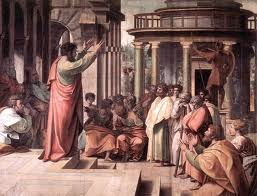
*Athens Revisited (An Exegetical Study of Acts 17) by D.A. Carson

I would like to think that most of us have become convinced of the primacy of what might generically be called worldview evangelism. In the recent past, at least in North America and Europe, evangelism consisted of a fairly aggressive presentation of one small part of the Bible’s story line. Most non-Christians to whom we presented the gospel shared enough common language and outlook with us that we did not find it necessary to unpack the entire plot line of the Bible.

A mere quarter of a century ago, if we were dealing with an atheist, he or she was not a generic atheist but a Christian atheist-that is, the God he or she did not believe in was more or less a god of discernibly Judeo-Christian provenance. The atheist was not particularly denying the existence of Hindu gods — Krishna, perhaps — but the God of the Bible. But that meant that the categories were still ours. The domain of discourse was ours.

When I was a child, if I had said, “Veiled in flesh the Godhead see,” 80 percent of the kids in my school could have responded, “Hail the incarnate deity.” That was because Christmas carols like “Hark, the Herald Angels Sing” were sung in home, church, school, and street. These kids may not have understood all-the words, but this domain of Christian discourse was still theirs. Young people at university doubtless imbibed massive doses of naturalism, but in most English departments it was still assumed you could not plumb the vast heritage of English poetry if you possessed no knowledge of the language, metaphors, themes, and categories of the Bible.

In those days, then, evangelism presupposed that most unbelievers, whether they were atheists or agnostics or deists or theists, nevertheless knew that the Bible begins with God, that this God is both personal and transcendent, that he made the universe and made it good, and that the Fall introduced sin and attracted the curse. Virtually everyone knew that the Bible has two Testaments. History moves in a straight line. There is a difference between good and evil, right and wrong, truth and error, fact and fiction. They knew that Christians believe there is a heaven to be gained and a hell to be feared. Christmas is bound up with Jesus’ birth; Good Friday and Easter, with Jesus’ death and resurrection. Those were the givens.

So what we pushed in evangelism was the seriousness of sin, the freedom of grace, who Jesus really is, what his death is about, and the urgency of repentance and faith. That was evangelism. Of course, we tilted things in certain ways depending on the people we were addressing; the focus was different when evangelizing in different subcultural settings— in the Bible Belt, for instance, or in an Italian-Catholic section of New York, or in an Ivy League university. But for most of us, evangelism was connected with articulating and pressing home a very small part of the Bible’s plot line.

In many seminaries like Trinity, of course, we recognized that missionaries being trained to communicate the gospel in radically different cultures needed something more. A missionary to Japan or Thailand or north India would have to learn not only another language or two but also another culture. No less important, they would have to begin their evangelism farther back, because many of their hearers would have no knowledge of the Bible at all and would tenaciously hold to some worldview structures that were fundamentally at odds with the Bible. The best schools gave such training to their missionary candidates. But pastors and campus workers were rarely trained along such lines. After all, they were doing nothing more than evangelizing people who shared their own cultural assumptions, or at least people located in the same domain of discourse, weren’t they?

We were naive, of course. We were right, a quarter of a century ago, when we sang, “The times they are a-changin’.” Of course, there were many places in America where you could evangelize churchy people who still retained substantial elements of a Judeo-Christian worldview. There are still places like that today: the over-fifties in the Midwest, parts of the Bible Belt. But in the New England states, in the Pacific Northwest, in universities almost anywhere in the country, in pockets of the population such as media people, and in many parts of the entire Western world, the degree of biblical illiteracy cannot be overestimated. One of my students commented a week ago that he was walking in Chicago with his girlfriend, who had a wooden cross hanging from a chain around her neck. A lad stopped her on the sidewalk and asked why she had a plus sign for a necklace. The people whom we evangelize on university campuses usually do not know that the Bible has two Testaments. As Phillip Jensen says, you have to explain to them the purpose of the big numbers and little numbers. They have never heard of Abraham, David, Solomon, Paul — let alone Haggai or Zechariah. They may have heard of Moses, but only so as to confuse him with Charlton Heston.

But this analysis is still superficial. My point is not so much that these people are ignorant of biblical data (though that is true) as that, having lost touch with the Judeo-Christian heritage that in one form or another (sometimes bowdlerized) long nourished the West, they are not clean slates waiting for us to write on them. They are not empty hard drives waiting for us to download our Christian files onto them. Rather, they have inevitably developed an array of alternative worldviews. They are hard drives full of many other files that collectively constitute various non-Christian frames of reference.

The implications for evangelism are immense. I shall summarize four.

First, the people we wish to evangelize hold some fundamental positions that they are going to have to abandon to become Christians. To continue my computer analogy, they retain numerous files that are going to have to be erased or revised, because as presently written, those files are going to clash formidably with Christian files. At one level, of course, that is always so. That is why the gospel demands repentance and faith; indeed, it demands the regenerating, transforming work of the Spirit of God. But the less there is of a common, shared worldview between “evangelizer” and “evangelizee,” between the biblically informed Christian and the biblically illiterate postmodern, the more traumatic the transition, the more decisive the change, the more stuff has to be unlearned.

Second, under these conditions evangelism means starting farther back. The good news of Jesus Christ — who he is and what he accomplished by his death, resurrection, and exaltation — is simply incoherent unless certain structures are already in place. You cannot make heads or tails of the real Jesus unless you have categories for the personal/transcendent God of the Bible; the nature of human beings made in the image of God; the sheer odium of rebellion against him; the curse that our rebellion has attracted; the spiritual, personal, familial, and social effects of our transgression; the nature of salvation; the holiness and wrath and love of God. One cannot make sense of the Bible’s plot line without such basic ingredients; one cannot make sense of the Bible’s portrayal of Jesus without such blocks in place. We cannot possibly agree on the solution that Jesus provides if we cannot agree on the problem he confronts. That is why our evangelism must be “worldview” evangelism. I shall flesh out what this means in a few moments.

Third, not for a moment am I suggesting that worldview evangelism is a restrictively propositional exercise. It is certainly not less than propositional; the Bible not only presents us with many propositions, but it insists in some cases that unless one believes those propositions one is lost. The point can easily be confirmed by a close reading of the gospel of John. For all its complementary perspectives, it repeatedly makes statements like “Unless you believe that . . .” One really ought not be forced to choose between propositions and relational faith any more than one should be forced to choose between the left wing of an airplane and the right. At its core, worldview evangelism is as encompassing as the Bible. We are called not only to certain propositional confession but also to loyal faith in Jesus Christ, the truth incarnate; to repentance from dead works to serve the living God; to life transformed by the Holy Spirit, given to us in anticipation of the consummated life to come; to a new community that lives and loves and behaves in joyful and principled submission to the Word of the King, our Maker and Redeemer. This massive worldview touches everything, embraces everything. It can be simply put, for it has a center; it can be endlessly expounded and lived out, for in its scope it has no restrictive perimeter.

Fourth, the evangelist must find ways into the values, heart, thought patterns — in short, the worldview — of those who are being evangelized but must not let that non-Christian worldview domesticate the biblical message. The evangelist must find bridges into the other’s frame of reference, or no communication is possible; the evangelist will remain ghettoized. Nevertheless, faithful worldview evangelism under these circumstances will sooner or later find the evangelist trying to modify or destroy some of the alien worldview an d to present another entire structure of thought and conduct that is unimaginably more glorious, coherent, consistent, and finally true.

All of this, of course, the apostle Paul well understood. In particular, by his own example he teaches us the difference between evangelizing those who largely share your biblical worldview and evangelizing those who are biblically illiterate. In Acts 13:16-41, we read Paul’s evangelistic address in a synagogue in Pisidian Antioch. The setting, a synagogue, ensures that his hearers are Jews, Gentile proselytes to Judaism, and Godfearers — in every case, people thoroughly informed by the Bible (what we would today call the Old Testament). In this context, Paul selectively narrates Old Testament history in order to prove that Jesus of Nazareth is the promised Messiah. He quotes biblical texts, reasons his way through them, and argues that the resurrection of Jesus is the fulfillment of biblical prophecies about the Holy One in David’s line not seeing decay From Jesus’ resurrection, Paul argues back to Jesus’ death and its significance — ultimately, the forgiveness of sins and justification before God (vv. 38-39). Paul ends with a biblical passage warning of fearful judgment against skepticism and unbelief. Here, then, is the apostolic equivalent to evangelism among churchy folk, biblically literate folk-the kind of people who already, at a certain level, know their Bibles.

In Acts 17:16-34, however, one finds the apostle Paul evangelizing intelligent Athenians who are utterly biblically illiterate. Here his approach is remarkably different, and has much to teach us as we attempt to evangelize a new generation of biblical illiterates.

Now while Paul was waiting for them at Athens, his spirit was provoked within him as he saw that the city was full of idols. So he reasoned in the synagogue with the Jews and the devout persons, and in the marketplace every day with those who happened to be there. Some of the Epicurean and Stoic philosophers also conversed with him. And some said, “What does this babbler wish to say?” Others said, “He seems to be a preacher of foreign divinities”—because he was preaching Jesus and the resurrection. And they took hold of him and brought him to the Areopagus, saying, “May we know what this new teaching is that you are presenting? For you bring some strange things to our ears. We wish to know therefore what these things mean.” Now all the Athenians and the foreigners who lived there would spend their time in nothing except telling or hearing something new. So Paul, standing in the midst of the Areopagus, said: “Men of Athens, I perceive that in every way you are very religious. For as I passed along and observed the objects of your worship, I found also an altar with this inscription, ‘To the unknown god.’ What therefore you worship as unknown, this I proclaim to you. The God who made the world and everything in it, being Lord of heaven and earth, does not live in temples made by man, nor is he served by human hands, as though he needed anything, since he himself gives to all mankind life and breath and everything. And he made from one man every nation of mankind to live on all the face of the earth, having determined allotted periods and the boundaries of their dwelling place, that they should seek God, in the hope that they might feel their way toward him and find him.

Yet he is actually not far from each one of us, for ‘In him we live and move and have our being’; as even some of your own poets have said, ‘For we are indeed his offspring.’ Being then God’s offspring, we ought not to think that the divine being is like gold or silver or stone, an image formed by the art and imagination of man. The times of ignorance God overlooked, but now he commands all people everywhere to repent, because he has fixed a day on which he will judge the world in righteousness by a man whom he has appointed; and of this he has given assurance to all by raising him from the dead.”

Now when they heard of the resurrection of the dead, some mocked. But others said, “We will hear you again about this.” So Paul went out from their midst. But some men joined him and believed, among whom also were Dionysius the Areopagite and a woman named Damaris and others with them.

I have organized the rest of what I have to say under four topics: the realities Paul faces, the priorities he adopts, the framework he establishes, and the nonnegotiable gospel he preaches.

(1) THE REALITIES PAUL FACES

Apart from their obvious biblical illiteracy — these Athenian intellectuals had never heard of Moses, never cracked a Bible — three features of this culture are striking.

First, the Roman Empire was characterized not only by large-scale empirical pluralism but also by government-sponsored religious pluralism. The Romans knew that a captive people were more likely to rebel if they could align religion, land, and people. Partly to break up this threefold cord, the Romans insisted on adopting into their own pantheon some of the gods of any newly subjugated people, and they insisted equally strongly that the newly subjugated people adopt some of the Roman gods. In any potential civil war, therefore, it would be quite unclear which side the gods were helping — and this policy of god-swaps strengthened the likelihood of imperial peace. It also meant that religious pluralism was not only endemic to the Empire but was buttressed by the force of law After all, it was a capital offense to desecrate a temple — any temple. But let no temple and no God challenge Washington — I mean Rome.

Second, like us, Paul was dealing not with people who were biblically illiterate and therefore had no worldview, but with people who vociferously argued for various competing and powerful worldviews.

Two are mentioned in the text: Epicurean and Stoic (v. 18). In the first century, philosophy did not have the fairly esoteric and abstract connotations it has today, connected with minor departments in large universities. It referred to an entire way of life, based on a rigorous and self-consistent intellectual system — close to what we mean by worldview The ideal of Epicurean philosophy, Epicurean worldview, was an undisturbed life — a life of tranquility, untroubled by undue involvement in human affairs.

The gods themselves are composed of atoms so fine they live in calmness in the spaces between the worlds. As the gods are nicely removed from the hurly-burly of life, so human beings should seek the same ideal. But over against this vision, as we shall see, Paul presents a God who is actively involved in this world as its Creator, providential Ruler, Judge, and self-disclosing Savior.

Stoic philosophy thought of god as all-pervasive, more or less in a pantheistic sense, so that the human ideal was to live life in line with what is ultimately real, to conduct life in line with this god/principle of reason, which must rule over emotion and passion. Stoicism, as someone has commented, was “marked by great moral earnestness and a high sense of duty.” Against such a vision, the God that Paul presents, far from being pantheistic, is personal, distinct from the creation, and is our final judge. Instead of focusing on “universal reason tapped into by human reasoning,” Paul contrasts divine will and sovereignty with human dependence and need. In short, there is a massive clash of worldviews.

Of course, there were other Greek and Latin worldviews. There is no mention here of the sophists or of the atheistic philosophical materialists such as Lucretius. What is clear is that Paul here finds himself evangelizing men and women deeply committed to one fundamentally alien worldview or another.

Third, no less striking is the sneering tone of condescension they display in verse 18: What is this babbler trying to say? — this “seed picker,” this little bird fluttering around picking up disconnected scraps of incoherent information, this second-class mind? Others remarked, He seems to be advocating foreign gods. Of course, as it turns out, some of these people become genuinely interested in the gospel. The tenor of condescension is unmistakable, however, when an alien worldview feels secure in its thoughtless majority.

These, then, are the realities Paul faces.

(2) THE PRIORITIES PAUL ADOPTS

The most immediate and striking response of the apostle Paul to all that he witnesses in Athens is an intuitively biblical analysis: he is greatly distressed to see that the city was full of idols (v. 16). Paul might have been overwhelmed by Athens’ reputation as the Oxford or Cambridge or Harvard of the ancient world (though universities per se did not then exist). He might have admired the architecture, gaping at the Parthenon. But Paul is neither intimidated nor snookered by Athens; he sees the idolatry. How we need Christians in our universities and high places who are neither impressed nor intimidated by reputation and accomplishment if it is nothing more than idolatry!

The apostle sets out, then, to evangelize. He aims at two quite different groups. As usual, he attaches a certain priority to evangelizing Jews and Godfearing Gentiles, the churchy folk, the biblically literate people; he reasons in the synagogue with the Jews and the God-fearing Greeks (v. 17a). He has a theological reason for this priority that we cannot examine here, but in any case we must never forget to evangelize such people. Second, he evangelizes the ordinary pagans who have no connection with the Bible: he evangelizes day by day in the market place, targeting anyone who happens to be there, most of whom would have been biblically illiterate (v. 17b). He does not wait for an invitation to the Areopagus. He simply gets on with his evangelism, and the invitation to the Areopagus is the result (v. 18).

These, then, are his priorities: God-centered cultural analysis, and persistent evangelism of both biblical literates and biblical illiterates.

Perhaps I should add that there is at least one fundamental difference between Paul’s situation and ours. When Paul evangelizes biblical illiterates, he is dealing with people whose heritage has not in recent centuries had anything to do with biblical religion. So when they react negatively to him, they do so solely because, from their perspective, his frame of reference is so alien to their own. They are not rejecting him in part because they are still running away from their own heritage. That is the additional problem we sometimes face. We sometimes deal with men and women who have adopted a worldview that is not only at several points profoundly antithetical to a biblical worldview but also self-consciously chosen over against that biblical worldview. That opens up some opportunities for us, but it raises some additional barriers as well. However, we cannot probe these opportunities and barriers here. It is enough to observe the priorities that Paul adopts.

(3) THE FRAMEWORK PAUL ESTABLISHES

Here it will be helpful to run through Paul’s argument from 17:22 to 17:31. Before I do so, however, I want to make three preliminary observations.

First, it takes you about two minutes to read this record of Paul’s address. But speeches before the Areopagus were not known for their brevity. In other words, we must remember that this is a condensed report of a much longer speech. Doubtless every sentence, in some cases every clause, constituted a point that Paul expanded upon at length.

Second, if you want to know a little more closely just how he would have expanded each point, it is easier to discover than some people think. For there are many points of comparison between these sermon notes and, for instance, Romans. I’ll draw attention to one or two of the parallels as we move on.

Third, there is a fascinating choice of vocabulary. It has often been shown that many of the expressions in this address, especially in the early parts, are the sorts of things one would have found in Stoic circles. Yet in every case, Paul tweaks them so that in his context they convey the peculiar emphases he wants to assign to them. In other words, the vocabulary is linguistically appropriate to his hearers, but at the level of the sentence and the paragraph, Paul in this report is saying just what he wants to say; he is establishing a biblical worldview.

Now let us scan the framework Paul establishes.

First, he establishes that God is the creator of the world and everything in it (17:24). How much he enlarged on this point we cannot be certain, but we know from his other writings how his mind ran. The creation establishes that God is other than the created order; pantheism is ruled out. It also establishes human accountability; we owe our Creator everything, and to defy him and set ourselves up as the center of the universe is the heart of all sin. Worse, to cherish and worship created things instead of the Creator is the essence of idolatry.

Second, Paul insists that God is the Lord of heaven and earth and does not live in temples built by hands (v. 24). The sovereignty of God over the whole universe stands over against views that assign this god or that goddess a particular domain — perhaps the sea (Neptune), or tribal gods with merely regional or ethnic interests. The God of the Bible is sovereign over everything. This teaching grounds the doctrine of providence. Because of the universality of his reign, God cannot be domesticated — not even by temples (v. 24). Paul is not denying the historical importance of the temple in

Jerusalem, still less that God uniquely disclosed himself there. Rather, he denies that God is limited to temples, and that he can be domesticated or squeezed or tapped into by the cultus of any temple (which of course threatens popular pagan practice). He is so much bigger than that.

Third, God is the God of aseity: he is not served by human hands, as if he needed anything (17:25). Aseity is a word now largely fallen into disuse, though it was common in Puritan times. Etymologically it comes from the Latin a se — “from himself.” God is so utterly “from himself” that he does not need us; he is not only self-existent (a term we often deploy with respect to God’s origins — the existence of everything else is God-dependent, but God himself is self-existent), but he is utterly independent of his created order so far as his own well-being or contentment or existence are concerned. God does not need us — a very different perspective from that of polytheism, where human beings and gods interact in all kinds of ways bound up with the finiteness and needs of the gods. The God of the Bible would not come to us if, rather whimsically, he wanted a McDonald’s hamburger; the cattle on a thousand hills are already his.

Fourth, the truth of the matter is the converse: we are utterly dependent on him — he himself gives all men life and breath and everything else (v. 25b). This strips us of our vaunted independence; it is the human correlative of the doctrines of creation and providence.

Fifth, from theology proper, Paul turns to anthropology. He insists that all nations descended from one man (v. 26). This contradicts not a few ancient notions of human descent, which conjectured that different ethnic groups came into being in quite different ways. But Paul has a universal gospel that is based on a universal problem (cf. Rom. 5; 1 Cor. 15). If sin and death were introduced into the one human race by one man such that the decisive act of another man is required to reverse them, then it is important for Paul to get the anthropology right so that the soteriology is right. We cannot agree on the solution if we cannot agree on the problem. But Paul’s stance has yet wider implications; there is no trace of racism here. Moreover, however much he holds that God has enjoyed a peculiar covenant relationship with Israel, because he is a monotheist, Paul holds that God must be sovereign over all the nations. Did he, perhaps, develop some of the lines of argument one finds in Isaiah 40ff.? If there is but one God, that God must in some sense be the God of all, whether his being and status are recognized by all or not.

Sixth, for the first time one finds an explicit reference to something wrong in this universe that God created. His providential rule over all was with the purpose that some would reach out for him and find him (v. 27). In short order Paul will say much more about sin (without actually using the word). Here he is preparing the way. The assumption is that the race as a whole does not know the God who made them. Something has gone profoundly wrong.

Seventh, although it has been important for him to establish God’s transcendence, Paul does not want such an emphasis to drift toward what would later be called deism. The God he has in mind is not far from each one of us (v. 27). He is immanent. Paul will not allow any suspicion that God is careless or indifferent about people; he is never far from us. Moreover, the apostle recognizes that some of this truth is acknowledged in some pagan religions. When Greek thought (or much of it) spoke of one “God” as opposed to many gods, very often the assumption was more or less pantheistic. That structure of thought Paul has already ruled out. Still, some of its emphases were not wrong if put within a better framework. We live and move and have our being in this God, and we are his offspring (17:28) — not, for Paul, in some pantheistic sense, but as an expression of God’s personal and immediate concern for our well-being.

Eighth, the entailment of this theology and this anthropology is to clarify what sin is and to make idolatry utterly reprehensible (v. 29). Doubtless Paul enlarged this point very much in terms of, say, Isaiah 44-45 and Romans 1. For he cannot rightly introduce Jesus and his role as Savior until he establishes what the problem is; he cannot make the good news clear until he elucidates the bad news from which the good news rescues us.

Ninth, Paul also introduces what might be called a philosophy of history — or better, perhaps, a certain view of time. Many Greeks in the ancient world thought that time went round and round in circles. Paul establishes a linear framework: creation at a fixed point; a long period that is past with respect to Paul’s present in which God acted in a certain way (In the past God over-looked such ignorance); a now that is pregnant with massive changes; and a future (v. 31) that is the final termination of this world order, a time of final judgment. The massive changes of Paul’s dramatic now are bound up with the coming of Jesus and the dawning of the gospel. Paul has set the stage so as to introduce Jesus.

So here is the framework Paul establishes. He has, in fact, constructed a biblical worldview. But he has not done so simply for the pleasure of creating a worldview. In this context he has done so in order to provide a framework in which Jesus himself, not least his death and resurrection, makes sense. Otherwise nothing that Paul wants to say about Jesus will make sense.

This is the framework Paul establishes.

(4) THE NONNEGOTIABLE GOSPEL PAUL PREACHES

We read again verse 31: For [God] has set a day when he will judge the world with justice by the man he has appointed. He has given proof of this to all men by raising him from the dead.

Here, at last, Jesus is introduced.

I want to emphasize two things. First, it is extraordinarily important to see that Paul has established the framework of the biblical metanarrative before he introduces Jesus. If metaphysics is a sort of big physics that explains all the other branches of physics, similarly metanarrative is the big story that explains all the other stories. By and large, postmodernists love stories, especially ambiguous or symbol-laden narratives. But they hate the metanarrative, the big story that makes all the little stories coherent. But what Paul provides is the biblical metanarrative. This is the big story in the Bible that frames and explains all the little stories. Without this big story, the accounts of Jesus will not make any sense — and Paul knows it.

For instance, if in a vague, New Age, postmodern context, we affirm something like “God loves you,” this short expression may carry a very different set of associations than we who are Christians might think. We already assume that men and women are guilty and that the clearest and deepest expression of God’s love is in the cross, where God’s own Son dealt with our sin at the expense of his own life. But if people know nothing of this story line, then the same words, “God loves you,” may be an adequate summary of the stance adopted by Jodie Foster in her recent film, Contact. The alien power is beneficent, wise, good, and interested in our well-being. There is nothing whatever to do with moral accountability, sin, guilt, and how God takes action to remove our sin by the death of his Son. The one vision nestles into the framework of biblical Christianity; the other nestles comfortably into the worldview of New Age optimism. In short, without the big story, without the metanarrative, the little story or the little expression becomes either incoherent or positively misleading. Paul understands the point.

Second, what is striking is that Paul does not flinch from affirming the resurrection of Jesus from the dead. And that is what causes so much offense that Paul is cut off, and the Areopagus address comes to an end. Paul was thoroughly aware, of course, that most Greeks adopted some form of dualism. Matter is bad, or at least relatively bad; spirit is good. To imagine someone coming back from the dead in bodily form was not saying anything desirable, still less believable. Bodily resurrection from the dead was irrational; it was an oxymoron, like intelligent slug or boiled ice. So some of Paul’s hearers have had enough, and they openly sneer and end the meeting (v. 32). If Paul had spoken instead of Jesus’ immortality, his eternal spiritual longevity quite apart from any body, he would have caused no umbrage. But Paul does not flinch. Elsewhere he argues that if Christ has not been raised from the dead, then the apostles are liars, and we are still dead in our trespasses and sins (I Cor. 15). He remains faithful to that vision here. Paul does not trim the gospel to make it acceptable to the worldview of his listeners.

For Paul, then, there is some irreducible and nonnegotiable content to the gospel, content that must not be abandoned, no matter how unacceptable it is to some other worldview. It follows that especially when we are trying hard to connect wisely with some worldview other than our own, we must give no less careful attention to the nonnegotiables of the gospel, lest in our efforts to communicate wisely and with relevance, we unwittingly sacrifice what we mean to communicate.

But suddenly we overhear the muttered objection of the critic. Can it not be argued that Paul here makes a fundamental mistake? Elsewhere in Acts he frequently preaches with much greater fruitfulness, and in those cases he does not stoop to all this worldview stuff. He just preaches Jesus and his cross and resurrection, and men and women get converted. Here, a piddling number believe (v. 34). In fact, Paul’s next stop in Greece after Athens is Corinth. Reflecting later on his experiences there, Paul writes to the Corinthians and reminds them For I resolved to know nothing while I was with you except Jesus Christ and him crucified (I Cor. 2:2) — doubtless because he was reflecting with some sour-faced chagrin on his flawed approach in Athens. So let us be frank, the critics charge, and admit that Paul made a huge mistake in Athens and stop holding up Acts 17 as if it were a model of anything except what not to do. The man goofed: he appealed to natural theology; he tried to construct redemptive history; he attempted to form a worldview when he should have stuck to his last and preached Jesus and the cross.

I sometimes wish this reading were correct, but it is profoundly mistaken for a number of reasons.

(1) It is not the natural reading of Acts. As Luke works through his book, he does not at this point in his narrative send up a red flag and warn us that at this point Paul makes a ghastly mistake. The false reading is utterly dependent on taking I Corinthians in a certain way (a mistaken way, as we shall see), and then reading it into Acts 17.

(2) What Paul expresses, according to Luke’s report of the Areopagus address, is very much in line with Paul’s own theology, not least his theology in the opening chapters of Romans.

(3) Strictly speaking, Paul does not say that only a “few” men believed. He says tines de andres, “certain people,” along with heteroi, “others.” These are in line with other descriptions. The numbers could scarcely have been large, because the numbers in the Areopagus could not have been very large in the first place.

(4) Transparently, Paul was cut off when he got to the resurrection of Jesus (vv. 31-32). But judging from all we know of him — both from a book like Romans and from the descriptions of him in Acts — we know where he would have gone from here.

(5) That is entirely in line with the fact that what Paul had already been preaching in the marketplace to the biblically illiterate pagans was the cc gospel” (v. 18).

(6) At this point in his life Paul was not a rookie. Far from being fresh out of seminary and still trying to establish the precise pattern of his ministry, on any chronology he had already been through twenty years of thrilling and brutal ministry. Nor is this Paul’s first time among biblically illiterate pagans or among intellectuals.

(7) In any case, I Corinthians 2 does not cast Paul’s resolve to preach Christ crucified against the background of what had happened to him in Athens. He does not say, in effect, “Owing to my serious mistakes in Athens, when I arrived in Corinth I resolved to preach only Christ and him crucified.” Rather, in 1 Corinthians Paul’s resolve to preach Christ crucified is cast against the background of what Christians in Corinth were attracted to — namely, to a form of triumphalism that espoused an ostensible wisdom that Paul detests. It is a wisdom full of pride and rhetoric and showmanship. Against this background, Paul takes a very different course. Knowing that believers must boast only in the Lord and follow quite a different wisdom (I Cor. 1), he resolves to preach Christ and him crucified.

(8) In any case, it would be wrong to think that Paul has no interest in worldviews. Writing after I Corinthians 2, Paul can say, We demolish arguments and every pretension that sets itself up against the knowledge of God, and we take captive every thought to make it obedient to Christ (2 Cor. 10:45). The context shows that Paul is not here interested so much in disciplining the individual’s private thought life (though that certainly concerns him elsewhere) as in bringing into obedience to Christ every thought structure, every worldview, that presents opposition to his beloved Master. In other words, Paul thought “worldviewishly” (if that is not too monstrous a neologism). That is clear in many of his writings; it is clear in both 2 Corinthians 10 and in Acts 17.

(9) Finally, the first line of Acts 17:34 is sometimes misconstrued: “A few men became followers of Paul and believed.” Many have assumed Luke means that a few people became Christians on the spot and followers of Paul. But that reverses what is said. Moreover, Paul has not yet given much gospel — in precisely what sense would they have become Christians? It is better to follow the text exactly Following Paul’s address, no one became a Christian on the spot. But some did become followers of Paul. In consequence, in due course they grasped the gospel and believed; they became Christians. This is entirely in line with the experience of many evangelists working in a university environment today.

A couple of years ago I spoke evangelistically at a large meeting in Oxford. So far as I know, no one became a Christian at that meeting. But sixteen students signed up for a six-week “Discovering Christianity” Bible study. A few weeks after the meeting, the curate, Vaughan Roberts, wrote me a note to tell me that eleven of the sixteen had clearly become Christians already, and he was praying for the remaining five. In other words, as a result of that meeting, some became “followers of Jesus,” and in due course believed. That is often the pattern when part of the evangelistic strategy is to establish a worldview, a frame of reference, to make the meaning of Jesus and the gospel unmistakably plain.

In short, however sensitive Paul is to the needs and outlook of the people he is evangelizing, and however flexible he is in shaping the gospel to address them directly, we must see that there remains for him irreducible content to the gospel. That content is nonnegotiable, even if it is remarkably offensive to our hearers. If it is offensive, we may have to decide whether it is offensive because of the intrinsic message or because we have still not done an adequate job of establishing the frame of reference in which it alone makes sense. But the gospel itself must never be compromised.

SOME CONCLUDING REFLECTIONS

I offer three concluding reflections. First, the challenge of worldview evangelism is not to make simple things complicated but to make clear to others some fairly complicated things that we simply assume. This can be done in fifteen minutes with the sort of presentation Phillip Jensen and Tony Payne have constructed (in Chapter 6 of Telling the Truth – “Two Ways To Live”). It might be done in seven consecutive expositions running right through the first eight chapters of Romans. It might be done with the six months of Bible teaching, beginning with Genesis, that many New Tribes Mission personnel now use before they get to Jesus. But it must be done.

Second, the challenge of worldview evangelism is not primarily to think in philosophical categories, but it is to make it clear that closing with Jesus has content (it is connected with a real, historical Jesus about whom certain things must be said and believed) and is all-embracing (it affects conduct, relationships, values, priorities). It is not reducible to a preferential religious option among many, designed primarily to make me feel good about myself.

Third, the challenge of worldview evangelism is not primarily a matter of how to get back into the discussion with biblically illiterate people whose perspectives may be very dissimilar to our own. Rather, worldview evangelism focuses primarily on where the discussion goes. There are many ways of getting into discussion; the crucial question is whether the Christian witness has a clear, relatively simple, straightforward grasp of what the Bible’s story line is, how it must give form to a worldview, and how the wonderful news of the gospel fits powerfully into this true story — all told in such a way that men and women can see its relevance, power, truthfulness, and life-changing capacity.

*”Athens Revisited” was originally a lecture at a conference on the topic of Evangelism in a Post Modern Culture held on May 13-15, 1998 at Trinity Evangelical Divinity School in Deerfield, Illinois & sponsored by the Bannockburn Institute (www.biccc.org). All the lectures from this conference were published in the book: Telling The Truth: Evangelizing Postmoderns, Grand Rapids: Zondervan, 2000; of which D.A. Carson was the general editor and the contributor of Chapter 28 from which this article is adapted.
About the Author: D. A. Carson (Ph.D., University of Cambridge) is research professor of New Testament at Trinity Evangelical Divinity School in Deerfield, Illinois. His theology is similar to that of Wayne Grudem except on charismatic issues, where his view may be described as “open but cautious.” Carson’s tendency is to strive for balance and amicability in disputes but is uncompromising on the essentials of the faith. He is a complementarian but supports gender-neutral Bible translations. Carson also helped produce the NLT. He is the author or coauthor of over 50 books. Some of the plethora of outstanding books he has written includes: The Intolerance of Tolerance, The God Who Is There, ScandalousHow Long O Lord, A Call to Spiritual Reformation; The Cross and Christian Ministry; The Difficult Doctrine of the Love of God; Divine Sovereignty and Human Responsibility; Exegetical Fallacies; For the Love of God; The Gagging of God; The Inclusive Language Debate; Introduction to the New Testament; New Testament Commentary Survey; Scripture and Truth (Ed. with John Woodbridge); Worship by the Book; Pillar Commentaries on Matthew and John and a contributor to Who Will be Saved. He also edits the New Studies in Biblical Theology book series.

Carson’s areas of expertise include biblical theology, the historical Jesus, postmodernism, pluralism, Greek grammar, Johannine theology, Pauline theology, and questions of suffering and evil. He has written books on free will and predestination from a generally compatibilist and Calvinist perspective. He is a member of the Tyndale Fellowship for Biblical Research, the Society of Biblical Literature, the Evangelical Theological Society, the Canadian Society of Biblical Studies, and the Institute for Biblical Research.

Dr. Carson and his wife, Joy, reside in Libertyville, Illinois. They have two children. In his spare time, Dr. Carson enjoys reading, hiking, and woodworking.

“Prophecy and the Bible” By James Montgomery Boice

What The Bible Has To Say About The Future:

Part 1 in a Series of 9 By *James M. Boice

Years ago the noted English agnostic Thomas Huxley was in Dublin, Ireland, for some speaking engagements. On one occasion he left his hotel in a hurry to catch a train, taking one of the city’s famous horse drawn taxis. Huxley thought that the doorman at the hotel had told the driver where he was going, so he simply settled back in the cab and told the man at the reins to drive fast. The driver set off at a vigorous pace. In a few minutes Huxley realized that the cab was headed away from the station. “Do you know where you are going?” he shouted to the driver, “No, your honor,” the driver answered, “but I’m driving fast.”

This story seems to sum up more than just the spirit of Huxley and his followers toward the end of the nineteenth century. It is also an illustration of the outlook of many in our tumultuous age. There is much motion, much speed. Yet few in our day seem to know where they are or where they are headed. For most of our contemporaries, life is as Franklin Delano Roosevelt described it in his inaugural address: “We don’t know where we are going but we are on our way.”

This state of affairs is completely abnormal, of course. Or, to put another way, the confusion is not God’s fault. In fact, God’s revelation in the Bible exists to accomplish just the opposite. The Bible is God’s revelation to men of where we have been, where we are, and where we are headed. It is a revelation of our past, present, and future; and these are revealed, not only in reference to the individual, but also as the concern nations and the movements of history. What will happen to us in the years to come? Where is history headed? How will it end? Is God in control or has He forgotten us? Do the events of our life have significance?

If you are interested in these questions and have not been satisfied with the predictions of politicians or pollsters, then this series of studies of what the Bible has to say about the future is for you.

 Why Study Prophecy?

 I must admit that for many years I have been reluctant to write on this subject – for two reasons. First, I believe that in the last generation there has been an overemphasis on prophecy in the writings of certain evangelical leaders. Prophecy is a part of the Bible. It should be studied. Yet sometimes prophecy has been discussed to the exclusion of many other vital and urgent doctrines. That is inexcusable when some still do not know about sin or about Christ’s atonement.

The second reason that I have hesitated to write on this subject has been an inner suspicion that much teaching on prophecy has been directed toward a wrong level of involvement both for the teacher and for the listener. Many are interested in prophecy solely because of a desire to know something that no one else knows, to have the final word on things to come in the future. In some circles this has led to a certain smugness which has destroyed the very compassion and outreach to humanity that a true understanding of the subject is intended to produce.

Since in the face of such misgivings, I have decided to write a series on biblical prophecy, it would be well to give you my reasons. There are four of them.

Four Reasons To Study Biblical Prophecy

First, for anyone who has determined, as I have, to explore the whole counsel of God by means of a thorough exposition of the Bible, it is impossible to avoid prophecy, for the Bible is full of it. In fact, from one point of view, the Bible is almost entirely prophecy. It is the record of God’s promises of a Redeemer and of the salvation of the human race, together with a record of the fulfillment of those promises insofar as they occurred. One-fourth of the Bible is specifically prophetic. Whole books, both in the Old Testament and the New Testament, are devoted to prophecy. It is a recognition of this fact that has led most good Bible students to treat the subject at least to some degree. A list of them would include such names as Sir Isaac Newton, Blaise Pascal, Jonathan Edwards, H.A. Ironside, I.M. Haldeman, C.I Scofield, Arno C. Gaebelein, G.H. Pember, and, in our day, J. Dwight Pentecost, Hal Lindsey, Billy Graham, and many others.

It is relevant here to point out that 2 Timothy 3:16-17 does not let us regard prophecy, any more than any other part of Scripture, as unprofitable. For we are told, “all Scripture is given by inspiration of God and profitable for doctrine, for reproof, for correction, for instruction in righteousness, that the man of God may be perfect, thoroughly furnished unto all good works.”

My second reason for treating prophetic themes at this time is the current secular interest in the future, particularly as shown by the involvement of many with astrology and spiritualism. It is true that humanity has had an interest in the future throughout history. The Babylonians, Egyptians, Greeks, and Romans all had fortune-telling priests and astrologers. Although condemned by Christianity, astrology was popular in the western world until after the Renaissance, when increased scientific study discredited it. However, the study of astrology has revived in recent years. Today an interest in the future is everywhere apparent. Astrological signs abound. Newstands are filled with books and pamphlets on what is to come. Astrology was brought to the popular level by the rock musical Hair, with its highly successful song “Aquarius.” Millions consult their horoscopes daily. In fact, according to Hal Lindsey, a new and popular writer on prophecy, columns on astrology now run in 1220 of 1750 daily newspapers in the United States. Twenty years ago only 100 papers ran astrology columns.

There is also an interest in the more popular prophets of the day such as Jeanne Dixon, Carroll Righter, and Syndey Omarr. In Europe there are literally thousands of mediums. According to one estimate, there is a fortune-teller for every 120 Parisians. I have been told that there are over 200 mediums in the city of Zurich, Switzerland, alone. Certainly, this kind of interest needs to be countered by the legitimate biblical approach to the events associated with the culmination of our age.

The third reason is the current renewed interest in biblical eschatology by established theologians. The best known of these is the German theologian named Juergen Moltmann, a professor of systematic theology at the University of Tuebingen. His first widely successful book, The Theology of Hope, is an attempt to look at all Christian doctrine from the perspective of God’s future promises, and it has set off a wide range of related studies by others. Thus, although a generation ago many scholars laughed at any interest on the part of conservatives in biblical prophecy, today many would agree with Henry P. Van Dusen who has argued that “the problem of eschatology my shortly become, if it is not already, the framework of American theological discussion,” and perhaps indeed of theological discussion generally (Henry P. Van Dusen, “A Preview of Evanston,” Union Seminary Quarterly Review, March, 1954, p.8).

God’s Challenge

My fourth and final reason for writing this series of studies is the most important one, however. It completely overshadows the others. The reason is this: God Himself appeals to the fulfillment of prophecy as evidence that He alone is God and that He is faithful to all who follow Him. In fact, He challenges those who do not yet believe to investigate personally the fulfillment of biblical prophecy.

I know that some will say, “But I have never heard of that. Where in the Bible does God make such an appeal?” God does so in many places, but the greatest appeal is in a section of nine chapters from the heart of the book of Isaiah, chapters 40-48. The theme of these chapters is the greatness and majesty of the true God, and the appeal is to prophecy.

In chapter 40 God begins by contrasting His own performance on behalf of His people with the performance of idols. The point is that the idols can do nothing.

To who then will you liken God?

Or what likeness will you compare with Him?

As for the idol, a craftsman casts it,

A goldsmith plates it with gold,

And a silversmith fashions chains of silver.

He who is too impoverished for such an offering

Selects a tree that does not rot:

He seeks out for himself a skillfull craftsman

To prepare an idol that will not totter. (Isaiah 40:18-20, NASB)


In the next chapter an appeal is made to the idols:

“Present your case,” the LORD says.

“Bring forward your strong arguments,”

The King of Jacob says.

Let them bring forth and declare to us what is going to take place;

As for the former events, declare what they were,

That we may consider them, and know their outcome;

Or announce to us what is coming.

Declare the things that are going to come afterward,

That we may know that you are gods;

Indeed, do good or evil,

that we may anxiously look about us and fear together.

Behold, you are of no account,

And your work amounts to nothing;

He who chooses you is an abomination. (Isaiah 41:21-24, NASB)

The point of these verses is that the idols are ineffective. No one but God Himself can tell the future, since no one but God can control it. The argument continues in this vein for several chapters until it is summed up in chapter 48, “Who can foretell the future?” God asks.

I declared the former things long ago

And they went forth from My mouth, and I proclaimed them.

Suddenly I acted, and they came to pass. (Isaiah 48:3, NASB)

This is the test of the true God and of the one who claims to speak in His name. No one in biblical times – or today, for that matter – doubts that there are people in every age who will pretend to possess insight into future events. The idols, as well as Jehovah, had their prophets. There have always been astrologers and mystics. But the question is not “Are there prophets?” The question is “Whose prophecies come true?” By this standard, it is the claim of God and of the Bible that all that is prophesied in the Bible has either come to pass or is coming to pass and that men should believe on the God of the Bible because of it.

God’s Spokesman

In this series we will be looking primarily at the biblical prophecies of things that have not yet come to pass. Yet it would be inadequate to look at prophecies that relate to the future without at least considering some of the many prophecies that are also part of the biblical revelation. For one thing, we need to look at the past to meet God’s challenge to Isaiah. For another, only as we do this will we be able to approach the future prophecies, not as guesses by reasonably intelligent men, but rather as further divine revelations, through those who have already been tested, of what awaits this race and the individuals in it.

An excellent place to begin is with a little known prophet, Micaiah. His story is told in 1 Kings 22. Micaiah was a prophet of God in Israel during the days of the divided monarchy when Ahab was king of Israel and Jehoshaphat was king of Judah. At one point in their reigns Jehoshaphat went north to visit Ahab, and the two kings got into a discussion about an area of ancient Palestine called Ramoth-gilead, which bordered on Israel. Ahab had wanted the land for some time, and he saw an opportunity in Jehoshaphat’s visit to possess it. He suggested, “We could take Ramoth-gilead if we did it together, you and I. Shall we do it?”

Jehoshaphat answered, “I am as thou art, my people as thy people, my horses as thy horses.” Ahab was not a worshiper of Jehovah and, in fact, was quite wicked, while Jehoshaphat was more or less a believer in God. So, before they went to battle, Jehoshaphat said, “Let’s consult the Lord before we break camp.” Ahab responded by producing four hundred of his court prophets and asking them, “Shall I go against Ramoth-gilead to battle, or shall I forbear?” The prophets gave the answer that the king wanted to hear.

“Go up; for the Lord shall deliver it into the hand of the king.” This word from the prophets satisfied king Ahab (actually, he would gone even without consulting the prophets) but Jehoshaphat was not satisfied. These men were paid mouthpieces, and Jehoshaphat knew it. So he said to Ahab, “But isn’t there a real prophet, a prophet of the Lord, that we may ask the outcome from him?” Ahab replied that there was one, a man named Micaiah, but that he hated Micaiah because Micaiah never prophesied anything good about him, only evil. Nevertheless, at Jehoshaphat’s insistence, Micaiah was called.

Now if ever there was a situation in which the deck was stacked against one poor prophet, this was it. First, Micaiah was warned as to what he should say. Second, he was brought into the capital city and into the marketplace where all the troops, the false prophets, and the two kings were assembled. Third, he was confronted by the king who hated and feared him. The question was asked: Micaiah, shall we go against Ramoth-gilead to battle; or shall we forbear?”

At first Micaiah ridiculed the kings. He said, “Go and prosper; for the LORD shall deliver it into the hand of the king.” What Micaiah said was a direct quotation of the false prophets, and everyone knew it. Ahab became angry. He literally roared at Micaiah: “I adjure thee that thou tel me nothing but that which is true in the name of the LORD.” So Micaiah replied, “I saw all Israel scattered upon the hills, as sheep that have not a shepherd. And the LORD said, These have no master; let them return every man to his house in peace.”

Ahab recognized that this was a prophecy of his death. He turned to Jehoshaphat and said, “See? What did I tell you? Didn’t I say that he would prophesy no good about me, only evil?” Ahab then disguised himself. But in the fighting one of the Syrian soldiers shot an arrow at random which entered a joint in Ahab’s armor and killed him. So the king died and the people of Israel were scattered, as Micaiah had prophesied.

Isaiah

A much better known prophet is Isaiah. Isaiah had a long life, prophesying over a period of sixty years, during the lifetimes of four successive kings of Judah. Many of his prophecies have been fulfilled, some during and others after his lifetime.

In the year 701 B.C., in the fourteenth year of the reign of King Hezekiah (the third king under whom Isaiah prophesied), the Assyrian king Sennacherib besieged the city of Jerusalem, threatening its total destruction. Sennacherib later wrote that he shut up Hezekiah “like a caged bird…in…his royal city.”

In the midst of the siege, which dragged on and on because of the city’s strong fortifications, Sennacherib sent one of his deputies named Rabshaketh to Jerusalem with a speech intended to weaken the morale of the defenders and perhaps lead to a revolt within the city and subsequent surrender. Rabshaketh spoke in Hebrew, rehearsing all that had happened to other cities and then threatening the same fate for the inhabitants of Jerusalem. The speech had a deadly effect, so much so, in fact, that the city officials asked Rabshaketh to speak Aramaic, the language of international diplomacy, lest the people be further discouraged by hearing him. At this confession of weakness, the deputy merely kept on with his destructive propaganda.

Word came to Hezekiah of what was happening, and he was dismayed. He sent to Isaiah and asked him to pray for the people and the city. Instead, Isaiah immediately sent back a prediction of what would happen. He said, “Thus saith the LORD, Be not afraid of the words which thou hast heard, with which the servants of the king of Assyria have blasphemed me. Behold, I will send a blight upon him, and he shall hear a rumor, and shall return to his own land; and I will cause him to fall by the sword in his own land” (2 Kings 19:6, 7; Is. 37:6,7).

That is precisely what happened. Soon a plague swept through Sennacherib’s army. Then the king apparently heard rumors of rebellion and insurrection at home, and the army left Palestine. Sennacherib was assassinated by two of his sons when he returned to Nineveh (2 Kings 19:35-37).

Later Isaiah predicted the fall of Jerusalem to the armies of Babylon, the captivity of the people, the overthrow of Babylon by the Medes and the Persians, and the eventual return of the Jewish exiles to their homeland. All these events took place roughly one hundred, one hundred fifty, and two hundred years after Isaiah had foretold them.

Prophecies of the Messiah

Spectacular as these specific prophecies relating to Jewish history are, however, the most important of Isaiah’s prophecies are not those relating to the nation at all. They are the prophecies of the Messiah. Here, however, the testimony of Isaiah is supplemented by the predictions of many other prophets who lived both before and after his time.

These men told a great deal about the Messiah and they told it in exquisite detail. The Old Testament tells us that the Messiah was to be a descendent of Abraham through King David (2 Sam. 7:12, 13; 1 Chron. 17:11-14; Jer. 23:5). Micah, one of the so-called Minor Prophets, wrote that the Messiah would be born in Bethlehem (Mic. 5:2). This prophecy was quoted by the Jewish leaders in Jerusalm as an answer to the Wise Men, who came to the city inquiring where the King of the Jews had been born. Isaiah revealed that the Messiah would be the child of a virgin (Isa. 7:14). He also foretold the King’s rejection by Israel and described His suffering (Isa. 53). Zechariah spoke of the price of the Messiah’s betrayal: “So they weighed for my price thirty pieces of silver” (Zech 11:12). Parts of the Psalms describe the crucifixion and intense suffering of the Chosen One; Psalm 22 contains prophecies of the mocking of the Messiah, the piercing of His hands and feet, and the division of His garments by those who carried out his execution.

In Daniel there is even a prophecy of the time at which this would take place. The Messiah was to come shortly before the destruction of the temple built by Herod; that is, before A.D. 70 (Dan. 9:24-26). Moreover, Daniel foretold that the time between the publishing of the decree permitting the rebuilding of the temple after the destruction of the first temple by the Babylonians and the “cutting off” of the Messiah would not exceed 483 years (69 weeks of years or 69 times 7). Since the date of the decree to permit the building of the temple has been fixed from several sources at 445 B.C., the latest possible date for the death of the Messiah is fixed at A.D. 38, meaning that if the prophecies of the Bible are correct, all the events foretold about the Messiah had to be fulfilled before that time (note: The prophecy may be even more accurate than these figures show. For if, as Charles C. Ryrie argues, the “years” of Daniel are based upon 360 rather than 365 days, the prophecy spans 173,880 days and the cutoff date for the Messiah falls on 6 April A.D. 32, the most probable date for Christ’s crucifixion. Justification for a 360-day year lies in the fact that the Scriptures seem to equate 1260 days with 42 months or 31/2 years in prophetic passages, See Ryrie, “The Bible and Tommorow’s News”, Wheaton, ILL.: Scripture Press, n.d., pp.52-56).

Were these prophecies fulfilled? Of course, they were fulfilled. They were fulfilled in the genealogy, birth, life, death, and resurrection of Jesus of Nazareth, who is thereby identified as the Messiah, the Son of God.

A Future World

In Part Two of our series we will begin to look at the biblical prophecies of things to come. But before we do that, we need to take note of the following three conclusions. First, if the prophecies we have already looked at have been fulfilled, as the Bible and history reveal them to have been fulfilled, then the  God of the Bible is the true God and we should worship Him. That is the conclusion that must be reached if we take God’s own challenge through the prophet Isaiah seriously.

Second, if these prophecies have been fulfilled, as we know them to have been fulfilled, then the Bible is a supernaturally trustworthy and totally authoritative book. This will guide our approach as we turn to future things. The Bible is a record of prophecy. If the prophecies have been fulfilled, then what Peter said about this Book is true. “No prophecy of the Scripture is of any private interpretation. For the prophecy came not at any time by the will of man, but holy men of God spoke as they were moved by the Holy Spirit” (2 Pet. 1:20, 21). God Himself stands behind this Book. It follows that we can trust the Bible for what it has to say about our own condition and about God’s plan of salvation through the death and resurrection of Jesus Christ.

Finally, if the biblical prophecies about the past events have come true and if we may expect the biblical prophecies about future events to come true, then the future is bright for those who believe in the Lord Jesus Christ and are His followers. One day the rays of the sun will rise on that last and future world that has been spoken of so much by our contemporaries. But it will not be a world devastated by an atomic holocaust, as some are predicting. It will not be a world decimated by the inevitable encroachment of worldwide famine, which others are warning about. It will not even be a dehumanized world composed of machines and the men who serve them. These things may come. The Bible even predicts that some of them will come. But this will not be the end. The Bible teaches that there is a future beyond them when the Lord Jesus Christ, the Messiah who came once to suffer and will return again, will reign in righteousness and will establish a social order in which love and justice will prevail.

[This article was adapted from Chapter One in one of the first of James Boice’s plethora of books, and is entitled: The Last and Future World, Grand Rapids, MI.: Zondervan, 1974. Though this book was written almost 40 years ago – it’s contents are just as relevant today as when it was first written, since most of the prophecies taught in the Scriptures and addressed by Dr. Boice have yet to be fulfilled.]

*Dr. James Montgomery Boice (July 7, 1938 – June 15, 2000) was a Reformed theologian, Bible teacher, and pastor of Tenth Presbyterian Church in Philadelphia from 1968 until his death. He is heard on The Bible Study Hour radio broadcast and was a well known author and speaker in evangelical and Reformed circles. He also served as Chairman of the International Council on Biblical Inerrancy for over ten years and was a founding member of the Alliance of Confessing Evangelicals. He was the author of numerous expositions of the Bible (e.g. Genesis and Romans), Theological writings (e.g. Whatever Happened to Grace? & Foundations of the Christian Faith), and on the practical Christian life (e.g. Living By The Book & The Cost of Discipleship).

News Alert: Blue Like JAZZ or Red Like BLOOD?

Blue Like Jazz, the movie, is set to hit the theatres April 13.  The hype is big.  South by Southwest premiered it on March 10.  Relevant Magazine is featuring information about the movie tour on their website.  This is great, but there’s one major problem:

 The gospel is missing!

The great thing about the book Blue Like Jazz is that Don Miller is a fantastic writer. Blue Like Jazz wrestles honestly with the intersection of life and faith.  Miller’s open and engaging style appeals to those (both Christian and non-Christian) looking for an honest conversation about making sense of the world we live in.  The release of the Blue Like Jazz movie has tremendous potential to present Christianity as profoundly relevant to daily life.  So what’s the problem? 

The gospel is missing.  And without the gospel, all the cool, relevant, honest writing in the world is powerless to transform us. 

Over the next several months the Red Like Blood blog will be featuring reviews and commentary on the Blue Like Jazz movie.  The release of this movie will create a resurgence of interest in Blue Like Jazz and the conversation it has started.  Red Like Blood was written to take that conversation to the place it becomes truly relevant – the cross.

The authors of Red Like Blood have recently set up a new website: www.bluelikejazzorredlikeblood.com, where they will point visitors to their reviews and commentary on the Blue Like Jazz movie.  We’re looking for ways to get the word out about this new website, and we’d like your help.  Donald Miller says Jazz doesn’t resolve. He’s right. But God’s plan of redemption does resolve. At the cross. 

As the release of the Blue Like Jazz movie takes place, we will keep you informed of ways that you and your readers can participate in this exciting opportunity to showcase the gospel.

Cordially,

Aaron Tripp

Shepherd Press

www.shepherdpress.com

Book Review: Three Candles by Will Corcoran

The Amazing Power of Love

 This book is primarily about the author growing up with tremendous verbal and physical abuse from his parents, and the lessons he learns as an adult about love from his son “Henry” who is living with an incurable disease. In reading the book you go through all kinds of emotions – sadness, anger, joy and laughter. The chapters alternate between the authors’ life as a child and as an adult. I think the main theme of the book isn’t about abuse, or an incurable disease. The main theme of the book is about choosing to live with love and a positive attitude and to make the most of your opportunities in life no matter what the obstacles happen to be.

The author is a wonderful writer – he is authentic and transparent and his prose flows effortlessly. He “hooks” you immediately and the only thing that kept me from reading the book in one day (I read it in two days) was the tug on your emotions. He is tackling weighty real life stuff. There is tremendous evil encountered in this book – countered equally by amazing benevolence. In the end you will be encouraged by the story. It will make you appreciate your life and inspire you to make the best of your situation. You will say if, “Will or Henry can survive and thrive with what they have been through then so can I.” It will fortify you for life and motivate you to boldly love those around you with words and actions.

In the end of the book Will gives some examples of how he has been able to keep going with the obstacles in his life. Will and Henry, his granny, his wife, and his other children are an inspiration. I wouldn’t doubt that this book will end up getting picked up by a major movie producer – it should. It would make for a very good movie, because good movies come from heroic stories. This is a heroic story that involves faith, hope, and love – and as the Bible says in 1 Corinthians 13, “The greatest of these is love.” This is a great story ultimately about love – the most powerful thing in the universe outside of God himself, but only made possible because God is love.