Are Christians to “Pursue Happiness?” by Ken Myers

AGCABSS Ken Myers


The Pursuit of Happiness


When Thomas Jefferson selected the phrase “the pursuit of happiness” to describe one of the unalienable rights of man, he was appropriating an idea with a very long history. Since the time of Aristotle and before, happiness was understood as a condition to which all people properly aspire. But for the Greeks, as for the biblical writers, happiness was an objective reality, not just a feeling or an emotional state. The phrase “whatever makes you happy,” so commonly uttered today, would have been nonsense to Hebrews, Greeks, and Christians alike, since it implies no fixed moral order in which happiness resides.

Happiness is roughly synonymous with the biblical idea of “blessedness.” In classical and medieval Christian ethics happiness referred to a state of human flourishing or well-being that aligned the life of a person with the truest good. Actions, thoughts, desires, and ambitions had to be ordered in light of the proper end of mankind for a person to be truly happy. Happiness was thus an ethical, not a psychological project. To pursue happiness was to pursue the whole reason for one’s being, but that meant recognizing that one’s desires and actions were in need of correction. It meant accounting for the fact that human beings did not instinctively pursue the truest good, that some very attractive pleasures were not truly in keeping with the most essential contours of our nature. In Christian terms, the pursuit of happiness meant recognizing that God had created us to flourish in the context of obedience to Him so that our image-bearing nature might display His glory. Since our sin and consequent waywardness alienated us from our deepest, truest identity, the pursuit of happiness was only possible by grace, since we cannot by our own strength resist the disordering effects of sin in our lives.

So happiness on this historic account is really a function of sanctification, of growth in holy obedience. That formulation would no doubt come as a shock to most of our contemporaries, perhaps even to many Christians, though it would have probably caused a nod of affirmation from most pagan philosophers. How has it come about that a nation often assumed to be Christian, a nation also obsessed with pursuing happiness, has acquired such an anti-Christian understanding of what it means to be happy?

Part of the answer is tied up with the radical innovations in ethical thought that took shape during the eighteenth-century, the Enlightenment culture in which Jefferson was at home. It was a time in which philosophers were abandoning the idea of an essential human nature that defined human ends. It was, in a sense, an abandonment of the idea of sin, since these Enlightenment thinkers were quite willing to talk about (in Alasdair MacIntyre’s words) “untutored-human-nature-as-it-is,” and base their understanding of ethics and politics on a picture of an intrinsically innocent human nature. This was a time in which the freedom of the individual was becoming the ultimate good, for individuals and societies. The philosophies of the time when our nation was founded were committed to the idea of the individual as sovereign in his moral authority (see MacIntyre, After Virtue, p. 62).

In such a context, the venerable idea of the pursuit of happiness took on a whole new meaning. Happiness came to be understood as whatever any individual conceives it to be. Since it could no longer be objectively defined in terms of a fixed purpose for human nature, the pursuit of happiness soon came to mean the pursuit of pleasure, the relentless quest for fun, for an emotional state of carefree bliss. And this state need have no correlation to the ethical choices one has made, to the way one has ordered one’s life. In fact, many Americans seem committed to pursuing this kind of happiness by means of making bad ethical choices: committing adultery, dishonoring their parents, killing their unborn children, abusing their own bodies. When happiness becomes merely a mood, the sustaining of which is the highest good, rules tend to get broken, like eggs in Lenin’s omelet.

In the twentieth century, aided by the rise of mass media and ubiquitous forms of entertainment, the pursuit of happiness-as-fun came to be felt as a kind of moral imperative. Writing in the mid-1950s, psychologist Martha Wolfenstein noted the emergence of what she called “fun morality,” an ethic that displaced the old-fashioned goodness morality “which stressed interference with impulses. Not having fun is an occasion for self-examination: ‘What is wrong with me?’ …Whereas gratification of forbidden impulses traditionally aroused guilt, failure to have fun now lowers one’s self-esteem.” Not only has happiness been detached from objective human ends and identified uncritically with personal pleasure, the pleasures assumed to be the source of happiness are increasingly the most trivial and fleeting. Submitting to the dictates of fun morality makes the passive consumption of entertainment a more plausible road to happiness than subtler, more demanding pleasures like learning to play the violin, acquiring a love of literature, or cultivating a beautiful garden.

As it happens, the dominant assumption that happiness is a custom-built project with potentially instant payoffs does not seem to have made most people that much happier. In a recent essay entitled “The Pursuit of Emptiness,” John Perry Barlow observes: “Of my legion friends and acquaintances who have become citizens of Prozac Nation, I have never heard any of them claim that these drugs bring them any closer to actual happiness. Rather, they murmur with listless gratitude, anti-depressants have pulled them back from The Abyss. They are not pursuing happiness. They are fleeing suicide.” Barlow reports on an experiment in looking for smiles on the faces of people in the “upscale organic supermarket” in San Francisco in which he regularly shops. In eleven months, seeing thousands of faces, “nearly all of them healthy, beautiful, and very expensively groomed,” he counted seven smiles, three of which he judged insincere. Instead, in supermarkets and elsewhere, he sees a characteristic “expression of troubled self-absorption [which] has become a nearly universal mask.” Trying to find happiness on our own terms, rather than on the terms our Creator has built into our nature, is an exhausting and disappointing undertaking.

Carl Elliott, author of the book Better than Well, perceptively documents how many Americans use various “enhancement technologies” in the effort to feel better about themselves (which may be the working definition of happiness for many of our contemporaries). Elliot senses that the American project of pursuing happiness has become so desperate that it now seems to require “not only that I pursue happiness, but that I pursue it aggressively, club it into unconsciousness, and drag it back bound and gagged to my basement.” The lengths to which people go to nab happiness are astonishing: the drugs they take; the fantasies they sustain; the money they spend; the relationships they poison.

There is something of a backlash against this militant happiness-seeking, this regime of relentless perkiness. Earlier this year, Eric Wilson’s slim manifesto, Against Happiness: In Praise of Melancholy, was greeted by a chorus of sympathy. Wilson questioned the virtue of striving to be perpetually upbeat, reminding readers that it is sometimes quite emotionally healthy to respond to the tragedies of life with darker sentiments. Other recent books have questioned the tendency to treat sadness as a mental illness. These protests are fine as far as they go, but they are still working with the assumption that happiness is a subjective state.

The recovery of a richer vision for human happiness is a project for which Christians are uniquely situated. We believe, unlike most of our contemporaries, that we are made to delight in the knowledge and love of God, to find our fulfillment as creatures only as we walk in His ways. Knowing also that we live in a world disordered by sin, we recognize that true blessedness will often, until Christ returns, involve suffering, persecution, and sacrifice. Our happiness is not a right, but a gift from one who was a man of sorrows, acquainted with grief. To the best of our knowledge, Jesus never asked the disciples: “Are we having fun yet?” But He did teach them that faithful servants would enter into the joy of their master. Happiness is the fruit of aligning our lives with God’s purposes for us. “If you keep my commandments,” Jesus promised, “you will abide in my love, just as I have kept my Father’s commandments and abide in his love. These things I have spoken to you, that my joy may be in you, and that your joy may be full” (John 15:10–11). The pursuit of such single-minded faithfulness, not simple-minded fun, is the true road to human happiness.


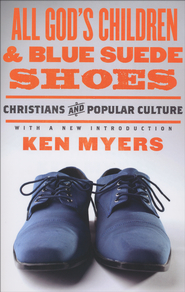
About Ken Myers: is host and producer of Mars Hill Audio in Quinque, Virginia. He is author of All God’s Children and Blue Suede Shoes: Christians and Popular Culture.

© Tabletalk magazine – September 1st, 2008. 
Permissions: You are permitted and encouraged to reproduce and distribute this material in any format provided that you do not alter the wording in any way, you do not charge a fee beyond the cost of reproduction, and you do not make more than 500 physical copies. For web posting, a link to this document on our website is preferred (where applicable). If no such link exists, simply link to http://www.ligonier.org/tabletalk. Any exceptions to the above must be formally approved by Tabletalk.

Please include the following statement on any distributed copy: From Ligonier Ministries and R.C. Sproul. © Tabletalk magazine. Website: http://www.ligonier.org/tabletalk. Email: tabletalk@ligonier.org. Toll free: 1-800

Dr. Tim Keller on The Pervasive Influence of Idolatry in the Human Heart

(Nobody has impacted and influenced my understanding of Jesus Christ and God’s amazing grace in the Biblical Gospel than Pastor Tim Keller – you will find more posts by Tim Keller on VLM’s website than any other writer – because nothing is more important than understanding, receiving, and applying the Gospel for closure on our past, present, and future justification and sanctification with the God of the Gospel – And nobody explains the Gospel in a more deep and applicational manner, in my opinion, than Tim Keller – DPC)

“Counterfeit Gods – The Personal Story”

I often get asked how I personally became acquainted with the pervasive influence of idolatry in the human heart.

Like many younger ministers I worked far too many hours, never saying “no” to anyone’s request for my pastoral services. When salary increases were offered to me, I turned them down. When administrative help was offered to me, I declined. I was quite proud of being the kind of person who worked very hard, never complained, and never asked for any help. This regularly brought me into conflict with my wife, who rightly contended that I was neglecting my relationships to her and to my young sons. It also led to health problems, although I was only in my early thirties.

Nevertheless, I continued to feel that the way I was living was noble and good. I believed I was sacrificially committed to the ministry of the Word. I was especially delighted to make sacrifices that nobody saw — not my people or even my family. That made me feel most noble of all. If all this created some problems for me personally, wasn’t that just evidence of how truly devoted I was? It was a very dangerous situation. My future was bleak, though I didn’t know it. In the short run, this kind of ministry workaholism is often rewarded by admiring people all around.

Some well-meaning friends, however, saw the problem and literally “laid the law” on me, showing me that I was violating the commandments of taking Sabbath and of honoring my family. I usually responded with incremental changes that never endured. Others used the modern technique of self-esteem — “You need to think of yourself; you need to do things that make you happy.” I despised that advice as terribly selfish.  I valued self-sacrifice.

It wasn’t until I began to search my heart with the Biblical category of idolatry that I made the horrendous discovery that all my supposed sacrifices were just a series of selfish actions. I was using people in order to forge my own self-appreciation. I was looking to my sacrificial ministry to give me the sense of “righteousness before God” that should only come from Jesus Christ. People make idols out of money, power, accomplishment, or moral excellence. They look to these things to “save them” — to give them the sense of purity, value, and acceptability that only Jesus can give. In my case, I was using ministry (and my own people) in this way.

Without the category of idolatry — a good thing turned into a pseudo-salvation — I would never have been able to see myself. Nothing but the concept of counterfeit gods could have blasted me out of my illusion of virtue and superiority. I thank God for this life-saving insight — though I still struggle mightily with the implementation of what I’ve learned.

*Article Originally posted by Dr. Tim Keller on October 20, 2009 at the excellent resource site: http://redeemercitytocity.com/blog/view.jsp?Blog_param=60

 About Tim Keller and His Absolutely Brilliant Gospel Centered Books:

 In 1989 Dr. Timothy J. Keller, his wife and three young sons moved to New York City to begin Redeemer Presbyterian Church. In 20 years it has grown to meeting for five services at three sites with a weekly attendance of over 5,000. Redeemer is notable not only for winning skeptical New Yorkers to faith, but also for partnering with other churches to do both mercy ministry and church planting.  Redeemer City to City is working to help establish hundreds of new multi-ethnic congregations throughout the city and other global cities in the next decades.

Dr. Tim Keller is the author of several phenomenal Christo-centric books including:

Every Good Endeavor: Connecting Your Work to God’s Plan for the World. New York, Penguin Publishing, November, 2012.

Center Church: Doing Balanced, Gospel-Centered Ministry in Your City. Grand Rapids: Zondervan, September, 2012.

The Freedom of Self Forgetfulness. New York: 10 Publishing, April 2012.

Generous Justice: How God’s Grace Makes Us Just. New York: Riverhead Trade, August, 2012.

The Gospel As Center: Renewing Our Faith and Reforming Our Ministry Practices (editor and contributor). Wheaton: Crossway, 2012.

The Meaning of Marriage: Facing the Complexities of Commitment with the Wisdom of God. New York, Dutton, 2011.

The Prodigal God. New York, Dutton, 2011.

King’s Cross: The Story of the World in the Life of Jesus. New York, Dutton, 2011.

Counterfeit Gods: The Empty Priorities of Money, Sex, and Power, and the Only Hope That Matters. New York, Riverhead Trade, 2011.

The Reason For God: Belief in an Age of Skepticism. New York, Dutton, 2009.

Worship By The Book (contributor). Grand Rapids: Zondervan, 2002.

Ministries of Mercy: The Call of the Jericho Road. Phillipsburg: P&R Publishing, 1997.


Do We Have Souls? Lee Strobel interviews Dr. J.P. Moreland

(The interview below is “heady” stuff – but very important. There is a huge movement of “scientism” in our culture that denies the reality and existence of the soul. One of my favorite teachers when I was at Talbot School of Theology was Dr. J.P. Moreland. What I love about Moreland is that he is a deep thinker and yet he has the ability to explain complex truths in a way that lay people can understand. Like anything Moreland writes or says, this interview will be challenging, enlightening, and clarifying – I hope that you will be able to better understand the reality of the soul and the overwhelming evidence for the existence of God as you read this interview with former atheist – turned Christian – Lee Strobel. Reading this article will exercise your mind and bring joy to your soul, and will be well worth your serious attention – enjoy! David P. Craig)
 

The Evidence of Consciousness: The Enigma of the Mind

When I pulled up to J. P. Moreland’s house on a cool and foggy morning, he was outside with a cup of coffee in his hand, having just walked home from a chat with some neighbors. His graying hair was close-cropped, his mustache neatly trimmed, and he was looking natty in a red tie, blue shirt, and dark slacks. “Good to see you again,” he said as we shook hands. “Come on in.” We walked into his living room, where he settled into a floral-patterned chair and I eased into an adjacent couch. The setting was familiar to me, since I had previously interviewed him on other challenging topics for The Case for Christ and The Case for Faith (See: “The Circumstantial Evidence” in: Lee Strobel, The Case for Christ, 244–57, and “Objection #6: A Loving God Would Never Torture People in Hell,” in: Lee Strobel, The Case for Faith, 169–94).

Both times I found him to have an uncanny ability to discuss abstract issues and technical matters in understandable but accurate language. That’s unusual for a scientist, uncommon for a theologian, and downright rare for a philosopher! Moreland’s science training came at the University of Missouri, where he received a degree in chemistry. He was subsequently awarded the top fellowship for a doctorate in nuclear chemistry at the University of Colorado but declined the honor to pursue a different career path. He then earned a master’s degree in theology at Dallas Theological Seminary and a doctorate in philosophy at the University of Southern California. Moreland developed an early interest in issues relating to human consciousness, returning to that theme time after time in his various books. He has written, edited, or coauthored Christianity and the Nature of Science, Body and Soul, The Life and Death Debate, Beyond Death, Does God Exist? Christian Perspectives on Being Human, The Creation Hypothesis, Scaling the Secular City, Love Your God with All Your Mind, Naturalism: A Critical Analysis, and many other books.

Also, he has authored more than fifty technical articles for Perspectives on Science and Christian Faith, Philosophy and Phenomenological Research, American Philosophical Quarterly, Journal of Psychology and Theology, Metaphilosophy, and a host of other journals. Moreland’s memberships include national scientific, philosophical, and theological societies. Currently, he’s a professor in the highly respected philosophy program at the Talbot School of Theology, where he teaches on numerous topics, including philosophy of mind. As we began our interview, I thought it would be a good idea to get straight on some key definitions—something that’s not always easy when discussing consciousness.

 REGAINING CONSCIOUSNESS

U.S. Supreme Court Justice Potter Stewart once said it may be difficult to define pornography, “but I know it when I see it” (Justice Potter Stewart [concurring], Jacobellis v. Ohio, 378 U.S. 198,1964). Similarly, consciousness can be a challenging concept to describe, even though our own conscious thoughts are quite tangible to ourselves. As J. R. Smythies of the University of Edinburgh put it: “The consciousness of other people may be for me an abstraction, but my own consciousness is for me a reality” (J. R. Smythies, “Some Aspects of Consciousness,” in Arthur Koestler and J. R. Smythies, editors, Beyond Reductionism. London: Hutchinson, 1969, 235, quoted in Arthur C. Custance, The Mysterious Matter of Mind, 35).

“What is consciousness?” Moreland said, echoing the opening question that I had just posed to him. “Well, a simple definition is that consciousness is what you’re aware of when you introspect. When you pay attention to what’s going on inside of you, that’s consciousness.” He looked at me and apparently could see from my expression that I needed a fuller description. “Think of it like this,” he continued. “Suppose you were having an operation on your leg, and suddenly you begin to be aware of people talking about you. Someone says, ‘I think he’s recovering.’ You start to feel an ache in your knee. You say to yourself, ‘Where am I? What’s going on?’ And you start to remember you were operated on. What you’re doing is regaining consciousness. In short, consciousness consists of sensations, thoughts, emotions, desires, beliefs, and free choices that make us alive and aware.”

“What if consciousness didn’t exist in the world?” I asked. “I’ll give you an example,” Moreland replied. “Apples would still be red, but there would be no awareness of red or any sensations of red.” “What about the soul?” I asked. “How would you define that?” “The soul is the ego, the ‘I,’ or the self, and it contains our consciousness. It also animates our body. That’s why when the soul leaves the body, the body becomes a corpse. The soul is immaterial and distinct from the body.” “At least,” I observed, “that’s what the Bible teaches.” “Yes, Christians have understood this for twenty centuries,” he said. “For example, when Jesus was on the cross, he told the thief being crucified next to him that he would be with Jesus immediately after his death and before the final resurrection of his body (Luke 23:43: “Today you will be with me in paradise”).

Jesus described the body and soul as being separate entities when he said, ‘Do not be afraid of those who kill the body but cannot kill the soul’ (Matthew 10:28). The apostle Paul says that “to be absent from the body is to be present with the Lord” (2 Corinthians 5:8).

I was curious about whether belief in the soul is a universal phenomenon. “What about beyond Christianity?” I asked. “Is this concept present in other cultures as well?” “We know that dualism was taught by the ancient Greeks, although, unlike Christians, they believed the body and soul were alien toward each other,” he explained. “In contemporary terms, I’d agree with physicalist Jaegwon Kim, who acknowledged that ‘something like this dualism of personhood, I believe, is common lore shared across most cultures and religious traditions’” (Jaegwon Kim, “Lonely Souls: Causality and Substance Dualism,” in Kevin Corcoran, editor, Soul, Body, and Survival. Ithica, NY: Cornell Univ. Press, 2001).

Still, there are those who deny dualism and instead believe we are solely physical beings who are, as geneticist Francis Crick said, “no more than the behavior of a vast assembly of nerve cells and their associated molecules” (Francis Crick, The Astonishing Hypothesis. New York: Scribner’s, 1994, 3). To explore this issue, I decided to take an unusual approach in my interview with Moreland by asking him to imagine—for just a few minutes—that these physicalists are right.

 WHAT IF PHYSICALISM IS TRUE?

“Let’s face it,” I said, “some people flatly deny that we have an immaterial soul. John Searle said, ‘In my worldview, consciousness is caused by brain processes’ (“What Is Consciousness?” in Closer to Truth).  In other words, they believe consciousness is purely a product of biology. As brain scientist Barry Beyerstein said, just as the kidneys produce urine, the brain produces consciousness” (“Do Brains Make Minds?” on Closer to Truth).

Moreland was listening carefully as I spoke, his head slightly cocked. I continued by saying, “Do me a favor, J. P. —assume for a moment that the physicalists are right. What are the logical implications if physicalism is true?” His eyes widened. “Oh, there would be several key ones,” he replied.

“Give me three,” I said. Moreland was more than willing. “First, if physicalism is true, then consciousness doesn’t really exist, because there would be no such thing as conscious states that must be described from a first-person point of view,” he said. “You see, if everything were matter, then you could capture the entire universe on a graph—you could locate each star, the moon, every mountain, Lee Strobel’s brain, Lee Strobel’s kidneys, and so forth. That’s because if everything is physical, it could be described entirely from a third-person point of view. And yet we know that we have first-person, subjective points of view—so physicalism can’t be true.” Clearly, Moreland was warming up to this exercise.

“The second implication,” he continued, “is that there would be no free will. That’s because matter is completely governed by the laws of nature. Take any physical object,” he said as he glanced out the window, where the fog was breaking up. “For instance, a cloud,” he said. “It’s just a material object, and its movement is completely governed by the laws of air pressure, wind movement, and the like. So if I’m a material object, all of the things I do are fixed by my environment, my genetics, and so forth. “That would mean I’m not really free to make choices. Whatever’s going to happen is already rigged by my makeup and environment. So how could you hold me responsible for my behavior if I wasn’t free to choose how I would act? This is one of the reasons we lost the Vietnam War.” I was following him until that last statement, which seemed oddly incongruous to me. “What has this got to do with Vietnam?” I asked. Moreland explained: “I heard a former advisor to the president say that B. F. Skinner’s behaviorism influenced the Pentagon’s strategy. Skinner believed that we’re just physical objects, so you can condition people, just like you can condition a laboratory animal by applying electric shocks. Keep doing certain things over and over, and you can change behavior. So in Vietnam, we bombed, we came back, we bombed, we came back, we bombed, and so forth. We assumed that after we gave the North Vietnamese shock after shock, pretty soon we could manipulate their behavior. After all, they’re just physical objects responding to stimuli. Eventually they had to give in.” “But they didn’t,” I said. “That’s right. It didn’t work.” “Why?” “Because there was more to the Vietnamese than their physical brains responding to stimuli. They have souls, desires, feelings, and beliefs, and they could make free choices to suffer and to stand firm for their convictions despite our attempt to condition them by our bombing.

“So if the materialists are right, kiss free will good-bye. In their view, we’re just very complicated computers that behave according to the laws of nature and the programming we receive. But, Lee, obviously they’re wrong—we do have free will. We all know that deep down inside. We’re more than just a physical brain.

“Third, if physicalism were true, there would be no disembodied intermediate state. According to Christianity, when we die, our souls leave our bodies and await the later resurrection of our bodies from the dead. We don’t cease to exist when we die. Our souls are living on. “This happens in near-death experiences. People are clinically dead, but sometimes they have a vantage point from above, where they look down at the operating table that their body is on. Sometimes they gain information they couldn’t have known if this were just an illusion happening in their brain. One woman died and she saw a tennis shoe that was on the roof of the hospital. How could she have known this? “If I am just my brain, then existing outside the body is utterly impossible. When people hear of near-death experiences, they don’t think that if they looked up at the hospital ceiling, they’d see a pulsating brain with a couple of eyeballs dangling down, right? When people hear near-death stories, Lee, they are intuitively attributing to that person a soul that could leave the body. And clearly these stories make sense, even if we’re not sure they’re true. We’ve got to be more than our bodies or else these stories would be ludicrous to us.” Moreland seemed to be sidestepping this issue a bit. “How about you personally?” I asked. “Do you think near-death experiences are true?” “We have to be careful with the data and not overstate things, but I do think they provide at least a minimalist case for consciousness surviving death,” he said. “In fact, as far back as 1965, psychologist John Beloff wrote in The Humanist that the evidence of near-death experiences already indicates ‘a dualistic world where mind or spirit has an existence separate from the world of material things.’ He conceded that this could ‘present a challenge to humanism as profound in its own way as that which Darwinian evolution did to Christianity a century ago.’ ” (Cited in David Winter, Hereafter: What Happens after Death? Wheaton, Ill.: Harold Shaw, 1972, 33–34).

Moreland paused before adding one other comment. “Regardless of what anyone thinks about near-death experiences, we do have confirmation that Jesus was put to death and was later seen alive by credible eyewitnesses,” he said. “Not only does this provide powerful historical corroboration that it’s possible to survive after the death of our physical body, but it also gives Jesus great credibility when he teaches that we have both a body and an immaterial spirit” (For a short description of the evidence for the Resurrection, see Gary R. Habermas and J. P. Moreland, Beyond Death, 111–54).

THE INNER AND PRIVATE MIND

At this point, having considered Moreland’s critique of physicalism, I wanted to hear his affirmative case that consciousness and the soul are immaterial entities. “What positive evidence is there that consciousness and the self are not merely a physical process of the brain?” I asked. “We have experimental data, for one thing,” he replied. “For example, neurosurgeon Wilder Penfield electrically stimulated the brains of epilepsy patients and found he could cause them to move their arms or legs, turn their heads or eyes, talk, or swallow. Invariably the patient would respond by saying, ‘I didn’t do that. You did.’ (See: Wilder Penfield, The Mystery of the Mind, 76–77).

According to Penfield, ‘the patient thinks of himself as having an existence separate from his body.’ (Wilder Penfield, “Control of the Mind” Symposium at the University of California Medical Center, San Francisco, 1961, quoted in Arthur Koestler, Ghost in the Machine. London: Hutchinson, 1967, 203).
“No matter how much Penfield probed the cerebral cortex, he said, ‘There is no place . . . where electrical stimulation will cause a patient to believe or to decide.’ (Wilder Penfield, The Mystery of the Mind, 77–78).

That’s because those functions originate in the conscious self, not the brain. “A lot of subsequent research has validated this. When Roger Sperry and his team studied the differences between the brain’s right and left hemispheres, they discovered the mind has a causal power independent of the brain’s activities. This led Sperry to conclude materialism was false (See: Roger W. Sperry, “Changed Concepts of Brain and Consciousness: Some Value Implications,” Zygon, March 1985).

“Another study showed a delay between the time an electric shock was applied to the skin, its reaching the cerebral cortex, and the self-conscious perception of it by the person (Laurence W. Wood, “Recent Brain Research and the Mind-Body Dilemma,” The Asbury Theological Journal, vol. 41, no. 1,1986). This suggests the self is more than just a machine that reacts to stimuli as it receives them. In fact, the data from various research projects are so remarkable that Laurence C. Wood said, ‘many brain scientists have been compelled to postulate the existence of an immaterial mind, even though they may not embrace a belief in an after-life.’””(Ibid).

“What about beyond the laboratory?” I asked. “There are valid philosophical arguments as well,” he said. “For instance, I know that consciousness isn’t a physical phenomenon because there are things that are true of my consciousness that aren’t true of anything physical.” “For instance . . . ,” I said, prompting him further. “For example, some of my thoughts have the attribute of being true. Tragically, some of my thoughts have the attribute of being false—like the Chicago Bears are going to go to the Super Bowl,” he said with a chuckle. “However, none of my brain states are true or false. No scientist can look at the state of my brain and say, ‘Oh, that particular brain state is true and that one’s false.’ So there’s something true of my conscious states that are not true of any of my brain states, and consequently they can’t be the same thing. “Nothing in my brain is about anything. You can’t open up my head and say, ‘You see this electrical pattern in the left hemisphere of J. P. Moreland’s brain? That’s about the Bears.’ Your brain states aren’t about anything, but some of my mental states are. So they’re different.

“Furthermore, my consciousness is inner and private to me. By simply introspecting, I have a way of knowing about what’s happening in my mind that is not available to you, my doctor, or a neuroscientist. A scientist could know more about what’s happening in my brain than I do, but he couldn’t know more about what’s happening in my mind than I do. He has to ask me.” When I asked Moreland for an illustration of this, he said, “Have you heard of Rapid Eye Movement?” “Sure,” I replied. “What does it indicate?” “Dreaming.” “Exactly. How do scientists know that when there is a certain eye movement that people are dreaming? They’ve had to wake people and ask them. Scientists could watch the eyes move and read a printout of what was physically happening in the brain, so they could correlate brain states with eye movements. But they didn’t know what was happening in the mind. Why? Because that’s inner and private. “So the scientist can know about the brain by studying it, but he can’t know about the mind without asking the person to reveal it, because conscious states have the feature of being inner and private, but the brain’s states don’t.”

THE REALITY OF THE SOUL

For centuries, the human soul has enchanted poets, intrigued theologians, challenged philosophers, and dumbfounded scientists. Mystics, like Teresa of Åvila in the sixteenth century, have described it eloquently: “I began to think of the soul as if it were a castle made of a single diamond or of very clear crystal, in which there are many rooms, just as in heaven there are many mansions” (Mark Water, compiler, The New Encyclopedia of Christian Quotations.Grand Rapids, Mich.: Baker, 2000), 972. Teresa’s reference to mansions is an allusion to John 14:2).

Moreland was understandably more precise in analyzing the soul, though unfortunately less poetic. He had already clarified that the soul contains our consciousness. Still, he hadn’t offered any reason to believe that the soul is an actual entity. It was time, I felt, to press him on this
issue. “What makes you think that the soul is real?” I asked.

Moreland replied by saying, “First, we’re aware that we’re different from our consciousness and our body. We know that we’re beings who have consciousness and a body, but we’re not merely the same thing as our conscious life or our physical life. “Let me give you an illustration of how we’re not the same thing as our personality traits, our memories, and our consciousness. I had a student a few years ago whose sister had a terrible accident on her honeymoon. She was knocked unconscious and lost all of her memories and a good bit of her personality. She did not believe she had been married. As she began to recover, they showed her videos of the wedding to convince her that she had actually married her husband. She eventually got to the point where she believed it, and she got remarried to him.

“Now, we all knew this was the same person all along.” This was Jamie’s sister. She was not a different person, though she was behaving differently. But she had totally different memories. She had lost her old memories and she didn’t even have the same personality. What that proves is you can be the same person even if you lose old memories and gain new memories, or you lose some of your old personality traits and gain new personality traits. “Now, if I were just my consciousness, when my consciousness was different, I’d be a different person. But we know that I can be the same person even though my consciousness changes, so I can’t be the same thing as my consciousness. I’ve got to be the ‘self,’ or soul, that contains my consciousness.

“Same with my body. I can’t be the same thing as my body or brain. There was a story on television about an epileptic who underwent an operation in which surgeons removed fifty-three percent of her brain. When she woke up, nobody said, ‘We have forty-seven percent of a person here.’ A person can’t be divided into pieces. You are either a person or you’re not. But your brain and your body can be divided. So that means I can’t be the same thing as my body.”

Those illustrations helped, though I said, “The fact that the soul and consciousness are invisible makes it difficult to conceptualize them.” “Sure, that’s true,” he replied. “My soul and my consciousness are invisible, though my body is visible. That’s another distinction. In fact, I remember the time when my daughter was in the fifth grade and we were having family prayers. She said, ‘Dad, if I could see God, it would help me believe in him.’ I said, ‘Well, honey, the problem isn’t that you’ve never seen God. The problem is that you’ve never seen your mother.’ And her mother was sitting right next to her! “My daughter said, ‘What do you mean, Dad?’ I said, ‘Suppose without hurting your mom, we were able to take her apart cell by cell and peek

inside each one of them. We would never come to a moment where we would say, ‘Look—here’s what Mommy’s thinking about doing the rest of the day.’ Or ‘Hey, this cell contains Mommy’s feelings.’ Or ‘So this is what Mom believes about pro football.’ We couldn’t find Mommy’s thoughts, beliefs, desires, or her feelings. “‘Guess what else we would never find? We’d never find Mommy’s ego or her self. We would never say, ‘Finally, in this particular brain cell, there’s Mommy. There’s her ego, or self.’ That’s because Mommy is a person, and persons are invisible. Mommy’s ego and her conscious life are invisible. Now, she’s small enough to have a body, while God is too big to have a body—so let’s pray!’ “The point is this, Lee: I am a soul, and I have a body. We don’t learn about people by studying their bodies. We learn about people by finding out how they feel, what they think, what they’re passionate about, what their worldview is, and so forth. Staring at their body might tell us whether they like exercise, but that’s not very helpful. That’s why we want to get ‘inside’ people to learn about them. “So my conclusion is that there’s more to me than my conscious life and my body. In fact, I am a ‘self,’ or an ‘I,’ that cannot be seen or touched unless I manifest myself through my behavior or my talk. I have free will because I’m a ‘self,’ or a soul, and I’m not just a brain.”

OF COMPUTERS AND BATS

Moreland’s denial that the brain produces consciousness made me think of the debate over whether future computers can become sentient. I decided to ask him to weigh in on the issue—although his ultimate conclusion was never in doubt. “If a machine can achieve equal or greater brain power as human beings, then some physicalists say the computer would become conscious,” I said. “I assume you would disagree with that.” Moreland chuckled. “One atheist said that when computers reach the point of imitating human behavior, only a racist would deny them full human rights. But of course that’s absurd.

Nobel-winner John Eccles said he’s ‘appalled by the naiveté’ of those who foresee computer sentience. He said there’s ‘no evidence whatsoever for the statement made that, at an adequate level of complexity, computers also would achieve self-consciousness’ (Quoted in Robert W. Augros and George N. Stanciu, The New Story of Science, 170).

“Look, we have to remember that computers have artificial intelligence, not intelligence. And there’s a huge difference. There’s no ‘what it’s like to be a computer.’ A computer has no ‘insides,’ no awareness, no first-person point of view, no insights into problems. A computer doesn’t think, ‘You know what? I now see what this multiplication problem is really like.’ A computer can engage in behavior if it’s wired properly, but you’ve got to remember that consciousness is not the same as behavior. Consciousness is being alive; it’s what causes behavior in really conscious beings. But what causes behavior in a computer is electric circuitry.

“Let me illustrate my point. Suppose we had a computerized bat that we knew absolutely everything about from a physical point of view. We would have exhaustive knowledge of all its circuitry so that we could predict everything this bat would do when it was released into the environment. “Contrast that with a real bat. Suppose we knew everything about the organs inside the bat—its blood system, nervous system, brain, heart, lungs. And suppose that we could predict everything this bat would do when released into the environment. There would still be one thing that we would have no idea about: what it’s like to be a bat. What it’s like to hear, to feel, to experience sound and color. That stuff involves the ‘insides’ of the bat, its point of view. That’s the difference between a conscious, sentient bat and a computerized bat. “So in general, computers might be able to imitate intelligence, but they won’t ever have consciousness. We can’t confuse behavior with what it’s like to be alive, awake, and sentient. A future superintelligent computer might be programmed to say it’s conscious or even behave as if it were conscious, but it can never truly become conscious, because consciousness is an immaterial entity apart from the brain.” Moreland’s choice of a bat for his illustration was an oblique reference to New York University philosopher Thomas Nagel’s famous 1974 essay “What Is it Like to Be a Bat?” (See: Thomas Nagel, “What Is It Like to Be a Bat?” Philosophical Review 83, October, 1974).

Thinking about life from a bat’s perspective prompted me to briefly pursue another line of inquiry on a tangential topic. “What about animals—do they have souls or consciousness?” I asked. “Absolutely,” came his quick answer. “In several places the Bible uses the word ‘soul’ or ‘spirit’ when discussing animals. For example:

Genesis 1:30, “And to every beast of the earth and to every bird of the heavens and to everything that creeps on the earth, everything that has the breath of life, I have given every green plant for food.” And it was so.”

Leviticus 24:18, “Whoever takes an animal’s life shall make it good, life for life.”

Ecclesiastes 3:19, “For what happens to the children of man and what happens to the beasts is the same; as one dies, so dies the other. They all have the same breath, and man has no advantage over the beasts, for all is vanity.”

Revelation 8:9, “A third of the living creatures in the sea died, and a third of the ships were destroyed.”

Animals are not simply machines. They have consciousness and points of view. But the animal soul is much simpler than the human soul. For example, the human soul is capable of free moral action, but I think the animal soul is determined. Also, Augustine said animals have thoughts, but they don’t think about their thinking. And while we have beliefs about our beliefs, animals don’t. “You see, the human soul is vastly more complicated because it’s made in the image of God. So we have self-reflection and self-thinking. And while the human soul survives the death of its body, I don’t think the animal soul outlives its body. I could be wrong, but I think the animal soul ceases to exist at death.” Bad news, it seems, for the bat.

CONSCIOUSNESS AND EVOLUTION

Moreland had made a cogent case for consciousness and the soul being independent of our brain and body. “How does this present a problem for Darwinists?” I asked. Moreland glanced down at some notes he had brought along. “As philosopher Geoffrey Medell said, ‘The emergence of consciousness, then, is a mystery, and one to which materialism fails to provide an answer.’ Atheist Colin McGinn agrees. He asks, ‘How can mere matter originate consciousness? How did evolution convert the water of biological tissue into the wine of consciousness? Consciousness seems like a radical novelty in the universe, not prefigured by the aftereffects of the Big Bang. So how did it contrive to spring into being from what preceded it?’ ”

Moreland looked squarely at me. “Here’s the point: you can’t get something from nothing,” he declared. “It’s as simple as that. If there were no God, then the history of the entire universe, up until the appearance of living creatures, would be a history of dead matter with no consciousness. You would not have any thoughts, beliefs, feelings, sensations, free actions, choices, or purposes. There would be simply one physical event after another physical event, behaving according to the laws of physics and chemistry.”

Moreland stopped for a moment to make sure this picture was vivid in my mind. Then he leaned forward and asked pointedly: “How, then, do you get something totally different—conscious, living, thinking, feeling, believing creatures—from materials that don’t have that? That’s getting something from nothing! And that’s the main problem. “If you apply a physical process to physical matter, you’re going to get a different arrangement of physical materials. For example, if you apply the physical process of heating to a bowl of water, you’re going to get a new product—steam—which is just a more complicated form of water, but it’s still physical. And if the history of the universe is just a story of physical processes being applied to physical materials, you’d end up with increasingly complicated arrangements of physical materials, but you’re not going to get something that’s completely nonphysical. That is a jump of a totally different kind. “At the end of the day, as Phillip Johnson put it, you either have ‘In the beginning were the particles,’ or ‘In the beginning was the Logos,’ which means ‘divine mind.’ If you start with particles, and the history of the universe is just a story about the rearrangement of particles, you may end up with a more complicated arrangement of particles, but you’re still going to have particles. You’re not going to have minds or consciousness.

“However—and this is really important—if you begin with an infinite mind, then you can explain how finite minds could come into existence. That makes sense. What doesn’t make sense—and which many atheistic evolutionists are conceding—is the idea of getting a mind to squirt into existence by starting with brute, dead, mindless matter. That’s why some of them are trying to get rid of consciousness by saying it’s not real and that we’re just computers.” He smiled after that last statement, then added: “However, that’s a pretty difficult position to maintain while you’re conscious!”

THE EMERGENCE OF THE MIND

“Still,” I protested, “some scientists maintain that consciousness is just something that happens as a natural byproduct of our brain’s complexity. They believe that once evolution gave us sufficient brain capacity, consciousness inexorably emerges as a biological process.”

“Let me mention four problems with that,” Moreland insisted. “First, they are no longer treating matter as atheists and naturalists treat matter—namely, as brute stuff that can be completely described by the laws of chemistry and physics. Now they’re attributing spooky, soulish, or mental potentials to matter.” “What do you mean by ‘potentials’?” “They’re saying that prior to this level of complexity, matter contained the potential for mind to emerge—and at the right moment, guess what happened? These potentials were activated and consciousness was sparked into existence.” “What’s wrong with that theory?” “That is no longer naturalism,” he said. “That’s panpsychism.” That was a new term to me. “Pan what?” “Panpsychism,” he repeated. “It’s the view that matter is not just inert physical stuff, but that it also contains proto-mental states in it. Suddenly, they’ve abandoned a strict scientific view of matter and adopted a view that’s closer to theism than to atheism. Now they’re saying that the world began not just with matter, but with stuff that’s mental and physical at the same time. Yet they can’t explain where these pre-emergent mental properties came from in the first place. And this also makes it hard for them to argue against the emergence of God.”

“The emergence of God?” I asked. “What do you mean by that?” “If a finite mind can emerge when matter reaches a certain level of complexity, why couldn’t a far greater mind—God—emerge when millions of brain states reach a greater level of consciousness? You see, they want to stop the process where they want it to stop—at themselves—but you can’t logically draw that line. How can they know that a very large God hasn’t emerged from matter, because, after all, haven’t a lot of people had religious experiences with God?” “That wouldn’t be the God of Christianity,” I pointed out. “Granted,” he replied. “But this is still a problem for atheists.

And there’s a second problem: they would still be stuck with determinism, because if consciousness is just a function of the brain, then I’m my brain, and my brain functions according to the laws of chemistry and physics. To them, the mind is to the brain as smoke is to fire. Fire causes smoke, but smoke doesn’t cause anything. It’s just a byproduct. Thus, they’re locked into determinism.

“Third, if mind emerged from matter without the direction of a superior Intelligence, why should we trust anything from the mind as being rational or true, especially in the area of theoretical thinking? “Let me give you an analogy. Let’s say you had a computer that was programmed by random forces or by nonrational laws without a mind being behind it. Would you trust a printout from that machine? Of course not. Well, same with the mind—and that’s a problem for Darwinists. And by the way, you can’t use evolution as an explanation for why the mind should be considered trustworthy, because theoretical thinking does not contribute to survival value.”

Moreland’s comments reminded me of the famous quote from British evolutionist J. B. S. Haldane: “If my mental processes are determined wholly by the motions of the atoms in my brain, I have no reason to suppose that my beliefs are true . . . and hence I have no reason for supposing my brain to be composed of atoms” (J. B. S. Haldane, “When I am Dead,” in Possible Worlds and Other Essays. London: Chatto and Winduw, 1927, 209, quoted in C. S. Lewis, Miracles. London: Fontana, 1947, 19).

“Here’s the fourth problem,” Moreland went on, “If my mind were just a function of the brain, there would be no unified self. Remember, brain function is spread throughout the brain, so if you cut the brain in half, like the girl who lost fifty-three percent of her brain, then some of that function is lost. Now you’ve got forty-seven percent of a person. Well, nobody believes that. We all know she’s a unified self, because we all know her consciousness and soul are separate entities from her brain.

“There’s one other aspect of this, called the ‘binding problem.’ When you look around the room, you see many things at the same time,” he said, gesturing around at various objects in our field of vision. “You see a table, a couch, a wall, a painting in a frame. Every individual thing has light waves bouncing off of it and they’re striking a different location in your eyeball and sparking electrical activity in a different region of the brain. That means there is no single part of the brain that is activated by all of these experiences. Consequently, if I were simply my physical brain, I would be a crowd of different parts, each having its own awareness of a different piece of my visual field. “But that’s not what happens. I’m a unified ‘I’ that has all of these experiences at the same time. There is something that binds all of these experiences and unifies them into the experience of oneself—me—even though there is no region of the brain that has all these activation sites. That’s because my consciousness and my ‘self’ are separate entities from the brain.”

Moreland was on a roll, but I jumped in anyway. “What about recent brain studies that have shown activity in certain areas of the brain during meditation and prayer?” I asked. “Don’t those demonstrate that there’s a physical basis for these religious experiences, as opposed to an immaterial basis through the soul?” “No, it doesn’t. All it shows is a physical correlation with religious experiences,” he replied. “You’ll have to explain that,” I said. “Well, there’s no question that when I’m praying, smelling a rose, or thinking about something, my brain still exists. It doesn’t pop out of existence when I’m having a conscious life, including prayer. And I would be perfectly happy if scientists were to measure what was going on in my brain while I’m praying, feeling forgiveness, or even thinking about lunch. But remember: just because there is a correlation between two things, that doesn’t mean they’re the same thing. Just because there’s a correlation between fire and smoke, this doesn’t mean smoke is the same as fire.

“Now, sometimes your brain states can cause your conscious states. For example, if you lose brain functioning due to Alzheimer’s disease, or you get hit over the head, you lose some of your mental conscious life. But there’s also evidence that this goes the other way as well. There are data showing that your conscious life can actually reconfigure your brain. “For example, scientists have done studies of the brains of people who worried a lot, and they found that this mental state of worry changed their brain chemistry. They’ve done studies of the brain patterns of little children who were not nurtured and loved, and their patterns are different than children who have warm experiences of love and nurture. So it’s not just the brain that causes things to happen in our conscious life; conscious states can also cause things to happen to the brain. “Consequently, I wouldn’t want to say there’s a physical basis for religious experiences, even though they might be correlated. Sometimes it
could be cause-and-effect from brain to mind, but it could also be cause-and-effect from mind to brain. How do the scientists know it isn’t actually my prayer life that’s causing something to happen in my brain, rather than the other way around?” (For a further critique of “neurotheology,” the idea that the brain is wired for religious experiences, see: Kenneth L. Woodward, “Faith Is More Than a Feeling,” Newsweek, May 7, 2001).

THE RETURN OF OCKHAM’S RAZOR

As we talked about the human mind, mine was drifting back to my first interview with William Lane Craig, during which he brought up a scientific principle called Ockham’s razor. As I listened to Moreland defend the concept of dualism, it dawned on me that Ockham’s razor would argue in the opposite direction—toward the view that only the brain exists—because it says science prefers simpler explanations where possible. It was a challenge I decided to pose to Moreland. “You’re familiar with the scientific principle called Ockham’s razor,” I said to him. As soon as the question left my mouth, Moreland knew where I was headed.

“Yes, it says that we shouldn’t multiply entities beyond what’s needed to explain something. And I assume your objection is that Ockham’s razor would favor a simple alternative, such as the brain accounting for everything, rather than more complicated explanation like the two entities of dualism.” “That’s right,” I said. “Surely this undercuts the case for dualism.” He was ready with an answer. “No, it really doesn’t. Actually, Ockham’s razor favors dualism, and here’s why,” he said. “What’s the intent of Ockham’s razor? The thrust of this principle is that when you’re trying to explain a phenomenon, you should only include the elements that are necessary to explain the phenomenon. And as I’ve demonstrated through scientific evidence and philosophical reasoning, dualism is necessary to explain the phenomenon of consciousness.

Only dualism can account for all of the evidence—and, hence, it does not violate Ockham’s razor.” I wasn’t ready to give up. “But maybe we just don’t have all the evidence yet,” I said. “Maybe your conclusions are premature. Physicalists are confident that the day will come when they’ll be able to explain consciousness solely in physical terms.” Moreland’s reply was adamant: “There will never, ever be a scientific explanation for mind and consciousness.”

His forceful and unequivocal statement startled me. “Why not?” I asked. “Think about how scientists go about explaining things: they show that something had to happen due to antecedent conditions. For example,

when scientists explain why gases behave the way they do, they show that if you hold the volume constant and increase the temperature, the pressure has to increase. That is, when we heat a pressure cooker, the pressure goes up. “When scientists explain that, they don’t just correlate temperature and pressure. They don’t just say that temperature and pressure tend to go together. They try to show why the pressure has got to increase, why it couldn’t have done anything other than that, given the temperature increase. Scientists want to show why something has to happen given the cause; they’re not content simply to correlate things and leave it at that. “And this will never work with consciousness, because the relationship between the mind and the brain is contingent, or dependent.

In other words, the mind is not something that had to happen. One atheist asked, ‘How could a series of physical events, little particles jostling against one another, electric currents rushing to and fro, blossom into conscious experience? Why shouldn’t pain and itches be switched around? Why should any experience emerge when these neurons fire in the brain?’ He’s pointing out that there’s no necessary connection between conscious states and the brain. “So in the future scientists will be able to develop more correlations between conscious states and states of the brain, and that’s wonderful. But my point is this: correlation is not explanation. To explain something scientifically, you’ve got to show why the phenomenon had to happen given the causes. And scientists cannot explain the ‘why’ behind consciousness, because there’s no necessary connection between the brain and consciousness. It didn’t have to happen this way.”

 DEDUCTIONS ABOUT GOD

It’s no wonder that Alvin Plantinga of Notre Dame University, a dualist who is frequently called the greatest living American philosopher, surveyed the current body/mind debate and concluded: “Things don’t look hopeful for Darwinian naturalists” (Quoted in Larry Witham, By Design, 211).

Faced with data and logic that support dualism, and unable to offer a plausible theory for how consciousness could have erupted from mindless matter, atheists are pinning their hopes on some as-yet-undetermined scientific discovery to justify their faith in physicalism. And some aren’t even so sure about that—physicist and atheist Steven Weinberg said scientists may have to “bypass the problem of human consciousness” altogether, because “it may just be too hard for us” (Ibid.,192).

In other words, it’s failing to give them the answers they want. As for Moreland, he agrees with Plantinga’s bleak assessment for atheists. “Darwinian evolution will never be able to explain the origin of consciousness,” he told me. “Perhaps Darwinists can explain how consciousness was shaped in a certain way over time, because the behavior that consciousness caused had survival value. But it can’t explain the origin of consciousness, because it can’t explain how you can get something from nothing.

“In Darwin’s notebooks, he said if there was anything his theory can’t explain, then there would have to be another explanation—a creationist explanation. Well, he can’t explain the origin of mind. He tried to reduce consciousness down to the brain, because he could tell a story about how the brain evolved. But as we’ve discussed, Lee, consciousness cannot be reduced merely to the physical brain. This means the atheist creation story is inadequate and false.

And yet there is an alternative explanation that makes sense of all the evidence: our consciousness came from a greater Consciousness. “You see, the Christian worldview begins with thought and feeling and belief and desire and choice. That is, God is conscious. God has thoughts. He has beliefs, he has desires, he has awareness, he’s alive, he acts with purpose. We start there. And because we start with the mind of God, we don’t have a problem with explaining the origin of our mind.” I asked, “What, then, can we deduce about God from this?” “That he’s rational, that he’s intelligent, that he’s creative, that he’s sentient. And that he’s invisible, because that’s the way conscious beings are. I have no inclination to doubt that this very room is teeming with the presence of God, just because I can’t see or touch or smell or hear him. As I explained earlier, I can’t even see my own wife! I can’t touch, see, smell, or hear the real her.

“One more thing. The existence of my soul gives me a new way to understand how God can be everywhere. That’s because my soul occupies my body without being located in any one part of it. There’s no place in my body where you can say, ‘Here I am.’ My soul is not in the left part of my brain, it’s not in my nose, it’s not in my lungs. My soul is fully present everywhere throughout my body. That’s why if I lose part of my body, I don’t lose part of my soul. “In a similar way, God is fully present everywhere. He isn’t located, say, right outside the planet Mars. God occupies space in the same way the soul occupies the body. If space were somehow cut in half, God wouldn‘t lose half his being. So now I have a new model, based on my own self, for God’s omnipresence. And shouldn’t we expect this? If we were made in the image of God, wouldn’t we expect there to be some parallels between us and God?” I asked, “Do you foresee more scientists coming to the conclusion that the soul, though immaterial, is very real?”

“The answer is yes—if they are willing to open themselves up to nonscientific knowledge,” he replied. “I believe in science; it’s wonderful and gives us some very important information. But there are other ways of knowing things as well. Because, remember, most of the evidence for the reality of consciousness and the soul is from our own first-person awareness of ourselves and has nothing to do with the study of the brain. The study of the brain allows us to correlate the brain with conscious states, but it tells us nothing about what consciousness itself is.”

“But, J. P., aren’t you asking scientists to do the unthinkable—to ignore scientific knowledge?” “No, not at all,” he insisted. “I’m only asking that they become willing to listen to all the evidence and see where it leads—which is what the quest for truth should be about.” “And if they do that?” “They will come to believe in the reality of the soul and the immaterial nature of consciousness. And this could open them up personally to something even more important—to a much larger Mind and a much bigger Consciousness, who in the beginning was the Logos, and who made us in his image.”

COGITO ERGO SUM

A ringing telephone ended our conversation, although I was wrapping up the interview anyway. A colleague was calling to remind Moreland of a faculty meeting. I thanked Moreland for his time and insights, gathered my things, and strolled out to my car. I was just about to start the engine, but instead I let go of the key, leaned back in my seat, and took a few moments (as Moreland would say) to introspect. Interestingly, this very act of introspection intuitively affirmed to me what Moreland’s facts and logic had already established—my ability to ponder, to reason, to speculate, to imagine, and to feel the emotional brunt of the interview showed that my mind surely could not have been the evolutionary byproduct of brute, mindless matter. “Selfhood . . . is not explicable in material or physical terms,” said philosopher Stuart C. Hackett. “The essential spiritual selfhood of man has its only adequate ground in the transcendent spiritual Selfhood of God as Absolute Mind” (Stuart C. Hackett, The Reconstruction of the Christian Revelation Claim. Grand Rapids, Mich.: Baker, 1984, 111).

In other words, I am more than just the sum total of a physical brain and body parts. Rather, I am a soul, and I have a body. I think—therefore, I am. Or as Hackett said: “With modest apology to Descartes: Cogito, ergo Deus est! I think, therefore God is” (Ibid). I found myself wholeheartedly agreeing with philosopher Robert Augros and physicist George Stanciu, who explored the depths of the mind/body controversy and concluded that “physics, neuroscience, and humanistic psychology all converge on the same principle: mind is not reducible to matter.” They added: “The vain expectation that matter might someday account for mind . . . is like the alchemist’s dream of producing gold from lead (Robert W. Augros and George N. Stanciu, The New Story of Science, 168, 171).

I leaned forward and started the car. After months of investigating scientific evidence for God—traveling a total of 26,884 miles, which is the equivalent of making one lap around the Earth at the equator—I had finally reached a critical mass of information. It was time to synthesize and digest what I had learned—and ultimately to come to a conclusion that would have vast and life-changing implications.

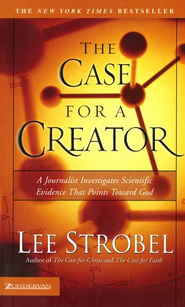
The interview of Lee Strobel (mini-bio below) with Dr. J. P. Moreland (mini-bio below) above is adapted from Chapter 10 in Lee Strobel. The Case for a Creator: A Journalist Investigates Scientific Evidence That Points Toward God. Grand Rapids: Zondervan, 2009.

 FOR FURTHER EVIDENCE

More Resources on This Topic

Cooper, John W. Body, Soul, and Life Everlasting. Grand Rapids, Mich.: Eerdmans, 1989.

Habermas, Gary and J. P. Moreland. Beyond Death. Wheaton, Ill.: Crossway, 1998.

Moreland, J. P. “God and the Argument from Mind.” In Scaling the Secular City. Grand Rapids, Mich.: Baker, 1987.

——. What Is the Soul? Norcross, Ga.: Ravi Zacharias International Ministries, 2002.

——. and Scott B. Rae. Body and Soul. Downer’s Grove, Ill.: InterVarsity, 2000.

Taliaferro, Charles. Consciousness and the Mind of God. Cambridge, England: Cambridge University Press, 1994.

Witham, Larry. “Mind and Brain.” In By Design: Science and the Search for God. San Francisco: Encounter Books, 2003.

About Lee Strobel

Atheist-turned-Christian Lee Strobel, the former award-winning legal editor of The Chicago Tribune, is a New York Times best-selling author of more than twenty books and has been interviewed on numerous national TV programs, including ABC, Fox, PBS, and CNN.

Described in the Washington Post as “one of the evangelical community’s most popular apologists,” Lee shared the Christian Book of the Year award in 2005 for a curriculum he co-authored with Garry Poole about the movie The Passion of the Christ. He also won Gold Medallions for his books The Case for Christ, The Case for Faith, and the The Case for a Creator, all of which have been made into documentaries distributed by Lionsgate.

His latest books include The Case for the Real Jesus, The Unexpected Adventure (co-authored with Mark Mittelberg) and The Case for Christ Study Bible, which includes hundreds of notes and articles on why Christians believe what they believe. His first novel, a legal thriller called The Ambition, came out in the Spring of 2011.

Lee was educated at the University of Missouri (Bachelor of Journalism degree, 1974) and Yale Law School (Master of Studies in Law degree, 1979). He was a professional journalist for 14 years at The Chicago Tribune and other newspapers, winning Illinois’ top honors for investigative reporting (which he shared with a team he led) and public service journalism from United Press International.

After a nearly two-year investigation of the evidence for Jesus, Lee became a Christian in 1981. He joined the staff of Willow Creek Community Church in South Barrington, IL, in 1987, and later became a teaching pastor there. He joined Saddleback Valley Community Church in Lake Forest, CA, as a teaching pastor in 2000. He left Saddleback’s staff to focus on writing.

Lee’s other books include God’s Outrageous Claims, The Case for Christmas, The Case for Easter, and Surviving a Spiritual Mismatch in Marriage, which he wrote with his wife, Leslie.

For two seasons, Lee was executive producer and host of the weekly national TV program Faith Under Fire.

Lee also is co-author of the Becoming a Contagious Christian course, which has trained more than a million Christians on how to naturally and effectively talk with others about Jesus. His articles have been published in a variety of magazines, including Discipleship Journal, Marriage Partnership, The Christian Research Journal, and Decision. He has appeared on such national radio programs as The Bible Answer Man and Focus on the Family. In addition, he has taught First Amendment law at Roosevelt University.

In recognition of his extensive research for his books, Southern Evangelical Seminary honored Lee with the conferring of a Doctor of Divinity degree in 2007.

Lee and Leslie have been married for 38 years and live in Colorado. Their daughter, Alison, is a novelist and co-author, with her husband Dan, of the children’s book, That’s Where God Is. Lee’s son, Kyle, holds two master’s degrees from the Talbot School of Theology and a PhD in theology from the University of Aberdeen in Scotland. His first book was Metamorpha: Jesus as a Way of Life.

About Dr. J.P. Moreland (in his own words: http://www.jpmoreland.com/about/bio/)


I am the Distinguished Professor of Philosophy at Talbot School of Theology, Biola University in La Mirada, California. I have four earned degrees: a B.S. in chemistry from the University of Missouri, a Th.M. in theology from Dallas Theological Seminary, an M. A. in philosophy from the University of California-Riverside, and a Ph.D. in philosophy from the University of Southern California.

During the course of my life, I have co-planted three churches, spoken and debated on over 175 college campuses around the country, and served with Campus Crusade for Christ for 10 years. For eight years, I served as a bioethicist for PersonaCare Nursing Homes, Inc. headquartered in Baltimore, Maryland.

My ideas have been covered by both popular religious and non-religious outlets, including the New Scientist and PBS’s “Closer to Truth,” Christianity TodayandWORLD magazine. I have authored or co-authored 30 books, including Kingdom Triangle, Scaling the Secular City, Consciousness and the Existence of God, The Recalcitrant Imago Dei, Love Your God With All Your Mind, The God Question, and Body and Soul. I have also published over 70 articles in journals, which include Philosophy and PhenomenologicalResearch,American Philosophical Quarterly, Australasian Journal of Philosophy, Metaphilosophy, Philosophia Christi, andFaith and Philosophy.

Personal Interests

My hobbies are exercising, following the Kansas City Chiefs, and being fixated by really great TV dramas like 24 and Lost. With my dear wife and ministry partner, Hope, we have two married daughters, Ashley and Allison, and as of 2010, four grandchildren! We attend Vineyard Anaheim church and are deeply committed to the body of believers there.

On Who Has Influenced Me

Besides my family and close friends, three people have had the greatest impact on me during my journey with Jesus: Bill Bright, Howard Hendricks, and Dallas Willard. I first came to Christ in 1968, and joined Campus Crusade staff from 1970-75, and 1979-84. I will never forget being in Dr. Bright’s presence during those years. He exuded intimacy with the Lord, he was full of faith, and he lived a holy life. These values were clearly put in place in my life due to his influence. He set a high bar in these areas, and his life gave me a living hope that significant progress in these areas was clearly within reach. Dr. Bright also died a vibrant, victorious death, and as I age, I very much want to do the same in a Christ-honoring way.

I have the honor of studying under Dr. Hendricks during my years at Dallas Theological Seminary (DTS) from 1975-79. I took several courses from him and was in a small discipleship group with Hendricks my last year at DTS. The values I saw in him were radical commitment to Christ, to reading in general and studying scripture in particular, and to the priority of marriage and family. He also had a commitment not to bore people while teaching the Bible and to exhibiting a keen sense of humor. These have all become my values, due in no small measure to Dr. Hendricks.

However as much as Bright and Hendricks have impacted me, the influence of Dallas Willard towers over everyone else. I was honored to have him as my dissertation supervisor at the University of Southern California and Hope and I have counted Dallas and his wife Jane as dear friends and mentors for twenty-five years. Dallas impacted me in his combination of a rigorous intellect with a vibrant walk with Jesus, his fresh, penetrating ideas about the kingdom and how to live in it, and by the reality of God that pours out of his life. I cannot overstate my debt to him. All three were full of humility. It was and is clear that they are about something much bigger than they.

My Dearest Partner, My Wife

My wife, Hope, has been my friend and partner for now 33 years. We were married in 1977. She has the gifts of evangelism, encouragement, helps/mercy. I have never met someone who is consistently happier than she, who loves to care for and serve others, and who exhibits the warmth and kindness of the Holy Spirit. It may sound canned to say this, but it is the truth, namely, that my life and work simply are inconceivable without her love and care all these years. She simply makes my life possible. Or, as I wrote of her in my 1985 book dedication (Universals, Qualities, and Quality-Instances) to her:

Her gracious life truly fits her name and her soul exemplifies that range of qualities that truly wise persons everywhere know as the moral virtues

Well said, I might add! For I experience her unconditional love in an ongoing way. And God made her to be a mother and grandmother par excellence. It is a joy to see how her children honor, respect and love her. My daughters, Ashley and Allison, have turned out to be good, solid people. What impresses me most about both of them is their genuine concern for others and their ability to be good listeners. It isn’t all about them, and this is refreshing these days. Our girls not only love Hope and me, but they actually like us!! They, and their dear husbands, actually like being around us!! As of this writing, I have two grandchildren around three years old (a girl and a boy), a one-month old grandson, and a granddaughter due to be born October 2010. Does it get any better than this?

My Church

My love for the local church was not something that characterized me for much of my Christian life. I was primarily a parachurch guy and I wanted to get the job done, whether or not the local church was part of the solution. I was always committed to a sense of team, but my friendships were the primary source of fellowship for me and Hope within the body of Christ. But the last several years has been transforming.

My relationship with my local church—the Vineyard Anaheim—has shown me how short-sighted my previous vision was. I am fully committed to my local church’s well-being and absolutely love being a part of the fellowship. I have never been a “Lone Ranger Christian”—quite the opposite—but I now see more than ever the centrality of the local church to my intellectual, affective, and relational maturation. I thank God that He brought me to my senses.

Tim Keller on The Gospel Is NOT Everything

“THE GOSPEL IS NOT EVERYTHING”

(Adapted from Tim Keller’s fantastic Gospel saturated book Center Church: Doing Balanced Gospel-Centered Ministry in Your City. Grand Rapids: Zondervan, 2012, Chapter One [I have written out many of the Scripture references in BOLD ITALIC print for ease of reference from the ESV – DPC])

What do we mean by “the gospel”? Answering this question is a bit more complex than we often assume. Not everything the Bible teaches can be considered “the gospel” (although it can be argued that all biblical doctrine is necessary background for understanding the gospel). The gospel is a message about how we have been rescued from peril. The very word gospel has as its background a news report about some life-altering event that has already happened:

Mark 1:1, “The beginning of the gospel of Jesus Christ, the Son of God.”

Luke 2:10, And the angel said to them, “Fear not, for behold, I bring you good news of great joy that will be for all the people.”

1 Corinthians 1:16-17 & 15:1-11, (I did baptize also the household of Stephanas. Beyond that, I do not know whether I baptized anyone else.) For Christ did not send me to baptize but to preach the gospel, and not with words of eloquent wisdom, lest the cross of Christ be emptied of its power…Now I would remind you, brothers, of the gospel I preached to you, which you received, in which you stand, and by which you are being saved, if you hold fast to the word I preached to you—unless you believed in vain. For I delivered to you as of first importance what I also received: that Christ died for our sins in accordance with the Scriptures, that he was buried, that he was raised on the third day in accordance with the Scriptures, and that he appeared to Cephas, then to the twelve. Then he appeared to more than five hundred brothers at one time, most of whom are still alive, though some have fallen asleep. Then he appeared to James, then to all the apostles. Last of all, as to one untimely born, he appeared also to me. For I am the least of the apostles, unworthy to be called an apostle, because I persecuted the church of God. But by the grace of God I am what I am, and his grace toward me was not in vain. On the contrary, I worked harder than any of them, though it was not I, but the grace of God that is with me. Whether then it was I or they, so we preach and so you believed.

 (1) The gospel is good news, not good advice.

The gospel is not primarily a way of life. It is not something we do, but something that has been done for us and something that we must respond to. In the Greek translation of the Old Testament — the Septuagint — the word euangelizo (proclaim good news) occurs twenty-three times. As we see in Psalm 40: 9 (ESV) — “I have told the glad news of [your] deliverance in the great congregation” — the term is generally used to declare the news of something that has happened to rescue and deliver people from peril. In the New Testament, the word group euangelion (good news), euangelizo (proclaim good news), and euangelistes (one who proclaims good news) occurs at least 133 times.

D. A. Carson draws this conclusion from a thorough study of gospel words:

Because the gospel is news, good news… it is to be announced; that is what one does with news. The essential heraldic element in preaching is bound up with the fact that the core message is not a code of ethics to be debated, still less a list of aphorisms to be admired and pondered, and certainly not a systematic theology to be outlined and schematized. Though it properly grounds ethics, aphorisms, and systematics, it is none of these three: it is news, good news, and therefore must be publicly announced (D.A. Carson, “What Is the Gospel? –Revisited,” in For the Fame of God’s Name: Essays in Honor of John Piper, ed. Sam Storms and Justin Taylor. Wheaton, ILL.: Crossway, 2010, 158.

(2) The gospel is good news announcing that we have been rescued or saved.

And what are we rescued from? What peril are we saved from? A look at the gospel words in the New Testament shows that we are rescued from the “coming wrath” at the end of history (1 Thessalonians 1:10, “and to wait for his Son from heaven, whom he raised from the dead, Jesus who delivers us from the wrath to come”).

But this wrath is not an impersonal force — it is God’s wrath. We are out of fellowship with God; our relationship with him is broken. In perhaps the most thoroughgoing exposition of the gospel in the Bible, Paul identifies God’s wrath as the great problem of the human condition (Rom 1:18–32).

Romans 1:18-32, For the wrath of God is revealed from heaven against all ungodliness and unrighteousness of men, who by their unrighteousness suppress the truth. For what can be known about God is plain to them, because God has shown it to them. For his invisible attributes, namely, his eternal power and divine nature, have been clearly perceived, ever since the creation of the world, in the things that have been made. So they are without excuse. For although they knew God, they did not honor him as God or give thanks to him, but they became futile in their thinking, and their foolish hearts were darkened. Claiming to be wise, they became fools, and exchanged the glory of the immortal God for images resembling mortal man and birds and animals and creeping things.

Therefore God gave them up in the lusts of their hearts to impurity, to the dishonoring of their bodies among themselves, because they exchanged the truth about God for a lie and worshiped and served the creature rather than the Creator, who is blessed forever! Amen.

For this reason God gave them up to dishonorable passions. For their women exchanged natural relations for those that are contrary to nature; and the men likewise gave up natural relations with women and were consumed with passion for one another, men committing shameless acts with men and receiving in themselves the due penalty for their error.

And since they did not see fit to acknowledge God, God gave them up to a debased mind to do what ought not to be done. They were filled with all manner of unrighteousness, evil, covetousness, malice. They are full of envy, murder, strife, deceit, maliciousness. They are gossips, slanderers, haters of God, insolent, haughty, boastful, inventors of evil, disobedient to parents, foolish, faithless, heartless, ruthless. Though they know God’s righteous decree that those who practice such things deserve to die, they not only do them but give approval to those who practice them.

Genesis 3:1-19, Now the serpent was more crafty than any other beast of the field that the Lord God had made. He said to the woman, “Did God actually say, ‘You shall not eat of any tree in the garden’?” And the woman said to the serpent, “We may eat of the fruit of the trees in the garden, but God said, ‘You shall not eat of the fruit of the tree that is in the midst of the garden, neither shall you touch it, lest you die.’ ”

But the serpent said to the woman, “You will not surely die. For God knows that when you eat of it your eyes will be opened, and you will be like God, knowing good and evil.” So when the woman saw that the tree was good for food, and that it was a delight to the eyes, and that the tree was to be desired to make one wise, she took of its fruit and ate, and she also gave some to her husband who was with her, and he ate. Then the eyes of both were opened, and they knew that they were naked. And they sewed fig leaves together and made themselves loincloths.

And they heard the sound of the Lord God walking in the garden in the cool of the day, and the man and his wife hid themselves from the presence of the Lord God among the trees of the garden. But the Lord God called to the man and said to him, “Where are you?” And he said, “I heard the sound of you in the garden, and I was afraid, because I was naked, and I hid myself.” He said, “Who told you that you were naked? Have you eaten of the tree of which I commanded you not to eat?” The man said, “The woman whom you gave to be with me, she gave me fruit of the tree, and I ate.” Then the Lord God said to the woman, “What is this that you have done?” The woman said, “The serpent deceived me, and I ate.”

The Lord God said to the serpent, “Because you have done this, cursed are you above all livestock and above all beasts of the field; on your belly you shall go, and dust you shall eat all the days of your life. I will put enmity between you and the woman, and between your offspring and her offspring; he shall bruise your head, and you shall bruise his heel.”

To the woman he said, “I will surely multiply your pain in childbearing; in pain you shall bring forth children. Your desire shall be for your husband, and he shall rule over you.”

And to Adam he said, “Because you have listened to the voice of your wife and have eaten of the tree of which I commanded you, ‘You shall not eat of it,’ cursed is the ground because of you; in pain you shall eat of it all the days of your life; thorns and thistles it shall bring forth for you; and you shall eat the plants of the field.

By the sweat of your face you shall eat bread, till you return to the ground, for out of it you were taken; for you are dust, and to dust you shall return.”

Here we see that the wrath of God has many ramifications. The background text is Genesis 3:17–19 (Genesis 3 passage above), in which God’s curse lies on the entire created order because of human sin. Because we are alienated from God, we are psychologically alienated within ourselves — we experience shame and fear (Gen 3:10). Because we are alienated from God, we are also socially alienated from one another (v. 7 describes how Adam and Eve must put on clothing, and v. 16 speaks of alienation between the genders; also notice the blame shifting in their dialogue with God in vv. 11–13). Because we are alienated from God, we are also physically alienated from nature itself. We now experience sorrow, painful toil, physical degeneration, and death (vv. 16–19). In fact, the ground itself is “cursed” (v. 17; see Rom 8:18–25 below).

Romans 8:18-25, For I consider that the sufferings of this present time are not worth comparing with the glory that is to be revealed to us. For the creation waits with eager longing for the revealing of the sons of God. For the creation was subjected to futility, not willingly, but because of him who subjected it, in hope that the creation itself will be set free from its bondage to corruption and obtain the freedom of the glory of the children of God. For we know that the whole creation has been groaning together in the pains of childbirth until now. And not only the creation, but we ourselves, who have the firstfruits of the Spirit, groan inwardly as we wait eagerly for adoption as sons, the redemption of our bodies. For in this hope we were saved. Now hope that is seen is not hope. For who hopes for what he sees? But if we hope for what we do not see, we wait for it with patience.

Since the garden, we live in a world filled with suffering, disease, poverty, racism, natural disasters, war, aging, and death — and it all stems from the wrath and curse of God on the world. The world is out of joint, and we need to be rescued. But the root of our problem is not these “horizontal” relationships, though they are often the most obvious; it is our “vertical” relationship with God.

All human problems are ultimately symptoms, and our separation from God is the cause. The reason for all the misery — all the effects of the curse — is that we are not reconciled to God. We see this in such texts as Romans 5:8 and 2 Corinthians 5:20 (below).

Romans 5:8, “but God shows his love for us in that while we were still sinners, Christ died for us.”

2 Corinthians 5:20, “Therefore, we are ambassadors for Christ, God making his appeal through us. We implore you on behalf of Christ, be reconciled to God.”

Therefore, the first and primary focus of any real rescue of the human race — the main thing that will save us — is to have our relationship with God put right again.

(3) The gospel is news about what has been done by Jesus Christ to put right our relationship with God.

Becoming a Christian is about a change of status. First John 3:14 (emphasis added) states that “we have passed from death to life,” not we are passing from death to life ((The verb translated “passed” in 1 John 3:14 is metabaino, which means to “cross over.” In John 5:24, Jesus states, “Whoever hears my word and believes him who went me has eternal life and will not be condemned; he has crossed over [metabaino] from death to life.” A parallel passage is Colosssians 1:13, where it is said that Christ-followers have been transferred from the dominion of darkness into the kingdom of the Son). You are either in Christ or you are not; you are either pardoned and accepted or you are not; you either have eternal life or you don’t. This is why Dr. Martyn Lloyd-Jones often used a diagnostic question to determine a person’s spiritual understanding and condition. He would ask, “Are you now ready to say that you are a Christian?” He recounts that over the years, whenever he would ask the question, people would often hesitate and then say, “I do no feel that I am good enough.” To that, he gives this response:

At once I know that… they are still thinking in terms of themselves; their idea still is that they have to make themselves good enough to be a Christian… It sounds very modest but it is the lie of the devil, it is a denial of the faith… you will never be good enough; nobody has ever been good enough. The essence of the Christian salvation is to say that He is good enough and that I am in Him! (D. Martyn Lloyd-Jones, Spiritual Depression: Its Causes and Cure. Grand Rapids: Eerdmans, 1965, 34).

Lloyd-Jones’s point is that becoming a Christian is a change in our relationship with God. Jesus’ work, when it is believed and rested in, instantly changes our standing before God. We are “in him.”

Ever since reading J. I. Packer’s famous essay introducing John Owen’s Death of Death in the Death of Christ, I have liked “God saves sinners” as a good summary of gospel: God saves sinners. God — the Triune Jehovah, Father, Son and Spirit; three Persons working together in sovereign wisdom, power and love to achieve the salvation of a chosen people, the Father electing, the Son fulfilling the Father’s will by redeeming, the Spirit executing the purpose of Father and Son by renewing. Saves — does everything, first to last, that is involved in bringing man from death in sin to life in glory: plans, achieves and communicates redemption, calls and keeps, justifies, sanctifies, glorifies. Sinners— men as God finds them, guilty, vile, helpless, powerless, unable to lift a finger to do God’s will or better their spiritual lot (J.I. Packer, “Introductory Essay to John Owen’s Death of Death in the Death of Christ” – see this website [verticallivingministries.com] under the category “Soteriology” or “J.I. Packer”).

THE GOSPEL IS NOT THE RESULTS OF THE GOSPEL

The gospel is not about something we do but about what has been done for us, and yet the gospel results in a whole new way of life. This grace and the good deeds that result must be both distinguished and connected. The gospel, its results, and its implications must be carefully related to each other— neither confused nor separated. One of Martin Luther’s dicta was that we are saved by faith alone but not by a faith that remains alone. His point is that true gospel belief will always and necessarily lead to good works, but salvation in no way comes through or because of good works. Faith and works must never be confused for one another, nor may they be separated.

For by grace you have been saved through faith. And this is not your own doing; it is the gift of God, not a result of works, so that no one may boast. For we are his workmanship, created in Christ Jesus for good works, which God prepared beforehand, that we should walk in them (Ephesians 2:8-10).

“What good is it, my brothers, if someone says he has faith but does not have works? Can that faith save him?So also faith by itself, if it does not have works, is dead. But someone will say, “You have faith and I have works.” Show me your faith apart from your works, and I will show you my faith by my works.

Do you want to be shown, you foolish person, that faith apart from works is useless? Was not Abraham our father justified by works when he offered up his son Isaac on the altar? You see that faith was active along with his works, and faith was completed by his works; and the Scripture was fulfilled that says, “Abraham believed God, and it was counted to him as righteousness”—and he was called a friend of God. You see that a person is justified by works and not by faith alone. And in the same way was not also Rahab the prostitute justified by works when she received the messengers and sent them out by another way? For as the body apart from the spirit is dead, so also faith apart from works is dead” (James 2:14, 17-18, 20-26).

I am convinced that belief in the gospel leads us to care for the poor and participate actively in our culture, as surely as Luther said true faith leads to good works. But just as faith and works must not be separated or confused, so the results of the gospel must never be separated from or confused with the gospel itself. I have often heard people preach this way: “The good news is that God is healing and will heal the world of all its hurts; therefore, the work of the gospel is to work for justice and peace in the world.” The danger in this line of thought is not that the particulars are untrue (they are not) but that it mistakes effects for causes. It confuses what the gospel is with what the gospel does. When Paul speaks of the renewed material creation, he states that the new heavens and new earth are guaranteed to us because on the cross Jesus restored our relationship with God as his true sons and daughters. Romans 8:1–25 teaches, remarkably, that the redemption of our bodies and of the entire physical world occurs when we receive “our adoption.” As his children, we are guaranteed our future inheritance, and because of that inheritance, the world is renewed. The future is ours because of Christ’s work finished in the past.

“In him you also, when you heard the word of truth, the gospel of your salvation, and believed in him, were sealed with the promised Holy Spirit, who is the guarantee of our inheritance until we acquire possession of it, to the praise of his glory…having the eyes of your hearts enlightened, that you may know what is the hope to which he has called you, what are the riches of his glorious inheritance in the saints” (Ephesians 1:13-14,18).

“giving thanks to the Father, who has qualified you to share in the inheritance of the saints in light… knowing that from the Lord you will receive the inheritance as your reward. You are serving the Lord Christ” (Colossians 1:12; 3:24).

“Therefore he [Jesus] is the mediator of a new covenant, so that those who are called may receive the promised eternal inheritance, since a death has occurred that redeems them from the transgressions committed under the first covenant” (Hebrews 9:15).

“Blessed be the God and Father of our Lord Jesus Christ! According to his great mercy, he has caused us to be born again to a living hope through the resurrection of Jesus Christ from the dead, to an inheritance that is imperishable, undefiled, and unfading, kept in heaven for you, who by God’s power are being guarded through faith for a salvation ready to be revealed in the last time” (1 Peter 1:3-5).

We must not, then, give the impression that the gospel is simply a divine rehabilitation program for the world, but rather that it is an accomplished substitutionary work. We must not depict the gospel as primarily joining something (Christ’s kingdom program) but rather as receiving something (Christ’s finished work). If we make this error, the gospel becomes another kind of a salvation by works instead of a salvation by faith.

As J. I. Packer writes:

The gospel does bring us solutions to these problems [of suffering and injustice], but it does so by first solving… the deepest of all human problems, the problem of man’s relation with his Maker; and unless we make it plain that the solution of these former problems depends on the settling of this latter one, we are misrepresenting the message and becoming false witnesses of God (J.I. Packer. Knowing God. Downers Grove, ILL.: InterVarsity, 1973, p. 171).

A related question has to do with whether the gospel is spread by the doing of justice. Not only does the Bible say over and over that the gospel is spread by preaching, but common sense tells us that loving deeds, as important as they are as an accompaniment of preaching, cannot by themselves bring people to a saving knowledge of Jesus Christ. Francis Schaeffer argued rightly that Christians’ relationships with each other constitute the criterion the world uses to judge whether their message is truthful — so Christian community is the “final apologetic” (Francis Schaeffer. The Mark of the Christian. Downers Grove, ILL.: InterVarsity, 1977, p. 25; cf. Timothy George and John Woodbridge. The Mark of Jesus: Loving in a Way the World Can See. Chicago: Moody, 2005).

Notice again, however, the relationship between faith and works. Jesus said that a loving community is necessary for the world to know that God sent him (John 17:23, “I in them and you in me, that they may become perfectly one, so that the world may know that you sent me and loved them even as you loved me.” And John 13:35, “By this all people will know that you are my disciples, if you have love for one another”).

Sharing our goods with each other and with the needy is a powerful sign to nonbelievers (see the relationship between witness and sharing in Acts 4:31– 37 and Acts 6). But loving deeds — even though they embody the truths of the gospel and cannot be separated from preaching the gospel — should not be conflated with it. The gospel, then, is preeminently a report about the work of Christ on our behalf — that is why and how the gospel is salvation by grace. The gospel is news because it is about a salvation accomplished for us. It is news that creates a life of love, but the life of love is not itself the gospel (See D.A. Carson, “What Is the Gospel? —Revisited,” in For the Fame of God’s Name, 158).

THE GOSPEL HAS TWO EQUAL AND OPPOSITE ENEMIES

The ancient church father Tertullian is reputed to have said, “Just as Jesus was crucified between two thieves, so the gospel is ever crucified between these two errors” (Having heard and read this in the words of other preachers, I have never been able to track down an actual place in Tertullian’s writings where he says it. I think it may be apocryphal, but the principle is right).

What are these errors to which Tertullian was referring? I often call them religion and irreligion; the theological terms are legalism and antinomianism. Another way to describe them could be moralism and relativism (or pragmatism).

These two errors constantly seek to corrupt the message and steal away from us the power of the gospel. Legalism says that we have to live a holy, good life in order to be saved. Antinomianism says that because we are saved, we don’t have to live a holy, good life.

This is the location of the “tip of the spear” of the gospel. A very clear and sharp distinction between legalism, antinomianism, and the gospel is often crucial for the life-changing power of the Holy Spirit to work. If our gospel message even slightly resembles “you must believe and live right to be saved” or “God loves and accepts everyone just as they are,” we will find our communication is not doing the identity-changing, heart-shaping transformative work described in the next part of this book. If we just preach general doctrine and ethics from Scripture, we are not preaching the gospel. The gospel is the good news that God has accomplished our salvation for us through Christ in order to bring us into a right relationship with him and eventually to destroy all the results of sin in the world.

Still, it can be rightly argued that in order to understand all this — who God is, why we need salvation, what he has done to save us — we must have knowledge of the basic teachings of the entire Bible. J. Gresham Machen, for example, speaks of the biblical doctrines of God and of man to be the “presuppositions of the gospel” ((J. Gresham Machen, Christianity and Liberalism, new ed. Grand Rapids: Eerdmans, 2001, 99).

This means that an understanding of the Trinity, of Christ’s incarnation, of original sin and sin in general — are all necessary. If we don’t understand, for example, that Jesus was not just a good man but the second person of the Trinity, or if we don’t understand what the “wrath of God” means, it is impossible to understand what Jesus accomplished on the cross. Not only that, but the New Testament constantly explains the work of Christ in Old Testament terms — in the language of priesthood, sacrifice, and covenant.

In other words, we must not just preach the Bible in general; we must preach the gospel. Yet unless those listening to the message understand the Bible in general, they won’t grasp the gospel. The more we understand the whole corpus of biblical doctrine, the more we will understand the gospel itself — and the more we understand the gospel, the more we will come to see that this is, in the end, what the Bible is really about. Biblical knowledge is necessary for the gospel and distinct from the gospel, yet it so often stands in when the gospel is not actually present that people have come to mistake its identity.

 THE GOSPEL HAS CHAPTERS

So, the gospel is good news — it is not something we do but something that has been done for us. Simple enough. But when we ask questions like “Good news about what?” or “Why is it good news?” the richness and complexity of the gospel begin to emerge.

There are two basic ways to answer the question “What is the gospel?” One is to offer the biblical good news of how you can get right with God. This is to understand the question to mean, “What must I do to be saved?” The second is to offer the biblical good news of what God will fully accomplish in history through the salvation of Jesus. This is to understand the question as “What hope is there for the world?”

If we conceive the question in the first, more individualistic way, we explain how a sinful human being can be reconciled to a holy God and how his or her life can be changed as a result. It is a message about individuals. The answer can be outlined: Who God is, what sin is, who Christ is and what he did, and what faith is. These are basically propositions.

If we conceive of the question in the second way, to ask all that God is going to accomplish in history, we explain where the world came from, what went wrong with it, and what must happen for it to be mended. This is a message about the world. The answer can be outlined: creation, fall, redemption, and restoration. These are chapters in a plotline, a story. There is no single way to present the biblical gospel. Yet I urge you to try to be as thoughtful as possible in your gospel presentations. The danger in answering only the first question (“What must I do to be saved?”) without the second (“What hope is there for the world?”) is that, standing alone, the first can play into the Western idea that religion exists to provide spiritual goods that meet individual spiritual needs for freedom from guilt and bondage. It does not speak much about the goodness of the original creation or of God’s concern for the material world, and so this conception may set up the listener to see Christianity as sheer escape from the world. But the danger in conceiving the gospel too strictly as a story line of the renewal of the world is even greater. It tells listeners about God’s program to save the world, but it does not tell them how to actually get right with God and become part of that program. In fact, I’ll say that without the first message, the second message is not the gospel. J. I. Packer writes these words:

In recent years, great strides in biblical theology and contemporary canonical exegesis have brought new precision to our grasp of the Bible’s overall story of how God’s plan to bless Israel, and through Israel the world, came to its climax in and through Christ. But I do not see how it can be denied that each New Testament book, whatever other job it may be doing, has in view, one way or another, Luther’s primary question: how may a weak, perverse, and guilty sinner find a gracious God? Nor can it be denied that real Christianity only really starts when that discovery is made. And to the extent that modern developments, by filling our horizon with the great metanarrative, distract us from pursuing Luther’s question in personal terms, they hinder as well as help in our appreciation of the gospel  (J. I. Packer, In My Place Condemned He Stood: Celebrating the Glory of the Atonement. Wheaton, Ill.: Crossway, 2007, 26 – 27).

Still, the Bible’s grand narrative of cosmic redemption is critical background to help an individual get right with God. One way to proceed is to interleave the two answers to the “What is the gospel?” question so that gospel truths are laid into a story with chapters rather than just presented as a set of propositions. The narrative approach poses the questions, and the propositional approach supplies the answers.

How would we relate the gospel to someone in this way? What follows is a “conversational pathway” for presenting the gospel to someone as the chapters in a story. In the Bible, the term gospel is the declaration of what Jesus Christ has done to save us. In light of the biblical usage, then, we should observe that chapters 1 (God and Creation), 2 (Fall and Sin), and 4 (Faith) are not, strictly speaking, “the gospel.” They are prologue and epilogue. Simon Gathercole argues that both Paul and the Gospel writers considered the good news to have three basic elements: the identity of Jesus as Son of God and Messiah, the death of Jesus for sin and justification, and the establishment of the reign of God and the new creation (Simon Gathercole, “The Gospel of Paul and the Gospel of the Kingdom,” in God’s Power to Save, ed. Chris Green. Leicester, UK: Inter-Varsity, 2006, 138 – 54).

The gospel, then, is packed into chapter 3, with its three headings — incarnation, substitution, and restoration. Chapter 1 on God and chapter 2 on sin constitute absolutely critical background information for understanding the meaning of the person and work of Jesus, and chapter 4 helps us understand how we must respond to Jesus’ salvation. Nevertheless, it is reasonable and natural to refer to the entire set of four chapters as “the gospel.”

WHERE DID WE COME FROM?

Answer: God. There is one God. He is infinite in power, goodness, and holiness and yet also personal and loving, a God who speaks to us in the Bible. The world is not an accident, but the creation of the one God (Genesis 1). God created all things, but why did he do that? Why did he create the world and us? The answer is what makes the Christian understanding of God profound and unique. While there is only one God, within God’s being there are three persons — Father, Son, and Holy Spirit —who are all equally God and who have loved, adored, served, and enjoyed one another from all eternity. If God were unipersonal, then he would have not known love until he created other beings. In that case, love and community would not have been essential to his character; it would have emerged later. But God is triune, and therefore love, friendship, and community are intrinsic to him and at the heart of all reality. So a triune God created us (John 1: 1 – 4), but he would not have created us to get the joy of mutual love and service, because he already had that. Rather, he created us to share in his love and service. As we know from John 17: 20– 24, the persons of the Trinity love and serve one another — they are “other-oriented”  (D. A. Carson in The Difficult Doctrine of the Love of God. Wheaton, Ill.: Crossway, 2000, pp. 39 & 43 writes, “What we have, then, is a picture of God whose love, even in eternity past, even before the creation of anything, is other-oriented. This cannot be said [for instance] of Allah. Yet because the God of the Bible is one, this plurality-in-unity does not destroy his entirely appropriate self-focus as God… There has always been an other-orientation to the love of God… We are the friends of God by virtue of the intra-Trinitarian love of God that so worked out in the fullness of time that the plan of redemption, conceived in the mind of God in eternity past, has exploded into our space-time history at exactly the right moment.”).

And thus God created us to live in the same way. In order to share the joy and love that God knew within himself, he created a good world that he cares for, a world full of human beings who were called to worship, know, and serve him, not themselves (See “The Dance of Creation,” in Tim Keller, The Reason for God: Belief in an Age of Skepticism. New York: Dutton, 2008, pp. 225– 26; “The Dance,” in Tim Keller, King’s Cross: The Story of the World in the Life of Jesus. New York: Dutton, 2011, 3– 13).

WHY DID THINGS GO SO WRONG?

Answer: Sin. God created us to adore and serve him and to love others. By living this way, we would have been completely happy and enjoyed a perfect world. But instead, the whole human race turned away from God, rebelling against his authority. Instead of living for God and our neighbors, we live lives of self-centeredness. Because our relationship with God has been broken, all other relationships — with other human beings, with our very selves, and with the created world — are also ruptured. The result is spiritual, psychological, social, and physical decay and breakdown. “Things fall apart; the center cannot hold. Mere anarchy is loosed upon the world” — the world now lies under the power of sin (Quote from the poem “The Second Coming,” 1920 by William Butler Yeats).

Sin reaps two terrible consequences. One consequence is spiritual bondage (Rom 6: 15–18). We may believe in God or we may not believe, but either way, we never make him our greatest hope, good, or love. We try to maintain control of our lives by living for other things — for money, career, family, fame, romance, sex, power, comfort, social and political causes, or something else. But the result is always a loss of control, a form of slavery. Everyone has to live for something, and if that something is not God, then we are driven by that thing we live for — by overwork to achieve it, by inordinate fear if it is threatened, deep anger if it is being blocked, and inconsolable despair if it is lost. So the novelist David Foster Wallace, not long before his suicide, spoke these words to the 2005 graduating class at Kenyon College:

Everybody worships. The only choice we get is what to worship. And the compelling reason for maybe choosing some sort of god or spiritual-type thing to worship… is that pretty much anything else you worship will eat you alive. If you worship money and things, if they are where you tap real meaning in life, then you will never have enough, never feel you have enough… Worship your body and beauty and sexual allure and you will always feel ugly. And when time and age start showing, you will die a million deaths before they finally grieve you… Worship power, you will end up feeling weak and afraid, and you will need ever more power over others to numb you to your own fear. Worship your intellect, being seen as smart, you will end up feeling stupid, a fraud, always on the verge of being found out. But the insidious thing about these forms of worship is… they’re unconscious. They are default settings (Emily Bobrow, “David Foster Wallace, in His Own Words,” taken from his 2005 commencement address at Kenyon College, http:// moreintelligentlife.com/ story/ david-foster-wallace-in-his-own-words; accessed January 4, 2012).

The second basic consequence of sin is condemnation (Rom 6: 23). We are not just suffering because of sin; we are guilty because of sin. Often we say, “Well, I’m not very religious, but I’m a good person — and that is what is most important.” But is it? Imagine a woman —a poor widow —with an only son. She teaches him how she wants him to live — to always tell the truth, to work hard, and to help the poor. She makes very little money, but with her meager savings she is able to put him through college. Imagine that when he graduates, he hardly ever speaks to her again. He occasionally sends a Christmas card, but he doesn’t visit her; he won’t answer her phone calls or letters; he doesn’t speak to her. But he lives just like she taught him — honestly, industriously, and charitably. Would we say this was acceptable? Of course not! Wouldn’t we say that by living a “good life” but neglecting a relationship with the one to whom he owed everything he was doing something condemnable? In the same way, if God created us and we owe him everything and we do not live for him but we “live a good life,” it is not enough. We all owe a debt that must be paid.

WHAT WILL PUT THINGS RIGHT?

Answer: Christ. First, Jesus Christ puts things right through his incarnation. C. S. Lewis wrote that if there is a God, we certainly don’t relate to him as people on the first floor of a building relate to people on the second floor. We relate to him the way Hamlet relates to Shakespeare. We (characters) might be able to know quite a lot about the playwright, but only to the degree that the author chooses to put information about himself in the play (See C. S. Lewis, Christian Reflections. Grand Rapids: Eerdmans, 1967, pp. 167– 76).

In the Christian view, however, we believe that God did even more than simply give us information. Many fans of Dorothy Sayers’s detective stories and mystery novels point out that Sayers was one of the first women to attend Oxford University. The main character in her stories — Lord Peter Wimsey — is an aristocratic sleuth and a single man. At one point in the novels, though, a new character appears, Harriet Vane. She is described as one of the first women who graduated from Oxford — and as a writer of mystery novels. Eventually she and Peter fall in love and marry. Who was she? Many believe Sayers looked into the world she had created, fell in love with her lonely hero, and wrote herself into the story to save him. Very touching! But that is not nearly as moving or amazing as the reality of the incarnation (John 1: 14). God, as it were, looked into the world he had made and saw our lostness and had pity on his people. And so he wrote himself into human history as its main character (John 3: 16). The second person in the Trinity, the Son of God, came into the world as a man, Jesus Christ.

The second way Jesus puts things right is through substitution. Because of the guilt and condemnation on us, a just God can’t simply shrug off our sins. Being sorry is not enough. We would never allow an earthly judge to let a wrongdoer off, just because he was contrite — how much less should we expect a perfect heavenly Judge to do so? And even when we forgive personal wrongs against us, we cannot simply forgive without cost. If someone harms us and takes money or happiness or reputation from us, we can either make them pay us back or forgive them— which means we absorb the cost ourselves without remuneration.

Jesus Christ lived a perfect life — the only human being to ever do so. “For we do not have a high priest who is unable to sympathize with our weaknesses, but one who in every respect has been tempted as we are, yet without sin” (Hebrews 4:15).

At the end of his life, he deserved blessing and acceptance; at the end of our lives, because every one of us lives in sin, we deserve rejection and condemnation. “What then? Are we Jews any better off? No, not at all. For we have already charged that all, both Jews and Greeks [Gentiles], are under sin, as it is written: “None is righteous, no, not one; no one understands; no one seeks for God. All have turned aside; together they have become worthless; no one does good, not even one” (Romans 3:9–12).

Yet when the time had fully come, Jesus received in our place, on the cross, the rejection and condemnation we deserve (“For Christ also suffered once for sins, the righteous for the unrighteous, that he might bring us to God, being put to death in the flesh but made alive in the spirit” – 1 Peter 3:18), so that, when we believe in him, we can receive the blessing and acceptance he deserves (“For our sake he made him to be sin, so that in him we might become the righteousness of God” – 2 Corinthians 5: 21).

There is no more moving thought than that of someone giving his life to save another. In Charles Dickens’s A Tale of Two Cities, two men — Charles Darnay and Sydney Carton — both love the same woman, Lucie Manette, but Lucie chooses to marry Charles. Later, during the French Revolution, Charles is thrown in prison and awaits execution on the guillotine. Sydney visits Charles in prison, drugs him, and has him carried out. When a young seamstress (also on death row) realizes that Sydney is taking Charles’s place, she is amazed and asks him to hold her hand for strength. She is deeply moved by his substitutionary sacrifice — and it wasn’t even for her! When we realize that Jesus did the very same thing for us, it changes everything — the way we regard God, ourselves, and the world.

The third way Jesus will put things right is through the eventual restoration of all that has gone wrong with the world. The first time Jesus came from heaven to earth, he came in weakness to suffer for our sins. But the second time he comes, he will judge the world, putting a final end to all evil, suffering, decay, and death. “For the creation waits with eager longing for the revealing of the sons of God. For the creation was subjected to futility, not willingly, but because of him who subjected it, in hope that the creation itself will be set free from its bondage to corruption and obtain the freedom of the glory of the children of God…But according to his promise we are waiting for new heavens and a new earth in which righteousness dwells” (Romans 8:19–21; 2 Peter 3:13).

This means that Christ’s salvation does not merely save our souls so we can escape the pain of the curse on the physical world. Rather, the final goal is the renewal and restoration of the material world, and the redemption of both our souls and our bodies. Vinoth Ramachandra notes how unique this view is among the religions of the world:

So our salvation lies not in an escape from this world but in the transformation of this world… You will not find hope for the world in any religious systems or philosophies of humankind. The biblical vision is unique. That is why when some say that there is salvation in other faiths I ask them, “What salvation are you talking about?” No faith holds out a promise of eternal salvation for the world the way the cross and resurrection of Jesus do (Vinoth Ramachandra, The Scandal of Jesus. Downers Grove, Ill.: InterVarsity, 2001, 24).

 HOW CAN I BE PUT RIGHT?

Answer: Faith. Jesus died for our sins and rose again from the grave. By faith in him, our sins can be forgiven and we can be assured of living forever with God and one day being raised from the dead like Christ. So what does it mean to believe, to have faith? First, it means to grasp what salvation “by faith” means. Believing in Christ does not mean that we are forgiven for our past, get a new start on life, and must simply try harder to live better than we did in the past. If this is your mind-set, you are still putting your faith in yourself. You are your own Savior. You are looking to your moral efforts and abilities to make yourself right with God. But this will never work. No one lives a perfect life. Even your best deeds are tainted by selfish and impure motives.

The gospel is that when we believe in Christ, there is now “no condemnation for those who are in Christ Jesus” (Romans 8:1). Putting our faith in Christ is not about trying harder; it means transferring our trust away from ourselves and resting in him. It means asking, “Father, accept me not because of what I have done or ever will do but because of what Jesus has done in my place.” When we do that, we are adopted into God’s family and given the right to his eternal, fatherly love (John 1:12–13).

The second thing to keep in mind is that it is not the quality of the faith itself that saves us; it is what Jesus has done for us. It is easy to assume that being “saved by faith” means that God will now love us because of the depth of our repentance and faith. But that is to once again subtly make ourselves our own Savior rather than Jesus. It is not the amount of our faith but the object of our faith that saves us. Imagine two people boarding an airplane. One person has almost no faith in the plane or the crew and is filled with fears and doubts. The other has great confidence in the plane and the crew. They both enter the plane, fly to a destination, and get off the plane safely. One person had a hundred times more faith in the plane than the other did, but they were equally safe. It wasn’t the amount of their faith but the object of their faith (the plane and crew) that kept them from suffering harm and arriving safely at their destination. Saving faith isn’t a level of psychological certainty; it is an act of the will in which we rest in Jesus. We give ourselves wholly to him because he gave himself wholly for us (“And calling the crowd to him with his disciples, he said to them, “If anyone would come after me, let him deny himself and take up his cross and follow me… Behold, I stand at the door and knock. If anyone hears my voice and opens the door, I will come in to him and eat with him, and he with me”– Mark 8:34; Revelation 3:20).

THE RIGHT RELATIONSHIP OF THE GOSPEL TO ALL OF MINISTRY

There is always a danger that church leaders and ministers will conceive of the gospel as merely the minimum standard of doctrinal content for being a Christian believer. As a result, many preachers and leaders are energized by thoughts of teaching more advanced doctrine, or of deeper forms of spirituality, or of intentional community and the sacraments, or of “deeper discipleship,” or of psychological healing, or of social justice and cultural engagement. One of the reasons is the natural emergence of specialization as a church grows and ages. People naturally want to go deeper into various topics and ministry disciplines. But this tendency can cause us to lose sight of the whole. Though we may have an area or a ministry that we tend to focus on, the gospel is what brings unity to all that we do. Every form of ministry is empowered by the gospel, based on the gospel, and is a result of the gospel.

Perhaps an illustration here will help. Imagine you’re in an orchestra and you begin to play, but the sound is horrific because the instruments are out of tune. The problem can’t be fixed by simply tuning them to each other. It won’t help for each person to get in tune to the person next to her because each person will be tuning to something different. No, they will all need to be tuned properly to one source of pitch. Often we go about trying to tune ourselves to the sound of everything else in our lives. We often hear this described as “getting balance.” But the questions that need to be asked are these: “Balanced to what?” “Tuned to what?” The gospel does not begin by tuning us in relation to our particular problems and surroundings; it first re-tunes us to God (Thanks to Michael Thate for this illustration).

If an element of ministry is not recognized as a result of the gospel, it may sometimes be mistaken for the gospel and eventually supplant the gospel in the church’s preaching and teaching. Counseling, spiritual direction, doing justice, engaging culture, doctrinal instruction, and even evangelism itself may become the main thing instead of the gospel. In such cases, the gospel as outlined above is no longer understood as the fountainhead, the central dynamic, from which all other things proceed. It is no longer the center of the preaching, the thinking, or the life of the church; some other good thing has replaced it. As a consequence, conversions will begin to dwindle in number because the gospel is not preached with a kind of convicting sharpness that lays bare the secrets of the heart and gives believers and nonbelievers a sense of God’s reality, even against their wills (“But if all prophesy, and an unbeliever or outsider enters, he is convicted by all, he is called to account by all, the secrets of his heart are disclosed, and so, falling on his face, he will worship God and declare that God is really among you. – 1 Corinthians 14:24–25).

Because the gospel is endlessly rich, it can handle the burden of being the one “main thing” of a church. First Peter 1:12 and its context indicate that the angels never tire of looking into and exploring the wonders of the gospel. It can be preached from innumerable stories, themes, and principles from all over the Bible. But when the preaching of the gospel is either confused with or separated from the other endeavors of the church, preaching becomes mere exhortation (to get with the church’s program or a biblical standard of ethics) or informational instruction (to inculcate the church’s values and beliefs). When the proper connection between the gospel and any aspect of ministry is severed, both are shortchanged.

The gospel is “heraldic proclamation” before it is anything else (D.A. Carson, “What Is the Gospel? —Revisited,” in For the Fame of God’s Name, 158). It is news that creates a life of love, but the life of love is not itself the gospel. The gospel is not everything that we believe, do, or say. The gospel must primarily be understood as good news, and the news is not as much about what we must do as about what has been done. The gospel is preeminently a report about the work of Christ on our behalf — salvation accomplished for us. That’s how it is a gospel of grace. Yet, as we will see in the next chapter, the fact that the gospel is news does not mean it is a simple message. There is no such thing as a “one size fits all” understanding of the gospel.

USE WORDS IF NECESSARY

[*This insert was an interesting aside by Keller, and not in the text: The
popular saying “Preach the gospel; use words if necessary” is helpful but also misleading. If the gospel were primarily about what we must do to be saved, it could be communicated as well by actions (to be imitated) as by words. But it the gospel is primarily about what God has done to save us, and how we can receive it through faith, it can only be expressed through words. Faith cannot come without hearing. This is why we read in Galatians 2:5 that heresy endangers the truth of the gospel, and why Philippians 1:16 declares that a person’s mind must be persuaded of the truth of the gospel. Ephesians 1:13 also asserts that the gospel is the word of truth. Ephesians 6:19 and Colossians 1:23 teach that we advance the gospel through verbal communication, particular preaching.]

The article above was adapted from Keller, Timothy J. (Center Church: Doing Balanced, Gospel-Centered Ministry in Your City (Kindle Locations 761-771). Zondervan. Kindle Edition.

About the Author:

Keller Tim with NY Background

Dr. Tim Keller is the founding pastor of Redeemer Presbyterian Church in Manhattan, New York, and the author of numerous books including The Reason for God: Belief in an age of Skepticism (In my opinion the best book to date on apologetics for a postmodern culture—I think this book will do for post moderns what Mere Christianity by C.S. Lewis did for moderns); and The Prodigal God (in my opinion the most clear presentation of the gospel for a post modern culture based on Luke 15).

Biblical Connections To Israel and Jerusalem From the Old Testament

(Adapted from Appendix “D” in the book Israel: The Will to Prevail by Danny Danon. New York: Palgrave MacMillian. 2012.

THE FOLLOWING ARE JUST SOME OF THE PASSAGES FROM THE BIBLE that indicate that Jerusalem is part of Israel.

GENESIS 12:7A: “The Lord appeared to Abram and said, ‘To your descendants I will give this land.’

GENESIS 13:15: “. . . for all the land which you see, I will give it to you and to your descendants forever.”

GENESIS 15:18: “To your descendants I have given this land.”

GENESIS 17:7–8: “And I will establish My covenant between Me and you and your descendants after you throughout their generations for an everlasting covenant, to be God to you and to your descendants after you. And I will give to you and to your descendants after you, the land of your sojourning, all the land of Canaan, for an everlasting possession; and I will be their God.”

JEREMIAH 31:35–36: “This is what the Lord says, ‘He who appoints the sun to shine by day, Who decrees the moon and stars to shine by night, Who stirs up the sea so that its waves roar— the Lord Almighty is His Name; Only if these ordinances vanish from My sight,’ declares the Lord, ‘will the descendants of Israel ever cease to be a nation before Me.’”

GENESIS 12:1–3: “The Lord has said to Abram, ‘Leave your country, your people and your father’s household and go to the land I will show you. I will make you into a great nation and I will bless you; I will make your name great, and you will be a blessing. I will bless those who bless you and whoever curses you I will curse; and all the peoples on earth will be blessed through you.

GENESIS 17:18: Abraham said to God, “Oh that Ishmael might live before You.” In Genesis 17:19, God answered Abraham: “No, but Sarah, your wife shall bear you a son, and you shall call his name Isaac; and I will establish My covenant with him for an everlasting covenant for his descendants after him.”

GENESIS 28:13–15: “I am the Lord, the God of your father Abraham and the God of Isaac; the land on which you lie, I will give it to you and to your descendants. Your descendants shall also be like the dust of the earth, and you shall spread out to the west and to the east and to the north and to the south; and in you and in your descendants shall all the families of the earth be blessed. And behold, I am with you, and will keep you wherever you go, and will bring you back to this land; for I will not leave you until I have done what I have promised you.”

DEUTERONOMY 1:8: “See, I have placed the land before you; go in and possess the land which the Lord swore to give to your fathers, to Abraham, to Isaac, and to Jacob, to them and their descendants after them.”

JOSHUA 1:2– 4,6: “Moses My servant is dead. Now then, you and all these people, get ready to cross the Jordan river into the land I am about to give to them— to the Israelites. I will give you every place where you set your foot, as I promised Moses. Your territory will extend from the desert and from Lebanon to the great river, the Euphrates— all the Hittite country— and to the Great Sea on the west. Be strong and courageous, because you will lead these people to inherit the land I swore to their forefathers to give them.”

LEVITICUS 26:44–45: “Yet in spite of this, when they are in the land of their enemies, I will not reject them, nor will I so abhor them as to destroy them, breaking My covenant with them; for I am the Lord their God. But I will remember for them the covenant with their ancestors, whom I brought out of the land of Egypt in the sight of the nations, that I might be their God. I am the Lord.”

DEUTERONOMY 30:3–5: “Then the Lord your God will restore you from captivity, and have compassion on you, and will gather you again from all the peoples where the Lord your God has scattered you. If your outcasts are at the ends of the earth, from there the Lord your God will gather you, and from there He will bring you back. And the Lord your God will bring you into the land which your fathers possessed, and you shall possess it; and He will prosper you and multiply you more than your fathers.”

AMOS 9:14–15: “Also I will restore the captivity of My people Israel, and they will rebuild the ruined cities and live in them. They will also plant vineyards and drink their wine, and make gardens and eat their fruit. I will also plant them on their land, and they will not again be rooted out from their land which I have given them, says the Lord your God.”

EZEKIEL 36:24: “I will take you from the nations and gather you from all the countries and bring you to your land.”

EZEKIEL 37:11–12: “Then He said to me, ‘Son of man, these bones are the whole house of Israel; behold, they say, Our bones are dried up, and our hope has perished. We are completely cut off.’ Therefore prophesy, and say to them, ‘thus says the Lord God, Behold, I will open your graves and cause you to come up out of your graves. My people; and I will bring you into the land of Israel.”

Obama’s Dream vs. The American Dream: Why Americans Should See The Movie “Obama’s America – 2016”

The American Dream In Danger of Becoming a “Nightmare” By Dr. David P. Craig


(I very seldom write about politics on this site – and don’t consider myself anywhere close to a “political  junkie.” However, I love the United States of America and I firmly believe that D’Souza’s perspective on the Obama presidency deserves a wide viewing/reading. I still believe in the American experiment/dream – and hope that D’Souza’s books and movie will influence the undecided about Obama’s dream for the USA – “Obama’s America: 2016” is extremely well done – the balance of dialogue, visuals, scenery, facts, interviews, philosophical/worldview discussion, etc., makes the movie intriguing and enjoyable despite the disturbing foundational belief’s and the ongoing implementation of Obama’s changing dream for America. The movie is produced by the same man who produced the academy award-winning “Schindler’s List” – Note: I don’t believe the answer for the world or own country is “The American Dream.” The only hope for individuals wherever they live in the world, and for true and lasting transformation is to be found only in the gospel of Jesus Christ which makes possible your reconciliation with God and provides the remedy for your sin and objective peace – DPC)

Yesterday I reluctantly went with my wife to see the movie “Obama’s America: 2016.” Honestly, I didn’t want to see the movie. Politics isn’t my thing – as a matter of fact I like politician’s or anything related to politics about as much as I enjoy getting my teeth drilled at the dentist. However, I never really understood the philosophy behind Obama’s foreign policies (especially his anti-Israel stance); the rising debt in America (more than all the other presidents before him combined) and why he seems to be so “down” on “Christianity;” “NASA;” “The Military” and just about anything that’s made America the envy of many nations in its short history.  I am so glad that my wife persisted in my seeing this movie. I am so glad and appreciative to people like my parents that have made the United States such a wonderful place to live – by the people, for the people, and of the people.

I have traveled all over the world: places as diverse and varied as Cuba, India, Argentina, Israel, and Spain (I’ve been to over 40 countries around the world). I’m always intrigued to talk to people who have a different perspective on America looking at it through the lenses of another culture, history, economy, and worldview. Why do so many people want to leave family, friends, and their roots behind to come to the USA?

My parents left Argentina and spent 3 years in England before coming to America to live the American dream in 1955. My dad sacrificed an executive career working for one of the wealthiest men in South America at the time – the equivalent of America’s William Randolph Hearst. However, even more difficult than starting a career over from scratch and leaving all his possessions – was leaving his family behind to provide a better future for his own young family (my three siblings were all born in Argentina – I was the only child born in the USA).

My dad and mom left Argentina for the same reason millions of people have left their possessions, careers, families, and countries behind to come to the United States of America. They have usually come because of governmental and social/religious oppression in exchange for economic and social/religious opportunities. In recent days I have had conversations with people from Iran, Syria, Cuba, and Argentina. In each of these conversations these individuals talked about the difference of why they came to America and what they see happening with Obama’s America and it absolutely terrifies them. Enter Dinesh D’Souza’s two books: The Roots of Obama’s Rage and Obama’s America, that have now become a major motion picture. If you want to understand the philosophy and world view of Obama – this is a great place to start.

Dinesh D’Souza the author of the two books the movie “Obama’s America: 2016” is based on, also came to America from India to experience the freedom and opportunities afforded him that he never would have experienced in India. It’s interesting that D’Souza and Obama have a lot in common: born the same year; both graduated from Ivy League schools; both are considered minorities; and both married in the same year. There are other similarities brought out in the movie and books as well.

“Obama’s America: 2016” helps one grasp the contrasting and diametrically opposing world-views of Obama and D’Souza and how Obama’s worldview specifically has and will continue to shape the future of America and the World – if re-elected. Everyone in America needs to decide which direction we will go, and our part in voting for our future and that of our progeny. D’Souza came to America and desires what our founding father’s desired – among them: life, liberty, and the pursuit of happiness. On the other hand, Obama has a different dream for America. Obama has a vision that has been shaped by his past – from his absentee father; his associations; his life experiences; and education. It is a unique and foreign dream to any other president we’ve had in American history.

Whether D’Souza is “dead on” in his articulation of Obama’s dream for America based on his past can be debated. However, the facts – Obama’s continued deficit spending, weakening of the military, denial of American exceptionalism, globalization, limiting of religious freedoms, taxation, regulations, and the expansion of government – among many other things – are the very reasons D’Souza, my parents, and millions of Americans came to the United States of America and left their homelands behind.

Our founding fathers, and many of our parents and grandparents came to America to be freed from Obama’s dream that has been inhabited in the likes of Peron, Castro, and Ahmajinedad (and myriads of others from one extreme to another). They came here to be freed from the bondage and coercion of regulations and governmental control. They came here to be free to worship, free to speak their minds, free to pursue opportunities that can become realities only in a country like the United States of America. In my opinion, Obama’s dream is in reality a “Nightmare!” Take my advice and see this movie or read the books by D’Souza, and decide for yourself whether you want the American dream or Obama’s nightmare in 2016. We owe it to ourselves to understand the foundational and philosophical underpinnings of arguably the most influential leader in the world: the current and possibly future president of the United States of America.

 About Dinesh D’Souza

NY Times Bestselling Author, Speaker and President of The King’s College in NYC. . You can follow Dinesh on Twitter @dineshdsouza and his website: http://www.dineshdsouza.com/

 Biography

In the fall of 2010 Dinesh D’Souza was named the President of The King’s College, a Christian College located in the Empire State Building in New York City. The mission of The King’s College is to transform society by educating students so that they are prepared to shape and lead the strategic institutions.D’Souza brings to King’s a distinguished 25 year career as a writer, scholar and intellectual. A former policy analyst in the Reagan White House, D’Souza also served as an Olin Fellow at the American Enterprise Institute as well as a Rishwain Scholar at the Hoover Institution at Stanford.

Called one of the “top young public-policy makers in the country” by Investor’s Business Daily, D’Souza quickly became a major influence on public policy through his writings. Illiberal Education, his first book publicized the phenomenon of political correctness in America’s colleges and universities and was on the best seller list for 15 weeks. Subsequent best sellers, include Ronald Reagan: How an Ordinary Man Became an Extraordinary Leader, The Virtue of Prosperity, Finding Values in an Age of Techno Affluence, What’s So Great About America, Letters to a Young Conservative and What’s So Great About Christianity, The Roots of Obama’s Rage, Godforsaken, and his latest book Obama’s America.

A prolific, writer, persuasive debater, and sought after speaker on college campuses as well as many other venues, D’Souza has been named one of America’s most influential conservative thinkers by the New York Times.

List of Some of Dinesh D’Souza’s Books

Obama’s America: Unmasking the American Dream; The Roots of Obama’s Rage; Life After Death: The Evidence; What’s So Great about Christianity; The Enemy at Home: The Cultural Left and Its Responsibility for 9/11; Letters to a Young Conservative; What’s So Great about America; The Virtue of Prosperity: Finding Values in an Age of Techno-Affluence; Ronald Reagan: How an Ordinary Man Became and Extraordinary Leader; Illiberal Education: The Politics of Race and Sex on Campus; The End of Racism: Principles for a Multiracial Society.

Dr. Ron Nash on What It Means To Have a Christian Worldview

[Adapted from Ronald H. Nash. Worldviews in Conflict: Choosing Christianity in the World of Ideas. Grand Rapids: Zondervan, pp. 34-45). 

“The Christian Worldview”

 GOD

The Christian worldview is theistic in the sense that it believes in the existence of one supremely powerful and personal God. Theism differs from polytheism in its affirmation that there is only one God (Deut. 6:4). It parts company with the various forms of pantheism by insisting that God is personal and must not be confused with the world that is his creation. Theism must also be distinguished from panentheism, the position that regards the world as an eternal being that God needs in much the same way a human soul needs a body. Theists also reject panentheistic attempts to limit God’s power and knowledge, which have the effect of making the God of panentheism a finite being (For a fuller discussion, see Ronald Nash, ed., Process Theology. Panentheism can be thought of as a position somewhere between theism’s belief in a personal, almighty, all-knowing God and the impersonal god of pantheism that is identical in some way with nature or the world order. While the god of panentheism is not identical with the world, this god and the world necessarily co-exist eternally Another basic feature of panentheism is the denial of the view that God can act as an efficient cause, a belief that precludes any belief in either creation or in such miracles as the Incarnation or the Resurrection).

Other important attributes of God, such as his holiness, justice, and love are described in Scripture. Historical Christian theism is also trinitarian. The doctrine of the Trinity reflects the Christian conviction that the Father, the Son, and the Holy Spirit are three distinct centers of consciousness sharing fully in the one divine nature and in the activities of the other persons of the Trinity. An important corollary of the doctrine is the Christian conviction that Jesus Christ is both fully God and fully man (It is important for Christians to realize that the belief that Jesus is fully God and fully man does not involve them in a logical contradiction. Critics of Christianity like to deceive people into thinking that this Christian claim is similar to believing that something is a square circle. It is not). Christians use the word incarnation to express their belief that the birth of Jesus Christ marked the entrance of the eternal and divine Son of God into the human race.

 ULTIMATE REALITY

The Bible begins with the words, “In the beginning God created the heavens and the earth.” Many early Christian thinkers found it important to draw out certain implications of the biblical view of God and stipulate that God created the world ex nihilo (from nothing), which is an important metaphysical tenet of the Christian worldview. This was necessary, they believed, to show the contrast between the Christian understanding of Creation and an account of the world’s origin found in Plato’s philosophy, a view held by a number of intellectuals in the early centuries of the Christian church (For more on this see Ron Nash. The Gospel and the Greeks). Plato had suggested that a godlike being, the Craftsman, had brought the world into being by fashioning an eternal or matter after the pattern of eternal ideas that existed independently of the Craftsman. Moreover, this creative activity took place in a space-time receptacle or box that also existed independently of the Craftsman. Such early Christian thinkers as Augustine wanted the world to know that the Christian God and the Christian view of Creation differed totally from this platonic picture. Plato’s god (if indeed that is an appropriate word for his Craftsman) was not the infinite, all-powerful, and sovereign God of the Christian Scriptures. Plato’s god was finite and limited. In the Christian account of Creation, nothing existed prior to Creation except God.

There was no time or space; there was no preexisting matter. Everything else that exists besides God depends totally upon God for its existence. If God did not exist, the world would not exist. The cosmos is not eternal, self-sufficient, or self-explanatory. It was freely created by God. The existence of the world, therefore, is not a brute fact; nor is the world a purposeless machine. The world exists as the result of a free decision to create by a God who is eternal, transcendent, spiritual (that is, nonmaterial), omnipotent, omniscient, omnibenevolent, loving, and personal. Because there is a God-ordained order to the creation, human beings can discover that order. It is this order that makes science possible; it is this order that scientists attempt to capture in their laws. The Christian worldview should be distinguished from any version of deism. This theory dared to suggest that although God created the world, he absents himself from the creation and allows it to run on its own. This view and several twentieth-century varieties seem to present the picture of a God (or god) who is incapable of acting causally within nature (This certainly appears to have been the view of such twentieth-century theologians as Paul Tillich and Rudolf Bultmann. While the term naturalism will be explained later, there is some justification for describing thinkers like Tillich and Bultmann as religious naturalists. They may have believed in God, but their God was effectively precluded from any providential or miraculous activity within the natural order). While no informed Christian will argue with the assured results of such sciences as physics, biology, and geology, the Christian worldview insists that divine activities such as miracles, revelation, and providence remain possible.

KNOWLEDGE

The study of epistemology can quickly involve one in fairly sticky problems. In fact, one should admit that on many epistemological issues (for example, the dispute between rationalists and empiricists – For the reader unfamiliar with these terms, an empiricist is a person who believes that all human knowledge can be traced back to bodily experience. A rationalist, on the other hand, believes that some human knowledge can originate in something other than sense experience) a wide variety of options seems to be consistent with other aspects of the Christian worldview. But there do seem to be limits to this tolerance. For example, the Christian worldview is clearly incompatible with universal skepticism, the self-defeating claim that no knowledge about anything is attainable. The fact that this kind of skepticism self-destructs becomes clear whenever one asks such a skeptic whether he knows that knowledge is unattainable.

It also seems obvious that a well-formed Christian worldview will exclude views suggesting that humans cannot attain knowledge about God. Christianity clearly proclaims that God has revealed information about himself (I defend this claim in Ron Nash. The Word of God and the Mind of Man). Nor will an informed Christian deny the importance of the senses in supplying information about the world. As St. Augustine observed, the Christian “believes also the evidence of the senses which the mind uses by aid of the body; for if one who trusts his senses is sometimes deceived, he is more wretchedly deceived who fancies he should never trust them” (Augustine. City of God, tran. Marcus Dods. New York: Modern Library, 1950, 19.18.). In his own theory of knowledge, Augustine was a rationalist in the sense that he gave priority to reason over sense experience. Augustine probably had a good theological reason for defending the general reliability of sense experience.

He undoubtedly realized that many claims made in the Bible depended upon eyewitness testimony. If the senses are completely unreliable, we cannot trust the reports of witnesses who say that they heard Jesus teach or saw him die or saw him alive three days after the Crucifixion. If the experiences of those who saw and heard a risen Christ were necessarily deceptive and unreliable, an important truth of the Christian faith is compromised. In recent Christian writings about the theory of knowledge, philosophers apparently operating on different tracks have found agreement on an important point. In the case of my own track (a kind of Christian rationalism that received its first formulation in the writings of St. Augustine), it is a mistake to accept an extreme form of empiricism that claims all human knowledge rises from sense experience. Older advocates of this empiricism used to illustrate their basic claim by arguing that the human mind at birth is like a tabula rasa, a blank tablet. At birth, the human mind is like a totally clean blackboard; absolutely nothing is written on it. In other words, human beings are born with no innate ideas or knowledge. As the human being grows and develops, the senses supply the mind with an ever-increasing stock of information. All human knowledge results, in this model, from what the mind does with ideas supplied through the senses—the basic building blocks of knowledge.

My alternative to this extreme kind of empiricism can be summarized in the claim that some human knowledge does not rise from sense experience (I consciously reject an extreme type of rationalism that claims no human knowledge rises from sense experience. Plato held this latter view. But as explained earlier, Augustine did not; nor do I). As many philosophers have noted, human knowledge of the sensible world is possible because human beings bring certain ideas, categories, and dispositions to their experience of the world. The impotence of empiricism is especially evident in the case of human knowledge of universal and necessary truth. Many things in the world could have been otherwise. The typewriter I am using at this moment happens to be brown, but it could have been red. Whether it is brown or not is a purely contingent feature of reality. Regardless of the color my typewriter happens to be, it could have been colored differently. But it is necessarily the case that my typewriter could not have been brown all over and red (or any other color) all over at the same time and in the same sense. The necessary truth that my typewriter is brown all over and not at the same time red all over cannot be a function of sense experience. Sense experience may be able to report what is fact at a particular time. But sense experience is incapable of grasping what must be the case at all times. The notions of necessity and universality can never be derived from our experience. Rather, they are notions (among others) that we bring to sense experience and use in making judgments about reality.

How do we account for the human possession of these categories of thought or innate ideas or dispositions that play such an indispensable role in human knowledge? According to a long and honored philosophical tradition that includes Augustine, Descartes, and Leibniz, human beings have these innate ideas, dispositions, and categories of thought by virtue of their creation by God. In fact, this may well be part of what is meant by the phrase the image of God (I have explored the roots of this theory in the writings of St. Augustine in my book The Light of the Mind: St. Augustine’s Theory of Knowledge. Lexington, Ky.: University Press of Kentucky, 1969). After all (Christians believe). God created the world. It is reasonable to assume that he created humans in such a way as to make them capable of attaining knowledge of his creation. To go even further, it is reasonable to believe that he endowed the human mind with the ability to attain knowledge of himself.

Philosopher Alvin Plantinga has noted an important similarity between the role that God-given categories and dispositions play in human knowledge and what Reformed thinkers like John Calvin said about belief in God:

Reformed Theologians such as Calvin…have held that God has implanted in us a tendency…to accept belief in God under certain conditions. Calvin speaks, in this connection, of a “sense of deity inscribed in the hearts of all.” Just as we have a natural tendency to form perceptual beliefs under certain conditions, so says Calvin, we have a natural tendency to form such beliefs as God is speaking to me and God has created all this or God disapproves of what. I’ve done under certainly widely realized conditions (Alvin Plantinga, “Self-Profile,” in Alvin Plantinga, ed. James E. Tomberlin and Peter van Inwagen (Boston: D. Reidel, 1985), 63, 64. Plantinga’s quote comes from Calvin’s Institutes of the Christian Religion, bk. 1, chap. 3, 43–44).

Plantinga shows no reluctance to describe the idea of God as “innate,” that is, present in the mind from birth, not derived from experience. These are complex issues. But it is clear that the Christian worldview is no ally of skepticism. Human beings can know God’s creation; they are also capable of attaining knowledge about God. Nor should this surprise anyone. It is exactly what we should have expected.

 ETHICS

The fact that all human beings carry the image of God (another of Christianity’s claims about human nature) explains why human beings are creatures capable of reasoning, love, and God-consciousness; it also explains why we are moral creatures. Of course, sin (yet another of Christianity’s important presuppositions about human beings) has distorted the image of God and explains why humans turn away from God and the moral law; why we sometimes go wrong with regard to our emotions, conduct, and thinking.

Because of the image of God, we should expect to find that the ethical recommendations of the Christian worldview reflect what all of us at the deepest levels of our moral being know to be true. As C. S. Lewis pointed out,

Christ did not come to preach any brand new morality… Really great moral teachers never do introduce new moralities; it is quacks and cranks who do that… The real job of every moral teacher is to keep on bringing us back, time after time, to the old simple principles which we are all so anxious not to see (C.S. Lewis. Mere Christianity, 78).

When one examines the moralities of different cultures and religions, certain differences do stand out. But Lewis was more impressed by the basic, underlying similarities:

Think of a country where people were admired for running away in battle, or where a man felt proud of doublecrossing all the people who had been kindest to him. You might just as well try to imagine a country where two and two made five. Men have differed as regards what people you ought to be unselfish to—whether it was only your own family, or your fellow countrymen, or everyone. But they have always agreed that you ought not to put yourself first. Selfishness has never been admired (Ibid., 19).

According to the Christian worldview, God is the ground of the laws that govern the physical universe and that make possible the order of the cosmos. God is also the ground of the moral laws that ought to govern human behavior and that make possible order between humans and within humans (Each of the areas dealing with God, ultimate reality, knowledge, ethics, and humankind includes its share of important but different questions that cannot be pursued in this study. One such problem in ethics is the precise relationship between God and morality. For some technical discussions of the topic, see Philip L. Quinn, Divine Commands and Moral Requirements. Oxford: Clarendon Press, 1978, and Robert Merrihew Adams, “A Modified Divine Command Theory of Ethical Wrongness” in Religion and Morality, Gene Outka and John P. Reeder, Jr., eds. Garden City, N.Y.: Anchor Press, Doubleday, 1973).

Christian theism insists on the existence of universal moral laws. In other words, the laws must apply to all humans, regardless of when or where they have lived. They must also be objective in the sense that their truth is independent of human preference and desire.

Much confusion surrounding Christian ethics results from a failure to observe the important distinction between principles and rules. Let us define moral principles as more general moral prescriptions, general in the sense that they cover a large number of instances. Moral rules, on the other hand, will be regarded as more specific moral prescriptions that are, in fact, applications of principles to more concrete situations.

The difference between principles and rules has advantages and disadvantages. One advantage of moral principles is the fact that they are less subject to change. Because of the larger number of instances where they are applicable, they possess a greater degree of universality. One disadvantage of any moral principle is its vagueness. Because principles cover so many situations, it is often difficult to know exactly when a particular principle applies. Rules, however, have the advantage of being much more specific. Their problem is their changeableness. Because they are so closely tied to specific situations, changes in circumstances usually require changes in the appropriate rule. For example, St. Paul warned the Christian women of Corinth not to worship with their heads uncovered. Some Christians have mistakenly regarded Paul’s advice as a moral principle that should be observed by Christian women in every culture at all times. But a study of the conditions that prevailed in ancient Corinth reveals that the city’s prostitutes identified themselves to their prospective customers by keeping their heads uncovered. In the light of this, it seems likely that Paul’s advice was not a moral principle intended to apply to Christians of all generations but a rule that applied only to the specific situation of the Christian women of Corinth and to other women in similar situations (Even if my particular interpretation of 1 Corinthians 11 is challenged, my point can be made in terms of other New Testament passages. See, for example, Paul’s remarks in Romans 14 concerning Christians eating meat that had been offered to pagan gods).

 The following chart may help clarify the points of the last paragraph:

 Advantage                         Disadvantage

Principles                                  Universal                                 Vague

Rules                                          Specific                               Situational

I recognize that the distinction I am drawing here suffers from impreciseness. This is due in part to the fact that the difference between principles and rules is sometimes relative. That is, Scripture actually presents a hierarchy of moral prescriptions beginning at the most general level with the duty to love. This duty to love is then further broken down into the duties to love God and love people (Matt. 22:37–40), and then still further into the more specific duties of the Decalogue (Rom. 13:9–10). And, of course, the still more specific duties spelled out in the New Testament, such as the prohibition against the lustful look and hatred, are further specifications of the Ten Commandments (Matt. 5:21–30). The distinction between principles and rules suggests that whenever you have two scriptural injunctions, where a more specific command is derived from the more general, you can regard the more specific injunction as the rule and the other as the principle. It is possible to read 1 Corinthians 13 in this way. First, Paul proposes love as a moral duty binding on all. Then he proceeds to provide more specific rules about how a loving person will behave; for example, he will be kind and patient. Based on our distinction between principles and rules plus a careful study of the New Testament, we can draw several conclusions:

(1) The New Testament gave first-century Christians plenty of rules. But, of course, the rules cover situations that may no longer confront twentieth-century Christians, such as Paul’s injunction against eating meat offered to idols.

(2) The New Testament does not provide twentieth-century Christians with any large number of rules regarding our specific situations. The reason is obvious. The rules were given to cover first-century situations. A first-century book that attempted to give moral rules to cover specific twentieth-century situations would have become unintelligible or irrelevant to readers in the intervening nineteen hundred years. What moral help could the first-century Christians in Rome or Ephesus have derived from such a moral rule as “thou shalt not make a first strike with nuclear weapons” or “it is wrong to use cocaine”?

(3) At the same time, some of the New Testament rules apply to situations that have existed throughout time. Passages dealing with acts of hating, stealing, lying, and the like continue to be relevant because the acts are similar.

(4) But often what many people miss is the importance of searching out the moral principles behind the New Testament rules. These principles are equally binding on humans of all generations. A careful consideration of the Bible’s first-century rules enables us to infer the more general principles behind them, principles that apply to us today. It may be unimportant today whether Christian women keep their heads covered, but it is important that they avoid provocative dress and behavior. Though few Christians in our generation are bothered by pagan butchers who have offered their wares as a sacrifice to a false god, we can profit from the principle that we should do nothing that causes a spiritually weaker person to stumble (Another qualification may help some readers. I am not suggesting that Scripture presents us with a casuistic system of morality in which specific moral duties can always be deduced from more general moral statements. Casuistry always leads to a type of legalism that is condemned by Scripture. But I do think a recognition of a biblical hierarchy of rules and principles can help us determine our duty).

While a properly formed Christian worldview allows a great deal of leeway regarding the positions sincere Christians may take on many of the tough problems that rise in the formulation of an ethical theory, informed Christians will have to reject certain views. One such view is the position called situation ethics, which asserts that Christian ethics imposes no duty other than the duty to love. In determining what he should do, the situationist declares, the Christian should face the moral situation and ask himself what the loving thing to do is in this particular case. No rules or principles prescribe how love will act. Indeed, each loving individual is free to act in any way he thinks is consistent with love as he understands it. The point to situation ethics is, then, that Christian ethics provides no universal principles and no specific rules. Nothing is intrinsically good except love; nothing intrinsically bad except nonlove. One can never prescribe in advance what a Christian should or should not do. Depending on the situation, love may find it necessary to lie, to steal, even presumably to fornicate, to blaspheme, and to worship false gods. The only absolute is love.

A proper response to situation ethics will begin by pointing out that love is insufficient in itself to provide moral guidance for each and every moral action. Love requires the further specification of principles or rules that suggest the proper ways in which love should be manifested. Because human beings are fallen creatures whose judgments on moral matters may be affected by moral weakness, love needs guidance from divinely revealed moral truth. Fortunately, Christians believe, this content is provided in the moral principles revealed in Scripture.

In spite of all this, life often confronts us with ambiguous moral situations in which even the most sincere among us may agonize over what to do. At times we simply do not know enough about ourselves, the situation, or the moral principle that applies to be sure we are doing the right thing. As many of us also know, weakness of will can hinder moral decision making.

In the unambiguous situations of life, Scripture teaches, God judges us in terms of our obedience to his revealed moral law. But how does God judge us in the more ambiguous situations where the precise nature of our duty is unclear? God looks upon the heart, Scripture advises. We are judged if we break God’s commandments. This is certain. But in those cases where we may not know which commandment applies or where we may have incomplete knowledge of the situation, God’s judgment will take into account not merely the rightness of the consequences of our act (something that we ourselves are often unable to determine in ambiguous situations) but the goodness of our intentions.

HUMANKIND

 William J. Abraham provides us with an introduction to the complex subject of what the Christian worldview teaches about human beings:

Human beings are made in the image of God, and their fate depends on their relationship with God. They are free to respond to or reject God and they will be judged in accordance with how they respond to him. This judgment begins now but finally takes place beyond death in a life to come. Christians furthermore offer a diagnosis of what is wrong with the world. Fundamentally, they say, our problems are spiritual: we need to be made anew by God. Human beings have misused their freedom; they are in a state of rebellion against God; they are sinners. These conclusions lead to a set of solutions to this ill. As one might expect, the fundamental solution is again spiritual…[I]n Jesus of Nazareth God has intervened to save and remake mankind. Each individual needs to respond to this and to become part of Christ’s body, the church, where they are to grow in grace and become more like Christ. This in turn generates a certain vision of the future. In the coming of Jesus, God has inaugurated his kingdom, but it will be consummated at some unspecified time in the future when Christ returns (Abraham, An Introduction to the Philosophy of Religion. Englewood Cliffs, N.J.: Prentice-Hall, 1985, 104-5).

What a paradox human beings are! The only bearers of the image of God on this planet are also capable of the most heinous acts. As Pascal put it, “What a freak, what a monster, what a chaos, what a subject of contradiction, what a marvel! Judge of all things, and imbecile earthworm; possessor of the truth, and sink of uncertainty and error; glory and rubbish of the universe” (Blaise Pascal. Selections from The Thoughts, trans. Athur H. Beattie. New York: Appleton-Century-Crofts, 1965, p. 68).

In another passage, Pascal wrote,

Man is but a reed, the weakest in nature, but he is a thinking reed. The whole universe need not arm itself to crush him; a vapor, a drop of water is enough to kill him. But even though the universe should crush him, man would still be nobler than what kills him since he knows that he dies, and the advantage that the universe has over him, the universe knows nothing of it (Ibid., 30).

The essential paradox here—the greatness and the misery of humankind—flows out of two important truths. God created humans as the apex of his creation; our chief end, in the words of the Westminster Catechism, is to glorify God and enjoy him forever. But each human being is fallen, is in rebellion against the God who created him and loves him.

Christianity simply will not make sense to people who fail to understand and appreciate the Christian doctrine of sin. Every human being lives in a condition of sin and alienation from his or her Creator. Each has sinned and fallen short of God’s standard (Rom. 3:23). As John Stott counsels, sin “is not a convenient invention of parsons to keep them in their job; it is a fact of human experience” (John Stott. Basic Christianity. Grand Rapids: Eerdmans, 1967, p. 61).

The sin that separates us from God and enslaves us is more than an unfortunate outward act of habit; it is a deep-seated inward corruption. In fact, the sins we commit are merely outward and visible manifestations of this inward and invisible malady, the symptoms of a moral disease…Because sin is an inward corruption of human nature we are in bondage. It is not so much certain acts or habits which enslave us, but rather the evil infection from which these spring (Ibid., 75-76).

In the writings of the nineteenth-century Christian writer Søren Kierkegaard, human alienation from God often rises to the surface in the form of moods like despair. As Kierkegaard described it in his technical way, two aspects of human existence (the finite/temporal and the infinite/eternal) compete for dominance in the life of every human being. Unless a person succeeds in getting these two dimensions into proper relation and manages somehow to unify them, he or she will never really be a self. Apart from God, each human being is a divided self.

Clearly, each of us is finite in many respects. We are limited and restricted by our bodies, our circumstances, our surroundings, our weakness of will. A constant and unavoidable reminder of the limitations of our existence is provided by death—the actual death of others and the realization of the inevitability of our own death. But there is also another side to our existence, a side that takes on dimensions of infinity or eternity. For one thing, our desires seem to transcend the finite limitations of our bodies. We always desire more than we have; we always want more than we can possibly achieve. No matter what we have accomplished or attained in the way of fame, fortune, pleasure, or happiness, we want more. In a very real sense, our appetites are never satisfied. This is not to ignore times when thoroughly satiated individuals pause, momentarily content with the most recent satisfaction of their desires. But the contentment soon disappears, and they are back on the trail, searching for more.

The frustration resulting from the human inability ultimately to satisfy all desires is just one manifestation of the tension between the finite and infinite poles of our being. Another example is the tendency of many to seek escape from reality through flights of fantasy. Rather than confront the truth about the closed frontiers of their existence, many people prefer to live in a world of dreams and illusions. In spite of their age, such people suffer from lifelong immaturity. They never really grow up.

Because most people never succeed in pulling the finite and infinite sides of their being together, they go through life suffering the spiritual and emotional consequences of being divided selves. Despair is one result of the failure to put the various parts of one’s life together. Despair is essentially enthusiasm that has gone astray, that has lost its bearings; it is a zeal for things that either disappear when they are most wanted or fail to deliver all that they seem to promise. If, in a person’s unconscious, he or she begins to feel that all the deepest yearnings of the soul will eventually end up unsatisfied, the onset of despair makes a kind of perverse sense. It is perfectly understandable how one’s unconscious, under these conditions, might react by repressing enthusiasm, thus producing the mood of despair.

The victim of moods like despair is frequently unaware of the problem. Kierkegaard clearly thought that despair is often unconscious. The individual senses dimly that something is wrong, without ever being able to put a finger on it. The great extent to which despair functions in human lives below the level of consciousness may be one more result of the refusal of many people to face the truth about themselves and their world. The truly unhappy person who mistakenly believes himself or herself happy tends to regard as an enemy everyone who threatens that illusion.

Moods like despair are also indications that the major source of human trouble lies within, not in external circumstances. Consider the contrast in the writings of St. Paul between sins, the overt acts, and sin, the depraved nature within. Human beings are not self-sufficient; we cannot cure ourselves. We can become selves, we can grow up and develop into complete human beings only through a proper relationship with God. The finite and infinite must be joined from without, by God himself. Despair is only one symptom of estrangement from God and consequently from the self. Divided selves can achieve the unity of selfhood only in a faith-relationship with God.

One final aspect of Kierkegaard’s analysis deserves attention. Moods like despair indicate that people are not wholly or ultimately made for this world. There is “something eternal” in us. We are to find the fulfillment of our passion for meaning and security, which is expressed in a distorted way by our typical immersion in these worldly projects, in a realm which is not subject to disappearance. A human being is not an absurdity, a futile passion, doomed either to repression or the most poignant unhappiness. He is, rather, a wayward child of God, whose restlessness and anxiety and despair can and should drive him into the arms of his Father. His despair is indeed a sickness, but it is curable when he finds his true home (Robert C. Roberts, “The Transparency of Faith,” The Reformed Journal. June, 1979, p. 11).

The eternal factor that God has implanted within leaves all of us ultimately frustrated, unhappy, and restless until we finally enter into his rest. As Augustine put it, God has made us for himself, and our hearts are restless until they rest in him. Human beings are driven to seek an eternal peace, in which everything will finally be in its proper place, in which perfect order both in the world and in the soul will be attained. Despair may be one way God informs us that we are to look beyond ourselves for our ultimate peace. It is one of several moods and affective states that ought to remind alert people that we should know better than to think that our highest good can be found in this life. The Christian worldview recognizes the human need for forgiveness and redemption and stresses that the blessings of salvation are possible because of Jesus’ death and resurrection. Christ’s redemptive work is the basis of human salvation. But human beings are required to repent of sins (be sorry for and turn from sins) and believe. Accepting Christ as one’s Lord and Savior brings about a new birth, a new heart, a new relationship with God, and a new power to live (See John 3:3-21; Galatians 2:20; Hebrews 8:10-12; and 1 John 3:1-2).

Christian conversion does not suddenly make the new Christian perfect. But the Christian has God’s nature and Spirit within and is called to live a particular kind of life in obedience to God’s will. Finally, the Christian worldview teaches that physical death is not the end of personal existence.

 CHRISTIANITY’S “TOUCHSTONE PROPOSITION”

Even my short outline of the Christian worldview may seem involved to some readers. Is it possible to boil everything down to one proposition? In this connection, William Halverson makes an interesting observation:

At the center of every worldview is what might be called the “touchstone proposition” of that worldview, a proposition that is held to be the fundamental truth about reality and serves as a criterion to determine which other propositions may or may not count as candidates for belief. If a given proposition P is seen to be inconsistent with the touchstone proposition or one’s worldview, then so long as one holds that worldview, proposition P must be regarded as false (William H. Halverson, A Concise Introduction to Philosophy, 3d. ed. New York: Random House, 1976, p. 384).

There is value in seeing how Halverson’s suggestion applies to what has already been said about the Christian worldview. Does one touchstone proposition or control belief or ultimate presupposition that is the fundamental truth of this particular worldview also serve as the test that any belief must pass before it can be included as part of the worldview?

One proposition that may fill the bill is the following: “Human beings and the universe in which they reside are the creation of the God who has revealed himself in Scripture” (By Scripture I mean the 39 books of the Old Testament and the 27 books of the New Testament deemed canonical by the Protestant Church).

The basic presupposition of the Christian worldview is the existence of God revealed in Scripture. This linkage between God and the Scripture is proper. It is true, naturally, that this particular touchstone proposition allows the Christian ready access to all that Scripture says about God, the world, and humankind. While that is certainly an advantage, it is hardly an unfair advantage. What would be both unwise and unfair would be any attempt to separate the Christian God from his self-disclosure.

As Carl F. H. Henry points out, God is not “a nameless spirit awaiting post-mortem examination in some theological morgue. He is a very particular and specific divinity, known from the beginning solely on the basis of his works and self-declaration as the one living God” (Carl F. H. Henry, God. Revelation and Authority, vol. 2: God Who Speaks and Shows. Waco: Word, 1976, p. 7).

Any final decision regarding the existence of the Christian God and the truth Christian worldview will necessarily involve decisions about issues related to the Christian Scriptures. Since details of that worldview flow from the Christian’s ultimate authority, the Bible, any negative reaction to one will likely produce a negative reaction to the other. Of course, to turn the coin over, a positive evaluation of one side of this equation should bear positively on the other. The Christian cannot pretend that his worldview was formulated in a revelational vacuum.

CONCLUSION

While all mature, thinking persons have a worldview, many of them are unaware of the fact. People often evidence great difficulty attaining consciousness of key elements of their worldview. Most of us know individuals who seldom think deeply enough to ask the right questions about God, metaphysics, epistemology, ethics, and humankind. As I have said, one of the important tasks for philosophers, theologians, and, indeed, for anyone interested in helping people in this important matter, is first to get people to realize that they do have a conceptual system. The second step is to help people get a clearer fix on the content of their worldview. What do they believe about the existence and nature of God, about humankind, morality, knowledge, and ultimate reality? The third step is to help people evaluate their worldview and either improve it (by removing inconsistencies and filling in gaps) or replace it with a better worldview. In the next chapter, I will examine recommendations regarding the best or most promising way to go about making a choice among competing worldviews.

The article above was adapted from Chapter 2 in Ronald H. Nash. Worldviews in Conflict: Choosing Christianity in the World of Ideas. Grand Rapids: Zondervan, 2010.

About the Author: Ronald H. Nash (PhD, Syracuse University; 1936-2006) was professor of philosophy at Southern Baptist Theological Seminary in Louisville, Kentucky. He also was a professor of philosophy and theology at Reformed Theological Seminary in Orlando, Florida. He previously served for 25 years as Head of the Department of Philosophy and Religion at Western Kentucky University. Nash was strongly influenced by such evangelical thinkers as Gordon H. Clark and Carl F.H. Henry. He influenced and mentored many young Christian philosophers and apologists during his life. He was a Fellow of the Christianity Today Institute, and a prolific author. He wrote hundreds of magazine and journal articles, as well as authoring or editing over thirty books, including:

Worldviews in Conflict: Choosing Christianity in the World of Ideas. Grand Rapids: Zondervan, 2010.

Is Jesus the Only Savior? Grand Rapids: Zondervan, 2010.

Life’s Ultimate Questions: An Introduction to Philosophy. Grand Rapids: Zondervan, 2010.

The Gospel and the Greeks: Did the New Testament Borrow from Pagan Thought? (Student Library). Phillipsburg, N.J.: P&R Publishing, 2003.

The Light of The Mind: Saint Augustine’s Theory of Knowledge. Phillipsburg, N.J.: P&R Publishing, 2003.

Great Divides: Understanding the Controversies That Come Between Christians. Colorado Springs: NavPress, 1993 (Republished by Academic Renewal Press, 2003).

Social Justice and the Christian Church. CCS Publishing, 2002.

When a Baby Dies. Grand Rapids: Zondervan, 1999.

The Meaning of History. B&H Academic, 1998.

Faith and Reason: Searching for a Rational Faith. Grand Rapids: Zondervan, 1999.

Christian Faith and Historical Understanding. Grand Rapids: Zondervan, 1999.

The Word of God and Mind of Man (Student Library). Phillipsburg, N.J.: P&R Publishing, 1992.

Poverty and Wealth: The Christian Debate over Capitalism. Grand Rapids: Zondervan, 1986.

The Concept of God. Grand Rapids: Zondervan, 1983.


Is God Tolerant?

No One Is More Tolerant Than God by Jonathan Parnell

Gay rights activists across the country plan to descend upon Chick-fil-A this evening (August 3,, 2012)  in response to Wednesday’s “Appreciation Day.” Here will be a real-life test of tolerance for many professing Christians.

Now, as political and newsy as it may seem, the main thing to understand about tolerance is this: It is profoundly theological. Yes, tolerance is defensible on the basis of mere reason, and no, you don’t have to be a Christian to practice it — or even a theist. But the firmest ground for why we would bother being tolerant goes back to God. We look to the one who has revealed himself ultimately in Jesus Christ and authoritatively in the Bible.

God is the most tolerant being ever. Not in terms of the “new tolerance,” but as Don Carson points out, according to the truest and best notions of tolerance. Think about God’s patience and forbearance. Carson explains that God has ordained a world in which “conflict, idolatry, confrontation, and wildly disparate systems of thought, even about God himself, persist” (Tolerance of Intolerance, 5).

In other words, God tolerates a world of bad ideas (among other things). He doesn’t have to do this. It’s his prerogative to shut the whole thing down anytime he wants. Yet he hasn’t. He endures it. He puts up with it in his perfect timing and patience. God forbears the foolishness and restrains his wrath. And a God that holy with a world this unholy requires more tolerance than we can quantify.

But why? Why does God do this? Here are two swings, one from Scripture and one as a good and necessary consequence.

For Our Sake

First, God is tolerant for our sake. The Bible is clear: God is patient so that we sinners would repent (2 Peter 3:9). He is kind and forbearing so that we would turn to him (Romans 2:4). We still have time to believe. And there are still many who will, God willing.

With the cross in view, God is able to righteously endure the sin of his unregenerate elect (and even the indwelling sin of the regenerate). Jesus absorbed the wrath we deserved so God could stop “passing over” the former sins of his people. Our sins were atoned for, God’s anger propitiated. Now, because of the cross, he is “just and the justifier of the one who has faith in Jesus” (Romans 3:24–27). He is tolerant now because he knows he doesn’t have to be tolerant forever. In the end, his wrath will be satisfied, either at the cross or in the lake of fire. Jesus died, God endures, we believe — he is tolerant for our sake.

For His Glory

Secondly, God is tolerant for his glory. He tolerates “wildly disparate systems of thought” because he is seen as great when he trumps the wisdom of man (1 Corinthians 1:20). This means that if God will trump worldly wisdom, he must forbear its existence. God tolerates man’s wisdom to show his foolishness is wiser; God tolerates man’s strength to show his weakness is stronger (1 Corinthians 1:25).

The point is the contrast. It’s one of the many ways God accommodates the knowledge of his worth to our little minds. He gets more glory in a world of differing ideas and disparate beliefs because against this background his beauty and worth is more clearly manifest. A creation full of almost innumerable ideas puts more money in the pot for that one “good idea” that outlasts the rest. And yes, there is one — one message of good news that gets God all the glory.

For our sake and his glory, no one is more truly tolerant than God.

The article above was posted on August 3, 2012 on the Desiring God Website: http://www.desiringgod.org/blog/posts/no-one-is-more-tolerant-than-god.

About the Author: Jonathan Parnell (@jonathanparnell) is a content strategist and blogger at Desiring God. He lives in the Twin Cities with his wife, Melissa, and their three children: Elizabeth, Hannah, and Micah.


Dr. Tim Keller on The Bible and Homosexuality – What’s The Big Deal?

How Should Christians Handle Objections from the Media?

[The article below is a masterful presentation by Tim Keller in helping Christians understand how the Old Testament laws need to be understood today – I am reposting this article under a different title from my June 12 posting –  because it’s so helpful Christians in answering the argument that is continually posed by the left concerning contemporary issues like homosexuality – Last night I was watching Fox News with a discussion of Chick-Fil-A and the boycott from many on the left – the liberal commentator made this statement “Dan Truett is a hypocrite for his statements” and then she proceeded to say that “Christians pick and choose what they adhere to from the Bible, and that we are against homosexuality but that we eat what we want and wear materials outlawed in the Old Testament – Christians are full of inconsistencies.” Is this true? Tim Keller wisely demonstrates how to handle the Scriptures in dealing with issues like homosexuality and why the Bible teaches what it does in both the OT and NT consistently – DPC]

Are Christians Consistent With the Biblical Message in the OT and NT?

I find it frustrating when I read or hear columnists, pundits, or journalists dismiss Christians as inconsistent because “they pick and choose which of the rules in the Bible to obey.” What I hear most often is “Christians ignore lots of Old Testament texts—about not eating raw meat or pork or shellfish, not executing people for breaking the Sabbath, not wearing garments woven with two kinds of material and so on. Then they condemn homosexuality. Aren’t you just picking and choosing what they want to believe from the Bible?”

It is not that I expect everyone to have the capability of understanding that the whole Bible is about Jesus and God’s plan to redeem his people, but I vainly hope that one day someone will access their common sense (or at least talk to an informed theological advisor) before leveling the charge of inconsistency.

First of all, let’s be clear that it’s not only the Old Testament that has prescriptions about homosexuality. The New Testament has plenty to say about it, as well. Even Jesus says, in his discussion of divorce in Matthew 19:3-12 that the original design of God was for one man and one woman to be united as one flesh, and failing that, (v. 12) persons should abstain from marriage and from sex:

(3) And Pharisees came up to him and tested him by asking, “Is it lawful to divorce one’s wife for any cause?” (4) He answered, “Have you not read that he who created them from the beginning made them male and female, (5) and said, ‘Therefore a man shall leave his father and his mother and hold fast to his wife, and the two shall become one flesh’? (6) So they are no longer two but one flesh. What therefore God has joined together, let not man separate.” (7) They said to him, “Why then did Moses command one to give a certificate of divorce and to send her away?” (8) He said to them, “Because of your hardness of heart Moses allowed you to divorce your wives, but from the beginning it was not so. (9) And I say to you: whoever divorces his wife, except for sexual immorality, and marries another, commits adultery.”

(10) The disciples said to him, “If such is the case of a man with his wife, it is better not to marry.” (11) But he said to them, “Not everyone can receive this saying, but only those to whom it is given. (12) For there are eunuchs who have been so from birth, and there are eunuchs who have been made eunuchs by men, and there are eunuchs who have made themselves eunuchs for the sake of the kingdom of heaven. Let the one who is able to receive this receive it.”

However, let’s get back to considering the larger issue of inconsistency regarding things mentioned in the OT that are no longer practiced by the New Testament people of God. Most Christians don’t know what to say when confronted about this. Here’s a short course on the relationship of the Old Testament to the New Testament:

The Old Testament devotes a good amount of space to describing the various sacrifices that were to be offered in the tabernacle (and later temple) to atone for sin so that worshippers could approach a holy God. As part of that sacrificial system there was also a complex set of rules for ceremonial purity and cleanness. You could only approach God in worship if you ate certain foods and not others, wore certain forms of dress, refrained from touching a variety of objects, and so on. This vividly conveyed, over and over, that human beings are spiritually unclean and can’t go into God’s presence without purification.

But even in the Old Testament, many writers hinted that the sacrifices and the temple worship regulations pointed forward to something beyond them:

1 Samuel 15:21-22 – But the people took of the spoil, sheep and oxen, the best of the things devoted to destruction, to sacrifice to the Lord your God in Gilgal.” And Samuel said,

“Has the Lord as great delight in burnt offerings and sacrifices,

as in obeying the voice of the Lord?

Behold, to obey is better than sacrifice,

and to listen than the fat of rams.”

Psalm 50:12-15 – “If I were hungry, I would not tell you,

for the world and its fullness are mine. Do I eat the flesh of bulls

or drink the blood of goats? Offer to God a sacrifice of thanksgiving,

and perform your vows to the Most High, and call upon me in the day of trouble; I will deliver you, and you shall glorify me.”

Psalm 51:17 – “The sacrifices of God are a broken spirit;

a broken and contrite heart, O God, you will not despise.”

Hosea 6:6 – For I desire steadfast love and not sacrifice,

the knowledge of God rather than burnt offerings.”

When Christ appeared he declared all foods ‘clean’ (Mark 7:19) and he ignored the Old Testament clean laws in other ways, touching lepers and dead bodies.

But the reason is made clear. When he died on the cross the veil in the temple was ripped through, showing that the need for the entire sacrificial system with all its clean laws had been done away with. Jesus is the ultimate sacrifice for sin, and now Jesus makes us “clean.”

The entire book of Hebrews explains that the Old Testament ceremonial laws were not so much abolished as fulfilled by Christ. Whenever we pray ‘in Jesus name’, we ‘have confidence to enter the Most Holy Place by the blood of Jesus’ (Hebrews 10:19). It would, therefore, be deeply inconsistent with the teaching of the Bible as a whole if we were to continue to follow the ceremonial laws.

The New Testament gives us further guidance about how to read the Old Testament. Paul makes it clear in places like Romans 13:8ff that the apostles understood the Old Testament moral law to still be binding on us. In short, the coming of Christ changed how we worship but not how we live. The moral law is an outline of God’s own character—his integrity, love, and faithfulness. And so all the Old Testament says about loving our neighbor, caring for the poor, generosity with our possessions, social relationships, and commitment to our family is still in force. The New Testament continues to forbid killing or committing adultery, and all the sex ethic of the Old Testament is re-stated throughout the New Testament:

Matthew 5:27-30 – “You have heard that it was said, ‘You shall not commit adultery.’  But I say to you that everyone who looks at a woman with lustful intent has already committed adultery with her in his heart. If your right eye causes you to sin, tear it out and throw it away. For it is better that you lose one of your members than that your whole body be thrown into hell. And if your right hand causes you to sin, cut it off and throw it away. For it is better that you lose one of your members than that your whole body go into hell.”

1 Corinthians 6:9-20Or do you not know that the unrighteous will not inherit the kingdom of God? Do not be deceived: neither the sexually immoral, nor idolaters, nor adulterers, nor men who practice homosexuality, nor thieves, nor the greedy, nor drunkards, nor revilers, nor swindlers will inherit the kingdom of God. And such were some of you. But you were washed, you were sanctified, you were justified in the name of the Lord Jesus Christ and by the Spirit of our God.

“All things are lawful for me,” but not all things are helpful. “All things are lawful for me,” but I will not be dominated by anything. “Food is meant for the stomach and the stomach for food”—and God will destroy both one and the other. The body is not meant for sexual immorality, but for the Lord, and the Lord for the body. And God raised the Lord and will also raise us up by his power.

Do you not know that your bodies are members of Christ? Shall I then take the members of Christ and make them members of a prostitute? Never!

Or do you not know that he who is joined to a prostitute becomes one body with her? For, as it is written, “The two will become one flesh.” But he who is joined to the Lord becomes one spirit with him. Flee from sexual immorality. Every other sin a person commits is outside the body, but the sexually immoral person sins against his own body. Or do you not know that your body is a temple of the Holy Spirit within you, whom you have from God? You are not your own, for you were bought with a price. So glorify God in your body.

1 Timothy 1:8-11 – Now we know that the law is good, if one uses it lawfully, understanding this, that the law is not laid down for the just but for the lawless and disobedient, for the ungodly and sinners, for the unholy and profane, for those who strike their fathers and mothers, for murderers, the sexually immoral, men who practice homosexuality, enslavers, liars, perjurers, and whatever else is contrary to sound doctrine, in accordance with the gospel of the glory of the blessed God with which I have been entrusted.

If the New Testament has reaffirmed a commandment, then it is still in force for us today.

Further, the New Testament explains another change between the Testaments. Sins continue to be sins—but the penalties change. In the Old Testament things like adultery or incest were punishable with civil sanctions like execution. This is because at that time God’s people existed in the form of a nation-state and so all sins had civil penalties.

But in the New Testament the people of God are an assembly of churches all over the world, living under many different governments. The church is not a civil government, and so sins are dealt with by exhortation and, at worst, exclusion from membership. This is how a case of incest in the Corinthian church is dealt with by Paul:

1 Corinthians 5:1ff. and 2 Corinthians 2:7-11: It is actually reported that there is sexual immorality among you, and of a kind that is not tolerated even among pagans, for a man has his father’s wife…so you should rather turn to forgive and comfort him, or he may be overwhelmed by excessive sorrow. So I beg you to reaffirm your love for him. For this is why I wrote, that I might test you and know whether you are obedient in everything. Anyone whom you forgive, I also forgive. Indeed, what I have forgiven, if I have forgiven anything, has been for your sake in the presence of Christ, so that we would not be outwitted by Satan; for we are not ignorant of his designs.”

Why this change? Under Christ, the gospel is not confined to a single nation—it has been released to go into all cultures and peoples.

Once you grant the main premise of the Bible—about the surpassing significance of Christ and his salvation—then all the various parts of the Bible make sense. Because of Christ, the ceremonial law is repealed. Because of Christ the church is no longer a nation-state imposing civil penalties. It all falls into place. However, if you reject the idea of Christ as Son of God and Savior, then, of course, the Bible is at best a mish-mash containing some inspiration and wisdom, but most of it would have to be rejected as foolish or erroneous.

So where does this leave us? There are only two possibilities.

(1)  If Christ is God, then this way of reading the Bible makes sense and is perfectly consistent with its premise.

(2)  The other possibility is that you reject Christianity’s basic thesis—you don’t believe Jesus was the resurrected Son of God—and then the Bible is no sure guide for you about much of anything. But the one thing you can’t really say in fairness is that Christians are being inconsistent with their beliefs to accept the moral statements in the Old Testament while not practicing other ones.

One way to respond to the charge of inconsistency may be to ask a counter-question—“Are you asking me to deny the very heart of my Christian beliefs?” If you are asked, “Why do you say that?” you could respond, “If I believe Jesus is the resurrected Son of God, I can’t follow all the ‘clean laws’ of diet and practice, and I can’t offer animal sacrifices. All that would be to deny the power of Christ’s death on the cross. And so those who really believe in Christ must follow some Old Testament texts and not others.”

About the Author: In 1989 Dr. Timothy J. Keller, his wife and three young sons moved to New York City to begin Redeemer Presbyterian Church. In 20 years it has grown to meeting for five services at three sites with a weekly attendance of over 5,000. Redeemer is notable not only for winning skeptical New Yorkers to faith, but also for partnering with other churches to do both mercy ministry and church planting.  Redeemer City to City is working to help establish hundreds of new multi-ethnic congregations throughout the city and other global cities in the next decades.

Dr. Tim Keller is the author of several phenomenal books including:

Every Good Endeavor: Connecting Your Work to God’s Plan for the World. New York, Penguin Publishing, November, 2012.

Center Church: Doing Balanced, Gospel-Centered Ministry in Your City. Grand Rapids: Zondervan, September, 2012.

The Freedom of Self Forgetfulness. New York: 10 Publishing, April 2012.

Generous Justice: How God’s Grace Makes Us Just. New York: Riverhead Trade, August, 2012.

The Gospel As Center: Renewing Our Faith and Reforming Our Ministry Practices (editor and contributor). Wheaton: Crossway, 2012.

The Meaning of Marriage: Facing the Complexities of Commitment with the Wisdom of God. New York, Dutton, 2011.

King’s Cross: The Story of the World in the Life of Jesus. New York, Dutton, 2011.

Counterfeit Gods: The Empty Priorities of Money, Sex, and Power, and the Only Hope That Matters. New York, Riverhead Trade, 2011.

The Reason For God: Belief in an Age of Skepticism. New York, Dutton, 2009.

The Prodigal God. New York, Dutton, 2008.

Worship By The Book (contributor). Grand Rapids: Zondervan, 2002.

Ministries of Mercy: The Call of the Jericho Road. Phillipsburg: P&R Publishing, 1997.


Dwelling In The Gospel by Dr. Tim Keller

There Is Only One Gospel – But Several Ways of Expressing It

There is one gospel that we can outline; but it exists in several forms.

Colossians 1:11-17, 11 Here there is not Greek and Jew, circumcised and uncircumcised, barbarian, Scythian, slave, free; but Christ is all, and in all. 12 Put on then, as God’s chosen ones, holy and beloved, compassion, kindness, humility, meekness, and patience, 13 bearing with one another and, if one has a complaint against another, forgiving each other; as the Lord has forgiven you, so you also must forgive. 14 And above all these put on love, which binds everything together in perfect harmony. 15 And let the peace of Christ rule in your hearts, to which indeed you were called in one body. And be thankful. 16 Let the word of Christ dwell in you richly, teaching and admonishing one another in all wisdom, singing psalms and hymns and spiritual songs, with thankfulness in your hearts to God. 17 And whatever you do, in word or deed, do everything in the name of the Lord Jesus, giving thanks to God the Father through him.”

There is a gospel outline that you see in John, Synoptics, & in Paul.

1 Corinthians 15:1ff – Paul is emphatic that the gospel he presents is the same as the one preached by the Jerusalem apostles. “Whether it was I or they,” Paul says, referring to Peter and the others, “so we preached and so you believed” (1 Cor. 15:10-11). This statement assumes a single body of gospel content.

1)   There is one gospel – Galatians 1:8; compare Mark 10:17, 23-34 with Matthew 25 and John 3:5, 6, 17 identical language is used for entering the kingdom of God – you have to be born again to see the kingdom; also Matthew 18:3 with Mark 10:13-16 and compare it with John 3 it’s the same language.

2)   There are several forms of the gospel – There are different perspectives on the one gospel. After insisting there is only one gospel (Gal. 1:8), he then speaks of being entrusted with “the gospel of the uncircumcised” as opposed to the “gospel of the circumcised” (Gal. 2:7). 
When Paul spoke to Greeks, he confronted their culture’s idol of speculation and philosophy with the “foolishness” of the cross, and then presented Christ’s salvation as true wisdom. When he spoke to Jews, he confronted their culture’s idol of power and accomplishment with the “weakness” of the cross, and then presented the gospel as true power (1 Cor. 1:22-25).

 Paul’s good news was:

First, that Jesus was the promised Messianic King and Son of God come to earth as a servant, in human form. (Rom. 1:3-4; Phil. 2:4ff.)

Second, by his death and resurrection, Jesus atoned for our sin and secured our justification by grace, not by our works (1 Cor. 15:3ff.)

Third, on the cross Jesus broke the dominion of sin and evil over us (Col. 2:13-15) and at his return he will complete what he began by the renewal of the entire material creation and the resurrection of our bodies (Rom 8:18ff.)

 In the Synoptic Gospels:

First, Jesus, the Messiah, is the divine Son of God (Mark 1:1)

Second, who died as a substitutionary ransom for the many (Mark 10:45),

Third, who has conquered the demonic present age with its sin and evil (Mark 1:14-2:10) and will return to regenerate the material world (Matt. 19:28.)

If I had to put this outline in a single statement, I might do it like this:

Through the person and work of Jesus Christ, God fully accomplishes salvation for us, rescuing us from judgment for sin into fellowship with him, and then restores the creation in which we can enjoy our new life together with him forever.

What is the Gospel?

3 Key Points: Manger/Cross/Crown

1) God emptied Himself (incarnation)

2) God substituted Himself  (cross, atonement, propitiation, justification)

3) God is returning to restore this world (restoration)

 Kingdom – the administration or order of how things work:

The upside down kingdom – God emptied Himself of His glory and came down (a reversal of the way of thinking – a church that works this part will put a great emphasis on justice and servanthood and avoiding class superiority and generosity and giving). He saves us not be taking power but by giving away power.

The inside out kingdom – salvation is a regenerated heart – the inner nature/ (legalism is outside in not inside out); the gospel is inside out.

Forward back kingdom – the idea of the already and not yet of the kingdom (John Stott talks about this in his book on the Contemporary Christian – and the dangers of an over realized or underealized eschatology).

How does this influence preaching?

People with religious backgrounds (Catholic, Jewish, Islamic) need the form of the gospel for the circumcised (they have a concept of sin, righteousness, and moral absolutes)

People with non-religious backgrounds who are the uncircumcised (draw on the texts that deal with idolatry; they are moral relativists – you have to treat them as idolater’s and address this idolatry – what they want is typically good, but they put it before God and make an idol out of it)

Kingdom and Eternal Life Gospel – Younger listeners are struggling with identity – speak in terms of the overarching biblical gospel in terms of creation, fall, redemption, resurrection and restoration.

About the Author: Dr. Tim Keller is the founding pastor of Redeemer Presbyterian Church in Manhattan, New York, and the author of numerous books including The Reason for God: Belief in an age of Skepticism (In my opinion the best book to date on apologetics for a postmodern culture—I think this book will do for post moderns what Mere Christianity by C.S. Lewis did for moderns); and The Prodigal God (in my opinion the most clear presentation of the gospel for a post modern culture based on Luke 15).