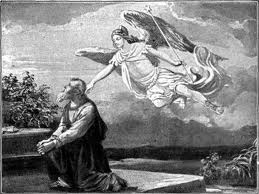
Is Daniel 9:24-27 A Prophecy of Jesus? By Dr. Walter C. Kaiser Jr.

Was Daniel’s prophecy about the coming “Anointed One,” that is, the Messiah, accurate? Or has the text been wrongly interpreted and is there a Messiah who comes at the end of the first set of seven sevens, that is, at the end of 49 years, and another Messiah who comes at the end of the sixty-two sevens, that is, after another 434 years?

If there are two Messiahs spoken of in this text, then the text has been doctored to make it seem that there was only one who came at the end of the sixty-nine weeks, or 483 years after the decree went forth to rebuild and restore Jerusalem. And in that case, it cannot be a prophecy about Jesus.

Originally the 1611 edition of the KJV of the Bible rendered it this way:

Know therefore and understand, that from the going forth of the commandment to restore and to build Jerusalem, into the Messiah the Prince, shall be seven weeks; and threescore and two weeks, the street shall be built again, and the wall even in troublous times. And after threescore and two weeks, shall Messiah be cut off, but not for himself, and the people of the Prince that shall come, shall destroy the city, and the Sanctuary, and the end thereof shall be with a flood. (Dan 9:25–26)

The reason the 1611 edition put “Messiah the Prince” (Hebrew: māšîaî) at the end of the “seven sevens” was because the Hebrew text has an athnachat the end of this clause, which sometimes indicates a break in the thought. But neither a comma nor an athnach is sufficient in and of itself to require the conclusion that Daniel intended a break in thought at this point and a radical separation of the seven sevens from the sixty-two sevens, thus making two appearances of Messiah, one at the end of 49 years and the other at the end of 434 years. Of course there is always the possibility that the sixth-century Jewish scholars, the Masoretes, who supplied the vowel points to the original consonantal text as well as the accents that serve as a form of punctuation at times, were in error. But if the Masoretic athnachbe retained, it may serve not to indicate a principal division of the text, as the 1611 edition of the KJV took it (which translation was in vogue up until 1885), but to indicate that one was not to confuse or to absorb the seven sevens into the sixty-two sevens. The point is that a violent separation of the two periods with a projection of two Messiahs is out of harmony with the context. Therefore, we contend that only one Anointed One is being addressed in this passage.

But what led Daniel to start talking about groups of sevens anyway? Daniel had been having devotions in the recent writings of Jeremiah (Dan 9:2) when he realized that Jeremiah’s predicted seventy years of captivity in Babylon had almost expired. Thus it happened that while he was praying, confessing his sin and the sin of his people, God answered his inquiry as to what was going to happen in the future. There would be an additional seventy sevens for Daniel’s people and for the holy city in order to do six things: (1) “to finish transgression,” (2) “to put an end to sin,” (3) “to atone for wickedness,” (4) “to bring in everlasting righteousness,” (5) “to seal up vision and prophecy” and (6) “to anoint the most holy [place?]” (Dan 9:24). That would embrace everything from Daniel’s day up to the introduction of the eternal state. What an omnibus plan!

But first the seventy sevens must take place. Now the Hebrew people were accustomed to reckoning time in terms of sevens, for the whole sabbatical cycle was laid out that way; accordingly, to equate the “sevens” with years was not a major problem for Jewish listeners. But these seventy sevens were divided up into three segments: (1) the first seven sevens were for the rebuilding of Jerusalem, which was consummated forty-nine years after the decree to rebuild the city was announced; (2) sixty-two additional sevens bring us to the time when Messiah the Prince will come; and (3) a remaining seven concludes the full seventy sevens as they were given to Daniel.

While the first two segments appear to be continuous, making up the first sixty-nine (7 + 62 = 69), Daniel 9:26 describes a gap after the first sixty-nine sevens. In this gap, Messiah will “be cut off,” a reference to the death of Messiah around a.d. 30, and the city and sanctuary of Jerusalem will be destroyed, a prediction of the Roman destruction of Jerusalem in a.d. 70. Given the forty-year spread between these two events, it is enough to indicate that the final seven in the seventy will not come in sequence with the other sixty-nine.

When was this “decree” or “word” to restore and rebuild Jerusalem issued? This constituted the terminus a quo, or the beginning point for this prophecy. One of three points has been variously adopted by interpreters for this terminus a quo, with a slight edge going to the third one. First, the decree was the one Cyrus issued in 538/37 b.c. (Ezra 1:2–4; 6:3–5). Second, the decree was the one Artaxerxes announced in 458 b.c., when Ezra returned to Jerusalem (Ezra 7:11–26). Third, it was the decree that the same Artaxerxes proclaimed in 445 b.c., when Nehemiah returned. Since it was Nehemiah who rebuilt the walls, while Cyrus’s decree focused on rebuilding the temple and Ezra focused on reestablishing proper services at the temple, 445 b.c. is favored as the terminus a quo.

The terminus ad quem (ending point) of the first sixty-nine sevens is usually put during the life of the Messiah; some preferring his birth (5/4 b.c.), others the beginning of his ministry at his baptism (a.d. 26/27) and some his triumphal entry into Jerusalem (a.d. 30).

So is this prophecy accurate in what it said about the coming Messiah, given in the sixth century b.c. to Daniel? Yes it was. It correctly said that Messiah the Prince would come and that he would die. Some have argued that it was possible to give the exact date for the announcement of Messiah’s kingdom by supposing that a “prophetic year” consists of 360 days (instead of 365 days of the solar year). This is based on the fact that during Noah’s flood, the 150 days equaled five months. There is no need, however, to make such an extrapolation. It is enough to know that there are some 483 years (69 x 7 = 483 years) from 445 b.c. to a.d. 30–33, when Christ was crucified.

Article adapted from pages 318-320 in Kaiser, W.C., Jr., Davids, P.H., Bruce, F.F., & Brauch, M.T. (1997). Hard Saying of the Bible. Downers Grove, ILL: InterVarsity Press.

About The Author: Walter C. Kaiser Jr. (PhD, Brandeis University) is the distinguished professor emeritus of Old Testament and president emeritus of Gordon-Conwell Theological Seminary in South Hamilton, Massachusetts. Dr. Kaiser has written over 40 books, including Toward an Exegetical Theology: Biblical Exegesis for Preaching and Teaching; A History of Israel; The Messiah in the Old Testament; Recovering the Unity of the Bible; The Promise-Plan of God; Preaching and Teaching The Last Things; and coauthored (with Moises Silva) An Introduction to Biblical Hermeneutics. Dr. Kaiser and his wife, Marge, currently reside at Kerith Farm in Cedar Grove, Wisconsin. Dr. Kaiser’s website is www.walterckaiserjr.com.

INTRIGUING DEAD SEA SCROLL SAYS MESSIAH TO COME, DIE, AND RISE ON THIRD DAY

What a wonderful article articulating from antiquity the expectation of the gospel!

joelcrosenberg's avatarJoel C. Rosenberg's Blog

A respected Israeli scholar and professor at Hebrew University is making an intriguing and compelling case that it is a distinctly Jewish notion to expect the Messiah to come, die as a “suffering servant” as an atonement for sins and the redemption of Israel, and then to rise from the dead on the third day. Based on his many years of research, and fairly recently analyzed archaeological evidence — including a previously unstudied Dead Sea Scroll — the scholar is also arguing that this notion of the Messiah rising on the third day is a pre-Christian concept that dates back to before the birth of Jesus in Bethlehem Ephratah. The case made by Dr. Israel Knohl has attracted significant attention, including a major article in the New York Times and several articles in Biblical Archaeology Review — see here, and here, and here.

The Times story, which ran under the headline, Ancient Tablet Ignites…

View original post 782 more words

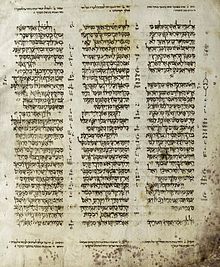
The Amazing Accuracy & Care of the Old Testament Manuscripts

No book in history has been copied as many times with as much care as has been the Word of God. The Talmud lists the following rules for copying the Old Testament.

1) The parchment had to be made from the skin of a clean animal, prepared by a Jew only, and be fastened by strings from clean animals.

2) Each column must have no less than 48 or more than 60 lines.

3) The ink must be of no other color than black, and had to be prepared according to a special recipe.

4) no word nor letter could be written from memory; the scribe must have an authentic copy before him, and he had to read and pronounce aloud each word before writing it.

5) He had to reverently wipe his pen each time before writing the Word of God, and had to wash his whole body before writing the sacred name “Jehovah!”

6) One mistake on a sheet condemned the sheet; if three mistakes were found on any page, the entire manuscript was condemned.

7) Every word and every letter was counted, and if a letter were omitted, an extra letter inserted, or if one letter touched another, the manuscript was condemned and destroyed at once.

The old Rabbi gave the solemn warning to each young scribe: “Take heed how thou dost thy work, for thy work is the work of Heaven; lest thou drop or add a letter of a manuscript and so become a destroyer of the world!”

The scribe was also told that while  he was writing if even a king would enter the room and speak with him, the scribe was to ignore him until he finished the page he was working on, lest he make a mistake!

In fact, some texts were actually annotated–that is, each letter was individually counted! Thus in copying the Old Testament they would note the letter aleph (first letter in the Hebrew alphabet) occurred 42,377 times, the letter beth 38,218 times, and so on.

According to scholars Westcott and Hort, the points in which we cannot be sure of the original words are microscopic in proportion to the bulk of the whole, some 1/1000. This only one letter out of 1580 in the Old Testament is open to speculation.

*This article is from some notes I took in a “Textual Criticism” class taught by Dr. Donald Brake back in the mid 1980’s at Multnomah School of the Bible in Portland, OR.

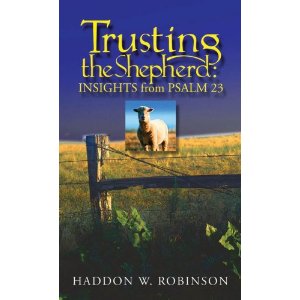
Book Review: Trusting the Shepherd: Insights from Psalm 23 by Haddon W. Robinson

Comfort and Guidance from a Wise Bible Teacher

Dr. Haddon W. Robinson is a veteran preacher, teacher of preachers, Seminary President, and one of the most sought after Bible teachers in the USA. In this short little book Robinson breaks down the most famous chapter in the Bible verse by verse giving cultural background and bridging the gap between the original meaning and the Psalms meaning for us today.

I find that for myself and most Christians I know – the battles with stress, worry, anxiety, and fear are huge. Even though we know we are supposed to trust in the Lord and walk by faith and not by sight, we struggle with trusting in a Sovereign and good God.

Robinson writes, “Someone has observed that every major portion of Scripture was written by someone having a hard time to men and women having a hard time or about to have a hard time.” Keeping this in mind throughout the chapters of this book Dr. Robinson applies the Twenty-third Psalm to many of the common human struggles we all face and shows how the Good Shepherd is worthy of our complete trust.

One of the most beneficial words of wisdom that helped me in the reading of this book was this: “God’s guidance has to do with what we are, not where we are. If we are what God wants us to be, He will have no trouble placing us where He wants us to be. We do not have to be plagued by decisions if we stay close to the Shepherd. He leads us in the right paths and they are paths of righteousness.”

I think this book is well worth reading because it will give you new insights, encourage you to trust in the Lord, and it will help you continue to become more like the Chief Shepherd – Our Lord Jesus Christ. It would be a perfect gift for people going through BIG trials like sickness, being out of work, facing death, etc. – it is a reminder of how we are like sheep who need the guidance, provision, and protection of an all-loving, all-knowing, all-wise, all-powerful, and perfect Shepherd.

Book Review – True Courage: Emboldened By God in a Disheartening World by Steve Farrar

Inspiring Courage For The Faint of Heart

Steve Farrar has written another biblical and practical winner. I have read all of Farrar’s books and this practical exposition on the first 6 chapters of the Book of Daniel does not disappoint. A good friend of mine recommended I read this book because we are both going through a tough time – much like Daniel – feeling like aliens in a foreign land, fearful or our countries direction, and having our faith tested in the fire.

Desperate times sometimes make us desperate, but the reality is that God is still on the throne and sovereign over all and uses his own people through their courage and convictions as thy take a stand for Him. Farrar writes, “In a nutshell, Daniel displayed True Courage by: Fearing God more than man; Trusting God with his future; and Realizing God’s governance over all events.

Farrar develops these themes throughout the book with many excellent illustrations, examples, and applications of how genuine courage is derived from fearing, trusting, and realizing God’s sovereign rule over the universe and our individual lives.

The book of Daniel is a tremendously encouraging book for our own times, and Farrar does a phenomenal job of showing its relevancy and numerous applications from its exposition of it, so that we can overcome our fears, worries, anxieties, and become strengthened because we have an all omniscient, omnipotent, and sovereign God who will give us the courage and grace we need sufficiently for each day – as he did for Daniel several thousand years ago. I highly recommend this book as one that will better equip you to be a courageous man or woman of God in these difficult days.

Commentary Review: Holman 2 Volume OT Psalms 1-75; & 76-170 by Steven J. Lawson

Steven J. Lawson is one of the best God-centered and Christo-centric expository preachers of our time. He is like a cross between John Piper, James Montgomery Boice and R.C. Sproul. Therefore, if any of those names mean anything to you – you will love this commentary by Lawson.

All the commentaries in the Holman series are concise, homiletical in orientation, and immensely practical for teachers and preachers of God’s Word.

Volume one contains an excellent and brief introduction to the Psalms with discussion and explanations of the unique features of the Psalms, including it’s title, authors, time period, literary types, book divisions, literary style, figures of speech, acrostics, and why and how they are so life-changing.

In volume one the first 75 Psalms are covered and in volume two he covers Psalms 76-150 and each are broken down in 75 individual chapters in the following manner:

1)    A title that summarizes the topic of the Psalm.

2)    A helpful quote that delineates the theme of the Psalm – usually from a great Christian from the past – Lawson is a very knowledgeable Church historian.

3)    A commentary on the chapter from the Bible which contains – the main idea of the passage and the supporting ideas written out in an expository outline with explanation, grammatical help, and exegetical insights.

4)    A main idea review and a conclusion for the chapter.

5)    A Conclusion – usually an excellent illustration of the passage.

6)    A Life Application – typically questions, commands, and principles to be applied from the passage.

7)    A prayer based on the passages truths and applications – all very God-focused and oriented toward praise.

8)    A section on “deeper discoveries” – usually key word studies, theological insights, and historical, cultural, and textual facts & helps.

9)    A teaching outline for the passage.

10) Lastly, issues for discussion taken from the passage.

I highly recommend this commentary on the Psalms – especially if you are only going to have one or two commentaries on the Psalms. Lawson is practical, theological, and does a superb job of getting to the heart of each passage without too much discussion of the details. I find that the devotional and practical nature of the commentary makes it very suitable for personal study, as well as the communal study of God’s Word.

Dr. Steven J. Lawson is the Senior Pastor of Christ Fellowship Baptist Church in Mobile, Alabama. Max Anders – the editor of the series is the Senior Pastor of Castleview Baptist Church in Indianapolis, Indiana.