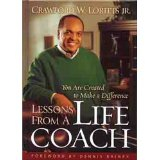
God’s 3 Powers At Work Within Us from Ephesians 3:20-21 by Crawford W. Loritts JR.

“God’s Got You Covered”


“Now to him who is able to do far more abundantly than all that we ask or think, according to the power at work within us, to him be glory in the church and in Christ Jesus throughout all generations, forever and ever. Amen” (Ephesians 3:20-21).

I recently took my ten-year-old nephew J.J. on a speaking engagement. He was overwhelmed when we got there. It was a huge auditorium, thousands of people were there, and television cameras were everywhere.

It made me smile to see J.J.’s reaction to everything, but after a while he asked me a question that made me chuckle. He looked at me and, with a look of concern, on his face, he said, “Uncle C.W., do I need some money for food?”

“No, buddy,” I said with a smile. “You don’t need anything. The folks here have taken care of everything. As long as you’re with Me, you don’t have need of anything.”

It’s a truth we take from the written Word of God: He has us covered! The apostle Paul addressed this issue when he wrote: “Now to him who is able to do far more abundantly than all that we ask or think, according to the power at work within us, to him be glory in the church and in Christ Jesus throughout all generations, forever and ever. Amen” (Ephesians 3:20-21).

What an amazing promise! This means that the same power that raised Jesus from the dead rests within us, ready to enable us to rise to any challenge we may face. No matter what task is ahead, no matter what problem lies before you, God has promised that the power that lives within us through the Spirit of God is more than enough for us to emerge victorious.

In this verse, the verb “work” is in the present tense, meaning that God did not just do the work in us at the time we first received salvation, but continues to work within us. That’s right! God’s power is at work in you at this very moment.

 I want to highlight three ways that God’s power works within us:

  • The first is His conforming us to the image of His Son, meaning He is working in us to make us more like Jesus. God uses the problems we face in this life, combined with the power of His Spirit, to change us and make us into reflections of Christ.
  • The second way that His power works within us is by enabling us to do that which, in our own efforts, is impossible. For example, that power enables us to overcome even the most stubborn habitual sin, and it enables us to speak with authority to others about the Lord Jesus Christ.
  • Third, that power is at work to sustain us. We all go through times of trouble and trial, times when we don’t know what we are going to do next. The power of God works within us during those times to keep us and give us balance.

My friend Joseph Garlington likes to say, “God’s power is getting you ready for what He already has ready for you.” Another way to say that is, no matter what your needs are, no matter how desperate a situation God is taking you through, you will always have the power to be victorious.

Always remember, God’s got you covered!

 ABOUT THE AUTHOR:

CRAWFORD W. LORITTS JR. (B.S., D.Th., Philadelphia Biblical University; D.Div., Biola University) is the senior pastor of Fellowship Bible Church in Roswell, Georgia. He has served as a national evangelist with the American Missionary Fellowship and the Urban Evangelistic Mission, and as Associate Director of Campus Crusade for Christ. He co-founded Oak Cliff Bible Fellowship in Dallas, Texas. He is a frequent speaker for professional sports teams, including three Super Bowls and the NCAA Final Four Chapel, and has spoken at conferences, churches, conventions and evangelistic outreaches throughout Europe, Africa, Asia, the Caribbean and the United States. He is also the host of Living A Legacy, a daily radio program.

Dr. Loritts has written numerous articles and is the author of six books, including Leadership as an Identity, Lessons from a Life Coach, and For a Time We Cannot See. He co-authored Developing Character in Your Child with his wife, Karen. Dr. Loritts and his wife have four grown children and live in the Atlanta, Georgia area.

Article above adapted from Crawford W. Loritts JR. Lessons From A Life Coach: You Are Created to Make a Difference. Chicago: Moody Press, 2001, pp. 136-137.

David R. Helm: A Biblical Exposition on Sharing in Christ’s Sufferings From 1 Peter 4:1-6

“Embrace Your Calling to Suffer in the World”

“Since therefore Christ suffered in the flesh, arm yourselves with the same way of thinking, for whoever has suffered in the flesh has ceased from sin, so as to live for the rest of the time in the flesh no longer for human passions but for the will of God. For the time that is past suffices for doing what the Gentiles want to do, living in sensuality, passions, drunkenness, orgies, drinking parties, and lawless idolatry. With respect to this they are surprised when you do not join them in the same flood of debauchery, and they malign you; but they will give account to him who is ready to judge the living and the dead. For this is why the gospel was preached even to those who are dead, that though judged in the flesh the way people are, they might live in the spirit the way God does” (1 Peter 4:1-6).

Some would say that those who suffer most often suffer first from blind naiveté. Albert Schweitzer thought as much about Jesus, claiming that his cruel death on the cross was nothing more than the unfortunate result of naiveté. According to Schweitzer, Jesus, the misguided visionary, never saw the sufferings of the cross coming until it was too late:

There is silence all around. The Baptist appears, and cries: “Repent, for the Kingdom of Heaven is at hand.” Soon after that comes Jesus, and in the knowledge that He is the coming Son of Man lays hold of the wheel of the world to set it moving on that last revolution which is to bring all ordinary history to a close. It refuses to turn, and He throws Himself upon it. Then it does turn, and crushes Him. Instead of bringing in the eschatological conditions, He has destroyed them. The wheel rolls onward, and the mangled body of the one immeasurably great Man, who was strong enough to think of Himself as the spiritual ruler of mankind and to bend history to His purpose, is hanging upon it still. That is His victory and His reign (Albert Schweitzer, The Quest of the Historical Jesus. New York: Macmillan, 1968, pp. 370, 371).

Peter, however, has been telling a different story. Jesus was vindicated in death. He rose victorious in the spirit and now reigns eternally as the Ascended Son at God’s right hand. According to Peter, naiveté is set aside. Jesus’ suffering was not the unfortunate result of an impoverished itinerant’s idealistic fervor. Instead, his suffering was by divine initiative. Persecution was the predetermined pathway for God’s Son.

All the Gospel writers concur. The Jesus they present to the world is well aware that his unique work required suffering and service. Jesus believed it on the strength of the Hebrew Scriptures. And Jesus embraced it every step along the way of his earthly ministry. Repeatedly he told his disciples, “The Son of Man must suffer many things and be rejected by the elders and the chief priests and the scribes and be killed” (Mark 8:31; 9:31; 10:33). When Jesus stood before the Sanhedrin on the night of his betrayal, never once did he defend himself in hopes of avoiding the cross. In fact, when he did speak, he intentionally said what he knew would seal his fate (Mark 14:62).

Clearly, Jesus fully embraced his calling to suffer out of his desire to save us. As Peter argued in 3:18: Christ suffered once for sins, the righteous for the unrighteous, that he might bring us to God.

Now, with the opening phrase of our text, Peter again returns to Christ’s sufferings, but this time with different intentions — he feels no need to further encourage us with Christ’s triumphant vindication. He accomplished that in 3:18-22. Rather, he writes about Christ’s suffering in this particular text to call us to embrace it as well. In 4:1 he says: “Since therefore Christ suffered in the flesh, arm yourselves with the same way of thinking.”

“Arm yourselves.” Emulate Jesus. It is as if Peter has finally come to the place in the letter where he rises up to unashamedly proclaim, “Followers of Jesus, be prepared to embrace not only submission but suffering as an aspect of your calling! Get yourselves ready for suffering!” (It is interesting that until this time suffering appears in the letter to be “if necessary.” But now he speaks with definitive force, preparing the church for the inevitable).

The question of course is, how? How do we go about getting ready? What does a person need to know and do to prepare to embrace his or her calling in the world?

Fortunately for us, the structure of our text unfolds the answers to these questions with clarity and simplicity. If we intend to embrace this aspect of our calling, there are three gospel commitments we must be willing to make (4:1-3), two personal costs we should be ready to endure (4:4), and one encouraging reminder that a final accounting awaits all humanity (4:5, 6).

THREE GOSPEL COMMITMENTS (vv. 1-3)

Become a Person of Resolve

How do we go about embracing our calling? First, by becoming persons of resolve. Take another look at verse 1. Peter writes, “arm yourselves with the same way of thinking.” Notice, to embrace our calling in Christ initially requires the attention of our mind. We begin by thinking clearly. And for that we need to develop the mental disposition of Jesus.

Today, in the West at least, it is the church that suffers from a naiveté of the mind. It is difficult for Christians here to understand and embrace God’s intentions in suffering. We prefer a gospel in which God gives us healthy bodies and bulging wallets. And we too readily think that material blessing is the entitled reward of the gospel. To put it bluntly, the democratized West expects in Jesus, comfort, ease, and acceptance from the world.

Yet, in actual fact the life of Christ challenges all of this. Jesus resolved to live as a stranger in the world. He expected hardship. And when he read his own Hebrew Scriptures, they taught him that union with God culminates in mixed reviews here on earth.

In one sense, when Peter calls us to arm ourselves with “the same way of thinking,” he is saying, “Beloved, grow up! Get the mind of Christ. Become a person of resolve. Be prepared. If you have been united with him by faith, you will need to identify with him in suffering.”

The first gospel commitment Peter calls us to embrace closes with a phrase that needs some explanation. Look at the latter part of 4:1:

“Arm yourselves with the same way of thinking, for whoever has suffered in the flesh has ceased from sin.”

The natural question this phrase raises is, what does it mean to “cease from sin”? Is the suffering person a sinless person? We ask this even though we know that such a wooden interpretation of the verse goes against all of Scripture and life experience. So what is Peter saying?

He is simply affirming that those who suffer for the gospel do, by their very willingness, demonstrate that they are done with sin. To put it as clearly as I can, everyone who suffers for Jesus first resolved, somewhere along the line, to cease from sinning. After all, the suffering they experience is a result of leaving off with sin. Thus, Peter says, “For whoever has suffered in the flesh has ceased from sin.”

Live for the Will of God

In the next verse Peter puts forward the second and third gospel commitments that followers of Christ make as they embrace their calling in the world: “…so as to live for the rest of the time in the flesh no longer for human passions but for the will of God” (v. 2).

The two commitments we are to make are spelled out by way of contrast: “…no longer for human passions” with “but for the will of God.” Since the following verse is going to highlight the kinds of behavior the Christian leaves behind, let’s look first at what we are to be about. Peter says we are to live “for the will of God.” What does Peter mean by the phrase “the will of God”? And how are we to start living for his will? Fortunately we have already seen in 1 Peter the kinds of godly pursuits he wants us to pursue. And in fact, in each of those places he contrasted the
things that God wills for us with the same phase he uses here — “human passions.”

So by looking back in the letter for “passions” we will run headlong into what Peter means when he wants us to make a commitment to “the will of God.” Look at 1 Peter 1:14,15: “As obedient children, do not be conformed to the passions of your former ignorance, but as he who called you is holy, you also be holy in all your conduct.”

If the will of God is found by way of contrast to human passions, then we can know for sure that we prepare our minds for suffering by giving ourselves wholly over to the pursuit of holiness. God wants us to make a commitment to holiness, to sanctification, to putting on the new man. This is how we prepare to embrace our calling.

Another text in 1 Peter that teaches us what the will of God is can be found in 2:11,12: “Beloved, I urge you as sojourners and exiles to abstain from the passions of the flesh, which wage war against your soul. Keep your conduct among the Gentiles honorable, so that when they speak against you as evildoers, they may see your good deeds and glorify God on the day of visitation.

We do the will of God when we “keep [our] conduct . . . honorable” by doing “good deeds.” This, of course, will require us to be countercultural. We will always be swimming against the current of today’s moral tide. We are to be known for doing good. And as we have seen in this letter, the supreme mark of goodness is our submission to difficult and ungodly people in authority.

Leave Human Passions Behind

I love the opening phrase in verse 3: “The time that is past suffices.” It is as if Peter barks out, “Enough already. Put sin in your rearview mirror.” And then he goes on to list the kinds of things that Christians are to put away. Look at how the verse finishes: “living in sensuality, passions, drunkenness, orgies, drinking parties, and lawless idolatry.”

Be done. Enough. The past is sufficient. Life as an ongoing fraternity party is a major problem in the church today. If we are not there in person, we are all too often present through what we watch on television, see in the theaters, or watch on the Internet. For men, sensuality is an especially prevalent issue. Sex is the elephant in the room. Peter says that in this matter it is time to clean house. Until we wake up and tackle this area head-on and out in the open, we will only continue debilitating a generation and will keep them from being grounded in their faith, unable to fly unencumbered toward Heaven’s delights.

The Danish philosopher Søren Kierkegaard tells a parable of the disastrous effects of not putting to death the desires of the flesh, of failing to leave a way of life behind. One springtime a duck was flying with his friends northward across Europe. During the flight he came down in a barnyard where there were tame ducks. He enjoyed some of their corn. He stayed for an hour, and then for a day. One week passed, and before he knew it a month had gone by. He loved the good food, so he stayed all summer long.

One autumn day, when the same wild ducks were winging their way southward again, they passed overhead, and the duck on the ground heard their cries. He was filled with a strange thrill and joy, and he desired to fly with them once again. With a great flapping of wings he rose in the air to rejoin his old comrades in flight.

But he found that his good fare had made him so soft and heavy that he could rise no higher than the eaves of the barn. He dropped back again into the barnyard and said to himself, “Oh well, my life is safe here, and the food is good.” Every spring and autumn when he heard the wild ducks honking, his eyes would gleam for a moment, and he would begin flapping his wings. But finally the day came when the wild ducks flew overhead uttering their cries, but he paid no attention. In fact, he failed to hear them at all.

What an apt parable for the church in our time. As Christians, too many of us have feasted for too long on the pleasant fare this world has to offer. We too easily forget that the time past was enough. We forget that we are still far from home — we haven’t arrived at our destination yet. Sadly, many go on day by day unfazed by the gospel thought that as we feed on the husks of this world we demonstrate that we think too little of the delights that await us in Heaven. Peter says to us, “Enough. Rise up, O men of God. Have done with lesser things” (From the hymn “Rise Up, O Men of God,” lyrics by William P. Merrill; http://www.cyberhymnal.org/htm/r/i/riseupom.htm; accessed July 31, 2007).

C. S. Lewis struggled with his own inability to grasp the gravity of his sin in light of God’s clear teaching on the subject. He wrote:

Indeed the only way in which I can make real to myself what theology teaches about the heinousness of sin is to remember that every sin is the distortion of an energy breathed into us — an energy which, if not thus distorted, would have blossomed into one of those holy acts whereof “God did it” and “I did it” are both true descriptions. We poison the wine as He decants it into us; murder a melody He would play with us as the instrument. We caricature the self-portrait He would paint. Hence all sin, whatever else it is, is sacrilege (C.S. Lewis, Letters to Malcolm: Chiefly on Prayer, chapter 13, as quoted in Wayne Martindale and Jerry Root, The Quotable Lewis. Wheaton, IL: Tyndale House, 1989, p. 547).

God has plans for your body, and they are plans for purity and for good. Don’t cheapen life. Don’t settle for distortion. Don’t poison the wine God decants into you. Be done with “sensuality, passions, drunkenness, orgies, drinking parties, and lawless idolatry.”

Make three gospel commitments that tell the world you are prepared to embrace this aspect of your calling in Christ.

  • Become a person of resolve.
  • Live for the will of God.
  • Leave human passions behind.

TWO PERSONAL COSTS (v. 4)

But as you do, know this: your newfound commitments come with a twofold cost. Consider verse 4: With respect to this they are surprised when you do not join them in the same flood of debauchery, and they malign you.

They Are Surprised at You

First, your friends and family will be surprised. You will be misunderstood. Remember, there are no categories for them to understand why you no longer grab all that you can in this life without regard for the next. “Come on,” they will say. “What happened? Loosen up. Look out for your own happiness. Pursue some pleasure. Live a little!” Malcolm Muggeridge articulates well how your new life in Christ will affect your relationship with former friends who are still pursuing only happiness and pleasure:

Anyone who suggests that the pursuit of happiness — that disastrous phrase written almost by chance into the American Declaration of Independence, and usually signifying in practice the pursuit of pleasure as expressed in the contemporary cult of eroticism — runs directly contrary to the Christian way of life as conveyed in the New Testament is sure to be condemned as a life-hater (Malcolm Muggeridge, Jesus Rediscovered. London: Collins, 1969, pp. 101,102).

Over time their surprise will turn to ridicule.

They Malign You

Surprise evokes misunderstanding, and misunderstanding evokes a sense of being judged. And when the world feels that it has been judged by your way of life, those who are of it will condemn you as “a life-hater.” They will malign you. Take a look again at the progression of behavior embedded in verse 4. “Surprised” gives way to the word “malign”:

With respect to this they are surprised when you do not join them in the same flood of debauchery, and they malign you.

R. C. Sproul, in his book The Holiness of God, tells of a time when Billy Graham was invited to play golf with President Ford and two PGA tour professionals. He writes:

After the round of golf was finished, one of the other pros came up to the golfer and asked, “Hey, what was it like playing with the President and with Billy Graham?” The pro unleashed a torrent of cursing, and in a disgusted manner said, “I don’t need Billy Graham stuffing religion down my throat.” With that he turned on his heel and stormed off, heading for the practice tee. His friend followed. . . . His friend said nothing. He sat on the bench and watched. After a few minutes the anger of the pro was spent. He settled down. His friend said quietly, “Was Billy a little rough on you out there?” The pro heaved an embarrassed sigh and said, “No, he didn’t even mention religion. I just had a bad round.”

About the incident Sproul concludes:

Astonishing. . . . Billy Graham is so identified with religion, so associated with the things of God, that his very presence is enough to smother the wicked man who flees when no man pursues. Luther was right, the pagan does tremble at the rustling of a leaf. He feels the hound of heaven breathing down his neck. He feels crowded by holiness even if it is only made present by an imperfect, partially sanctified human vessel (R.C. Sproul, The Holiness of God. Wheaton, IL: Tyndale House, 1985, pp. 91-93).

ONE FINAL ACCOUNTING (vv. 5, 6)

Peter closes our text with a reminder on the final judgment. It is meant as an encouragement to his readers. In verse 5 it appears that he is especially thinking of the judgment that awaits those unbelievers who choose to malign us. But they will give account to him who is ready to judge the living and the dead. In one sense you and I do not need to judge the world. It already stands condemned. Entrust yourself to God, and wait for Jesus to set all things straight. The closing verse in our text is tricky to get hold of at first glance. It is especially hard to see how it functions as an encouraging word to

Christians who await the final judgment. “For this is why the gospel was preached even to those who are dead, that though judged in the flesh the way people are, they might live in the spirit the way God does” (v. 6).

What we need to remember is that the early church had many questions about their family members and friends who had died after coming to faith in Christ. They wondered what happened to believers after death. There was a concern for those who had already undergone the penalty of death. Peter wants to reassure his readers here with news that although believers are “judged in the flesh the way all people are,” they need not worry about their future with God. He says they will still “live in the spirit the way God does.”

We have nothing to fear in Christ! We have nothing to fear in embracing suffering in this life. Peter wants us to grasp this as part of our calling. To do so, we need to make three gospel commitments: become a person of resolve, live for the will of God, and leave human passions behind. We must be ready to incur two costs: the surprise of those with whom we once lived in sin and the inevitable maligning and slander that is sure to follow. In all this, though, Peter reassures us with one encouraging reminder: there will be a final accounting for everyone. As those who are in Christ, we shall live on in the Spirit forever.

Dear Lord, help us to truly embrace our calling to suffer in Christ. May we receive it with open arms. We know that everything we bear for you in this life will be nothing to compare with the glory we will share in with you in Heaven. Make us people of resolve. In your precious name we pray, Amen.

The end of all things is at hand; therefore be self-controlled and sober-minded for the sake of your prayers. Above all, keep loving one another earnestly, since love covers a multitude of sins. Show hospitality to one another without grumbling. As each has received a gift, use it to serve one another, as good stewards of God’s varied grace: whoever speaks, as one who speaks oracles of God; whoever serves, as one who serves by the strength that God supplies — in order that in everything God may be glorified through Jesus Christ. To him belong glory and dominion forever and ever. Amen. (4:7-11)

The Sermon/Article above was adapted from the sermon based on 1 Peter 4:1-6 in David R. Helm’s terrific book of sermons on 1 & 2 Peter, and Jude: Sharing Christ’s Sufferings in the Christo-centric Series of expositions published by Crossway books in Wheaton, IL. – The Preaching the Word Series edited by the faithful expositional preacher R. Kent Hughes.

About the Preacher:

David Helm, along with Arthur Jackson, serves as Lead Pastor of our Hyde Park Congregation, and is the Director of Ministry Training at HTC. After ten and a half years as founding Sr. Pastor of Holy Trinity Church, David handed off the Senior Pastor role to Jon Dennis on November 23, 2008. In addition to serving our South Side congregation, David is Chairman of The Charles Simeon Trust, a ministry devoted to equipping men in expository preaching.

A graduate of Wheaton College and Gordon-Conwell Theological Seminary, David is ordained in the PCA and serves on the council of The Gospel Coalition. He authored I, II Peter and Jude in Crossway’s Preaching the Word series, and contributed to Preach the Word:Essays in Expository Preaching in Honor of Kent Hughes. In addition, David has written The Big Picture Story Bible and The Genesis Factor (the latter with Jon Dennis).

David and his wife, Lisa, have five children (Noah, Joanna, Baxter, Silas and Mariah) and reside in the Hyde Park neighborhood. In his spare time, he generally roots for the Chicago White Sox and enjoys Johnny Cash.

Pastor Geoff Thomas On Why We Should Give Thanks To God for Everything

GIVING THANKS TO GOD FOR EVERYTHING

Ephesians 5:19-21 Sing and make music in your heart to the Lord, always giving thanks to God the Father for everything, in the name of our Lord Jesus Christ. Submit to one another out of reverence for Christ.”

We often hear that the Bible is a gloomy book, and we’re regularly told that a religion based on it, and worship that comes out of it is bound to be gloomy and sorrowful. So the Puritans are normally portrayed as melancholic, severe people, and Calvinism is especially targeted as a faith that tends to depression. Yet we come across this exhortation in this extraordinary letter with its immense theology. It is an exhortation to Christians, Sing!” and, Make music in your heart to the Lord.” The apostle tells us that our lives are to be characterised by constant doxology – always giving thanks to God the Father for everything, in the name of our Lord Jesus Christ.”

These exhortations are not rare in the Bible. In the heart of the Old Testament the Psalter is full of psalms of rejoicing, psalms of hopefulness, and psalms of abundant joyfulness. They are concerned with people singing to God, possessing an inward serenity, knowing a profound joy and peace. We are faithful to biblical religion not only if we knows its truths and live by its immensely stringent ethic but if we also reflect its praise.

Here is a Christian church in Ephesus, the first generation out of paganism, in a city dominated by the temple of Diana, and the congregation hear this mighty letter read to them explaining the glorious grace of God. They are urged to live in a vitally new way unheard of in Greek or Roman circles before – “Submit to one another out of reverence for Christ” (v.21) – and they are being told to sing to one another in their homes and churches and places of work and to make constant melody in their hearts to God. That is the impression they are to make on their neighbours of sustained happiness. This is one of the ways they triumphed over Rome; they out-sang Roman philosophy and religion. They were singing because as they saw things, they had good reason to sing. In the great objective universe around them there were facts and entities, and there had been events; there were great concrete promises unfolding in their own experience day by day, and it was upon the basis of these realities that there was in their hearts music to God and songs of praise to one another.

You will find in the entire Bible this emphasis that this is the heart response of authentic Christianity. If you read this letter you will discover the rational for these emotions. We’re not only told to rejoice and sing but we’re shown why we should. We’re not simply told to exert feelings of delight and contentment; we’re pointed to certain great reasons why we must be gripped by them. In other words, the exhortations to a different kind of life in chapters 4, 5 and 6 are built on the glorious truths of chapters 1, 2 and 3, and within these chapters Paul is presenting us with the glories of God’s love and then exhorting our behaviour to reflect that love.

 1. HOLY SPIRIT FILLS US.

Here we are told of the third person of the Godhead, God the Holy Spirit, and that he doesn’t just touch our lives, but that he fills every part of our beings, and that we under an obligation to ensure that he does, more and more. God stands pledged to be within his people, to make them his abode; the church is the fellowship of the Holy Spirit, and as long as we continue as an authentic Christian church, so long as this particular congregation remains faithful to its divine mandate, just as long as it continues in its testimony to the glory of God’s salvation then we will continue to know the Spirit glorifying Jesus Christ in our midst.

We may go beyond that fact; we will know in the depths of our hearts, in the profoundest realities of our own personal experience, that the mighty Creator of the universe is our God. He is the one who is supplying all our need. He has committed himself not only to the cause in general, not only to particular churches, but to us as individual Christians so that we can say from hearts as Paul said, He loved me and gave himself for me.”

We sing and make melody in our hearts because God has come to us in his eternal and unconditional sovereign love. He has sent his Son into the world to bear my sin. He has sent his Spirit as the Spirit of consolation and courage into my soul. He is totally determined to present me faultless in the presence of his glory with exceeding joy. My God is a committed God. All his resources, and all his attributes, and all his grace and power he has dedicated to my salvation. There is a love that will never let me go. I am caught up, not in something visible and physical, and not in something temporal and terrestrial, but I am caught up in something eternal, something invincible, and something infinite. I am saying that in my heart there is music going out to the Lord, and on my lips are psalms and hymns and spiritual songs because the mighty God is not simply committed to his cause in the world, or in Wales, or even to this congregation’s testimony, but God is committed to each believer in particular. God is committed personally by his Spirit who indwells us so that we can know “He is my God; he is love; he has given himself for me; he has filled me with his Spirit.” I know that Almighty God is totally committed to my salvation, and that the work that he has begun is a work from which he will never desist until we are presented without spot or wrinkle before the throne. The Spirit of God fills his people. “Make sure you go on being filled with him,” Paul says, “and sing and make music in your heart to God.”

 2. THE HOLY SPIRIT IS WITH US TODAY.

Where can I go from your Spirit?” asks the psalmist (Psa. 139:7) because of the sheer naked fact of his omnipresence. He is everywhere in this universe and beyond. I take the wings of the morning and fly to the uttermost parts of the ocean but when I arrive there the first thing I discover is that the Spirit of God is already there. Paul and Silas were thrown into the darkest deepest dungeon in the jail of Philippi, but the first discovery they made in that stinking blackness was that the Holy Spirit was there. So they could sing to one another in psalms and hymns and spiritual songs and all the other prisoners listened to them. It is his presence in us in grace, in all the consolations of his personal love, in all his enabling resourcefulness that make us songsters. He is in us to help, and sustain, and guide, and encourage, and bless. It is not his universal cosmic presence that makes us sing so much as his presence in redeeming pity and encouragement.

You remember how the Spirit is with us, in every challenging phase of our lives. God has sent us individually on a mission. We leave this church today and enter our own mission field. We are to go and teach the nations. We are to hold fast to our confession, and we are to point men to the glory of God in Christ. And for us to fulfil this task God provides us with the indwelling Spirit. In every congregation which today is pointing men to that Lamb who bears away the sin of the world the Spirit is present and working. In every pulpit which declares the truths of the gospel – that we deserve eternal death because we are sinners, but Jesus because he loved us died for us – in every such pulpit the Holy Spirit is present steadfastly and consistently and unadornedly. In the life of every single believer who is holding fast to his confession then there is this great reality, the presence of God the Spirit, and as you go and stammer and speak and serve, and as you maintain the integrity of your own Christian witness then this is your privilege, the Holy Spirit’s presence in and with you.

I can put it like this, where two or three are gathered together in the Lord’s name then the Spirit is present, not only in our evangelism and outreach and our witness and testimony but as we meet at a prayer meeting for our own comfort and edification. Then we show forth the glory of our God and Saviour and we have the assurance that the Spirit is there, indeed that the Spirit is here now. He is blessing this sort of gathering right now; he is applying his word to every need of our souls; he is alongside us as we write that difficult letter, or as we turn the other cheek, or as Paul says here, “Submit to one another out of reverence for Christ” (v.21). We must know that we are indwelt by God’s Spirit permanently and irreversibly, no matter where we are or what we are doing. It is the greatest reality of this Christian life that we are temples of the Holy Spirit, that we have been baptized by one Spirit into one body. We cannot be, without the vitality of the Spirit coursing through our hearts and souls and spirits. We cannot be, and not be temples. We cannot be, and not have the presence of the Spirit. No matter what we are relating to, and no matter what we are confronting, and no matter what we are experiencing, and no matter what we are doing, we are doing it as those energised and motivated by the indwelling Spirit of God. I am saying that God the Spirit is present with us not only in the great evangelistic movements, and not only in the large worshipping congregations with their meetings every night of the week and their huge staffs, but the Spirit is in the heart of each individual believer. He is there with her private sorrows; he is there with her individual stresses; he is there with her personal temptations. The Spirit is there.

Yet, you remember this truth that you never take the Spirit for granted. “Go on being filled with the Spirit,” says Paul. His presence is, in some respects, an irreversible reality, and yet we know from the church of Laodicea something was missing. There was a curious and peculiar relationship to the Lord which they professed. He was very near that church, but he was only near it in so far as he was at the door. It is true that he was knocking; he was claiming admission and begging entry, but none of that alters the fact that he was outside. That church had no right to claim that is was a Spirit-filled congregation. She had the name of a church; she had all the machinery of a church; maybe she had the authentic message of a church, and yet the Lord was outside.

There may be moments in our own individual lives when we have given such offence to the Spirit that we have grieved him, and he has turned away and hidden his face from us. Though his preservation is not withdrawn yet his saving and comforting works are not present. There are Christians today – there may be even some at this meeting – and the Spirit is not filling them. Certainly God will never let them go; they will not fall utterly. Yet they do not know his consolation. They do not know his help. They do not know his guidance because for one reason or another they have grieved him. They are not singing and making melody in their hearts to God.

There is this whole emphasis on the presence of the Spirit with the Christian. It is a reminder to us of how accessible God is to us. He is within such easy reach. Let’s imagine for a moment that we are in trouble and need help. Where do we get it? We have illimitable access to the indwelling Spirit. Paul is saying, “You don’t have to go miles to look for him. You don’t need some special code. You don’t need outriders and guides to take you to him. He is in you and you talk to him.” Or to put it better, using Paul’s words in Romans, you just send him a message by means of a groan that cannot be uttered. He is so near that he hears that. We sometimes cannot sing a hymn with our voices; we sometimes cannot shout; we cannot send eloquent prayers or beautiful petitions to the Lord, and yet he is so near that if only we mutter a few words he can hear us. Just a wordless groan and the Spirit is so near he understands and cares.

3. WE RESPOND IN SINGING GOD’S PRAISE TO ONE ANOTHER.

We enjoy the blessings of God each day. Success in our exams, the joy of our families, food in our refrigerators, long life, happy relationships, all such temporal mercies from God call for songs of loudest praise. There are also the blessings that the gospel brings in this life and the life to come, justification, full forgiveness, adoption into the family of God, the end of the reign of sin, union with Christ and glorification. How do we respond to all God’s goodness? The world celebrates everything with its drinking, but in our hearts there rings a melody of love, and on our lips there is a song of doxology:

“Praise God from whom all blessings flow

Praise him all people here below.

Praise him above ye heavenly host;

Praise Father, Son and Holy Ghost.”

We respond to all that the Spirit of God applies to our lives by great praise. Great is the Lord and greatly to be praised. We have to make sure that each one of us praises God. “I am going to sing to him.” We are not going to leave it to others. We are not going to say, “Let all the world praise God.” I’ll praise my Maker while I’ve got breath. I will do it. My old, cracked, weak voice that is tone-deaf will sing to him, with my own powers and initiative, because I am not standing before the Force, or an abstraction, or a memory, but I am standing before the Jehovah Jesus who is “My God.” I will praise my God for myself.

Have you ever been struck by the opening words of the 108th psalm. It says this. “A song. A psalm of David. My heart is steadfast, O God.” A psalm of David . . . my heart is steadfast O God. There seems to me such irony in those words. This is David writing these words, the man who once could babble away outside the gates of a city of the Philistines to give them the impression that he was mad. This is David who could walk on the roof of his palace and spot Bathsheba washing and then draw himself and her family into evil tragedy. Think also of David as he begins Psalm 69, Save me, O God, for the waters have come up to my neck. I sink in the miry depths, where there is no foothold. I have come into the deep waters; the floods engulf me. I am worn out calling for help; my throat is parched. My eyes fail, looking for my God (Psa. 69:1-3). We say, “That’s David, so like me!” and we are glad to know someone as wobbly as David was in the kingdom; then there is hope for me too.  If ever there was a man who was not steadfast it was David, and yet he begins Psalm 108, My heart is steadfast O God.” He has enjoying a day of gospel assurance; he is expressing his highest confidence in God; he has grown in grace; through all his great falls he has kept coming back to God; a new maturity has come into his life. David’s heart is steadfast, and how does he show it? See what he goes on to say in that psalm, I will sing and make music with all my soul. Awake, harp and lyre! I will awaken the dawn. I will praise you, O LORD, among the nations; I will sing of you among the peoples. For great is your love, higher than the heavens; your faithfulness reaches to the skies. Be exalted, O God, above the heavens, and let your glory be over all the earth.” (Psa. 108 2-5). David is steadfast in praising God. This is what must characterise the Christian.

Aren’t we in many ways a strange gathering? We are a company of men and women who say that for them to live is Christ. So the challenge comes to us that if that’s our profession and privilege then are we determined to sing our God’s praises? “I for myself will make melody in my heart and on my lips to my Lord.” It is simply marvellous that in this universe there are two such different existences. There is the unsearchable God, Father, Son and Holy Spirit, and there is puny man, a mere speck. Yet these two can come so close together, “I . . .  and  . . . Thee.” I may sing to Thee; Thou art pleased with my singing. There is this amazing proximity of us and him. My soul can be totally involved with God. I can sing, and he is listening. I can be making music in my heart with no one around able to hear my praise, but to God my heart-song of thankfulness sounds like a huge cathedral organ with all the stops pulled out.

The great challenge is to be doing it for ever and ever. We will praise him on special occasions when we are members of a vast congregation when every seat in the church is taken. We will praise him when the preacher happens to choose our favourite hymn on a Sunday. We will praise him, on every good day we have; at every gathering of the Lord’s people we will sing to him. “Always giving thanks to God the Father.”

Then there is something else, that it is to one another that we sing our psalms, and hymns, and spiritual songs. Often we are told of the existence of a ‘generation gap,’ but we cannot allow a generation gap in the church because in the church there is neither young nor old, but all are one in Christ Jesus. And this is one way that the gap between old Christians and young Christians is crossed; the old praise God’s works to the young. The old commend God’s works of creation and providence and also God’s works of redemption to the young. They do it in the words of their hymns. We have to be sure that we don’t compartmentalise the age groups of the church so that the young never hear the old, never hear them speaking of God’s faithfulness, and shepherding and love. The trend today is for larger churches to have two kinds of services. There is the so-called ‘contemporary service’ and all the young people go to that, and there is the so-called ‘traditional service’ and all the old folks go to that. What a tragedy. What a tearing apart of the body of Christ. The older generation has to praise his works to the younger and declare his mighty acts. We do this by demonstrating their reality in our lives. We believe these things.  We commend these things. We praise God for these things, and of course, best of all, we live them. We live them out. As we grow older and become more feeble, death coming nearer, then God’s works are our theme. His mighty acts are the theme of our psalms and hymns and songs.

4. FOR EVERYTHING WE WILL GIVE THANKS TO GOD.

You notice Paul’s insistence on this, Always giving thanks to God the Father for everything.”Not all days are holy days; not all days are good days, but whatever its character, and whatever my circumstances may be I’m to be Always giving thanks to God the Father for everything.”Some days are simply dreadful; there are great dark weeks which come into the lives of some of God’s people, and for some of you, today, it may be one of these times. You ask your best friend how things are going, and she says, “Not a good day today.” There is darkness and no light; the waters are rising and going over my soul; deep is calling unto deep. Yet on these days too I am to be giving thanks to God the Father for everything, whatever the storms, whatever the pain and privations, however desolate I may feel, whatever burden is crushing my spirit, thanks . . . always . . . for everything.

Matthew Henry was once robbed; how can you possibly give thanks to God the Father for a robbery in the name of our Lord Jesus Christ? That night Matthew Henry wrote these words in his diary: “Let me be thankful. First, because I was never robbed before. Second, because although they took my wallet, they did not take my life. Third, because although they took my all, it was not much. Fourth, because it was I who was robbed, not I who robbed.”

Let our minds for a moment contemplate the grandeur of such a spirit. We can recall, I’m sure, some homes and some hospital beds where a word about thanksgiving has a special poignancy – “Always giving thanks to God the Father for everything.”Men and women suffer intensely, and suffer helplessly, and suffer hopelessly, and suffer pathetically with their grieving families gathered around them; they are men and women of faith, but they have no hope of healing or of their lives being prolonged. These are the last months of their lives. What does this “always giving thanks” mean to them? What kind of day is it to them? It is a day the Lord has made. It is his workmanship and from their hearts they can affirm, “We will be glad and rejoice in it.” The Lord has made everything in it and suited grace for this day. You existentialists and atheists – none of you can say that!

Think of the despair of the unbelieving world. Its greatest hope is that men will be annihilated and cease to exist. They don’t want an eternal sleep with nightmares of memories of their lives eternally haunting them. They prefer non-existence, and they dread non-existence. What a life – a life without loving the living God! What a journey into darkness! Think of Beckett’s Waiting for Godot and the character called Lucky (!) Pozzo’s slave, as he makes his final, long, anguished, monologue. In spite of philosophy, invention and progress what is his life without God(ot)? We “shrink and dwindle, waste and pine,” Lucky intones. Ours is the generation who put its faith in Caesar, that is, in the power of the state to regulate and control and provide for our lives from cradle to grave. This generation is now realising that Caesar’s promises to comprehensively help them are vain. This is the generation who have lived through the political confidence of their twenties but are now sandwiched between young children and ageing parents, burdened with mortgages and fears of dirty bombs and Islamic terrorism. The trust their parents had in the institutions of Caesar they themselves have lost, but there is no other object for their trust. The local maternity unit is so overstretched that new mothers have been turned away to have their babies on the kitchen floor. The neighbouring streets are clubbing together for private security to replace the non-existent police. The Old Age Pension seems to be shrinking as they approach pay day – like the pot at the rainbow’s end. What do they have to praise and worship?

There are those who think that being a Christian is something instinctive, simple and automatic. Now they ought to contemplate the glory of the notes of praise which run through a mere Christian’s life. You know how you can recognise someone who is full of the Spirit. It is not by glossolalia; it is that when he is in the depths and his heart is breaking he is still able to give thanks to God the Father for everything. Whatever kind of day it is he won’t be quarreling with God; he won’t be questioning the will of God he will be humbly praising giving God.

It is a description of the Spirit-filled life, and it is a commandment, and so by the grace of God it becomes our experience for whatever God commands to do he enables us to perform. We can give him thanks always for everything not because we force ourselves but because on every day there are subjects of new praise and fresh gratitude. Morning by morning new mercies I see. There are times when faith must concentrate; it must focus its attention; it must screw up its eyes; it must scan the horizon; it must look to the short distance, to the middle distance and to the distant horizons. Look every which way and consider every sign of God’s blessing. The apostle says that there will be a cause for thanksgiving always. Every day will I bless thee! Where is today’s reason to be grateful? I ask you.

Some of us have come out of comfortable, affluent, marvellously benign providences. I’ve come from such a background. I often think that I’ve had the easiest and most trouble-free life of anyone. Yet how often do we come to God with complaints? We have a sense of deprivation instead of this great alertness to the marvelous goodness of Almighty God. We grumble and complain; our spirits are hard, and I am saying that at such times, in the midst of so much human grief, could I suggest that you and I might have the discipline and self-possession by the grace of God to look all around and say to ourselves, “Well, God has said that there would be blessing every day, so where is today’s cause of thanksgiving? There must be blessings today because God said there would be. Then when I see it I think, “How good God is in providing this for me,” and I praise him, and bless him for today’s blessing – always giving thanks to God the Father for everything.

“Always”! I will never stop being grateful, even on the darkest days. You know how on many a dark day your prayers had stopped, but Paul tells us that we should never stop being thankful. Paul knows, as you and I know, that one day soon this poor lisping stammering tongue will lie silent in the grave, but when that happens the voice of thanksgiving will not be silent.  I shall see the once crucified Saviour; he will bear the marks of my redemption and he now has all authority in heaven and on earth. That day will be the day of the fierce indignation of God, for the great day of his wrath is come and who shall be able to stand? Men will cry to the rocks and mountains to fall on them and hide them from his face.

We shall bow before him – we Christians, lost in wonder love and praise, for through the blood of Christ a sinner is justified, the Father is reconciled and all our sins are pardoned. Doesn’t that give us much to be thankful for? Then in a nobler sweeter song won’t I be grateful for God’s power to save? When I stand before Thy throne, dressed in beauty not my own, then I’ll be so grateful for the robes of righteousness. When I see the Lamb and his fair army standing on Mount Zion then I’ll praise him who loved me and washed me from my sins in his own blood. For ever and ever – “Always giving thanks to God the Father for everything.”

 5. WE WILL NEVER CEASE GIVING THANKS TO GOD.

Now, you see it’s a sad world; it’s a very empty world; it’s full of bitterness and resentment. “What have I got to give thanks to God for?” people say. I want to say to you that out there, objectively, really, sovereignly, there is the only God there is. You might think that he is tremendously august, and wholly other, a God of majesty and righteousness and unimaginable power to have made this whole universe. He is a God who speaks with such awesome holiness in his law and to our consciences, and all of that is true. But out there, I tell you, there is a heart so tender and loyal and generous and forgiving that the man or woman who is reading this and whose life is in the biggest shambles conceivable may go to this God, and ask him to forgive it. He or she may go to God and ask him to bless it with his own generosity. He may go and expect God to be true to every promise he has made.

I have a great problem and that is this, that I speak to such ordinary people, and I have the impression sometimes that so many are trying to make themselves different. You are trying to make yourselves special, and if you achieve that then you think perhaps you may be converted. There are some very odd people and they’re afraid of being saved. They are afraid of some outburst of emotion and embarrassment. They don’t want to make fools of themselves. They are more afraid of missing a dance because they imagine being converted means missing a dance. That worries them far more than losing out on the love of God and experiencing a lost eternity. So you are doing all you can to avoid being converted.

There are others of you and I believe that you are very anxious to be converted, but you want to make yourself special first. You don’t want to come to God ordinary; you want to come to God standing. But everyone I’ve known who’s come to God has come kneeling. He has come to God ordinary, feeling unqualified and unprepared, wishing he was more sincere and with more conviction, hungering and thirsting for that. Some of us try to come breaking our hearts from guilt, but in spite of all this when we come to God we feel terribly unprepared. Yet many of you are playing with your souls because you are trying to prepare first, and you won’t come ordinary. I am saying, let’s come just as we are, with many a conflict and many a doubt.

That’s not a bad thing, as all of us can testify, to come to God saying, “Nothing in my hands I bring; simply to Thy cross I cling.” That’s not a bad way to come, and all who come that way say, “God met all my desires.” Why shouldn’t Christians go and tell people that? The world thinks of all that it will have to give up, and the difficulties it would face and how narrow the road would be. Well, let us go and tell the world we are so thankful to God for all he has given us every day. We are abundantly satisfied with him. What glory it has been to have Jesus Christ as our Saviour, and what hopes we have of eternal life.

Where is your music? Why is your heart silent? Where have your convictions gone? If the Lord is your salvation, and if you feel convinced by the great gospel themes of our preaching then where is the melody? Bring your heart under the control of your theology. My heart is steadfast O God.I will sing and make music with all my soul”(Psa. 108:1&2).

You are seeing the enormous pressures coming on the Christian church. There is militant Islam and militant humanism. Two mighty threats. And yet throughout human history the church has faced such challenges. In the Old Testament there was Egypt and Assyria and Babylon. In the New Testament there were terrible attacks on the church of Jesus Christ, and where are those enemies now? Some of them seemed so mighty that they were the occasion for the writing of New Testament epistles. Yet where are they now? We don’t even know what Gnosticism was, and yet at one time it threatened to destroy the Christian church. Where is it now – Gnosticism? Where has it gone? All those enemies that emerged for a while, look what the Lord did to them. Today where is Hume? Where is Rousseau? Where is Voltaire? Where is Bertrand Russell? They are all dead, but the church lives on, as Christ lives.

In other words the gates of hell have not prevailed against the church. Is that not cause for praise? Time and again men have written the church’s epitaph; they have described the world as ‘post-Christian’; they have said that the influence of the church is gone never to return, and yet the men who wrote those epithets are forgotten and the church lives. In the 1950’s I remember the fuss George Orwell’s book and play called ‘1984’ made. What a bleak world it portrayed. No singing; no music in the heart; no church and no gospel would exist in 1984. There were the common prophesies of science fiction, that life in the 21st century would be a bleak dictatorship. We boys in school asked ourselves, “Is that what it will be like in 30 years’ time?” But the year 1984 has come and gone and another twenty years have passed, and the church is, and the gospel is, and there is still melody in our hearts. “Come, behold the works of the Lord!” The very facts are saying to us that our labour in the Lord is not in vain. We are not whistling in the dark to keep our spirits up. We are singing and making melody in our hearts to the living God. Of course we would be facing enormous difficulties even if we gathered here in Aberystwyth all the Christians of mid-Wales with all their gifts and resources. Even then it would still be a huge battle, but is it an impossible one? Does any Christian here today hold to the principle that labour in the Lord is in vain? Not one. How can we possibly hold to such despairing ideas if the living God is our Shepherd, and Rock, and Teacher, and the Sovereign Ruler of earth and heaven? Then we will sing our praises to him and to one another. Great is the Lord and greatly to be praised.

About the Preacher of this Sermon:

Geoffrey was born in Merthyr Tydfil and became a Christian in Tabernacle Baptist Church in Hengoed. He went to University in Cardiff to study Biblical Studies as did his wife Lola one year behind him. Geoff then went to Westminster Theological Seminary in Philadelphia, PA. In 1965 he was called to pastor the Baptist Church in Alfred Place, Aberystwyth where he has been ever since. Geoff and Lola have three daughters, eight grandsons and one granddaughter. His activities include maintaining the Banner of Truth website.

Geoffrey’s books include Daniel, Servant of God under Four Kings (Bryntirion), The Life of Ernest Reisinger (Banner of Truth), Philip and the Great Revival in Samaria (Banner of Truth), Preaching: the Man, the Method and the Message (Reformed Academic Press), and The Sure Word of God (Bryntirion). The full text of 550 of Geoff’s sermons has been published on the Alfred Place website @ http://www.alfredplacechurch.org.uk/ The sermon above depicts the original Welsh/English spelling of the preacher. It was delivered on August 29th in 2005.

H.J. Berry on the Question: “Why Does God Send Trials Into Our Lives?”

Series: Word Studies in New Testament Greek #1 – Testing: for Good or Evil? 

James wrote, “Count it all joy, my brothers, when you meet trials of various kinds, for you know that the testing of your faith produces steadfastness.” In verse 12 of the same chapter he wrote, “Blessed is the man who remains steadfast under trial, for when he has stood the test he will receive the crown of life, which God has promised to those who love him. However, a problem arises when the next verse is read, because it says, “Let no one say when he is tempted, “I am being tempted by God,” for God cannot be tempted with evil, and he himself tempts no one’” (James 1:2,12-13).

On the one hand it seems that temptations are sent to us from God and we are to consider it a privilege to pass through them, but on the other hand we are told that God does not tempt any man.

In order to understand these verses, it is necessary to know the meaning of the words that are translated “trial” and “tempted.” The same Greek word is used in all three of the verses quoted from James (vv. 2,12-13). Yet there are different shades of meaning intended by the author. The word is used in its noun form in verses 2 and 12 and its verb form in verse 13. The noun is peirasmos and the verb us peirazo. The root word of these forms has such meanings as “test,” “try,” and “prove.”

The matter of significance about peirazo is that it is used in both a good sense and a bad sense It can have the idea of testing with the purpose of bringing out that which is good, or it can have the idea of testing with the purpose of bringing out that which is bad.

When the word is used in regard to Satan, it has the bad sense of brining out that which is evil or soliciting to evil. Satan himself is known as “the tempter” (Matthew 4:3a). Satan thought he could get Christ to respond to evil, but because Christ is God, there was nothing in Him which answered to evil. Christ told Satan, “You shall not put the Lord your God to the test” (Matthew 4:7). Satan was not trying to bring out that which was good in God but was endeavoring to solicit Him to evil.

When Ananias and Sapphira lied about the amount they had received for their land, Peter asked Sapphira, “How is it that you have agreed together to test the Spirit of the Lord?” (Acts 5:9). They were not trying to bring out that which was good in the Lord, so the word is used in its bad sense in this context.

The word peirazo is used in 2 Corinthians 13:5, where Paul told the Corinthians, “Examine yourselves, to see whether you are in the faith. Test yourselves. Or do you not realize this about yourselves, that Jesus Christ is in you? —unless indeed you fail to meet the test!” In this context the Corinthians were obviously to look at the good as well as the bad in their lives. So the word is also used in a good sense. This, in the Book of James, the “trials of various kinds” have a good purpose in view—to bring out that which is good in the believers. This is also true regarding James 1:12. However, the word is used in its negative sense in verse 13, as is evident from the words, “for God cannot be tempted with evil.” In the phrase “and he himself tempts no one,” it is with reference to “with evil.” Therefore, God never solicits a person to do evil but rather He brings tests into a person’s life that will bring out that which is good in him.

First Corinthians 10:13 uses both peirasmos and peirazo in their good sense: “No temptation has overtaken you that is not common to man. God is faithful, and he will not let you be tempted beyond your ability, but with the temptation he will also provide the way of escape, that you may be able to endure it.” God sends tests and trials into our lives to bring out that which is good in us, and He always provides the strength necessary to bear up under the tests.

Another Greek word was frequently used when the writer wanted to emphasize a testing with the purpose of bringing out that which is good. This word is dokimazo. Whereas peirazo could be used in either a good or bad sense, dokimazo is used only in a good sense. In this regard it has to do with “proving” or “examining.” In fact, of the 23 times dokimazo is used in the New Testament, it is translated “prove,” “examine,” or “discern” ten times (depending on the English translation).

One such occurrence is Romans 12:2: “Do not be conformed to this world, but be transformed by the renewal of your mind, that by testing you may discern (dokimazo = “prove,” or “examine,”) what is the will of God, what is good and acceptable and perfect.”

Dokimazo is also translated “examine” in Luke 14:19: “And another said, ‘I have bought five yoke of oxen, and I go to examine them. Please have me excused.’ The excuse this person used for not attending the great supper was that he wanted to try out his yoke of oxen to see how good they were.

In 1 Corinthians 3, which tells of the Judgment Seat of Christ, dokimazo is translated “will test” in verse 13: “each one’s work will become manifest, for the Day will disclose it, because it will be revealed by fire, and the fire will test what sort of work each one has done.” This helps us to see that at the Judgment Seat of Christ the emphasis will be on discovering that which is good so it might be rewarded. Only those who have received Jesus Christ as Savior will appear before the Judgment Seat of Christ. The purpose of the judgment will be, not to condemn, but to reward that which is good. The believer has been delivered from all condemnation through faith in Christ.

The understanding of this Greek word also helps us to see what God’s purpose is in sending trials of our faith. 1 Peter 1:7 says, “so that the tested genuineness of your faith—more precious than gold that perishes though it is tested by fire—may be found to result in praise and glory and honor at the revelation of Jesus Christ.” The word “tested” is a noun form of dokimazo. Thus we see that the purpose for the trials of our faith is that God might bring out that which is good and that it might become mature Christians.

Because peirazo has both good and bad meanings, it can be used in regard to both God and Satan. However, dokimazo can never be used for Satan because he never tests to “prove, discern, or examine” that which is good but rather to solicit to evil.

 About the Author:

Harold J. Berry specialized in Theology and Greek at Dallas Theological Seminary and graduated in 1960 with his Th.M. He was for many years the personal assistant to Dr. Theodore H. Epp (the Bible Teacher of the Back to the Bible Hour before Warren W. Wiersbe became its primary teacher). He was known as an outstanding professor of Greek in various Institutions. The Word Study above was adapted from a publication by Berry entitled “Gems From The Original” published by Back to the Bible Broadcast in Lincoln, Nebraska in 1972. The outdated language has been updated where necessary, and the more familiar ESV has been used instead of the KJV.

Dr. James Montgomery Boice on Laying Your Burdens Before The Throne

“He drew me up from the pit of destruction, out of the miry bog, and set my feet upon a rock, making my steps secure.” – Psalm 40:2

“If You’re Defeated, Bring Your Defeats to God”

What is your slimy pit? Some people are caught in the mud and mire of sin. David himself was an example of this at one point in his life. He began his descent into this pit by staying home from battle in the season when kings were supposed to be at war. While enjoying himself in Jerusalem, he saw a woman named Bathsheba bathing herself on the roof of a home close to the palace. David brought her to the palace, slept with her, and then, when he learned she was pregnant, arranged to have her husband Uriah abandoned in battle so that he was killed by enemy soldiers. David continued nearly a year in this condition. The story is in 2 Samuel 11.

Maybe you are caught in just such a sin. Perhaps one sin has led to another. You know what is happening but you can’t get out of it. That is no surprise. Sin is like that. Romans Chapter One describes the downward pull of sin on all people. When you are caught in this way, there is no point beyond which you may not go. You need help. Where is your help to come from if not from God?

Some people have a very different kind of pit from which they need to be lifted. It is the pit of personal defeat, whether at work or school or in the home or in some other setting or relationship. Some people would say that their entire lives have been one long and unending defeat. They have never succeeded at anything.

I do not want to trivialize your discouragement. But I can tell you this. God does have things he wants you to succeed at, and he will enable you to succeed at those, even though they may be different from what you are doing now. The place to begin is where David began. He began by laying his problem before the Lord. There was a time early in his life when he could have spoken very graphically of his defeats. No matter what he did, he was unable to please King Saul, and Saul in his hatred and jealousy of David ruthlessly hounded the young man from place to place. It was many years before the Lord intervened to remove Saul and eventually bring David to the throne. If you are defeated, bring your defeats to God. Wait on God. David “waited patiently for the Lord.” That is how Psalm 40:1 begins: “I waited patiently for the Lord; He inclined to me and heard my cry.”

If you wait patiently, you too will learn that God has important things for you to do, and he will give you significant victories in his own perfect time.

 About James Montgomery Boice:

Dr. James Montgomery Boice, just 8 weeks after being diagnosed with a fatal liver cancer, died in his sleep on June 15, 2000. The senior pastor of Tenth Presbyterian Church in Philadelphia, he was a world-famous Bible teacher, author, and statesman for Reformed theology. He informed his congregation of 32 years of his condition on May 7, proclaiming his complete confidence in God’s sovereignty and goodness.

In the past 72 years, historic Tenth Presbyterian Church had two senior pastors, Donald Grey Barnhouse and James Montgomery Boice – previous to Dr. Philip Graham Ryken (Currently the President at Wheaton College). Founded in 1828, the church itself predates their tenure by another hundred years. Tenth Presbyterian Church lies in the very heart of the city and today has about 1,200 members.

James Montgomery Boice accepted the position as senior pastor in 1968, and was the teacher of the Bible Study Hour since 1969 and the more recent God’s Word Today broadcast as well. Dr. Boice held degrees from Harvard, Princeton Theological Seminary, and the University of Basel, Switzerland. He had written or contributed to nearly 50 books, including Foundations of the Christian FaithLiving by the Book, and exegetical commentaries on Genesis, Psalms, Acts, and Romans.

He was no less involved in the preserving of the fundamentals of the faith than his predecessor, Dr. Barnhouse. In 1985, Boice assumed the presidency of Evangelical Ministries, Inc., the parent organization of the Bible Study Hour, Bible Study Seminars, Bible Studies magazine, and other teaching ministries. In 1997, Evangelical Ministries merged with Christians United for Reformation and the Alliance of Confessing Evangelicals, taking the latter as the new organization’s name, and Dr. Boice assumed the presidency. In 1997, he was a founding member of, and chaired, the International Council on Biblical Inerrancy.

Of particular concern to Boice was the matter of the church and her relationship to and engagement of society. His recent book, Two Cities, Two Loves, maintains that Christians are citizens of the kingdom of this world and the kingdom of heaven and that they have responsibilities in each. He urged Christians to “participate in secular life rather than merely shoot from the sidelines at secular people.”

His wife, Linda, and three daughters survive Dr. Boice. Characteristic of his ministry was his pushing Christians to commit themselves to staying in one place. He lived what he preached, committing to the church and his downtown neighborhood for 30 years. A gifted pastor and leader, he turned down many attractive opportunities in order to build a sense of permanence and belonging. And he urged his parishioners to do the same.

The article above is adapted from a Book of Sermons by Dr. Boice entitled: Psalm 1-41: An Exposition of the Psalms, Volume 1. Grand Rapids: Baker, 1994/2004, pages 348-349.

5 Questions Dr. Tim Keller Asks of a Biblical Passage

David Cooke has posted Keller’s Five Questions over at Cookies Days (a blog full of Gospel centered resources worth frequenting). David first posted these questions Keller asks in 2009.

Tim Keller said these are five questions he asks of a biblical text as he reads it for himself. Helpful.

  1. How can I praise him?
  2. How can I confess my sins on the basis of this text?
  3. If this is really true, what wrong behavior, what harmful emotions or false attitudes result in me when I forget this? Every problem is because you have forgotten something. What problems are you facing?
  4. What should I be aspiring to on the basis of this text?
  5. Why is God telling me this today?

About Dr. Tim Keller:

In 1989 Dr. Timothy J. Keller, his wife and three young sons moved to New York City to begin Redeemer Presbyterian Church. In 20 years it has grown to meeting for five services at three sites with a weekly attendance of over 5,000. Redeemer is notable not only for winning skeptical New Yorkers to faith, but also for partnering with other churches to do both mercy ministry and church planting.  Redeemer City to City is working to help establish hundreds of new multi-ethnic congregations throughout the city and other global cities in the next decades.

Dr. Tim Keller is the author of several phenomenal Christo-centric books including:

Every Good Endeavor: Connecting Your Work to God’s Plan for the World. New York, Penguin Publishing, November, 2012.

Center Church: Doing Balanced, Gospel-Centered Ministry in Your City. Grand Rapids: Zondervan, September, 2012.

The Freedom of Self Forgetfulness. New York: 10 Publishing, April 2012.

Generous Justice: How God’s Grace Makes Us Just. New York: Riverhead Trade, August, 2012.

The Gospel As Center: Renewing Our Faith and Reforming Our Ministry Practices (editor and contributor). Wheaton: Crossway, 2012.

The Meaning of Marriage: Facing the Complexities of Commitment with the Wisdom of God. New York, Dutton, 2011.

The Prodigal God. New York, Dutton, 2011.

King’s Cross: The Story of the World in the Life of Jesus. New York, Dutton, 2011.

Counterfeit Gods: The Empty Priorities of Money, Sex, and Power, and the Only Hope That Matters. New York, Riverhead Trade, 2011.

The Reason For God: Belief in an Age of Skepticism. New York, Dutton, 2009.

Worship By The Book (contributor). Grand Rapids: Zondervan, 2002.

Ministries of Mercy: The Call of the Jericho Road. Phillipsburg: P&R Publishing, 1997.

John Piper on the Question: How Can We Be Thankful In The Midst of Suffering?

Thanksgiving in Suffering

“Since we have a great high priest, Jesus, the Son of God, who has passed through the heavens [or: gone into heaven], let us hold fast our confession. For we do not have a high priest who is unable to sympathize with our weaknesses, but one who in every respect has been tested as we are, yet without sin. Let us then with confidence draw near to the throne of grace, that we may receive mercy and find grace to help in time of need” (Hebrews 4:14-16).

I want to present Jesus to you as a sympathetic Go-between for you and God. I want you to understand how Jesus, the Son of God, is alive today, and stands ready to serve you as your advocate with God the Father. I want you to see why you can draw near to the throne of God with Jesus as your Go-between and Advocate, and expect to find mercy and grace to help in times of need. If it’s true that we can always go to God’s throne and find mercy and help in times of need, then there can always be thanksgiving, even in suffering—and that’s my theme, “Thanksgiving in Suffering.”

A Wrong Way to View Jesus as a Go-Between

Now when I call Jesus a “Go-between” for you and God, I realize that I might be creating a false picture in your mind. You might take me to mean that God is the bad guy and we are the victims and Jesus is the good guy, and Jesus comes between us and God the way a level-headed son comes in between a furious father and a helpless child and rescues the child by grabbing the father’s arms and saying, “Cool it! Cool it, dad.”

We Are Not Victims but Sinners

There are three things wrong with that picture. You and I are not victims of God, we are sinners against God. The Bible says, “All have sinned and fallen short of God’s glory” (Romans 3:23). Our consciences tell us plainly that we have not even lived up to our own standards, let alone God’s.

Sending Jesus Was God’s Idea

The second thing wrong with that picture is that Jesus did not intrude himself between us and God. He didn’t jump in to wrestle God away from us against God’s will. God put Jesus between us and himself. “For God so love the world that he GAVE his only begotten Son, that whoever believes on him might have everlasting life” (John 3:16). The Go-between was God’s idea. He took the initiative to make a way for sinners to come to him through Jesus.

God Is Never Impulsive or Rash or Reckless

The third thing wrong with that picture is that God does not lose his cool. He is not impulsive or rash or reckless. He is perfectly righteous and unswervingly just and infinitely holy and pure. He never plays fast and loose with truth or with virtue. He upholds his law with unimpeachable equity and integrity. No shady deals. No bribery. No skeletons in the closet. “God is light and in him is no darkness at all” (1 John 1:5).

The Right Understanding of Jesus as a Go-Between

That’s why we need a Go-between. The Bible says, “Your iniquities have made a separation between you and your God, and your sins have hid his face from you” (Isaiah 59:2). God is like a blazing fire of light and truth and righteousness, and I am like a broken, dark, dead, dry piece of wood. If I get near him, I will be consumed.

And so God sends a Go-between—his Son. He takes on human nature, he lives a perfect life, he dies to bear the sins of many, and he rises to vindicate the saving power of his death. Now Jesus says, “I am the way the truth and the life, no one comes to the Father but by me” (John 14:6). Jesus is the only true Go-between with God. The apostle Peter said, “Christ died for sins once for all, the righteous for the unrighteous, that he might bring us to God” (1 Peter 3:18). Only Jesus can bring us to God. The apostle Paul said, “We were reconciled to God by the death of his Son” (Romans 5:10). Only Jesus can save us from the separation and alienation that cuts us off from the Father. “There is salvation in no one else, for there is no other name under heaven given among men by which we must be saved” (Acts 4:12). It’s Jesus or alienation.

He came into the world and took on himself our human nature, our weaknesses, our pain, and our death. He was tested in every way like we are, and yet he didn’t sin. Since he didn’t sin, he can be a perfect High Priest—a Go-between—for us. And since he suffered and was tested and tempted, he can be a sympathetic Go-between.

The Amazing Invitation of Hebrews 4:16

I say all of this just to lay the foundation for the amazing invitation that God gives to us in Hebrews 4:16. He says, “Therefore, let us with confidence [not hesitation, not reluctance, but with confidence let us] draw near to the throne of grace, that we may receive mercy and find grace to help in time of need.” When Jesus is your Go-between, the throne of God is a throne of grace, not judgment, and what you find there is mercy and grace to help in time of need.

What this means is that when Jesus, the perfect Go-between, has met your need for forgiveness and acceptance with God, he doesn’t take off and say, “You’re on your own now; see you in heaven.” Instead, he stands ready to serve you all the rest of your life.

The Christian life begins with forgiveness and reconciliation with God. It’s like a great homecoming, with tears of repentance and hope and joy and acceptance. For some it’s almost too good to be true. But then the Christian life continues, and it’s a life of ongoing dependence on the grace of God. We don’t escape the pain and stress and disappointments and suffering and calamities and tragedies and frustrations and pressures of life in this world.

In fact, sometimes becoming a Christian and obeying the Word of the Lord increases our troubles rather than lessening them. But the difference now is, first, that the outcome of life is settled—it will be eternal life with infinite happiness (Romans 8:17–18)—and, second, all along the way in this world God helps us in times of need through our Go-between, Jesus. God’s invitation to everyone is, first, come to Jesus for forgiveness and reconciliation with me, and then, second, “Draw near to the throne of grace, that you may receive mercy and find grace to help in time of need.”

The Story of Sandra Tarlen

I want to illustrate this power and willingness of God to help you in time of need by introducing you to one more person who is living evidence that God gives mercy and grace to help in time of need.

This person is Sandra Tarlen. She has been part of our fellowship since early this year. Her story goes like this.

My major crisis started when I was four years old! I was burned in a gasoline fire. A little boy threw a can of gasoline into a fire and I was standing on the other side. The gas went through the fire and into my face and the flames followed. My face suffered 1st, 2nd, and 3rd degree burns. These burns left ugly, disfiguring scars. When I started school it was very difficult. I felt different from the rest of the children and a lot of them were very cruel to me. I didn’t like school much, but I didn’t like summers either, because that always meant I would have to have another surgery on my face.

My father became an alcoholic and the word love or any action of love was not heard or seen in my family that I can ever remember. An old man who lived next door to us was always very nice and would buy or make me things—but there was a price to pay for gifts. He fondled and molested me repeatedly. One night when I was 13 years old, I was walking home from the show, and a gang of young men picked me up and raped me.

Although these things caused me to feel dirty and empty inside, they also gave me the feeling that at least somebody wanted me for something. I began to fill a lot of loneliness with sexual relationships. My heart began to get hard and bitter and full of hate. The hate began to eat at me from the inside out.

I became anorexic, then bulimic. I had chronic migraine headaches, ulcers, a hysterectomy, and other major surgeries. I was in and out of doctor’s offices constantly looking for a remedy. I experimented with alcohol, drugs and a couple of times even suicide! By the time I was 17 I already had two children and by the time I was 25 I had been married four times. Life seemed pretty hopeless.

I knew there had to be more to life than what I was living. In search for that, I went with my best friend Sherry to a Victorious Christian Living Conference. There I heard David Ritzenthaler talk about the Gospel. He explained how much God loved me, enough to send His own Son to die for me and save me from my sins. I knew that this God David was talking about was not the God of my life and I desperately wanted to know Him. Five days after hearing this, I called David. I went to his office and he shared with me the “Four Spiritual Laws.” That night on March 12, 1982, at 7:30 PM, I prayed and confessed I was a sinner in need of a Savior, I invited Jesus into my heart to be Lord of my life. At that very moment God gave me new life.

That was just the beginning of new life for Sandra. We will give her time to tell her story early next year. But there remained 11 more surgeries to bring the total to 32 in her life. She speaks of surgeries and scar tissue on the inside too. Broken relationships and broken dreams being healed. Amazingly Sandra writes,

He gave me new dreams as I continued to seek Him. Today after all those surgeries, I can honestly say with a joyful heart that I am thankful for the experiences I’ve gained as a result of them all. God has used each one to strengthen me and my relationship with Him and when I share my experience, it has helped to strengthen others.

The point of Sandra Tarlen’s story and the point of God’s word in Scripture is that Jesus is a very sympathetic, caring, and powerful Go-between with God. Because he loved us and died for us and rose from the dead, anyone—any one of you—who trusts him can draw near to the throne of grace to receive mercy and grace to help in time of need.

Sermon/ Article Above Used by Permission. By Dr. John Piper. © 2012 Desiring God Foundation. Website: desiringGod.org. Thanksgiving in Suffering is a synopisis of John Piper’s sermon in  a Celebration of Thanksgiving at Maranatha Hall on November 18,1990.

About Dr. John Piper

John Piper was pastor for preaching and vision for over thirty years at Bethlehem Baptist Church in the Twin Cities of Minnesota. He grew up in Greenville, South Carolina, and studied at Wheaton College, Fuller Theological Seminary (B.D.), and the University of Munich (D.theol.). For six years he taught Biblical Studies at Bethel College in St. Paul, Minnesota, and in 1980 accepted the call to serve as pastor at Bethlehem. John is the author of more than 40 books and more than 30 years of his preaching and teaching is available free at desiringGod.org. John and his wife, Noel, have four sons, one daughter, and twelve grandchildren.

Tim Keller’s 5 Steps to a Wise and Godly Life from Proverbs

Proverbs: A Mini Guide to LIfe

There are five things that comprise a wise, godly life. They function both as means to becoming wise and godly as well as signs that you are growing into such a life:

1. Put your heart’s deepest trust in God and his grace. Every day remind yourself of his unconditioned, covenantal love for you. Do not instead put your hopes in idols or in your own performance.

“Let love and faithfulness never leave you; bind them around your neck, write them on the tablet of your heart. Then you will win favor and a good name in the sight of God and man. Trust in the LORD with all your heart.” (Proverbs 3:3-5a)

2. Submit your whole mind to the Scripture. Don’t think you know better than God’s word. Bring it to bear on every area of life. Become a person under authority.

“Lean not on your own understanding; in all your ways acknowledge him, and he will make your paths straight.” (Proverbs 3:5b-6)

3. Be humble and teachable toward others. Be forgiving and understanding when you want to be critical of them; be ready to learn from others when they come to be critical of you.

“Do not be wise in your own eyes; fear the LORD and shun evil. This will bring health to your body and nourishment to your bones.” (Proverbs 3:7-8)

4. Be generous with all your possessions, and passionate about justice. Share your time, talent, and treasure with those who have less.

“Honor the LORD with your wealth, with the first fruits of all your crops; then your barns will be filled to overflowing, and your vats will brim over with new wine.” (Proverbs 3:9-10)

5. Accept and learn from difficulties and suffering. Through the gospel, recognize them as not punishment, but a way of refining you.

“My son, do not despise the LORD’s discipline and do not resent his rebuke, because the LORD disciplines those he loves, as a father the son he delights in.” (Proverbs 3:10-11)

As I meditated on these five elements–rooted in his grace, obeying and delighting in his Word, humble before other people, sacrificially generous toward our neighbor, and steadfast in trials–I thought of Jesus.

The New Testament tells us that the personified ‘divine wisdom’ of the Old Testament is actually Jesus.

The Son of Man came eating and drinking, and they say, ‘Look at him! A glutton and a drunkard, a friend of tax collectors and sinners!’ Yet wisdom is justified by her deeds.” (Matthew 11:19)

And I realized that:

a) Jesus showed the ultimate trust and faithfulness to God and to us by going to the cross,

b) Jesus was saturated with and shaped by Scripture,

c) Jesus was meek and lowly in heart

“Come to me, all who labor and are heavy laden, and I will give you rest. Take my yoke upon you, and learn from me, for I am gentle and lowly in heart, and you will find rest for your souls. For my yoke is easy, and my burden is light.” (Matthew 11:28-30),

d) Jesus, though rich, became poor for us,

e) and he bore his suffering, for us, without complaint. We can only grow in these five areas if you know you are saved by costly grace. That keeps you from idols, from self-sufficiency and pride, from selfishness with your things, and from crumbling under troubles. Jesus is wisdom personified, and believing his gospel brings these character qualities into your life.

For a number of weeks I have been spending time praying for these five things for my family and my church leaders. There’s no better way to instill these great things in your own heart, than to pray intensely for them in the lives of those you love.

– Tim Keller, Excerpted from the March 16, 2010 post on RCTC – http://redeemercitytocity.com/blog/view.jsp?Blog_param=146; Click on this link: Proverbs: A Mini-Guide to Life

 About Dr. Tim Keller

In 1989 Dr. Timothy J. Keller, his wife and three young sons moved to New York City to begin Redeemer Presbyterian Church. In 20 years it has grown to meeting for five services at three sites with a weekly attendance of over 5,000. 
Redeemer is notable not only for winning skeptical New Yorkers to faith, but also for partnering with other churches to do both mercy ministry and church planting. Redeemer City to City is working to help establish hundreds of new multi-ethnic congregations throughout the city and other global cities in the next decades.

 Books Authored By Dr. Tim Keller:

Every Good Endeavor: Connecting Your Work to God’s Plan for the World. New York, Penguin Publishing, November, 2012.

Center Church: Doing Balanced, Gospel-Centered Ministry in Your City. Grand Rapids: Zondervan, September, 2012.

The Freedom of Self Forgetfulness. New York: 10 Publishing, April 2012.

Generous Justice: How God’s Grace Makes Us Just. New York: Riverhead Trade, August, 2012.

The Gospel As Center: Renewing Our Faith and Reforming Our Ministry Practices (editor and contributor). Wheaton: Crossway, 2012.

The Meaning of Marriage: Facing the Complexities of Commitment with the Wisdom of God. New York, Dutton, 2011.

The Prodigal God. New York, Dutton, 2011.

King’s Cross: The Story of the World in the Life of Jesus. New York, Dutton, 2011.

Counterfeit Gods: The Empty Priorities of Money, Sex, and Power, and the Only Hope That Matters. New York, Riverhead Trade, 2011.

The Reason For God: Belief in an Age of Skepticism. New York, Dutton, 2009.

Worship By The Book (contributor). Grand Rapids: Zondervan, 2002.

Ministries of Mercy: The Call of the Jericho Road. Phillipsburg: P&R Publishing, 1997.

Dr. Gleason L. Archer on the Question: Does Proverbs 22:6 Always Work for the Children of Believers?

Proverbs 22:6 – One of The Most Misunderstood Bible Verses

Proverbs 22:6 says, “Train up a child in the way he should go, even when he is old he will not depart from it” (NASB). The NIV renders the second line thus: “And when he is old he will not turn from it.”

 Does Proverbs 22:6 always work for the children of believers?

Before discussing the practical application of this verse, we should examine quite carefully what it actually says. The literal rendering of the Hebrew is “Initiate, train the boy” (na’ar refers to a young male from childhood until he reaches majority); the verb does not occur elsewhere in the Old Testament with the meaning “train up.” Normally the verb means “dedicate” (a house or a temple [Deut. 20:5; 1 Kings 8:63; 2 Chron. 7:5], or else a dedication offering [Num. 7:10]). This seems to be a cognate with the Egyptian h-n-k-n-k (“give to the gods,” “set up something for divine service”).

This gives us the following range of possible meanings: “Dedicate the child to God,” “Prepare the child for his future responsibilities,” “Exercise or train the child for adulthood.”

Next we come to what is translated “in the way he should go.” Literally, it is “according to his way” (’al-pîC darkôC); ‘al-pîC (lit., “according to the mouth of”) generally means “after the measure of,” “conformably to,” or “according to.” As for darkôC, it comes from dere (“way”); and this may refer to “the general custom of, the nature of, the way of acting, the behavior pattern of” a person. This seems to imply that the manner of instruction is to be governed by the child’s own stage of life, according to his personal bent, or else, as the standard translations render it, according to the way that is proper for him—in the light of God’s revealed will, according to the standards of his community or his cultural heritage. In this highly theological, God-centered context (“Yahweh is the maker” of both the rich and the poor [v.2]; “The reward of humility and the fear of Yahweh is riches, honor, and life” [v.4]), there can be little doubt that “his way” here implies “his proper way” in the light of the goals and standards set forth in v.4 and tragically neglected by the “perverse” in v.5. Yet there may also be a connotation that each child is to be reared and trained for God’s service according to the child’s own personal and peculiar needs and traits.

The second line reads gam kîC (“even when”) yazqîCn (“he gets old”—zāqēn is the word for “old” or “an elder”), lō’ yāsûCr (“he will not turn away”) mimmennāh (“from it,” i.e., from his derek), which seems to strengthen the interpretation “his proper way,” “behavior pattern,” or “lifestyle” as a well-trained man of God or good citizen in his community.

What this all adds up to, then, is the general principle (and all the general maxims in Proverbs concerning human conduct are of this character, rather than laying down absolute guarantees to which there may never be an exception) that when a godly parent gives proper attention to the training of his child for adult responsibility and for a well-ordered life lived for God, then he may confidently expect that that child—even though he may stray during his young adulthood—will never be able to get away completely from his parental training and from the example of a Godfearing home. Even when he becomes old, he will not depart from it. Or else, this gam kîC may imply that he will remain true to this training throughout his life, even when he gets old.

Does this verse furnish us with an iron-clad guarantee that all the children of conscientious, God-fearing, nobly living parents will turn out to be true servants of God? Will there never be any rebellious children, who will turn their backs on their upbringing and fall into the guilt and shame of a Satan-dominated life? One might construe the verse that way, perhaps; but it is more than doubtful that the inspired Hebrew author meant it as an absolute promise that would apply in every case. These maxims are meant to be good, sound, helpful advice; they are not presented as surefire promises of infallible success.

The same sort of generality is found in Proverbs 22:15: “Foolishness is bound up in the heart of a child; the rod of discipline will remove it far from him” (NASB). This surely does not mean that all children are equally willful and rebellious and that all of them stand in need of the same amount and type of discipline. Nor does it guarantee that a person brought up in a well-disciplined home will never stray off into the folly of sin. There may be exceptions who turn out to be worldly-minded egotists or even lawbreakers who end up in prison. But the rate of success in childrearing is extremely high when the parents follow the guidelines of Proverbs.

What are those guidelines? Children are to be accepted as sacred trusts from God; they are to be trained, cherished, and disciplined with love; and they are to be guided by a consistent pattern of godliness followed by the parents themselves. This is what is meant by bringing them up “in the discipline and instruction of the Lord” (Eph. 6:4). This type of training implies a policy of treating children as even more important than one’s own personal convenience or social life away from home. It means impressing on them that they are very important persons in their own right because they are loved by God, and because He has a wonderful and perfect plan for their lives. Parents who have faithfully followed these principles and practices in rearing their children may safely entrust them as adults to the keeping and guidance of God and feel no sense of personal guilt if a child later veers off course. They have done their best before God. The rest is up to each child himself.

Article adapted from the outstanding reference book by Dr. Gleason L. Archer Jr., New International Encyclopedia of Bible Difficulties (Zondervan’s Understand the Bible Reference Series) (Kindle Locations 6571-6579). Grand Rapids: Zondervan (Reprinted 2011).

 About Dr. Gleason L. Archer

Gleason L. Archer Jr. (1916-2004 – B.A., M.A., Ph.D., Harvard University; B.D., Princeton Theological Seminary; L.L.B., Suffolk Law School) was a biblical scholar, theologian, educator, and author. He served as an assistant pastor of Park Street Church in Boston from 1945 to 1948. He was a Professor at Fuller Theological Seminary for 16 years, teaching New Testament, Greek, Hebrew, and Arabic. From 1965 to 1986 he served as a Professor of Old Testament and Semitics at Trinity Evangelical Divinity School, Deerfield, Illinois. He became an emeritus faculty member in 1989. He also served for many years as a minister of the Evangelical Free Church of America.

The remainder of his life was spent researching, writing, and lecturing. Archer served as one of the 50 original translators of the NASB published in 1971. He also worked on the team which translated the NIV Bible published in 1978. I give this introduction, because many people are not familiar with Archer (unfortunately), but he was a brilliant Christian scholar who could have excelled as a lawyer (his father was the founder and president of Suffolk Law School), and chose to use his exceptional gifts to defend the inerrancy and integrity of the Scriptures over the span of his entire adult life. I would say that along with Bruce Waltke and Walter Kaiser Jr., he was one of the most influential Old Testament Evangelical Scholars at the end of the Twentieth Century. Legend has it, (I have not been able to verify whether this is 100% true or not) that he was so gifted in languages that for fun (and as a challenge) he would study the Bible in a different language every year to continue to grow and develop mentally.

“Where Is Your Faith?” Dr. David Martyn Lloyd-Jones Exposition on Luke 8:22-25

(*Disclaimer: There is much that Lloyd-Jones writes here and elsewhere that is to be commended. However, in this case I wholeheartedly disagree with his view that a Christian should “never be depressed.” Many godly men and women have battled with depression their entire lives – Martin Luther and Charles H. Spurgeon to name two (not to mention – David and Moses in the Bible). I think that certain personalities are prone to depression and some people are clinically depressed and can be helped tremendously with the aid of medication and biblically based counseling. If you are severely depressed and have battled chronic depression I think you would be wise to seek medical attention. I agree with Lloyd-Jones that the Holy Spirit is powerful to help anyone overcome anything, and that all Christians can and should grow in their faith in the Omnipotence, Omniscience, and Omnipresence of God. The reality is that yes, Christians should never sin, but we do; and thanks to the work of the Trinity we are saved by grace and sanctified by grace. Sanctification is a journey of ups and downs and God-willing this sermon will help you to increase your faith – no matter what your doubts and struggles may be! – DPC) 
One day he got into a boat with his disciples, and he said to them, “Let us go across to the other side of the lake.” So they set out, and as they sailed he fell asleep. And a windstorm came down on the lake, and they were filling with water and were in danger. And they went and woke him, saying, “Master, Master, we are perishing!” And he awoke and rebuked the wind and the raging waves, and they ceased, and there was a calm. He said to them, “Where is your faith?” And they were afraid, and they marveled, saying to one another, “Who then is this, that he commands even winds and water, and they obey him?” – Luke 8:22-25

I WANT to call attention particularly to this question which was addressed by our Lord and Savior Jesus Christ to the disciples. He said to them: `Where is your faith?’ Indeed I would call your attention to this entire incident as a part of our consideration of the subject of spiritual depression. We have already considered a number of causes of the condition and this particular incident in the life and ministry of our Lord brings us face to face with yet another cause.

The one that is dealt with here is the whole problem and question of the nature of faith. In other words, there are many Christians who get into difficulty and are unhappy from time to time because they clearly have not understood the nature of faith. `Well’, you may say, `if they have not understood the nature of faith, how can they be Christians?’ The answer is that what makes one a Christian is that one is given the gift of faith. We are given the gift of faith by God through the Holy Spirit and we believe on the Lord Jesus Christ and that saves us; but that does not mean that we have fully understood the nature of faith. So it comes to pass that, while we may be truly Christian and genuinely saved through receiving this gift of faith, we may subsequently get into trouble with our spiritual experience because we have not understood what faith really is. It is given as a gift, but from there on we have to do certain things about it.

Now this very striking incident brings out the vital importance of distinguishing between the original gift of faith and the walk of faith, or the life of faith which comes subsequently. God starts us off in this Christian life and then we have to walk in it. `We walk by faith, not by sight’, is the theme that we are now considering.

Before I come actually to that particular theme, I must say a few words about this great incident in and of itself. Looked at from any standpoint it is a very interesting and important incident. It has a great deal to tell us, for instance, about the Person of our Lord Himself. It brings us face to face with what is described as a paradox, the seeming contradiction in the Person of our Lord Jesus Christ. There He was, weary and tired, so tired, in fact, that He fell asleep. Now this incident is recorded by the three so-called synoptic Gospels, Matthew, Mark and Luke, and it is really important from the standpoint of understanding the Person of the Lord Jesus Christ. Look at Him. There is no doubt about His humanity, He is fatigued, He is tired and weary, so much so that He just falls asleep, and, though the storm has arisen, He still goes on sleeping. He is subject to infirmity, He is a man in the body and flesh like all the rest of us. Ah, yes, but wait a minute. They came to Him and awoke Him saying:

`Master, carest Thou not that we perish?’ Then He arose and rebuked the wind and the raging of the sea, and they ceased and there was a calm-one of the others describes it as `a great calm’. Now it is not surprising that the disciples, seeing all this, wondered and said one to another: `What manner of Man is this! For He commandeth even the winds and water and they obey Him’.

Man, and yet obviously God. He could command the elements, He could silence the wind and stop the raging of the sea. He is the Lord of nature and of creation, He is the Lord of the universe. This is the mystery and the marvel of Jesus Christ-God and Man, two natures in One Person, two natures unmixed yet resident in the same Person.

We must start here, because if we are not clear about that there is no purpose in our going on. If you do not believe in the unique deity of the Lord Jesus Christ, you are not a Christian, whatever else you may be. We are not looking at a good Man only, we are not interested merely in the greatest Teacher the world has ever seen; we are face to face with the fact that God, the Eternal Son, has been in this world and that He took upon Him human nature and dwelt amongst us, a Man amongst men-God-Man. We are face to face with the mystery and the marvel of the Incarnation and of the Virgin Birth. It is all here, and it shines out in all the fullness of its amazing glory. `What manner of Man is this?’ He is more than Man. That is the answer-He is also God.

However, that is not, it seems to me, the special purpose of this particular incident. You get that revelation in other places also, it shines out right through all the Gospels; but the separate particular incidents in which it is seen, generally also have some special and peculiar message of their own to teach us. In this case there can be no doubt that that message is the lesson with regard to the disciples and their condition at this point-it is the great lesson concerning faith and the nature or the character of faith. I do not know what you feel, but I never cease to be grateful to these disciples. I am grateful for the record of every mistake they ever made, and for every blunder they ever committed, because I see myself in them. How grateful we should be to God that we have these Scriptures, how grateful to Him that He has not merely given us the gospel and left it at that. How wonderful it is that we can read accounts like this and see ourselves depicted in them, and how grateful we should be to God that it is a divinely inspired Word which speaks the truth, and shows and pictures every human frailty.

So we find our Lord rebuking these men. He rebukes them because of their alarm, because of their terror, because of their lack of faith. Here they were in the boat with Him, and the storm arose, and soon they were in difficulties. They baled out the water, but the boat was filling up and they could see that in a few moments it was going to sink. They had done everything they could but it did not seem to be of any avail, and what amazed them was that the Master was still sleeping soundly in the stern of the vessel. So they awoke Him and said: `Master, Master, carest Thou not that we perish?’ -are You unconcerned about it all? And He arose, and having rebuked the wind and the sea, He rebuked them.

Now we must be careful to observe this rebuke and to understand what He was saying. In the first place, He was rebuking them for being in such a state at all. `Where is your faith?’ He says. Matthew puts it: `O ye of little faith!’ Here as elsewhere `He marvelled at their unbelief’. He rebuked them for being in that state of agitation and terror and alarm while He was with them in the boat.

That is the first great lesson we have to apply to ourselves and to one another. It is very wrong for a Christian ever to be in such a condition. I do not care what the circumstances may be, the Christian should never be agitated, the Christian should never be beside himself like this, the Christian should never be at his wit’s end, the Christian should never be in a condition in which he has lost control of himself. That is the first lesson, a lesson we have emphasized before because it is an essential part of the New Testament teaching. A Christian should never, like the worldly person, be depressed, agitated, alarmed, frantic, not knowing what to do. It is the typical reaction to trouble of those who are not Christian, that is why it is so wrong to be like that.

The Christian is different from other people, the Christian has something which the non-Christian does not possess, and the ideal for the Christian is that which is stated so perfectly by the Apostle Paul in the fourth chapter of the Epistle to the Philippians : `I have learned, in whatsoever state I am, therewith to be content . . . I can do all things through Christ which strengtheneth me’. That is the Christian position, that is what the Christian is meant to be like. The Christian is never meant to be carried away by his feelings, whatever they are-never. That is always wrong in a Christian. He is always to be controlled, as I hope to show you. The trouble with these men was that they were lacking in self-control. That is why they were miserable, that is why they were unhappy, that is why they were alarmed and agitated, though the Son of God was with them in the boat. I cannot emphasize this point too strongly. I lay it down as a simple proposition that a Christian should never lose self-control, should never be in a state of agitation or terror or alarm, whatever the circumstances. That is obviously our first lesson.

The position of these people was alarming. They were in jeopardy and it looked as if they were going to be drowned the next moment, but our Lord says in effect: `You should not be in that condition. As My followers you have no right to be in such a state even though you are in jeopardy’. That is the first great lesson, and the second is, that what is so wrong about being in this condition is that it implies a lack of trust and of confidence in Him. That is the trouble and that is why it is so reprehensible. That is why He reprimanded these men at that point. He said in effect: `Do you feel like this in spite of the fact that I am with you? Do you not trust Me?’ Mark reports them as saying: `Master, carest Thou not that we perish?’ Now I do not think that they were referring only to themselves or to their own safety. I do not think that they were so self-centred.

I do not think that they simply meant: Don’t You care that we are going to drown? without considering Him at all. I believe they were including Him as well, that they thought they were all going to be drowned. `Master, carest Thou not that we perish?’ But still, this agitation and alarm always carries with it a lack of implicit trust and confidence in Him. It is a lack of faith in His concern for us and in His care for us. It means that we take charge and are going to look after the situation ourselves, feeling either that He does not care, or perhaps that He cannot do.

It means that we take charge and are going to look after the situation ourselves, feeling either that He does not care, or perhaps that He cannot do anything. That is what makes this so terrible, but I wonder whether we always realize it. It seems obvious as we look at it objectively in the case of these disciples; but when you and I are agitated or disturbed and do not know what to do, and are giving the impression of great nervous tension, anybody looking at us is entitled to say : `That person has not much faith in his or her Lord. There does not seem to be much point in being a Christian after all, there is not much value in Christianity as I see it in that person’.

Now during the war we were all subject to these trials in an exceptional way, but even now in days of peace anything that comes across our path and puts us in difficulty, at once shows whether we believe in Him and trust in Him, by our response and reaction to it. There seems to me, therefore, on the very surface to be these two great lessons.

We must never allow ourselves to be agitated and disturbed whatever the circumstances because to do so implies a lack of faith, a lack of trust, a lack of confidence in our blessed Lord and God. However, let us look at the passage in detail, let us now draw some general principles out of the incident and its great teaching.

First of all, in looking at this whole question of faith, let me say a word about what I might call `the trial of faith’. Scripture is full of this idea of the trial of one’s faith. Take the eleventh chapter of the Epistle to the Hebrews. That is, in a sense, nothing but a great exposition of this theme of the trial of faith. Every one of those men was tried. They had been given great promises and they had accepted them, and then everything seemed to go wrong. It is true of all of them. Think of the trial of a man like Noah, the trial of a man like Abraham, the trials that men like Jacob and especially Moses had to endure. God gives the gift of faith and then the faith is tried.

Peter, in his First Epistle in the first chapter, says exactly the same thing. He says : `Though ye are in heaviness for a season’ because of certain circumstances, the object of that is `that the trial of your faith which is more precious than of gold that perisheth, though it be tried with fire, might be found unto praise and honor and glory at the appearing of Jesus Christ’. That is the theme of all the Scriptures. You find it in the history of the Patriarchs and of all the Old Testament saints, you find it running through the New Testament. Indeed, it is peculiarly the theme of the last book of the Bible, the Book of Revelation.

Let us then be clear about this. We must start by understanding that we may well find ourselves in a position in which our faith is going to be tried. Storms and trials are allowed by God. If we are living the Christian life, or trying to live the Christian life, at the moment, on the assumption that it means just come to Christ and you will never have any more worry in the whole of your life, we are harboring a terrible fallacy. In fact it is a delusion and it is not true. Our faith will be tried, and James goes so far as to say: `Count it all joy when ye fall into divers temptations (trials)’ (James 1:2). God permits storms, He permits difficulties, He permits the wind to blow and the billows to roll, and everything may seem to be going wrong and we ourselves to be in jeopardy. We must learn and realize that God does not take His people and lead them into some kind of Elysium in which they are protected from all `the slings and arrows of outrageous fortune’. Not at all, we are living in the same world as everybody else. Indeed, the Apostle Paul seems to go further than that.

He tells the Philippians: `Unto you it is given in the behalf of Christ, not only to believe on Him, but also to suffer for His sake’ (Philippians 1. 29). `In the world’, says our Lord, `ye shall have tribulation but be of good cheer; I have overcome the world’ (John 16:33) `Be of good cheer’-yes, but remember that you will have the tribulation. Paul and Barnabas going on their missionary journey visited the churches and warned them, `that we must through much tribulation enter into the Kingdom of God’ (Acts 14:22).

We must start by realizing that `to be forewarned is to be forearmed’ in this matter. If we have a magical conception of the Christian life, we are certain to find ourselves in trouble, because, when difficulties come, we shall be tempted to ask: `Why is this allowed?’ And we should never ask such a question. If we but realized this fundamental truth, we never would ask it. Our Lord goes to sleep and allows the storm to come. The position may indeed become quite desperate and we may appear to be in danger of our lives. Everything may seem to be against us, yet-well here it is, a Christian poet has said it for us:

`When all things seem against us To drive us to despair’ .. .

But it does not drive him to despair because he goes on to say:

`We know one gate is open One ear will hear our prayer’.

But things may be desperate: `All things seem against us, to drive us to despair’. Let us then be prepared for that. Yes, but we must go further. While all this is happening to us, our Lord appears to be utterly unconcerned about us. That is where the real trial of faith comes in. The wind and the billows were bad enough and the water coming into the ship. That was terrible, but the thing that to them was most terrible of all was His apparent unconcern. Still sleeping and not apparently caring. `Master, carest Thou not that we perish?’ He appears to be unconcerned, unconcerned about us, unconcerned about Himself, unconcerned about His cause, unconcerned about His Kingdom.

Just imagine the feelings of these men. They had followed Him and listened to His teaching about the coming of the Kingdom, they had seen His miracles and were expecting marvelous things to happen; and now it looked as if everything was going to come to an end in shipwreck and drowning. What an anti-climax and all because of His unconcern! We must be very young indeed in the Christian life if we do not know something about this. Do we not all know something of this position of trial and difficulty, yes, and of a feeling that God somehow does not seem to care? He does not do anything about it. `Why does He allow me, a Christian, to suffer at the hands of a non-Christian?’ says many a person. `Why does He allow things to go wrong with me and not with the other person?’ `Why is that man successful while I am unsuccessful? Why does not God do something about it?’ How often do Christian people ask such questions. They have asked it about the whole state of the Church today. `Why does He not send revival? Why does He allow these rationalists and atheists to take the ascendancy? Why does He not break in and do something, and revive His work?’ How often we are tempted to say such things, exactly as these disciples in the boat were!

The fact that God permits these things and that He often appears to be quite unconcerned about it all really constitutes what I am describing as the trial of faith. Those are the conditions in which our faith is tried and tested, and God allows it all, God permits it all. James even tells us to `count it all joy’ when these things happen to us. This is a great subject-the trial of faith. We do not talk much about it these days, do we? But if we went back to the seventeenth or eighteenth century we would find that it was then a very familiar theme. I suppose that in many ways it was the central theme of the Puritans. It was certainly prominent later on in the evangelical awakening of the eighteenth century. The trial of man’s faith and how to overcome these things, the walk of faith, and the life of faith, was their constant theme.

Let us now go on to the second question–What is the nature of faith, the character of faith? This is above everything the particular message of this incident and I feel that it is brought out especially clearly in this record of it in the Gospel according to St. Luke. That is why I am taking the incident from that particular Gospel and emphasizing the way in which our Lord puts the question: `Where is your faith?’ There is the key to the whole problem. You observe our Lord’s question. It seems to imply that He knows perfectly well that they have faith. The question He asks them is: `Where is it? You have got faith, but where is it at this moment? It ought to be here, where is it?’ Now that gives us the key to the understanding of the nature of faith.

Let me first of all put it negatively. Faith, obviously, is not a mere matter of feeling. It cannot be, because one’s feelings in this kind of condition can be very changeable. A Christian is not meant to be dejected when everything goes wrong. He is told to `rejoice’. Feelings belong to happiness alone, rejoicing takes in something much bigger than feelings; and if faith were a matter of feelings only, then when things go wrong and feelings change, faith will go. But faith is not a matter of feelings only, faith takes up the whole man including his mind, his intellect and his understanding. It is a response to truth, as we shall see.

The second thing is still more important. Faith is not something that acts automatically, faith is not something that acts magically. This, I think, is the blunder of which we have all, at some time or another, been guilty. We seem to think that faith is something that acts automatically. Many people, it seems to me, conceive of faith as if it were something similar to those thermostats which you have in connection with a heating apparatus, you set your thermostat at a given level, you want to maintain the temperature at a certain point and it acts automatically. If the temperature is tending to rise above that, the thermostat comes into operation and brings it down; if you use your hot water and the temperature is lowered, the thermostat comes into operation and sends it up, etc. You do not have to do anything about it, the thermostat acts automatically and it brings the temperature back to the desired level automatically. Now there are many people who seem to think that faith acts like that. They assume that it does not matter what happens to them, that faith will operate and all will be well. Faith, however, is not something that acts magically or automatically. If it did, these men would never have been in trouble, faith would have come into operation and they would have been calm and quiet and all would have been well. But faith is not like that and those are utter fallacies with respect to it.

What is faith? Let us look at it positively. The principle taught here is that faith is an activity, it is something that has to be exercised. It does not come into operation itself, you and I have to put it into operation. It is a form of activity.

Now let me divide that up a little. Faith is something you and I have to bring into operation. That is exactly what our Lord said to these men. He said: `Where is your faith?’ which means, `Why are you not taking your faith and applying it to this position?’ You see, it was because they did not do so, because they did not put their faith into operation, that the disciples had become unhappy and were in this state of consternation. How then does one put faith into operation? What do I mean by saying that faith is something we have to apply? I can divide my answer in this way. The first thing I must do when I find myself in a difficult position is to refuse to allow myself to be controlled by the situation. A negative, you see. These men were in the boat, the Master was asleep and the billows were rolling, the water was coming in, and they could not bale it out fast enough. It looked as if they were going to sink, and their trouble was that they were controlled by that situation. They should have applied their faith and taken charge of it, and said: `No, we are not going to panic’. They should have started in that way, but they did not do so. They allowed the position to control them.

Faith is a refusal to panic. Do you like that sort of definition of faith? Does that seem to be too earthly and not sufficiently spiritual? It is of the very essence of faith. Faith is a refusal to panic, come what may. Browning, I think had that idea when he defined faith like this: `With me, faith means perpetual unbelief kept quiet, like the snake ‘neath Michael’s foot’. Here is Michael and there is the snake beneath his foot, and he just keeps it quiet under the pressure of his foot. Faith is unbelief kept quiet, kept down. That is what these men did not do, they allowed this situation to grip them, they became panicky. Faith, however, is a refusal to allow that. It says: `I am not going to be controlled by these circumstances-I am in control’. So you take charge of yourself, and pull yourself up, you control yourself. You do not let yourself go, you assert yourself.

That is the first thing, but it does not stop at that. That is not enough, because that may be nothing but resignation. That is not the whole of faith. Having taken that first step, having pulled yourself up, you then remind yourself of what you believe and what you know. That again is something these foolish disciples did not do. If only they had stopped a moment and said:

`Now then what about it? Is it possible that we are going to drown with Him in the boat? Is there anything He cannot do? We have seen His miracles, He turned the water into wine, He can heal the blind and the lame, He can even raise the dead, is it likely that He is going to allow us and Himself to be drowned in this way? Impossible! In any case He loves us, He cares for us, He has told us that the very hairs of our head are all numbered!’ That is the way in which faith reasons. It says: `All right, I see the waves and the billows but’-it always puts up this `but’. That is faith, it holds on to truth and reasons from what it knows to be fact. That is the way to apply faith.

These men did not do that and that is why they became agitated and panic stricken. And you and I will become panic stricken and agitated if we fail to do the same. Whatever the circumstances, therefore, stand, wait for a moment. Say: `I admit it all, but–‘ But what? But God! but the Lord Jesus Christ! But what? The whole of my salvation! That is what faith does. All things may seem to be against me `to drive me to despair’, I do not understand what is happening; but I know this, I know that God has so loved me that He sent His only begotten Son into this world for me, I know that while I was an enemy, God sent His only Son to die on the Cross on Calvary’s Hill for me. He has done that for me while I was an enemy, a rebellious alien. I know that the Son of God `loved me and gave Himself for me’. I know that at the cost of His life’s blood I have salvation and that I am a child of God and an heir to everlasting bliss. I know that. Very well, then, I know this, that `if when we were enemies, we were reconciled to God by the death of His Son, much more, being reconciled, we shall be saved by His life’ (Romans 5:10). It is inevitable logic, and faith argues like that. Faith reminds itself of what the Scripture calls ‘the exceeding great and precious promises’.

Faith says: ‘I cannot believe that He who has brought me so far is going to let me down at this point. It is impossible, it would be inconsistent with the character of God’. So faith, having refused to be controlled by circumstances, reminds itself of what it believes and what it knows.

And then the next step is that faith applies all that to the particular situation. Again, that was something these men did not do, and that is why our Lord puts it to them in this way: `Where is your faith?’ –`You have got it, why don’t you apply it, why don’t you bring all you know to bear on this situation, why don’t you focus it on this particular problem?’ That is the next step in the application of faith. Whatever your circumstances at this moment, bring all you know to be true of your relationship to God to bear upon it. Then you will know full well that He will never allow anything to happen to you that is harmful. `All things work together for good to them that love God.‘ Not a hair of your head shall be harmed, He loves you with an everlasting love.

I do not suggest that you will be able to understand everything that is happening. You may not have a full explanation of it; but you will know for certain that God is not unconcerned. That is impossible. The One who has done the greatest thing of all for you, must be concerned about you in everything, and though the clouds are thick and you cannot see His face, you know He is there. `Behind a frowning providence He hides a smiling face.’ Now hold on to that. You say that you do not see His smile. I agree that these earthborn clouds prevent my seeing Him, but He is there and He will never allow anything finally harmful to take place. Nothing can happen to you but what He allows, I do not care what it may be, some great disappointment, perhaps, or it may be an illness, it may be a tragedy of some sort, I do not know what it is, but you can be certain of this, that God permits that thing to happen to you because it is ultimately for your good. `Now no chastening for the present seemeth to be joyous, but grievous; nevertheless afterward it yieldeth the peaceable fruit of righteousness’ (Hebrews 12:11).

That is the way faith works. But you and I have to exercise it. It does not come into operation automatically. You have to focus your faith on to events and say: `All right, but I know this about God, and because that is true I am going to apply it to this situation. This, therefore, cannot be what I think it is, it must have some other explanation’. And you end by seeing that it is God’s gracious purpose for you, and having applied your faith, you then hold on. You just refuse to be moved. The enemy will come and attack you, the water will seem to be pouring into the boat, but you say: `It is all right, let the worst come to the worst’. You stand on your faith. You say to yourself: `I believe this, I am resting on this, I am certain of this and though I do not understand what is happening to me I am holding on to this!’

That brings me to my final word, which is my third principle –the value of even the weakest or smallest faith. We have looked at the trial of faith, we have looked at the nature of faith, let me say a closing word on the value of even the weakest and smallest faith. However poor and small and however incomplete the faith of these disciples was on this occasion, they at any rate had a sufficient amount of faith to make them do the right thing in the end. They went to Him. Having been agitated and distressed and alarmed and exhausted, they went to Him. They still had some kind of feeling that He could do something about it, and so they woke Him and said: `Master, are you not going to do something about it?’ That is very poor faith you may say, very weak faith, but it is faith, thank God. And even faith `like a grain of mustard seed’ is valuable because it takes us to Him. And when you do go to Him this is what you will find. He will be disappointed with you and He will not conceal that. He will rebuke you, He will say: `Why did you not reason it out, why did you not apply your faith, why do you appear agitated before that worldly person, why do you behave as if you were not a Christian at all, why didn’t you apply your faith as you should have done? I would have been so pleased if I could have watched you standing like a man in the midst of the hurricane or stormy why didn’t you?’ He will let us know that He is disappointed in us and He will rebuke us; but, blessed be His Name, He will nevertheless still receive us. He does not drive us away. He did not drive these disciples away, He received them and He will receive us. Yes, and He will not only receive us, He will bless us and He will give us peace. `He rebuked the wind and the sea and there was a great calm.’ He produced the condition they were so anxious to enjoy, in spite of their lack of faith. Such is the gracious Lord that you and I believe in and follow. Though He is disappointed in us often and though He rebukes us, He will never neglect us; He will receive us, He will bless us, He will give us peace, indeed He will do for us what He did for these men.

With this peace He gave them a still greater conception of Himself than they had had before. They marveled, and were full of amazement at His wonderful power. He, as it were, threw that into the bargain on top of all the blessings. If you find yourself in this position of trial and trouble and testing, take it as a wonderful opportunity of proving your faith, of showing your faith, of manifesting your faith and bringing glory to His great and Holy Name. But if you should fail to do that, if you should apparently be too weak to apply your faith, if you are being so besieged and attacked by the devil and by hell and by the world, well, then, I say, just fly to Him at once and He will receive you and will bless you, He will give you deliverance, He will give you peace. But remember always that faith is an activity, it is something that has to be applied. `Where is your faith?’ Let us make certain that it is always at the place and at the point of need and of testing.

The Article/Sermon above was adapted from Chapter 10 in the Classic book of Sermons by Dr. David Martyn Lloyd-Jones. Spiritual Depression: It’s Causes and Cure. Grand Rapids: Eerdmans, 1965.

 About the Preacher:
Dr. David Martyn Lloyd-Jones (1899-1981) [hereafter – DMLJ] was a British evangelical born and brought up within Welsh Calvinistic Methodism, he is most noted for his pastorate and expository preaching career at Westminster Chapel in London.

In addition to his work at Westminster Chapel, he published books and spoke at conferences and, at one point, presided over the Inter-Varsity Fellowship of Students (now known as UCCF). Lloyd-Jones was strongly opposed to the liberal theology that had become a part of many Christian denominations in Wales and England.

DMLJ’s most popular writings are collections of his sermons edited for publication, as typified by his multi-volume series’ on Acts, Romans, Ephesians, 1 John, and Philippians. My favorite writings are his expositions on the Sermon on the Mount; Revival; Joy Unspeakable; Spiritual Depression; and his recently revised 40th Anniversary edition of Preaching and Preachers.

Born in Wales, Lloyd-Jones was schooled in London. He then entered medical training at Saint Bartholomew’s Hospital, better known simply as Bart’s. Bart’s carried the same prestige in the medical community that Oxford did in the intellectual community. Martyn’s career was medicine. He succeeded in his exams so young that he had to wait to take his MD, by which time he was already chief clinical assistant to Sir Thomas Horder, one of the best and most famous doctors of the day. By the age of 26 he also had his MRCP (Member of the Royal College of Physicians).

Although he had considered himself a Christian, the young doctor was soundly converted in 1926. He gave up his medical career in 1927 and returned to Wales to preach and pastor his first church in Sandfields, Aberavon.

In 1935, Lloyd-Jones preached to an assembly at Albert Hall. One of the listeners was 72-year-old Dr. Campbell Morgan, pastor of Westminster Chapel in London. When he heard Martyn Lloyd-Jones, he wanted to have him as his colleague and successor in 1938. But it was not so easy, for there was also a proposal that he be appointed Principal of the Theological College at Bala; and the call of Wales and of training a new generation of ministers for Wales was strong. In the end, however, the call from Westminster Chapel prevailed and the Lloyd-Jones family finally committed to London in April 1939.

After the war, under Lloyd-Jones preaching, the congregation at Westminster Chapel grew quickly. In 1947 the balconies were opened and from 1948 until 1968 when he retired, the congregation averaged perhaps 1500 on Sunday mornings and 2000 on Sunday nights.

In his 68th year, he underwent a major medical operation. Although he fully recovered, he decided to retire from Westminster Chapel. Even in retirement, however, Lloyd-Jones worked as a pastor of pastors an itinerant speaker and evangelist. “The Doctor”, as he became known, was one of the major figureheads of British evangelicalism and his books and published sermons continue to be appreciated by many within the United Kingdom and beyond. DMLJ believed that the greatest need of the church was revival.