Dr. R.C. Sproul on the Essence of God’s Sovereignty in Our Salvation

The Pelagian Captivity of the Church

by R.C. Sproul

Shortly after the Reformation began, in the first few years after Martin Luther posted the Ninety-Five Theses on the church door at Wittenberg, he issued some short booklets on a variety of subjects. One of the most provocative was titled The Babylonian Captivity of the Church. In this book Luther was looking back to that period of Old Testament history when Jerusalem was destroyed by the invading armies of Babylon and the elite of the people were carried off into captivity. Luther in the sixteenth century took the image of the historic Babylonian captivity and reapplied it to his era and talked about the new Babylonian captivity of the Church. He was speaking of Rome as the modern Babylon that held the Gospel hostage with its rejection of the biblical understanding of justification. You can understand how fierce the controversy was, how polemical this title would be in that period by saying that the Church had not simply erred or strayed, but had fallen — that it’s actually now Babylonian; it is now in pagan captivity.

I’ve often wondered if Luther were alive today and came to our culture and looked, not at the liberal church community, but at evangelical churches, what would he have to say? Of course I can’t answer that question with any kind of definitive authority, but my guess is this: If Martin Luther lived today and picked up his pen to write, the book he would write in our time would be entitled The Pelagian Captivity of the Evangelical Church. Luther saw the doctrine of justification as fueled by a deeper theological problem. He writes about this extensively in The Bondage of the Will. When we look at the Reformation and we see the solas of the Reformation — sola Scriptura, sola fide, solus Christus, soli Deo gloria, sola gratia — Luther was convinced that the real issue of the Reformation was the issue of grace; and that underlying the doctrine of solo fide, justification by faith alone, was the prior commitment to sola gratia, the concept of justification by grace alone.

In the Fleming Revell edition of The Bondage of the Will, the translators, J. I. Packer and O. R. Johnston, included a somewhat provocative historical and theological introduction to the book itself. This is from the end of that introduction:

These things need to be pondered by Protestants today. With what right may we call ourselves children of the Reformation? Much modern Protestantism would be neither owned nor even recognised by the pioneer Reformers. The Bondage of the Will fairly sets before us what they believed about the salvation of lost mankind. In the light of it, we are forced to ask whether Protestant Christendom has not tragically sold its birthright between Luther’s day and our own. Has not Protestantism today become more Erasmian than Lutheran? Do we not too often try to minimise and gloss over doctrinal differences for the sake of inter-party peace? Are we innocent of the doctrinal indifferentism with which Luther charged Erasmus? Do we still believe that doctrine matters? (J.I. Packer and O.R. Johnston, “Introduction” to the Bondage of the Will. Old Tappan, NJ: Fleming Revell, 1957: pp. 59-60)

Historically, it’s a simple matter of fact that Luther, Calvin, Zwingli, and all the leading Protestant theologians of the first epoch of the Reformation stood on precisely the same ground here. On other points they had their differences. In asserting the helplessness of man in sin and the sovereignty of God in grace, they were entirely at one. To all of them these doctrines were the very lifeblood of the Christian faith. A modern editor of Luther’s works says this:

Whoever puts this book down without having realized that Evangelical theology stands or falls with the doctrine of the bondage of the will has read it in vain. The doctrine of free justification by faith alone, which became the storm center of so much controversy during the Reformation period, is often regarded as the heart of the Reformers’ theology, but this is not accurate. The truth is that their thinking was really centered upon the contention of Paul, echoed by Augustine and others, that the sinner’s entire salvation is by free and sovereign grace only, and that the doctrine of justification by faith was important to them because it safeguarded the principle of sovereign grace. The sovereignty of grace found expression in their thinking at a more profound level still in the doctrine of monergistic regeneration (Ibid).

That is to say, that the faith that receives Christ for justification is itself the free gift of a sovereign God. The principle of sola fide is not rightly understood until it is seen as anchored in the broader principle of sola gratia. What is the source of faith? Is it the God-given means whereby the God-given justification is received, or is it a condition of justification which is left to man to fulfill? Do you hear the difference? Let me put it in simple terms. I heard an evangelist recently say, “If God takes a thousand steps to reach out to you for your redemption, still in the final analysis, you must take the decisive step to be saved.” Consider the statement that has been made by America’s most beloved and leading evangelical of the twentieth century, Billy Graham, who says with great passion, “God does ninety-nine percent of it but you still must do that last one percent.”

What Is Pelagianism?

Now, let’s return briefly to my title, “The Pelagian Captivity of the Church.” What are we talking about? Pelagius was a monk who lived in Britain in the fifth century. He was a contemporary of the greatest theologian of the first millennium of Church history if not of all time, Aurelius Augustine, Bishop of Hippo in North Africa. We have heard of St. Augustine, of his great works in theology, of his City of God, of his Confessions, and so on, which remain Christian classics.

Augustine, in addition to being a titanic theologian and a prodigious intellect, was also a man of deep spirituality and prayer. In one of his famous prayers, Augustine made a seemingly harmless and innocuous statement in the prayer to God in which he says: “O God, command what you wouldst, and grant what thou dost command.” Now, would that give you apoplexy — to hear a prayer like that? Well it certainly set Pelagius, this British monk, into orbit. When he heard that, he protested vociferously, even appealing to Rome to have this ghastly prayer censured from the pen of Augustine. Here’s why. He said, “Are you saying, Augustine, that God has the inherent right to command anything that he so desires from his creatures? Nobody is going to dispute that. God inherently, as the creator of heaven and earth, has the right to impose obligations on his creatures and say, ‘Thou shalt do this, and thou shalt not do that.’ ‘Command whatever thou would’ — it’s a perfectly legitimate prayer.”

It’s the second part of the prayer that Pelagius abhorred when Augustine said, “and grant what thou dost command.” He said, “What are you talking about? If God is just, if God is righteous and God is holy, and God commands of the creature to do something, certainly that creature must have the power within himself, the moral ability within himself, to perform it or God would never require it in the first place.” Now that makes sense, doesn’t it? What Pelagius was saying is that moral responsibility always and everywhere implies moral capability or, simply, moral ability. So why would we have to pray, “God grant me, give me the gift of being able to do what you command me to do”? Pelagius saw in this statement a shadow being cast over the integrity of God himself, who would hold people responsible for doing something they cannot do.

So in the ensuing debate, Augustine made it clear that in creation, God commanded nothing from Adam or Eve that they were incapable of performing. But once transgression entered and mankind became fallen, God’s law was not repealed nor did God adjust his holy requirements downward to accommodate the weakened, fallen condition of his creation. God did punish his creation by visiting upon them the judgment of original sin, so that everyone after Adam and Eve who was born into this world was born already dead in sin. Original sin is not the first sin. It’s the result of the first sin; it refers to our inherent corruption, by which we are born in sin, and in sin did our mothers conceive us. We are not born in a neutral state of innocence, but we are born in a sinful, fallen condition. Virtually every church in the historic World Council of Churches at some point in their history and in their creedal development articulates some doctrine of original sin. So clear is that to the biblical revelation that it would take a repudiation of the biblical view of mankind to deny original sin altogether.

This is precisely what was at issue in the battle between Augustine and Pelagius in the fifth century. Pelagius said there is no such thing as original sin. Adam’s sin affected Adam and only Adam. There is no transmission or transfer of guilt or fallenness or corruption to the progeny of Adam and Eve. Everyone is born in the same state of innocence in which Adam was created. And, he said, for a person to live a life of obedience to God, a life of moral perfection, is possible without any help from Jesus or without any help from the grace of God. Pelagius said that grace — and here’s the key distinction — facilitates righteousness. What does “facilitate” mean?

It helps, it makes it more facile, it makes it easier, but you don’t have to have it. You can be perfect without it. Pelagius further stated that it is not only theoretically possible for some folks to live a perfect life without any assistance from divine grace, but there are in fact people who do it. Augustine said, “No, no, no, no . . . we are infected by sin by nature, to the very depths and core of our being — so much so that no human being has the moral power to incline himself to cooperate with the grace of God. The human will, as a result of original sin, still has the power to choose, but it is in bondage to its evil desires and inclinations. The condition of fallen humanity is one that Augustine would describe as the inability to not sin. In simple English, what Augustine was saying is that in the Fall, man loses his moral ability to do the things of God and he is held captive by his own evil inclinations.

In the fifth century the Church condemned Pelagius as a heretic. Pelagianism was condemned at the Council of Orange, and it was condemned again at the Council of Florence, the Council of Carthage, and also, ironically, at the Council of Trent in the sixteenth century in the first three anathemas of the Canons of the Sixth Session. So, consistently throughout Church history, the Church has roundly and soundly condemned Pelagianism  —  because Pelagianism denies the fallenness of our nature; it denies the doctrine of original sin.

Now what is called semi-Pelagianism, as the prefix “semi” suggests, was a somewhat middle ground between full-orbed Augustinianism and full-orbed Pelagianism. Semi-Pelagianism said this: yes, there was a fall; yes, there is such a thing as original sin; yes, the constituent nature of humanity has been changed by this state of corruption and all parts of our humanity have been significantly weakened by the fall, so much so that without the assistance of divine grace nobody can possibly be redeemed, so that grace is not only helpful but it’s absolutely necessary for salvation. While we are so fallen that we can’t be saved without grace, we are not so fallen that we don’t have the ability to accept or reject the grace when it’s offered to us. The will is weakened but is not enslaved. There remains in the core of our being an island of righteousness that remains untouched by the fall. It’s out of that little island of righteousness, that little parcel of goodness that is still intact in the soul or in the will that is the determinative difference between heaven and hell. It’s that little island that must be exercised when God does his thousand steps of reaching out to us, but in the final analysis it’s that one step that we take that determines whether we go to heaven or hell — whether we exercise that little righteousness that is in the core of our being or whether we don’t. That little island Augustine wouldn’t even recognize as an atoll in the South Pacific. He said it’s a mythical island, that the will is enslaved, and that man is dead in his sin and trespasses.

Ironically, the Church condemned semi-Pelagianism as vehemently as it had condemned original Pelagianism. Yet by the time you get to the sixteenth century and you read the Catholic understanding of what happens in salvation the Church basically repudiated what Augustine taught and Aquinas taught as well. The Church concluded that there still remains this freedom that is intact in the human will and that man must cooperate with — and assent to — the prevenient grace that is offered to them by God. If we exercise that will, if we exercise a cooperation with whatever powers we have left, we will be saved. And so in the sixteenth century the Church reembraced semi-Pelagianism.

At the time of the Reformation, all the reformers agreed on one point: the moral inability of fallen human beings to incline themselves to the things of God; that all people, in order to be saved, are totally dependent, not ninety-nine percent, but one hundred percent dependent upon the monergistic work of regeneration in order to come to faith, and that faith itself is a gift of God. It’s not that we are offered salvation and that we will be born again if we choose to believe. But we can’t even believe until God in his grace and in his mercy first changes the disposition of our souls through his sovereign work of regeneration. In other words, what the reformers all agreed with was, unless a man is born again, he can’t even see the kingdom of God, let alone enter it. Like Jesus says in the sixth chapter of John, “No man can come to me unless it is given to him of the Father” — that the necessary condition for anybody’s faith and anybody’s salvation is regeneration.

Evangelicals and Faith

Modern Evangelicalism almost uniformly and universally teaches that in order for a person to be born again, he must first exercise faith. You have to choose to be born again. Isn’t that what you hear? In a George Barna poll, more than seventy percent of “professing evangelical Christians” in America expressed the belief that man is basically good. And more than eighty percent articulated the view that God helps those who help themselves. These positions — or let me say it negatively — neither of these positions is semi-Pelagian. They’re both Pelagian. To say that we’re basically good is the Pelagian view. I would be willing to assume that in at least thirty percent of the people who are reading this issue, and probably more, if we really examine their thinking in depth, we would find hearts that are beating Pelagianism. We’re overwhelmed with it. We’re surrounded by it. We’re immersed in it. We hear it every day. We hear it every day in the secular culture. And not only do we hear it every day in the secular culture, we hear it every day on Christian television and on Christian radio.

In the nineteenth century, there was a preacher who became very popular in America, who wrote a book on theology, coming out of his own training in law, in which he made no bones about his Pelagianism. He rejected not only Augustinianism, but he also rejected semi-Pelagianism and stood clearly on the subject of unvarnished Pelagianism, saying in no uncertain terms, without any ambiguity, that there was no Fall and that there is no such thing as original sin. This man went on to attack viciously the doctrine of the substitutionary atonement of Christ, and in addition to that, to repudiate as clearly and as loudly as he could the doctrine of justification by faith alone by the imputation of the righteousness of Christ. This man’s basic thesis was, we don’t need the imputation of the righteousness of Christ because we have the capacity in and of ourselves to become righteous. His name: Charles Finney, one of America’s most revered evangelists. Now, if Luther was correct in saying that sola fide is the article upon which the Church stands or falls, if what the reformers were saying is that justification by faith alone is an essential truth of Christianity, who also argued that the substitutionary atonement is an essential truth of Christianity; if they’re correct in their assessment that those doctrines are essential truths of Christianity, the only conclusion we can come to is that Charles Finney was not a Christian. I read his writings and I say, “I don’t see how any Christian person could write this.” And yet, he is in the Hall of Fame of Evangelical Christianity in America. He is the patron saint of twentieth-century Evangelicalism. And he is not semi-Pelagian; he is unvarnished in his Pelagianism.

The Island of Righteousness

One thing is clear: that you can be purely Pelagian and be completely welcome in the evangelical movement today. It’s not simply that the camel sticks his nose into the tent; he doesn’t just come in the tent — he kicks the owner of the tent out. Modern Evangelicalism today looks with suspicion at Reformed theology, which has become sort of the third-class citizen of Evangelicalism. Now you say, “Wait a minute, R. C. Let’s not tar everybody with the extreme brush of Pelagianism, because, after all, Billy Graham and the rest of these people are saying there was a Fall; you’ve got to have grace; there is such a thing as original sin; and semi-Pelagians do not agree with Pelagius’ facile and sanguine view of unfallen human nature.” And that’s true. No question about it. But it’s that little island of righteousness where man still has the ability, in and of himself, to turn, to change, to incline, to dispose, to embrace the offer of grace that reveals why historically semi-Pelagianism is not called semi-Augustinianism, but semi-Pelagianism.

I heard an evangelist use two analogies to describe what happens in our redemption. He said sin has such a strong hold on us, a stranglehold, that it’s like a person who can’t swim, who falls overboard in a raging sea, and he’s going under for the third time and only the tops of his fingers are still above the water; and unless someone intervenes to rescue him, he has no hope of survival, his death is certain. And unless God throws him a life preserver, he can’t possibly be rescued. And not only must God throw him a life preserver in the general vicinity of where he is, but that life preserver has to hit him right where his fingers are still extended out of the water, and hit him so that he can grasp hold of it. It has to be perfectly pitched. But still that man will drown unless he takes his fingers and curls them around the life preserver and God will rescue him. But unless that tiny little human action is done, he will surely perish.

The other analogy is this: A man is desperately ill, sick unto death, lying in his hospital bed with a disease that is fatal. There is no way he can be cured unless somebody from outside comes up with a cure, a medicine that will take care of this fatal disease. And God has the cure and walks into the room with the medicine. But the man is so weak he can’t even help himself to the medicine; God has to pour it on the spoon. The man is so sick he’s almost comatose. He can’t even open his mouth, and God has to lean over and open up his mouth for him. God has to bring the spoon to the man’s lips, but the man still has to swallow it.

Now, if we’re going to use analogies, let’s be accurate. The man isn’t going under for the third time; he is stone cold dead at the bottom of the ocean. That’s where you once were when you were dead in sin and trespasses and walked according to the course of this world, according to the prince of the power of the air. And while you were dead hath God quickened you together with Christ. God dove to the bottom of the sea and took that drowned corpse and breathed into it the breath of his life and raised you from the dead. And it’s not that you were dying in a hospital bed of a certain illness, but rather, when you were born you were born D.O.A. That’s what the Bible says: that we are morally stillborn.

Do we have a will? Yes, of course we have a will. Calvin said, if you mean by a free will a faculty of choosing by which you have the power within yourself to choose what you desire, then we all have free will. If you mean by free will the ability for fallen human beings to incline themselves and exercise that will to choose the things of God without the prior monergistic work of regeneration then, said Calvin, free will is far too grandiose a term to apply to a human being.

The semi-Pelagian doctrine of free will prevalent in the evangelical world today is a pagan view that denies the captivity of the human heart to sin. It underestimates the stranglehold that sin has upon us.

None of us wants to see things as bad as they really are. The biblical doctrine of human corruption is grim. We don’t hear the Apostle Paul say, “You know, it’s sad that we have such a thing as sin in the world; nobody’s perfect. But be of good cheer. We’re basically good.” Do you see that even a cursory reading of Scripture denies this?

Now back to Luther. What is the source and status of faith? Is it the God-given means whereby the God-given justification is received? Or is it a condition of justification which is left to us to fulfill? Is your faith a work? Is it the one work that God leaves for you to do? I had a discussion with some folks in Grand Rapids, Michigan, recently. I was speaking on sola gratia, and one fellow was upset.

He said, “Are you trying to tell me that in the final analysis it’s God who either does or doesn’t sovereignly regenerate a heart?”

And I said, “Yes;” and he was very upset about that. I said, “Let me ask you this: are you a Christian?”

He said, “Yes.”

I said, “Do you have friends who aren’t Christians?”

He said, “Well, of course.”

I said, “Why are you a Christian and your friends aren’t? Is it because you’re more righteous than they are?” He wasn’t stupid. He wasn’t going to say, “Of course it’s because I’m more righteous. I did the right thing and my friend didn’t.” He knew where I was going with that question.

And he said, “Oh, no, no, no.”

I said, “Tell me why. Is it because you are smarter than your friend?”

And he said, “No.”

But he would not agree that the final, decisive issue was the grace of God. He wouldn’t come to that. And after we discussed this for fifteen minutes, he said, “OK! I’ll say it. I’m a Christian because I did the right thing, I made the right response, and my friend didn’t.”

What was this person trusting in for his salvation? Not in his works in general, but in the one work that he performed. And he was a Protestant, an evangelical. But his view of salvation was no different from the Roman view.

God’s Sovereignty in Salvation

This is the issue: Is it a part of God’s gift of salvation, or is it in our own contribution to salvation? Is our salvation wholly of God or does it ultimately depend on something that we do for ourselves? Those who say the latter, that it ultimately depends on something we do for ourselves, thereby deny humanity’s utter helplessness in sin and affirm that a form of semi-Pelagianism is true after all. It is no wonder then that later Reformed theology condemned Arminianism as being, in principle, both a return to Rome because, in effect, it turned faith into a meritorious work, and a betrayal of the Reformation because it denied the sovereignty of God in saving sinners, which was the deepest religious and theological principle of the reformers’ thought. Arminianism was indeed, in Reformed eyes, a renunciation of New Testament Christianity in favor of New Testament Judaism. For to rely on oneself for faith is no different in principle than to rely on oneself for works, and the one is as un-Christian and anti-Christian as the other. In the light of what Luther says to Erasmus there is no doubt that he would have endorsed this judgment.

And yet this view is the overwhelming majority report today in professing evangelical circles. And as long as semi-Pelagianism, which is simply a thinly veiled version of real Pelagianism at its core — as long as it prevails in the Church, I don’t know what’s going to happen. But I know, however, what will not happen: there will not be a new Reformation. Until we humble ourselves and understand that no man is an island and that no man has an island of righteousness, that we are utterly dependent upon the unmixed grace of God for our salvation, we will not begin to rest upon grace and rejoice in the greatness of God’s sovereignty, and we will not be rid of the pagan influence of humanism that exalts and puts man at the center of religion. Until that happens there will not be a new Reformation, because at the heart of Reformation teaching is the central place of the worship and gratitude given to God and God alone. Soli Deo gloria, to God alone be the glory.

About the Author: Dr. R.C. Sproul is the founder and chairman of Ligonier Ministries, an international Christian education ministry located near Orlando, Florida. His teaching can be heard on the program Renewing Your Mind, which is broadcast on hundreds of radio outlets in the United States and in 40 countries worldwide. He is the executive editor of Tabletalk magazine and general editor of The Reformation Study Bible, and the author of more than seventy books (including some of my all time favorites: The Work of ChristThe Holiness of God; Chosen By God; Reason to Believe; Knowing Scripture; Willing to Believe; The Intimate Marriage; Pleasing God; If There’s A God, Why Are There Atheists?, and Defending The Faith) and scores of articles for national evangelical publications. Dr. Sproul also serves as president of Ligonier Academy of Biblical and Theological Studies and Reformation Bible College. He currently serves as Senior Minister of preaching and teaching at Saint Andrew’s in Sanford, FL. The article above was adapted from Modern Reformation, Vol 10, Number 3 (May/June 2001), pp. 22-29.

The Calvinistic Heritage of Dispensationalism By Dr. Thomas Ice

If systematic Dispensationalism is rightly understood it logically makes sense only within a theocentric and soteriologically Calvinists theology. Dispensationalism teaches that it is GOD who is ruling His household, as administered through the various dispensations of history. Though Dispensationalism, or elements of Dispensationalism have been disseminated throughout a wide diversity of Protestant traditions, this system of theology is best seen as a system of theology that views God as the Sovereign ruler of heaven and earth; man as a rebellious vice-regent (along with some angels); Jesus Christ is the hero of history as He is saves some by His Grace; history as a lesson in the outworking of God’s glory being displayed to both heaven and earth. In essence, Dispensationalism is a theology properly derived from biblical study and lets God be God.

Modern, systematic Dispensationalism is approaching two hundred years of expression and development. We live at a time in which Dispensationalism and some of its ideas have been disseminated and adopted by various theological traditions. This is not surprising since our day is characterized by anti-systemization and eclecticism in the area of thought. It may be surprising, to some, to learn that Dispensationalism was developed and spread during its first 100 years by those within a Reformed, Calvinistic tradition. It had only been in the last 75 to 50 years that Dispensationalism and some of its beliefs were disseminated in any significant way outside of the sphere of Calvinism.

Definitions

Before proceeding further I need to provide working definitions of what I mean by Calvinism and Dispensationalism.

First, by Calvinism, I am speaking mainly of the theological system that relates to the doctrine of grace or soteriological Calvinism. This would include strict and modified Calvinism (i.e. four and five point Calvinism [some hold to limited atonement and some hold to universal atonement]). I am referring to that aspect of Calvinism that speaks of the fallen nature of man and the elective grace of God (John Calvin image at left).

Second, by Dispensationalism, I have in mind that system of theology that was developed by J. N. Darby (pictured on right) that gave rise to its modern emphasis of consistent literal interpretation, a distinction between God’s plan for Israel and the church, usually a pretribulational rapture of the church before the seventieth week of Daniel, premillennialism, and a multifaceted emphasis upon God’s glory as the goal of history. This includes some who have held to such a system but may have stop short of embracing pretribulationism. The focus of this article will be upon Dispensational premillennialism.

Theological Logic

In concert with the Calvinist impulse to view history theocentricly, I believe that dispensational premillennialism provides the most logical eschatological ending to God’s sovereign decrees for salvation and history. Since Dispensational premillennialists view both the promises of God’s election of Israel and the church as unconditional and something that God will surely bring to pass, such a belief is consistent with the Bible and logic. A covenant theologian would say that Israel’s election was conditional and temporary. Many Calvinists are covenant theologians who think that individual election within the church is unconditional and permanent. They see God’s plan with Israel conditioned upon human choice, while God’s plan for salvation within the church is ultimately a sovereign act of God. There is no symmetry in such logic. Meanwhile, Dispensational premillennialists see both acts as a sovereign expression of God’s plan in history that is a logical, consistent application of the sovereign will of God in human affairs.

Samuel H. Kellogg, a Presbyterian minister, missionary, and educator wrote of the logic between Calvinism and “modern, futurist premillennialism,” which was in that day (1888) essentially dispensational. “But in general,” notes Kellogg, “we think, it may be rightly said that the logical relations of premillennialism connect it more closely with the Augustinianthan with any other theological system” (Samuel H. Kellogg, “Premillennialism: Its relations to Doctrine and Practice,” Bibliotheca Sacra, XLV [1888], p. 253).

His use of “Augustinian” is the older term for Calvinism. Kellogg points out the different areas in which Calvinism and premillennialism are theologically one. “Premillennialism logically presupposes an anthropology essentially Augustinian. The ordinary Calvinism affirms the absolute helplessness of the individual for self-regeneration and self- redemption” (Kellogg, “Premillennialism,” p. 254). He continues, “it is evident that the anthropological presuppositions on which premillennialism seems to rest, must carry with them a corresponding soteriology” (Kellogg, “Premillennialism,” p. 257). Kellogg reasons that “the Augustinian affinity of the premillennialist eschatology becomes still more manifest. Nothing is more marked than the emphasis with which premillennialists constantly insist that, the present dispensation is strictly elective” (Kellogg, “Premillennialism,” p. 258-59). “In a word,” concludes Kellogg, “we may say that premillennialists simply affirm of the macrocosm what the common Augustinianism affirms only of the microcosm” (Kellogg, “Premillennialism,” p. 256).

This is not to say that Dispensationalism and Calvinism are synonymous. I merely contend that it is consistent with certain elements of Calvinism that provide a partial answer as to why Dispensationalism sprang from the Reformed tradition. C. Norman Kraus contends,

There are, to be sure, important elements of seventeenth-century Calvinism in contemporary dispensationalism, but these elements have been blended with doctrinal emphasis from other sources to form a distinct system which in many respects is quite foreign to classical Calvinism (C. Norman Kraus, Dispensationalism in America: Its Rise and Development. Richmond: John Knox Press, 1958, p. 59).

Nevertheless, Dispensationalism did develop within the Reformed community and most of its adherents during the first 100 years were from within the Calvinist milieu. Kraus concludes: “Taking all this into account, it must still be pointed out that the basic theological affinities of dispensationalism are Calvinistic. The large majority of men involved in the Bible and prophetic conference movements subscribed to Calvinistic creeds” (Ibid). I will now turn to an examination of some of the founders and proponents of Dispensationalism?

Darby and the Brethren

Modern systematic dispensationalism was developed in the 1830s by J. N. Darby and those within the Brethren movement. Virtually all of these men came from churches with a Calvinistic soteriology. “At the level of theology,” says Brethren historian H. H. Rowdon, “the earliest Brethren were Calvinists to a man” (Harold H. Rowdon, Who Are The Brethren and Does it Matter? Exeter, England: The Paternoster Press, 1986, p. 35). This is echoed by one of the earliest Brethren, J. G. Bellett, who was beginning his association with the Brethren when his brother George wrote, “for his views had become more decidedly Calvinistic, and the friends with whom he associated in Dublin were all, I believe without exception, of this school” (George Bellett, Memoir of the Rev. George Bellett . London: J. Masters, 1889, pp. 41–2, cited in Max S. Weremchuk, John Nelson Darby. Neptune, N.J.: Loizeaux Brothers, 1992, p. 237, f.n. 25).

What were Darby’s views on this matter? John Howard Goddard observes that Darby “held to the predestination of individuals and that he rejected the Arminian scheme that God predestinated those whom he foreknew would be conformed to the image of Christ.”  In his “Letter on Free-Will,” it is clear that Darby rejects this notion. “If Christ has come to save that which is lost, free-will has no longer any place.”  “I believe we ought to hold to the word;” continues Darby, “but, philosophically and morally speaking, free-will is a false and absurd theory. Free-will is a state of sin” (Ibid, p. 186).  Because Darby held to the bondage of the will, he logically follows through with belief in sovereign grace as necessary for salvation.

Such is the unfolding of this principle of sovereign grace, without which not one should would be saved, for none understand, none seek after God, not one of himself will come that he might have life. Judgment is according to works; salvation and glory are the fruit of grace (J. N. Darby, “Notes on Romans,” in The Collected Writings of J. N. Darby [Winschoten, Netherlands: H. L. Heijkoop, 1971], 26: 107–8).

Further evidence of Darby’s Calvinism is that on at least two occasions he was invited by non-dispensational Calvinists to defend Calvinism for Calvinists. One of Darby’s biographers, W. G. Turner spoke of his defense at Oxford University:

It was at a much earlier date (1831, I think) that F. W. Newman invited Mr. Darby to Oxford: a season memorable in a public way for his refutation of Dr. E. Burton’s denial of the doctrines of grace, beyond doubt held by the Reformers, and asserted not only by Bucer, P. Martyr, and Bishop Jewell, but in Articles IX—XVIII of the Church of England (W. G. Turner, John Nelson Darby: A Biography [London: C. A. Hammond, 1926], p. 45).

On another occasion Darby was invited to the city of Calvin—Geneva, Switzerland—to defend Calvinism. Turner declares, “He refuted the ‘perfectionism’ of John Wesley, to thedelight of the Swiss Free Church.”  Darby was awarded a medal of honor by the leadership of Geneva (Rowdon, Who Are The Brethren, pp. 205–07).

Still yet, when certain Reformed doctrines came under attack from within the Church in which he once served, “Darby indicates his approval of the doctrine of the Anglican Church as expressed in Article XVII of the Thirty-Nine Articles” (Goddard, “The Contribution of Darby,” p. 86).  On the subject of election and predestination, Darby said,

For my own part, I soberly think Article XVII to be as wise, perhaps I might say the wisest and best condensed human statement of the view it contains that I am acquainted with. I am fully content to take it in its literal and grammatical sense. I believe that predestination to life is the eternal purpose of God, by which, before the foundations of the world were laid, He firmly decreed, by His counsel secret to us, to deliver from curse and destruction those whom He had chosen in Christ out of the human race, and to bring them, through Christ, as vessels made to honour, to eternal salvation (J. N. Darby, “The Doctrine of the Church of England at the Time of the Reformation,” in The Collected Writings of J. N. Darby [Winschoten, Netherlands: H. L. Heijkoop, 1971], 3:3).

Dispensationalism in America

 Darby and other Brethren brought dispensationalism to America through their many trips and writings that came across the Atlantic. “In fact the millenarian (or dispensational premillennial) movement,” declares George Marsden, “had strong Calvinistic ties in its American origins” (George M. Marsden, Fundamentalism and American Culture: The Shaping of Twentieth-Century Evangelicalism: 1870–1925 [New York: Oxford University Press, 1980], p. 46). Reformed historianMarsden continues his explanation of how dispensationalism came to America:

This enthusiasm came largely from clergymen with strong Calvinistic views, principally Presbyterians and Baptists in the northern United States. The evident basis for this affinity was that in most respects Darby was himself an unrelenting Calvinist. His interpretation of the Bible and of history rested firmly on the massive pillar of divine sovereignty, placing as little value as possible on human ability (Ibid).

The post-Civil War spread of dispensationalism in North America occurred through the influence of key pastors and the Summer Bible Conferences like Niagara, Northfield, and Winona. Marsden notes:

The organizers of the prophetic movement in America were predominantly Calvinists. In 1876 a group led by Nathaniel West, James H. Brookes, William J. Eerdman, and Henry M. Parsons, all Presbyterians, together with Baptist A. J. Gordon, …These early gatherings, which became the focal points for the prophetic side of their leaders’ activities, were clearly Calvinistic. Presbyterians and Calvinist Baptists predominated, while the number of Methodists was extremely small… Such facts can hardly be accidental (Ibid).

Proof of Marsden’s point above is supplied by Samuel H. Kellogg—himself a Presbyterian and Princeton graduate—with his breakdown of the predominately dispensational Prophecy Conference in New York City in 1878. Kellogg classified the list of those that signed the call for the Conference as follows (Kellogg, “Premillennialism,” p. 25):

Reformed Episcopalians 10
Congregationalists 10
Methodists 6
Adventists 5
Lutheran 1
Presbyterians 31
United Presbyterians 10
Reformed (Dutch) 3
Episcopalians 10
Baptist 22

Kellogg concluded that “the proportion of Augustinians in the whole to be eighty-eight per cent” (Ibid, p. 254). “The significance of this is emphasized,” continues Kellogg, “by the contrasted fact that the Methodists, although one of the largest denominations of Christians in the country, were represented by only six names” (Ibid). Kellogg estimates that “analyses of similar gatherings since held on both sides of the Atlantic, would yield a similar result” (Ibid).

George Marsden divides Reformed Calvinism in America into three types: “doctrinalist, culturalist, and pietist” (George M. Marsden, “Introduction: Reformed and American,” in David F. Wells, ed., Reformed Theology in America: A History of Its Modern Development [Grand Rapids: Baker, 1997], p. 3). He then explains that “Dispensationalism was essentially Reformed in its nineteenth-century origins and had in later nineteenth-century America spread most among revival-oriented Calvinists” (Ibid, p. 8). This is not to say that only revival-oriented Calvinists were becoming dispensational in their view of the Bible and eschatology. Ernest Sandeen lists at least one Old School Presbyterian—L. C. Baker of Camden, New Jersey—as an active dispensationalist during the later half of the nineteenth century (Ernest R. Sandeen, The Roots of Fundamentalism: British and American Millenarianism, 1800–1930 [Grand Rapids: Baker, 1970]).

Timothy Weber traces the rise of Dispensationalism as follows:

The first converts to dispensational premillennialism after the Civil War were pietistic evangelicals who were attracted to its Biblicism, its concern for evangelism and missions, and its view of history, which seemed more realistic than that of the prevailing postmillennialism. Most of the new premillennialists came from Baptist, New School Presbyterian, and Congregationalist ranks, which gave the movement a definite Reformed flavor. Wesleyan evangelicals who opposed premillennialism used this apparent connection to Calvinism to discredit it among Methodists and holiness people (Timothy P. Weber, “Premillennialism and the Branches of Evangelicalism,” in Donald W. Dayton and Robert K Johnston, editors, The Variety of American Evangelicalism [Downers Grove, IL: InterVarsity Press]).

It is safe to say that without the aid of Reformed Calvinists in America dispensational premillennialism would have had an entirely different history. Men like the St. Louis Presbyterian James H. Brookes (1830–1897), who was trained at Princeton Seminary, opened his pulpit to Darby and other speakers. Brookes, considered the American father of the pretribulational rapture in America, also discipled a new convert to Christ in the legendary C. I. Scofield (For more on the life of Brookes see Larry Dean Pettegrew, “The Historical and Theological Contributions of the Niagara Bible Conference to American Fundamentalism,” [Th.D. Dissertation from Dallas Theological Seminary, 1976]; David Riddle Williams, James H. Brookes: A Memoir, [St. Louis: Presbyterian Board of Publication, 1897]). Others such as Presbyterians Samuel H. Kellogg (Princeton trained), E. R. Craven, who was a PrincetonCollege and Seminary graduate and Old School Presbyterian (Samuel Macauley Jackson, ed., The New Schaff-Herzog Encyclopedia of Religious Knowledge [Grand Rapids: Baker, 1952], 3: 296), and Nathaniel West provided great leadership in spreading dispensationalism in the late 1800s.

Scofield, Chafer, and Dallas Seminary

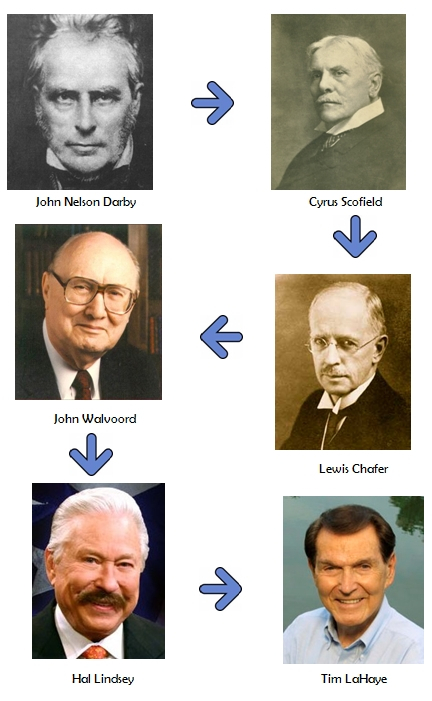
C. I. Scofield (1843–1921), Lewis Sperry Chafer (1871–1952), and Dallas Theological Seminary (est. 1924) were great vehicles for the spread of dispensationalism in America and throughout the world. Both Scofield and Chafer were ordained Presbyterian ministers. The “Scofield Reference Bible, is called by many the most effective tool for the dissemination of dispensationalism in America” (Larry V. Crutchfield, The Origins of Dispensationalism: The Darby Factor, [Lanham, MD: University Press of America, 1992], preface).  Scofield was converted in mid-life and first discipled by James H. Brookes in St. Louis. He was ordained to the ministry at the First Congregational Church of Dallas in 1882 and transferred his ministerial credentials to the Presbyterian Church in the U. S. in 1908 (Daniel Reid, ed., Dictionary of Christianity in America [Downers Grove, IL: InterVarsity Press, 1990], pp. 1057–58). Thus, his ministry took place within a Calvinistic context (Chart of some of the biggest popularizers of Dispensationalism pictured left – Darby, Scofield, Chafer were Calvinists – not certain about the others).

Scofield was the major influence upon the development of Chafer’s theology. John Hannah notes that “it is impossible to understand Chafer without perceiving the deep influence of Scofield” (John David Hannah, “The Social and Intellectual History of the Origins of the Evangelical Theological College,” [Ph. D. Dissertation from The University of Texas at Dallas, 1988], pp. 118–19). In fact, “Chafer often likened this relationship to that of father and a son” (Jeffrey J. Richards, The Promise of Dawn: The Eschatology of Lewis Sperry Chafer, [Lanham, MD: University Press of America, 1991], p. 23). This relationship grew out of Chafer’s study under Scofield at the Northfield Conference and from a life-changing experience in Scofield’s study of the First Congregational Church of Dallas in the early 1900s. Scofield toldChafer that his gifts were more in the field of teaching and not in the area of evangelism in which he had labored. “The two prayed together, and Chafer dedicated his life to a lifetime of biblical study” (Ibid).

Scofield and Chafer were two of the greatest American dispensationalists and both developed their theology from out of a Reformed background. Scofield is known for his study bible and Chafer for his Seminary and systematic theology. Jeffrey Richards describes Chafer’s theological characteristics as having “much in common with the entire Reformed tradition. Excluding eschatology, Chafer is similar theologically to such Princeton divines as Warfield, Hodge, and Machen. He claims such doctrines as the sovereignty of God, …total depravity of humanity, election, irresistible grace, and the perseverance of the saints” (Ibid, p.3). C. Fred Lincoln describes Chafer’s 8-volume Systematic Theology as “unabridged, Calvinistic, premillennial, and dispensational” (C. F. Lincoln, “Biographical Sketch of the Author,” in Lewis Sperry Chafer, Systematic Theology [Dallas: Dallas Seminary Press, 1948], 8:6).

Since its founding in 1924 as The Evangelical Theological College (changed to Dallas Theological Seminary in 1936), it has exerted a global impact on behalf of dispensationalism. Dallas Seminary’s primary founder was Chafer, but William Pettingill and W. H. Griffith-Thomas also played a leading role. Pettingill, like Chafer, was Presbyterian. Griffith Thomas, an Anglican, wrote one of the best commentaries on the Thirty-nine Articles of the Anglican Church (W. H. Griffith Thomas, The Principles of Theology: An Introduction to the Thirty-nine Articles [Grand Rapids: Baker Book House, 1979/1930]), which is still widely used by conservative Anglicans and Episcopalians today. The Thirty-nine Articles are staunchly Calvinistic. Both men were clearly Calvinists. The seminary, especially before World War II, considered itself Calvinistic. Chafer once characterized the school in a publicity brochure as “in full agreement with the Reformed Faith and itstheology is strictly Calvinistic.”  In a letter to Allan MacRae of Westminster Theological Seminary, Chafer said, “You probably know that we are definitely Calvinistic in our theology” (Cited in Ibid, p. 200). “Speaking of the faculty, Chafer noted in 1925 that they were ‘almost wholly drawn from the Southern and Northern Presbyterian Churches’“ (Cited in Ibid., p. 346). Further, Chafer wrote to a Presbyterian minister the following: “I am pleased to state that there is no institution to my knowledge which is more thoroughly Calvinistic nor more completely adjusted to this system of doctrine, held by the Presbyterian Church” (Ibid., p. 346, footnote 323).

Since so many early Dallas graduates entered the Presbyterian ministry, there began to be a reaction to their dispensational premillennialism in the 1930s. This was not an issue as to whether they were Calvinistic in their soteriology, but an issue over their eschatology. In the late 1930s, “Dallas Theological Seminary, though strongly professing to be a Presbyterian institution, was being severed from the conservative Presbyterian splinter movement” (Ibid, pp. 357-358).  In 1944, Southern Presbyterians issued a report from a committee investigating the compatibility of dispensationalism with the Westminster Confession of Faith. The committee ruled dispensationalism was not in harmony with the Church’s Confession. This “report of 1944 was a crippling blow to any future that dispensational premillennialism might have within Southern Presbyterianism” (Ibid, 364). This ruling effectively moved Dallas graduates away from ministry within Reformed denominations toward the independent Bible Church movement.

A Broadening of Dispensational Acceptance

Even though dispensationalism had made a modest penetration of Baptists as early as the 1880s through advocates such as J. R. Graves (See J. R. Graves, The Work of Christ Consummated in 7 Dispensations [Memphis: Baptist Book House, 1883]), a strong Calvinist, they were rebuffed by non-Calvinists until the mid-1920s when elements of dispensational theology began to be adopted by some Pentecostals in an attempt to answer the increasing threat of liberalism. Kraus explains:

Some teachers said explicitly that premillennialism was a bulwark against rationalist theology. Thus it is not surprising to find that the theological elements which became normative in dispensationalism ran directly counter to the developing emphasis of the “New Theology” (Kraus, Dispensationalism, p. 61).

Up to this point in history, those from the Arminian and Wesleyan traditions were more interested in present, personal sanctification issues, rather than the Calvinist attention in explaining God’s sovereign work in the progress of history. However, the rise of the fundamentalist/liberal controversy in the 1920s stirred an interest, outside of the realm of Calvinism, in defending the Bible against the anti-supernatural attacks of the liberal critics. Dispensationalism was seen as a conservative and Bible-centered answer to liberalism, not only within fundamentalism, but increasingly by Pentecostals and others as well. Timothy Weber notes:

But in time, dispensationalism had its devotees within the Wesleyan tradition as well. More radical holiness groups resonated with its prediction of declining orthodoxy and piety in the churches; and Pentecostals found in it a place for the outpouring of the Spirit in a “latter-day rain” before the Second Coming (Weber, “Premillennialism,” p. 15).

Latter Rain Pentecostalism

One of the first non-Calvinist groups to adopt a dispensational orientation can be found among some Pentecostals in the mid-1920s. This development must be understood against a backdrop of the Wesleyan and holiness heritage out of which Pentecostalism arose at the turn of last century. The American holiness movement of the 1800s was primarily postmillennial and if premillennial, then historical premillennial. They were not in any way dispensational.

Pentecostalism is at heart a supposed restoration of apostolic Christianity that is meant to bring in the latter rain harvest in preparation for Christ’s return. The phrase “latter rain” is taken from Joel 2:23 & 28 and sometimes James 5:7 as a label describing an end-time revival and evangelistic harvest expected by many charismatics and Pentecostals. Some time in the future, they believe the Holy Spirit will be poured out like never before. The latter rain teaching is developed from the agricultural model that a farmer needs rain at two crucial points in the growing cycle in order to produce a bountiful harvest. First, right after the seed is planted the “early rain” is needed to cause the seed to germinate in order to produce a healthy crop. Second, the crop needs rain right before the harvest, called the “latter rain,” so the grain will produce a high yield at harvest time, which shortly follows. Latter rain advocates teach that the Acts 2 outpouring of the Holy Spirit was the “early rain” but the “latter rain” outpouring of the Holy Spirit will occur at the end-times. This scenario is in conflict with dispensationalism that sees the current age ending, not in revival, but apostasy. It will be during the tribulation, after the rapture of the church, that God will use the miraculous in conjunction with the preaching of the gospel. Thus, latter rain theology fits within a postmillennial or historical premillennial eschatology, but it is not consistent with dispensationalism.

Many Christians are aware that the Pentecostal movement began on January 1, 1901 in Topeka, Kansas when Agnes Ozman (1870–1937) spoke in tongues under the tutelage of Charles Fox Parham (1873–1929). Yet, how many realize that in the “early years Movement’” (Donald Dayton, Theological Roots of Pentecostalism (Grand Rapids: Zondervan, 1987), p. 27)? This is because Parham titled his report of the new movement as “The Latter Rain: The Story of the Origin of the Original Apostolic or Pentecostal Movements” (Dayton, Roots, pp. 22–23). Many are also aware that William J. Seymour (1870–1922) came under the influence of Parham in Houston, Texas in 1905 and then took the Pentecostal message to Azusa Street in Los Angeles in 1906, from where it was disseminated to the four-corners of the world. But, how many are also aware that he too spoke of these things in terms of a latter rain framework?

There is no doubt that the latter rain teaching was one of the major components—if not the major distinctive—in the theological formation of Pentecostalism. “Modern Pentecostalism is the ‘latter rain,’ the special outpouring of the Spirit that restores the gifts in the last days as part of the preparation for the ‘harvest,’ the return of Christ in glory,” says Donald Dayton (Ibid, 27).  David Wesley Myland (1858–1943) was one of the early Pentecostal leaders. He wrote the first distinctly Pentecostal hymn entitled, “The Latter Rain” in 1906. The “first definitive Pentecostal theology that was widely distributed, the Latter Rain Covenant” appeared in 1910 (Stanley M. Burgess and Gary B. McGee, editors, Dictionary of Pentecostal and Charismatic Movements [Grand Rapids: Zondervan, 1988], p. 632).  Myland argued in his book that “now we are in the Gentile Pentecost, the first Pentecost started the church, the body of Christ, and this, the second Pentecost, unites and perfects the church into the coming of the Lord” (Cited by Dayton, Roots, p. 27).

Dayton concludes that the “broader Latter Rain doctrine provided a key…premise in the logic of Pentecostalism” (Ibid).  In spite of having such a key place in the thinking of early Pentecostalism, “the latter rain doctrine did tend to drop out of Pentecostalism” in the 1920s “only to reappear, however, in the radical Latter Rain revitalization movement of the 1940s” (Ibid, 43). One of reasons that latter rain teachings began to wane in the mid-1920s was that as Pentecostalism became more institutionalized it needed an answer to the inroads of liberalism. As noted above, dispensationalism was seen helpful in these areas.

The Latter Rain teaching developed out of the Wesleyan-Holiness desire for both individual (sanctification) and corporate (eschatological) perfection. Thus, early perfectionist teachers like John Wesley, Charles Finney, and Asa Mahan were all postmillennial and social activists. Revivalism was gagged by carrying the burden of both personal and public change or perfection. It follows that one who believes in personal perfection should also believe that public perfection is equally possible. Those who believe the latter are postmillennialists. After all, if God has given the Holy Spirit in this age to do either, then why not the other? If God can perfect individuals, then why not society?

However, as the 1800s turned into the 1900s, social change was increasingly linked with Darwin’s theory of evolution. The evolutionary rationale was then used to attack the Bible itself. To most English-speaking Christians it certainly appeared that society was not being perfected, instead it was in decline. Critics of the Bible said that one needed a Ph.D. from Europe before the Bible could be organized and understood. It was into this climate that dispensationalism was introduced into America and probably accounts for its speedy and widespread acceptance by many conservative Christians. To many Bible believing Christians, Dispensationalism made a great deal more sense of the world than did the anti-supernaturalism conclusions of liberalism.

Dispensationalism, in contrast to Holiness teaching, taught that the world and the visible church were not being perfected, instead Christendom was in apostasy and heading toward judgment. God is currently in the process of calling out His elect through the preaching of the gospel. Christian social change would not be permanent, nor would it lead to the establishment of Christ’s kingdom before His return. Instead a cataclysmic intervention was needed (Christ’s second coming), if society was to be transformed.

Early Pentecostalism was born out of a motivation and vision for restoring to the church apostolic power lost over the years. Now she was to experience her latter-day glory and victory by going out in a blaze of glory and success. On the other hand, dispensationalism was born in England in the early 1800s bemoaning the latter-day apostasy and ruin of the church. Nevertheless, within Pentecostalism, these two divergent views were merged. Thus, denominations like the Assemblies of God and Foursquare Pentecostals moved away from doctrines like the latter rain teaching and generated official positions against those teachings. It was in the mid-1920s that dispensationalism began to be adopted by non-Calvinists and spread throughout the broader world of Conservative Protestantism.

Dispensationalism appealed to the average person with its emphasis that any average, interested person could understand the Bible without the enlightened help of a liberal education. Once a student understood God’s overall plan for mankind, as administered through the dispensations, he would be able to see God’s hand in history. Thus, dispensational theology made a lot of sense to both Pentecostal and evangelical believers at this point in history.

Post War Development

Fundamentalism/Evangelicalism and Pentecostalism- Charismatic movements spread rapidly in America after the second World War and since dispensationalism was attached to them, it also grew rapidly. Many baby-boomers within Pentecostal and Charismatic churches grew up with dispensationalism and the pre-trib rapture as part of their doctrinal framework. Thus, it would not occur to them that dispensationalism was not organic to their particular brands of restoration theology. Further, as non-Calvinist Fundamentalism grew after the War, especially within independent Baptist circles, there was an even greater disconnect of dispensational distinctives from their Calvinist roots.

We have seen that the Pentecostal/Charismatic movement has a tradition of both Latter Rain/restoration teachings as well as the later rise of a dispensational stream. However, these are contradictory teachings that appear to be on a collision course.

Either the church age is going to end with perfection and revival or it will decline into apostasy, preparing the way for the church to become the harlot of Revelation during the tribulation. It is not surprising to see within the broader Pentecostal/Charismatic movement, since the mid 1980s, a clear trend toward reviving Latter Rain theology and a growing realization that it is in logical conflict with their core doctrine. Many, who grew up on Dispensational ideas and the pre-trib rapture, are dumping these views as the leaven of Latter Rain theology returns to prominence within Pentecostal/Charismatic circles.

Pentecostal/Charismatic leaders like Earl Paulk  and Tommy Reid, to name just a couple among many, are attempting to articulate the tension over the struggles of two competing systems. They are opting for the dismissal of dispensational elements from a consistent Pentecostal/Charismatic and Latter Rain theology. Tommy Reid observes:

This great Last Day revival was often likened in the preaching of Pentecostal pioneer to the restoration promised to Israel in the Old Testament. Whereas Dispensationalists had relegated all of these prophetic passages of restoration only to physical Israel, Pentecostal oratory constantly referred to these prophecies as having a dual meaning, restoration for physical Israel, AND restoration for the present day church. WE WERE THE PEOPLE OF THAT RESTORATION, ACCORDING TO OUR THEOLOGY (Tommy Reid, Kingdom Now But Not Yet. Buffalo: IJN Publishing, 1988, pp. xv-xvi. [emphasis in original]).

At the same time, the purge of Dispensationalism from Reformed Christianity, begun in the late 1930s, has been pretty much completed. Typical of this polarization is found in books like John Gerstner’s Wrongly Dividing The Word Of Truth: A Critique of Dispensationalism (John H. Gerstner, Wrongly Dividing The Word Of Truth: A Critique of Dispensationalism. Brentwood, TN: Wolgemuth & Hyatt Publishers, 1991). While admitting on the one hand that a “strange thing about Dispensationalism is that it seems to have had its strongest advocates in Calvinistic churches” (Ibid, 106). Gerstner so strongly opposes dispensationalism, that it has blinded him to the true Calvinist nature of such a God-centered theology. Gerstner claims that he and other Reformed theologians have raised “strong questions about the accuracy of dispensational claims to be Calvinistic” (Ibid, pp. 105-47). It appears that since Dispensationalism arose within the Reformed tradition, as a rival to Covenant Theology, some want to say that they cannot logically be Calvinistic. This is what Gerstner contends. However, in spite of Gerstner’s sophistry on this issue,he cannot wipe out the historical fact that dispensationalism was birthed within the biblical mindset of a clear theocentric theology and by those who held strongly to soteriological Calvinism. The fact that Dispensationalism arose within a Reformed context is probably the reason why the Reformed community has led the way in the criticism of Dispensational theology.

Conclusion

The purpose of this article is to remind modern Dispensationalists and Calvinists of the historical roots of Dispensationalism. It is precisely because Dispensationalism has penetrated almost every form of Protestantism that many today may be surprised to learn of its heritage. In our day of Postmodern irrationalism, where it is considered a virtue to NOT connect the dots of one’s theology, we need to be reminded that the theology of the Bible is a seamless garment. It all hangs together. If one starts pulling at a single thread, the whole cloth is in danger of unraveling.

I personally think that if systematic Dispensationalism is rightly understood then it still logically makes sense only within a theocentric and soteriologically Calvinistic theology. After all, Dispensationalism teaches that it is GOD who is ruling His household, as administered through the various dispensations of history. However, the reality is that Dispensationalism, or elements of Dispensationalism (i.e., pretribulationism, futurism, etc.), have been disseminated throughout a wide diversity of Protestant traditions. Dispensationalism is best seen as a system of theology that sees views God as the Sovereign ruler of heaven and earth; man as a rebellious vice-regent (along with some angels); Jesus Christ is the hero of history as He is saves some by His Grace; history as a lesson in the outworking of God’s glory being displayed to both heaven and earth. Dispensationalism is a theology that I believe is properly derived from biblical study and lets God be God (Article Adapted from Vol. 4: Conservative Theological Journal Volume 4. 2000 (12) (127). Fort Worth, TX: Tyndale Theological Seminary).

About the Author: Dr. Thomas Ice is the Executive Director of The Pre-Tribulational Research Center. He founded The Center in 1994 with Dr. Tim LaHaye to research, teach, and defend the pretribulational rapture and related Bible prophecy doctrines. The Center is currently located on the campus of Liberty University in Virginia.

Dr. Ice has authored or co-authored about 30 books, written hundreds of articles, and is a frequent conference speaker. He has served as a pastor for 15 years. Dr. Ice has a B.A. from Howard Payne University, a Th.M. from Dallas Theological Seminary, a Ph.D. from Tyndale Theological Seminary, and is a Doctoral Candidate at The University of Wales in Church History. Dr. Ice lives in Omaha, Nebraska with his wife Janice. Two of their three boys are college graduates and the third is currently in college.

Why Sola Scriptura is Crucial to Evangelicalism by Dr. R.C. Sproul

“The only source and norm of all Christian knowledge is the Holy Scripture.” This thematic statement introduces De Scriptura Sacra of Heinrich Heppe’s classic work in Reformed dogmatics and provides a succinct expression of the Reformation slogan: Sola Scriptura (Scripture Alone). The two key words that are used to crystallize the sola character of Scripture are source and norm.

The Reformation principle of Sola Scriptura was given the status of the formal cause of the Reformation by Melanchthon and his Lutheran followers. The formal cause was distinguished from the material cause of Sola Fide (by faith alone). Though the chief theological issue of the Reformation was the question of the matter of justification, the controversy touched heavily on the underlying question of authority. As is usually the case in theological controversy, the issue of ultimate authority lurked in the background (though it was by no means hidden or obscure) of Luther’s struggle with Rome over justification. The question of the source of Luther’s doctrine and the normative authority by which it was to be judged was vital to his cause.

Sola Scriptura and Inerrancy

A brief historical recapitulation of the steps that led to Luther’s Sola Scriptura dictum may be helpful. After Luther posted his Ninety-Five Theses in 1517, a series of debates, correspondence, charges, and countercharges ensued, culminating in Luther’s dramatic stand at Worms in April 1521. The two most significant transitional points between the theses of 1517 and the Diet of Worms of 1521 were the debates at Augsburg and Leipzig.

In October 1518 Luther met with Cardinal Cajetan of the Dominicans. Cajetan was acknowledged to be the most learned theologian of the Roman Curia. In the course of their discussions Cajetan was able to elicit from Luther his views on the infallibility of the pope. Luther asserted that the pope could err and claimed that Pope Clement VI’s bull Unigenitus (1343) was contrary to Scripture.

In the summer of 1519 the dramatic encounter between Luther and Johannes von Eck took place at Leipzig. In this exchange Eck elicited from Luther the admission of his belief that not only could the pope err but church councils could and did err as well. It was at Leipzig that Luther made clear his assertion: Scripture alone is the ultimate, divine authority in all matters pertaining to religion.

Gordon Rupp gives the following account:

Luther affirmed that “among the articles of John Huss and the Hussites which were condemned, are many which are truly Christian and evangelical, and which the church universal cannot condemn!” This was sensational! There was a moment of shocked silence, and then an uproar above which could be heard Duke George’s disgusted, “Gad, Sir, that’s the Plague!… ” Eck pressed his advantage home, and Luther, trapped, admitted that since their decrees are also of human law, Councils may err.

So by the time Luther stood before the Diet of Worms, the principle of Sola Scriptura was already well established in his mind and work. Only the Scripture carries absolute normative authority. Why? For Luther the sola of Sola Scriptura was inseparably related to the Scriptures’ unique inerrancy. It was because popes could and did err and because councils could and did err that Luther came to realize the supremacy of Scripture. Luther did not despise church authority nor did he repudiate church councils as having no value. His praise of the Council of Nicea is noteworthy. Luther and the Reformers did not mean by Sola Scriptura that the Bible is the only authority in the church. Rather, they meant that the Bible is the only infallible authority in the church.

Paul Althaus summarizes the train of Luther’s thought by saying:

We may trust unconditionally only in the Word of God and not in the teaching of the fathers; for the teachers of the Church can err and have erred. Scripture never errs. Therefore it alone has unconditional authority. The authority of the theologians of the Church is relative and conditional. Without the authority of the words of Scripture, no one can establish hard and fast statements in the Church.

Thus Althaus sees Luther’s principle of Sola Scriptura arising as a corollary of the inerrancy of Scripture. To be sure, the fact that Scripture is elevated to be the sole authority of the church does not carry with it the necessary inference that it is inerrant. It could be asserted that councils, popes, and the Bible all err and still postulate a theory of Sola Scriptura. Scripture could be considered on a primus inter pares (“first among equals”) basis with ecclesiastical authority, giving it a kind of primacy among errant sources. Or Scripture could be regarded as carrying unique authority solely on the basis of its being the primary historical source of the gospel. But the Reformers’ view of Sola Scriptura was higher than this. The Reformation principle of Sola Scriptura involved inerrancy.

Sola Scriptura, ascribing to the Scriptures a unique authority, must be understood in a normative sense. Not descriptive, but rather normative authority is meant by the formula. The normative character of the Sola Scriptura principle may be seen by a brief survey of sixteenth-century Reformed confessions.

The Theses of Berne (1528): The Church of Christ makes no laws or commandments without God’s Word. Hence all human traditions, which are called ecclesiastical commandments, are binding upon us only in so far as they are based on and commanded by God’s Word (Sec. II).

The Geneva Confession (1536): First we affirm that we desire to follow Scripture alone as a rule of faith and religion, without mixing with it any other things which might be devised by the opinion of men apart from the Word of God, and without wishing to accept for our spiritual government any other doctrine than what is conveyed to us by the same Word without addition or diminution, according to the command of our Lord (Sec. I).

The French Confession of Faith (1559): We believe that the Word contained in these books has proceeded from God, and receives its authority from him alone, and not from men. And inasmuch as it is the rule of all truth, containing all that is necessary for the service of God and for our salvation, it is not lawful for men, nor even for angels, to add to it, to take away from it, or to change it. Whence it follows that no authority, whether of antiquity, or custom, or numbers, or human wisdom, or judgments, or proclamations, or edicts, or decrees, or councils, or visions, or miracles, should be opposed to these Holy Scriptures, but on the contrary, all things should be examined, regulated, and reformed according to them (Art. V).

The Belgic Confession (1561): We receive all these books, and these only, as holy and confirmation of our faith; believing, without any doubt, all things contained in them, not so much because the church receives and approves them as such, but more especially because the Holy Ghost witnessed in our hearts that they are from God, whereof they carry the evidence in themselves (Art. V). Therefore we reject with all our hearts whatsoever doth not agree with this infallible rule (Art. VII).

Second Helvetic Confession (1566): Therefore, we do not admit any other judge than Christ himself, who proclaims by the Holy Scriptures what is true, what is false, what is to be followed, or what is to be avoided (Chap. II).

Uniformly the sixteenth-century confessions elevate the authority of Scripture over any other conceivable authority. Thus, even the testimony of angels is to be judged by the Scriptures. Why? Because, as Luther believed, the Scriptures alone are inerrant. Sola Scriptura as the supreme norm of ecclesiastical authority rests ultimately on the premise of the infallibility of the Word of God.

Extent of the Norm

To what extent does the Sola Scriptura principle of authority apply? We hear statements that declare Scripture to be the “only infallible rule of faith and practice.” Does this limit the scope of biblical infallibility? Among advocates of limited inerrancy we hear the popular notion that the Bible is inerrant or infallible only when it speaks of matters of faith and practice. Matters of history or cosmology may contain error but not matters of faith and practice. Here we see a subtle shift from the Reformation principle. Note the difference in the following propositions:

A. The Bible is the only infallible rule of faith and practice.

B. The Bible is infallible only when it speaks of faith and practice.

In premise A, “faith and practice” are generic terms that describe the Bible. In premise B, “faith and practice” presumably describe only a particular part of the Bible. Premise A affirms that there is but one infallible authority for the church. The proposition sets no content limit on the infallibility of the Scriptures. Premise B gives a reduced canon of that which is infallible; that is, the Bible is infallible only when it speaks of faith and practice. This second premise represents a clear and decisive departure from the Reformation view.

Premise A does not say that the Bible provides information about every area of life, such as mathematics or physics. But it affirms that what he Bible teaches, it teaches infallibly.

The Source of Authority

Heppe’s sola indicates that the Bible is not only the unique and final authority of the church but is also the “only source of all Christian knowledge.” At first glance this statement may seem to suggest that the only source of revelation open to man is that found in Scripture. But that is not the intent of Heppe’s statement, nor is it the intent of the Reformation principle of Sola Scriptura.

Uniformly the Reformers acknowledged general revelation as a source of knowledge of God. The question of whether or not that general revelation yields a bona fide natural theology was and is widely disputed, but there is no serious doubt that the Reformers affirmed a revelation present in nature. Thus the sola does not exclude general revelation but points beyond it to the sufficiency of Scripture as the unique source of written special revelation.

The context of the Sola Scriptura schema with respect to source was the issue (raised over against Rome) regarding the relationship of Scripture and Tradition. Central to the debate was the Council of Trent’s declaration regarding Scripture and Tradition. (Trent was part of the Roman counteroffensive to the Reformation, and Sola Scriptura was not passed over lightly in this counter-offensive.)

In the Fourth Session of the Council of Trent the following decree was formulated: This (Gospel), of old promised through the Prophets in the Holy Scriptures, our Lord Jesus Christ, the Son of God, promulgated first with His own mouth, and then commanded it to be preached by His Apostles to every creature as the source at once of all saving truth and rules of conduct. It also clearly perceives that these truths and rules are contained in the written books and in the unwritten traditions, which, received by the Apostles from the mouth of Christ Himself, or from the Apostles themselves, the Holy Ghost dictating, have come down to us, transmitted as it were from hand to hand. Following then, the examples of the Orthodox fathers, it receives and venerates with a feeling of piety and reverence all the books both of the Old and New Testaments, since one God is the author of both; also the traditions, whether they relate to faith or to morals, as having been dictated either orally by Christ or by the Holy Ghost, and preserved in the Catholic church in unbroken succession.

In this decree the Roman Catholic church apparently affirmed two sources of special revelation—Scripture and the Tradition of the church—although in recent years this “dual source” theory has come into question within the Roman church.

G. C. Berkouwer’s work on Vatican Council II provides a lengthy discussion of current interpretations of the Tridentine formula on Scripture and Tradition. Some scholars argue that Tradition adds no new content to Scripture but merely serves either as a depository in the life of the church or as a formal interpretive tool of the church. A technical point of historical research concerning Trent sheds some interesting light on the matter. In the original draft of the fourth session of Trent the decree read that “the truths … are contained partly [partim] in Scripture and partly [partim] in the unwritten traditions.” But at a decisive point in the Council’s deliberations two priests, Nacchianti and Bonnucio rose in protest against the partim … partim formula. These men protested on the grounds that this view would destroy the uniqueness and sufficiency of Scripture. All we know from that point on is that the words partly … partly were removed from the text and replaced by the word and (et). Did this mean that the Council responded to the protest and perhaps left the relationship between Scripture and Tradition purposely ambiguous? Was the change stylistic, meaning that the Council still maintained two distinct sources of revelation? These questions are the focus of the current debate among Roman theologians.

One thing is certain. The Roman church has interpreted Trent as affirming two sources of special revelation since the sixteenth century. Vatican I spoke of two sources. The papal encyclical Humani Generis spoke of “sources of revelation.” Even Pope John XXIII spoke of Scripture and Tradition in Ad Petri Cathedram.

Not only has the dual-source theory been confirmed both by ecumenical councils and papal encyclicals, but tradition has been appealed to on countless occasions to validate doctrinal formulations that divide Rome and Protestantism. This is particularly true regarding decisions in the area of Mariology.

Over against this dual-source theory stands the sola of Sola Scriptura. Again, the Reformers did not despise the treasury of church tradition. The great councils of Nicea, Ephesus, Chalcedon, and Constantinople receive much honor in Protestant tradition. The Reformers themselves gave tribute to the insights of the church fathers. Calvin’s love for Augustine is apparent throughout the Institutes. Luther’s expertise in the area of Patristics was evident in his debates with Cajetan and Eck. He frequently quotes the fathers as highly respected ecclesiastical authorities. But the difference is this: For the Reformers no church council, synod, classical theologian, or early church father is regarded as infallible. All are open to correction and critique. We have no Doctor Irrefragabilis of Protestantism.

Protestant churches have tended to be confessional in character. Subscription to confessions and creeds has been mandatory for the clergy and parish of many denominations. Confessions have been used as a test of orthodoxy and conformity to the faith and practice of the church. But the confessions are all regarded as reformable. They are considered reformable because they are considered fallible. But the Sola Scriptura principles in its classic application regards the Scripture as irreformable because of its infallibility. Thus the two primary thrusts of Sola Scriptura point to:

1) Scripture’s uniqueness as normative authority and

2) its uniqueness as the source of special revelation. Norm and source are the twin implicates of the Sola Scriptura principle.

Is Sola Scriptura the Essence of Christianity?

In a recent publication on questions of Scripture, Bernard Ramm wrote an essay entitled, “Is ‘Scripture Alone’ the Essence of Christianity?” Using the nineteenth-century German penchant for the quest of the “Wesen” of Christianity as a jumping-off point, Ramm gives a brief history of the liberal-conservative controversy concerning the role of Scripture in the Christian faith. Defining Wesen as “the essence of something, the real spirit or burden of a treatise, the heart of the matter,” he concludes that Scripture is not the Wesen of Christianity. He provides a historical survey to indicate that neither the Reformers nor the strong advocates of inerrancy, A. A. Hodge and B. B. Warfield, believed that Sola Scriptura was the essence of Christianity. Ramm cites numerous quotations from Hodge and Warfield that speak of the Scriptures as being “absolutely infallible,” and “without error of facts or doctrines.” Yet these men affirmed that “Christianity was true independently of any theory of inspiration, and its great doctrines were believable within themselves.”

Ramm goes on to express grave concern about the present debate among evangelicals concerning inerrancy. Here his concern focuses not on the teaching of Hodge and Warfield but on the attitudes of their contemporary disciples who, in Ramm’s opinion, go beyond their forefathers in asserting a particular view of Scripture as being Christianity’s essence. Ramm writes:

From the other writings of Warfield in particular, it would be impossible to say that he identified the Wesen of Christianity with his view of Holy Scripture. He was enough of a historian of theology to avoid saying that. The “inspiration” article was an essay in strategy. However, among current followers of the so-called Warfield position there have been certain shifts away from the original strategic stance of the essay. One’s doctrine of Scripture has become now the first and most important doctrine, one’s theory of the wesen of Christianity, so that all other doctrines have validity now only as they are part of the inerrant Scripture. Thus evangelical teachers, or evangelical schools or evangelical movements, can be judged as to whether or not they are true to the wesen of Christianity by their theory of inspiration. It can be stated even more directly: an evangelical has made a theory of inspiration the wesen of Christianity if he assumes that the most important doctrine in a man’s theology, and most revelatory of the entire range of his theological thought, is his theology of inspiration.

It appears from this statement that the “essence” of Ramm’s concern for the present state of evangelicalism is that one’s doctrine of Scripture is viewed as the essence or wesen of Christianity. This writer can only join hands with Ramm in total agreement with his concern. To make one’s view of Scripture in general or of inspiration in particular the essence of Christianity would be to commit an error of the most severe magnitude. To subordinate the importance of the gospel itself to the importance of our historical source book of it would be to obscure the centrality of Christ. To subordinate Sola Fide to Sola Scriptura would be to misunderstand radically the wesen of the Reformation. Clearly Ramm is correct in taking his stand on this point with Hodge, Warfield, and the Reformers. Who can object to that?

One may be troubled, however, by a portion of Ramm’s stated concern. Who are these “current followers” of Warfield who in fact do maintain that Sola Scriptura is the heart or essence of Christianity? What disciple of Warfield’s has ever maintained that Sola Scriptura is essential to salvation? Ramm provides us with no names or documentary evidence to demonstrate that his deep concern is warranted.

To be sure, strong statements have been made by followers of the Warfield school of the crucial importance of Sola Scriptura and the centrality of biblical authority to all theological disputes. Perhaps these statements have contained some “overkill” in the passion of debate, which is always regrettable. We must be very cautious in our zeal to defend a high view of Scripture not to give the impression that we are talking about an article on which our salvation depends.

We can cite the following statements by advocates of the Warfield school that could be construed as a possible basis for Ramm’s concern. In God’s Inerrant Word, J. I. Packer makes the following assertion:

What Luther thus voiced at Worms shows the essential motivation and concern, theological and religious, of the entire Reformation movement: namely that the Word of God alone must rule, and no Christian man dare do other than allow it to enthrone itself in his conscience and heart.

Here Packer calls the notion of Sola Scriptura “the essential motivation and concern” of the Reformation. In itself this quote certainly suggests that Packer views Sola Scriptura as the essence of the Reformation.

However, in defense of Packer it must be noted that to say Sola Scriptura was the essential motivation of the Reformation movement is not to say that Sola Scriptura is the essence of Christianity. He is speaking here of a historical controversy. That Sola Scriptura was at the heart of the controversy and central to the debate cannot be doubted. To say that Sola Scriptura was an essential motif or concern of the Reformation cannot be doubted. That is was the essential concern may be brought into question; this may be regraded as an overstatement. But again, in fairness to Packer, it must be noted that earlier in his essay he had already indicated that Justification by Faith Alone was the material principle. So he had already maintained that Sola Scriptura was subordinate to Sola Fide in the controversy. In any case, though the word essential is used, there is no hint here that Packer maintains that Sola Scriptura is the essence of Christianity.

In a recent unpublished essay, Richard Lovelace of Gordon-Conwell Theological Seminary cites both Harold Lindsell and Francis Schaeffer as men who have sounded urgent warnings concerning the relationship between inerrancy and evangelicalism. Lovelace cites the following statements of Schaeffer:

There is not use of evangelicalism seeming to get larger and larger, if at the same time appreciable parts … are getting soft at that which is the central core, namely the Scriptures.… We must say most lovingly but clearly: evangelicalism is not consistently evangelical unless there is a line drawn between those who take a full view of Scripture and those who do not.

Again Schaeffer is cited: “Holding to a strong view of Scripture or not holding to it is the watershed of the evangelical world.” In these statements Francis Schaeffer maintains that the Scriptures are:

1) the “central core” of evangelicalism,

2) a mark of “consistent evangelicalism,” and

3) the “watershed of the evangelical world.”

These are strong assertions about the role of Sola Scriptura, but they are made with reference to evangelicalism, not Christianity (though I am sure Schaeffer believes evangelicalism is the purest expression of Christianity to be found). Evangelicalism refers to a historical position or movement. When he speaks of “watersheds,” he is speaking of crucial historical turning points. When he speaks of “consistent” evangelicalism, he implies there may be such a thing as inconsistent evangelicalism.

The troublesome quote of Schaeffer is that one in which he says the Scriptures are “the central core” of evangelicalism. Here “core” is in the singular with the definite article giving it a sola character. Does Schaeffer mean that the Bible is the core of evangelicalism and the gospel is the husk? Is Sola Scriptura the center and Sola Fide at the periphery of evangelicalism? It is hard to think that Schaeffer would make such an assertion. Indeed, one may question if Schaeffer means what he in fact does say here. Had he said, “Scripture is at the core of evangelicalism,” there would be no dispute. But to say it is the core appears an overstatement. Perhaps we have here a slip of the pen, which any of us can and frequently do make.

In similar fashion Harold Lindsell may be quoted: “Is the term ‘evangelical’ broad enough in its meaning to include within it believers in inerrancy and believers in an inerrancy limited to matters of faith and practice?” Lindsell raises the question of whether or not inerrancy of the entire Bible is essential to the term evangelical. The question raised is: If Sola Scriptura in its fullest sense is of the Wesen of evangelicalism, can one who espouses limited inerrancy be genuinely called evangelical? The issue is the meaning of the term evangelical. Does it carry with it the automatic assumption of full inerrancy? Again we must point out the difference between the historical label “evangelical” and what is essential to Christianity.

None of the scholars mentioned have said that adherence to inerrancy or Sola Scriptura is essential to salvation. None have Sola Scriptura as the Wesen of Christianity.

It could be said that the argument of the writer of this chapter is constructed on straw men who “come close” to asserting that Sola Scriptura is the essence of Christianity but who, in the final analysis, shrink for such an assertion. But it is not my purpose to create straw men. It is simply to find some basis for Ramm’s assertion about modern followers of Warfield. Since I have not been able to find any followers of Warfield who assert Sola Scriptura as the Wesen of Christianity, the best I can do is to cite examples of statements that could possibly be misconstrued to assert that. It is probably charity that restrained Ramm from naming those he had in mind. But unfortunately, the absence of names casts a shadow of suspicion over all modern followers of Warfield who hold to full inerrancy.

Though advocates of inerrancy in the full sense of Sola Scriptura do not regard it as being essential to salvation, they do maintain that the principle is crucial to Christianity and to consistent evangelicalism. That in Scripture we have divine revelation is no small matter. That the gospel rests not on human conjecture or relational speculation is of vital importance. But there is no quarrel with Ramm on these points. He summarizes his own position by saying:

1. There is no questioning of the Sola Scriptura in theology. Scripture is the supreme and final authority in theological decision-making.

2. One’s views of revelation, inspiration, and interpretation are important. They do implicate each other. Our discussion rather has been whether a certain view of inspiration could stand as the wesen of Christianity. We have in no manner suggested that matters of revelation, inspiration, and interpretation are unimportant in theology.

Here we delight in agreement with this strong affirmation of the crucial importance of Sola Scriptura.

Strangely, however, Ramm continues his summary by saying, “If the integrity of other evangelicals, evangelical schools, or evangelical movements are assessed by their view of inspiration, then, for them, inspiration has become the wesen of Christianity.” The inference Ramm draws at this point is at once puzzling and astonishing, and perhaps we meet here merely another case of overstatement or a slip of the pen. How would it follow from an assessment of others’ evangelicalism as being consistent or inconsistent according to their view of Scripture that inspiration has become the wesen of Christianity? This inference involves a quantum leap of logic.

If the first two points of Ramm’s summary are correct—that Sola Scriptura is important and that it implicates views of interpretation and theological decision making—why should not a school’s or movement’s integrity (a fully integrated stance) be assessed by this principle? Though Sola Scriptura is not the wesen of Christianity, it is still of crucial importance. If a school or movement softens its view of Scripture, that does not mean it has repudiated the essence of Christianity. But it does mean that a crucial point of doctrine and classical evangelical unity has been compromised. If, as Ramm suggests, one’s view of Scripture is so important, then a weakening of that view should concern us.

The issue of full or limited inerrancy is a serious one among those within the framework of historic evangelicalism. In the past a healthy and energetic spirit of cooperation has existed among evangelicals from various and diverse theological persuasions and ecclesiastical affiliations. Lutherans and Baptists, Calvinists and Arminians, and believers of all sorts have united in evangelical activity. What has been the cohesive force of that unity? In the first instance, there has been a consensus of catholic articles of faith, such as the deity of Christ. In the second instance, a strong point of unity has been the cardinal doctrine of the Protestant Reformation: justification by faith alone. In the last instance, there has been the unifying factor of Sola Scriptura in the sense of full inerrancy. The only “creed” that has bound the Evangelical Theological Society together, for example, has been the affirmation of inerrancy. Now that point of unity is in jeopardy. The essence of Christianity is not the issue. But a vital point of consistent evangelicalism is.

Sola Scriptura and Limited Inerrancy

Is Sola Scriptura compatible with a view of Scripture that limits inerrancy to matters of faith and practice? Theoretically it would seem to be possible if “faith and practice” could be separated from any part of Scripture. So long as biblical teaching regarding faith and practice were held to be normative for the Christian community, there would appear to be no threat to the essence of Christianity. However, certain problems exist with such a view of Scripture that do seriously threaten the essence of Christianity.

The first major problem we encounter with limited inerrancy is the problem of canon reduction. The canon or “norm” of Scripture is reduced de facto to that content relating to faith and practice. This immediately raises the hermeneutical question concerning what parts of Scripture deal with faith. As evangelicals wrestle among themselves in intramural debates, they must keep one eye focused on the liberal world of biblical scholarship, for the principle of the reduction of canon to matters of “faith” is precisely the chief operative in Bultmann’s hermeneutic. Bultmann thinks we must clear away the prescientific and faulty historical “husk” of Scripture to get to the viable kernel of “faith.” Thus, although Bultmann has no inerrant kernel or kerygma to fall back on, his problem of canon reduction remains substantially the same as that of those who limit inerrancy to faith and practice.

Before someone cries foul or cites the informal fallacy of argumentum ad hominem (abusive) or the “guilt by association” fallacy, let this concern be clarified. I am not saying that advocates of limited inerrancy are cryptic or even incipient Bultmannians, but that there is one very significant point of similarity between the two schools: canon reductionism. Evangelical advocates of limited inerrancy are not expected to embrace Bultmann’s mythical view of New Testament supernaturalism. But their method has no inherent safeguard from an arbitrary delimitation of the scope of the biblical canon.

The second serious problem, closely related to the first, is the problem of the relationship of faith and history, perhaps the most serious question of contemporary New Testament scholarship. If we limit the notion of inerrancy to matters of faith and practice, what becomes of biblical history? Is the historical substratum of the gospel negotiable? Are only those portions of the biblical narrative that have a clear bearing on faith inerrant? How do we escape dehistoricizing the gospel and relegating it to a level of supratemporal existential “decision”? We know that the Bible is not an ordinary history book but a book of redemptive history. But is it not also a book of redemptive history? If we exclude the realm of history from the category of inspiration or inerrancy either in whole or in part, do we not inevitably lose the gospel?

The third problem we face with limiting inerrancy to matters of faith and practice is an apologetic one. To those critics outside the fellowship of evangelicals, the notion of “limited inerrancy” appears artificial and contrived. Limited inerrancy gets us off the apologetical hook by making us immune to religious-historical criticism. We can eat our cake and have it too. The gospel is preserved; and our faith and practice remains intact while we admit errors in matters of history and cosmology. We cannot believe the Bible concerning earthly things, but we stake our lives on what it says concerning heavenly things. That approach was totally abrogated by our Lord (John 3:12).

How do we explain and defend the idea that the Bible is divinely superintended in part of its content but not all of it? Which part is inspired? Why only the faith and practice parts? Again, which are the faith and practice parts? Can we not justly be accused of “weaseling” if we adopt such a view? We remove our faith from the arena of historical verification nor falsification. This is a fatal blow for apologetics as the reasoned defense of Christianity.

Finally, we face the problem of the domino theory. Frequently this concern is dismissed out of hand as being so much alarmism. But our doctrine of Scripture is not a child’s game of dominoes. We know instances in which men have abandoned belief in full inerrancy but have remained substantially orthodox in the rest of their theology. We are also aware of the sad instances in which full inerrancy is affirmed yet the substance of theology is corrupt. Inerrancy is no guarantee of biblical orthodoxy. Yet even a cursory view of church history has shown some pattern of correlation between a weakening of biblical authority and serious defection regarding the Wesen of Christianity. The wesen of nineteenth-century liberalism is hardly the gospel evangelicals embrace.

We have already seen, within evangelical circles, a move from limited inerrancy to challenges of matters of faith and practice. When the apostle Paul is depicted as espousing two mutually contradictory views of the role of women in the church, we see a critique of apostolic teaching that does touch directly on the practice of the church. In the hotly disputed issue of homosexuality we see denominational commissions not only supplementing biblical authority with corroborative evidence drawn from modern sources of medical psychological study but also “correcting” the biblical view by such secular authority.The direction of these movements of thought is a matter of grave concern for advocates of full inerrancy.

We face a crisis of authority in the church. It is precisely our faith and our practice that is in question. It is for faith and practice that we defend a fully infallible rule—a total view of Sola Scriptura.

We know some confusion has existed (much unnecessarily) about the meaning of full inerrancy. But with all the problems of definition that plague the concept, we do not think it has died the death of a thousand qualifications.

We are concerned about Sola Scriptura for many reasons. But we affirm it in the final analysis not because it was the view of the Reformers, not because we slavishly revere Hodge and Warfield, not even because we are afraid of dominoes or a difficult apologetic. We defend it and express our deep concern about it because we believe it is the truth. It is a truth we do not want to negotiate. We earnestly desire dialogue with our evangelical brothers and colaborers who differ from us. We want to heal the wounds that controversy so frequently brings. We know our own views are by no means inerrant. But we believe inerrancy is true and is of vital importance to our common cause of the gospel.

Further dialogue within the evangelical world should at least help us clarify what real differences there are among us. Such clarification is important if there is to be any hope of resolving those differences. We do not intend to communicate that a person’s Christian faith stands or falls with his view of Scripture. We do not question the Christian commitment of advocates of limited inerrancy. What we do question is the correctness of their doctrine of Scripture, as the question ours. But we consider this debate, as serious as it is, a debate between members of the household of God. May our Father bring us to unity here as he has in many glorious affirmations of his gospel.

Article above written by Dr. R.C. Sproul. “Sola Scriptura: Crucial to Evangelicalism.” The Foundations of Biblical Authority. James M. Boice, ed. Grand Rapids: Zondervan, 1980.

About the Author: Dr. R.C. Sproul is the founder and chairman of Ligonier Ministries, an international Christian education ministry located near Orlando, Florida. His teaching can be heard on the program Renewing Your Mind, which is broadcast on hundreds of radio outlets in the United States and in 40 countries worldwide. He is the executive editor of Tabletalk Magazine and general editor of The Reformation Study Bible, and the author of more than seventy books (including some of my all time favorites: THE HOLINESS OF GOD; CHOSEN BY GOD; KNOWING SCRIPTURE; WILLING TO BELIEVE; REASON TO BELIEVE; and PLEASING GOD) and scores of articles for national evangelical publications. Dr. Sproul also serves as president of Ligonier Academy of Biblical and Theological Studies and Reformation Bible College. He currently serves as Senior Minister of preaching and teaching at Saint Andrew’s in Sanford, FL

May 7th in Christian History – Dr. James M. Boice and Elisha A. Hoffman

Series: On This Day In Christian History

 Dr. James Montgomery Boice: “He Realized His Boyhood Dream”

As a boy, James Montgomery Boice attended Tenth Presbyterian Church in Philadelphia with his family. He loved his pastor, Donald Grey Barnhouse, and he was an avid listener to Barnhouse’s radio program, The Bible Study Hour. At the age of twelve Boice decided he wanted to become a minister. Little did he know how closely he would follow in his beloved minister’s footsteps (Tenth Presbyterian Church in Philadelphia pictured left).

Boice attended Harvard, where he received a degree in English literature. There he met his future wife, Linda Ann McNamara, at InterVarsity Christian Fellowship. She received a master of arts from Harvard, and they shared a dream of creating a Christian college preparatory school for needy inner-city youth.

After Harvard, Boice went to seminary top prepare himself for becoming a minister. He then married Linda, and they moved to Switzerland so Jim could study at the University of Basel. After he received his doctorate, they settled in Washington, D.C., where he worked for the magazine Christianity Today.

In 1968 Tenth Presbyterian Church in Philadelphia, the church of his youth, called him to be their pastor. In 1969 he also became the speaker for The Bible Study Hour. Boice continued Barnhouse’s legacy of providing clear, intellectual, heartfelt expository preaching to the Tenth Presbyterian congregation. Under Boice’s leadership the church grew in numbers, budget, and outreach programs. The church became ethnically diverse and intensely missions focused. Many of its ministries grew out of inner-city location: ministries to internationals, HIV positive individuals, inner-city youth, women with crisis pregnancies, and the homeless. Jim and Linda achieved their dream of a Christian college preparatory school for needy inner-city youth with the creation of City Center Academy, which was started and run by Tenth Presbyterian. Despite the lack of parking in its downtown location , the church has well over a thousand members.

In the 1970’s Boice started the Philadelphia Conference on Reformed Theology, which spawned many similar conferences in cities throughout the country. In 1977 he founded the International Council on Biblical Inerrancy, a topic on which he frequently wrote. In all he wrote or contributed to more than sixty books. Under Boice’s leadership Tenth Presbyterian left the Presbyterian USA in 1981 and joined the Presbyterian Church in America, a denomination that conformed more closely to the church’s Reformed theological beliefs.

On Good Friday 2000, two hours before he was to preach, Dr. Boice learned that he had an aggressive form of liver cancer. His prognosis was not good.

Jim Boice (pictured on left) mounted the pulpit of Tenth Presbyterian for the last time on Sunday, May 7, 2000. He announced to his stunned congregation that he was rapidly dying of cancer. He said to them: “Should you pray for a miracle? Well, you’re free to do that, of course. My general impression is that the God who is able to perform miracles—and he certainly can—is also able to keep you from getting the problem in the first place…Above all, I would say pray for the glory of God. If you thin of God glorifying himself in history and you say, “Where in all of history has God most glorified himself?’ the answer is that he did it at the cross of Jesus Christ, and it wasn’t by delivering Jesus from the cross, though he could have…And yet that’s where God is most glorified.”

On June 15, 2000, at the age of sixty-one, James Montgomery Boice died peacefully in his sleep, just eight weeks after his diagnosis.

Reflection:

How do you think you would react if you were given news of your impending death?

Dr. Boice’s inclination was not to pray for a miracle but rather to pray that Christ be glorified in his death.

What is your reaction to what Dr. Boice told his congregation?

“While we live, we live to please the Lord. And when we die, we go to be with the Lord. So in life and in death, we belong to the Lord.” – Romans 14:8

Author’s of the Article Above: Mike and Sharon Rusten are not only marriage and business partners; they also share a love for history. Mike studied at Princeton (B.A.), the University of Minnesota (M.A.), Westminster Theological Seminary (M.Div.), Trinity Evangelical Divinity School (Th.M.), and New York University (Ph.D.). Sharon studied at Beaver College, Lake Forest College, and the University of Minnesota (B.A.), and together with Mike has attended the American Institute of Holy Land Studies (now Jerusalem University College). Mike and Sharon have two grown children and live in Minnetonka, Minnesota. This article was adapted from the May 7th entry in their wonderful book The One Year Book of Christian History, Carol Stream, IL: Tyndale, 2003.

Elisha A Hofman: “I Must Tell of Jesus”

Many New Testament promises have corresponding verses in the Old Testament that reinforce their power. When Peter, for example, said, “God cares for you, so turn all your worries over to him” (1 Peter 5:7), he was but restating David’s words in Psalm 55:22: “Our Lord, we belong to you. We tell you what worries us, and you won’t let us fall.”

Elisha A. Hoffman loved those verses. He was born May 7, 1839 in Orwigsburg, Pennsylvania. His father was a minister, and Elisha followed Christ at a young age. He attended Philadelphia public schools, studied science, and then pursued the classics at Union Seminary of the Evangelical Association. He worked for 11 years with the association’s publishing house in Cleveland, Ohio. Then, following the death of his young wife, he returned to Pennsylvania and devoted 33 years to pastoring Benton Harbor Presbyterian Church.

Hoffman’s pastime was writing hymns, many of which were inspired by pastoral incidents. One day, for example, while calling on the destitute of Lebanon, Pennsylvania, he met a woman whose depression seemed beyond cure. She opened her heart and poured on him her pent-up sorrows. Wringing her hands, she cried, “What shall I do? Oh, what shall I do?” Hoffman knew what she should do; for he had himself learned the deeper lessons of God’s comfort. He said to the woman, “You cannot do better than to take all your sorrows to Jesus. You must tell Jesus.”

Suddenly the lady’s face lighted up. “Yes!” she cried, “That’s it! I must tell Jesus.” Her words echoed in Hoffman’s ears, and he mulled them over as he returned home. He drew out his pen and started writing, I must tell Jesus! I must tell Jesus! / I cannot bear my burdens alone; / I must tell Jesus! I must tell Jesus! / Jesus can help me, Jesus alone.

Hoffman lived to be 90, telling Jesus his burdens and giving the church such hymns as What A Wonderful Savior, Down at the Cross, Are You Washed in the Blood?, Leaning on the Everlasting Arms, and a thousand more.

The Scriptures say, “God opposes proud people, but he helps everyone who is humble.” Be humble in the presence of God’s mighty power, and he will honor you when the time comes. God cares for you, so turn all your worries over to him. 1 Peter 5:5b-7

About the Author: Robert J. Morgan, is the pastor of Donelson Fellowship in Nashville, Tennessee and the author of the best-selling Then Sings My Soul, From This Verse, Red Sea Rules, and On This Day – this article was adapted from the May 7th entry in this excellent book. He conducts Bible conferences, parenting and marriage retreats, and leadership seminars across the country.

 Significant Events on This Day:

1274: The Council of Lyons II met. The council was supposed to promote plans to reunite the Eastern and Western Churches, but nothing came of it.

1794: French revolutionaries proclaimed the worship of a “supreme being,” a Deist god.

1823: A group of Russian Orthodox missionaries left Irkust to evangelize the Aleutian Islands and Alaska.

1844: Protestants burned dozens of Irish Catholic homes and the St. Augustine Church in Kensington, a suburb of Philadelphia. The action was in retaliation for the killing of one of their own by a Catholic the day before during an ill0advised rally in the Irish streets. Protestants were outraged that Catholics would not participate in school Bible reading (the Catholics believed that Church leaders, not individuals, should interpret Scripture). In defense of their property, Catholics killed several more Protestants as the riot progressed.

1859: Guido Verbeck and his bride, Maria, destined for Shanghai, sailed from New York aboard the Surprise. With them were Rev. and Mrs. Brown and the medical missionary Duane B. Simmons and his wife. Verbeck was so notable a missionary that the Japanese honored him highly.

A. Kenneth Curtis and Daniel Graves edited This Day In Christian History. Camp Hill, PA: Christian Publications Inc., 2005. The events above were adapted from the entry for May 7th.

May 6th in Christian History – The Beginning of Princeton University and Rome Sacked Again

Series: On This Day In Christian History

 “From Log Cabin to University”

William Tennent was born in 1673, educated at the University of Edinburgh (pictured left), where he received a Master of Arts degree, and eventually was ordained in the Anglican Church in Ireland. He had an independent streak and tended not to conform to the Anglican Church. Instead of leading his own parish as a typical clergyman, he served as a chaplain to an Irish nobleman.

In 1718 he and his family emigrated from Ireland to Philadelphia. Shortly after his arrival he petitioned the Presbyterian synod to allow him to become a Presbyterian minister. He renounced the Anglican Church because of disagreements over church government and the Arminian tendencies of its doctrines. His petition was accepted, and he was ordained as a Presbyterian minister without having to undergo further education.

He first took pastorates in New York and then in 1726 went to Neshaminy, Pennsylvania, to lead a church. He remained there for the rest of his life. Shortly after his arrival, he began informally tutoring his sons and some other young men who were preparing to enter the Presbyterian ministry. By 1735 he formalized his efforts by building a simple log building on his property to serve as his school. It came to be known at “Log College.” His motivation for building the college was to increase the supply of Presbyterian ministers in America. Until this point candidates for the ministry had had to go to New England or abroad for training. Tennent was known for his excellent teaching skills, deep faith, and godly lifestyle.

Tennent’s three younger sons, William, John, and Charles, were trained at Log College and went on to become Presbyterian ministers and leaders of the Great Awakening.

The college was not without its detractors. In fact, the name “Log College” was itself a derogatory and derisive reference. Many within the Presbyterian Church were skeptical of the college’s ability to provide adequate training because of its humble and remote surroundings. Additional tension came from the fact that those who were supporters of the college also tended to be more aggressively evangelistic. They embraced the great evangelist George Whitefield and his methods, which were controversial at the time.

Although many demeaned the simplicity of the Log College, George Whitefield admired it. He wrote in his journal:

The place wherein the young men study now, is in contempt called, the college. It is a log house, about twenty foot long, and near as many broad; and to me it seemed to resemble the school of the old prophets; for their habitations were mean; and that they sought not great things for themselves is plain…All that we can say of most of our universities is, they are glorious without. From this despised place, seven or eight worthy ministers of Jesus have lately been sent forth; more are almost ready to be sent, and the foundation is now laying for the instruction of many others.

The Log College closed as old age and poor health claimed William Tennent. He died on May 6, 1746. That fall supporters of the Log College joined together with Presbyterians disillusioned with Yale’s recent expulsion of David Brainerd to form the College of New Jersey. Four of the initial trustees were graduates of the Log College, including two of Tennent’s sons. Another Log College graduate and initial trustee was Samuel Finley, who later became the fifth president of the college. Today we know the College of New Jersey, the successor of Log College, as Princeton University Princeton University was born in a log cabin (pictured left – a long way from a log cabin)!

Reflection:

William Tennent’s deep faith and his commitment to teaching others created a far-reaching legacy for the kingdom of Christ.

Do you ever think about he legacy you will leave? Will it further God’s kingdom?

“Do not despise small beginnings, for the Lord rejoices to see the work begin.” – Zechariah 4:10

Author’s of the Article Above: Mike and Sharon Rusten are not only marriage and business partners; they also share a love for history. Mike studied at Princeton (B.A.), the University of Minnesota (M.A.), Westminster Theological Seminary (M.Div.), Trinity Evangelical Divinity School (Th.M.), and New York University (Ph.D.). Sharon studied at Beaver College, Lake Forest College, and the University of Minnesota (B.A.), and together with Mike has attended the American Institute of Holy Land Studies (now Jerusalem University College). The Rustens have two grown children and live in Minnetonka, Minnesota. This article was adapted from the May 6th entry in their wonderful book The One Year Book of Christian History, Carol Stream, IL: Tyndale, 2003.


“Rome Sacked Again”

In 1523 Giulio de’ Medici became Pope Clement VII. Martin Luther was causing problems at the time; but portents soon appeared of greater distresses to come. On April 8, 1527, as Clement blessed a crowd of 10,000, a fanatic in leather loincloth mounted a nearby statue, shouting, “Thou bastard of Sodom! For thy sins Rome shall be destroyed. Repent and turn thee!” Not quite a month later, on fog-shrouded May 6, 1527, a vast army of barbarians burst through Rome’s walls and poured into the city. They had been sent—but were no longer controlled—by Emperor Charles V. By the time the troops reached Rome, they were hungry, unpaid, shoeless, reduced to tatters, and rabid (Coliseum of Rome pictured on left).

The defending Roman and Swiss guards were annihilated. The barbarians pillaged, plundered, and burned with abandon. They entered hospitals and orphanages, slaughtering the occupants. Women of every age were attacked; nuns were herded into bordellos; priests were molested. The banks and treasuries were looted, the rich flogged until they turned over their last coin. Fingernails were ripped out one by one. Children were flung from high windows. Tombs were plundered, churches stripped, libraries and archives burned. Priceless manuscripts became bedding for horses. Drunken soldiers strutted around in papal garments, parodying holy rites. Within a week, 2,000 bodies were floating in the Tiber and nearly 10,000 more awaited burials. Multitudes perished. Rats and dogs eviscerated the bloating, fetid corpses that piled up in the city.

Pope Clement had barely made it into the safety of the Castle of St. Angelo, and from its towers he helplessly watched the ravaging of his city. “Why did you take me from the womb?” he wailed. “Would that I had been consumed.”

As news spread over Europe, Protestants interpreted the sack of Rome as divine retribution, and even some Catholics agreed. “We who should have been the salt of the earth decayed until we were good for nothing,” wrote Cardinal Cajetan, Luther’s contestant at Augsburg. “Everyone is convinced that all this has happened as a judgment of God on the great tyranny and disorders of the papal court.”

My eyes are red from crying, my stomach is in knots, and I feel sick all over. My people are being wiped out, and children lie helpless in the streets of the city. Those who pass by shake their heads and sneer as they make fun and shout, “What a lovely city you were, the happiest on earth, but look at you now!” Lamentations 2:11,15

About the Author: Robert J. Morgan, is the pastor of Donelson Fellowship in Nashville, Tennessee and the author of the best-selling Then Sings My Soul, From This Verse, Red Sea Rules, and On This Day – this article was adapted from the May 6th entry in this excellent book. He conducts Bible conferences, parenting and marriage retreats, and leadership seminars across the country.

Significant Events on This Day:

1312: The Council of Vienne ended. It was called chiefly to suppress the Knights Templar at the insistence of Philip IV of France. Philip made sure he got his way by appearing outside the city with an army.

1527: Charles V’s out-of-hand army entered Rome, killing, looting, raping and torturing. Pope Clement VII barely escaped with his life. The tragedy followed a prophecy by a beggar-preacher that Rome would be destroyed for Clement’s sins.

1746: William Tennent died on this day (See article above). He opened what was called a “log-college,” and his zealous students played a key role in the Great Awakening and in founding the school that became Princeton Theological Seminary.”

1840: Father Demetrius A. Gallitzin, “Apostle of the Alleghenies,” died. He immigrated to the US from Russia, converted to Catholicism, studied at Baltimore Seminary and spent the bulk of his life establishing churches in the Allegheny Mountains. He had been strongly influenced by his zealously religious mother. Amalia, who had brought many to a belief in Catholicism.

1986: The first American Indian Roman Catholic bishop, Donald E. Pelotte, was ordained in Gallup, New Mexico.

A. Kenneth Curtis and Daniel Graves edited This Day In Christian History. Camp Hill, PA: Christian Publications Inc., 2005. The events above were adapted from the entry for May 6th.

May 5th in Christian History – Alexander Maclaren, Justinian, and George Whitefield

Series: On This Day In Christian History

 Significant Events on This Day:

321: Emperor Constantine, unable to subdue the Donatists, gave them grudging tolerance. The Donatists, a North African sect, split from the Catholic Church because they insisted that those who had betrayed Christ and the Scripture could not lightly be readmitted to the Church. Bishops consecrated by former traitors were not in the apostolic succession, they said, and so they set up their own succession.

553: The Council of Constantinople II began. Under Emperor Justinian, who was manipulated by his wife, Theodora, it issued a ruling favorable to the Monophysite heresy (Constantinople image on rightSee article on Justinian below).

1525: Frederick the Wise, benefactor of Martin Luther and Reformation, died.

1910: Alexander Maclaren, a Baptist preacher with a worldwide reputation for his sermons and writings, died on this day. He refused to write out his sermons so that the Holy Spirit would have free play when he spoke. During singing, he sat with the congregation, observing that he wanted to “join the praise, not lead it.” (See article on Alexander Maclaren below)

A. Kenneth Curtis and Daniel Graves edited This Day In Christian History. Camp Hill, PA: Christian Publications Inc., 2005. The events above were adapted from the entry for May 5th.

 “Alexander Maclaren: The Prince of Expositors”

 Alexander Maclaren, born in Glasgow, Scotland in 1826 was one of the greatest preachers of the nineteenth century.

“A man who reads one of Alexander Maclaren’s sermons,” said Sir Robertson Nicoll, “must either take his outline—or take another text.” How did he do it? The answer is simple: Through hard work, disciplined study, and concentration on the one important thing—preaching the Word. He turned down most speaking and social invitations. He stayed home, did his work, and built a great church.

“I began my ministry,” he told a group of young preachers, “with the determination of concentrating all my available strength on the work, the proper work of the Christian ministry, the pulpit … I have tried to make my ministry a ministry of exposition of Scripture.”

To Alexander Maclaren, preparing messages was hard work. He often said he could never prepare sermons while wearing slippers; he always wore his outdoor boots. He was known to devote sixty hours to the preparation of a single sermon.

In 1845 Maclaren was sent to preach at a run-down church in Southampton, where the people were so impressed they called him to be their pastor. The Portland Chapel had suffered greatly under an incompetent pastor who had plunged them into debt and given the church a bad reputation.

“If the worst comes to the worst,” Maclaren wrote home, “I shall at all events not have to reflect that at the funeral of a withered one.” The work at Portland Chapel prospered.

Two years later, he was invited to preach at Union Chapel, Manchester. He accepted their call, and began an amazing forty-five-year term that gave him the name, “Maclaren of Manchester.”

History repeated itself: the church grew and had to move into a new edifice that seated nearly two thousand people. Maclaren had changed his location, but not his disciplines. He refused most invitations, and concentrated on studying the Word and feeding his people. He was not a visiting pastor and he repeatedly challenged the adage that “a home-going pastor makes a church-going people.” He reminded ministerial students that the adage was true only if, when the people came to church, they received something worth coming to hear.

Dr. Alexander Maclaren was one of the clearest Bible Expositors of the age. How he became such a Bible scholar is worthy of note. One who in his early ministry was an assistant to the great Baptist preacher, once asked him what had contributed most of all to his success.

Dr. Maclaren, after deprecating the idea that he had attained “success,” said that he owed all that was in himself and his ministry to the habit, never broken, of spending one hour a day “alone with the Eternal.” The hour, which he took, was from nine to ten in the morning. His assistant says that he was sometimes allowed to be in the room with the pastor, but no word was allowed. In his well-worn armchair he sat, with his big Bible on his knees, sometimes reading its pages, more frequently his hand over his face.

During that hour he did not allow himself to read even the Bible for texts, or as a student. It was read as a child would read a letter from an absent father; as a loving heart would drink in again the message from a loved one far away. Maclaren died on May 5th, 1910.

 “Justinian and Jesus”

The fourth, fifth, and sixth centuries rumbled with prolonged controversy about the nature of Christ, and numerous councils convened to grapple with this issue. The Council of Nicaea in 325 said that Christ was fully divine. Fifty years later, the Council of Constantinople proclaimed Christ fully human. The Council of Chalcedon in 451 formulated the famous creed that Christ is “truly God and truly man … two natures without confusion, without change, without division, or without separation. … ”

On this day in Christian history, May 5, 553, another council was convoked, this one by Emperor Justinian in Constantinople. Justinian, brilliant and tireless, longed to be religious. He spent many nights in prayer and fasting, and endless days in theological study. He built the fabulous cathedral of Hagia Sophia and spoke longingly of a unified church.

But Justinian was also vain, ambitious, ostentatious, and easily influenced. His beautiful wife Theodora, daughter of a bear trainer, was ruthless, and she played him like a marionette. Unable to understand the two natures of Christ, she held the Monophysite view—that Jesus had no human nature but possessed only a divine nature, clothed somehow in human flesh. At the Council of Constantinople, Justinian, manipulated by his wife, issued a decree favorable to the Monophysites.

Pope Vigilius had refused to attend the council due to fear for his safety and because of the preponderance of Eastern bishops. In Rome he received news of the council’s actions with disdain but eventually accepted its decisions as unimportant. Monophysite views, however, continue to this day in Abyssinia, Syria, and in the Coptic church of Egypt.

And Justinian? He eventually became a full-fledged heretic, preaching that the body of Christ, being incorruptible, could not have experienced suffering and death. He died in 565, unrepentant, at age 83, his later years darkened by perpetual disasters.

Healthy Christianity demands both a correct theological knowledge of Christ and a personal knowledge of the Savior through faith and obedience. Justinian grappled with the former, never arrived at the latter, and makes us wonder what the Lord thinks of his title in history—Justinian the Great.

In the beginning was the one who is called the Word. The Word was with God and was truly God. From the very beginning the Word was with God. And with this Word, God created all things. Nothing was made without the Word.John 1:1-3a

About the Author: Robert J. Morgan, is the pastor of Donelson Fellowship in Nashville, Tennessee and the author of the best-selling Then Sings My Soul, From This Verse, Red Sea Rules, and On This Day – this article was adapted from the May 5th entry in this excellent book. He conducts Bible conferences, parenting and marriage retreats, and leadership seminars across the country.


“Charles Wesley, George Whitefield and the Holy Club”

Charles Wesley and two friends began a small Christian group at Oxford in 1728. John Wesley, who had already graduated from Oxford, returned the following year as a tutor and assumed its leadership. Oxford students made fun of the group, referring to it as the “Holy Club” or “Methodists.” By the time George Whitefield joined the group in 1733, there were eight or nine dedicated members.

The focus of the Holy Club was on religious self-discipline. They woke up early for lengthy devotions, took Communion each Sunday, fasted every Wednesday and Friday, and observed Saturday as the Sabbath in preparation for the Lord’s Day. Exhorting each other to live piously and do good works, they were motivated by the belief that they were working for the salvation of their souls. Yet their self-discipline brought them neither happiness nor salvation (Oxford University Campus pictured on left).

The lifestyle of the Holy Club had a catastrophic effect on the life of William Morgan, one of the founders. He lost his mind and eventually his life in his struggle to achieve self-disciplined perfection.

Whitefield was the first Holy Club member to question their practices. He read a book where, in his words,

God showed me that I must be born again, or be damned! I learned that a man may go to church, say his prayers, receive the sacrament, and yet not be a Christian. Shall I burn this book? Shall I throw it down? Or shall I search it? I did search it; and, holding the book in my hand, thus addressed the God of heaven and earth: “Lord, if I am not a Christian, or if I am not a real one, for Jesus Christ’s sake, show me what Christianity is that I may not be damned at last!” God soon showed me in reading a few lines further that “true religion is a union of the soul with God, and Christ formed within us,” a ray of Divine light was instantaneously darted in upon my soul, and from that moment, but not till then, did I know that I must become a new creature.

His solution, however, was to try to become a new creature through further extremes of self-denial. During Lent in 1735 he only ate a little coarse bread with tea. By Holy Week he was so weak that he could not study or even walk up a flight of stairs. His grades began to suffer and his tutor wondered if he was going mad. His physician put him in bed, where he remained for seven weeks.

Having hit bottom in his efforts to earn his salvation. Whitefiled described what happened next:

God was pleased to remove the heavy load, to enable me to lay hold f his dear Son by a living faith, and by giving me the Spirit of adoption, to seal me, even to the day of everlasting redemption.

O! With what joy—joy unspeakable—even joy that was full of and big with glory, was my soul filled when the weight of sin went off and an abiding sense of the love of God broke in upon my disconsolate soul! Surely it was a day to be had in everlasting remembrance. My joys were like a spring tide and overflowed the banks.

Later he declared, “I knew the place: it may be superstitious, perhaps, but whenever I go to Oxford I cannot help running to the place where Jesus Christ first revealed himself to me, and gave me the new birth”

On May 5, 1735, Whitefield wrote a letter to John Wesley, attempting to share what had happened to him. He wrote, “Into his all gracious arms, I blindly throw myself.” It would be three more years before the Wesley’s found his gracious arms.

Reflection:

 Have you ever found yourself trying to earn your salvation?

Salvation is a gift to be received from God, and there is nothing we can do to earn it. Good works do not lead us to Christ—it is out of our relationship with Christ that good works flow.

God saved you by his special favor when you believed. And you cannot take credit for this; it is a gift from God. Salvation is not a reward for the good things we have done, so none of us can boast about it. – Ephesians 2:8-9

Author’s of the Article Above: Mike and Sharon Rusten are not only marriage and business partners; they also share a love for history. Mike studied at Princeton (B.A.), the University of Minnesota (M.A.), Westminster Theological Seminary (M.Div.), Trinity Evangelical Divinity School (Th.M.), and New York University (Ph.D.). Sharon studied at Beaver College, Lake Forest College, and the University of Minnesota (B.A.), and together with Mike has attended the American Institute of Holy Land Studies (now Jerusalem University College). The Rustens have two grown children and live in Minnetonka, Minnesota. This article was adapted from the May 5th entry in their wonderful book The One Year Book of Christian History, Carol Stream, IL: Tyndale, 2003.


May 4th In Christian History – Father Damien, W. Robertson Nicoll, and Jessie Hetherington

Series: On This Day In Christian History

 Significant Events on This Day:

1256: With the bull Licet Ecclesiaa Catholicae, Pope Alexander IV founded the order of Hermits f St. Augustine, also known as Augustinians.

1453: Patrick Yohannis XI issued a bull on the West Indies, drawing a line of demarcation between the colonial possessions of Spain and Portugal.

1521: Martin Luther arrived at Wartburg (castle pictured on left) after having been kidnapped for his own protection by German ruler Frederick the Wise on his way home from the Diet (Congress) of Worms. During his months there, Luther translated the Bible into German (Luther’s study at Wartburg Castle where he did his translation pictured on right).

1535: King Henry VIII of England had several Carthusian monks hanged, drawn and quartered in London for refusing to submit to him as head of the church.

1923: Sir William Robertson Nicoll died. The sickly scholar was in bed for much of his life but read two books a day and wrote the Expositor’s Bible (mini-biography in article below).

“Father Damien: Minister to Sufferers of Leprosy on Molokai”

“I am ready to be buried alive with those poor wretches.” The man who said this was father Damien. The wretches he spoke of were the miserable sufferers of leprosy on Molokai Island. Leprosy was the curse of the Hawaiian archipelago, which was so blessed in other ways. People with the disease were isolated on the peninsula of Molokai. The disease causes nerves to die and leads to damage of the body’s extremities. Leprosy was so feared that the Hawaiian government made it illegal for anyone landing on the peninsula to return to the other islands. Damien knew that if he went, he would not be allowed to return. On this day, May 4, 1873, he made an irrevocable decision: He would confront the gates of hell (Father Damien pictured on left in 1873 shortly before he left for Molokai).

Conditions on the island were bestial. Demon-faced men raped beautiful young girls in whom leprosy had just been discovered in the stages of final decay. Victims of the dreadful disease threw weaker victims out of the huts to die. Not that the huts were wonderful: They were hideous with disease and despair. Most of the wretched men and women reeked of a decaying flesh.

Damien turned white as a sheet as he landed on the beach. Yet he prayed to be able to see Christ in the ghastly forms before him. Given one last chance to leave he refused. He had volunteered for hell, and he intended to civilize it.

The son of a Flemish farmer, Damien had entered the priesthood with great fervor. His very presence in Hawaii was the result of constant appeals to his supervisor to let him go. Once there, he proved himself a determined evangelist.

Nothing he had done before could compare with the efforts he now made. Although water was plentiful in the mountains,, there was little in the settlement, so Damien organized daily bucket brigades. Later he constructed a channel that diverted a stream of water to the very doorsteps of the unhealthy town. He developed farms. The apathetic lepers had neglected even this simple attempt to make themselves self-sufficient. He burned the worst houses and scoured out those that could be salvaged. Saw and axe in hand, he built new houses. He laid out a cemetery, stating that from that point on, anyone who died would be properly buried. He prepared a dump and cleaned up the village and its land. He shut down alcohol stills.

And he told his decaying audience about Christ. His cheerful conversation led dozens to turn to Christ. The same men who had been stealing from dying outcasts or dumping them into ditches to die asked for baptism (Island of Molokai pictured on right).

Jealous Hawaiian authorities and Protestant missionaries, who had done little for the outcasts, spread scandalous stories about Damien. But he labored on.

Twelve years after he arrived on the island, Damien discovered that his own feet were leprous. Four years later he was dead. His quiet heroism won worldwide renown. It brought new donations to help the leper colony and staff nurses and other helpers. By his gruesome living death, Damien assaulted the gates of hell.

Author’s of the Above Article: A. Kenneth Curtis and Daniel Graves edited This Day In Christian History. Camp Hill, PA: Christian Publications Inc., 2005. The article above was adapted from the entry for May 4th.

A. Kenneth Curtis, Ph.D, is president of the Christian History Institute and the founding editor of Christian History magazine. He has written and produced several award winning historical films for Gateway Films/Vision Video’s Church history collection. He is also coauthor of 100 Most Important Dates in Christian History and From Christ to Constantine: The Trial and Testimony of the Early Church. He and his wife, Dorothy, reside in eastern Pennsylvania.

Daniel Graves is the Webmaster for the Christian History Institute and holds a master’s degree in library science from Western Michigan University. He is the author of Doctors Who Followed Christ and Scientists of Faith. Dan and wife, Pala reside in Jackson, Michigan.

“Weak Lungs: Sir William Robertson Nicoll”

Sickness proved a blessing for W. Robertson Nicoll, for it determined his career and ministry. He was born in 1851 with weak lungs. His mother, brother, and sister died from tuberculosis. He was raised by his father, Pastor Harry Nicoll, whose church numbered 100 souls—but whose library numbered 17,000 books.

Inheriting his dad’s love for literature, Robertson began a weekly column for the Aberdeen Journal. He started pastoring, but doctors told him his lungs were too weak for preaching. He contracted typhoid and pleurisy, resigned his church, and retreated to his books. Here Robertson found his calling.

He was already editing a magazine called The Expositor, and in 1886 he began The British Weekly. It became a leading Christian journal in Britain. He then started The Bookman, and two years later The Woman at Home appeared in magazine stalls. While editing his four periodicals, Robertson began publishing books (he read two books a day throughout his life). The Expositor’s Bible, a series of 50 volumes, was released between 1888 and 1905. Then The Expositor’s Greek New Testament appeared. Robertson persuaded Alexander Maclaren to issue his expositions; then he found and developed other writers. In all, Robertson edited hundreds of titles and wrote 40 books of his own. He became the most prolific and respected Christian journalist in the English-speaking world.

In 1909, while being knighted, he said, “I never contemplated a literary career. I had expected to go on as a minister, doing literary work in leisure times, but my fate was sealed for me.” His illness forced him to do much of his work propped in bed amid the clutter of newspapers, books, pipes, and cigarette ashes. His cats purred nearby, and he always kept a fire burning, claiming that fresh air was the devil’s invention. His library contained 25,000 volumes, including 5,000 biographies. “I have read every biography I could lay my hands on,” he said, “and not one has failed to teach me something.”

Sir W. Robertson Nicoll died on May 4, 1923. Among his last words were, “I believe everything I have written about immortality!”

“For as the rain and the snow come down from heaven and do not return there but water the earth, making it bring forth and sprout, giving seed to the sower and bread to the eater, so shall my word be that goes out from my mouth; it shall not return to me empty, but it shall accomplish that which I purpose, and shall succeed in the thing for which I sent it.” – Isaiah 55:10-11

About the Author: Robert J. Morgan, is the pastor of Donelson Fellowship in Nashville, Tennessee and the author of the best-selling Then Sings My Soul, From This Verse, Red Sea Rules, and On This Day – this article was adapted from the May 4th entry in this excellent book. He conducts Bible conferences, parenting and marriage retreats, and leadership seminars across the country.

 “Jessie Hetherington: Voyaging to Australia—But Ending Up in Paradise”

On May 4, 1837, Jessie Hetherington began a letter to her mother that she never finished.

Several months earlier Jessie and Irving Hetherington had been married and immediately left Scotland for Sydney, Australia. Before their wedding, Irving had a fruitful ministry in the poor suburbs of Edinburgh. While involved in this work, he felt the call of God when he heard a request for preachers in New South Wales, Australia, even though he knew it might mean the end of his engagement to Jessie. Jessie, however, gladly agreed to accompany him: “Where you wish to take me, there I will go.” Three months later into the voyage to Sydney, Jessie caught scarlet fever and died just days later. (All Saints Church in New South Wales pictured on left).

The following is an excerpt from the letter Irving finished for his wife:

I write now in Sydney, for, during our whole voyage, we met no opportunity in England; yet is my Jessie’s every look and every tone as distinctly engraved on my memory—as fully remembered, as they were two months ago. O yes! I never can forget. And in particular will you be anxious to know what was her experience in the prospect of eternity. It was of the serenity of heaven. Let me die the death f the righteous, and let my last end be like hers. O, it was the most perfect peace! On the surgeon appraising me on Tuesday of her extreme danger, I thought it right to communicate this to her. She was quite collected at the time; and was looking at me in the affectionate manner that was so usual to her, and which will, I think, never cease to haunt my dreams. I said to her that Mr. Thompson did not give us reason to expect her recovery. “It is the Lord’s will, and we must submit, Irving,” she quietly answered. “And have you no fear then, of death, Jessie? “No, dear.” “And how is it that you are not afraid to die?” “I have long taken Christ for my portion, and set my hopes on Him.” I could but weep. Afterwards I asked her what word of God gave her the most comfort. “Come unto me all you that are weary and heavy laden, and I will give you rest,” she replied, with much eagerness; and, after I had made some remarks on this, she bade me repeat some of those Scriptures in which salvation by grace is offered to sinners. This I continued to do, when I thought she was in a state of consciousness; and prayed with her day and night. Her spirit ascended as I was commending her to the grace of God. As assured do I feel of her blessedness, yea, as confident that she is now with the God for whom she gave up so much, as I could be were an angel to bring to me tidings of her mingling with the choir above. To her, death was indeed unspeakable gain. But what a loss have I sustained!

Now alone, Irving Hetherington continued on to Australia and became the first evangelical minister in Singleton, New South Wales. It was a district fifty miles long by thirty miles wide. For several years he also was the superintendent of the area’s school. Combined with these responsibilities he made weekly treks in all weather to settler’s houses to serve both them and their convict servants, doing much of his studying and sermon preparations on horseback. After nine years he was called as the minister of Scott’s Church in Melbourne, where he preached until just before his death in 1875.

Reflection

Have you ever lost a loved one? If it hasn’t happened yet, it will in the future. When our loved ones have given their allegiance to Jesus, we can know that they are in God’s presence. If you have loved ones who are not yet on the way to heaven, share with them that Jesus is the way.

Jesus told him, “I am the way, the truth, and the life. No one can come to the Father except through me.” – John 14:6

Author’s of the Article Above: Mike and Sharon Rusten are not only marriage and business partners; they also share a love for history. Mike studied at Princeton (B.A.), the University of Minnesota (M.A.), Westminster Theological Seminary (M.Div.), Trinity Evangelical Divinity School (Th.M.), and New York University (Ph.D.). Sharon studied at Beaver College, Lake Forest College, and the University of Minnesota (B.A.), and together with Mike has attended the American Institute of Holy Land Studies (now Jerusalem University College). The Rustens have two grown children and live in Minnetonka, Minnesota. This article was adapted from the May 4th entry in their wonderful book The One Year Book of Christian History, Carol Stream, IL: Tyndale, 2003.

May 3rd In Christian History – A.C. Hopkins and Hans Egede

Series: On This Day In Christian History

 Significant Events on This Day:

996: Gregory V became the first German pope. He was a nephew of emperor Otto III, whom he crowned. During an absence from Rome, rivals set up an antipope, but Gregory was able to overthrow him. There was a suspicion of foul play when Gregory died suddenly.

1512: The Fifth Lateran Council opened. Called by Pope Julius II, it was not accepted as legitimate by the French Church because it denied their claim to ancient liberties.

1738: Evangelist George Whitefield arrived in America from England, where he preached thousands of sermons. Whitefield described the theme of his sermons with these words: “Oh, the righteousness of Jesus Christ! I must be excused if I mention it in almost all my sermons!”

1832: Edward Irving was barred from his Presbyterian church, where he honored “prophets” and tongues-speakers. Later he was stripped of his ordination because of faulty teachings on the nature of Christ.

A.C. Hopkins: “To Serve the Armies”

Before the Civil War, few chaplains served with American armies. But on May 3, 1861, the Southern Congress approved Bill 102, stating, “There shall be appointed by the President chaplains to serve the armies of the Confederate States during the existing war.” On May 3, 1862, Rev. A. C. Hopkins, Presbyterian pastor from Martinsburg, West Virginia, joined them, commissioned as chaplain of the Second Virginia Regiment.

Hopkins wasted no time. On May 16 he led the men in a day of fasting and prayer. Two days later he conducted Sunday services at Mossy Creek. The ensuing week found him consumed by the wounded, dying, and dead.

During the Seven Days’ Battle near Richmond, he marched all day in the hot sun and spent a sleepless night ministering to the wounded and dying. The next morning, attempting to preach to his men on the line, he collapsed, strength gone. He was carried to the rear to recover, but when he returned to the front ten days later, he learned that his best friends were dead. Hopkins sank into despondency. Heavy losses at Malvern Hill further drained him, and Hopkins felt he could no longer continue.

He retreated for a season of intense prayer, and soon Bible classes were organized and flourished. Evangelists visited the brigade, and religious services were followed by group discussions, prayer meetings, and baptisms. Large sums were raised to provide Christian literature for ravaged cities. Generals and officers were saved, and prayer meetings were conducted three times daily.

In all, between 100,000 and 200,000 Union soldiers and approximately 150,000 Southern troops were converted during the Civil War revivals. Whole armies on both sides became vast fields, ready for harvest. And many of the soldiers who perished went to heaven through the efforts of chaplains like Rev. A. C. Hopkins, who continued hard in service until the bitter end.

With the Civil War, chaplains earned a lasting place with American troops around the world.

Don’t be afraid! I am with you. From both east and west I will bring you together. I will say to the north and to the south, “Free my sons and daughters! Let them return from distant lands. They are my people—I created each of them to bring honor to Me.” – Isaiah 43:5-7

About the Author: Robert J. Morgan, is the pastor of Donelson Fellowship in Nashville, Tennessee and the author of the best-selling Then Sings My Soul, From This Verse, Red Sea Rules, and On This Day – this article was adapted from the May 3rd entry in this excellent book. He conducts Bible conferences, parenting and marriage retreats, and leadership seminars across the country.

 “Hans Egede: The Apostle of Greenland”

Hans Egede was born in northeastern Norway in 1686. While serving as a Lutheran minister in Vaagan, Norway, Egede began studying about the old Norse Christian settlements in Greenland. During the Middle Ages a bishop had sent Norwegian settlers there, and these settlers had not had any contact with Europe since 1410. Egede wondered what had become of their descendents.

Egede became fascinated with the idea of resuming contact with the settlers and evangelizing them if they were no longer followers of Jesus. He felt that it was the duty of Norway and Denmark to bring the gospel to the descendants of the settlers and whoever else might live on the island. He tried to interest both the Danish king and the bishops in a missionary effort to Greenland, but they were not interested. When Egede changed his proposition to include more commercial purposes, such as colonizing, setting up trading posts, and investigating the natural resources of Greenland, he found support. He eventually succeeded in founding a company that supported both commercial and missionary endeavors, and he set sail for Greenland with his wife and two sons on May 3, 1721.

Upon his arrival in Greenland, Egede was shocked to find no Norse communities. No Europeans had survived the centuries, and solely Eskimos inhabited the island. Although surprised, he maintained his missionary purpose and attempted to learn the language and culture of the Eskimo people and present the gospel to them. He initially had very limited success. However, his optimism was clear in his founding of the colonial town of Godthab, which means “Good Hope.” Godthab today is known, as the capital city of Nuuk.

The evangelistic tides turned in 1733 when a smallpox epidemic killed thousands of Eskimos on the island. The selfless way that Egede and his family cared for the sick and buried the dead had a profound impact on the Eskimos. All of a sudden his message was received eagerly and many were won to Christ. Due to the difficult time that Egede had experienced learning the Eskimo language, it was his son Paul who did most of the preaching and the winning of souls to Christ. Having grown up with the Eskimos, he spoke their language as his own. After his father left Greenland, Paul remained as a missionary. Hans, Egede’s other son, Niels, his son-in-law, and two nephews also were missionaries to Greenland (Egede pictured on left).

Hans Egede returned to Denmark in 1736 to found a school for the training of missionaries to Greenland. He wrote ethnographic books on the history, folklore, geography, and language of Greenland that are still respected today. With Paul’s assistance he translated the New Testament into the Eskimo language and wrote an Eskimo grammar, a dictionary, and a catechism.

Moravian missionaries arrived in Greenland in 1733. They carried on the work for Christ that Egede and his family had pioneered. Due to the missionary efforts of Hans Egede, his family, and the Moravian missionaries that followed, all of Greenland’s Eskimos eventually became members of Christian churches!

 Reflection

Hans Egede’s ministry did not bear fruit quickly. Despite his initial lack of success, he trusted that God would reach the people of Greenland, and he did. It was Egede’s selfless actions and not his words that earned him a hearing. What can you learn from Hans Egede to apply to your own life?

“Be careful how you live among your unbelieving neighbors. Even if they accuse you of doing wrong, they will see your honorable behavior, and they will believe and give honor to God when he comes to judge the world.” – 1 Peter 2:11

Author’s of the Article Above: Mike and Sharon Rusten are not only marriage and business partners; they also share a love for history. Mike studied at Princeton (B.A.), the University of Minnesota (M.A.), Westminster Theological Seminary (M.Div.), Trinity Evangelical Divinity School (Th.M.), and New York University (Ph.D.). Sharon studied at Beaver College, Lake Forest College, and the University of Minnesota (B.A.), and together with Mike has attended the American Institute of Holy Land Studies (now Jerusalem University College). The Rusten’s have two grown children and live in Minnetonka, Minnesota. This article was adapted from the May 3rd entry in their wonderful book The One Year Book of Christian History, Carol Stream, IL: Tyndale, 2003.

May 2nd In Christian History – John Knox, William Taylor, and Peter Waldo

Series: On This Day In Christian History

 Significant Events on This Day:

373: Bishop Athanasius of Alexandria died on this day. Athanasius not only defended the theology of the Trinity but also was the first to list the New Testament canon as we have it. He was exiled many times but remarked, “If the world goes against truth, then Athanasius goes against the world.”

1550: Joan Boucher was burned to death in England for denying that the Virgin Mary was sinless. The minister who preached at her execution made so many errors in his sermon that she told him, “Go read the Bible.”

1559: After serving a stint as a prisoner in the French galleys, John Knox reached Edinburgh to lead the Reformation in Scotland.

1913: The love letters of the Christian poet Robert Browning to Elizabeth Barret were sold. Browning inspired Elizabeth to rise from her sickbed through a faith expressed in terms of positive thinking. They married. He was distressed when she dabbled in spiritualism.

1982: Ailing Pastor Lin Xiangao was arrested in Guangzhou, China, for holding house-church services despite a government ban.

“William Taylor: The Practical Bishop of African Methodists”

William Taylor was born in Virginia on May 2, 1821. He made his mark as a Methodist circuit rider and missionary. The mark he made as a child, however, was probably not much different than that of other boys of his day.

There was the time, for instance, when three-year-old Taylor saw a large cluster of bees hanging down from the front of his grandfather’s hive:

I said, “Ah, my sweeties, I’ll fix you.” So I got an empty horn of a cow and filled it with water and dashed it on the bees. They resented it and speared at me most unmercifully. The lesson I learned was to attend to my own business and not meddle with the affairs of other folks.

Before Taylor was ten, his grandmother taught him the Lord’s Prayer and explained that he could be a Son of God. He longed for the relationship but did not know how to get it. Overhearing the story of a poor black man who had gotten salvation, Taylor wondered why he could not do the same:

But soon after, as I sat one night by the kitchen fire, the Spirit of the Lord came on me and I found myself suddenly weeping aloud and confessing my sins to God in detail, as I could recall them, and begged him for Jesus’ sake to forgive them, with all I could not remember; and I found myself suddenly weeping aloud and confessing my sins to God in detail, as I could recall them, and begged him for Jesus’ sake to forgive them, with all I could not remember; and I found myself trusting in Jesus that it would all be so, and in a few minutes my heart was filled with peace and love, not the shadows of a doubt remaining.

After his conversion, Taylor backslid. Satan, he perceived told him there was no longer forgiveness for him, and for years he lived in dread and misery. But then, when he was a teen, he was restored to Christ, and he became so joyful that he felt he had to tell others. It was the beginning of a long life of evangelism.

Taylor’s greatest torment was to go up to perfect strangers and speak to them about their souls, but he did it until he learned better methods. One technique that he learned was to join people at their work—even logrolling—with their confidence with his brawn and then invite them to hear him preach.

Taylor rode circuits in Virginia and Maryland. In 1849 he accepted an appointment to California, and journeyed there with Annie Kimberlie, his wife, and their two children. When they reached California they lived for a fortnight in the open air before someone relented and took them in. Taylor cut trees and built a home while at the same time he ministered to California’s gamblers, gold diggers and sick.

Annie was four-and-a-half years younger than her husband but looked younger still. People often mistook them for father and daughter. Although deeply in love, they were often separated for years at a time while he led revival meetings and mission work around the world. It was Taylor’s contention that if whalers could leave their families for three years to gather blubber, he could do no less for the greater treasure of souls.

Taylor’s labors took him to every continent. He preached in Canada, Australia, Africa, India, Britain and South America. Wherever he went, hundreds turned to Christ. He became bishop of Africa. With wry humor, he remarked that if he disposed to lay a scheme for killing bishops decently, he would advise that by all means they avoid the highlands of Liberia and remain on the deadly malaria infested coast (William Taylor pictured left).

William Taylor urged that missionaries be self-supporting. By his hard work, he showed how they might become so. Taylor University in Upland, Indiana, is named for him.

Author’s of the Above Article: A. Kenneth Curtis and Daniel Graves edited This Day In Christian History. Camp Hill, PA: Christian Publications Inc., 2005. The article above was adapted from the entry for May 2nd.

A. Kenneth Curtis, Ph.D, is president of the Christian History Institute and the founding editor of Christian History magazine. He has written and produced several award winning historical films for Gateway Films/Vision Video’s Church history collection. He is also coauthor of 100 Most Important Dates in Christian History and From Christ to Constantine: The Trial and Testimony of the Early Church. He and his wife, Dorothy, reside in eastern Pennsylvania.

Daniel Graves is the Webmaster for the Christian History Institute and holds a master’s degree in library science from Western Michigan University. He is the author of Doctors Who Followed Christ and Scientists of Faith. Dan and wife, Pala reside in Jackson, Michigan.

John Knox: “A Trumpet’s Voice”

Giffordgate, Scotland, outside Haddington, was an ardently Catholic village containing several churches, two monasteries, an abbey—and a farming couple named Knox who reared a child named John. The lad excelled at Haddington Grammar School where his teacher proclaimed him the most brilliant pupil he had ever had. John entered the University of Glasgow, then St. Andrews University, where the gusts of the Reformation tugged at his Catholic heart.

Knox spent the next 20 years as a village priest and college lecturer. Then one day, listening to a Mr. Williams preach Reformation truth, he was struck as with an arrow. Soon thereafter he “cast anchor” by faith in Christ alone. His Reformation ideas put him at risk, and for years he alternated between flight and imprisonment (once chained to the oars of a galley ship). He finally settled down in relative safety on the Continent where he studied, wrote, discussed, and kept an eye on his native land.

In 1559 he sensed it was time to return. England’s Queen Mary had been replaced by the more Protestant Elizabeth, and the groups of Protestant refugees in Europe were abuzz with excitement. Protestants began streaming back into England, and in late April Knox himself set sail for Scotland, determined to “blow the Lord’s trumpet” gallantly.

He landed on May 2, 1559 to find a nation on the knife-edge of chaos. Mary of Guise, queen regent and mother of young Mary, Queen of Scots, was railing against Protestants. Civil war was threatening. Knox’s presence and preachments so inspired the people that the English ambassador reported, “The voice of one man is able in one hour to put more life in us than five hundred trumpets continually blustering in our ears.”

The government fought Protestants tooth and nail until June 10, 1560, when the queen regent died. The Treaty of Edinburgh temporarily ended the conflict, and the Reformation took hold. More storms lay ahead, and the aging Knox grew surly. But he managed to lead a bloodless revolution in Scotland and establish the faith of a nation (John Knox pictured at left).

“Sound the trumpet on Zion! Call the people together. Show your sorrow by going without food. Make sure that everyone is fit to worship me” (Joel 2:15).

About the Author: Robert J. Morgan, is the pastor of Donelson Fellowship in Nashville, Tennessee and the author of the best-selling Then Sings My Soul, From This Verse, Red Sea Rules, and On This Day – this article was adapted from the May 2nd entry in this excellent book. He conducts Bible conferences, parenting and marriage retreats, and leadership seminars across the country.

Peter Waldo – “A Narrow Escape”

Peter Waldo was a wealthy twelfth-century merchant from Lyons, France, an important center of the silk industry. Waldo decided to take literally the words of Mark 10:21: “Go and sell all you have and give the money to the poor, and you will have treasure in heaven. Then come, follow me.” He did precisely that.

Waldo never intended to found a movement; he merely wanted to follow Jesus as the disciples had done. He focused on Christ’s poverty. His followers, known as the “Poor of Lyons,” were sent out two by two to preach and teach the Bible. Waldo had sections of the Scriptures translated into the local dialect to use in their preaching. The Roman Catholic Church was threatened by this ministry of laymen and condemned them as heretics. The Poor of Lyons fled to Languedoc in southern France and across the Alps to Lombardy in northern Italy, suffering persecution along the way. A century later they were found in Germany, still experiencing intense persecution (Statue of Peter Waldo pictured on left).

In 1689 the Waldensians, as they subsequently were called, began what has come to be known as their “glorious return” to the Alps of northern Italy, their adopted homeland. During this same period French Huguenots were also fleeing their country for the Italian Alps. High in the mountains a small group of Waldensian officers, together with their soldiers, made a solemn pact, called the Covenant of Sibaud:

God by his grace, having brought us happily back to the heritages of our fathers, to re-establish there the pure service of our holy religion—in continuance and for the accomplishment of the great enterprise which the great God of armies hath hitherto carried on in our favor—

We, pastors, captains, and other officers, swear and promise before the living God, and on the life of our souls, to keep union and order among ourselves; and not to separate and disunite ourselves from one another, whilst God shall preserve us in life, if we should be reduced even to three of four in number…

And we, soldiers, promise and swear this day before God, to be obedient to the orders of our officers, and to continue faithful t them, even to the last drop of our blood…

And in order that, which is the soul of all our affairs, may remain always unbroken among us, the officers swear fidelity to the soldiers, and the soldiers to the officers;

All together promising to our Lord and Savior Jesus Christ to rescue, as far as is possible to us, the dispersed remnant of our brethren from the yoke which oppresses them, that along with them we may establish and maintain in these valleys the kingdom of the gospel, even unto death.

In witness whereof, we swear to observe this present engagement so long as we shall live.

Finally on May 2, 1690, their numbers reduced over the hard winter to three hundred men, the Waldensians were entrenched on the mountain crags. Lined up beneath them in the valley were four thousand French dragoons led by the Maquis de Feuquiere. The marquis first attacked during a severe snowstorm, and then commanded his artillery to roll its cannons up the slopes to attack the bedraggled remnant of men who climbed even higher, waiting for death. In his confidence, the marquis had already sent a victory message back to France. But then a miracle happened. A thick fog surrounded the Waldensians, allowing them to escape off the mountaintop during the night! They were saved by God’s hand!

The Waldensian church later united with the Methodists and still exists today.

Reflection

Have you experienced God’s intervention in your life?

In the case of the Waldensians God did protect the final three hundred men but chose not to preserve those who died earlier in the winter. We should pray for God’s protection, realizing that in some cases he protects his children by taking them to be with himself.

“This I declare of the Lord: he alone is my refuge, my place of safety; he is my God, and I am trusting him.” – Psalm 91:1-2

Author’s of the Article Above: Mike and Sharon Rusten are not only marriage and business partners; they also share a love for history. Mike studied at Princeton (B.A.), the University of Minnesota (M.A.), Westminster Theological Seminary (M.Div.), Trinity Evangelical Divinity School (Th.M.), and New York University (Ph.D.). Sharon studied at Beaver College, Lake Forest College, and the University of Minnesota (B.A.), and together with Mike has attended the American Institute of Holy Land Studies (now Jerusalem University College). The Rustens have two grown children and live in Minnetonka, Minnesota. This article was adapted from the May 2nd entry in their wonderful book The One Year Book of Christian History, Carol Stream, IL: Tyndale, 2003.


May 1st In Christian History – Joseph Addison and John Brown

Series: On This Day In Christian History

 Significant Events on This Day:

1551: The eleventh session of the Council of Trent opened. The council, which began in December 1545, was interrupted so many times as it dealt with deep issues that it took eighteen years to accomplish its work on the Counter-Reformation, finally closing in December 1563.

1873: Missionary-Explorer David Livingstone died in Africa near Lake Bangweolo (now within Zambia).

1939: The popular radio series that has featured Theodore Epp, Warren W. Wiersbe, and currently Woodrow Kroll (pictured on the left) – Back to the Bible began broadcasting from Nebraska.

 “Raised Up to Remake English Morals”

God raised up Mr. Addison and his associates to lash the prevailing vices and ridiculous and profane customs of this country, and to show the excellence of Christ and Christian institutions. – John Wesley

To win such praise from John Wesley, Joseph Addison must have been a good influence indeed.

God “raised up” Addison on May 1st in 1672. He was born in England near Amesbury in Wiltshire, in the heart of Old Wessex, not far from the Avon River. His health at birth did not give much assurance that he would survive long, so he was baptized the same day. Despite his early poor health, he survived and grew into a young man, surrounded by strong moral influences. He was related to clergymen on both sides of his family. Hs mother was sister to the bishop of Bristol, and his father became the dean of Lichfield while Joseph was a youngster. Richard Steele visited the Addison home and considered its air of affectionate peace worthy of writing about in an issue of The Tatler.

Addison became one of the great stylists of the English language. His Latin poetry was also among the best written by an Englishman. But his real fame comes from the periodicals he and Richard Steele produced together: The Tatler, The Spectator and The Guardian.

The papers enjoyed a wide readership. Addison’s stated purpose in The Tatler was “to enliven morality with wit, and to temper wit with morality.” The papers introduced the middle-class readership to recent developments in philosophy and literature. It is said that Addison and Steele’s works in the three papers were responsible for raising the general cultural level of the English middle class.

One of the most popular sections of the papers was Addison’s tales about a fictional character named Sir Roger de Coverly. Lively anecdotes about him exposed folly and suggested better behavior:

My friend Sir Roger has often told me, with a great deal of mirth, that at his first coming to his estate, he found three parts of his house altogether useless: that the best room in it had the reputation of being haunted, and by that means was locked up; that noises had been heard in his long gallery, so that he could not get a servant to enter it after 8 o’clock at night; that the door of one of his chambers was nailed up, because there went a story in the family that a butler had formerly hanged himself in it; and that his mother, who lived to a great age, had shut up half the rooms in the house, in which either her husband, a son, or daughter had died. The knight, seeing his habitation reduced to so small a compass and himself a manner shut our of his own house…ordered all the apartments to be flung open and exorcised by his chaplain, who lay in every room one after another, and by that means dissipated the fears which had so long reigned in the family.

I should not have been thus particular upon these ridiculous harrows, did not I find them to very much prevail in all parts of the country.

Although he trained to become a priest, Addison never became one. It would have been a difficult path for him, for he was painfully shy. Instead of preaching to the public in a church, the press became his pulpit. In addition to his satires, Addison wrote hymns such as “When All Thy Mercies, O My God”:

When all Thy mercies, O my God,

My rising soul surveys,

Transported with the view, I’m lost

In wonder, love and praise.

(Addison pictured on left)

On his deathbed, Addison was calm and courageous. He urged his nephew to “see how a Christian can die.” The excellence of his writing ensures that his memory will not perish soon, for his essays are often included in anthologies of English literature.

Author’s of the Above Article: A. Kenneth Curtis and Daniel Graves edited This Day In Christian History. Camp Hill, PA: Christian Publications Inc., 2005. The article above was adapted from the entry for May 1st.

A. Kenneth Curtis, Ph.D, is president of the Christian History Institute and the founding editor of Christian History magazine. He has written and produced several award winning historical films for Gateway Films/Vision Video’s Church history collection. He is also coauthor of 100 Most Important Dates in Christian History and From Christ to Constantine: The Trial and Testimony of the Early Church. He and his wife, Dorothy, reside in eastern Pennsylvania.

Daniel Graves is the Webmaster for the Christian History Institute and holds a master’s degree in library science from Western Michigan University. He is the author of Doctors Who Followed Christ and Scientists of Faith. Dan and wife, Pala reside in Jackson, Michigan.


John Brown Finds A Wife

The mid-1680s is remembered as the Killing Time in Scotland. Royal regiments martyred Scottish Presbyterians at will. Despite the danger, Presbyterian John Brown fell in love with Isabel Weir. He proposed to her, but warned that he would one day seal his testimony with blood. Isabel replied, “If it be so, I will be your comfort. The Lord has promised me grace.” They were married in a secret glen by the outlawed minister, Alexander Peden. “These witnesses of your vows,” said Peden, beginning the illegal ceremony, “have come at risk of their lives to hear God’s word and his ordinance of marriage.” The vows were spoken, and then Peden drew Isabel aside, saying, “You have got a good husband. Keep linen for a winding-sheet beside you; for in a day when you least expect it, thy master shall be taken.”

The Brown home soon included two children. It was happy, filled with prayer and godly conversation. Fugitive preachers were hidden and cared for there. But on May 1, 1685 John rose at dawn, singing Psalm 27, to find the house surrounded by soldiers. The family filed onto the lawn. The commander, Claverhouse, shouted to John, “Go to your prayers; you shall immediately die.” Kneeling, John prayed earnestly for his wife, pregnant again, and for his children. Then he rose, embraced Isabel, and said, “The day is come of which I told you when I first proposed to you.”

“Indeed, John. If it must be so, I can willingly part with you.”

“This is all I desire,” replied John. “I have no more to do but to die.” He kissed his children, then Claverhouse ordered his men to shoot. The soldiers hesitated. Snatching a pistol, Claverhouse placed it to John’s head and blew out his brains. “What thinkest thou of thy husband now, woman?” he snarled. Isabel, fixing Claverhouse in her gaze, told him she had never been so proud of him. Claverhouse mounted his horse and sped away, troops in tow. Isabel tied John’s head in a napkin and sat on the ground weeping with her children until friends arrived to comfort them.

“Armies may surround me, but I won’t be afraid; War may break out, but I will trust you. I ask only one thing, Lord: Let me live in your house every day of my life to see how wonderful you are and to pray in your temple.”Psalm 27:3,4

About the Author: Robert J. Morgan, is the pastor of Donelson Fellowship in Nashville, Tennessee and the author of the best-selling Then Sings My Soul, From This Verse, Red Sea Rules, and On This Day – this article was adapted from the May 1st entry in this excellent book. He conducts Bible conferences, parenting and marriage retreats, and leadership seminars across the country.


“The Death of John Brown”

 The child on the moss she laid 

And she stretched the cold limbs of the dead,

And drew the eyelid’s shade,

And bound the corpse’s shattered head,

And shrouded the martyr in his plaid;

And where the dead and living slept,

Sat in the wilderness and wept.

This POEM, written by Henry Inglis, tells the story of death of John Brown, Covenater martyr.

The Covenanters were Scottish Presbyterians who resisted the Episcopal system that Charles I, Charles II, and James VI imposed upon Scotland from 1637 to 1690. They opposed the divine right of kings, believing that limitless sovereignty belongs to God alone. When Presbyterianism was outlawed and replaced by episcopacy, the situation became very serious for the Covenanters, who were forced to choose between obedience to God or to the king. During the reign of Charles II they were haunted, jailed, and killed in large numbers.

John Brown was a poor farmer in Priesthill, Scotland, who aspired to be a Covenanter minister, but felt hampered by a problem with stammering. A brilliant man, Brown instead put his intellect and love of the Bible to work at home—teaching theology classes to local youth at his farm. Being a Covenanter meant being willing to give up his life for Christ at any moment, and Brown taught his students not to fear persecution but rather to consider it joy to suffer for Christ. Students came from miles around to be inspired by the gifted teacher (John Brown pictured on left).

In 1682 Covenanter pastor Alexander Peden performed the wedding ceremony for John Brown and Isabel Weir. After the ceremony Peden said to the bride, “Isabel, you have got a good man; but you will not enjoy him long. Prize his company and keep linen by you to he his winding sheet; for you will need it when you are not looking for it, and it will be a bloody one.”

On May 1, 1685, the king’s troops came to Priesthill looking for Peden. They surprised Brown in his field and brought him back to his house and ransacked it. Finding some Covenanter literature, they began to interrogate him. Speaking in a clear, stammer-free voice, Brown’s confident answers made the chief officer ask whether he was a preacher. When told no, the officer replied, “Well, if he has never preached, much has he prayed in his time. Go to your prayers, for you shall immediately die.”

John Brown fell on his knees, asking God to spare a remnant of believers in Scotland. The officer, cut him short, accusing him of preaching rather than praying. The officer later confessed that he could never forget John Brown’s powerful prayer.

Brown then said to his wife, “Now Isabel, the day is come that I told you would come when I spoke to you first of marrying me.”

She said, “Indeed, John, I can willingly part with you.”

He replied, “That is all I desire. I have no more to do but die. I have been ready to meet death for years past.”

As he said his good-byes and kissed his wife and baby, the officer broke in and ordered the troops to shoot him. The soldiers were so moved by the scene that they would not comply. The officer angrily pulled out his pistol, walked over, and shot John Brown in the head.

“What do you think of your fine husband now?” he asked Isabel.

Through her tears she answered, “I ever thought much good of him, and more than ever now.”

As the poem tells, Isabel laid her baby on the ground, bound up her beloved husband’s head, straightened his body, covered him with a plaid blanket, and sat down and wept.

Peden was in a nearby Covenanter home and described seeing a meteor that morning, “a bright, clear, shining light [that] fell from heaven to the earth.” He told his fellow believers, “And indeed there is a clear, shining light fallen this day, the greatest Christian that I ever conversed with.”

 Reflection

John and Isabel Brown’s marriage was filled with love and yet accompanied by the awful reality of the constant threat of death. Can you imagine what it would be like to live with martyrdom as a continual possibility? How would you live differently?

“You refused to deny me even when Antipas, my youthful witness, was martyred among you by Satan’s followers.” Revelation 2:13

Author’s of the Article Above: Mike and Sharon Rusten are not only marriage and business partners; they also share a love for history. Mike studied at Princeton (B.A.), the University of Minnesota (M.A.), Westminster Theological Seminary (M.Div.), Trinity Evangelical Divinity School (Th.M.), and New York University (Ph.D.). Sharon studied at Beaver College, Lake Forest College, and the University of Minnesota (B.A.), and together with Mike has attended the American Institute of Holy Land Studies (now Jerusalem University College). The Rustens have two grown children and live in Minnetonka, Minnesota. This article was adapted from the May 1st entry in their wonderful book The One Year Book of Christian History, Carol Stream, IL: Tyndale, 2003.