Booklet Review: Kinda Christianity by Ted Kluck and Zach Bartels

“Get Smart” Meets The Emergent Movement

 I was born in the 1960’s and wasn’t old enough or “smart” enough to enjoy the original airing of the satirical show “Get Smart.” Get Smart was a successful spoof on two very popular and successful icons of the time – James Bond and the Peter Sellers character – Inspector Clouseau. Don Adams playing secret agent 86 was both dashing and fumbling and played the role perfectly. I have the whole Get Smart series on DVD and when I am in dire need of a good laugh – I break out a disc and watch a few episodes with my teens – who love Get Smart as much (or more) than I do.

This book is a satire on the representatives of the emergent movement largely represented by Brian McLaren and his book “A New Kind of Christianity.” Much like aficionados or critics of the show “Get Smart” – you are either going to love or hate this little book. If you take James Bond, Inspector Clouseau, Brian McLaren, or those of his ilk too seriously – you will really hate this book! Well if that’s you – and I knew who you were – I’d pray that you would lighten up and learn to laugh at yourself and your heroes.

For those of you who believe in absolute truth, calling a spade a spade, and actually take a stand for something, instead of being continually banal and vague – you will love this book and laugh a lot!

My only critique of the book was that it was too short. However, like episodes of “Get Smart” – I have noticed that as much as I love watching these shows – the reality of the satires and the truths we laugh about are too serious to only make fun of. Ultimately, the sad part about this book is the reality of the truth that it conveys – a lot of people are duped by the emergent leaders that have little to stand on, and that’s why the movement – like the 60’s – will pass and die out – but leave many dazed and confused in it’s wake. God willing – the truth will be sought and found – where it’s been all along – the authoritative, inerrant, and sufficient Bible.

Ted, Frank, and Zach – thanks for the laughter amidst the chaos that is the “emergent movement.” I gave this book four stars out of five – not because I didn’t like it, but because I only give five stars to books that I will read over and over again, or are what I would consider classics that will stand the test of time. This book will not stand the test of time, because the emergent movement – like the liberal theology of the 20th century will be part of history as a passing fad in a short period of time – and the book like “Get Smart” will not be as relevant to the times – but will always be funny to those who lived through the times in which it took place. The gospel grows churches, speculation, and confusion only scatters wandering sheep.

Book Review: Lost in the Middle by Paul David Tripp

Great Help For Applying God’s Grace To Your Life

 I want to write out the outset that this book (along with “The Holiness of God” by R. C. Sproul; “Heaven” by Peter Kreeft; “Emotionally Healthy Spirituality” by Pete Scazzero and “Prodigal God” by Tim Keller) has been one of the top paradigm shifting books I have read to help me change my thinking – radically. I also, have to write that I do not have the skill or ability to describe or recommend this book with the superlatives it deserves. I can only write that if you are struggling with “mid-life crisis” this book is absolute MUST reading and I’m confident that you will be much better off by reading it.

All that written – on with the review. I have personally battled depression my whole life. I am a perfectionist and have had to learn to “chill out” over the years, because I have found that things break, plans don’t work out the way you thought they would, and God is sovereign and I’m overwhelmingly NOT!

In this book Paul Tripp brilliantly exegetes reality and brokenness in this fallen world in which we live. He gives dozens of illustrations from the Bible, and men and women in the 21st century to point out the various manifestations of why so many people struggle with the mid-life years. I have read the book twice (and I’m certain – I will read it again) because so many of the stories are about my own struggles. He brings out in the open so many thoughts, and questions that many of us wrestle with and answers them with penetrating insight, theological depth, and practical life giving grace.

This book is not an easy read. I think the more you struggle with life (especially in your middle years) – the harder it will be to read. I found myself crying, and physically aching as I read some of the stories and analysis from Tripp’s pen. However, in the final analysis the book leads you to a fresh new start and brilliantly applies the gospel to your life. Brimming with hope – Tripp shows very practically how God’s purposes and plans for your life will be fulfilled, no matter what you have done, or how you feel at this stage of life.

I have been immensely helped in so many ways from reading this book. Let me list just five:

1)    It was just flat out helpful to have so many of the things I’ve thought and felt be identified and addressed so insightfully by the author – in other words – “I’m not crazy” – there are actually millions of people that have gone and are going through what I am during this stage of life – and they are still trucking!

2)    I learned to appreciate the realities of God’s design for humanity and how His plans will culminate – my story is a part of the fulfillment of the Great Story of the Bible. Tripp helps you to see that nothing in your life is wasted, and that Christ’s victory on the cross is also your ultimate victory as well. Your failure has been nullified by Christ’s Person and Work on your behalf. We have fallen, but He has picked us up. We have failed, but He has succeeded, and ultimately everything will be made new and perfect again – forever!

3)    I was so encouraged over and over again. Sometimes I feel like a major failure in every area of life: as a Christian, pastor, provider, husband, father, taking care of myself physically, and the list can go on and on. However, Tripp is able to bring out the positive realities that result from recognizing our weaknesses and how that makes God’s grace such a wonderful reality for us.

4)    I felt like I got to sit down with Jesus as I read this book. Perhaps one of the most helpful things he did in the book is show how much we are like the people in the Bible (even though we think we are not). The author has such a good grasp of theology, the Bible, and what God and people are like – that almost everything he writes is penetrating the deepest recesses of your soul. I think Paul Tripp is very wise, because he has a very intimate relationship with Jesus and brings that relationship to the reader in the book. It made me want to know God more intimately, the Bible more than I do, and to walk more closely with Jesus.

5)    It made me even more excited about Heaven and to live for that which will last forever. It made me want to live more simply, for others, and for those things that will please my Master – Jesus. Like many of the Psalms – I started reading the book in a discouraged and depressed state, and by the end of the book I was able to praise my Lord with a smile on my face, and with joy in my soul.

I feel like this review is rubbish compared to how GOOD this book actually is. I can only say that this book will help you to understand your sin, need of a Savior, and need for His grace more than you ever have before. Also, that His grace is MUCH greater than all your sin. One more thing – anyone at any life stage can benefit tremendously from this book – you don’t have to be struggling through mid-life to benefit from this book. Get this book, get copies to give away, and grow in His amazing grace. Thanks, Paul Tripp – and I hope that many more people will read and benefit from this book – I sure have!

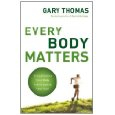
Book Review: Every Body Matters by Gary Thomas

A Swift Kick in the Pants to Get in Shape for God’s Glory

 On the positive side – Thomas has written a compelling book for Christians to take care of their bodies for the right reasons. He elaborates on the wrong reasons and the right reasons in the book. If we take care of our bodies by eating better, and exercising we have more energy to work, serve, minister, and maximize our relationships by using all of our gifts and talents for God’s glory. Thomas puts it this way, “By God’s design, we are a people with souls who desperately yearn for intimacy with God – people whose souls reside in bodies that can hinder or help this pursuit. Which will it be?”

Thomas does a good job throughout the book in balancing the convicting aspects that lead to poor health (e.g., laziness & gluttony) and highlighting the positive aspects that result from good health – there are many. He makes an excellent case for how freeing taking care of God’s temple (your body) can be, and gives numerous real life examples and Scriptures to back this up. Gluttony and laziness have proven in many churches to be “acceptable” sins. I am glad that Thomas calls a spade a spade!

I have two BIG theological pet peeves that really bothered me in this book:

In chapter two Thomas writes in a confusing manner, when he writes of “mind and spirit” and “soul and body.” In this chapter he exchanges the word “spirit” for “heart.” I wish he would have defined his terms and defended his trichotomist position better (he really doesn’t define any of these terms). I think this is very unfortunate, because it’s very easy to derive bad theology when you do not make clear distinctions in addressing the soul/spirit and body. I happen to be a dichotomist (of which the vast majority of theologians throughout history and today are and have been), which is neither here nor there in this review, but if you are writing a book for the masses, it would have been nice if Thomas had done more work in this area to make his position more clear, and less vague.

Thomas makes this statement in chapter 3, “the enemy can disrupt and disable our lives through sickness, which thwarts God’s purposes for us in the world.” If he means by this that we reap what we sow – that’s one thing – case in point well taken. However, nothing can thwart the purposes of God – when Satan attacked Job physically he still had to ask permission from God, and God’s purposes aren’t necessarily clear, but nobody and nothing can ever thwart the purposes of a sovereign, omnipotent, and all wise God.

Overall, I appreciate the message of this book. It’s really a kick in the pants for Christians to be good stewards of what God has entrusted to us, and to control and be responsible over the choices we can make. It’s not about what we can’t do, but what we can do with the bodies God has entrusted to us in order to serve Him well for as long as we can – and we can serve Him much better if we take care of our temples for His glory.

I would hesitate to give this book to new or weak brothers and sisters in Christ because of the overemphasis on man’s responsibility and what I would consider a weak view of God’s sovereignty. It is subtle, and I don’t know if Thomas intended this or not (I hope not). The book comes with questions for discussion and I think can be beneficial for small groups. I would definitely make certain that my small group leaders have a good God-centered theology before letting them loose with this book.  I give this book a 3.5 out of 5 stars for good ideas, but for weak theological underpinnings.

Book Review: Mid-Course Correction by Gordon MacDonald

Much Needed Soul Surgery Motivation for Mid-Life

I read this book when I was in my mid thirties (preparing for mid-life) and now I have read it a second time in my mid forties (wrestling and struggling with mid-life). I must admit that I enjoyed it more this time around, because I have been bruised, bent, and broken a lot more than I ever experienced in my thirties or up until that point. I suppose I will probably be reading this book again in my mid fifties too!

I am partial to MacDonald’s writing because he is a deep thinker, good story-teller, and weaves biblical principles in ways that are practical, well thought ought, and go beyond clichés.

This book is beneficial in helping one pause and take stock and evaluate their life. It is especially geared to helping those who aren’t sure what to do with their lives; have had to, or desire to change careers, or are out of work; wrestling with meaning, purpose, and in need of hope and direction. It is thought provoking and doesn’t necessarily give all the answers you may be looking for, but sets you on the right course – and helps to correct taking the wrong course for sure.

In the body of the book MacDonald weaves his own story (and our own) with those of Abraham, Moses, The People of Israel, Paul, and the Disciples and uses the outline of the fact that we need to leave something behind; learn to follow Christ; and reach for higher possibilities. Learning, following, and reaching are well developed emotionally, spiritually, and practically and steeped in a good theology of “being” like Christ, rather than merely “doing” all the time.

Gordon emphasizes the fact that God wants us to have depth of character, and this depth can really only be achieved through suffering, faith when we can’t see, trying when we don’t know if we will succeed. However, all these factors and more are necessary in our lives in order that we may become deep people internally (in and from the soul) with proven character.

I have been helped significantly through MacDonald’s writing as a broken man to another broken man, and have been given more hope through his writing in pointing me to Jesus – the only One worth following, being like, and living for. Gordon writes like a master surgeon on the soul – taking out what needs to be removed and fixes what needs to be fixed. GMAC (I’m told that’s what his friends call him) – thanks again for your writing that goes deep into the mind and heart and for healing wounds and souls for the glory of God.

An Atheist and a Little Girl: Good For a Few Laughs

An atheist seated next to a little girl on a plane said, “Do you want to talk? Flights go  quicker that way.” The little girl, who had just started to read her book, replied to the stranger, “What do you want to talk about?” “How about why there is no God, Heaven, Hell, or life after death?” “OK,” she said. “That could be interesting, first let me ask you this, “A horse, a cow and a deer all eat the same stuff – grass. Yet a deer excretes little pellets, a cow turns out a flat patty, but a horse produces clumps. Why?” … The atheist, surprised by the girls intelligence, thinks then says, “I have no idea.” To which she replies, “Do you really feel qualified to discuss why there is no God, or no Heaven or Hell, or life after death, when you don’t know crap?” And she went back to reading her book. – Source Unknown

Sent To Me By a Close Catholic Friend

Catholic Heart Attack

A man suffered a serious heart attack while shopping in a store. The store clerks called 911 when they saw him collapse to the floor.  The paramedics rushed the man to the nearest hospital where he had emergency open-heart bypass surgery.

He awakened from the surgery to find himself in the care of nuns at the Catholic Hospital he was taken to.  A nun was seated next to his bed holding a clipboard loaded with several forms, and a pen.  She asked him how he was going to pay for his treatment.

“Do you have health insurance?” she asked.

He replied in a raspy voice, “No health insurance.”

The nun asked, “Do you have money in the bank?”

He replied, “No money in the bank.”

“Do you have a relative who could help you with the payments?” asked the irritated nun.

He said, “I only have a spinster sister, and she is a nun.”

The nun became agitated and announced loudly, “Nuns are not spinsters!  Nuns are married to God.”

The patient replied, “Perfect.  Send the bill to my brother-in-law.”

Funny Story: Pastor On Salary By Faith

I heard about a pastor who candidated at a church and was called, provided that he lived by faith. He asked the six men on the committee what they meant by living by faith. What it meant was that he would have no stated salary but that he would simply trust God for his needs. The candidate made a suggestion that cost him the church: “Each of you men has a salary, so why don’t we put all of our salaries together, divide the total by seven and all of us can live by faith.” (God Isn’t In a Hurry, by Warren Wiersbe, p. 23)

Book Review: Christians Get Depressed Too by David Murray

 Overcoming Depression 101

David Murray admits that his book is not an exhaustive treatment on the subject of depression, but to be seen as an introduction to depression. If it were a class it would be Depression 101.

As a pastor and life coach I have helped people with depression, and have personally battled depression my whole life. One of the things I really like about this book, is that it is short, sweet, and to the point. People who are battling depression don’t feel like reading a long treatise on depression.

In six short chapters Murray carefully and concisely writes about the (1) Crisis, (2) Complexity, (3) Condition, (4) Causes, (5) Cures, and those who (6) Care for those who are depressed. In each chapter Murray writes in a balanced manner, avoids extremes, and gives good sound biblical advice, ways to identify causes and cures of depression, through the practical use of various illustrations, examples, and solutions to help in the battle with depression.

I think one of the most helpful Chapters is Chapter 5 were he gives the 5 Keys to developing a balanced lifestyle in reducing the stress and anxiety that often leads to depression: Routine, Relaxation, Recreation, Rest, and Reprioritization. I recommend this book for those who struggle with depression, and to understand those you care for who battle with depression. It is clear, concise, and communicates well the essence of where depression comes from, how to deal with it, and where to find hope for overcoming depression.

DVD REVIEW: Start! Walking with Leslie Sansone 3 Mile Walk

In her two-mile walk video I lost 21 pounds in six weeks. Now with this DVD, after two weeks I’ve lost 4% body fat – from 26%-22%. It’s a big step up (energy wise) from the two-mile workout. It’s also 45 minutes of your time. My wife and I have been doing it five times a week – and it’s giving me a lot of energy and I think I’ve even lost an inch on my waistline too! Leslie makes it fun, and the first and third miles go pretty fast – the second mile (for some reason) is the tough one!

Book Review: Emotionally Healthy Spirituality by Peter Scazzero

The “Missing Link” in Christian Discipleship

Pete Scazzero (the pastor of a thriving church in New York) writes a very transparent and yet helpful account of how Christians have a tendency to neglect two areas of their lives: the emotions, and the realities of generational sin. He begins the book by demonstrating how devastating this can be in relationships, and how this affects the corporate health of the body of Christ. What this does ultimately is it creates a “false peace” that deals only with symptoms and not the causes of what makes for unhealthy relationships.

I think this book is must reading for all Christians, especially church leaders (pastors, teachers, small group leaders, etc.) because I think most interpersonal relationships, marriages, families, and thus churches live in this reality Scazzero calls “false peace.” In the book he gives various examples from his life, and others lives – as well as many biblical examples of how to identify these real emotional and sinful tendencies, and how to correct them through the biblical disciplines.

For example – I have discipled numerous men over the years (as a pastor and professional life coach) who know the Bible well, but their relationships are a mess. Sometimes they have a ton of repressed anger inside, or are trying to “make up” for the approval they never received at home, or they have an incurable “lust” problem, etc. Ultimately, all these “realities” are typically below the surface in the discipleship process – and never dealt with. We give people more verses; more lists of dos and don’ts, and continue to live in this realm of false peace.

Scazzero builds a great case in the book for identifying personal and generational sin, and gives excellent tools for grappling with, and overcoming these areas of sin with the help of God’s Word and the Holy Spirit. I can’t recommend this book (and the workbook that goes with it) highly enough. I think if Christians and churches (he’s also written a book called the Emotionally Healthy Church with a workbook that goes with it) want to really become healthy and rid the false peace and barriers that have been built up over time, you can’t do any better than to read and work through this book.

My wife and I have read this book and gone through the workbook at least four times, and it has been absolutely life transforming. Along with R.C. Sproul’s the “Holiness of God,” and Peter Kreeft’s (“Heaven: The Heart’s Deepest Longing”) and Randy Alcorn’s books on Heaven – this book has radically changed my thinking and behavior – and has helped me repent of, and deal with sin in my life in a way that few books have helped me to do. I think every Christian should read this book more than once and go through the workbook with another person, or several people (small groups are ideal – especially if they are a close knit small group).

As a pastor and church leader for many years I also recommend that staff’s, elders, and ministry teams go through this book and the Workbook based on this book for healthier teams that will radically benefit the body of Christ for good. If I could give this a higher rating than a five I would – this book is one of the greatest gifts of God’s grace I’ve received – it has helped me in all of my relationships – with God, other believers, and those who have yet to believe – and taken me to a deeper level in all these relationships than I ever thought possible.


*Peter Scazzero is the Founder and Senior Lead Pastor of New Life Fellowship Church. A graduate of Gordon-Conwell (MDiv) and Eastern Baptist Theological Seminary (DMin in marriage and family), he is also the author of Emotionally Healthy Spirituality (Nelson, 2006), The Emotionally Healthy Church: Expanded (Zondervan, 2010), and Begin the Journey with the Daily Office (WCA, 2009). Pete has been married to his best friend, Geri, and together they have four daughters – Maria, Christy, Faith and Eva. He loves libraries, bookstores, and the printed page — on almost any topic. Basketball, hiking and the outdoors (thanks to Geri), laughter, Italian opera, history, and great meals with family, are among his greatest joys. Pete and Geri are co-founders of Emotionally Healthy Spirituality.