Dr. Steve W. Brown on the Question: Why Does God Have Rules?

“God’s Rules”

Someone gave me several great rules of diet. Let me give you some of them:

  • If you eat something and no one sees you eat it, it has no calories.

  • If you drink a diet soda with a candy bar, the diet soda cancels out the calories in the candy bar.

  • When you eat with other people, calories don’t count if don’t eat more than they do.

  • Cookie pieces contain no calories; the process of breaking causes calorie leakage.

Don’t you wish those were true?

You see, there are certain inviolable rules built into the universe, so I’m afraid that wishing for fewer calories won’t make it so. The other rules of God are like that too. He doesn’t have rules to make you unhappy. Just the opposite. His word is simply the way the world works. Someone has said, “You don’t break the Ten Commandments. You break yourself against them.”

We would find life more enjoyable if we stopped fighting against God’s rules.

For Meditation & Application: Read Psalm 119

Circle, highlight, or underline all the benefits of God’s Word and knowing and obeying it as mentioned in Psalm 119. You’ll begin to get a taste of all that awaits those who guide their lives by God’s loving counsel.

About the Author:

Dr. Steve Brown is one of the most sought after preachers and conference speakers in the country. Having had extensive radio experience before entering the ministry, he is now heard weekdays on the national radio program, Key Life, and one minute feature, “Think Spots”. Steve also hosts a weekly radio talk show, “Steve Brown, Etc.”. He served as the senior pastor of Key Biscayne Presbyterian Church for 17 years before joining the Reformed Theological Seminary (RTS) faculty as Professor of Preaching. After teaching full time for almost two decades at RTS, Dr. Brown retired and is Emeritus Professor of Preaching but remains an Adjunct Professor of Preaching teaching occasional classes each year.

Dr. Brown is the author of many (16 and counting) books and also serves on the Board of the National Religious Broadcasters and Harvest USA (He earned his B.A. from High Point College; an S.T.B. from Boston University School of Theology; and an Litt.D. from King College). Steve is one of my favorite writers and speakers because he is authentic, a great story-teller, is a theologian in disguise, and really knows how to address the realities of how sinful humans can experience the amazing grace of God. The article above was adapted from page 176 in his excellent book on surviving and thriving in a tough world: Jumping Hurdles, Hitting Glitches, and Overcoming Setbacks. Colorado Springs: NavPress, 1992.

Steve Brown Has Authored These Outstanding Grace-Filled Books:

Three Free Sins: God’s Not Mad at You. New York: Simon and Schuster/ Howard Books, 2012.

A Scandalous Freedom. New York: Simon and Schuster/ Howard Books, 2009.

What Was I Thinking? Things I’ve learned Since I Knew It All. New York: Simon and Schuster/ Howard Books, 2006.

Follow the Wind: Our Lord, the Holy Spirit. Grand Rapids: Baker, 1999.

Approaching God: How to Pray. New York: Howard, 1996.

Living Free: How to Live a Life of Radical Freedom and Infectious Joy. Grand Rapids: Baker, 1994.

Born Free: How to Find Radical Freedom and Infectious Joy in an Authentic Faith. Grand Rapids: Baker, 1993.

How To Talk So People Will Listen. Grand Rapids: Baker, 1993.

If Jesus Has Come: Thoughts on the Incarnation for Skeptics, Christians and Skeptical Christians by a Former Skeptic. Grand Rapids: Baker, 1992.

Jumping Hurdles, Hitting Glitches, Overcoming Setbacks. Colorado Springs: NavPress, 1992.

No More Mr. Nice Guy! Saying Goodbye to “Doormat” Christianity. Nashville: Thomas Nelson, 1991.

When Being Good Isn’t Good Enough. Nashville: Thomas Nelson, 1990.

Welcome to the Family: A Handbook for Living the Christian Life. Old Tappan, New Jersey: Fleming H. Revell, 1990.

When Your Rope Breaks: Christ-centered advice on how to go on living—when making it through another day is the hardest thing in the world. Nashville: Thomas Nelson, 1988.

Heirs with the Prince. Nashville: Thomas Nelson, 1985.

If God is in Charge: Thoughts On The Nature of God For Skeptics, Christians, and Skeptical Christians. Grand Rapids: Baker 1983.

Randy Alcorn on the Question: “Will There Be Animals on the New Earth?”

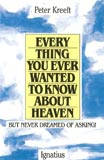
(When Randy Alcorn wrote his Biblical Theology of Heaven in 2004 simply entitled “Heaven” I preached a series at my church on the subject for three months. I read half a dozen books in my series preparation, and His book was by far the best of the bunch. It’s Theologically deep; contains every passage in the Bible that addresses Heaven and the New Earth; extremely well organized; thought provoking; and full of good argumentation for his interpretations and ideas based on his extensive study.  Honestly, I was never that excited about Heaven until I read his book! Now I can barely contain myself about how awesome it will be to be with Jesus for eternity! Alcorn’s writings are always saturated with Scripture, cogently articulated, and interesting. Here is a sampling of his thoughts on animals on the New Earth – enjoy! – By the way, another excellent thought provoking book on this topic is Peter Kreeft’s Heaven: The Heart’s Deepest Longing –  DPC)

Animals in Heaven?

I have included two full chapters on this fascinating subject in the book Heaven but I will try to summarize the main points here (Randy Alcorn. Heaven. Wheaton: Tyndale 2004 – pictured above). Animals were part of God’s perfect original design for Earth and mankind. “God made the wild animals according to their kinds, the livestock according to their kinds, and all the creatures that move along the ground according to their kinds. And God saw that it was good” (Genesis 1:25).

Because animals were a significant part of life on the original Earth and Scripture makes it clear that God will remake the earth just as he will remake mankind, it stands to reason that animals will be part of the New Earth. (Why wouldn’t they be?)

We’re told that animals, along with all creation, long for the deliverance that will be theirs at the time of the redemption of our bodies, at the resurrection (Romans 8:19, 23). They await and long for it, because they will be part of it.

As the entire creation, including animals, plants, and nature itself, fell on humanity’s coattails, so shall the entire creation rise on our coattails, as beneficiaries of Christ’s redemptive work.

Isaiah 11, 60, and 65 depict animals on the New Earth. (For reasons I explain in the book – Heaven, the application of these passages cannot be restricted only to the millennial kingdom.)

God’s plan for a renewed Earth after the Flood—the judgment of water—prominently involved animals. Wouldn’t we expect his plan for a renewed Earth after the future judgment of fire to likewise include animals? The rescue of mankind and animals in the ark is a picture of the resurrection, through which people and animals are rescued to live on the New Earth. Since according to Romans 8 it is those presently suffering and groaning who will be delivered, it’s likely that some of the same animals on the present Earth will be remade to live on the New Earth.

Because the New Earth will be earthly, we shouldn’t be surprised to realize it will have animals. Like all of God’s other creations, they will declare his attributes and we will find joy in God by finding joy in them.

 About Randy Alcorn

Randy Alcorn is a versatile and prolific author, and the founder and director of Eternal Perspective Ministries (EPM), a nonprofit ministry dedicated to teaching principles of God’s Word and assisting the church in ministering to the unreached, unfed, unborn, uneducated, unreconciled, and unsupported people around the world. His ministry focus is communicating the strategic importance of using our earthly time, money, possessions and opportunities to invest in need-meeting ministries that count for eternity. He accomplishes this by analyzing, teaching, and applying the biblical truth.

Before starting EPM in 1990, Randy served as a pastor for fourteen years. He has an MA degree in Biblical Studies from Multnomah University and an Honorary Doctorate from Western Seminary in Portland, Oregon and has taught on the adjunct faculties of both.

A New York Times bestselling author, Randy has written more than forty books, including the bestsellers Heaven, The Treasure Principle, and the Gold Medallion winner Safely Home.His books in print exceed seven million and have been translated into over thirty languages.Randy has written for many magazines including EPM’s quarterly issues-oriented magazine Eternal Perspectives. He is active daily on Facebook and Twitter, has been a guest on more than 700 radio, television and online programs including Focus on the Family, FamilyLife Today, Revive Our Hearts, The Bible Answer Man, and The Resurgence.

Randy resides in Gresham, Oregon, with his wife, Nanci. They have two married daughters and are the proud grandparents of five grandsons. Randy enjoys hanging out with his family, biking, tennis, research, and reading.

The short article above was adapted from Randy Alcorn. Heaven: Biblical Answers to Common Questions (booklet). Tyndale House Publishers. Wheaton, 2009. Check out Randy’s excellent website featuring all kinds of fantastic resources: http//www.epm.org.

Do We Have Souls? Lee Strobel interviews Dr. J.P. Moreland

(The interview below is “heady” stuff – but very important. There is a huge movement of “scientism” in our culture that denies the reality and existence of the soul. One of my favorite teachers when I was at Talbot School of Theology was Dr. J.P. Moreland. What I love about Moreland is that he is a deep thinker and yet he has the ability to explain complex truths in a way that lay people can understand. Like anything Moreland writes or says, this interview will be challenging, enlightening, and clarifying – I hope that you will be able to better understand the reality of the soul and the overwhelming evidence for the existence of God as you read this interview with former atheist – turned Christian – Lee Strobel. Reading this article will exercise your mind and bring joy to your soul, and will be well worth your serious attention – enjoy! David P. Craig)
 

The Evidence of Consciousness: The Enigma of the Mind

When I pulled up to J. P. Moreland’s house on a cool and foggy morning, he was outside with a cup of coffee in his hand, having just walked home from a chat with some neighbors. His graying hair was close-cropped, his mustache neatly trimmed, and he was looking natty in a red tie, blue shirt, and dark slacks. “Good to see you again,” he said as we shook hands. “Come on in.” We walked into his living room, where he settled into a floral-patterned chair and I eased into an adjacent couch. The setting was familiar to me, since I had previously interviewed him on other challenging topics for The Case for Christ and The Case for Faith (See: “The Circumstantial Evidence” in: Lee Strobel, The Case for Christ, 244–57, and “Objection #6: A Loving God Would Never Torture People in Hell,” in: Lee Strobel, The Case for Faith, 169–94).

Both times I found him to have an uncanny ability to discuss abstract issues and technical matters in understandable but accurate language. That’s unusual for a scientist, uncommon for a theologian, and downright rare for a philosopher! Moreland’s science training came at the University of Missouri, where he received a degree in chemistry. He was subsequently awarded the top fellowship for a doctorate in nuclear chemistry at the University of Colorado but declined the honor to pursue a different career path. He then earned a master’s degree in theology at Dallas Theological Seminary and a doctorate in philosophy at the University of Southern California. Moreland developed an early interest in issues relating to human consciousness, returning to that theme time after time in his various books. He has written, edited, or coauthored Christianity and the Nature of Science, Body and Soul, The Life and Death Debate, Beyond Death, Does God Exist? Christian Perspectives on Being Human, The Creation Hypothesis, Scaling the Secular City, Love Your God with All Your Mind, Naturalism: A Critical Analysis, and many other books.

Also, he has authored more than fifty technical articles for Perspectives on Science and Christian Faith, Philosophy and Phenomenological Research, American Philosophical Quarterly, Journal of Psychology and Theology, Metaphilosophy, and a host of other journals. Moreland’s memberships include national scientific, philosophical, and theological societies. Currently, he’s a professor in the highly respected philosophy program at the Talbot School of Theology, where he teaches on numerous topics, including philosophy of mind. As we began our interview, I thought it would be a good idea to get straight on some key definitions—something that’s not always easy when discussing consciousness.

 REGAINING CONSCIOUSNESS

U.S. Supreme Court Justice Potter Stewart once said it may be difficult to define pornography, “but I know it when I see it” (Justice Potter Stewart [concurring], Jacobellis v. Ohio, 378 U.S. 198,1964). Similarly, consciousness can be a challenging concept to describe, even though our own conscious thoughts are quite tangible to ourselves. As J. R. Smythies of the University of Edinburgh put it: “The consciousness of other people may be for me an abstraction, but my own consciousness is for me a reality” (J. R. Smythies, “Some Aspects of Consciousness,” in Arthur Koestler and J. R. Smythies, editors, Beyond Reductionism. London: Hutchinson, 1969, 235, quoted in Arthur C. Custance, The Mysterious Matter of Mind, 35).

“What is consciousness?” Moreland said, echoing the opening question that I had just posed to him. “Well, a simple definition is that consciousness is what you’re aware of when you introspect. When you pay attention to what’s going on inside of you, that’s consciousness.” He looked at me and apparently could see from my expression that I needed a fuller description. “Think of it like this,” he continued. “Suppose you were having an operation on your leg, and suddenly you begin to be aware of people talking about you. Someone says, ‘I think he’s recovering.’ You start to feel an ache in your knee. You say to yourself, ‘Where am I? What’s going on?’ And you start to remember you were operated on. What you’re doing is regaining consciousness. In short, consciousness consists of sensations, thoughts, emotions, desires, beliefs, and free choices that make us alive and aware.”

“What if consciousness didn’t exist in the world?” I asked. “I’ll give you an example,” Moreland replied. “Apples would still be red, but there would be no awareness of red or any sensations of red.” “What about the soul?” I asked. “How would you define that?” “The soul is the ego, the ‘I,’ or the self, and it contains our consciousness. It also animates our body. That’s why when the soul leaves the body, the body becomes a corpse. The soul is immaterial and distinct from the body.” “At least,” I observed, “that’s what the Bible teaches.” “Yes, Christians have understood this for twenty centuries,” he said. “For example, when Jesus was on the cross, he told the thief being crucified next to him that he would be with Jesus immediately after his death and before the final resurrection of his body (Luke 23:43: “Today you will be with me in paradise”).

Jesus described the body and soul as being separate entities when he said, ‘Do not be afraid of those who kill the body but cannot kill the soul’ (Matthew 10:28). The apostle Paul says that “to be absent from the body is to be present with the Lord” (2 Corinthians 5:8).

I was curious about whether belief in the soul is a universal phenomenon. “What about beyond Christianity?” I asked. “Is this concept present in other cultures as well?” “We know that dualism was taught by the ancient Greeks, although, unlike Christians, they believed the body and soul were alien toward each other,” he explained. “In contemporary terms, I’d agree with physicalist Jaegwon Kim, who acknowledged that ‘something like this dualism of personhood, I believe, is common lore shared across most cultures and religious traditions’” (Jaegwon Kim, “Lonely Souls: Causality and Substance Dualism,” in Kevin Corcoran, editor, Soul, Body, and Survival. Ithica, NY: Cornell Univ. Press, 2001).

Still, there are those who deny dualism and instead believe we are solely physical beings who are, as geneticist Francis Crick said, “no more than the behavior of a vast assembly of nerve cells and their associated molecules” (Francis Crick, The Astonishing Hypothesis. New York: Scribner’s, 1994, 3). To explore this issue, I decided to take an unusual approach in my interview with Moreland by asking him to imagine—for just a few minutes—that these physicalists are right.

 WHAT IF PHYSICALISM IS TRUE?

“Let’s face it,” I said, “some people flatly deny that we have an immaterial soul. John Searle said, ‘In my worldview, consciousness is caused by brain processes’ (“What Is Consciousness?” in Closer to Truth).  In other words, they believe consciousness is purely a product of biology. As brain scientist Barry Beyerstein said, just as the kidneys produce urine, the brain produces consciousness” (“Do Brains Make Minds?” on Closer to Truth).

Moreland was listening carefully as I spoke, his head slightly cocked. I continued by saying, “Do me a favor, J. P. —assume for a moment that the physicalists are right. What are the logical implications if physicalism is true?” His eyes widened. “Oh, there would be several key ones,” he replied.

“Give me three,” I said. Moreland was more than willing. “First, if physicalism is true, then consciousness doesn’t really exist, because there would be no such thing as conscious states that must be described from a first-person point of view,” he said. “You see, if everything were matter, then you could capture the entire universe on a graph—you could locate each star, the moon, every mountain, Lee Strobel’s brain, Lee Strobel’s kidneys, and so forth. That’s because if everything is physical, it could be described entirely from a third-person point of view. And yet we know that we have first-person, subjective points of view—so physicalism can’t be true.” Clearly, Moreland was warming up to this exercise.

“The second implication,” he continued, “is that there would be no free will. That’s because matter is completely governed by the laws of nature. Take any physical object,” he said as he glanced out the window, where the fog was breaking up. “For instance, a cloud,” he said. “It’s just a material object, and its movement is completely governed by the laws of air pressure, wind movement, and the like. So if I’m a material object, all of the things I do are fixed by my environment, my genetics, and so forth. “That would mean I’m not really free to make choices. Whatever’s going to happen is already rigged by my makeup and environment. So how could you hold me responsible for my behavior if I wasn’t free to choose how I would act? This is one of the reasons we lost the Vietnam War.” I was following him until that last statement, which seemed oddly incongruous to me. “What has this got to do with Vietnam?” I asked. Moreland explained: “I heard a former advisor to the president say that B. F. Skinner’s behaviorism influenced the Pentagon’s strategy. Skinner believed that we’re just physical objects, so you can condition people, just like you can condition a laboratory animal by applying electric shocks. Keep doing certain things over and over, and you can change behavior. So in Vietnam, we bombed, we came back, we bombed, we came back, we bombed, and so forth. We assumed that after we gave the North Vietnamese shock after shock, pretty soon we could manipulate their behavior. After all, they’re just physical objects responding to stimuli. Eventually they had to give in.” “But they didn’t,” I said. “That’s right. It didn’t work.” “Why?” “Because there was more to the Vietnamese than their physical brains responding to stimuli. They have souls, desires, feelings, and beliefs, and they could make free choices to suffer and to stand firm for their convictions despite our attempt to condition them by our bombing.

“So if the materialists are right, kiss free will good-bye. In their view, we’re just very complicated computers that behave according to the laws of nature and the programming we receive. But, Lee, obviously they’re wrong—we do have free will. We all know that deep down inside. We’re more than just a physical brain.

“Third, if physicalism were true, there would be no disembodied intermediate state. According to Christianity, when we die, our souls leave our bodies and await the later resurrection of our bodies from the dead. We don’t cease to exist when we die. Our souls are living on. “This happens in near-death experiences. People are clinically dead, but sometimes they have a vantage point from above, where they look down at the operating table that their body is on. Sometimes they gain information they couldn’t have known if this were just an illusion happening in their brain. One woman died and she saw a tennis shoe that was on the roof of the hospital. How could she have known this? “If I am just my brain, then existing outside the body is utterly impossible. When people hear of near-death experiences, they don’t think that if they looked up at the hospital ceiling, they’d see a pulsating brain with a couple of eyeballs dangling down, right? When people hear near-death stories, Lee, they are intuitively attributing to that person a soul that could leave the body. And clearly these stories make sense, even if we’re not sure they’re true. We’ve got to be more than our bodies or else these stories would be ludicrous to us.” Moreland seemed to be sidestepping this issue a bit. “How about you personally?” I asked. “Do you think near-death experiences are true?” “We have to be careful with the data and not overstate things, but I do think they provide at least a minimalist case for consciousness surviving death,” he said. “In fact, as far back as 1965, psychologist John Beloff wrote in The Humanist that the evidence of near-death experiences already indicates ‘a dualistic world where mind or spirit has an existence separate from the world of material things.’ He conceded that this could ‘present a challenge to humanism as profound in its own way as that which Darwinian evolution did to Christianity a century ago.’ ” (Cited in David Winter, Hereafter: What Happens after Death? Wheaton, Ill.: Harold Shaw, 1972, 33–34).

Moreland paused before adding one other comment. “Regardless of what anyone thinks about near-death experiences, we do have confirmation that Jesus was put to death and was later seen alive by credible eyewitnesses,” he said. “Not only does this provide powerful historical corroboration that it’s possible to survive after the death of our physical body, but it also gives Jesus great credibility when he teaches that we have both a body and an immaterial spirit” (For a short description of the evidence for the Resurrection, see Gary R. Habermas and J. P. Moreland, Beyond Death, 111–54).

THE INNER AND PRIVATE MIND

At this point, having considered Moreland’s critique of physicalism, I wanted to hear his affirmative case that consciousness and the soul are immaterial entities. “What positive evidence is there that consciousness and the self are not merely a physical process of the brain?” I asked. “We have experimental data, for one thing,” he replied. “For example, neurosurgeon Wilder Penfield electrically stimulated the brains of epilepsy patients and found he could cause them to move their arms or legs, turn their heads or eyes, talk, or swallow. Invariably the patient would respond by saying, ‘I didn’t do that. You did.’ (See: Wilder Penfield, The Mystery of the Mind, 76–77).

According to Penfield, ‘the patient thinks of himself as having an existence separate from his body.’ (Wilder Penfield, “Control of the Mind” Symposium at the University of California Medical Center, San Francisco, 1961, quoted in Arthur Koestler, Ghost in the Machine. London: Hutchinson, 1967, 203).
“No matter how much Penfield probed the cerebral cortex, he said, ‘There is no place . . . where electrical stimulation will cause a patient to believe or to decide.’ (Wilder Penfield, The Mystery of the Mind, 77–78).

That’s because those functions originate in the conscious self, not the brain. “A lot of subsequent research has validated this. When Roger Sperry and his team studied the differences between the brain’s right and left hemispheres, they discovered the mind has a causal power independent of the brain’s activities. This led Sperry to conclude materialism was false (See: Roger W. Sperry, “Changed Concepts of Brain and Consciousness: Some Value Implications,” Zygon, March 1985).

“Another study showed a delay between the time an electric shock was applied to the skin, its reaching the cerebral cortex, and the self-conscious perception of it by the person (Laurence W. Wood, “Recent Brain Research and the Mind-Body Dilemma,” The Asbury Theological Journal, vol. 41, no. 1,1986). This suggests the self is more than just a machine that reacts to stimuli as it receives them. In fact, the data from various research projects are so remarkable that Laurence C. Wood said, ‘many brain scientists have been compelled to postulate the existence of an immaterial mind, even though they may not embrace a belief in an after-life.’””(Ibid).

“What about beyond the laboratory?” I asked. “There are valid philosophical arguments as well,” he said. “For instance, I know that consciousness isn’t a physical phenomenon because there are things that are true of my consciousness that aren’t true of anything physical.” “For instance . . . ,” I said, prompting him further. “For example, some of my thoughts have the attribute of being true. Tragically, some of my thoughts have the attribute of being false—like the Chicago Bears are going to go to the Super Bowl,” he said with a chuckle. “However, none of my brain states are true or false. No scientist can look at the state of my brain and say, ‘Oh, that particular brain state is true and that one’s false.’ So there’s something true of my conscious states that are not true of any of my brain states, and consequently they can’t be the same thing. “Nothing in my brain is about anything. You can’t open up my head and say, ‘You see this electrical pattern in the left hemisphere of J. P. Moreland’s brain? That’s about the Bears.’ Your brain states aren’t about anything, but some of my mental states are. So they’re different.

“Furthermore, my consciousness is inner and private to me. By simply introspecting, I have a way of knowing about what’s happening in my mind that is not available to you, my doctor, or a neuroscientist. A scientist could know more about what’s happening in my brain than I do, but he couldn’t know more about what’s happening in my mind than I do. He has to ask me.” When I asked Moreland for an illustration of this, he said, “Have you heard of Rapid Eye Movement?” “Sure,” I replied. “What does it indicate?” “Dreaming.” “Exactly. How do scientists know that when there is a certain eye movement that people are dreaming? They’ve had to wake people and ask them. Scientists could watch the eyes move and read a printout of what was physically happening in the brain, so they could correlate brain states with eye movements. But they didn’t know what was happening in the mind. Why? Because that’s inner and private. “So the scientist can know about the brain by studying it, but he can’t know about the mind without asking the person to reveal it, because conscious states have the feature of being inner and private, but the brain’s states don’t.”

THE REALITY OF THE SOUL

For centuries, the human soul has enchanted poets, intrigued theologians, challenged philosophers, and dumbfounded scientists. Mystics, like Teresa of Åvila in the sixteenth century, have described it eloquently: “I began to think of the soul as if it were a castle made of a single diamond or of very clear crystal, in which there are many rooms, just as in heaven there are many mansions” (Mark Water, compiler, The New Encyclopedia of Christian Quotations.Grand Rapids, Mich.: Baker, 2000), 972. Teresa’s reference to mansions is an allusion to John 14:2).

Moreland was understandably more precise in analyzing the soul, though unfortunately less poetic. He had already clarified that the soul contains our consciousness. Still, he hadn’t offered any reason to believe that the soul is an actual entity. It was time, I felt, to press him on this
issue. “What makes you think that the soul is real?” I asked.

Moreland replied by saying, “First, we’re aware that we’re different from our consciousness and our body. We know that we’re beings who have consciousness and a body, but we’re not merely the same thing as our conscious life or our physical life. “Let me give you an illustration of how we’re not the same thing as our personality traits, our memories, and our consciousness. I had a student a few years ago whose sister had a terrible accident on her honeymoon. She was knocked unconscious and lost all of her memories and a good bit of her personality. She did not believe she had been married. As she began to recover, they showed her videos of the wedding to convince her that she had actually married her husband. She eventually got to the point where she believed it, and she got remarried to him.

“Now, we all knew this was the same person all along.” This was Jamie’s sister. She was not a different person, though she was behaving differently. But she had totally different memories. She had lost her old memories and she didn’t even have the same personality. What that proves is you can be the same person even if you lose old memories and gain new memories, or you lose some of your old personality traits and gain new personality traits. “Now, if I were just my consciousness, when my consciousness was different, I’d be a different person. But we know that I can be the same person even though my consciousness changes, so I can’t be the same thing as my consciousness. I’ve got to be the ‘self,’ or soul, that contains my consciousness.

“Same with my body. I can’t be the same thing as my body or brain. There was a story on television about an epileptic who underwent an operation in which surgeons removed fifty-three percent of her brain. When she woke up, nobody said, ‘We have forty-seven percent of a person here.’ A person can’t be divided into pieces. You are either a person or you’re not. But your brain and your body can be divided. So that means I can’t be the same thing as my body.”

Those illustrations helped, though I said, “The fact that the soul and consciousness are invisible makes it difficult to conceptualize them.” “Sure, that’s true,” he replied. “My soul and my consciousness are invisible, though my body is visible. That’s another distinction. In fact, I remember the time when my daughter was in the fifth grade and we were having family prayers. She said, ‘Dad, if I could see God, it would help me believe in him.’ I said, ‘Well, honey, the problem isn’t that you’ve never seen God. The problem is that you’ve never seen your mother.’ And her mother was sitting right next to her! “My daughter said, ‘What do you mean, Dad?’ I said, ‘Suppose without hurting your mom, we were able to take her apart cell by cell and peek

inside each one of them. We would never come to a moment where we would say, ‘Look—here’s what Mommy’s thinking about doing the rest of the day.’ Or ‘Hey, this cell contains Mommy’s feelings.’ Or ‘So this is what Mom believes about pro football.’ We couldn’t find Mommy’s thoughts, beliefs, desires, or her feelings. “‘Guess what else we would never find? We’d never find Mommy’s ego or her self. We would never say, ‘Finally, in this particular brain cell, there’s Mommy. There’s her ego, or self.’ That’s because Mommy is a person, and persons are invisible. Mommy’s ego and her conscious life are invisible. Now, she’s small enough to have a body, while God is too big to have a body—so let’s pray!’ “The point is this, Lee: I am a soul, and I have a body. We don’t learn about people by studying their bodies. We learn about people by finding out how they feel, what they think, what they’re passionate about, what their worldview is, and so forth. Staring at their body might tell us whether they like exercise, but that’s not very helpful. That’s why we want to get ‘inside’ people to learn about them. “So my conclusion is that there’s more to me than my conscious life and my body. In fact, I am a ‘self,’ or an ‘I,’ that cannot be seen or touched unless I manifest myself through my behavior or my talk. I have free will because I’m a ‘self,’ or a soul, and I’m not just a brain.”

OF COMPUTERS AND BATS

Moreland’s denial that the brain produces consciousness made me think of the debate over whether future computers can become sentient. I decided to ask him to weigh in on the issue—although his ultimate conclusion was never in doubt. “If a machine can achieve equal or greater brain power as human beings, then some physicalists say the computer would become conscious,” I said. “I assume you would disagree with that.” Moreland chuckled. “One atheist said that when computers reach the point of imitating human behavior, only a racist would deny them full human rights. But of course that’s absurd.

Nobel-winner John Eccles said he’s ‘appalled by the naiveté’ of those who foresee computer sentience. He said there’s ‘no evidence whatsoever for the statement made that, at an adequate level of complexity, computers also would achieve self-consciousness’ (Quoted in Robert W. Augros and George N. Stanciu, The New Story of Science, 170).

“Look, we have to remember that computers have artificial intelligence, not intelligence. And there’s a huge difference. There’s no ‘what it’s like to be a computer.’ A computer has no ‘insides,’ no awareness, no first-person point of view, no insights into problems. A computer doesn’t think, ‘You know what? I now see what this multiplication problem is really like.’ A computer can engage in behavior if it’s wired properly, but you’ve got to remember that consciousness is not the same as behavior. Consciousness is being alive; it’s what causes behavior in really conscious beings. But what causes behavior in a computer is electric circuitry.

“Let me illustrate my point. Suppose we had a computerized bat that we knew absolutely everything about from a physical point of view. We would have exhaustive knowledge of all its circuitry so that we could predict everything this bat would do when it was released into the environment. “Contrast that with a real bat. Suppose we knew everything about the organs inside the bat—its blood system, nervous system, brain, heart, lungs. And suppose that we could predict everything this bat would do when released into the environment. There would still be one thing that we would have no idea about: what it’s like to be a bat. What it’s like to hear, to feel, to experience sound and color. That stuff involves the ‘insides’ of the bat, its point of view. That’s the difference between a conscious, sentient bat and a computerized bat. “So in general, computers might be able to imitate intelligence, but they won’t ever have consciousness. We can’t confuse behavior with what it’s like to be alive, awake, and sentient. A future superintelligent computer might be programmed to say it’s conscious or even behave as if it were conscious, but it can never truly become conscious, because consciousness is an immaterial entity apart from the brain.” Moreland’s choice of a bat for his illustration was an oblique reference to New York University philosopher Thomas Nagel’s famous 1974 essay “What Is it Like to Be a Bat?” (See: Thomas Nagel, “What Is It Like to Be a Bat?” Philosophical Review 83, October, 1974).

Thinking about life from a bat’s perspective prompted me to briefly pursue another line of inquiry on a tangential topic. “What about animals—do they have souls or consciousness?” I asked. “Absolutely,” came his quick answer. “In several places the Bible uses the word ‘soul’ or ‘spirit’ when discussing animals. For example:

Genesis 1:30, “And to every beast of the earth and to every bird of the heavens and to everything that creeps on the earth, everything that has the breath of life, I have given every green plant for food.” And it was so.”

Leviticus 24:18, “Whoever takes an animal’s life shall make it good, life for life.”

Ecclesiastes 3:19, “For what happens to the children of man and what happens to the beasts is the same; as one dies, so dies the other. They all have the same breath, and man has no advantage over the beasts, for all is vanity.”

Revelation 8:9, “A third of the living creatures in the sea died, and a third of the ships were destroyed.”

Animals are not simply machines. They have consciousness and points of view. But the animal soul is much simpler than the human soul. For example, the human soul is capable of free moral action, but I think the animal soul is determined. Also, Augustine said animals have thoughts, but they don’t think about their thinking. And while we have beliefs about our beliefs, animals don’t. “You see, the human soul is vastly more complicated because it’s made in the image of God. So we have self-reflection and self-thinking. And while the human soul survives the death of its body, I don’t think the animal soul outlives its body. I could be wrong, but I think the animal soul ceases to exist at death.” Bad news, it seems, for the bat.

CONSCIOUSNESS AND EVOLUTION

Moreland had made a cogent case for consciousness and the soul being independent of our brain and body. “How does this present a problem for Darwinists?” I asked. Moreland glanced down at some notes he had brought along. “As philosopher Geoffrey Medell said, ‘The emergence of consciousness, then, is a mystery, and one to which materialism fails to provide an answer.’ Atheist Colin McGinn agrees. He asks, ‘How can mere matter originate consciousness? How did evolution convert the water of biological tissue into the wine of consciousness? Consciousness seems like a radical novelty in the universe, not prefigured by the aftereffects of the Big Bang. So how did it contrive to spring into being from what preceded it?’ ”

Moreland looked squarely at me. “Here’s the point: you can’t get something from nothing,” he declared. “It’s as simple as that. If there were no God, then the history of the entire universe, up until the appearance of living creatures, would be a history of dead matter with no consciousness. You would not have any thoughts, beliefs, feelings, sensations, free actions, choices, or purposes. There would be simply one physical event after another physical event, behaving according to the laws of physics and chemistry.”

Moreland stopped for a moment to make sure this picture was vivid in my mind. Then he leaned forward and asked pointedly: “How, then, do you get something totally different—conscious, living, thinking, feeling, believing creatures—from materials that don’t have that? That’s getting something from nothing! And that’s the main problem. “If you apply a physical process to physical matter, you’re going to get a different arrangement of physical materials. For example, if you apply the physical process of heating to a bowl of water, you’re going to get a new product—steam—which is just a more complicated form of water, but it’s still physical. And if the history of the universe is just a story of physical processes being applied to physical materials, you’d end up with increasingly complicated arrangements of physical materials, but you’re not going to get something that’s completely nonphysical. That is a jump of a totally different kind. “At the end of the day, as Phillip Johnson put it, you either have ‘In the beginning were the particles,’ or ‘In the beginning was the Logos,’ which means ‘divine mind.’ If you start with particles, and the history of the universe is just a story about the rearrangement of particles, you may end up with a more complicated arrangement of particles, but you’re still going to have particles. You’re not going to have minds or consciousness.

“However—and this is really important—if you begin with an infinite mind, then you can explain how finite minds could come into existence. That makes sense. What doesn’t make sense—and which many atheistic evolutionists are conceding—is the idea of getting a mind to squirt into existence by starting with brute, dead, mindless matter. That’s why some of them are trying to get rid of consciousness by saying it’s not real and that we’re just computers.” He smiled after that last statement, then added: “However, that’s a pretty difficult position to maintain while you’re conscious!”

THE EMERGENCE OF THE MIND

“Still,” I protested, “some scientists maintain that consciousness is just something that happens as a natural byproduct of our brain’s complexity. They believe that once evolution gave us sufficient brain capacity, consciousness inexorably emerges as a biological process.”

“Let me mention four problems with that,” Moreland insisted. “First, they are no longer treating matter as atheists and naturalists treat matter—namely, as brute stuff that can be completely described by the laws of chemistry and physics. Now they’re attributing spooky, soulish, or mental potentials to matter.” “What do you mean by ‘potentials’?” “They’re saying that prior to this level of complexity, matter contained the potential for mind to emerge—and at the right moment, guess what happened? These potentials were activated and consciousness was sparked into existence.” “What’s wrong with that theory?” “That is no longer naturalism,” he said. “That’s panpsychism.” That was a new term to me. “Pan what?” “Panpsychism,” he repeated. “It’s the view that matter is not just inert physical stuff, but that it also contains proto-mental states in it. Suddenly, they’ve abandoned a strict scientific view of matter and adopted a view that’s closer to theism than to atheism. Now they’re saying that the world began not just with matter, but with stuff that’s mental and physical at the same time. Yet they can’t explain where these pre-emergent mental properties came from in the first place. And this also makes it hard for them to argue against the emergence of God.”

“The emergence of God?” I asked. “What do you mean by that?” “If a finite mind can emerge when matter reaches a certain level of complexity, why couldn’t a far greater mind—God—emerge when millions of brain states reach a greater level of consciousness? You see, they want to stop the process where they want it to stop—at themselves—but you can’t logically draw that line. How can they know that a very large God hasn’t emerged from matter, because, after all, haven’t a lot of people had religious experiences with God?” “That wouldn’t be the God of Christianity,” I pointed out. “Granted,” he replied. “But this is still a problem for atheists.

And there’s a second problem: they would still be stuck with determinism, because if consciousness is just a function of the brain, then I’m my brain, and my brain functions according to the laws of chemistry and physics. To them, the mind is to the brain as smoke is to fire. Fire causes smoke, but smoke doesn’t cause anything. It’s just a byproduct. Thus, they’re locked into determinism.

“Third, if mind emerged from matter without the direction of a superior Intelligence, why should we trust anything from the mind as being rational or true, especially in the area of theoretical thinking? “Let me give you an analogy. Let’s say you had a computer that was programmed by random forces or by nonrational laws without a mind being behind it. Would you trust a printout from that machine? Of course not. Well, same with the mind—and that’s a problem for Darwinists. And by the way, you can’t use evolution as an explanation for why the mind should be considered trustworthy, because theoretical thinking does not contribute to survival value.”

Moreland’s comments reminded me of the famous quote from British evolutionist J. B. S. Haldane: “If my mental processes are determined wholly by the motions of the atoms in my brain, I have no reason to suppose that my beliefs are true . . . and hence I have no reason for supposing my brain to be composed of atoms” (J. B. S. Haldane, “When I am Dead,” in Possible Worlds and Other Essays. London: Chatto and Winduw, 1927, 209, quoted in C. S. Lewis, Miracles. London: Fontana, 1947, 19).

“Here’s the fourth problem,” Moreland went on, “If my mind were just a function of the brain, there would be no unified self. Remember, brain function is spread throughout the brain, so if you cut the brain in half, like the girl who lost fifty-three percent of her brain, then some of that function is lost. Now you’ve got forty-seven percent of a person. Well, nobody believes that. We all know she’s a unified self, because we all know her consciousness and soul are separate entities from her brain.

“There’s one other aspect of this, called the ‘binding problem.’ When you look around the room, you see many things at the same time,” he said, gesturing around at various objects in our field of vision. “You see a table, a couch, a wall, a painting in a frame. Every individual thing has light waves bouncing off of it and they’re striking a different location in your eyeball and sparking electrical activity in a different region of the brain. That means there is no single part of the brain that is activated by all of these experiences. Consequently, if I were simply my physical brain, I would be a crowd of different parts, each having its own awareness of a different piece of my visual field. “But that’s not what happens. I’m a unified ‘I’ that has all of these experiences at the same time. There is something that binds all of these experiences and unifies them into the experience of oneself—me—even though there is no region of the brain that has all these activation sites. That’s because my consciousness and my ‘self’ are separate entities from the brain.”

Moreland was on a roll, but I jumped in anyway. “What about recent brain studies that have shown activity in certain areas of the brain during meditation and prayer?” I asked. “Don’t those demonstrate that there’s a physical basis for these religious experiences, as opposed to an immaterial basis through the soul?” “No, it doesn’t. All it shows is a physical correlation with religious experiences,” he replied. “You’ll have to explain that,” I said. “Well, there’s no question that when I’m praying, smelling a rose, or thinking about something, my brain still exists. It doesn’t pop out of existence when I’m having a conscious life, including prayer. And I would be perfectly happy if scientists were to measure what was going on in my brain while I’m praying, feeling forgiveness, or even thinking about lunch. But remember: just because there is a correlation between two things, that doesn’t mean they’re the same thing. Just because there’s a correlation between fire and smoke, this doesn’t mean smoke is the same as fire.

“Now, sometimes your brain states can cause your conscious states. For example, if you lose brain functioning due to Alzheimer’s disease, or you get hit over the head, you lose some of your mental conscious life. But there’s also evidence that this goes the other way as well. There are data showing that your conscious life can actually reconfigure your brain. “For example, scientists have done studies of the brains of people who worried a lot, and they found that this mental state of worry changed their brain chemistry. They’ve done studies of the brain patterns of little children who were not nurtured and loved, and their patterns are different than children who have warm experiences of love and nurture. So it’s not just the brain that causes things to happen in our conscious life; conscious states can also cause things to happen to the brain. “Consequently, I wouldn’t want to say there’s a physical basis for religious experiences, even though they might be correlated. Sometimes it
could be cause-and-effect from brain to mind, but it could also be cause-and-effect from mind to brain. How do the scientists know it isn’t actually my prayer life that’s causing something to happen in my brain, rather than the other way around?” (For a further critique of “neurotheology,” the idea that the brain is wired for religious experiences, see: Kenneth L. Woodward, “Faith Is More Than a Feeling,” Newsweek, May 7, 2001).

THE RETURN OF OCKHAM’S RAZOR

As we talked about the human mind, mine was drifting back to my first interview with William Lane Craig, during which he brought up a scientific principle called Ockham’s razor. As I listened to Moreland defend the concept of dualism, it dawned on me that Ockham’s razor would argue in the opposite direction—toward the view that only the brain exists—because it says science prefers simpler explanations where possible. It was a challenge I decided to pose to Moreland. “You’re familiar with the scientific principle called Ockham’s razor,” I said to him. As soon as the question left my mouth, Moreland knew where I was headed.

“Yes, it says that we shouldn’t multiply entities beyond what’s needed to explain something. And I assume your objection is that Ockham’s razor would favor a simple alternative, such as the brain accounting for everything, rather than more complicated explanation like the two entities of dualism.” “That’s right,” I said. “Surely this undercuts the case for dualism.” He was ready with an answer. “No, it really doesn’t. Actually, Ockham’s razor favors dualism, and here’s why,” he said. “What’s the intent of Ockham’s razor? The thrust of this principle is that when you’re trying to explain a phenomenon, you should only include the elements that are necessary to explain the phenomenon. And as I’ve demonstrated through scientific evidence and philosophical reasoning, dualism is necessary to explain the phenomenon of consciousness.

Only dualism can account for all of the evidence—and, hence, it does not violate Ockham’s razor.” I wasn’t ready to give up. “But maybe we just don’t have all the evidence yet,” I said. “Maybe your conclusions are premature. Physicalists are confident that the day will come when they’ll be able to explain consciousness solely in physical terms.” Moreland’s reply was adamant: “There will never, ever be a scientific explanation for mind and consciousness.”

His forceful and unequivocal statement startled me. “Why not?” I asked. “Think about how scientists go about explaining things: they show that something had to happen due to antecedent conditions. For example,

when scientists explain why gases behave the way they do, they show that if you hold the volume constant and increase the temperature, the pressure has to increase. That is, when we heat a pressure cooker, the pressure goes up. “When scientists explain that, they don’t just correlate temperature and pressure. They don’t just say that temperature and pressure tend to go together. They try to show why the pressure has got to increase, why it couldn’t have done anything other than that, given the temperature increase. Scientists want to show why something has to happen given the cause; they’re not content simply to correlate things and leave it at that. “And this will never work with consciousness, because the relationship between the mind and the brain is contingent, or dependent.

In other words, the mind is not something that had to happen. One atheist asked, ‘How could a series of physical events, little particles jostling against one another, electric currents rushing to and fro, blossom into conscious experience? Why shouldn’t pain and itches be switched around? Why should any experience emerge when these neurons fire in the brain?’ He’s pointing out that there’s no necessary connection between conscious states and the brain. “So in the future scientists will be able to develop more correlations between conscious states and states of the brain, and that’s wonderful. But my point is this: correlation is not explanation. To explain something scientifically, you’ve got to show why the phenomenon had to happen given the causes. And scientists cannot explain the ‘why’ behind consciousness, because there’s no necessary connection between the brain and consciousness. It didn’t have to happen this way.”

 DEDUCTIONS ABOUT GOD

It’s no wonder that Alvin Plantinga of Notre Dame University, a dualist who is frequently called the greatest living American philosopher, surveyed the current body/mind debate and concluded: “Things don’t look hopeful for Darwinian naturalists” (Quoted in Larry Witham, By Design, 211).

Faced with data and logic that support dualism, and unable to offer a plausible theory for how consciousness could have erupted from mindless matter, atheists are pinning their hopes on some as-yet-undetermined scientific discovery to justify their faith in physicalism. And some aren’t even so sure about that—physicist and atheist Steven Weinberg said scientists may have to “bypass the problem of human consciousness” altogether, because “it may just be too hard for us” (Ibid.,192).

In other words, it’s failing to give them the answers they want. As for Moreland, he agrees with Plantinga’s bleak assessment for atheists. “Darwinian evolution will never be able to explain the origin of consciousness,” he told me. “Perhaps Darwinists can explain how consciousness was shaped in a certain way over time, because the behavior that consciousness caused had survival value. But it can’t explain the origin of consciousness, because it can’t explain how you can get something from nothing.

“In Darwin’s notebooks, he said if there was anything his theory can’t explain, then there would have to be another explanation—a creationist explanation. Well, he can’t explain the origin of mind. He tried to reduce consciousness down to the brain, because he could tell a story about how the brain evolved. But as we’ve discussed, Lee, consciousness cannot be reduced merely to the physical brain. This means the atheist creation story is inadequate and false.

And yet there is an alternative explanation that makes sense of all the evidence: our consciousness came from a greater Consciousness. “You see, the Christian worldview begins with thought and feeling and belief and desire and choice. That is, God is conscious. God has thoughts. He has beliefs, he has desires, he has awareness, he’s alive, he acts with purpose. We start there. And because we start with the mind of God, we don’t have a problem with explaining the origin of our mind.” I asked, “What, then, can we deduce about God from this?” “That he’s rational, that he’s intelligent, that he’s creative, that he’s sentient. And that he’s invisible, because that’s the way conscious beings are. I have no inclination to doubt that this very room is teeming with the presence of God, just because I can’t see or touch or smell or hear him. As I explained earlier, I can’t even see my own wife! I can’t touch, see, smell, or hear the real her.

“One more thing. The existence of my soul gives me a new way to understand how God can be everywhere. That’s because my soul occupies my body without being located in any one part of it. There’s no place in my body where you can say, ‘Here I am.’ My soul is not in the left part of my brain, it’s not in my nose, it’s not in my lungs. My soul is fully present everywhere throughout my body. That’s why if I lose part of my body, I don’t lose part of my soul. “In a similar way, God is fully present everywhere. He isn’t located, say, right outside the planet Mars. God occupies space in the same way the soul occupies the body. If space were somehow cut in half, God wouldn‘t lose half his being. So now I have a new model, based on my own self, for God’s omnipresence. And shouldn’t we expect this? If we were made in the image of God, wouldn’t we expect there to be some parallels between us and God?” I asked, “Do you foresee more scientists coming to the conclusion that the soul, though immaterial, is very real?”

“The answer is yes—if they are willing to open themselves up to nonscientific knowledge,” he replied. “I believe in science; it’s wonderful and gives us some very important information. But there are other ways of knowing things as well. Because, remember, most of the evidence for the reality of consciousness and the soul is from our own first-person awareness of ourselves and has nothing to do with the study of the brain. The study of the brain allows us to correlate the brain with conscious states, but it tells us nothing about what consciousness itself is.”

“But, J. P., aren’t you asking scientists to do the unthinkable—to ignore scientific knowledge?” “No, not at all,” he insisted. “I’m only asking that they become willing to listen to all the evidence and see where it leads—which is what the quest for truth should be about.” “And if they do that?” “They will come to believe in the reality of the soul and the immaterial nature of consciousness. And this could open them up personally to something even more important—to a much larger Mind and a much bigger Consciousness, who in the beginning was the Logos, and who made us in his image.”

COGITO ERGO SUM

A ringing telephone ended our conversation, although I was wrapping up the interview anyway. A colleague was calling to remind Moreland of a faculty meeting. I thanked Moreland for his time and insights, gathered my things, and strolled out to my car. I was just about to start the engine, but instead I let go of the key, leaned back in my seat, and took a few moments (as Moreland would say) to introspect. Interestingly, this very act of introspection intuitively affirmed to me what Moreland’s facts and logic had already established—my ability to ponder, to reason, to speculate, to imagine, and to feel the emotional brunt of the interview showed that my mind surely could not have been the evolutionary byproduct of brute, mindless matter. “Selfhood . . . is not explicable in material or physical terms,” said philosopher Stuart C. Hackett. “The essential spiritual selfhood of man has its only adequate ground in the transcendent spiritual Selfhood of God as Absolute Mind” (Stuart C. Hackett, The Reconstruction of the Christian Revelation Claim. Grand Rapids, Mich.: Baker, 1984, 111).

In other words, I am more than just the sum total of a physical brain and body parts. Rather, I am a soul, and I have a body. I think—therefore, I am. Or as Hackett said: “With modest apology to Descartes: Cogito, ergo Deus est! I think, therefore God is” (Ibid). I found myself wholeheartedly agreeing with philosopher Robert Augros and physicist George Stanciu, who explored the depths of the mind/body controversy and concluded that “physics, neuroscience, and humanistic psychology all converge on the same principle: mind is not reducible to matter.” They added: “The vain expectation that matter might someday account for mind . . . is like the alchemist’s dream of producing gold from lead (Robert W. Augros and George N. Stanciu, The New Story of Science, 168, 171).

I leaned forward and started the car. After months of investigating scientific evidence for God—traveling a total of 26,884 miles, which is the equivalent of making one lap around the Earth at the equator—I had finally reached a critical mass of information. It was time to synthesize and digest what I had learned—and ultimately to come to a conclusion that would have vast and life-changing implications.

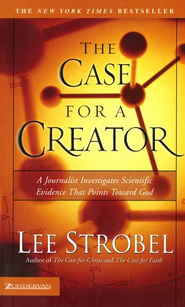
The interview of Lee Strobel (mini-bio below) with Dr. J. P. Moreland (mini-bio below) above is adapted from Chapter 10 in Lee Strobel. The Case for a Creator: A Journalist Investigates Scientific Evidence That Points Toward God. Grand Rapids: Zondervan, 2009.

 FOR FURTHER EVIDENCE

More Resources on This Topic

Cooper, John W. Body, Soul, and Life Everlasting. Grand Rapids, Mich.: Eerdmans, 1989.

Habermas, Gary and J. P. Moreland. Beyond Death. Wheaton, Ill.: Crossway, 1998.

Moreland, J. P. “God and the Argument from Mind.” In Scaling the Secular City. Grand Rapids, Mich.: Baker, 1987.

——. What Is the Soul? Norcross, Ga.: Ravi Zacharias International Ministries, 2002.

——. and Scott B. Rae. Body and Soul. Downer’s Grove, Ill.: InterVarsity, 2000.

Taliaferro, Charles. Consciousness and the Mind of God. Cambridge, England: Cambridge University Press, 1994.

Witham, Larry. “Mind and Brain.” In By Design: Science and the Search for God. San Francisco: Encounter Books, 2003.

About Lee Strobel
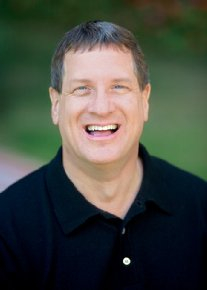
Atheist-turned-Christian Lee Strobel, the former award-winning legal editor of The Chicago Tribune, is a New York Times best-selling author of more than twenty books and has been interviewed on numerous national TV programs, including ABC, Fox, PBS, and CNN.

Described in the Washington Post as “one of the evangelical community’s most popular apologists,” Lee shared the Christian Book of the Year award in 2005 for a curriculum he co-authored with Garry Poole about the movie The Passion of the Christ. He also won Gold Medallions for his books The Case for Christ, The Case for Faith, and the The Case for a Creator, all of which have been made into documentaries distributed by Lionsgate.

His latest books include The Case for the Real Jesus, The Unexpected Adventure (co-authored with Mark Mittelberg) and The Case for Christ Study Bible, which includes hundreds of notes and articles on why Christians believe what they believe. His first novel, a legal thriller called The Ambition, came out in the Spring of 2011.

Lee was educated at the University of Missouri (Bachelor of Journalism degree, 1974) and Yale Law School (Master of Studies in Law degree, 1979). He was a professional journalist for 14 years at The Chicago Tribune and other newspapers, winning Illinois’ top honors for investigative reporting (which he shared with a team he led) and public service journalism from United Press International.

After a nearly two-year investigation of the evidence for Jesus, Lee became a Christian in 1981. He joined the staff of Willow Creek Community Church in South Barrington, IL, in 1987, and later became a teaching pastor there. He joined Saddleback Valley Community Church in Lake Forest, CA, as a teaching pastor in 2000. He left Saddleback’s staff to focus on writing.

Lee’s other books include God’s Outrageous Claims, The Case for Christmas, The Case for Easter, and Surviving a Spiritual Mismatch in Marriage, which he wrote with his wife, Leslie.

For two seasons, Lee was executive producer and host of the weekly national TV program Faith Under Fire.

Lee also is co-author of the Becoming a Contagious Christian course, which has trained more than a million Christians on how to naturally and effectively talk with others about Jesus. His articles have been published in a variety of magazines, including Discipleship Journal, Marriage Partnership, The Christian Research Journal, and Decision. He has appeared on such national radio programs as The Bible Answer Man and Focus on the Family. In addition, he has taught First Amendment law at Roosevelt University.

In recognition of his extensive research for his books, Southern Evangelical Seminary honored Lee with the conferring of a Doctor of Divinity degree in 2007.

Lee and Leslie have been married for 38 years and live in Colorado. Their daughter, Alison, is a novelist and co-author, with her husband Dan, of the children’s book, That’s Where God Is. Lee’s son, Kyle, holds two master’s degrees from the Talbot School of Theology and a PhD in theology from the University of Aberdeen in Scotland. His first book was Metamorpha: Jesus as a Way of Life.

About Dr. J.P. Moreland (in his own words: http://www.jpmoreland.com/about/bio/)


I am the Distinguished Professor of Philosophy at Talbot School of Theology, Biola University in La Mirada, California. I have four earned degrees: a B.S. in chemistry from the University of Missouri, a Th.M. in theology from Dallas Theological Seminary, an M. A. in philosophy from the University of California-Riverside, and a Ph.D. in philosophy from the University of Southern California.

During the course of my life, I have co-planted three churches, spoken and debated on over 175 college campuses around the country, and served with Campus Crusade for Christ for 10 years. For eight years, I served as a bioethicist for PersonaCare Nursing Homes, Inc. headquartered in Baltimore, Maryland.

My ideas have been covered by both popular religious and non-religious outlets, including the New Scientist and PBS’s “Closer to Truth,” Christianity TodayandWORLD magazine. I have authored or co-authored 30 books, including Kingdom Triangle, Scaling the Secular City, Consciousness and the Existence of God, The Recalcitrant Imago Dei, Love Your God With All Your Mind, The God Question, and Body and Soul. I have also published over 70 articles in journals, which include Philosophy and PhenomenologicalResearch,American Philosophical Quarterly, Australasian Journal of Philosophy, Metaphilosophy, Philosophia Christi, andFaith and Philosophy.

Personal Interests

My hobbies are exercising, following the Kansas City Chiefs, and being fixated by really great TV dramas like 24 and Lost. With my dear wife and ministry partner, Hope, we have two married daughters, Ashley and Allison, and as of 2010, four grandchildren! We attend Vineyard Anaheim church and are deeply committed to the body of believers there.

On Who Has Influenced Me

Besides my family and close friends, three people have had the greatest impact on me during my journey with Jesus: Bill Bright, Howard Hendricks, and Dallas Willard. I first came to Christ in 1968, and joined Campus Crusade staff from 1970-75, and 1979-84. I will never forget being in Dr. Bright’s presence during those years. He exuded intimacy with the Lord, he was full of faith, and he lived a holy life. These values were clearly put in place in my life due to his influence. He set a high bar in these areas, and his life gave me a living hope that significant progress in these areas was clearly within reach. Dr. Bright also died a vibrant, victorious death, and as I age, I very much want to do the same in a Christ-honoring way.

I have the honor of studying under Dr. Hendricks during my years at Dallas Theological Seminary (DTS) from 1975-79. I took several courses from him and was in a small discipleship group with Hendricks my last year at DTS. The values I saw in him were radical commitment to Christ, to reading in general and studying scripture in particular, and to the priority of marriage and family. He also had a commitment not to bore people while teaching the Bible and to exhibiting a keen sense of humor. These have all become my values, due in no small measure to Dr. Hendricks.

However as much as Bright and Hendricks have impacted me, the influence of Dallas Willard towers over everyone else. I was honored to have him as my dissertation supervisor at the University of Southern California and Hope and I have counted Dallas and his wife Jane as dear friends and mentors for twenty-five years. Dallas impacted me in his combination of a rigorous intellect with a vibrant walk with Jesus, his fresh, penetrating ideas about the kingdom and how to live in it, and by the reality of God that pours out of his life. I cannot overstate my debt to him. All three were full of humility. It was and is clear that they are about something much bigger than they.

My Dearest Partner, My Wife

My wife, Hope, has been my friend and partner for now 33 years. We were married in 1977. She has the gifts of evangelism, encouragement, helps/mercy. I have never met someone who is consistently happier than she, who loves to care for and serve others, and who exhibits the warmth and kindness of the Holy Spirit. It may sound canned to say this, but it is the truth, namely, that my life and work simply are inconceivable without her love and care all these years. She simply makes my life possible. Or, as I wrote of her in my 1985 book dedication (Universals, Qualities, and Quality-Instances) to her:

Her gracious life truly fits her name and her soul exemplifies that range of qualities that truly wise persons everywhere know as the moral virtues

Well said, I might add! For I experience her unconditional love in an ongoing way. And God made her to be a mother and grandmother par excellence. It is a joy to see how her children honor, respect and love her. My daughters, Ashley and Allison, have turned out to be good, solid people. What impresses me most about both of them is their genuine concern for others and their ability to be good listeners. It isn’t all about them, and this is refreshing these days. Our girls not only love Hope and me, but they actually like us!! They, and their dear husbands, actually like being around us!! As of this writing, I have two grandchildren around three years old (a girl and a boy), a one-month old grandson, and a granddaughter due to be born October 2010. Does it get any better than this?

My Church

My love for the local church was not something that characterized me for much of my Christian life. I was primarily a parachurch guy and I wanted to get the job done, whether or not the local church was part of the solution. I was always committed to a sense of team, but my friendships were the primary source of fellowship for me and Hope within the body of Christ. But the last several years has been transforming.

My relationship with my local church—the Vineyard Anaheim—has shown me how short-sighted my previous vision was. I am fully committed to my local church’s well-being and absolutely love being a part of the fellowship. I have never been a “Lone Ranger Christian”—quite the opposite—but I now see more than ever the centrality of the local church to my intellectual, affective, and relational maturation. I thank God that He brought me to my senses.

Dr. Peter Kreeft on Will There Be Sex in Heaven?

(The article below is an excellent example of philosophy and theology made practical – Dr. Peter Kreeft is a professor of philosophy at the King’s College in New York, and a long time professor at Boston College. The author of a plethora of books – He is arguably one of the most interesting and well-liked professors by students in the United States – I don’t always agree with him – but he always stimulates my thinking and expands my learning with his profound insights about all things philosophical – DPC).

Is There Sex in Heaven?

We cannot know what X-in-Heaven is unless we know what X is. We cannot know what sex in Heaven is unless we know what sex is. We cannot know what in Heaven’s name sex is unless we know what on earth sex is.

But don’t we know? Haven’t we been thinking about almost nothing else for years and years? What else dominates our fantasies, waking and sleeping, twenty-four nose-to-the-grindstone hours a day? What else fills our TV shows, novels, plays, gossip columns, self-help books, and psychologies but sex?

No, we do not think too much about sex; we think hardly at all about sex. Dreaming, fantasizing, feeling, experimenting—yes. But honest, look-it-in-the-face thinking?—hardly ever. There is no subject in the world about which there is more heat and less light (For some light, see Stephen Clark, Man and Woman in Christ. Ann Arbor, Mich.: Servant, 1980; Frank Sheed, Society and Sanity. New York: Sheed & Ward, 1953, chap. 8; C.S. Lewis, The Four Loves. New York: Harcourt, Brace Jovanovich, 1960; Jerry Exell, Sex and the Spirit. Berkely, Calif.: Genesis Publications, 1973; Robert Capon, Bed and Board. New York: Simon & Schuster, 1965).

Therefore I want to begin with four abstract philosophical principles about the nature of sex. They are absolutely necessary not only for sanity about sex in Heaven but also for sanity about sex on earth, a goal at least as distant as Heaven to our sexually suicidal society (Geroge Gilder, Sexual Suicide. New York: Quadrangle, 1973).

The fact that sex is public does not mean it is mature and healthy. The fact that there are thousands of “how to do it” books on the subject does not mean that we know how; in fact, it means the opposite. It is when everybody’s pipes are leaking that people buy books on plumbing (Excell, Sex and the Spirit, p.6).

My four philosophical principles will seem strange or even shocking to many people today. Yet they are far from radical, or even original; they are simply the primeval platitudes known to all premodern societies; the sane, sunny country of sexual common sense by the vote of “the democracy of the dead” (G.K. Chesterton, Orthodoxy. New York: Dodd, Mead, 1946, p. 85).

Yet in another way they are “radical”, in the etymological sense of the word: they are our sexual roots, and our uprooted society is rooting around looking for sexual substitute-roots like a pig rooting for truffles. It has not found them. That fact should at least make us pause and look back at our “wise blood,” our roots (Flannery O’Connor, Wise Blood. New York: Harcourt, Brace, 1962).

 Here are four of them (4 Philosophical Principles of Sex):

 First Principle: Sex Is Something You Are, Not Something You Do

Suppose you saw a book with the title “The Sexual Life of a Nun” (Capon, Bed and Board, p.12). You would probably assume it was a scurrilous, gossipy sort of story about tunnels connecting convents and monasteries, clandestine rendezvous behind the high altar, and masking a pregnancy as a tumor. But it is a perfectly proper title: all nuns have a sexual life. They are women, not men. When a nun prays or acts charitably, she prays or acts, not he. Her celibacy forbids intercourse, but it cannot forbid her to be a woman. In everything she does her essence plays a part, and her sex is as much a part of her essence as her age, her race, and her sense of humor.

The counterfeit phrase “having sex” (meaning “intercourse”) was minted only recently. Of course a nun “has sex”: she is female. Draftees often fill in the box on their induction forms labeled “sex” not with the word “male” but “occasionally” or “please!” The joke would have been unintelligible to previous generations. The significance of the linguistic change is that we have trivialized sex into a thing to do rather than a quality of our inner being. It has become a thing of surfaces and external feeling rather than of personality and internal feeling. Thus even masturbation is called “having sex”, though it is exactly the opposite: a denial of real relationship with the other sex (Excell, Sex and the Spirit, p.8).

The words “masculinity” and “femininity”, meaning something more than merely biological maleness and femaleness, have been reduced from archetypes to stereotypes. Traditional expectations that men be men and women be women are confused because we no longer know what to expect men and women to be. Yet, though confused, the expectations remain. Our hearts desire, even while our minds reject, the old “stereotypes”. The reason is that the old stereotypes were closer to our innate sexual instincts than are the new stereotypes. We have sexist hearts even while we have unisex heads. Evidence for this claim? More people are attracted to the old stereotypes than to the new ones. Romeo still wants to marry Juliet.

The main fault in the old stereotypes was their too-tight connection between sexual being and social doing, their tying of sexual identity to social roles, especially for women: the feeling that it was somehow unfeminine to be a doctor, lawyer, or politician. But the antidote to this illness is not confusing sexual identities but locating them in our being rather than in our doing. Thus we can soften up social roles without softening up sexual identities. In fact, a man who is confident of his inner masculinity is much more likely to share in traditionally female activities like housework and baby care than one who ties his sexuality to his social roles.

If our first principle is accepted, if sexuality is part of our inner essence, then it follows that there is sexuality in Heaven, whether or not we “have sex” and whether or not we have sexually distinct social roles in Heaven.

 Second Principle: The Alternative to Chauvinism Is Not Egalitarianism

The two most popular philosophies of sexuality today seem totally opposed to each other; yet at a most basic level they are in agreement and are equally mistaken. The two philosophies are the old chauvinism and the new egalitarianism; and they seem totally opposed. For chauvinism (a) sees one sex as superior to the other, “second”, sex (Simone de Beauvoir. The Second Sex. New York: Knopf; 1953). This is usually the male, but there are increasingly many strident female chauvinist voices in the current cacophony (E.g., Mary Daly, Gyn-Ecology: The Metaethics of Radical Feminism. Boston: Beacon Press, 1979; Una Stannard, Mrs. Man. San Francisco: Germain Books, 1977; Kathy Ferguson, Self Society and Womankind: The Dialectic of Liberation (Westport, Conn.: Greenwood Press, 1980; Zillah Eisenstein, The Radical Future of Liberal Feminism. New York: Longmans,1981). This presupposes (b) that the sexes are intrinsically different, different by nature not social convention. Egalitarianism tries to disagree with (a) totally; it thinks that to do so it has to disagree with (b) as well. But this means that it agrees with chauvinism on (c), the unstated but assumed premise that all differences must be differences in value, or, correlatively, that the only way for two things to be equal in value is for them to be equal in nature. Both philosophies see sameness or superiority as the only options. It is from this assumption (that differences are differences in value) that the chauvinist argues that the sexes are different in nature, therefore they are different in value. And it is from the same assumption that the egalitarian argues that the sexes are not different in value, therefore they are not different in nature.

Chauvinism:

(c)

and (b)

therefore (a)

Egalitarianism:

(c)

and not (a)

therefore not (b)

Once this premise is smoked out, it is easy to see how foolish both arguments are. Of course not all differences are differences in value. Are dogs better than cats, or cats than dogs? Or are they different only by convention, not by nature? Chauvinist and egalitarian should both read the poets, songwriters, and mythmakers to find a third philosophy of sexuality that is both more sane and infinitely more interesting. It denies neither the obvious rational truth that the sexes are equal in value (as the chauvinist does) nor the equally obvious instinctive truth that they are innately different (as the egalitarian does). It revels in both, and in their difference: vive la difference!

If sexual differences are natural, they are preserved in Heaven, for “grace does not destroy nature but perfects it” (St. Thomas Aquinas, Summa Theologogiae, I, 1,8 ad 2). If sexual differences are only humanly and socially conventional, Heaven will remove them as it will remove economics and penology and politics. (Not many of us have job security after death. That is one advantage of being a philosopher.) All these things came after and because of the Fall, but sexuality came as part of God’s original package: “be fruitful and multiply” (Genesis 1:28). God may unmake what we make, but He does not unmake what He makes. God made sex, and God makes no mistakes.

Saint Paul’s frequently quoted statement that “in Christ. . . there is neither male nor female” (Galatians 3:28) does not mean there is no sex in Heaven. For it refers not just to Heaven but also to earth: we are “in Christ” now (Galatians 2:20 – In fact, if we are not “in Christ” now there is no hope of Heaven for us!) But we are male or female now. His point is that our sex does not determine our “in-Christness”; God is an equal opportunity employer. But He employs the men and women He created, not the neuters of our imagination.

Third Principle: Sex Is Spiritual

That does not mean “vaguely pious, ethereal, and idealistic”. “Spiritual” means “a matter of the spirit”, or soul, or psyche, not just the body. Sex is between the ears before it’s between the legs. We have sexual souls (Exel, Sex and the Spirit, chap. 1).

For some strange reason people are shocked at the notion of sexual souls. They not only disagree; the idea seems utterly crude, superstitious, repugnant, and incredible to them. Why? We can answer this question only by first answering the opposite one: why is the idea reasonable, enlightened, and even necessary? The idea is the only alternative to either materialism or dualism. If you are a materialist, there is simply no soul for sex to be a quality of. If you are a dualist, if you split body and soul completely, if you see a person as a ghost in a machine, then one half of the person can be totally different from the other: the body can be sexual without the soul being sexual (Gilbert Ryle. The Concept of Mind. New York, London: Hutchinson’s University Library, 1949).

The machine is sexed, the ghost is not. (This is almost the exact opposite of the truth: ghosts, having once been persons, have sexual identity from their personalities, their souls. Machines do not.) No empirical psychologist can be a dualist; the evidence for psychosomatic unity is overwhelming (Gilbert Ryle. The Concept of Mind). No pervasive feature of either body or soul is insulated from the other; every sound in the soul echoes in the body, and every sound in the body echoes in the soul. Let the rejection of dualism be Premise One of our argument. Premise Two is the even more obvious fact that biological sexuality is innate, natural, and in fact pervasive to every cell in the body. It is not socially conditioned, or conventional, or environmental; it is hereditary. The inevitable conclusion from these two premises is that sexuality is innate, natural, and pervasive to the whole person, soul as well as body. The only way to avoid the conclusion is to deny one of the two premises that logically necessitate it—to deny psychosomatic unity or to deny innate somatic sexuality. In the light of this simple and overwhelming argument, why is the conclusion not only unfamiliar but shocking to so many people in our society? I can think of only two reasons. The first is a mere misunderstanding, the second a serious and substantial mistake. The first reason would be a reaction against what is wrongly seen as monosexual soul-stereotyping. A wholly male soul, whatever maleness means, or a wholly female soul, sounds unreal and oversimplified. But that is not what sexual souls implies. Rather, in every soul there is—to use Jungian terms—anima and animus, femaleness and maleness; just as in the body, one predominates but the other is also present (C.G. Jung. The Structure and Dynamics of the Psyche. New York: Pantheon Books, 1960. P. 345).

If the dominant sex of soul is not the same as that of the body, we have a sexual misfit, a candidate for a sex change operation of body or of soul, earthly or Heavenly. Perhaps Heaven supplies such changes just as it supplies all other needed forms of healing. In any case, the resurrection body perfectly expresses its soul, and since souls are innately sexual, that body will perfectly express its soul’s true sexual identity.

A second reason why the notion of sexual souls sounds strange to many people may be that they really hold a pantheistic rather than a theistic view of spirit as undifferentiated, or even infinite. They think of spirit as simply overwhelming, or leaving behind, all the distinctions known to the body and the senses. But this is not the Christian notion of spirit, nor of infinity. Infinity itself is not undifferentiated in God. To call God infinite is not to say He is everything in general and nothing in particular: that is confusing God with The Blob! God’s infinity means that each of His positive and definite attributes, such as love, wisdom, power, justice, and fidelity, is unlimited.

Spirit is no less differentiated, articulated, structured, or formed than matter (C.S. Lewis. Miracles. New York: Macmillan, 1955). The fact that our own spirit can suffer and rejoice far more, more delicately and exquisitely, and in a far greater variety of ways, than can the body—this fact should be evidence of spirit’s complexity. So should the fact that psychology is nowhere near an exact science, as anatomy is. Differences in general, and sexual differences in particular, increase rather than decrease as you move up the cosmic hierarchy. (Yes, there is a cosmic hierarchy, unless you can honestly believe that oysters have as much right to eat you as you have to eat them.) Angels are as superior to us in differentiation as we are to animals. God is infinitely differentiated, for He is the Author of all differences, all forms. Each act of creation in Genesis is an act of differentiation—light from darkness, land from sea, animals from plants, and so on (Genesis 1:4, 7,10,18, 21, 25, 27).

Creating is forming, and forming is differentiating. Materialism believes differences in form are ultimately illusory appearance; the only root reality is matter. Pantheism also believes differences in form are ultimately illusory; the only root reality is one universal Spirit. But theism believes form is real because God created it. And whatever positive reality is in the creation must have its model in the Creator. We shall ultimately have to predicate sexuality of God Himself as we shall see next.

 Fourth Principle: Sex Is Cosmic

Have you ever wondered why almost all languages except English attribute sexuality to things? Trees, rocks, ships, stars, horns, kettles, circles, accidents, trips, ideas, feelings—these, and not just men and women, are masculine or feminine. Did you always assume unthinkingly that this was of course a mere projection and personification, a reading of our sexuality into nature rather than reading nature’s own sexuality out of it (or rather, out of her)? Did it ever occur to you that it just might be the other way round, that human sexuality is derived from cosmic sexuality rather than vice versa, that we are a local application of a universal principle? (C.S. Lewis. That Hideous Strength. New York: Macmillan, 1969, p. 315; Perelandra. New York: Macmillan, 1965, pp. 200-1).

If not, please seriously consider the idea now, for it is one of the oldest and most widely held ideas in our history, and one of the happiest. It is a happy idea because it puts humanity into a more human universe. We fit; we are not freaks. What we are, everything else also is, though in different ways and different degrees. We are, to use the medieval image, a microcosm, a little cosmos; the universe is the macrocosm, the same pattern written large. We are more like little fish inside bigger fish than like sardines in a can. It is the machine-universe that is our projection, not the human universe.

We do not have time here to apply this idea, so pregnant with consequences, to other aspects of our being, to talk about the cosmic extension of consciousness and volition, but many philosophers have argued for this conclusion, and a deeper eye than reason’s seems to insist on it. But we can apply it to sexuality here. It means that sexuality goes all the way up and all the way down the cosmic ladder (For an ancient version, see Plato, Timaeus, 30b ff., 34b ff. For a modern version, see  Teilhard de Chardin, The Phenomenon of Man. New York: Harper & Row, 1961, bk. I, chap. 2, pp. 53-65).

At the “down” end there is “love among the particles”: gravitational and electromagnetic attraction. That little electron just “knows” the difference between the proton, which she “loves”, and another electron, which is her rival. If she did not know the difference, she would not behave so knowingly, orbiting around her proton and repelling other electrons, never vice versa.

But, you say, I thought that was because of the balanced resultant of the two merely physical forces of angular momentum, which tends to zoom her straight out of orbit, and bipolar electromagnetic attraction, which tends to zap her down into her proton: too much zoom for a zap and too much zap for a zoom. Quite right. But what right do you have to call physical forces “mere”? And how do you account for the second of those two forces? Why is there attraction between positive and negative charges? It is exactly as mysterious as love. In fact, it is love. The scientist can tell you how it works, but only the lover knows why.

 Sex at the Top

Sex “goes all the way up” as well as “all the way down”. Spirit is no less sexual than matter; on the contrary, all qualities and all contrasts are richer, sharper, more real as we rise closer and closer to the archetype of realness, God. The God of the Bible is not a monistic pudding in which differences are reduced to lumps, or a light that out-dazzles all finite lights and colors. God is a sexual being, the most sexual of all beings.

This sounds shocking to people only if they see sex only as physical and not spiritual, or if they are Unitarians rather than Trinitarians. The love relationship between the Father and the Son within the Trinity, the relationship from which the Holy Spirit eternally proceeds, is a sexual relationship. It is like the human sexual relationship from which a child proceeds in time; or rather, that relationship is like the divine one. Sexuality is “the image of God” according to Scripture (see Genesis 1:27), and for B to be an image of A, A must in some way have all the qualities imaged by B. God therefore is a sexual being.

There is therefore sex in Heaven because in Heaven we are close to the source of all sex. As we climb Jacob’s ladder the angels look less like neutered, greeting-card cherubs and more like Mars and Venus.

Another reason we are more, not less, sexual in Heaven is that all earthly perversions of true sexuality are overcome, especially the master perversion, selfishness. To make self God, to desire selfish pleasure as the summum bonum, is not only to miss God but to miss pleasure and self as well, and to miss the glory and joy of sex. Jesus did not merely say, “Seek ye first the kingdom of God”, but also added that “all these things shall be added” when we put first things first (Matthew 6:33). Each story fits better when the foundation is put first.

C. S. Lewis calls this the principle of “first and second things” (C.S. Lewis, “First and Second Things” in God in the Dock. Grand Rapids, Mich.: Eerdmans, 1970, pp. 278-81). In any area of life, putting second things first loses not only the first things but also the second things, and putting first things first gains not only the first things but the second things as well. So to treat sexual pleasure as God is to miss not only God but sexual pleasure too.

The highest pleasure always comes in self-forgetfulness. Self always spoils its own pleasure. Pleasure is like light; if you grab at it, you miss it; if you try to bottle it, you get only darkness; if you let it pass, you catch the glory. The self has a built-in, God-imaging design of self-fulfillment by self-forgetfulness, pleasure through unselfishness, ecstasy by ekstasis, “standing-outside-the-self”. This is not the self-conscious self-sacrifice of the do-gooder but the spontaneous, unconscious generosity of the lover.

This principle, that the greatest pleasure is self-giving, is graphically illustrated by sexual intercourse and by the very structure of the sexual organs, which must give themselves to each other in order to be fulfilled. In Heaven, when egotistic perversions are totally eliminated, all pleasure is increased, including sexual pleasure. Whether this includes physical sexual pleasure or not, remains to be seen.

 Application of the Principles: Sex in Heaven

In the most important and obvious sense there is certainly sex in Heaven simply because there are human beings in Heaven. As we have seen, sexuality, like race and unlike clothes, is an essential aspect of our identity, spiritual as well as physical. Even if sex were not spiritual, there would be sex in Heaven because of the resurrection of the body. The body is not a mistake to be unmade or a prison cell to be freed from, but a divine work of art designed to show forth the soul as the soul is to show forth God, in splendor and glory and overflow of generous superfluity. But is there sexual intercourse in Heaven? If we have bodily sex organs, what do we use them for there?

Not baby-making. Earth is the breeding colony; Heaven is the homeland.

Not marriage. Christ’s words to the Sadducees are quite clear about that (Matthew 22:30, “For in the resurrection they neither marry nor are given in marriage, but are like angels in heaven”).

It is in regard to marriage that we are “like angels”. (Note that it

Is not said that we are like the angels in any other ways, such as lacking physical bodies.)

Might there be another function in which baby-making and marriage are swallowed up and transformed, aufgehoben? Everything on earth is analogous to something in Heaven. Heaven neither simply removes nor simply continues earthly things. If we apply this principle to sexual intercourse, we get the conclusion that intercourse on earth is a shadow or symbol of intercourse in Heaven. Could we speculate about what that could be?

It could certainly be spiritual intercourse—and, remember, that includes sexual intercourse because sex is spiritual. This spiritual intercourse would mean something more specific than universal charity. It would be special communion with the sexually complementary; something a man can have only with a woman and a woman only with a man. We are made complete by such union: “It is not good that the man should be alone” (Genesis 2:18). And God does not simply rip up His design for human fulfillment.

The relationship need not be confined to one in Heaven. Monogamy is for earth. On earth, our bodies are private (This is the bane of Plato’s Republic; e.g., at 464c).

In Heaven, we share each other’s secrets without shame, and voluntarily (C.S. Lewis. The Problem of Pain. New York: Macmillan, 1962, p. 61). In the Communion of Saints, promiscuity of spirit is a virtue.

The relationship may not extend to all persons of the opposite sex, at least not in the same way or degree. If it did extend to all, it would treat each differently simply because each is different—sexually as well as in other ways. I think there must be some special “kindred souls” in Heaven that we are designed to feel a special sexual love for. That would be the Heavenly solution to the earthly riddle of why in the world John falls for Mary, of all people, and not for Jane, and why romantic lovers feel their love is fated, “in the stars”, “made in Heaven” (Peter Kreeft. Heaven: The Heart’s Deepest Longing. San Francisco: Ignatius Press, 1989, pp. 107-8).

But this would differ from romantic love on earth in that it would be free, not driven; from soul to body, not from body to soul. Nor would it feel apart from or opposed to the God-relationship, but a part of it or a consequence of it: His design, the wave of His baton. It would also be totally unselfconscious and unselfish: the ethical goodness of agape joined to the passion of eros; agape without external, abstract law and duty, and eros without selfishness or animal drives (Anders Nygren. Agape and Eros. London: S.P.C.K., 1953).

But would it ever take the form of physical sexual intercourse? We should explore this question, not to kowtow to modernity’s sexual monomania but because it is an honest question about something of great significance to us now, and because we simply want to know all we can about Heaven.

Since there are bodies in Heaven, able to eat and be touched, like Christ’s resurrection body (John 20:27), there is the possibility of physical intercourse. But why might the possibility be actualized? What are its possible purposes and meanings?

We know Heaven by earthly clues. Let us try to read all the clues in earthly intercourse. It has three levels of meaning: the subhuman, or animal; the superhuman, or divine; and the specifically human. (All three levels exist in us humans.)

Animal reasons for intercourse include (1) the conscious drive for pleasure and (2) the unconscious drive to perpetuate the species. Both would be absent in Heaven. For although there are unimaginably great pleasures in Heaven (Psalm 16:11), we are not driven by them. And the species is complete in eternity: no need for breeding.

Transhuman reasons for intercourse include (1) idolatrous love of the beloved as a substitute for God and (2) the Dante-Beatrice love of the beloved as an image of God. As to the first, there is, of course, no idolatry in Heaven. No substitutes for God are even tempting when God Himself is present. As to the second, the earthly beloved was a window to God, a mirror reflecting the divine beauty. That is why the lover was so smitten. Now that the reality is present, why stare at the mirror? The impulse to adore has found its perfect object. Furthermore, even on earth this love leads not to intercourse but to infatuation. Dante neither desired nor enacted intercourse with Beatrice.

Specifically human reasons for intercourse include (1) consummating a monogamous marriage and (2) the desire to express personal love. As to the first, there is no marriage in Heaven. But what of the second?

I think there will probably be millions of more adequate ways to express love than the clumsy ecstasy of fitting two bodies together like pieces of a jigsaw puzzle. Even the most satisfying earthly intercourse between spouses cannot perfectly express all their love. If the possibility of intercourse in Heaven is not actualized, it is only for the same reason earthly lovers do not eat candy during intercourse: there is something much better to do (C.S. Lewis. Miracles, p. 160).

The question of intercourse in Heaven is like the child’s question whether you can eat candy during intercourse: a funny question only from the adult’s point of view. Candy is one of children’s greatest pleasures; how can they conceive a pleasure so intense that it renders candy irrelevant? Only if you know both can you compare two things, and all those who have tasted both the delights of physical intercourse with the earthly beloved and the delights of spiritual intercourse with God testify that there is simply no comparison.

 A Heavenly Reading of the Earthly Riddle of Sex

This spiritual intercourse with God is the ecstasy hinted at in all earthly intercourse, physical or spiritual. It is the ultimate reason why sexual passion is so strong, so different from other passions, so heavy with suggestions of profound meanings that just elude our grasp. No mere practical
needs account for it. No mere animal drive explains it. No animal falls in love, writes profound romantic poetry, or sees sex as a symbol of the ultimate meaning of life because no animal is made in the image of God. Human sexuality is that image, and human sexuality is a foretaste of that self-giving, that losing and finding the self, that oneness-in-manyness that is the heart of the life and joy of the Trinity. That is what we long for; that is why we tremble to stand outside ourselves in the other, to give our whole selves, body and soul: because we are images of God the sexual being. We love the other sex because God loves God.

And this earthly love is so passionate because Heaven is full of passion, of energy and dynamism. We correctly deny that God has passions in the passive sense, being moved, driven, or conditioned by them, as we are. But to think of the love that made the worlds, the love that became human, suffered alienation from itself and died to save us rebels, the love that gleams through the fanatic joy of Jesus’ obedience to the will of His Father and that shines in the eyes and lives of the saints—to think of this love as any less passionate than our temporary and conditioned passions “is a most disastrous fantasy” (C.S. Lewis. Miracles, pp. 92-93).

And that consuming fire of love is our destined Husband, according to His own promise:

Hosea 2:16-20 & Isaiah 54:5, “And in that day, declares the Lord, you will call me ‘My Husband,’ and no longer will you call me ‘My Baal.’ For I will remove the names of the Baals from her mouth, and they shall be remembered by name no more. And I will make for them a covenant on that day with the beasts of the field, the birds of the heavens, and the creeping things of the ground. And I will abolish the bow, the sword, and war from the land, and I will make you lie down in safety. And I will betroth you to me forever. I will betroth you to me in righteousness and in justice, in steadfast love and in mercy. I will betroth you to me in faithfulness. And you shall know the Lord… For your Maker is your husband, the Lord of hosts is his name; and the Holy One of Israel is your Redeemer, the God of the whole earth he is called.”

Sex in Heaven? Indeed, and no pale, abstract, merely mental shadow of it either. Earthly sex is the shadow, and our lives are a process of thickening so that we can share in the substance, becoming Heavenly fire so that we can endure and rejoice in the Heavenly fire.

 About the Author:

The Question and Answer above was adapted from Peter Kreeft. Everything You Ever Wanted to Know about Heaven…But Never Dreamed of Asking. San Francisco: Ignatius Press, 1990. Note: I do not heartily recommend all of Kreefts teaching (e.g. – I do not think Scripture warrants the belief of “Purgatory”; nor some of his doctrinal distinctives as a “Catholic” and “Ecumenist.”  However, Peter Kreeft is an amazing thinker, writer, and teacher and much can be learned from his plethora of writings. He will always expand your thinking and increase your appetite for learning – even when you disagree with him. His book Heaven: The Heart’s Deepest Longing is still on my list of top ten books of all-time – for it’s depth, cogency, and brilliant apologetic of evidence and hope for the afterlife, and articulation of meaning for this life because of the Triune God that is revealed in the Scriptures and the Person and Work of Jesus. Dr. Kreeft earned degrees from Calvin College, and his Ph. D. from Fordham University. He has taught at Villanova University, Boston College, and the King’s College.

 Here Is a Partial Listing of Some of Dr. Kreeft’s Books:

Novel

An Ocean Full of Angels   (Also see Dr. Kreeft’s Strange Story behind the novel.)

Audio Courseware 

Theology and Logic

 Socrates

 C.S. Lewis, J.R.R. Tolkien and Pascal

 The Culture War

Author’s Commentary on the controversial Islam book

 Surfing

 Relating to God

Kids

 Heaven

 Highly Recommended by Dr. Kreeft

Dr. R.C. Sproul on Where Do Babies Go When They Die?

When a baby dies or is aborted, where does its soul go?

The way this question is worded indicates a certain ambiguity about the relationship between abortion and death. If life begins at conception, then abortion is a type of death. If life does not begin until birth, then obviously abortion does not involve death. The classical view is that life begins at conception. If that is so, the question of infant death and prenatal death involve the same answer. Any time a human being dies before reaching the age of accountability (which varies according to mental capacity), we must look to special provisions of God’s mercy.

Most churches believe that there is such a special provision in the mercy of God. This view does not involve the assumption that infants are innocent. David declared that he was both born in sin and conceived in sin (Ps. 51:5, “Behold, I was brought forth in iniquity, and in sin did my mother conceive me.”). By this he was obviously referring to the biblical notion of original sin. Original sin does not refer to the first sin of Adam and Eve, but to the result of that initial transgression. Original sin refers to the condition of our fallenness, and it affects all human beings.

We are not sinners because we sin; rather, we sin because we are sinners. That is, we sin because we are born with sinful natures. Though infants are not guilty of actual sin, they are tainted with original sin. That is why we insist that the salvation of infants depends not on their presumed innocence but on God’s grace. My particular church (note: R.C. Sproul is ordained in the PCA church) believes that the children of believers who die in infancy go to heaven by the special grace of God. What happens to the children of unbelievers is left to the realm of mystery. There may be a special provision of God’s grace for them as well. We can certainly hope for that.

Even though we hope for such grace, there is little specific biblical teaching on the matter. Jesus’ words, “Let the little children come to Me; for of such is the kingdom of heaven” (Matt. 19:14), give us some consolation but do not offer a categorical promise of infant salvation. When the son of David and Bathsheba was taken by God, David lamented, “While the child was alive, I fasted and wept; for I said, `Who can tell whether the LORD will be gracious to me, that the child may live?’ But now he is dead; why should I fast? Can I bring him back again? I shall go to him, but he shall not return to me” (2 Sam. 12:22-23). Here David declared his confidence that “I shall go to him.” Though this could have referred merely to David’s eventual death, it is more likely a thinly veiled reference to his hope of future reunion with his son. This hope of a future reunion is a glorious hope, one that is buttressed by the New Testament teaching on the resurrection.

*The article above was adapted from the Appendix of Question and Answers in the excellent book by R. C. Sproul. Surprised by Suffering: The Role of Pain and Death in The Christian Life. Orlando, FL.: Reformation Trust Publishing (Most recently re-printed in 2012).

 About the Author:

Dr. R.C. Sproul has taught theology to hundreds of thousands of people through books, radio, audiotapes, videotapes, seminars, sermons, seminary classes and other forums.

Sproul has written approximately sixty books (and counting). In addition to many volumes designed to teach theology, apologetics, and ethics to laymen through expository prose, he has written a novel, a biography, and several childrens books. He has also edited several volumes, including a festschrift for John H. Gerstner, a seminary textbook, and the New Geneva Study Bible. He has written one of the top classics of the 20th century – The Holiness of God; and perhaps the best book to explain God’s sovereignty in our salvation for laymen entitled Chosen by God.

Sproul founded Ligonier Ministries in 1971, a teaching ministry to assist the church in nurturing believers and equipping them for the ministries to which God has called them. Ligonier sponsors a radio program, “Renewing Your Mind,” which features Sproul and is broadcast nationally, five days a week.

Ligonier Ministries sponsors several seminars each year, the largest one in Orlando every winter. Ligonier publishes a monthly periodical, Tabletalk, and has its own web site (http://www.gospelcom.net).

Sproul has taught theology and apologetics at several seminaries. He earned a B.A. degree from Westminster College, a B.D. from Pittsburgh Theological Seminary, and a Drs. from the Free University of Amsterdam. He is ordained in the Presbyterian Church in America.

In 1994 Christianity Today asked a select list of “critics,” “What theologian or biblical scholar has most shaped your Christian life?” Third on the list (and the only American in the top four) was R.C. Sproul.

10 Ways To Be a Better Dad

Condensed from Michael Howden in Christian News Northwest:  

LOVE YOUR CHILDREN’S MOTHER

It is a precious gift a father passes on to his children.

SPEND TIME WITH YOUR CHILDREN

At the end of each week, look and see where time was spent.

EARN YOUR CHILDREN’S EAR

Develop communication out of just the negative.

DISCIPLINE WITH LOVE

Guidance and discipline are lacking today, but be sure they are a function of love and not just a reaction.

BE A ROLE MODEL

Both sons and daughters will shape patterns and expectations based on what you say and do.

BE A TEACHER

No one can replace what dad alone can teach.

EAT TOGETHER AS A FAMILY

It is one of the easiest ways to bring everyone’s days together, but so easy to crowd off the schedule.

READ TO YOUR CHILDREN

While many kids lean on technology, there should also be times when they learn from books and dad together.

SHOW AFFECTION

Their security grows with each hug.

REALIZE THAT A FATHER’S JOB IS NEVER DONE

Time with them is short. Make the most of it!

Dr. Gary R. Collins on Six Ways To Find Your Passion

“How To Find Your Passion”

(1)  Ask someone who knows you well to identify your passions.

(2)  Look at your environment. Does this reveal what really interests and excites you?

(3)  If you had no limitations in terms of money or time, what would you do?

(4)  Think of times in your life when you felt exuberant and excited to be alive. What might this say about your passion?

(5)  When you were young and your parents couldn’t find you, what did they assume you were doing? What does this say about your passion?

(6)  Pray that God will reveal His passion and open doors for you to be able to use your passion for His glory in your life.

The six steps above are condensed and adapted from the excellent book on by Gary Collins called Christian Coaching. Colorado Springs: NavPress, 2009 (Revised Edition).

 About the Author:

Gary R. Collins is a licensed clinical psychologist with a Ph.D. in clinical psychology from Purdue University. He is author of numerous articles and over 50 books, including Christian Counseling: A Comprehensive Guide, The Biblical Basis of Christian Counseling, and Christian Coaching: Helping Others Turn Potential into Reality. Gary was general editor of the thirty-volume Resources for Christian Counseling series of professional counseling books mostly published in the 1980s, the Word Christian Counseling Library of cassette tapes, and the twelve-volume Contemporary Christian Counseling series of books that appeared in the early 1990’s.

In December 2001 NavPress published Gary’s book Christian Coaching, a book that has been revised, expanded, updated, and published in 2009. The third edition of Christian Counseling (revised, expanded and completely updated) was published by Thomas Nelson publishers in 2007, followed by an accompanying Casebook of Christian Counseling, also published by Nelson.

Gary Collins grew up in Canada and graduated from McMaster University in Hamilton, Ontario and the University of Toronto before taking a year of study at the University of London. His first teaching occurred during that year as he taught courses for the University of Maryland in Germany and England. Gary spent several years in the Royal Canadian Navy Reserve before moving to the United States to study clinical psychology at Purdue University. He took his clinical psychology internship at the University of Oregon Medical School Hospitals (now University of Oregon Health Sciences University) in Portland and subsequently enrolled at Western Seminary for a year of theological study.

At Western he met his wife Julie. They were married in 1964 and moved to Minnesota where Gary taught psychology at Bethel College in St. Paul. Their two daughters, Lynn and Jan were born in Minnesota. After a year on the faculty of Conwell School of Theology in Philadelphia, the Collins family moved to Illinois where Gary taught psychology and counseling at Trinity Evangelical Divinity School. For much of that time he was department chairman.

In 1991, Gary assumed responsibility for co-leading the fledgling American Association of Christian Counselors. In the seven years that followed, Gary was AACC Executive Director and later the organization’s first President. During that time AACC grew from about 700 paid members to more than 15,000. In addition to these duties, Gary founded Christian Counseling Today, the official AACC magazine which he edited for several years. In October, 1998 Gary Collins resigned from his responsibilities with AACC so he could devote more time to developing Christian counseling and Christian coaching worldwide. In addition to his other responsibilities, he currently holds a position as Distinguished Professor of Coaching and Leadership at Richmont Graduate University (formerly Psychological Studies Institute) in Atlanta and Chattanooga. In addition he is Distinguished Visiting Professor in the School of Psychology and Counseling at Regent University in Virginia where he consults with the faculty and annually teaches an accredited on-line doctoral course in coaching.

Gary has accepted invitations to speak in more than fifty countries and he continues to travel overseas and within North America to give lectures and lead workshops on Christian counseling, leadership, and Christian coaching. Gary also has a small coaching practice, writes the weekly Gary R. Collins Newsletter, and mentors a number of young, emergent leaders. He is active in a local fitness center, is blessed with boundless energy and good health, and has no plans to retire. Gary and Julie Collins live in northern Illinois, not far from their two daughters, their son-in-law, and their grandson Colin Angus McAlister.

Dr. Tim Keller on Suffering

Dr. Tim Keller on Dealing With The Question “Why Me?”

[This article first appeared in edited form on CNN and is printed below in its entirety. The article is adapted from the City to City Blog of Redeemer Presbyterian Church in New York on August 6, 2012: http://redeemercitytocity.com/blog/view.jsp?Blog_param=446%5D

When I was diagnosed with cancer, the question “Why me?” was a natural one. Later, when I survived but others with the same kind of cancer died, I also had to ask, “Why me?”

Suffering and death seem random, senseless. The recent Aurora shootings—in which some people were spared and others lost—is the latest, vivid example of this, but there are plenty of others every day: from casualties in the Syria uprising to victims of accidents on American roads. Tsunamis, tornadoes, household accidents—the list is long. As a minister, I’ve spent countless hours with suffering people crying: “Why did God let this happen?” In general I hear four answers to this question—but each is wrong, or at least inadequate.

The first answer is, “This makes no sense—I guess this proves there is no God.” But the problem of senseless suffering does not go away if you abandon belief in God. Dr. Martin Luther King, Jr., in his Letter from Birmingham Jail, said that if there was no higher divine Law, there would be no way to tell if any particular human law was unjust or not. If there is no God, then why have a sense of outrage and horror when suffering and tragedy occur? The strong eat the weak—that’s life—so why not? When Friedrich Nietzsche heard that a natural disaster had destroyed Java in 1883, he wrote a friend: “Two hundred thousand wiped out at a stroke—how magnificent!” Nietzsche was relentless in his logic. Because if there is no God, all value judgments are arbitrary. All definitions of justice are just the results of your culture or temperament. As different as they were in other ways, King and Nietzsche agreed on this point. If there is no God or higher divine Law, then violence is perfectly natural. So abandoning belief in God doesn’t help with the problem of suffering at all, and as we will see, it removes many resources for facing it.

The second answer is, “If there is a God, senseless suffering proves that God is not completely in control of everything. He couldn’t stop this.”  As many thinkers have pointed out—both devout believers as well as atheists—such a being, whatever it is, doesn’t really fit our definition of God. And this leaves you with the same problems mentioned above. If you don’t believe in a God powerful enough to create and sustain the whole world, then the world came about through natural forces, and that means, again, that violence is natural. Or if you think that God is an impersonal life force and this whole material world is just an illusion, again you remove any reason to be outraged at evil and suffering or to resist it.

The third answer to seemingly sudden, random death is, “God saves some people and lets others die because he favors and rewards good people.” But the Bible forcefully rejects the idea that people who suffer more are worse people than those who are spared suffering. This was the self-righteous premise of Job’s friends in that great Old Testament book. They sat around Job, who was experiencing one sorrow in life after another, and said, “the reason this is happening to you and not us is because we are living right and you are not.” At the end of the book, God expresses his fury at Job’s “miserable comforters.” The world is too fallen and deeply broken to issue in neat patterns of good people having good lives and bad people having bad lives.

The fourth answer is, “God knows what he’s doing, so be quiet and trust him.” This is partly right, but inadequate. It is inadequate because it is cold and because the Bible gives us more with which to face the terrors of life.

God did not create a world with death and evil in it. It is the result of humankind turning away from him. We were put into this world to live wholly for him, and when instead we began to live for ourselves everything in our created reality began to fall apart—physically, socially, and spiritually. Everything became subject to decay. But God did not abandon us. Of all the world’s major religions, only Christianity teaches that God came to earth (in Jesus Christ) and became subject to suffering and death himself—dying on the Cross to take the punishment our sins deserved—so that some day he can return to earth to end all suffering without ending us.

Do you see what this means? Yes, we don’t know the reason God allows evil and suffering to continue, or why it is so random, but now at least we know what the reason isn’t—what it can’t be. It can’t be that he doesn’t love us! It can’t be that he doesn’t care. He is so committed to our ultimate happiness that he was willing to plunge into the greatest depths of suffering himself.

He understands us, he’s been there, and he assures us that he has a plan to eventually to wipe away every tear, to make “everything sad come untrue,” as J.R.R. Tolkien put it at the end of his Christian allegory The Lord of the Rings.

Someone might say, “But that’s only half an answer to the question ‘Why?'” Yes, but it is the half that we need.

If God actually explained all the reasons why he allows things to happen as they do, it would be too much for our finite brains. Think of small children and their relationship to their parents. Three-year-olds can’t understand most of what their parents allow and disallow for them. But though they aren’t capable of comprehending their parents’ reasons, they are capable of knowing their parents’ love, and therefore capable of trusting them and living securely. That is what they really need. Now the difference between God and human beings would be infinitely greater than the difference between a thirty-year-old parent and a three-year-old child. So we should not expect to be able to grasp all God’s purposes, but through the Cross and gospel of Jesus Christ, we can know his love. And that is what we need most.

In Ann Voskamp’s book One Thousand Gifts, she shares her journey to understand the senseless death of her sister, crushed by a truck at the age of two. In the end, she concludes that the primary issue is whether we trust God’s character. Is he really loving? Is he really just? Her conclusion:

“[God] gave us Jesus… If God didn’t withhold from us His very own Son, will God withhold anything we need? If trust must be earned, hasn’t God unequivocally earned our trust with the bark on the raw wounds, the thorns pressed into the brow, your name on the cracked lips? How will he not also graciously give us all things He deems best and right? He’s already given the incomprehensible.”

 About The Author:

In 1989 Dr. Timothy J. Keller, his wife and three young sons moved to New York City to begin Redeemer Presbyterian Church. In 20 years it has grown to meeting for five services at three sites with a weekly attendance of over 5,000. Redeemer is notable not only for winning skeptical New Yorkers to faith, but also for partnering with other churches to do both mercy ministry and church planting.  Redeemer City to City is working to help establish hundreds of new multi-ethnic congregations throughout the city and other global cities in the next decades.

Dr. Tim Keller is the author of several phenomenal books including:

Every Good Endeavor: Connecting Your Work to God’s Plan for the World. New York, Penguin Publishing, November, 2012.

Center Church: Doing Balanced, Gospel-Centered Ministry in Your City. Grand Rapids: Zondervan, September, 2012.

The Freedom of Self Forgetfulness. New York: 10 Publishing, April 2012.

Generous Justice: How God’s Grace Makes Us Just. New York: Riverhead Trade, August, 2012.

The Gospel As Center: Renewing Our Faith and Reforming Our Ministry Practices (editor and contributor). Wheaton: Crossway, 2012.

The Meaning of Marriage: Facing the Complexities of Commitment with the Wisdom of God. New York, Dutton, 2011.

The Prodigal God. New York, Dutton, 2011.

King’s Cross: The Story of the World in the Life of Jesus. New York, Dutton, 2011.

Counterfeit Gods: The Empty Priorities of Money, Sex, and Power, and the Only Hope That Matters. New York, Riverhead Trade, 2011.

The Reason For God: Belief in an Age of Skepticism. New York, Dutton, 2009.

Worship By The Book (contributor). Grand Rapids: Zondervan, 2002.

Ministries of Mercy: The Call of the Jericho Road. Phillipsburg: P&R Publishing, 1997.

Howard and William Hendricks on The Ideal Mentor

TEN MARKS OF A MENTOR

The Ideal Mentor is a Person Who:

1. Seems to have what you personally need.

2. Cultivates relationships.

3. Is willing to take a chance on you.

4. Is respected by other Christians.

5. Has a network of resources.

6. Is consulted by others.

7. Both talks and listens.

8. Is consistent in his lifestyle.

9. Is able to diagnose your needs.

10. Is concerned with your interests.

Adapted from Howard Hendricks & William Hendricks. As Iron Sharpens Iron. Chicago: Moody Press, 2000 (Kindle Locations 713-715). Kindle Edition.

Tim Keller and David Powlison’s Questions For Pastoral Self-Evaluation

Pastor’s Self-Evaluation Questionnaire 

“Pay close attention both to yourself and to your teaching; persevere in these things; for as you do this you will save both yourself and those who hear you.” – 1 Timothy 4:16

The questions that follow help you to pay close attention to yourself and to your teaching. The purpose is to bless you and those you seek to love and serve. For the vast majority of readers, it will help you set a positive, personal agenda for growth as God’s instrument. The Great Shepherd of the sheep will by His grace continue to develop you in His image. Conduct your self-evaluation in the light of His love.

Perhaps for a few readers it will prove to be a pass-fail test for your current ministry. Perhaps God has not given you certain gifts. Perhaps you are walking in some disqualifying pattern of sin. Even in these cases the questionnaire serves a positive purpose. The Lord has another place for those gifts that He has given you. The Lord has a way of repentance and renewal for sins that sabotage pastoral integrity and effectiveness. Remember the grace of the gospel.

So set your heart on Christ, on His gospel of mercy, on His high call, on His abounding riches of grace, on His honor in your life and His church. Here are some suggestions on how to profit from this study.

Read the questions carefully. The questions are posed first, followed by work-sheets. The questions range widely over the pastor’s role. If you are not a pastor, you can still profit. Ignore the questions that do not apply to your situation.

Think hard. Answer each question honestly after taking time to ponder. Set aside a day or several evenings to reflect on your life and ministry. Wherever possible give concrete examples of fruitfulness or failure, of growth or struggle.

Pray. Pray for wisdom to know God and yourself better. Pray for wisdom to serve God more effectively. Pray to know yourself before the eyes of the God who is both light and love.

Seek counsel from others. Many of the questions are difficult to answer about yourself. This self-evaluation questionnaire will be most useful when you combine it with feedback from others. Ask other leaders, friends, spouse, coworkers on a ministry team, and so forth.

Plan. The work-sheets will guide you in practical planning.

Acknowledge that others have gifts that complement yours. The second half of the questionnaire deals with pastoral skills. You may have limitations which God covers by providing others on the pastoral team with complementary gifts. In acknowledging personal weaknesses, ask yourself whether or not your pastoral team as a whole is covering all the bases.

Remember, the goal of this self-evaluation is to guide you in the path of growing holiness and growing pastoral skill. The questions are divided into these two major sections: personal holiness and pastoral skills. Effective ministers demonstrate holiness by humility, love, integrity and spirituality. Effective ministers are skilled in nurture, communication, leadership and mission.

Under each category you will find several questions. Notice that each question is two-sided. This captures that you fail either by omission or by commission. For example, biblical love is neither careless detachment from others nor obsession with others. You will likely find that you tend towards one side of each question. Let the questions stimulate you to ask further questions. They are not exhaustive. Some will apply to you; some won’t.

Part I. Personal Qualifications of Effective Ministers: Holiness

A. Humility

1. Do you acknowledge your limitations and needs out of confidence in Christ’s gracious power?

Are you honest enough? Do you demonstrate a willingness to admit your limits, mistakes, sins and weaknesses? Are you defensive, guarded, hypersensitive? Do you model that the Christian life is the open life? Do you demonstrate that the Christian life is a work in process rather than a completed product? Do you deal forthrightly with the common temptations you face: anger, anxiety, escapism, love of pleasure, self-love, materialism, perfectionism, and the like?

Are you too open? Do you wear your heart on your sleeve, indulging and wallowing in your limits, mistakes, sins and weaknesses? Are you morbidly or ‘exhibitionistically’ confessional? Or have you learned to speak of your weaknesses in ways that (1) point to your confidence in Christ, (2) genuinely seek help from people who can help, and (3) edify others?

2. Do you demonstrate a flexible spirit out of confidence in God’s control over all things, God’s authority over you, and God’s presence with you?

Are you flexible enough? Do you adapt faithfully, flexibly and creatively to the unexpected? Do you value and encourage the ideas and gifts of others? Do you insist on your own way, whether forcefully or through subtle manipulation? Do you exemplify confidence in the sovereign control of God down to the details of life? Are you caught up in the various aggressions and fears produced by a drive to ensure your own control?

Are you willing to try things experimentally and then reevaluate and make changes? Are you evidently a learner?

Are you too flexible? Do you bend too much? Do you blow in the wind of others’ opinions and get overwhelmed by people’s demands and agendas? Do you compromise, under-assert, seek to please, fail to push things that need to be pushed? Do you let people or circumstances control you rather than the Lord?

B. Love

1. Do you have a positive approach to people because of confidence in the power and hope of the Gospel of Jesus Christ?

Do you give grace to others? Do you love and encourage persons, even when under stress or in the face of an attack? Do you exhibit core biblical virtues: love for enemies, gentleness with opponents, patience with people and circumstances when undergoing trial or suffering? Are you able to confront the failings of others—to discipline your children, to admonish wanderers, to conduct church discipline—in a way that is not punitive, irritable, or censorious but breathes the invitations of God’s grace? Can you say hard things lovingly? Is your “speaking the truth” harsh, opinionated, idiosyncratic? Do you create problems by making mountains out of molehills? Do you contribute to destructive conflict or to peacemaking?

Are you too tolerant? Are you naively optimistic about people? Do you massage people’s egos with praise and “unconditional positive regard”? Is your “love” limp and truthless? Do you whitewash or minimize problems rather than tackle them? Because of biblical love are you willing to enter into constructive conflict? Are you a peace-lover and conflict-avoider rather than a peacemaker?

2. Do you show a servant’s heart to people because you are first and foremost a servant of the Lord?

Do you serve willingly? Do you serve yourself or others primarily? Do you truly serve the well-being of others and shepherd them under the Lord? Do you strive for personal glory either aggressively (compulsively driven “on an ego trip”) or passively (preoccupied with your “low self-esteem”)? Do you manifest the combination of forcefulness and sensitivity, commitment and flexibility, which characterizes servants of the Lord’s glory? Do you lord it over other people? Do you resist or avoid serving and loving others?

Do you serve compulsively? Do you serve other people slavishly, kowtowing to their demands, expectations, and whims? Do you let others lord it over you? Are you confused about what it means to serve and love others? Do you know how to say “No” realistically, firmly and graciously? Do you regularly rest and lay aside your work?

C. Integrity

1. Are you responsible to God first and foremost?

Are you irresponsible? Do you follow through on convictions and commitments? Do you speak the truth firmly, confidently, faithfully? Do you “trim” the truth or waffle on your commitments because of convenience or social pressures? Do you fail to demand of yourself and others things that God demands? Do you follow your impulses, moods, and feelings? Are you walking in the grip of a sin: e.g., greed, lust, outbursts of anger, fear of man, drunkenness, pride?

Are you overly demanding? Do you behave in a rigid manner? Do you sledgehammer people because of your commitment to principle? Are you legalistic in your commitments and nit-picking in your convictions? Do you major in minors? Do you make demands of yourself and others which God does not make?

2. Do you demonstrate a disciplined lifestyle under the Lordship of Jesus?

Are you undisciplined? Is your visible life and behavior disciplined, consistent and attractive? Do you manifest the joy, humility, and winsomeness of wisdom and holiness? Would people want to imitate what they see of your faith, your faithfulness, your character? What would people see if they could tag along with you for a week? Do you work diligently or are you lazy?

Are you too rigid? Are you too disciplined, organized, “perfect” on the outside? Does your visible example actually discourage or intimidate people? Are you in effect playing the role of “pastor” or “mature Christian”? Is your visible discipline a mask for hypocrisy, a cover for ignorance of yourself or a denial of a deviant inner life? Are you humbled by conscious awareness that you fight the common besetting temptations of every human heart: pride, fear of man, attachment to money, sexual lust, preoccupation with your own performance, control, judgmentalism, love of various pleasures, and the like? Do you have an active sense of humor? Do you take time to rest or are you consumed with anxious toil?

3. Are your family commitments a proper priority under the Lord?

Do you give yourself to your family? Are you over-committed to your ministry and under-committed to your family? Do you love your family in such a way that they willingly become committed to your ministry and really stand with and behind you? Are they being sacrificed to “ministry”? Are they being dragged along behind you? Do you give to them significantly, substantially, willingly?

Are you over-involved in your family? Are you over-committed to your family so that they provide an improper refuge, distraction and excuse to avoid ministry? Is family life an excuse for selfishness?

D. Spirituality

1. Do you demonstrate personal piety and vigor in your relationship with God?

Is your piety genuine? Is your communion with God rich and growing? Is your personal prayer life both spontaneous and disciplined or are you mostly a public pray-er? Do you apply the Bible searchingly and encouragingly to yourself or only to your hearers? Do you praise, enjoy and thank God with heartfelt integrity? Do you know God, rely on God, seek God, praise God genuinely? What does Christ mean in your life on a day-in, day-out basis? Are you significantly prayer-less, Bible-less, praise-less, God-less, Christ-less?

Are you ‘pietistic’? Do you escape into pious clichés and misuse the spiritual disciplines? Do you use “I’ll pray about it” or “I need to study the Bible” in order to avoid problems for which you feel inadequate? Do you pray too much (Matthew 6:7) or self-centeredly (James 4:3) because you do not know God very well? Is your Bible, praise and prayer life a hypocritical diversion in a life far from God?

2. Do you demonstrate faithfulness to the Bible and sound doctrines?

Are you biblically and theologically careful? Are you orthodox, faithful to the whole counsel of God? Do you have clear, definite, and thought-out biblical positions on the central issues of life? Do you have theological quirks or hobby-horses which upset the balance of truth? Do you articulate core biblical truth clearly and consistently, with a working feel for its personal and pastoral application? Are you ignorant? Fuzzy? In error? Unbalanced?

Are you a theological nit-picker? Are your theological convictions abstract, theoretical, and scholastic? Are you narrowly dogmatic, combative, critical, reductionistic, overly precise in your interpretations and applications of Scripture? Are you simplistic or superficial in your understanding of contemporary life and of human nature? Do you recognize the broad range of questions on which Scripture bears? Do you recognize the many variables which influence the application of Scripture to particular situations?

Part II. Functional Qualifications of Effective Ministers: Pastoral Skill

A. Nurture

1. Do you show involved caring that comes from genuine love in Christ for your brothers and sisters?

Do you involve yourself with the needs of others? Do you keep people at a distance? Are you able to develop relationships of honesty and trust through which you can comfort and challenge persons? Are you approachable? Do you create frequent conflict? Do you approach people warmly? Do you communicate care for people in ways they can sense?

Do you become overly absorbed in people? Do you become overly involved with people, caring too much because of a desire to be liked or a savior-complex or a fear of failure? Do you seek relationships as an end in themselves rather than as a component of pastoring people unto godliness?

2. Do you counsel people the Lord’s way?

Do you counsel biblically? Are you skilled in helping people respond to and solve personal problems using biblical principles? Do you counsel biblically both informally and formally? Do you use unbiblical conceptual categories and methods? Is what you say in your office congruent both with what you say in the pulpit and with how you yourself live? Do you get involved constructively with troubled people, or do you disdain them, refer them, avoid them? Are individuals encouraged in godliness, amid their sufferings and sins, through your personal ministry?

Do you go overboard on counseling? Do you become overly centered on problem people and focus on one-on-one remedial counseling to the detriment of more positive, preventive, building-up and corporate aspects of the ministry? Do you tend to turn the church into a counseling center or therapy group?

3. Do you discipline others into maturity in Christ and use of their gifts?

Do you help others productively serve the Lord? Do you demonstrate skills in nurturing growth in grace in individuals and in developing their gifts? Does your ministry have a positive, equipping thrust to it? Do you develop leaders and team ministries?

Do you focus too much on activism and productivity? Does your focus on gifts and discipleship have an elitist flavor? Are Christians with minimal gifts and energies neglected? Are there certain kinds of gifts which you recognize and encourage to the neglect of other kinds of gifts? Do you tend to move only with the movers?

4. Do you give yourself to discipline and to patrolling the boundaries of the church which God bought with His own blood?

Do you protect Christ’s honor in the church? Are you committed to church discipline? Are you able to confront winsomely and persistently? Do you recognize the limits of the edification ministries of counseling, care and discipling? Do you stand courageously against real errors and falsehoods which encroach into the body of Christ that you shepherd? Are you realistic that the ministry is a savor both of life and death? Do you try to be so positive that you cannot be properly and biblically negative?

Are you over-absorbed in border patrol? Do you demonstrate a nit-picking, sectarian, vigilante spirit? Are you uncompassionate of people’s failings, negativistic rather than upbuilding? Do you create in others a fear of failure and a fear of being found wrong, rather than creating love for ongoing growth in the Lord and love for ever-deepening truth?

B. Communication

1. Do you preach the whole counsel of God?

Are you preaching and teaching the Word of God? Are you skillful in expounding the Word of God publicly so that people are convicted, encouraged, and edified? Do you use the pulpit effectively? Do you downplay the importance of the pulpit and teaching in your attitudes, practice, and theory of ministry? Is what you say in the pulpit congruent both with what you say in your office and with how you yourself live? Do you take adequate time and work hard at preparation, or are you casual and presumptuous?

Are you overly absorbed in your pulpit? Are you overly concerned with pulpit ministry to the detriment of other aspects of pastoral care? Does pride puff you up or does the fear of men tie you in knots? Do you envision yourself as a “pulpiteer,” to the harm of reaching people where they live? Do you take too much time to prepare for public ministry because of perfectionism, self-trust, or fear?

2. Do you provide education for God’s many kinds of people?

Do you educate all? Are you skilled in identifying Christian Education needs and in helping people learn? Does your philosophy of Christian Education reach all age groups and all different kinds of needs? Is biblical and doctrinal knowledge undervalued? Do you tend to ignore, despise, or belittle the educational needs of certain kinds of people? Does your approach to Christian Education effectively combine truth and practice?

Do you overeducate? Do you tend to turn your church into a school? Is education and factual or doctrinal knowledge overvalued in comparison with other aspects of the Christian life? Is the teacher-pupil role the dominant one in the church or only one role among many?

3. Do you lead others to worship the Lord?

Do you lead others to worship God in truth? Do you lead people into the presence of God? Is your worship perfunctory and rote? Do you yourself worship God as you lead, or does worship become a performance and task? Do you undervalue worship, viewing it only as a glorified warm-up for the message?

Are you overly absorbed in worship? Do you over-emphasize the “worship experience” to the detriment of truth and the other aspects of church life? Are you overly subjective, gauging the Christian life by emotions and sentiment? Do you use words, music, and staging to manipulate experience? Is God at the center of your worship or do you worship the worship?

C. Leadership

1. Do you lead God’s people into effective work together?

Do you lead groups of people well? Do you help groups develop a biblical vision, and do you motivate them towards biblical goals? Are you confused about what the goals of groups should be? Are you overly absorbed either in personal one-on-one work with people or in impersonal programs and public ministry? Do you function constructively in groups, or do you hamper and divert groups from achieving God’s ends? Do you value groups and encourage them to take on significant responsibilities?

Are you overly absorbed in groups? Do you tend to see groups, committees, and task forces as a panacea or a substitute for other aspects of ministry? Does a task orientation sabotage other biblical goals such as prayer, worship, caring, and counseling?

2. Do you administer well, creating a church that is wise in its stewardship?

Are you a good administrator? Are you skilled in using time, money, and people efficiently to achieve biblical goals in the church? Do you neglect or despise administration?

Are you overly absorbed in administration? Do you tend to over-administer or retreat to administrative tasks because they are easier or are the squeaky wheel?

3. Do you mediate fellowship among God’s people?

Do you help people come together? Are you skilled in stimulating the congregation to mutual ministry in love? Does your ministry create one-anothering opportunities and activities among God’s people? Do you enhance a family atmosphere in the church? Are you able to teach people how to make significant friendships through your teaching, manner, and example?

Are you overly absorbed with the church’s social life? Are you so oriented towards “fellowship and family feeling” that the church’s fellowship with God and orientation to mission are lost?

4. Do you create cooperative and team ministry within the church and between churches that honor Christ?

Are you a team player? Do you work well as part of a ministry or pastoral team, or do you always insist on leading (in overt or covert ways)? Do you tend to stake out turf? Is your leadership based on true biblical wisdom or on personal drive, clerical status, and political savvy? Do you build unity and mutual respect among different parts of the body of Christ? Can you cooperate with other evangelical churches and pastors, or do you have sectarian instincts? Are you committed in practical ways to see the work of the local congregation as part of the larger work of Christ? Are you too independent and not enough of a “churchman”?

Do you allow the team to shield you from the front lines of ministry? Do you shirk leadership responsibilities out of diffidence or laziness and seek to embed yourself safely within a niche? Do you put your attention too much into the work of presbyteries, synods, general assemblies, conferences, associations, conventions, ministeriums, school boards and the like? Are you a politician and too much a “churchman” rather than a pastor?

D. Mission

1. Do you evangelize those outside of Jesus Christ?

Are you active in evangelism? Are you skilled both in effectively sharing the gospel and in leading the church in outreach? Are you committed in theory and personal practice to evangelize the lost? Do you believe with all your heart that people without Christ remain under the wrath of God? Do you neglect evangelism out of ignorance, love of comfort, fear, prejudice, bad experiences? Do you lead your people to support worldwide missionary efforts?

Are you overly committed to evangelism? Do you overemphasize evangelism or one evangelistic technique to the detriment of the church’s overall ministry? Do you create ministry activists rather than godly people? Do you play a numbers game with evangelism? Do your evangelistic methods hold the message of salvation in Christ in proper balance with God’s sovereignty in grace and with the call for us to demonstrate genuine love for each other and the lost? Are missionaries idolized as a higher species of Christian?

2. Do you show social concern for the many needs of people that God desires to address?

Do you care for the whole person? Are you skilled in applying the resources of the church to the social and material needs of mankind? Do you value diaconal work and the mercy gifts? Do you believe that the gospel addresses the whole man, or do you drift towards a gospel that is a bare verbal message? Do you care in practical ways for justice, or do you tacitly accept the status quo? Can you identify the social needs of your community and mobilize effective modes of addressing these needs?

Are you overly involved in social needs? Do you overemphasize social concerns and drift towards a “social gospel”? Do you ride the hobby-horse or one particular point of view or one particular social policy issue? Do you tend to view people through the eyes of politics, economics or sociology rather than through the eyes of the God of the Bible?

 Application Work Sheet

Part I. Personal Qualifications of Effective Ministers: Holiness

A. Humility

1. Do you acknowledge your limitations and needs out of confidence in Christ’s gracious power?

2. Do you demonstrate a flexible spirit out of confidence in God’s control over all things, God’s authority over you, and God’s presence with you?

B. Love

1. Do you have a positive approach to people because of confidence in the power and hope of the Gospel of Jesus Christ?

2. Do you show a servant’s heart to people because you are first and foremost a servant of the Lord?

C. Integrity

1. Are you responsible to God first and foremost?

2. Do you demonstrate a disciplined lifestyle under the Lordship of Jesus?

3. Are your family commitments a proper priority under the Lord?

D. Spirituality

1. Do you demonstrate personal piety and vigor in your relationship with God?

2. Do you demonstrate faithfulness to the Bible and sound doctrine?

Part II: Functional Qualifications of Effective Ministers: Pastoral Skill

A. Nurture

1. Do you show involved caring that comes from genuine love in Christ for your brothers and sisters?

2. Do you counsel people the Lord’s way?

3. Do you disciple others into maturity in Christ and use of their gifts?

4. Do you give yourself to discipline and to patrolling the boundaries of the church which God bought with His own blood?

B. Communication

1. Do you preach the whole counsel of God?

2. Do you provide education for God’s many kinds of people?

3. Do you lead others to worship the Lord?

C. Leadership

1. Do you lead people into effective work together?

2. Do you administer well, creating a church that is wise in its stewardship?

3. Do you mediate fellowship among God’s people?

4. Do you create cooperative and team ministry within the church and between churches that honor Christ?

D. Mission

1. Do you evangelize those outside of Jesus Christ?

2. Do you show social concern for the many needs of people whom God desires to address?

You have looked at yourself, hopefully through God’s eyes. Now work with what you have seen.

If you could change in one area in the next year, which would it be? Where do you most need to mature in wisdom? What changes in you would bring the greatest glory to God and greatest blessing to other people?

Confess your sins and failings to God. Jesus Christ is your faithful high priest and shepherd. He is the Pastor of pastors. “Come with confidence to the throne of His grace that you may receive mercy and grace to help you in your time of need” (Hebrews 4:16). Believe it and do it. The Lord’s strength is made perfect in your weakness.

Now what must you do? Prayerfully set goals. How will you become a more godly person and pastor? Are there people you must ask to pray for you and hold you accountable? Are there Bible passages or books you must study? Are there plans you must make? Do you need advice from a wise Christian about how to go about changing?

About the Authors: Dr. Tim Keller is the pastor of Redeemer Presbyterian Church in New York City. He is the author of numerous helpful books including: The Prodigal God; Counterfeit Gods; The Meaning of Marriage; The Reason for God & Center Church: Doing Balanced, Gospel-Centered Ministry in Your City. Dr. David Powlison is the editor of The Journal of Biblical Counseling and served for many years as a professor at Westminster Theological Seminary. David is currently faculty member at CCEF and a counselor with over thirty years of experience. He has written many counseling articles, booklets, and books including Seeing with New Eyes; Speaking Truth in Love; and Power Encounters.

Two sources in which these evaluation questions have appeared are The Journal of Biblical Counseling, Vol. XII, No. 1, Fall 1993 & The Appendix in Curtis C. Thomas. Practical Wisdom for Pastors: Words of Encouragement and Counsel for a Lifetime of Ministry. Wheaton: Crossway Books, 2001.