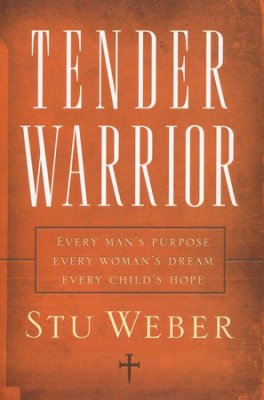
Book Review Of Stu Weber’s “Tender Warrior”

526139.jpg

“God’s Design For Biblical Manhood”

Book Review by Dr. David P. Craig

I can hardly believe the speed with which God’s design for biblical manhood and womanhood has been decaying in American culture. I am so grateful for the legacy that my own parents have left behind for their four children, and multiple grand, and great grand children. My parents weren’t perfect by any means, but they were godly and strove to be biblical in every aspect of life which nowadays is saying a ton. In a culture where idolatry, selfishness, and any semblance of character and integrity are woefully lacking – this book offers much needed help for men who take God, marriage, parenting,, and friendship seriously.

Using personal examples, biblical examples, and principles based on God’s design for biblical manhood exemplified in Jesus, Stu Weber has written a very good biblical manual for men to help them think and act in accordance with God’s design for manhood. In a day where confusion reigns in regard to God’s purpose for men and women this book gives clarity and practical teaching on the purpose, calling, meaning, and design for manhood. I highly recommend Weber’s book as a helpful guide for men of any age.

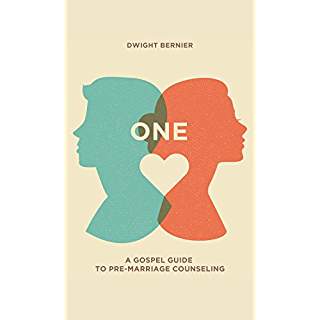
Book Review on Dwight Bernier’s – One: A Gospel Guide to Pre-Marriage Counseling

41ejAghbU4L._AC_US320_QL65_.jpg

God-glorifying One Stop Resource For Counselors and Pastors

Book Reviewed by Dr. David P. Craig

As a pastor for the past thirty years I have done my share of pre-marital and post-marital counseling. I have found more and more that couples spend more time planning their wedding day, than they do preparing for being married to a partner for life. A man and a woman will spend four to eleven years post high school for their careers, but often will not even crack open one book to help them with their marriage. This book provides seven guided sessions for a Christian couple to be well-prepared for marriage.

Bernier wisely writes at the outset, “The great challenge in marriage is to lose ‘me’ and become ‘us’ while our hearts, in contrast, want to glorify ‘me’…the great hope in marriage is that Jesus is changing ‘us’ and our hearts…The Spirit of God begins the process of morphing our motives to be more in line with the kingdom of God rather than the kingdom that we once belonged to.” In seven sessions Bernier provides a Christo-centric approach as being absolutely essential and foundational to building a great marriage. In seven sessions there are assigned readings from three excellent resources (not included – these books need to be purchased apart from this guide): Dave Harvey’s When Sinners Say I Do; Timothy Keller’s The Meaning of Marriage; and Justin Buzzard’s Date Your Wife.

In the seven sessions Bernier includes homework assignments from the readings; questions to discuss based on Scripture; personal application questions; and helps the counselor weave the gospel into the story of marriage. Each session contains a list of tasks to complete before each subsequent meeting. The various topics the book covers are: biblical love, friendship, glorifying God through marriage, roles and God’s design for marriage, how to be merciful and forgiving, implementing soul care via the gospel, and sex.

Bernier has provided a wonderful resource for pastors and counselors. It’s literally a step by step guide that is gospel centered, Christ glorifying, and covers the biblical foundations for establishing a God-glorifying marriage. I think it’s the best resource of its kind that I’ve seen and thus highly recommend it as an effective resource for those who value God’s design for marriage.

Preaching to Power: An Interview with Lloyd John Ogilvie

954877

(The Interview conducted with Michael Duduit below is adapted from http://www.preaching.com/resources/articles/11565834/ – Lloyd John Ogilvie recently wrote a book on preaching [pictured above] published by Harvest House Publishers in 2014 entitled A Passionate Calling: Recapturing Preaching That Enriches the Spirit and Moves the Heart)

Preaching to Power: An Interview with Lloyd John Ogilvie with Michael Duduit

Lloyd John Ogilvie has served since 1995 as Chaplain of the United States Senate, a role in which he opens each Senate session in prayer and leads an active schedule of Bible studies and counseling for Senators and their staffs. He came to Washington from Hollywood, California, where he had served as Pastor of First Presbyterian Church and hosted a national television ministry. He is author of nearly 50 books and continues to be a popular speaker and preacher. He was interviewed in his Senate office this spring by Preaching editor Michael Duduit.

Preaching: As we conduct this interview, we are sitting in the U.S. Capitol building, a place that is a symbol of political power. As you have made the transition from the pastorate of a local church to chaplain of the Senate, how has it influenced your approach to ministry?

Ogilvie: It has had an influence. I’ve had to discover ways to help people who have immense secular power learn how to find the power of God for their work. The transition that must be made is to help persons realize that the river bed is the flow of God’s power, not the river — to help them be recipients of supernatural power, instead of simply the power of talents. For instance, any Senator to be elected must have talents of articulation, clear thinking, organization, a lodestar kind of leadership that attracts others. However, once in office, a person needs the gifts of the Holy Spirit to be the kind of leader the nation needs — gifts of wisdom, knowledge, discernment, prophetic vision, and then empowered articulation that’s really the result of knowing God personally and yielding the role of leadership to him to receive the empowerment for the task. So our work here is around the motto, “Without God, we can’t; without us, He won’t.” And when we get that into perspective, great leaders can be born and nurtured to recognize that apart from the Lord’s power we can’t move at a supernatural level. God has so created the way He moves providentially in history that He works through people. Where He wants to be He invests a person; when He wants something to occur in a particular society, He puts His people to discover and do His will. And to get leaders to be open to that call is the important thing.

Preaching: You use your ministry of preaching and teaching not only to lead but to build leaders. How would you translate that into the local church setting for the pastor who is trying to build leaders among the laity?

Ogilvie: I think there has to be a fundamental reevaluation of the biblical idea of the meaning of the laity. To be in Christ is to be in the ministry, so every member of a congregation is a minister. The question is: what kind of a ministry does he or she have? So I think our task is to be a coach of the ministers, which puts preaching and teaching, counseling and administration in an entirely different focus:

I used to ask four basic questions in a church:

(1) What kind of people do we want to put into the world?

(2) What kind of church will make that quality of person possible?

(3) What kind of church officer will make that kind of church possible?

(4) And lastly, what kind of pastor will be an enabler of that quality of laity?

Once we make the basic decision that we don’t do ministry on behalf of the congregation but we equip them to do their ministry, then everything else falls into place. If, however, we think that we do ministry for people, and as professional clergy accomplish the work of the church, then our people are simply observers of the game we play as leaders. I like to picture a big stadium with all the seats filled, and two teams seated on both sides of the field, with blankets huddling in the cold. Then the coaches of both teams are running up and down the field, playing the game for everyone to see. That’s the picture of the contemporary church: the clergy — highly trained and honed in their skills — doing ministry on behalf of the people rather than equipping them. Once you get an understanding that our task is equipping the saints for the work of ministry, then preaching with power becomes the task of inciting enthusiasm and excitement for ministry of the laity and the adventure of following Christ in the secular realm. Then you can reevaluate the nature of the church’s program: is it accomplishing the task of putting the people into the world to accomplish that work?

Preaching: As a pastor, what kind of preaching did you find best accomplished that purpose of equipping the congregation for ministry?

Ogilvie: I think there’s a great hunger in our time for biblically-rooted, Christ-centered, Holy-Spirit empowered preaching. Great preaching comes from exposition. An understanding of the original languages is very important, so that the messenger has a message that arises out of a study of the text. Then the whole question is application to the contemporary scene — the explanation of the text, the illustration of the text, and the application of the text becomes the task of the pastor. If you live in the text eventually it will grip you to the place where it becomes like a banked fire, just waiting for the bellows of the Holy Spirit to be placed on it, to set it aflame to warm the minds and hearts of the people. If it happens to us it then can happen through us, so the text must become very real to us.Then I think we’ve got to have Richard Baxter’s rule, “I preach as a dying man to dying men, as if never to preach again.”

So every sermon ought to be preached with vigor as if we will never have another chance. That kind of enthusiasm and passion is what is needed in the church in America today — and all over the world, for that matter. I call it preaching with passion, and that kind of preaching is an understanding, an appreciation and an acceptance of the passion of Christ, the suffering of Christ for us, and then an identification with the suffering of human beings, so that we really feel what is going on inside of people. We want to bring the two together in an enthusiastic, heartfelt but intellectually healthy presentation.

Preaching: You talk about living with a text. I recall that as a pastor you would live with a text for more than a year before preaching it. Tell me about that process.

Ogilvie: I would use a three-year process. I would spend a year with a portion of Scripture as a devotional exercise. If I was going to plan to preach from the book of James, I would use that book as my devotional literature for the first year. The next year I would do an in-depth expositional study, and a reading of the great minds — to study the expositors, the great preachers through the ages. In the actual year of the preaching, I would take the time in my study leave to outline the presentation for a whole period of time, a portion of the year, then prepare a manila folder for each Sunday of that series, then publish a preaching guide for that period of time. I would do 45 Sundays a year in the parish, and I would come out of my study leave with 45 outlines of sermons, 45 manila folders, ready to receive the illustrative material that would go into each of them as I read, gathering illustrative materials from everyday life, and as I talked with people. Then, as I got to the week of actually preaching a sermon, there was the devotional year’s resource, the intensive study scholarship, then the practical gathering of material. Then the actual writing of the sermon — it is very important that the writing of the sermon be fresh, not dependent on well-worn phrases and hackneyed language. After the sermon is written it takes about a day of memorization, repeating it until it becomes a part of the preacher, then preaching it with as few notes as possible.

Preaching: What was the nature of the preaching guide you published?

Ogilvie: There would be a single page for each week. I would list out the title, the text, and the development. I would actually write three clear, concise, distilled paragraphs explaining what it is that I wanted to do with that particular text. That would be sent to the director of music, and he would take that and prepare all of the music to fit with the particular theme of that Sunday. So from the beginning note of the prelude to the last note of the postlude, one central theme in all of the hymns, Scripture readings, responses — all would augment that one central theme. Often I would add another page actually outlining the sermon as I envisioned it. Once I got to the week of the preaching of that sermon, the folder would be full of illustrative material that I had gathered through the year.

Preaching: Was most of your preaching in the form of series?

Ogilvie: Yes, I would take books of the Scripture for themes. The book of James I did a series on Making Stress Work for You. I did a book on the “He is able” statements of the epistles; that became the book Lord of the Loose Ends. Then I did one on the book of Acts that was entitled The Bush is Still Burning. I did one on the “I am” statements of Christ.

Preaching: How long was a typical series for you?

Ogilvie: Usually three months, so I’d do three major series in a year. I found that brought continuity and unity to the preaching. I tried to vary them so we would cover the whole of Scripture.

Preaching: I recall sitting in your congregation and marveling that you communicated so effectively with apparently no notes at all. Many preachers struggle with that.

Ogilvie: I learned that from James Stewart, my professor at New College (in Edinburgh). His method was to outline clearly, then to memorize the outline as you worked with it, then to write the sermon from that outline. Then that outline would be clearly focused in your mind so that you could move through it without hesitation. So the outlining becomes very important. Actually the church in Hollywood had a round balcony, and I would often picture the title of the separate sections of the sermon around the balcony, and I would picture them in my mind. I often used alliteration to help me remember the development of the text. All of those things would help me to retain eye contact. However I found that in lecturing or in giving long messages, we ought to be able to use notes unashamedly. But the sermon itself is a different article.

Preaching: And you spent a full day getting it into your memory?

Ogilvie: Yes, I would speak it aloud ten times and then it would be in me and could be communicated without total dependence on notes.

Preaching: What’s the most important thing you’ve learned about preaching over the years?

Ogilvie: Nothing can happen through you that hasn’t happened to you. I feel a person’s relationship with the living Lord is the most important aspect of preaching, and a growing relationship with the Lord is essential to powerful preaching. When we realize that we have been given the privilege of communicating the love, peace, power of the living Lord, then it’s very important to maintain a growing relationship with the Lord so that we have something fresh to share with the people.

Preaching: Clearly James Stewart was a great influence in your life. In what way did he influence your ministry?

Ogilvie: He was a great expositor and loved the Scriptures. He was an intense preacher — he had hurricane force. I’ve written a great deal about him and given lectures on him. To me, he was the greatest preacher of the twentieth century. The chance to study with him meant a great deal to me. He was a good friend long after I finished my theological education. I would go back in the summers and renew our friendship. We would often review what I was going to preach on in the coming year, and he would always have new insights. He was the most thorough scholar-preacher I have ever met.

Preaching: If you were starting over, is there anything you’d do differently as a preacher?

Ogilvie: I came to the commitment of a schedule that allowed for intensive study each week later in my ministry. I would start earlier allowing for two full days for study and preparation of the sermon. The commitment of one hour in the study for each minute in the pulpit is one I would apply sooner in my ministry. I think the temptation when you are starting in ministry is to say, “When I move to a larger church I’ll really concentrate on study.” I think you move to the larger church because you have concentrated on study. So the commitment of time to study and prepare is to me the most important aspect. Then the pastor’s own prayer life and commitment to an honest and growing relationship with the Lord, and his accountability to a small group is very important. I would meet with a group of elders every Sunday prior to preaching, and usually one was elected to say, “Are you ready to preach? Is there anything we can pray for?” The renewal of the church will rise or fall on the quality of its preaching, and I think it will depend on preachers who make preaching the central priority in their allocation of time and energy. To do that we will need an understanding of the officers of the church and the membership — to allow their pastor to take the time to be ready to preach is absolutely essential. It’s been a great adventure. It still is.

Dr. Daniel L. Akin Answers The Question: Why Does Theology Matter?

Why Theology Matters
An Interview with Daniel L. Akin
President, Southeastern Baptist Theological Seminary, Wake Forest, North CarolinaThis summer, Broadman & Holman released a new textbook on theology entitled A Theology for the Church. The book was edited by Danny Akin, president of Southeastern Baptist Theological Seminary, and it has contributions from some of the best known names in Southern Baptist life in the field of theology. This is the first compendium of theological topics produced by Broadman & Holman and written by Southern Baptists in more than fifty years. What follows is an interview between SBC LIFE and Dr. Akin. SBC LIFE wanted to know why Dr. Akin and the contributors to this book believe theology is important for the church and why it is especially crucial at this particular juncture in Southern Baptist life.SBC LIFE Why do you feel it is necessary for churches to focus on theology?

Akin Theology enables God’s people to think correctly and live rightly. What we do always flows from what we believe, and a sound theology helps us think clearly, rightly, and, most importantly, biblically about God.

SBC LIFE What difference does theology really make? Is it not enough that we worship the Lord with our hearts and enjoy warm and affirming fellowship?

Akin It is important that we love God with our heart, but it is also imperative that we love the Lord with our mind as well. Most of the time, Southern Baptists do a good job of loving God with their heart. However, I am not sure that we always do a good job at loving God with our mind. Peter reminds us to set apart the Messiah as Lord in your hearts and always be ready to give a defense to anyone who asks you a reason for the hope that is in you (1 Peter 3:15). Jesus instructed us in Matthew 22:37, that you shall love the Lord your God with all your heart, with all your soul, and with all your mind. Theology is one means whereby we love God with our minds.

SBC LIFE How would you respond to those who suggest that studying theology tends to reduce God in the Christian life to an “ivory tower” academic exercise?

Akin Studying theology can certainly run that risk, but we do not have to fall into this trap. That is why Jesus challenges us to love the Lord both with our heart and with our mind. I am convinced that the best theology is done within the context of a passion for the Great Commission. I often tell our students that the model in this area is the Apostle Paul who was both the great missionary and the great theologian. When you wed solid theology to a commitment to the Great Commission, you will bring a balance to your theology that will be healthy and fruitful. We must remember that the best missionaries are capable theologians, and the best theologians are passionate missionaries. The two must never be separated. This is imperative for the future of our convention of churches.

SBC LIFE Many people believe that theology is a discipline best left to seminary professors and the seminary classroom. They would say that pastors and their churches are better served to be about Kingdom priorities of spreading the Gospel and not getting distracted by all of this “heady” material. How would you respond to that?

Akin The title of this book explains what we believe is the case. Theology is a discipline for the church, not just the academy. Indeed, it is primarily a task for the church. The fact of the matter is that defining the Gospel is inherently a theological task. You cannot define the Gospel without doing theology. You cannot define the Kingdom of God without doing theology. You can’t really even define the Great Commission without doing theology. In other words, we do theology whether we realize it or not. Therefore, we are either going to do theology well or we are going to do theology poorly. Pastors need to set the standard in this area by emphasizing and modeling the importance of good theology for their people.

Further, I believe pastors need to regain a renewed understanding of what it means to be a pastor/theologian and to challenge their people likewise to grow in the discipline of studying theology. Reading popular Christian works is fine and good, but it is certainly not enough. Just as a child (and adults for that matter!) needs to have a balanced diet to grow and stay healthy, we also need to take in spiritual food from various sources to ensure that we have a balanced diet. I am personally convinced, as are all the contributors of this theology, that our people are far more interested in, and capable of, thinking theologically than many of us believe. My experience has been when people are challenged to study theology, they respond in a wonderful manner. This has especially been true in what I have seen in teaching high school and college students over the last decade. Let’s raise the theological bar and see what happens! I think the response will be awesome to behold.

SBC LIFE So you believe a pastor could take this work, A Theology for the Church, and lead his people through a study of it over an extended period of time with great fruit resulting.

Akin Absolutely! I know of a Southern Baptist church in which the pastor began five years ago working through a basic systematic theology textbook with ten men. This past year there were 480 men and women who met weekly to study theology! I am convinced more than ever that there is a deep hunger in Southern Baptist churches for a steady diet of good, sound, biblical theology. I also believe that the need has never been greater. It is the prayer of all the contributors of this work that this book might bring about something of a revival and renaissance of the study of theology within the Southern Baptist Convention. Given so much of the conversation and controversy recently in our Convention over the Baptist Faith and Message, I believe the need is self evident.

SBC LIFE Theologians are sometimes viewed as being out of touch with the churches. Further, sometimes they can even come across as being almost “papal,” speaking down to the common people in the pew concerning what they should believe and how they should think. How would you respond to someone who raises this concern, as well as to those who even hold that the doctrine of the Priesthood of all Believers would argue against the validity of theological instruction?

Akin That is a really good question. I would begin by saying that we as Southern Baptists affirm wholeheartedly the doctrine of the Priesthood of Believers. We also believe that this doctrine is primarily one of accountability and responsibility which fits perfectly into the study of theology. We are responsible to hold one another accountable in defending the faith once and for all delivered to the saints (Jude 3).

It is also the case that God raises up men in the body of Christ to be pastor/teachers to lead us and to help us in thinking biblically and theologically. Some of these men find their place of service in our seminaries and colleges. However, even these men are accountable within and to the churches.

There is no place for a Baptist pope or ecclesiastical magisterium in Southern Baptist life. There is also no place for sloppy and unbiblical thinking either. I can say this. Southern Baptist seminaries are not interested in being theological peeping-toms nor are we interested in conducting theological witch hunts. Rather, we honor all those that God raises up who have the ability to help us think well theologically, and we also recognize that every believer in the body of Christ is responsible to be a capable and competent theologian. Therefore, when a Baptist church, and for that matter a convention, is functioning as it ought, there is a wonderful and healthy accountability that exists between the academy and the local church. Our six Southern Baptist seminaries serve the churches. We are accountable to the churches. We recognize that we will do a better job because of that accountability and responsibility. It is not something that we wish to negate or run from. Rather, it is something we gladly embrace. We are partners in service to King Jesus.

SBC LIFE In looking at the list of contributors, it is clear that there is a broad spectrum of representation among the authors. Some are known for being Calvinistic in their theology, while others are not. Was that intentional and did it present any problems?

Akin You are accurate in your observation. I believe the contributors to this volume represent the best thinkers in Southern Baptist life. And it is true that the contributors are not lock step in all of their theological positions. However, and I think that this is crucially important at this particular time in our history, each of these men is a confessional Baptist committed to evangelical theology and theBaptist Faith and Message. We are in 100 percent agreement on the essentials of the faith, as well as those distinctives that mark and identify us as Baptists. There may be differing views on the number of points of Calvinism, plurality of elders versus a single pastor, or a particular perspective on eschatology. Yet, we are united in what constitutes historic orthodox Christianity, and we are united in the distinctive marks of what constitutes a Baptist. I think A Theology for the Churchmodels well what could be a consensus for Southern Baptists in terms of confessional theology. At least that is a hope that I believe the Lord has placed deep within my heart.

SBC LIFE Is there anything else you would add to our interview?

Akin I would simply want to challenge pastors to take the lead in helping their people once again become good students of theology. I would challenge them to start a study group focusing on theology. Use this book and see what God does. I think many will be pleasantly surprised. I think they will also discover that they will cultivate better listeners of their preaching as well as a cohort of fellow followers of Jesus Christ who will come along side of them to ensure that their people are not tossed to and fro by every wind of doctrine, but instead they are growing up in Christ to a mature man who is capable of rightly dividing the Word of Truth and holding in trust the wonderful mysteries of the Christian faith.

Original Source: http://www.sbclife.net/Articles/2007/09/sla7

Tim Keller on Mars Hill Preaching, Homosexuality, and Transgender Identity

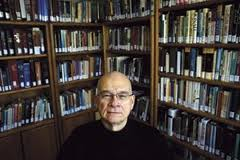
Tim Keller in office image

Owen Strachan with Tim Keller

I recently had the privilege of interviewing Manhattan pastor Tim Keller for Christianity Today. The interview was about Keller’s new book Encounters with Jesus: Unexpected Answers to Life’s Biggest Questions (Dutton, Nov. 2013). It’s a book that would be marvelous to read whether for one’s own edification or for the purposes of discipleship or evangelism. If you’re in college ministry, and in particular ministry to thoughtful students on a secular college campus, this book will be very valuable.

In the course of my free-ranging conversation with Keller, we touched on some matters that were not directly related to the book and thus weren’t included in the CT interview. I was helped and heartened by Keller’s characteristically winsome, gracious, and convictional thoughts on these topics, and I’m glad to share them.

Keller on quoting cultural authorities in his preaching to “bring people along”:

The only reason to do so is if you’re in an Acts 17 setting. In Acts 13, Paul goes to a synagogue and expounds the Bible. But these are people who trust the Bible…so Paul does a very simple exposition. In Acts 17, Paul’s talking to people with no faith. There’s disagreement over how much he’s quoting, but he quotes poets and pagan authors and makes a more common appeal to natural reason, as it were.

What I try to do since I have people in a spectrum—people who don’t trust the Bible at all or people who trust it a lot—so what I do is expound Scripture, and then I add sources where people agree. I’m not basing my authority on Dylan Thomas, but when I’m able to bring in someone that the broader culture really trusts, it helps the people who doubt biblical authority to see how the Bible is true.

If I was speaking in a Mars Hill situation, I might give a topical talk like Paul did. So most of my preaching is somewhere in the middle. I’m supplementing my points to make it a little easier for the skeptic to accept my point. I’m trying to bring people along; I want the person to come with me. In the earlier parts of my sermon I’m trying to fortify—this psychologist says that, and so on. But at the end, I’m bringing in Jesus as the solution to the problem, and I’m not using those sources anymore.

Keller on how the church should speak to the issue of homosexuality:

You always want to speak in the most disarming way, but still be very truthful. Both disarming and truthful. I’m not sure most of us speak in that way—trying to be both. Ed Clowney, former President of Westminster Theological Seminary, said this many years ago: We tend to say we preach the Bible, but you tend to preach the answers to the questions you’ve posed to the Bible. Whether you know it or not, you read the Bible with certain questions. A Korean might have a question in mind when he reads that an African wouldn’t have. Right now our culture asks certain questions and we can’t help but respond to them. We do that in the most disarming way, but to some degree we can’t ignore the culture’s questions. We need to give biblical answers to the culture’s questions. You don’t give them the answers they want, you give them the answers they need. You can’t be a responsible pastor if you don’t.

If we are going to shepherd and teach, we must give the most disarming and truthful answers.

Keller on how the church should handle the shift to transgender identity in the broader culture:

Jerome Kagan in The Atlantic has talked about how we’re all wired—there are three basic ways to deal with threats. Some run, some fight, some stop and get philosophical. You find this insight in neurochemistry—across 36 cultures, these instincts are wired into us. These are very much who we are. In only a small percentage of the threatening situations is our habitual approach the right one. The worst thing parents can do is listen to the culture when it says, “Let your child be who that child is. Don’t try to change him.” Kagan says that’s the worst thing you can do. Children need to be pulled out of their natural instincts. Parents need to intervene and not let their natures run them. Doing so is a form of child neglect.

I’ve never forgotten that with the transgender question. We’re told we can only affirm [this identity] today. The lack of wisdom in this response will become more evident over time. We’re now a radical individualistic culture. If you do anything against it, you’re sacrilegious. I think we’ll see 20 years of mistakes, and then we’ll realize it wasn’t a good idea.

Keller on the state of the complementarian movement:

The arguments are pretty well made now. At this point, complementarians need to get our own house in order and show that our families and churches are thriving places. That’s more important than anything right now….Kathy and I are very committed to saying that Christians are committed to complementarianism.

Read more: http://www.patheos.com/blogs/thoughtlife/2014/06/tim-keller-on-mars-hill-preaching-homosexuality-and-transgender-identity/#ixzz34R1n4Myf

A Passion for Preaching: An Interview with Steven J. Lawson

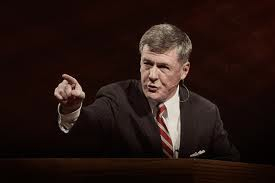
Steve Lawson pointing

Tabeltalk (TT): How did you become a Christian, and how were you called to ministry?

Steven J. Lawson: I grew up in a Christian home and was brought to faith as a young boy through the consistent witness of my father and mother. Specifically, it was through the reading of the Bible by my father each night that the seed of the gospel was planted, which God caused to germinate in my heart. Regarding my call to the ministry, I actually began preaching and teaching while in college in various ministries and churches. Upon graduating, I sat under the strong preaching of Adrian Rogers at Bellevue Baptist Church in Memphis, Tenn., and strongly felt God summoning me into full-time ministry. His bold preaching electrified my heart and served as the catalyst that launched me to seminary, where I would be prepared for a lifetime of ministry.

TT: What are the biggest challenges you have faced during your ministry? How have you faced these challenges?

SL: In my earlier years, the greatest challenges I faced were preaching the doctrines of grace to congregations that were theologically untaught. To say the least, it was difficult and demanding to try to establish God-centered truth and a biblical philosophy of ministry where there had previously been a stronghold of man-centered thinking concerning the work of God in salvation. Though it was obviously a painful process, the only way to meet such an obstacle was head-on, unashamedly preaching the full counsel of God. This required much prayer, pastoral discretion, patience, and perseverance, which God honored. Over time, God established His truth in the minds and hearts of many, though it came at a high price personally.

TT: What advice would you give to a young man who aspires to be a pastor?

SL: First, any man aspiring to the pastorate needs to be sitting under strong expository preaching. He needs a role model who exemplifies what is in his heart to do. Second, he needs a personal ministry whereby he can use what he is learning, test his giftedness, and cultivate what has been entrusted to him. Third, he should surround himself with a small circle of spiritually mature men who can provide wise counsel in helping steer his life and ministry as important decisions arise. Fourth, he must begin to inquire of various seminaries regarding his future theological education. He needs to contact some institutions, visit their campuses, and talk to some of the faculty. Fifth, he needs to become an avid reader of important Christian books, including the spiritual biographies of noted men who have been mightily used by God.

TT: How does a pastor remain faithful to his calling over the long haul?

SL: In order to persevere in ministry, a pastor needs to be, first and foremost, deeply rooted and anchored in God’s Word. The more he studies, learns, teaches, and preaches God’s Word, the greater will be his staying power in ministry. Further, reading Christian biographies of men who have faced great adversity in their ministries provides greater drive and endurance. Reading the heroic accounts of martyrs and missionaries who have faced great persecution should be at the top of his reading list. Likewise, being surrounded by a small group of laymen who will encourage him in God’s work is a necessity. Pastors can be vulnerable to severe bouts of discouragement. Having the edifying feedback of trusted individuals helps him remain steadfast in doing God’s work.

TT: Who has most influenced your preaching?

SL: There have been multiple influences upon my preaching—Adrian Rogers,W.A. Criswell, James Montgomery Boice, R.C. Sproul, John MacArthur, and S. Lewis Johnson. Each of these men has contributed something vitally important to my preaching ministry. Over many decades, John MacArthur has most shaped my approach to biblical exposition. He has influenced me in preaching through entire books of the Bible sequentially. I have learned from him the need for sound exegesis, word studies, historical background, crossreferences, theological precision, sermon outline, and manuscript writing. Moreover, Dr. MacArthur has demonstrated the need for guarding the gospel and teaching sound doctrine.

TT: Why have you focused so much of your attention to the practice of expository preaching and to helping both preachers and laypeople see its importance?

SL: I strongly believe that no church can rise any higher than its pulpit. As the pulpit goes, so goes the church. The deeper the preacher takes his flock into the Word of God, the higher they will rise in worship. The stronger they are in the Scripture, the stronger they will be in the pursuit of holiness. Likewise, strong preaching leads to sacrificial service in the Lord’s work. Strong exposition kindles hearts for the work of evangelism and the cause of worldwide missions. Every great movement of God in church history has been ushered in by a renewed commitment to solid preaching of the Word. If we are to see a spiritual awakening in our day, the church must recover the primacy of preaching. I desire to be used by God to help equip a new generation of preachers and laypeople in recognizing the importance of this primary means of grace.

TT: Can you describe for us what your sermon preparation looks like?

SL: I begin each week by photocopying everything that I need to read in order to prepare my sermon. This includes study Bibles, commentaries, expository sermons, linguistic and historical tools, and the like. I first read the passage and discover its literary unit, determining what verse or verses I will preach. After writing a block diagram and reading the passage in the original language, I identify the central theme of these verses. I then read all of my photocopied information, thoroughly marking it up. I draft the beginnings of a working outline for the sermon. I will start writing the sermon—with a fountain pen, I might add—beginning with the first homiletical point. I then move systematically through the text, creating a manuscript that explains and applies each successive part of the passage. I will then add transitions, illustrations, and quotations as needed. The final step is to write the introduction and conclusion. I will compose this manuscript as though I can hear myself preaching it. At last, I will review my manuscript for length, balance, and quality, praying over its truths.

TT: What is the purpose of OnePassion Ministries and how does it seek to accomplish its goals?

SL: OnePassion Ministries was created to help bring about a new reformation in this day. It has a website in which most all of my preaching and writing resources are found (www.onepassionministries.org). We are hosting conferences both nationally and internationally in order to train preachers, teachers, prospective pastors, and interested laypeople in the art and science of expository preaching and teaching. I want to define what it is, what it is not, and show how to effectively carry out this divine calling. I desire to help take people to the next level in their skills of handling and ministering God’s Word. Also, I want to motivate those who attend our conferences to be fully committed to preaching the Word expositionally. Moreover, we want to host conferences for all people in order to introduce them to Christ and encourage them in their Christian walk. Finally, we will be hosting church history tours in which I will take people to important historical sites around the world.

TT: Why did you decide to establish the book series A Long Line of Godly Men, and what other men do you hope to profile individually in this series?

SL: The Long Line series was birthed in my teaching ministry at the church that I pastor. As I was teaching the men of my church sound doctrine from Scripture, I wanted them to see that what we believe in the doctrines of sovereign grace has been the mainline position by great men and movements down through the centuries. Out of this Friday morning teaching series has arisen these books so that these essential truths may be made available to a wider audience around the world. There is much instruction and inspiration to be drawn from this profile study. In the future, I need to write volume three of the larger books, which will move from John Knox to this present hour. In the smaller books, there are other key figures who I want to address such as William Tyndale, John Wycliffe, Robert Murray M’Cheyne, D. Martyn Lloyd-Jones, and, yes, R.C. Sproul.

Steven J. Lawson is founder and president of OnePassion Ministries, a ministry designed to bring about biblical reformation in the church today, and former senior pastor of Christ Fellowship Baptist Church in Mobile, Ala. He has served as a pastor in Arkansas and Alabama for twenty-five years and is author of many books, including The Evangelistic Zeal of George Whitefield and In It to Win It: Pursuing Victory in the One Race That Really Counts. He is a teaching fellow for and serves on the board of Ligonier Ministries and the Ligonier Academy of Biblical and Theological Studies, and is professor of preaching at The Master’s Seminary.

Source: www.ligonier.org (June 1, 2014)

Q & A with Dr. Tim Keller on “The Meaning of Marriage”

The Meaning of Marriage Image

Interview Conducted by Karen Swallow Prior/ NOVEMBER 1, 2011

Why the pastor says gender roles are changing and how the church can be more effective in promoting marriage.

What does your book contribute to the conversation about marriage that other books have not?

It’s not simply a how-to manual. Many Christian marriage books are “here’s how to work on your problems.” On the other hand, the book is not just theological or “here’s the biblical view of marriage.” The most recent and the best-selling Christian books on marriage from the last few years were either theological, polemical, or absolutely practical. This is a combination of those.  Most books I know on the subject recently have not been written by pastors; they’ve been written by counselors or theologians or people like that. This book was originally a series of sermons. When you preach, the sermon usually goes from the theological to the more polemical and into the practical.

You suggest that the Bible’s teachings come “not only in well-stated propositions, but also through brilliant stories and moving poetry.” Has the contemporary church been less effective in presenting good stories about marriage than in stating propositions?

I don’t know that I would say the church has been great at laying out rules, and I don’t think it’s actually been very practical. The theological tends to be propositions. The polemical tends to be arguments. The practical uses lots of stories to give you the gist of what a good marriage should be like. Somewhere in Mystery and Manners, Flannery O’Connor was asked to put the basic point of her short story in a nutshell. She said, ‘If I could put it in a nutshell, I wouldn’t have had to write the story.’

I believe she says a story can’t be paraphrased.

Yes, that’s right. I think what she means is a story gives you an excess of meaning that no proposition could possibly convey, or even a set of propositions. There’s meaning that comes with a narrative that is certainly somewhat propositional—you can put some of it into propositions—but the impact is greater.

On a practical level, the church doesn’t do a great job of giving people a vision for what God wants marriage to be. I actually think that’s a way that my book is somewhat different in that it’s almost as much for a non-married person as for a married person. I actually think, in the end, what is very practical for both singles and married people is they need to get a breathtaking vision for what marriage should be. I don’t know if the strictly theological, strictly polemical, and strictly practical books do that.

One of the paradoxes you talk about is how the commitment of marriage actually produces freedom: the freedom to be truly ourselves, the freedom to be fully known, the freedom to be there in the future for those we love and who love us. Why do you believe that the commitment of marriage is viewed as largely anything but freeing today?

Our culture pits the two against each other. The culture says you have to be free from any obligation to really be free. The modern view of freedom is freedom from. It’s negative: freedom from any obligation, freedom from anybody telling me how I have to live my life. The biblical view is a richer view of freedom. It’s the freedom of—the freedom of joy, the freedom of realizing what I was designed to be.

If you don’t bind yourself to practice the piano for eight hours a day for ten years, you’ll never know the freedom of being able to sit down and express yourself through playing beautiful music. I don’t have that freedom. It’s very clear that to be able to do so is a freeing thing for people, with the diminishment of choice. And since freedom now is defined as all options, the power of choice, that’s freedom from. I don’t think ancient people saw these things as contradictions, but modern people do.

Your wife Kathy adheres to a complementarian view of gender roles but points out that a subdivision of labor can vary greatly within marriages and across cultures, generations, and societies. You state that cultural gender roles are not necessarily the same as biblical gender roles. Might this view might advance the egalitarian vs. complementarian debate beyond a current stalemate?

I don’t know. I would love that. Let’s just say, I hope so. I don’t have a lot of hopes right now about some of the stalemates we have in our evangelical world.

On the one hand, we say there is such a thing as male headship. It is irreducible in the home and in the church. But then, the details of what it looks like are almost completely un-spelled out. There are hints, but they are not laid out. We think it’s a principle for all times, all places, and all cultures, so if you had any list of specifics, it would make the principle less applicable. Complementarians admit the principle, but they always add a list of specifics that they treat as universal. Egalitarians won’t admit the principle. So, you might say we’re complementarians who endorse the principle that the husband and wife say “yes, the husband is the head,” but then we expect couples to come up with what that’s going to look like in their own marriage. Just don’t punt on the principle.

You describe marriage as a means for each spouse to “become their glorious future-selves through sacrificial service and spiritual friendship” and sex as one of the expressions of that relationship.  Such a purpose pre-supposes a belief in a biblical eschatology. What purpose does marriage serve for those who do not share such a belief?

It doesn’t have the vertical dimension. A Christian marriage shows me more of the gospel, shows me more of Christ’s love. But there’s no doubt that marriage has natural benefits, too. First, it creates a stable environment for the rearing of children, who can’t thrive as well anywhere else. It also brings the two genders together to complement one another and knock off the rough edges. Marriage provides the personal growth that comes through cross-gender relationships.

Do you think the question of gay marriage has been settled politically? Would it have been more effectively addressed by the church if the church had more effectively upheld and supported the biblical model of marriage?

Right now it seems as if gay marriage has the upper hand politically, but it’s hard to say whether 50 years from now gay marriage will still have public support. Gay marriage activists say that if you don’t believe in gay marriage, it’s the same as not believing in interracial marriage. They don’t realize that’s not at all the case, because the texts of the major religions do not treat the subjects of race and homosexuality the same.

What advice can you offer families who are devoting more hours to work and less to home and family because of the economy?

It’s a very hard time now economically. In the end, family has to take precedence over making money. As the saying goes, on one’s deathbed, no one says, “I wish I’d spent more time at the office.”

Source: www.christianitytoday.com (November 1, 2011)

Tim Keller Answers 10 Preaching Questions

Tim Keller Interview Conducted with Colin Adams

Tim Keller seated image

In great faith, I have written to a number of better-known preachers on both sides of the Atlantic. Each of them has been sent ten questions on the subject of preaching. The following is Tim Keller’s response. For those of you who don’t know, “Timothy J. Keller is an author, a speaker, and the founding pastor of Redeemer Presbyterian Church (PCA) in New York City, New York.”

1. Where do you place the importance of preaching in the grand scheme of church life?
It is central, but not alone at the center. Pastoral ministry is as important as preaching ministry, and lay “every-member” ministry is as crucial as ordained ministry. I wouldn’t make a hierarchy out of these things—they are interdependent. But pastoral ministry and lay ministry are not substitutes for strong preaching.

2. In a paragraph, how did you discover your gifts in preaching?
I preached about 200 different expositions a year for the first nine years of my ministry (when I was age 24 through 33). During that time I was considered interesting and good but I never got a lot of feedback that I was anything special. I’ve grown a lot through lots of practice.

3. How long (on average) does it take you to prepare a sermon?
I pastor a large church and have a large staff, and so I give special prominence to preparing the sermon. I give it 15–20 hours a week. I would not advise younger ministers to spend so much time, however. The main way to become a good preacher is to preach a lot, and to spend tons of time in people work—that is how you grow from becoming not just a Bible commentator but a flesh and blood preacher. When I was a pastor without a large staff, I put in six to eight hours on a sermon.

4. Is it important to you that a sermon contain one major theme or idea? If so, how do you crystallize it?
I don’t know that I’d be so rigid as to say there has to be just one Big Idea every time. That is a good discipline for preachers in general, because it helps with clarity. Most texts have too much in them for the preacher to cover in one address. You must be selective. But sometimes a preaching-size text simply has two or three major ideas that are too good to pass up.

5. What is the most important aspect of a preacher’s style and what should he avoid?
He should combine warmth and authority/force. That is hard to do, since temperamentally we incline one way or the other. (And many, many of us show neither warmth nor force in preaching.)

6. What notes, if any, do you use?
I use a very detailed outline, with many key phrases in each sub-point written out word for word.

7. What are the greatest perils that a preacher must avoid?
This seems to me too big a question to tackle here. Virtually everything a preacher ought to do has a corresponding peril-to-avoid. For examples, preaching should be Biblical, clear (for the mind), practical (for the will), vivid (for the heart,) warm, forceful, and Christo-centric. You should avoid the opposites of all these things.

8. How do you fight to balance preparation for preaching with other important responsibilities (e.g., pastoral care, leadership responsibilities)?
See my remarks on #3 above. It is a very great mistake to pit pastoral care and leadership against preaching preparation. It is only through doing people-work that you become the preacher you need to be—someone who knows sin, how the heart works, what people’s struggles are, and so on. Pastoral care and leadership are to some degree sermon prep. More accurately, it is preparing the preacher, not just the sermon. Prayer also prepares the preacher, not just the sermon.

9. What books on preaching, or exemplars of it, have you found most influential in your own preaching?
British preachers have had a much greater impact on me than American preachers (Dick Lucas, Alec Motyer and Martyn Lloyd-Jones). And the American preachers who have been most influential (e.g., Jonathan Edwards) were essentially British anyway.

10. What steps do you take to nurture or encourage developing or future preachers?
I haven’t done much on that front at all, and I’m not happy about that. Currently I meet with two other younger preachers on my staff who also preach regularly. We talk specifically about their preaching and sermon prep.

pastedGraphic.png

Colin Adams is the pastor of Ballymoney Baptist Church, Northern Ireland. For six years he had the privilege of serving as an Associate Pastor with Charlotte Baptist Chapel in Edinburgh. Before coming to Edinburgh he studied theology for four years at International Christian College in Glasgow.

More from Colin Adams or visit Colin at unashamedworkman.wordpress.com/

Source: http://www.churchleaders.com

8 THINGS EVERY CHILD NEEDS

baby imageEvery Child Needs…

At least one adult who is a positive role model.

To feel accepted.

Recognition.

A sense of belonging.

To feel safe and secure.

Some control over his or her environment.

Social interaction skills.

To accept responsibility for his or her behavior.

*SOURCE: Leah Davies condensed from http://www.kellybear.com