Faith and the Power of God by Jerry Bridges

Feeding of the 5000

The healing of the demon possessed boy (Matt. 17:14–20) at first glance seems to be only one more in a series of miraculous healings recorded by Matthew. What makes this one unique is Jesus’ emphasis on the role of faith. It is true that faith is prominent in the miracles recorded in chapter 9, but in chapter 17 it is the lack of faith that is emphasized by Jesus.

That God is not dependent on human faith for accomplishing His work is clear from the accounts of other miracles recorded by Matthew. The transfiguration of Jesus immediately prior to the healing of the boy is a prime example. It was a spectacular miracle; yet no human faith was involved. This is also true in the feeding of the five thousand (Matt. 14:13–21) and the four thousand (15:32–38). So the first thing we need to learn about faith and the power of God is that He is not dependent on our faith to do His work. God will not be hostage to our lack of faith.

The second thing we need to learn, however, is that God often requires our faith in the carrying out of His purposes. We see this in the healing of the demon possessed boy. Mark, in his account, brings this out sharply in Jesus’ conversation with the boy’s father. The father, in great distress, said to Jesus: “But if you can do anything, have compassion on us and help us” (Mark 9:22). He had already experienced the failure of the disciples, so he was not sure if Jesus could help. His faith at this point may be described as no more than an uncertain hope that Jesus could do what the disciples could not do.

Jesus responded to the father: “If you can! All things are possible for one who believes” (v. 23). Biblical faith may be described in different ways depending on the situation. The description of faith in Hebrews 11:1 as “the assurance of things hoped for, the conviction of things not seen,” was appropriate for the Jewish recipients of the letter, who were facing severe opposition and needed to be encouraged as to the certainty of their hope in Christ.

For the father of the boy, faith would mean believing that Jesus could heal his son. We are often like the father. We may face what seems to be an intractable situation, and because we have prayed a long time without an answer, we begin to doubt that God can answer our prayer. But we must believe that with God nothing is impossible.

Sarah, the wife of Abraham, doubted that God could give them a son in their advanced age, to which God replied, “Is anything too hard for the Lord?” (Gen. 18:14). Centuries later, the prophet Jeremiah wavered in his faith when God told him to buy a field in the face of the Chaldeans’ invasion (Jer. 32:6-26). Again God’s response was: “Is anything too hard for me?” (v. 27). To have faith in God, even in the face of unanswered prayer or a seemingly impossible situation, means we continue to believe that He can do what seems impossible to us.

The importance of faith is further emphasized in Jesus’ answer to the disciples’ question: “Why could we not cast it out?” (Matt. 17:19). He said it was because of their little faith. We are not told in what way their faith was deficient. We do know that Jesus had previously given them authority over demons to cast them out (Matt. 10:1–8), so why was their faith so weak at this time? Perhaps it was because the demon did not respond immediately to their command, and so they began to doubt the power of Jesus. Or perhaps they presumed that because they had been successful before, they would be at that time. So we see that faith not only involves a firm reliance on Jesus’ power and ability, but also a complete renunciation of any confidence in our own.

Last month we looked briefly at the subject of God’s providence. In Matthew 17 we see an example of it in action, in connection with a mundane event — the paying of the temple tax. Jesus, as the Son of God, was under no obligation to pay the tax. Yet in order to give no offense, He sent Peter to catch a fish in whose mouth was the required shekel. This brief account raises some questions: How did the shekel get into the mouth of the fish? How did Peter just “happen” to catch that fish and not another one nearby? It is possible that Jesus performed a miracle and created the coin out of nothing in the mouth of the fish.

It is more likely, however, that it was a work of providence. Someone “accidentally” dropped a shekel into the sea. A particular fish grabbed it, and it stuck in its mouth. The fish swam to the exact spot where Peter cast his net and the fish was caught. None of these events was miraculous; yet all of them were necessary to accomplish Jesus’ purpose, and Jesus was in control of each one of them. God’s power is as much at work in His providence as in His miracles. So as we struggle with our own faith, or lack of it, in the difficult situations of life, let us believe that God is able, whether through miracles or providence, to care for us.


About Dr. Jerry Bridges: an author and speaker, as well as a staff member at The Navigators in Colorado Springs, Colorado.

Article above from © Tabletalk magazine. July 1st, 2008. 
Permissions: You are permitted and encouraged to reproduce and distribute this material in any format provided that you do not alter the wording in any way, you do not charge a fee beyond the cost of reproduction, and you do not make more than 500 physical copies. For web posting, a link to this document on our website is preferred (where applicable). If no such link exists, simply link to http://www.ligonier.org/tabletalk. Any exceptions to the above must be formally approved by Tabletalk.

Please include the following statement on any distributed copy: From Ligonier Ministries and R.C. Sproul. © Tabletalk magazine. Website: http://www.ligonier.org/tabletalk. Email: tabletalk@ligonier.org. Toll free: 1-800-435-4343.

John C. Maxwell on “Listening to the Voices of Vision”

THE VOICES OF VISION

T21IQOAL Maxwell

Where does vision come from? To find the vision that is indispensable to leadership, you have to become a good listener. You must listen to several voices.

The Inner Voice: Vision starts within. Do you know your life’s mission? What stirs your heart? What do you dream about? If what you’re pursuing in life doesn’t come from a desire within—from the very depths of who you are and what you believe—you will not be able to accomplish it.

The Unhappy Voice: Where does inspiration for great ideas come from? From noticing what doesn’t work. Discontent with the status quo is a great catalyst for vision. Are you on complacent cruise control? Or do you find yourself itching to change your world? No great leader in history has fought to prevent change.

The Successful Voice: Nobody can accomplish great things alone. To fulfill a big vision, you need a good team. But you also need good advice from someone who is ahead of you in the leadership journey. If you want to lead others to greatness, find a mentor. Do you have an adviser who can help you sharpen your vision?

The Higher Voice: Although it’s true that your vision must come from within, you shouldn’t let it be confined by your limited capabilities. A truly valuable vision must have God in it. Only He knows your full capabilities. Have you looked beyond yourself, even beyond your own lifetime, as you’ve sought your vision? If not, you may be missing your true potential and life’s best for you.   —The 21 Indispensable Qualities of a Leader  

MAKE SURE YOUR VISION CONTAINS ALL THAT IT MUST FOR YOU TO REACH YOUR POTENTIAL.

Source: Maxwell, John C. (2008-10-28). The Maxwell Daily Reader: 365 Days of Insight to Develop the Leader Within You and Influence Those Around You (Kindle Locations 5088-5102). Thomas Nelson – A. Kindle Edition.

Zig Ziglar on “Being Gratefull For Your Problems”

Gene Tunney Boxer

We all frequently deal with people who complain about the trials and tribulations of their daily lives. Life seems to be one big problem for them. I would like to take a commonsense, realistic approach and address this mind-set. If there were no problems on your job, then your employer would hire a much less capable person than you to do the routine things that don’t require much thought. In the business world, those who are able to solve complex problems are the ones who are the most valuable to the employer.

Many times the problems or challenges we face force us to grow and become more capable. The runner who trains for the mile run in the Olympics by running downhill will have no chance of winning the medal. The runner who trains by running uphill is far more likely to develop the speed, mental toughness, and endurance needed to win the medal. The best thing that ever happened to boxer Gene Tunney was that he broke both hands in the ring. His manager felt that he could never again punch hard enough to be the heavyweight champion. Instead, Tunney decided that he would become a scientific boxer and win the title as a boxer, not a slugger. Boxing historians will tell you that he developed into one of the best boxers who ever fought. They also will tell you that as a puncher, he would not have had a chance against Jack Dempsey, who was considered by many to be the hardest hitter in heavyweight history. Tunny would never have been champion had he not had the problem of his broken hands.

Message: The next time you encounter a difficult climb, obstacle, or problem, you should smile and say, “Here’s my chance to grow”

*Article adapted from the very encouraging book by Zig Ziglar. Something to Smile About: Encouragement and Inspiration for Life’s Ups and Downs (Kindle Locations 1138-1141). Kindle Edition.

Dr. John Maxwell’s 5 Reasons to Live on Purpose

THE POWER OF PURPOSE

John C Maxwell seated

But I want you to know, brethren, that the things which happened to me have actually turned out for the furtherance of the gospel, so that it has become evident to the whole palace guard, and to all the rest, that my chains are in Christ; and most of the brethren in the Lord, having become confident by my chains, are much more bold to speak the word without fear. – PhiIippians 1:12-14

Paul might have been forgiven had he chosen to take a little sabbatical as he sat in prison, awaiting his trial. Yet he used even this opportunity to advance the gospel. Paul was a leader who never drifted from his mission. He determined to leave his mark wherever he went. How did Paul’s sense of purpose keep him in the battle as he sat in prison? What did he learn behind bars? Consider the following:

  1. A purpose will motivate you.
  2. A purpose will keep your priorities straight.
  3. A purpose will develop your potential.
  4. A purpose will give you power to live in the present.
  5. A purpose will help you evaluate your progress.

Article adapted from John C. Maxwell. Leadership Promises for Every Day (Kindle Locations 80-86). Kindle Edition.

“Living Gratitude” by Ellen Vaughn

RG Vaughn

On the whole, I do not find Christians, outside of the catacombs, sufficiently sensible of conditions. Does anyone have the foggiest idea what sort of power we so blithely invoke? Or, as I suspect, does no one believe a word of it? The churches are children playing on the floor with their chemistry sets, making up a batch of TNT to kill a Sunday morning. It is madness to wear ladies’ hats and straw hats and velvet hats to church; we should all be wearing crash helmets! Ushers should issue life preservers and signal flares; they should lash us to our pews. For the sleeping god may wake someday and take offense, or the waking god may draw us out to where we can never return. Annie Dillard

Having considered gratitude’s surprising blessings, as well as some of the obstacles that can block its flow, how then to develop a perpetual mindset of thankfulness? Is gratitude yet another discipline to be mastered, a potential source of guilt, another daily check box goal that grinds and binds us? No.

After a chat with Chuck Colson one day, off I went to the dentist. Chuck and I had been talking about gratitude, and in passing I mistakenly used the word “discipline” to describe it. Memo to self: Never use an imprecise word with Chuck Colson.

“Gratitude is not a discipline,” he growled, straightening his Prison Fellowship tie pin. “It is the response of the believer to the Spirit’s work.”

Soon after this I left Chuck’s office, arrived at the dentist’s, and settled into the chair. Dr. Funk injected Novocain in my front gum under my nose and in my jaw near my ear. Within a few minutes I couldn’t smell or hear, but I was feeling no pain. Then the doctor called in a dental assistant, and the two of them commenced military operations in my mouth. To remove myself from the stress of the immediate situation, my brain and I entered a deep and reflective meditative state, pondering Chuck’s words.

“He’s quite right,” we thought. Dr. Funk ground away. Tooth fragments flew through the air and settled in a fine dust on my soggy bib. “Gratitude is not a discipline. You can’t fall into the trap of treating it like one. You can’t resolve to be more grateful. Can’t conjure it up by your own determined effort, or it will blow away in the first strong breeze. Can’t go around telling yourself and others that we all must be grateful, we just really must, or you become a nag and no one invites you to Thanksgiving dinner.

“No, if grace is the gift of God, so too is the gratitude that grace creates.”

Ah. My dental-chair epiphany was quite freeing, even after the Novocain wore off. But while a perpetually thankful heart is a gift, receiving it does depend on a discipline or two. Four, actually.

There are four things that we can do to practice the presence of gratitude. When we do, we find that God further uncorks a flood of thankfulness. The four things are quite simple. Any child can do them. So can most adults. First, we remember. Second, we forget. Third, we look up to God. Fourth, we look around to His people.

Adapted from Ellen Vaughn (2009-05-19). Radical Gratitude: Discovering Joy through Everyday Thankfulness (Kindle Locations 1604-1624). Zondervan. Kindle Edition.

The Art of Cultivating a Heart of Gratitude in the Character of Christ by Dr. Ken Boa

Ken Boa

Our culture teaches us that people are basically good and that their internal problems are the result of external circumstances. But Jesus taught that no outside-in program will rectify the human condition, since our fundamental problems stem from within (Mark 7:20-23). Holiness is never achieved by acting ourselves into a new way of being. Instead, it is a gift that God graciously implants within the core of those who have trusted in Christ. All holiness is the holiness of God within us—the indwelling life of Christ. Thus, the process of sanctification is the gradual diffusion of this life from the inside (being) to the outside (doing), so that we become in action what we already are in essence. Our efforts faithfully reveal what is within us, so that when we are dominated by the flesh we will do the deeds of the flesh, and when we walk by the Spirit we will bear the fruit of the Spirit (Galatians 5:16-26).

A Process from the Inside to the Outside

Holiness is a new quality of life that progressively flows from the inside to the outside. As J. I. Packer outlines it in Keep in Step with the Spirit, the nature of holiness is transformation through consecration; the context of holiness is justification through Jesus Christ; the root of holiness is co-crucifixion and co-resurrection with Jesus Christ; the agent of holiness is the Holy Spirit; the experience of holiness is one of conflict; the rule of holiness is God’s revealed law; and the heart of holiness is the spirit of love. When we come to know Jesus we are destined for heaven because He has already implanted His heavenly life within us. The inside-out process of the spiritual life is the gradual outworking of this kingdom righteousness. This involves a divine-human synergism of dependence and discipline so that the power of the Spirit is manifested through the formation of holy habits. As Augustine put it, “Without God we cannot; without us, He will not.” Disciplined grace and graceful discipline go together in such a way that God-given holiness is expressed through the actions of obedience. Spiritual formation is not a matter of total passivity or of unaided moral endeavor, but of increasing responsiveness to God’s gracious initiatives. The holy habits of immersion in Scripture, acknowledging God in all things, and learned obedience make us more receptive to the influx of grace and purify our aspirations and actions.

“Beloved, if our heart does not condemn us, we have confidence before God” (1 John 3:21). It is wise to form the habit of inviting God to search your heart and reveal “any hurtful way” (Psalm 139:23) within you. Sustained attention to the heart, the wellspring of action, is essential to the formative process. By inviting Jesus to examine our intentions and priorities, we open ourselves to His good but often painful work of exposing our manipulative and self-seeking strategies, our hardness of heart (often concealed in religious activities), our competitively-driven resentments, and our pride. “A humble understanding of yourself is a surer way to God than a profound searching after knowledge” (Thomas A Kempis, The Imitation of Christ). Self-examining prayer or journaling in the presence of God will enable us to descend below the surface of our emotions and actions and to discern sinful patterns that require repentance and renewal. Since spiritual formation is a process, it is a good practice to compare yourself now with where you have been. Are you progressing in Christlike qualities like love, patience, kindness, forgiveness, compassion, understanding, servanthood, and hope? To assist you, here is a prayer sequence for examination and encouragement that incorporates the ten commandments, the Lord’s prayer, the beatitudes, the seven deadly sins, the four cardinal and three theological virtues, and the fruit of the Spirit. This can serve as a kind of spiritual diagnostic tool:

Search me, O God, and know my heart; Try me and know my anxious thoughts;

And see if there be any hurtful way in me, And lead me in the everlasting way. (Psalm 139:23-24)

Watch over your heart with all diligence, For from it flow the springs of life. (Proverbs 4:23)

The Ten Commandments

  1. You shall have no other gods before Me.
  2. You shall not make for yourself an idol.
  3. You shall not take the name of the Lord your God in vain.
  4. Remember the sabbath day, to keep it holy.
  5. Honor your father and your mother.
  6. You shall not murder.
  7. You shall not commit adultery.
  8. You shall not steal.
  9. You shall not bear false witness against your neighbor.
  10. You shall not covet.

The Lord’s Prayer
Our Father who is in heaven,

Hallowed be Your name.

Your kingdom come,

Your will be done,

On earth as it is in heaven.

Give us this day our daily bread.

And forgive us our debts, as we also have forgiven our debtors.

And do not lead us into temptation,

But deliver us from evil.

For Yours is the kingdom and the power and the glory forever.

The Beatitudes

Poverty of spirit (nothing apart from God’s grace)

Mourning (contrition)

Gentleness (meekness, humility)

Hunger and thirst for righteousness

Merciful to others

Purity of heart (desiring Christ above all else)

Peacemaking

Bearing persecution for the sake of righteousness

The Seven Deadly Sins

Pride

Avarice

Envy

Wrath

Sloth

Lust

Gluttony

The Four Cardinal and Three Theological Virtues

Prudence (wisdom, discernment, clear thinking, common sense)

Temperance (moderation, self-control)

Justice (fairness, honesty, truthfulness, integrity)

Fortitude (courage, conviction)

Faith (belief and trust in God’s character and work)

Hope (anticipating God’s promises)

Love (willing the highest good for others, compassion)

The Fruit of the Spirit

Love

Joy

Peace

Patience

Kindness

Goodness

Faithfulness

Gentleness

Self-control

Letting Loose of Control and Results

One of the great enemies of process spirituality is the craving to control our environment and the desire to determine the results of our endeavors. Many of us have a natural inclination to be manipulators, grabbers, owners, and controllers. The more we seek to rule our world, the more we will resist the rule of Christ; those who grasp are afraid of being grasped by God. But until we relinquish ownership of our lives, we will not experience the holy relief of surrender to God’s good and loving purposes. Thomas Merton put it this way in New Seeds of Contemplation:

This is one of the chief contradictions that sin has brought into our souls: we have to do violence to ourselves to keep from laboring uselessly for what is bitter and without joy, and we have to compel ourselves to take what is easy and full of happiness as though it were against our interests, because for us the line of least resistance leads in the way of greatest hardship and sometimes for us to do what is, in itself, most easy, can be the hardest thing in the world.

Our resistance to God’s rule even extends to our prayerful attempts to persuade the Lord to bless our plans and to meet our needs in the ways we deem best. Instead of seeking God’s will in prayer, we hope to induce Him to accomplish our will. Thus, even in our prayers, we can adopt the mentality of a consumer rather than a servant.

Perhaps the most painful lesson for believers to learn is the wisdom of being faithful to the process and letting loose of the results.

Opportunity Obedience Outcome
Divine Sovereignty Human Responsibility Divine Sovereignty

We have little control over opportunities we encounter and the outcomes of our efforts, but we can be obedient to the process.

Distorted dreams and selfish ambitions must die before we can know the way of resurrection. We cannot be responsive to God’s purposes until we abandon our strategies to control and acknowledge His exclusive ownership of our lives. At the front end, this surrender to the life of Christ in us appears to be the way of renunciation, but on the other side of renunciation we discover that it is actually the way of affirmation. “For whoever wishes to save his life will lose it, but whoever loses his life for My sake, he is the one who will save it” (Luke 9:24). The better we apprehend our spiritual poverty and weakness, the more we will be willing to invite Jesus to increase so that we may decrease (John 3:30).

Another key to staying in the process is learning to receive each day and whatever it brings as from the hand of God. Instead of viewing God’s character in light of our circumstances, we should view our circumstances in light of God’s character. Because God’s character is unchanging and good, whatever circumstances He allows in the life of His children are for their good, even though they may not seem so at the time. Since His will for us is “good and acceptable and perfect” (Romans 12:2), the trials, disappointments, setbacks, tasks, and adversities we encounter are, from an eternal vantage point, the place of God’s kingdom and blessing. This Romans 8:28-39 perspective can change the way we pray. Instead of asking the Lord to change our circumstances to suit us, we can ask Him to use our circumstances to change us. Realizing that “the sufferings of this present time are not worthy to be compared with the glory that is to be revealed to us” (Romans 8:18), we can experience “the fellowship of [Christ’s] sufferings” through “the power of His resurrection” (Philippians 3:10). Thus, Blaise Pascal prayed in his Pensees:

With perfect consistency of mind, help me to receive all manner of events. For we know not what to ask, and we cannot ask for one event rather than another without presumption. We cannot desire a specific action without presuming to be a judge, and assuming responsibility for what in Your wisdom You may hide from me. O Lord, I know only one thing, and that is that it is good to follow You and wicked to offend You. Beyond this, I do not know what is good for me, whether health or sickness, riches or poverty, or anything else in this world. This knowledge surpasses both the wisdom of men and of angels. It lies hidden in the secrets of Your providence, which I adore, and will not dare to pry open.

We are essentially spiritual beings, and each “today” that is received with gratitude from God’s hand contributes to our preparation for our glorious and eternal destiny in His presence. In “the sacrament of the present moment” as Jean-Pierre de Caussade described it, “It is only right that if we are discontented with what God offers us every moment, we should be punished by finding nothing else that will content us” (Abandonment to Divine Providence). It is when we learn to love God’s will that we can embrace the present moment as a source of spiritual formation.

As we grow in dependence on Christ’s life and diminish in dependence on our own, the fulfillment of receiving His life gradually replaces the frustration of trying to create our own. It is in this place of conscious dependence that God shapes us into the image of His Son. Here we must trust Him for the outcome, because we cannot measure or quantify the spiritual life. We know that we are in a formative process and that God is not finished with us yet, but we must also remember that we cannot control or create the product. Furthermore, we cannot measure our ministry or impact on others in this life. If we forget this, we will be in a hurry to accomplish significant things by the world’s standard of reckoning. Frances Felenon noted that “the soul, by the neglect of little things, becomes accustomed to unfaithfulness” (Christian Perfection). It is faithfulness in the little daily things that leads to faithfulness in much (Luke 16:10). Henri Nouwen used to ask God to get rid of his interruptions so he could get on with his ministry. “Then I realized that interruptions are my ministry.” As servants and ambassadors of the King, we must be obedient in the daily process even when we cannot see what difference our obedience makes.

Cultivating a Heart of Gratitude

A young man with a bandaged hand approached the clerk at the post office. “Sir, could you please address this post card for me?” The clerk did so gladly, and then agreed to write a message on the card.

He then asked, “Is there anything else I can do for you?” The young man looked at the card for a moment and then said, “Yes, add a PS: ‘Please excuse the handwriting.’”

We are an ungrateful people. Writing of man in Notes from the Underground, Dostoevsky says, “If he is not stupid, he is monstrously ungrateful! Phenomenally ungrateful. In fact, I believe that the best definition of man is the ungrateful biped.” Luke’s account of the cleansing of the ten lepers underscores the human tendency to expect grace as our due and to forget to thank God for His benefits. “Were there not ten cleansed? But the nine—where are they? Was no one found who turned back to give glory to God, except this foreigner?” (Luke 17:17-18).

Remember: God’s Deliverance in the Past

Our calendar allocates one day to give thanks to God for His many benefits, and even that day is more consumed with gorging than with gratitude. Ancient Israel’s calendar included several annual festivals to remind the people of God’s acts of deliverance and provision so that they would renew their sense of gratitude and reliance upon the Lord.

In spite of this, they forgot: “they became disobedient and rebelled against You . . . . they did not remember Your abundant kindnesses . . . . they quickly forgot His works” (Nehemiah 9:26;Psalm 106:7, 13). The prophet Hosea captured the essence of this decline into ingratitude: “As they had their pasture, they became satisfied, and being satisfied, their heart became proud; therefore, they forgot Me” (13:6). When we are doing well, we tend to think that our prosperity was self-made; this delusion leads us into the folly of pride; pride makes us forget God and prompts us to rely on ourselves in place of our Creator; this forgetfulness always leads to ingratitude.

Centuries earlier, Moses warned the children of Israel that they would be tempted to forget the Lord once they began to enjoy the blessings of the promised land. “Then your heart will become proud and you will forget the Lord your God who brought you out from the land of Egypt, out of the house of slavery. . . . Otherwise, you may say in your heart, ‘My power and the strength of my hand made me this wealth’” (Deuteronomy 8:14, 17). The antidote to this spiritual poison is found in the next verse: “But you shall remember the Lord your God, for it is He who is giving you power to make wealth” (8:18).

Our propensity to forget is a mark of our fallenness. Because of this, we should view remembering and gratitude as a discipline, a daily and intentional act, a conscious choice. If it is limited to spontaneous moments of emotional gratitude, it will gradually erode and we will forget all that God has done for us and take His grace for granted.

Remember: God’s Benefits in the Present

“Rebellion against God does not begin with the clenched fist of atheism but with the self-satisfied heart of the one for whom ‘thank you’ is redundant” (Os Guinness, In Two Minds). The apostle Paul exposes the error of this thinking when he asks, “What do you have that you did not receive? And if you did receive it, why do you boast as if you had not received it?” (1 Corinthians 4:7). Even as believers in Christ, it is quite natural to overlook the fact that all that we have and are—our health, our intelligence, our abilities, our very lives—are gifts from the hand of God, and not our own creation. We understand this, but few of us actively acknowledge our utter reliance upon the Lord throughout the course of the week. We rarely review the many benefits we enjoy in the present. And so we forget.

We tend toward two extremes when we forget to remember God’s benefits in our lives. The first extreme is presumption, and this is the error we have been discussing. When things are going “our way,” we may forget God or acknowledge Him in a shallow or mechanical manner. The other extreme is resentment and bitterness due to difficult circumstances. When we suffer setbacks or losses, we wonder why we are not doing as well as others and develop a mindset of murmuring and complaining. We may attribute it to “bad luck” or “misfortune” or not “getting the breaks,” but it really boils down to dissatisfaction with God’s provision and care. This lack of contentment and gratitude stems in part from our efforts to control the content of our lives in spite of what Christ may or may not desire for us to have. It also stems from our tendency to focus on what we do not possess rather than all the wonderful things we have already received.

“Rejoice always; pray without ceasing; in everything give thanks; for this is God’s will for you in Christ Jesus” (1 Thessalonians 5:16-18). We cannot give thanks and complain at the same time. To give thanks is to remember the spiritual and material blessings we have received and to be content with what our loving Lord provides, even when it does not correspond to what we had in mind. Gratitude is a choice, not merely a feeling, and it requires effort especially in difficult times. But the more we choose to live in the discipline of conscious thanksgiving, the more natural it becomes, and the more our eyes are opened to the little things throughout the course of the day that we previously overlooked. G. K. Chesterton had a way of acknowledging these many little benefits: “You say grace before meals. All right. But I say grace before the concert and the opera, and grace before the play and pantomime, and grace before I open a book, and grace before sketching, painting, swimming, fencing, boxing, walking, playing, dancing and grace before I dip the pen in the ink.” Henri Nouwen observed that “every gift I acknowledge reveals another and another until, finally, even the most normal, obvious, and seemingly mundane event or encounter proves to be filled with grace.”

Remember: God’s Promises for the Future

If we are not grateful for God’s deliverance in the past and His benefits in the present, we will not be grateful for His promises for the future. Scripture exhorts us to lay hold of our hope in Christ and to renew it frequently so that we will maintain God’s perspective on our present journey. His plans for His children exceed our imagination, and it is His intention to make all things new, to wipe away every tear, and to “show the surpassing riches of His grace in kindness toward us in Christ Jesus” in the ages to come (Ephesians 2:7).

Make it a daily exercise, either at the beginning or the end of the day, to review God’s benefits in your past, present, and future. This discipline will be pleasing to God, because it will cultivate a heart of gratitude and ongoing thanksgiving.

The Secret of Contentment

“We want a whole race perpetually in pursuit of the rainbow’s end, never honest, nor kind, nor happy now, but always using as mere fuel wherewith to heap the altar of the future every real gift which is offered them in the Present.” Uncle Screwtape’s diabolical counsel to his nephew Wormwood in C. S. Lewis’ The Screwtape Letters is a reminder that most of us live more in the future than in the present. Somehow we think that the days ahead will make up for what we perceive to be our present lack. We think, “When I get this or when that happens, then I’ll be happy,” but this is an exercise in self-deception that overlooks the fact that even when we get what we want, it never delivers what it promised.

Most of us don’t know precisely what we want, but we are certain we don’t have it. Driven by dissatisfaction, we pursue the treasure at the end of the rainbow and rarely drink deeply at the well of the present moment, which is all we ever have. The truth is that if we are not satisfied with what we have, we will never be satisfied with what we want.

The real issue of contentment is whether it is Christ or ourselves who determine the content (e.g., money, position, family, circumstances) of our lives. When we seek to control the content, we inevitably turn to the criterion of comparison to measure what it should look like. The problem is that comparison is the enemy of contentment—there will always be people who possess a greater quality or quantity of what we think we should have. Because of this, comparison leads to covetousness. Instead of loving our neighbors, we find ourselves loving what they possess.

Covetousness in turn leads to a competitive spirit. We find ourselves competing with others for the limited resources to which we think we are entitled. Competition often becomes a vehicle through which we seek to authenticate our identity or prove our capability. This kind of competition tempts us to compromise our character. When we want something enough, we may be willing to steamroll our convictions in order to attain it. We find ourselves cutting corners, misrepresenting the truth, cheating, or using people as objects to accomplish our self-driven purposes.

It is only when we allow Christ to determine the content of our lives that we can discover the secret of contentment. Instead of comparing ourselves with others, we must realize that the Lord alone knows what is best for us and loves us enough to use our present circumstances to accomplish eternal good. We can be content when we put our hope in His character rather than our own concept of how our lives should appear.

Writing from prison to the believers in Philippi, Paul affirmed that “I have learned to be content in whatever circumstances I am. I know how to get along with humble means, and I also know how to live in prosperity; in any and every circumstance I have learned the secret of being filled and going hungry, both of having abundance and suffering need” (Philippians 4:11-12). Contentment is not found in having everything, but in being satisfied with everything we have. As the Apostle told Timothy, “we have brought nothing into the world, so we cannot take anything out of it either. If we have food and covering, with these we shall be content” (1 Timothy 6:7-8). Paul acknowledged God’s right to determine his circumstances, even if it meant taking him down to nothing. His contentment was grounded not in how much he had but in the One who had him. Job understood this when he said, “Naked I came from my mother’s womb, and naked I shall return there. The Lord gave and the Lord has taken away. Blessed be the name of the Lord” (Job 1:21). The more we release temporal possessions, the more we can grasp eternal treasures. There are times when God may take away our toys to force us to transfer our affections to Christ and His character.

A biblical understanding of contentment leads to a sense of our competency in Christ. “I can do all things through Him who strengthens me” (Philippians 4:13). As Peter put it, “His divine power has granted to us everything pertaining to life and godliness” (2 Peter 1:3). “Not that we are adequate in ourselves to consider anything as coming from ourselves, but our adequacy is from God” (2 Corinthians 3:5). Contentment is not the fulfillment of what we want, but the realization of how much we already possess in Christ.

A vision of our competency in Christ enables us to respond to others with compassion rather than competition, because we understand that our fundamental needs are fulfilled in the security and significance we have found in Him. Since we are complete in Christ, we are free to serve others instead of using them in the quest to meet our needs. Thus we are liberated to pursue character rather than comfort and convictions rather than compromise.

Notice the contrast between the four horizontal pairs in this chart:

WHO DETERMINES THE CONTENT OF YOUR LIFE?

SELF

CHRIST

Comparison

Covetousness

Competition

Compromise

Contentment

Competency

Compassion

Character

As we learn the secret of contentment, we will be less impressed by numbers, less driven to achieve, less hurried, and more alive to the grace of the present moment.

Article adapted from several sources on the Internet – most likely originally from Bible.org or Monergism.com. Dr. Ken Boa is an outstanding Bible scholar, and Spiritual director, and author of numerous helpful books including the Outstanding Textbook on the Subject of Sanctification and Spiritual Formation: Conformed To His Image.


A Christian Harvard Law Professor Speaks Wisely About His Stage 4 Cancer

Dr. Bill Stuntz Godly Response to His Cancer Diagnosis

William Stuntz 1958 to 2011

My cancer has been promoted: I’m officially in stage 4. My doctors have found two can- cerous nodules—a euphemism for “small tumors”—one on each of my lungs. I started chemo this week. Next week, I’ll see a thoracic surgeon who will, sometime this summer, cut those tumors out. Needless to say, this isn’t good news—though, thanks to medical advances (especially, thanks to those evil drug companies that politicians regularly attack), it isn’t disastrous news either. We’ll see what the future brings.

I don’t have any previous experience with this sort of thing, but judging from what I hear and read, I’m supposed to be asking why all this is happening, and why it’s happening to me. Honestly, those questions are about the farthest thing from my mind.

Partly, that’s because they aren’t hard questions. Why does our world have gravity? Why does the sun rise in the East? There are technical answers, but the meta- physical answer is simple: that’s how reality works. So too here. Only in the richest parts of the rich world of the twenty-first century could anyone entertain the thought that we should expect long, pain-free lives. Suffering and premature death (an odd phrase: what does it mean to call death “premature”?) are constant presences in the lives of most of the peoples of the Earth, and were routine parts of life for generations of our predecessors in this country—as they still are today, for those with their eyes open. Stage 4 cancers happen to middle-aged men and women, seemingly out of the blue, because that’s how reality works.

As for why this is happening to me in particular, the implicit point of the question is an argument: I deserve better than this. There are two responses. First, I don’t—I have no greater moral claim to be free from unwanted pain and loss than anyone else. Plenty of people more virtuous than I am suffer worse than I have, and some who don’t seem virtuous at all skate through life with surprising ease. Welcome to the world.

Once again, it seems to me that this claim arises from the incredibly unusual experience of a small class of wealthy professionals in the wealthiest parts of the world today. We think we live in a world governed by merit and moral desert. It isn’t so. Luck, fortune, fate, providence—call it what you will, but whatever your preferred label, it has far more to do with the successes of the successful than what any of us deserves. Aristocracies of the past awarded wealth and position based on the accident of birth. Today’s meritoc- racies award wealth and position based on the accident of being in the right place at the right time. The difference is smaller than we tend to think. Once you under- stand that, it’s hard to maintain a sense of grievance in the face of even the ugliest medical news. I’ve won more than my share of life’s lotteries. It would seem churlish to rail at the unfairness of losing this one—if indeed I do lose it: which I may not.

The second response is sim- pler; it comes from the movie “Unforgiven.” Gene Hackman is dying, and says to Clint Eastwood: “I don’t deserve this. To die like this. I was building a house.” Eastwood responds: “Deserve’s got nothing to do with it.”

That gets it right, I think. It’s a messed-up world, upside-down as often as it’s rightside up. Bad things happen; future plans (that house Hackman was building) come to naught. Deserve’s got nothing to do with it.

Why, then, are we so prone to think otherwise? This is one of the biggest reasons I believe my faith is true: something deep within us expects, even demands moral order—in a world that shouts from the rooftops that no such order exists. Any good metaphysical theory must explain both of those phenomena: both the expectation and the lack of supporting evidence for the thing expected. The only persuasive way to get there, I think, is to begin with a world made good that was twisted, corrupted, bent. Buried deep in our hearts are hints of the way things ought to be; the ugliest reality can’t snuff them out. Still, that reality exists; it can’t be denied. Christianity sees that reality, recognizes it for what it is—but also sees the expectation, and recognizes where it comes from.

Bottom line: I don’t need anyone to tell me why I’m in the situation I’m in, and I certainly don’t think I merit an exemption from the rottenness to which the rest of the world is subject.

But I do need to know some things. Three, to be precise: first, that I’m not alone; second, that my disease has not made me ugly to those I love and to the God who made me; and third, that somehow, something good can come from this. My faith tells me that the God of the universe suf- fered everything I suffer and infinitely worse. Death and suffering don’t separate human beings from our Creator—on the contrary: those things unite us with our Creator. The barrier became the bridge: that is the great miracle of the Incarnation, the Cross, and the Resurrection. So I need never suffer alone. Job’s story confirms that, far from rejecting the ugli- ness of disease and pain, God embraces those who suffer and takes on their suffering. Beauty and ugliness are turned inside-out. Joseph’s story and the gospels alike show a God who delights to use the worst things to produce the best things. That doesn’t make life’s hells less than hellish. But it does make them bearable.

This isn’t just whistling in the dark—at least, I hope it isn’t. It all makes sense to me: it fits the world I see and feel, with all its shades of glory and misery. And it answers the questions my soul cries out. “Why” isn’t one of those questions.

Article adapted from: http://www.law.upenn.edu/blogs/dskeel/archives/2008/04/ more_cancerstuntz.html#more

[In Dr. Fritzt own words: “I’m a law professor—I teach criminal law and criminal procedure at Harvard—and also an evangelical Christian.That puts [me] in a pretty small, and maybe pretty weird, demo- graphic. I’m also a political junkie and a registered Republican, though I’ve cast as many Democratic votes as Republican ones. I’m interested in all those things—law and legal theory, crime and criminal justice, everything about American politics and political culture, the culture of evangelical Protestantism, and the intersections of various items on that list.] From: http://www.law.upenn.edu/ blogs/dskeel/archives/2008/02/ welcome.html]

 Harvard Law School: Obituary for Dr. Stuntz

William Stuntz, a renowned scholar of criminal justice at Harvard Law School,  an evangelical Christian and a teacher much beloved by students and colleagues, died March 15 after a long battle with cancer.

Stuntz, 52, joined the HLS faculty in 2000 and was named the Henry J. Friendly Professor of Law in 2006. His influential scholarship over the past three decades addressed the full spectrum of issues related to criminal justice and procedure, from the overcrowding of prisons and racial disparities in incarceration to the appropriate role of faith, emotion and mercy in the penal system. He authored three dozen law review articles and essays on criminal law, and published articles and op-eds in the New York Times, Christianity Today, First Things, The New Republic and The Weekly Standard.  This fall,  Harvard University Press will publish a book he authored on the collapse of the criminal justice system.

In a statement to the Harvard Law School community today, Dean Martha Minow observed: “Bill was extraordinary; his wisdom and compassion touched our lives in so many ways, large and small.  His gifts to society through his scholarship and teaching on criminal law and justice changed and improved academic inquiry and policies on the ground.  His scholarship and teaching of Christian legal theory and of confronting life’s burdens inspire people in our community and well beyond it.  He imbued his work and his life with a vision of mercy and compassion.  The Harvard Law School, the larger community of scholars, and the communities connected through Bill’s writings are better, wiser, kinder because of Bill.”

That kindness—and a personal style marked also by good humor and generosity—profoundly affected those who knew Stuntz or knew of him through his writing. As Minow wrote: “Among his many gifts to us was the grace with which he lived his life.  In knowing Bill, we couldn’t help but be reminded to live life as our better selves.  Bill once wrote, ‘We understand that the world is not what it should be, and that our own capacities to understand it are severely limited.’  He described and lived his life in recognition of the need for humility and also for judgment and work to repair what we find around us.  His devotion to family and friends remains legendary. Those of us lucky enough to have been able to consult with him for personal or professional advice will never forget his insights and generosity.”

Carol Steiker, the Howard J. and Katherine W. Aibel Professor of Law at HLS, and a criminal justice scholar who was a close colleague of Stuntz, said: “He was an extraordinary and unforgettable teacher, scholar, colleague and friend. He was someone we’ll all miss, more than we can really say.”

Celebrated for his unusual ability to appeal to a wide variety of legal scholars and others of all political and methodological perspectives, Stuntz was generous with his time and guidance. Colleagues and students were especially struck by his open-mindedness, as reflected in his willingness to listen to a variety of opinions and to change his own when he felt it appropriate. Many observed that his style served as a model for civil discourse.

Extremely popular among his students for his compassion and accessibility, Stuntz was the 2004 recipient of the HLS Sacks-Freund Teaching Award, given by the graduating class to honor a professor for his or her contributions to teaching. In the upcoming week, the the Harvard Law & Policy Review will be publishing a series of student reflections on Professor Stuntz (Read the introduction to the collection at http://hlpronline.com/2011/03/professor-bill-stuntz-in-memoriam/).

From his perspective as a legal scholar and also an evangelical Protestant, Stuntz co-authored a blog that addressed law, politics, and other topics, “Less Than the Least,” with fellow evangelical David Skeel, a law professor at the University of Pennsylvania Law School. As they noted in their blog, “We are both law professors and evangelical Protestants – a weird combination in our time. We hope it’s also an interesting combination.” Stuntz wrote honestly and lyrically, with humor and wisdom, about his struggles with chronic pain and his long battle with cancer, as well as the role of his religious faith in helping him deal with his illnesses.

Said Skeel: “Although Bill was an enormously influential scholar, and was widely viewed as the leading criminal procedure scholar of the past generation, he may have had an even broader impact writing and speaking about his struggles with cancer the past three years, and with debilitating back pain before that. His blog posts and other writings have been reprinted in numerous church bulletins and widely circulated elsewhere. I’ve never known anyone who lived out the Christian call to love one’s neighbor as oneself the way Bill did. He was an inspiration to everyone who came into contact with him.”

Many readers of the blog, including fellow cancer patients, wrote of being deeply touched by the honesty and compassion that imbued his writing.

A year ago, in March 2010, a large group of his many admirers, including legal scholars, colleagues, friends, and students—“a simply dazzling array of conference participants,” as Dean Martha Minow said in opening remarks—gathered at HLS for a two-day conference, “A Celebration of the Career of Bill Stuntz.” In tribute after tribute, they noted that Stuntz had exerted a tremendous influence on the fields of American criminal justice and criminal procedure while at the same time having a profound effect, professionally and personally, on so many who worked with or were taught by him.

Present at the conference, Stuntz described factors that had led to what he called the “disaster of criminal justice in our time,” in particular, the massive and “racially unfair” prison population in the U.S., but held out hope that the system might become fairer.

HLS Professor Jeannie Suk ’02, a former student of Stuntz, and a moderator of one of the panels at the conference, said after learning of Stuntz’s death: “He was a wonderful mentor to me since my time as a student at Harvard Law School. He was the one, when I was a student, who looked me right in the eye and told me not to worry about seeing things that might be unconventional or that might surprise or anger people, that it was a good thing if I had those instincts. He encouraged me to develop that and to be unafraid.”

She added, “The whole time I was an assistant professor, he was very ill, yet … he would stop by my office, he would read all my drafts [of articles] and have something to say about them, with great insight. I really think he was one of the main reasons, the primary reason, I became a professor, that I became a criminal law scholar.”

Born on July 3, 1958, Stuntz grew up in Annapolis, then attended the College of William and Mary and the University of Virginia School of Law.  After two judicial clerkships, he was a professor at the University of Virginia for 14 years until he joined the Harvard Law faculty in 2000.

Stuntz was the loving husband of Ruth Stuntz of Belmont, and devoted father of Sarah Stuntz, Andrew Stuntz, and Samuel Cook-Stuntz, all of Cambridge. He also leaves his parents, John and Sandy Stuntz of Annapolis, Md., and siblings, Linda Adamson of Annapolis, Michael Stuntz of Silver Spring, Md., Richard Stuntz of Annapolis, and David Stuntz of Durham, NC, as well as many nieces and nephews, and a daughter-in-law, Elizabeth Cook-Stuntz.

A memorial service will be held at Park Street Church in Boston on Saturday, March 19 at 5:00 p.m. In lieu of flowers, guests should feel free to make donations to International Justice Mission (www.ijm.org) or the Cancer Center Priorities Fund at Massachusetts General Hospital (165 Cambridge Street, Suite 600, Boston, MA 02114-2792).

“Charles Haddon Spurgeon’s Humor”

Dr. Larry J. Michael and C.H. Spurgeon on “The Medicine of Laughter”

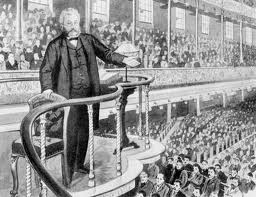
Spurgeon in pulpit image

Dr. Larry Michael is senior pastor at First Baptist Church in Clanton, Ala. He serves as an adjunct professor at Beeson Divinity School in Birmingham. This article is an adaptation of writings from the upcoming book, Spurgeon on Leadership, Kregel Publications, scheduled for release October 2003.

Some years ago there was a documented case in the British Medical Journal about a man who laughed himself well. He actually had a terminal illness, and through the employment of laughter therapy, he allowed his body to successfully fight the disease.

While we may smilingly acknowledge the merit of such a case, for the most part, we find such an incident almost incredible. Can laughter really be that good for us? The Bible definitely supports such a notion.

The Bible advocates laughter

The writer of Ecclesiastes stated: “There’s a time to laugh, and a time to cry” (Ecclesiastes 3:4). We know that there are plenty of reasons to cry. Just a casual glance at our world, with its wars, hatred, violence and evil — makes us sad. Every day we see/hear on the news horrible accounts of hurting people who hurt others. We are grieved at the plight of so many persons who are living in darkness and have rejected the light of Christ. The stark reality of sin in our world is indeed sobering.

It’s not surprising that many of us as leaders may be more inclined toward sadness than to joy. Given the nature and demands of Christian leadership in an increasingly challenging world, one could cynically surmise that leaders may have more reason to be glum than glad these days. The pressures of our organizational responsibilities, and the accompanying stresses, can drag us down. Handling church conflict, losing someone special, helplessly seeing a marriage dissolve, experiencing personal betrayal, facing an unsuspected tragedy — all may give cause for tears.

To counter the sad times, the Scripture also advises that there is a time to laugh. Leaders need to know the balancing therapy of laughter. Toward that goal, we should fully embrace the joys of ministry — celebrating special moments with members, “high-fiving” family achievements, relishing the reaching of hard-earned goals, and savoring the blessing of spiritual growth. But those experiences may still fall short of the biblical pronouncement regarding laughter. C’mon, when was the last time you laughed so hard you cried?! Or, you actually had a good belly laugh?

Spurgeon’s great sense of humor

Many evangelicals know well the stern side of C. H. Spurgeon and his serious pursuit of the holy life. Indeed, his stands for righteous causes, and countering doctrinal error are often recounted. But many readers may not know that he was a man with a great sense of humor. Spurgeon knew the value of laughter and mirth. He virtually took to heart the word in Proverbs 17:22: “A merry heart doeth good like a medicine.”

Spurgeon laughed as often as he could. He laughed at the ironies of life, he laughed at comical incidents, he laughed at the amusing elements of nature. He sometimes laughed at his critics. He loved to share wholesome jokes with his friends and colleagues in ministry. He was known to tell humorous stories from the pulpit. William Williams, a fellow pastor who kept company with Spurgeon, was a near and dear friend in the latter years of Spurgeon’s life. He wrote:

What a bubbling fountain of humour Mr. Spurgeon had! I laughed more, I verily believe, when in his company than during all the rest of my life besides. He had the most fascinating gift of laughter . . . and he had also the greatest ability for making all who heard him laugh with him. When someone blamed him for saying humourous things in his sermons, he said, “He would not blame me if he only knew how many of them I keep back.” 1

Spurgeon considered humor such an integral part of his ministry that a whole chapter in his autobiography is devoted to it. Humor permeates his sermons and writings, often woven into the fabric of his messages. It’s one reason among many why he is still so readable today.

The therapy of laughter

Spurgeon knew the blessing of the treatment of humor. He often spoke of his illness in humorous terms: “I have had sharp pains,” he wrote to a friend, “but I am recovering. Only my back is broken, and I need a new vertebrae.” 2 Once, when he was feeling depressed, he spoke of the remedy of laughter:

The other evening I was riding home after a heavy day’s work. I felt wearied and sore depressed, when swiftly and suddenly that text came to me, ‘My grace is sufficient for thee.’ I reached home and looked it up in the original, and at last it came to me in this way. ‘My grace is sufficient for THEE.’ And I said, ‘I should think it is, Lord,’ and I burst out laughing. I never understood what the holy laughter of Abraham was till then. It seemed to make unbelief so absurd…O brethren, be great believers. Little faith will bring your souls to heaven, but great faith will bring heaven to your souls. 3

Some of Spurgeon’s humor even bordered on the cynical — like the time he was embroiled in the Baptismal Regeneration Controversy. When Spurgeon took on the Church of England clerics because of their belief in baptismal regeneration, he had a baptismal font installed in his back garden as a birdbath. He referred to it as “the spoils of war.” While the great “Prince of Preachers” may have gone over the top on that one, for the most part, his humor was balanced and appropriate.

Laughter a needful release

Laughter is an important release in a leader’s life. It is much-needed therapy for positions that are most often fraught with stress and the burdens of the day. Certainly there is a time to be sober as we face many tough situations in our lives and ministries. But, we need to learn how to experience the relief of laughter. Part of the problem is that too many of us take ourselves way too seriously. When we forget that God has a sense of humor, we need to do as one leader suggested — go look in the mirror!

Spurgeon knew the value of laughter and humor. Both in tough times and sick times, humor was a means for him to deal with his situation. It was a coping mechanism for him. There will always be seasons of sadness and joy for the conscientious leader. But, the leader who learns to balance the two, will learn the discipline of employing laughter and joy in his life. It could very well make a difference in his fulfillment and purpose in his service to the Lord.

Article adapted from Reformed Perspectives Magazine, Volume 9, Number 40, Septemeber 30 to October 6, 2007.

Notes: 1. William Williams, Personal Remembrances of Charles Haddon Spurgeon (London: Passmore and Alabaster, 1895), 24; 2. Ibid, 231; 3. Ibid, 25.

“Every Day With Jesus is Like A Thanksgiving Holiday” By Dr. David P. Craig

I have so much to be thankful for – now 15 treatments into Chemo and Radiation – almost half way done with my 33 treatments here are my reflections on Thanksgiving Day. DPC

lifecoach4God's avatarLifeCoach4God

“Thank God It’s Thanksgiving Everyday – Especially on Thursday’s!”

I have always loved the Thanksgiving Holiday. It’s one of the few times of the year where our very large family can come together from all over the United States and enjoy giving thanks for our many blessings. This year more than likely I’ll be having liquid formula through a feeding tube in my stomach. I already had the G-Tube surgically implanted in my stomach this past week. During chemotherapy and radiation around Thanksgiving time will be a time of great testing for me, when according to my Doctors I will be unable to swallow and chew due to the severity of my treatment for throat and neck cancer. Watching every one I love dearest passing around the turkey with all the trimmings will be something my eyes will enjoy, but not my taste buds. However, I’m good with that. I’m…

View original post 3,962 more words

Zig Ziglar on the Question: Are You a Responder or a Reactor to Life?

It’s Better to Respond Than to React

When you respond to life, that’s positive; when you react to life, that’s negative. Example: You get sick and go to the doctor. Chances are good that after an examination, she would give you a prescription with instructions to return in several days. If, when you walk back in, the doctor starts shaking her head and says, “It looks like your body is reacting to the medicine; we’re going to have to change it,” you probably would get a little nervous. However, if the doctor smiles and says, “You’re looking great! Your body is responding to the medication,” you would feel relieved. Yes, responding to life is good. Reacting to the incidents of life is negative-and that’s bad.

The next example validates that fact.

Today, there is much turmoil in the job market, and many people are losing their jobs through downsizing, mergers, and takeovers. This creates some unusual opportunities for many people. One positive from this trend is that in the last five years, according to the Wall Street Journal, more than fifteen million new businesses have been created, well over half of them by women. Very few of the women had any marketable skills, and all of them had great financial need. Most of the new businesses were “trust” businesses, meaning that the women collected the money before they delivered the goods or services. The Journal comments that virtually none of the women have been prosecuted and jailed for failure to deliver on that trust. That’s exciting!

Many of these new businesses-possibly most of them-would never have been started had not an unfortunate event occurred in the people’s lives. When those events did occur and needs became obvious, the women chose to respond, and there is little doubt that many of them are better off now than they were before the “tragedy” took place.

The message is clear: If you respond to life instead of react to it, then you’ve got a much better chance of achieving success.

About Zig Ziglar:

Zig Ziglar was born in Coffee County, Alabama on November 26, 1926 and was the tenth of 12 children. In 1931, when Ziglar was five years old, his father took a management position at a Mississippi farm, and family moved to Yazoo City, Mississippi, where he spent his early childhood. In 1932, his father died of a stroke, and his younger sister died two days later.

Zigler served in the Navy during World War II (circa 1943-1945). He was in the Navy V-12 College Training Program, attending the University of South Carolina. In 1944 he met his wife Jean, in Jackson, Mississippi; he was 17 and she was 16. They married in late 1946.

Ziglar later worked as a salesman in a succession of companies. In 1968 he became the vice president and training director for the Automotive Performance company, moving to Dallas, Texas.

In 1970, Ziglar went into the business of motivational speaking full-time, with an emphasis on Christian values. Until then, he called himself by his given name, Hilary, but now satarted using his nickname, Zig, instead.

Until 2010 (aged 86) Ziglar traveled around the world taking part in motivational seminars, but has been somewhat limited recently due to a fall down a flight of stairs in 2007 that has impaired his short-term memory and physical abilities.

Through the ups and downs of life Ziglar has maintained his optimism and encouraged thousands of people to be their best in the particular endeavors to which God has called them. Zig Ziglar is one of the most inspirational people on the planet today and is a terrific example of someone who has embraced the struggle of life giving God the glory each step of the way.

The article above was adapted from one of Zig’s many encouraging books: Something to Smile About: Encouragement and Inspiration for Life’s UPS and DOWNS. Nashville: Thomas Nelson, 1997.

Zig Ziglar’s Books:

Ziglar, Zig; Ziglar, Tom. Born to Win: Find Your Success Code. Dallas: SUCCESS Media (2012).

Zig Ziglar. Something Else To Smile About: More Encouragement and Inspiration for Life’s Ups and Downs. Nashville: Thomas Nelson (2010).

Ziglar, Zig; Norman, Julie Ziglar. Embrace the Struggle: Living Life on Life’s Terms. New York: Howard Books (2009).

The One-Year Daily Insights with Zig Ziglar. Tyndale House Publishers (2009)

Inspiration 365 Days a Year with Zig Ziglar. SIM (2008)

God’s Way is Still the Best Way. Nashville: Thomas Nelson  (2007).

Better Than Good: Creating a Life You Can’t Wait to Live. Nashville: Thomas Nelson Publishers (2006).

Conversations with My Dog. B&H Books (2005).

The Autobiography of Zig Ziglar. New York: Random House (2004).

Confessions of a Grieving Christian. Nashville: B&H Publishing Group 2004).

Courtship After Marriage: Romance Can Last a Lifetime. Nashville: Thomas Nelson  (2004).

Staying Up, Up, Up in a Down, Down World. Nashville: Thomas Nelson  (2004).

Zig Ziglar’s Life Lifters: Moments of Inspiration for Living Life Better. B&H (2003).

Selling 101: What Every Successful Sales Professional Needs to Know. Nashville: Thomas Nelson Publishers (2003).

Ziglar, Zig and Hayes, John P. Network Marketing For Dummies. Foster City, Calif: IDG Books (2001).

Zig Ziglar. Success for Dummies. Foster City, Calif: IDG Books (1998).

Zig Ziglar. Something to Smile About: Encouragement and Inspiration for Life’s UPS and DOWNS. Nashville: Thomas Nelson (1997).

Great Quotes from Zig Ziglar. Career Press (1997)

Zig Ziglar. Over the Top. Nashville: Thomas Nelson Publishers (1994).

Zig Ziglar. Five Steps to Successful Selling. Nigtingale-Conant Corp. (1987).

Zig Ziglar. Top Performance: How to Develop Excellence in Yourself and Others. New York: Berkley Books (1986).

Zig Ziglar. Raising Positive Kids in a Negative World. Nashville: Oliver Nelson (1985).

Zig Ziglar’s Secrets of Closing the Sale. New York: Berkley Books (1982).

Zig Ziglar. See You at the Top. Gretna: Pelican (1975).