
Category: Devotions

What was Jesus Doing on April 7, A.D. 30 (1,982 years ago)?
How Can One Enter God’s Kingdom? By *Mike & Sharon Rusten
On April 7, A.D. 30, (See Dr. Harold Hoehner’s book: Chronological Aspects of the Life of Christ) Jesus was in Jerusalem for the Feast of Passover, the first since he had begun his public ministry. Since he had been performing miracles, many people believed he was indeed the Messiah. But Jesus didn’t trust them because he knew that they were just following him because of the miracles (John 2:23-24).
Then one dark evening while Jesus was still in Jerusalem, a sincere seeker came to him. His name was Nicodemus, a leader of the Pharisees, the legalist followers of the law of Moses, and a member of the Sanhedrin, Judaism’s ruling body.
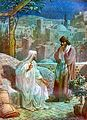 Now a certain man, a Pharisee named Nicodemus, who was a member of the Jewish ruling council,came to Jesus at night and said to him, “Rabbi, we know that you are a teacher who has come from God. For no one could perform the miraculous signs that you do unless God is with him.” Jesus replied,“I tell you the solemn truth,unless a person is born from above,he cannot see the kingdom of God.”Nicodemus said to him, “How can a man be born when he is old? He cannot enter his mother’s womb and be born a second time, can he?”
Jesus answered, “I tell you the solemn truth,unless a person is born of water and spirit,he cannot enter the kingdom of God. What is born of the flesh is flesh,and what is born of the Spirit is spirit. Do not be amazed that I said to you, ‘You must all be born from above.’The windblows wherever it will, and you hear the sound it makes, but do not know where it comes from and where it is going. So it is with everyone who is born of the Spirit.”
Nicodemus replied,“How can these things be?”Jesus answered,“Are you the teacher of Israel and yet you don’t understand these things?I tell you the solemn truth, we speak about what we know and testify about what we have seen, but you people do not accept our testimony.If I have told you people about earthly things and you don’t believe, how will you believe if I tell you about heavenly things?No onehas ascended into heaven except the one who descended from heaven – the Son of Man.Just as Moses lifted up the serpent in the wilderness,so must the Son of Man be lifted up,so that everyone who believes in him may have eternal life.”
For this is the way God loved the world: He gave his one and only Son, so that everyone who believes in him will not perish but have eternal life.For God did not send his Son into the world to condemn the world, but that the world should be saved through him. The one who believes in him is not condemned.The one who does not believe has been condemned already, because he has not believed in the name of the one and only Son of God. Now this is the basis for judging: that the light has come into the world and people loved the darkness rather than the light, because their deeds were evil. For everyone who does evil deeds hates the light and does not come to the light, so that their deeds will not be exposed. But the one who practices the truth comes to the light, so that it may be plainly evident that his deeds have been done in God (John 3:1-21).
Nicodemus next appears in Scripture defending Jesus before the Pharisees. They asked him, “Is there a single one of us rulers or Pharisees who believes in him?” Nicodemus spoke up on his behalf. “Is it legal to convict a man before he is given a hearing? he asked. The Pharisees, suspecting something in his question, replied, “Are you from Galilee, too?” (John 7:42-52).
Nicodemus is last seen following the Crucifixion, bringing seventy-five pounds of embalming ointment to Jesus’ tomb and then helping Joseph of Arimethea, another secret believer, prepare Jesus’ body for burial (John 19:38-42.)
Reflection
What does being born again mean to you? God gives eternal life to those who truly believe in Jesus, and the beginning of eternal life is what Jesus terms being born again. It is being born again into God’s family and becoming his child forever. Have you been born again? How do you know?
To all who believed him and accepted him, he gave the right to become children of God. They are reborn! This is not a physical birth resulting from human passion of plan—this rebirth comes from God. – John 1:12-13
 *Mike and Sharon Rusten are not only marriage and business partners; they also share a love for history. Mike studied at Princeton (B.A.), the University of Minnesota (M.A.), Westminster Theological Seminary (M.Div.), Trinity Evangelical Divinity School (Th.M.), and New York University (Ph.D.). Sharon studied at Beaver College, Lake Forest College, and the University of Minnesota (B.A.), and together with Mike has attended the American Institute of Holy Land Studies (now Jerusalem University College). The Rustens have two grown children and live in Minnetonka, Minnesota. This article was adapted from the April 7 entry in their wonderful book The One Year Book of Christian History, Carol Stream, IL: Tyndale, 2003.
Jonathan Edwards “Resolved” by Dr. Steven Lawson
 For the last seven years, I have spoken at a conference on the West Coast called “Resolved.” The name is drawn from the Resolutions of Jonathan Edwards and is aimed at college students and “twenty-somethings” in the next generation. As an eighteen and nineteen year old, young Edwards wrote seventy resolutions, which became his personal mission statement to guide his life. To launch the first conference, I spoke from Edward’s first resolution, what Edwards determined would be the single most important pursuit in his life — the glory of God.
Edwards began his Resolutions with what he desired to be the driving force of his life — an all-absorbing passion to pursue the glory of God. “Resolved: that I will do whatsoever I think to be most to God’s glory and to my own good, profit, and pleasure, in the whole of my duration, without any consideration of the time, whether now or never so many myriads of ages hence. Resolved: to do whatever I think to be my duty, and most for the good and advantage of mankind in general. Resolved: to do this whatever difficulties I meet with, how ever so many and how ever so great.”
With this before his eyes weekly, this first resolution set the tone for his entire life. In every arena, he resolved to honor God supremely. Everything else in his life would be subsidiary to this one driving pursuit.
What is the glory of God? The Bible speaks of it in two ways. First, there is His intrinsic glory, the revelation of all that God is. It is the sum total of all His divine perfections and holy attributes. There is nothing that man can do to add to His intrinsic glory. Second, there is God’s ascribed glory, which is the praise and honor due His name. This is the glory that man must give to God.
For Edwards, to be resolved to live for God’s glory means to exalt His most glorious name. It means to live consistently with His holy character. It means to proclaim and promote His supreme greatness. This is the highest purpose for which God created us.
Why did Edwards place this resolution first? He understood that Scripture places the glory of God first in all things. Edwards was gripped with a transcendent, high view of God. As a result, in writing his “resolutions,” he knew he must live wholeheartedly for this awesome, sovereign God.
Thus, Edwards intentionally chose to “do whatsoever I think is most to God’s glory.” Here is the interpretive principle for everything in life. You want to know what God’s will is? You want to know whom to marry? You want to know what job to take? You want to know what ministry to pursue? You want to know how to invest your resources? You want to know how to spend your time?
There it is! Everything in life fits under this master theme. Anything out of alignment with this principle pursuit is in dangerous territory. Sometimes our decisions are not between right and wrong. Sometimes they are between good, better, and best. These are sometimes the hardest decisions. Edwards said that he would not live for what is merely good. Nor for what is better. He purposed to live only for what is best. Whatever is most to the glory of God — that is what is best!
Edwards believed that God’s glory was inseparably connected with his “own good, profit, and pleasure.” Whenever he sought God’s glory, he was confident that it would inevitably yield God’s greatest good for his life. The glory of God produced his greatest “pleasure.” So it is with us. Would you know unspeakable joy? Abundant peace? True contentment? Then pursue God’s glory.
With unwavering determination, young Edwards chose this first resolution to mark “the whole of my duration.” As long as he was alive, this was to be the driving thrust of his life. He must always live for God’s glory. He would never outgrow this central theme. He must never exchange it for a lesser glory.
Also, Edwards’ believed that his commitment to God’s glory would bring the greatest “good of mankind.” By seeking God’s honor, the greatest advantage would accrue to others. Thus, living for the glory of God would lead to the greatest influence of the Gospel upon the world. Souls would be converted. Saints would be edified. Needs would be met.
Would you have maximum impact upon this world? Would you lead others to Christ? Would you live for eternity? There it is! Live for God’s glory.
No matter what, Edwards resolved to live for God’s glory despite “whatever difficulties I meet with, how ever so many and ever so great.” Regardless the cost, despite the pain, he would pursue God’s honor. Even if it meant persecution or poverty, his mind was made up, his will resolved. He would pay any price to uphold the glory of God, regardless of the hardship that awaited him.
This is my challenge to the next generation: Would you seek the highest goal? Would you know the deepest joy? Would you realize the greatest good? Would you cast the widest influence? Would you overcome the greatest difficulties?
Then make this first resolution of Jonathan Edwards your chief aim. Be resolved to live for God’s glory.
 *Article originally appeared in Tabletalk Magazine, August 1, 2008. Dr. Steven J. Lawson is the senior pastor of Christ Fellowship Baptist Church in Mobile, Alabama. Dr. Lawson serves on the board of directors of The Master’s College and on the ministerial board for Reformed Theological Seminary, and teaches with Dr. John MacArthur at the Expositor’s Institute. In addition, Dr. Lawson has written numerous books, including Foundations of Grace and Famine in the Land: A Passionate Call for Expository Preaching, The Unwavering Resolve of Jonathan Edwards, and his recent offering The Gospel Focus of Charles Spurgeon.
4 Good Reasons We Go Through Trials by Warren W. Wiersbe
“A Land of Hills and Valleys”
Excerpt from Chapter 1: From the Wonderful Devotional book Turning Mountains into Molehills by Warren W. Wiersbe (Grand Rapids: Baker, 1987 – Only changes are that the Scriptures are from KJV to ESV)
For some reason, I have never enjoyed geography. Perhaps I didn’t study hard enough in school. But as I study my Bible, I find myself becoming greatly interested in God’s geography, particularly something that God said about the Promised Land He was giving to His people, Israel. “But the land that you are going over to possess is a land of hills and valleys, which drinks water by the rain from heaven (Deuteronomy 11:11).” I can’t think of a better description of the Christian life—a land of hills and valleys.
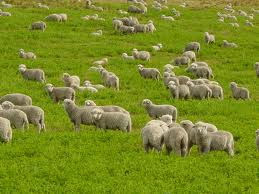 Christians today have a great deal in common with the nation of Israel back in Moses’ day, even though there are some radical differences. For example, there was a time when the people were in bondage; and God set them free. Once you and I were in bondage to sin; but God has set us free. God set Israel free by the blood of the lamb; and God has set us free by the blood of Jesus Christ, God’s Lamb without spot or blemish. God led the nation with a cloud by day and a pillar of fire by night; and God leads us today through His Holy Word. God brought His people to the border of their inheritance and told them to go in and possess the land by faith; but, unfortunately they fell into unbelief and failed to posses the land.
The Lord has given Christians today a wonderful spiritual inheritance in Christ, and all we have to do is possess it by faith. The Bible is the divine road map that describes our inheritance for us; and God says that our inheritance is “a land of hills and valleys.”
Now, this fact may come as a surprise to some of you. Many people have the idea that the Christian life is an easy life—that once you are saved, your troubles are over. Well, once you are saved, many problems are solved; but many new ones appear. Jesus never promised that it would be easy for us to claim our inheritance. “In this world you will have tribulation,” He warned His disciples. “If they have hated me, they will hate you.” The Christian life is a land of hills and valleys.
Let’s begin with the valleys. Have you ever noticed that most of the great people in the Bible went through valley experiences? In Genesis 15 I find Abraham going through “the horror of a great darkness.” I find Isaac trembling because one of his sons has tricked him. I see Jacob wrestling all night until he is willing to surrender to God. I hear Moses crying out to God, “I am not able to bear all this people alone…kill me, I beg you.” I see David hiding in a cave a wondering if the crown would ever be on his head. I hear the prophet Isaiah lamenting, “I have labored in vain; I have spent my strength for nothing and in vain!” (Isa. 49:4). I watch John the Baptist in prison as he sends his disciples to Jesus to ask, “Are you the Messiah, or should we look for another?” Yes, I even hear the great apostle Paul saying, “For we would not have you ignorant, brothers, or our trouble which came to us in Asia, that we were pressed out of measure, above strength, insomuch that we despaired even of life.” These men knew what it was to go through the valley.
Why does God permit these valleys to come into our lives? For one thing we learn some lessons in the valleys  that we could never learn on the mountaintop. Do you think that David could have written those wonderful psalms if had never known the trials in the valley? How could he have written ‘Even though I walk through the valley of the shadow of death, I will fear no evil, for I know that you are with me,” if he had not gone through the valley himself? Suppose Jeremiah had never gone through that terrible valley that made him the “Weeping Prophet”? Could he ever have written, “His compassions never fail; they are new every morning; great is your faithfulness” (Lam. 3:22,23)? Suppose Paul had never gone through the valley with his thorn in the flesh? Could he have written, “My grace is sufficient for you”? When we go through the valley, we learn lessons we could never learn any other way.
And, we grow in character in a way we could never grow apart from the valley. Great Christians are made by great trials. A man does not become patient simply by reading a book or praying a prayer. He becomes patient by going through the valley. Faith is cultivated in the darkness of the valley. God may teach us in the light, but he tests us in the darkness. This is why Paul wrote: “But we had the sentence of death in ourselves, that we should not trust in ourselves, but in God who raises the dead.” The Christian graces are developed as we walk through the valley.
But God has another purpose for the valley: as we go through the valley, we learn to help others. Psalm 84:6 puts it this way: “Who passing through the valley of weeping makes it a place of springs.” Here is a pilgrim going through a difficult valley, so difficult he is even weeping; but he leaves behind a well to refresh the pilgrims that will follow him. Perhaps the reason you are in the valley today is that God may comfort you so you in turn may comfort someone else. He wants you to leave a well behind. Paul had this in mind when he wrote, “God comforts us in all our tribulation that we may comfort them which are in any trouble, by the comfort we have received from God” (2 Cor. 1:4).
The Christian life is a land of hills and valleys. God ordains the valleys that He might teach us lessons we could never learn any other way. He leads us through the valleys so that we may grow in our Christian character, and so that we may help others when they go through the valley. But there’s a fourth reason He permits valleys, and it’s this: you cannot have hills unless you have valleys.
Wouldn’t it be wonderful if life were just a series of mountaintop experiences? Wouldn’t we be happier if there were no valleys in our lives? The Christian life is a land of hills and valleys, but we must never forget that you cannot have hills unless you have valleys.
God knows how to balance our lives. All sunshine makes the desert, says the old proverb; and all hills, without valleys, will make an immature and shallow life. If you and I want to enjoy the hilltops of happiness, we must be willing to experience the valleys of trial. It’s comforting and encouraging to know that at the end of every valley there is a hill, and atop that hill is a new experience of blessing from the Lord.
 I can’t help but notice that the lives of God’s people in the Bible were made up of both hills and valleys. Abraham received a great promise from God one day, and the next day the land was plunged into drought and famine. Isaac was born, and Abraham’s joy was complete. A few years later, God told him to offer his beloved son on the altar. The great prophet Moses experienced his hills and valleys. No sooner had he led the nation out of Egypt when they began to complain and ask to go back to bondage! Moses met God on the mountaintop and saw His glory; then he came down and discovered Israel dancing before a golden idol. Hills and valleys!
It was true even in the earthly life of our Lord. When Jesus was baptized in the Jordan River, the Father spoke from heaven and the Spirit came down on Jesus like a dove. What a mountaintop experience! But then the Spirit drove Jesus into the wilderness to be tempted by the devil. What a valley to go through! See Him as He enters Gethsemane, as he prays and sweats great drops of blood. See Him hanging on a cross! What a valley He endured! But then, see Him risen from the dead—radiant in the glorified body! What a mountaintop experience! Then He ascends to the highest heaven and sits at the right hand of God!
This is God’s word of encouragement to you as you go through the valley. He has a glorious blessing waiting for you at the end of the valley. The Christian life is a land of hills and valleys; and wherever you find a valley, you will always find a mountaintop at the other end. This is true because our Lord Jesus Christ has already gone before us to prepare a way. Every valley that we go through, Christ has already traveled before us.
I’m glad the Christian life is a land of hills and valleys. There is nothing monotonous about it. Every day presents a new challenge to grow in grace, a new opportunity to help others, a new privilege to receive grace and strength from Jesus Christ. It is a land of hills and valleys, and our God is a God of the hills and a God of the valleys.
*Warren W. Wiersbe is the Distinguished Professor of Preaching at Grand Rapids Baptist Seminary, Warren Wiersbe is the author of more than 100 books. Billy Graham calls him “one of the greatest Bible expositors of our generation.” Interestingly, Warren’s earliest works had nothing to do with scriptural interpretation. His interest was in magic, and his first published title was Action with Cards (1944).
“It was sort of imbecilic for a fifteen-year-old amateur magician to have the audacity to write a book and send it to one of the nation’s leading magic houses,” Warren says. But having a total of three books published by the L.L. Ireland Magic Company—before the age of 20—gave him a surge of confidence. In later years, he applied his confidence and writing talent to the Youth for Christ (YFC) ministry.
Warren wrote many articles and guidebooks for YFC over a three-year period, but not all his manuscripts were seen by the public eye. One effort in particular, The Life I Now Live, based on Galations 2:20, was never published. The reason, Warren explains with his characteristic humor, is simple: it was “a terrible book…Whenever I want to aggravate my wife, all I have to say is, ‘I think I’ll get out that Galations 2:20 manuscript and work on it.’” Fortunately, Warren’s good manuscripts far outnumbered the “terrible” ones, and he was eventually hired by Moody Press to write three books.
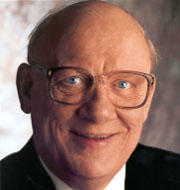 The much-sought-after author then moved on to writing books for Calvary Baptist Church. It was during his ten years at Calvary that Expository Outlines on the New Testament and Expository Outlines on the Old Testament took shape. These two works later became the foundation of Warren’s widely popular Bible studies known as the Be series, featuring such titles as Be Loyal (a study on Matthew) and Be Delivered (a study on Exodus). Several of these books have been translated into Spanish.
His next avenue of ministry was Chicago’s Moody Memorial Church, where he served for seven years. He wrote nearly 20 books at Moody before moving to Lincoln, Nebraska, where he and his wife, Betty, now live. Prior to relocating, he had been the senior pastor of Moody Church, a teacher at Trinity Evangelical Divinity School, and a producer of the Back to the Bible radio program.
During all these years of ministry, Warren held many more posts and took part in other projects too numerous to mention. His accomplishments are extensive, and his catalog of biblical works is indeed impressive and far-reaching (many of his books have been translated into other languages). But Warren has no intention of slowing down any time soon, as he readily explains: “I don’t like it when people ask me how I’m enjoying my ‘retirement,’ because I’m still a very busy person who is not yet living on Social Security or a pension. Since my leaving Back to the Bible, at least a dozen books have been published, and the Lord willing, more are on the way.”
Wiersbe’s recent books include Your Next Miracle, The 20 Essential Qualities of a Child of God, The Bumps are What You Climb On, Classic Sermons on the Fruit of the Spirit, Classic Sermons on Jesus the Shepherd, Key Words of the Christian Life, Lonely People, A Gallery of Grace, Real Peace: Freedom and Conscience in the Christian Life, and On Being a Leader for God.
 LifeCoach4God