A Common Misconception on the Millennium


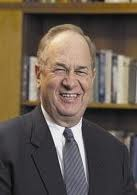 *Walter C. Kaiser Jr. (PhD, Brandeis University) is the distinguished professor emeritus of Old Testament and president emeritus of Gordon-Conwell Theological Seminary in South Hamilton, Massachusetts. Dr. Kaiser has written over 40 books, including Toward an Exegetical Theology: Biblical Exegesis for Preaching and Teaching; A History of Israel; The Messiah in the Old Testament; Recovering the Unity of the Bible; The Promise-Plan of God; Preaching and Teaching The Last Things; and coauthored (with Moises Silva) An Introduction to Biblical Hermeneutics. Dr. Kaiser and his wife, Marge, currently reside at Kerith Farm in Cedar Grove, Wisconsin. This article is adapted from Dr. Kaiser’s website: www.walterckaiserjr.com
 Objection #1 Answered: “The Bible is Full of Myths and Contradictions. It’s just a Fairy Tale.”
(This is #1 in a series of book excerpts from Objections to Christianity derived from Chapter 1 in *Dr. R.C. Sproul’s fantastic book Reason To Believe, [originally entitled Objections Answered] Grand Rapids: Zondervan, 1982, pp.19-34)
Christians, to support their claim of revealed truth, appeal to a book that was written hundreds of years ago. This book—the Bible—has been a subject of an enormous amount of study and criticism which has left the integrity of its trustworthiness seriously in doubt. If the Bible were universally regarded as an authoritarian source book for religious truth, many of the questions we will deal with in Reason to Believe would be easily resolved. But the authority and trustworthiness of the Bible is presently the question.
It is well beyond the scope of this [article] to give a comprehensive defense of the integrity of Scripture. Such a comprehensive defense would involve so many complex matters that it deserves a separate treatment. A large number of such works have been published in recent years (e.g., F.F. Bruce, The Canon of Scripture, The Defense of the Gospel in the New Testament, The New Testament Documents: Are they Reliable?; and Walter Kaiser, The Old Testament Documents: Are They Reliable?). But, several common questions about the integrity of Scripture are dealt with briefly here.
Is the Bible Full of Myths?
That the Bible is a book of myths is a common charge leveled by its critics. Since myths have no counterpart in historical truth, they are considered to be worthless sources of truth. One dictionary of myth terms it as “any fictitious story.”
Why is it so often said that the Bible is full of myths? A chief reason is because of the numerous accounts of miracles that are found in its pages. Another reason is because of parallel accounts between such things as the biblical view of the flood and that found, for example, in Babylonian mythology.A third reason why the presence of myth is suspected is because there exist similarities between events surrounding Jesus and portraits of the gods found in Greek mythology. These three reasons serve as the substantial basis for attributing a mythological character to biblical literature.
A question of miracle is not merely a question of literary style but it involves important questions of history and philosophy. If a miracle is rejected as a myth then the issue becomes one of the philosophy of nature and history rather than one of literary analysis. Before miracles can be rejected out of hand as ipso facto impossible, the critic must first establish that we are living in a closed mechanistic universe in which there exists no possibility of divine or supernatural intrusion. On the other hand, if there is a God who is omnipotent, then miracles are possible and accounts of them cannot be gratuitously dismissed as myths.
If we allow that miracles are possible that does not mean that every claim to them is valid. It is one thing to say that miracles could have happened; it is quite another to say that miracles could have happened; it is quite another to say that they did happen. As we deal with the question of an alleged miracle we must deal with it not only on the grounds of the possibility, but on the evidence that is offered to support its claim.
One of the interesting elements of biblical miracles involves the sobriety of the accounts. Compare, for example, miracle narratives of the New Testament with those found in the Gnostic literature of the second century. The Gnostic “miracles” display a flavor and atmosphere of the bizarre and frivolous. New Testament miracles take place in a context of a sober view of history and redemption. Those who claim them are men of obvious profound ethical integrity and men who are willing to die for their veracity. When evaluating the claims of biblical miracles it is important to understand the total value system of those who are making the claims. The biblical writers, in the Judeo-Christian tradition, write with a constraint that involves a profound commitment to the sanctity of truth. Peter for example writes, “We do not declare unto you cleverly devised myths or fables but rather what we have seen with our eyes and heard with our ears” (1 Peter 1:16).
Because there are parallel accounts of ancient events found in the Bible as well as in ancient mythological literature, this is no justification for impugning the writers of Scripture on the basis of the fallacy of guilt by association. If we assume, for example, that there was a natural catastrophe such as the flood in the ancient world, it should not surprise us that the event is reflected on the writings of other ancient people. The Christian welcomes a close study of comparison between the biblical account of the flood and that found, for example, in the Gilgamesh Epic (The Babylonian account of the Flood that covered the earth). That the biblical account is already demythologized appears self-evident.
The charge that the New Testament surrounds the person of Christ with mythology is often inferred from similarities of dying and rising gods in Greek mythology such as fond in Ovid’s Metamorphoses. However, in a comparative examination of any object or event under analysis the scientific method demands that we note not only the similarities but the differences as well. Mythic creatures that are half man and half beast, for example, are noticeably absent from the Scriptures. Bizarre stories about the creation of the universe are also conspicuously absent. The world, for example, is nowhere described in Scriptures as an appendage of a god; nor do we see notions of the world coming into being as the result of sexual acts of procreation among the gods. Though Jesus is virgin born, He does not spring anew out of the head of Zeus.
At the heart of the difference between Greek mythology and biblical literature is a radically different view of the significance of history. For the Greek there is no overt attempt to ground myth within the framework of history. Indeed, for the gods to become actually incarnate in the realm of space and time is utterly repugnant to the Greek mind. On the other hand that which is non-historical is relegated to the level of falsehood by the Hebrew. This radical opposing view of history is essential to understanding the Jewish-Greek antithesis with respect to the question of myth.
Does the Bible Conflict with Science?
Perhaps nothing has contributed more to the loss of credibility of Scripture than the conflicts between religion and science that have come out in the scientific and technological revolution. We remember the condemnation of Galileo and the circus atmosphere of the Scopes “Monkey Trials.” Galileo was condemned for teaching that the sun was the center of our solar system (heliocentricity) over against the accepted view that the earth was the center (geocentricity). The bishops of the church in Galileo’s day refused to look into his telescope and examine the empirical evidence that the earth is not the center of our solar system. The church is still feeling the embarrassment of that episode.
Some argue that the Bible teaches a view of reality that is utterly in conflict with the assured results of modern scientific inquiry. Some allege that the Bible teaches a primitive, prescientific view of the universe which is no longer tenable to modern man. The Bible describes the universe as being “three-storied” with heaven above, the earth in the middle, and hell underneath the earth. It describes a world of demons and angels which is considered in conflict with modern theories of physics and biology.
How does the Christian respond to such allegations? In the first place, it must be acknowledged that the church indeed has made grievous errors in drawing scientific inferences from Scripture that are unwarranted. Nowhere does the Bible “teach” that the earth is the center of the universe. The Scripture describes nature from a phenomenological perspective. That is, the world of nature is described as it appears to the naked eye. The sun is described as moving across the heavens. The Bible speaks of sunrises and sunsets. And in popular speech modern scientists still speak in the same manner. One only needs to observe the daily weather forecast to see this taking place. The weather report, or “meteorological” survey, is couched in technical scientific jargon. We hear about high pressure systems, barometric pressure, precipitation probability quotients, and the like. Yet at the end of the forecast we are told that the sun will rise at a given time and will set at another time. We do not phone the news station and angrily demand that such antiquated notions of geocentricity be deleted from the weather forecast. We do not charge the scientists with being unscientific when the describe things phenomenologically. We shouldn’t do that with the biblical writers either.
That the Bible speaks of a demonic world is evident. The Bible does not, however, teach that diseases and other mysterious maladies are caused by demonic activity. The Scriptures recognize and endorse the practice of medicine. I might add that the notion of the existence of a demonic world conflicts with no known natural scientific law.
The Bible is not a textbook of science. It does not purport to instruct us in matters of calculus, physics, or chemistry. There are times, however, when serious conflicts do emerge between theories inferred from science and biblical teaching. If, for example, a scientist concludes that the origin of man is a cosmic accident, then the scientist holds a position that is antithetical to the teaching of Scripture. But the question of man’s origin can never be determined by the study of biology. The question of origin is a question of history. The biologist can describe how things could have happened, but can never tell us how they did happen.
Is the Bible Filled with Contradictions?
People accept without hesitation the charge that the Bible is full of contradictions. Yet the charge is completely inaccurate and misleading. Why, then, if the charge is so inaccurate, do we hear it so often repeated? Apart from the problem of prejudice, there are reasons why this misconception is propagated. There is a problem not only of ignorance of what the Bible says, but perhaps even more so, a problem of ignorance of the laws of logic. The word “contradiction” is used all too loosely with respect to biblical content. That there are divergences of biblical accounts, that biblical writers describe the same things from different perspectives, is not in dispute. Whether, those varied accounts are, in fact, contradictory is in dispute.
It would be a serious overstatement to say that all discrepancies within the biblical text have been easily and satisfactorily resolved. There are serious discrepancies that have not yielded full and satisfactory resolutions. But these problems are few and far between. To say that the Bible is full of contradictions is a radical exaggeration and reflects a misunderstanding of the law of contradiction. For example, critics have alleged repeatedly that the Gospel writers contradict each other with respect to the number of angels present at the tomb of Jesus. One writer mentions one angel and the other mentions two angels. However, the writer who mentions one angel does not say there was only one angel. He merely speaks of one angel. There is no contradiction in that. Now, if one writer said there was only one angel and the other writer said there were two, at the same time and in the same relationship, there would be a bonafide contradiction.
The problem of the loose use of the word contradiction came home to me in a discussion I had with a seminary student. He repeated the charge, “The Bible is full of contradictions.” I said to him, “The Bible is a large book. If it is full of contradictions you should have no problem finding 50 clear violations of the law of contradiction in the next 24 hours. Why don’t you go home and write down 50 contradictions and we’ll discuss them at the same time tomorrow.” He accepted the challenge.
The next day he returned bleary-eyed with a list of 30 contradictions. He admitted that he had work long into the night and could come up with only 30. But he presented me a list of the most blatant contradictions he could find. (He made use of critical books that listed such contradictions.) He went through his list, one at a time, applying the test of formal logic to each alleged contradiction. We used syllogisms, the laws of immediate inference, truth tables, and even Venn diagrams to test for logical inconsistency and contradictions. In every single incident we proved objectively, not only to my satisfaction, but to his, that not a single violation of the law of contradiction was made.
Not every biblical discrepancy has been resolved. But the direction of the evidence is very encouraging. As biblical scholarship increases and knowledge of language, text, and context increases, the problem of discrepancy becomes smaller and smaller. There is less reason today to believe that the Bible is full of contradictions than at any time in the history of the church. Prejudice and critical philosophical theories, however, die a very slow and hard death.
Is The Bible Inaccurate Historically?
If any area of biblical scholarship has given us reason for optimism concerning the reliability of Scripture, it is the area of historical investigation. To be sure there are certain dimensions of biblical content that are difficult to either verify or falsify by means of historical research. For example, the existence of angels can hardly be verified through archaeological research. Unless we can dig up some petrified angel wings we must deal with these matters on other grounds. But where biblical material touches on areas where historical research is possible it has come out remarkably well.
Twentieth-century discoveries such as those at Ugarit, Qumran and Ebla have done much to enhance our understanding of antiquity. The Nuzi tablets and the Armana tablets have resolved a host of Old Testament problems. The work of Ramsey tracing the journeys of Paul recorded by Luke has so vindicated Luke’s accuracy as a historian, that modern historians have called him the finest historian of antiquity. The biblical historians have fared considerably better under close scrutiny and critique than have other ancient historians such as Josephus and Herodotus.
The Christian has nothing to fear from righteous historical research. Rather, we have everything to gain. To illustrate the weight of historical research let us note one of the last statements in print by the dean of archaeological scholarship in the twentieth century, Dr. William Foxwell Albright:
For much too long a time the course of New Testament scholarship has been dedicated to theological, quasitheological, and philosophical presupposition. In far too many cases commentaries on New Testament books have neglected such basic requirements as up-to-date historical and philological analysis of the text itself. In many ways this preoccupation with theological and metaphysical interpretation is the unacknowledged child of Hegelianism. To this should be added the continuing and baleful influence of Schleiermacher and his successors on the whole treatment of historical material. The result has often been steadfast refusal to take seriously the findings of archaeological and linguistic research. We believe that there is less and less excuse for the resulting confusion in this latter half of the twentieth century. Closely allied with these presuppositions is the ever-present fog of existentialism, casting ghostly shadows over an already confused landscape. Existentialism as a method of interpreting the New Testament is based upon a whole series of undemonstrable postulates of Platonic, Neo-Platonic, left-wing scholastic, and relativistic origins. So anti-historical is this approach that it fascinates speculative minds which prefer clichés to factual data, and shifting ideology to empirical research and logical demonstration (W.F. Albright and C.S. Mann, Matthew, Anchor Bible Series, New York, Doubleday, 1971, vol. 26, 5-6).
Why Is Some of the Bible Offensive?
Apart from questions of mythology, contradiction, conflict with science, and historical inaccuracy, people have rejected the Bible because the content of it is considered offensive. In particular, biblical expressions of the wrath of God have been singled out for criticism. The Old Testament is criticized for portraying a God who is merciless and arbitrary in His judgment. It is frequently stated, “I have no problems with the loving God of the New Testament, it is the angry God of the Old Testament I reject.”
In such reactions to the Old Testament, we find serious misunderstandings of the wrath of God. Nowhere do we find God involved in capricious or arbitrary acts of judgment. His wrath is never directed against the innocent. His anger never flows without reason. It is always directed against human rebellion and sin.
It is ironic that the two Testaments are so often placed in contrast to each other. The irony may be seen in light of the cross. It is the cross of the New Testament that reveals the most violent and mysterious outpouring of the wrath of God that we find anywhere in the Scripture. Here an innocent man does suffer but only after he willingly takes upon Himself, by imputation, the sins of the world. Without this act of wrath there is no grace. But it is precisely through this act of wrath that grace is made available. The New Testament knows no disjunction between the God of Jesus and the God of Abraham. Jesus appeals to the God of the Old Testament fathers as the God He is serving and revealing.
The Old Testament, in spite of its manifestations of the wrath of God, remains a history of God’s grace and long-suffering with a rebellious people. There is wrath unparalleled in the New Testament and grace overwhelming in the Old Testament. A false dichotomy between the Testaments is foreign to the biblical writers themselves.
When we examine the law code of Israel, however, do we not see a legal ethic that is in fact bloodthirsty? Does not this list of over 35 crimes which require capital punishment reflect a barbarian ethic? Are not the punitive measures of the Old Testament manifestations of what we would regard as cruel and unusual punishment?
The law code of the Old Testament seems harsh to us in light of our present societal standards. But we live in an age where serious sin is not taken seriously. We live in an age where the holiness of God and the sanctity of human life have been sadly eclipsed. If we compare the law of the Old Testament with the law of creation, we see not the cruelty of God but the mercy of God. In creation all sin against God is regarded as a capital offense. In the slightest act of rebellion we commit cosmic treason. Any sin against a perfectly holy and righteous God may justly culminate in death. This the Old Testament law represents a massive reduction of capital crimes which reveals not the bloodthirsty vengeance of an angry God, but the long-suffering mercy of a holy and loving God.
It is precisely at the point of offense in Scripture that we meet a special opportunity for supernatural instruction. By studying the parts of Scripture that are offensive to us we have the opportunity to discover those values and concepts we hold that are out of harmony with the wisdom of God. If we are offended by the Bible perhaps the fault is not with God but our own corrupt and distorted sense of values. I wonder what would happen if we called a moratorium on our criticism of the Bible and allowed the Bible to criticize us!
Are Scriptures Infallible?
It is one thing to argue that the Bible is a basically reliable source of history and religious instruction; it is quite another thing to assert that the Bible is inspired, inerrant, and infallible. It is one thing to maintain that the Bible has great value as a treasury of human insight into religious truth; it is quite another to maintain that it provides us with divine revelation and can justly be called the Word of God.
Why do Christians go beyond asserting general reliability of the Bible to conviction that the Bible is the infallible Word of God? What follows is not an attempt to present an argument for the infallibility of Scripture, but rather an attempt to outline the procedure by which such a conclusion is reached. It is beyond the scope of this article to provide a defense of biblical infallibility. Rather the aim is to explain and clarify the process by which the conclusion is reached.
The case for the infallibility of Scripture proceeds along both deductive and inductive lines. It moves from the premise of general trustworthiness to the conclusion of infallibility. The reasoning process proceeds as follows:
Premise A – The Bible is a basically reliable and trustworthy document.
Premise B – On the basis of this reliable document we have sufficient evidence to believe confidently that Jesus Christ is the Son of God.
Premise C – Jesus Christ being the Son of God is an infallible authority.
Premise D – Jesus Christ teaches that the Bible is more than generally trustworthy; it is the very Word of God.
Premise E – The word, in that it comes from God, is utterly trustworthy because God is utterly trustworthy.
Conclusion – On the basis of the infallible authority of Jesus Christ, the church believes the Bible to be utterly trustworthy, i.e., infallible.
Note that this progression does not involve circular reasoning. Circular reasoning occurs when the conclusion is already present in the first presence. Rather this method follows the linear pattern of development. The argument itself is not infallible as each premise involves matters of inductive or deductive reasoning that is done by fallible human beings. But there is no subjective leap of faith found in the method. Rather the process involves careful historical, empirical investigation as well as logical inferences.
That the Bible claims to be the Word of God is not enough to authenticate the claim. Any book can make such a claim. But the fact that the claim is made is significant indeed. If the Bible is trustworthy then we must take seriously the claim that it is more than trustworthy. If we are persuaded that Christ is the sinless Son of God then we must take seriously His view of Holy Scripture. If the church submits to the authority of Christ then it must regard His view of Scripture as being authoritative. It is from the impetus of Christ Himself that the church is led to confess her faith in the divine authority and infallibility of Scripture.
In a symposium of biblical scholars and theologians that was held in the Ligonier Valley in Pennsylvania in the fall of 1973, a joint team of scholars issued a statement on Scripture that focuses on the authority of Christ as the ground-basis for biblical authority. This “Ligonier Statement” says:
We believe the Holy Scriptures of the Old and New Testaments to be the inspired and inerrant Word of God: We hold the Bible, as originally given through human agents of revelation, to be infallible and see this as a crucial article of faith with implications for the entire life and practice of all Christian people. With the great fathers of Christian history we declare our confidence in the total trustworthiness of Scriptures, urging that any view which imputes to them a lesser degree of inerrancy than total, is in conflict with the Bibles’ self-testimony in general and with the teaching of Jesus Christ in particular. Out of obedience to the Lord Jesus Christ we submit ourselves unreservedly to his authoritative view of Holy Writ.
Key Points to Remember:
Why should you trust the Bible? You should trust the Bible because the Bible has been proven trustworthy.
(1) The Bible does not have a mythical literary style as compared with other ancient literature. The frequent charge that the Bible is “full of myths” is not warranted by the facts. People should be encouraged to read the biblical accounts of miracles, the flood, and other controversial areas and compare them with other ancient sources that do use mythology as a literary style.
(2) Jewish-Christian history differs from the Greek view. This significant difference is a crucial one to understand before we evaluate the historical credibility of the Bible.
(3) The Bible is not a science text but describes the world as it appears to the naked eye. Biblical “conflicts” with science must be understood in terms of common-sense approaches to the “phenomenal” world. The concept of phenomenological description is important to master to be able to deal with this question. We should learn from the church’s mistakes in the past—such as the case of Galileo.
(4) Variant accounts are not the same as contradictory accounts. The charge that the Bible is “full of contradictions” is unwarranted. An understanding of the Law of Contradiction is vital to this question. Close scrutiny of biblical texts will show a difference between variant accounts and contradictory accounts.
(5) Modern historical research adds to biblical credibility. Historical research and archaeology have done much to vindicate the historical reliability and accuracy of the Bible. Important discoveries at Qumran, Ebla, Amarna and elsewhere have exploded the “assured results” of negative nineteenth-century criticism.
(6) The church’s faith in the infallibility of Scripture is established on the basis of Christ’s view of Scripture. It involves a reasoning process which is linear, not circular. It moves from general reliability to a knowledge of Christ’s “infallible” view of Scripture.
 *Dr. R.C. Sproul (1939-2017) was the founder and chairman of Ligonier Ministries, an international Christian education ministry located near Orlando, Florida. His teaching can be heard on the program Renewing Your Mind, which is broadcast on hundreds of radio outlets in the United States and in 40 countries worldwide. He is the executive editor of Tabletalk Magazine and general editor of The Reformation Study Bible, and the author of more than seventy books (including some of my all time favorites: THE HOLINESS OF GOD; CHOSEN BY GOD; KNOWING SCRIPTURE; WILLING TO BELIEVE; REASON TO BELIEVE; and PLEASING GOD) and scores of articles for national evangelical publications. Dr. Sproul also serves as president of Ligonier Academy of Biblical and Theological Studies and Reformation Bible College. He currently serves as Senior Minister of preaching and teaching at Saint Andrew’s in Sanford, FL
 On This Day in Church History – April 12th
Few assume greatness by themselves. Behind the scenes often lies an older mentor, watching with pride. John Calvin exists as a hero in church history because of Guillaume Farel.
Farel was a traveling evangelist in France, full of fire and fury. He was likened to Elijah and was called the “scourge of priests.” He considered the pope the Antichrist and viewed the Mass as nothing but idolatry. Priests wishing him dead, carried weapons under their cloaks to assassinate him. After one attempt on his life, he whirled around and faced the priest who had fired the errant bullet, “I am not afraid of your shots,” he roared.
He was small, sunburned, fiery, and powerful. His sermons were canon blasts, and his oratory captivated the nation. He often said too much, and one friend cautioned him, “Your mission is to evangelize, not to curse.”
On April 12, 1523 Farel was forbidden to preach in France. He fled to Switzerland and wandered from town to town, turning stumps and stones into pulpits. When he entered Geneva, the city fathers and priests tried to make him leave. “Who invited you?” They demanded. Farel replied:
I have been baptized in the name of the Father, the Son, and the Holy Ghost, and am not of the devil. I go about preaching Christ, who died for our sins and rose for our justification. Whoever believes in him will be saved; unbelievers will be lost. I am bound to preach to all who will hear. I am ready to dispute with you, to give account of my faith and ministry. Elijah said to King Ahab, “It is thou, and not I, who disturbest Israel.” So I say, it is you and yours, who trouble the world by your traditions, your human inventions, and your dissolute lives.
He was ridiculed, beaten, shot at, and abused. But he wouldn’t give up on Geneva. Several years later when young John Calvin came passing through. Farel spotted him and gave him a place top minister—and, as it turns out, a place in church history.
Ahab went to meet Elijah, and when he saw him, Ahab shouted, “There you are, the biggest troublemaker in Israel!” Elijah answered, “You’re the troublemaker—not me! You and your family have disobeyed the LORD’s commands by worshiping Baal.” – 1 Kings 18:16b-18
*Robert J. Morgan is the pastor of Donelson Fellowship in Nashville, Tennessee and the author of the best selling Then Sings My Soul, From This Verse, and Red Sea Rules. He conducts Bible conferences, parenting and marriage retreats, and leadership seminars across the country. This article was adapted from the April 11 entry in his book On This Day, Nashville: Thomas Nelson, 1997.
*Significant Events on April 12th in Church History:
352: Pope St. Julius died on this day. He was a staunch defender of Athanasius of Alexandria, and once gave him asylum when the Arians drove him into exile.
 366: Pope Liberius died. It is said he was restored from exile by swearing to a heretical Arian creed. Under threat, he also agreed to allow Athanasius of Alexandria to be deposed.
1204: In three days of looting, the Fourth Crusade sacked the Christian city of Constantinople. The attack ended any hope of reunifying eastern and western Christendom.
1850: Adoniram Judson, Baptist Missionary pioneer to Burma, died on this day. He translated the Bible into Burmese. At his death, he was on a voyage in an attempt to regain his health and overcome depression that made him doubt his salvation.
1978: Two hundred Makarere Church people were arrested in Uganda under Idi Amin’s cruel regime.
*Adapted from This Day In Christian History, edited by A Kenneth Curtis and Daniel Graves, Camp Hill, PA: Christian Publications.
 After a week of meetings in Pittsburgh, a man came up to meet me following the service. A former missionary and member of the church for over thirty years, he said something to me I still haven’t been able to classify as either a compliment or something otherwise. “Steve,” he said, “I’ve really appreciated what you’ve said this week.” I told him I was glad. Then he added, “I’ve been in church all my life, and all my life I’ve heard pastors say that they were sinners. You’re the first one I ever really believed.”
Though I still chuckle about that remark, I acknowledge with complete sincerity his observation. You see, I’m not a pastor and radio preacher because I’m good or have abilities or because I’m talented. I’m where I’m at because God put me here. And sometimes I’ll be soft and sometimes I’ll be hard, but you remember, I’m just like you. God must remind me over and over that even when people call me Reverend, I’m not. Christ established an equality in the brotherhood that has direct implications for me as well as for you.
In every congregation of believers, God sets aside brothers and sisters who are called of God to lead. But the problem is, sometimes we get the idea that we are God’s gift to the world, and when that happens, the delicate balance between gifted leadership and ecclesiastical elitism gets shattered. There’s no room in the Body of Christ for elitism of any sort. That’s the world’s way.
After Queen Victoria and Prince Albert had had one of their famous, loud arguments, Prince Albert went to his room and slammed and locked the door. Queen Victoria marched after him and pounded on his door.
“Who is it?” asked Prince Albert.
“It is the Queen of England.”
Dead silence. The again the question: “Who is it?”
“It is your sovereign ruler,” replied the Queen.
Then once again, “Who is it?”
“It is your wife, Victoria, Albert.”
At that point Albert opened the door.
You may be an elder or deacon or a leader in your Sunday school. Perhaps you lead in some of the other groups in your church and conduct Bible studies. Whatever your role, I thank God for you. But remember that you’re doing it (or at least should be) because God told you to do it, not because you’re a super Christian. There are no super Christians in the body of Christ. All of us are just one among equals. So when a Christian brother or sister stands on the pedestal of his or her own status…when a peacock feathers start flying in the breeze…don’t bow. That kind of behavior doesn’t need to be encouraged. Honesty does. The importance of being honest and acknowledging our true condition and coequal status cannot be overstated.
When a Christian gets honest, something exciting happens. We get to the point where God can use us. Evangelist D.L. Moody once said, “I’ve had more trouble with D.L. Moody than with any other man I’ve ever known.” Thomas a Kempis said, “Be not angry that you cannot make others as you wish them to be since you cannot make yourself as you wish yourself to be.” If we don’t get honest with ourselves, then God is going to force it on us.
Let me tell you a prayer that God always answers: “Lord, show me myself.” Don’t pray it unless you mean it because God will surely answer you, and you won’t like what you see. But he’ll make you different through it—I guarantee it.
Super Christians? They don’t exist. There are only sinners saved by the blood of the Lamb. Remember the next time you find yourself enjoying compliments so much. If you listen carefully, you will hear them sound like a cape flapping vainly in the wind.
*Steve Brown is a radio broadcaster, seminary professor and author. He previously served as a pastor for over twenty-five years and now devotes much of his time to the radio broadcast, Key Life.
 With such varied experience and unique perspective on life, Steve is an original. He refuses to be a “guru,” doesn’t want to be anyone’s mother and gives, in his teaching, the freedom to think. Overall, Steve has become known for his refreshing and practical Biblical applications.
Steve serves as Professor Emeritus of Preaching and Pastoral Ministry at Reformed Theological Seminary. He sits on the board of the National Religious Broadcasters and Harvest USA. Traveling extensively, Steve is a much-in-demand speaker.
Steve is the author of numerous books including A Scandalous Freedom, Approaching God, When Being God Isn’t Good Enough, What Was I Thinking? And Three Free Sins. His articles appear in such magazines and journals as Leadership, Decision, Plain Truth and Today’s Christian Woman. Article above “No Super Christians” adapted from Steve Brown, Jumping Hurdles, Hitting Glitches, Overcoming Setbacks, Colorado Springs, NavPress, 1992, 107-108.
“Read as an act of worship. Read to be elevated into the great truths of God so that you may worship the Trinity in Spirit and in truth. Be selective about what you read, however. Measure all your reading against the touchstone of Scripture. So much of today’s Christian literature is froth, riddled with Arminian theology or secular thinking. Time is too precious to waste on nonsense. Read more for eternity than time, more for spiritual growth than professional advancement.” Joel R. Beeke
The New Oxford American Dictionary defines a “classic” as that which is “judged over a period of time to be of the highest quality and outstanding of its kind.” Therefore, based this definition here are some books that RC considers classics or “must” reading:
 Freedom of the Will by Jonathan Edwards
 Bondage of the Will by Martin Luther
Institutes of the Christian Religion by John Calvin
Charity and Its Fruits by Jonathan Edwards
The Person of Christ by G.C. Berkouwer
Gospel Fear by Jeremiah Burroughs
 Gospel Worship by Jeremiah Burroughs
Elenctic Theology (3 vols.) by Francis Turretin
Principles of Conduct by John Murray
Here I Stand (On the Life of Martin Luther) by Roland Bainton
Other Books That Have Influenced RC:
God and Modern Philosophy by James Collins
A Time for Truth by William Simon
Moby Dick by Herman Melville
American Caesar by W. Manchester
Power Golf by Ben Hogan
 *Dr. R.C. Sproul is the founder and chairman of Ligonier Ministries, an international Christian education ministry located near Orlando, Florida. His teaching can be heard on the program Renewing Your Mind, which is broadcast on hundreds of radio outlets in the United States and in 40 countries worldwide. He is the executive editor of Tabletalk Magazine and general editor of The Reformation Study Bible, and the author of more than seventy books (including some of my all time favorites: THE HOLINESS OF GOD; CHOSEN BY GOD; KNOWING SCRIPTURE; WILLING TO BELIEVE; REASON TO BELIEVE; and PLEASING GOD) and scores of articles for national evangelical publications. Dr. Sproul also serves as president of Ligonier Academy of Biblical and Theological Studies and Reformation Bible College. He currently serves as Senior Minister of preaching and teaching at Saint Andrew’s in Sanford, FL. I believe that his book The Holiness God will stand the test of time as a classic for generations to come. Next to the Bible no other book has influenced me more in my understanding of God, sin, and my own need of salvation and sanctification. I am forever indebted to Sproul’s influence in my life in helping me understand more than anyone else the importance of knowing the nature, character, and attributes of God, and how they impact every aspect of life.
 On This Day in Church History – April 11th
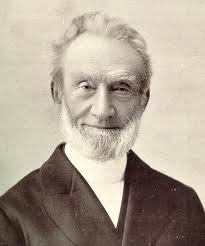
George Mueller, born into a German tax collector’s family, was often in trouble. He learned at an early age to steal and gamble and drink. As a teenager he learned how to he learned how to stay in expensive hotels, then sneak out without paying the bill. But at length he was caught and jailed. Prison did him little good, for upon release he continued his crime spree until, on a Saturday night in 1825, he met Jesus Christ.
Mueller married and settled down in Bristol, England, growing daily in faith and developing a burden for the homeless children running wild and ragged through the streets. At a public meeting in Bristol on December 9, 1835, he presented a plan for an orphanage. Several contributions came in. Mueller rented Number 6 Wilson Street, and on April 11, 1836 the doors of the orphanage opened. Twenty-six children were immediately taken in. A second house opened, then a third.
From the beginning Mueller refused to ask for funds or even speak of his ministries financial needs. He  believed in praying earnestly and trusting the Lord to provide. And the Lord did provide, though sometimes at the last moment. The best known story involves a morning when the plates and bowls and cups were set on the tables, but there was no food or milk. The children sat waiting for breakfast while Mueller led in prayer for their daily bread. A knock at the door sounded. It was the baker. “Mr. Mueller,” he said, “I couldn’t sleep last night. Somehow I felt you didn’t have bread for breakfast, so I got up at 2 a.m. and baked some fresh bread.” A second knock sounded. The milkman had broken down right in front of the orphanage, and he wanted to give the children his milk so could empty his wagon and repair it.
 Such stories became the norm for Mueller’s work. During the course of his 93 years, Mueller housed more than 10,000 orphans, “prayed in” millions of dollars, traveled to scores of countries preaching the gospel, and recorded 50,000 answers to prayer in his journals.
* Robert J. Morgan is the pastor of Donelson Fellowship in Nashville, Tennessee and the author of the best selling Then Sings My Soul, From This Verse, , and Red Sea Rules. He conducts Bible conferences, parenting and marriage retreats, and leadership seminars across the country. This article was adapted from the April 11 entry in his book On This Day, Nashville: Thomas Nelson, 1997.
*Significant Events on April 11th in Church History:
626: Hilde of Whitby was baptized. She was one of England’s most influential women of the Middle Ages. She founded the Whitby Monastery, discovered the early English poet Caedmon and trained five bishops.
 1079: Stanislaus, the bishop of Krakow, Poland, was martyred. King Boleslaw II called him a traitor. Stanislaus had excommunicated the evil king, nicknamed “the cruel.”
1567: Thomas Aquinas was elevated to the status of “doctor of the church.” He was arguably the greatest Christian Philosopher of the Middle Ages.
1836: George Muller opened his first orphanage in Bristol, England. He took in twenty-six waifs. Forty years later, his orphanages housed 2,000 children. Their needs were not met by public appeals, but through private prayer – Amazing!
1861: Sarah Doremus, became the first president of the Women’s Union Missionary Society of America for Heathen Lands. She would be known as the “Mother of Missions.”
*Adapted from This Day In Christian History, edited by A Kenneth Curtis and Daniel Graves, Camp Hill, PA: Christian Publications.

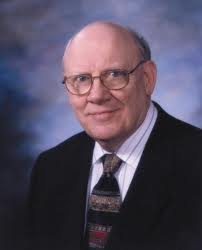 *Warren W. Wiersbe is the Distinguished Professor of Preaching at Grand Rapids Baptist Seminary, and is the author of more than 100 books. Billy Graham calls him “one of the greatest Bible expositors of our generation.” Interestingly, Warren’s earliest works had nothing to do with scriptural interpretation. His interest was in magic, and his first published title was Action with Cards (1944).
TITLE FOR THE BOOK OF GENESIS:
“IN THE BEGINNING GOD CREATED THE HEAVEN AND THE EARTH AND MAN”
CHAPTER: TITLE
C1 Inception of the world
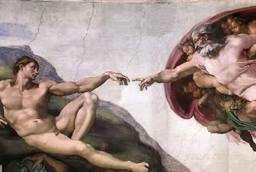
C2 Newlyweds placed in Eden
C3 Temptation and man’s fall
C4 Hatred and first murder
C5 Entire genealogy of Adam
C6 Building of the ark
C7 Eruption of the flood
C8 Going from the ark
C9 Initiation of rainbow promise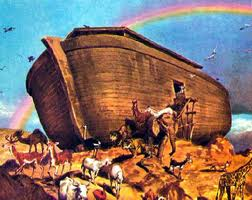
C10 Noah’s sons and grandsons
C11 Nations scattered from Babel
C12 Immigration of Abram’s family
C13 Nephew Lot leaves Abram
C14 Gifts for Priest Melchizedek
C15 God counts Abram righteous
C16 Offspring Ishmael from Hagar
C17 Designation changed to Abraham
C18 Compassion for Sodom’s righteous
C19 Removal of Sodom, Gomorrah
C20 Egyptian escaped of Abraham
C21 Arrival of promised Isaac
C22 Test of Abraham’s faith
C23 End of Sarah’s life
C24 Denoting Rebekah as bride
C25 Twins Esau, Jacob born
C26 Hostility between Isaac, Philistines
C27 Esau robbed of birthright
C28 Heavenly ladder at Bethel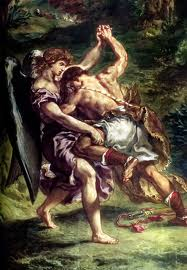
C29 Earning Leah and Rachel
C30 Additions to Jacob’s family
C31 Venture away from Laban
C32 Endeavoring to wrestle God
C33 New friendship with Esau
C34 Avenge for Dinah’s defilement
C35 Name changed to Israel
C36 Descendents of Esau listed
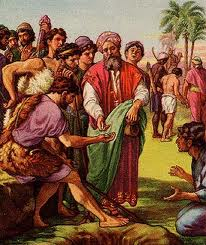
C37 Treachery of Joseph’s brothers
C38 Harlot Tamar deceives Judah
C39 Enraged Potiphar jails Joseph
C40 Explanation of two dreams
C41 Appointing Joseph as ruler
C42 Reuben held in Egypt
C43 Trek to Egypt again
C44 Holding Benjamin for cup
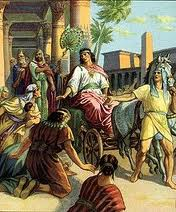
C45 Announcement of Joseph’s identity
C46 New home in Egypt
C47 Design to save Egypt
C48 Manasseh and Ephraim adopted
C49 Announcement of Jacob’s blessing
C50 New relationship among brothers
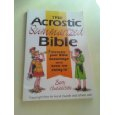
Barry Huddleston got the idea for The Acrostic Summarized Bible when taking a class taught by Terry Hall (a member of Walk Thru The Bible Ministries) in the 1980’s. The Acrostic Summarized Bible was last published in 1992 in Grand Rapids, by Baker. See the Introduction to his book on this blog under the “Acronym” category in the article by Bruce H. Wilkinson – entitled “Why Use Acrostics For Biblical Retention?”
 *Article Adapted from the Introduction to The Acrostic Summarized Bible by Barry Huddleston, Grand Rapids: Baker, 1992.
Acrostics are nothing new. They are as timeless as the pages of Scripture and as contemporary as the morning newspaper. An acrostic is “a poem, word puzzle, or other composition in which certain letters in each line form a word or words.” Origin late 16th cent.: from French acrostiche, from Greek akrostikhis, from akron ‘end’ + stikhos ‘row, line of verse.’
Even in Bible times acrostics were known and used. The Old Testament contains fourteen acrostic poems, the most notable being Psalm 119. Though there are no acrostics in the New Testament, the early Christians identified one another by drawing the sign of the fish—in Greek ichthus—an acrostic for the Greek words meaning “Jesus Christ God’s Son, Savior.”
Chances are you use acrostics nearly every day of your life. Piano students often learn the lines of the treble clef with the aid of the acrostic: “Every Good Boy Does Fine” –EGBDF.
Acrostics have rescued many a grocery shopper who has arranged the list of needed items in such a way as to spell an easily remembered word. For example, here is a list of seven items. Read it over, close your eyes, and then try to recall all seven:
Onions
Watermelon
Soup
Flour
Relish
Eggs
Lettuce
Now try it again, this time with the aid of an acrostic. By rearranging these seven items into a particular order, you will find that their first letters spell the word FLOWERS. Now can you recall all seven using the acrostic?
Flour
Lettuce
Onions
Watermelon
Eggs
Relish
Soup
In much the same way, Bible readers down through the centuries have sought ways to remember the contents of Scripture. Ever since Stephen Langton hot upon the idea of dividing the Bible into chapters in A.D. 1228, men have searched for newer and better techniques for summarizing and memorizing God’s inspired Word. What Sunday School teacher hasn’t used the acrostic GRACE (God’s Riches At Christ’s Expense) and FAITH (Forsaking All I Trust Him) to help the learning process. You hold in your hands perhaps the most significant contribution yet to that continuing search. Barry Huddleston has created a unique approach that meets the three greatest needs of the serious Bible Student:
(1) A chapter by chapter summary of the Bible;
(2) A thematic overview of each of the sixty-six books; and
(3) A topical index that aids quick location of every chapter in the Bible dealing with a particular subject.
In the Acrostic Summarized Bible, short four-word phrases introduce each chapter of the Bible—from Genesis to Revelation. Then, reading down the page, the first letter of each chapter phrase forms another word, phrase, or sentence that accurately—yet succinctly—captures the theme of the book. The vocabulary is pungent and pithy.
*The Cold War was at its height; there was no such thing as a space shuttle, a PC, or the Internet; cars ran on leaded gas…and a Dallas Theological Seminary student named Bruce Wilkinson was wondering, “How can Christians teach a written Word in a visual age? How are we to present 66 books to a world that would rather watch 66 channels?” He answered his question by drawing from a concept in his master’s thesis and developed Walk Thru the Bible, a program by which, in just one day, just about anyone can learn the geography, characters, and key concepts of every book of the Old Testament in chronological order.
Twenty-five years later, Dr. Wilkinson’s teachings have helped thousands of Christians draw closer to God’s Word. Walk Thru the Bible is the largest conductor of live seminars in the world, religious or secular, and the world’s largest publisher of devotional magazines. Materials are available in more than 40 countries and 25 languages.
As the author of many books (including Personal Holiness in Times of Temptation, Talk Thru the Bible, and the best-sellers The 7 Laws of the Learner and The Prayer of Jabez), Wilkinson is an in-demand speaker, and makes frequent appearances at Promise Keeper rallies and the National Association of Christian Schools conventions. He is also a regular contributor to Dr. James Dobson’s radio program.
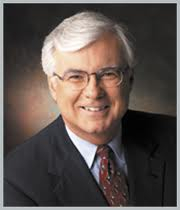 He is a “teacher’s teacher,” and sees everyone as a teacher of something to someone—for Christians, that “something” is God’s truth. The 7 Laws of the Learner shows parents, pastors, business professionals, and teachers how to expect and encourage the best from their children, congregations, colleagues, and students; apply what they’re teaching to their own lives; discover students’ needs and meet them; and overcome their own sins so they can help others grow in Christ.
His little book The Prayer of Jabez has taken the country by storm since it’s release. With 4 million copies in print since its first appearance in April 2000, the book has, indeed, become a call to live a more blessed life for countless readers. This master teacher does not avoid the prayer’s “name it and claim it” allusions, but puts them in proper biblical perspective. His conversational writing style persuades and challenges even the most cynical reader to seek God’s protection, blessing, and guidance—and watch God work! Jabez has been released in multiple forms for all age groups. The follow-up, Secrets of the Vine, which explores John 15 to show readers how to make maximum impact for God, is doing much the same thing with versions for adults through toddlers.
Other recent books by Wilkinson include 30 Days to Experiencing Spiritual Breakthroughs, The Dream Giver, 30 Days to Discovering Personal Victory Through Holiness, and Set Apart.
Dr. Wilkinson and his wife, Darlene, live near Atlanta, Georgia. They have two children, David, Jennifer, and Jessica, and four grandsons. A New Jersey native, he has degrees from Northeastern Bible College, Dallas Seminary, and Western Conservative Baptist Seminary. He is listed in Who’s Who in the World, Men of Achievement, and Personalities of America. He continues to pursue biblical answers to his life-long ministry question: “How can we fulfill the Great Commission in modern culture?
In the months to come I will be posting Acrostics from each book of the Bible from this fabulous resource as a helpful memory device – since it is no longer in print [Dr. David P. Craig].
 Revised Resolutions of Jonathan Edwards
January 1, 2012 By *Dennis Griffith
As a young man – a teenager, really – Jonathan Edwards set down on paper a series of thoughts and practices to help cultivate growth in grace. (See 2 Peter 3.18) Edwards then re-read this list at least once a week to keep his mind focused and renewed. The result: A man of humble godliness, who was to become a significant spark used to ignite one of the greatest revivals known to history. Even many unbelieving scholars admit Edwards may have been the greatest mind to be born on the North American continent.
The Resolutions of Jonathan Edwards are still a practical and beneficial tool for spiritual cultivation. But one problem for many is that the early 18th Century language makes it sometimes difficult to grasp what Edwards wrote. I have taken it upon myself to attempt to translate Edwards’ meaning in hopes that some might use these resolutions who might otherwise feel discouraged by the archaic words. And while I admit that there are a few of these resolutions that I cannot embrace, I will leave it to each individual to pick out anything that might seem worthy for adoption among his/her own personal resolutions.
***
Aware that I am unable to do anything without God’s help, I do pray that, by his grace, he will enable me to keep these Resolutions, so far as they are in line with his will, and that they will honor Christ.
NOTE: Remember to read over these Resolutions once a week.
1. Resolved: I will DO whatever I think will be most to God’s glory; and my own good, profit and pleasure, for as long as I live. I will do all these things without any consideration of the time they take. Resolved: to do whatever I understand to be my duty and will provide the most good and benefit to mankind in general. Resolved to do this, whatever difficulties I encounter, and no matter how many I experience or how severe they may be.
2. Resolved: I will continually endeavor to find new ways to practice and promote the things from Resolution 1.
3. Resolved: If ever – really, whenever – I fail & fall and/or grow weary & dull; whenever I begin to neglect the keeping of any part of these Resolutions; I will repent of everything I can remember that I have violated or neglected, …as soon as I come to my senses again.
4. Resolved: Never to do anything, whether physically or spiritually, except what glorifies God. In fact, I resolve not only to this commitment, but I resolve not to even grieve and gripe about these things, …if I can avoid it.
5. Resolved: Never lose one moment of time; but seize the time to use it in the most profitable way I possibly can.
6. Resolved: To live with all my might, …while I do live.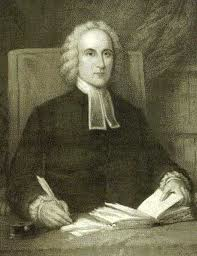
7. Resolved: Never to do anything which I would be afraid to do if it were the last hour of my life.
8. Resolved: To act, in all respects, both in speaking and doing, as if nobody had ever been as sinful as I am; and when I encounter sin in others, I will feel (at least in my own mind& heart) as if I had committed the same sins, or had the same weaknesses or failings as others. I will use the knowledge of their failings to promote nothing but humility – even shame – in myself. I will use awareness of their sinfulness and weakness only as an occasion to confess my own sins and misery to God.
9. Resolved: To think much, on all occasions, about my own dying, and of the common things which are involved with and surround death.
10. Resolved: When I feel pain, to think of the pains of martyrdom – both of Jesus and of Believers around the world; and remind myself of the reality of hell.
11. Resolved: When I think of any theological question to be resolved, I will immediately do whatever I can to solve it, … if circumstances don’t hinder.
12. Resolved: If I find myself taking delight in any gratification of pride or vanity, or on any other such empty virtue, I will immediately discard this gratification.
13. Resolved: To be endeavoring to discover worthy objects of charity and liberality.
14. Resolved: Never to do anything out of revenge.
15. Resolved: Never to suffer the least emotions of anger about irrational beings.
16. Resolved: Never to speak evil of anyone, except if it is necessary for some real good.
17. Resolved: I will live in such a way, as I will wish I had done when I come to die.
18. Resolved: To live, at all times, in those ways I think are best in me during my most spiritual moments and seasons – those times when I have clearest understanding of the gospel and awareness of the World that is to come.
19. Resolved: Never to do anything, which I would be afraid to do if I expected it would not be more than an hour before I would hear the last trump sound. (i.e. when Jesus returns.)
20. Resolved: To maintain the wisest and healthiest practices in my eating and drinking.
21. Resolved: Never to do anything, which if I saw another do, I would consider a just reason to despise him for, or to think in any way lesser of him.
22. Resolved: To endeavor to obtain for myself as much happiness in the world to come as I possibly can. To accomplish this I will use all the strength, power, vigor, and vehemence – even violence – I am capable of, or can bring myself to exert, in any way that can be thought of.
23. Resolved: Frequently take some deliberate action – something out of the ordinary – and do it for the glory of God. Then I will trace my intention back and try to discern my real and deepest motive: What did I really desire out of it? If I find that my truest motive was not for God’s glory, then I consider it as a breach of the 4th Resolution. (See Above)
24. Resolved: Whenever I do any conspicuously evil action, I will trace it back till I come to the original cause; and then I will carefully endeavor BOTH 1) to do so no more AND 2) to fight and pray with all my might against the source of the original impulse.
25. Resolved: To examine carefully, and constantly, what that one thing in me is that causes me to doubt of the love of God, even the least little bit; and then to direct all my forces against it.
26. Resolved: To oust away anything I find that diminishes my assurance of God’s love and grace.
27. Resolved: Never intentionally omit or neglect anything, except if such an omission would be for the glory of God. NOTE to Self: frequently examine anything I have omitted.
28. Resolved: To study the Scriptures so steadily, and so constantly, and so frequently, that it becomes evident – even obvious – to myself that my knowledge of them has grown.
29. Resolved: Never consider something a prayer, nor to let pass for a prayer, any petition that when making I cannot actually hope that God will answer; nor offer as a confession anything which I cannot hope God will accept.
30. Resolved: To strive to my utmost every week to be brought to a higher spiritual place, and to a greater experience of grace, than I was the week before.
31. Resolved: Never to say anything at all against anybody; except when to do so is perfectly consistent with the highest standards of Christian honor and love to mankind; and except when it is consistent with the sense of greatest humility and awareness of my own faults and failings. Then, whenever I have said anything against anyone, I will examine my words against the strictest test of the Golden Rule.
32. Resolved: To be strictly and firmly faithful to whatever God entrusts to me. My hope is that the saying in Proverbs 20.6, “A faithful man who can find?” may not be found to be even partly true of me.
33. Resolved: Always do whatever I can towards making, maintaining, establishing and preserving peace, whenever it can be, but without over-balancing the value peace to such a degree that it becomes a detriment in other respects.
34. Resolved: When telling stories, never to speak anything but the pure and simple truth.
35. Resolved: Whenever I so much as question whether I have done my duty, to a point that my peace and tranquility is disturbed, I will stop and question myself until my concern is resolved.
36. Resolved: Never to speak evil of anyone, except I have some particular good purpose for doing so.
37. Resolved: To inquire every night, as I am going to bed, where I may have been negligent, what sin I have committed, and how I have denied myself. I will also do this at the end of every week, month, and year.
38. Resolved: Never to speak anything that is ridiculous, trivial, or otherwise inappropriate on the Lord’s Day or Sabbath evening.
39. Resolved: Never to do anything when the lawfulness is questionable. And then afterward, resolve to consider and examine whether or not whatever I have just done is truly lawful and/or whether whatever I have refrained from doing would have actually been permissible.
40. Resolved: To inquire every night, before I go to bed, whether I have acted in the best way I possibly could, with respect to eating and drinking.
41. Resolved: To ask myself at the end of every day, week, month and year, where I could have possibly done better in any respect.
42. Resolved: To frequently renew my dedication to God, which was first made at my baptism and which I solemnly renewed when I was received into the communion of the church; and which I have now solemnly re-made this [DATE] day of [MONTH], [YEAR].
43. Resolved: Never, from this day until the day I die, act as if I were in any way my own, but entirely and altogether belong to God, and then live in a way agreeable to this reality.
44- Resolved: That nothing other than the gospel shall have any influence at all on any of my actions; and that no action shall be, even in the very least circumstance, anything other than gospel declares, demands, and implies.
45. Resolved: Never to allow any pleasure or grief, joy or sorrow, nor any affection at all, nor any degree of affection, nor any circumstance, but what advances the gospel.
46. Resolved: Never allow the least measure of any fretting or uneasiness about my father or mother. Resolved to never allow the effects of disappointment in them, or frustrations with them, to even in the very least alter what I say to them or about them, or any activity in reaction to them. Let me be careful about this, not only about my parents, but also with respect to any of our family.
47. Resolved: To endeavor to my utmost to deny whatever is not most agreeable to a good, and universally sweet and benevolent, quiet, peace able, contented, easy, compassionate, generous, humble, meek, modest, submissive, obliging, diligent and industrious, charitable, even, patient, moderate, forgiving, sincere temper; and to do at all times what such a temper would lead me to. Examine strictly every week, whether I have done so. Sabbath morning. May 5,1723.
48. Resolved: With the utmost niceness and diligence, and with the strictest scrutiny, constantly be looking into the state condition of my soul, so that I may know whether or not I have truly an interest in Christ at any given time. I will do this so that, when I come to my end in death, I will not have neglected to repent of anything I have found.
49. Resolved: That Neglect never shall be, if I can help it.
50. Resolved: I will act in such a way as I think I will judge to have been best and most prudent, when I have come into the future world – Heaven.
51. Resolved: That I will act in every respect, as I think I would wish I had done, if in the end for some reason I would have be damned.
52. I frequently hear persons in old age say how they would live, if they were to live their lives over again, so… Resolved: That I will live just as I can imagine I shall wish I had done, supposing I live to old age.
53. Resolved: To improve every opportunity, when I am in the best and happiest frame of mind, to cast and venture my soul on the Lord Jesus Christ, to trust and confide in him, and consecrate myself wholly to him; that from this I may have assurance of my eternal safety, knowing that my confidence is in my Redeemer.
54. Resolved: Whenever I hear anything spoken in a conversation of any person, if I think what is said of that person would be praiseworthy in me, I will endeavor to imitate it.
55. Resolved: To endeavor to my utmost to act as I can imagine I would if I had already seen all the happiness of heaven, as well as the torments of hell.
56. Resolved: Never to give up, nor even slacken up, in my fight with my own corruptions, no matter how successful or unsuccessful I may be.
57. Resolved: When I fear misfortunes and adversities, to examine whether I have done all I am expected to do, and resolve to do everything I am able to do. Once I have done all that God requires of me, I will accept whatever comes my way, and accept that it is just as God’s Providence has ordered it. I will, as far as I can, be concerned about nothing but my own duty and my own sin.
58. Resolved: Not only to refrain from an air of dislike, fretfulness, and anger in conversations, but also to exhibit an air of love, cheerfulness and graciousness.
59. Resolved: Whenever I am most conscious of feelings of ill nature, bad attitude, and/or anger, I will strive then the most to feel and act good naturedly. At such times I know I may feel that to exhibit good nature might seem in some respects to be to my own immediate disadvantage, but I will nevertheless act in a way that is gracious, realizing that to do otherwise would be imprudent at other times (i.e. times when I am not feeling so irked).
60. Resolved: Whenever my feelings begin to appear in the least out of sorts, when I am conscious of the least uneasiness within my own heart and/or soul, or the least irregularity in my behavior, I will immediately subject myself to the strictest examination. (i.e. Psalm 42.11)
61. Resolved: I will not give way to that apathy and listlessness which I find artificially eases and relaxes my mind from being fully and fixedly set on God’s Grace. Whatever excuses I may have for it, whatever my listlessness inclines me to do, or rather whatever it inclines me to neglect doing, I will realize that it would actually be best for me to do these things.
62. Resolved: Never to do anything but what God, by the Law of Love, requires me to do. And then, according to Ephesians 6.6-8, I must do it willingly and cheerfully as to the Lord, and not for man. I must remember that whatever good thing any man has or does he has first received from God; and that whenever a man is compelled by faith to act with love and charity toward others, especially those in need, that we do it as if to/for the Lord.
63. On the hypothetical supposition that at any one time there was never to be but ONE individual in the world who was a genuine and complete Christian, who in all respects always demonstrated the Faith shining in its truest luster, and appearing excellent and lovely, from whatever angle and under whatever circumstance this Faith is viewed… Resolved: To act just as I would do, if I strove with all my strength, to be that ONE; and to live as if that ONE should live in my time and place.
64. Resolved: Whenever I experience those “groanings which cannot be uttered” (Romans 8.26), of which the Apostle speaks, and those “longings” that consume our souls, of which the Psalmist speaks (Psalm 119:20), I will embrace them with everything I have within me. And I will not be weary of earnestly endeavoring to express my desires, nor of the repetitions so often necessary to express them and benefit from them.
65. Resolved: To exercise myself in all my life long, with the greatest openness I am capable of, to declare my ways to God, and lay open my soul to him: all my sins, temptations, difficulties, sorrows, fears, hopes, desires; and every thing in every circumstance. (See Dr. Manton‘s 27th Sermon on Psalm 119.)
66. Resolved: I will endeavor always to keep a gracious demeanor, and air of acting and speaking in all places and in all companies, except if it should so happen that faithfulness requires otherwise.
67. Resolved: After afflictions, to inquire in what ways I am now the better for having experienced them. What good have I received by them? What benefits and insights do I now have because of them?
68. Resolved: To confess honestly to myself all that I find in myself – whether weakness or sin. And if it something that concerns my spiritual health, I will also confess the whole case to God, and implore him for all needed help.
69. Resolved: Always to do that which I will wish I had done whenever I see others do it.
70. Let there be something of benevolence, in all that I speak.
*Article Adapted from the excellent Blog: “Grace and Peace” http://wdennisgriffith.wordpress.com/2012/01/01/revised-resolutions-of-jonathan-edwards/. Dennis Griffith lives in Bristol, Tennessee with his wife Carolyn, their three children: Andrew, Matthew and Rebekah; and Ike, their Great Dane. Dennis also has the privilege of serving as pastor of Walnut Hill Presbyterian Church and chaplain to the Bristol White Sox, the Appalachian League affiliate of the Chicago White Sox. In addition Dennis is a contributing columnist for the Bristol Herald Courier.
 LifeCoach4God