Dr. Zack Eswine’s Sermon Preparation Help For Preaching in a Post-Everything World

 *Adapted from Appendix 1 in Zach Eswine’s outstanding award winning book

Preaching to a Post-Everything World: Crafting Biblical Sermons that Connect with our Culture (Grand Rapids, MI.: Baker, 2008).

Use the Four Stories in Six Steps


^Day/Hour – (explanation: Some might use one day for each step. For these preachers I have broken steps down into days. Others might use each step in one day. For these preachers I have broken the steps down into hours.)

 ^Monday/Hour One – Step One

 Story #1 – Goal = What does this text teach me about God?

Identify the textual manner (word type and mood).

Locate parrot words. Connecting words, and divine comments.

Interrogate the big idea with questions (who, what, when, where, why, how)

Show and tell from the text.

Identify the echoes of redemption (armor, promise, fruit, gift, diaconal, miracle, community, divine silence, himself).

Find the illustrative path (picture, sensory, and creation words).

^Tuesday/Hour Two – Step Two

 Story #2 – Goal = What does this text teach me about people?

Identify echoes of creation (worship, relationship, vocation, conscience)

Identify echoes of the fall (fallen, finite, fragile, faltering)

Identify idol noise (superstition, skepticism, suspicion, stardom, stealing, squandering, sophistry).

Expose my moralistic responses to fallen echoes and idol noise.

Locate the vine.

^Wednesday/Hour Three – Step Three

 Story #3 – Goal = What does this text teach me about life under the sun?

Identify the Context of Reality (COR) (life situations, life seasons).

Discern my expository bans (censoring, muting, equivocating, evicting).

Expose my simplistic response to life under the sun.

Account for the accents of my hearers (memoir, marketplace, lore, land).

Translate cultural connections with biblical redirection (“You have heard it said…, but I say to you…”).

Describe the third way.

Account for the consciences of my hearers (hard-hearted and soft-hearted).

Bring echoes of heaven and hell into these features as appropriate.

^Thursday/Hour Four – Step Four

 Story #4 – Goal = What does this text say to me?

Receive instruction (grieving and quenching the Spirit).

Locate the vine.

Seek repentance.

Find forgiveness.

Give thanks and praise.

Testify.

^Friday/Hour Five – Step Five

 Goal: Place the four stories into a deductive or inductive sermon form


^Saturday/Sunday/Hour Six – Step Six

 Goal = Pray the four stories

Pray for illumination = Psalm 119:18, “Open my eyes, that I may behold wondrous things out of your law.”

Pray for a message = Ephesians 6:19, “and also for me, that words may be given to me in opening my mouth boldly to proclaim the mystery of the gospel.”

Pray for an open door = Colossians 4:3-4, “At the same time, pray for us, that God may open to us a door for the word, to declare the mystery of Christ, on account of which I am in prison.”

Pray for effectiveness = 2 Thessalonians 3:1, “Finally, brothers, pray for us, that the word of the Lord may speed ahead and be honored, as happened among you,”

Pray for clarity = Colossians 4:4, “that I may make it clear, which is how I ought to speak.”

Pray for boldness = Ephesians 6:20, “for which I am an ambassador in chains, that I may declare it boldly, as I ought to speak.”

Pray for a deliverance = 2 Thessalonians 3:2, “and that we be delivered from wicked and evil men. For not all have faith.”

*Zack Eswine serves as the Senior Pastor of Riverside Community Church in St. Louis, Missouri. His role focuses his time on setting vision, preaching, spiritual formation and pastoral care.

Dr. Eswine has served in pastoral roles for over twenty years. He served as Assistant Professor of Homiletics and Director for Doctor of Ministry for six years at Covenant Theological Seminary.  Zack’s most recent book, won Preaching Today’s Book of the Year Award in 2009. It is entitled, Preaching to a Post-Everything World: Crafting Biblical Sermons that Connect with our Culture (Baker, 2008).  He has also written, Kindled Fire: How the Methods of C.H. Spurgeon can help your Preaching (Mentor, 2006). His forthcoming books are entitled, Preaching Barefoot: Life and Ministry as a Human Being (Crossway) and Spurgeon’s Sorrows: Handling the Darker Sides of Life and Ministry (Christian Focus).

David Martyn Lloyd-Jones on Authority in Preaching by Iain H. Murray

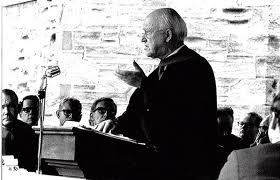
During the Second World War a Scot who was in the services and visiting London went to Westminster Chapel but the Chapel was closed, damaged by bombing, but on a piece of paper visitors were directed to a nearby hall. He described a ‘thin man’ wearing a tie calling the people to worship. He thought the man was a church officer, and he appreciated his prayer, but then the man began to preach, beginning quietly enough. “This must be Lloyd-Jones,” he thought. But for the next 40 minutes he was unconscious of anything else in the world, hearing only this man’s words. He had been caught up in the mystery of preaching. That man later became a well-known Church of Scotland minister called Tom Allen.

When he left that service Tom Allen was taken up with the message, not the preacher. DMLJ would have thought little of conferences addresses like this one about himself. He thought messages about contemporary men had done great injury especially during the Victorian period. With man-centeredness being the terrible bane of today’s church there is a danger in drawing attention to personalities. DMLJ would quote the words of God, “My servant Moses is dead so arise and go over to Jordan.” DMLJ prevented several would-be biographers writing anything, and reluctantly consented to Iain Murray’s official biography if only something could be written which would encourage those who were entering the gospel ministry.

DMLJ believed that God was the God of tomorrow who would raise up servants who would enjoy blessings that he himself had not known. Frequently when he prayed it was particularly for a recovery of authority and power in preaching.

One must add another observation, that preaching was not DMLJ’s exclusive concern. He was concerned with the church fellowship, prayer meetings, and the promotion of foreign missionaries, but he was convinced that the spiritual health of the church depended on the state of the pulpit. On behalf of Christ the true preacher speaks and the Lord himself is building his church in his sovereign way. So DMLJ was conscious of what he spoke of as the romance of preaching. The preacher is but an instrument in the Lord’s hands: the preacher is not in control. Preaching is the highest and most glorious calling to which anyone could be called.

So when we come to the subject of authority in preaching there are a number of ways this could be addressed and the New Testament terminology on this theme should be studied, e.g. that ‘Jesus spoke with authority’, the phrase ‘the word came with power’, and the word ‘boldness’ which is surprisingly frequent in the NT. Iain Murray’s approach was to take the characteristics of preaching with power.

(1) It always is attended by a consciousness of the presence of God.

Though a worshipper may be meeting in the midst of a large congregation of people when the preaching is with authority the individual forgets the person he has come with, and the building they are sitting in, and even the one who is preaching. He is conscious that he is being spoken to by the living God. Thus it was in Acts 2. A remarkable illustration of this is the spiritualist woman in Sandfields, drawn to hear DMLJ and conscious that she was surrounded by ‘clean’ power. For the first time she was conscious she was in the presence of God. Thomas Hooker had such a sense of God about him that it was said that he could have put a king in his pocket.

(2) There is no problem of holding the attention of the people.

It is a problem to keep people’s attention. The preacher has his chain of thought, and all the people also may have theirs which are all very different so that they are taking in very little from the preaching. But authoritative preaching gets inside people because it speaks to the heart, conscience and will. Skillful oratory cannot come anywhere near to that preaching. It made a moral and emotional earthquake in those who heard the word at Thessalonica. The well-remembered ship builder who built ships in his mind during Sundays’ sermon could not lay the first plank when he was listening to George Whitefield preach. Conviction of sin and the reality of the living God became far more important to him than his business.

One Friday night in his series of lectures on theology DMLJ was preaching from Revelation on the final judgment on Babylon and listening to that exultant message it would have been impossible to have been occupied with any other subject, the great reality was such that awareness of anything else disappeared. The very date of that occasion was accurately quoted, easily memorable to the speaker because the next day he was getting married, but all thoughts of that were gone as he saw the overthrow of great Babylon.

(3) Even children can understand it.

There is a mistake in thinking that preaching is chiefly to address the intellect, and thus the will. Rather preaching is to address the heart and soul of men and women. Preaching which accomplishes that can arrest a child as easily as a grown-up. Children did listen to DMLJ because of the character of the preaching and the sense of God about it.

(4) It is preaching that results in a change in those who listen.

It may be repentance; it may be restoration, or reconciliation; it may be strength given for those in the midst of trials, but powerful preaching brings that change. Sometimes they went away indignant and some of them were later converted. You cannot be apathetic under true preaching. Felix trembled. There was no certainty of conversions but there was a degree of certainty that there will be power in that preaching. In Mrs Bethan Lloyd-Jones’ book on Sandfields there is a reference to a professor of law at Liverpool who said that there were two men who kept the country from communism – Aneurin Bevan and DMLJ. His preaching affected communities. On November 15 1967 he was preaching in Aberfan a year after the disaster. His text was Romans 8:18 “the sufferings of the present time are not worthy to be compared to the glory to be revealed in us.” It had a great impact on the perplexed little religious community in the Taff valley.

What is Necessary for Powerful Preaching? What elements produce it?

(1) Sermons will not be marked by authority and power unless they are marked by truth that the Holy Spirit can honor.

The word of God is to be exegeted and explained. That has to be the heart of the sermon. There is a real danger that we become over concerned about such things as delivery, while the New Testament is insistent on the content: “let him speak as the oracles of God.” The authority of the preaching comes from the text of Scripture. It is God- given power which honours his own word.

Dr Lloyd-Jones grew up in a vague sentimental era with churches fascinated with the personalities and quirks of famous men. DMLJ as a man was absorbed with the glory and the greatness of the truth. A preacher lives in the truth. DMLJ expected the preacher to go through the whole Bible in his personal devotions once each year. He expected him to continue to read theology as long as he lived. The more he read the better. Preaching is theology coming through a man who is on fire.

In the latter part of his ministry there was a change in emphasis. In the first 30 years there was a stress on the importance of the historic faith, and then in the last decades a new emphasis emerged, not now on the recovery of truth but with the accompanying need of power to proclaim it.

(2) The man himself is a part of the message. He can read all the best books and give out a whole rounded exegesis of the text, but somehow the man himself has not become a part of the truth.

The less we say of ourselves in preaching the better, but the Holy Spirit does not work in preaching except through the man, and so, inevitably, not only does the message compel attention but the man himself. The man becomes a part of the message. What does that mean?

The preacher must know the power of the message he is bringing to others.

When DMLJ was 25 and at the cross-roads of his life, he became engaged to Bethan Philips, and she became conscious that her future husband was considering becoming a preacher. She was very concerned because she had never heard him preach. At that point a letter came from a missionary society inviting them to become medical missionaries in India. She was challenged by this invitation but DMLJ had no interest at all. Bethan said to him, “But how do you know that you can preach?” “I know I can preach to myself” he replied. He knew the power of the truth in his own heart.

When he was preaching on Ephesians 2 on fulfilling the lusts of the flesh and the mind he raised the question what they were? He interjected that “as I was preparing this sermon it filled me with a loathing and hatred of myself. I look back and I think of the hours I have wasted in mere talk and argumentation. And it was with one end only, simply to gain my point and to show how clever I was” (“God’s Way of Reconciliation” p.65). So DMLJ was preaching to himself before he spoke to others.

The Holy Spirit must produce the feelings in the preacher’s heart that must be in harmony with what the Spirit has breathed out.

Paul writes, “Knowing the terror of the Lord we persuade men.” Again he speaks of some “with tears” that they are enemies of the cross. One finds phrases like, “I tell you weeping …I am glad and rejoice with you all.” There was something in the way these preachers used by God spoke – “I preached what I smartingly did feel,” said Bunyan. A most important part of preaching is exhortation. In preaching we move people to do what they are listening to, and to this end there has to be a felt consciousness in the preacher of the truth of what he is saying. We have to bring our feelings into harmony with the stupendous nature of what we are saying. The men most used of God in their pulpits are those who know they had fallen far short of the wonder that should characterise the preaching.

The more he becomes part of his message then the more he forgets himself.

What is the main feeling in the preacher? It should be love – to God and to man. It is the very opposite of self-centredness. Love seeks not her own. The needs of the people spoken to take over. We forget ourselves. A baptism of Holy Spirit love gives us a love for people.

Preaching Under the Influence of the Holy Spirit.

There is a total insufficiency in ourselves or in anyone else in the world, so that we cannot preach without the Holy Spirit. 1 Corinthians 2:3 – is the key text, “And I was with you in weakness, and in fear, and in much trembling.” God makes us weak and so enables us to become true preachers. Real authority always comes out of felt weakens, and then God uses us. The preacher is the last person to be praised. To be clapped when he had finished would have horrified him.

Bethan Lloyd-Jones once listed to some men speaking about her husband and she interjected, “No one will understand my husband who does not realise that he was first an evangelist and a man of prayer.” DMLJ loved the hymn of Oswald Allen, “Today thy mercy calls us…” especially these final lines:

When all things seem against us,


To drive us to despair,


We know one gate is open,


One ear will hear our prayer

That is what he believed. His public pastoral prayer lifted many burdens long before the preaching began. He rested ultimately on the Holy Spirit being given to them that ask him. The real preacher is a mere voice sounding in the wilderness. DMLJ was criticized for being too dogmatic and authoritarian. If we are preaching from God then that has to be delivered with faith and confidence that we knows what God is saying. You have to believe definite truths in order to be saved. Men have to know that they are condemned before they can be saved. There is the utter certainty of a preacher in what he is preaching. Paul says, “We have the same spirit of faith … we also believe and we speak.” That is the fundamental thing. We are going against all that the natural man believes.

DMLJ’s faith came out in what he preached, that man was under the wrath of God, depraved and lost. He preached this with absolute conviction, and he followed it up with the cross, week by week. That authority was given by the Holy Spirit. It influenced DMLJ’s whole way of looking at things. He was a man who stood alone for most of his life and one reason was that he was conscious that the problem with man was far deeper than people in the church were prepared to acknowledge They were thinking of ‘communication to the modern man’ etc. DMLJ believed that we face not the problem of communication but what was wrong in the church itself. One of the reasons that he did not take part in the big crusades was because there was something wrong in the churches themselves. He quietly stood aside, God having kept him in the way he did, he preached evangelistically each Sunday.

The test of the presence of the Holy Spirit’s work is the presence of Christ himself in the assembly and known by the congregation. A maid worked in a Manse and there was great anticipation for the coming of the powerful preacher, Mr Cook. One maid was not enthusiastic, and she told the butcher she was fed up, “with all this fuss you would think Jesus Christ himself was coming.” Mr Cook duly came and preached and as she heard him something happened in her life. The butcher said to her with a grin on the following Tuesday, “Did Jesus Christ come?” “Yes, he did come,” she said seriously.

William Williams of Pantycelyn said, “Love is the greatest thing in religion, and without it religion is nothing.” DMLJ often quoted those words. Love has to lead the way. He thought the people were not ready to hear extended series of systematic expository sermons for the first 20 years he was in the ministry. The needs of the people were paramount because love is in our hearts.

*Summary of an Address given by Iain H. Murray at the Carey Conference 2001 at Swanwick. Iain Hamish Murray (b. 1931; Lancashire, England) was educated in the Isle of Man and at the University of Durham. He entered the Christian ministry in 1955. He served as assistant to Martyn Lloyd-Jones at Westminster Chapel(1956–59) and subsequently at Grove Chapel, London (1961–69) and St. Giles Presbyterian Church, Sydney, Australia, (1981–84). In 1957 he and Jack Cullum founded the Reformed publishing house, the Banner of Truth Trust, where he has periodically worked full-time and remains the Editorial Director.

*David Martyn Lloyd-Jones (December 20, 1899 – March 1, 1981) was a Welsh Protestant minister, preacher and medical doctor who was influential in the Reformed wing of the British evangelical movement in the 20th century. For almost 30 years, he was the minister of Westminster Chapel in London. Lloyd-Jones was strongly opposed to Liberal Christianity, which had become a part of many Christian denominations; he regarded it as aberrant. He disagreed with the broad church approach and encouraged evangelical Christians (particularly Anglicans) to leave their existing denominations. He believed that true Christian fellowship was possible only amongst those who shared common convictions regarding the nature of the faith. One of his classic works has been republished as a 40th Edition – with many new features –  (reviewed on this blog) and is entitled Preaching and Preachers.

6 Evidences Verifying The Resurrection of Jesus by Dr. James Boice

Solid Evidence For The Bodily Resurrection of Jesus Christ
(Article adapted from: Foundations of the Christian Faith. *James Montgomery Boice, Downers Grove, IL: Inter Varsity Press. 1986. Chapter 17, pages 348-360)

If the bodily resurrection of Jesus Christ is true it is obviously the best news the world has ever heard. But we ask, “Can any news that good be believed?” That question leads to an investigation of the evidences for the resurrection.

Some modern theologians maintain that we have no need for historical evidences for the resurrection of Jesus Christ or evidences of any other point of Christian belief for that matter. Such things are supposed to be authenticated by the logic of faith alone. There is, of course, a sense in which that is true. Christians know that their faith rests not on their ability to demonstrate the truthfulness of the biblical narratives but rather on supernatural activity of the Holy Spirit within their hearts leading them to faith. Yet many come to faith through the various evidences for the resurrection, and the substance and form of the Christian faith rests upon those evidences. Apart from them our experiences of Christ could be mystical and even quite wrong.

We have every right to investigate the evidences, for the Bible itself speaks of “many infallible proofs” of the resurrection (Acts 1:3 KJV). We want to look at six of them here:

(1) The Resurrection Narratives

A first important evidence for the resurrection of Jesus Christ is that of the resurrection narratives themselves. There are four of them, one in each Gospel; they are more or less independent. Yet they are also harmonious, and that suggests their reliability as historical documents.

That the accounts are basically independent is evident from the considerable variations of detail. Of course there might be some overlap simply be-cause reports of a given incident would have been circulating throughout the Christian church when these books were being written. An account could have been told by different people at times in nearly identical language. But the four writers obviously did not sit down together and conspire to make up the story of Christ’s resurrection. If four people had sat down together and said, “Let’s invent an account of a resurrection of Jesus Christ” and had then worked out the details of their stories, there would be far more agreement than we find. We would not find the many small apparent contradictions. Yet if the story were not true and they had somehow separately made it up, it is impossible that we should have the essential agreement we find. In other words, the nature of the narratives is what we would expect from four separate accounts prepared by eyewitnesses.

Here are two examples. First, there is the variety of statements about the moment at which the women first arrived at the tomb. Matthew says that it was “toward the dawn of the first day of the week” (Mt. 28:1). Mark says that it was “very early on the first day of the week … when the sun had risen” (Mk. 16:2). Luke says that it was “at early dawn” (Lk. 24:1). John says that “it was still dark” (Jn. 20:1). These phrases are the kind of thing the authors would have standardized if they had been working on their accounts together. But they are in no real contradiction. For one thing, although John says that it was “still dark,” he obviously does not mean that it was pitch black; the next phrase says that Mary Magdalene “saw that the stone had been taken away from the tomb.” Presumably, the women started out while it was yet dark but arrived at the garden as day was breaking.

A second example of variation in detail in the midst of essential harmony is the listing of the women who made the first visit to the garden. Matthew says there were two Marys, “Mary Magdalene and the other Mary” (Mt. 28:1). Mark writes, “Mary Magdalene, and Mary the mother of James, and Salome” (Mk. 16:1). Luke refers to “Mary Magdalene and Jo–Anna and Mary the mother of James and the other women with them” (Lk. 24:10). John mentions only “Mary Magdalene” (Jn. 20:1). Actually, one reference throws light on the others. Mark and Luke, for example, explain who Matthew’s “other Mary” was. When we put them together we find that on that first Easter morning, when it was still dark, at least five women set out for the tomb: Mary Magdalene (who is mentioned by each of the writers), Mary the mother of James, Salome, Jo-Anna, and at least one other unnamed woman (who fits into Luke’s reference to “other women,” which includes Salome). The purpose of their trip is to anoint Christ’s body. They already know of the difficulty they face, for the tomb had been sealed by a large stone and they have no idea how they can move it. It begins to lighten a bit as they travel, so when they finally draw close to the tomb they see that the stone has been moved. That is something they were not expecting; so, although it suits their purpose, they are nevertheless upset and uncertain what to do. Apparently, they send Mary Magdalene back to tell Peter and John about the new development, which John himself records, although he does not mention the presence of the other women (Jn. 20:2). As the women wait for her to return, the morning grows lighter; eventually, emboldened by daybreak, the women go forward. Now they see the angels and are sent back into the city by them to tell the other disciples (Mt. 28:5-7; Mk. 16:5-7; Lk. 24:4-7).

In the meantime, Mary Magdalene has found Peter and John, who immediately leave her behind them and run to the tomb. John records their view of the graveclothes and points out that it was at this moment that he personally believed (Jn. 20:3-9). Finally, Mary Magdalene arrives back at the tomb again and is the first to see Jesus (Jn. 20:11-18; compare Mk. 16:9). On the same day Jesus also appears to the other women as they are returning from the tomb, to Peter, to the Emmaus disciples, and to the others as they are gathered together that evening in Jerusalem.

Two other factors also strongly suggest that these are accurate historical accounts. The first is that they leave problems for the reader that would have been eliminated were they fictitious. For example, there is the problem, repeated several times over, that the disciples did not always recognize Jesus when he appeared to them. Mary did not recognize him in the garden (Jn. 20:14). The Emmaus disciples did not know who he was (Lk. 24:16). Even much later, when he appeared to many of the disciples in Galilee, we are told that “some doubted” (Mt. 28:17). From the point of view of persuasion, the inclusion of such details is foolish. The skeptic who reads them will say, “It is obvious that the reason why the disciples did not immediately recognize Jesus is that he was actually someone else. Only the gullible believed, and that was because they wanted to believe. They were self-deluded.” Whatever can be said for that argument, the point is that the reason why such problems were allowed to remain in the narrative is that they are, in fact, the way the appearances happened. Consequently, they at least provide strong evidence that these are honest reports of what the writers believed to have transpired.

Another example of a problem is Christ’s statement to Mary that she was not to touch him because he was “not yet ascended to the Father” (Jn. 20:17). Yet Matthew tells us that, when Jesus appeared to the other women, presumably within minutes of his appearance to Mary, they “took hold of his feet and worshiped him” (Mt. 28:9). In the whole history of the Christian church no one has given a thoroughly convincing explanation of that anomaly. But it is allowed to stand because, whatever the reason, that is what happened.

Finally, the accounts evidence a fundamental honesty and accuracy through what we can only call their natural simplicity. If we were setting out to write an account of Christ’s resurrection and resurrection appearances, could we have resisted the urge to describe the resurrection itself-the descent of the angel, the moving of the stone, the appearance of the Lord from within the recesses of the tomb? Could we have resisted the urge to recount how he appeared to Pilate and confounded him? Or how he appeared to Caiaphas and the other members of the Jewish Sanhedrin? The various apocryphal Gospels (the Gospel according to the Hebrews, the Gospel of Peter, the Acts of Pilate and others) contain these elements. Yet the Gospel writers include none, because either they did not happen or else the writers themselves did not witness them. The Gospels do not describe the resurrection because no one actually witnessed it. It would have made good copy, but the disciples all arrived at the tomb after Jesus had been raised.

(2) The Empty Tomb

A second major evidence for the resurrection of Jesus Christ is the empty tomb. We might deny that an actual resurrection took place, but we can hardly deny that the tomb was empty. The disciples began soon after the crucifixion and burial to preach about the resurrection, at a time when those to whom they preached could simply walk to the tomb to see if the body of the supposedly resurrected Lord still lay there.

The empty tomb has been so formidable an argument for the resurrection throughout history that unbelievers have invented a number of theories to account for it. One theory is that the women and later the disciples went to the wrong place. It is conceivable that in the dark the women might have made such an error. But, as we have seen, it was not entirely dark, and besides they had been there earlier and thus were acquainted with its location. Again, we cannot suppose that John and Peter and then all the others would make an identical error.

Another theory is the so-called swoon theory. According to that view, Jesus did not die on the cross but rather swooned––as a result of which he was taken for dead and then buried alive. In the cool of the tomb he revived, moved the stone, and went forth to appear as resurrected. But that explanation has numerous problems. There are the difficulties in believing that a Roman guard entrusted with an execution could be fooled in such a manner; or that the spear thrust into Christ’s side would not have killed him even if he had been swooning; or that a weak, barely surviving Christ could have had the strength to move the large stone and overcome Roman guards. Further, one would have to suppose that a Christ in such a condition could convince his disciples that he had overcome death triumphantly.

Finally, there are the views that someone either stole or simply moved the body. But who? Certainly not the disciples, for if they had removed the body, they would later hardly have been willing to die for what they knew to be a fabrication. Nor would the Jewish or Roman authorities have taken the body. We might imagine that they could have moved it initially in order better to guard it––for the same reasons they sealed the tomb and posted a watch: “We remember how that imposter said, while he was still alive, ‘After three days I will rise again.’ Therefore order the sepulcher to be made secure until the third day, lest his disciples go and steal him away, and tell the people, ‘He has risen from the dead'” (Mt. 27:63-64). If that had happened, they would certainly have produced the body later when the disciples began their preaching. The authorities hated the gospel and did everything in their power to stop its spread. They arrested the apostles, threatened them and eventually killed some of them. None of that would have been necessary if they could have produced the body. The obvious reason why they did not is that they could not. The tomb was empty. The body was gone (The evidence of the empty tomb is discussed by John Stott, Basic Christianity, Downers Grove, IL: IVP,  pp.46-50; Merrill C. Tenney, The Reality of the Resurrection, Chicago: Moody Press. 1963, pp. 113-16; James Orr, The Resurrection of Jesus, London: Hodder and Stoughton, n.d., pp. 111-39; and others).

(3) A Not Quite Empty Tomb

According to John, the tomb was not quite empty. The body of Jesus was gone but the graveclothes remained behind. The narrative suggests that there was something about them so striking that at least John saw them and believed in Jesus’ resurrection.

Every society has its distinct modes of burial, and that was true in ancient cultures as today. In Egypt bodies were embalmed. In Italy and Greece they were often cremated. In Palestine they were wrapped in linen bands that enclosed dry spices and were placed face up without a coffin in tombs generally cut from the rock in the Judean and Galilean hills. Many such tombs still exist and can be seen by any visitor to Palestine.

Another aspect of Jewish burial in ancient times is of special interest for understanding John’s account of Jesus’ resurrection. In a book called The Risen Master (1901), Henry Latham calls attention to a unique feature of Eastern burials, which he noticed when in Constantinople during the last century. He says that the funerals he witnessed there varied in many respects, depending upon whether the funeral was for a poor or rich person. But in one respect all the arrangements were identical. Latham noticed that the bodies were wrapped in linen cloths in such a manner as to leave the face, neck and upper part of the shoulders bare. The upper part of the head was covered by a cloth that had been twirled about it like a turban. Latham concluded that since burial styles change slowly, particularly in the East, that mode of burial may well have been practiced in Jesus’ time.

Luke tells us that when Jesus was approaching the village of Nain earlier in his ministry, he met a funeral procession leaving the city. The only son of a widow had died. Luke says that when Jesus raised him from death two things happened. First, the young man sat up, that is, he was lying on his back on the bier without a coffin. And second, he at once began to speak. Hence, the graveclothes did not cover his face. Separate coverings for the head and body were also used in the burial of Lazarus (Jn. 11:44).

It must have been in a similar manner that Joseph of Arimathea and Nicodemus buried Jesus Christ. The body of Jesus was removed from the cross before the beginning of the Jewish Sabbath, was washed, and then was wrapped in linen bands. One hundred pounds of dry spices were carefully inserted into the folds of the linen. One of them, aloes, was a powdered wood like fine sawdust with an aromatic fragrance; another, myrrh, was a fragrant gum that would be carefully mixed with the powder. Jesus’ body was thus encased. His head, neck and upper shoulders were left bare. A linen cloth was wrapped about the upper part of his head like a turban. The body was then placed within the tomb where it lay until sometime on Saturday night or Sunday morning.

What would we have seen had we been there at the moment at which Jesus was raised from the dead? Would we have seen him stir, open his eyes, sit up, and begin to struggle out of the bandages? We must remember that it would have been difficult to escape from the bandages. Is that what we would have seen? Not at all. That would have been a resuscitation, not a resurrection. It would have been the same as if he had recovered from a swoon. Jesus would have been raised in a natural body rather than a spiritual body, and that was not what happened.

If we had been present in the tomb at the moment of the resurrection, we would have noticed that all at once the body of Jesus seemed to disappear. John Stott says that the body was” ‘vaporized,’ being transmuted into something new and different and wonderful” (Stott, Basic Christianity, p.52). Latham says that the body had been “exhaled,” passing “into a phase of being like that of Moses and Elias on the Mount” (Henry Latham, The Risen Master. Cambridge Deighton Bell and Company, 1901, pp.36, 54). We would have seen only that it was gone.

What would have happened then? The linen cloths would have collapsed once the body was removed, because of the weight of the spices, and would have been lying undisturbed where the body of Jesus had been. The cloth which surrounded the head, without the weight of spices, might well have retained its concave shape and have lain by itself separated from the other cloths by the space where the neck and shoulders of the Lord had been.

That is exactly what John and Peter saw when they entered the sepulcher, and the eyewitness account reveals it perfectly. John was the first at the tomb, and as he reached the open sepulcher in the murky light of early dawn he saw the graveclothes lying there. Something about them attracted his attention. First, it was significant that they were lying there at all. John places the word for “lying” at an emphatic position in the Greek sentence. We might translate it, “He saw, lying there, the graveclothes” (Jn 20 5) further the cloths were undisturbed. The word that John uses (keimena) is used in the Greek papyri of things that have been carefully placed in order. (One document speaks of legal papers saying, “I have not yet obtained the documents, but they are lying collated.” Another speaks of clothes that are “lying [in order] until you send me word.”) Certainly John noticed that there had been no disturbance at the tomb.

At that point Peter arrived and went into the sepulcher. Undoubtedly Peter saw what John saw, but in addition he was struck by something else. The cloth that had been around the head was not with the other cloths. It was lying in a place by itself (Jn. 20:7). And what was more striking, it had retained a circular shape. John says that it was “wrapped together” (KJV). We might say that it was “twirled about itself.” And there was a space between it and the cloths that had enveloped the body. The narrative says, “Then Simon Peter came, following him and went into the tomb he saw the linen cloths lying, and the napkin, which had been on his head not lying with the linen cloths but rolled up in a place by itself” (20 6 7) Finally John too entered the sepulcher and saw what Peter saw. When he saw it he believed.

What did John believe? He might have explained it to Peter like this “Don’t you see, Peter, that no one has moved the body or disturbed the graveclothes? They are lying exactly as Nicodemus and Joseph of Arimathea left the eve of the Sabbath. Yet the body is gone. It has not been stolen. It has not been moved. Clearly it must have passed through the clothes, leaving them as we see them now. Jesus must be risen.” Stott says, “A glance at these graveclothes proved the reality, and indicated the nature, of the resurrection” ((Stott, Basic Christianity, p. 53).

(4) The Post Resurrection Appearances

A fourth evidence for the resurrection is the obvious fact that Jesus was seen by the disciples. According to the various accounts he appeared to Mary Magdalene first of all, then to the other women who were returning from the tomb, afterward to Peter, to the Emmaus disciples, to the ten gathered in the upper room, then (a week later) to the eleven disciples including Thomas, to James, to five hundred brethren at once (1 Cor. 15:6, perhaps on a mountainside in Galilee), to a band of disciples who had been fishing on the lake of Galilee, to those who witnessed the ascension from the Mount of Olives near Jerusalem, and last of all to Paul, who claimed to have seen Christ in his vision on the road to Damascus. During the days following the resurrection, all these persons moved from blank, enervating despair to firm conviction and joy. Nothing accounts for that but the fact that they had indeed seen Jesus.

During the last century a well-known critic of the Gospels, Ernest Renan, wrote that belief in Christ’s resurrection arose from the passion of a hallucinating woman, meaning that Mary Magdalene was in love with Jesus and deluded herself into thinking that she had seen him alive when she had actually only seen the gardener. That is preposterous. The last person in the world that Mary (or any of the others) expected to see was Jesus. The only reason she was in the garden was to anoint his body. Moreover, even if Mary had believed in some sort of resurrection through the power of love, there is no evidence that the disciples could have been so deluded or that they anticipated anything of the kind. Many despaired; some, like the Emmaus disciples, were scattering. Thomas, for one, was adamant in his disbelief. Yet we find that within a matter of days after the Lord’s alleged resurrection, all of them were convinced of what beforehand they would have judged impossible. And they went forth to tell about it, persisting in their conviction even in the face of threats, persecution and death.

One clear example of unbelieving disciples being convinced of the resurrection solely by the appearance of Jesus is that of the Emmaus disciples. One of them is identified. He is Cleopas (Lk. 24:18). If he is to be identified with the Clopas (slight variation in spelling) mentioned in John 19:25, then we know that his wife’s name was Mary, that she was in Jerusalem, had witnessed the crucifixion along with the other women and was therefore probably the one returning to Emmaus with him on the first Easter morning.

The importance of this identification lies in the fact that Mary, and perhaps Cleopas too, had witnessed the crucifixion and therefore had not the slightest doubt that Jesus was dead. Mary had seen the nails driven into Christ’s hands. She had seen the cross erected. She saw the blood. Finally, she saw the spear driven into his side. Afterwards Mary undoubtedly went back to where she was staying. The Passover came, and Mary and Cleopas observed it like good Jews. They waited in sadness over the holidays––from the day of the crucifixion until the day of the resurrection––for the same Sabbath restraints on travel that had kept the women from going to the sepulcher to anoint the body would also have kept Cleopas and Mary from returning home to Emmaus. The morning after the Saturday Sabbath finally came. It is possible that Mary is one who went to the tomb to anoint the body. If that is the case, she saw the angels, returned to tell Cleopas about it, and then––look how remarkable this is––joined him in preparing to leave. So far from their thinking was any idea of the literal truth of Christ’s bodily resurrection!

What is more, during the time that Cleopas and Mary were getting ready to leave, Peter and John set out for the sepulcher. They entered the tomb. Right then John believed in some sense, although he may not have understood all that the resurrection meant. Peter and John returned, told Cleopas, Mary and the others what they had seen. And then––again this is most remarkable––Cleopas and Mary went right on packing. As soon as they were ready, they left Jerusalem. Did that Palestinian peasant couple believe in Christ’s resurrection? Certainly not. Did they come to believe, as they eventually did, because of their own or someone else’s wishful thinking or a hallucination? No. They were so sad at the loss of Jesus, so miserable, so preoccupied with the reality of his death, that they would not even take twenty or thirty minutes personally to investigate the reports of his resurrection.

If someone should say, “But surely they must not have heard the reports; you are making that part of the story up,” the objection is answered by the words of Cleopas. When Jesus appeared to them on the road and asked why they were so sad, Cleopas answered by telling him first about the crucifixion and then adding, “Moreover, some women of our company amazed us. They were at the tomb early in the morning and did not find his body; and they came back saying that they had even seen a vision of angels, who said that he was alive. Some of those who were with us [Peter and John] went to the tomb, and found it just as the women had said; but him they did not see” (Lk. 24:22-24).

What accounts for a belief in the resurrection on the part of Christ’s disciples? Nothing but the resurrection itself. If we cannot account for the belief of the disciples in that way, we are faced with the greatest enigma in history. If we account for it by a real resurrection and real appearances of the risen Lord, then Christianity is understandable and offers a sure hope to all.

(5) The Transformed Disciples

A fifth evidence for the resurrection flows from what has just been said: the transformed character of the disciples.

Take Peter as an example. Before the resurrection Peter is in Jerusalem going along quietly behind the arresting party. That night he denies Jesus three times. Later he is in Jerusalem, fearful, shut up behind closed doors along with the other disciples. Yet all is changed following the resurrection. Then Peter is preaching boldly. He says in his first sermon on the day of Pentecost, “Men of Israel, hear these words: Jesus of Nazareth, a man attested to you by God with mighty works and wonders and signs which God did through him in your midst, as you yourselves know––this Jesus, delivered up according to the definite plan and foreknowledge of God, you crucified and killed by the hands of lawless men. But God raised him up, having loosed the pangs of death, because it was not possible for him to be held by it” (Acts 2:22-24). A few chapters farther on in Acts we find him before the Jewish Sanhedrin (the body that condemned Jesus to death), saying, “Whether it is right in the sight of God to listen to you rather than to God, you must judge; for we cannot but speak of what we have seen and heard” (Acts 4:19-20).

“Something tremendous must have happened to account for such a radical and astounding moral transformation as this. Nothing short of the fact of the resurrection, of their having seen the risen Lord, will explain it” (R. A. Torrey, The Bible and Its Christ, p. 92).

Another example is James, Jesus’ brother. At one point none of Jesus brothers believed in him (Jn. 7:5). Jesus once declared, “A prophet is not without honor except in his own country and in his own house” (Mt. 13:57). But later James does believe (compare Acts 1:14). What made the difference? Obviously, only the appearance of Jesus to him, which is recorded in 1 Corinthians 15:7.

(6) The New Day of Christian Worship

The final though often overlooked evidence for the resurrection of Jesus Christ is the change of the day of regular Christian worship from the Jewish Sabbath (Saturday) to Sunday, the first day of the week Could anything be more fixed in religious tradition than the setting aside of the seventh day for worship as practiced in Judaism? Hardly. The sanctification of the seventh day was embodied in the Law of Moses and had been practiced for centuries. Yet from the very beginning we see Christians though Jews disregarding the Sabbath as their day of worship and instead worshiping on Sunday. What can account for that? There is no prophecy to that effect, no declaration of an early church council. The only adequate cause is the resurrection of Jesus Christ, an event so significant that it immediately produced the most profound changes, not only in the moral character of the early believers, but in their habits of life and forms of worship as well.

I was once speaking to another minister about his spiritual experience when the conversation turned to the resurrection. The minister said that when he came out of seminary he possessed no real convictions concerning the gospel of Christ. He probably believed some things intellectually, but they had not gripped his heart. He said that he began to reflect on the resurrection. I asked, “What did you find?” First of all, he replied, he discovered a strange happiness and internal rest as he struggled with the accounts and the questions that they forced to his mind. That indicated to him that, although he did not have the answers yet, at least he was on the right track. As he studied he came to see the importance of the issue. He saw that if Jesus really rose from the dead, everything else recorded about him in the New Testament is true––at least there is no sound reason for rejecting it. And he concluded that if Jesus was not raised from the dead, he should leave the ministry.

So he read books. He visited the seminary where he had studied. He talked with his professors. He said that he became convinced that Jesus is indeed risen, as the Bible declares, and that all the other doctrines of the faith stand with it. Interestingly enough, he came to that conclusion several weeks before Easter that particular year, and on Easter he therefore stood up in church to proclaim his personal faith in these things. Afterward members of his congregation said that they had never heard preaching like that before, and several believed in Christ as a result of his preaching.

That has happened to many: to jurists like Frank Morison, Gilbert West, Edward Clark and J.N.D. Anderson; to scholars like James Orr, Michael Ramsey, Arnold H.M. Lunn, Wolfhart Pannenburg and Michael Green. Green says that “the evidence in favor of this astonishing fact is overwhelming” (Michael Green, Runaway World, Downer Grove Ill.: InterVarsity Press, 1968, p. 09. Michael Ramsey wrote, “So utterly new and foreign to the expectations of men was this doctrine, that it seems hard to doubt that only historical events could have created it” (A.M. Ramsey, The Resurrection of Christ, London: Geoffrey Bles, 1945, p.19).

Did Jesus rise from the dead? If he did, then he is the Son of God and our Savior. It is for us to believe and follow him.

*James Montgomery Boice, Th.D., (July 7, 1938 – June 15, 2000) was a Reformed theologian, Bible teacher, and pastor of Tenth Presbyterian Church in Philadelphia from 1968 until his death. He is heard on The Bible Study Hour radio broadcast and was a well known author and speaker in evangelical and Reformed circles. He also served as Chairman of the International Council on Biblical Inerrancy for over ten years and was a founding member of the Alliance of Confessing Evangelicals. He is the author of numerous Bible expositions on Genesis, Joshua, Nehemiah, Daniel, The Minor Prophets, Matthew, John, Romans and one of my favorite Systematic Theologies called Foundations of the Christian Faith from which this article is derived.

Dr. Tim Keller On The Importance of Gospel Repentance

*Dr. Tim Keller: “All of Life is Repentance”

Martin Luther opened the Reformation by nailing “The Ninety-Five Theses” to the door of Wittenberg Cathedral. The very first of the theses was: “Our Lord and Master Jesus Christ…willed the entire life of believers to be one of repentance.” On the surface this looks a little bleak! Luther seems to be saying Christians will never be making much progress in the Christian life. Indeed, pervasive, all-of-life-repentance is the best sign that we are growing deeply into the character of Jesus.

The Transformation of Repentance:

It is important to consider how the gospel affects and transforms the act of repentance. In ‘religion’ the purpose of repentance is basically to keep God happy so he will continue to bless you and answer your prayers. This means that ‘religious repentance’ is a) selfish, b) self-righteous, c) and bitter all the way to the bottom. But in the gospel the purpose of repentance is to repeatedly tap into the joy of union with Christ in order to weaken our need to do anything contrary to God’s heart.

“Religious” repentance is selfish:

In religion we only are sorry for sin because of its consequences to us. It will bring us punishment – and we want to avoid that. So we repent. But the gospel tells us that sin can’t ultimately bring us into condemnation (Rom. 8:1) its heinousness is therefore what it does to God-it displeases and dishonors him. Thus in religion, repentance is self-centered; the gospel makes it God-centered. In religion we are mainly sorry for the consequences of sin, but in the gospel we are sorry for the sin itself.

Furthermore, ‘religious’ repentance is self-righteous. Repentance can easily become a form of ‘atoning’ for the sin. Religious repentance often becomes a form of self-flagellation in which we convince God (and ourselves) that we are truly miserable and regretful that we deserve to be forgiven. In the gospel, however, we know that Jesus suffered and was miserable for our sin. We do not have to make ourselves suffer in order to merit forgiveness. We simply receive the forgiveness earned by Christ. 1 John 1:8 says that God forgives us because he is ‘just.’ That is a remarkable statement. It would be unjust of God to ever deny us forgiveness, because Jesus earned our acceptance! In religion we earn forgiveness with our repentance, but in the gospel we just receive it.

Last, religious repentance is “bitter all the way down.” In religion our only hope is to live a good enough life for God to bless us. Therefore every instance of sin and repentance is traumatic, unnatural, and horribly threatening. Only under great duress does a religious person admit they have sinned-because their only hope is their moral goodness. But in the gospel the knowledge of our acceptance in Christ makes it easier to admit we are flawed (because we know we won’t be cast off if we confess the true depths of our sinfulness).

Our hope is in Christ’s righteousness, not our own-so it is not so traumatic to admit our weaknesses and lapses. In religion we repent less and less often. But the more accepted and loved in the gospel we feel the more and more often we will be repenting. And though of course there is always some bitterness in any repentance, in the gospel there is ultimately sweetness. This creates a radical new dynamic for personal growth. The more you see your own flaws and sins, the more precious, electrifying, and amazing God’s grace appears to you. But on the other hand, the more aware you are of God’s grace and acceptance in Christ, the more able you are to drop your denials and self-defenses and admit the true dimensions of your sin. The sin under all other sins is a lack of joy in Christ.

The Disciplines of Gospel-Repentance:

If you clearly understood these two different ways to go about repentance, then (and only then!) you can profit greatly from a regular and exacting discipline of self-examination and repentance. I’ve found that the practices of the 18th century Methodist leaders George Whitefield and John Wesley have been helpful to me here. In January 9, 1738, in a letter to a friend, George Whitefield laid out an order for regular repentance. (He ordinarily did his inventory at night) He wrote: “God give me a deep humility and a burning love, a well-guided zeal and a single eye, and then let men and devils do their worst!” Here is one way to use this order in gospel-grounded repentance.

Deep Humility vs. Pride:

Have I looked down on anyone? Have I been too stung by criticism? Have I felt snubbed and ignored?

Repent like this: Consider the free grace of Jesus until I sense a) decreasing disdain (since I am a sinner too), b) decreasing pain over criticism (since I should not value human approval over God’s love). In light of his grace I can let go of the need to keep up a good image-it is too great a burden and now unnecessary. Consider free grace until I experience grateful, restful joy.

Burning love vs. Indifference:

Have I spoken or thought unkindly of anyone? Am I justifying myself by caricaturing (in my mind) someone else? Have I been impatient and irritable? Have I been self-absorbed and indifferent and inattentive to people?

Repent like this: Consider the free grace of Jesus until there is a) no coldness or unkindness (think of the sacrificial love of Christ for you), b) no impatience (think of his patience with you), and c) no indifference. Consider free grace until I show warmth and affection. God was infinitely patient and attentive to me, out of grace.

Wise Courage vs. Anxiety:

Have I avoided people or tasks that I know I should face? Have I been anxious and worried? Have I failed to be circumspect or have I been rash and impulsive?

Repent like this: Consider the free grace of Jesus until there is a) no cowardly avoidance of hard things (since Jesus faced evil for me), b) no anxious or rash behavior (since Jesus’ death proves God cares and will watch over me). It takes pride to be anxious – I am not wise enough to know how my life should go. Consider free grace until I experience calm thoughtfulness and strategic boldness.

Godly motivations (a ‘single eye’):

Am I doing what I am doing for God’s glory and the good of others or am I being driven by fears, need for approval, love of comfort and ease, need for control, hunger for acclaim and power, or the ‘fear of man?’ Am I looking at anyone with envy? Am I giving in to any of even the first motions of lust or gluttony? Am I spending my time on urgent things rather than important things because of these inordinate desires?

Repent like this: How does Jesus provide for me in what I am looking for in these other things? Pray: “O Lord Jesus, make me happy enough in you to avoid sin and wise enough in you to avoid danger, that I may always do what is right in your sight, in your name I pray, Amen.”

*Dr. Tim Keller is the founding pastor of Redeemer Presbyterian Church in Manhattan, New York, and the author of The Reason for God: Belief in an age of Skepticism (In my opinion the best book to date on apologetics for a postmodern culture—I think this book will do for post moderns what Mere Christianity by C.S. Lewis did for moderns).

What is the Difference Between Discipleship & Mentoring? By Ted Engstrom

“A discipler is one who helps an understudy (1) give up his own will for the will of God the Father, (2) live daily a life of spiritual sacrifice for the glory of Christ, and (3) strive to be consistently obedient to the commands of his Master. A mentor, on the other hand, provides modeling, close supervision on special projects, individualized help in many areas—discipline, encouragement, correction, confrontation, and a calling to accountability.” – Ted Engstrom (The Fine Art of Mentoring, recently re-published by Wipf and Stock Publishers, 2008 )

Dr. Ted W. Engstrom (1916-2006) dedicated his life to effective Christian ministry leadership. His 60 years of Christian service include careers as Christian book editor at Zondervan, president of Youth for Christ International, president of World Vision, and author of more than 50 books. He was a board member for dozens of Christian organizations and assisted religious and political leaders in 136 other countries where he stood as a model of godly leadership.

How Was The New Testament Canon Formed?

The Formation of the Canon of the New Testament By *B.B. Warfield

Published in 1892, by the American Sunday School Union, Philadelphia, Pa.

In order to obtain a correct understanding of what is called the formation of the Canon of the New Testament, it is necessary to begin by fixing very firmly in our minds one fact which is obvious enough when attention is once called to it. That is, that the Christian church did not require to form for itself the idea of a “canon” — or, as we should more commonly call it, of a “Bible” — that is, of a collection of books given of God to be the authoritative rule of faith and practice. It inherited this idea from the Jewish church, along with the thing itself, the Jewish Scriptures, or the “Canon of the Old Testament.” The church did not grow up by natural law: it was founded. And the authoritative teachers sent forth by Christ to found His church, carried with them, as their most precious possession, a body of divine Scriptures, which they imposed on the church that they founded as its code of law. No reader of the New Testament can need proof of this; on every page of that book is spread the evidence that from the very beginning the Old Testament was as cordially recognized as law by the Christian as by the Jew. The Christian church thus was never without a “Bible” or a “canon.”

But the Old Testament books were not the only ones which the apostles (by Christ’s own appointment the authoritative founders of the church) imposed upon the infant churches, as their authoritative rule of faith and practice. No more authority dwelt in the prophets of the old covenant than in themselves, the apostles, who had been “made sufficient as ministers of a new covenant” [2 Cor. 3:6]; for (as one of themselves argued) “if that which passeth away was with glory, much more that which remaineth is in glory.” [2 Cor. 3:11] Accordingly not only was the gospel they delivered, in their own estimation, itself a divine revelation, but it was also preached “in the Holy Ghost” (I Pet. i. 12); not merely the matter of it, but the very words in which it was clothed were “of the Holy Spirit” (I Cor. ii. 13). Their own commands were, therefore, of divine authority (I Thess. iv. 2), and their writings were the depository of these commands (II Thess. ii. 15). “If any man obeyeth not our word by this epistle,” says Paul to one church (II Thess. iii. 14), “note that man, that ye have no company with him.” To another he makes it the test of a Spirit-led man to recognize that what he was writing to them was “the commandments of the Lord” (I Cor. xiv. 37). Inevitably, such writings, making so awful a claim on their acceptance, were received by the infant churches as of a quality equal to that of the old “Bible”; placed alongside of its older books as an additional part of the one law of God; and read as such in their meetings for worship — a practice which moreover was required by the apostles (I Thess. v. 27; Col. iv. 16; Rev. i. 3). In the apprehension, therefore, of the earliest churches, the “Scriptures” were not a closed but an increasing “canon.” Such they had been from the beginning, as they gradually grew in number from Moses to Malachi; and such they were to continue as long as there should remain among the churches “men of God who spake as they were moved by the Holy Ghost.”

We say that this immediate placing of the new books — given the church under the seal of apostolic authority — among the Scriptures already established as such, was inevitable. It is also historically evinced from the very beginning. Thus the apostle Peter, writing in A.D. 68, speaks of Paul’s numerous letters not in contrast with the Scriptures, but as among the Scriptures and in contrast with “the other Scriptures” (II Pet. iii.16) — that is, of course, those of the Old Testament. In like manner the apostle Paul combines, as if it were the most natural thing in the world, the book of Deuteronomy and the Gospel of Luke under the common head of “Scripture” (I Tim. v.18): “For the Scripture saith, Thou shalt not muzzle the ox when he treadeth out the corn” [Deut. xxv. 4]; and, “The laborer is worthy of his hire” (Luke x. 7). The line of such quotations is never broken in Christian literature. Polycarp in A.D. 115 unites the Psalms and Ephesians in exactly similar manner: “In the sacred books … as it is said in these Scriptures, ‘Be ye angry and sin not,’ and ‘Let not the sun go down upon your wrath.'” So, a few years later, the so-called second letter of Clement, after quoting Isaiah, adds (ii. 4): “And another Scripture, however, says, ‘I came not to call the righteous, but sinners'” — quoting from Matthew — a book which Barnabas (circa 97-106 A.D.) had already adduced as Scripture. After this such quotations are common.

What needs emphasis at present about these facts is that they obviously are not evidences of a gradually-heightening estimate of the New Testament books, originally received on a lower level and just beginning to be tentatively accounted Scripture; they are conclusive evidences rather of the estimation of the New Testament books from the very beginning as Scripture, and of their attachment as Scripture to the other Scriptures already in hand. The early Christians did not, then, first form a rival “canon” of “new books” which came only gradually to be accounted as of equal divinity and authority with the “old books”; they received new book after new book from the apostolical circle, as equally “Scripture” with the old books, and added them one by one to the collection of old books as additional Scriptures, until at length the new books thus added were numerous enough to be looked upon as another section of the Scriptures.

The earliest name given to this new section of Scripture was framed on the model of the name by which what we know as the Old Testament was then known. Just as it was called “The Law and the Prophets and the Psalms” (or “the Hagiographa”), or more briefly “The Law and the Prophets,” or even more briefly still “The Law”; so the enlarged Bible was called “The Law and the Prophets, with the Gospels and the Apostles” (so Clement of Alexandria, Strom. vi. 11, 88; Tertullian, De Prms. Men 36), or most briefly “The Law and the Gospel” (so Claudius Apolinaris, Irenaeus); while the new books apart were called “The Gospel and the Apostles,” or most briefly of all “The Gospel.” This earliest name for the new Bible, with all that it involves as to its relation to the old and briefer Bible, is traceable as far back as Ignatius (A.D. 115), who makes use of it repeatedly (e.g., ad Philad. 5; ad Smyrn. 7). In one passage he gives us a hint of the controversies which the enlarged Bible of the Christians aroused among the Judaizers (ad Philad. 6). “When I heard some saying,” he writes, “‘Unless I find it in the Old [Books] I will not believe the Gospel’ on my saying, ‘It is written.’ they answered, ‘That is the question.’ To me, however, Jesus Christ is the Old [Books]; his cross and death and resurrection and the faith which is by him, the undefiled Old [Books] — by which I wish, by your prayers, to be justified. The priests indeed are good, but the High Priest better,” etc. Here Ignatius appeals to the “Gospel” as Scripture, and the Judaizers object, receiving from him the answer in effect which Augustine afterward formulated in the well known saying that the New Testament lies hidden in the Old and the Old Testament is first made clear in the New. What we need now to observe, however, is that to Ignatius the New Testament was not a different book from the Old Testament, but part of the one body of Scripture with it; an accretion, so to speak, which had grown upon it.

This is the testimony of all the early witnesses — even those which speak for the distinctively Jewish-Christian church. For example, that curious Jewish-Christian writing, “The Testaments of the XII. Patriarchs” (Beni. 11), tells us, under the cover of an ex post facto prophecy, that the “work and word” of Paul, i.e., confessedly the book of Acts and Paul’s Epistles, “shall be written in the Holy Books,” i.e., as is understood by all, made a part of the existent Bible. So even in the Talmud, in a scene intended to ridicule a “bishop” of the first century, he is represented as finding Galatians by “sinking himself deeper” into the same “Book” which contained the Law of Moses (Babl. Shabbath, 116 a and b). The details cannot be entered into here. Let it suffice to say that, from the evidence of the fragments which alone have been preserved to us of the Christian writings of that very early time, it appears that from the beginning of the second century (and that is from the end of the apostolic age) a collection (Ignatius, II Clement) of “New Books” (Ignatius), called the “Gospel and Apostles” (Ignatius, Marcion), was already a part of the “Oracles” of God (Polycarp, Papias, II Clement), or “Scriptures” (I Tim., II Pet., Barn., Polycarp, II Clement), or the “Holy Books” or “Bible” (Testt. XII. Patt.).

The number of books included-in this added body of New Books, at the opening of the second century, cannot be satisfactorily determined by the evidence of these fragments alone. The section of it called the “Gospel” included Gospels written by “the apostles and their companions” (Justin), which beyond legitimate question were our four Gospels now received. The section called “the Apostles” contained the book of Acts (The Testt. XII. Patt.) and epistles of Paul, John, Peter and James. The evidence from various quarters is indeed enough to show that the collection in general use contained all the books which we at present receive, with the possible exceptions of Jude, II and III John and Philemon. And it is more natural to suppose that failure of very early evidence for these brief booklets is due to their insignificant size rather than to their nonacceptance.

It is to be borne in mind, however, that the extent of the collection may have — and indeed is historically shown actually to have varied in different localities. The Bible was circulated only in handcopies, slowly and painfully made; and an incomplete copy, obtained say at Ephesus in A.D. 68, would be likely to remain for many years the Bible of the church to which it was conveyed; and might indeed become the parent of other copies, incomplete like itself, and thus the means of providing a whole district with incomplete Bibles. Thus, when we inquire after the history of the New Testament Canon we need to distinguish such questions as these: (1) When was the New Testament Canon completed? (2) When did any one church acquire a completed canon? (3) When did the completed canon — the complete Bible — obtain universal circulation and acceptance? (4) On what ground and evidence did the churches with incomplete Bibles accept the remaining books when they were made known to them?

The Canon of the New Testament was completed when the last authoritative book was given to any church by the apostles, and that was when John wrote the Apocalypse, about A.D. 98. Whether the church of Ephesus, however, had a completed Canon when it received the Apocalypse, or not, would depend on whether there was any epistle, say that of Jude, which had not yet reached it with authenticating proof of its apostolicity. There is room for historical investigation here. Certainly the whole Canon was not universally received by the churches till somewhat later. The Latin church of the second and third centuries did not quite know what to do with the Epistle to the Hebrews. The Syrian churches for some centuries may have lacked the lesser of the Catholic Epistles and Revelation. But from the time of Ireanaeus down, the church at large had the whole Canon as we now possess it. And though a section of the church may not yet have been satisfied of the apostolicity of a certain book or of certain books; and though afterwards doubts may have arisen in sections of the church as to the apostolicity of certain books (as e.g. of Revelation): yet in no case was it more than a respectable minority of the church which was slow in receiving, or which came afterward to doubt, the credentials of any of the books that then as now constituted the Canon of the New Testament accepted by the church at large. And in every case the principle on which a book was accepted, or doubts against it laid aside, was the historical tradition of apostolicity.

Let it, however, be clearly understood that it was not exactly apostolic authorship which in the estimation of the earliest churches, constituted a book a portion of the “canon.” Apostolic authorship was, indeed, early confounded with canonicity. It was doubt as to the apostolic authorship of Hebrews, in the West, and of James and Jude, apparently, which underlay the slowness of the inclusion of these books in the “canon” of certain churches. But from the beginning it was not so. The principle of canonicity was not apostolic authorship, but imposition by the apostles as “law.” Hence Tertullian’s name for the “canon” is “instrumentum”; and he speaks of the Old and New Instrument as we would of the Old and New Testament. That the apostles so imposed the Old Testament on the churches which they founded — as their “Instrument,” or “Law,” or “Canon” — can be denied by none. And in imposing new books on the same churches, by the same apostolical authority, they did not confine themselves to books of their own composition. It is the Gospel according to Luke, a man who was not an apostle, which Paul parallels in I Tim. v. 18 with Deuteronomy as equally “Scripture” with it, in the first extant quotation of a New Testament book as Scripture. The Gospels which constituted the first division of the New Books, — of “The Gospel and the Apostles,” — Justin tells us were “written by the apostles and their companions.” The authority of the apostles, as by divine appointment founders of the church, was embodied in whatever books they imposed on the church as law, not merely in those they themselves had written.

The early churches, in short, received, as we receive, into the New Testament all the books historically evinced to them as given by the apostles to the churches as their code of law; and we must not mistake the historical evidences of the slow circulation and authentication of these books over the widely-extended church, evidence of slowness of the “canonization” of these books by the authority or taste of the church itself.

*Dr. Benjamin B Warfield graduated from the College of New Jersey, now Princeton University, in 1871 and after a period of study abroad at Edinburgh and Heidelberg entered Princeton Theological Seminary and was graduated with the class of 1876. Following a year’s study at Leipzig, Germany, and a short pastorate in Baltimore he was appointed instructor in New Testament Language and Literature in Western Theological Seminary in Pittsburgh and a year later elected professor. In 1886 he was called to succeed Archibald Alexander Hodge as professor of Systematic Theology in Princeton Theological Seminary — a position which he occupied with great distinction until his death in 1921.

Dr. Warfield won early recognition as a scholar, teacher and author. He received the degree of Doctor of Divinity from the college of New Jersey in 1880; that of Doctor of Laws from both the College of New Jersey and Davidson college in 1892; that of Doctor of Letters from Lafayette College in 1911; and that of Sacrae Theologiae Doctor from the University of Utrecht in 1913. He was editor of the Presbyterian and Reformed Review from 1890-1903 and until the time of his death, the chief contributor to the Princeton Theological Review.

A Remembrance of Warfield by J. Gresham Machen

“When I returned from Germany in 1906, I entered, as instructor in the New Testament department, into the teaching staff of Princeton Theological Seminary….Warfield was Professor of Systematic Theology (or “Professor of Didactic and Polemic Theology,” as the chair was then more sonorously and vigorously called). And what a wonderful man he was! His learning was prodigious. No adequate notion of its breadth can be obtained even from his voluminous collected works. Consult him on the most out-of-the-way subjects, and you would find him with the “literature” of each subject at his tongue’s end and able to give you just the guidance of which you had need. Now and then, in wonderfully generous fashion, he would go out of his way to give a word of encouragement to a younger man. The old Princeton was an environment in which a man felt encouraged to do his very best”.

The Importance of Reproducing Leaders by Neil Cole


“If you can’t reproduce disciples, you can’t reproduce leaders. If you can’t reproduce leaders, you can’t reproduce churches. If you can’t reproduce churches, you can’t reproduce movements.” – Niel Cole, Qouted in the book The Forgotten Ways, by Alan Hirsch, p.119

Neil Cole was born and raised in Los Angeles, CA. While studying at CSULB he encountered the Good News of Jesus Christ and turned his life over to Him, never looking back. His journey in God’s kingdom brought him to serve in a mega church, a local community church and now small rapidly multiplying organic churches that meet in homes, campuses and places of business all over the world. Neil travels around the world sowing the seeds of God’s kingdom, catalyzing the development of organic church networks and coaching leaders. He has been married for over 27 years to Dana and has three adult children–Heather, Erin and Zach.

Twelve Steps Toward Balance by Carson Pue

12 WAYS TO BRING MORE BALANCE INTO YOUR LIFE

(Adapted from *Carson Pue, Mentoring Leaders, Grand Rapids, MI: Baker, 2005, p. 227)

(1) Set boundaries…If you don’t set boundaries, other people will set them for you. Establish ones that are healthy for you and your family without taking advantage of the ministry God has called you to do.

(2) Watch, ask, and listen…Observe other leaders and talk with a mentor about managing the demands of ministry, marriage, and family life.

(3) Work smarter, not harder…Often people default to do what is easiest first, rather than those things that are most important.

(4) Make appointments…Entries in our day planner should reflect what’s important to us, such as family, reading times, time for neighbors and friends, etc. Write them in!

(5) Begin small…Give yourself the gift of a couple of hours of freedom. Then expand it to a half-day block of time.

(6) Leave work at the office…Or it can ruin your days off, cause feelings of guilt, consume emotional energy; turn off your cell phone, BlackBerry, etc.

(7) Teach yourself to grow into your leisure time…It takes practice, but it’s fun. Develop a healthy theology of leisure.

(8) Find other ways to get all the work done…Keep chipping away at the tasks and delegate.

(9) Let people know when you are “off”…Keep staff informed and set boundaries.

(10) Find ways to clear your mind after work…Take an hour every Friday to organize your next week; it helps to unclutter your mind for the weekend.

(11) Create more space around activities…Resist packing more into each day, and instead build a little margin into your activities.

(12) Learn to not over schedule errands…Avoid pushing all your personal errands onto your days off.

Carson is today the Executive Director at First Baptist Church right smack in the heart of downtown Vancouver, Canada. He describes the church this way, “Congregating in this historic stone building in the very heart of the downtown is a community. We are young, old and in-between, rich, poor, employed and re-training, multicultural, families and singles, Bible scholars, seekers. All share a heart for the city.”
For fourteen years Carson served as CEO of Arrow Leadership a ministry recognized as a global leader in Christian leadership development. Arrow develops leaders worldwide “to be led more by Jesus, lead more like Jesus, and to lead more to Jesus.” They have been highly successful in transforming and enriching the lives and  leadership of men and women who are now deployed around the world.

Recognized as a leader of leaders Carson has an ability to identify leaders and invest wisdom into their development through mentoring, teaching and spiritual guidance.He is also best-selling author: “Mentoring Leaders: Wisdom for Developing Character, Calling and Competency” by Baker Books and his new  Mentoring Wisdom: Living and leading well. Carson is known through his speaking at conferences, published articles, national radio programs and commentaries. Through referrals over 50,000 leaders benefit from his monthly leadership emails “To the Point” “Mentoring Questions” and magazine columns.

With his encouraging style, creative ideas, engaging humor and ministry experience, people find Carson well fitted for his role. In a straightforward manner Carson shares both from success and failure in ministry, believing that leaders learn from both. He is a popular keynote speaker on themes around leadership, spiritual development and the realities of being a pastor today.Carson extends his leadership by serving on the board of directors for World Vision,  Crossroad Communications and CTS Television Network. In addition he is an advisor for the boards of The Billy Graham CenterTruefaced, and the Entrepreneurial Leaders Organization.  He is a trusted advisor to Christian leaders across Canada and the USA and connects globally with The Lausanne Movement and World Evangelical Alliance.

When not traveling the world encouraging leaders, he loves sailing with his BFF and first mateBrenda whom he has been married to since 1976. He loves time with his three sons, two daughters by marriage and three grandsons. He is also restored by laughter, sailing, Ireland, writing and spiritual retreats.

World Renowned Classical Guitarist Shares How Christ Changed His Life

Christopher Parkening: Life Story and Christian Testimony  


For over a quarter century, I have been known in the classical music world as a concert guitarist, following the tradition of the great Spanish guitarist Andrés Segovia. However, there was a time in my life when I stopped concertizing and recording, and even gave up practicing the instrument. Apart from a small amount of teaching at Montana State University, I quit the guitar completely. This is the story of why I decided to perform once again.

Growing Up in Los Angeles

I grew up in Los Angeles and started playing the guitar at the age of 11, inspired by my cousin, Jack Marshall, who was staff guitarist at MGM Studios. I loved the way he played the guitar, and I asked him about studying the instrument. He recommended that I learn classical technique first to establish solid technical skills. He also suggested I purchase the recordings of Andrés Segovia, the greatest guitarist in the world. I was so impressed with Segovia’s playing that I started classical, loved it, and stayed with it.

Even before I began playing the guitar, I had a great love of the outdoors, in particular, fly-fishing for trout. My dad taught me the art of dry fly-fishing when I was six years old. The most enjoyable times of my life were spent on a trout stream in the High Sierras of Northern California. My goal in life was to some day own my own ranch with my own private trout stream.

As I grew up, I became convinced that my aim should be to make a lot of money, retire early and enjoy the good life. Since my father had retired at 47, I decided that 30 would be a good retirement age for me. And as I became more proficient with the guitar, I wondered if my musical ability might somehow help me achieve that goal.

Working Toward Early Retirement

I grew up in a home that taught me the value of hard work and discipline. With my father’s encouragement, I would get up at 5:00 a.m. and practice for an hour and a half before school and again in the afternoon. You can imagine what a conflict that created for a young man with a keen interest in sports.

However, with the support of my parents, the hard work began to pay off. Four years later, at age 15, I was invited to attend Andrés Segovia’s first United States master class held at the University of California at Berkeley. It was a great honor to play for the man who had inspired me for so many years. He told me I had the potential for a wonderful career with the classical guitar and encouraged me to work “very hard.” It was my good fortune to continue private study with Segovia and later, when I attended the University of Southern California, to study musical interpretation with the world renowned cellist Gregor Piatigorsky.

At age 19, I signed with Capitol Records for a series of six albums, and was asked to start a guitar department at the University of Southern California. The following year I signed with Columbia Artists Management for a rigorous concert schedule touring the United States, Canada, Europe, and Asia, eventually performing over 90 concerts a year!

Needless to say, as I added a grueling concert schedule to my teaching and recording obligations, my life became ever more stressful. Frankly, I was miserable on tour. I hated the hotel rooms, the airplanes, the monotony of one concert after the next. But, I thought, There will come a day when I will be happy. I’ll have my own ranch with my own trout stream and I can retire. I can do what I want to do, go where I want to go, and be content. And that was the goal I pursued.

At 30, I achieved my goal. I stopped playing the guitar, I found a ranch with a beautiful trout stream in Montana, and I moved there from Southern California. I called Capitol Records, USC, and Columbia Artists Management to thank them, and to let them know that I wouldn’t be playing the guitar anymore. I had achieved my life’s dream.

For the next four years I was doing everything I wanted to do. I was fishing to my heart’s content, learning every trout stream in the area, and going back to Southern California in the winter to escape the snow and cold weather. I was living the good life—or so I thought.


Searching for Truth

There’s an old proverb: “Be careful what you wish for, you might get it.” Well, that was the case with me. Soon after retirement, I became bored with my life and began to feel empty inside. It was like Solomon said in the Bible, “Vanity of vanities! All is vanity” (Ecclesiastes 1:1). My “ideal” life was turning out to be not so ideal after all. I needed something more, something to provide the fulfillment my success wasn’t giving me.

During one of my winter visits to Southern California a neighbor leaned over the backyard fence and invited me to Grace Community Church. I decided to go. John MacArthur preached a sermon entitled “Examine Yourself Whether You Be in the Faith,” and he read this passage from the Bible:

Not every one that saith unto me, Lord, Lord, shall enter into the kingdom of heaven; but he that doeth the will of my Father which is in heaven. Many will say to me in that day, Lord, Lord, have we not prophesied in thy name? and in thy name have cast out devils? and in thy name done many wonderful works? And then will I profess unto them, I never knew you: depart from me, ye that work iniquity (Matthew 7:21-23).

Now, when I was a young child my parents took me to Sunday school every week and even had me baptized. I had read the Bible occasionally during my boyhood and had been lead to believe I was a Christian. I was convinced that because I knew the “facts” about Jesus Christ, I would get into heaven one day. But, as I listened to the words that Pastor MacArthur was reading I felt something cutting deep into my heart. “That’s me!” I thought, “I would be one of those who would say, ‘Lord, Lord, I believe who You are. I went to Sunday school. My parents even had me baptized!’” In my heart I knew that Jesus would answer me, “You never cared to glorify Me with your life or with your music. All you cared about were your ranches and your trout streams. Depart from Me, I never knew you!” It was in that sudden, terrible moment I realized that I was not a Christian. I thought I had faith and yet my lifestyle had been characterized by total selfishness and disobedience. (I supposed I had wanted a Savior to save me from hell, but I had never wanted a Lord of my life whom I should follow, trust, and obey.)

That night I lay awake, broken over my sins. I realized that my life was a total washout. I had lived very selfishly and it had not made me happy. Knowing I was a sinner before God, I prayed and asked Him to forgive me. It was then that I asked Jesus Christ to come into my life, to be my Lord and Savior. For the first time, I remember telling Him, “Whatever You want me to do with my life, Lord, I’ll do it.”


Performing for God’s Glory

My new commitment to Christ gave me a great desire to read the Bible and learn more about the Word of God. One day I read a passage from 1 Corinthians which said, “Whatsoever ye do, do all to the glory of God” (1 Corinthians 10:31). Well, there were only two things I knew how to do: one was fly-fishing for trout, and the other was playing the guitar. The latter seemed the better option to pursue. The great composer J.S. Bach said, “The aim and final reason of all music is none else but the glory of God.” Bach signed many of his compositions with the initials S.D.G., which stands for Soli Deo Gloria (to God alone the glory). I thought, If Bach could use his great ability for that purpose, that would be the least I could do with whatever ability or talent the Lord had given me. It became evident that the Lord wanted me to return to playing the guitar again, but this time with a different purpose—to honor and glorify my Lord and Savior Jesus Christ.

Shortly after making my decision to return to playing, I sold my ranch in Montana and returned to California. Initially, I had a rude awakening when I contacted my former manager in New York. He told me flatly that I had thrown away a very valuable career and that it would be extremely difficult, if not impossible, to return to the concert stage after a four year absence. I knew that all things are according to God’s will and that it would be only by His grace that I would be able to return to a professional music career. The Lord has been gracious! Since my return to the music world I have played with every major orchestra in the nation, traveled the world on countless concert tours and have even played for the President of the United States at the White House!

Andrés Segovia was my musical inspiration growing up, and I still desire to follow with excellence the musical tradition he left us. However, my true goal in life now is to be a good and faithful servant of the Lord Jesus Christ. My career is only a means to an end, and that end is to glorify the Lord with my life and with the music that I play. Pursuing that goal gives me great joy and contentment; the fulfillment which eluded me so many years ago has at last been found and the emptiness I once felt has gone forever.


Sharing the Good News

One day I had the opportunity to share with my 11-year-old niece, Christi, what it means to be a Christian. I said, “Christi, if you were to die tonight and stand before God and He were to say to you, ‘Why should I let you into My heaven?’ what would you say?”

“Well,” she replied, “I would say ‘Because I’ve been a good girl.’”

“How good have you been?,” I asked, “Have you been perfect?”

“No,” she admitted, “I haven’t been perfect.”

“That’s true,” I said, “No, no one is perfect. In fact, the Bible says, ‘For all have sinned and come short of the glory of God (Romans 3:23).’ But God requires us to be perfect (James 2:10), and who can be perfect? Nobody, right? Nobody can be perfect.”

I told her that salvation is a free gift received by faith. Ephesians 2:8-9 says, “For by grace are ye saved through faith; and that not of yourselves: it is the gift of God: Not of works, lest any man should boast.” I said, “You’re not saved by your good deeds; you are saved by grace, and grace means God is freely giving you something you don’t deserve.”

I also told her the Bible says that God is holy and just. Hebrews 10:31 says, “It is a fearful thing to fall into the hands of the living God.” And Exodus 34:7 says that God “will by no means clear the guilty.” Since God is just, He will judge those who sin. 1 Peter 1:16 says, “Be ye holy; for I am holy.”

I went on to say that God is also a loving God. That famous Bible verse, John 3:16, says, “For God so loved the world, that he gave his only begotten Son, that whosoever believeth in him should not perish, but have everlasting life.” God judges those who sin, but in love He gave His Son to die on a cross to bear our sin and judgment.

How can God judge sinners and yet love them? To illustrate the answer, I told her a story about a king who was a wise and just ruler of his people:

Someone was embezzling from the king’s treasury, so the king issued an edict throughout all the land, saying, “Whoever is guilty, come forward and receive a just punishment of 10 public lashings.” But no one came forward.

The second week someone was continuing to steal from the king’s treasury, so the king set the punishment at 20 public lashings. But still no one came forward.

The third and fourth weeks went by and the thievery continued. On the fifth week the king set the punishment at 50 public lashings.

Finally, the guilty person was discovered. The one embezzling from the king’s treasury turned out to be the king’s own mother! The whole kingdom turned out to see what the king was going to do because they knew he was in a real dilemma: On the one hand he loved his mother, yet he knew that 50 lashes would very likely kill her. On the other hand he had a reputation for being a just king who would certainly punish the crime.

On the day for sentencing to be carried out, his mother was tied to a stake and a big man was ready to flog her with a whip. Then the king gave his order: “Render the punishment!” Just as he spoke, he took off his own robe, baring his own back, and putting his arms around his mother, he then took the lashes that she deserved, thereby satisfying the demand for justice.

The Bible says:

But he was wounded for our transgressions, he was bruised for our iniquities: the chastisement of our peace was upon him; and with his stripes we are healed. All we like sheep have gone astray; we have turned every one to his own way; and the Lord hath laid on him the iniquity of us all (Isaiah 53:5-6). Who his own self bare the sins in his own body on the tree, that we, being dead to sins, should live unto righteousness: by whose stripes ye were healed (1 Peter 2:24).

As I told little Christi, that’s exactly what Jesus Christ did for us. Jesus Christ, by His death and physical resurrection, paid for our sins and purchased a place in heaven for us, which He offers as a gift that may be received by faith. I told her, “You have a choice in this life: You can stand before God when you die and say, ‘I’ve been a good girl,’ but you will fall short. You could say, ‘The good I’ve done outweighs the bad,’ but you will still fall short. You can even invent your own standard for heaven and achieve that, but God’s standard is perfect righteousness! Or, you can humble yourself and receive the gift that God has described in the Bible: ‘Neither is there salvation in any other: for there is none other name under heaven given among men, whereby we must be saved’ (Acts 4:12). Jesus said, ‘I am the way, the truth, and the life: no man cometh unto the Father, but by me’ (John 14:6).

“Apart from the death of Christ on the cross for your sins, no one has access to the Father, no one has access to heaven. That’s what the Bible says. True saving faith, then, is trusting in Jesus Christ alone for your salvation—and the response to true faith will be an overwhelming desire to be obedient to the Lord. Jesus said in Luke 6:46, ‘And why call ye me, Lord, Lord, and do not the things which I say?’ That’s what it means to make Him ‘Lord and Savior.’”

In conclusion, I’m very thankful I had the opportunity that day to share with Christi what the Bible says about true salvation. But what about you? Are you willing to humble yourself before God and confess to Him that you are a sinner? Are you willing to repent, turn from your sins and receive Christ as your Savior and Lord? If so, you might wish to pray the following prayer from your heart:

Lord Jesus, I know that I’m a sinner. I’ve been trusting in my own good deeds to save me, but now I’m putting my trust in You. I accept You as my personal Savior. I believe You died for me. I receive You as Lord and Master over my life. Help me to turn from my sins and follow You. In Jesus’ name I pray. Amen.

I hope that you will make this prayer your own so that you can join with me in living life for God’s glory. If you have any questions, I hope you will contact a Bible teaching church in your area or write to me at:

Christopher Parkening

PO Box 2067, Malibu, CA 90265-7067

Website: http://www.parkening.com/

Developing Vision in Those You Are Mentoring By Asking Great Questions by Bobb Biehl

Developing Vision in Your Mentoree/Disciple

(Adapted from Bobb Biehl, Mentoring, pp. 201-202)

 DREAMING…about the Future in a Practical Way

  1. God: What three changes in me would most please our Eternal God in His Holy Heaven?
  1. Dream/Purpose: What can I do to make the most significant difference for God in my lifetime? Why am I on the earth? What is the very best organizational context for my dream?
  1. Primary Result: What is the single best measurable indicator that I am making progress with my dream?


  1. Life Priorities: If I could accomplish only three measurable priorities before I die, what would I accomplish?
  1. Ten-Year Focus: If I could accomplish only three measurable priorities in the next ten years what would make a 50% difference in my life-long contribution, what would I accomplish?
  1. Annual Focus:
    • Focus – What single word best captures the focus of my next year?
    • Opportunity – Where was my greatest unexpected success last year? Why? What three steps could I take now to take full advantage of this “Window of Opportunity” this coming year?
    • Land Mines – What three land mines or roadblocks need my immediate attention? What have I been praying most about in the past 30 days? What three changes could reduce my “risk” by 50%?
    • 30/10/50% – If I could only accomplish three measurable priorities in the next twelve months that would make a 50% difference in my contribution in the next ten years, which 3 things would I most want to accomplish?
  1. Quarterly Focus: What three measurable priorities could I accomplish in the next ninety days to make a 50% difference in the results I see by the end of the year?
  1. Organization: What three categories could I make to see a 50% difference in our morale as a family or team?
  1. Cash: If I had to cut my budget 21%, what would be the first three things to go? If I got a surprise gift of 21% of my budget, what three things would I do immediately?
  1. Quality: What three changes could improve the quality of my work by 50% in the next twelve months?

*Bobb Biehl is an executive mentor. He graduated from Michigan State University (psychology major) in 1964 and received a Master’s degree (counseling) from Michigan State in 1966.

In 1976, Bobb founded Masterplanning Group International. As its president, he has consulted personally with over 400 clients. In that time, he has met one-on-one with over 3,500 executives (board members, senior executives, and staff members) and invested an estimated 40,000 hours in private sessions with some of the finest leaders of our generation. His clients are primarily large or fast-growing churches, nonprofit organizations, for profit corporations, and government agencies.

Based on these thousands of hours of practical “rubber-meets-the-runway” experience, Bobb has originated 35 resources (books, tapes, notebooks) in the area of personal and organizational development. These resources include published books entitled Boardroom Confidence, Dreaming, Leading with Confidence, Masterplanning, Mentoring, Stop Setting Goals, and Why You Do What You Do. His latest book, Dreaming Big, is co-authored with Dr. Paul Swets.

Bobb is a founding member of the board of directors of Focus on the Family. He is also a member of the board of directors of Liquid Metal (publicly traded). Prior to starting Masterplanning Group, Bobb was on the executive staff of World Vision International. While at World Vision he designed and developed the Love Loaf program, which has raised millions of dollars worldwide.

Bobb and his wife, Cheryl, have been married since 1964.