R.C. Sproul’s “The Intimate Marriage”

527086.jpg

Wisdom For Building a Great Marriage

Book Review by Dr. David P. Craig

A book is always so much more powerful when the one who writes the book practices what he or she preaches. R.C. Sproul and his wife Vesta had a great marriage for forty seven years before he went to be in the Lord’s presence in December of 2017. In this very practical book of 163 pages Sproul practically covers six subjects with biblical insight, practical wisdom, and wry humor: (1) Communication between the husband and his wife; (2) The Role of the Man and the Woman in marriage; (3) Problems in Marriage; (4) What the Bible says about Divorce; (5) Communication and Sex; (6) The Institution and Sanctity of Marriage.

This book is by no means an exhaustive resource on Christian marriage, but it is very instructive, has strong biblical wisdom for its points, and Sproul’s inimitable ability to take deep theological truths and make them very practical. This book has something for everyone: Singles considering marriage, young engaged couples; couples with a good marriage who want it better; and those who are in trouble in their marriage. You will definitely find wisdom and encouragement to help you in whatever state you find yourself in your current relationship.

I think the greatest area of strength in this book to help you is in the area of communication. Since two of the six chapters primarily focus on communication it is particularly helpful for men – who typically have a greater struggle with communicating intimately than their female counterparts. Sproul gives numerous illustrations, and helpful ways to communicate the truth in love with your spouse. The author is a master communicator. If you have ever heard Dr. Sproul teach, preach, or read another of his many books you will be impressed with his unique ability to communicate effectively.

Since a huge problem in marriage for many couples is the inability to communicate – who better to learn from than a master communicator. I highly recommend this book to help you communicate more clearly and effectively in your marriage. Great communication is a wonderful goal to have whether you are single or married and this book is a deep well full of apples of gold to help you become a better communicator.


David S. Steele’s “The White Flag”

81WolHX4eBL._AC_UY436_QL65_ML3_.jpg

Rock Solid Biblical Advice For Church Leaders

Book Review By Dr. David P. Craig

It’s a rare occasion that I get to read and review a book by an author I know well. The author and I have been close friends since we were roommates in Bible college in the mid-eighties. I also feel honored and humbled that he would dedicate this book to me. David S. Steele is the man in my life that next to me dad, I admire more than any man I’ve ever known. He is the most disciplined godly man I know and I am delighted to recommend this book with the highest recommendation possible.

In this book Dr. Steele tackles the subjects of worldview, theology, biblical theology, heresy, and spiritual warfare with the skill of a top notch surgeon. There is no one I know that comes close to being as well-read, and a student who takes seriously the pursuit of godliness and the application of God’s Word as Pastor Steele. Where this book shines so brightly as an encouragement to leaders is in its depth. Dr. Steele is adept at brining the best of the Bible, Church History, Philosophy, and Theology in a way that brings tremendous depth, logic, and coherence to a Church Leader’s task.

The bottom line thesis of this book is that many pastors and church leaders in our culture have capitulated to the cultural relativism of our age. We have exchanged the great truths of the Bible for half-truths – which are really full-on lies. Too many pastors and leaders of churches are lazy with their minds, and thus not able to run the race before them. Steele brilliantly examines five key areas where the Church has compromised: (1) The dismantling of the biblical God; (2) The blatant disregard for biblical doctrine; (3) The denigrating of the person and work of Christ; (4) The disregarding of the unified attributes of God in salvation and judgment; and (5) The demolishing of a Christian mind.

What I love about this book most is that though the author does not minimize the problems we face, his emphasis is on biblical solutions that are immensely practical. The three most helpful chapters for leaders are the last five – which include a wonderful Epilogue and Appendix that are very encouraging. Steele offers a helpful strategy, offensive insights, and a plan of perseverance for leaders. This book will inspire you, re-invigorate your calling, and help you to fall in love again with your first Love. It is a call to worship the God of the Gospel. It is a resounding call to all church leaders to be what God has made us to be – His ambassadors who are not ashamed of the Gospel of Christ. Soli Deo Gloria!

Jonathan Edwards for Armchair Theologians by James P. Byrd

231990.jpg

Excellent Introduction To Edwards Life, Times, and Theology

Book Reviewed by Dr. David P. Craig

The past three years have been a lot of fun for me as I’ve decided to saturate myself in the writings by, and on great Christians of history. Last year I picked C.S. Lewis, the year before that – Francis Schaeffer. This year I’m embarking upon the adventure of learning from and about Jonathan Edwards. He is considered by many Americans to be our greatest theologian and perhaps one of the top five theologians in history.

This book is a part of series of books entitled “For Armchair Theologians.” There are other books in this series on Thomas Aquinas, Augustine, Karl Barth, Dietrich Bonhoeffer, John Calvin, Martin Luther, John Wesley and several topics like Heretics, The Reformation, and Liberation Theology. I was so impressed with this book introduction to Edwards that I plan on reading all of the books in this series.

Byrd’s introduction consists of seven chapters and 174 pages before the final sections composed of notes, a helpful bibliography for further reading, and an excellent index. The chapters focus on seven areas: (1) Edwards youth – especially emphasizing his spiritual and scientific curiosity; (2) His experiences and accounts of revival in New England; (3) His ministry and eventual ousting from his church in Northampton; (4) An explanation and commentary on his theological masterpiece: “Freedom of the Will”; (5) An explanation and commentary on his work “Original Sin”; (6) An explanation and commentary on the two works: “The End For Which God Created the World” as well as his “The Nature of True Virtue”; (7) The book concludes with Edwards legacy and how he has impacted evangelicals since his time in at least three powerful ways: (a) “In their revival practice they hailed Edward’s legendary accomplishments and his scientific analysis of the effects of revival success; (b) In their personal piety they found in Edwards a model for humility and entire devotion to God; (c) And in the Life of David Brainerd, evangelicals embraced a narrative description of Edward’s theology that fit perfectly with their zeal for missions.

I enjoyed this book immensely. It has motivated me to read more biographies on Edwards, more works on his theology, but mostly it has inspired me to read the Works of Edwards and let him speak for himself. Byrd has written a concise, thorough, warm, insightful, and readable introduction that packs a punch with wit, style, and grace. I wholeheartedly recommend this book as a starting point for anyone who is intimidated by beginning a study of the great works of America’s greatest Theologian.

“Jesus in The Present Tense” By Warren Wirsebe – Reviewed by Dr. David P. Craig

21448EB.jpg

How Jesus’ ‘I Am’ Sayings Make A Difference in Our Lives Today

Book Reviewed by Dr. David P. Craig

Warren W. Wiersbe is one of my favorite Christian writers because he is biblical, encouraging, and practical. This offering is no different and especially offers much encouragement for the weary Christian. In this journey through the ‘I Am’ sayings of Jesus, and treatments of many other Scripture passages as well, Wiersbe articulates the amazing difference Jesus makes today in the lives of those who are followers of Him.

There is great encouragement to be found in the pages of this book for those who want to understand who Jesus is, why He came as God incarnate, and how He helps us today. I found this book to be a great reminder that Jesus is more than a historical person or a distant deity. He is alive and present in our lives and more than ready to help us bear fruit for that which will last for eternity. The ‘I Am’ sayings dealt with in this book are a wonderful picture of how Jesus is the same yesterday, today, and forever, and demonstrate how we get to be an integral part of these realities.

I highly recommend this book for understanding and applying the ‘I Am’ sayings of Jesus and the bonus chapters that also show how Jesus makes all the difference in having an abundant life through Him in the here and now.

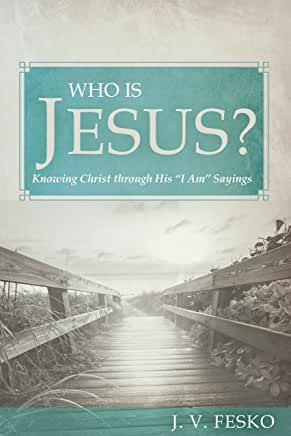
Book Review on J.V. Fesko’s “Who Is Jesus?” by David P. Craig

71Y-e4mau7L._AC_UY436_QL65_ML3_.jpg

How The ‘I Am Statements’ of Jesus Connect The Old Testament and Now Testament Dots

Book Reviewed by Dr. David P. Craig

J.V. Fesko does a wonderful job in this short book (93 pages) showing the Old Testament connections of Jesus’ New Testament claims in his eight ‘I Am’ sayings in the book of John.

Fesko elaborates on how in the Old Testament “Only Yahweh walks on the water, but Jesus walks on the water and tells the disciples not to fear because He is I Am” with reference to John 6:20 when Jesus says “Do not be afraid. I Am.”

When Jesus says He is the “Bread of Life” in John 6:35, 40 the author shows how “Jesus draws the crowd’s attention to the exodus, when God fed Israel with manna from heaven. Jesus tells the crowd that He too is from heaven and that God intends to feed them with His Son, the bread of life.”

Commenting on John 8:12 where Jesus says He is “the light of the world” Fesko states, “During the Feast of Tabernacles, Jesus invokes the exodus , particularly the theme of the pillar of fire guiding Israel by night. Israel identified the pillar with Yahweh, but now Jesus tells the crowds that He is the light of the world, not just Israel.”

With each of the eight sayings the author does a thorough job of exploring the themes, types, shadows, and fore-shadowing of Jesus in the Old Testament and how He comes to reveal the incarnation and redemptive plans of God in the New Testament.

J.V. Fesko’s book is concise, thorough, and contains good food for thought and discussion. I recommend this book especially for small group study (7-8 weeks) – as each chapter concludes with 3-4 questions for discussion. I found the book helpful as I preached on the ‘I Am’ sayings of Christ in a recent 8 week series in my church.

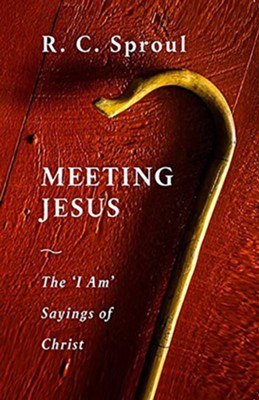
Book Review on R.C. Sproul’s “Meeting Jesus”

719284.jpg

A Helpful Guide To Understanding The ‘I Am” Sayings of Jesus

Book Review by Dr. David P. Craig

The stated purpose of the Gospel of John is found in the second to the last chapter in verses 30-31 of chapter 20, “Now Jesus did many other signs in the presence of the disciples, which are not written in this book; but these are written so that you may believe that Jesus is the Christ, the Son of God, and that by believing you may have life in his name.” Before arriving at this conclusion John gives many proofs along the way of Jesus’ deity. Perhaps the most profound examples of Christ’s deity are His eight “I am” sayings in chapters 6, 8, 10, 11, 14, and 15.

In this short little book (77 pages), R.C. Sproul covers the 8 ‘I am’ sayings of Jesus in the following order: (1) The Bread of Life; (2) The Light of the World; (3) The Door; (4) The Good Shepherd; (5) The Resurrection and the Life; (6) The Way, the Truth and The Life; (7) The True Vine; and (8) Before Abraham Was, I Am.

In each chapter Sproul uses biblical theology to show how the types, shadows, and illustrations of the person and work of Jesus in the New Testament have been the total fulfillment of Israel’s expectations. Each chapter articulates how the person and work of Jesus demonstrates how the realities of Christ’s birth, life, death, and resurrection are essential for our salvation and abundant living in Christ in the hear and now.

The book is based on a series of lectures that R.C. Sproul gave available through Ligonier Ministries. I also found that the Study Guide available from Ligonier Ministries entitled  “Knowing Christ: The ‘I Am’ Sayings of Jesus” by Sproul was also very helpful for further study, discussion questions for small groups, and cross references related to each ‘I Am’ saying. I highly recommend the book, study guide, and lecture series by Sproul for anyone who wants to better understand the person and work of Christ.


Book Review on Costi W. Hinn’s “God, Greed, And The (Prosperity) Gospel by David P. Craig

355274.jpg

The Truth About The False Gospel

One of the first papers I wrote in Bible college in 1985 was a critique on the so-called “Prosperity Gospel.” At the time, the big name prosperity preacher in America was Robert Schuller. As I compared his teaching with the Bible it was very clear that what’s been come to be known as the “prosperity gospel” is clearly a false or non-gospel. It’s not good news because it’s not the biblical gospel – it’s a mirage that is synonymous with the so-called “American Dream.”

As I did my research for my paper on Schuller, something really caught my attention. One, I realized that nobody in the Bible lived with total health, wealth, and prosperity. Pick just about anyone from the Old Testament or New Testament. What they all had in common wasn’t health, wealth, and prosperity, but suffering, pain, and ultimately death – many of them martyrs deaths for the sake of the real gospel. Compare the American dream with the life of Joseph, Job, Paul, Peter, and Jesus – and you have a clear bifurcation of the real and unreal gospel.

Another thing that stood out to me was how Schuller’s “Hour of Power” (his TV show watched by millions of people around the world) couldn’t get traction in communist Russia. I talked with a Russian evangelical pastor and he told me that Schuller couldn’t get traction in Russia because what he was teaching didn’t work in Russia. He wasn’t preaching the gospel because the gospel works everywhere: among the poor and rich, free and suppressed; educated and uneducated; every language; every ethnic group, etc. The gospel has never changed. The reality of the gospel is it works everywhere because it’s true and has the power of God behind it (Romans 1:16). If it can’t be preached everywhere and to everyone than its simply NOT the biblical gospel!

Unfortunately, the false gospel known as the “Prosperity-Gospel” continues to be propounded world-wide. Among the most famous proponents of this false gospel has been Benny Hinn – the uncle of the author, Costi W. Hinn. First of all, kudos to Costi for his courage in writing this book. Costi understands that people’s eternal lives and earthly lives are at stake as to how we understand and what we believe about the gospel. It’s essential that we get the gospel right.

Who should read this book? Everyone! I have been an evangelical pastor for over 30 years and it never ceases to amaze me how many church going people don’t read their Bibles, don’t understand the gospel, and are prone to believe in deceptive lies of the enemy that are proclaimed by wolves in sheep’s clothing.

Costi does a wonderful job of bringing the reader into the world view of prosperity gospel ministries. He gives an honest assessment of its strengths and weaknesses and testifies to how he was deceived growing up in this movement. He then goes on to compare prosperity theology with biblical theology. He compares false teaching and doctrine with biblical doctrine and teaching.

He has some very helpful sections in the book that help you biblically detect false teachers and false doctrines; shows how the prosperity gospel contradicts the real gospel; and gives a balanced view of healing, health, and wealth that is truly biblically based. He also has a great section on helps to reach those who are lost and caught up in false religions and cults.

By God’s grace Costi has been spared from a life apart from truth and the genuine gospel. Now he proclaims God’s grace and the genuine gospel as a pastor and writer. May our Lord use this book to help many flee from the darkness and run to the light of the gospel: That Jesus died for our sins according to the Scriptures, that He was buried, and rose again according to the Scriptures, and that those who repent of their sins and trust in Him may have eternal life. May all those who are deceived have the blinders taken off and may God use this great book to help us in reaching those who were once like Costi – who was once dead spiritually and is now alive spiritually because of the mercy of God delineated by the apostle Paul in 1 Corinthians 15:1-6 & Ephesians 2:1-10.


Recommended Resources on Science and the Bible (Compiled by Pastor David P. Craig)

images.jpegThe Relationship Between the Bible and Science

Barret, Eric C., and David Fisher. Scientists Who Believe.

Berlinski, David. The Devil’s Delusion: Atheism and its Scientific Pretensions.

Cabal, Theodore and Peter Rasor II. Controversy of the Ages: Why Christians Should Not Divide Over The Age Of The Earth.

Carlson, Richard F., editor. Science & Christianity: Four Views.

Collins, C. John. Science & Faith: Friends Or Foes?

Flew, Anthony with Roy Abraham Varghese. There is a God: How The World’s Most Notorious Atheist Changed His Mind.

Guillen, Michael. Amazing Truths: How Science And The Bible Agree

Guillen, Michael. Can A Smart Person Believe in God?

Helm, David R. and Jon M. Dennis. The Genesis Factor: Probing Life’s Big Questions.

Hunter, Cornelius G. Science’s Blind Spot: The Unseen Religion of Scientific Naturalism.

Kethley, Kenneth D., and Mark F. Rooker. 40 Questions About Creation and Evolution.

Lennox, John. Can Science Explain Everything?

Lennox, John. God’s Undertaker: Has Science Buried God?

Lennox, John. Seven Days That Divide The World: The Beginning According To Genesis and Science. 

Moreland, J.P. Christianity and the Nature of Science.

Moreland, J.P. Scientism and Secularism: Learning to Respond to a Dangerous Ideology.

Morris, Henry. Men of Science, Men of God.

Plantinga, Alvin. Where The Conflict Really Lies: Science, Religion, & Naturalism.

Ratzsch, Del. Science and Its Limits.

Ratzsch, Del. The Battle of Beginnings: Why Neither Side Is Winning the Creation- Evolution Debate.

Rau, Gerald. Mapping The Origins Debate: Six Models of The Beginning of Everything.

Stokes, Mitch. How To Be An Atheist: Why Skeptics Aren’t Skeptical Enough.

Strobel, Lee. The Case for a Creator: A Journalist Investigates Scientific Evidence That Points Toward God.

Wallace, J. Warner. God’s Crime Scene: A Cold-Case Detective Examines The Evidence For A Divinely Created Universe.

Williams, Richard N. and Daniel N. Robinson, eds. Scientism: The New Orthodoxy.

Intelligent Design

Axe, Douglas. Undeniable: How Biology Confirms Our Intuition That Life Is Designed.

Behe, Michael J. Darwin’s Black Box: The Biochemical Challenge to Evolution. 

Behe, Michael J. The Edge of Evolution: The Search for the Limits of Darwinism.

Behe, Michael J. Darwin Devolves: The New Science About DNA That Challenges Evolution.

Behe, Michael, William A. Dembski, and Stephen C. Meyer. Science And Evidence For Design In The Universe.

Dembski, William. Intelligent Design: The Bridge Between Science and Theology.

Dembski, William. The Design Inference: Eliminating Chance Through Small Probabilities.

Dembski, William. The Design Revolution: Answering the Toughest Questions About Intelligent Design.

Dembski, William and Jonathan Witt. The Intelligent Design Uncensored: An Easy-to- Understand Guide to the Controversy.

Denton, Michael. Children of Light: The Astonishing Properties of Sunlight that Make Us Possible.

Denton, Michael J. Destiny: How The Laws Of Biology Reveal Purpose In The Universe.

Denton, Michael. Fire-Maker: How Humans Were Designed to Harness Fire and Transform Our Planet.

Denton, Michael. The Wonder of Water.

Eberlin, Marcos. Fore Sight: How the Chemistry of Life Reveals Planning and Purpose.

Gonzalez, Guillermo, and Jay W. Richards. The Privileged Planet: How Are Place In The Cosmos Is designed For Discovery.

Johnson, Phillip E. Darwin on Trial.

Johnson, Phillip E. The Wedge of Truth: Splitting The Foundations of Naturalism.

Keas, Michael Newton. Unbelievable: 7 Myths About the History and Future of Science and Religion.

Leila, Matti & Jonathan Witt. Heretic: One Scientist’s Journey From Darwin To Design.

Meyer, Stephen C. Signature in the Cell: DNA and the Evidence for Intelligent Design.

Meyer, Stephen C. Darwin’s Doubt: The Explosive Origin Of Animal Life And The Case For Intelligent Design.

Meyer, Stephen C. “Intelligent Design” in Four Views On Creation, Evolution, and Intelligent Design edited by J.B. Stump.

Travis, Melissa Cain. Science and The Mind of the Maker: What the Conversation Between Faith and Science Reveals About God.

Wells, Jonathan. Icons of Evolution: Science or Myth? Why Much of What We teach About Evolution Is Wrong.

Wells, Jonathan. The Myth of Junk DNA.

Wells, Jonathan. Zombie Science: More Icons of Evolution.

West, John G. editor. The Magician’s Twin: C.S. Lewis on Science, Scientism, and Society.

Websites Promoting Intelligent Design: intelligentdesign.org ; discovery.org ; intelligentdesignnetwork.org ; ideacenter.org ; biologicinstitute.org ; arn.org 

Six-Day Creationism (Young Earth)

Ashton, John F., editor. In Six Days: Why Fifty Scientists Choose to Believe in Creation.

Barrick, William D. by William D. “Young Earth View of Adam” in Four Views on the Historical Adam.

Duncan III, J. Ligon and David W. Hall “The 24-Hour View” in The Genesis Debate: Three Views on the Days of Creation.

Ham, Ken. “Young Earth Position” in Four Views on Creation, Evolution, and Intelligent Design.

 Hoffmeier, James K. “Genesis as History”in Genesis: History, Fiction, or Neither? Three Views on the Bible’s Earliest Chapters

MacArthur, John. The Battle of Beginnings: Creation, Evolution, and The Bible.

Morris, Henry and John Whitcomb. The Genesis Flood.

Morris, Henry M. Scientific Creationism.

Morris, John D. The Global Flood: Unlocking Earth’s Geologic History.

Morris, John D. The Young Earth: The Real History of the the Earth – Past, Present, and Future.

Morris, John D and Frank J. Sherwin. The Fossil Record: Unearthing Nature’s History of Life.

Mortenson Terry and Thane H. Ury. Coming to Grips With Genesis.

Nelson, Paul and Mark Reynolds. “Young Earth Creationism” in Three Views on Creation and Evolution.

Vail, Tom. Grand Canyon: A Different View.

Young Earth/ Six-Day Creationism Websites: – Ken Ham’s Ministry: answersingenesis.org ; Institute for Creation Research (Founded by Henry M. Morris) – icr.org ; Creation Ministries Internationalcreation.com.

The Day Age Theory or Progressive Creationism (Old Earth)

Gribbin, John. Alone in the Universe: Why Our Planet Is Unique.

Hill, Carol, Gregg Davidson, Tim Helble, and Wayne Ranney, editors. The Grand Canyon, Monument to an Ancient Earth: Can Noah’s Flood Explain the Grand Canyon?

Rana, Fazale. Creating Life In The Lab.

Rana, Fazale. The Cell’s Design.

Rana, Fazale & Hugh Ross. Origins of Life: Biblical and Evolutionary Models Face Off.

Rana, Fazale & Hugh Ross. Who Was Adam? A Creation Model Approach To The Origin of Humanity.

Rana, Fazale R. & Kenneth R. Samples. Humans 2.0: Scientific, Philosophical and Theological Perspectives on Transhumanism.

Ross, Hugh. A Matter of Days.

Ross, Hugh. Beyond The Cosmos.

Ross, Hugh. Creator and The Cosmos.

Ross, Hugh. Improbable Planet.

Ross, Hugh. More Than A Theory.

Ross, Hugh. Navigating Genesis.

Ross, Hugh. The Fingerprint of God.

Ross, Hugh. Why The Universes Is The Way It Is.

Snoke, David. A Biblical Case for an Old Earth.

Young, Davis A. and Ralph F. Stearley. The Bible, Rocks and Time: Geological Evidence for the Age of the Earth.

Websites Promoting The Day Age Theory: reasons.org ; oldearth.org 

The Gap Theory

Barnhouse, Donald Grey. Genesis.

Chalmers, Thomas. The Works of Thomas Chalmers: Complete In One Volume.

Custance, Arthur C.. Without Form and Void.

DeHaan, M.R. Genesis.

Pember, G.H. Earth’s Earliest Ages.

Pink, A.W. Gleanings in Genesis.

Rimmer, Harry. Modern Science and the Genesis Record.

Schaeffer, Francis. Genesis in Space and Time.

Scofield C.I. Scofield Reference Bible (Notes).

Evolutionary Creationism or Theistic Evolution

A Defense of Theistic Evolution:

Applegate, Kathryn & J.B. Stump. How I Changed My Mind About Evolution: Evangelicals Reflect on Faith and Science.

Bishop, Robert C. and Larry L. Funck. Understanding Scientific Theories of Origins: Cosmology, Geology, and Biology in Christian (BioLogos Books on Science and Christianity).

Collins, Francis S. The Language of God: A Scientist Presents Evidence for Belief.

Keathley, Kenneth, J.B. Stump, and Joe Aguirre. Old-Earth Or Evolutionary Creation? Discussing Origins with Reasons To Believe and Biologos.

Haarsma, Deborah B. “Evolutionary Creationism”  in Four Views On Creation, Evolution, and Intelligent Design.

Haarsma, Deborah B. and Loren D. Haarsma. Origins: Christian Perspectives on Creation, Evolution, and Intelligent Design

Lamoureux, Denis O. I Love Jesus & I Accept Evolution 

Lamoureux, Denis O. Evolutionary Creation: A Christian Approach to Evolution

Lamoureux, Denis O. “No Historical Adam: Evolutionary Creation View” in Four Views On The Historical Adam.

McGrath, Alister. The Science of God.

Van Till, Howard J. “The Fully Gifted Creation” in Three Views on Creation and Evolution.

Wood, Todd Charles, and Darrel R. Falk. The Fool And The Heretic: How Two Scientists Moved Beyond Labels To A Christian Dialogue About Creation and Evolution.

Websites Promoting Theistic Evolution: biologos.org ; oldearth.org ; faithandevolution.org ; www.theistic-evolution.com

Evolution Critiqued

Berlinski, David. The Deniable Darwin.

Bethell, Tom. Darwin’s House Of Cards: A Journalists Odyssey Through The Darwin Debates.

Carlson, Ron and Ed Decker. “Evolution The Incredible Theory” in Fast Facts on False Teaching.

Denton, Michael. Evolution: A Theory In Crises.

Denton, Michael. Evolution: Still A Theory In Crises.

Gale,  Barry G. Evolution Without Evidence: Charles Darwin and The Origin of the Species.

Gillespie, Neil. Charles Darwin and The Problems of Creation.

Hanegraaf, Hank. The FARCE of Evolution.

Johnson, Phillip E. Darwin on Trial.

Johnson, Phillip E. Defeating Darwinism by Opening Minds.

Moreland, J.P., Stephen C. Meyer, Christopher Shaw, Ann K. Gauger, and Wayne Grudem, eds. Theistic Evolution: A Scientific, Philosophical, and Theological Critique.

Nagel, Thomas. Mind And Cosmos: Why The Materialist Noe-Darwinian Conception of Nature Is Almost Certainly False

Rhodes, Ron. The 10 Things You Should Know About the Creation vs. Evolution Debate.

Richards, Jay, editor. God And Evolution. 

Simmons, M.D. Geoffrey. What Darwin Didn’t Know: A Doctor Dissects the Theory of Evolution.

Woodward, Thomas. Doubts About Darwin.

YouTube Videos On Science, the Bible, and Evolution

“Nothing Left to Chance” (48:15) {R.C. Sproul, Ligonier Ministries}.

“An Interview with Michael J. Denton” (32:47).

“Blind Watchmaker? A Skeptical Look at Darwinism” (1:12:55) {Phillip E. Johnson}.

“God, Science & the Big Questions: Leading Christian Thinkers Respond to the New Atheism” (1:45:15) {Held at Biola University – with William Lane Craig, John Lennox, J.P. Moreland, and Hugh Hewitt}.

“Hugh Ross and Walter Kaiser vs. Ken Ham and Jason Lisle – Genesis Debate” (3:45:06).

“Hugh Ross and John Ankerberg – Genesis and Science” (2:49:36).

“God and Evolution: The Problem with Theistic Evolution” – Stephen C. Meyer (1:02:36).

“The Origin of Life: Evolution vs. Design” [Full Debate between evolutionist, Michael Ruse and Reason to Believe’s – Fazale Rana, (2:28:35)].

“God & Evolution: A Critique of Theistic Evolution” (2:23:44) [with Stephen Meyer].

“Mathematical Challenges to Darwin’s Theory of Evolution with Berlinski, Meyer, and Gelerenter” (57:14).

“For the City: J.P. Moreland on “A Christian View of Science” (1:08:36).

“Hugh Ross talks Four Views on Creation, Evolution, and Intelligent Design” (Part 1, 33:21).

“Creation – Evolution Debates – Dawkins vs. Lennox at Cambridge” (1:21:53).

“Intelligent Design Vs. Evolution 2.0 – Perry Marshall debates Stephen Meyer” (1:21:53).

“John Lennox: The Question of Science and God – Part 1 (47:34) {Socrates in the City Interview with Eric Metaxas}; Part 2 (58:28).

“John Lennox: Seven Days That Divide the World” (1:30:07) {Socrates in the City Lecture Introduction and MC’d by Eric Metaxas}.

“Eric Metaxas Interviews Stephen Meyer on Science and Faith” (1:11:42).

“Can Science Explain Everything? An Interview with John Lennox (1:30:09).

“Eric Metaxas: The Miracle of the Universe” (45:06).

“Dr. David Berlinski: The Devil’s Delusion: Atheism and Its Scientific Pretensions” (1:14:57) {Socrates in the City – Introduction by Eric Mataxas}.

“Michael Behe – Lee Strobel – Molecular Machines Disprove Evolution” (8:41).

“Michael Behe: Darwin Devolves” (1:01:24) {Socrates in the City Interview with Eric Metaxas}.

“Irreducible Complexity” (1:42:48) {Michael Behe on the Access Research Network}.

“From the Big Bang to Irreducible Complexity – Michael Behe, PhD” (58:18).

“What Are The Limits of Drwinism? A Presentation by Dr. Micahel Behe at the University of Toronto” (1:25:34).

“Stephen Meyer & Eric Metaxas Discuss Darwin’s Doubt at Socrates in the City” ((1:25:48) {Socrates in the City Interview with Eric Metaxas}.

“Stephen Meyer: The Return of the God Hypothesis” (1:11:55) {Socrates in the City Interview with Eric Metaxas}.

“Ard Louis: Science and Faith” (1:18:45) {Socrates in the City Interview with Eric Metaxas}.

“Has Science Buried God? Oxford Professor, John Lennox, at SMU (1:11:25).

“James Tour: The Mystery of the Origin of Life” (58:02).

“Does Science Make Faith Obsolete? James Tour at Mississippi State University” (1:57:11).

“Dr. Tour On The Origin of Life at Syracuse University Cru” (1:30:29).

“Science Refutes Evolution – Dr. James Tour” (59:29).

“Dr. James Tour speaking about Evolution” (34:05).

“James Tour: The Origin of Life Has Not Been Explained” (22:57).

“The Scientific Case For Intelligent Design – William Dembski, PhD” (45:34).

“Information and the End of Materialism – William Dembski, PhD” (44:09).

“Molecular Machines and the Death of Darwinism – Dembski, Wells, Nelson, Macosko” (43:15).

“Detecting Design in Biology” (1:51:31) {Access Research Network}.

“Hugh Ross – Origin of Life” (1:13:01).

“Hugh Ross – Beyond the Cosmos: How Science Reveals God’s Trans-Dimensional Power” (1:13:11).

“Hugh Ross vs. Ken Ham – TBN Debate” (1:14:18).

“Hugh Ross vs. Kent Hovind How Old Is The Earth” (2:35:43).

“Does Science Prove God’s Glory? Dr. Hugh Ross Regent University (29:27).

“Hugh Ross – The Flood of Noah” (1:09:14).

“Hugh Ross – Hubble Confirms Universe Expanding Faster Than Expected” (1:47:11).

“Inner Life of the Cell (Full Version)” (7:59).

“The Failure of Darwin’s Theory” (28:31) {Stephen Meyer on John Ankerberg}.

“Harmony Between Christianity and Science Michael Guillen” (8:02).

“Francis Collins: How I Became a Christian” (27:53).

“10 Top Christian Scientists on Science and Faith” (6:28).

“Stephen C. Meyer The Ben Shapiro Show Sunday Special Episode 43” (59:38).

“How Darwinists Think Lecture and Q&A Phillip E. Johnson” (1:39:51).

“Phillip E. Johnson on Darwinism” (57:58).

“Darwinism on Trial” (1:40:59) {Phillip E. Johnson}.

“Focus on Darwinism – An Interview with Phillip E. Johnson” (54:08).

“One Nation Under Darwin” (1:32:09) {Phillip E. Johnson}.

“Debate: Darwinism: Science or Naturalistic Philosophy? Phillip Johnson vs William Provine” (1:46:33).

“Darwinism: Science or Philosophy – Phillip E. Johnson” (58:06).

*REVIVAL KEYS By Ajith Fernando

photo of clouds during golden hour
Photo by Joshua Woroniecki on Pexels.com

I was very encouraged when a small group of Christians seeking to pray for revival asked me to speak to them and give them some guidance. This is an expansion of what I shared.

Revival means many things to many people. But what I am talking about is a situation where large numbers of people are fired up to seek God fully, yearn for obedience, confess sin in their life, and experience the joy and freedom of walking with God.

History shows us that there is no exact prescription for revival. It is an act of the sovereign God and we can’t dictate to God what he should do and when he should do it. I have been praying for revival in Sri Lanka since 1975. Only once have I seen something close to revival (at a conference I was part of). But I will not give up praying. In my lifetime or after, may the Lord send his showers of blessing upon our people.

While we cannot dictate to God what he will do, history shows us that there are some things that happen before and when revival comes that are worth noting.

1. There is faithful preaching of the Word before revival comes, as we saw with the ministry of Ezra, and in all the revivals in the history of the church. The Word systematically preached can create a thirst for all that the Word teaches, and the Holy Spirit can ignite the Word with fires of revival when God’s time has come. Often pre-revival preaching is characterised by a call to total commitment to God, to repent and get right with God and an extolling of the beauty of holiness.

2. The great historian of revival J. Edwin Orr has made famous the statement, “No great spiritual awakening has begun anywhere in the world apart from united prayer—Christians persistently praying for revival.” This is what the disciples of Christ did before the outpouring of the Spirit at Pentecost (Acts 1:14). People with a burden recognise others with a similar burden and they join and pray. I can tell you story after story of great revivals that were preceded by such united, persevering prayer by people who recognised that they share a similar burden for revival.

3. Unity is often the trigger for revival and sometimes the result of revival. Once when Ugandan Bishop Festo Kivengere was preaching in South India, his interpreter Samuel Ganesh felt convicted of the need to make peace with a person in the audience. He took leave from the preacher and went to audience and made peace. This triggered a process of person after person making peace with each other. Revival had come; there was no need to complete the sermon. Bishop Festo left room for the Spirit do his work. The Bible speaks of the urgency of believers being united (John 17:31, 23; Eph. 4:1-3). One of the most important callings of leaders is to yearn and pray for unity and do all they can to facilitate it. The Holy Spirit can use a leaders’ yearning to trigger revival. Those who pray for revival should make sure that they have done all to be at peace with others.

4. Another revival key is earnestness (Jonah 3:8). The famous revival prayer, “Will you not revive us again, that your people may rejoice in you?” (Psa. 85:6) suggests a tone of earnest desire. Revival is preceded by people seeking God with all their heart and wanting to see God’s glory among his people. My favourite example of such praying are the students at Pandita Ramabhai’s school in India who fervently prayed, and God answered by reviving them and many others through them. The young Evan Roberts, whose ministry triggered the Welsh Revival, often prayed, “Bend me, O God.” We are open to whatever it takes for God to be totally in control of our lives!

5. Every genuine revival I know of has been accompanied by the confession of sin (2 Chron. 7:14). Some so-called revivals have been characterised by exotic experiences without much emphasis on repentance. People go to such places like tourists to see what is happening. I wonder whether we could call that revival. After the revival at Asbury College and Seminary in 1971 many students came to the bookstore to return things that they have taken without paying. That is a powerful sign that they had got right with God.

Preaching against sin before the revival often contributes to revival and influences what sins are sins confessed. In the history of the church there were times when some sins were neglected in revival preaching—like sexual impurity, exploitation, race, class and caste prejudice. This has resulted in revived churches perpetuating sins that the revival should have addressed. In other revivals, like the 18th century Wesleyan revival in the UK, revival helped influence social reform and attack injustice.

6. Often revivals are accompanied by spectacular phenomena, especially during the start of the revival. The revivals associated with the Wesleys and Jonathan Edwards had people falling down with somewhat violent reactions under deep conviction of sin. We need to be open to God’s “surprising works” and be careful about stifling such. But we also need to remember that after some time these phenomena could become rituals that have lost their original meaning. Sometimes these phenomena could be taken to extremes that make them unbalanced and unbiblical.

7. Revivals start in different, sometimes surprising, places. In Wales it was a group of young people under a seminary student Evan Roberts, who came home from seminary to seek God sensing that he had lost his fire. Roberts started a prayer group which grew and grew and became a nationwide movement resulting in about 100,000 people being converted and joining the church. In the Hebrides Islands of Scotland, there were two single house-bound ladies in their eighties, Misses Smith, who prayed earnestly for revival. At the same time in another part of their island seven young men met regularly to prevail in prayer until revival broke. In Korea in the early 1900s God spoke to the leaders of the church and revived them first and that led to a national awakening. In an Indian girls school it was the prodding of a devout leader Pandita Ramabhai which fired up students to prevail in prayer and trigger revival. Five university students in the USA gathered at a haystack and prayed for missions and helped give birth to the great missionary movement of that nation.

8. While revivals usually result in the awakening of Christians, they are also accompanied by a powerful witness to those outside the church. Unbelievers see the power of God at work in the revived Christians and these Christians are emboldened to share their faith. The result is that large numbers of people are saved. So effective evangelism generally accompanies genuine revival.

Do not lose heart, dear friends, keep yearning for a great visitation from God. The seven young people in the Hebrides Islands made Isaiah 62:6-7 their watchword as they prayed for revival: “You who put the LORD in remembrance, take no rest, and give him no rest until he establishes Jerusalem and makes it a praise in the earth.” Let us take no rest and give no rest to God until he sends revival to our people.

*Ajith Fernando is the teaching director of Youth for Christ in Sri Lanka. He served as the ministry’s national director for 35 years. He is the author of seventeen books, including Discipling in a Multicultural World, and lives in Colombo, Sri Lanka, with his wife. They have two adult children and four grandchildren.

*Responding to the Argument from Evil – 3 Approaches for the Theist by Dr. David Wood

9780801072604.jpg

A few weeks ago, my five-year-old son, Lucian, came up with his first argument against the existence of God. He reasoned that, since God can’t be seen, God must not exist. Put formally:

  1. If I can’t see x, x doesn’t exist.
  2. I can’t see God.
  3. Therefore, God doesn’t exist.

The first premise, of course, is false, and it wasn’t difficult to show young Luke that seeing isn’t the only way to know that something exists. We can, for instance, know that something exits because of its effects. Hence, this argument was easily refuted (and I remain undefeated in debates with five-year-olds). Nevertheless, I doubt my son is going to stop formulating arguments. It’s only a matter of time before he presents me with a much stronger case, based on a crucial piece of data that is always before him.

In November of 2007, my son Reid was born. He wasn’t moving or breathing. The only sign of life was his heartbeat. He was placed on a respirator, and he was eventually given a tracheostomy. We had to wait several months for a diagnosis, but we finally learned that Reid has myotubular myopathy, a rare genetic disorder that makes his muscles extremely weak—so weak that he can’t hold his head up, breathe consistently, swallow when he needs to, or make a sound when he cries.

We teach our sons that God is all-knowing, all-powerful, and completely good. I’m quite certain that, within the next few years, Luke is going to reason as follows:

  1. God, by definition is all-knowing, all-powerful, and completely good.
  2. If God is all-knowing, he would know how to prevent children from getting myotubular myopathy.
  3. If God is all-powerful, he would have the power to prevent children from getting myotubular myopathy.
  4. If God is completely good, he would want to prevent children from getting myotubular myopathy.
  5. My brother has myotubular myopathy.
  6. Therefore, God doesn’t exist.

This argument isn’t nearly as easily refuted as the previous argument. How are theists (i.e., people who believe that God exists and acts in our world) to respond?

There are three main approaches we can take when we respond to the argument from evil (hereafter AE). We can point out problems with the argument, we can try to explain suffering, and we can offer additional arguments for theism that outweigh any evidence against theism. Let’s take a closer look at these responses.

Problems with the Argument from Evil (AE)

Since AE is an argument, the burden of proof is on the proponent to show that the argument is a good one. Thus, the first approach we can take is to point out problems with the argument itself, for example, inconsistencies, unproven assumptions, or ambiguous terms.

Inconsistencies

When atheists present AE, they’re usually guilty of a number of inconsistencies. Let’s consider one that’s quite common. The most popular version of AE goes something like this:

  1. If God exists, there wouldn’t be any pointless suffering.
  2. Since we can’t think of reasons for allowing certain instances of suffering, some suffering is probably pointless (e.g., an injured deer experiencing pointless pain as it slowly dies in the woods).
  3. Therefore, God probably doesn’t exist.

But notice what the atheist is claiming. Since there’s probably no point to at least some suffering (because we can’t think of one), God probably doesn’t exist. The atheist is claiming, then, that we shouldn’t believe something that seems improbable. But what happens when atheists are confronted by, say, the design argument? The theist argues, “Look, it’s extremely improbable that life formed on its own, or that the universe just happened to be finely tuned for life. So life and the world probably have a designer.” Here the atheist responds, “Yes, these things may be improbable, but I’m going to believe them anyway.” This is a clear inconsistency. When one argument is on the table, we mustn’t go against the probabilities; when a different argument is on the table, it’s suddenly perfectly acceptable to go against the probabilities.

Based on this inconsistency alone, I would say that even if a theist has no explanation for suffering, he or she is no worse than the atheist who has no explanation for the origin of the universe of for the complexity of life. If, however, it can be shown that there are other problems with the argument from evil, and if theists can offer reasons for God to allow suffering, theists are on much better ground than atheists.

Ambiguous Terms

Certain words can mean very different things to different people. For instance, if I say to an atheist, “I have faith in God,” the atheist assumes I mean that my belief in God has nothing to do with evidence. But this isn’t what I mean by faith at all. When I say that I have faith in God, I mean that I place my trust in God based on what I know about him.

Ambiguous terms can cause significant problems when they’re used in arguments. Consider a simple word: good. Theists say that God is wholly good. But what do we mean by this? As I examine AE, I find that atheists are using this term quite differently from the way I use it. If we examine atheistic arguments carefully, we find that a “good” being is one who maximizes pleasure and minimizes pain. Given this definition, we can see why AE seems so persuasive to some:

  1. If Gd existed, he would maximize our pleasure and minimize our pain.
  2. Our pleasure is not maximized, and our pain is not minimized.
  3. Thus, God doesn’t exist.

If the premises of this argument are true, the conclusion follows. But what if we challenge the first premise by rejecting the claim that God’s goodness implies giving lots of pleasure? Theists believe that some things are far more important than pleasure or lack of pain. Becoming good people, developing virtues, learning that we’re not the center of the universe, seeking God with all our hearts—these are all vastly more important than pleasure or lack of pain. Thus, when theists say that God is wholly good, we’re applying the term good within a framework of Christian values, where pleasure simply isn’t at the top of our priorities.

Unproven Assumptions

When we make an argument, we assume various things. For instance, we assume that our minds are functioning properly, that valid logic preserves truth, and so on. Such things are rarely questioned. Nevertheless, when an assumption is crucial to an argument, and there’s no good reason to believe the assumption, the argument is on very shaky ground. Consider the awareness assumption, which is absolutely critical for most versions of AE: If God has reasons for allowing evil, we will be aware of these reasons.

I cannot imagine how a defender of AE could even hope to show that this assumption is true. God’s knowledge and wisdom are infinite, while even the smartest of human beings knows practically nothing by comparison. Yet without this assumption, most versions of AE cannot get off the ground.

Explaining Suffering

Given numerous problems with AE (and we’ve only looked at a few), I don’t think that theists are under any obligation to explain suffering. Yet if we can come up with plausible reasons for God to allow suffering , this would increase the overall plausibility of theism.

Theists can account for suffering in two important ways: we can account for suffering theologically by appealing to Christian doctrines, and we can account for suffering philosophically by appealing towhead philosophers call “theodicies.”

Christian Doctrine

The most important religious claim to consider when faced with AE is that humanity is in a state of rebellion against God. While an atheist will probably reject such a claim, it’s important to keep in mind that AE relies, to a large extent, on how awful humanity is and can become. When atheists offer evidence of suffering, they typically point to the Holocaust, or to the “Rape of Nanking,” or to children being horribly victimized. But such events fit quite well with the idea that humanity has turned away from God. To put it differently, the more examples of moral evil an atheist presents in support of his argument, the more evidence he’s given that human beings are extremely sinful. And it makes little sense to say, “Human beings are incredibly sinful and are at war with God, but God should give us a world of total pleasure and should rush to our aid whenever something goes wrong.”

Theodicies

A theodicy is an attempt to answer the question, What morally sufficient reason could there be for God to allow evil? Let’s look at two of the most important types of theodicy.

First, there are free will theodicies, which are based on two central ideas:

  1. A world containing free beings is better than a world without free beings, since only free beings can choose the good or genuinely love or be moral in any meaningful sense.
  2. True freedom entails that we are also free to choose the bad or not to love or to disobey the moral law.

On this view, moral evil is a misuse of moral freedom. Freedom itself, however, is a wonderful gift.

Second, there are soul-building theodicies. As we noted earlier, it’s quite common for people to think that, of God exists, his primary goal should be to maximize our pleasure. Such a view doesn’t fit well within a Christian framework, for it turns God into a “cosmic thermostat,” whose job is to keep the universe just the way we like it. Proponents of soul-building theodicies maintain that God has more important things in mind than pleasure or lack of pain. While it’s wonderful to go through times when life is comfortable, it’s a simple fact of human experience that we don’t grow much during those times. So if becoming mature human beings (or mature Christians) is important, then a world with pain is better than a world without pain. 

I don’t believe that such theodicies account for all of the evil in our world. nevertheless, as a theist, I don’t believe that our minds are capable of God’s reasons for allowing suffering. The fact that we can come up with some plausible explanations for suffering (despite our limited knowledge) is itself a serious blow to AE.

Outweighing the Argument from Evil

Since the argument from evil only claims to provide a certain amount of evidence against theism, we must note that, even if we think AE is a good argument, the evidence drawn from it can potentially be outweighed by other evidence. Theists can therefore muster a number of arguments in favor of their position. If these arguments, taken as a whole, provide a stronger case than AE, we must conclude, once again, that AE is not a serious threat to theism. While there are dozens of arguments for the existence of God, we will briefly consider three.

Design Arguments

There are two main versions of the design argument: (1) the argument from fine-tuning, and (2) the argument from biological complexity. Physicists are aware of the fact that the fundamental constants of our universe seem to be finely-tuned for life. If the gravitational force, the weak nuclear force, the strong nuclear force, and the electromagnetic force were altered even slightly, human beings could not exist. Since there’s no naturalistic explanation for why these values should be just right for life, the fine-tuning of the cosmos provides strong evidence of a designing intelligence.

A cosmos finely tuned for life, however, doesn’t give us life. Additional steps are required to reach living cells, multicellular organisms, complete ecosystems, and especially conscious, self-reflective beings. The complexity of even the most basic living organism (let alone the complexity of more advanced life) is further evidence of a designing intelligence.

Cosmological Arguments

Many arguments for theism attempt to show that the universe must have a cause, or a certain type of cause. One such argument begins as follows:

  1. Whatever begins to exist must have a cause.
  2. The universe began to exist.
  3. Therefore, the universe must have  cause.

The first premise is self-evident; the second premise can be known scientifically; thus, the conclusion follows. But we can go even further by examining the nature of the cause of the universe. Since the scientific evidence shows that matter and time began to exist, the first cause must be immaterial and timeless (both of which are attributes of God). The first cause must also be extraordinarily powerful and free to create. These attributes fit in perfectly with theism; they make no sense in atheism.

The Argument from Morality

Third, consider the following argument.

  1. If God does not exist, objective moral values do not exist.
  2. Objective moral values exist.
  3. Therefore, God exists.

The first premise is certainly true. When we say that there are objective moral values, we’re saying that there are moral claims that are true whether or not human beings agree with them. Thus, the claim “rape is immoral” would still be true even if every human being on the planet decided otherwise. But if human beings cannot serve as the ground for objective morality, what can? Only a being that completely transcends humans.

What about the second premise? Interestingly enough, proponents of AE often grant this premise in the course of their argument. By declaring that suffering is evil, atheists have admitted that there is an objective moral standard by which we distinguish good and evil. Amazingly, then, even as atheists make their case against the existence of God, they actually help us prove that God exists!

Assessment 

We’ve looked at three approaches theists can take when we respond to the AE. We must be careful to use such responses at the appropriate time, however. Remember that Job had the best friends in the world, so long as they kept their mouths shut. Job’s time of intense suffering was not the appropriate occasion for a deep philosophical and theological analysis of human pain.

Similarly, when my son Luke comes up to me and says (as I know he eventually will), “Why did God allow Reid to get sick?” the appropriate response is not to charge in and say, “Well, let me explain the soul-building theodicy to you.” To give specific and confident answers is to pretend that we have certainty of God’s reasons for things when we often don’t. Human anguish is powerful, sometimes far more powerful than words.

Nevertheless, at appropriate times, we must respond to AE. Atheists claim that their arguments refute theism. Yet they-re inconsistent in the application of their principles, and they’re smuggling in unproven assumptions and a distorted hierarchy of values. When we combine these problems with the fact that theists can explain a fair amount of suffering (which is all that can be reasonably expected of limited beings) and that we have strong evidence that supports belief in God, it’s clear that the only significant argument for atheism fails on multiple levels.

*The article above is adapted from chapter 6 in the excellent book edited by  Michael A. Dembski and Michael R. Licona entitled: 50 Arguments for Faith from the Bible, History, Philosophy, and Science. Grand Rapids, MI.: Baker Books, 2010.

About David Wood: He is the teaching fellow in philosophy at Fordham University, where his doctoral work focused on the problem of evil. A former atheist, he became a Christian after investigating the historical evidence for Jesus’s resurrection. He is co-director of Acts 17 Apologetics Ministries, has been in more than two dozen pubic debates with Muslims and atheists, and is a member of the Society of Christian Philosophers. David lives in the Bronx, New York, with his wife, Marie, and their sons, Lucian, Blaise, and Reid. You can watch a short testimony of David Wood on YouTube entitled “Why I am A Christian” (34:06); or a longer version: “Dr. David Wood shares his Testimony @ IPC Hebron, Houston” (1:04:03). Both of these videos are highly recommended and will encourage you and motivate you toward using apologetics in your sharing the gospel with those you may think are difficult to reach.