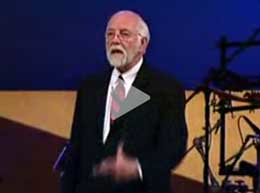
Dr. Warren Wiersbe on the question: What is the Purpose of Life’s Trials?

“The Bumps Are What You Climb On”

A little boy was leading his sister up a mountain path and the way was not too easy. “Why, this isn’t a path at all,” the little girl complained. “It’s all rocky and bumpy.” And her brother replied, “Sure, the bumps are what you climb on.” That’s a remarkable piece of philosophy. What do you do with the bumps on the path of life?

I have been a reader of biographies for many years, and I have yet to find a successful person whose life was free from problems and difficulties. Looking at these people from a distance, you might think they had it made and that life was easy for them. But when you get closer, you discover that their climb to the top of the mountain was not an easy one. The road was rocky and bumpy, but the bumps were what they climbed on to get to the top.

We don’t have to read too far in the Bible before we discover the truth. Abraham certainly didn’t become a great man of faith overnight. He had to go through some difficult tests on the road of life before he reached the top of the mountain. No sooner did Abraham arrive in Canaan than a famine came to the land. Imagine facing a famine in the land God has promised you! Then Abraham had problems with his nephew, Lot; and then war came to the land, and Abraham had to go out and fight. His wife led him astray with bad counsel and the result was the birth of Ishmael, a boy who brought sorrow to Abraham’s heart. Finally, Isaac, the promised son, was born, bringing great joy to Abraham and Sarah. Then God asked Abraham to put Isaac on the altar, a sacrifice that would be difficult for any father or mother. Yes, there were many bumps on that road, but Abraham used the bumps to climb higher.

If anybody walked a rocky road, Joseph did. His father pampered him, hated by his brothers, sold for a slave, falsely accused, put into prison, forgotten, and apparently forsaken. But the bumps on the road helped him to climb higher, and one day Joseph became the second in command of all Egypt. Moses had a similar experience, and so did David, Daniel, and Paul. Here were people who did not complain about the road; they accepted the difficulties of life and used them as stepping-stones to the top of the mountain.

I don’t know what difficulties you are going through just now, but I know some of the feelings you have, because I have been on this bumpy road myself. You feel like quitting, like giving up. You can’t understand why the road doesn’t get easier, why God doesn’t remove the stones and straighten the path. If God did that, you might never get to the top, because the bumps are what you can climb on.

Psalm 91 says, “He that dwelleth in the secret place of the most High shall abide under the shadow of the Almighty.” It is a psalm that magnifies the care that God exercises over His children. Eleven different kinds of dangers are named in this psalm-war, snares, sickness, terrors by night, arrows by day, and others-yet God says that He can protect us from them all. This doesn’t mean that we will never experience accidents or injuries; but it does mean that no matter what happens in the will of God, all things will work together for good.

One of the greatest promises found in Psalm 91 has to do with the stones on the path. “For he shall give his angels charge over thee, to keep thee in all thy ways. They shall bear thee up in their hands, lest thou dash thy foot against a stone.” God doesn’t promise to remove the stones from the path, but He does promise to make them stepping-stones and not stumbling blocks. He promises to help us climb higher because of the difficulties of life.

Most of us respond in a predictable wayto the rocks in the path. We complain about them; we kick against them and only hurt ourselves. We try to pick them up and get rid of them, only to discover they are too heavy for us. We can’t always get around them, and we wonder if we can get over them. Some people just stop and go no further. Others give up and turn back. But the child of God does not have to stop or go back; he can use the rocky places in life as stepping-stones to climb higher.

The trouble with most of us is that we are accustomed to paved roads and level sidewalks. But life is not made that way. Sometimes the road is level and easy, and the birds are singing and the way is wonderful. But sometimes the road is rocky and bumpy, and we hear no music and feel no helping hand. Then what? Complain? Give up? No, that’s the time to remember God’s promise: “For he shall give his angels charge over thee, to keep thee in all thy ways.” God’s invisible army is at your service, and God can see you through.

Charlie Brown in the “Peanuts” comic strip is one of my favorite characters. In one particular strip, he is complaining because his team always loses their games. Lucy tries to console him by saying, “Remember, Charlie Brown, you learn more from your defeats than you do from your victories.” And Charlie Brown replies, “That makes me the smartest man in the world!”

If life were nothing but a series of defeats, all of us would get discouraged. God knows how to balance our lives so that we have sunshine and rain, calm and storm, laughter and tears. On the road of life there are level places that delight us, and there are difficult places that challenge us. If we get off the path of God’s will and go on a detour, the way will be rough from start to finish. The detour is always rougher than the main road. But there are rocks and bumps even on the paths of God’s choosing, and we have to learn to accept them and benefit from them. The bumps are what you climb on.

But this takes faith. It is much easier to kick the rock and turn around and go back. The secret to climbing higher is to look away from yourself and your difficulties, and look by faith to Jesus Christ. He knows where you are, how you feel, and what you can do. Turn it all over to Him and start walking by faith. The very rocks that seem like barriers to human eyes will, to the eyes of faith, become blessings. Listen to the promises of Psalm 91:15: “He shall call upon me, and I will answer him: I will be with him in trouble; I will deliver him, and honor him.”

If anybody faced obstacles on the road of life, it was our Lord Jesus Christ. He was born into a poor family, a member of a rejected minority race. He grew up in obscurity in a little town that mentioned only in scorn—“Can any good thing come out of Nazareth?” He gathered about Him a small group of nondescript men, and one of them became a traitor and sold Him for the price of a slave. He was called a liar, a glutton, a drunkard, and a man in league with the devil. Men twisted His words and questioned His motives, yet Jesus Christ continued to do the will of God. Finally, He came to that greatest stone of all—being crucified like a common thief. But He continued to climb that mountain, and God gave Him the victory.

This is why the writer of the Book of Hebrews urges us to look to Jesus Christ and keep on trusting. “Looking unto Jesus the author and finisher of our faith; who for the joy that was set before him endured the cross, despising the shame, and is set down at the right hand of the throne of God” (12:2). We are to look not at ourselves, our circumstances, our troubles, or the bumps in the road, but unto Jesus.

Yes, the bumps are what you climb on!

About Warren W. Wiersbe:

Warren W. Wiersbe is the Distinguished Professor of Preaching at Grand Rapids Baptist Seminary, and is the author of more than 100 books. Billy Graham calls him “one of the greatest Bible expositors of our generation.” Interestingly, Warren’s earliest works had nothing to do with scriptural interpretation. His interest was in magic, and his first published title was Action with Cards (1944).

“It was sort of imbecilic for a fifteen-year-old amateur magician to have the audacity to write a book and send it to one of the nation’s leading magic houses,” Warren says. But having a total of three books published by the L.L. Ireland Magic Company—before the age of 20—gave him a surge of confidence. In later years, he applied his confidence and writing talent to the Youth for Christ (YFC) ministry.

Warren wrote many articles and guidebooks for YFC over a three-year period, but not all his manuscripts were seen by the public eye. One effort in particular, The Life I Now Live, based on Galatians 2:20, was never published. The reason, Warren explains with his characteristic humor, is simple: it was “a terrible book…Whenever I want to aggravate my wife, all I have to say is, ‘I think I’ll get out that Galatians 2:20 manuscript and work on it.’” Fortunately, Warren’s good manuscripts far outnumbered the “terrible” ones, and he was eventually hired by Moody Press to write three books.

The much-sought-after author then moved on to writing books for Calvary Baptist Church. It was during his ten years at Calvary that Expository Outlines on the New Testament and Expository Outlines on the Old Testament took shape. These two works later became the foundation of Warren’s widely popular Bible studies known as the Be series, featuring such titles as Be Loyal (a study on Matthew) and Be Delivered (a study on Exodus). Several of these books have been translated into Spanish.

His next avenue of ministry was Chicago’s Moody Memorial Church, where he served for seven years. He wrote nearly 20 books at Moody before moving to Lincoln, Nebraska, where he and his wife, Betty, now live. Prior to relocating, he had been the senior pastor of Moody Church, a teacher at Trinity Evangelical Divinity School, and a producer of the Back to the Bible radio program.

During all these years of ministry, Warren held many more posts and took part in other projects too numerous to mention. His accomplishments are extensive, and his catalog of biblical works is indeed impressive and far-reaching (many of his books have been translated into other languages). But Warren has no intention of slowing down any time soon, as he readily explains: “I don’t like it when people ask me how I’m enjoying my ‘retirement,’ because I’m still a very busy person who is not yet living on Social Security or a pension. Since my leaving Back to the Bible, at least a dozen books have been published, and the Lord willing, more are on the way.”

Some of Wiersbe’s recent books include Your Next MiracleThe 20 Essential Qualities of a Child of GodThe Bumps are What You Climb OnClassic Sermons on the Fruit of the SpiritClassic Sermons on Jesus the ShepherdKey Words of the Christian LifeLonely PeopleA Gallery of GraceReal Peace: Freedom and Conscience in the Christian Life, and On Being a Leader for God.

The article above was adapted from the very encouraging and practical book by Warren W. Wiersbe. The Bumps Are What You Climb On: Encouragement for Difficult Days. Baker: Grand Rapids, 2003 (Chapter One).

A Supernatural Life by Steve Brown

Series: Friday Humor #3

A friend of mine told me a great story the other day, which he confirmed was true.

A woman shipped a very valuable dog on airplane. But when the clerks checked the cage after the flight was complete, they found the dog dead. So they went out and bought one just like it and replaced the live dog for the dead one. When the woman came to pick up her dog, she looked in the cage and stepped back in surprise.

“What’s the matter?” an attendant asked.

“Why,” she said in a trembling voice, “That dog was dead when I put him in the cage.”

Jesus said that Christians have passed from death to life. Since that’s true, pagans, especially those who knew us before we trusted in Christ, ought to be just as surprised when they come in contact with us as that woman was when she saw her dog. Our new life ought to be different than the old one—so different, in fact, that people notice the difference.

What in your life can only be explained in terms of the supernatural? Ask a pagan. He should know.

Meditation:

What habits of your old life still linger in your new? I know. Old habits die hard, but God is bigger than any habit, and He sure won’t tolerate bad ones. So get through with them. With God at your side, start rooting them out of your life. As long as you can rely on Him you can do it—He promises you (Philippians 4:13)

 For Further Study:

Acts 9:1-31, “But Saul, still breathing threats and murder against the disciples of the Lord, went to the high priest and asked him for letters to the synagogues at Damascus, so that if he found any belonging to the Way, men or women, he might bring them bound to Jerusalem. Now as he went on his way, he approached Damascus, and suddenly a light from heaven shone around him. And falling to the ground he heard a voice saying to him, “Saul, Saul, why are you persecuting me?” And he said, “Who are you, Lord?” And he said, “I am Jesus, whom you are persecuting. But rise and enter the city, and you will be told what you are to do.” The men who were traveling with him stood speechless, hearing the voice but seeing no one. Saul rose from the ground, and although his eyes were opened, he saw nothing. So they led him by the hand and brought him into Damascus. And for three days he was without sight, and neither ate nor drank.

Now there was a disciple at Damascus named Ananias. The Lord said to him in a vision, “Ananias.” And he said, “Here I am, Lord.” And the Lord said to him, “Rise and go to the street called Straight, and at the house of Judas look for a man of Tarsus named Saul, for behold, he is praying, and he has seen in a vision a man named Ananias come in and lay his hands on him so that he might regain his sight.” But Ananias answered, “Lord, I have heard from many about this man, how much evil he has done to your saints at Jerusalem. And here he has authority from the chief priests to bind all who call on your name.” But the Lord said to him, “Go, for he is a chosen instrument of mine to carry my name before the Gentiles and kings and the children of Israel. For I will show him how much he must suffer for the sake of my name.” So Ananias departed and entered the house. And laying his hands on him he said, “Brother Saul, the Lord Jesus who appeared to you on the road by which you came has sent me so that you may regain your sight and be filled with the Holy Spirit.” And immediately something like scales fell from his eyes, and he regained his sight. Then he rose and was baptized; and taking food, he was strengthened.

For some days he was with the disciples at Damascus. And immediately he proclaimed Jesus in the synagogues, saying, “He is the Son of God.” And all who heard him were amazed and said, “Is not this the man who made havoc in Jerusalem of those who called upon this name? And has he not come here for this purpose, to bring them bound before the chief priests?” But Saul increased all the more in strength, and confounded the Jews who lived in Damascus by proving that Jesus was the Christ.

When many days had passed, the Jews plotted to kill him, but their plot became known to Saul. They were watching the gates day and night in order to kill him, but his disciples took him by night and let him down through an opening in the wall, lowering him in a basket.

And when he had come to Jerusalem, he attempted to join the disciples. And they were all afraid of him, for they did not believe that he was a disciple. But Barnabas took him and brought him to the apostles and declared to them how on the road he had seen the Lord, who spoke to him, and how at Damascus he had preached boldly in the name of Jesus. So he went in and out among them at Jerusalem, preaching boldly in the name of the Lord. And he spoke and disputed against the Hellenists. But they were seeking to kill him. And when the brothers learned this, they brought him down to Caesarea and sent him off to Tarsus.

So the church throughout all Judea and Galilee and Samaria had peace and was being built up. And walking in the fear of the Lord and in the comfort of the Holy Spirit, it multiplied.”

Ephesians 4:17-5:12, Now this I say and testify in the Lord, that you must no longer walk as the Gentiles do, in the futility of their minds. They are darkened in their understanding, alienated from the life of God because of the ignorance that is in them, due to their hardness of heart. They have become callous and have given themselves up to sensuality, greedy to practice every kind of impurity. But that is not the way you learned Christ!— assuming that you have heard about him and were taught in him, as the truth is in Jesus, to put off your old self, which belongs to your former manner of life and is corrupt through deceitful desires, and to be renewed in the spirit of your minds,  and to put on the new self, created after the likeness of God in true righteousness and holiness.

Therefore, having put away falsehood, let each one of you speak the truth with his neighbor, for we are members one of another. Be angry and do not sin; do not let the sun go down on your anger, and give no opportunity to the devil. Let the thief no longer steal, but rather let him labor, doing honest work with his own hands, so that he may have something to share with anyone in need. Let no corrupting talk come out of your mouths, but only such as is good for building up, as fits the occasion, that it may give grace to those who hear. And do not grieve the Holy Spirit of God, by whom you were sealed for the day of redemption. Let all bitterness and wrath and anger and clamor and slander be put away from you, along with all malice. Be kind to one another, tenderhearted, forgiving one another, as God in Christ forgave you.

Therefore be imitators of God, as beloved children. And walk in love, as Christ loved us and gave himself up for us, a fragrant offering and sacrifice to God. But sexual immorality and all impurity or covetousness must not even be named among you, as is proper among saints. Let there be no filthiness nor foolish talk nor crude joking, which are out of place, but instead let there be thanksgiving. For you may be sure of this, that everyone who is sexually immoral or impure, or who is covetous (that is, an idolater), has no inheritance in the kingdom of Christ and God. Let no one deceive you with empty words, for because of these things the wrath of God comes upon the sons of disobedience. Therefore do not become partners with them; for at one time you were darkness, but now you are light in the Lord. Walk as children of light (for the fruit of light is found in all that is good and right and true), and try to discern what is pleasing to the Lord. Take no part in the unfruitful works of darkness, but instead expose them. For it is shameful even to speak of the things that they do in secret.”

 About the Writer:

Dr. Steve Brown is one of the most sought after preachers and conference speakers in the country. Having had extensive radio experience before entering the ministry, he is now heard weekdays on the national radio program, Key Life, and one minute feature, “Think Spots”. Steve also hosts a weekly radio talk show, “Steve Brown, Etc.”. He served as the senior pastor of Key Biscayne Presbyterian Church for 17 years before joining the Reformed Theological Seminary (RTS) faculty as Professor of Preaching. After teaching full time for almost two decades at RTS, Dr. Brown retired and is Emeritus Professor of Preaching but remains an Adjunct Professor of Preaching teaching occasional classes each year.

Dr. Brown is the author of many (16 and counting) books and also serves on the Board of the National Religious Broadcasters and Harvest USA (He earned his B.A. from High Point College; an S.T.B. from Boston University School of Theology; and an Litt.D. from King College). Steve is one of my favorite writers and speakers because he is authentic, a great story-teller, is a theologian in disguise, and really knows how to address the realities of how sinful humans can experience the amazing grace of God. The article above was adapted from page 112 in his excellent book on surviving and thriving in a tough world: Jumping Hurdles, Hitting Glitches, and Overcoming Setbacks. Colorado Springs: NavPress, 1992.

Steve Brown Has Authored These Outstanding Grace-Filled Books:

Three Free Sins: God’s Not Mad at You. New York: Simon and Schuster/ Howard Books, 2012.

A Scandalous Freedom. New York: Simon and Schuster/ Howard Books, 2009.

What Was I Thinking? Things I’ve learned Since I Knew It All. New York: Simon and Schuster/ Howard Books, 2006.

Follow the Wind: Our Lord, the Holy Spirit. Grand Rapids: Baker, 1999.

Approaching God: How to Pray. New York: Howard, 1996.

Living Free: How to Live a Life of Radical Freedom and Infectious Joy. Grand Rapids: Baker, 1994.

Born Free: How to Find Radical Freedom and Infectious Joy in an Authentic Faith. Grand Rapids: Baker, 1993.

How To Talk So People Will Listen. Grand Rapids: Baker, 1993.

If Jesus Has Come: Thoughts on the Incarnation for Skeptics, Christians and Skeptical Christians by a Former Skeptic. Grand Rapids: Baker, 1992.

Jumping Hurdles, Hitting Glitches, Overcoming Setbacks. Colorado Springs: NavPress, 1992.

No More Mr. Nice Guy! Saying Goodbye to “Doormat” Christianity. Nashville: Thomas Nelson, 1991.

When Being Good Isn’t Good Enough. Nashville: Thomas Nelson, 1990.

Welcome to the Family: A Handbook for Living the Christian Life. Old Tappan, New Jersey: Fleming H. Revell, 1990.

When Your Rope Breaks: Christ-centered advice on how to go on living—when making it through another day is the hardest thing in the world. Nashville: Thomas Nelson, 1988.

Heirs with the Prince. Nashville: Thomas Nelson, 1985.

If God is in Charge: Thoughts On The Nature of God For Skeptics, Christians, and Skeptical Christians. Grand Rapids: Baker 1983.

Friday Humor: “The Whole World Stinks!” By John C. Maxwell

Series: Friday Humor #2

One of my favorite stories is about a grandpa and grandma who visited the grandchildren. Each afternoon Grandpa would lie down for a nap. One day, as a practical joke, the kids decided to put Limburger cheese in his moustache. Quite soon he awoke sniffing. “Why, this room stinks;’ he exclaimed as he got up and went out into the kitchen. He wasn’t there long until he decided that the kitchen smelled too, so he walked outdoors for a breath of fresh air. Much to Grandpa’s surprise, the open air brought no relief, and he proclaimed, “The whole world stinks”

How true that is to life! When we carry “Limburger cheese” in our attitudes, the whole world smells bad.

One of the valid ways to test your attitude is to answer this question: “Do you feel your world is treating you well?” If your attitude toward the world is excellent, you will receive excellent results. If you feel so-so about the world, your response from the world will be average. Feel badly about your world, and you will seem to have only negative feedback from life. Look around you. Analyze the conversations of people who lead unhappy, unfulfilled lives. You will find they are crying out against a society, which they feel is out to get them and to give them a lifetime of trouble, misery and bad luck. Sometimes their own hands have built the prison of discontent.

The world doesn’t care whether we free ourselves from this prison or not. It marches on. Adopting a good, healthy attitude toward life does not affect society nearly so much as it affects us. The change cannot come from others. It must come from us.

About John C. Maxwell

John C. Maxwell is an internationally renowned leadership expert, coach, and author who has sold over 21 million books. Dr. Maxwell founded EQUIP and the John Maxwell Company, organizations that have trained more than 5 million leaders in 174 countries. Every year he speaks to Fortune 100 companies, international government leaders, and organizations such as the United States Military Academy at West Point, the National Football League, and the United Nations. A New York Times, Wall Street Journal, and Business Week best-selling author, Maxwell’s The 21 Irrefutable Laws of Leadership has sold more than 2 million copies. Developing the Leader Within You and The 21 Indispensable Qualities of a Leader have each sold more than 1 million copies. The annecdote above was adapted from the encouraging and practical book by John C. Maxwell. The Winning Attitude: Your Pathway to Personal Success. Nashville: Thomas Nelson, 2001, Chapter 3.

You can read his blog at JohnMaxwellOnLeadership.com, follow him at Twitter.com/JohnCMaxwell, and learn more about him at JohnMaxwell.com.

Pastor Geoff Thomas On Why We Should Give Thanks To God for Everything

GIVING THANKS TO GOD FOR EVERYTHING

Ephesians 5:19-21 Sing and make music in your heart to the Lord, always giving thanks to God the Father for everything, in the name of our Lord Jesus Christ. Submit to one another out of reverence for Christ.”

We often hear that the Bible is a gloomy book, and we’re regularly told that a religion based on it, and worship that comes out of it is bound to be gloomy and sorrowful. So the Puritans are normally portrayed as melancholic, severe people, and Calvinism is especially targeted as a faith that tends to depression. Yet we come across this exhortation in this extraordinary letter with its immense theology. It is an exhortation to Christians, Sing!” and, Make music in your heart to the Lord.” The apostle tells us that our lives are to be characterised by constant doxology – always giving thanks to God the Father for everything, in the name of our Lord Jesus Christ.”

These exhortations are not rare in the Bible. In the heart of the Old Testament the Psalter is full of psalms of rejoicing, psalms of hopefulness, and psalms of abundant joyfulness. They are concerned with people singing to God, possessing an inward serenity, knowing a profound joy and peace. We are faithful to biblical religion not only if we knows its truths and live by its immensely stringent ethic but if we also reflect its praise.

Here is a Christian church in Ephesus, the first generation out of paganism, in a city dominated by the temple of Diana, and the congregation hear this mighty letter read to them explaining the glorious grace of God. They are urged to live in a vitally new way unheard of in Greek or Roman circles before – “Submit to one another out of reverence for Christ” (v.21) – and they are being told to sing to one another in their homes and churches and places of work and to make constant melody in their hearts to God. That is the impression they are to make on their neighbours of sustained happiness. This is one of the ways they triumphed over Rome; they out-sang Roman philosophy and religion. They were singing because as they saw things, they had good reason to sing. In the great objective universe around them there were facts and entities, and there had been events; there were great concrete promises unfolding in their own experience day by day, and it was upon the basis of these realities that there was in their hearts music to God and songs of praise to one another.

You will find in the entire Bible this emphasis that this is the heart response of authentic Christianity. If you read this letter you will discover the rational for these emotions. We’re not only told to rejoice and sing but we’re shown why we should. We’re not simply told to exert feelings of delight and contentment; we’re pointed to certain great reasons why we must be gripped by them. In other words, the exhortations to a different kind of life in chapters 4, 5 and 6 are built on the glorious truths of chapters 1, 2 and 3, and within these chapters Paul is presenting us with the glories of God’s love and then exhorting our behaviour to reflect that love.

 1. HOLY SPIRIT FILLS US.

Here we are told of the third person of the Godhead, God the Holy Spirit, and that he doesn’t just touch our lives, but that he fills every part of our beings, and that we under an obligation to ensure that he does, more and more. God stands pledged to be within his people, to make them his abode; the church is the fellowship of the Holy Spirit, and as long as we continue as an authentic Christian church, so long as this particular congregation remains faithful to its divine mandate, just as long as it continues in its testimony to the glory of God’s salvation then we will continue to know the Spirit glorifying Jesus Christ in our midst.

We may go beyond that fact; we will know in the depths of our hearts, in the profoundest realities of our own personal experience, that the mighty Creator of the universe is our God. He is the one who is supplying all our need. He has committed himself not only to the cause in general, not only to particular churches, but to us as individual Christians so that we can say from hearts as Paul said, He loved me and gave himself for me.”

We sing and make melody in our hearts because God has come to us in his eternal and unconditional sovereign love. He has sent his Son into the world to bear my sin. He has sent his Spirit as the Spirit of consolation and courage into my soul. He is totally determined to present me faultless in the presence of his glory with exceeding joy. My God is a committed God. All his resources, and all his attributes, and all his grace and power he has dedicated to my salvation. There is a love that will never let me go. I am caught up, not in something visible and physical, and not in something temporal and terrestrial, but I am caught up in something eternal, something invincible, and something infinite. I am saying that in my heart there is music going out to the Lord, and on my lips are psalms and hymns and spiritual songs because the mighty God is not simply committed to his cause in the world, or in Wales, or even to this congregation’s testimony, but God is committed to each believer in particular. God is committed personally by his Spirit who indwells us so that we can know “He is my God; he is love; he has given himself for me; he has filled me with his Spirit.” I know that Almighty God is totally committed to my salvation, and that the work that he has begun is a work from which he will never desist until we are presented without spot or wrinkle before the throne. The Spirit of God fills his people. “Make sure you go on being filled with him,” Paul says, “and sing and make music in your heart to God.”

 2. THE HOLY SPIRIT IS WITH US TODAY.

Where can I go from your Spirit?” asks the psalmist (Psa. 139:7) because of the sheer naked fact of his omnipresence. He is everywhere in this universe and beyond. I take the wings of the morning and fly to the uttermost parts of the ocean but when I arrive there the first thing I discover is that the Spirit of God is already there. Paul and Silas were thrown into the darkest deepest dungeon in the jail of Philippi, but the first discovery they made in that stinking blackness was that the Holy Spirit was there. So they could sing to one another in psalms and hymns and spiritual songs and all the other prisoners listened to them. It is his presence in us in grace, in all the consolations of his personal love, in all his enabling resourcefulness that make us songsters. He is in us to help, and sustain, and guide, and encourage, and bless. It is not his universal cosmic presence that makes us sing so much as his presence in redeeming pity and encouragement.

You remember how the Spirit is with us, in every challenging phase of our lives. God has sent us individually on a mission. We leave this church today and enter our own mission field. We are to go and teach the nations. We are to hold fast to our confession, and we are to point men to the glory of God in Christ. And for us to fulfil this task God provides us with the indwelling Spirit. In every congregation which today is pointing men to that Lamb who bears away the sin of the world the Spirit is present and working. In every pulpit which declares the truths of the gospel – that we deserve eternal death because we are sinners, but Jesus because he loved us died for us – in every such pulpit the Holy Spirit is present steadfastly and consistently and unadornedly. In the life of every single believer who is holding fast to his confession then there is this great reality, the presence of God the Spirit, and as you go and stammer and speak and serve, and as you maintain the integrity of your own Christian witness then this is your privilege, the Holy Spirit’s presence in and with you.

I can put it like this, where two or three are gathered together in the Lord’s name then the Spirit is present, not only in our evangelism and outreach and our witness and testimony but as we meet at a prayer meeting for our own comfort and edification. Then we show forth the glory of our God and Saviour and we have the assurance that the Spirit is there, indeed that the Spirit is here now. He is blessing this sort of gathering right now; he is applying his word to every need of our souls; he is alongside us as we write that difficult letter, or as we turn the other cheek, or as Paul says here, “Submit to one another out of reverence for Christ” (v.21). We must know that we are indwelt by God’s Spirit permanently and irreversibly, no matter where we are or what we are doing. It is the greatest reality of this Christian life that we are temples of the Holy Spirit, that we have been baptized by one Spirit into one body. We cannot be, without the vitality of the Spirit coursing through our hearts and souls and spirits. We cannot be, and not be temples. We cannot be, and not have the presence of the Spirit. No matter what we are relating to, and no matter what we are confronting, and no matter what we are experiencing, and no matter what we are doing, we are doing it as those energised and motivated by the indwelling Spirit of God. I am saying that God the Spirit is present with us not only in the great evangelistic movements, and not only in the large worshipping congregations with their meetings every night of the week and their huge staffs, but the Spirit is in the heart of each individual believer. He is there with her private sorrows; he is there with her individual stresses; he is there with her personal temptations. The Spirit is there.

Yet, you remember this truth that you never take the Spirit for granted. “Go on being filled with the Spirit,” says Paul. His presence is, in some respects, an irreversible reality, and yet we know from the church of Laodicea something was missing. There was a curious and peculiar relationship to the Lord which they professed. He was very near that church, but he was only near it in so far as he was at the door. It is true that he was knocking; he was claiming admission and begging entry, but none of that alters the fact that he was outside. That church had no right to claim that is was a Spirit-filled congregation. She had the name of a church; she had all the machinery of a church; maybe she had the authentic message of a church, and yet the Lord was outside.

There may be moments in our own individual lives when we have given such offence to the Spirit that we have grieved him, and he has turned away and hidden his face from us. Though his preservation is not withdrawn yet his saving and comforting works are not present. There are Christians today – there may be even some at this meeting – and the Spirit is not filling them. Certainly God will never let them go; they will not fall utterly. Yet they do not know his consolation. They do not know his help. They do not know his guidance because for one reason or another they have grieved him. They are not singing and making melody in their hearts to God.

There is this whole emphasis on the presence of the Spirit with the Christian. It is a reminder to us of how accessible God is to us. He is within such easy reach. Let’s imagine for a moment that we are in trouble and need help. Where do we get it? We have illimitable access to the indwelling Spirit. Paul is saying, “You don’t have to go miles to look for him. You don’t need some special code. You don’t need outriders and guides to take you to him. He is in you and you talk to him.” Or to put it better, using Paul’s words in Romans, you just send him a message by means of a groan that cannot be uttered. He is so near that he hears that. We sometimes cannot sing a hymn with our voices; we sometimes cannot shout; we cannot send eloquent prayers or beautiful petitions to the Lord, and yet he is so near that if only we mutter a few words he can hear us. Just a wordless groan and the Spirit is so near he understands and cares.

3. WE RESPOND IN SINGING GOD’S PRAISE TO ONE ANOTHER.

We enjoy the blessings of God each day. Success in our exams, the joy of our families, food in our refrigerators, long life, happy relationships, all such temporal mercies from God call for songs of loudest praise. There are also the blessings that the gospel brings in this life and the life to come, justification, full forgiveness, adoption into the family of God, the end of the reign of sin, union with Christ and glorification. How do we respond to all God’s goodness? The world celebrates everything with its drinking, but in our hearts there rings a melody of love, and on our lips there is a song of doxology:

“Praise God from whom all blessings flow

Praise him all people here below.

Praise him above ye heavenly host;

Praise Father, Son and Holy Ghost.”

We respond to all that the Spirit of God applies to our lives by great praise. Great is the Lord and greatly to be praised. We have to make sure that each one of us praises God. “I am going to sing to him.” We are not going to leave it to others. We are not going to say, “Let all the world praise God.” I’ll praise my Maker while I’ve got breath. I will do it. My old, cracked, weak voice that is tone-deaf will sing to him, with my own powers and initiative, because I am not standing before the Force, or an abstraction, or a memory, but I am standing before the Jehovah Jesus who is “My God.” I will praise my God for myself.

Have you ever been struck by the opening words of the 108th psalm. It says this. “A song. A psalm of David. My heart is steadfast, O God.” A psalm of David . . . my heart is steadfast O God. There seems to me such irony in those words. This is David writing these words, the man who once could babble away outside the gates of a city of the Philistines to give them the impression that he was mad. This is David who could walk on the roof of his palace and spot Bathsheba washing and then draw himself and her family into evil tragedy. Think also of David as he begins Psalm 69, Save me, O God, for the waters have come up to my neck. I sink in the miry depths, where there is no foothold. I have come into the deep waters; the floods engulf me. I am worn out calling for help; my throat is parched. My eyes fail, looking for my God (Psa. 69:1-3). We say, “That’s David, so like me!” and we are glad to know someone as wobbly as David was in the kingdom; then there is hope for me too.  If ever there was a man who was not steadfast it was David, and yet he begins Psalm 108, My heart is steadfast O God.” He has enjoying a day of gospel assurance; he is expressing his highest confidence in God; he has grown in grace; through all his great falls he has kept coming back to God; a new maturity has come into his life. David’s heart is steadfast, and how does he show it? See what he goes on to say in that psalm, I will sing and make music with all my soul. Awake, harp and lyre! I will awaken the dawn. I will praise you, O LORD, among the nations; I will sing of you among the peoples. For great is your love, higher than the heavens; your faithfulness reaches to the skies. Be exalted, O God, above the heavens, and let your glory be over all the earth.” (Psa. 108 2-5). David is steadfast in praising God. This is what must characterise the Christian.

Aren’t we in many ways a strange gathering? We are a company of men and women who say that for them to live is Christ. So the challenge comes to us that if that’s our profession and privilege then are we determined to sing our God’s praises? “I for myself will make melody in my heart and on my lips to my Lord.” It is simply marvellous that in this universe there are two such different existences. There is the unsearchable God, Father, Son and Holy Spirit, and there is puny man, a mere speck. Yet these two can come so close together, “I . . .  and  . . . Thee.” I may sing to Thee; Thou art pleased with my singing. There is this amazing proximity of us and him. My soul can be totally involved with God. I can sing, and he is listening. I can be making music in my heart with no one around able to hear my praise, but to God my heart-song of thankfulness sounds like a huge cathedral organ with all the stops pulled out.

The great challenge is to be doing it for ever and ever. We will praise him on special occasions when we are members of a vast congregation when every seat in the church is taken. We will praise him when the preacher happens to choose our favourite hymn on a Sunday. We will praise him, on every good day we have; at every gathering of the Lord’s people we will sing to him. “Always giving thanks to God the Father.”

Then there is something else, that it is to one another that we sing our psalms, and hymns, and spiritual songs. Often we are told of the existence of a ‘generation gap,’ but we cannot allow a generation gap in the church because in the church there is neither young nor old, but all are one in Christ Jesus. And this is one way that the gap between old Christians and young Christians is crossed; the old praise God’s works to the young. The old commend God’s works of creation and providence and also God’s works of redemption to the young. They do it in the words of their hymns. We have to be sure that we don’t compartmentalise the age groups of the church so that the young never hear the old, never hear them speaking of God’s faithfulness, and shepherding and love. The trend today is for larger churches to have two kinds of services. There is the so-called ‘contemporary service’ and all the young people go to that, and there is the so-called ‘traditional service’ and all the old folks go to that. What a tragedy. What a tearing apart of the body of Christ. The older generation has to praise his works to the younger and declare his mighty acts. We do this by demonstrating their reality in our lives. We believe these things.  We commend these things. We praise God for these things, and of course, best of all, we live them. We live them out. As we grow older and become more feeble, death coming nearer, then God’s works are our theme. His mighty acts are the theme of our psalms and hymns and songs.

4. FOR EVERYTHING WE WILL GIVE THANKS TO GOD.

You notice Paul’s insistence on this, Always giving thanks to God the Father for everything.”Not all days are holy days; not all days are good days, but whatever its character, and whatever my circumstances may be I’m to be Always giving thanks to God the Father for everything.”Some days are simply dreadful; there are great dark weeks which come into the lives of some of God’s people, and for some of you, today, it may be one of these times. You ask your best friend how things are going, and she says, “Not a good day today.” There is darkness and no light; the waters are rising and going over my soul; deep is calling unto deep. Yet on these days too I am to be giving thanks to God the Father for everything, whatever the storms, whatever the pain and privations, however desolate I may feel, whatever burden is crushing my spirit, thanks . . . always . . . for everything.

Matthew Henry was once robbed; how can you possibly give thanks to God the Father for a robbery in the name of our Lord Jesus Christ? That night Matthew Henry wrote these words in his diary: “Let me be thankful. First, because I was never robbed before. Second, because although they took my wallet, they did not take my life. Third, because although they took my all, it was not much. Fourth, because it was I who was robbed, not I who robbed.”

Let our minds for a moment contemplate the grandeur of such a spirit. We can recall, I’m sure, some homes and some hospital beds where a word about thanksgiving has a special poignancy – “Always giving thanks to God the Father for everything.”Men and women suffer intensely, and suffer helplessly, and suffer hopelessly, and suffer pathetically with their grieving families gathered around them; they are men and women of faith, but they have no hope of healing or of their lives being prolonged. These are the last months of their lives. What does this “always giving thanks” mean to them? What kind of day is it to them? It is a day the Lord has made. It is his workmanship and from their hearts they can affirm, “We will be glad and rejoice in it.” The Lord has made everything in it and suited grace for this day. You existentialists and atheists – none of you can say that!

Think of the despair of the unbelieving world. Its greatest hope is that men will be annihilated and cease to exist. They don’t want an eternal sleep with nightmares of memories of their lives eternally haunting them. They prefer non-existence, and they dread non-existence. What a life – a life without loving the living God! What a journey into darkness! Think of Beckett’s Waiting for Godot and the character called Lucky (!) Pozzo’s slave, as he makes his final, long, anguished, monologue. In spite of philosophy, invention and progress what is his life without God(ot)? We “shrink and dwindle, waste and pine,” Lucky intones. Ours is the generation who put its faith in Caesar, that is, in the power of the state to regulate and control and provide for our lives from cradle to grave. This generation is now realising that Caesar’s promises to comprehensively help them are vain. This is the generation who have lived through the political confidence of their twenties but are now sandwiched between young children and ageing parents, burdened with mortgages and fears of dirty bombs and Islamic terrorism. The trust their parents had in the institutions of Caesar they themselves have lost, but there is no other object for their trust. The local maternity unit is so overstretched that new mothers have been turned away to have their babies on the kitchen floor. The neighbouring streets are clubbing together for private security to replace the non-existent police. The Old Age Pension seems to be shrinking as they approach pay day – like the pot at the rainbow’s end. What do they have to praise and worship?

There are those who think that being a Christian is something instinctive, simple and automatic. Now they ought to contemplate the glory of the notes of praise which run through a mere Christian’s life. You know how you can recognise someone who is full of the Spirit. It is not by glossolalia; it is that when he is in the depths and his heart is breaking he is still able to give thanks to God the Father for everything. Whatever kind of day it is he won’t be quarreling with God; he won’t be questioning the will of God he will be humbly praising giving God.

It is a description of the Spirit-filled life, and it is a commandment, and so by the grace of God it becomes our experience for whatever God commands to do he enables us to perform. We can give him thanks always for everything not because we force ourselves but because on every day there are subjects of new praise and fresh gratitude. Morning by morning new mercies I see. There are times when faith must concentrate; it must focus its attention; it must screw up its eyes; it must scan the horizon; it must look to the short distance, to the middle distance and to the distant horizons. Look every which way and consider every sign of God’s blessing. The apostle says that there will be a cause for thanksgiving always. Every day will I bless thee! Where is today’s reason to be grateful? I ask you.

Some of us have come out of comfortable, affluent, marvellously benign providences. I’ve come from such a background. I often think that I’ve had the easiest and most trouble-free life of anyone. Yet how often do we come to God with complaints? We have a sense of deprivation instead of this great alertness to the marvelous goodness of Almighty God. We grumble and complain; our spirits are hard, and I am saying that at such times, in the midst of so much human grief, could I suggest that you and I might have the discipline and self-possession by the grace of God to look all around and say to ourselves, “Well, God has said that there would be blessing every day, so where is today’s cause of thanksgiving? There must be blessings today because God said there would be. Then when I see it I think, “How good God is in providing this for me,” and I praise him, and bless him for today’s blessing – always giving thanks to God the Father for everything.

“Always”! I will never stop being grateful, even on the darkest days. You know how on many a dark day your prayers had stopped, but Paul tells us that we should never stop being thankful. Paul knows, as you and I know, that one day soon this poor lisping stammering tongue will lie silent in the grave, but when that happens the voice of thanksgiving will not be silent.  I shall see the once crucified Saviour; he will bear the marks of my redemption and he now has all authority in heaven and on earth. That day will be the day of the fierce indignation of God, for the great day of his wrath is come and who shall be able to stand? Men will cry to the rocks and mountains to fall on them and hide them from his face.

We shall bow before him – we Christians, lost in wonder love and praise, for through the blood of Christ a sinner is justified, the Father is reconciled and all our sins are pardoned. Doesn’t that give us much to be thankful for? Then in a nobler sweeter song won’t I be grateful for God’s power to save? When I stand before Thy throne, dressed in beauty not my own, then I’ll be so grateful for the robes of righteousness. When I see the Lamb and his fair army standing on Mount Zion then I’ll praise him who loved me and washed me from my sins in his own blood. For ever and ever – “Always giving thanks to God the Father for everything.”

 5. WE WILL NEVER CEASE GIVING THANKS TO GOD.

Now, you see it’s a sad world; it’s a very empty world; it’s full of bitterness and resentment. “What have I got to give thanks to God for?” people say. I want to say to you that out there, objectively, really, sovereignly, there is the only God there is. You might think that he is tremendously august, and wholly other, a God of majesty and righteousness and unimaginable power to have made this whole universe. He is a God who speaks with such awesome holiness in his law and to our consciences, and all of that is true. But out there, I tell you, there is a heart so tender and loyal and generous and forgiving that the man or woman who is reading this and whose life is in the biggest shambles conceivable may go to this God, and ask him to forgive it. He or she may go to God and ask him to bless it with his own generosity. He may go and expect God to be true to every promise he has made.

I have a great problem and that is this, that I speak to such ordinary people, and I have the impression sometimes that so many are trying to make themselves different. You are trying to make yourselves special, and if you achieve that then you think perhaps you may be converted. There are some very odd people and they’re afraid of being saved. They are afraid of some outburst of emotion and embarrassment. They don’t want to make fools of themselves. They are more afraid of missing a dance because they imagine being converted means missing a dance. That worries them far more than losing out on the love of God and experiencing a lost eternity. So you are doing all you can to avoid being converted.

There are others of you and I believe that you are very anxious to be converted, but you want to make yourself special first. You don’t want to come to God ordinary; you want to come to God standing. But everyone I’ve known who’s come to God has come kneeling. He has come to God ordinary, feeling unqualified and unprepared, wishing he was more sincere and with more conviction, hungering and thirsting for that. Some of us try to come breaking our hearts from guilt, but in spite of all this when we come to God we feel terribly unprepared. Yet many of you are playing with your souls because you are trying to prepare first, and you won’t come ordinary. I am saying, let’s come just as we are, with many a conflict and many a doubt.

That’s not a bad thing, as all of us can testify, to come to God saying, “Nothing in my hands I bring; simply to Thy cross I cling.” That’s not a bad way to come, and all who come that way say, “God met all my desires.” Why shouldn’t Christians go and tell people that? The world thinks of all that it will have to give up, and the difficulties it would face and how narrow the road would be. Well, let us go and tell the world we are so thankful to God for all he has given us every day. We are abundantly satisfied with him. What glory it has been to have Jesus Christ as our Saviour, and what hopes we have of eternal life.

Where is your music? Why is your heart silent? Where have your convictions gone? If the Lord is your salvation, and if you feel convinced by the great gospel themes of our preaching then where is the melody? Bring your heart under the control of your theology. My heart is steadfast O God.I will sing and make music with all my soul”(Psa. 108:1&2).

You are seeing the enormous pressures coming on the Christian church. There is militant Islam and militant humanism. Two mighty threats. And yet throughout human history the church has faced such challenges. In the Old Testament there was Egypt and Assyria and Babylon. In the New Testament there were terrible attacks on the church of Jesus Christ, and where are those enemies now? Some of them seemed so mighty that they were the occasion for the writing of New Testament epistles. Yet where are they now? We don’t even know what Gnosticism was, and yet at one time it threatened to destroy the Christian church. Where is it now – Gnosticism? Where has it gone? All those enemies that emerged for a while, look what the Lord did to them. Today where is Hume? Where is Rousseau? Where is Voltaire? Where is Bertrand Russell? They are all dead, but the church lives on, as Christ lives.

In other words the gates of hell have not prevailed against the church. Is that not cause for praise? Time and again men have written the church’s epitaph; they have described the world as ‘post-Christian’; they have said that the influence of the church is gone never to return, and yet the men who wrote those epithets are forgotten and the church lives. In the 1950’s I remember the fuss George Orwell’s book and play called ‘1984’ made. What a bleak world it portrayed. No singing; no music in the heart; no church and no gospel would exist in 1984. There were the common prophesies of science fiction, that life in the 21st century would be a bleak dictatorship. We boys in school asked ourselves, “Is that what it will be like in 30 years’ time?” But the year 1984 has come and gone and another twenty years have passed, and the church is, and the gospel is, and there is still melody in our hearts. “Come, behold the works of the Lord!” The very facts are saying to us that our labour in the Lord is not in vain. We are not whistling in the dark to keep our spirits up. We are singing and making melody in our hearts to the living God. Of course we would be facing enormous difficulties even if we gathered here in Aberystwyth all the Christians of mid-Wales with all their gifts and resources. Even then it would still be a huge battle, but is it an impossible one? Does any Christian here today hold to the principle that labour in the Lord is in vain? Not one. How can we possibly hold to such despairing ideas if the living God is our Shepherd, and Rock, and Teacher, and the Sovereign Ruler of earth and heaven? Then we will sing our praises to him and to one another. Great is the Lord and greatly to be praised.

About the Preacher of this Sermon:

Geoffrey was born in Merthyr Tydfil and became a Christian in Tabernacle Baptist Church in Hengoed. He went to University in Cardiff to study Biblical Studies as did his wife Lola one year behind him. Geoff then went to Westminster Theological Seminary in Philadelphia, PA. In 1965 he was called to pastor the Baptist Church in Alfred Place, Aberystwyth where he has been ever since. Geoff and Lola have three daughters, eight grandsons and one granddaughter. His activities include maintaining the Banner of Truth website.

Geoffrey’s books include Daniel, Servant of God under Four Kings (Bryntirion), The Life of Ernest Reisinger (Banner of Truth), Philip and the Great Revival in Samaria (Banner of Truth), Preaching: the Man, the Method and the Message (Reformed Academic Press), and The Sure Word of God (Bryntirion). The full text of 550 of Geoff’s sermons has been published on the Alfred Place website @ http://www.alfredplacechurch.org.uk/ The sermon above depicts the original Welsh/English spelling of the preacher. It was delivered on August 29th in 2005.

10 Danger Signs of Stress By Carol Clifford

YOU MAY BE UNDER TOO MUCH STRESS IF YOU…

  • Find yourself irritable or impatient with things you normally tolerate.
  • Have difficulty getting to sleep and feel exhausted when you are awake.
  • Sense you are one step away from falling apart.
  • Suffer from frequent headaches or stomach pains.
  • Get distracted easily and have trouble concentrating.
  • Talk more negatively than usual.
  • Become forgetful and absentminded.
  • Don’t laugh as much as you used to.
  • Use alcohol, prescription drugs, or food to help you relax.
  • Postpone what is truly important, to accomplish what isn’t that important.

*Signs of Stress by Carol Clifford, PH.D. (Psychology)

Negative Attitude? Here’s Help From John C. Maxwell In Developing a Positive Attitude!

“Why Your Attitude Is So Important In Your Pathway to Success”


Do you feel the world is treating you well? If your attitude toward the world is excellent, you will receive excellent results. If you feel so-so about the world, your response from the world will be average. Feel badly about your world and you will seem to have only negative feedback from life. – John C. Maxwell

We live in a world of words. Attached to these words are meanings that bring varied responses from us. Words such as happiness, acceptance, peace and success describe what each of us desires. But there is one word that will either heighten the possibility of our desires being fulfilled or prevent them from becoming a reality within us.

While leading a conference in South Carolina, I tried the following experiment. To reveal the significance of this word, I read the previous paragraph and asked, “What word describes what will determine our happiness, acceptance, peace and success?” The audience began to express words such as job, education, money, and time. Finally someone said attitude. Such an important area of their lives was a second thought. Our attitude is the primary force that will determine whether we succeed or fail.

For some, attitude presents a difficulty in every opportunity; for others it presents an opportunity in every difficulty. Some climb with a positive attitude, while others fall with a negative perspective. The very fact that the attitude “makes some” while “breaking others” is significant enough for us to explore its importance. Studying the major statements listed in this chapter will highlight this truth to us.

 Attitude Axiom #1: Our attitude determines our approach to life.

The story of the two buckets underlines this truth. One bucket was an optimist, and the other was a pessimist. “There has never been a life as disappointing as mine,” said the empty bucket as it approached the well. “I never come away from the well full but what I return again empty.”

“There has never been such a happy life as mine:’ said the full bucket as it left the well. “I never come to the well empty but what I go away again full.”

Our attitude tells us what we expect from life. If our “nose” is pointed up, we are taking off; if it is pointed down, we may be headed for a crash.

One of my favorite stories is about a grandpa and grandma who visited the grandchildren. Each afternoon Grandpa would lie down for a nap. One day, as a practical joke, the kids decided to put Limburger cheese in his moustache. Quite soon he awoke sniffing. “Why, this room stinks;’ he exclaimed as he got up and went out into the kitchen. He wasn’t there long until he decided that the kitchen smelled too, so he walked outdoors for a breath of fresh air. Much to Grandpa’s surprise, the open air brought no relief, and he proclaimed, “The whole world stinks”

How true that is to life! When we carry “Limburger cheese” in our attitudes, the whole world smells bad.

One of the valid ways to test your attitude is to answer this question: “Do you feel your world is treating you well?” If your attitude toward the world is excellent, you will receive excellent results. If you feel so-so about the world, your response from the world will be average. Feel badly about your world, and you will seem to have only negative feedback from life. Look around you. Analyze the conversations of people who lead unhappy, unfulfilled lives. You will find they are crying out against a society, which they feel is out to get them and to give them a lifetime of trouble, misery and bad luck. Sometimes their own hands have built the prison of discontent.

The world doesn’t care whether we free ourselves from this prison or not. It marches on. Adopting a good, healthy attitude toward life does not affect society nearly so much as it affects us. The change cannot come from others. It must come from us.

The apostle Paul had a terrible background to overcome. He told Timothy that he was the “chief of sinners.” But after his conversion he was infused with desire to know Christ in a greater way. How did he fulfill this desire? Not by waiting for someone else to assist him. Neither did he look backward and whine about his terrible past. Paul diligently “pressed on to lay hold of Jesus.” His singleness of purpose caused him to state, “But one thing I do: forgetting what lies behind and reaching forward to what lies ahead, I press on toward the goal for the prize of the upward call of God in Christ Jesus” (Philippians 3:13,14).

We are individually responsible for our view of life. The Bible says, “Whatever a man sows, this he will also reap” (Galatians 6:7). Our attitude and action toward life help determine what happens to us.

It would be impossible to estimate the number of jobs, which have been lost, the number of promotions missed, the number of sales not made and the number of marriages ruined by poor attitudes. But almost daily we witness jobs that are held but hated and marriages that are tolerated but unhappy, all because people are waiting for others, or the world, to change instead of realizing that they are responsible for their behavior. God is sufficient to give them the desire to change, but the choice to act upon that desire is theirs.

It is impossible for us to tailor-make all situations to fit our lives perfectly. But it is possible to tailor-make our attitudes to fit. The apostle Paul beautifully demonstrated this truth while he was imprisoned in Rome. He certainly had not received a “fair shake” The atmosphere of his confinement was dark and cold. Yet he writes to the church at Philippi brightly declaring, “Rejoice in the Lord always; again I will say rejoice” (Philippians 4:4). Notice that the confined man was telling carefree people to rejoice Was Paul losing his mind? No. The secret is found late in the same chapter. Paul states:

Not that I speak from want; for I have learned to be content in whatever circumstances I am. I know how to get along with humble means and I also know how to live in prosperity; in any and every circumstance I have learned the secret of being filled and going hungry, both of having abundance and suffering need (verses 11-12).

The ability to tailor-make his attitude to his situation in life was learned behavior. It did not come automatically. The behavior was learned and a positive outlook became natural. Paul repeatedly teaches us by his life that man helps create his environment-mental, emotional, physical and spiritual-by the attitude he develops.

 Attitude Application:

Circle, underline, or highlight the number that most closely reveals your attitude toward life:

1. “Make the World Go Away”

2. “Raindrops Keep Falling on my Head”

3. “I Did It My Way”

4. “Oh, What a Beautiful Morning”

 Attitude Axiom #2: Our attitude determines our relationships with people.

The Golden Rule: “Therefore, however you want people to treat you, so treat them” (Matthew 7:12). This axiom takes on a higher significance when, as Christians, we realize that effective ministry to one another is based on relationships. The model of ministry (as I understand ministry) is best captured in John 13. Christ and His disciples are gathered in the upper room. The components of Christ’s model of ministry are:

1. Men with whom He had shared all areas of life;

2. An attitude and demonstration of servanthood;

3. An all-encompassing command of relational love. (“By this all men will know you are My disciples.”)

An effective ministry of relating to others must include all three of these biblical components. No single methodology (preaching, counseling, visitation) will effectively minister to all the needs all the time. It takes a wise combination of many methods to reach the needs of people. And the bridge between the gospel remedy and people’s needs is leadership based on relationship. John 10:3-5 gives a view of relational leadership:

1. Relationship to the point of instant recognition (He calls His own sheep by name);

2. Established relationship built on trust (His sheep hear his voice and come to Him);

3. Modeled leadership (He walks ahead of them and they follow Him).

Yet establishing such relationships is difficult. People are funny. They want a place in the front of the bus, the back of the church and the middle of the road. Tell a man there are 300 billion stars, and he will believe you. Tell that same man that a bench has just been painted, and he has to touch it to be sure.

People are frustrating at times. They show up at the wrong place at the wrong time for the wrong reason. They are always interesting but not always charming. They are not always predictable because they have minds of their own. You can’t get along with them, and you can’t make it without them. That’s why it is essential to build proper relationships with others in our crowded world.

The Stanford Research Institute says that the money you make in any endeavor is determined only 12.5 percent by knowledge and 87.5 percent by your ability to deal with people.

87.5% people knowledge + = Success 12.5% product knowledge

That is why Teddy Roosevelt said, “The most important single ingredient to the formula of success is knowing how to get along with people.”

“I will pay more for the ability to deal with people than any other ability under the sun;’ asserted John D. Rockefeller.

J. Paul Getty, when asked what was the most important quality for a successful executive, replied, “It doesn’t make much difference how much other knowledge or experience an executive possesses; if he is unable to achieve results through people, he is worthless as an executive.”

When the attitude we possess places others first and we see people as important, then our perspective will reflect their viewpoint, not ours. Until we walk in the other person’s shoes and see life through another’s eyes, we will be like the man who angrily jumped out of his car after a collision with another car. “Why don’t you people watch where you’re driving?” he shouted wildly. “You’re the fourth car I’ve hit today!”

A few years ago I was traveling in the South and stopped at a service station for some fuel. It was a rainy day, yet the station workers were diligently trying to take care of the customers. I was impressed by the first-class treatment and fully understood the reason when I read this sign on the front door of the station:

 WHY CUSTOMERS QUIT

1% die, 3% move away, 5% other friendships, 9% competitive reasons (price), 14 % product dissatisfaction – BUT…68% quit because of an attitude of indifference toward them by some employee! In other words, 68 percent quit because the workers did not have a customer mindset working for them.

Usually the person who rises within an organization has a good attitude. The promotions did not give that individual an outstanding attitude, but an outstanding attitude resulted in promotions. A recent study by Telemetrics International concerned those “nice guys” who had climbed the corporate ladder. A total of 16,000 executives were studied. Observe the difference between executives defined as “high achievers” (those who generally have a healthy attitude) and “low achievers” (those who generally have an unhealthy attitude):

  • High achievers tended to care about people as well as profits; low achievers were preoccupied with their own security.
  • High achievers viewed subordinates optimistically; low achievers showed a basic distrust of subordinates’ abilities.
  • High achievers sought advice from their subordinates; low achievers didn’t.
  • High achievers were listeners; low achievers avoided communication and relied on policy manuals.

In 1980-81 I took on a rather ambitious project, which included teaching and leading fifteen pastors and their congregations to become growing, vibrant churches. One of my favorite responsibilities was to speak in a Sunday service and recruit workers for that particular church. Right before the “enlisting service;’ I would ask the pastor how many people he thought would come forward, sign a card and enlist in evangelism and discipleship. I would watch the pastor slowly calculate the “who woulds” and the “who would nots:” After receiving the carefully chosen number, I would announce, “More than that number will sign up.”

Why could I say that? Did I know his people better than he did? Of course not. What I did know was that the pastor had mentally placed his people into slots and “knew” how they would react during the service. Since I did not know the congregation, my attitude was open and positive toward all of them. I treated the listeners as if they all would respond, and most did! All fifteen pastors guessed lower than the actual laity response.

A negative past experience sometimes paralyzes our thinking and our attitude. A man unable to find his best saw, suspected his neighbor’s son who was always tinkering around with woodworking. During the next few days everything that the young man did looked suspicious-the way he walked, the tone of his voice and his gestures. But when the older man found the saw behind his own workbench, where it had fallen when he accidentally knocked it off the bench, he no longer saw anything suspicious in his neighbor’s son.

Attitude Application:

Challenge: For one week treat every person you meet, without a single exception, as the most important person on earth. You will find that they will begin treating you the same way.

Attitude Axiom #3: Often our attitude is the only difference between success and failure.

History’s greatest achievements have been made by men who excelled only slightly over the masses of others in their fields. This could be called the principle of the slight edge. Many times that slight difference was attitude. The former Israeli Prime Minister Golda Meir underlined this truth in one of her interviews. She said, “All my country has is spirit. We don’t have petroleum dollars. We don’t have mines or great wealth in the ground. We don’t have the support of a worldwide public opinion that looks favorably on us. All Israel has is the spirit of its people. And if the people lose their spirit, even the United States of America cannot save us.” This great lady was saying,

Resources + Bad Attitude = Defeat

Resources + Right Attitude = Victory

Below I’ve listed resources that enable a person to achieve success. Beside this list write down some of your other blessings. Read them when you are losing that slight edge.

  • Experiences
  • Connections
  • Health
  • Friends
  • Family
  • Aptitude
  • Money
  • Attitude
  • Goals

Certainly aptitude is important to our success in life. Yet success or failure in any undertaking is caused more by mental attitude than by mere mental capacities. I remember times when Margaret, my wife, would come home from teaching school frustrated because of modern education’s emphasis on aptitude instead of attitude. She wanted the kids to be tested on A.Q. (attitude quotient) instead of just the I.Q. (intelligence quotient). She would talk of kids whose I.Q. was high yet their performance was low. There were others whose I.Q. was low, but their performance was high.

As a parent, I hope my children have excellent minds and outstanding attitudes. But if I had to choose in an “either-or” situation, without hesitation I would want their A.Q. to be high.

A Yale University president some years ago gave this advice to a former president of Ohio State: “Always be kind to your A and B students. Someday one of them will return to your campus as a good professor. And also be kind to your C students. Someday one of them will return and build a two-million dollar science laboratory.”

A Princeton Seminary professor discovered that the spirit of optimism really does make a difference. He made a study of great preachers across past centuries. He noted their tremendous varieties of personalities and gifts. Then he asked the question, “What do these outstanding pulpiteers all have in common besides their faith?” After several years of searching he found the answer. It was their cheerfulness. In most cases they were happy men.

There is very little difference in people, but that little difference makes a big difference. The little difference is attitude. The big difference is whether it is positive or negative. Nowhere is this principle better illustrated than in the story of the young bride from the East who, during wartime, followed her husband to a U.S. Army camp on the edge of the desert in California.

Living conditions were primitive at best, and her husband had advised against her move, but she wanted to be with him. The only housing they could find was a rundown shack near an Indian village. The heat was unbearable in the daytime—115 degrees in the shade. The wind blew constantly, spreading dust and sand all over everything. The days were long and boring. Her only neighbors were Indians, none of whom spoke English. When her husband was ordered farther into the desert for two weeks of maneuvers, loneliness and the wretched living conditions got the best of her. She wrote to her mother that she was coming home. She couldn’t take it anymore.

In a short time she received a reply which included these two lines, “Two men looked through prison bars; one saw mud, the other saw stars.” She read the lines over and over again and began to feel ashamed of herself. She didn’t really want to leave her husband. All right, she thought, she’d look for the stars. In the following days she set out to make friends with the Indians, asking them to teach her weaving and pottery. At first they were distant, but as soon as they sensed her genuine interest, they returned her friendship. She became friendly with their culture and history—in fact, everything about them. As she began to study the desert, it too changed from a desolate, forbidding place to a marvelous thing of beauty.

She had her mother send her books. She studied the forms of the cacti, the yuccas and the Joshua trees. She collected sea shells that had been left there when the sands had an ocean floor. Later, she became such an expert on the area that she wrote a book about it.

What had changed? Not the desert; not the Indians. Simply by changing her own attitude she had transformed a miserable experience into a highly rewarding one.

Attitude Application:

There is very little difference in people, but that little difference makes a big difference. That difference is attitude. Think of something that you desire. What attitude will you need to get it or achieve it?

Attitude Axiom #4: Our attitude at the beginning of a task will affect its outcome more than anything else.

Coaches understand the importance of their teams having the right attitude before facing a tough opponent. Surgeons want to see their patients mentally prepared before going into surgery. Job-seekers know that their prospective employer is looking for more than just skills when they apply for work. Public speakers want a conducive atmosphere before they communicate to their audience. Why? Because the right attitude in the beginning insures success at the end. You are acquainted with the saying, “All’s well, that ends well.” An equal truth is “All’s well that begins well.

One of the key principles I teach when leading evangelism conferences is the importance of our attitude when witnessing to others. Most of the time it is the way we present the gospel rather than the gospel itself that offends people. Two people can share the same news with the same person and receive different results. Why? Usually the difference is in the attitude of the person sharing. The eager witness says to himself, “People are hungry for the gospel and desirous of a positive change in their lives.” The reluctant witness says to himself, “People are hungry for the gospel and desirous of a positive change in their lives.” The reluctant witness says to himself, “People are not interested in spiritual things and don’t want to be bothered.” Those two attitudes will not only determine the number of attempts made in witnessing (can you guess which one will witness?) but also will determine the results if they both share the same faith.

The American statesman Hubert H. Humphrey was admired by millions. His bubbly enthusiasm was contagious. When he died I cut out one of his quotes from a newspaper article about him. It was written to his wife on his first trip to Washington, D.C., in 1935: “I can see how someday, if you and I just apply ourselves and make up our minds for bigger things, we can someday live here in Washington and probably be in government, politics or service. Oh gosh, I hope my dream comes true; I’m going to try anyhow.” With that type of attitude he couldn’t fail!

Most projects fail or succeed before they begin. A young mountain climber and an experienced guide were ascending a high peak in the Sierras. Early one morning a tremendous cracking sound suddenly awakened the young climber.

He was convinced that the end of the world had come. The guide responded, “It’s not the end of the world, just the dawning of a new day.” As the sun rose, it was merely hitting the ice and causing it to melt.

Many times we have been guilty of viewing our future challenges as the sunset of life rather than the sunrise of a bright new opportunity.

For instance, there’s the story of two shoe salesman who were sent to an island to sell shoes. The first salesman, upon arrival, as shocked to realize that no one wore shoes. Immediately he sent a telegram to his home office in Chicago saying, “Will return home tomorrow. No one here wears shoes.”

The second salesman was thrilled by the same realization. Immediately he wired the home office in Chicago saying, “Please send me 10,000 shoes. Everyone here needs shoes.” Raise the level of your attitude!

Attitude Axiom #5: Our attitude can turn problems into blessings.

In Awake, My Heart, my find J. Sidlow Baxter writes, “What is the difference between an obstacle and an opportunity? Our attitude toward it. Every opportunity has a difficulty and every difficulty has an opportunity.”

When confronted with a difficult situation, a person with an outstanding attitude makes the best of it while he gets the worst of it. Life can be likened to a grindstone. Whether it grinds you down or polishes you depends upon what you are made of.

While attending a conference of young leaders, I heard this statement: “No society has ever developed tough men during times of peace.” Adversity is prosperity to those who possess a great attitude. Kites rise against, not with, the wind. When the adverse wind of criticism blows, allow it to be to you what the blast of wind is to the kite—a force against it higher. A kite would not fly unless it had the controlling tension of the string to tie it down. It is equally true in life.

When Napoleon’s school companions made sport of him because of his humble origin and poverty, he devoted himself entirely to his books. Quickly rising above his classmates in scholarship, he commanded their respect. Soon he was regarded as the brightest in the class.

If the germ of the seed has to struggle to push its way up through the stones and hard sod, to fight its way up to the sunlight and air and then to wrestle with storm, snow and frost, the fiber or its timber will be all the tougher and stronger.

Few people knew Abraham Lincoln until the great weight showed his character.

Robinson Crusoe was written in prison. John Bunyan wrote Pilgrim’s Progress in the Bedford jail. Sir Walter Raleigh wrote The History of the World during a thirteen-year imprisonment. Luther translated the Bible while confined in the castle of Wartburg. For ten years Dante, author of The Divine Comedy, worked in exile and under the sentence of death. Beethoven was almost totally deaf and burdened with sorrow when he produced his greatest works.

When God wants to educate a man, He does not send him to the school of graces but to the school of necessities. Through the pit and the dungeon Joseph came to the throne. Moses tended sheep in the desert before God called him for service. Peter, humbled and broken by his denial of Christ, heeded the command to “Feed My sheep.” Hosea loved and cared for an unfaithful wife out of obedience to God.

In the Chinese language, whole words are written with a symbol. Often when two completely unlike symbols are put together, they have a meaning different from their two separate components. An example is the symbol of “man” and that of “woman.” When combined, they mean “good.”

The same is true of dreams and problems. As the answers always lie in the questions, so the opportunities of life lie directly in our problems. Thomas Edison said, “There is much more opportunity than there are people to see it.”

Great leaders emerge when crises occur. In the lives of people who achieve, we read repeatedly of terrible troubles which force them to rise above the commonplace. Not only do they find the answers, but also they discover a tremendous power within themselves. Like a ground swell far out in the ocean, this force within explodes into a mighty wave when circumstances seem to overcome. Then out steps the athlete, the author, the statesman, the scientist or the businessman. David Sarnoff said, “There is plenty of security in the cemetery; I long for opportunity.”

We will know our attitude is on the right track when we are like the small businessmen whose clothing store was threatened with extinction. A national chain store had moved in and acquired all the properties on his block. This one particular businessman refused to sell. “All right then, we’ll build around you and put you out of business,” the new competitors said. The day came when the small merchant found himself hemmed in with a new department store stretching out on both sides of this little retail shop. The competitors’ banners announced, “Grand Opening!” The merchant countered with a banner stretching across the entire width of his store. It read, “Main Entrance.”

Attitude Application:

List two problems that are presently a part of your life. Besides the two problems write down your present reactions to them. Are they negative? Your challenge: Discover at least three possible benefits from each problem. Now attack the problem with your eyes on the benefits, not the barriers.

Attitude Axiom #6: Our attitude can give us an uncommonly positive perspective.

The result of that truth: the accomplishment of uncommon goals. I have keenly observed the different approaches and results achieved by a positive thinker and by a person filled with fear and apprehension.

Example: When Goliath came up against the Israelites, the soldiers all thought, He’s so big we can never kill him. David looked at the same giant and thought; He’s so big I can’t miss.

Example: When you go to a shopping mall or any public place that contains a lot of cars and people, do you start at the farthest point of the parking lot and work your way toward the building, or drive to the front, assuming someone will be pulling out so you can pull in? If you operate from a positive perspective in life you will always go to the front. One time I had a friend ask me why I always assumed a close parking space would be available. My answer: “The odds are that a person coming out of the store has been there the longest. Since that individual arrived at the store the earliest, he parked the closest.” When they pull out, I drive in and give them a friendly wave. It’s the least I can do for a person who has saved my parking space.

Former Moody Bible Institute President George Sweeting, in his sermon entitled “Attitude Makes the Difference,” tells about a Scotsman who was an extremely hard worker and expected all the men under him to be the same. His men would tease him, “Scotty, don’t you know that Rome wasn’t built in a day?” “Yes,” he would answer, “I know that. But I wasn’t foreman on that job.”

The individual whose attitude causes him to approach life from an entirely positive perspective is not always understood. He is what some would call a “no-limit person.” In other words, he doesn’t accept the normal limitations of life like most people. He is unwilling to accept “the accepted” just because it is accepted. His response to self-limiting conditions will probably be a “Why?” instead of an “Okay.” He has limitation in his life. His gifts are not so plentiful that he cannot fail. But he determined to walk to the very edge of his potential or the potential of a prophet before he accepts a defeat.

He is like the bumblebee. According to a theory of aerodynamics, as demonstrated through the wind tunnel tests, the bumblebee should be unable to fly. Because of the size, weight and shape of his body in relationship to the total wingspread, flying is scientifically impossible. The bumblebee, being ignorant of scientific theory, goes ahead and flies anyway and makes honey every day.

This mindset allows a person to start each day with a positive disposition, like the elevator operator on Monday morning. The elevator was full and the man began humming a tune. One passenger seemed particularly irritated by the man’s mood and snapped, “What are you so happy about?” “Well, sir,” replied the man happily, “I ain’t never lived this day before!”

Asked which of his works he would select as his masterpiece, architect Frank Lloyd Wright, at age 83, replied, “My next one.” The future not only looks bright when the attitude is right, but also the present is much more enjoyable. The positive person understands that the journey is as enjoyable as the destination.

One day a man was watching two masons working on a building. He noticed that one worker continually frowned, groaned and cursed his labors. When asked what he was doing, he replied, “Just piling one stone on top of another all day long until my back is about to break.” The other mason whistled as he worked. His movements were swift and sure and his face was aglow with satisfaction. When asked what he was doing, he replied, “Sir, I’m not just making a stone wall. I’m helping to build a cathedral.”

A friend of mine in Ohio drove for an interstate trucking company. Knowing the hundreds of miles he logged weekly, I once asked him how he kept from getting extremely tired. “It’s all in your attitude,” he replied. “Some drivers ‘go to work’ in the morning but I ‘go for a ride in the country.’” That kind of positive perspective gives him the “edge” on life.

Attitude Application:

Notice the limitation that you or your friends accept today. With each limitation example ask the question, “Why? Example: “Why did I choose this parking space far away without checking up close first?” Make a mental note to become a “no limit person” each time you ask the question, Why?

Attitude Axiom #7: Our attitude is not automatically good just because we are Christians.

It is noteworthy that even the seven deadly sins (pride, covetousness, lust, envy, anger, gluttony, and sloth) are all matters of attitude, inner spirit and motives. Sadly, many carnal Christians carry with them inner spirit problems. They are like the elder brother in the parable of the prodigal son, thinking they do everything right. He chose to stay home with his father. No way was he going to spend his time sowing wild oats. Yet, when the younger brother came back home, some of the elder brother’s wrong attitudes began to surface.

First came a feeling of self-importance. The elder brother was out in a field doing what he ought to do, but he got mad when the party began at home. He didn’t get mad because he didn’t like parties. I know he liked parties, because he claimed to his father that he would never let him throw one!

That was followed by a feeling of self-pity. The elder brother said, “Look! For so many years I have been serving you, and I have never neglected a command of yours; and yet you have never given me a kid, that I might merry with my friends; but when this son of yours came, who devoured your wealth with harlots, you killed the fatted calf for him” (Luke 15:29-30).

Often we overlook the true meaning of the story of the prodigal son. We forget that have not one but two prodigals. The younger brother is guilty of the sins of the spirit (attitude). When the parable closes, it is the elder brother—the second prodigal—who is outside the father’s house. [For an outstanding presentation of the Gospel from Luke 15 and contrast in the religiosity of the one son and rebelliousness of the other – see Tim Keller’s short book: The Prodigal God – DPC].

In Philippians 2:3-8, Paul talks about the attitudes we should possess as Christians:

Do nothing from selfish ambition or conceit, but in humility count others more significant than yourselves. Let each of you look not only to his own interests, but also to the interests of others. Have this mind among yourselves, which is yours in Christ Jesus, who, though he was in the form of God, did not count equality with God a thing to be grasped, but emptied himself, by taking the form of a servant, being born in the likeness of men. And being found in human form, he humbled himself by becoming obedient to the point of death, even death on a cross.

Paul tells us at least 5 things about the proper Christian attitude:

  1. Do things for the right reasons (verse 3).
  2. Regard others as more important than yourself (verse 3).
  3. Look out for the interests of others (verse 4).
  4. Christ recognized His sonship and therefore was willing to serve God and others (verse 6).
  5. Possess the attitude of Christ, who was not power hungry (verse 6) but rather emptied Himself (verse 7), demonstrated obedience (verse 8) and fulfilled God’s purpose (verse 8).

When our emphasis of lifestyle is focused on verse 4, looking out for own personal interests, we become like the elder brother. We nurture attitudes of jealousy, pity and selfishness. Christians who possess no greater cause than themselves are not as happy as those who do not know Christ as Savior, yet have a purpose greater than themselves.

This “elder brother” attitude has three possible results, none of which is positive.

First, it is possible for us to assume the place and privilege of a son while refusing the obligations of a brother. The elder brother outwardly was correct, conscientious, industrious and dutiful [externally religious], but look at his attitude. Also note that a wrong relationship with the brother brought a strained relationship with the father (Luke 15:28).

Second, it is possible to serve the Father faithfully yet not be in fellowship with Him. A right relationship will usually cultivate similar interests and priorities. Yet the elder brotherhad no idea why the father would rejoice over his son’s return.

Third, it is possible to be an heir of all our Father possesses yet have less joy and liberty than one who possesses nothing. The servants were happier than the elder son. They ate, laughed and danced while he stood on the outside demanding his rights.

A wrong attitude kept the elder brother away from the heart’s desire of the father, the love of his brother and the joy of the servants. Wrong attitudes in our lives  will block the blessings of God and cause us to live below God’s potential for our lives.

Attitude Application:

When our attitude begins to erode like the elder brother’s we should rememeber two things:

  1. Our privilege: “My child, you have always been with me” (Luke 15:31)
  2. Our possessions: “All that is mine is yours” (Luke 15:31).

Take a moment to list your privileges and possessions in Christ. How rich we are!

 About John C. Maxwell

John C. Maxwell is an internationally renowned pastor, leadership expert, coach, and author who has sold over 21 million books. Dr. Maxwell founded EQUIP and the John Maxwell Company, organizations that have trained more than 5 million leaders in 174 countries. Every year he speaks to Fortune 100 companies, international government leaders, and organizations such as the United States Military Academy at West Point, the National Football League, and the United Nations. A New York Times, Wall Street Journal, and Business Week best-selling author, Maxwell’s The 21 Irrefutable Laws of Leadership has sold more than 2 million copies. Developing the Leader Within You and The 21 Indispensable Qualities of a Leader have each sold more than 1 million copies. The article above was adapted from the encouraging and practical book by John C. Maxwell. The Winning Attitude: Your Pathway to Personal Success. Nashville: Thomas Nelson, 2001, Chapter 3.

You can read his blog at JohnMaxwellOnLeadership.com, follow him at Twitter.com/JohnCMaxwell, and learn more about him at JohnMaxwell.com.

Friday Humor: “The Golf Challenge”

*Series: Friday Humor #1

 A joyful heart is good medicine, but a crushed spirit dries up the bones…He will yet fill your mouth with laughter and your lips with shouting.”  Proverbs 17:22 & Job 8:21


The Pope met with his Cardinals to discuss a proposal from Benjamin Netanyahu, the leader of Israel. “Your Holiness,” said one of the Cardinals, Mr. Netanyahu wants to challenge you to a game of golf to show the friendship and ecumenical spirit shared by the Jewish and Catholic faiths.

The Pope thought this was a good idea, but he had never held a golf club in his hand. “Do we have a Cardinal who could represent me?” he asked.

“None that plays very well,” a Cardinal replied. “But,” he added, “there is a man named Jack Nicklaus, an American golfer who is a devout Catholic. We can offer to make him a Cardinal, then ask him to play Mr. Netanyahu as your personal representative. In addition, to showing our spirit of cooperation, we’ll also win the match.”

Everyone agreed it was a good idea. The call was made. Of course, Nicklaus was honored and agreed to play. The day after the match, Nicklaus reported to the Vatican to inform the Pope of the result, “I have some good news and some bad news, your Holiness,” said the golfer.

“Tell me the good news first, Cardinal Nicklaus,” said the Pope.

Well, your Holiness, I don’t like to brag, but even though I’ve played some pretty terrific rounds of golf in my life, this was the best I have played, by far. I must have been inspired from above. My drives were long and true, my irons were accurate and purposeful, and my putting was perfect. With all due respect, my play was truly marvelous.

“There’s bad news? the Pope asked.

“Yes,” Nicklaus sighed, “I lost to Rabbi Tiger Woods by seven strokes.”

*Each Friday – God-willing – On the VLM blog I will be positing some kind of “clean” humor – whether a story, illustration, joke, cartoon, and the like, to bring a smile to your face. I believe that God has a sense of humor. Elton Trueblood even wrote a wonderful book on the subject called: The Humor of Christ. San Francisco: Harper and Row, 1975. The goal of this blog is to encourage you in Christ. I hope that each week I will be able to post “good medicine for your soul” through the gift of laugher – DPC. The source of this joke is unknown.

Zig Ziglar on Having a Mature Attitude Amidst Difficult Challenges

“The Best News”


There are many different attitudes. Roberto De Vincenzo, a golfer from Argentina, beautifully displayed one of the best ones many years ago when he won the Masters golf tournament but was denied the coveted green jacket.

I say he won it because he had the lowest score at the end of four days. But his playing partner who kept the score had inadvertently written that he had made a five in on one of the holes when in reality he had made a four.

De Vincenzo signed the card, and when an incorrect card is signed, the player is disqualified. He had not cheated, but the rules stood. What was his reaction when he learned he was disqualified? Did he blame his playing partner? No, he said he made a stupid mistake. He accepted full responsibility himself. Now what kind of man is he?

Some time later he won another tournament. After they gave him the check, he spent a great deal of time in the dressing room. He was in no particular hurry. When he got out to the parking lot, it was empty except for a young woman. She approached him saying she didn’t have a job, her sick baby was at the point of death, and she didn’t have the money to pay the hospital or the doctors. De Vincenzo signed his tournament winnings over to the young woman and went on his way.

The next week he was in a country club. One of the PGA officials told him he had been a victim of fraud—that the woman didn’t have a baby and was not even married. De Vincenzo said, “You mean there is not a sick baby at all?” The official said, “That’s right.” De Vincenzo said, “You have just given me the best news I’ve heard all year.”

Where’s your heart? What’s your attitude? How would you have felt under those circumstances? Who had the greater problem—the golfer or the young woman? I think it is obvious isn’t it? How many of you think De Vincenzo really brooded the rest of his life over that woman who had beaten him out of that check? I don’t think he gave it another thought. He was truly glad that there had not been an ill child. Now that takes compassion, it takes heart, but it also takes wisdom.

When is maturity in attitude reached? Is attitude a head thing, a heart thing, or both? Maturity in attitude is reached when you fully understand what you can change and what you can’t change, and you respond accordingly. De Vincenzo couldn’t change the figures on his score card retrieve the money he had signed over to the lying woman. Fussing and fuming would not change the reality of either mistake. He chose to accept what had happened and move forward. By doing so he saved his partner any further embarrassment and grief over the mistake. He showed everyone who witnessed the other incident his true character and was not made to look like a naïve fool by an official who was all too proud to have the scoop.

People with a good heart are exposed most readily in times of stress and ill fortune. De Vincenzo was more interested in the needs of his golfing partner and the wlfare of a baby than he was in claiming to have been wronged. A heart like his, one that is honest, expects the best and holds no malice. It is developed over a lifetime.

Roberto De Vincenzo at some point decided he was responsible for his circumstances in life, that he had control over how he responded to disappointment, and that a good attitude and a trusting heart offered many more rewards than their counterparts. Make the same decisions for yourself and relax into a more fulfilling life.

 Message! 

It’s not what happens to you; it’s how you handle it that will determine whether you are happy or miserable.

 About Zig Ziglar:

Zig Ziglar was born in Coffee County, Alabama on November 26, 1926 and was the tenth of 12 children. In 1931, when Ziglar was five years old, his father took a management position at a Mississippi farm, and family moved to Yazoo City, Mississippi, where he spent his early childhood. In 1932, his father died of a stroke, and his younger sister died two days later.

Zigler served in the Navy during World War II (circa 1943-1945). He was in the Navy V-12 College Training Program, attending the University of South Carolina. In 1944 he met his wife Jean, in Jackson, Mississippi; he was 17 and she was 16. They married in late 1946.

Ziglar later worked as a salesman in a succession of companies. In 1968 he became the vice president and training director for the Automotive Performance company, moving to Dallas, Texas.

In 1970, Ziglar went into the business of motivational speaking full-time, with an emphasis on Christian values. Until then, he called himself by his given name, Hilary, but now satarted using his nickname, Zig, instead.

Until 2010 (aged 86) Ziglar traveled around the world taking part in motivational seminars, but has been somewhat limited recently due to a fall down a flight of stairs in 2007 that has impaired his short-term memory and physical abilities.

Through the ups and downs of life Ziglar has maintained his optimism and encouraged thousands of people to be their best in the particular endeavors to which God has called them. Zig Ziglar is one of the most inspirational people on the planet today and is a terrific example of someone who has embraced the struggle of life giving God the glory each step of the way.

The article above was adapted from Chapter 5 in the very encouraging book by Zig Ziglar entitled Zig Ziglar’s Life Lifters: Moments of Inspiration for Living Life Better. Nashville, TN.: B&H, 2003.

 Zig Ziglar’s Books:

Ziglar, Zig; Ziglar, Tom. Born to Win: Find Your Success Code. Dallas: SUCCESS Media (2012).

Something Else To Smile About: More Encouragement and Inspiration for Life’s Ups and Downs. Nashville: Thomas Nelson (2010).

Ziglar, Zig; Norman, Julie Ziglar. Embrace the Struggle: Living Life on Life’s Terms. New York: Howard Books (2009).

The One-Year Daily Insights with Zig Ziglar. Tyndale House Publishers (2009)

Inspiration 365 Days a Year with Zig Ziglar. SIM (2008)

God’s Way is Still the Best Way. Nashville: Thomas Nelson  (2007).

Better Than Good: Creating a Life You Can’t Wait to Live. Nashville: Thomas Nelson Publishers (2006).

Conversations with My Dog. B&H Books (2005).

The Autobiography of Zig Ziglar. New York: Random House (2004).

Confessions of a Grieving Christian. Nashville: B&H Publishing Group 2004).

Courtship After Marriage: Romance Can Last a Lifetime. Nashville: Thomas Nelson  (2004).

Staying Up, Up, Up in a Down, Down World. Nashville: Thomas Nelson  (2004).

Zig Ziglar’s Life Lifters: Moments of Inspiration for Living Life Better. B&H (2003).

Selling 101: What Every Successful Sales Professional Needs to Know. Nashville: Thomas Nelson Publishers (2003).

Ziglar, Zig and Hayes, John P. Network Marketing For Dummies. Foster City, Calif: IDG Books (2001).

Success for Dummies. Foster City, Calif: IDG Books (1998).

Something to Smile About: Encouragement and Inspiration for Life’s UPS and DOWNS. Nashville: Thomas Nelson (1997).

Great Quotes from Zig Ziglar. Career Press (1997)

Over the Top. Nashville: Thomas Nelson Publishers (1994).

Five Steps to Successful Selling. Nigtingale-Conant Corp. (1987).

Top Performance: How to Develop Excellence in Yourself and Others. New York: Berkley Books (1986).

Raising Positive Kids in a Negative World. Nashville: Oliver Nelson (1985).

Zig Ziglar’s Secrets of Closing the Sale. New York: Berkley Books (1982).

See You at the Top. Gretna: Pelican (1975).

 About Golfer Roberto De Vincenzo

The world will always remember Roberto De Vicenzo for what he lost, not for what he won-for that careless mistake he made at the 1968 Masters, signing an incorrect scorecard that had him making a par and not a birdie on the 17th hole that Sunday afternoon-and, thus, his uttering of the immortal golf quote, “What a stupid I am.” Yet there is so much more to De Vicenzo’s career and the contributions he made to golf around the world than what occurred in the scorer’s tent at Augusta National that should not overshadow the man’s legacy. Roberto De Vicenzo won more than 230 golf tournaments, including the 1967 Open Championship at Hoylake, where he held off the Sunday charges of Jack Nicklaus and Gary Player to become, at 44, the oldest winner of the world’s oldest golf championship.

Facing success and catastrophe and treating those twin imposters the same inspired British golf writer Peter Dobereiner to use the Rudyard Kipling quote when giving De Vicenzo his due. In Dobereiner’s words, “By that standard, De Vicenzo is a giant of a man because he faced the greatest triumph and the most devastating disaster which the game of golf can provide.” The United States Golf Association and the Golf Writers Association of America agreed, presenting De Vicenzo with the Bob Jones and William Richardson Awards, respectively, in 1970.

All the trophies he captured didn’t mean as much to De Vicenzo as the friends he made traveling the globe. He won national opens in Belgium, Brazil, Chile, Colombia, Holland, France, Germany, Jamaica, Mexico, Panama, Peru, Spain, Uruguay, Venezuela and Argentina, a country he represented 17 times in the World Cup. Essayist Jack Whitaker once said that if golf were war, Roberto would have conquered more countries than Alexander the Great. But golf was not war to De Vicenzo. And that is what made him so loved.

Born in Buenos Aires April 14, 1923, De Vicenzo learned the game as a caddy’s assistant. He turned professional at age 15 and won his first of nine Argentine Open titles six years later. Three-time Open Championship winner Henry Cotton once said there were very few professionals in the business who would not take the play through the green of Argentine golfing master Roberto De Vicenzo, and his game never left him. At 51 he won the PGA Seniors’ Championship and in 1980, at age 57, the inaugural U.S. Senior Open.

He believed in hard practice, routinely hitting 400 balls a day and maintaining a slow pace. “If you hurry,” he would say, “then nothing seems to go right.” He’d visualize a shot, pick a club and hit. His method was simple to watch, and it held up under pressure.

It did that final round at the Masters in 1968. What’s lost behind that staggering mistake made by fellow competitor Tommy Aaron and signed for by De Vicenzo is that Roberto shot what has been called one of the greatest rounds in major championship history. He took only 65 strokes around Augusta National that day, including a bogey at the 18th, on his 45th birthday. His 31 on the front side started with an eagle 2 at the first and tied the course record. It should have been good enough to tie Bob Goalby and set up a playoff which, had he won, would have given Roberto De Vicenzo both the Open Championship and Masters titles at the same time.

Tim Keller on The Gospel Is NOT Everything

“THE GOSPEL IS NOT EVERYTHING”

(Adapted from Tim Keller’s fantastic Gospel saturated book Center Church: Doing Balanced Gospel-Centered Ministry in Your City. Grand Rapids: Zondervan, 2012, Chapter One [I have written out many of the Scripture references in BOLD ITALIC print for ease of reference from the ESV – DPC])

What do we mean by “the gospel”? Answering this question is a bit more complex than we often assume. Not everything the Bible teaches can be considered “the gospel” (although it can be argued that all biblical doctrine is necessary background for understanding the gospel). The gospel is a message about how we have been rescued from peril. The very word gospel has as its background a news report about some life-altering event that has already happened:

Mark 1:1, “The beginning of the gospel of Jesus Christ, the Son of God.”

Luke 2:10, And the angel said to them, “Fear not, for behold, I bring you good news of great joy that will be for all the people.”

1 Corinthians 1:16-17 & 15:1-11, (I did baptize also the household of Stephanas. Beyond that, I do not know whether I baptized anyone else.) For Christ did not send me to baptize but to preach the gospel, and not with words of eloquent wisdom, lest the cross of Christ be emptied of its power…Now I would remind you, brothers, of the gospel I preached to you, which you received, in which you stand, and by which you are being saved, if you hold fast to the word I preached to you—unless you believed in vain. For I delivered to you as of first importance what I also received: that Christ died for our sins in accordance with the Scriptures, that he was buried, that he was raised on the third day in accordance with the Scriptures, and that he appeared to Cephas, then to the twelve. Then he appeared to more than five hundred brothers at one time, most of whom are still alive, though some have fallen asleep. Then he appeared to James, then to all the apostles. Last of all, as to one untimely born, he appeared also to me. For I am the least of the apostles, unworthy to be called an apostle, because I persecuted the church of God. But by the grace of God I am what I am, and his grace toward me was not in vain. On the contrary, I worked harder than any of them, though it was not I, but the grace of God that is with me. Whether then it was I or they, so we preach and so you believed.

 (1) The gospel is good news, not good advice.

The gospel is not primarily a way of life. It is not something we do, but something that has been done for us and something that we must respond to. In the Greek translation of the Old Testament — the Septuagint — the word euangelizo (proclaim good news) occurs twenty-three times. As we see in Psalm 40: 9 (ESV) — “I have told the glad news of [your] deliverance in the great congregation” — the term is generally used to declare the news of something that has happened to rescue and deliver people from peril. In the New Testament, the word group euangelion (good news), euangelizo (proclaim good news), and euangelistes (one who proclaims good news) occurs at least 133 times.

D. A. Carson draws this conclusion from a thorough study of gospel words:

Because the gospel is news, good news… it is to be announced; that is what one does with news. The essential heraldic element in preaching is bound up with the fact that the core message is not a code of ethics to be debated, still less a list of aphorisms to be admired and pondered, and certainly not a systematic theology to be outlined and schematized. Though it properly grounds ethics, aphorisms, and systematics, it is none of these three: it is news, good news, and therefore must be publicly announced (D.A. Carson, “What Is the Gospel? –Revisited,” in For the Fame of God’s Name: Essays in Honor of John Piper, ed. Sam Storms and Justin Taylor. Wheaton, ILL.: Crossway, 2010, 158.

(2) The gospel is good news announcing that we have been rescued or saved.

And what are we rescued from? What peril are we saved from? A look at the gospel words in the New Testament shows that we are rescued from the “coming wrath” at the end of history (1 Thessalonians 1:10, “and to wait for his Son from heaven, whom he raised from the dead, Jesus who delivers us from the wrath to come”).

But this wrath is not an impersonal force — it is God’s wrath. We are out of fellowship with God; our relationship with him is broken. In perhaps the most thoroughgoing exposition of the gospel in the Bible, Paul identifies God’s wrath as the great problem of the human condition (Rom 1:18–32).

Romans 1:18-32, For the wrath of God is revealed from heaven against all ungodliness and unrighteousness of men, who by their unrighteousness suppress the truth. For what can be known about God is plain to them, because God has shown it to them. For his invisible attributes, namely, his eternal power and divine nature, have been clearly perceived, ever since the creation of the world, in the things that have been made. So they are without excuse. For although they knew God, they did not honor him as God or give thanks to him, but they became futile in their thinking, and their foolish hearts were darkened. Claiming to be wise, they became fools, and exchanged the glory of the immortal God for images resembling mortal man and birds and animals and creeping things.

Therefore God gave them up in the lusts of their hearts to impurity, to the dishonoring of their bodies among themselves, because they exchanged the truth about God for a lie and worshiped and served the creature rather than the Creator, who is blessed forever! Amen.

For this reason God gave them up to dishonorable passions. For their women exchanged natural relations for those that are contrary to nature; and the men likewise gave up natural relations with women and were consumed with passion for one another, men committing shameless acts with men and receiving in themselves the due penalty for their error.

And since they did not see fit to acknowledge God, God gave them up to a debased mind to do what ought not to be done. They were filled with all manner of unrighteousness, evil, covetousness, malice. They are full of envy, murder, strife, deceit, maliciousness. They are gossips, slanderers, haters of God, insolent, haughty, boastful, inventors of evil, disobedient to parents, foolish, faithless, heartless, ruthless. Though they know God’s righteous decree that those who practice such things deserve to die, they not only do them but give approval to those who practice them.

Genesis 3:1-19, Now the serpent was more crafty than any other beast of the field that the Lord God had made. He said to the woman, “Did God actually say, ‘You shall not eat of any tree in the garden’?” And the woman said to the serpent, “We may eat of the fruit of the trees in the garden, but God said, ‘You shall not eat of the fruit of the tree that is in the midst of the garden, neither shall you touch it, lest you die.’ ”

But the serpent said to the woman, “You will not surely die. For God knows that when you eat of it your eyes will be opened, and you will be like God, knowing good and evil.” So when the woman saw that the tree was good for food, and that it was a delight to the eyes, and that the tree was to be desired to make one wise, she took of its fruit and ate, and she also gave some to her husband who was with her, and he ate. Then the eyes of both were opened, and they knew that they were naked. And they sewed fig leaves together and made themselves loincloths.

And they heard the sound of the Lord God walking in the garden in the cool of the day, and the man and his wife hid themselves from the presence of the Lord God among the trees of the garden. But the Lord God called to the man and said to him, “Where are you?” And he said, “I heard the sound of you in the garden, and I was afraid, because I was naked, and I hid myself.” He said, “Who told you that you were naked? Have you eaten of the tree of which I commanded you not to eat?” The man said, “The woman whom you gave to be with me, she gave me fruit of the tree, and I ate.” Then the Lord God said to the woman, “What is this that you have done?” The woman said, “The serpent deceived me, and I ate.”

The Lord God said to the serpent, “Because you have done this, cursed are you above all livestock and above all beasts of the field; on your belly you shall go, and dust you shall eat all the days of your life. I will put enmity between you and the woman, and between your offspring and her offspring; he shall bruise your head, and you shall bruise his heel.”

To the woman he said, “I will surely multiply your pain in childbearing; in pain you shall bring forth children. Your desire shall be for your husband, and he shall rule over you.”

And to Adam he said, “Because you have listened to the voice of your wife and have eaten of the tree of which I commanded you, ‘You shall not eat of it,’ cursed is the ground because of you; in pain you shall eat of it all the days of your life; thorns and thistles it shall bring forth for you; and you shall eat the plants of the field.

By the sweat of your face you shall eat bread, till you return to the ground, for out of it you were taken; for you are dust, and to dust you shall return.”

Here we see that the wrath of God has many ramifications. The background text is Genesis 3:17–19 (Genesis 3 passage above), in which God’s curse lies on the entire created order because of human sin. Because we are alienated from God, we are psychologically alienated within ourselves — we experience shame and fear (Gen 3:10). Because we are alienated from God, we are also socially alienated from one another (v. 7 describes how Adam and Eve must put on clothing, and v. 16 speaks of alienation between the genders; also notice the blame shifting in their dialogue with God in vv. 11–13). Because we are alienated from God, we are also physically alienated from nature itself. We now experience sorrow, painful toil, physical degeneration, and death (vv. 16–19). In fact, the ground itself is “cursed” (v. 17; see Rom 8:18–25 below).

Romans 8:18-25, For I consider that the sufferings of this present time are not worth comparing with the glory that is to be revealed to us. For the creation waits with eager longing for the revealing of the sons of God. For the creation was subjected to futility, not willingly, but because of him who subjected it, in hope that the creation itself will be set free from its bondage to corruption and obtain the freedom of the glory of the children of God. For we know that the whole creation has been groaning together in the pains of childbirth until now. And not only the creation, but we ourselves, who have the firstfruits of the Spirit, groan inwardly as we wait eagerly for adoption as sons, the redemption of our bodies. For in this hope we were saved. Now hope that is seen is not hope. For who hopes for what he sees? But if we hope for what we do not see, we wait for it with patience.

Since the garden, we live in a world filled with suffering, disease, poverty, racism, natural disasters, war, aging, and death — and it all stems from the wrath and curse of God on the world. The world is out of joint, and we need to be rescued. But the root of our problem is not these “horizontal” relationships, though they are often the most obvious; it is our “vertical” relationship with God.

All human problems are ultimately symptoms, and our separation from God is the cause. The reason for all the misery — all the effects of the curse — is that we are not reconciled to God. We see this in such texts as Romans 5:8 and 2 Corinthians 5:20 (below).

Romans 5:8, “but God shows his love for us in that while we were still sinners, Christ died for us.”

2 Corinthians 5:20, “Therefore, we are ambassadors for Christ, God making his appeal through us. We implore you on behalf of Christ, be reconciled to God.”

Therefore, the first and primary focus of any real rescue of the human race — the main thing that will save us — is to have our relationship with God put right again.

(3) The gospel is news about what has been done by Jesus Christ to put right our relationship with God.

Becoming a Christian is about a change of status. First John 3:14 (emphasis added) states that “we have passed from death to life,” not we are passing from death to life ((The verb translated “passed” in 1 John 3:14 is metabaino, which means to “cross over.” In John 5:24, Jesus states, “Whoever hears my word and believes him who went me has eternal life and will not be condemned; he has crossed over [metabaino] from death to life.” A parallel passage is Colosssians 1:13, where it is said that Christ-followers have been transferred from the dominion of darkness into the kingdom of the Son). You are either in Christ or you are not; you are either pardoned and accepted or you are not; you either have eternal life or you don’t. This is why Dr. Martyn Lloyd-Jones often used a diagnostic question to determine a person’s spiritual understanding and condition. He would ask, “Are you now ready to say that you are a Christian?” He recounts that over the years, whenever he would ask the question, people would often hesitate and then say, “I do no feel that I am good enough.” To that, he gives this response:

At once I know that… they are still thinking in terms of themselves; their idea still is that they have to make themselves good enough to be a Christian… It sounds very modest but it is the lie of the devil, it is a denial of the faith… you will never be good enough; nobody has ever been good enough. The essence of the Christian salvation is to say that He is good enough and that I am in Him! (D. Martyn Lloyd-Jones, Spiritual Depression: Its Causes and Cure. Grand Rapids: Eerdmans, 1965, 34).

Lloyd-Jones’s point is that becoming a Christian is a change in our relationship with God. Jesus’ work, when it is believed and rested in, instantly changes our standing before God. We are “in him.”

Ever since reading J. I. Packer’s famous essay introducing John Owen’s Death of Death in the Death of Christ, I have liked “God saves sinners” as a good summary of gospel: God saves sinners. God — the Triune Jehovah, Father, Son and Spirit; three Persons working together in sovereign wisdom, power and love to achieve the salvation of a chosen people, the Father electing, the Son fulfilling the Father’s will by redeeming, the Spirit executing the purpose of Father and Son by renewing. Saves — does everything, first to last, that is involved in bringing man from death in sin to life in glory: plans, achieves and communicates redemption, calls and keeps, justifies, sanctifies, glorifies. Sinners— men as God finds them, guilty, vile, helpless, powerless, unable to lift a finger to do God’s will or better their spiritual lot (J.I. Packer, “Introductory Essay to John Owen’s Death of Death in the Death of Christ” – see this website [verticallivingministries.com] under the category “Soteriology” or “J.I. Packer”).

THE GOSPEL IS NOT THE RESULTS OF THE GOSPEL

The gospel is not about something we do but about what has been done for us, and yet the gospel results in a whole new way of life. This grace and the good deeds that result must be both distinguished and connected. The gospel, its results, and its implications must be carefully related to each other— neither confused nor separated. One of Martin Luther’s dicta was that we are saved by faith alone but not by a faith that remains alone. His point is that true gospel belief will always and necessarily lead to good works, but salvation in no way comes through or because of good works. Faith and works must never be confused for one another, nor may they be separated.

For by grace you have been saved through faith. And this is not your own doing; it is the gift of God, not a result of works, so that no one may boast. For we are his workmanship, created in Christ Jesus for good works, which God prepared beforehand, that we should walk in them (Ephesians 2:8-10).

“What good is it, my brothers, if someone says he has faith but does not have works? Can that faith save him?So also faith by itself, if it does not have works, is dead. But someone will say, “You have faith and I have works.” Show me your faith apart from your works, and I will show you my faith by my works.

Do you want to be shown, you foolish person, that faith apart from works is useless? Was not Abraham our father justified by works when he offered up his son Isaac on the altar? You see that faith was active along with his works, and faith was completed by his works; and the Scripture was fulfilled that says, “Abraham believed God, and it was counted to him as righteousness”—and he was called a friend of God. You see that a person is justified by works and not by faith alone. And in the same way was not also Rahab the prostitute justified by works when she received the messengers and sent them out by another way? For as the body apart from the spirit is dead, so also faith apart from works is dead” (James 2:14, 17-18, 20-26).

I am convinced that belief in the gospel leads us to care for the poor and participate actively in our culture, as surely as Luther said true faith leads to good works. But just as faith and works must not be separated or confused, so the results of the gospel must never be separated from or confused with the gospel itself. I have often heard people preach this way: “The good news is that God is healing and will heal the world of all its hurts; therefore, the work of the gospel is to work for justice and peace in the world.” The danger in this line of thought is not that the particulars are untrue (they are not) but that it mistakes effects for causes. It confuses what the gospel is with what the gospel does. When Paul speaks of the renewed material creation, he states that the new heavens and new earth are guaranteed to us because on the cross Jesus restored our relationship with God as his true sons and daughters. Romans 8:1–25 teaches, remarkably, that the redemption of our bodies and of the entire physical world occurs when we receive “our adoption.” As his children, we are guaranteed our future inheritance, and because of that inheritance, the world is renewed. The future is ours because of Christ’s work finished in the past.

“In him you also, when you heard the word of truth, the gospel of your salvation, and believed in him, were sealed with the promised Holy Spirit, who is the guarantee of our inheritance until we acquire possession of it, to the praise of his glory…having the eyes of your hearts enlightened, that you may know what is the hope to which he has called you, what are the riches of his glorious inheritance in the saints” (Ephesians 1:13-14,18).

“giving thanks to the Father, who has qualified you to share in the inheritance of the saints in light… knowing that from the Lord you will receive the inheritance as your reward. You are serving the Lord Christ” (Colossians 1:12; 3:24).

“Therefore he [Jesus] is the mediator of a new covenant, so that those who are called may receive the promised eternal inheritance, since a death has occurred that redeems them from the transgressions committed under the first covenant” (Hebrews 9:15).

“Blessed be the God and Father of our Lord Jesus Christ! According to his great mercy, he has caused us to be born again to a living hope through the resurrection of Jesus Christ from the dead, to an inheritance that is imperishable, undefiled, and unfading, kept in heaven for you, who by God’s power are being guarded through faith for a salvation ready to be revealed in the last time” (1 Peter 1:3-5).

We must not, then, give the impression that the gospel is simply a divine rehabilitation program for the world, but rather that it is an accomplished substitutionary work. We must not depict the gospel as primarily joining something (Christ’s kingdom program) but rather as receiving something (Christ’s finished work). If we make this error, the gospel becomes another kind of a salvation by works instead of a salvation by faith.

As J. I. Packer writes:

The gospel does bring us solutions to these problems [of suffering and injustice], but it does so by first solving… the deepest of all human problems, the problem of man’s relation with his Maker; and unless we make it plain that the solution of these former problems depends on the settling of this latter one, we are misrepresenting the message and becoming false witnesses of God (J.I. Packer. Knowing God. Downers Grove, ILL.: InterVarsity, 1973, p. 171).

A related question has to do with whether the gospel is spread by the doing of justice. Not only does the Bible say over and over that the gospel is spread by preaching, but common sense tells us that loving deeds, as important as they are as an accompaniment of preaching, cannot by themselves bring people to a saving knowledge of Jesus Christ. Francis Schaeffer argued rightly that Christians’ relationships with each other constitute the criterion the world uses to judge whether their message is truthful — so Christian community is the “final apologetic” (Francis Schaeffer. The Mark of the Christian. Downers Grove, ILL.: InterVarsity, 1977, p. 25; cf. Timothy George and John Woodbridge. The Mark of Jesus: Loving in a Way the World Can See. Chicago: Moody, 2005).

Notice again, however, the relationship between faith and works. Jesus said that a loving community is necessary for the world to know that God sent him (John 17:23, “I in them and you in me, that they may become perfectly one, so that the world may know that you sent me and loved them even as you loved me.” And John 13:35, “By this all people will know that you are my disciples, if you have love for one another”).

Sharing our goods with each other and with the needy is a powerful sign to nonbelievers (see the relationship between witness and sharing in Acts 4:31– 37 and Acts 6). But loving deeds — even though they embody the truths of the gospel and cannot be separated from preaching the gospel — should not be conflated with it. The gospel, then, is preeminently a report about the work of Christ on our behalf — that is why and how the gospel is salvation by grace. The gospel is news because it is about a salvation accomplished for us. It is news that creates a life of love, but the life of love is not itself the gospel (See D.A. Carson, “What Is the Gospel? —Revisited,” in For the Fame of God’s Name, 158).

THE GOSPEL HAS TWO EQUAL AND OPPOSITE ENEMIES

The ancient church father Tertullian is reputed to have said, “Just as Jesus was crucified between two thieves, so the gospel is ever crucified between these two errors” (Having heard and read this in the words of other preachers, I have never been able to track down an actual place in Tertullian’s writings where he says it. I think it may be apocryphal, but the principle is right).

What are these errors to which Tertullian was referring? I often call them religion and irreligion; the theological terms are legalism and antinomianism. Another way to describe them could be moralism and relativism (or pragmatism).

These two errors constantly seek to corrupt the message and steal away from us the power of the gospel. Legalism says that we have to live a holy, good life in order to be saved. Antinomianism says that because we are saved, we don’t have to live a holy, good life.

This is the location of the “tip of the spear” of the gospel. A very clear and sharp distinction between legalism, antinomianism, and the gospel is often crucial for the life-changing power of the Holy Spirit to work. If our gospel message even slightly resembles “you must believe and live right to be saved” or “God loves and accepts everyone just as they are,” we will find our communication is not doing the identity-changing, heart-shaping transformative work described in the next part of this book. If we just preach general doctrine and ethics from Scripture, we are not preaching the gospel. The gospel is the good news that God has accomplished our salvation for us through Christ in order to bring us into a right relationship with him and eventually to destroy all the results of sin in the world.

Still, it can be rightly argued that in order to understand all this — who God is, why we need salvation, what he has done to save us — we must have knowledge of the basic teachings of the entire Bible. J. Gresham Machen, for example, speaks of the biblical doctrines of God and of man to be the “presuppositions of the gospel” ((J. Gresham Machen, Christianity and Liberalism, new ed. Grand Rapids: Eerdmans, 2001, 99).

This means that an understanding of the Trinity, of Christ’s incarnation, of original sin and sin in general — are all necessary. If we don’t understand, for example, that Jesus was not just a good man but the second person of the Trinity, or if we don’t understand what the “wrath of God” means, it is impossible to understand what Jesus accomplished on the cross. Not only that, but the New Testament constantly explains the work of Christ in Old Testament terms — in the language of priesthood, sacrifice, and covenant.

In other words, we must not just preach the Bible in general; we must preach the gospel. Yet unless those listening to the message understand the Bible in general, they won’t grasp the gospel. The more we understand the whole corpus of biblical doctrine, the more we will understand the gospel itself — and the more we understand the gospel, the more we will come to see that this is, in the end, what the Bible is really about. Biblical knowledge is necessary for the gospel and distinct from the gospel, yet it so often stands in when the gospel is not actually present that people have come to mistake its identity.

 THE GOSPEL HAS CHAPTERS

So, the gospel is good news — it is not something we do but something that has been done for us. Simple enough. But when we ask questions like “Good news about what?” or “Why is it good news?” the richness and complexity of the gospel begin to emerge.

There are two basic ways to answer the question “What is the gospel?” One is to offer the biblical good news of how you can get right with God. This is to understand the question to mean, “What must I do to be saved?” The second is to offer the biblical good news of what God will fully accomplish in history through the salvation of Jesus. This is to understand the question as “What hope is there for the world?”

If we conceive the question in the first, more individualistic way, we explain how a sinful human being can be reconciled to a holy God and how his or her life can be changed as a result. It is a message about individuals. The answer can be outlined: Who God is, what sin is, who Christ is and what he did, and what faith is. These are basically propositions.

If we conceive of the question in the second way, to ask all that God is going to accomplish in history, we explain where the world came from, what went wrong with it, and what must happen for it to be mended. This is a message about the world. The answer can be outlined: creation, fall, redemption, and restoration. These are chapters in a plotline, a story. There is no single way to present the biblical gospel. Yet I urge you to try to be as thoughtful as possible in your gospel presentations. The danger in answering only the first question (“What must I do to be saved?”) without the second (“What hope is there for the world?”) is that, standing alone, the first can play into the Western idea that religion exists to provide spiritual goods that meet individual spiritual needs for freedom from guilt and bondage. It does not speak much about the goodness of the original creation or of God’s concern for the material world, and so this conception may set up the listener to see Christianity as sheer escape from the world. But the danger in conceiving the gospel too strictly as a story line of the renewal of the world is even greater. It tells listeners about God’s program to save the world, but it does not tell them how to actually get right with God and become part of that program. In fact, I’ll say that without the first message, the second message is not the gospel. J. I. Packer writes these words:

In recent years, great strides in biblical theology and contemporary canonical exegesis have brought new precision to our grasp of the Bible’s overall story of how God’s plan to bless Israel, and through Israel the world, came to its climax in and through Christ. But I do not see how it can be denied that each New Testament book, whatever other job it may be doing, has in view, one way or another, Luther’s primary question: how may a weak, perverse, and guilty sinner find a gracious God? Nor can it be denied that real Christianity only really starts when that discovery is made. And to the extent that modern developments, by filling our horizon with the great metanarrative, distract us from pursuing Luther’s question in personal terms, they hinder as well as help in our appreciation of the gospel  (J. I. Packer, In My Place Condemned He Stood: Celebrating the Glory of the Atonement. Wheaton, Ill.: Crossway, 2007, 26 – 27).

Still, the Bible’s grand narrative of cosmic redemption is critical background to help an individual get right with God. One way to proceed is to interleave the two answers to the “What is the gospel?” question so that gospel truths are laid into a story with chapters rather than just presented as a set of propositions. The narrative approach poses the questions, and the propositional approach supplies the answers.

How would we relate the gospel to someone in this way? What follows is a “conversational pathway” for presenting the gospel to someone as the chapters in a story. In the Bible, the term gospel is the declaration of what Jesus Christ has done to save us. In light of the biblical usage, then, we should observe that chapters 1 (God and Creation), 2 (Fall and Sin), and 4 (Faith) are not, strictly speaking, “the gospel.” They are prologue and epilogue. Simon Gathercole argues that both Paul and the Gospel writers considered the good news to have three basic elements: the identity of Jesus as Son of God and Messiah, the death of Jesus for sin and justification, and the establishment of the reign of God and the new creation (Simon Gathercole, “The Gospel of Paul and the Gospel of the Kingdom,” in God’s Power to Save, ed. Chris Green. Leicester, UK: Inter-Varsity, 2006, 138 – 54).

The gospel, then, is packed into chapter 3, with its three headings — incarnation, substitution, and restoration. Chapter 1 on God and chapter 2 on sin constitute absolutely critical background information for understanding the meaning of the person and work of Jesus, and chapter 4 helps us understand how we must respond to Jesus’ salvation. Nevertheless, it is reasonable and natural to refer to the entire set of four chapters as “the gospel.”

WHERE DID WE COME FROM?

Answer: God. There is one God. He is infinite in power, goodness, and holiness and yet also personal and loving, a God who speaks to us in the Bible. The world is not an accident, but the creation of the one God (Genesis 1). God created all things, but why did he do that? Why did he create the world and us? The answer is what makes the Christian understanding of God profound and unique. While there is only one God, within God’s being there are three persons — Father, Son, and Holy Spirit —who are all equally God and who have loved, adored, served, and enjoyed one another from all eternity. If God were unipersonal, then he would have not known love until he created other beings. In that case, love and community would not have been essential to his character; it would have emerged later. But God is triune, and therefore love, friendship, and community are intrinsic to him and at the heart of all reality. So a triune God created us (John 1: 1 – 4), but he would not have created us to get the joy of mutual love and service, because he already had that. Rather, he created us to share in his love and service. As we know from John 17: 20– 24, the persons of the Trinity love and serve one another — they are “other-oriented”  (D. A. Carson in The Difficult Doctrine of the Love of God. Wheaton, Ill.: Crossway, 2000, pp. 39 & 43 writes, “What we have, then, is a picture of God whose love, even in eternity past, even before the creation of anything, is other-oriented. This cannot be said [for instance] of Allah. Yet because the God of the Bible is one, this plurality-in-unity does not destroy his entirely appropriate self-focus as God… There has always been an other-orientation to the love of God… We are the friends of God by virtue of the intra-Trinitarian love of God that so worked out in the fullness of time that the plan of redemption, conceived in the mind of God in eternity past, has exploded into our space-time history at exactly the right moment.”).

And thus God created us to live in the same way. In order to share the joy and love that God knew within himself, he created a good world that he cares for, a world full of human beings who were called to worship, know, and serve him, not themselves (See “The Dance of Creation,” in Tim Keller, The Reason for God: Belief in an Age of Skepticism. New York: Dutton, 2008, pp. 225– 26; “The Dance,” in Tim Keller, King’s Cross: The Story of the World in the Life of Jesus. New York: Dutton, 2011, 3– 13).

WHY DID THINGS GO SO WRONG?

Answer: Sin. God created us to adore and serve him and to love others. By living this way, we would have been completely happy and enjoyed a perfect world. But instead, the whole human race turned away from God, rebelling against his authority. Instead of living for God and our neighbors, we live lives of self-centeredness. Because our relationship with God has been broken, all other relationships — with other human beings, with our very selves, and with the created world — are also ruptured. The result is spiritual, psychological, social, and physical decay and breakdown. “Things fall apart; the center cannot hold. Mere anarchy is loosed upon the world” — the world now lies under the power of sin (Quote from the poem “The Second Coming,” 1920 by William Butler Yeats).

Sin reaps two terrible consequences. One consequence is spiritual bondage (Rom 6: 15–18). We may believe in God or we may not believe, but either way, we never make him our greatest hope, good, or love. We try to maintain control of our lives by living for other things — for money, career, family, fame, romance, sex, power, comfort, social and political causes, or something else. But the result is always a loss of control, a form of slavery. Everyone has to live for something, and if that something is not God, then we are driven by that thing we live for — by overwork to achieve it, by inordinate fear if it is threatened, deep anger if it is being blocked, and inconsolable despair if it is lost. So the novelist David Foster Wallace, not long before his suicide, spoke these words to the 2005 graduating class at Kenyon College:

Everybody worships. The only choice we get is what to worship. And the compelling reason for maybe choosing some sort of god or spiritual-type thing to worship… is that pretty much anything else you worship will eat you alive. If you worship money and things, if they are where you tap real meaning in life, then you will never have enough, never feel you have enough… Worship your body and beauty and sexual allure and you will always feel ugly. And when time and age start showing, you will die a million deaths before they finally grieve you… Worship power, you will end up feeling weak and afraid, and you will need ever more power over others to numb you to your own fear. Worship your intellect, being seen as smart, you will end up feeling stupid, a fraud, always on the verge of being found out. But the insidious thing about these forms of worship is… they’re unconscious. They are default settings (Emily Bobrow, “David Foster Wallace, in His Own Words,” taken from his 2005 commencement address at Kenyon College, http:// moreintelligentlife.com/ story/ david-foster-wallace-in-his-own-words; accessed January 4, 2012).

The second basic consequence of sin is condemnation (Rom 6: 23). We are not just suffering because of sin; we are guilty because of sin. Often we say, “Well, I’m not very religious, but I’m a good person — and that is what is most important.” But is it? Imagine a woman —a poor widow —with an only son. She teaches him how she wants him to live — to always tell the truth, to work hard, and to help the poor. She makes very little money, but with her meager savings she is able to put him through college. Imagine that when he graduates, he hardly ever speaks to her again. He occasionally sends a Christmas card, but he doesn’t visit her; he won’t answer her phone calls or letters; he doesn’t speak to her. But he lives just like she taught him — honestly, industriously, and charitably. Would we say this was acceptable? Of course not! Wouldn’t we say that by living a “good life” but neglecting a relationship with the one to whom he owed everything he was doing something condemnable? In the same way, if God created us and we owe him everything and we do not live for him but we “live a good life,” it is not enough. We all owe a debt that must be paid.

WHAT WILL PUT THINGS RIGHT?

Answer: Christ. First, Jesus Christ puts things right through his incarnation. C. S. Lewis wrote that if there is a God, we certainly don’t relate to him as people on the first floor of a building relate to people on the second floor. We relate to him the way Hamlet relates to Shakespeare. We (characters) might be able to know quite a lot about the playwright, but only to the degree that the author chooses to put information about himself in the play (See C. S. Lewis, Christian Reflections. Grand Rapids: Eerdmans, 1967, pp. 167– 76).

In the Christian view, however, we believe that God did even more than simply give us information. Many fans of Dorothy Sayers’s detective stories and mystery novels point out that Sayers was one of the first women to attend Oxford University. The main character in her stories — Lord Peter Wimsey — is an aristocratic sleuth and a single man. At one point in the novels, though, a new character appears, Harriet Vane. She is described as one of the first women who graduated from Oxford — and as a writer of mystery novels. Eventually she and Peter fall in love and marry. Who was she? Many believe Sayers looked into the world she had created, fell in love with her lonely hero, and wrote herself into the story to save him. Very touching! But that is not nearly as moving or amazing as the reality of the incarnation (John 1: 14). God, as it were, looked into the world he had made and saw our lostness and had pity on his people. And so he wrote himself into human history as its main character (John 3: 16). The second person in the Trinity, the Son of God, came into the world as a man, Jesus Christ.

The second way Jesus puts things right is through substitution. Because of the guilt and condemnation on us, a just God can’t simply shrug off our sins. Being sorry is not enough. We would never allow an earthly judge to let a wrongdoer off, just because he was contrite — how much less should we expect a perfect heavenly Judge to do so? And even when we forgive personal wrongs against us, we cannot simply forgive without cost. If someone harms us and takes money or happiness or reputation from us, we can either make them pay us back or forgive them— which means we absorb the cost ourselves without remuneration.

Jesus Christ lived a perfect life — the only human being to ever do so. “For we do not have a high priest who is unable to sympathize with our weaknesses, but one who in every respect has been tempted as we are, yet without sin” (Hebrews 4:15).

At the end of his life, he deserved blessing and acceptance; at the end of our lives, because every one of us lives in sin, we deserve rejection and condemnation. “What then? Are we Jews any better off? No, not at all. For we have already charged that all, both Jews and Greeks [Gentiles], are under sin, as it is written: “None is righteous, no, not one; no one understands; no one seeks for God. All have turned aside; together they have become worthless; no one does good, not even one” (Romans 3:9–12).

Yet when the time had fully come, Jesus received in our place, on the cross, the rejection and condemnation we deserve (“For Christ also suffered once for sins, the righteous for the unrighteous, that he might bring us to God, being put to death in the flesh but made alive in the spirit” – 1 Peter 3:18), so that, when we believe in him, we can receive the blessing and acceptance he deserves (“For our sake he made him to be sin, so that in him we might become the righteousness of God” – 2 Corinthians 5: 21).

There is no more moving thought than that of someone giving his life to save another. In Charles Dickens’s A Tale of Two Cities, two men — Charles Darnay and Sydney Carton — both love the same woman, Lucie Manette, but Lucie chooses to marry Charles. Later, during the French Revolution, Charles is thrown in prison and awaits execution on the guillotine. Sydney visits Charles in prison, drugs him, and has him carried out. When a young seamstress (also on death row) realizes that Sydney is taking Charles’s place, she is amazed and asks him to hold her hand for strength. She is deeply moved by his substitutionary sacrifice — and it wasn’t even for her! When we realize that Jesus did the very same thing for us, it changes everything — the way we regard God, ourselves, and the world.

The third way Jesus will put things right is through the eventual restoration of all that has gone wrong with the world. The first time Jesus came from heaven to earth, he came in weakness to suffer for our sins. But the second time he comes, he will judge the world, putting a final end to all evil, suffering, decay, and death. “For the creation waits with eager longing for the revealing of the sons of God. For the creation was subjected to futility, not willingly, but because of him who subjected it, in hope that the creation itself will be set free from its bondage to corruption and obtain the freedom of the glory of the children of God…But according to his promise we are waiting for new heavens and a new earth in which righteousness dwells” (Romans 8:19–21; 2 Peter 3:13).

This means that Christ’s salvation does not merely save our souls so we can escape the pain of the curse on the physical world. Rather, the final goal is the renewal and restoration of the material world, and the redemption of both our souls and our bodies. Vinoth Ramachandra notes how unique this view is among the religions of the world:

So our salvation lies not in an escape from this world but in the transformation of this world… You will not find hope for the world in any religious systems or philosophies of humankind. The biblical vision is unique. That is why when some say that there is salvation in other faiths I ask them, “What salvation are you talking about?” No faith holds out a promise of eternal salvation for the world the way the cross and resurrection of Jesus do (Vinoth Ramachandra, The Scandal of Jesus. Downers Grove, Ill.: InterVarsity, 2001, 24).

 HOW CAN I BE PUT RIGHT?

Answer: Faith. Jesus died for our sins and rose again from the grave. By faith in him, our sins can be forgiven and we can be assured of living forever with God and one day being raised from the dead like Christ. So what does it mean to believe, to have faith? First, it means to grasp what salvation “by faith” means. Believing in Christ does not mean that we are forgiven for our past, get a new start on life, and must simply try harder to live better than we did in the past. If this is your mind-set, you are still putting your faith in yourself. You are your own Savior. You are looking to your moral efforts and abilities to make yourself right with God. But this will never work. No one lives a perfect life. Even your best deeds are tainted by selfish and impure motives.

The gospel is that when we believe in Christ, there is now “no condemnation for those who are in Christ Jesus” (Romans 8:1). Putting our faith in Christ is not about trying harder; it means transferring our trust away from ourselves and resting in him. It means asking, “Father, accept me not because of what I have done or ever will do but because of what Jesus has done in my place.” When we do that, we are adopted into God’s family and given the right to his eternal, fatherly love (John 1:12–13).

The second thing to keep in mind is that it is not the quality of the faith itself that saves us; it is what Jesus has done for us. It is easy to assume that being “saved by faith” means that God will now love us because of the depth of our repentance and faith. But that is to once again subtly make ourselves our own Savior rather than Jesus. It is not the amount of our faith but the object of our faith that saves us. Imagine two people boarding an airplane. One person has almost no faith in the plane or the crew and is filled with fears and doubts. The other has great confidence in the plane and the crew. They both enter the plane, fly to a destination, and get off the plane safely. One person had a hundred times more faith in the plane than the other did, but they were equally safe. It wasn’t the amount of their faith but the object of their faith (the plane and crew) that kept them from suffering harm and arriving safely at their destination. Saving faith isn’t a level of psychological certainty; it is an act of the will in which we rest in Jesus. We give ourselves wholly to him because he gave himself wholly for us (“And calling the crowd to him with his disciples, he said to them, “If anyone would come after me, let him deny himself and take up his cross and follow me… Behold, I stand at the door and knock. If anyone hears my voice and opens the door, I will come in to him and eat with him, and he with me”– Mark 8:34; Revelation 3:20).

THE RIGHT RELATIONSHIP OF THE GOSPEL TO ALL OF MINISTRY

There is always a danger that church leaders and ministers will conceive of the gospel as merely the minimum standard of doctrinal content for being a Christian believer. As a result, many preachers and leaders are energized by thoughts of teaching more advanced doctrine, or of deeper forms of spirituality, or of intentional community and the sacraments, or of “deeper discipleship,” or of psychological healing, or of social justice and cultural engagement. One of the reasons is the natural emergence of specialization as a church grows and ages. People naturally want to go deeper into various topics and ministry disciplines. But this tendency can cause us to lose sight of the whole. Though we may have an area or a ministry that we tend to focus on, the gospel is what brings unity to all that we do. Every form of ministry is empowered by the gospel, based on the gospel, and is a result of the gospel.

Perhaps an illustration here will help. Imagine you’re in an orchestra and you begin to play, but the sound is horrific because the instruments are out of tune. The problem can’t be fixed by simply tuning them to each other. It won’t help for each person to get in tune to the person next to her because each person will be tuning to something different. No, they will all need to be tuned properly to one source of pitch. Often we go about trying to tune ourselves to the sound of everything else in our lives. We often hear this described as “getting balance.” But the questions that need to be asked are these: “Balanced to what?” “Tuned to what?” The gospel does not begin by tuning us in relation to our particular problems and surroundings; it first re-tunes us to God (Thanks to Michael Thate for this illustration).

If an element of ministry is not recognized as a result of the gospel, it may sometimes be mistaken for the gospel and eventually supplant the gospel in the church’s preaching and teaching. Counseling, spiritual direction, doing justice, engaging culture, doctrinal instruction, and even evangelism itself may become the main thing instead of the gospel. In such cases, the gospel as outlined above is no longer understood as the fountainhead, the central dynamic, from which all other things proceed. It is no longer the center of the preaching, the thinking, or the life of the church; some other good thing has replaced it. As a consequence, conversions will begin to dwindle in number because the gospel is not preached with a kind of convicting sharpness that lays bare the secrets of the heart and gives believers and nonbelievers a sense of God’s reality, even against their wills (“But if all prophesy, and an unbeliever or outsider enters, he is convicted by all, he is called to account by all, the secrets of his heart are disclosed, and so, falling on his face, he will worship God and declare that God is really among you. – 1 Corinthians 14:24–25).

Because the gospel is endlessly rich, it can handle the burden of being the one “main thing” of a church. First Peter 1:12 and its context indicate that the angels never tire of looking into and exploring the wonders of the gospel. It can be preached from innumerable stories, themes, and principles from all over the Bible. But when the preaching of the gospel is either confused with or separated from the other endeavors of the church, preaching becomes mere exhortation (to get with the church’s program or a biblical standard of ethics) or informational instruction (to inculcate the church’s values and beliefs). When the proper connection between the gospel and any aspect of ministry is severed, both are shortchanged.

The gospel is “heraldic proclamation” before it is anything else (D.A. Carson, “What Is the Gospel? —Revisited,” in For the Fame of God’s Name, 158). It is news that creates a life of love, but the life of love is not itself the gospel. The gospel is not everything that we believe, do, or say. The gospel must primarily be understood as good news, and the news is not as much about what we must do as about what has been done. The gospel is preeminently a report about the work of Christ on our behalf — salvation accomplished for us. That’s how it is a gospel of grace. Yet, as we will see in the next chapter, the fact that the gospel is news does not mean it is a simple message. There is no such thing as a “one size fits all” understanding of the gospel.

USE WORDS IF NECESSARY

[*This insert was an interesting aside by Keller, and not in the text: The
popular saying “Preach the gospel; use words if necessary” is helpful but also misleading. If the gospel were primarily about what we must do to be saved, it could be communicated as well by actions (to be imitated) as by words. But it the gospel is primarily about what God has done to save us, and how we can receive it through faith, it can only be expressed through words. Faith cannot come without hearing. This is why we read in Galatians 2:5 that heresy endangers the truth of the gospel, and why Philippians 1:16 declares that a person’s mind must be persuaded of the truth of the gospel. Ephesians 1:13 also asserts that the gospel is the word of truth. Ephesians 6:19 and Colossians 1:23 teach that we advance the gospel through verbal communication, particular preaching.]

The article above was adapted from Keller, Timothy J. (Center Church: Doing Balanced, Gospel-Centered Ministry in Your City (Kindle Locations 761-771). Zondervan. Kindle Edition.

About the Author:

Keller Tim with NY Background

Dr. Tim Keller is the founding pastor of Redeemer Presbyterian Church in Manhattan, New York, and the author of numerous books including The Reason for God: Belief in an age of Skepticism (In my opinion the best book to date on apologetics for a postmodern culture—I think this book will do for post moderns what Mere Christianity by C.S. Lewis did for moderns); and The Prodigal God (in my opinion the most clear presentation of the gospel for a post modern culture based on Luke 15).

Leslie Flynn on Why We Owe The Messiah To The Jews

“The Messiah” By Leslie B. Flynn

During the early persecution of the Jews in Nazi Germany, some Jews began going to churches on Sunday. The Nazis sent orders to church leaders to ask the Jews to leave. Someone has related that in the middle of one service a pastor asked the folks to bow their heads and all who had Jewish fathers to leave. There was some rustling. Then the pastor asked all who had Jewish mothers to leave. Louder commotion. When the congregation looked up, someone had removed the form on the cross.

We owe the Messiah to the Jews. In His humanity He was Jewish. He was born in the Jewish city of Bethlehem, David’s city, of a Jewish mother. He was a descendent of Abraham, Isaac, Jacob, and David. He was called “The Lion of the Tribe of Judah.” He bore the Jewish name of Jesus.

He never left the confines of Palestine, except briefly as an infant carried in flight by his parents to Egypt. He spoke the Hebrew dialect of His day. He attended the Jewish synagogue and temple services and participated in the yearly festivals. For thirty years He lived in a Jewish home. When He began His ministry, He was recognized as a Jew. The Samaritan woman at Jacob’s well asked in surprise, “You are a Jew and I am a Samaritan woman. How can you ask me for a drink?” (Jhn. 4:9). The superscription on the cross read, “Jesus of Nazareth, the king of the Jews” (Jhn. 19:19). He was bone of their bone, and flesh of their flesh. Paul said that from the patriarchs “is traced the human ancestry of Christ, who is God over all, forever praised!” (Rom. 9:5).

Max I. Reich, a Jewish professor during my student days at Moody Bible Institute, penned these words,

They meant to shame me, calling me a Jew!

I pity them. They know not what they do.

They little think the name which they deride,

Each time I hear it fills my heart with pride.

Since Jesus bore that name when here on earth

No princely title carries half such worth.”

HANDEL’S MESSIAH

Recently my wife and I were looking around a gift shop filled with Christmas decorations. Suddenly above the din of friendly conversation I heard the strains of faint music over the store’s sound system. I caught these words, “unto us a Child is born; unto us a Son is given, and the government shall be upon His shoulder, and His name shall be called Wonderful, Counselor, the Mighty God, the Everlasting Father, the Prince of Peace.” I knew I was listening to The Messiah. I rejoiced in the almost universal acclaim given this oratorio sung every December in countless churches and played in shopping malls everywhere. I thought of how its composer, Handel, at the lowest ebb in his life, sequestered in his attic study for 24 days, often going without food and sleep, wrote almost continuously to capture the glorious music often called “The Greatest Story Ever Sung.”

Every word of The Messiah is from the Bible. Listening to this oratorio, you hear only God’s Word sung, for it’s a compilation of verses drawn entirely from Holy Writ, predictions or fulfillments of the Anointed One. More verses come from the Old Testament than from the New. More than one-fifth of the Bible books are quoted, seven from the Old, and seven from the New. Most quoted Old Testament books are Isaiah and Psalms. The Messiah is about the Messiah.

Two strains of seeming opposing thought run throughout this oratorio. First is the suffering, the humiliation, and the disavowal of the Messiah. “He was despised and rejected of men; a man of sorrows, and acquainted with grief. He gave His back to smiters, and His cheeks to them that plucked off the hair. He hid not His face from shame and spitting…. He was wounded for our transgressions; He was bruised for our iniquities.” Reportedly, a visitor who arrived while Handel was writing this section found the composer shaking with emotion.

The second strain found in The Messiah is a glorious one, predicting the ultimate triumph and reign of the Lord Jesus Christ. The resurrection is promised in these lines, “But Thou didst not leave His soul in hell; nor didst Thou suffer Thy Holy one to see corruption.” Also in “I know that my Redeemer liveth, and that He shall stand at the latter day upon the earth.” But the most thrilling section of The Messiah for most folks is the “Hallelujah Chorus” as it exclaims over and over again, “And He shall reign for ever and ever, King of Kings, and Lord of Lords.”

How sad that people, hearing The Messiah sung, fail to grasp the significance of these verses from the Bible. John Newton, once a slave trader and best known for his hymn “Amazing Grace,” was converted seven years after the composition of this famous work. He grew to admire this oratorio, but with its rising popularity recoiled at the thought of people finding enjoyment in the music while totally heedless of the message. As a pastor, he delivered a series of “Fifty Expository Discourses on the Scriptural Oratorio,’ praying that audiences would respond with a sense of obligation to the divine love that sent the Messiah.

THE MESSIAH-PREDICTION AND FULFILLMENT

The inspiring compilation of texts in The Messiah doesn’t begin to exhaust the Old Testament predictions about His coming. The Old Testament contains dozens and dozens of such prophecies. Dr. John Gerstner, professor at Pittsburgh Theological Seminary, quoted Church of England Canon Liddon as stating that “there are in all more than three hundred prophecies in the Old Testament concerning the coming Messiah. All have been fulfilled, more or less fully and clearly, in Jesus of Nazareth” (John Gerstner. Reasons For Faith. New York: Harper & Row. 1960, p. 115).

Many times in the Gospels, events in the life of Jesus are mentioned as specifically fulfilling an Old Testament prophecy. For example, the account of His virgin birth (Matt. 1:22,23) is said “to fulfill what the Lord had said through the prophet.” Then follows a quote from Isaiah 7:14, “The virgin will be with child and will give birth to a son, and they will call him Immanuel.” The birthplace of Jesus-Bethlehem-was predicted over 500 years in advance. When the wise men came to Jerusalem seeking a newborn king, King Herod was disturbed at the mention of a rival, and asked the teachers of the law where the Christ was to be born. “In Bethlehem in Judea,” they replied, “for this is what the prophet

has written.” To Herod they then quoted Micah 5:2: “But you, Bethlehem, in the land of Judah, are by no means least among the rulers of Judah; for out of you will come a ruler who will be the shepherd of my people Israel” (Matt. 2:1-6).

The flight of Joseph and Mary with baby Jesus to escape Herod’s slaughter of innocent infants (Matt. 2:13-15) is said to fulfill what the Lord had said through the prophet Hosea (11:1), “Out of Egypt I called my son.”

The senseless murder of baby boys (Matt. 2:16,17) fulfilled Jer. 31:15, which Matthew quoted. (From here on, we’ll give just the reference of the prophecy and omit the quote.) In a Sabbath service in his hometown synagogue of Nazareth, Jesus read a prophecy about the Spirit’s anointing of the Messiah for a ministry to the poor, to prisoners, and to the blind and the oppressed (Luke 4:16-21). Then with all eyes focused on Him, Jesus declared, “Today this Scripture is fulfilled in your hearing.” He had quoted the prophet Isaiah (61:1,2).

The moving of Jesus from Nazareth to Capernaum, which was situated by the lake near Zebulun and Naphtali (Matt. 4:12-16) fulfilled a prophecy by Isaiah (9:1,2).

His plentiful use of parables (Matt. 13:34,35) was predicted in Ps. 78:2. Failure of the people to believe in Jesus even after performing many miracles in their presence (John 12:37), fulfilled Isaiah’s prophecy (53:1).

Betrayal by one of His own (John 13:18-39) fulfilled a prophecy of David (Psalm 41:9).

Hatred against Jesus without any cause (John 15:24) was predicted by David in two Psalms (35:19; 69:4).

Jesus riding into Jerusalem on a colt in His so-called triumphal entry on the day we call Palm Sunday (Matt. 21:4,5) was foretold hundreds of years before by the prophet Zechariah (9:9).

The use of the thirty pieces of silver given Judas for betraying Jesus to purchase a potter’s field (Matt. 27:3-10) was also foretold by the prophet Zechariah (11:12,13).

The division of Jesus’ garments by the soldiers into four shares, and the casting of lots for His seamless robe (Jhn. 19:23,24) was foretold in another of David’s Psalms (22:18)

The apostle John related that Jesus’ cry, “I am thirsty” was uttered on purpose “so that the Scripture would be fulfilled” (19:28). The prophecy came from David’s Psalm (69:21).

It was customary to break the legs of victims of crucifixion to hasten their death. Though the soldiers broke the legs of the thieves on either side of Jesus, they did not break His for they saw He was already dead. Instead, a soldier pierced His side with a spear, bringing a sudden flow of blood and water (John 19: 31-37). These actions, sparing His bones and piercing His side, fulfilled two prophecies (Psalm 22:17 and Zechariah 12:10).

Many predictions about Jesus are found in certain Psalms, termed by scholars “Messianic Psalms.” Twice on the first Easter, first to the couple on the Emmaus road, and then to the disciples in the Upper Room, Jesus showed how the law of Moses, the Psalms, and the Prophets, predicted not only His death, but His glory as well (Luke 24:25-27, 44).

In Peter’s sermon on the Day of Pentecost (Acts 2:24- 35) he clearly declared that the resurrection of Jesus from the dead and His exaltation to the right hand of God had been prophesied by David (Psalm 16:8-11;110:1). Two Messiahs had not been prophesied, one to suffer, and another to reign; rather, the one same Messiah was to both suffer and then be exalted. Paul’s strategy in preaching in synagogues on his missionary journeys was to reason with his hearers from the Scriptures that the Messiah, when He came, had to suffer and rise from the dead. Then he would declare, “This Jesus I am proclaiming to you is the Christ” (Acts 17:1-3). His presentation rested strongly on Jesus’ fulfillment of Old Testament prophecies.

Available in many Christian bookstores is the New Testament Prophecy Edition which notes in bold print verses that fulfill Old Testament prophecies about the Messiah. The Old Testament says, “The Messiah will come.” The New Testament says, “The Messiah has come.” Despite all the evidence to the Messiahship of Jesus, many believe that the Messiah has not yet come.

To those who hold that His coming is still future, Joseph Rabinowitz, pioneer of a Messianic congregation in 1885 in Russia, used to relate “The Parable of the Wheel,” which went like this. Some people driving in a four-wheel wagon happened to lose a wheel. Finding that the wagon lurched along clumsily, they looked about and discovered that a wheel was missing. One of the men jumped down and ran forward in search of the missing wheel. To everyone he met he said, “We’ve lost a wheel. Have you seen a wheel?” Finally a wise bystander said, “You are looking in the wrong direction. Instead of looking in front for your wheel, you ought to be looking behind.”

Then Rabinowitz commented that this was the same mistake Jews have been making for centuries. They have been looking ahead for the Messiah instead of looking back. The Messiah has already come. The four wheels of Hebrew history are Abraham, Moses, David, and Jesus. The Jews by looking in front, instead of behind, have failed to find their fourth wheel. Abraham, Moses and David are but beautiful types and symbols of Jesus. But thank God, “the Israelites of the New Covenant” have found Y’shua, our Brother Jesus, our All, “who of God has been made unto us, wisdom, righteousness, sanctification, and redemption;” from whom alone we have found divine light, life, liberty, and love, for the great Here and the greater Hereafter (Kai Kjaer. Joseph Rabinowitz and the Messianic Movement. Grand Rapids: Eerdmans, pp. 57-58).

THE BLOOD OF THE LAMB

The Old Testament not only gave direct predictions of the coming Messiah, but also foreshadowed His death on the cross in many events involving sacrifices.

Right after Adam and Eve had sinned and stood in naked shame before a righteous God, the “Lord God made garments of skin for the pair and clothed them” (Gen. 3:21). They then learned that the covering for their sin came at a price-the death of an innocent substitute-the shedding of some animal’s lifeblood.

Adam’s sons, Cain and Abel, each brought an offering to the Lord. The Lord rejected Cain’s, but accepted Abel’s. Abel had offered portions of his flock. Through the shedding of blood, “by faith Abel offered God a better sacrifice than Cain did” (Heb. 11:4).

When the Lord was about to deliver the Israelites from Egyptian bondage, he directed the Jews to slay a lamb, and sprinkle its blood on their doorframes. The Lord said, “when I see the blood, I will pass over you” (Ex. 12:12,13). At midnight the Lord struck all the firstborn in Egypt. But every house that had the blood on the doorposts was passed over, and no one “under the blood” died. The lambs had died, but the sons were alive-saved by the blood of the lambs. This story foreshadowed the deliverance from sin’s bondage for all who put their trust in the blood of the Messiah shed on Calvary. Paul wrote that “Christ, our Passover lamb, has been sacrificed” (I Cor. 5:7).

On Yom Kippur, the day of atonement, the High Priest required two goats. He would sacrifice one and sprinkle its blood on the Mercy Seat atop the Ark which contained the tablets of the Ten Commandments which the people had broken. On the head of the other goat the High Priest would lay both hands, confess the wickedness of the Israelites, and send it off into the desert. This annual ceremony anticipated the redemptive work of Jesus Christ who would first offer up Himself, shedding His blood as a sacrifice for our sins, and who also would carry away our sins never to be remembered against us again. The book of Hebrews points out the finality of Jesus’ sacrifice on the cross. Once He had offered Himself at Calvary and entered heaven to appear for us in God’s presence, no further sacrifice was needed. “Nor did he enter heaven to offer himself again and again, the way the high priest enters the Most Holy Place every year with blood that is not his own….But now he has appeared once for all at the end of the ages to do away with sin by the sacrifice of himself” (9:25,26). The once-for-allness of Jesus’ sacrifice was indicated by the ripping of the veil in front of the Holy Place. Just at the moment Jesus died, the curtain was torn from top to bottom (Matt. 27:51).

The downward direction indicated a heavenly hand. Not only the Day of Atonement ceremony, but also the entire Levitical sacrificial system with its daily sacrifices, was done away with through the final, all-sufficient offering of the Lamb of God. Priests must have sewed the curtain back together and used it till the temple was destroyed 40 years later. But other priests evidently saw a relationship between the tearing of the veil and the death of Jesus and became believers (Acts 6:7). Of the various animals offered in Old Testament sacrifices, the lamb was probably the most frequent. So, it’s not strange that “the Lamb” was a favorite title for the Lord Jesus. John the Baptist pointed Him out, “Look, the Lamb of God, who takes away the sin of the world!” (Jhn. 1:29). In the book of Revelation, He is called the Lamb over 25 times. John has a vision of “a lamb, looking as if it had been slain” (5:6). Revelation speaks of “the song of Moses the servant of God and the song of the Lamb” (15:3). Also of “the wedding supper of the Lamb” (19:9). Perhaps the most thrilling picture is that of the ten thousand times ten thousand circling the throne of God, where Jesus now sits, singing, “Worthy is the Lamb, who was slain, to receive power and wealth and wisdom and strength and honor and wealth and wisdom and strength and honor and glory and praise.”

Recently Messianic believers in Israel have pioneered the placing of full-page advertisements in the nation’s leading Hebrew newspapers. The first, just before Yom Kippur in 1988, pictured a slain lamb on the Temple altar, and was headlined, “Who Is The Sacrifice?” It explained to a potential audience of half the population of Israel how Y’shua the Messiah atones for sin.

ISAIAH 53

Probably no Old Testament chapter speaks more clearly beforehand of the humiliation, suffering and victory of the Messiah than Isaiah 53. Here are snatches of the chapter:

“He was despised and rejected by men, a man of sorrows, and familiar with suffering…. we considered him stricken by God, smitten by him, and afflicted. But he was pierced for our transgressions, he was crushed for our iniquities; the punishment that brought us peace was upon him, and by his wounds we are healed. We all, like sheep, have gone astray, each of us has turned to his own way; and the Lord has laid on him the iniquity of us all. He was oppressed and afflicted, yet he did not open his mouth; he was led like a lamb to the slaughter, and as a sheep before her shearers is silent, so he did not open his mouth …. He was assigned a grave with the wicked, and with the rich in his death, though he had done no violence, nor was any deceit in his mouth …. my righteous servant will justify many … For he bore the sin of many, and made intercession for the transgressors.”

Rabbinical scholars have tried to identify the Suffering Servant of Isaiah 53 as the nation of Israel. But there are some problems with this view. Isaiah 53 speaks of the Suffering Servant’s perfect innocence, whereas Israel could never be characterized as innocent. Also, the Servant suffers vicariously for the sins of others, whereas in the Old Testament Israel suffers because of its own sin. Again, the Servant suffers willingly, but the Old Testament never describes the sufferings of Israel as a willing sacrifice for the sins of others, especially for the sins of Gentile people.

The language is so descriptive that it seems as though the prophet was standing by the cross reporting the proceedings. Interestingly, a few years ago some of our church teenagers told me of an incident in their high school where a section of the Bible was read over the loudspeaker each morning before classes. Because of a large Jewish enrollment, the agreement was that only the Old Testament would be read. One morning someone read Isaiah 53. A howl of protest went up from students claiming that the reading was from the New Testament and about Jesus!

The Ethiopian

It was Isaiah 53 that an important Ethiopian official was reading on his way home after worship in Jerusalem. Sitting in his chariot in the desert of Gaza, he was met by Philip, an evangelist, who had been diverted by an angel from evangelism in Samaria and directed to the Ethiopian’s chariot.

Philip asked the Ethiopian if he understood what he was reading. “How can I,” he said, “unless someone explains it to me,” and then invited Philip to join him. The Ethiopian was reading the passage, “He was led like a sheep to the slaughter, and as a lamb before the shearer is silent, so he did not open his mouth.” He asked who the prophet was talking about. “Philip began with that very passage of scripture and told him the good news about Jesus” (Acts 8:35). The Ethiopian believed and was baptized.

A Rabbi Believes

Through the centuries Isaiah 53 has led many to trust in Jesus as their Messiah. Harold A. Sevener details the conversion story of the founder of Chosen People Ministries.Leopold Cohn, an orthodox rabbi from Hungary, in his search for the Messiah, left his wife and family to come to America. On his third Sunday in New York City, out for a walk, he saw a church sign in Hebrew saying, “Meeting for Jews.” About to walk in, he was warned by friends not to enter a building with a cross on top, “There are some apostates in that church who mislead our Jewish brethren. They say that the Messiah has already come.” But since he was searching for the Messiah he went in (Harold A. Sevener. Vision. Chosen People Ministries, pp. 7-11).

Inside on the platform 24 Jewish girls, dressed in blue frocks with white sleeves, were singing in Yiddish with great sincerity and enthusiasm, “At the cross, at the cross, where I first saw the light.” While he was pondering the enigma of Jewish girls singing about Jesus, the rabbi noticed that the room grew quiet, as if something exciting was about to happen. Suddenly, as if out of nowhere, a young man sprang onto the platform and without introduction began preaching about the Messiah. He ran back and forth across the platform with the force of a political orator. Suddenly he leaped to one side, disappeared into the wings, and in a few seconds came out again, carrying in his arms a little live lamb. The audience gasped. He went on with his sermon about the Lamb of God and the Lamb in Isaiah 53. Then the speaker, who was a Jew, went to the wings of the platform, handed the lamb over to another person, then came running out, shouting at the top of his voice, “The Messiah has come! The Messiah has come!” Though both fascinated and disgusted, the rabbi heard for the first time how salvation was available to all who believed in the Lamb of God, the Messiah.

Sometime later Leopold Cohn accepted Jesus as his Messiah and started a mission to Jews which, after a hundred years, is still going strong.

The book Testimonies: of Jews who believe In Jesus contains the full accounts of how sixteen Jews came to believe in Jesus as their Messiah. Edited by Ruth Rosen, she chose to begin with the account of her mother’s journey to faith:

Losing her mother in infancy, Ceil Rosen was raised in an Orthodox Jewish home by foster parents who loved her and treated her as their own. They were strict about the dietary laws, kept all the holidays and forbad picking up a needle, scissors or even a pencil on Saturdays. She knew that being Jewish meant knowing the real God who expected things to be done in a certain way. She knew that unlike Jews, the goyim (non-Jews) had strange ideas about God. As observant as her foster parents were, she didn’t hear much about God at home.

When she was 13, her mother moved to Denver because of her need for a better climate. At the age of questioning authority, Ceil tired under the restrictions of her Orthodox upbringing. When she was 14, she answered a knock at the door and found a boy named Moishe Rosen standing there, who was selling house numbers. Her mother didn’t buy any, but Moishe asked her out on a date. She refused. A year later he asked again. At age 15 she went for a walk with him. They lived on the same block, went to the same school, and they began going steady. His family were nominally Orthodox, members of an Orthodox synagogue, but his mother didn’t keep kosher. Ceil could eat bacon at his house and not feel guilty.

As a member of the high school girls’ chorus, Ceil recalls them dressing up as Israeli women for a Christmas program, gliding across the floor in flowing gowns, and singing, “O come, O come Immanuel/ And ransom captive Israel.” She suddenly realized that Jesus was Jewish, and briefly wondered if He could be for Jewish people after all.

Moishe and Ceil married when she was 18. They decided not to have an Orthodox home, but be modern American Jews without religious hang-ups. With pride in their heritage they maintained their roots, but the compulsion to be religious was lifted. Having her first baby at 19, she began saying prayers of thanks to God. Any doubts as to the existence of God evaporated. Though she didn’t know what to believe about God, she knew He was the giver of life and in charge of things.

She and Moishe went to the movies a lot. The picture “Quo Vadis” made a lasting impression on her. Something about Jesus nabbed her attention. After Moishe gave her an album of Christmas carols which she listened to over and over, she asked herself, “Was it possible God really wanted her to believe in Jesus?” She began to wonder about the New Testament. She asked her cousin to buy a copy of the whole Bible at Newberry’s 5 & 10. She read the four gospels, and then started all over again. She knew Jesus was real, and just couldn’t read enough about Him. It was so obvious he was Jewish, and she was impressed with the down-to-earth, authoritative, compassionate way He talked.

Ceil knew that to confess Christ had the potential of disrupting family relationships. But she also knew that if Jesus’ claims were true, then to deny Him would be to deny God. If she came to the conviction that Jesus was truly the Messiah, she would not be able to deny it, inconvenient and disruptive as it might be.

She wanted to talk to someone but didn’t know where to turn. On a snowy day Mrs. Hannah Wago, a missionary, knocked on the door. A Christian lady, totally unaware of Ceil’s search, had asked the missionary to visit the Rosens. Mrs. Wago began teaching every week but Moishe wanted no part of Ceil’s growing interest. Finally, he told Ceil that Mrs. Wago was not welcome in their home. Ceil shifted their Bible studies to the telephone. One day Moishe came home to find Ceil engaged in one of their phone Bible studies. Moishe, who ordinarily would not deny Ceil anything, became so infuriated that he ripped the phone out of the wall. Embarrassed at his flash of anger, Moishe later apologized, but made no attempt to call a repairman. Ceil discreetly continued her studies with Mrs. Wago.

On Easter Sunday 1953, Ceil walked into a church for the first time in her life. She responded to the invitation and came forward to pray with the minister. After that she prayed for her husband every day, weeping as she asked the Lord to show him the truth about Jesus. Seeing Ceil’s deep interest, Moishe began reading about Jesus and could make quite a case against Christianity. But the information he had read had taken root. They both were surprised one Saturday night when Moishe confessed his faith. They both prayed for him to accept Jesus as his Messiah. He told Ceil he wanted to go to church the next day. He went forward at the minister’s invitation, just as Ceil had on Easter.

They told both sets of parents who could not understand nor accept their children for believing in Jesus. Ceil’s folks told her to forget that she was their daughter. They left town, and Ceil never saw them or heard from them again. She did hear that they moved to Israel, but could never discover any trace of them. Moishe’s parents threatened to disown them, but did not cut them out of their lives for more than a year or so.

Says Ceil, “When I began praying that Moishe would accept Jesus as his Messiah, I had no idea what I was asking. Once my husband committed his life to Y’shua, he could not bear to stand idly by while the majority of our people wnet on believing that Jesus is only for Gentiles. My husband eventually became the founder and executive director of Jews for Jesus, a team of people who have challenged literally millions to think about Jesus.”

Moishe Rosen says, “Witnessing to Jews is like Philip who, becoming a follower of Jesus, went and found Nathaniel. Like Philip, we want to find our brothers and sisters and tell them, “We have found the one Moses wrote about in the Law, and about whom the prophets also wrote—Jesus of Nazareth, the son of Joseph.’”

Rosen has a suggested prayer to help Jews or Gentiles who wish to become followers of Jesus:

“God of Abraham, I know that I have sinned against You, and I want to turn from my sins. I believe you provided Jesus (Y’shua when speaking to Jews) as a once-and-for-all atonement for me. With this prayer I receive Jesus as my Savior and my Lord. I thank You for cleansing me of sin and making me a new person. Amen.”

A well-to-do businessman was entertaining a devout believer in his palatial home. In the course of the evening, while the two of them were sitting in the living room before the glowing fireplace, the wealthy host, a nominal Christian, made a biased remark, “I want nothing Jewish in my home.” The surprised guest said nothing at first. Then slowly rising from his chair, he approached a painting on the wall. It was the apostle Paul preaching to the Athenians on Mars Hill. Carefully he took the painting down and laid it by the crackling fireplace. Then spotting a lovely leather Bible on the marble table, he walked over, picked it up, and placed it beside the painting. Looking around, he saw a paitning of the crucifixion, painstakingly removed it and laid it beside the Bible and the other painting. Then picking up all three items, and moving in the direction of the fireplace, he paused, “You said you want nothing Jewish in your home. Would you like me to put these in the fire?”

In a flash the host jumped to his feet. “Stop! Stop! May God forgive me! I never thought of it in this light before. I never realized how indebted I am for things Jewish—especially my Savior” (Testimonies: of Jews who believe In Jesus, ed. Ruth Rosen. San Francisco: Purple Pomegranate Productions, 1992, pp. 1-11).

*The article above was adapted from Chapter 7 in the excellent book by Leslie B. Flynn. What the Church Owes the Jew. Magnus Press. Carlsbad, CA: 1998.

About the Author

Leslie B. Flynn, pastor, author, teacher, radio broadcaster, husband, father, grandfather, and great-grandfather, died at home in Nanuet, New York on August 11, 2006, at age 87. Reverend Flynn was the pastor of the Grace Baptist Church in Nanuet, New York for 40 years, from 1949 until he retired in 1989, and he had been Pastor Emeritus there from 1989 until his death. At the age of 15, Leslie Flynn claimed Psalm 37:4 as his life verse: “Delight yourself in the Lord and he shall give you the desires of your heart.”

Reverend Flynn often said that this verse proved to be true in his life. He dedicated himself to trying to answer God’s call for his life and in return he felt blessed beyond measure. Reverend Flynn enjoyed a rewarding career doing meaningful work that he loved, an active retirement, and a rich family life. Married for 61 years, he and his wife raised seven daughters. Upon his retirement from Grace Baptist Church at the age of 70, he invoked Psalm 23:6, saying “Surely goodness and mercy have followed me all the days of my life.”

Born in Hamilton, Ontario, Canada on October 3, 1918, Reverend Flynn graduated from a five-year high school at the age of 16. He completed the pastor’s course at Moody Bible Institute and earned a Bachelor of Arts degree from Wheaton College, a Bachelor of Divinity degree from Eastern Baptist Seminary, and a Master of Arts degree in philosophy from the University of Pennsylvania. He was also granted an honorary Doctor of Divinity degree from Denver Seminary. Before coming to Nanuet, he was the pastor of Bethlehem Baptist Church in St. Clair, Pennsylvania from 1944–1949.

During his 40-year pastorate at Grace Baptist Church in Nanuet, Reverend Flynn was dedicated to his parishioners. He started each workday praying for members of his congregation individually by name. He was faithful in his visitation, making approximately 1,000 calls a year to homes and hospitals. Under his leadership, two new buildings were erected to accommodate the needs of the growing congregation. When asked how he survived 40 years in the same church, he answered, “Ultimately, through the goodness of God and the support of a kind congregation.”

Reverend Flynn’s ministry was not confined to his church. A prolific writer, he authored 43 books and hundreds of articles for religious magazines. His last book, Laugh, he completed at age 87. His most popular book, 19 Gifts of the Spirit, sold over 250,000 copies since its publication in 1973. His most widely published tract, Through the Bible in a Year, has had more than nine million copies printed. In addition to pastoring and writing, Reverend Flynn taught pastoral methods, journalism, and evangelism at Nyack College for 21 years. He also had weekly broadcasts on three local New York radio stations for 24 years. In addition, he filled an average of 40 speaking engagements outside the church each year. Reverend Flynn was a member of the Board of Trustees of Denver Seminary for 15 years and a member of the Board of Directors of the World Relief Commission for 20 years. Through the generosity of his church and in his capacity as a World Relief board member, he traveled extensively, visiting mission fields worldwide.

Through his ministry at the church, on the radio, in writing and in person, Reverend Flynn touched countless lives and worked tirelessly to spread God’s message of love and forgiveness to all people. He was gentle, hard-working, humble, disciplined, and soft-spoken. He had both an encyclopedic knowledge of the Bible and a winning sense of humor. Nothing made him happier than to see someone’s life change for the better through Christ’s teachings. When asked how he would like to be remembered, he answered, “Simply, that I preached the word of God.” Reverend Flynn is survived by his wife, Bernice Carlson Flynn; seven daughters, Dr. Linnea Carlson-Sabelli, of Chicago, Illinois, Rev. Janna Roche of Williamsburg, Virginia, Marilee Lee of Jensen Beach, Florida, Annilee Oppenheimer of Potomac, Maryland, Donna McGrath of Ravena, New York, Carol Mellema of Sioux Falls, South Dakota, and Susan Symington of Bethesda, Maryland; 22 grandchildren; and five great-grandchildren. Published in the Journal News: Friday, August 18th, 2006.