Dr. Bryan Chapell’s Process of Sermon Preparation

A SERMON PREPARATION PYRAMID

CCP Bryan Chapell

METHODS OF PREPARATION

The steps preachers take in preparing messages vary according to the personality of the preacher, the time available, the nature of the occasion, the type of sermon, the prior knowledge the preacher has of the text, and many other factors. Still, general guidance is helpful as preachers begin developing their own personal approach to preparing sermons.

Sometimes this guidance comes in colloquial terms: “I read myself full, think myself clear, pray myself hot, and let myself go.” Other times the guidance receives more academic treatment: “Read the text, research the material, then focus everything on a single idea. The following preparation pyramid captures the essence of these formulas while emphasizing ideas central to expository preaching.

STEPS ARE IN ASCENDING ORDER

14) Preach

13) Pray

12) Practice

11) Reduce to Outline

10) Write Sermon Body (Interchangeable with 9)

9) Write Conclusion and Introduction (Interchangeable with 10)

8) Plan Developmental Matter

7) Create a Homiletical Outline (Proposition and Main points)

6) Collect Developmental Matter (Quotes, statistics, illustrations, key terms, commentary, data, etc.)

5) Consider Specific Applications

4) Research the Text (History, grammar, exegetical outline, issues, etc.)

3) Identify the Fallen Condition Focus

2) Read and Digest the Thought of the Text

1) Spiritual Preparation: Piety, Planning, and Prayer

*SOURCE: Adapted from Bryan Chapell. “Appendix 3: Methods of Preparation” in Christ-Centered Preaching. Grand Rapids: Baker, 2005.

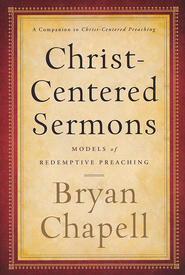
BOOK REVIEW: BRYAN CHAPELL’S “CHRIST-CENTERED SERMONS”

MODELS OF REDEMPTIVE PREACHING

CCS Chapell

 APPLYING CHRIST-CENTERED PREACHING IN YOUR MINISTRY

Book Review by David P. Craig

It’s hard to believe that its already been nineteen years since Bryan Chapell penned his classic text on preaching – Christ-Centered Preaching (CCP). Since that time Christo-centric preaching has been on the rise and pastors have become much more exposed to biblical theology and the redemptive historical method of interpretation in helping the busy pastor with sermon preparation. This new work by Chapell is a wonderful complement and sequel to his seminal text that his been so influential in both Reformed and Non-Reformed circles.

Whereas Chapell laid the foundational ground work for Christo-centric preaching in CCP, here he helps the preacher apply the groundwork by giving various examples of sermons that demonstrate the various genres of Scripture and how they point to Christ. Part One focuses on the structure of the Christo-centric sermon by giving examples of informal, formal, inductive, and expository sermons. Part Two delves into various redemptive approaches of Scripture passages. Part Three focuses on sermons that reveal how a variety of redemptive truths can be used from the Scriptures to apply to our lives.

The common denominator of all the expository sermons found in this book is that they focus on saying what God says in the passage. The preacher is encouraged to proclaim the truths gleaned from the passage in order to convey what was originally intended by the Holy Spirit. “Making sure God’s people know what God has said and why he has said it is the tandem goal of expository preaching.” All of the sermons in this book focus on the empowering power of grace through Christ that is found throughout the Scriptures. The message of the gospel and God’s grace in Christ is what leads us to repentance, salvation, and genuine transformation from darkness to light.

The author masterfully teaches and guides the preacher by showing him that “Christ-centered exposition does not require us to unveil depictions of Jesus by mysterious alchemies of allegory or typology; rather, it identifies how every text functions in furthering our understanding of who Christ is, what the Father sent him to do, and why.” In Christ-centered preaching the listener is helped to apply the biblical text by answering four main questions from the passage: (1) What am I to do? (2) Where am I to do it? (3) Why am I to do it? (4) How am I to do it?

Chapell writes, “In essence, redemptive exposition requires that we identify an aspect of our fallen condition that is addressed by the Holy Spirit in each passage, which he inspired for our edification, and then show God’s way out of the human dilemma.” The way out of the dilemma of our fallen condition is through the motivation of grace and holiness because the realities of the cross. We are enabled to have victory over sin due to our union and communion with Christ as revealed in the Scriptures.

I highly recommend that you read Chapell’s first book on preaching before reading this one. However, it’s not essential that you read his first book because he does a lot of review and explains everything he is doing in each sermon in this new offering. He lays out the foundations and theory in his first book as a solid basis for its application in this new one. Together these two books provide a tour de force of Christo-centric preaching resources for the Christ-centered preacher.

Chapell gives various ways that the same passage can be preached using different strategies without changing the biblical author’s intent. His introductions and demonstration of how the principles work for each sermon are immensely instructive. The sermons in this book are based on the following passages of Scripture: 2 Timothy 4:1-5; Judges 6-8; Psalm 126; Jeremiah 33:14-16; Isaiah 44:9-23; Numbers 20:1-13; Romans 15:4; Luke 17:1-19; Titus 2:11-15; and Romans 6:1-14. By providing sermons on various genres from the Old and New Testament Chapell has provided a wonderful guide for preachers to learn better how to apply the principles of Christ-centered preaching from Genesis to Revelation.

BOOK REVIEW: JASON C. MEYER’S “PREACHING: A BIBLICAL THEOLOGY”

A BIBLICAL THEOLOGY OF THE MINISTRY OF THE WORD

PABT Meyer

Book Review by David P. Craig

I’ve been waiting for a book like this since my calling into the ministry thirty-one years ago. Meyer combines two of my favorite subjects: biblical theology and preaching with my greatest passion – the glory of God as revealed in Jesus. The thesis of this very enjoyable book is that “the ministry of the word in Scripture is stewarding and heralding God’s word in such a way that people encounter God through his word.”

What makes this book unique is that the author shows how “the whole Bible alone can give a holistic answer to what preaching is.” Meyer brilliantly and cogently examines what the whole of the Scriptures have to say broadly about the ministry of the Word and specifically in light of what this means for the expository preacher. The ultimate reason of preaching isn’t for the transfer of information, but to have an encounter with the living God.

Meyer takes the reader on a biblically saturated journey from Genesis to Revelation and unpacks what the entire Scriptures have to say about the ministry of the Word. He does a remarkable job of conveying how preaching the Word is grounded within the big picture story line of the gospel. Christ is the plot-line of the Scriptures and Meyer helps the minister build a foundation for preaching, paradigms for preaching, and demonstrates how biblical and systematic theology guides the preacher in ministering the Word so that we and our hearers encounter the glory of God in Christ.

I highly recommend this book for beginning and seasoned preachers, but also for all Christians. It is packed full with excellent illustrations, robust theological truths, and insightful applications. By helping us to interpret the whole Bible through the lenses of redemption Meyer helps us to see that Jesus is at the forefront of every passage we preach. I believe that any believer reading this book will come to understand the gospel better, and strive to minister the word with Jesus at the center of our proclamation so that we and our listeners will truly encounter our Awesome God.


Keller & Clowney: Preaching Christ in a Post-Modern World

Some of the most helpful resources on preaching Christ from all of Scripture that you will ever find. HIGHLY RECOMMENDED!!!

Ted Torreson's avatarFaith In Motion


I love sharing God’s word through preaching.  Since I’m moving to preaching every week, as we launch The Exchange Community in Jackson, Mo, I thought It would be good to reexamine my preaching and how I interpret and display God’s word.  I remembered a friend of mine shared, a number of years back, that Tim Killer and Edmond Clowney team taught a class at Reformed Theological Seminary on Preaching Christ in a Post-Modern World.  As I started to listen through these teachings, I desired to share them with other church planters, preachers, and pastors that may not be aware of their existence.  Even if you don’t fit in these categories, this is an excellent resource to understand and share scripture.

Free Resources:

Audio from itunes

Course Material in PDF These notes were extremely difficult to find.  I believe they are notes from this course as it was later modified.  They do not…

View original post 272 more words

Dr. Sidney Greidanus on Ten Steps from Text to Sermon

Dr. Greidanus’ *Ten Steps from Text to Sermon

Sidney Greidanus

(1) Select the preaching text.

Select the preaching text with an eye to congregational needs. The text must be a literary unit and contain a vital theme.

(2) Read the text in its literary context.

Read and reread the text in its context and jot down initial questions.

(3) Outline the structure of the text.

In the Hebrew/Aramaic or Greek text, note the major affirmations, clausal flow, plot line, scenes, or other literary structures. Mark major units with headings and verse references.

(4) Interpret the text in its own historical setting.

a. Literary interpretation

b. Historical interpretation

c. Theocentric interpretation

Review your results with the help of some good commentaries.

(5) Formulate the text’s theme, goal, and need addressed.

a. State the textual theme in a brief sentence that summarizes the message of the text for its original hearers: subject and predicate. What is the text saying?

b. State the goal of the author for his original hearers. What is the text doing? Does the author aim to persuade, to motivate, to urge, to warn, to comfort? Be specific.

c. State the need the author addressed – the question behind the text.

(6) Understand the message in the contexts of canon and redemptive history.

a. Canonical interpretation: interpret the message in the context of the whole canon;

b. Redemptive-historical interpretation: understand the message in the context of God’s redemptive history from creation to new creation;

c. Christocentric interpretation: explore the ways of (1) redemptive-historical progression, (2) promise-fulfillment, (3) typology, (4) analogy, (5) longitudinal themes, (6) New Testament references, and (7) contrast.

(7) Formulate the sermon theme, goal, and need addressed.

a. Ideally, your sermon theme will be the same as your textual theme (Step 5a). If Step 6 forces a change, stay as close as possible to the textual theme. Your theme will guide especially the development of the body of the sermon.

b. Your goal must be in harmony with the author’s goal (Step 5b) and match the sermon theme. Your goal will guide the style of the sermon as well as the content of its conclusion.

c. State the need you are addressing. This need should be similar to the need addressed by the author. The need will inform the content of your introduction.

(8) Select a suitable sermon form.

Select a sermon form that respects the form of the text (didactic or narrative, deductive or inductive) and that achieves the goal of the sermon.

(9) Prepare the sermon outline.

If possible, follow the flow of the text (Step 3) in the body of the sermon. Main points, derived from the text, support the theme. The introduction should expose the need. The conclusion should clinch your goal.

(10) Write the sermon in oral style.

Say it out loud as you write it. Write in oral style, using short sentences, vivid words, strong nouns and verbs, active voice, present tense, images and illustrations.

PCFD Greidanus

*Adapted from Appendix One in Sidney Greidanus. Preaching Christ From Daniel (Foundations For Expository Sermons). Grand Rapids, MI. Eerdmans, 2012.

About the Author:

Sidney Greidanus received his B.A. from Calvin College in Grand Rapids, MI, his B.D. from Calvin Theological Seminary, also in Grand Rapids, and his Th.D. from the Free University in Amsterdam, The Netherlands. His dissertation, Sola Scriptura: Problems and Principles in Preaching Historical Texts, was first published in 1970 and reprinted in 1979. Since returning to North America, he served as pastor of two Christian Reformed Churches in Canada, taught at Calvin College in Grand Rapids, MI, The King’s College in Edmonton, AB, Canada, and since 1990 has been professor of preaching at Calvin Theological Seminary.

Besides many articles and sermons, he has published several excellent scholarly and theologically rich books on preaching including:

Preaching Christ from Daniel: Foundations for Expository Sermons. Grand Rapids: Eerdmans, 2012.

Preaching Christ from Ecclesiastes: Foundations for Expository Sermons. Grand Rapids: Eerdmans, 2010.

Preaching Christ from Genesis: Foundations for Expository Sermons. Grand Rapids: Eerdmans, 2007.

Sola Scriptura: Problems and Principles in Preaching Historical Texts. Wipf & Stock Publishers, 2001.

Preaching Christ from the Old Testament: A Contemporary Hermeneutical Method. Grand Rapids: Eerdmans, 1999. (from which the article above is adapted).

The Modern Preacher and the Ancient Text: Interpreting and Preaching Biblical Literature: Grand Rapids: Eerdmans. 1989. Selected “The 1990 Book of the Year” by the Journal Preaching.

9 Principles For Improving Your Preaching by Justin Anderson


Justin Anderson preaching RSF

J—Just be you.

O—Only preach as long as people want to listen to you

E—Every point should make the same point

L—Listen to what your body is saying

O—Operate a Manuel Transmission (change gears)

S—Say less, prove more

T—Teach me, move me, show me

E—Engage 4 archetypes: (1) Mechanic, (2) Smart Skeptic, (3) Disciple, (4) Dude there to pick up chicks (hit him with a hammer).

E—Everything is not “awesome” – only God is “Awesome”

N—Nurture your brain and heart

Justin Anderson is the Pastor of Redemption Church in San Francisco, California (redemptionsf.com)

*This acronym does not endorse by any means the ministry or theology of Joel Osteen. It just happens to be a good acronym for remembering these 9 points to improving your preaching craft.

The Pastor as Theologian by R. Albert Mohler, Jr.

Mohler Al image

Every pastor is called to be a theologian. This may come as a surprise to some pastors who see theology as an academic discipline taken during seminary rather than as an ongoing and central part of the pastoral calling. Nevertheless, the health of the church depends on its pastors functioning as faithful theologians—teaching, preaching, defending, and applying the great doctrines of the faith.

The transformation of theology into an academic discipline more associated with the university than the church has been one of the most lamentable developments of the last several centuries. In the earliest eras of the church, and through the annals of Christian history, the central theologians of the church were its pastors. This was certainly true of the great Reformation of the sixteenth century. From the Patristic era, we associate the discipline and stewardship of theology with names such as Athanasius, Irenaeus, and Augustine. Similarly, the great theologians of the Reformation were, in the main, pastors such as John Calvin and Martin Luther. Of course, their responsibilities often ranged beyond those of the average pastor, but they could not have conceived of the pastoral role without the essential stewardship of theology.

The emergence of theology as an academic discipline coincides with the development of the modern university. Theology was one of the three major disciplines taught in the medieval university. Yet, so long as the medieval synthesis was intact, the university was always understood to be in direct service to the church and its pastors.

The rise of the modern research university led to the development of theology as merely one academic discipline among others—and eventually to the redefinition of theology as “religious studies” separated from ecclesiastical control or concern. In most universities, the secularization of the academy has meant that the academic discipline of theology has no inherent connection to Christianity, much less to its central truth claims.

These developments have caused great harm to the church, separating ministries from theology, preaching from doctrine, and Christian care from conviction. In far too many cases the pastor’s ministry has been evacuated of serious doctrinal content and many pastors seem to have little connection to any sense of theological vocation.

All this must be reversed if the church is to remain true to God’s Word and the gospel. Unless the pastor functions as a theologian, theology is left in the hands of those who, in many cases, have little or no connection or commitment to the local church.

The Pastor’s Calling

The pastoral calling is inherently theological. Given the fact that the pastor is to be the teacher of the Word of God and the teacher of the gospel, it cannot be otherwise. The idea of the pastorate as a nontheological office is inconceivable in light of the New Testament. Though this truth is implicit throughout the Scriptures, this emphasis is perhaps most apparent in Paul’s letters to Timothy. In these letters Paul affirmed Timothy’s role as a theologian—affirming that all of Timothy’s fellow pastors were to share in the same calling. Paul emphatically encouraged Timothy concerning his reading, teaching, preaching, and study of Scripture. All of this is essentially theological, as is made clear when Paul commanded Timothy to “retain the standard of sound words which you have heard from me, in the faith and love which are in Christ Jesus. Guard, through the Holy Spirit who dwells in us, the treasure which has been entrusted to you” (2 Tim. 1:13—14).1 Timothy was to be a teacher of others who would also teach. “The things which you have heard from me in the presence of many witnesses, these entrust to faithful men, who will be able to teach others also” (2 Tim. 2:2).

As Paul completed his second letter to Timothy, he reached a crescendo of concern as he commanded Timothy to preach the Word, specifically instructing him to “reprove, rebuke, exhort, with great patience and instruction” (2 Tim. 4:2). Why? “For the time will come when they will not endure sound doctrine; but wanting to have their ears tickled, they will accumulate for themselves teachers in accordance to their own desires; and will turn away their ears from the truth and will turn aside to myths” (2 Tim. 4:3–4).

As Paul makes clear, the pastoral theologian must be able to defend the faith even as he identifies false teachings and makes correction by the Word of God. There is no more theological calling than this—guard the flock of God for the sake of God’s truth.

Clearly this will require intense and self-conscious theological thinking, study, and consideration. Paul made this abundantly clear in writing to Titus when he defined the duty of the overseer or pastor as one who is “holding fast the faithful word which is in accordance with the teaching, that he may be able both to exhort in sound doctrine and to refute those who contradict” (Titus 1:9). In this single verse Paul simultaneously affirmed the apologetical and polemical facets of the pastor-theologian’s calling.

In reality there is no dimension of the pastor’s calling that is not deeply, inherently, and inescapably theological. There is no problem the pastor will encounter in counseling that is not specifically theological in character. There is no major question in ministry that does not come with deep theological dimensions and the need for careful theological application. The task of leading, feeding, and guiding the congregation is as theological as any other vocation conceivable.

Beyond all this, the preaching and teaching of the Word of God is theological from beginning to end. The preacher functions as a steward of the mysteries of God, explaining the deepest and most profound theological truths to a congregation that must be armed with the knowledge of these truths in order to grow as disciples and meet the challenge of faithfulness in the Christian life.

Evangelism is a theological calling as well, for the act of sharing the gospel is, in short, a theological argument presented with the goal of seeing a sinner come to faith in the Lord Jesus Christ. In order to be a faithful evangelist, the pastor must first understand the gospel and then understand the nature of the evangelist’s calling. At every step of the way, the pastor is dealing with issues that are irrefutably theological.

As many observers have noted, today’s pastors are often pulled in many directions simultaneously—and the theological vocation is often lost amidst the pressing concerns of a ministry that has been reconceived as something other than what Paul intended for Timothy. The managerial revolution has left many pastors feeling more like administrators than theologians, dealing with matters of organizational theory before ever turning to the deep truths of God’s Word and the application of these truths to everyday life. The rise of therapeutic concerns within the culture means that many pastors, and many of their church members, believe that the pastoral calling is best understood as a “helping profession.” As such, the pastor is seen as someone who functions in a therapeutic role in which theology is often seen as more of a problem than a solution.

All this is a betrayal of the pastoral calling as presented in the New Testament. Furthermore, it is a rejection of the apostolic teaching and of the biblical admonition concerning the role and responsibilities of the pastor. Today’s pastors must recover and reclaim the pastoral calling as inherently and cheerfully theological. Otherwise pastors will be nothing more than communicators, counselors, and managers of congregations that have been emptied of the gospel and of biblical truth.

The Pastor’s Concentration

The pastor’s stewardship of the theological task requires a clear sense of pastoral priority, a keen pastoral ear, and careful attention to the theological dimensions of church life and Christian discipleship. This must be foundational to the ministry of the local church, and ministry must emerge from a fundamentally theological foundation.

In a real sense, Christians live out their most fundamental beliefs in everyday life. One essential task of the pastor is to feed the congregation and to assist Christians to think theologically in order to demonstrate discernment and authentic discipleship.

All this must start with the pastor. The preacher must give attention, study, time, and thought to the theological dimensions of ministry. A ministry that is deeply rooted in the deep truths of God’s Word will be enriched, protected, and focused by a theological vision.

The pastor’s concentrated attention to the theological task is necessary for the establishment of faithful preaching, God-honoring worship, and effective evangelism in the local church. Such a theological vision is deeply rooted in God’s truth and in the truth about God that forms the basis of Christian theology.

The pastor’s concentration is a necessary theological discipline. Thus, the pastor must develop the ability to isolate what is most important in terms of theological gravity from that which is less important.

I call this the process of theological triage. As anyone who visits a hospital emergency room is aware, a triage nurse is customarily in place in order to make a first-stage evaluation of which patients are most in need of care. A patient with a gunshot wound is moved ahead of a sprained ankle in terms of priority. This makes medical sense, and to misconstrue this sense of priority would amount to medical malpractice.

In a similar manner, the pastor must learn to discern different levels of theological importance. First-order doctrines are those that are fundamental and essential to the Christian faith. The pastor’s theological instincts should seize upon any compromise on doctrines such as the full deity and humanity of Christ, the doctrine of the Trinity, the doctrine of atonement, and essentials such as justification by faith alone. Where such doctrines are compromised, the Christian faith falls. When a pastor hears an assertion that Christ’s bodily resurrection from the dead is not a necessary doctrine, he must respond with a theological instinct that is based in the fact that such a denial is tantamount to a rejection of the gospel itself.

Second-order doctrines are those that are essential to church life and necessary for the ordering of the local church but that, in themselves, do not define the gospel. That is to say, one may detect an error in a doctrine at this level and still acknowledge that the person in error remains a believing Christian. Nevertheless, such doctrines are directly related to how the church is organized and its ministry is fulfilled. Doctrines found at this level include those most closely related to ecclesiology and the architecture of theological systems. Calvinists and Arminians may disagree concerning a number of vital and urgently important doctrines—or, at the very least, the best way to understand and express these doctrines. Yet both can acknowledge each other as genuine Christians. At the same time these differences can become so acute that it is difficult to function together in the local congregation over such an expansive theological difference.

Third-order doctrines are those that may be the ground for fruitful theological discussion and debate but that do not threaten the fellowship of the local congregation or the denomination. Christians who agree on an entire range of theological issues and doctrines may disagree over matters related to the timing and sequence of events related to Christ’s return. Yet such ecclesiastical debates, while understood to be deeply important because of their biblical nature and connection to the gospel, do not constitute a ground for separation among believing Christians.

Without a proper sense of priority and discernment, the congregation is left to consider every theological issue to be a matter of potential conflict or, at the other extreme, to see no doctrines as worth defending if conflict is in any way possible.

The pastor’s theological concentration establishes a sense of proper proportion and a larger frame of theological reference. At the same time this concentration on the theological dimension of ministry also reminds the pastor of the necessity of constant watchfulness.

At crucial points in the history of Christian theology, the difference between orthodoxy and heresy has often hung on a single word, or even a syllable. When Arius argued that the Son was to be understood as being of a similar substance as the Father, Athanasius correctly understood that the entirety of the gospel was at risk. As Athanasius faithfully led the church to understand, the New Testament clearly teaches that the Son is of the same substance as the Father. In the Greek language the distinction between the word offered by Arius and the correction offered by Athanasius was a single syllable. Looking back, we can now see that when the Council of Nicea met in AD 325, the gospel was defended and defined at this very point. Without the role of Athanasius as both pastor and theologian, the heresy of Arius might have spread unchecked, leading to disaster for the young church.

 The Pastor’s Conviction

As a theologian the pastor must be known for what he teaches as well as for what he knows, affirms, and believes. The health of the church depends on pastors who infuse their congregations with deep biblical and theological conviction. The means of this transfer of conviction is the preaching of the Word of God.

We will be hard pressed to define any activity as being more inherently theological than the preaching of God’s Word. The ministry of preaching is an exercise in the theological exposition of Scripture. Congregations that are fed nothing more than ambiguous “principles” supposedly drawn from God’s Word are doomed to spiritual immaturity, which will become visible in compromise, complacency, and a host of other spiritual ills.

Why else would the Apostle Paul command Timothy to preach the Word in such solemn and serious terms: “I solemnly charge you in the presence of God and of Christ Jesus, who is to judge the living and the dead, and by His appearing and His kingdom: preach the word; be ready in season and out of season; reprove, rebuke, exhort, with great patience and instruction” (2 Tim. 4:1–2).

As we have already seen, this text points to the inescapably theological character of ministry. In these preceding verses Paul specifically ties this theological ministry to the task of preaching—understood to be the pastor’s supreme calling. As Martin Luther rightly affirmed, the preaching of the Word of God is the first mark of the church. Where it is found, there one finds the church. Where it is absent, there is no church, whatever others may claim.

Paul had affirmed Scripture as “inspired by God and profitable for teaching, for reproof, for correction, for training in righteousness” (2 Tim. 3:16). Through the preaching of the Word of God, the congregation is fed substantial theological doctrine directly from the biblical text. Expository preaching is the most effective means of imparting biblical knowledge to the congregation and thus arming God’s people with deep theological conviction.

In other words, the pastor’s conviction about theological preaching becomes the foundation for the transfer of these convictions into the hearts of God’s people. The divine agent of this transfer is the Holy Spirit, who opens hearts, eyes, and ears to hear, understand, and receive the Word of God. The preacher’s responsibility is to be clear, specific, systematic, and comprehensive in setting out the biblical convictions that are drawn from God’s Word and that, taken together, frame a biblical understanding of the Christian faith and the Christian life.

The Pastor’s Confession

All this assumes, of course, that the pastoral ministry is first rooted in the pastor’s own confession of faith—the pastor’s personal theological convictions.

The faithful pastor does not teach merely that which has historically been believed by the church and is even now believed by faithful Christians; he teaches out of his own personal confession of belief. There is no sense of theological detachment or of academic distance when the pastor sets out a theological vision of the Christian life.

All true Christian preaching is experiential preaching, set before the congregation by a man who is possessed by deep theological passion, specific theological convictions, and an eagerness to see these convictions shared by his congregation.

Faithful preaching does not consist in the preacher presenting a set of theological options to the congregation. Instead, the pastor should stand ready to define, defend, and document his own deep convictions, drawn from his careful study of God’s Word and his knowledge of the faithful teaching of the church.

Our model for this pastoral confidence is, once again, the Apostle Paul. Paul’s personal testimony is intertwined with his own theology. Consider Paul’s retrospective analysis of his own attempts at human righteousness, coupled with his bold embrace of the gospel as grounded in grace alone.

“But whatever things were gain to me, those things I have counted as loss for the sake of Christ,” Paul asserted. “More than that, I count all things to be loss in view of the surpassing value of knowing Christ Jesus my Lord, for whom I have suffered the loss of all things, and count them but rubbish in order that I may gain Christ, and may be found in Him, not having a righteousness of my own derived from the Law, but that which is through faith in Christ, the righteousness which comes from God on the basis of faith, that I may know Him and the power of His resurrection and the fellowship of His sufferings, being conformed to His death; in order that I may attain to the resurrection from the dead” (Phil. 3:7–11).

In other words, Paul did not hide behind any sense of academic neutrality from the doctrines he so powerfully taught. Nor did he set before his congregation in Philippi a series of alternate renderings of doctrine. Instead, he taught clearly, defended his case, and made clear that he embraced these doctrines as the substance of his life and faith.

Of course, the experiential nature of the pastor’s confession does not imply that the authority for theology is in personal experience. To the contrary, the authority must always remain the Word of God. The experiential character of the pastor’s theological calling underlines the fact that the preacher is speaking from within the circle of faith as a believer, not from a position of detachment as a mere teacher.

The pastor’s confession of his faith and personal example add both authority and authenticity to the pastoral ministry. Without these the pastor can sound more like a theological consultant than a faithful shepherd. The congregation must be able to observe the pastor basing his life and ministry upon these truths, not merely teaching them in the pulpit.

In the end every faithful pastor’s theological confession must include an eschatological confidence that God will preserve his work to the end. As Paul confessed, “For this reason I also suffer these things, but I am not ashamed; for I know whom I have believed and I am convinced that He is able to guard what I have entrusted to Him until that day” (2 Tim. 1:12).

In the end, every preacher receives the same mandate that Paul handed down to Timothy: “Retain the standard of sound words which you have heard from me, in the faith and love which are in Christ Jesus. Guard, through the Holy Spirit who dwells in us, the treasure which has been entrusted to you” (2 Tim. 1:13–14).

n other words, we are the stewards of sound words and the guardians of doctrinal treasure that has been entrusted to us at the very core of our calling as pastors. The pastor who is no theologian is no pastor.

*All Scriptures unless otherwise noted are from the NASB.

Article adapted from “The Pastor as Theologian” in Akin, Daniel (2007-07-01). A Theology for the Church (Kindle Locations 24731-24908). B&H Publishing. Kindle Edition.

Dr. Tim Keller on The Gospel and Humor

Humor in the Gospel?

Tim Keller seated image

I was reading a review of the movie ‘Prince Caspian’ in a newspaper for urban downtown-types, and the article dripped with sarcastic, sneering, smirking humor that, among other things, referred to Susan’s horn as a phallic symbol. Humor is like seasoning on food—everything is flat without it. But something was amiss here. I began to ask myself, ‘Does the gospel have an effect on our sense of humor?’ The answer has to be yes—but why and how?

Your humor has a lot to do with how you regard yourself. Many people use humor to put down others, keep themselves in the driver’s seat in a conversation and setting, and to remind the hearers of their superior vantage point. They use humor not to defuse tension and put people at ease, but to deliberately belittle the opposing view.

Rather than showing respect and doing the hard work of true disagreement, they mock others’ points of view and dismiss them without actually engaging the argument.

Ultimately, sarcastic put-down humor is self-righteous, a form of self-justification, and that is what the gospel demolishes.

When we grasp that we are unworthy sinners saved by infinitely costly grace it destroys both our self- righteousness and our need to ridicule others. This is also true of self-directed ridicule. There are some people who constantly, bitterly, mock themselves. At first it looks like a form of humility, or realism, but really it is just as self-absorbed as the other version. It is a sign of an inner disease with one’s self, a profound spiritual restlessness.

There is another kind of self-righteousness, however, that produces a person with little or no sense of humor. Moralistic persons often have no sense of irony because they take themselves too seriously, or because they are too self-conscious and self-absorbed in their own struggles to be habitually joyful.


The gospel, however, creates a gentle sense of irony. Our doctrine of sin keeps us from being over-awed by anyone (especially ourselves) or shocked, shocked by any behavior. We find a lot to laugh at, starting with our own weaknesses. They don’t threaten us any more because our ultimate worth is not based on our record or performance.

Our doctrine of grace and redemption also keeps us from seeing any situation as hopeless. This ground note of joy and peace makes humor spontaneous and natural.

In gospel-shaped humor we don’t only poke fun at ourselves, we also can gently poke fun at others, especially our friends. But it is always humor that takes the other seriously and ultimately builds them up as a show of affection.

“We are not to be perpetually solemn. We must play. But our merriment must be of that kind (and it is, in fact, the merriest kind) which exists between people who have, from the outset, taken each other seriously— no flippancy, no superiority, no presumption.” (C.S. Lewis, “The Weight of Glory”)

So how do we get such a sense of humor? That’s the wrong question. The gospel doesn’t change us in a            mechanical way. To give the gospel primacy in our lives is not always to logically infer a series of principles from it that we then ‘apply’ to our lives.

Recently I heard a sociologist say that, for the most part, the frameworks of meaning by which we navigate our lives are so deeply embedded in us that they operate ‘pre-reflectively.’ They don’t exist only as a list of propositions and formulations, but also as themes, motives, attitudes, and values that are as affective and emotional as they are cognitive and intellectual. When we listen to the gospel preached, or meditate on it in the Scripture, we are driving it so deeply into our hearts, imaginations, and thinking, that we begin to instinctively “live out” the gospel.

I have definitely seen the gospel transform a person’s sense of humor, but it would be artificial to say that there are ‘gospel-principles of humor’ that we must apply to our lives. It just happens, as we believe the gospel more and more.


*Article by Tim Keller from the Redeemer Church Manhattan Report – June 2008.

H.J. Berry on the Question: “Why Does God Send Trials Into Our Lives?”

Series: Word Studies in New Testament Greek #1 – Testing: for Good or Evil? 

James wrote, “Count it all joy, my brothers, when you meet trials of various kinds, for you know that the testing of your faith produces steadfastness.” In verse 12 of the same chapter he wrote, “Blessed is the man who remains steadfast under trial, for when he has stood the test he will receive the crown of life, which God has promised to those who love him. However, a problem arises when the next verse is read, because it says, “Let no one say when he is tempted, “I am being tempted by God,” for God cannot be tempted with evil, and he himself tempts no one’” (James 1:2,12-13).

On the one hand it seems that temptations are sent to us from God and we are to consider it a privilege to pass through them, but on the other hand we are told that God does not tempt any man.

In order to understand these verses, it is necessary to know the meaning of the words that are translated “trial” and “tempted.” The same Greek word is used in all three of the verses quoted from James (vv. 2,12-13). Yet there are different shades of meaning intended by the author. The word is used in its noun form in verses 2 and 12 and its verb form in verse 13. The noun is peirasmos and the verb us peirazo. The root word of these forms has such meanings as “test,” “try,” and “prove.”

The matter of significance about peirazo is that it is used in both a good sense and a bad sense It can have the idea of testing with the purpose of bringing out that which is good, or it can have the idea of testing with the purpose of bringing out that which is bad.

When the word is used in regard to Satan, it has the bad sense of brining out that which is evil or soliciting to evil. Satan himself is known as “the tempter” (Matthew 4:3a). Satan thought he could get Christ to respond to evil, but because Christ is God, there was nothing in Him which answered to evil. Christ told Satan, “You shall not put the Lord your God to the test” (Matthew 4:7). Satan was not trying to bring out that which was good in God but was endeavoring to solicit Him to evil.

When Ananias and Sapphira lied about the amount they had received for their land, Peter asked Sapphira, “How is it that you have agreed together to test the Spirit of the Lord?” (Acts 5:9). They were not trying to bring out that which was good in the Lord, so the word is used in its bad sense in this context.

The word peirazo is used in 2 Corinthians 13:5, where Paul told the Corinthians, “Examine yourselves, to see whether you are in the faith. Test yourselves. Or do you not realize this about yourselves, that Jesus Christ is in you? —unless indeed you fail to meet the test!” In this context the Corinthians were obviously to look at the good as well as the bad in their lives. So the word is also used in a good sense. This, in the Book of James, the “trials of various kinds” have a good purpose in view—to bring out that which is good in the believers. This is also true regarding James 1:12. However, the word is used in its negative sense in verse 13, as is evident from the words, “for God cannot be tempted with evil.” In the phrase “and he himself tempts no one,” it is with reference to “with evil.” Therefore, God never solicits a person to do evil but rather He brings tests into a person’s life that will bring out that which is good in him.

First Corinthians 10:13 uses both peirasmos and peirazo in their good sense: “No temptation has overtaken you that is not common to man. God is faithful, and he will not let you be tempted beyond your ability, but with the temptation he will also provide the way of escape, that you may be able to endure it.” God sends tests and trials into our lives to bring out that which is good in us, and He always provides the strength necessary to bear up under the tests.

Another Greek word was frequently used when the writer wanted to emphasize a testing with the purpose of bringing out that which is good. This word is dokimazo. Whereas peirazo could be used in either a good or bad sense, dokimazo is used only in a good sense. In this regard it has to do with “proving” or “examining.” In fact, of the 23 times dokimazo is used in the New Testament, it is translated “prove,” “examine,” or “discern” ten times (depending on the English translation).

One such occurrence is Romans 12:2: “Do not be conformed to this world, but be transformed by the renewal of your mind, that by testing you may discern (dokimazo = “prove,” or “examine,”) what is the will of God, what is good and acceptable and perfect.”

Dokimazo is also translated “examine” in Luke 14:19: “And another said, ‘I have bought five yoke of oxen, and I go to examine them. Please have me excused.’ The excuse this person used for not attending the great supper was that he wanted to try out his yoke of oxen to see how good they were.

In 1 Corinthians 3, which tells of the Judgment Seat of Christ, dokimazo is translated “will test” in verse 13: “each one’s work will become manifest, for the Day will disclose it, because it will be revealed by fire, and the fire will test what sort of work each one has done.” This helps us to see that at the Judgment Seat of Christ the emphasis will be on discovering that which is good so it might be rewarded. Only those who have received Jesus Christ as Savior will appear before the Judgment Seat of Christ. The purpose of the judgment will be, not to condemn, but to reward that which is good. The believer has been delivered from all condemnation through faith in Christ.

The understanding of this Greek word also helps us to see what God’s purpose is in sending trials of our faith. 1 Peter 1:7 says, “so that the tested genuineness of your faith—more precious than gold that perishes though it is tested by fire—may be found to result in praise and glory and honor at the revelation of Jesus Christ.” The word “tested” is a noun form of dokimazo. Thus we see that the purpose for the trials of our faith is that God might bring out that which is good and that it might become mature Christians.

Because peirazo has both good and bad meanings, it can be used in regard to both God and Satan. However, dokimazo can never be used for Satan because he never tests to “prove, discern, or examine” that which is good but rather to solicit to evil.

 About the Author:

Harold J. Berry specialized in Theology and Greek at Dallas Theological Seminary and graduated in 1960 with his Th.M. He was for many years the personal assistant to Dr. Theodore H. Epp (the Bible Teacher of the Back to the Bible Hour before Warren W. Wiersbe became its primary teacher). He was known as an outstanding professor of Greek in various Institutions. The Word Study above was adapted from a publication by Berry entitled “Gems From The Original” published by Back to the Bible Broadcast in Lincoln, Nebraska in 1972. The outdated language has been updated where necessary, and the more familiar ESV has been used instead of the KJV.

5 Questions Dr. Tim Keller Asks of a Biblical Passage

David Cooke has posted Keller’s Five Questions over at Cookies Days (a blog full of Gospel centered resources worth frequenting). David first posted these questions Keller asks in 2009.

Tim Keller said these are five questions he asks of a biblical text as he reads it for himself. Helpful.

  1. How can I praise him?
  2. How can I confess my sins on the basis of this text?
  3. If this is really true, what wrong behavior, what harmful emotions or false attitudes result in me when I forget this? Every problem is because you have forgotten something. What problems are you facing?
  4. What should I be aspiring to on the basis of this text?
  5. Why is God telling me this today?

About Dr. Tim Keller:

In 1989 Dr. Timothy J. Keller, his wife and three young sons moved to New York City to begin Redeemer Presbyterian Church. In 20 years it has grown to meeting for five services at three sites with a weekly attendance of over 5,000. Redeemer is notable not only for winning skeptical New Yorkers to faith, but also for partnering with other churches to do both mercy ministry and church planting.  Redeemer City to City is working to help establish hundreds of new multi-ethnic congregations throughout the city and other global cities in the next decades.

Dr. Tim Keller is the author of several phenomenal Christo-centric books including:

Every Good Endeavor: Connecting Your Work to God’s Plan for the World. New York, Penguin Publishing, November, 2012.

Center Church: Doing Balanced, Gospel-Centered Ministry in Your City. Grand Rapids: Zondervan, September, 2012.

The Freedom of Self Forgetfulness. New York: 10 Publishing, April 2012.

Generous Justice: How God’s Grace Makes Us Just. New York: Riverhead Trade, August, 2012.

The Gospel As Center: Renewing Our Faith and Reforming Our Ministry Practices (editor and contributor). Wheaton: Crossway, 2012.

The Meaning of Marriage: Facing the Complexities of Commitment with the Wisdom of God. New York, Dutton, 2011.

The Prodigal God. New York, Dutton, 2011.

King’s Cross: The Story of the World in the Life of Jesus. New York, Dutton, 2011.

Counterfeit Gods: The Empty Priorities of Money, Sex, and Power, and the Only Hope That Matters. New York, Riverhead Trade, 2011.

The Reason For God: Belief in an Age of Skepticism. New York, Dutton, 2009.

Worship By The Book (contributor). Grand Rapids: Zondervan, 2002.

Ministries of Mercy: The Call of the Jericho Road. Phillipsburg: P&R Publishing, 1997.