The Atheist’s Holiday

sunset dark yellow and black

Series: Friday Humor #11

A 1999 study by the Barna Research Group shows that roughly seven percent of the American adult population—approximately fourteen million people—describe themselves as atheistic or agnostic. America has more atheists and agnostics than Mormons (by a three to one margin), Jews (by a four to one margin) or Muslims (by a fourteen to one margin.)

An atheist complained that Christians had their special days such as Christmas, Easter, and so on. The Jews celebrate Passover. “But we atheists,” he said, “have no recognized national holiday. It isn’t fair.”

“I have an idea,” said the man’s friend. “Why don’t you celebrate April 1st?”

 Psalm 14:1a, “The fool says in his heart, ‘There is no God.'”

Friday Humor: “Don’t Fill Him, Lord…” by R.C. Sproul

Series: Friday Humor #10

R.C. Sproul sitting in green chair 

We know people who have been “converted” many times. Every time there is a church revival they go to the altar and get “saved.” One minister told of a man in his congregation who had been “saved” seventeen times. During a revival meeting the evangelist made an altar call for all who wanted to be filled with the Spirit. The man who had been converted so often made his way toward the altar again. A woman from the congregation shouted, “Don’t fill him, Lord. He leaks!” … Those who become “unconverted” were never converted in the first place. – R.C. Sproul from a sermon.

HUMOR: “May I Speak to the Head Hog at the Trough!” by James Hewett

PIG CARTOON

SERIES: FRIDAY HUMOR #9

A MAN CALLED AT THE CHURCH and asked if he could speak to the Head Hog at the Trough. The secretary said, “Who?” The man replied, “I want to speak to the Head Hog at the Trough!” Sure now that she had heard correctly, the secretary said, “Sir, if you mean our pastor, you will have to treat him with more respect-and ask for `The Reverend’ or `The Pastor.’ But certainly you cannot refer to him as the Head Hog at the Trough!” At this, the man came back, “Oh, I see. Well, I have ten thousand dollars I was thinking of donating to the Building Fund.” Secretary: “Hold the line-I think the Big Pig just walked in the door.”

-James Hewett, Illustrations Unlimited

Charles R. Swindoll. Swindoll’s Ultimate Book of Illustrations & Quotes (pp. 534-535). Kindle Edition.

Right Field Is Really Messed Up! By Tony Evans

Series: Friday Humor #8

 baseball fielder cartoon

The humorous story is told of a baseball manager who decided to play a rookie in right field one day. The regular right fielder wasn’t happy about it and loudly made it known from the bench that it was a mistake to play the kid. Well, as it turned out the rookie was so nervous that he messed up big-time. He made a couple of errors and misjudged several other fly balls that could have been called errors. And each time he messed up, the veteran complained loudly on the bench. Finally, late in the game the manager replaced the rookie with the veteran, mostly to shut the veteran up. Sure enough, he muffed the first ball hit to him for an error. As he came off the field at the end of the inning, everyone on the bench got very quiet to hear what he would say. The manager was waiting for the veteran too, but before the manager could say anything, the man slammed his glove down in disgust and said, ‘Skip, that kid has right field so messed up nobody can play it!’

That’s the way many Christians feel about the teachings surrounding the great doctrine of salvation in Jesus Christ. They feel as if church ‘professionals’ have so mixed up and complicated the issues that no one can get them straight anymore. Too many pastors, teachers, and theologians have added to the problem by failing to communicate the wonder of the unspeakable gift of salvation in Christ in language the everyday person can relate to. As a result, this truth is far too misunderstood, underappreciated, and even abused. That’s unfortunate, because there are few teachings in the Bible more glorious than the truth that God has delivered us from His wrath and given us the guarantee of heaven in the salvation He has provided through the death and resurrection of Jesus Christ.

Anecdote above adapted from Tony Evans. Totally Saved: Understanding, Experiencing, and Enjoying the Greatness of Your Salvation (Kindle Locations 77-91). Moody Publishers. Kindle Edition. 2003.

Friday Humor: “Be Who You Are!” By Steve Brown

Series: Friday Humor #7

Image

The first axiomatic statement is this: Almost all frustration and anxiety come from a refusal to be what one is. In other words, frustration and anxiety are the result of playing a part other than the one you have been given.

Someone tells the story of a man who was out of work. His unemployment compensation benefits had run out, and he was desperate. He went to the zoo to ask for work, and the zoo keeper told him they didn’t really have any work, but he could make a few extra dollars by taking the place of a gorilla who had died the day before.

Ordinarily the man would not have done it, but he really needed money. He accepted the job, put on the gorilla suit, and made his way back to the gorilla cage. It really wasn’t a bad job. All he had to do was to eat bananas and swing from a rope, and after a while he began to like the job. But alas, all good things must come to an end. One day his rope broke and he fell over the fence into the lion’s cage. He started yelling for help, and the closer the lion came to him, the louder he yelled. Finally the lion came right up next to him, nudged him, and said, “Hey Buddy, will you shut up! We are both going to be out of a job!”

Now the difference between some Christians and the man in the gorilla outfit is that whereas he was forced into his role, we aren’t. We choose a role for which we are not suited, and in that choice is the source of much of our misery and frustration.

Have you ever seen Christians who seemed to be very pure and very spiritual—and very miserable? The problem with those Christians is that they were playing a role for which they were not suited. Jesus said, “No one is good except God” (Mark 10:18). If Jesus was right, and I have every reason to believe He was, then we pretend to be good and pure, we have just climbed into a gorilla suit.

And then there are those Christians who feel that everything they say comes as if from Sinai. They make all sorts of political and social pronouncements as if God Himself had given them a corner on truth. They are very serious—and very miserable. God says, “The heart is more deceitful than all else” (Jeremiah 17:9a). If that is true, then the person who believes and acts as if he or she had a corner on truth (when only God has that corner) has started wearing a gorilla costume.

We see countless examples of Christian men and women who play parts for which they were not created in the pride that so often is the a mark of modern Christianity, in the anger we feel when our plans are crossed, or in the way we want the world to revolve around our selfish desires. It is important that we understand that the source of much of our frustration and anxiety is our proclivity toward being something we aren’t.

*This humorous anecdote was adapted from the excellent book by Stephen Brown. If God is In Charge. Thomas Nelson: Nashville, 1983. Pages 61-62.

Friday Humor: Pathetic Faith

Series: Friday Humor #7

coal miner image

The great evangelist George Whitefield once asked a coal miner in Cornwall, England, what he believed.

“Oh, he said, “I believe what my church believes.”

Whitfield then inquired, “And what does you church believe?”

“Well,” he answered, “The church believes what I believe.”

Seeing that he was getting nowhere, Whitefield then asked, “What do you both believe?”

“We both believe the same thing.”

That sort of unintelligent faith is pathetic and only perpetuates and promotes error (pseudo-faith).

*Anecdote told by Scottish Pastor and Former President of Moody Bible Institute in Chicago – Dr. George Sweeting


“Charles Haddon Spurgeon’s Humor”

Dr. Larry J. Michael and C.H. Spurgeon on “The Medicine of Laughter”
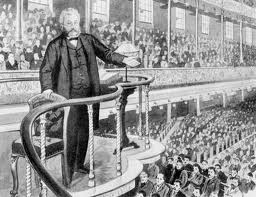
Spurgeon in pulpit image

Dr. Larry Michael is senior pastor at First Baptist Church in Clanton, Ala. He serves as an adjunct professor at Beeson Divinity School in Birmingham. This article is an adaptation of writings from the upcoming book, Spurgeon on Leadership, Kregel Publications, scheduled for release October 2003.

Some years ago there was a documented case in the British Medical Journal about a man who laughed himself well. He actually had a terminal illness, and through the employment of laughter therapy, he allowed his body to successfully fight the disease.

While we may smilingly acknowledge the merit of such a case, for the most part, we find such an incident almost incredible. Can laughter really be that good for us? The Bible definitely supports such a notion.

The Bible advocates laughter

The writer of Ecclesiastes stated: “There’s a time to laugh, and a time to cry” (Ecclesiastes 3:4). We know that there are plenty of reasons to cry. Just a casual glance at our world, with its wars, hatred, violence and evil — makes us sad. Every day we see/hear on the news horrible accounts of hurting people who hurt others. We are grieved at the plight of so many persons who are living in darkness and have rejected the light of Christ. The stark reality of sin in our world is indeed sobering.

It’s not surprising that many of us as leaders may be more inclined toward sadness than to joy. Given the nature and demands of Christian leadership in an increasingly challenging world, one could cynically surmise that leaders may have more reason to be glum than glad these days. The pressures of our organizational responsibilities, and the accompanying stresses, can drag us down. Handling church conflict, losing someone special, helplessly seeing a marriage dissolve, experiencing personal betrayal, facing an unsuspected tragedy — all may give cause for tears.

To counter the sad times, the Scripture also advises that there is a time to laugh. Leaders need to know the balancing therapy of laughter. Toward that goal, we should fully embrace the joys of ministry — celebrating special moments with members, “high-fiving” family achievements, relishing the reaching of hard-earned goals, and savoring the blessing of spiritual growth. But those experiences may still fall short of the biblical pronouncement regarding laughter. C’mon, when was the last time you laughed so hard you cried?! Or, you actually had a good belly laugh?

Spurgeon’s great sense of humor

Many evangelicals know well the stern side of C. H. Spurgeon and his serious pursuit of the holy life. Indeed, his stands for righteous causes, and countering doctrinal error are often recounted. But many readers may not know that he was a man with a great sense of humor. Spurgeon knew the value of laughter and mirth. He virtually took to heart the word in Proverbs 17:22: “A merry heart doeth good like a medicine.”

Spurgeon laughed as often as he could. He laughed at the ironies of life, he laughed at comical incidents, he laughed at the amusing elements of nature. He sometimes laughed at his critics. He loved to share wholesome jokes with his friends and colleagues in ministry. He was known to tell humorous stories from the pulpit. William Williams, a fellow pastor who kept company with Spurgeon, was a near and dear friend in the latter years of Spurgeon’s life. He wrote:

What a bubbling fountain of humour Mr. Spurgeon had! I laughed more, I verily believe, when in his company than during all the rest of my life besides. He had the most fascinating gift of laughter . . . and he had also the greatest ability for making all who heard him laugh with him. When someone blamed him for saying humourous things in his sermons, he said, “He would not blame me if he only knew how many of them I keep back.” 1

Spurgeon considered humor such an integral part of his ministry that a whole chapter in his autobiography is devoted to it. Humor permeates his sermons and writings, often woven into the fabric of his messages. It’s one reason among many why he is still so readable today.

The therapy of laughter

Spurgeon knew the blessing of the treatment of humor. He often spoke of his illness in humorous terms: “I have had sharp pains,” he wrote to a friend, “but I am recovering. Only my back is broken, and I need a new vertebrae.” 2 Once, when he was feeling depressed, he spoke of the remedy of laughter:

The other evening I was riding home after a heavy day’s work. I felt wearied and sore depressed, when swiftly and suddenly that text came to me, ‘My grace is sufficient for thee.’ I reached home and looked it up in the original, and at last it came to me in this way. ‘My grace is sufficient for THEE.’ And I said, ‘I should think it is, Lord,’ and I burst out laughing. I never understood what the holy laughter of Abraham was till then. It seemed to make unbelief so absurd…O brethren, be great believers. Little faith will bring your souls to heaven, but great faith will bring heaven to your souls. 3

Some of Spurgeon’s humor even bordered on the cynical — like the time he was embroiled in the Baptismal Regeneration Controversy. When Spurgeon took on the Church of England clerics because of their belief in baptismal regeneration, he had a baptismal font installed in his back garden as a birdbath. He referred to it as “the spoils of war.” While the great “Prince of Preachers” may have gone over the top on that one, for the most part, his humor was balanced and appropriate.

Laughter a needful release

Laughter is an important release in a leader’s life. It is much-needed therapy for positions that are most often fraught with stress and the burdens of the day. Certainly there is a time to be sober as we face many tough situations in our lives and ministries. But, we need to learn how to experience the relief of laughter. Part of the problem is that too many of us take ourselves way too seriously. When we forget that God has a sense of humor, we need to do as one leader suggested — go look in the mirror!

Spurgeon knew the value of laughter and humor. Both in tough times and sick times, humor was a means for him to deal with his situation. It was a coping mechanism for him. There will always be seasons of sadness and joy for the conscientious leader. But, the leader who learns to balance the two, will learn the discipline of employing laughter and joy in his life. It could very well make a difference in his fulfillment and purpose in his service to the Lord.

Article adapted from Reformed Perspectives Magazine, Volume 9, Number 40, Septemeber 30 to October 6, 2007.

Notes: 1. William Williams, Personal Remembrances of Charles Haddon Spurgeon (London: Passmore and Alabaster, 1895), 24; 2. Ibid, 231; 3. Ibid, 25.

Dr. Tim Keller on The Gospel and Humor

Humor in the Gospel?

Tim Keller seated image

I was reading a review of the movie ‘Prince Caspian’ in a newspaper for urban downtown-types, and the article dripped with sarcastic, sneering, smirking humor that, among other things, referred to Susan’s horn as a phallic symbol. Humor is like seasoning on food—everything is flat without it. But something was amiss here. I began to ask myself, ‘Does the gospel have an effect on our sense of humor?’ The answer has to be yes—but why and how?

Your humor has a lot to do with how you regard yourself. Many people use humor to put down others, keep themselves in the driver’s seat in a conversation and setting, and to remind the hearers of their superior vantage point. They use humor not to defuse tension and put people at ease, but to deliberately belittle the opposing view.

Rather than showing respect and doing the hard work of true disagreement, they mock others’ points of view and dismiss them without actually engaging the argument.

Ultimately, sarcastic put-down humor is self-righteous, a form of self-justification, and that is what the gospel demolishes.

When we grasp that we are unworthy sinners saved by infinitely costly grace it destroys both our self- righteousness and our need to ridicule others. This is also true of self-directed ridicule. There are some people who constantly, bitterly, mock themselves. At first it looks like a form of humility, or realism, but really it is just as self-absorbed as the other version. It is a sign of an inner disease with one’s self, a profound spiritual restlessness.

There is another kind of self-righteousness, however, that produces a person with little or no sense of humor. Moralistic persons often have no sense of irony because they take themselves too seriously, or because they are too self-conscious and self-absorbed in their own struggles to be habitually joyful.


The gospel, however, creates a gentle sense of irony. Our doctrine of sin keeps us from being over-awed by anyone (especially ourselves) or shocked, shocked by any behavior. We find a lot to laugh at, starting with our own weaknesses. They don’t threaten us any more because our ultimate worth is not based on our record or performance.

Our doctrine of grace and redemption also keeps us from seeing any situation as hopeless. This ground note of joy and peace makes humor spontaneous and natural.

In gospel-shaped humor we don’t only poke fun at ourselves, we also can gently poke fun at others, especially our friends. But it is always humor that takes the other seriously and ultimately builds them up as a show of affection.

“We are not to be perpetually solemn. We must play. But our merriment must be of that kind (and it is, in fact, the merriest kind) which exists between people who have, from the outset, taken each other seriously— no flippancy, no superiority, no presumption.” (C.S. Lewis, “The Weight of Glory”)

So how do we get such a sense of humor? That’s the wrong question. The gospel doesn’t change us in a            mechanical way. To give the gospel primacy in our lives is not always to logically infer a series of principles from it that we then ‘apply’ to our lives.

Recently I heard a sociologist say that, for the most part, the frameworks of meaning by which we navigate our lives are so deeply embedded in us that they operate ‘pre-reflectively.’ They don’t exist only as a list of propositions and formulations, but also as themes, motives, attitudes, and values that are as affective and emotional as they are cognitive and intellectual. When we listen to the gospel preached, or meditate on it in the Scripture, we are driving it so deeply into our hearts, imaginations, and thinking, that we begin to instinctively “live out” the gospel.

I have definitely seen the gospel transform a person’s sense of humor, but it would be artificial to say that there are ‘gospel-principles of humor’ that we must apply to our lives. It just happens, as we believe the gospel more and more.


*Article by Tim Keller from the Redeemer Church Manhattan Report – June 2008.

Friday Humor: A Lesson In Skipping Church

Series: Friday Humor #6

golf ball by hole

A church Pastor woke up Sunday morning and realizing it was an exceptionally beautiful and sunny early spring day, decided he just had to play golf.

So… he told the Associate Pastor that he was feeling sick and persuaded him to preside over the services for him that day.

As soon as the Associate Pastor left the room, the Pastor headed out of town to a golf course about forty miles away.

This way he knew he wouldn’t accidentally meet anyone he knew from his church. Setting up on the first tee, he was alone. After all, it was Sunday morning and everyone else was in church!

At about this time, Saint Peter leaned over to the Lord while looking down from the heavens and exclaimed, “You’re not going to let him get away with this, are you?” The Lord sighed, and said, “No, I guess not.”

Just then the Pastor hit the ball and it shot straight towards the pin, dropping just short of it, rolled up and fell into the hole.

IT WAS A 300 YARD HOLE IN ONE! St. Peter was astonished. He looked at the Lord and asked, “Why did you let him do that?” The Lord smiled and replied, Who is he going to tell?

Friday Humor: The Seeing Eye Dog

Series – Friday Humor #6: No Dogs Allowed!

A man goes into a bar with his dog. He goes up to the bar and asks for a drink.

The bartender says “You can’t bring that dog in here!” The guy, without missing a beat, says “This is my seeing-eye dog.”

“Oh man,” the bartender says, “I’m sorry, here, the first one’s on me.” The man takes his drink and goes to a table near the door.

Another guy walks into the bar with a Chihuahua. The first guys sees him, stops him and says “You can’t bring that dog in here unless you tell him it’s a seeing-eye dog.”

The second man graciously thanks the first man and continues to the bar. He asks for a drink. The bartender says “Hey, you can’t bring that dog in here!”

The second man replies “This is my seeing-eye dog.” The bartender says, “No, I don’t think so. They do not have Chihuahuas as seeing-eye dogs.”

The man pauses for a half-second and replies “What??! They gave me a Chihuahua??!”