“Charles Haddon Spurgeon’s Humor”

Dr. Larry J. Michael and C.H. Spurgeon on “The Medicine of Laughter”

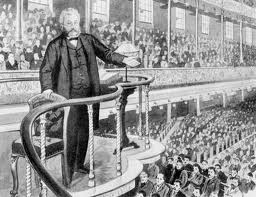
Spurgeon in pulpit image

Dr. Larry Michael is senior pastor at First Baptist Church in Clanton, Ala. He serves as an adjunct professor at Beeson Divinity School in Birmingham. This article is an adaptation of writings from the upcoming book, Spurgeon on Leadership, Kregel Publications, scheduled for release October 2003.

Some years ago there was a documented case in the British Medical Journal about a man who laughed himself well. He actually had a terminal illness, and through the employment of laughter therapy, he allowed his body to successfully fight the disease.

While we may smilingly acknowledge the merit of such a case, for the most part, we find such an incident almost incredible. Can laughter really be that good for us? The Bible definitely supports such a notion.

The Bible advocates laughter

The writer of Ecclesiastes stated: “There’s a time to laugh, and a time to cry” (Ecclesiastes 3:4). We know that there are plenty of reasons to cry. Just a casual glance at our world, with its wars, hatred, violence and evil — makes us sad. Every day we see/hear on the news horrible accounts of hurting people who hurt others. We are grieved at the plight of so many persons who are living in darkness and have rejected the light of Christ. The stark reality of sin in our world is indeed sobering.

It’s not surprising that many of us as leaders may be more inclined toward sadness than to joy. Given the nature and demands of Christian leadership in an increasingly challenging world, one could cynically surmise that leaders may have more reason to be glum than glad these days. The pressures of our organizational responsibilities, and the accompanying stresses, can drag us down. Handling church conflict, losing someone special, helplessly seeing a marriage dissolve, experiencing personal betrayal, facing an unsuspected tragedy — all may give cause for tears.

To counter the sad times, the Scripture also advises that there is a time to laugh. Leaders need to know the balancing therapy of laughter. Toward that goal, we should fully embrace the joys of ministry — celebrating special moments with members, “high-fiving” family achievements, relishing the reaching of hard-earned goals, and savoring the blessing of spiritual growth. But those experiences may still fall short of the biblical pronouncement regarding laughter. C’mon, when was the last time you laughed so hard you cried?! Or, you actually had a good belly laugh?

Spurgeon’s great sense of humor

Many evangelicals know well the stern side of C. H. Spurgeon and his serious pursuit of the holy life. Indeed, his stands for righteous causes, and countering doctrinal error are often recounted. But many readers may not know that he was a man with a great sense of humor. Spurgeon knew the value of laughter and mirth. He virtually took to heart the word in Proverbs 17:22: “A merry heart doeth good like a medicine.”

Spurgeon laughed as often as he could. He laughed at the ironies of life, he laughed at comical incidents, he laughed at the amusing elements of nature. He sometimes laughed at his critics. He loved to share wholesome jokes with his friends and colleagues in ministry. He was known to tell humorous stories from the pulpit. William Williams, a fellow pastor who kept company with Spurgeon, was a near and dear friend in the latter years of Spurgeon’s life. He wrote:

What a bubbling fountain of humour Mr. Spurgeon had! I laughed more, I verily believe, when in his company than during all the rest of my life besides. He had the most fascinating gift of laughter . . . and he had also the greatest ability for making all who heard him laugh with him. When someone blamed him for saying humourous things in his sermons, he said, “He would not blame me if he only knew how many of them I keep back.” 1

Spurgeon considered humor such an integral part of his ministry that a whole chapter in his autobiography is devoted to it. Humor permeates his sermons and writings, often woven into the fabric of his messages. It’s one reason among many why he is still so readable today.

The therapy of laughter

Spurgeon knew the blessing of the treatment of humor. He often spoke of his illness in humorous terms: “I have had sharp pains,” he wrote to a friend, “but I am recovering. Only my back is broken, and I need a new vertebrae.” 2 Once, when he was feeling depressed, he spoke of the remedy of laughter:

The other evening I was riding home after a heavy day’s work. I felt wearied and sore depressed, when swiftly and suddenly that text came to me, ‘My grace is sufficient for thee.’ I reached home and looked it up in the original, and at last it came to me in this way. ‘My grace is sufficient for THEE.’ And I said, ‘I should think it is, Lord,’ and I burst out laughing. I never understood what the holy laughter of Abraham was till then. It seemed to make unbelief so absurd…O brethren, be great believers. Little faith will bring your souls to heaven, but great faith will bring heaven to your souls. 3

Some of Spurgeon’s humor even bordered on the cynical — like the time he was embroiled in the Baptismal Regeneration Controversy. When Spurgeon took on the Church of England clerics because of their belief in baptismal regeneration, he had a baptismal font installed in his back garden as a birdbath. He referred to it as “the spoils of war.” While the great “Prince of Preachers” may have gone over the top on that one, for the most part, his humor was balanced and appropriate.

Laughter a needful release

Laughter is an important release in a leader’s life. It is much-needed therapy for positions that are most often fraught with stress and the burdens of the day. Certainly there is a time to be sober as we face many tough situations in our lives and ministries. But, we need to learn how to experience the relief of laughter. Part of the problem is that too many of us take ourselves way too seriously. When we forget that God has a sense of humor, we need to do as one leader suggested — go look in the mirror!

Spurgeon knew the value of laughter and humor. Both in tough times and sick times, humor was a means for him to deal with his situation. It was a coping mechanism for him. There will always be seasons of sadness and joy for the conscientious leader. But, the leader who learns to balance the two, will learn the discipline of employing laughter and joy in his life. It could very well make a difference in his fulfillment and purpose in his service to the Lord.

Article adapted from Reformed Perspectives Magazine, Volume 9, Number 40, Septemeber 30 to October 6, 2007.

Notes: 1. William Williams, Personal Remembrances of Charles Haddon Spurgeon (London: Passmore and Alabaster, 1895), 24; 2. Ibid, 231; 3. Ibid, 25.

Dr. Tim Keller on The Gospel and Humor

Humor in the Gospel?

Tim Keller seated image

I was reading a review of the movie ‘Prince Caspian’ in a newspaper for urban downtown-types, and the article dripped with sarcastic, sneering, smirking humor that, among other things, referred to Susan’s horn as a phallic symbol. Humor is like seasoning on food—everything is flat without it. But something was amiss here. I began to ask myself, ‘Does the gospel have an effect on our sense of humor?’ The answer has to be yes—but why and how?

Your humor has a lot to do with how you regard yourself. Many people use humor to put down others, keep themselves in the driver’s seat in a conversation and setting, and to remind the hearers of their superior vantage point. They use humor not to defuse tension and put people at ease, but to deliberately belittle the opposing view.

Rather than showing respect and doing the hard work of true disagreement, they mock others’ points of view and dismiss them without actually engaging the argument.

Ultimately, sarcastic put-down humor is self-righteous, a form of self-justification, and that is what the gospel demolishes.

When we grasp that we are unworthy sinners saved by infinitely costly grace it destroys both our self- righteousness and our need to ridicule others. This is also true of self-directed ridicule. There are some people who constantly, bitterly, mock themselves. At first it looks like a form of humility, or realism, but really it is just as self-absorbed as the other version. It is a sign of an inner disease with one’s self, a profound spiritual restlessness.

There is another kind of self-righteousness, however, that produces a person with little or no sense of humor. Moralistic persons often have no sense of irony because they take themselves too seriously, or because they are too self-conscious and self-absorbed in their own struggles to be habitually joyful.


The gospel, however, creates a gentle sense of irony. Our doctrine of sin keeps us from being over-awed by anyone (especially ourselves) or shocked, shocked by any behavior. We find a lot to laugh at, starting with our own weaknesses. They don’t threaten us any more because our ultimate worth is not based on our record or performance.

Our doctrine of grace and redemption also keeps us from seeing any situation as hopeless. This ground note of joy and peace makes humor spontaneous and natural.

In gospel-shaped humor we don’t only poke fun at ourselves, we also can gently poke fun at others, especially our friends. But it is always humor that takes the other seriously and ultimately builds them up as a show of affection.

“We are not to be perpetually solemn. We must play. But our merriment must be of that kind (and it is, in fact, the merriest kind) which exists between people who have, from the outset, taken each other seriously— no flippancy, no superiority, no presumption.” (C.S. Lewis, “The Weight of Glory”)

So how do we get such a sense of humor? That’s the wrong question. The gospel doesn’t change us in a            mechanical way. To give the gospel primacy in our lives is not always to logically infer a series of principles from it that we then ‘apply’ to our lives.

Recently I heard a sociologist say that, for the most part, the frameworks of meaning by which we navigate our lives are so deeply embedded in us that they operate ‘pre-reflectively.’ They don’t exist only as a list of propositions and formulations, but also as themes, motives, attitudes, and values that are as affective and emotional as they are cognitive and intellectual. When we listen to the gospel preached, or meditate on it in the Scripture, we are driving it so deeply into our hearts, imaginations, and thinking, that we begin to instinctively “live out” the gospel.

I have definitely seen the gospel transform a person’s sense of humor, but it would be artificial to say that there are ‘gospel-principles of humor’ that we must apply to our lives. It just happens, as we believe the gospel more and more.


*Article by Tim Keller from the Redeemer Church Manhattan Report – June 2008.

Friday Humor: A Lesson In Skipping Church

Series: Friday Humor #6

golf ball by hole

A church Pastor woke up Sunday morning and realizing it was an exceptionally beautiful and sunny early spring day, decided he just had to play golf.

So… he told the Associate Pastor that he was feeling sick and persuaded him to preside over the services for him that day.

As soon as the Associate Pastor left the room, the Pastor headed out of town to a golf course about forty miles away.

This way he knew he wouldn’t accidentally meet anyone he knew from his church. Setting up on the first tee, he was alone. After all, it was Sunday morning and everyone else was in church!

At about this time, Saint Peter leaned over to the Lord while looking down from the heavens and exclaimed, “You’re not going to let him get away with this, are you?” The Lord sighed, and said, “No, I guess not.”

Just then the Pastor hit the ball and it shot straight towards the pin, dropping just short of it, rolled up and fell into the hole.

IT WAS A 300 YARD HOLE IN ONE! St. Peter was astonished. He looked at the Lord and asked, “Why did you let him do that?” The Lord smiled and replied, Who is he going to tell?

Friday Humor: The Seeing Eye Dog

Series – Friday Humor #6: No Dogs Allowed!

A man goes into a bar with his dog. He goes up to the bar and asks for a drink.

The bartender says “You can’t bring that dog in here!” The guy, without missing a beat, says “This is my seeing-eye dog.”

“Oh man,” the bartender says, “I’m sorry, here, the first one’s on me.” The man takes his drink and goes to a table near the door.

Another guy walks into the bar with a Chihuahua. The first guys sees him, stops him and says “You can’t bring that dog in here unless you tell him it’s a seeing-eye dog.”

The second man graciously thanks the first man and continues to the bar. He asks for a drink. The bartender says “Hey, you can’t bring that dog in here!”

The second man replies “This is my seeing-eye dog.” The bartender says, “No, I don’t think so. They do not have Chihuahuas as seeing-eye dogs.”

The man pauses for a half-second and replies “What??! They gave me a Chihuahua??!”

Friday Humor: Police Emergency

Series: Friday Humor #5

This is the true story of George Phillips of Meridian, Mississippi, who was going to bed when his wife told him that he’d left the light on in the shed. George opened the door to go turn off the light but saw there were people in the shed in the process of stealing things.

He immediately phoned the police, who asked “Is someone in your house?” and George said no and explained the situation. Then they explained that all patrols were busy, and that he should simply lock his door and an officer would be there when available.

George said, “Okay,” hung up, counted to 30, and phoned the police again.

“Hello, I just called you a few seconds ago because there were people in my shed. Well, you don’t have to worry about them now because I’ve just shot them all.”

Then he hung up. Within five minutes three squad cars, an Armed Response unit, and an ambulance showed up. Of course, the police caught the burglars red-handed.

One of the policemen said to George: “I thought you said that you’d shot them!”

George said, “I thought you said there was nobody available!”

Zig Ziglar on the Question: Are You a Responder or a Reactor to Life?

It’s Better to Respond Than to React

When you respond to life, that’s positive; when you react to life, that’s negative. Example: You get sick and go to the doctor. Chances are good that after an examination, she would give you a prescription with instructions to return in several days. If, when you walk back in, the doctor starts shaking her head and says, “It looks like your body is reacting to the medicine; we’re going to have to change it,” you probably would get a little nervous. However, if the doctor smiles and says, “You’re looking great! Your body is responding to the medication,” you would feel relieved. Yes, responding to life is good. Reacting to the incidents of life is negative-and that’s bad.

The next example validates that fact.

Today, there is much turmoil in the job market, and many people are losing their jobs through downsizing, mergers, and takeovers. This creates some unusual opportunities for many people. One positive from this trend is that in the last five years, according to the Wall Street Journal, more than fifteen million new businesses have been created, well over half of them by women. Very few of the women had any marketable skills, and all of them had great financial need. Most of the new businesses were “trust” businesses, meaning that the women collected the money before they delivered the goods or services. The Journal comments that virtually none of the women have been prosecuted and jailed for failure to deliver on that trust. That’s exciting!

Many of these new businesses-possibly most of them-would never have been started had not an unfortunate event occurred in the people’s lives. When those events did occur and needs became obvious, the women chose to respond, and there is little doubt that many of them are better off now than they were before the “tragedy” took place.

The message is clear: If you respond to life instead of react to it, then you’ve got a much better chance of achieving success.

About Zig Ziglar:

Zig Ziglar was born in Coffee County, Alabama on November 26, 1926 and was the tenth of 12 children. In 1931, when Ziglar was five years old, his father took a management position at a Mississippi farm, and family moved to Yazoo City, Mississippi, where he spent his early childhood. In 1932, his father died of a stroke, and his younger sister died two days later.

Zigler served in the Navy during World War II (circa 1943-1945). He was in the Navy V-12 College Training Program, attending the University of South Carolina. In 1944 he met his wife Jean, in Jackson, Mississippi; he was 17 and she was 16. They married in late 1946.

Ziglar later worked as a salesman in a succession of companies. In 1968 he became the vice president and training director for the Automotive Performance company, moving to Dallas, Texas.

In 1970, Ziglar went into the business of motivational speaking full-time, with an emphasis on Christian values. Until then, he called himself by his given name, Hilary, but now satarted using his nickname, Zig, instead.

Until 2010 (aged 86) Ziglar traveled around the world taking part in motivational seminars, but has been somewhat limited recently due to a fall down a flight of stairs in 2007 that has impaired his short-term memory and physical abilities.

Through the ups and downs of life Ziglar has maintained his optimism and encouraged thousands of people to be their best in the particular endeavors to which God has called them. Zig Ziglar is one of the most inspirational people on the planet today and is a terrific example of someone who has embraced the struggle of life giving God the glory each step of the way.

The article above was adapted from one of Zig’s many encouraging books: Something to Smile About: Encouragement and Inspiration for Life’s UPS and DOWNS. Nashville: Thomas Nelson, 1997.

Zig Ziglar’s Books:

Ziglar, Zig; Ziglar, Tom. Born to Win: Find Your Success Code. Dallas: SUCCESS Media (2012).

Zig Ziglar. Something Else To Smile About: More Encouragement and Inspiration for Life’s Ups and Downs. Nashville: Thomas Nelson (2010).

Ziglar, Zig; Norman, Julie Ziglar. Embrace the Struggle: Living Life on Life’s Terms. New York: Howard Books (2009).

The One-Year Daily Insights with Zig Ziglar. Tyndale House Publishers (2009)

Inspiration 365 Days a Year with Zig Ziglar. SIM (2008)

God’s Way is Still the Best Way. Nashville: Thomas Nelson  (2007).

Better Than Good: Creating a Life You Can’t Wait to Live. Nashville: Thomas Nelson Publishers (2006).

Conversations with My Dog. B&H Books (2005).

The Autobiography of Zig Ziglar. New York: Random House (2004).

Confessions of a Grieving Christian. Nashville: B&H Publishing Group 2004).

Courtship After Marriage: Romance Can Last a Lifetime. Nashville: Thomas Nelson  (2004).

Staying Up, Up, Up in a Down, Down World. Nashville: Thomas Nelson  (2004).

Zig Ziglar’s Life Lifters: Moments of Inspiration for Living Life Better. B&H (2003).

Selling 101: What Every Successful Sales Professional Needs to Know. Nashville: Thomas Nelson Publishers (2003).

Ziglar, Zig and Hayes, John P. Network Marketing For Dummies. Foster City, Calif: IDG Books (2001).

Zig Ziglar. Success for Dummies. Foster City, Calif: IDG Books (1998).

Zig Ziglar. Something to Smile About: Encouragement and Inspiration for Life’s UPS and DOWNS. Nashville: Thomas Nelson (1997).

Great Quotes from Zig Ziglar. Career Press (1997)

Zig Ziglar. Over the Top. Nashville: Thomas Nelson Publishers (1994).

Zig Ziglar. Five Steps to Successful Selling. Nigtingale-Conant Corp. (1987).

Zig Ziglar. Top Performance: How to Develop Excellence in Yourself and Others. New York: Berkley Books (1986).

Zig Ziglar. Raising Positive Kids in a Negative World. Nashville: Oliver Nelson (1985).

Zig Ziglar’s Secrets of Closing the Sale. New York: Berkley Books (1982).

Zig Ziglar. See You at the Top. Gretna: Pelican (1975).


John C. Maxwell on Contentment vs. Discontentment

Which Tent Do You Live In?

All men live in one of two tents—content or discontent. In which do you live?

The contented man looks beyond his circumstances and sees a better day; the discontented man looks at his circumstances and sees no other way.

The contented man understands the purpose for which he was born; the discontented man looks at other’s success with a face that is filled with scorn.

The contented man has surrendered to a purpose that demands his best; the discontented man has selfishly hoarded much and grasping for more, will not rest.

The contented man has placed his values on things which will forever last; the discontented man has placed his values on things which will soon be past.

The contented man is anchored to clear goals and is hardly ever swayed;  the discontented man has no goals that anchor him and is many times dismayed.

The contented man counts his blessings and names them one by one; the discontented man counts other’s blessings and thinks he has no fun.

All men live in one of two tents—content or discontent. In which do you live?

 About John C. Maxwell:

John C. Maxwell is an internationally renowned pastor, leadership expert, coach, and author who has sold over 21 million books. Dr. Maxwell founded EQUIP and the John Maxwell Company, organizations that have trained more than 5 million leaders in 174 countries. Every year he speaks to Fortune 100 companies, international government leaders, and organizations such as the United States Military Academy at West Point, the National Football League, and the United Nations. A New York Times, Wall Street Journal, and Business Week best-selling author, Maxwell’s The 21 Irrefutable Laws of Leadership has sold more than 2 million copies. Developing the Leader Within You and The 21 Indispensable Qualities of a Leader have each sold more than 1 million copies. The article above was adapted from the encouraging and practical book by John C. Maxwell. Think On These Things. Kansas City: Beacon Hill Press, 1979, Chapter 30. This was the book that launched Maxwell’s writing career!

You can read his blog at JohnMaxwellOnLeadership.com, follow him at Twitter.com/JohnCMaxwell, and learn more about him at JohnMaxwell.com.

Dr. Tim Keller on “The Christian’s Happiness” – Romans 8:28-30

“And we know that for those who love God all things work together for good, for those who are called according to his purpose. For those whom he foreknew he also predestined to be conformed to the image of his Son, in order that he might be the firstborn among many brothers. And those whom he predestined he also called, and those whom he called he also justified, and those whom he justified he also glorified” (Romans 8:28-30)

Cheer Up Christian: “Your bad things turn out for good, your good things can never be lost, and the best things are yet to come.” – Tim Keller

Introduction

If you’re a Christian, you know that Christianity is supposed to be about joy. You probably also know that you’re supposed to experience joy in spite of circumstances. The Bible clearly teaches that joy is available that should make us happy no matter the circumstances. There’s a joy that the deepest trouble can’t put out and, if properly nourished and nurtured, can even overwhelm the greatest grief.

When Jesus prays to the Father in John 17:13, he prays for us—his followers. He says, I pray that “they may have the full measure of my joy within them.” One chapter before, he says to his disciples, “You will rejoice. and no one will take away your joy” (16:22). That’s pretty amazing! He’s talking to the twelve disciples, men who are going to be persecuted. They’re going to be robbed of everything they own, tortured, and put to death. Yet Jesus promises to give them a joy that will withstand all that. Nothing—not disease or persecution or alienation or loneliness or torture or even death—will be able to take it away.

I often wrestle with that concept. I have to ask myself, “Why do things affect me so much? Why is my joy not relentless?” Sometimes I wonder, “Do we have that kind of impervious joy?” I’m afraid not. I don’t think we understand the nature of this joy.

Romans 8 is all about living in a suffering world marked by brokenness. Paul talks about trouble and persecution and nakedness and poverty and how Christians are supposed to live in a world like that. In 8:28–30 he offers three principles for finding joy in suffering. Paul tells us that if we follow Christ, our bad things turn out for good, our good things cannot be lost, and our best things are yet to come. Those are the reasons for our joy.

Our bad things turn out for good

Verse 28 says: “For those loving him, God works together all things for good.”

There are three implications of this first principle.

First, this verse says that all things happen to Christians. That is, the Christian’s circumstances are no better than anybody else’s. It is extremely important for us to understand this if we’re going to experience relentless and impervious joy. Terrible things happen to people who love God. Many Christians explicitly teach—and most Christians implicitly believe—that if we love and serve God, then we will not have as many bad things happen to us. That’s not true! Horrible things can happen to us, and believing in and loving and serving God will not keep them from happening. All the same things that happen to everybody else will happen to people who love God. “All things” means all things, in this text. In verse 35 Paul says, “What can separate us from the love of Christ? Can trouble, hardship, persecution, famine, poverty, danger, or sword?” Those are terrible things. Paul is saying all the same things that happen to everybody else will happen to us, even if we love God. It’s very important to realize that.

The second implication of this point is that when things work together in your life, it’s because of God. Notice Paul does not say, “Things work together for good.” Things never work together for good on their own. Rather, if anything good happens, it is because God is working it together.

Earlier in Romans 8, Paul discusses how things fall apart because the world is burdened with evil and sin. Things are subject to decay. Everyone will eventually experience the decay of their bodies; that’s the nature of things. The little grains of sand on the beach used to be a mountain. Everything falls apart; things do not come together. This verse tells Christians to get rid of the saccharine, sentimental idea that things ought to go right, that things do go right, and that it’s normal for things to go right. Modern, Western people believe that if things go wrong, we should sue, because things ought to go right. But Christians have to discard that idea completely. Christians have to recognize that if our health remains intact, it is simply because God is holding it up. If people love us, if someone is there to hug us or squeeze our hand, if someone loves us in spite of all our flaws—if someone loves us at all—it’s because God is bringing all things together. God is holding it up. Everything that goes well is a miracle of grace.

The third implication of this principle is the most basic: Although bad things happen, God works them for good. This verse does not promise that those who love God will have better circumstances. Nor does this verse say that bad things are actually good things. Rather, it acknowledges that these are bad things, but it promises that they’re working for good. That means God will work them to good effect in your life.

The story of Jesus standing before the tomb of Lazarus is an endless source of insight for me. As he was about to raise Lazarus from the dead, Jesus was not smiling. He was angry. He was weeping. Why? Because death is a bad thing! Jesus wasn’t thinking, “They think that this is a tragedy, but no harm done! I’m about to raise him from the dead. This looks like a bad thing, but it’s not. It’s really a good thing! It’s a way for me to show my glory. It’s really exciting! I can’t wait!” He wasn’t thinking that. Jesus was weeping at the tomb, because the bad thing he’s about to work for good is bad. The story of Lazarus does not give you a saccharine view of suffering, saying bad things are really blessings in disguise or that every cloud has a silver lining. The Bible never says anything like that! God will give bad things good effects in your life, but they’re still bad. Jesus Christ’s anger at the tomb of Lazarus proves that he hates death. He also hates loneliness, alienation, pain, and suffering. Jesus hates it all so much that he was willing to come into this world and experience it all himself, so that eventually he could destroy it without destroying us.

There’s no saccharine view in the Christian faith. The promise is not that if you love God, good things will happen in your life. The promise is not that if you love God, the bad things really aren’t bad; they’re really good things. The promise is that God will take the bad things, and he’ll work them for good in the totality.

Keep in mind that verse 28 says all things work together for good. That doesn’t mean that when something bad happens, we can decide to give God a week to show us how the situation is going to turn out for good. In fact, don’t wait a month. Don’t wait a year. Don’t wait a decade. The promise isn’t for a month or a year or a decade. The promise is not that we will see how every bad patch in our lives works out for our good. The promise is that God will make sure that all the bad circumstances will work together for your life in its totality.

The best summary of this lesson that anybody has ever come up with is John Newton’s. He said: “Everything is necessary that he [God] sends; nothing can be necessary that he withholds.” What John Newton and Paul are saying is that if God has withheld good things—things that you think are good—they would only be good in the short run. In the long run, they would be terrible. They would be good in the partial but not in the whole. On the other hand, God will only bring bad things into your life—things God knows are bad—in order to cure you of things that can destroy you in the long run. The premise is, the things that really hurt—foolishness, pride, selfishness, hardness of heart, and the belief that you don’t need God—are the only things that can hurt you in the long run. In the short run selfishness and self-deception feel great, but in the long run they will destroy you.

Your joy will be impervious if you hold onto these three principles. Bad things will happen to you. We shouldn’t be shocked or surprised when bad things happen. One of the main reasons a lot of Christians are continually overthrown is not simply because bad things happen to them. At least half of their discouragement and despondency is due to their surprise at the bad things that happen to them. Do you see the distinction? Fifty percent of the reason we get so despondent is that we’re shocked. We say, “This isn’t how it’s supposed to be.” We may say life should be better, but that’s not what the promise is. Or we say we love God, therefore, surely we will have more good circumstances. That’s not the promise either. Until you understand what the promise is, you’re going to be continually shocked and even overthrown.

Our good things can never be lost

The second principle in this passage is that the good things we have cannot be lost. If you’ve been a Christian for any period of time, you know that Romans 8:28 is a very famous verse. People use it all the time. It’s what I call a “blessing box” verse. A blessing box is a collection of verses you rip out of context and recite without concern for what came before and after the verse. It feels good, so you use it. For example, people use Romans 8:28 to assure themselves that when bad things happen, then surely good things will happen. You might think, “I didn’t get into the grad school I wanted to get into, but that’s because there’s a better grad school for me somewhere.” Or, “I didn’t marry the girl or guy I wanted to marry, but that means there’s a better one for me somewhere.” That’s not the promise.

There’s a little word between verses 28 and 29 that indicates the verses go together. The little word is for. “All things work together for good for those who love God and are called according to his purpose, for those he foreknew he also predestined to be conformed into the likeness of his Son.”

God does not promise you better life circumstances if you love him. He promises you a better life. Grad school and marriage are circumstances. We’re talking about a joy that goes beyond circumstances. How dare we interpret verse 28 as a joy that is dependent on those things! Here is an important principle: Jesus Christ did not suffer so that you would not suffer. He suffered so that when you suffer, you’ll become like him. The gospel does not promise you better life circumstances; it promises you a better life.

Romans 8:29 tells us the goal toward which all our circumstances are moving us. Paul uses the word predestined. He’s not introducing the word to confuse you—he doesn’t intend to explain the doctrine of predestination or address the issues that arise when that word is mentioned. He uses this word to comfort us. Something that is predestined is fixed. What Paul means is that if you love God, you can count on a promise that is absolutely fixed, no matter what. That’s all he’s trying to get across.

What is it that is predestined? That we will be conformed to the image of Christ. The Greek word here is morpha, from which we get the word metamorphosis. Paul is saying that God promises to “metamorphosize” us. He promises to change our very inner essence into the very inner essence of Jesus Christ. To be a Christian is to become passionately in love with the character of Jesus. You read about him in the Bible and are amazed by the truth and love you find in his life. You see wisdom and utter conviction. You see incredible courage, brightness, and radiance. The good that God is moving you toward through everything that happens in your life—whether externally good or bad—is your transformation into Christ’s nature. If you love God, everything that happens in your life will mold you, sculpt you, polish you, and shape you into the image of his Son. He is making you like him. He’ll give you Christ’s incredible compassion and courage. God is working everything that happens in your life toward that magnificent goal. It’s predestined. It’s guaranteed.

One of the most astounding things in Romans 8:30 is this: “And those he predestined, he also called; those he called, he also justified; those he justified, he also glorified.” Glorified is in the past tense. Shouldn’t Paul say, “The ones he foreknew he predestined, and justified, and will glorify”? Because the apostle is so absolutely certain that you are bound—that God is going to make you as beautiful as Jesus and give you all these incredible things—he writes of the glorification as an accomplished fact. He talks about it in the past tense because it’s as good as done. God is not going to let anything in life get between you and that goal. You are predestined to be conformed to the image of God’s Son.

In Romans 8:29 Paul calls Christ “the firstborn among many brothers.” That means we are all sons of God. We are all adopted into the family. When Paul alludes to adoption, he’s talking about a practice that was common in the Roman world, but one that’s quite different from the way we think of adoption. In the Roman world, most people who were adopted were adults. When a wealthy man had no heir and didn’t want his estate to be broken up when he died, he would adopt an adult male, usually someone who worked for him whom he trusted. By adopting that adult male, he made him his son. The minute the legal procedure took place, their relationship was changed from formal to intimate, from temporary and conditional to permanent and unconditional. All the debts the man owed before his adoption were wiped out, and he suddenly became rich.

Being completely conformed to the likeness of God’s Son is something that we look forward to in the future, although the transformation is happening now gradually. Being adopted among many brothers is something that we have now. The minute you become a Christian, you have intimacy of relationship. You have an unconditional relationship. You become wealthy, because everything that Jesus Christ has accomplished is transferred to you. You become beautiful and spiritually rich in him.

Some people are put off by Paul’s language of adoption because it’s gender insensitive. They argue, “Wouldn’t it be better to say that we become sons and daughters of God?” It would, but that misses the whole point. Some time ago, a woman helped me understand this. She was raised in a non-Western family from a very traditional culture. There was only one son in the family, and it was understood in her culture that he would receive most of the family’s provisions and honor. In essence, they said, “He’s the son; you’re just a girl.” That’s just the way it was.

One day she was studying a passage on adoption in Paul’s writings. She suddenly realized that the apostle was making a revolutionary claim. Paul lived in a traditional culture just like she did. He was living in a place where daughters were second-class citizens. When Paul said—out of his own traditional culture—that we are all sons in Christ, he was saying that there are no second-class citizens in God’s family. When you give your life to Christ and become a Christian, you receive all the benefits a son enjoys in a traditional culture. As a white male, I’ve never been excluded like that. As a result, I didn’t see the sweetness of this welcome. I didn’t recognize all the beauty of God’s subversive and revolutionary promise that raises us to the highest honor by adopting us as his sons.

Our adoption means we are loved like Christ is loved. We are honored like he is honored—every one of us—no matter what. Your circumstances cannot hinder or threaten that promise. In fact, your bad circumstances will only help you understand and even claim the beauty of that promise. The more you live out who you are in Christ, the more you become like him in actuality. Paul is not promising you better life circumstances; he is promising you a far better life. He’s promising you a life of greatness. He is promising you a life of joy. He’s promising you a life of humility. He’s promising you a life of nobility. He’s promising you a life that goes on forever.

 The best things are yet to come

That brings us to the third point. Why can you be joyful no matter what? Your bad things turn out for good, your good things can never be lost, and the best is yet to come. If you understand what is to come, you can handle anything here. What amazes me is that even Ivan Karamazov, the atheist character in Dostoevsky’s The Brothers Karamazov, understood how knowing what is to come helps a person endure present circumstances. He said:

I believe that suffering will be healed and made up for, that in the world’s finality, at the moment of eternal harmony, something so precious will come to pass that it will suffice for all hearts, for the comforting of all resentments, for the atonement of all the crimes of humanity, of all the blood that’s been shed, that it will make it not just possible to forgive, but to justify all that’s happened.

I don’t want you to think that this talk about glory and about heaven trivializes suffering. In fact, Ivan Karamazov said that this hope is the only worldview that takes our brokenness seriously. Our souls are so great and our suffering is so deep that nothing but this promise can overwhelm it. Glory does not trivialize human brokenness. It’s the only thing that takes it seriously. What else could possibly deal with the hurts of our hearts? Your soul is too great for anything but this. Don’t you know a compliment when you hear it?

 About the Author

Timothy Keller is founding pastor of Redeemer Presbyterian Church (PCA) in New York City and the author of numerous books, including The Reason for God, King’s Cross, Counterfeit Gods, The Prodigal God, and Generous Justice.

The sermon above was adapted from a collection of Sermons in a book entitled “Sunday’s Best” published by Hendrickson Publishers in Peabody, Massachusetts, 2011.



“I See You, and Jesus Sees You” by R.C. Sproul

Series: Friday Humor #4

A local newspaper told an anecdote about a burglar who stalked the neighborhood watching for homes left unguarded by people leaving for vacation. He watched as a family loaded their suitcases into their car and departed. He waited until dark and then approached the front door and rang the bell. There was no answer. The burglar neatly picked the lock and let himself in. He called into the darkness, “Is anybody home?” He was stunned when he heard a voice in reply, “I see you, and Jesus sees you.” Terrified, the burglar called out, “Who’s there?” Again the voice came back, “I see you, and Jesus sees you.” The burglar switched on his flashlight and aimed it in the direction of the voice. He was instantly relieved when his light revealed a caged parrot reciting the refrain, “I see you, and Jesus sees you.” The burglar laughed out loud and switched on the lights. Then he saw it. Beneath the parrot’s cage was a huge Doberman pinscher. Then the parrot said, “Attack, Jesus, attack!”

Adapted from R.C. Sprouls excellent book on sanctification entitled Pleasing God. Tyndale: Wheaton, 1991, p. 46.

John Wooden: 9 Promises To Help Change Your Life

9 Promises To Make a Big Difference in Your Own and Others Lives:

  • Promise to think of the best, to work only for the best, and to expect only the best in yourself and others.
  • Promise to be just as enthusiastic about the success of others as you are about your own.
  • Promise yourself to make all your friends know there is something in them that is special and that you value.
  • Promise yourself that you will talk health, happiness, and prosperity as often as possible.
  • Promise yourself to be so strong that nothing can disturb your peace of mind.
  • Promise to forget the mistakes of the past and press on to greater achievements in the future.
  • Promise to wear a cheerful appearance at all times and give every person a smile.
  • Promise to give so much time to improving yourself that you have no time to criticize others.
  • Promise to be too large for worry, too noble for anger, too strong for fear, and to happy to permit trouble to press on you.

 About Coach John Wooden:

John Wooden was born on his parents’ farm near Centerville, Indiana. Life was difficult for the Woodens. Their farm had neither running water nor electricity and money was often in short supply. In later years, Coach Wooden credited his success to the habits of discipline and hard work he learned on the farm.

Rural America did not share in the prosperity enjoyed by large cities in the 1920s. In 1924, the Woodens, like many farm families, went bankrupt and lost their farm. The family moved to Martinsville, a small town which, like so many in Indiana, took great pride in the performance of its high school basketball teams. Wooden, who had shown a gift for the game from grade school days, soon became a star player on his high school team. The team went to the state championship three years running, and won it twice. While still in high school, John met Nellie Riley. By his own account, it was love at first sight, and the two teenagers decided to marry as soon as John finished college.

John Wooden entered Purdue University in Indiana to study civil engineering, but became an English major instead. In college basketball, he earned a reputation as a fearless player of dazzling speed. He made All-American three years running and won a place in the Basketball Hall of Fame.

After graduation in 1932, he was offered a spot on the Celtics professional basketball team, but passed it up to begin a teaching career and marry his beloved Nellie. His first post was in Dayton, Kentucky, where he not only taught high school English, but coached all of the school’s athletic teams. The basketball team had a losing season, the only one in Wooden’s entire career.

The following year, John and Nellie settled in South Bend, Indiana, where he taught English and coached the basketball team of South Bend Central High School. In eleven years of coaching high school basketball Wooden’s teams won 218 games, losing only 42. The young coach served as a physical education instructor in the United States Navy during World War II. Appendicitis kept him from shipping off for the South Pacific. A Japanese kamikaze plane struck the ship Wooden was to travel on, killing the officer who had taken his place.

After military service, Wooden, like many other teachers he knew, was not re-hired at his old job. He quickly found work however, at Indiana State Teachers’ College, later known as Indiana State University. He coached basketball at the school, resuming his string of winning seasons.

In 1948, Wooden accepted an offer to coach the UCLA Bruins. At the time, the team was considered the weakest in the Pacific conference. The University had not provided the team with the facilities usually considered essential; the Bruins lacked a home court to play in, and had to share practice facilities with the school’s other teams.

Wooden’s Bruins astonished the skeptics by winning 22 out of 29 games in his first season as coach. The following year, they took 24 out of 31 and won their conference championship. Under Wooden’s tutelage, the Bruins maintained their high win-loss ratio, and won the Pacific conference titles again in 1952, 1956, 1962 and 1963.

In 1964, Wooden achieved a long sought-after goal. His team had a perfect season, and won the NCAA championship. The following year, they won the title again, losing only two games in a 30-game season. What they lacked in size, the 1964 and ’65 Bruins made up for in speed, discipline and an extra-keen will to win that has been the hallmark of all of Wooden’s teams. The break-up of this championship lineup may have cost the Bruins the championship in 1966, but they came back with a vengeance in 1967, and held the championship for the next seven years.

The seven-foot center Lew Alcindor (later Kareem Abdul-Jabbar) dominated the Bruins’ game for the first three seasons of their seven-year streak. Bill Walton was the dominant star of the 1973 and ’74 seasons, when UCLA set the all-time record for an unbroken winning streak: 88 consecutive games. In 1974, UCLA again won the Pacific conference title, but lost to North Carolina State in the NCAA semi-finals.

The Bruins bounced back in 1975, Coach Wooden’s last year, winning 27 out of 30 games, turning around a losing semi-final against Louisville in the closing minute of the game. In the final game of the tournament, UCLA defeated the University of Kentucky, 92-85.

In all his years as coach, John Wooden prohibited his players from any use of profanity, and consistently avoided it himself. Still, in his first 12 years at UCLA, the coach developed a fearsome reputation among opposing teams for the fanciful harangues he directed at officials and opposing players from the bench. This habit was virtually the only aspect of his career for which the coach expressed any regret. In the championship years, fans and players alike noticed a distinct mellowing of Wooden’s behavior on the bench.

One of Coach Wooden’s proudest moments, he later recalled, came when he overheard one of his players, an African-American, reply to a reporter’s question about racial tensions on the team: “You don’t know our coach. He doesn’t see color. He just sees ballplayers.” Wooden remained close to many of his former players in his long years of retirement. He died peacefully in Los Angeles at the age of 99. His record of accomplishment remains unmatched.

The 9 Promises above adapted from Wooden: A Lifetime of Observations and Reflections On and Off The Court. Coach John Wooden with Steve Jamison. Contemporary Books: Chicago, 1997, pp. 79-78.