
Category: Attitude

John Piper on “Thanksgiving Toward the Past, Faith Toward the Future”

A Parable: The Anvil
Isaiah 40:8, “The grass withers, the flower fades, but the word of our God will stand forever.”
Let’s begin with a parable today. Once upon a time in land before there were any cars or modern machines – a time when horses and carriages and wagons were common on the dirt roads – there was a blacksmith shop with a large, heavy, well-worn anvil. One day a little farm boy, who had never left the farm, came with his father to town for the first time. Everything was new and different. As he walked with his father down the unpaved main street, he heard a loud clang . . . clang . . . clang. He said to his father, “What’s that?” His father said, “Come, I’ll show you.” He took his son to the door of the blacksmith’s shop. And there the boy saw a huge man, a strong man, lifting a big, heavy hammer with a long handle and a large head on it high in the air, as if to chop down a tree, and then crashing it down on a glowing piece of metal on top of the anvil. He hit the anvil so hard that it made the boy wince with every blow. His father explained to him that this was a blacksmith who made all kinds of metal pieces for wagons and carriages and plows and tools and horseshoes.
But the little boy was fixed on one thing: the long, heavy hammer and the great metal anvil. They met each other with such a loud sound and with such a force that he thought surely this anvil could not last long. The big, strong blacksmith paused for a moment to catch his breath, and saw the boy standing in the doorway. “Aren’t you going to break that thing?” the boy asked, pointing at the anvil. But the blacksmith smiled and said, “This anvil is a hundred years old and has worn out many hammers.”
The Bible: Forged in the Furnace of Truth
Here’s the point of the parable. The Bible is an anvil that has worn out a thousand hammers. In every generation, new, huge, heavy hammers are forged against the truth of the Bible. And strong men lift the hammers and pound on the Scriptures. People with no historical perspective – like little boys who’ve never been to town – see it and say, “Surely the Bible will be destroyed.” But others who know their history a little better say, “This Bible was forged in the furnace of divine truth and has worn out many hammers.”
In the Old Testament, the prophet Isaiah said, “The grass withers, the flower fades, but the word of our God stands forever” (Isaiah 40:8). And Jesus said, “Heaven and earth will pass away, but My words will not pass away” (Matthew 24:35).
Why is this? Why has the Bible worn out a thousand hammers? Why does the Bible survive generation after generation as a living and powerful book in the lives of millions of people? The answer can be found in two observations: one is that God endures from generation to generation. And the other is that the Bible is the Word of God.
In Psalm 90:1-2 Moses says, “Lord, You have been our dwelling place in all generations. Before the mountains were born, or You gave birth to the earth and the world, even from everlasting to everlasting, You are God.” And in the New Testament, Hebrews 13:8 says, “Jesus Christ is the same yesterday and today and forever.” The reason the Bible has worn out a thousand hammers is because it is the Word of God who endures from everlasting to everlasting, and because its central character is Jesus Christ who is the same yesterday, today and forever.
Bubbles and Fads
There are two reasons why I point this out. One is that I want to build my life on something that lasts. And I think most of you would share this desire. I don’t want to build my life on sand. I don’t want to spend my life chasing bubbles that shimmer with beauty and pop as soon as you catch them. I want to build my life on something durable – something like an anvil that breaks a thousand hammers.
The other reason why I point out the indestructible toughness of the Bible is to contrast it with the incredibly short shelf-life of the ever-changing remedies and treatments and schemes of hope in our day. Schemes of hope that leave out of account God and Christ and sin and salvation and repentance and death and heaven and hell. They leave these great realities out of consideration as if they were non-realities or inconsequential, like unicorns and Cyclopses and flat-earth theories. These treatments and remedies and schemes of hope put themselves forward with great forcefulness. But how many people notice how short is the life of God-neglecting promises of hope?
Let me illustrate what I mean, and I give credit here to David Powlison in an article titled “Biological Psychiatry” (The Journal of Biblical Counseling, 17/3, Spring, 1999, pp. 2-8). I don’t know if you have noticed yet, but there has been a sea change in the world of mental health in the last five years or so. When was the last time you heard anybody talking about codependency? Just twelve years ago this was all the rage. Melody Beattie’s Codependent No More and John Bradshaw’s Homecoming were best-sellers. Wherever you turned, from books to talk shows to seminars, the diagnosis of our problems was the same: dysfunctional families of origin. Past emotional pain and emptiness were the primal causes of our present misery and misbehavior. And the remedy? Psychotherapy with sensitive non-judgmental counselors and support groups with those who felt your pain and understood your woundedness.
That was in its heyday of the eighties. But then something changed. Something always changes. Diagnoses and remedies that are not built on the full embrace of God’s Word must always fade. These things slip up on you. And you suddenly realize: hmm, those kinds of books aren’t being written any more. People don’t seem to be talking with the same confidence they used to about the dynamics of the wounded soul. What ever became of codependency?
What’s happened? Well, there’s a new excitement, a new scheme of hope. The new scheme is more biological and less psychological. In the place of the needy, hurting, wounded soul has now arisen the dysfunctional brain. It’s not the family of origin now that has center stage, but hormones and genes and chemicals and neurotransmitters. And what are the new books today? Harold Koplewicz’s It’s Nobody’s Fault, that explains the problems of human life in terms of neurotransmitter shortages; and Peter Kramer’s Listening to Prozac, that says we have entered an era of “cosmetic psychopharmacology.”
Here’s the way David Powlison describes the shift:
The world did change in the mid-90s. The action is now in your body. It’s what you got from Mom and Dad, not what they did to you. The excitement is about brain functions, not family dysfunctions. The cutting edge is in the hard science medical research and psychiatry, not squishy soft, philosophy-of-life, feel-your-pain psychologies.
Psychiatry’s back. . . . Biology is suddenly hot. Psychiatry has suddenly broken forth, a blitzkrieg sweeping away all opposition. The insurance companies love it because drugs seem more like “medicine,” seem to be cheaper than talk, and promise more predictable results. Psychotherapy professionals are on the defensive. (Powlison, “Biological Psychiatry,” p. 3)
The point is this: I want my life to be built on something more durable than a 15-year-long therapeutic fad. And make no mistake: the present craze with genes and hormones and neurotransmitters and the Human Genome Project and genomic mapping and chemical therapies – this excitement too will fade and we will move on to something else. And in its wake will be left vast disillusionment. No fulfilled life. No fountain of youth. No utopia. No comfort at death. And millions of people will be left with the question: is there a more durable hope to build my life on? Is there a diagnosis of my condition and a remedy for my flaws and a promise for the future that will not pass by like a fad in one generation, and leave me feeling like an out-of-date fool using leeches to cure my headache?
Or to ask it another way: When Ritalin has calmed you down and Prozac has cheered you up, then what? The promise of these things seems so big, when it fact the pay-off is so small. All the things that never change, all the things that last, all the really big things in life and eternity still wait to be addressed: God, Christ, sin, redemption, repentance, faith, forgiveness, death, heaven, hell, eternal life.
The Eternal Realities of the Bible
Which brings us back to where we started: there is a rugged, unchanging, solid anvil called the Bible. It has outlived all fads and broken a thousand hammers of criticism. It doesn’t sweat the small stuff very much; its message deals with the big things that never change from generation to generation. And what is the message?
The message of the Bible is this. It has to do with four great realities: God, sin, Christ, faith.
1. God
“In the beginning God . . .” – the first verse of the Bible: “In the beginning God created the heavens and the earth” (Genesis 1:1). There is a personal, infinite, eternal, just, loving, holy God who made this universe and everything in it to reflect his glory – his greatness and beauty and power and wisdom and justice and mercy. He had no beginning. He is absolute Reality. He depends on nothing. He says that his name is simply, “I am” (Exodus 3:14). This great, personal, eternal God made you to know him and to enjoy him and display him in the world. The prophet Isaiah said, “Bring My sons from afar and My daughters from the ends of the earth, everyone who is called by My name, and whom I have created for My glory, whom I have formed, even whom I have made” (Isaiah 43:7). The first great reality is God, who made us to enjoy and display his glory.
2. Sin
But the second great reality that the Bible teaches us about is sin. If the purpose of our existence is to know and enjoy and reflect the glory of God as our highest value, then sin is our failure to do that. The apostle Paul puts it like this in the greatest letter ever written, “All have sinned and fall short of the glory of God” (Romans 3:23). Notice two things: sin is about everybody and sin is about God. All of us have sinned. There is no exception. And sin mainly has to do with our relationship to God, not man. Sin hurts people. But that’s not the main reason it is evil. The main reason is that God is worthy of our trust and obedience and worship and our joy, but we treat him like a raincoat, leaving him in the closet forgotten until it rains hard enough outside. God is not a raincoat for bad days. He is the Giver of the sunlight and the Creator of the clouds and the Sustainer of every breath you take and the Judge of all the living and the dead.
Therefore, our neglect of God is a great evil and we are guilty of sin in his presence. The Bible says, “The wages of sin is death” (Romans 6:23). We are under the sentence of God’s eternal judgment. And we will perish unless God himself provides a Redeemer to save us from our sin and from his wrath.
3. Christ
Which brings us to the third great reality of the Scriptures: the central character of history, Jesus Christ. O for a thousand tongues to describe the greatness of the God-Man Christ Jesus! “In the beginning was the Word, and the Word was with God, and the Word was God. He was in the beginning with God; all things were made through him, and without him was not anything made that was made. . . . And the Word became flesh and dwelt among us, full of grace and truth; we have beheld his glory, glory as of the only Son from the Father” (John 1:1-3, 14).
Jesus Christ is the Son of God, eternal, without beginning, but with the Father from everlasting to everlasting, truly God. And yet, he was made flesh, that is, became human. Why? Because without a human nature he couldn’t die. But his aim in coming was to die. He lived to die. Why? Why would God send his Son to die? Because God’s heart toward us is not only wrath flowing from his justice, but also mercy flowing from his love. And to satisfy both justice and love, God substituted his Son to die in our place. Jesus said, “The Son of Man did not come to be served, but to serve, and to give His life a ransom for many” (Mark 10:45). He came to give his life as a ransom to rescue sinners from hell.
This is the center of Christianity. God sent his own Son to provide a substitute for all who would be saved from sin. A substitute life, and a substitute death. Jesus Christ lived a perfect life of faith and obedience to God. And he died a totally undeserved, horrific, and obedient death by crucifixion. Therefore, all of us who are saved by him from the wrath of God are saved because our sin is laid on him, and his righteousness is credited to us. “All we like sheep have gone astray; we have turned every one to his own way; and the LORD has laid on him the iniquity of us all” (Isaiah 53:6). “For our sake [God] made him to be sin who knew no sin, so that in him we might become the righteousness of God” (2 Corinthians 5:21).
This is the center and heart of Christianity. This is the deepest need of every human being that no medicine and no therapy will ever touch.
4. Faith
Which leaves one last great Biblical reality to mention. What must I do to be saved by Jesus Christ from my sin? How can I obtain forgiveness and acceptance with God? How can I prepare to die so that on the other side of this life I will have everlasting joy in the presence of God – and in that hope become the kind of risk-taking, humble, loving, sacrificial person that the world so desperately needs?
The answer of the Bible is: Trust Christ. “For God so loved the world that he gave his only Son, that whoever believes in him [that is, trusts in him] should not perish but have eternal life” (John 3:16). Trust him that everything he says he has done, he has done; and everything he says he will do, he will do; and everything he says he is, he is. Trust him, and you will be saved.
And you will live the rest of your life in the place of greatest healing. Where is that? It is the solid, durable, invincible, anvil-like place between thankfulness toward the past and faith toward the future. The aim of psychotherapy and the aim of medicine is to give us healing. But there is no place of greater, deeper, more lasting healing than to be in Christ with sins forgiven and heaven secured, living moment by moment looking back with thankfulness on all that God has done for us, and looking forward at all God promises to do for us because of Christ.
It’s a great place to live. I invite you, I urge you, trust Christ and take your eternal place between bygone grace and future grace where gratitude and faith, thankfulness and confidence fill the soul and make it well.
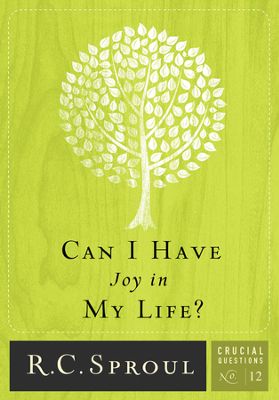
BOOK REVIEW: R.C. SPROUL’S “CAN I HAVE JOY IN MY LIFE?”
WHY PUTTING JESUS FIRST RESULTS IN JOY
Book Review by David P. Craig
In this insightful book Sproul helps the reader discern what true biblical joy consists of. It is not based on our circumstances, or even our personality. Sproul writes, “The key to the Christian’s joy is its source, which is the Lord. If Christ is in me and I am in Him, that relationship is not a sometimes experience. The Christian is always in the Lord and Lord is always in the Christian, and that is always a reason for joy. Even if the Christian cannot rejoice in his circumstances, if he finds himself passing through pain, sorrow, or grief, he still can rejoice in the Lord, and since He never leaves us or forsakes us, we can rejoice always.”
R.C. helps the reader by taking you to key passages of Scripture from Philippians, James, Romans, and the Gospel of John and gleans principles on the ground and source of our joy as being in Christ – who never changes and will never leave nor forsake us. The primary enemy of our joy is anxiety. Fear and anxiety rob us of our joy. However, if we understand who Christ is, and what he has done for us it deepens and opens up a new dimension of joy in us.
The acronym J-O-Y is used to demonstrate that Jesus first, then others, and then you – is actually a good way to practice the habit of joy in our lives. If we focus on Jesus – who is perfect, never changing, loving, and so forth – instead of our imperfect selves, or the imperfections of others and changing circumstances we can maintain and equilibrium of and growth in the genuine joy of the Holy Spirit who dwells within us as Christians. According to Sproul the reason that joy is often so elusive s because we put ourselves first, and Jesus last.
I love what Sproul has to say about Jesus’ own joy: “Jesus is the only person in history who spelled the word joy without putting the letter ‘j’ first. He put Himself last in order to make it possible for us to participate in joy.” The greatest joy anyone can possibly have is knowing and being like Jesus – trusting and believing in His redemptive work on our behalf. By participating (abiding) in our new life with Christ as forgiven, reconciled, children of God we have everything we need to live in peace and joy with God, others, and ourselves. Joy is possible because of Jesus alone. Even our continued struggles with sin, doubts, guilt, and so forth can never take away His righteousness in exchange for our sins and His gift of eternal life. Since our names our written in the Lamb’s Book of Life we have reason to rejoice no matter what our circumstances are – because ultimately we win in Him. We can always rejoice “in the Lord” – because the Lord has an infinite supply of unchanging perfections for us to delight in.
What is Faith?
WHAT FAITH IS:

- Doing the right thing regardless of the consequences and knowing God will turn the ultimate effect to good.
- Reliance on the certainty that God has a pattern for my life when everything seems meaningless.
- Confidence that God is acting for my highest good when He says no to my prayers.
- Realizing that I am useful to God not in spite of my scars but because of them.
- Accepting the fact that God knows better than I do what is ultimately good for me.
- Living with the unexplained.
- The way to please God.
Excerpts from Pamela Reeve’s Faith Is. Portland: Multnomah Press, 1994
Dr. John Piper on Having a “Gratitude Ethic”
How Does Gratitude Motivate?
On May 29 [1983] in my message on Galatians 5:1-5, I opposed the “Gratitude Ethic” which says: “God has worked for me, now I will return the favor and work for him;” or: “God has given me more than I could ever pay back, but I will devote my life to trying.” But the question was raised by Steve Roy after the service whether there may be another way gratitude could motivate obedience that does not involve a debtor mentality. So I spent about six hours on Memorial Day trying to think that question through. Here is where I am.
Definition: gratitude is a species of joy which arises in our heart in response to the good will of someone who does (or tries to do) us a favor. We do not respond with gratitude to a person if they accidentally do us a favor. Nor do we respond with gratitude if they do us a favor with mercenary ulterior motives. On the other hand, we do respond with gratitude to a person who tries to do us a favor but is hindered by circumstances beyond his control—say, he sacrifices his life to bring us medicine in the jungle but it turns out not to heal. We still feel gratitude toward him. Therefore gratitude is not merely the response of joy to a benefit received. It has special reference to the good will of another person. A person whose joy centers only on a gift received with no sense of joy in the good will of the giver, we call an ingrate. So gratitude is a species of joy which arises in response to the good will of someone who does (or tries to do) us a favor.
This joy, like all joys, has in it an impulse to express or display the value of its cause. This is a crucial insight for understanding how gratitude motivates behavior. It is the nature of joy to demonstrate or express the value of its cause. When something gives us joy we feel an impulse to show the value of it by our words or actions.
The intensity of this joy and its expressive impulse is determined by three varying factors:
1) the importance to us of the gift offered (We are more thankful for a winter coat than for an ice-cream cone);
2) the sacrifice it cost someone to give the gift (We are more thankful if a person risks his life than if his gift is of no inconvenience);
3) our own sense of unworthiness to receive the gift (We are more thankful for free gifts than earned wages).
The question how gratitude can properly motivate good behavior is the question: how should we express or demonstrate the value of God’s good will toward us? Gratitude is the joy that arises in response to God’s good will toward us in all his gifts. This joy has an impulse to express the value of that good will. How should it do so?
Answer: It should express the value of God’s good will in a way that honors the nature andaim of that will and does not contradict it. (For example: I should not try to show my gratitude to someone who just paid my way through an alcohol treatment center by throwing him a beer party.)
Let’s take God’s good will expressed in sending his Son to die, for example. The nature of that act of love is that it was unconditional, undeserved, a gift of sheer grace. The aim of that act was to unleash a power of forgiveness and renewal that would transform people into reflectors of God’s glory. So the way gratitude for this act of God’s good will toward us should express itself is by saying and doing what honors the nature of it as free and theaim of it as God’s glory.
Certain attitudes are thus ruled out: any attempt to pay God back would contradict the nature of the act as free and gracious. Any attempt to turn and become God’s benefactors is ruled out as dishonoring to the nature and aim of the divine act. That was my point last Sunday. But there are some proper ways for the impulse of the joy of gratitude to find expression:
1) the admission that we don’t deserve Christ honors the gracious freeness of the gift.
2) Words of love, praise and thanks will pop out like fruit on the branch of gratitude.
3) Trust in the forgiveness and renewing power unleashed in the cross honors its aim.
4) Acts of self-denying love also show how free we are made by the all-sufficiency of the gift of love in the cross.
This is how I see gratitude motivating obedience to Christ. It does not prompt us to pay him back or to meet his needs. As a species of joy it has in it an impulse to show the value of God’s good will. What shows the value of God’s good will in its true nature and aim are words of praise, a heart of trust, and a life of love.
Thankful for you,
Pastor John
Are You Bitter or Better?
Neal Jeffrey: A Case Study

One of my favorite people, and certainly one of America’s One finest communicators, is Neal Jeffrey. Neal, as quarterback, led the Baylor Bears football team to the Southwest Conference championship in 1974. Today, he addresses many youth groups as well as adult businesspeople. He is truly one of the most humorous, sincere, and capable speakers I’ve ever heard. The interesting thing is that Neal is a stutterer. However, he has chosen to make stuttering an asset, not a problem. Now think about what you just read. A very successful quarterback and public speaker who stutters doesn’t compute in the minds of most people. Neal Jeffrey has taken a negative and turned it into a positive. After speaking a few minutes, he tells audiences that in case they hadn’t noticed, he stutters. Then with a big smile, he says, “Sometimes I do get hung up a little bit. But don’t worry. I guarantee you something’s coming!” The audience invariably responds enthusiastically Neal is the classic example of an outstanding individual who chose to make an obstacle an asset. The obstacle has forced Neal to be more creative and to do more reading, research, and studying so he can most effectively turn that liability into an asset. Result: He got better, not bitter. He is better not in spite of his stutter, but because of his stutter. Neal has reached and is reaching goal after goal in all areas of his life. I believe that you can do the same thing. When (not if) troubles and problems come your way, remember that the only way to the mountaintop is through the valley. All of us have liabilities that can hold us back or propel us forward. In most cases, the choice is ours. So, take your obstacles or liabilities, recognize and evaluate them, and then find a way to turn them into assets.

– Zig Ziglar. Something to Smile About: Encouragement and Inspiration for Life’s Ups and Downs (Kindle Locations 1215-1226). Kindle Edition.
Chuck Swindoll on The Huge Importance of Our Attitude
Attitude is the Most Important Thing by Chuck Swindoll

“The longer I live the more I realize the impact of attitude on life. Attitude to me is more important than the past, than education, than money, than circumstances, than failures, than success, than what others think, or say, or do. I am convinced that life is 10% what happens to me and 90% how I react to it.”
Robertson McQuilkin on the question: Why Does God Let Us Get Old?

Robertson McQuilkin, former esteemed president of Columbia International University in Columbia, South Carolina, once drove an elderly friend on an errand. She moved slowly and painfully, being crippled with arthritis.
“Robertson,” she asked as they drove along, “why does God let us get old and weak? Why must I hurt so?”
“I’m not sure,” McQuilkin replied, “but I have a theory.”
“What is it?”
He hesitated to share it, but she insisted. This is what he said: “I think God has planned the strength and beauty of youth to be physical. But the strength and beauty of age is spiritual. We gradually lose the strength and beauty that is temporary, so we’ll be sure to concentrate on the strength and beauty which is forever.”
What Today Will Be Like Is Up To Me: It’s All in Your Attitude!

Today I can complain because the weather is rainy or I can be thankful that the grass is getting watered for free.
Today I can feel sad that I don’t have more money or I can be glad that my finances encourage me to plan my purchases wisely and guide me from waste.
Today I can grumble about my health or I can rejoice that I am alive.
Today I can lament over all that my parents didn’t give me when I was growing up or I can feel grateful that they allowed me to be born.
Today I can cry because roses have thorns or I can celebrate the thorns that have roses.
Today I can mourn my lack of friends or I can excitedly embark upon a quest to discover new relationships.
Today I can whine because I have to go to work or I can shout for joy because I have a job to do.
Today I can complain because I have to go to school or eagerly open my mind and fill it with rich new bits of knowledge.
Today I can murmur dejectedly because I have to do housework or I can feel honored because the Lord has provided shelter for my mind, body, and soul.
Today stretches ahead of me, waiting to be shaped. And here I am, the sculptor who gets to do the shaping. What today will be is up to me.
I get to choose what kind of day I will have!
– Author unknown
Are Christians to “Pursue Happiness?” by Ken Myers
The Pursuit of Happiness
When Thomas Jefferson selected the phrase “the pursuit of happiness” to describe one of the unalienable rights of man, he was appropriating an idea with a very long history. Since the time of Aristotle and before, happiness was understood as a condition to which all people properly aspire. But for the Greeks, as for the biblical writers, happiness was an objective reality, not just a feeling or an emotional state. The phrase “whatever makes you happy,” so commonly uttered today, would have been nonsense to Hebrews, Greeks, and Christians alike, since it implies no fixed moral order in which happiness resides.
Happiness is roughly synonymous with the biblical idea of “blessedness.” In classical and medieval Christian ethics happiness referred to a state of human flourishing or well-being that aligned the life of a person with the truest good. Actions, thoughts, desires, and ambitions had to be ordered in light of the proper end of mankind for a person to be truly happy. Happiness was thus an ethical, not a psychological project. To pursue happiness was to pursue the whole reason for one’s being, but that meant recognizing that one’s desires and actions were in need of correction. It meant accounting for the fact that human beings did not instinctively pursue the truest good, that some very attractive pleasures were not truly in keeping with the most essential contours of our nature. In Christian terms, the pursuit of happiness meant recognizing that God had created us to flourish in the context of obedience to Him so that our image-bearing nature might display His glory. Since our sin and consequent waywardness alienated us from our deepest, truest identity, the pursuit of happiness was only possible by grace, since we cannot by our own strength resist the disordering effects of sin in our lives.
So happiness on this historic account is really a function of sanctification, of growth in holy obedience. That formulation would no doubt come as a shock to most of our contemporaries, perhaps even to many Christians, though it would have probably caused a nod of affirmation from most pagan philosophers. How has it come about that a nation often assumed to be Christian, a nation also obsessed with pursuing happiness, has acquired such an anti-Christian understanding of what it means to be happy?
Part of the answer is tied up with the radical innovations in ethical thought that took shape during the eighteenth-century, the Enlightenment culture in which Jefferson was at home. It was a time in which philosophers were abandoning the idea of an essential human nature that defined human ends. It was, in a sense, an abandonment of the idea of sin, since these Enlightenment thinkers were quite willing to talk about (in Alasdair MacIntyre’s words) “untutored-human-nature-as-it-is,” and base their understanding of ethics and politics on a picture of an intrinsically innocent human nature. This was a time in which the freedom of the individual was becoming the ultimate good, for individuals and societies. The philosophies of the time when our nation was founded were committed to the idea of the individual as sovereign in his moral authority (see MacIntyre, After Virtue, p. 62).
In such a context, the venerable idea of the pursuit of happiness took on a whole new meaning. Happiness came to be understood as whatever any individual conceives it to be. Since it could no longer be objectively defined in terms of a fixed purpose for human nature, the pursuit of happiness soon came to mean the pursuit of pleasure, the relentless quest for fun, for an emotional state of carefree bliss. And this state need have no correlation to the ethical choices one has made, to the way one has ordered one’s life. In fact, many Americans seem committed to pursuing this kind of happiness by means of making bad ethical choices: committing adultery, dishonoring their parents, killing their unborn children, abusing their own bodies. When happiness becomes merely a mood, the sustaining of which is the highest good, rules tend to get broken, like eggs in Lenin’s omelet.
In the twentieth century, aided by the rise of mass media and ubiquitous forms of entertainment, the pursuit of happiness-as-fun came to be felt as a kind of moral imperative. Writing in the mid-1950s, psychologist Martha Wolfenstein noted the emergence of what she called “fun morality,” an ethic that displaced the old-fashioned goodness morality “which stressed interference with impulses. Not having fun is an occasion for self-examination: ‘What is wrong with me?’ …Whereas gratification of forbidden impulses traditionally aroused guilt, failure to have fun now lowers one’s self-esteem.” Not only has happiness been detached from objective human ends and identified uncritically with personal pleasure, the pleasures assumed to be the source of happiness are increasingly the most trivial and fleeting. Submitting to the dictates of fun morality makes the passive consumption of entertainment a more plausible road to happiness than subtler, more demanding pleasures like learning to play the violin, acquiring a love of literature, or cultivating a beautiful garden.
As it happens, the dominant assumption that happiness is a custom-built project with potentially instant payoffs does not seem to have made most people that much happier. In a recent essay entitled “The Pursuit of Emptiness,” John Perry Barlow observes: “Of my legion friends and acquaintances who have become citizens of Prozac Nation, I have never heard any of them claim that these drugs bring them any closer to actual happiness. Rather, they murmur with listless gratitude, anti-depressants have pulled them back from The Abyss. They are not pursuing happiness. They are fleeing suicide.” Barlow reports on an experiment in looking for smiles on the faces of people in the “upscale organic supermarket” in San Francisco in which he regularly shops. In eleven months, seeing thousands of faces, “nearly all of them healthy, beautiful, and very expensively groomed,” he counted seven smiles, three of which he judged insincere. Instead, in supermarkets and elsewhere, he sees a characteristic “expression of troubled self-absorption [which] has become a nearly universal mask.” Trying to find happiness on our own terms, rather than on the terms our Creator has built into our nature, is an exhausting and disappointing undertaking.
Carl Elliott, author of the book Better than Well, perceptively documents how many Americans use various “enhancement technologies” in the effort to feel better about themselves (which may be the working definition of happiness for many of our contemporaries). Elliot senses that the American project of pursuing happiness has become so desperate that it now seems to require “not only that I pursue happiness, but that I pursue it aggressively, club it into unconsciousness, and drag it back bound and gagged to my basement.” The lengths to which people go to nab happiness are astonishing: the drugs they take; the fantasies they sustain; the money they spend; the relationships they poison.
There is something of a backlash against this militant happiness-seeking, this regime of relentless perkiness. Earlier this year, Eric Wilson’s slim manifesto, Against Happiness: In Praise of Melancholy, was greeted by a chorus of sympathy. Wilson questioned the virtue of striving to be perpetually upbeat, reminding readers that it is sometimes quite emotionally healthy to respond to the tragedies of life with darker sentiments. Other recent books have questioned the tendency to treat sadness as a mental illness. These protests are fine as far as they go, but they are still working with the assumption that happiness is a subjective state.
The recovery of a richer vision for human happiness is a project for which Christians are uniquely situated. We believe, unlike most of our contemporaries, that we are made to delight in the knowledge and love of God, to find our fulfillment as creatures only as we walk in His ways. Knowing also that we live in a world disordered by sin, we recognize that true blessedness will often, until Christ returns, involve suffering, persecution, and sacrifice. Our happiness is not a right, but a gift from one who was a man of sorrows, acquainted with grief. To the best of our knowledge, Jesus never asked the disciples: “Are we having fun yet?” But He did teach them that faithful servants would enter into the joy of their master. Happiness is the fruit of aligning our lives with God’s purposes for us. “If you keep my commandments,” Jesus promised, “you will abide in my love, just as I have kept my Father’s commandments and abide in his love. These things I have spoken to you, that my joy may be in you, and that your joy may be full” (John 15:10–11). The pursuit of such single-minded faithfulness, not simple-minded fun, is the true road to human happiness.
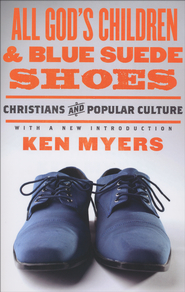
About Ken Myers: is host and producer of Mars Hill Audio in Quinque, Virginia. He is author of All God’s Children and Blue Suede Shoes: Christians and Popular Culture.
© Tabletalk magazine – September 1st, 2008. Permissions: You are permitted and encouraged to reproduce and distribute this material in any format provided that you do not alter the wording in any way, you do not charge a fee beyond the cost of reproduction, and you do not make more than 500 physical copies. For web posting, a link to this document on our website is preferred (where applicable). If no such link exists, simply link to http://www.ligonier.org/tabletalk. Any exceptions to the above must be formally approved by Tabletalk.
Please include the following statement on any distributed copy: From Ligonier Ministries and R.C. Sproul. © Tabletalk magazine. Website: http://www.ligonier.org/tabletalk. Email: tabletalk@ligonier.org. Toll free: 1-800
 LifeCoach4God