Speed With God by Dr. Sinclair Ferguson

Ferguson S image

When Sereno E. Dwight included the seventy resolutions in his biography of his great-grandfather Jonathan Edwards, he added the arresting comment: “These were all written before he was twenty years of age.”

Doubtless the resolutions display the marks of relative youth — references to God are frequent, while references to Christ and to grace are noticeably infrequent. Edwards’ sense of the need for radical consecration was then greater than his ability to show how such devotion would need to be resourced in Christ over the long haul. While this is not wholly lacking, there is no doubt that introspection dominates over divine provision. That notwithstanding, the “Resolutions” provide a very powerful illustration of an often-repeated divine pattern: those the Lord means to use significantly he often deals with profoundly in early years.

Edwards stood in a great puritan tradition of resolution-forming and covenant-making. Both are lost spiritual arts, substituted at best by life-plans that tend to focus on the externals. Edwards, by contrast, was deeply concerned with the internals. He early grasped the value of a deliberate binding of the conscience to a life of holiness and of expressing such commitment in a concrete, objective, and also very specific way. Thus for him, the practice of keeping a journal (in which half of his resolutions are found) was not merely an exercise in narcissism but a careful guarding of the heart against sin. In addition, Edwards was conscious from his teenage years that dealing with indwelling sin (“mortifying” it in the older terminology) meant a commitment to deal generally with all sin, and also repenting of — and mortifying — “particular sins, particularly” (Westminster Confession of Faith, 15.5; Rom. 8:13Col. 3:58–10. Indeed, these words of Paul form the unwritten backdrop to a number of the resolutions).

What can we learn for Christian living today from the resolutions themselves? Here are only three of many outstanding lessons:

Life is for the glory of God. Resolution 4 epitomizes this: “Resolved, never to do any manner of thing, whether in soul or body, less or more, but what tends to the glory of God; nor be, nor suffer it, if I can avoid it.”

These words have a Daniel-like ring about them (Dan. 1:8). When coupled with Edwards’s further principle that we learn from Scripture how God is to be glorified in our lives, this is both a life-goal statement and a life-simplifying one. The question, what will most tend to the glory of God in this situation? asked against the background of growing biblical wisdom wonderfully simplifies and clarifies the choices of life. In a world full of apparent complexities, this is an invaluable litmus test to use — not least if, like Edwards, you are a teenager.

Life should be lived in the light of eternity. This was, of course, a dominant perspective throughout Edwards’ later life. But it was already powerfully present in his late teens. He sought to relate the whole of life to its end (in both senses of the word). In pain he reflected on the sufferings of hell (resolution 10). He lived from death and judgment backwards into the present (resolution 17), and endeavored to do so as if each hour might be his last (resolution 19). He sought to make future happiness a central goal (resolutions 22, 50, 55). Thus, if living for the glory of God simplifies all of life, living in the light of eternity solemnizes all of life and enables one increasingly to give weight to every thought, word, and deed.

Life is lived best by those who guard the heart. Edwards guarded his emotions and affections — and his verbal and physical expressions of them — with great care. This emerges in several resolutions (including 31, 34, 36, 45, 58, and 59). Particularly noteworthy is resolution 25. Here he stresses that, if he wishes so to live in a holy manner, he must be “resolved, to examine carefully, and constantly, what that one thing in me is, which causes me in the least to doubt of the love of God; and to direct all my forces against it.” Whether consciously or not, Edwards here recognized a cardinal element in the original temptation — to malign and thus destroy a sense of the generous love and goodness of God to Adam and Eve (“Has he set you in this garden and forbidden you to eat of all the trees?” seeGen. 3:1).

As early as the age of nineteen, therefore, Edwards recognized that if he lost a sense of the greatness and generosity of the divine love, there would be no resources of grace to motivate the life of holiness to which he committed himself in his resolutions. Therein lay wisdom far beyond his years.

When he penned his final series of resolutions in the summer of 1723, Edwards appears to have been reading through Thomas Manton’s sermons on Psalm 119. He refers to the idea of being open to God found in Manton’s exposition of Psalm 119:26 (sermon 27 in a series of 190). There Manton had given directives for those “who would speed with God.” Edwards was certainly such a young man. Great intellect though he was, he recognized that to “speed with God” was a matter of the heart. That is why all of us — teenagers included — can still aspire today to share the devotion to God he expressed so powerfully in his resolutions.

FROM Tabletalk Magazine
DATE January 1st, 2009
TOPICS Spiritual Growth,Sanctification and Growth
KEYWORDS Jonathan Edwards,Sanctification

Dr. Sinclair B. Ferguson is senior minister of First Presbyterian Church in Columbia, South Carolina.

A Christian Harvard Law Professor Speaks Wisely About His Stage 4 Cancer

Dr. Bill Stuntz Godly Response to His Cancer Diagnosis

William Stuntz 1958 to 2011

My cancer has been promoted: I’m officially in stage 4. My doctors have found two can- cerous nodules—a euphemism for “small tumors”—one on each of my lungs. I started chemo this week. Next week, I’ll see a thoracic surgeon who will, sometime this summer, cut those tumors out. Needless to say, this isn’t good news—though, thanks to medical advances (especially, thanks to those evil drug companies that politicians regularly attack), it isn’t disastrous news either. We’ll see what the future brings.

I don’t have any previous experience with this sort of thing, but judging from what I hear and read, I’m supposed to be asking why all this is happening, and why it’s happening to me. Honestly, those questions are about the farthest thing from my mind.

Partly, that’s because they aren’t hard questions. Why does our world have gravity? Why does the sun rise in the East? There are technical answers, but the meta- physical answer is simple: that’s how reality works. So too here. Only in the richest parts of the rich world of the twenty-first century could anyone entertain the thought that we should expect long, pain-free lives. Suffering and premature death (an odd phrase: what does it mean to call death “premature”?) are constant presences in the lives of most of the peoples of the Earth, and were routine parts of life for generations of our predecessors in this country—as they still are today, for those with their eyes open. Stage 4 cancers happen to middle-aged men and women, seemingly out of the blue, because that’s how reality works.

As for why this is happening to me in particular, the implicit point of the question is an argument: I deserve better than this. There are two responses. First, I don’t—I have no greater moral claim to be free from unwanted pain and loss than anyone else. Plenty of people more virtuous than I am suffer worse than I have, and some who don’t seem virtuous at all skate through life with surprising ease. Welcome to the world.

Once again, it seems to me that this claim arises from the incredibly unusual experience of a small class of wealthy professionals in the wealthiest parts of the world today. We think we live in a world governed by merit and moral desert. It isn’t so. Luck, fortune, fate, providence—call it what you will, but whatever your preferred label, it has far more to do with the successes of the successful than what any of us deserves. Aristocracies of the past awarded wealth and position based on the accident of birth. Today’s meritoc- racies award wealth and position based on the accident of being in the right place at the right time. The difference is smaller than we tend to think. Once you under- stand that, it’s hard to maintain a sense of grievance in the face of even the ugliest medical news. I’ve won more than my share of life’s lotteries. It would seem churlish to rail at the unfairness of losing this one—if indeed I do lose it: which I may not.

The second response is sim- pler; it comes from the movie “Unforgiven.” Gene Hackman is dying, and says to Clint Eastwood: “I don’t deserve this. To die like this. I was building a house.” Eastwood responds: “Deserve’s got nothing to do with it.”

That gets it right, I think. It’s a messed-up world, upside-down as often as it’s rightside up. Bad things happen; future plans (that house Hackman was building) come to naught. Deserve’s got nothing to do with it.

Why, then, are we so prone to think otherwise? This is one of the biggest reasons I believe my faith is true: something deep within us expects, even demands moral order—in a world that shouts from the rooftops that no such order exists. Any good metaphysical theory must explain both of those phenomena: both the expectation and the lack of supporting evidence for the thing expected. The only persuasive way to get there, I think, is to begin with a world made good that was twisted, corrupted, bent. Buried deep in our hearts are hints of the way things ought to be; the ugliest reality can’t snuff them out. Still, that reality exists; it can’t be denied. Christianity sees that reality, recognizes it for what it is—but also sees the expectation, and recognizes where it comes from.

Bottom line: I don’t need anyone to tell me why I’m in the situation I’m in, and I certainly don’t think I merit an exemption from the rottenness to which the rest of the world is subject.

But I do need to know some things. Three, to be precise: first, that I’m not alone; second, that my disease has not made me ugly to those I love and to the God who made me; and third, that somehow, something good can come from this. My faith tells me that the God of the universe suf- fered everything I suffer and infinitely worse. Death and suffering don’t separate human beings from our Creator—on the contrary: those things unite us with our Creator. The barrier became the bridge: that is the great miracle of the Incarnation, the Cross, and the Resurrection. So I need never suffer alone. Job’s story confirms that, far from rejecting the ugli- ness of disease and pain, God embraces those who suffer and takes on their suffering. Beauty and ugliness are turned inside-out. Joseph’s story and the gospels alike show a God who delights to use the worst things to produce the best things. That doesn’t make life’s hells less than hellish. But it does make them bearable.

This isn’t just whistling in the dark—at least, I hope it isn’t. It all makes sense to me: it fits the world I see and feel, with all its shades of glory and misery. And it answers the questions my soul cries out. “Why” isn’t one of those questions.

Article adapted from: http://www.law.upenn.edu/blogs/dskeel/archives/2008/04/ more_cancerstuntz.html#more

[In Dr. Fritzt own words: “I’m a law professor—I teach criminal law and criminal procedure at Harvard—and also an evangelical Christian.That puts [me] in a pretty small, and maybe pretty weird, demo- graphic. I’m also a political junkie and a registered Republican, though I’ve cast as many Democratic votes as Republican ones. I’m interested in all those things—law and legal theory, crime and criminal justice, everything about American politics and political culture, the culture of evangelical Protestantism, and the intersections of various items on that list.] From: http://www.law.upenn.edu/ blogs/dskeel/archives/2008/02/ welcome.html]

 Harvard Law School: Obituary for Dr. Stuntz

William Stuntz, a renowned scholar of criminal justice at Harvard Law School,  an evangelical Christian and a teacher much beloved by students and colleagues, died March 15 after a long battle with cancer.

Stuntz, 52, joined the HLS faculty in 2000 and was named the Henry J. Friendly Professor of Law in 2006. His influential scholarship over the past three decades addressed the full spectrum of issues related to criminal justice and procedure, from the overcrowding of prisons and racial disparities in incarceration to the appropriate role of faith, emotion and mercy in the penal system. He authored three dozen law review articles and essays on criminal law, and published articles and op-eds in the New York Times, Christianity Today, First Things, The New Republic and The Weekly Standard.  This fall,  Harvard University Press will publish a book he authored on the collapse of the criminal justice system.

In a statement to the Harvard Law School community today, Dean Martha Minow observed: “Bill was extraordinary; his wisdom and compassion touched our lives in so many ways, large and small.  His gifts to society through his scholarship and teaching on criminal law and justice changed and improved academic inquiry and policies on the ground.  His scholarship and teaching of Christian legal theory and of confronting life’s burdens inspire people in our community and well beyond it.  He imbued his work and his life with a vision of mercy and compassion.  The Harvard Law School, the larger community of scholars, and the communities connected through Bill’s writings are better, wiser, kinder because of Bill.”

That kindness—and a personal style marked also by good humor and generosity—profoundly affected those who knew Stuntz or knew of him through his writing. As Minow wrote: “Among his many gifts to us was the grace with which he lived his life.  In knowing Bill, we couldn’t help but be reminded to live life as our better selves.  Bill once wrote, ‘We understand that the world is not what it should be, and that our own capacities to understand it are severely limited.’  He described and lived his life in recognition of the need for humility and also for judgment and work to repair what we find around us.  His devotion to family and friends remains legendary. Those of us lucky enough to have been able to consult with him for personal or professional advice will never forget his insights and generosity.”

Carol Steiker, the Howard J. and Katherine W. Aibel Professor of Law at HLS, and a criminal justice scholar who was a close colleague of Stuntz, said: “He was an extraordinary and unforgettable teacher, scholar, colleague and friend. He was someone we’ll all miss, more than we can really say.”

Celebrated for his unusual ability to appeal to a wide variety of legal scholars and others of all political and methodological perspectives, Stuntz was generous with his time and guidance. Colleagues and students were especially struck by his open-mindedness, as reflected in his willingness to listen to a variety of opinions and to change his own when he felt it appropriate. Many observed that his style served as a model for civil discourse.

Extremely popular among his students for his compassion and accessibility, Stuntz was the 2004 recipient of the HLS Sacks-Freund Teaching Award, given by the graduating class to honor a professor for his or her contributions to teaching. In the upcoming week, the the Harvard Law & Policy Review will be publishing a series of student reflections on Professor Stuntz (Read the introduction to the collection at http://hlpronline.com/2011/03/professor-bill-stuntz-in-memoriam/).

From his perspective as a legal scholar and also an evangelical Protestant, Stuntz co-authored a blog that addressed law, politics, and other topics, “Less Than the Least,” with fellow evangelical David Skeel, a law professor at the University of Pennsylvania Law School. As they noted in their blog, “We are both law professors and evangelical Protestants – a weird combination in our time. We hope it’s also an interesting combination.” Stuntz wrote honestly and lyrically, with humor and wisdom, about his struggles with chronic pain and his long battle with cancer, as well as the role of his religious faith in helping him deal with his illnesses.

Said Skeel: “Although Bill was an enormously influential scholar, and was widely viewed as the leading criminal procedure scholar of the past generation, he may have had an even broader impact writing and speaking about his struggles with cancer the past three years, and with debilitating back pain before that. His blog posts and other writings have been reprinted in numerous church bulletins and widely circulated elsewhere. I’ve never known anyone who lived out the Christian call to love one’s neighbor as oneself the way Bill did. He was an inspiration to everyone who came into contact with him.”

Many readers of the blog, including fellow cancer patients, wrote of being deeply touched by the honesty and compassion that imbued his writing.

A year ago, in March 2010, a large group of his many admirers, including legal scholars, colleagues, friends, and students—“a simply dazzling array of conference participants,” as Dean Martha Minow said in opening remarks—gathered at HLS for a two-day conference, “A Celebration of the Career of Bill Stuntz.” In tribute after tribute, they noted that Stuntz had exerted a tremendous influence on the fields of American criminal justice and criminal procedure while at the same time having a profound effect, professionally and personally, on so many who worked with or were taught by him.

Present at the conference, Stuntz described factors that had led to what he called the “disaster of criminal justice in our time,” in particular, the massive and “racially unfair” prison population in the U.S., but held out hope that the system might become fairer.

HLS Professor Jeannie Suk ’02, a former student of Stuntz, and a moderator of one of the panels at the conference, said after learning of Stuntz’s death: “He was a wonderful mentor to me since my time as a student at Harvard Law School. He was the one, when I was a student, who looked me right in the eye and told me not to worry about seeing things that might be unconventional or that might surprise or anger people, that it was a good thing if I had those instincts. He encouraged me to develop that and to be unafraid.”

She added, “The whole time I was an assistant professor, he was very ill, yet … he would stop by my office, he would read all my drafts [of articles] and have something to say about them, with great insight. I really think he was one of the main reasons, the primary reason, I became a professor, that I became a criminal law scholar.”

Born on July 3, 1958, Stuntz grew up in Annapolis, then attended the College of William and Mary and the University of Virginia School of Law.  After two judicial clerkships, he was a professor at the University of Virginia for 14 years until he joined the Harvard Law faculty in 2000.

Stuntz was the loving husband of Ruth Stuntz of Belmont, and devoted father of Sarah Stuntz, Andrew Stuntz, and Samuel Cook-Stuntz, all of Cambridge. He also leaves his parents, John and Sandy Stuntz of Annapolis, Md., and siblings, Linda Adamson of Annapolis, Michael Stuntz of Silver Spring, Md., Richard Stuntz of Annapolis, and David Stuntz of Durham, NC, as well as many nieces and nephews, and a daughter-in-law, Elizabeth Cook-Stuntz.

A memorial service will be held at Park Street Church in Boston on Saturday, March 19 at 5:00 p.m. In lieu of flowers, guests should feel free to make donations to International Justice Mission (www.ijm.org) or the Cancer Center Priorities Fund at Massachusetts General Hospital (165 Cambridge Street, Suite 600, Boston, MA 02114-2792).

“Charles Haddon Spurgeon’s Humor”

Dr. Larry J. Michael and C.H. Spurgeon on “The Medicine of Laughter”

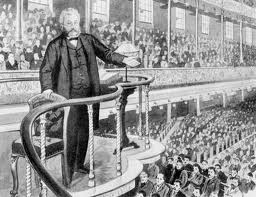
Spurgeon in pulpit image

Dr. Larry Michael is senior pastor at First Baptist Church in Clanton, Ala. He serves as an adjunct professor at Beeson Divinity School in Birmingham. This article is an adaptation of writings from the upcoming book, Spurgeon on Leadership, Kregel Publications, scheduled for release October 2003.

Some years ago there was a documented case in the British Medical Journal about a man who laughed himself well. He actually had a terminal illness, and through the employment of laughter therapy, he allowed his body to successfully fight the disease.

While we may smilingly acknowledge the merit of such a case, for the most part, we find such an incident almost incredible. Can laughter really be that good for us? The Bible definitely supports such a notion.

The Bible advocates laughter

The writer of Ecclesiastes stated: “There’s a time to laugh, and a time to cry” (Ecclesiastes 3:4). We know that there are plenty of reasons to cry. Just a casual glance at our world, with its wars, hatred, violence and evil — makes us sad. Every day we see/hear on the news horrible accounts of hurting people who hurt others. We are grieved at the plight of so many persons who are living in darkness and have rejected the light of Christ. The stark reality of sin in our world is indeed sobering.

It’s not surprising that many of us as leaders may be more inclined toward sadness than to joy. Given the nature and demands of Christian leadership in an increasingly challenging world, one could cynically surmise that leaders may have more reason to be glum than glad these days. The pressures of our organizational responsibilities, and the accompanying stresses, can drag us down. Handling church conflict, losing someone special, helplessly seeing a marriage dissolve, experiencing personal betrayal, facing an unsuspected tragedy — all may give cause for tears.

To counter the sad times, the Scripture also advises that there is a time to laugh. Leaders need to know the balancing therapy of laughter. Toward that goal, we should fully embrace the joys of ministry — celebrating special moments with members, “high-fiving” family achievements, relishing the reaching of hard-earned goals, and savoring the blessing of spiritual growth. But those experiences may still fall short of the biblical pronouncement regarding laughter. C’mon, when was the last time you laughed so hard you cried?! Or, you actually had a good belly laugh?

Spurgeon’s great sense of humor

Many evangelicals know well the stern side of C. H. Spurgeon and his serious pursuit of the holy life. Indeed, his stands for righteous causes, and countering doctrinal error are often recounted. But many readers may not know that he was a man with a great sense of humor. Spurgeon knew the value of laughter and mirth. He virtually took to heart the word in Proverbs 17:22: “A merry heart doeth good like a medicine.”

Spurgeon laughed as often as he could. He laughed at the ironies of life, he laughed at comical incidents, he laughed at the amusing elements of nature. He sometimes laughed at his critics. He loved to share wholesome jokes with his friends and colleagues in ministry. He was known to tell humorous stories from the pulpit. William Williams, a fellow pastor who kept company with Spurgeon, was a near and dear friend in the latter years of Spurgeon’s life. He wrote:

What a bubbling fountain of humour Mr. Spurgeon had! I laughed more, I verily believe, when in his company than during all the rest of my life besides. He had the most fascinating gift of laughter . . . and he had also the greatest ability for making all who heard him laugh with him. When someone blamed him for saying humourous things in his sermons, he said, “He would not blame me if he only knew how many of them I keep back.” 1

Spurgeon considered humor such an integral part of his ministry that a whole chapter in his autobiography is devoted to it. Humor permeates his sermons and writings, often woven into the fabric of his messages. It’s one reason among many why he is still so readable today.

The therapy of laughter

Spurgeon knew the blessing of the treatment of humor. He often spoke of his illness in humorous terms: “I have had sharp pains,” he wrote to a friend, “but I am recovering. Only my back is broken, and I need a new vertebrae.” 2 Once, when he was feeling depressed, he spoke of the remedy of laughter:

The other evening I was riding home after a heavy day’s work. I felt wearied and sore depressed, when swiftly and suddenly that text came to me, ‘My grace is sufficient for thee.’ I reached home and looked it up in the original, and at last it came to me in this way. ‘My grace is sufficient for THEE.’ And I said, ‘I should think it is, Lord,’ and I burst out laughing. I never understood what the holy laughter of Abraham was till then. It seemed to make unbelief so absurd…O brethren, be great believers. Little faith will bring your souls to heaven, but great faith will bring heaven to your souls. 3

Some of Spurgeon’s humor even bordered on the cynical — like the time he was embroiled in the Baptismal Regeneration Controversy. When Spurgeon took on the Church of England clerics because of their belief in baptismal regeneration, he had a baptismal font installed in his back garden as a birdbath. He referred to it as “the spoils of war.” While the great “Prince of Preachers” may have gone over the top on that one, for the most part, his humor was balanced and appropriate.

Laughter a needful release

Laughter is an important release in a leader’s life. It is much-needed therapy for positions that are most often fraught with stress and the burdens of the day. Certainly there is a time to be sober as we face many tough situations in our lives and ministries. But, we need to learn how to experience the relief of laughter. Part of the problem is that too many of us take ourselves way too seriously. When we forget that God has a sense of humor, we need to do as one leader suggested — go look in the mirror!

Spurgeon knew the value of laughter and humor. Both in tough times and sick times, humor was a means for him to deal with his situation. It was a coping mechanism for him. There will always be seasons of sadness and joy for the conscientious leader. But, the leader who learns to balance the two, will learn the discipline of employing laughter and joy in his life. It could very well make a difference in his fulfillment and purpose in his service to the Lord.

Article adapted from Reformed Perspectives Magazine, Volume 9, Number 40, Septemeber 30 to October 6, 2007.

Notes: 1. William Williams, Personal Remembrances of Charles Haddon Spurgeon (London: Passmore and Alabaster, 1895), 24; 2. Ibid, 231; 3. Ibid, 25.

Dare To Pray Like Daniel by John Piper

“Prayer: A Warrior’s Weapon”

In Daniel 10, the prophet receives a word from the Lord (v. 1) — a vision of conflict that stunned him with its greatness. So Daniel set himself with tears and fasting and prayer to seek the meaning of the vision, and for three weeks he wrestled in prayer over this vision and sought to know God’s will.

After three weeks he went out to the banks of the Tigris River (v. 4). There he had a vision that was so awesome he could hardly bear it. To make matters worse (in v. 10), a hand reached out and touched him so that he shook terribly on his hands and knees. Then the voice said (vv. 11–12): “O Daniel, man greatly loved, understand the words that I speak to you, and stand upright, for now I have been sent to you…. Fear not, Daniel, for from the first day that you set your heart to understand and humbled yourself before your God, your words have been heard, and I have come because of your words.”

Now this is immensely important for understanding prayer. Notice the words: “I have come because of your words.” Put that together with the words in verse 11: “I have been sent to you.” That is, God sent him. So the point is that God answered Daniel’s prayer as soon as he began to pray three weeks ago. “From the first day that you humbled yourself before your God your words [your prayers] have been heard, and I have come because of your words [your prayer].”

So this heavenly being has come because Daniel prayed and humbled himself before God and fasted. And the three-week delay was not because God took three weeks to hear. What was it then?

Verse 13: “The prince of the kingdom of Persia withstood me twenty-one days, but Michael, one of the chief princes, came to help me.” The reason the messenger of God was detained is because a spiritual being called “the prince of the kingdom of Persia” stood against him. And the reason this angelic messenger got free from this opposition was because the angel Michael came to help him.

This is the clearest example in all the Bible of what is called by some people a “territorial spirit.” Verse 13 refers to “the prince of the kingdom of Persia.” The natural meaning of this phrase would be that among the supernatural beings opposed to God, at least one is assigned to a territory or, more accurately, to a kingdom, in this case Persia. Presumably his job is to darken the people of Persia — to keep them from having the truth and the light of God’s Word.

But this spirit is not the only one mentioned. Look at verse 20–21: “Then he [the messenger from God] said, ‘Do you know why I have come to you? But now I will return to fight against the prince of Persia; and when I go out, behold, the prince of Greece will come. But I will tell you what is inscribed in the book of truth: there is none who contends by my side against these except Michael, your prince.’”

So it appears that there was a spirit over Persia and a spirit over Greece. But it also seems that Michael, the good angel, has some special assignment for Israel, because it says at the end of verse 21: “Michael, your prince.” And the “your” there is plural. This is not a reference to Daniel’s guardian angel, but to Israel’s guardian angel.

How then shall we do ministry in view of this reality of territorial spirits?

First, we ought to take the supernatural seriously and realize that we are in a warfare that cannot and should not be domesticated by reinterpreting everything in the biblical worldview so that it fits nicely with secular, naturalistic ways of thinking about the world.

Secondly, notice that Daniel’s prayer that has such powerful effects in the spiritual realm did not focus on angels and territorial spirits. Rather, he was wrestling for truth and for the good of God’s people. He was totally shocked when an angel appeared to him. And he knew nothing about the conflict with the prince of the kingdom of Persia.

But it’s no accident that the messenger said that his struggle with the prince of Persia lasted exactly the same amount of time that Daniel’s fasting and prayer did — twenty-one days. The reason for this is that the warfare in the spirit realm was being fought in a real sense by Daniel in the prayer realm.

And so it is with more of our prayers than we realize. But the point is this: Daniel’s praying was not about angels. And probably ours shouldn’t be either. We should wrestle in prayer and fasting for the things that we know are God’s will in our lives and our families and our church and our city and our world. But by and large we should probably leave it to God how He will use angels to get His work done. If God shows us more, we will use it. But the essence of the matter is not knowing the spirits but knowing God and praying in the power of Holy Spirit.

So let us be about prayer with all our might. May the Lord make us a people who pray like Daniel.

Article Information: From Tabletalk Magazine (Ligonier Ministries), July 1st, 2007 by Former Preaching Pastor of Bethlehem Baptist Church, and founder of Desiring God – Dr. John Piper.

“Every Day With Jesus is Like A Thanksgiving Holiday” By Dr. David P. Craig

I have so much to be thankful for – now 15 treatments into Chemo and Radiation – almost half way done with my 33 treatments here are my reflections on Thanksgiving Day. DPC

lifecoach4God's avatarLifeCoach4God

“Thank God It’s Thanksgiving Everyday – Especially on Thursday’s!”

I have always loved the Thanksgiving Holiday. It’s one of the few times of the year where our very large family can come together from all over the United States and enjoy giving thanks for our many blessings. This year more than likely I’ll be having liquid formula through a feeding tube in my stomach. I already had the G-Tube surgically implanted in my stomach this past week. During chemotherapy and radiation around Thanksgiving time will be a time of great testing for me, when according to my Doctors I will be unable to swallow and chew due to the severity of my treatment for throat and neck cancer. Watching every one I love dearest passing around the turkey with all the trimmings will be something my eyes will enjoy, but not my taste buds. However, I’m good with that. I’m…

View original post 3,962 more words

R.C. Sproul on the Question: “Does Prayer Change God’s Mind?”

We’ve been taught that prayer changes things. In view of God’s sovereignty, what is the role of prayer in a Christian’s life?


First of all, we need to establish that it is the sovereign God who not only invites us but commands us to pray. Prayer is a duty, and as we perform that duty, one thing for sure is going to be changed, and that is us. To live a life of prayer is to live a life of obedience to God.

Also, we must understand that there is more to prayer than intercession and supplication. When the disciples said to Jesus, “Lord, teach us to pray,” they saw a connection between the power of Jesus and the impact of his ministry and the time he spent in prayer. Obviously, the Son of God felt that prayer was a very valuable enterprise because he gave himself to it so deeply and passionately. But I was surprised that he answered the question by saying, “Here’s how you ought to pray,” and gave them the Lord’s Prayer. I would have expected Jesus to answer that question a different way: “You want to know how to pray? Read the Psalms,” because there you see inspired prayer.

The Spirit himself, who helps us to pray, inspired the prayers that are recorded in the Psalms. When I read the Psalms, I read intercession and I read supplication, but overwhelmingly what I read is a preoccupation with adoration, with thanksgiving, and with confession.

Take those elements of prayer, and what happens to a person who learns how to adore God? That person is changed. What happens to a person who learns how to express his gratitude to God? That person will now become more and more aware of the hand of Providence in his life and will grow in his sense of gratitude toward God. What happens to the person who spends time confessing his sins? He keeps in front of his mind the holiness of God and the necessity of keeping short accounts with God.

But can our requests change God’s sovereign plan? Of course not. When God sovereignly declares that he is going to do something, all of the prayers in the world aren’t going to change God’s mind. But God not only ordains ends, he also ordains means to those ends, and part of the process he uses to bring his sovereign will to pass are the prayers of his people. And so we are to pray.

Question adapted from the section on Prayer by R.C. Sproul. Now, That’s a Good Question! Wheaton: Tyndale House Publishers, 2001.

About Dr. R.C. Sproul

R.C. Sproul has taught theology to hundreds of thousands of people through books, radio, audiotapes, videotapes, seminars, sermons, seminary classes and other forums.

Sproul has written approximately sixty books (and counting). In addition to many volumes designed to teach theology, apologetics, and ethics to laymen through expository prose, he has written a novel, a biography, and several childrens books. He has also edited several volumes, including a festschrift for John H. Gerstner, a seminary textbook, and the New Geneva Study Bible. He has written one of the top classics of the 20th century – The Holiness of God; and perhaps the best book to explain God’s sovereignty in our salvation for laymen entitled Chosen by God.

Sproul founded Ligonier Ministries in 1971, a teaching ministry to assist the church in nurturing believers and equipping them for the ministries to which God has called them. Ligonier sponsors a radio program, “Renewing Your Mind,” which features Sproul and is broadcast nationally, five days a week.

Ligonier Ministries sponsors several seminars each year, the largest one in Orlando every winter. Ligonier publishes a monthly periodical, Tabletalk, and has its own web site (http://www.gospelcom.net).

Sproul has taught theology and apologetics at several seminaries. He earned a B.A. degree from Westminster College, a B.D. from Pittsburgh Theological Seminary, and a Drs. from the Free University of Amsterdam. He is ordained in the Presbyterian Church in America.

In 1994 Christianity Today asked a select list of “critics,” “What theologian or biblical scholar has most shaped your Christian life?” Third on the list (and the only American in the top four) was R.C. Sproul.

Tim Keller on How to Pray Better in Public and in Private

Lesson on Prayer from Thomas Cranmer

Years ago when I wanted to become more skillful in public prayer, I was fortunate to come across the collects of Thomas Cranmer, the writer of the original Episcopal Book of Common Prayer. The “collects” (the stress is on the first syllable)that Cranmer wrote were brief but extremely ‘packed’ little prayers that tied together the doctrine of the day to a particular way of living. They were prayed by the minister on behalf of the people, or prayed in unison by the whole congregation.

As I have read them over the years they have brought me two great benefits. First, they have given me a basic structure by which I can compose good public prayers, either ahead of time, or spontaneously. Cranmer’s collects consist of 5 parts:

1. The address – a name of God

2. The doctrine – a truth about God’s nature that is the basis for the prayer

3. The petition – what is being asked for

4. The aspiration – what good result will come if the request is granted

5. In Jesus’ name – this remembers the mediatorial role of Jesus

See this structure in Cranmer’s famous collect for the service of Holy Communion:

1. Almighty God

2. unto whom all hearts are open, all desires known, and from whom no secrets are hid,

3. cleanse the thoughts of our hearts by the inspiration of thy Holy Spirit,

4. that we may perfectly love thee, and worthily magnify thy holy name,

5. through Jesus Christ our Lord, Amen. 

See how the prayer moves from a doctrinal basis (why we can ask for it) to the petition (what we want) to the aspiration (what we will do with it if we get it.) It is remarkable how this combines solid theology with deep aspirations of the heart and concrete goals for our daily life.

As time has gone on I have come to use Cranmer’s collects in my personal devotional time (this is the second benefit.) I take up one collect at the beginning of each new week. I read Paul Zahl’s volume The Collects of Thomas Cranmer (Eerdmans, 1999) that provides a very short explanation and meditation on the prayer. Then I pray that prayer to God reflectively every morning for the rest of the week as I begin my personal time with God. I commend this practice to you. Here are a couple of my favorites:

Blessed Lord, who has caused all holy Scripture to be written for our learning; grant that we may so hear them, read, mark, learn, and inwardly digest them; that by patience and comfort of thy holy word we may embrace and ever hold fast the blessed hope of eternal life, which thou hast given us in our savior, Jesus Christ. Amen.

Almighty God, who dost make the minds of all faithful men to be of one will; grant unto thy people, that they may love the thing which thou commandest, and desire that which thou dost promise, that among the sundry and manifold changes of the world, our hearts may be surely fixed where true joys are to be found, through Jesus Christ our Lord. Amen. 

God, which hast prepared to them that love thee such good things as pass all man’s understanding; Pour into our hearts such love toward thee, that we loving thee in all things, may obtain thy promises, which exceed all that we can desire; through Christ our Lord. Amen.

Almighty and everlasting God, who art always more ready to hear than we to pray, and art wont to give more than either we desire or deserve, pour down upon us the abundance of thy mercy, forgiving us those things whereof our conscience is afraid and giving unto us that which our prayer dare not presume to ask; through Jesus Christ our Lord. Amen.

Almighty and everlasting God, give unto us the increase of faith, hope, and charity, that we may obtain that which thou dost promise, make us to love that which thou does command; through Jesus Christ our Lord. Amen.


*Article adapted from the Redeemer Report – October, 2010.


Zig Ziglar on the Question: Are You a Responder or a Reactor to Life?

It’s Better to Respond Than to React

When you respond to life, that’s positive; when you react to life, that’s negative. Example: You get sick and go to the doctor. Chances are good that after an examination, she would give you a prescription with instructions to return in several days. If, when you walk back in, the doctor starts shaking her head and says, “It looks like your body is reacting to the medicine; we’re going to have to change it,” you probably would get a little nervous. However, if the doctor smiles and says, “You’re looking great! Your body is responding to the medication,” you would feel relieved. Yes, responding to life is good. Reacting to the incidents of life is negative-and that’s bad.

The next example validates that fact.

Today, there is much turmoil in the job market, and many people are losing their jobs through downsizing, mergers, and takeovers. This creates some unusual opportunities for many people. One positive from this trend is that in the last five years, according to the Wall Street Journal, more than fifteen million new businesses have been created, well over half of them by women. Very few of the women had any marketable skills, and all of them had great financial need. Most of the new businesses were “trust” businesses, meaning that the women collected the money before they delivered the goods or services. The Journal comments that virtually none of the women have been prosecuted and jailed for failure to deliver on that trust. That’s exciting!

Many of these new businesses-possibly most of them-would never have been started had not an unfortunate event occurred in the people’s lives. When those events did occur and needs became obvious, the women chose to respond, and there is little doubt that many of them are better off now than they were before the “tragedy” took place.

The message is clear: If you respond to life instead of react to it, then you’ve got a much better chance of achieving success.

About Zig Ziglar:

Zig Ziglar was born in Coffee County, Alabama on November 26, 1926 and was the tenth of 12 children. In 1931, when Ziglar was five years old, his father took a management position at a Mississippi farm, and family moved to Yazoo City, Mississippi, where he spent his early childhood. In 1932, his father died of a stroke, and his younger sister died two days later.

Zigler served in the Navy during World War II (circa 1943-1945). He was in the Navy V-12 College Training Program, attending the University of South Carolina. In 1944 he met his wife Jean, in Jackson, Mississippi; he was 17 and she was 16. They married in late 1946.

Ziglar later worked as a salesman in a succession of companies. In 1968 he became the vice president and training director for the Automotive Performance company, moving to Dallas, Texas.

In 1970, Ziglar went into the business of motivational speaking full-time, with an emphasis on Christian values. Until then, he called himself by his given name, Hilary, but now satarted using his nickname, Zig, instead.

Until 2010 (aged 86) Ziglar traveled around the world taking part in motivational seminars, but has been somewhat limited recently due to a fall down a flight of stairs in 2007 that has impaired his short-term memory and physical abilities.

Through the ups and downs of life Ziglar has maintained his optimism and encouraged thousands of people to be their best in the particular endeavors to which God has called them. Zig Ziglar is one of the most inspirational people on the planet today and is a terrific example of someone who has embraced the struggle of life giving God the glory each step of the way.

The article above was adapted from one of Zig’s many encouraging books: Something to Smile About: Encouragement and Inspiration for Life’s UPS and DOWNS. Nashville: Thomas Nelson, 1997.

Zig Ziglar’s Books:

Ziglar, Zig; Ziglar, Tom. Born to Win: Find Your Success Code. Dallas: SUCCESS Media (2012).

Zig Ziglar. Something Else To Smile About: More Encouragement and Inspiration for Life’s Ups and Downs. Nashville: Thomas Nelson (2010).

Ziglar, Zig; Norman, Julie Ziglar. Embrace the Struggle: Living Life on Life’s Terms. New York: Howard Books (2009).

The One-Year Daily Insights with Zig Ziglar. Tyndale House Publishers (2009)

Inspiration 365 Days a Year with Zig Ziglar. SIM (2008)

God’s Way is Still the Best Way. Nashville: Thomas Nelson  (2007).

Better Than Good: Creating a Life You Can’t Wait to Live. Nashville: Thomas Nelson Publishers (2006).

Conversations with My Dog. B&H Books (2005).

The Autobiography of Zig Ziglar. New York: Random House (2004).

Confessions of a Grieving Christian. Nashville: B&H Publishing Group 2004).

Courtship After Marriage: Romance Can Last a Lifetime. Nashville: Thomas Nelson  (2004).

Staying Up, Up, Up in a Down, Down World. Nashville: Thomas Nelson  (2004).

Zig Ziglar’s Life Lifters: Moments of Inspiration for Living Life Better. B&H (2003).

Selling 101: What Every Successful Sales Professional Needs to Know. Nashville: Thomas Nelson Publishers (2003).

Ziglar, Zig and Hayes, John P. Network Marketing For Dummies. Foster City, Calif: IDG Books (2001).

Zig Ziglar. Success for Dummies. Foster City, Calif: IDG Books (1998).

Zig Ziglar. Something to Smile About: Encouragement and Inspiration for Life’s UPS and DOWNS. Nashville: Thomas Nelson (1997).

Great Quotes from Zig Ziglar. Career Press (1997)

Zig Ziglar. Over the Top. Nashville: Thomas Nelson Publishers (1994).

Zig Ziglar. Five Steps to Successful Selling. Nigtingale-Conant Corp. (1987).

Zig Ziglar. Top Performance: How to Develop Excellence in Yourself and Others. New York: Berkley Books (1986).

Zig Ziglar. Raising Positive Kids in a Negative World. Nashville: Oliver Nelson (1985).

Zig Ziglar’s Secrets of Closing the Sale. New York: Berkley Books (1982).

Zig Ziglar. See You at the Top. Gretna: Pelican (1975).


John C. Maxwell on Contentment vs. Discontentment

Which Tent Do You Live In?

All men live in one of two tents—content or discontent. In which do you live?

The contented man looks beyond his circumstances and sees a better day; the discontented man looks at his circumstances and sees no other way.

The contented man understands the purpose for which he was born; the discontented man looks at other’s success with a face that is filled with scorn.

The contented man has surrendered to a purpose that demands his best; the discontented man has selfishly hoarded much and grasping for more, will not rest.

The contented man has placed his values on things which will forever last; the discontented man has placed his values on things which will soon be past.

The contented man is anchored to clear goals and is hardly ever swayed;  the discontented man has no goals that anchor him and is many times dismayed.

The contented man counts his blessings and names them one by one; the discontented man counts other’s blessings and thinks he has no fun.

All men live in one of two tents—content or discontent. In which do you live?

 About John C. Maxwell:

John C. Maxwell is an internationally renowned pastor, leadership expert, coach, and author who has sold over 21 million books. Dr. Maxwell founded EQUIP and the John Maxwell Company, organizations that have trained more than 5 million leaders in 174 countries. Every year he speaks to Fortune 100 companies, international government leaders, and organizations such as the United States Military Academy at West Point, the National Football League, and the United Nations. A New York Times, Wall Street Journal, and Business Week best-selling author, Maxwell’s The 21 Irrefutable Laws of Leadership has sold more than 2 million copies. Developing the Leader Within You and The 21 Indispensable Qualities of a Leader have each sold more than 1 million copies. The article above was adapted from the encouraging and practical book by John C. Maxwell. Think On These Things. Kansas City: Beacon Hill Press, 1979, Chapter 30. This was the book that launched Maxwell’s writing career!

You can read his blog at JohnMaxwellOnLeadership.com, follow him at Twitter.com/JohnCMaxwell, and learn more about him at JohnMaxwell.com.

Dr. Tim Keller on “The Christian’s Happiness” – Romans 8:28-30

“And we know that for those who love God all things work together for good, for those who are called according to his purpose. For those whom he foreknew he also predestined to be conformed to the image of his Son, in order that he might be the firstborn among many brothers. And those whom he predestined he also called, and those whom he called he also justified, and those whom he justified he also glorified” (Romans 8:28-30)

Cheer Up Christian: “Your bad things turn out for good, your good things can never be lost, and the best things are yet to come.” – Tim Keller

Introduction

If you’re a Christian, you know that Christianity is supposed to be about joy. You probably also know that you’re supposed to experience joy in spite of circumstances. The Bible clearly teaches that joy is available that should make us happy no matter the circumstances. There’s a joy that the deepest trouble can’t put out and, if properly nourished and nurtured, can even overwhelm the greatest grief.

When Jesus prays to the Father in John 17:13, he prays for us—his followers. He says, I pray that “they may have the full measure of my joy within them.” One chapter before, he says to his disciples, “You will rejoice. and no one will take away your joy” (16:22). That’s pretty amazing! He’s talking to the twelve disciples, men who are going to be persecuted. They’re going to be robbed of everything they own, tortured, and put to death. Yet Jesus promises to give them a joy that will withstand all that. Nothing—not disease or persecution or alienation or loneliness or torture or even death—will be able to take it away.

I often wrestle with that concept. I have to ask myself, “Why do things affect me so much? Why is my joy not relentless?” Sometimes I wonder, “Do we have that kind of impervious joy?” I’m afraid not. I don’t think we understand the nature of this joy.

Romans 8 is all about living in a suffering world marked by brokenness. Paul talks about trouble and persecution and nakedness and poverty and how Christians are supposed to live in a world like that. In 8:28–30 he offers three principles for finding joy in suffering. Paul tells us that if we follow Christ, our bad things turn out for good, our good things cannot be lost, and our best things are yet to come. Those are the reasons for our joy.

Our bad things turn out for good

Verse 28 says: “For those loving him, God works together all things for good.”

There are three implications of this first principle.

First, this verse says that all things happen to Christians. That is, the Christian’s circumstances are no better than anybody else’s. It is extremely important for us to understand this if we’re going to experience relentless and impervious joy. Terrible things happen to people who love God. Many Christians explicitly teach—and most Christians implicitly believe—that if we love and serve God, then we will not have as many bad things happen to us. That’s not true! Horrible things can happen to us, and believing in and loving and serving God will not keep them from happening. All the same things that happen to everybody else will happen to people who love God. “All things” means all things, in this text. In verse 35 Paul says, “What can separate us from the love of Christ? Can trouble, hardship, persecution, famine, poverty, danger, or sword?” Those are terrible things. Paul is saying all the same things that happen to everybody else will happen to us, even if we love God. It’s very important to realize that.

The second implication of this point is that when things work together in your life, it’s because of God. Notice Paul does not say, “Things work together for good.” Things never work together for good on their own. Rather, if anything good happens, it is because God is working it together.

Earlier in Romans 8, Paul discusses how things fall apart because the world is burdened with evil and sin. Things are subject to decay. Everyone will eventually experience the decay of their bodies; that’s the nature of things. The little grains of sand on the beach used to be a mountain. Everything falls apart; things do not come together. This verse tells Christians to get rid of the saccharine, sentimental idea that things ought to go right, that things do go right, and that it’s normal for things to go right. Modern, Western people believe that if things go wrong, we should sue, because things ought to go right. But Christians have to discard that idea completely. Christians have to recognize that if our health remains intact, it is simply because God is holding it up. If people love us, if someone is there to hug us or squeeze our hand, if someone loves us in spite of all our flaws—if someone loves us at all—it’s because God is bringing all things together. God is holding it up. Everything that goes well is a miracle of grace.

The third implication of this principle is the most basic: Although bad things happen, God works them for good. This verse does not promise that those who love God will have better circumstances. Nor does this verse say that bad things are actually good things. Rather, it acknowledges that these are bad things, but it promises that they’re working for good. That means God will work them to good effect in your life.

The story of Jesus standing before the tomb of Lazarus is an endless source of insight for me. As he was about to raise Lazarus from the dead, Jesus was not smiling. He was angry. He was weeping. Why? Because death is a bad thing! Jesus wasn’t thinking, “They think that this is a tragedy, but no harm done! I’m about to raise him from the dead. This looks like a bad thing, but it’s not. It’s really a good thing! It’s a way for me to show my glory. It’s really exciting! I can’t wait!” He wasn’t thinking that. Jesus was weeping at the tomb, because the bad thing he’s about to work for good is bad. The story of Lazarus does not give you a saccharine view of suffering, saying bad things are really blessings in disguise or that every cloud has a silver lining. The Bible never says anything like that! God will give bad things good effects in your life, but they’re still bad. Jesus Christ’s anger at the tomb of Lazarus proves that he hates death. He also hates loneliness, alienation, pain, and suffering. Jesus hates it all so much that he was willing to come into this world and experience it all himself, so that eventually he could destroy it without destroying us.

There’s no saccharine view in the Christian faith. The promise is not that if you love God, good things will happen in your life. The promise is not that if you love God, the bad things really aren’t bad; they’re really good things. The promise is that God will take the bad things, and he’ll work them for good in the totality.

Keep in mind that verse 28 says all things work together for good. That doesn’t mean that when something bad happens, we can decide to give God a week to show us how the situation is going to turn out for good. In fact, don’t wait a month. Don’t wait a year. Don’t wait a decade. The promise isn’t for a month or a year or a decade. The promise is not that we will see how every bad patch in our lives works out for our good. The promise is that God will make sure that all the bad circumstances will work together for your life in its totality.

The best summary of this lesson that anybody has ever come up with is John Newton’s. He said: “Everything is necessary that he [God] sends; nothing can be necessary that he withholds.” What John Newton and Paul are saying is that if God has withheld good things—things that you think are good—they would only be good in the short run. In the long run, they would be terrible. They would be good in the partial but not in the whole. On the other hand, God will only bring bad things into your life—things God knows are bad—in order to cure you of things that can destroy you in the long run. The premise is, the things that really hurt—foolishness, pride, selfishness, hardness of heart, and the belief that you don’t need God—are the only things that can hurt you in the long run. In the short run selfishness and self-deception feel great, but in the long run they will destroy you.

Your joy will be impervious if you hold onto these three principles. Bad things will happen to you. We shouldn’t be shocked or surprised when bad things happen. One of the main reasons a lot of Christians are continually overthrown is not simply because bad things happen to them. At least half of their discouragement and despondency is due to their surprise at the bad things that happen to them. Do you see the distinction? Fifty percent of the reason we get so despondent is that we’re shocked. We say, “This isn’t how it’s supposed to be.” We may say life should be better, but that’s not what the promise is. Or we say we love God, therefore, surely we will have more good circumstances. That’s not the promise either. Until you understand what the promise is, you’re going to be continually shocked and even overthrown.

Our good things can never be lost

The second principle in this passage is that the good things we have cannot be lost. If you’ve been a Christian for any period of time, you know that Romans 8:28 is a very famous verse. People use it all the time. It’s what I call a “blessing box” verse. A blessing box is a collection of verses you rip out of context and recite without concern for what came before and after the verse. It feels good, so you use it. For example, people use Romans 8:28 to assure themselves that when bad things happen, then surely good things will happen. You might think, “I didn’t get into the grad school I wanted to get into, but that’s because there’s a better grad school for me somewhere.” Or, “I didn’t marry the girl or guy I wanted to marry, but that means there’s a better one for me somewhere.” That’s not the promise.

There’s a little word between verses 28 and 29 that indicates the verses go together. The little word is for. “All things work together for good for those who love God and are called according to his purpose, for those he foreknew he also predestined to be conformed into the likeness of his Son.”

God does not promise you better life circumstances if you love him. He promises you a better life. Grad school and marriage are circumstances. We’re talking about a joy that goes beyond circumstances. How dare we interpret verse 28 as a joy that is dependent on those things! Here is an important principle: Jesus Christ did not suffer so that you would not suffer. He suffered so that when you suffer, you’ll become like him. The gospel does not promise you better life circumstances; it promises you a better life.

Romans 8:29 tells us the goal toward which all our circumstances are moving us. Paul uses the word predestined. He’s not introducing the word to confuse you—he doesn’t intend to explain the doctrine of predestination or address the issues that arise when that word is mentioned. He uses this word to comfort us. Something that is predestined is fixed. What Paul means is that if you love God, you can count on a promise that is absolutely fixed, no matter what. That’s all he’s trying to get across.

What is it that is predestined? That we will be conformed to the image of Christ. The Greek word here is morpha, from which we get the word metamorphosis. Paul is saying that God promises to “metamorphosize” us. He promises to change our very inner essence into the very inner essence of Jesus Christ. To be a Christian is to become passionately in love with the character of Jesus. You read about him in the Bible and are amazed by the truth and love you find in his life. You see wisdom and utter conviction. You see incredible courage, brightness, and radiance. The good that God is moving you toward through everything that happens in your life—whether externally good or bad—is your transformation into Christ’s nature. If you love God, everything that happens in your life will mold you, sculpt you, polish you, and shape you into the image of his Son. He is making you like him. He’ll give you Christ’s incredible compassion and courage. God is working everything that happens in your life toward that magnificent goal. It’s predestined. It’s guaranteed.

One of the most astounding things in Romans 8:30 is this: “And those he predestined, he also called; those he called, he also justified; those he justified, he also glorified.” Glorified is in the past tense. Shouldn’t Paul say, “The ones he foreknew he predestined, and justified, and will glorify”? Because the apostle is so absolutely certain that you are bound—that God is going to make you as beautiful as Jesus and give you all these incredible things—he writes of the glorification as an accomplished fact. He talks about it in the past tense because it’s as good as done. God is not going to let anything in life get between you and that goal. You are predestined to be conformed to the image of God’s Son.

In Romans 8:29 Paul calls Christ “the firstborn among many brothers.” That means we are all sons of God. We are all adopted into the family. When Paul alludes to adoption, he’s talking about a practice that was common in the Roman world, but one that’s quite different from the way we think of adoption. In the Roman world, most people who were adopted were adults. When a wealthy man had no heir and didn’t want his estate to be broken up when he died, he would adopt an adult male, usually someone who worked for him whom he trusted. By adopting that adult male, he made him his son. The minute the legal procedure took place, their relationship was changed from formal to intimate, from temporary and conditional to permanent and unconditional. All the debts the man owed before his adoption were wiped out, and he suddenly became rich.

Being completely conformed to the likeness of God’s Son is something that we look forward to in the future, although the transformation is happening now gradually. Being adopted among many brothers is something that we have now. The minute you become a Christian, you have intimacy of relationship. You have an unconditional relationship. You become wealthy, because everything that Jesus Christ has accomplished is transferred to you. You become beautiful and spiritually rich in him.

Some people are put off by Paul’s language of adoption because it’s gender insensitive. They argue, “Wouldn’t it be better to say that we become sons and daughters of God?” It would, but that misses the whole point. Some time ago, a woman helped me understand this. She was raised in a non-Western family from a very traditional culture. There was only one son in the family, and it was understood in her culture that he would receive most of the family’s provisions and honor. In essence, they said, “He’s the son; you’re just a girl.” That’s just the way it was.

One day she was studying a passage on adoption in Paul’s writings. She suddenly realized that the apostle was making a revolutionary claim. Paul lived in a traditional culture just like she did. He was living in a place where daughters were second-class citizens. When Paul said—out of his own traditional culture—that we are all sons in Christ, he was saying that there are no second-class citizens in God’s family. When you give your life to Christ and become a Christian, you receive all the benefits a son enjoys in a traditional culture. As a white male, I’ve never been excluded like that. As a result, I didn’t see the sweetness of this welcome. I didn’t recognize all the beauty of God’s subversive and revolutionary promise that raises us to the highest honor by adopting us as his sons.

Our adoption means we are loved like Christ is loved. We are honored like he is honored—every one of us—no matter what. Your circumstances cannot hinder or threaten that promise. In fact, your bad circumstances will only help you understand and even claim the beauty of that promise. The more you live out who you are in Christ, the more you become like him in actuality. Paul is not promising you better life circumstances; he is promising you a far better life. He’s promising you a life of greatness. He is promising you a life of joy. He’s promising you a life of humility. He’s promising you a life of nobility. He’s promising you a life that goes on forever.

 The best things are yet to come

That brings us to the third point. Why can you be joyful no matter what? Your bad things turn out for good, your good things can never be lost, and the best is yet to come. If you understand what is to come, you can handle anything here. What amazes me is that even Ivan Karamazov, the atheist character in Dostoevsky’s The Brothers Karamazov, understood how knowing what is to come helps a person endure present circumstances. He said:

I believe that suffering will be healed and made up for, that in the world’s finality, at the moment of eternal harmony, something so precious will come to pass that it will suffice for all hearts, for the comforting of all resentments, for the atonement of all the crimes of humanity, of all the blood that’s been shed, that it will make it not just possible to forgive, but to justify all that’s happened.

I don’t want you to think that this talk about glory and about heaven trivializes suffering. In fact, Ivan Karamazov said that this hope is the only worldview that takes our brokenness seriously. Our souls are so great and our suffering is so deep that nothing but this promise can overwhelm it. Glory does not trivialize human brokenness. It’s the only thing that takes it seriously. What else could possibly deal with the hurts of our hearts? Your soul is too great for anything but this. Don’t you know a compliment when you hear it?

 About the Author

Timothy Keller is founding pastor of Redeemer Presbyterian Church (PCA) in New York City and the author of numerous books, including The Reason for God, King’s Cross, Counterfeit Gods, The Prodigal God, and Generous Justice.

The sermon above was adapted from a collection of Sermons in a book entitled “Sunday’s Best” published by Hendrickson Publishers in Peabody, Massachusetts, 2011.