God Can, and God Does – An Encouraging Word

Lady Walking alone on the beach

When you feel unlovable, unworthy and unclean, when you think that no one can heal you: Remember, friend, God Can.

When you think that you are unforgivable for your guilt and your shame:  Remember, friend, God Can.

When you think that all is hidden and no one can see within:  Remember, friend, God Can.

And when you have reached the bottom and you think that no one can hear:  Remember, my dear friend, God Can.

And when you think that no one can love the real person deep inside of you:  Remember,my dear friend, God Does.

“In this the love of God was made manifest among us, that God sent his only Son into the world, so that we might live through him. In this is love, not that we have loved God but that he loved us and sent his Son to be the propitiation for out sins.” – 1 John 4:9-10

The Heart of a Christian Mentor

Qualities and Qualifications of a Mentor by Ron Lee Davis

Two surfers walking on the beach

In 1 Timothy 3 and Titus 1, the apostle Paul listed the qualities and qualifications for people who would occupy positions of leadership and influence in the church. I believe these lists are just as applicable to the role of mentor as to other positions of influence, such as pastor or elder. Here is my own paraphrase of Paul’s qualifications for a biblical mentor:

(1) A mentor must be well-established in the Christian faith, not a recent convert.

(2) A mentor must be a person of good reputation and above reproach.

(3) A mentor must be faithful to his or her spouse.

(4) A mentor must be level-headed and self-controlled, not controlled by bad habits or addictions.

(5) A mentor must be honest and genuine.

(6) A mentor must love what is good, upright, and holy.

(7) A mentor must be biblically literate, daily studying and holding firmly the truths of Scripture.

(8) A mentor must be able to teach others.

(9) A mentor must be hospitable, ready to welcome both friends and strangers.

(10) A mentor must have a gentle and gracious spirit, not given to violent outbursts or anger, not quarrelsome.

(11) A mentor must not be a lover of money and material possessions.

(12) A mentor must be a mentor at home first; that is, a mentor must prove that he or she can nurture, love, teach, train, and counsel his or her own children before attempting to be an example to others.

Mentoring by Ron Lee Davis

– Ron Lee Davis. Mentoring: The Strategy of the Master. Thomas Nelson: Nashville, 1991, pp. 211-212.

Book Review on Jared C. Wilson’s “The Pastor’s Justification”

The Gospel Graced Pastor – Book Review By David P. Craig

TPJ Wilson

In this much-needed corrective to the purpose driven or pragmatic oriented pastoral model of our day, Wilson gets back to the foundation of pastoral ministry – the centrality of the Gospel in all of life, including pastoral ministry. Wilson critiques modern pragmatism, the modern obsession that pastors have with success, and makes a great case for a thoroughly biblical model of pastoring based on Peter’s first letter to the churches scattered throughout Asia, and the Sola’s of the Reformation.

Jared isn’t so much concerned with success or pragmatism as much as he is with being saturated in the Person and work of the Lord Jesus Christ. In the first half of the back the author addresses the “heart” of the Pastor from 1 Peter 5:1-11. Wilson writes six chapters explaining the context of pastoral ministry, the struggles and temptations of ministry, and how the gospel changes the pastor’s heart and mind and should be his focus for life and ministry.

After addressing the heart of the pastor in part 1 of the book Wilson addresses what he calls the Pastor’s glory. Whereas in part 1 he addresses the soul and character of the pastor; in part two he is concerned with the theological foundations that are needed for pastoral ministry: namely, the power, authority, and sufficiency of the Scriptures in preaching; being saturated by a biblical theology and intimacy with grace; an unshakable faith; being unwavering in Christ centeredness; and being totally committed to the glory of God.

Here is a sampling of the book with some of my favorite quotes from Wilson:

“I’ve concluded that God is as much, if not more, interested in doing a great work in us as he is in doing a great work through us” (Mike Ayers, in the Foreward).

“But there is something both lay elders and career elders have in common…a profound sense of insecurity for which the only antidote is the gospel.”

“In preaching (the pastor), he is broken open upon the rock of Christ that the living water of Christ might flow out freely and flood the valleys of his people.”

“The primary problem in pastoral ministry, brother pastor, is not them. It’s you.”

“We should all want our churches to be moving forward, growing and changing, conforming more with the image of Christ. But we shouldn’t let that image get in the way of loving our church where it is.”

“Pastor, do not let your vision for the church you want get in the way of God’s vision for the church you actually have!”

‘My first thoughts on Monday mornings are to my fatigue and all I must do, but I must push them into thoughts of Christ, of all he is and all he has done. There lies the vision that compels my will.”

“The minute I begin seeing God’s people as problems to be solved (or avoided) is the minute I’ve denied the heart of Christ.”

“The struggle to shepherd willingly happens every time ministry becomes difficult. So we have to see people as Jesus sees them.”

“I say to my leadership, if you give me credit for the increase, you will give me blame for the decrease, so how about we just credit God?”

“A leader who doesn’t trust other gifted and authorized leaders doesn’t trust God.”

“It will be a frustrating–and ultimately failing–endeavor, attempting to maintain forward missional momentum if you are known more for your denials than your affirmations.”

“So whatever you want to see, that you must be.”

“Pastors are not appointed to a church primarily to lead in the instruction of skills and the dissemination of information; they are appointed to a church primarily to lead in Christ-following.”

“I remind myself and my church that a message of grace may attract people, but a culture of grace will keep them.”

“Really what (the church) wants–and our heart wants is Jesus; they just expect to find him in you. And find him in you they will, if you will keep pointing them to the real Jesus and away from yourself.”

“Any worship directed to anyone or anything other than God is essentially self-worship.”

“God uses sinners so that he will get the glory and so that he will get the glory in the vivid, repeating imagery of turning ashes to beauty.”

“When the preferences of the church members are greater than their passion for the gospel, the church is dying” (Thom Rainer).

“When God calls a man to pastoral ministry, he calls him to deal exclusively in the glory of God. God’s glory is our trust, our means, our end.”

“God has promised himself to you in Christ, and he will secure you to himself in Christ. To be hidden with Christ in God is to be as secure as Christ is.”

‘Preaching is proclamation that exults in the exposing of God’s glory.”

“With our sermons we are to deliver what we’ve received, not what we’ve created.”

“in the preaching ministry, we take ourselves lightly and the Word of God heavily.”

“What expository preaching aims to do is explicate what the text means, expound on how it applies to the lives of the hearers, and explain its connection to the gospel story line of the entire Bible.”

“The Bible speaks to all manner of good things useful to men, but the church is starving (starving!) for the glory of God.”

“When we ‘expose’ what God’s Word means, how it applies to our lives, and what it reveals about his saving purposes in Christ, we are showing his glory.”

“The pastoral imperative, then, is to get the gospel indicative into every nook and cranny of church life as we can. We want to be seeding grace in every space.”

“Jesus Christ alone is the hope, treasure, joy, and purpose of pastoral ministry.”

“Let everything be a means to this end: the treasuring of Christ and the enjoying of his glory.”

“It is Christ alone that should be the focus of our message and ministry. Trust in all else will fail, because all else fails. Trust in Christ will prevail, because Christ has prevailed.”

Wilson’s book should be a welcome addition to any leader in the church’s library. It is a book that I will definitely read more than once. I need to be reminded of the essentials and foundations for ministry: Christ, the Gospel, the Scriptures, all for the glory of God, and the good of the Church. We are great sinners, but we have a greater Savior – and Wilson’s book gives the right amount of conviction and encouragement in order for pastors and leaders to be good stewards of what has been entrusted to us as Christ’s servants in His Church!

*I was given a copy of this book for review by the publisher and was not required to write a favorable review.

James Montgomery Boice on “The First Miracle”

An Expositional Sermon By James Montgomery Boice on Acts 3:1-26
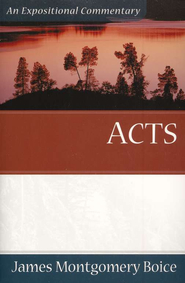
Acts Boice


One day Peter and John were going up to the temple at the time of prayer—at three in the afternoon. Now a man crippled from birth was being carried to the temple gate called Beautiful, where he was put every day to beg from those going into the temple courts. When he saw Peter and John about to enter, he asked them for money. Peter looked straight at him, as did John. Then Peter said, “Look at us!” So the man gave them his attention, expecting to get something from them. 

Then Peter said, “Silver or gold I do not have, but what I have I give you. In the name of Jesus Christ of Nazareth, walk.” – Acts 3:1–6

In chapter 3 of this study I pointed out that Acts is a transitional book. Acts comes between the Gospels and the Epistles. When we begin to read it, the Lord Jesus Christ is still here. The characters we come across are people who knew Jesus, those who in many cases had traveled with him during the days of his ministry. Most of them were witnesses of his resurrection. But then as we go on through the book, we come to people who did not have those experiences. Paul himself did not live with Christ during the days of his earthly ministry. And there are people like Timothy and Titus, Aquila, Priscilla, and Apollos, who had not even seen him. The flow of the book is from those early days in Jerusalem, when Jesus is still present, to Rome, which is where Acts ends. Acts is a transition in another way too. It is a transition from an age in which miracles were common to a time more closely resembling our own.

Better Than Gold

Luke described the early fellowship of believers by saying, “Everyone was filled with awe, and many wonders and miraculous signs were done by the apostles” (Acts 2:43). In Acts 2 Luke does not give us any indication as to what those miraculous signs may have been. But now, when we come to Acts 3, we have the account of at least one of them.

Why did Luke choose to chronicle this particular miracle? The answer is two-fold: (1) because it was the occasion for a second sermon of Peter’s, which Luke wants us to hear; and (2) because the miracle and sermon were the cause of the first persecution of the church.

Verse 1 tells us that Peter and John were going up to the temple at the time of prayer. We were told in chapter 2 that one of the things the early church did was gather in the temple courts to pray. In time God would cause a break with formal Judaism. But the break had not come yet. The apostles and other early believers were still Jews as well as being Christians, and they were continuing to take part in the worship that their people had enjoyed for centuries.

As Peter and John were doing this, they met a man who had been placed at the temple gate to beg from those who were entering. He was unable to walk. But he had friends, and they had put him in what was obviously a good position. They must have reasoned that it would be difficult for people to enter the temple, offer heartfelt worship to God, and then, as they left, utterly ignore a poor man who clearly needed help. Peter and John saw him and stopped. We are told that Peter fixed his attention on him and demanded that the man look at them.

That is what the man wanted. I can imagine that if his experience was that of most beggars, most people would simply have walked by. If you see somebody who is needy and you do not want to help, you try not to notice him. That is what most people would have been doing. So when Peter and John stopped, looked at him, and said, “Look at us,” the man must have looked up very hopefully, thinking that they were going to give him something. I do not know what they begged with in those days. But if he had owned a tin cup, I imagine he would have held the cup out to them, no doubt thinking, This is going to be a good day. These people are going to give me money.

Then Peter uttered the words that most of us know very well: “Silver or gold I do not have.…”

Can you visualize what must have happened at that moment? The man was expecting silver or gold. So when Peter said, “Silver or gold I do not have…” his eyes must have dropped, and he must have put his cup down. But Peter went on, adding, “But what I have I give you. In the name of Jesus Christ of Nazareth, walk” (v. 6).

Notice, first, that it was to Peter’s credit that he could utter both parts of that sentence. There is a story from the Renaissance period that I have come across in several different versions. It may or may not be true. In any case, the version I like best goes like this: St. Thomas Aquinas was in Rome. He was walking along the street with a cardinal. The cardinal noticed a beggar. Reaching in his pocket, he pulled out a silver coin and gave it to him. Then he turned to Aquinas, the great doctor of the church, and said, “Well, Thomas, fortunately we can no longer say, as Peter did, ‘Silver and gold have I none.’ ”

St. Thomas replied, “Yes, that is true. But neither can we say, ‘In the name of Jesus Christ of Nazareth, walk.’ ”

It has always been sadly true that people have used religion as a means of acquiring wealth. We see much of this today, particularly in the way some “ministries” are promoted on television. The heads of these ministries make a great deal of money. Peter was not one of these people. I suppose that in the early church there were people who kept the church’s money. Later on we find that there was a treasury. Perhaps Peter had learned something from Judas, who dipped into the common purse when he needed something. Peter apparently did not. So when he went up to the temple to pray, he said quite honestly, I do not have any money. His penniless state may even have been a factor in his being close enough to God that he could also say, “But I am going to give you what I have.”

When Peter reached down, he took that man by the hand. Luke, who perhaps was interested in this miracle from the point of view of a physician, records with particularly vivid language how strength flowed into the man so that his feet and ankles could now bear his weight. He was completely restored to health. And he was so exuberant in his new-found health that he leaped—“walking and jumping, and praising God.” The language itself literally leaps, just as he leaped. This was a great, great day. And the people who knew the man because they had gone in and out of that gate many times and had seen him often were filled with amazement and undoubtedly praised God also.

In the case of the man who had been born blind, whose story is told in John 9, the man’s appearance was so altered that the people questioned whether or not this was the same man. In the case of the man healed by Peter there was no doubt at all. Everyone understood at once what had happened. A miracle had taken place by the same power that had been displayed in the resurrection of Jesus of Nazareth and at Pentecost.

Peter’s Second Sermon

At this point Peter began to preach his second sermon. When we compare Peter’s first sermon with this one, we find some differences. Yet there are similarities too, because regardless of the circumstances, Peter was trying to do the same thing here as on the earlier occasion: He was trying to point his listeners to Jesus as the Savior of the world. He also confronted them with their sin, appealed for their repentance, and gave reasons to repent and believe.

Christ-Centered

Just as in the sermon at Pentecost, this new sermon focuses on Jesus. I suppose it would have been possible for Peter to have focused on something else. He could have focused on the miracle itself. He could have said, “This is an important thing that has happened, and I want to make sure that you understand that this really is a miracle. Look at this man. Let’s all gather around and examine him.”

Peter’s sermon could have led into a testimony service. He could have said, “Now, brother, you have been healed. Here’s your chance to give a testimony. Stand up and tell everybody what Jesus has done for you.” A testimony like that might have focused on the man. The man could have said, “Let me tell you about my experience. Let me tell you how I first came to be part of what is going on here today.…” The man could have gotten quite a bit of personal attention out of that.

Instead, Peter said, “Men of Israel, why does this surprise you? Why do you stare at us as if by our own power or godliness we had made this man walk? The God of Abraham, Isaac and Jacob, the God of our fathers, has glorified his servant Jesus” (vv. 12–13). Jesus! This is where the emphasis of the entire sermon lies.

In speaking about Jesus, Peter is inevitably biblical. I say inevitably because this sermon is not so obviously biblical as the previous one. When we were studying the sermon Peter gave at Pentecost, I pointed out that it focuses on three great texts (see chapter 5 of this study). The way Peter preached that sermon was to quote each text at length and then explain it. The fact that he is biblical is not so obvious in this second sermon—although at the end he does quote from Deuteronomy and Genesis. Nevertheless, Peter is biblical.

The biblical nature of the sermon is apparent in Peter’s choice of words. When Peter refers to Jesus as God’s “servant,” as he does in verse 13, he uses the word for servant that occurs in the Septuagint (Greek) translation of Isaiah 52:13–53:12, where the coming servant of God (52:13) is described as the one who would be “pierced for our transgressions [and] crushed for our iniquities” (53:5). The concept of the “servant of the Lord” was well-known in Israel because of Isaiah 53 and other texts. So when Peter used “servant” and then went on to speak of “the Holy and Righteous One”—another title for the Christ that also appears in Isaiah—it is pretty clear that he was thinking of these chapters. He was teaching that Jesus is the Messiah promised in the Old Testament Scriptures.

When Peter talked about Jesus, he had a number of important facts to mention. One is that Jesus was a real man. Earlier when he spoke to the paralyzed man, he referred to Jesus as “Jesus Christ of Nazareth” (v. 6). It was not some imaginary, philosophical Jesus that Peter was proclaiming. It was a Jesus they all knew, a Jesus who had lived in Nazareth and who had traveled about the country teaching and doing good. But notice: That Jesus was also the same Jesus who had died for sin and then had been raised from death by the power of God. Peter was not retreating into philosophy, nor was he de-supernaturalizing the gospel, as some modern Bible critics have done. He was preaching a biblical Jesus who was both the Son of God and fully man.

When you think about Christianity, do you think primarily about Jesus Christ? And do you understand who Jesus is by the words and doctrines of the Bible? There is a lot more that Christians talk about, of course. But properly understood, those other things all relate to Jesus in some measure. Without Jesus you do not have Christianity, and the Jesus of Christianity is the Bible’s Jesus. To be a Christian is to have a personal relationship with him. Therefore Peter was preaching about him in this sermon.

Grappling with Sin

Peter’s sermon is also direct in speaking about sin. Even more than in his earlier sermon Peter emphasizes the sin of the people in disowning Jesus and handing him over to Pilate to be crucified.

He does it in a personal way. Where Peter begins to talk about the sin of the people he uses the word “you” (the second person plural pronoun) four times. In the previous sermon he only used it in that way once: You, with the help of wicked men, put him to death by nailing him to the cross” (Acts 2:23, italics mine). That is pretty blunt. But I suppose that as Peter reflected on it (and even got a little better with practice), he figured that when he got around to preaching a second time he would give that point emphasis. So now he says, “You handed him over to be killed, and you disowned him before Pilate, though he had decided to let him go. You disowned the Holy and Righteous One and asked that a murderer be released to you. You killed the author of life, but God raised him from the dead” (vv. 13–15, italics mine).

Peter is saying this in the very city where the people had cried out against Jesus, saying, “Crucify him! Crucify him!” He is speaking to these same people, perhaps with the very same leaders who had urged them to cry out looking on, and he is saying, You did it; you crucified him. The verbs are powerful, too: “You handed him over to be killed. You disowned [him]. You killed the author of life” (italics mine).

From time to time when I am preaching I will say something about the death of Jesus and how the Jewish leaders handed him over to Pilate to be crucified. Whenever a study like that appears on the radio later, as many of my studies do, I get letters from people who object to my saying that Jews demanded the death of Jesus. That is understandable, of course, because it is a sensitive point in Judaism, and I usually answer by pointing out that the Gentiles in the person of Pilate were also guilty. We are all guilty of Jesus’ death, and if we had been there at the time, we might all have joined in the cries of those who demanded Jesus’ death. But I notice here that, sensitive as that point may be, it was certainly never any more sensitive than it was in this early day when Peter preached in Jerusalem. In spite of the sensitive nature of the issue, Peter did not allow people’s feelings to stand in the way of preaching clearly. He did not say “Jews” to the exclusion of others. He included Pilate in his “you.” He included the Romans. They had actually put him to death. But that was not what concerned Peter in this sermon. Peter’s “you” meant everybody, including the Jews and perhaps even the Jews particularly. He was not pulling his punches.

We need to realize that we are all to blame for the death of Christ in one way or another. Even though we were not there at the time Jesus was arrested, tried, and crucified, it was our sins that took him there. And if Jesus were here today, we would spurn him today, just as the masses of Israel spurned him in Jerusalem long ago.

An Appeal for Repentance

Third, not only does Peter’s sermon point to Jesus and highlight the listeners’ sin—making it clear that the people of Jerusalem had something to repent of—but it also contains an appeal. This is because in the final analysis, Peter was not interested in merely condemning his hearers. On the contrary, he wanted them to repent of their sin and believe on Jesus.

He begins with the words “Now, brothers” (v. 17). He does not treat them as foreigners, aliens, or enemies. Indeed, how could he, since what he said earlier, “You disowned him… you disowned the Holy and Righteous One” (he repeated it), was the very thing Peter himself had done? Peter had denied Jesus on the night of his arrest. So he does not stand aloof now as he appeals to these people. He calls them brothers, saying, “I know that you acted in ignorance, as did your leaders.” Their ignorance did not make them guiltless. Nevertheless, they were not fully aware of what they were doing, and Peter was in exactly that category himself.

Where our English text has Peter encouraging his listeners to “turn to God” (v. 19), the Greek text actually says “flee to God.” That was probably intended to suggest a powerful image. In Israel there were cities set aside from other cities as “cities of refuge.” If an Israelite accidentally killed someone else, he could flee to one of these cities and there be protected from an avenger of blood, a relative of the deceased who might try to kill him in retaliation. These cities were not to protect real murderers. If somebody intentionally killed someone, well, he was to be tried and punished, as he should be. But if the killing was accidental—if it was what we would call “manslaughter” rather than “murder in the first degree”—then the killer could flee to the city and be protected there. He was to stay there until the high priest died. Then he could go home.

There is something like that idea in Peter’s sermon. Peter told the people that they were guilty of killing Jesus, but he taught that God would forgive their sin if they would repent of it and flee to the refuge that he has provided in Christ.

Peter tells them to “repent, then, and turn to God” (v. 19). These two things always go together. Sometimes we feel sorry for what we have done. But it is not enough merely to feel sorry. Sorrow is not repentance. Repentance is feeling sorry enough to quit, and quitting means turning from sin to Jesus Christ. When Peter tells the people, “Repent… and turn to God,” he makes the connection apparent and indicates exactly what we need to do.

Reasons to Repent and Believe

The fourth thing Peter does in this sermon is offer inducements to repent and believe on Jesus. The first is: “so that your sins may be wiped out” (v. 19), that is, so that you might be forgiven. Forgiveness is what people need, and the only place anyone will ever really find forgiveness is in Christ. A director of a large mental institution in England said to John Stott some years ago, “I could send half of my patients home tomorrow if only they could find forgiveness.”

Most people carry heavy loads of guilt. This may be true of you. You may not have not told anybody what you have done. You are afraid that if you told someone else, that person would reject you. Nevertheless, you remember what you have done, and you carry the guilt of your actions around with you day by day, week by week, and year by year. Your burden keeps you from being what you might otherwise be. Moreover, you do not find forgiveness in the world. The world is not capable of that. The world can judge you for your sin or pretend to overlook it. But it is not capable of forgiving it. On one occasion the Lord Jesus Christ said to a man, “Your sins are forgiven,” and the religious leaders who were standing by replied, “Who can forgive sins but God only?” They were absolutely right. They did not recognize that Jesus was God and therefore had the right to forgive sin. In that they were wrong. But their theology was right. Only God can forgive sin. That is why the world is so unsatisfactory in this respect. Peter is saying that God can forgive your sin; he can lift that great load of guilt. Clearly this is one great inducement to turn from sin and believe in Jesus Christ.

Peter has another inducement too. It is the “times of refreshing [that] come from the Lord” (v. 19). This may be understood in different ways. On the one hand, it probably concerns a future day of blessing when the Jewish people will turn to Christ in large numbers and a final age of national blessing will come. Paul talks about it in Romans 11. On the other hand, there are also “times of refreshing” for all God’s people even now.

Many of us go through much of life feeling pretty stale in what we do. We feel like the horse that eats hay and oats on Monday, oats and hay on Tuesday, hay and oats on Wednesday, and so on throughout the week. Many people find, especially if they are in an unrewarding job, that life is often quite dreary. And sometimes even their Christianity becomes stale. They say, “I’ve been coming to church every week. But somehow it just isn’t what it used to be. I feel so flat when I come.” Well, that happens. We all go through dry spells. Times like that do not necessarily mean that we are far from God. They only mean that we feel far from God. Sometimes the cause is bad health. Sometimes the cause is the weather. A few days of gloomy rain and cold sometimes plunge me into a dark night of the soul. What we are told here is that in Christ there will be times of refreshing.

Haven’t you known times when Jesus became so real and the gospel so vivid that your whole spirit, soul, and body were revived? If you want times of refreshing, times that make life really worth living so you can say, “Oh, it is good to be a Christian,” turn from sin and follow close to Jesus.

There is another inducement here also, in verse 26. After Peter gets through saying that all that has happened in Christ is a fulfillment of prophecy and that they ought to know it because it is clear in their Bibles (he quotes from Deuteronomy 18:15, 18, 19 and Genesis 22:18), he says, “When God raised up his servant, he sent him first to you to bless you by turning each of you from your wicked ways.” First to you! To whom? Well, to the Jews! But more than that, because it was not just to Jews generally that Peter was preaching on this occasion. Peter was preaching to Jews who had been instrumental in the death of Jesus. They handed him over to be killed, disowned him, asked that a murderer be released to them, and demanded that Jesus be crucified. It is to these people, the very ones who had been instrumental in the greatest crime in human history, that God now comes with the gospel of salvation. And he comes to them first. It is God’s way of saying, “I know what you have done, but I do not hold it over you. I love you anyway. It is precisely for people like you that I caused Jesus to die.”

You and I cannot say that God sent his servant to us first of all. Many have come to Christ before us in former ages of human history. But the principle is the same. Regardless of what you have done, the low self-image you may have, or the guilt you may carry, God proclaims his Son to you. And the reason the gospel is proclaimed to you is because God says it is for you that Jesus died.

About the Author

Boice JM in pulpit

James Montgomery Boice, Th.D., (July 7, 1938 – June 15, 2000) was a Reformed theologian, Bible teacher, and pastor of Tenth Presbyterian Church in Philadelphia from 1968 until his death. He is heard on The Bible Study Hour radio broadcast and was a well-known author and speaker in evangelical and Reformed circles. He also served as Chairman of the International Council on Biblical Inerrancy for over ten years and was a founding member of the Alliance of Confessing Evangelicals. James Boice was one of my favorite Bible teachers. Thankfully – many of his books and expositions of Scripture are still in print and more are becoming available. The sermon above was adapted from Chapter 7 in Acts: An Expositional Commentary. Grand Rapids: Baker, 1997, 2006.

A Summary of the Four Gospels

*THE FOUR GOSPELS

Symbols of the 4 Gospels

Background

The four Gospels record the eternal being, human ancestry, birth, life, and ministry, death, resurrection and ascension of Jesus the Christ, Son of God and Son of Man. Taken together they present not a biography but a Person.

The fact that the four Gospels present a Person rather than a complete biography indicates the spirit in which they should be approached. It is more important to see and know Him who these narratives reveal than to try to piece together a full account of His life from these inspired records (John 21:25, “Now there are also many other things that Jesus did. Were every one of them to be written, I suppose that the world itself could not contain the books that would be written”). For some reason God did not lead men to write a full biography of His Son. The years preceeding His ministry are passed over in a silence that is broken only once, as recorded in a few verses in Luke’s Gospel (Luke 2:40-52, “And the child grew and became strong, filled with wisdom. And the favor of God was upon him. Now his parents went to Jerusalem every year at the Feast of the Passover. And when he was twelve years old, they went up according to custom. And when the feast was ended, as they were returning, the boy Jesus stayed behind in Jerusalem. His parents did not know it, but supposing him to be in the group they went a day’s journey, but then they began to search for him among their relatives and acquaintances, and when they did not find him, they returned to Jerusalem, searching for him. After three days they found him in the temple, sitting among the teachers, listening to them and asking them questions. And all who heard him were amazed at his understanding and his answers. And when his parents saw him, they were astonished. And his mother said to him, “Son, why have you treated us so? Behold, your father and I have been searching for you in great distress.” And he said to them, “Why were you looking for me? Did you not know that I must be in my Father’s house?” And they did not understand the saying that he spoke to them. And he went down with them and came to Nazareth and was submissive to them. And his mother treasured up all these things in her heart. And Jesus increased in wisdom and in stature and in favor with God and man”). It is wise to respect the divine reticence.

Incomplete Story, Complete Revelation

But the four Gospels, though designedly incomplete as a story, are complete as revelation. We may not know everything that Jesus did, but we may know Him. In four great narratives, each of which in some respects supplements the other three, we have Jesus Christ Himself.

This is the essential respect in which these narratives differ from biography or portraiture. “The words that I have spoken to you are spirit and life” (John 6:63). The believing student finds here the living Christ.

The Old Testament is the inspired introduction to the New Testament, and whoever comes to the study of the four Gospels with a mind saturated with the Old Testament foreview of Christ–His Person, work, and kingdom–will be greatly helped in understanding them. Old Testament quotation, allusion, and type are woven into the Gospels. The very first verse of the New Testament drives the reader back to the Old Testament; and the risen Christ took His disciples back to the Hebrew Scriptures for an explanation of His suffering and glory (Luke 24:27, 44, “And beginning with Moses and all the Prophets, he interpreted to them in all the Scriptures the things concerning himself…Then he said to them, “These are my words that I spoke to you while I was still with you, that everything written about me in the Law of Moses and the Prophets and the Psalms must be fulfilled”).

Therefore, in approaching the study of the Gospels the mind should be freed, as far as possible from presuppositions such as the Church is to be equated with the true Israel, and that the Old Testament promises to Israel and the foreview of the kingdom relate only to the Church. Interpretations are not true simply because they are familiar. It should not, therefore, be assumed that “the throne of his father David” (Luke 1:32) is synonymous with the Father’s throne (Revelation 3:21, “The one who conquers, I will grant him to sit with me on my throne, as I also conquered and sat down with my Father on his throne,” or that “the house of Jacob” (Luke 1:33) is the Church composed of both Jew and Gentile.

The mission of Jesus was initially to the Jews (Matthew 10:5-6; 15:23-25; John 1:11, “These twelve Jesus sent out, instructing them, “Go nowhere among the Gentiles and enter no town of the Samaritans, but go rather to the lost sheep of the house of Israel…But he did not answer her a word. And his disciples came and begged him, saying, “Send her away, for she is crying out after us.” He answered, “I was sent only to the lost sheep of the house of Israel.” But she came and knelt before him, saying, “Lord, help me.” …He came to his own, and his own people did not receive him”). He was “born under the law” (Galatians 4:4), and was “a servant to the circumcised to show God’s truthfulness, in order to confirm the promises given to the patriarchs” (Romans 15:8) and to fulfill the law that grace might abound. Therefore, a strong legal and Jewish coloring is to be expected up to the cross (Matthew 5:17-19; 10:5-6; 15:22-28; 23:2 & Mark 1:44, “Do not think that I have come to abolish the Law or the Prophets; I have not come to abolish them but to fulfill them. For truly, I say to you, until heaven and earth pass away, not an iota, not a dot, will pass from the Law until all is accomplished. Therefore whoever relaxes one of the least of these commandments and teaches others to do the same will be called least in the kingdom of heaven, but whoever does them and teaches them will be called great in the kingdom of heaven…These twelve Jesus sent out, instructing them, “Go nowhere among the Gentiles and enter no town of the Samaritans, but go rather to the lost sheep of the house of Israel…And behold, a Canaanite woman from that region came out and was crying, “Have mercy on me, O Lord, Son of David; my daughter is severely oppressed by a demon.” But he did not answer her a word. And his disciples came and begged him, saying, “Send her away, for she is crying out after us.” He answered, “I was sent only to the lost sheep of the house of Israel.” But she came and knelt before him, saying, “Lord, help me.” And he answered, “It is not right to take the children’s bread and throw it to the dogs.” She said, “Yes, Lord, yet even the dogs eat the crumbs that fall from their masters’ table.” Then Jesus answered her, “O woman, great is your faith! Be it done for you as you desire.” And her daughter was healed instantly…“The scribes and the Pharisees sit on Moses’ seat,…and said to him, “See that you say nothing to anyone, but go, show yourself to the priest and offer for your cleansing what Moses commanded, for a proof to them.” The Sermon on the Mount is closely related to law in the highest spiritual sense, for it demands as the condition of blessing, that perfect character which only grace through power creates (Matthew 5:3-9 and Galatians 5:22-23, “Blessed are the poor in spirit, for theirs is the kingdom of heaven. “Blessed are those who mourn, for they shall be comforted. “Blessed are the meek, for they shall inherit the earth. “Blessed are those who hunger and thirst for righteousness, for they shall be satisfied. “Blessed are the merciful, for they shall receive mercy. “Blessed are the pure in heart, for they shall see God. “Blessed are the peacemakers, for they shall be called sons of God…But the fruit of the Spirit is love, joy, peace, patience, kindness, goodness, faithfulness, gentleness, self-control; against such things there is no law.”

The doctrines of grace are developed in the Letters, not in the Gospels; but they are implicit in the Gospels, because they rest upon the death and resurrection of Christ and upon the great germinal truths he taught, truths of which the Letters are the unfolding. The Christ of the Gospels is the perfect manifestation of grace.

The Gospels do not develop the doctrine of the Church. The word “church” occurs in Matthew only. After His rejection as King and Savior by the Jews, our Lord, announcing a mystery until the moment “hidden for ages in God” (Ephesians 3:3-10), said, “I will build my church” (Matthew 16:18). It was therefore, yet future; but His personal ministry had gathered out the believers who were, on the Day of Pentecost, made by the baptism of the Spirit the first members of “the church, which is his body” (Ephesians 1:23 compare with 1 Corinthians 12:12-13).

The Gospels present a group of Jewish disciples, associated on earth with a Messiah in humiliation. The Letters present a Church which is the body of Christ, made up of the regenerate who are associated with Him “in heavenly places,” co-heirs with Him of the Father, co-rulers with Him of the coming kingdom; and, as to the earth, although strangers and pilgrims, yet acting as His witnesses and the instruments for doing His will among men (Acts 1:8; 1 Corinthians 12:12-13; 2 Corinthians 5:14-21; Ephesians 1:3-14, 20-23; 2:4-6; 1 Peter 2:11).

The Gospels present Christ in His three offices of Prophet, Priest, and King.

As Prophet His ministry resembles that of the Old Testament prophets. But it is the nature and dignity of His Person that makes Him the unique Prophet. In former times God spoke through the prophets; now He speaks in the Son (Hebrews 1:1-2). The Old Testament prophet was a voice from God; the Son is God Himself (Deuteronomy 18:18-19).

The prophet in any dispensation is God’s messenger to His people, first, to establish truth; and second, when His people are in declension and apostasy, to call them back to truth. The prophet’s message, therefore, is usually one of rebuke and appeal. At times, however, as when his message of rebuke and appeal is not heeded, he becomes a foreteller of things to come. In this too, Christ is like the other prophets; most of His predictive ministry occurs after His rejection as King.

The sphere and character of Christ’s kingly office are defined in the Davidic Covenant (2 Samuel 7:16), as interpreted by the prophets and confirmed by the New Testament. Whereas the New Testament in no way abrogates or changes the Davidic Covenant or its interpretation, it adds details  which were not in the original covenant. The Sermon on the Mount is an elaboration of the idea of righteousness as the predominant characteristic of the kingdom  (Isaiah 11:2-5; Jeremiah 23:5-6; 33:14-16). The Old Testament prophet saw in one horizon, so to speak, the suffering and glory of the Messiah (1 Peter 1:10-11, “Concerning this salvation, the prophets who prophesied about the grace that was to be yours searched and inquired carefully, inquiring what person or time the Spirit of Christ in them was indicating when he predicted the sufferings of Christ and the subsequent glories”). The New Testament shows that His suffering and glory are separated by the present Church Age, and points forward to the Lord’s return as the time when the Davidic Covenant of blessing through power will be fulfilled (Luke 1:30-31; Acts 2:29-36; 15:14-17), just as the Abrahamic Covenant of blessing through suffering was fulfilled at His first coming (Acts 3:24-25; Galatians 3:6-14).

Christ is never called King of the Church. “The King” is indeed one of His divine titles, and the Church joins Israel in exalting “the King of ages, immortal, invisible” (Psalm 10:16; 1 Timothy 1:17). The Church is to reign under Him. The Holy Spirit is now calling out, not the subjects but the co-heirs and co-rulers of the kingdom (Romans 8:15-16; 1 Corinthians 6:2-3; 2 Timothy 2:11-12; Revelation 1:6; 3:21; 5:10).

Christ’s priestly office is the complement of His prophetic office. The prophet represents God to the people; the priest represents the people to God. Because the people are sinful he, the priest, must be a sacrificer; because they are needy, he must be a compassionate intercessor (Hebrews 5:1-2; 8:1-3). So Christ on the cross entered upon His high priestly work, offering Himself without blemish to God (Hebrews 9:14), as now He exercises on ever-living intercession for His people (Hebrews 7:25). John 17 provides the pattern of that continuing intercession.

In the Gospels, primary interpretation should be distinguished from moral application. Much in the Gospels that belongs in strict interpretation to the Jews or the kingdom is yet such a revelation of the mind of God and is so based on eternal principles as to have a moral application to the people of God, whatever their dispensational position. it is always true that the “pure in heart” are blessed because they “see God” and that “woe” is the portion of religious formalists whether under law or grace.

Special emphasis should be made to the things the four Gospels have in common.

(1) In all of them there is revealed one unique Person. The pen is a different pen, the incidents in which He is seen are sometimes different incidents, but He is always the same Christ.

(2) All the evangelists record the ministry of John the Baptist.

(3) All record the feeding of the 5,000.

(4) All record Christ’s offer of Himself as King, according to Zechariah 9:9, “Rejoice greatly, O daughter of Zion! Shout aloud, O daughter of Jerusalem! Behold, your king is coming to you; righteous and having salvation is he, humble and mounted on a donkey, on a colt, the foal of a donkey.”

(5) All record the betrayal by Judas; the denial by Peter.

(6) All record the trial and crucifixion of Christ.

(7) All record the bodily resurrection of Christ.

(8) All record events occurring during the forty days of the post-resurrection ministry of Christ–a ministry keyed to a new note of universality and of power.

(9) All point forward to His second coming.

And this record is so presented as to testify that the supreme business that brought Him into the world was His death and resurrection; that all that precedes these was preparation, and that from them flow all the blessings God ever has bestowed or ever will bestow upon humanity.

Since the first three Gospels contain so much material in common that they may be arranged as a synopsis, they are called the Synoptic Gospels. Careful readers of the New Testament will observe the similarities among and also the difference peculiar to these Gospels. That they contain dissimilarities is not surprising in view of the fact that each of these three Gospels is written for a particular purpose–Matthew to present Jesus as King, Mark to present Him as Servant, and Luke to present Him as Son of Man.

Matthew may have been the first Gospel written. It is thought that Mark’s account reflects, in its subject matter, Peter’s view of our Lord. That there were in existence many early accounts of the life and work of Christ is plain from Luke’s prologue to his Gospel (Luke 1:1-4).

As for John, this Gospel is in a class by itself. Probably written later than the Synoptics, it does not outline the life of our Lord but selects its material (including much that is not in the first three Gospels) in keeping with the writer’s declared aim of presenting Jesus as the Son of God (John 20:30-31).

Certain scholars have tried to trace the forms or patterns into which the earliest traditions about Christ were put for oral repetition. These forms are supposed to have provided material for the Gospels and are also thought to have been so thoroughly shaped by the needs of the early Church as to preclude a full historical basis for all the events recorded in the Gospels. In its effort to explain the difference in the Gospels, this critical view raises a question concerning the historical accuracy of the whole record. However, it fails to recognize evidence which supports the historicity of the Gospels. It may also be observed that selectivity of material does not necessarily mean distortion of fact, nor is the use of reliable tradition incompatible with the inspiration the Gospel records.

The important thing to keep in mind is the established fact that these Gospels are inspired historical documents of genuine authenticity and full integrity. Moreover, the believer in Christ knows in his own life the reality of the living Lord, who is so faithfully and yet so variously presented in the Synoptics and in John’s Gospel.

 *Article adapted from the Scofield Study Bible (ESV). New York: Oxford University Press, 2006 edition.

Friday Humor: Pastors – Call Before You Visit Your Flock!

Series: Friday Humor #21

Door Image

A new pastor was visiting in the homes of his parishioners. At one house it seemed obvious that someone was home, but no answer came to his repeated knocks at the door.

Therefore, he took out a card and wrote “Revelation 3:20” on the back and stuck it on the door.

When the offering was processed the following Sunday, he found that the card had been returned. Added to it was this cryptic message, “Genesis 3:10.”

Reaching for his Bible to check out the citation, he broke up in gales of laughter.

Revelation 3:20 begins “Behold, I stand at the door and knock.”

Genesis 3:10 reads, “I heard your voice in the garden and I was afraid for I was naked.”

What is Sin? The Bible Answers…

14 Explanations of Sin According to the Bible by Robert G. Lee

Sin separates us from God

(1) Sin is transgression of the law-lawlessness.

1 John 3:4, “Everyone who makes a practice of sinning also practices lawlessness; sin is lawlessness.”

(2) Sin is a grievous malady, contaminating the whole man’s being.

Isaiah 1:4-5, “Ah, sinful nation, a people laden with iniquity, offspring of evildoers, children who deal corruptly! They have forsaken the Lord, they have despised the Holy One of Israel, they are utterly estranged. Why will you still be struck down? Why will you continue to rebel? The whole head is sick, and the whole heart faint.” 

Romans 3:10-18, “as it is written: ‘None is righteous, no, not one; no one understands; no one seeks for God. All have turned aside; together they have become worthless; no one does good, not even one.’ ‘Their throat is an open grave; they use their tongues to deceive.’ ‘The venom of asps is under their lips.” ‘Their mouth is full of curses and bitterness.’ ‘Their feet are swift to shed blood; in their paths are ruin and misery, and the way of peace they have not known.’ ‘There is no fear of God before their eyes.'”
(3) Sin is an obscuring cloud, which hides the face of God’s blessing.

Isaiah 59:2, “but your iniquities have made a separation between you and your God, and your sins have hidden his face from you so that he does not hear.”

(4) Sin is a binding cord, which holds man in its power.

Proverbs 5:22, “The iniquities of the wicked ensnare him, and he is held fast in the cords of his sin.”

(5) Sin is a tyrannical owner, who embitters the lives of his slaves.

Nehemiah 9:37, “And its rich yield goes to the kings whom you have set over us because of our sins. They rule over our bodies and over our livestock as they please, and we are in great distress.”

(6) Sin is a disturber of rest, which causes disorder and anxiety.

Psalm 38:3, “There is no soundness in my flesh because of your indignation; there is no health in my bones because of my sin.”

(7) Sin is a robber of blessing, which strips and starves the soul.

Jeremiah 5:25, “Your iniquities have turned these away, and your sins have kept good from you.”

(8) Sin is a terrible devastation, which brings untold desolation.

Micah 6:13, “Therefore I strike you with a grievous blow, making you desolate because of your sins.”

(9) Sin is a tripper-up, which continually overthrows the sinner to his hurt.

Proverbs 13:6, “Righteousness guards him whose way is blameless, but sin overthrows the wicked.”

(10) Sin is a record writer, which leaves its indelible mark upon the committer.

Jeremiah 17:1, “The sin of Judah is written with a pen of iron; with a point of diamond it is engraved on the tablet of their heart, and on the horns of their altars.”

(11) Sin is a betraying presence, which “will out” no matter what pains are taken to hide it.

Ezekiel 21:24, “Therefore thus says the Lord God: Because you have made your guilt to be remembered, in that your transgressions are uncovered, so that in all your deeds your sins appear—because you have come to remembrance, you shall be taken in hand.”

(12) Sin is a sure detective, which turns upon the sinner and finds him out.

Numbers 32:23, “But if you will not do so, behold, you have sinned against the Lord, and be sure your sin will find you out.”

(13) Sin is an accusing witness, which points its condemning finger at the prisoner in the bondage of sin.

Isaiah 59:12, “For our transgressions are multiplied before you, and our sins testify against us; for our transgressions are with us, and we know our iniquities.”

(14) Sin is the sum of addition which accumulates its weight to the condemnation of the sinner.

Isaiah 30:1, “Ah, stubborn children,” declares the Lord, ‘who carry out a plan, but not mine, and who make an alliance, but not of my Spirit, that they may add sin to sin.'”

An Acrostic for S.C.R.I.P.T.U.R.E

All Scripture is to/for:

Bible opened image

S-anctify: “Sanctify them in the truth; your word is truth.” – John 17:17

C-orrect: “All Scriptures is breathed out by God and profitable for…correction…” – 2 Timothy 3:16

R-ejoice: “The precepts of the LORD are right, rejoicing the heart.” – Psalm 19:8

I-nstruct: “All Scriptures is breathed out by God and profitable for…instruction…” – 2 Timothy 3:16

P-urity: “Having purified your souls by your obedience to the truth [of the Word]…” – 1 Peter 1:22

T-each: “Blessed are you, O LORD; teach me your statutes!” – Psalm 119:12

U-nite: “Teach me your way, O LORD, that I may walk in your truth; unite my heart to fear your name” Psalm 86:11

R-eprove:  “All Scriptures is breathed out by God and profitable for…reproof…” – 2 Timothy 3:16

be E-aten: “Your words were found, and I ate them, and your words became to me a joy and the delight of my heart, for I am called by your name, O Lord, God of hosts.” – Jeremiah 15:16

Spurgeon on Christ’s Love for You

sunset-in-hawaii-1.jpg

The Love of Christ by Charles Haddon Spurgeon

Christ loved you before you loved him.

He loved you when there was nothing good in you.

He loved you though you insulted him, though you despised him and rebelled against him.

He has loved you right on, and never ceased to love you.

He has loved you in your backslidings and loved you out of them.

He has loved you in your sins, in your wickedness and folly.

His loving heart will still eternally the same, and shed his heart’s blood to prove his love for you.

He has given you what you need on earth, and provided for you an habitation in heaven.

Now, Christian, your religion claims from you, that you should love others, as your Master loved you.

How can you imitate him, unless you love too?

With you “un” kindness should be a strange anomaly. It is a gross contradiction to the spirit of your religion,

And if you do not love your neighbor, I cannot see how you can be a true follower of Jesus.

“This is my commandment, that you love one another as I have loved you. Greater love has no one than this, that someone lay down his life for his friends. You are my friends if you do what I command you.” – John 15:12-14

A Garden That You Should Plant Daily

Butchart gardens 1

For best results, this garden should be planted every day:

Five Rows of “P”eas:

  • Preparedness,
  • Perseverance,
  • Promptness,
  • Politeness,
  • Prayer.

Three Rows of Squash:

  • Squash gossip,
  • Squash criticism,
  • Squash indifference.

Five Rows of Lettuce:

  • Let us love one another,
  • Let us be faithful,
  • Let us be loyal,
  • Let us be unselfish,
  • Let us be truthful.

Three Rows of Turnips:

  • Turn up for church,
  • Turn up with a new idea,
  • Turn up with the determination to do a better job tomorrow than you did today.

– Eugene Prime