“Charles Haddon Spurgeon’s Humor”

Dr. Larry J. Michael and C.H. Spurgeon on “The Medicine of Laughter”
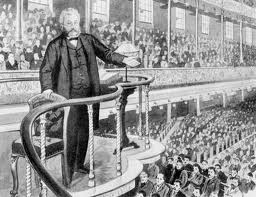
Spurgeon in pulpit image

Dr. Larry Michael is senior pastor at First Baptist Church in Clanton, Ala. He serves as an adjunct professor at Beeson Divinity School in Birmingham. This article is an adaptation of writings from the upcoming book, Spurgeon on Leadership, Kregel Publications, scheduled for release October 2003.

Some years ago there was a documented case in the British Medical Journal about a man who laughed himself well. He actually had a terminal illness, and through the employment of laughter therapy, he allowed his body to successfully fight the disease.

While we may smilingly acknowledge the merit of such a case, for the most part, we find such an incident almost incredible. Can laughter really be that good for us? The Bible definitely supports such a notion.

The Bible advocates laughter

The writer of Ecclesiastes stated: “There’s a time to laugh, and a time to cry” (Ecclesiastes 3:4). We know that there are plenty of reasons to cry. Just a casual glance at our world, with its wars, hatred, violence and evil — makes us sad. Every day we see/hear on the news horrible accounts of hurting people who hurt others. We are grieved at the plight of so many persons who are living in darkness and have rejected the light of Christ. The stark reality of sin in our world is indeed sobering.

It’s not surprising that many of us as leaders may be more inclined toward sadness than to joy. Given the nature and demands of Christian leadership in an increasingly challenging world, one could cynically surmise that leaders may have more reason to be glum than glad these days. The pressures of our organizational responsibilities, and the accompanying stresses, can drag us down. Handling church conflict, losing someone special, helplessly seeing a marriage dissolve, experiencing personal betrayal, facing an unsuspected tragedy — all may give cause for tears.

To counter the sad times, the Scripture also advises that there is a time to laugh. Leaders need to know the balancing therapy of laughter. Toward that goal, we should fully embrace the joys of ministry — celebrating special moments with members, “high-fiving” family achievements, relishing the reaching of hard-earned goals, and savoring the blessing of spiritual growth. But those experiences may still fall short of the biblical pronouncement regarding laughter. C’mon, when was the last time you laughed so hard you cried?! Or, you actually had a good belly laugh?

Spurgeon’s great sense of humor

Many evangelicals know well the stern side of C. H. Spurgeon and his serious pursuit of the holy life. Indeed, his stands for righteous causes, and countering doctrinal error are often recounted. But many readers may not know that he was a man with a great sense of humor. Spurgeon knew the value of laughter and mirth. He virtually took to heart the word in Proverbs 17:22: “A merry heart doeth good like a medicine.”

Spurgeon laughed as often as he could. He laughed at the ironies of life, he laughed at comical incidents, he laughed at the amusing elements of nature. He sometimes laughed at his critics. He loved to share wholesome jokes with his friends and colleagues in ministry. He was known to tell humorous stories from the pulpit. William Williams, a fellow pastor who kept company with Spurgeon, was a near and dear friend in the latter years of Spurgeon’s life. He wrote:

What a bubbling fountain of humour Mr. Spurgeon had! I laughed more, I verily believe, when in his company than during all the rest of my life besides. He had the most fascinating gift of laughter . . . and he had also the greatest ability for making all who heard him laugh with him. When someone blamed him for saying humourous things in his sermons, he said, “He would not blame me if he only knew how many of them I keep back.” 1

Spurgeon considered humor such an integral part of his ministry that a whole chapter in his autobiography is devoted to it. Humor permeates his sermons and writings, often woven into the fabric of his messages. It’s one reason among many why he is still so readable today.

The therapy of laughter

Spurgeon knew the blessing of the treatment of humor. He often spoke of his illness in humorous terms: “I have had sharp pains,” he wrote to a friend, “but I am recovering. Only my back is broken, and I need a new vertebrae.” 2 Once, when he was feeling depressed, he spoke of the remedy of laughter:

The other evening I was riding home after a heavy day’s work. I felt wearied and sore depressed, when swiftly and suddenly that text came to me, ‘My grace is sufficient for thee.’ I reached home and looked it up in the original, and at last it came to me in this way. ‘My grace is sufficient for THEE.’ And I said, ‘I should think it is, Lord,’ and I burst out laughing. I never understood what the holy laughter of Abraham was till then. It seemed to make unbelief so absurd…O brethren, be great believers. Little faith will bring your souls to heaven, but great faith will bring heaven to your souls. 3

Some of Spurgeon’s humor even bordered on the cynical — like the time he was embroiled in the Baptismal Regeneration Controversy. When Spurgeon took on the Church of England clerics because of their belief in baptismal regeneration, he had a baptismal font installed in his back garden as a birdbath. He referred to it as “the spoils of war.” While the great “Prince of Preachers” may have gone over the top on that one, for the most part, his humor was balanced and appropriate.

Laughter a needful release

Laughter is an important release in a leader’s life. It is much-needed therapy for positions that are most often fraught with stress and the burdens of the day. Certainly there is a time to be sober as we face many tough situations in our lives and ministries. But, we need to learn how to experience the relief of laughter. Part of the problem is that too many of us take ourselves way too seriously. When we forget that God has a sense of humor, we need to do as one leader suggested — go look in the mirror!

Spurgeon knew the value of laughter and humor. Both in tough times and sick times, humor was a means for him to deal with his situation. It was a coping mechanism for him. There will always be seasons of sadness and joy for the conscientious leader. But, the leader who learns to balance the two, will learn the discipline of employing laughter and joy in his life. It could very well make a difference in his fulfillment and purpose in his service to the Lord.

Article adapted from Reformed Perspectives Magazine, Volume 9, Number 40, Septemeber 30 to October 6, 2007.

Notes: 1. William Williams, Personal Remembrances of Charles Haddon Spurgeon (London: Passmore and Alabaster, 1895), 24; 2. Ibid, 231; 3. Ibid, 25.

Dr. Tim Keller on The Gospel and Humor

Humor in the Gospel?

Tim Keller seated image

I was reading a review of the movie ‘Prince Caspian’ in a newspaper for urban downtown-types, and the article dripped with sarcastic, sneering, smirking humor that, among other things, referred to Susan’s horn as a phallic symbol. Humor is like seasoning on food—everything is flat without it. But something was amiss here. I began to ask myself, ‘Does the gospel have an effect on our sense of humor?’ The answer has to be yes—but why and how?

Your humor has a lot to do with how you regard yourself. Many people use humor to put down others, keep themselves in the driver’s seat in a conversation and setting, and to remind the hearers of their superior vantage point. They use humor not to defuse tension and put people at ease, but to deliberately belittle the opposing view.

Rather than showing respect and doing the hard work of true disagreement, they mock others’ points of view and dismiss them without actually engaging the argument.

Ultimately, sarcastic put-down humor is self-righteous, a form of self-justification, and that is what the gospel demolishes.

When we grasp that we are unworthy sinners saved by infinitely costly grace it destroys both our self- righteousness and our need to ridicule others. This is also true of self-directed ridicule. There are some people who constantly, bitterly, mock themselves. At first it looks like a form of humility, or realism, but really it is just as self-absorbed as the other version. It is a sign of an inner disease with one’s self, a profound spiritual restlessness.

There is another kind of self-righteousness, however, that produces a person with little or no sense of humor. Moralistic persons often have no sense of irony because they take themselves too seriously, or because they are too self-conscious and self-absorbed in their own struggles to be habitually joyful.


The gospel, however, creates a gentle sense of irony. Our doctrine of sin keeps us from being over-awed by anyone (especially ourselves) or shocked, shocked by any behavior. We find a lot to laugh at, starting with our own weaknesses. They don’t threaten us any more because our ultimate worth is not based on our record or performance.

Our doctrine of grace and redemption also keeps us from seeing any situation as hopeless. This ground note of joy and peace makes humor spontaneous and natural.

In gospel-shaped humor we don’t only poke fun at ourselves, we also can gently poke fun at others, especially our friends. But it is always humor that takes the other seriously and ultimately builds them up as a show of affection.

“We are not to be perpetually solemn. We must play. But our merriment must be of that kind (and it is, in fact, the merriest kind) which exists between people who have, from the outset, taken each other seriously— no flippancy, no superiority, no presumption.” (C.S. Lewis, “The Weight of Glory”)

So how do we get such a sense of humor? That’s the wrong question. The gospel doesn’t change us in a            mechanical way. To give the gospel primacy in our lives is not always to logically infer a series of principles from it that we then ‘apply’ to our lives.

Recently I heard a sociologist say that, for the most part, the frameworks of meaning by which we navigate our lives are so deeply embedded in us that they operate ‘pre-reflectively.’ They don’t exist only as a list of propositions and formulations, but also as themes, motives, attitudes, and values that are as affective and emotional as they are cognitive and intellectual. When we listen to the gospel preached, or meditate on it in the Scripture, we are driving it so deeply into our hearts, imaginations, and thinking, that we begin to instinctively “live out” the gospel.

I have definitely seen the gospel transform a person’s sense of humor, but it would be artificial to say that there are ‘gospel-principles of humor’ that we must apply to our lives. It just happens, as we believe the gospel more and more.


*Article by Tim Keller from the Redeemer Church Manhattan Report – June 2008.

Friday Humor: A Lesson In Skipping Church

Series: Friday Humor #6

golf ball by hole

A church Pastor woke up Sunday morning and realizing it was an exceptionally beautiful and sunny early spring day, decided he just had to play golf.

So… he told the Associate Pastor that he was feeling sick and persuaded him to preside over the services for him that day.

As soon as the Associate Pastor left the room, the Pastor headed out of town to a golf course about forty miles away.

This way he knew he wouldn’t accidentally meet anyone he knew from his church. Setting up on the first tee, he was alone. After all, it was Sunday morning and everyone else was in church!

At about this time, Saint Peter leaned over to the Lord while looking down from the heavens and exclaimed, “You’re not going to let him get away with this, are you?” The Lord sighed, and said, “No, I guess not.”

Just then the Pastor hit the ball and it shot straight towards the pin, dropping just short of it, rolled up and fell into the hole.

IT WAS A 300 YARD HOLE IN ONE! St. Peter was astonished. He looked at the Lord and asked, “Why did you let him do that?” The Lord smiled and replied, Who is he going to tell?

Dare To Pray Like Daniel by John Piper

“Prayer: A Warrior’s Weapon”

In Daniel 10, the prophet receives a word from the Lord (v. 1) — a vision of conflict that stunned him with its greatness. So Daniel set himself with tears and fasting and prayer to seek the meaning of the vision, and for three weeks he wrestled in prayer over this vision and sought to know God’s will.

After three weeks he went out to the banks of the Tigris River (v. 4). There he had a vision that was so awesome he could hardly bear it. To make matters worse (in v. 10), a hand reached out and touched him so that he shook terribly on his hands and knees. Then the voice said (vv. 11–12): “O Daniel, man greatly loved, understand the words that I speak to you, and stand upright, for now I have been sent to you…. Fear not, Daniel, for from the first day that you set your heart to understand and humbled yourself before your God, your words have been heard, and I have come because of your words.”

Now this is immensely important for understanding prayer. Notice the words: “I have come because of your words.” Put that together with the words in verse 11: “I have been sent to you.” That is, God sent him. So the point is that God answered Daniel’s prayer as soon as he began to pray three weeks ago. “From the first day that you humbled yourself before your God your words [your prayers] have been heard, and I have come because of your words [your prayer].”

So this heavenly being has come because Daniel prayed and humbled himself before God and fasted. And the three-week delay was not because God took three weeks to hear. What was it then?

Verse 13: “The prince of the kingdom of Persia withstood me twenty-one days, but Michael, one of the chief princes, came to help me.” The reason the messenger of God was detained is because a spiritual being called “the prince of the kingdom of Persia” stood against him. And the reason this angelic messenger got free from this opposition was because the angel Michael came to help him.

This is the clearest example in all the Bible of what is called by some people a “territorial spirit.” Verse 13 refers to “the prince of the kingdom of Persia.” The natural meaning of this phrase would be that among the supernatural beings opposed to God, at least one is assigned to a territory or, more accurately, to a kingdom, in this case Persia. Presumably his job is to darken the people of Persia — to keep them from having the truth and the light of God’s Word.

But this spirit is not the only one mentioned. Look at verse 20–21: “Then he [the messenger from God] said, ‘Do you know why I have come to you? But now I will return to fight against the prince of Persia; and when I go out, behold, the prince of Greece will come. But I will tell you what is inscribed in the book of truth: there is none who contends by my side against these except Michael, your prince.’”

So it appears that there was a spirit over Persia and a spirit over Greece. But it also seems that Michael, the good angel, has some special assignment for Israel, because it says at the end of verse 21: “Michael, your prince.” And the “your” there is plural. This is not a reference to Daniel’s guardian angel, but to Israel’s guardian angel.

How then shall we do ministry in view of this reality of territorial spirits?

First, we ought to take the supernatural seriously and realize that we are in a warfare that cannot and should not be domesticated by reinterpreting everything in the biblical worldview so that it fits nicely with secular, naturalistic ways of thinking about the world.

Secondly, notice that Daniel’s prayer that has such powerful effects in the spiritual realm did not focus on angels and territorial spirits. Rather, he was wrestling for truth and for the good of God’s people. He was totally shocked when an angel appeared to him. And he knew nothing about the conflict with the prince of the kingdom of Persia.

But it’s no accident that the messenger said that his struggle with the prince of Persia lasted exactly the same amount of time that Daniel’s fasting and prayer did — twenty-one days. The reason for this is that the warfare in the spirit realm was being fought in a real sense by Daniel in the prayer realm.

And so it is with more of our prayers than we realize. But the point is this: Daniel’s praying was not about angels. And probably ours shouldn’t be either. We should wrestle in prayer and fasting for the things that we know are God’s will in our lives and our families and our church and our city and our world. But by and large we should probably leave it to God how He will use angels to get His work done. If God shows us more, we will use it. But the essence of the matter is not knowing the spirits but knowing God and praying in the power of Holy Spirit.

So let us be about prayer with all our might. May the Lord make us a people who pray like Daniel.

Article Information: From Tabletalk Magazine (Ligonier Ministries), July 1st, 2007 by Former Preaching Pastor of Bethlehem Baptist Church, and founder of Desiring God – Dr. John Piper.

Friday Humor: The Seeing Eye Dog

Series – Friday Humor #6: No Dogs Allowed!

A man goes into a bar with his dog. He goes up to the bar and asks for a drink.

The bartender says “You can’t bring that dog in here!” The guy, without missing a beat, says “This is my seeing-eye dog.”

“Oh man,” the bartender says, “I’m sorry, here, the first one’s on me.” The man takes his drink and goes to a table near the door.

Another guy walks into the bar with a Chihuahua. The first guys sees him, stops him and says “You can’t bring that dog in here unless you tell him it’s a seeing-eye dog.”

The second man graciously thanks the first man and continues to the bar. He asks for a drink. The bartender says “Hey, you can’t bring that dog in here!”

The second man replies “This is my seeing-eye dog.” The bartender says, “No, I don’t think so. They do not have Chihuahuas as seeing-eye dogs.”

The man pauses for a half-second and replies “What??! They gave me a Chihuahua??!”

“Every Day With Jesus is Like A Thanksgiving Holiday” By Dr. David P. Craig

I have so much to be thankful for – now 15 treatments into Chemo and Radiation – almost half way done with my 33 treatments here are my reflections on Thanksgiving Day. DPC

lifecoach4God's avatarLifeCoach4God

“Thank God It’s Thanksgiving Everyday – Especially on Thursday’s!”

I have always loved the Thanksgiving Holiday. It’s one of the few times of the year where our very large family can come together from all over the United States and enjoy giving thanks for our many blessings. This year more than likely I’ll be having liquid formula through a feeding tube in my stomach. I already had the G-Tube surgically implanted in my stomach this past week. During chemotherapy and radiation around Thanksgiving time will be a time of great testing for me, when according to my Doctors I will be unable to swallow and chew due to the severity of my treatment for throat and neck cancer. Watching every one I love dearest passing around the turkey with all the trimmings will be something my eyes will enjoy, but not my taste buds. However, I’m good with that. I’m…

View original post 3,962 more words

R.C. Sproul on the Question: “Does Prayer Change God’s Mind?”

We’ve been taught that prayer changes things. In view of God’s sovereignty, what is the role of prayer in a Christian’s life?


First of all, we need to establish that it is the sovereign God who not only invites us but commands us to pray. Prayer is a duty, and as we perform that duty, one thing for sure is going to be changed, and that is us. To live a life of prayer is to live a life of obedience to God.

Also, we must understand that there is more to prayer than intercession and supplication. When the disciples said to Jesus, “Lord, teach us to pray,” they saw a connection between the power of Jesus and the impact of his ministry and the time he spent in prayer. Obviously, the Son of God felt that prayer was a very valuable enterprise because he gave himself to it so deeply and passionately. But I was surprised that he answered the question by saying, “Here’s how you ought to pray,” and gave them the Lord’s Prayer. I would have expected Jesus to answer that question a different way: “You want to know how to pray? Read the Psalms,” because there you see inspired prayer.

The Spirit himself, who helps us to pray, inspired the prayers that are recorded in the Psalms. When I read the Psalms, I read intercession and I read supplication, but overwhelmingly what I read is a preoccupation with adoration, with thanksgiving, and with confession.

Take those elements of prayer, and what happens to a person who learns how to adore God? That person is changed. What happens to a person who learns how to express his gratitude to God? That person will now become more and more aware of the hand of Providence in his life and will grow in his sense of gratitude toward God. What happens to the person who spends time confessing his sins? He keeps in front of his mind the holiness of God and the necessity of keeping short accounts with God.

But can our requests change God’s sovereign plan? Of course not. When God sovereignly declares that he is going to do something, all of the prayers in the world aren’t going to change God’s mind. But God not only ordains ends, he also ordains means to those ends, and part of the process he uses to bring his sovereign will to pass are the prayers of his people. And so we are to pray.

Question adapted from the section on Prayer by R.C. Sproul. Now, That’s a Good Question! Wheaton: Tyndale House Publishers, 2001.

About Dr. R.C. Sproul

R.C. Sproul has taught theology to hundreds of thousands of people through books, radio, audiotapes, videotapes, seminars, sermons, seminary classes and other forums.

Sproul has written approximately sixty books (and counting). In addition to many volumes designed to teach theology, apologetics, and ethics to laymen through expository prose, he has written a novel, a biography, and several childrens books. He has also edited several volumes, including a festschrift for John H. Gerstner, a seminary textbook, and the New Geneva Study Bible. He has written one of the top classics of the 20th century – The Holiness of God; and perhaps the best book to explain God’s sovereignty in our salvation for laymen entitled Chosen by God.

Sproul founded Ligonier Ministries in 1971, a teaching ministry to assist the church in nurturing believers and equipping them for the ministries to which God has called them. Ligonier sponsors a radio program, “Renewing Your Mind,” which features Sproul and is broadcast nationally, five days a week.

Ligonier Ministries sponsors several seminars each year, the largest one in Orlando every winter. Ligonier publishes a monthly periodical, Tabletalk, and has its own web site (http://www.gospelcom.net).

Sproul has taught theology and apologetics at several seminaries. He earned a B.A. degree from Westminster College, a B.D. from Pittsburgh Theological Seminary, and a Drs. from the Free University of Amsterdam. He is ordained in the Presbyterian Church in America.

In 1994 Christianity Today asked a select list of “critics,” “What theologian or biblical scholar has most shaped your Christian life?” Third on the list (and the only American in the top four) was R.C. Sproul.

God Has Always Been and Ever Will Be by J.I. Packer

“Before the mountains were brought forth, or ever you had formed the earth and the world, from everlasting to everlasting you are God.” – Psalm 90:2

The Self-Existence of God: His Aseity 

Children sometimes ask, “Who made God?” The clearest answer is that God never needed to be made, because he was always there. He exists in a different way from us: we, his creatures, exist in a dependent, derived, finite, fragile way, but our Maker exists in an eternal, self-sustaining, necessary way—necessary, that is, in the sense that God does not have it in him to go out of existence, just as we do not have it in us to live forever. We necessarily age and die, because it is our present nature to do that; God necessarily continues forever unchanged, because it is his eternal nature to do that. This is one of many contrasts between creature and Creator.

God’s self-existence is a basic truth. At the outset of his presentation of the unknown God to the Athenian idolaters, Paul explained that this God, the world’s Creator, “is not served by human hands, as if he needed anything, because he himself gives all men life and breath and everything else” (Acts 17:23-25). Sacrifices offered to idols, in today’s tribal religions as in ancient Athens, are thought of as somehow keeping the god going, but the Creator needs no such support system. The word aseity, meaning that he has life in himself and draws his unending energy from himself (a se in Latin means “from himself”), was coined by theologians to express this truth, which the Bible makes clear:

Psalm 90:1-4, “Lord, you have been our dwelling place in all generations. Before the mountains were brought forth, or ever you had formed the earth and the world, from everlasting to everlasting you are God. You return man to dust and say, “Return, O children of man!” For a thousand years in your sight are but as yesterday when it is past, or as a watch in the night.”

Psalm 102:25-27, “Of old you laid the foundation of the earth, and the heavens are the work of your hands. They will perish, but you will remain; they will all wear out like a garment. You will change them like a robe, and they will pass away, but you are the same, and your years have no end.”

Isaiah 40:28-31, “Have you not known? Have you not heard? The Lord is the everlasting God, the Creator of the ends of the earth. He does not faint or grow weary; his understanding is unsearchable. He gives power to the faint, and to him who has no might he increases strength. Even youths shall faint and be weary, and young men shall fall exhausted; but they who wait for the Lord shall renew their strength; they shall mount up with wings like eagles; they shall run and not be weary; they shall walk and not faint.”

John 5:26, “For as the Father has life in himself, so he has granted the Son also to have life in himself.”

Revelation 4:10-11, “the twenty-four elders fall down before him who is seated on the throne and worship him who lives forever and ever. They cast their crowns before the throne, saying, “Worthy are you, our Lord and God, to receive glory and honor and power, for you created all things, and by your will they existed and were created.”

In theology, endless mistakes result from supposing that the conditions, bounds, and limits of our own finite existence apply to God. The doctrine of his aseity stands as a bulwark against such mistakes. In our life of faith, we easily impoverish ourselves by embracing an idea of God that is too limited and small, and again the doctrine of God’s aseity stands as a bulwark to stop this happening. It is vital for spiritual health to believe that God is great (cf. Ps. 95:1-7 below), and grasping the truth of his aseity is the first step on the road to doing this.

Psalm 95:1-7, “Oh come, let us sing to the Lord; let us make a joyful noise to the rock of our salvation! Let us come into his presence with thanksgiving; let us make a joyful noise to him with songs of praise! For the Lord is a great God, and a great King above all gods. In his hand are the depths of the earth; the heights of the mountains are his also. The sea is his, for he made it, and his hands formed the dry land. Oh come, let us worship and bow down; let us kneel before the Lord, our Maker! For he is our God, and we are the people of his pasture, and the sheep of his hand. Today, if you hear his voice, do not harden your hearts.”

Article above adapted from J.I. Packer. Concise Theology: A Guide to Historic Christian Beliefs. Wheaton: Tyndale House Publishers, 2001, p. 26.

About J.I. Packer:

Dr. J.I. Packer is a British Theologian and has written over 50 books and numerous contributions to theological journals, reference works, and compilations. He is a a brilliant humble scholar who is best known for his works on Theology Proper – The Study of God. His classic work on the attributes and character of God – Knowing God is “must reading” for the Christian.

Tim Keller on How to Pray Better in Public and in Private

Lesson on Prayer from Thomas Cranmer

Years ago when I wanted to become more skillful in public prayer, I was fortunate to come across the collects of Thomas Cranmer, the writer of the original Episcopal Book of Common Prayer. The “collects” (the stress is on the first syllable)that Cranmer wrote were brief but extremely ‘packed’ little prayers that tied together the doctrine of the day to a particular way of living. They were prayed by the minister on behalf of the people, or prayed in unison by the whole congregation.

As I have read them over the years they have brought me two great benefits. First, they have given me a basic structure by which I can compose good public prayers, either ahead of time, or spontaneously. Cranmer’s collects consist of 5 parts:

1. The address – a name of God

2. The doctrine – a truth about God’s nature that is the basis for the prayer

3. The petition – what is being asked for

4. The aspiration – what good result will come if the request is granted

5. In Jesus’ name – this remembers the mediatorial role of Jesus

See this structure in Cranmer’s famous collect for the service of Holy Communion:

1. Almighty God

2. unto whom all hearts are open, all desires known, and from whom no secrets are hid,

3. cleanse the thoughts of our hearts by the inspiration of thy Holy Spirit,

4. that we may perfectly love thee, and worthily magnify thy holy name,

5. through Jesus Christ our Lord, Amen. 

See how the prayer moves from a doctrinal basis (why we can ask for it) to the petition (what we want) to the aspiration (what we will do with it if we get it.) It is remarkable how this combines solid theology with deep aspirations of the heart and concrete goals for our daily life.

As time has gone on I have come to use Cranmer’s collects in my personal devotional time (this is the second benefit.) I take up one collect at the beginning of each new week. I read Paul Zahl’s volume The Collects of Thomas Cranmer (Eerdmans, 1999) that provides a very short explanation and meditation on the prayer. Then I pray that prayer to God reflectively every morning for the rest of the week as I begin my personal time with God. I commend this practice to you. Here are a couple of my favorites:

Blessed Lord, who has caused all holy Scripture to be written for our learning; grant that we may so hear them, read, mark, learn, and inwardly digest them; that by patience and comfort of thy holy word we may embrace and ever hold fast the blessed hope of eternal life, which thou hast given us in our savior, Jesus Christ. Amen.

Almighty God, who dost make the minds of all faithful men to be of one will; grant unto thy people, that they may love the thing which thou commandest, and desire that which thou dost promise, that among the sundry and manifold changes of the world, our hearts may be surely fixed where true joys are to be found, through Jesus Christ our Lord. Amen. 

God, which hast prepared to them that love thee such good things as pass all man’s understanding; Pour into our hearts such love toward thee, that we loving thee in all things, may obtain thy promises, which exceed all that we can desire; through Christ our Lord. Amen.

Almighty and everlasting God, who art always more ready to hear than we to pray, and art wont to give more than either we desire or deserve, pour down upon us the abundance of thy mercy, forgiving us those things whereof our conscience is afraid and giving unto us that which our prayer dare not presume to ask; through Jesus Christ our Lord. Amen.

Almighty and everlasting God, give unto us the increase of faith, hope, and charity, that we may obtain that which thou dost promise, make us to love that which thou does command; through Jesus Christ our Lord. Amen.


*Article adapted from the Redeemer Report – October, 2010.


Why Are Preachers So Exhausted After Preaching?

Why Are Preachers So Exhausted After Preaching?.